

Sample Category Title
USDCAD Stuck in Range after Advance Gets Rejected
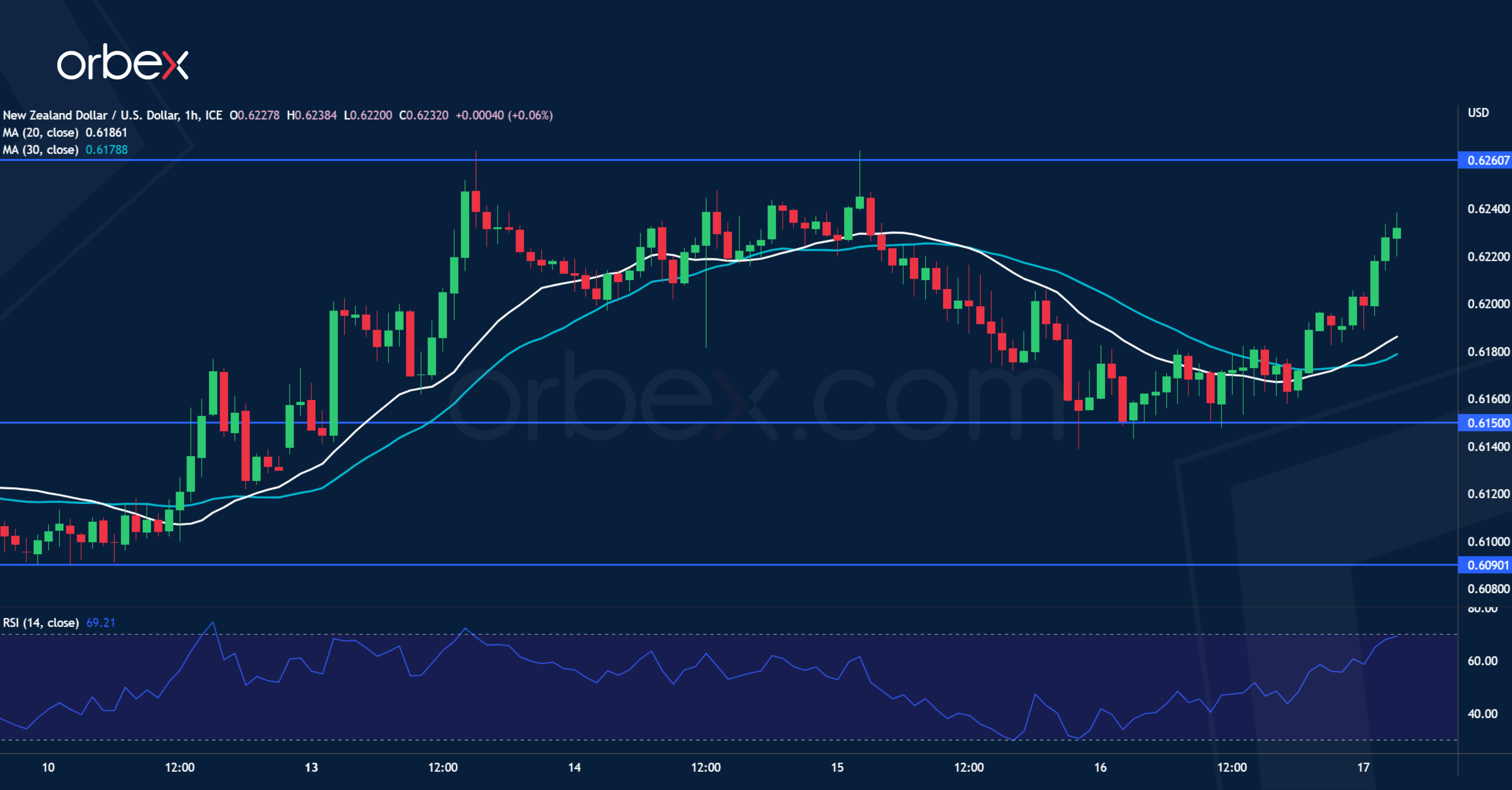
USDCAD has been in a steady uptrend after bouncing off its 2023 low of 1.3262 in late January. However, the pair experienced a pullback and has been trading sideways since the 1.3850 ceiling capped its upside trajectory.
The short-term oscillators currently suggest that the positive momentum is waning but the bears have not taken control yet. Specifically, the RSI is pointing downwards above its 50-neutral mark, while the MACD histogram has softened below its red signal line in the positive region.
If this latest downside correction resumes, the price could encounter support at the recent low of 1.3650. Diving beneath that zone, the 1.3515 hurdle, which has acted as both support and resistance multiple times in the past few months, might provide downside protection. Should that barrier fail, further declines could cease at the February support of 1.3440.
On the flipside, bullish actions may send the price to challenge 1.3810, which also held strong last November. Conquering this barricade, the bulls could then target the recent trend-rejection region of 1.3850. A break above the latter could set the stage for the 34-month high of 1.3976.
In brief, USDCAD has been rangebound in the last few daily sessions, appearing unable to extend its recent advance. Therefore, a break above the 1.3850 rejection territory is needed for the continuation of the pair’s uptrend.
Nasdaq 100 Breaks Resistance
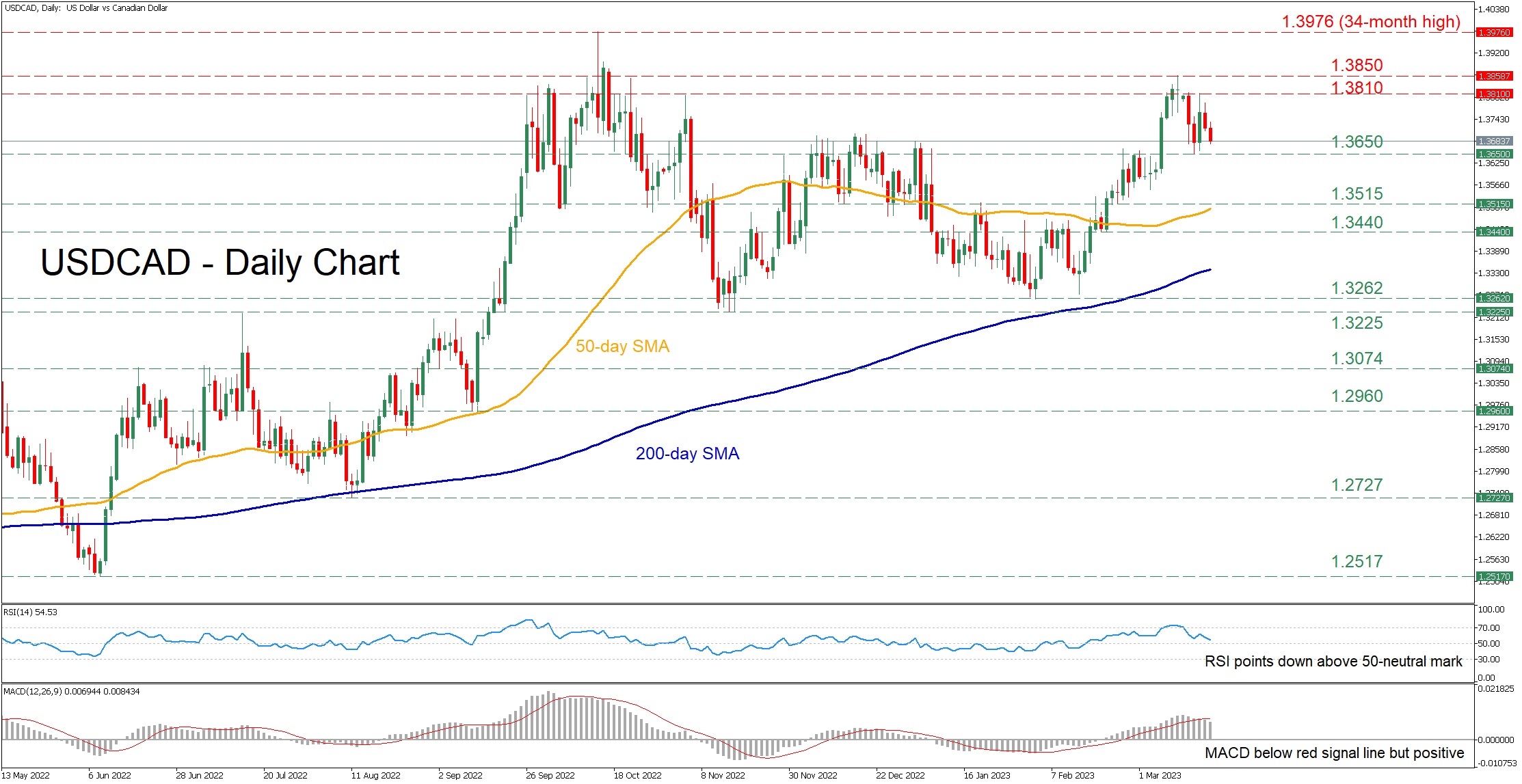
Equities found relief after the SNB came to the rescue of Credit Suisse. A bullish RSI divergence showed a slowdown in the sell-off momentum. A brief drop below the daily support of 11820 was followed by a swift bounce above 12050, easing the selling pressure. The index surged above the support-turned-resistance of 12320, prompting sellers to cover and paving the way for a sustained recovery towards 12740. In case of a pullback, the base of the latest impetus at 12220 is key in keeping the bulls hopeful.
EUR/JPY Bounces Off Critical Floor
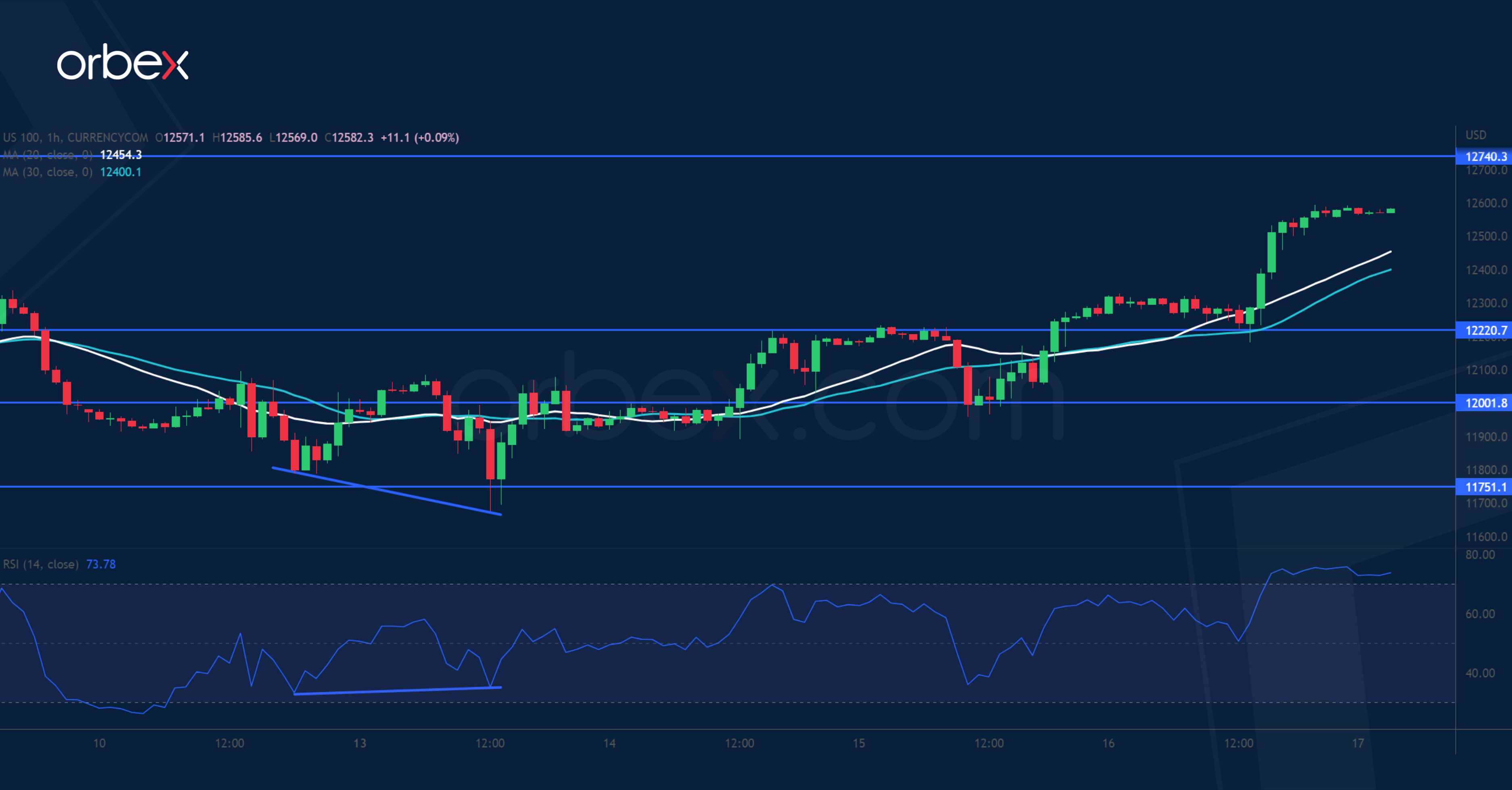
The euro rallied after the ECB went ahead with a 50 bp rate hike as expected. On the daily chart, the pair has failed to secure a higher high. Instead, a sharp reversal below 141.70 caught rebound players off guard. The pair has found some rest over February’s low of 139.50 with the RSI recovering into the neutral area. However, the bounce could be temporary as it may be driven by short-covering. 143.00 is the immediate resistance and without fresh buying above 144.90 to take offers out, the bears would stay in control.
NZD/USD Recoups Losses
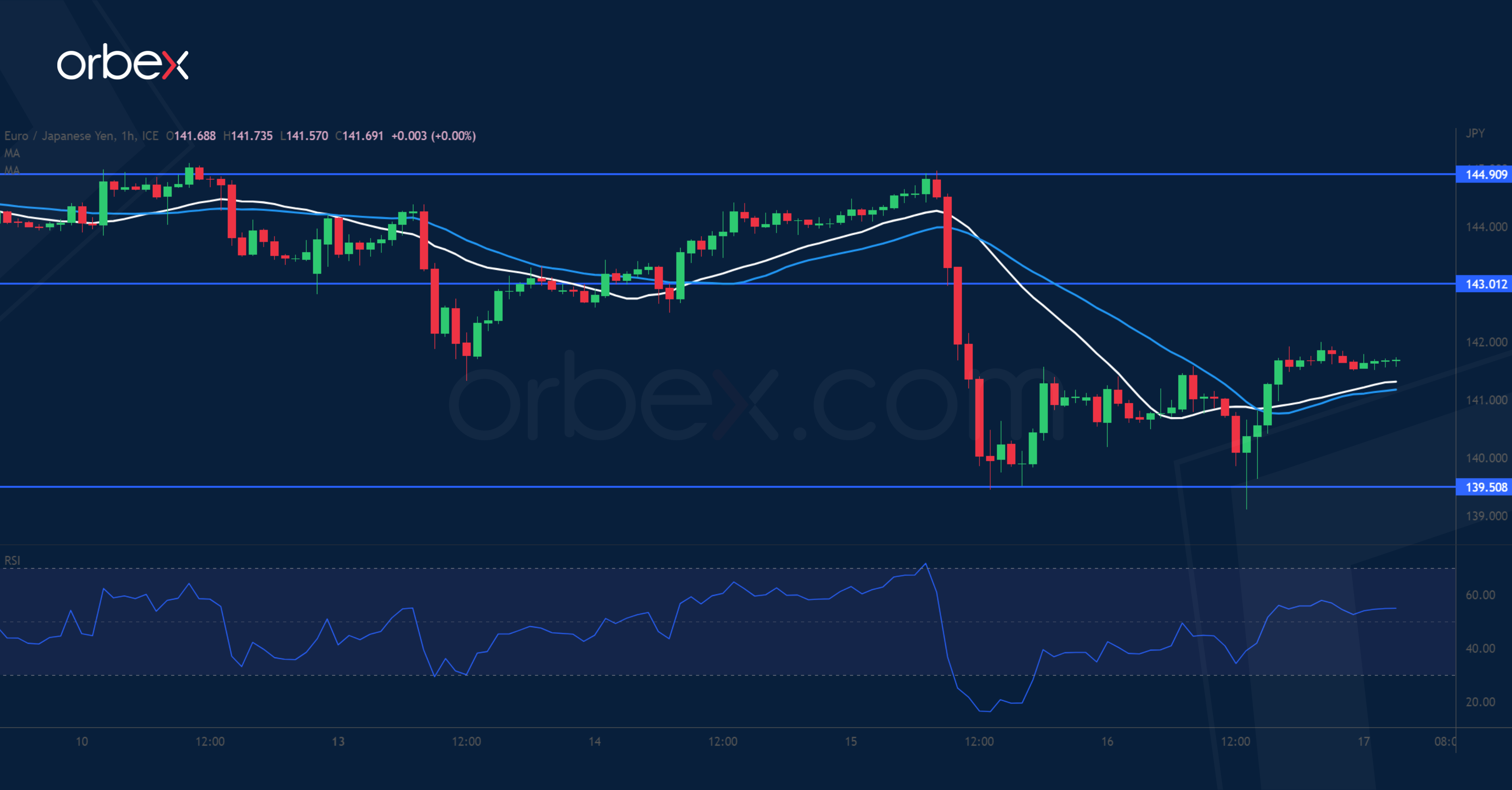
The New Zealand dollar steadies as market sentiment tries to stabilise amid bank rescues. After flirting this month’s high of 0.6270 over the 30-day SMA, two shooting star patterns indicate the bulls’ struggle to push beyond. Their long upper shadows are a sign of double rejection. However, buyers were eager to buy the dip near 0.6150 and helped the kiwi recoup all the losses. A break above 0.6260 would prompt the bears to cover and signal that a bullish reversal is under way with 0.6370 as the next target.
GBP/JPY Daily Outlook
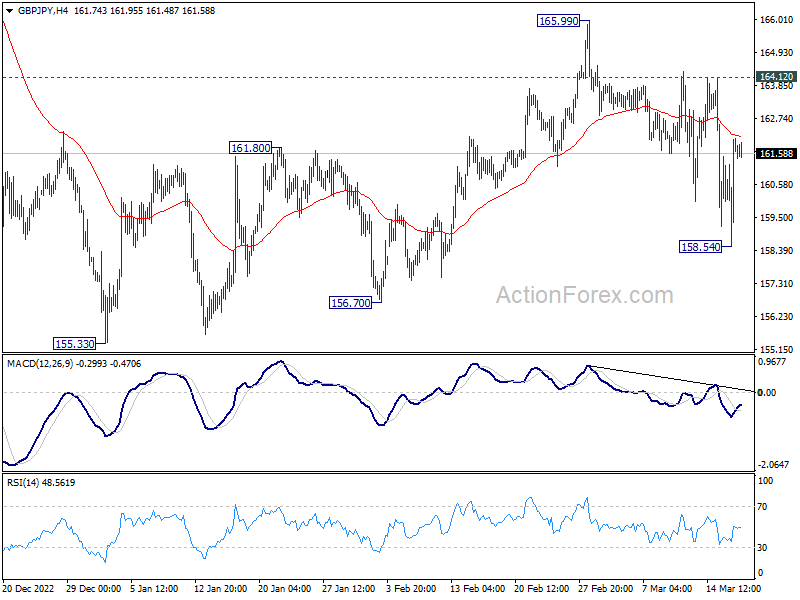
Daily Pivots: (S1) 159.67; (P) 160.90; (R1) 163.21; More...
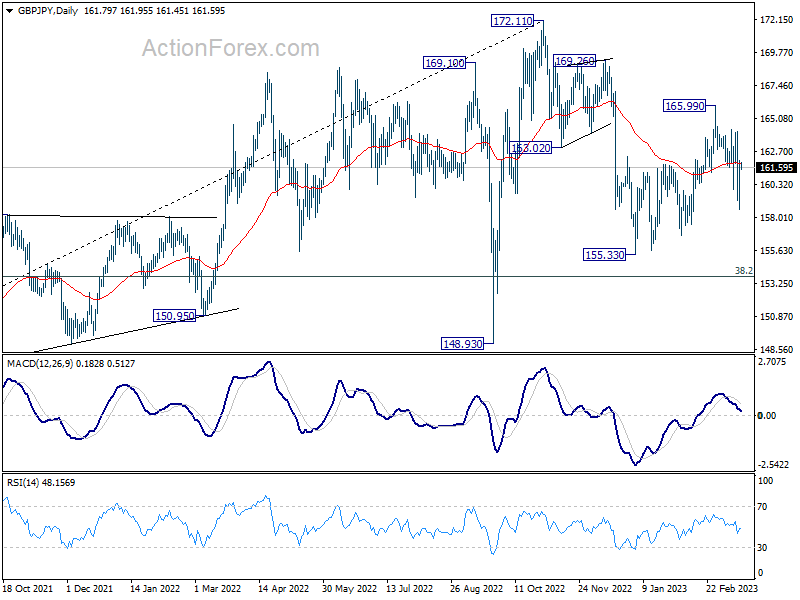
Intraday bias in GBP/JPY is turned neutral after recovery from 158.54. Further decline is expected as long as 164.12 resistance holds. Fall from 165.99 is seen as part of the larger correction from 172.11. Below 158.54 will target 155.33 low.
In the bigger picture, as long as 38.2% retracement of 123.94 (2020 low) to 172.11 (2022 high) at 153.70 holds, medium term bullishness is retained. That is, larger up trend from 123.94 (2020 low) is still in progress. Break of 172.11 high to resume such up trend is expected at a later stage.
EUR/JPY Daily Outlook
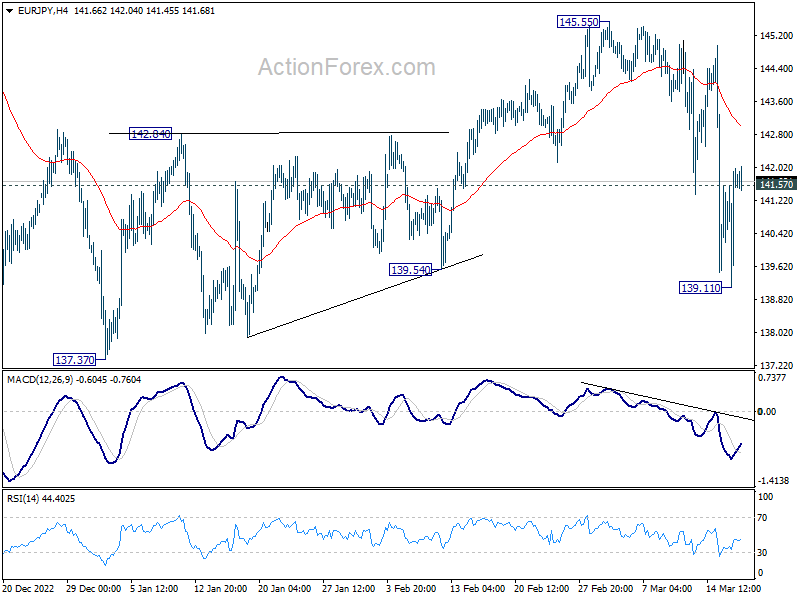
Daily Pivots: (S1) 140.06; (P) 141.04; (R1) 142.94; More....
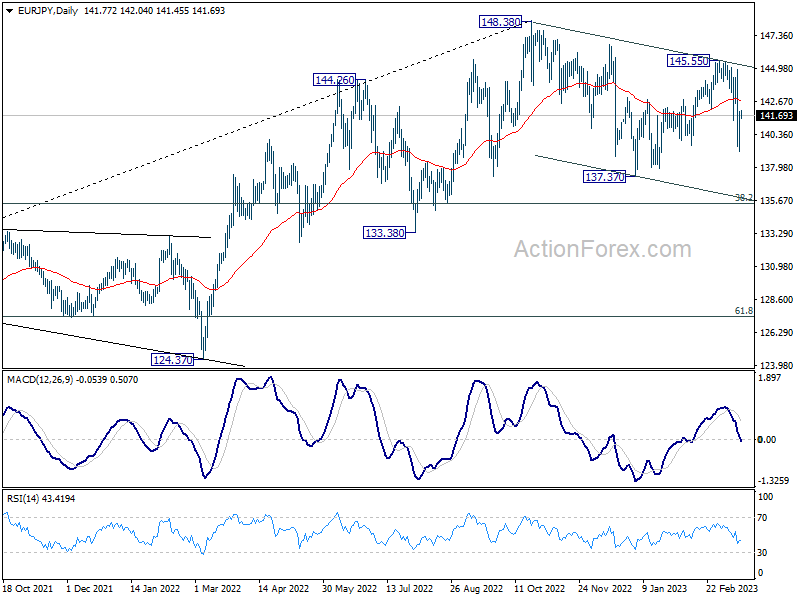
Intraday bias in EUR/JPY is turned neutral first as it recovered notably after dipping to 139.11. Risk stays on the downside as long as 4 hour 55 EMA (now at 143.01) holds. Fall from 145.55 is seen as the third leg of the whole correction from 148.38 high. Below 139.11 will target 137.37 low, and then 135.40 fibonacci level.
In the bigger picture, as long as 55 week EMA (now at 139.54) holds, larger up trend from 114.42 (2020 low) is still in progress for 149.76 long term resistance. However, firm break of 55 week EMA will bring deeper fall to 38.2% retracement of 114.42 to 148.38 at 135.40. Sustained break there will raise the chance of trend reversal, and target 61.8% retracement at 127.39.
EUR/GBP Daily Outlook
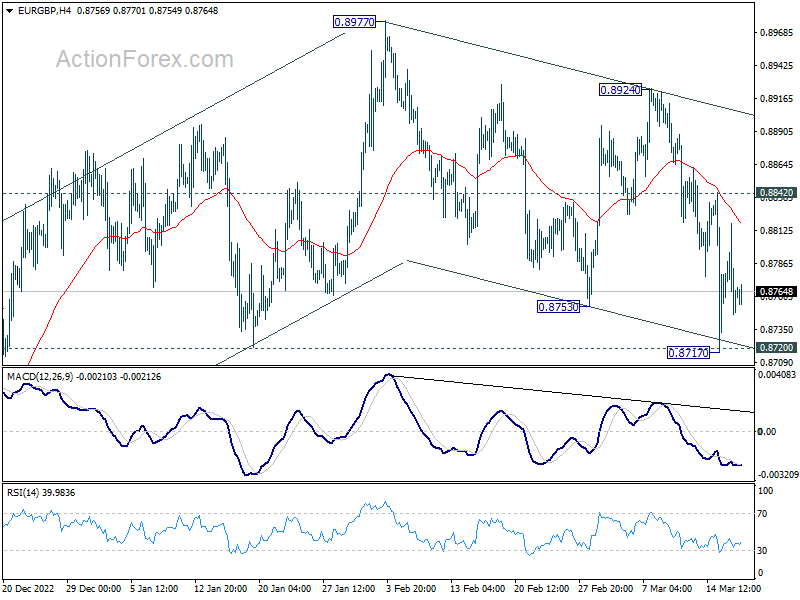
Daily Pivots: (S1) 0.8735; (P) 0.8777; (R1) 0.8806; More...
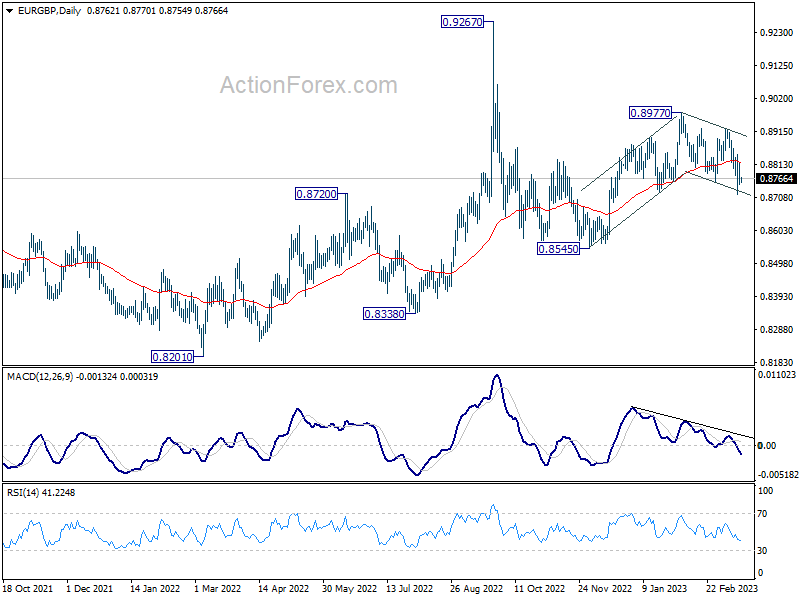
Intraday bias in EUR/GBP stays neutral at this point. On the upside, break of 0.8842 resistance will argue that the corrective pull back from 0.8977 has completed. Further rise should be seen back to 0.8924 resistance and above. However, sustained break of 0.8720 will bring deeper decline to 0.8545 instead.
In the bigger picture, outlook is rather mixed for now, except that price actions from 0.9267 (2022 high) are part of the long term range pattern from 0.9499 (2020 high). With 0.8720 support intact, rise from 0.8545 is in favor to continue through 0.8977. However, firm break of 0.8720 will argue that such rebound has completed, and open up deeper fall through this support level.
EUR/AUD Daily Outlook
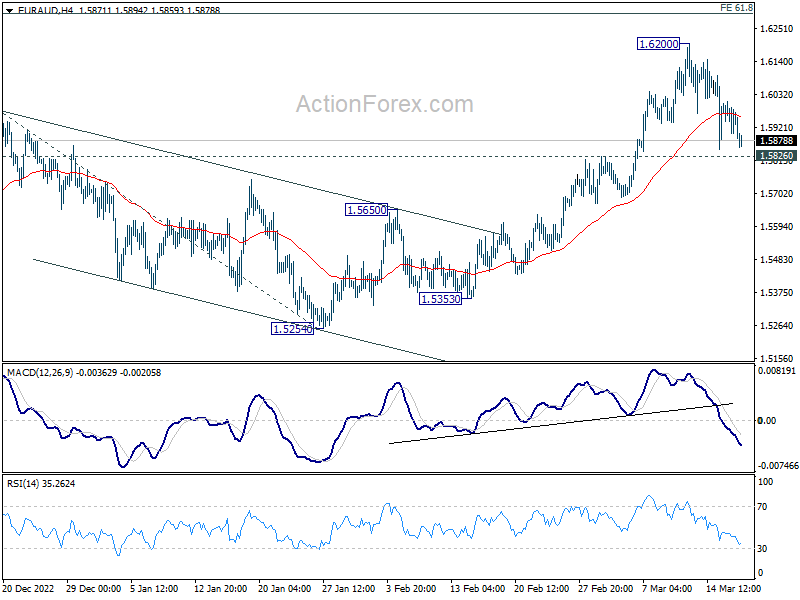
Daily Pivots: (S1) 1.5895; (P) 1.5953; (R1) 1.6001; More...
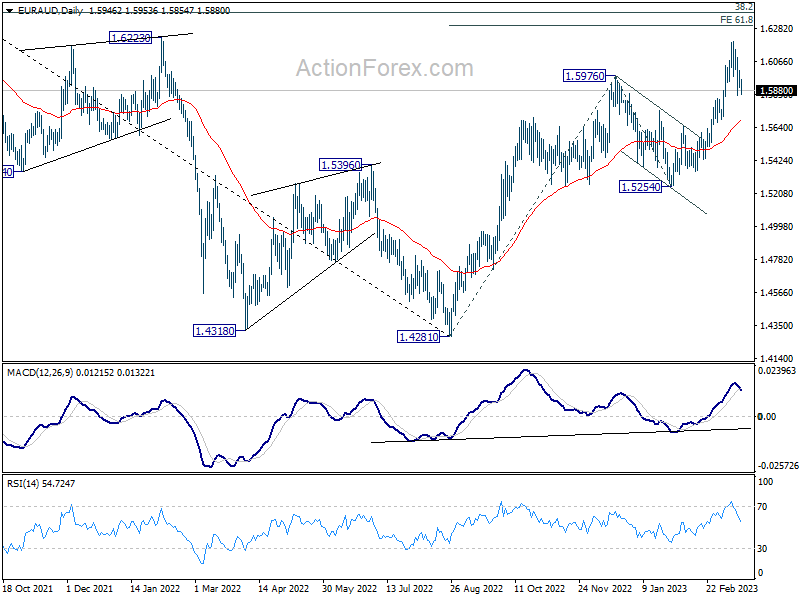
Intraday bias in EUR/AUD remains neutral first. Further rise is expected as long as 1.5826 support holds. Break of 1.6200 will resume the larger rise from 1.4281 to 61.8% projection of 1.4281 to 1.5976 from 1.5254 at 1.6302 next. However, firm break of 1.5826 will confirm short term topping, and bring deeper fall to 55 day EMA (now at 1.5684).
In the bigger picture, the strong support from 55 week EMA (now at 1.5404) is raising the chance of bullish trend reversal. Focus is now on 1.6434 cluster resistance (38.2% retracement of 1.9799 to 1.4281 at 1.6389). Sustained break there should confirm that whole down trend from 1.9799 (2020 high) has completed. Further rally should then be seen to 61.8% retracement at 1.7691. However, rejection by this cluster resistance will make medium term outlook neutral at best.
EUR/CHF Daily Outlook
Daily Pivots: (S1) 0.9815; (P) 0.9849; (R1) 0.9898; More...
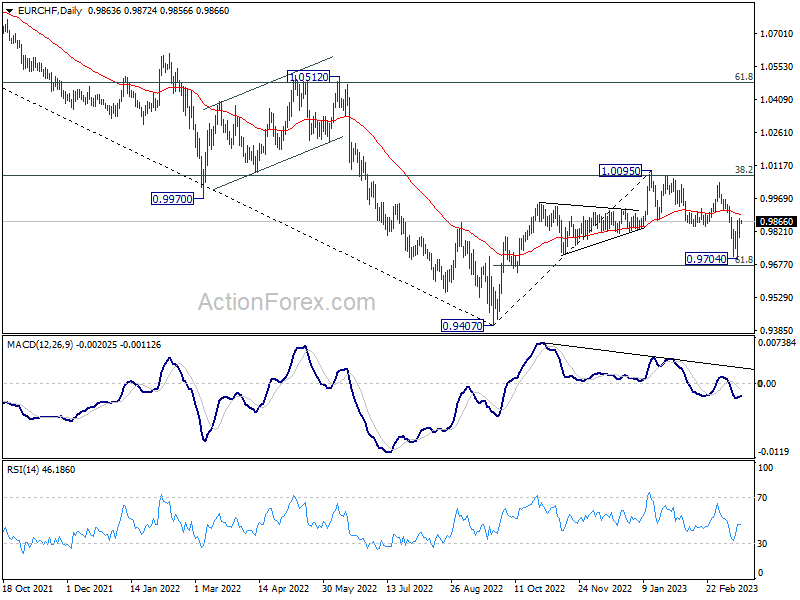
Intraday bias in EUR/CHF remains neutral first and risks stays on the downside with 55 day EMA (now at 0.9899) intact. Rebound 0.9407 could have completed at 1.0095 already. Below 0.9711 will target 61.8% retracement of 0.9407 to 1.0095 at 0.9670. Firm break there will bring deeper fall to retest 0.9407 low. However, sustained trading above 55 day EMA will bring stronger rise back to retest 1.0095 instead.
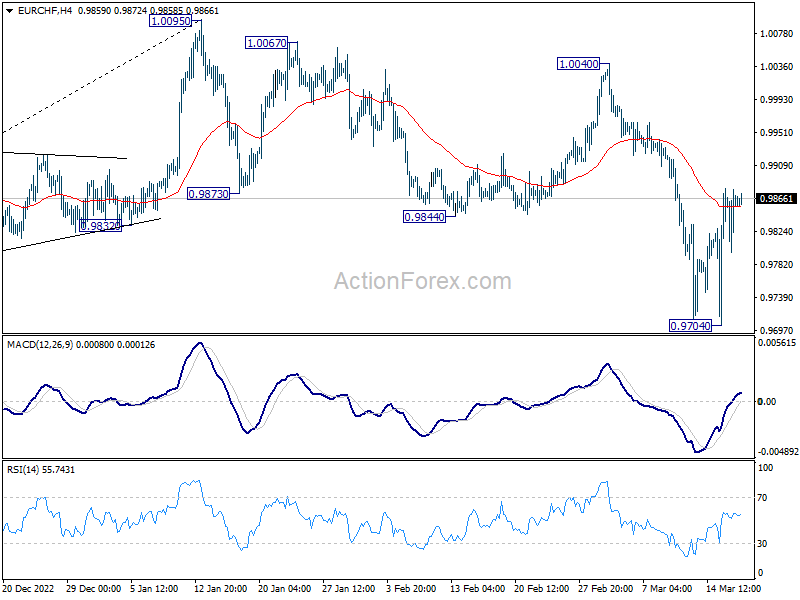
In the bigger picture, rejection by 55 week EMA (now at 1.0011) and 38.2% retracement of 1.1149 to 0.9407 at 1.0072 suggests that medium term outlook is staying bearish. That is, down trend from 1.2004 is not completed yet and is in favor to resume through 0.9407 at a later stage. For now, this will be the favored case as long as 1.0095 resistance holds.
Focus Remains on Financial Stability Risks
Markets
The Credit Suisse liquidity stopgap helped restore some calm in the run-up to the ECB meeting. The central bank pushed through with its flagged 50 bps rate hike despite recent financial stability concerns. They lifted the deposit rate from 2.5% to 3% as inflation is projected to remain too high for too long (>2% over policy horizon). From now on, Lagarde and co shift to data-dependence when it comes to future policy decisions. Not only in order to assess the inflation outlook, dynamics of underlying inflation and the strength of monetary policy transmission, but also to monitor current market tensions closely and stand ready to respond as necessary to preserve financial stability in the euro area as well as price stability. Regarding the former, the statement suggests providing liquidity support if needed. At the press conference ECB Lagarde said that the central bank has a lot more ground to cover if the inflation baseline persists and uncertainty would remove around financial tensions. Overall, the ECB’s tone remained hawkish on inflation. There’s no trade-off between price stability and financial stability with the ECB ready to address each in its own manner. The first via interest rates, the second via liquidity tools. Financial markets remained extremely stoic from the release of the press statement up until the end of Lagarde’s Q&A session. Afterwards, we finally saw European bond yields come off intraday lows. German yields closed the session 16.7 bps (30-yr) to 20.2 bps (2-yr) higher. Money markets currently discount a final 25 bps rate hike in May or June which is way too conservative in our view. Daily changes on the US curve varied between +5.7 bps (30-yr) and +27.1 bps (2-yr). The ECB’s reaction function might give a glimpse on what the Fed will do next week. In that scenario, also US markets are currently way too dovish positioned. EUR/USD closed at 1.0610 from an open at 1.0577.
Focus shifted during US trading hours to the First Republic Bank, another regional bank which suffered significant deposit outflows in the wake of the SVB and Signature turmoil. Other banks were obviously on the receiving end of these transactions and – in an effort to stave off liquidity concerns and boost confidence – yesterday made a combined amount of $30bn of uninsured deposits back in First Republic. The Treasury Department, Federal Reserve, Federal Deposit Insurance Corp. and the Office of the Comptroller of the Currency said in a joint statement that “this show of support by a group of large banks is most welcome, and demonstrates the resilience of the banking system.” The rescue action has echoes to the handling of the 1998 LTCM crisis. US equity markets opened with losses, but closed 1.2% (Dow) to 2.5% (Nasdaq) higher. Asian risk sentiment remains constructive overnight. EUR/USD rises from the 1.06 area towards 1.0650. Today’s eco calendar is irrelevant. Focus remains on financial stability risks. Liquidity efforts in the US and Switzerland should help to put the recent volatility/scare to bed. Next week’s Fed meeting is the next high profile event.
News Headlines
The French government used a special constitutional procedure (Article 49.3) to get its plan approved to raise the French retirement age to 64 year. This procedure allows the proposal to by adopted without a vote in the National Assembly. The procedure requires that the French government survives a vote of confidence in Parliament related to the topic. Otherwise the bill wouldn’t become effective and the government would have to step down. The opposition also has other procedures at its disposal to delay the reform, including a review by the Constitutional Court or starting a procedure that might result into a referendum.
Data Published by the Fed showed that banks borrowed a combined $164.8bn from two Federal reserve backstop facilities in the week that ended March 15. Banks borrowed $152.85bn from the discount window, up from $4.58bn in the week up to March 08. Banks also borrowed $11.9bn form the Fed’s new Bank Term Funding Program that was put in place last weekend. Rating agency S&P affirmed its AA+ long term credit rating for the US. The stable outlook reflects the U.S.'s institutional checks and balances, strong rule of law, and free flow of information that contribute to stability and predictability in economic policies. It also assumes that Congress will either raise or suspend the debt ceiling to ensure that the Treasury can remain timely on its debt service obligations.