

Sample Category Title
ECB Centeno: For sure, we’re much closer to that terminal rate than before
ECB Governing Council member Mario Centeno told BloombergTV, "for sure, we're much closer to that terminal rate than before... We're approaching it and I think March will be a great moment for us to be very clear about it."
Meanwhile, for the central bank to slow tightening pace from current 50bps per meeting, Centeno said, "we really need to see inflation converging to 2% in the medium term".
He added, the new forecasts in March are "going to tell us exactly where we are in that process".
EUR/USD: Bears Hold Grip But Likely to Stay on Hold, Awaiting US Inflation Data
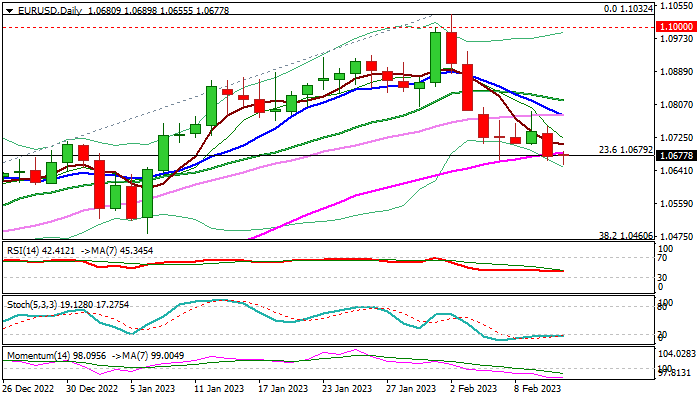
The Euro keeps negative tone at the start of the week following 0.55% drop on Friday, which resulted in a marginal close below 55DMA (1.0686) and Fibo 23.6% of 0.9535/1.1032 (1.0679), on probe through the floor of four-day consolidation range
The second consecutive bearish weekly close after a bull-trap above weekly cloud top (1.0930) adds to bearish signals.
Repeated close below 55DMA is needed to maintain bearish bias for further weakness and test of strong support at 1.0611, provided by the top of rising thick daily cloud.
Bears may face headwinds on approach to this support as daily RSI turned sideways and stochastic is oversold.
On the other hand, strengthening negative momentum keeps overall structure bearishly aligned, suggesting that upticks should provide better selling opportunities while the action is capped by converged 10/30DMA’s (1.0780) in attempts to form a bear-cross.
Monday’s action may remain in a quiet mode, as today’s calendar is empty, but also as traders stay on hold, awaiting release of Eurozone Q4 GDP and a key release, US Jan inflation data on Tuesday, which are expected to provide stronger direction signals.
Res: 1.0752; 1.0780; 1.0817; 1.0843.
Sup: 1.0655; 1.0611; 1.0483; 1.0460.
Gold’s Bullish Channel at Risk; Support at 50-SMA
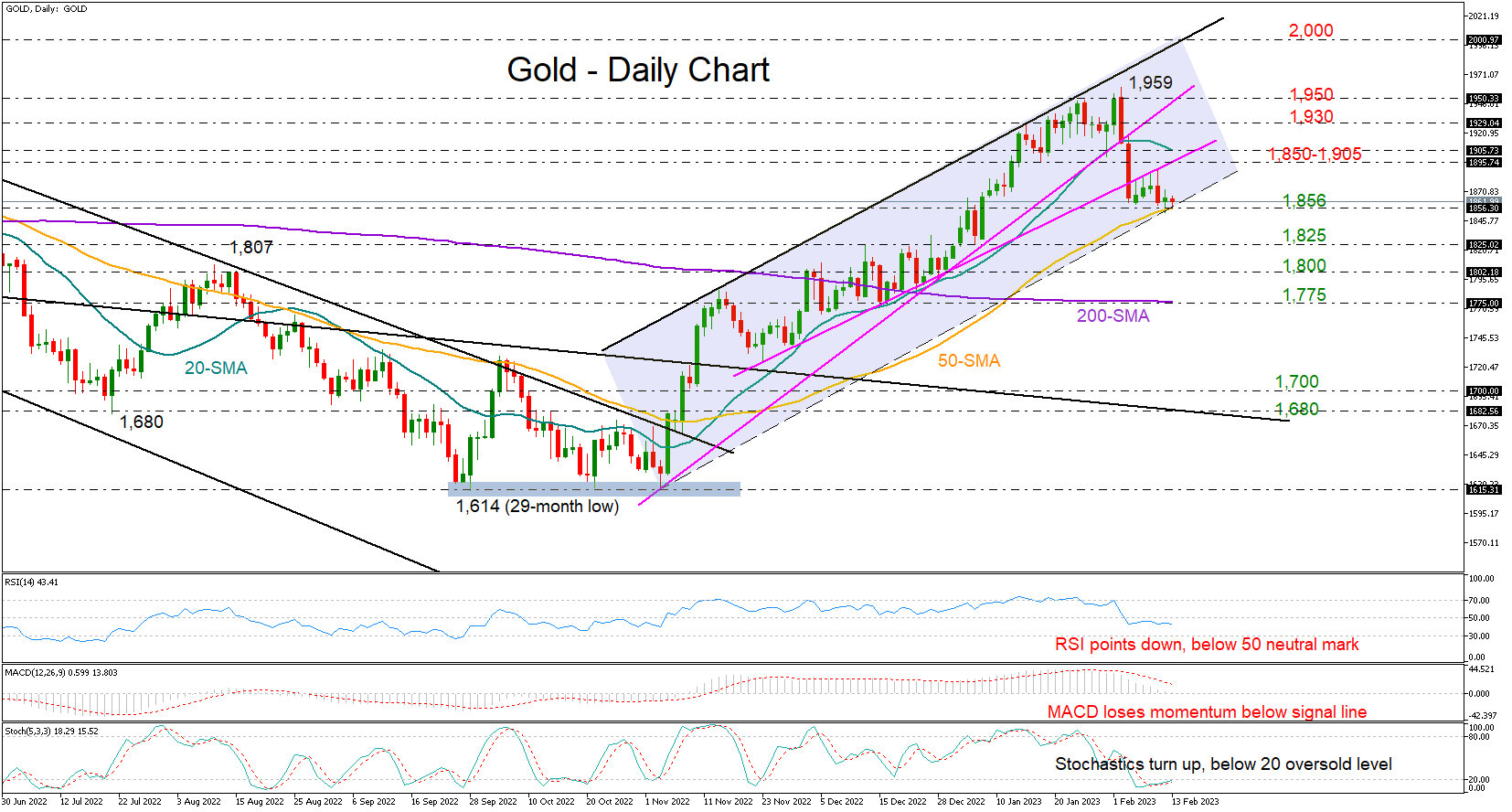
Gold was experiencing a flat trading session around the 1,860 level during Monday’s early European hours after a not-so-encouraging week, which sent the price to a one-month low of 1,852.
Specifically, the precious metal could not attract enough buying to crawl back above the support-turned-resistance trendline, edging lower instead to test the 50-day simple moving average (SMA) at 1,856. That is where the lower boundary of a bullish channel seems to be positioned. Hence, failure to rebound here could cause a relatively sharper decline to 1,825. If the 1,800 psychological mark proves fragile too, the door will open for the flattening 200-day SMA at 1,775. Another violation at this point would officially invalidate the uptrend from autumn’s lows.
The RSI and the MACD are backing the aforementioned bearish scenario as the former is facing downside pressures below its 50 neutral mark, while the latter has well distanced itself below its red signal line and is set to enter the negative area.
On the other hand, the stochastic oscillator is showing a soft bullish divergence after bottoming out in the oversold area, feeding some optimism that the price could soon pivot. Nevertheless, sentiment may remain weak unless the price bounces above the 1,895-1,900 wall, where the 20-day SMA is located. A successful penetration higher may face some congestion around 1,930 before heading for the key resistance area of 1,950. Then, the bulls will push towards the channel’s upper band, likely charting a new higher high at 2,000.
All in all, gold traders are expected to stay on the sidelines in the short term, waiting for fresh direction below the 50-day SMA at 1,856 or above the 1,895-1,900 barrier.
GBP/USD: Is Pound Ready for a Bearish Trend?
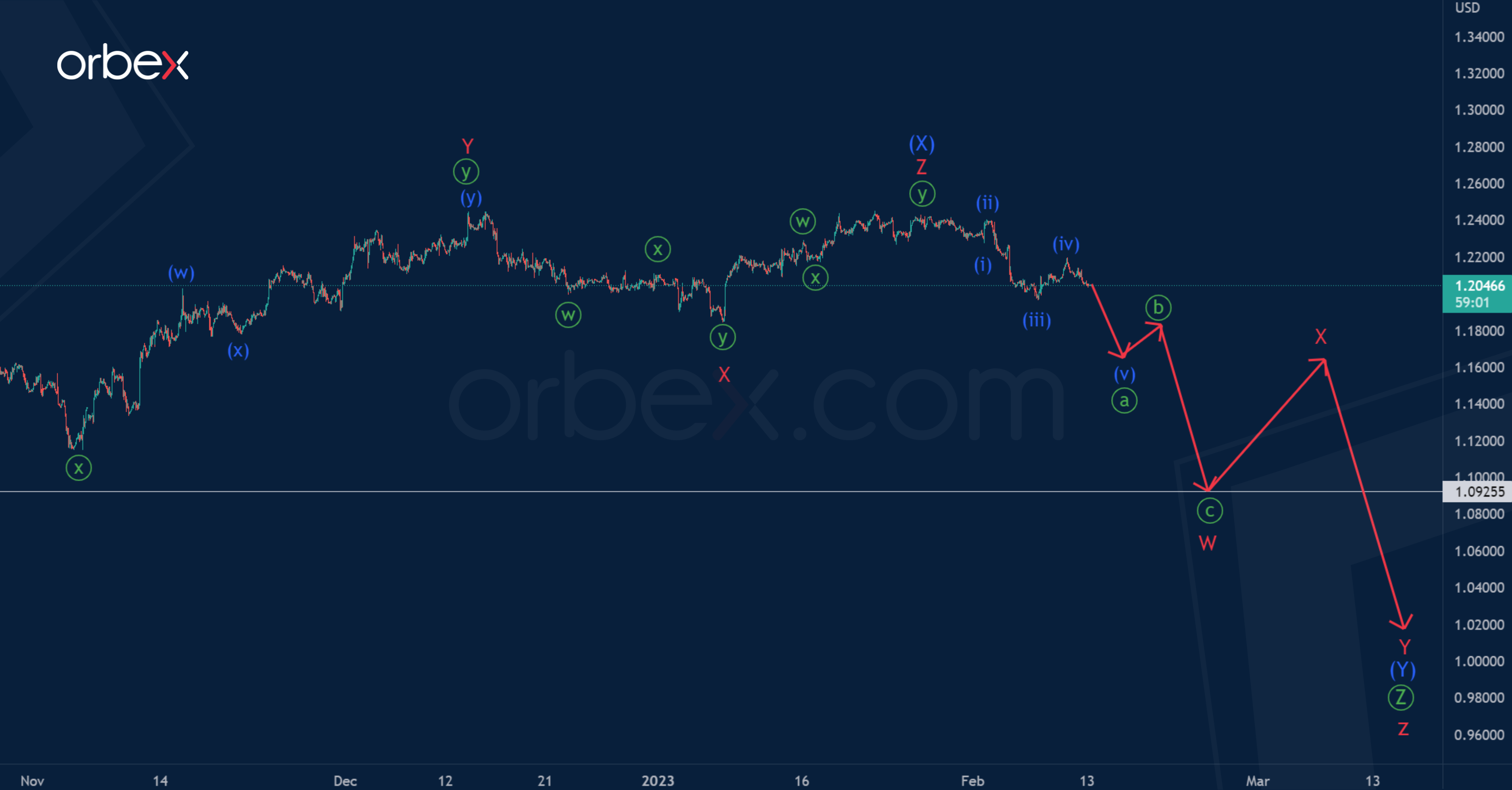
In the long run, GBPUSD seems to be forming a global triple zigzag w-x-y-x-z, in which the final actionary wave z develops.
Wave z most likely takes the form of a primary triple zigzag Ⓦ-Ⓧ-Ⓨ-Ⓧ-Ⓩ, in which we see the development of the primary wave Ⓩ. It can take the form of a double zigzag pattern (W)-(X)-(Y). The formation of the intervening wave (X) has recently ended.
There is a high probability that the last sub-wave (Y) will take the form of a double zigzag W-X-Y.
The first actionary leg W can end in the form of a minute zigzag to a minimum of 1.092.
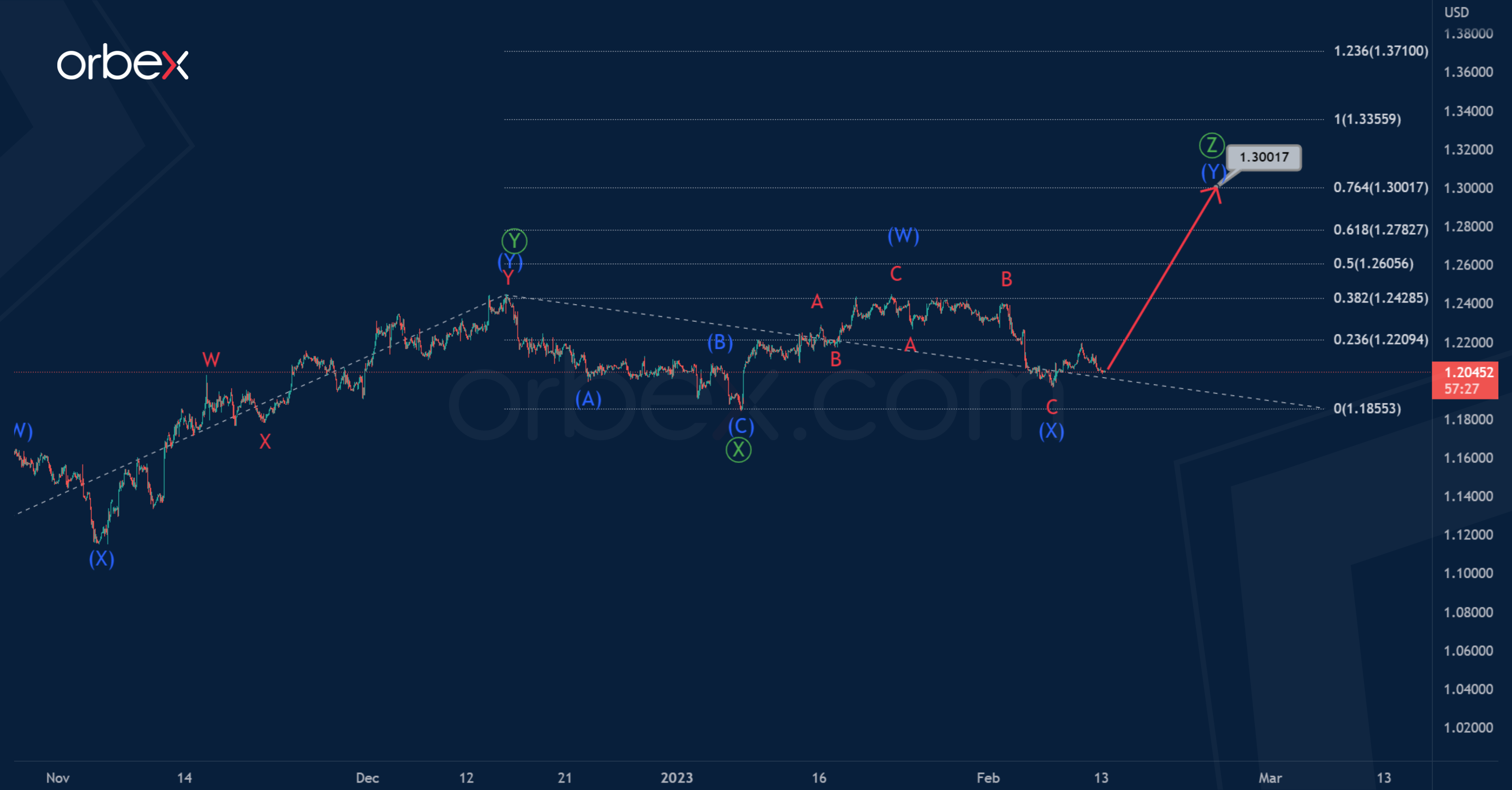
In the second scenario, the wave z could be fully completed. And now the bulls can move the price up within the new trend.
It is assumed that the formation of a primary triple zigzag Ⓦ-Ⓧ-Ⓨ-Ⓧ-Ⓩ occurs, where the first four parts are already formed.
In the last section of the chart, the final actionary wave Ⓩ is formed, the structure of which is similar to a double zigzag (W)-(X)-(Y). Most likely, it will be at 76.4% of wave Ⓨ, and will end near 1.300.
Dax 40 Breaks Lower
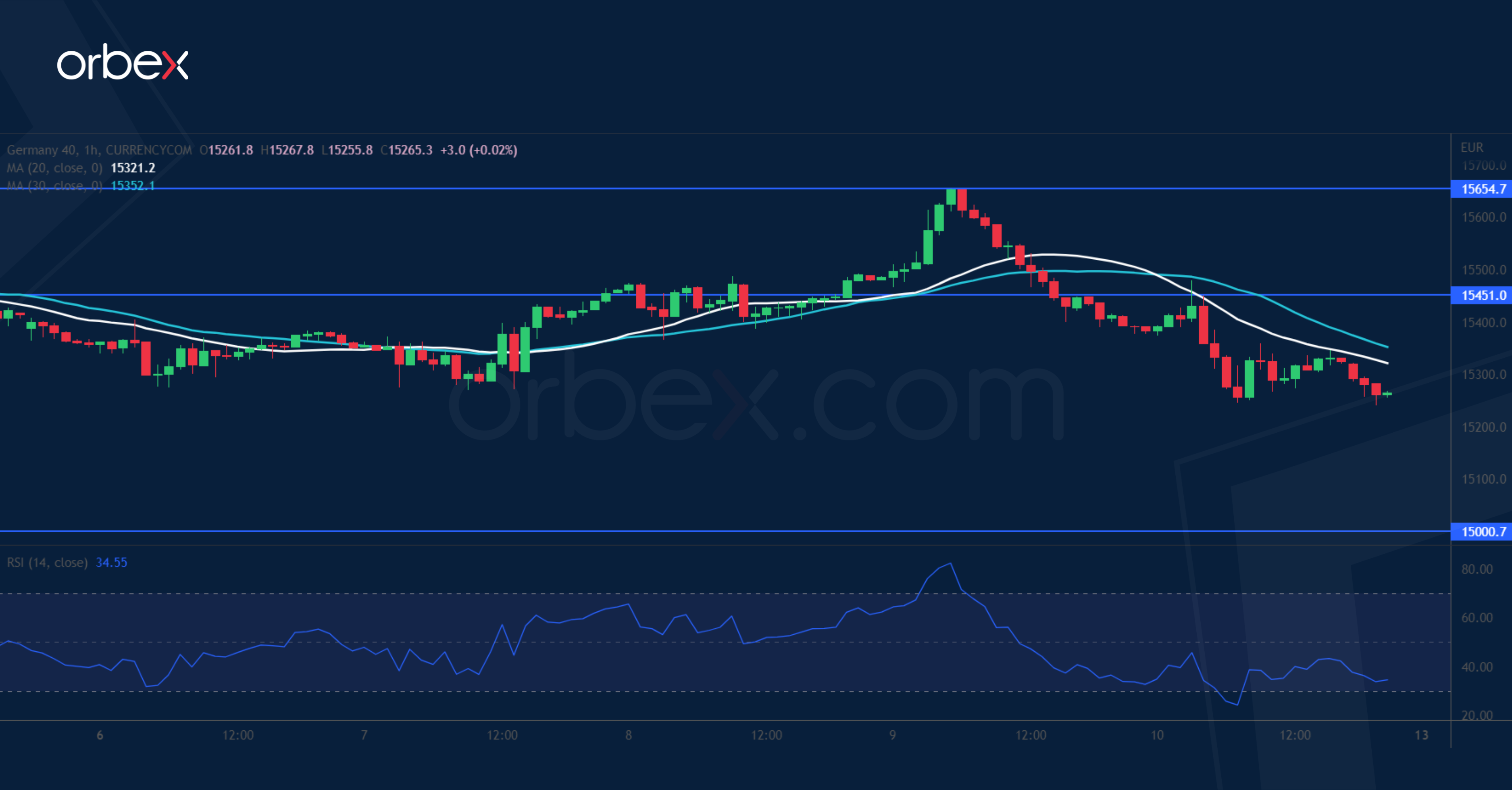
Equities trade on a cautious note amid rising US Treasury yields. The Dax 40 has failed to hold on to its gains above 15400, prompting the bulls to scramble for the exit. A drop below the previous swing low of 15280 would confirm the lack of follow-up bids and potentially trigger a broader liquidation. The psychological level of 15000 at the confluence of the lower end of a previous consolidation and the 30-day SMA is a major floor. 15450 at the top of a brief rebound would be the first hurdle when buyers make their way back.
EUR/GBP Struggles for Support
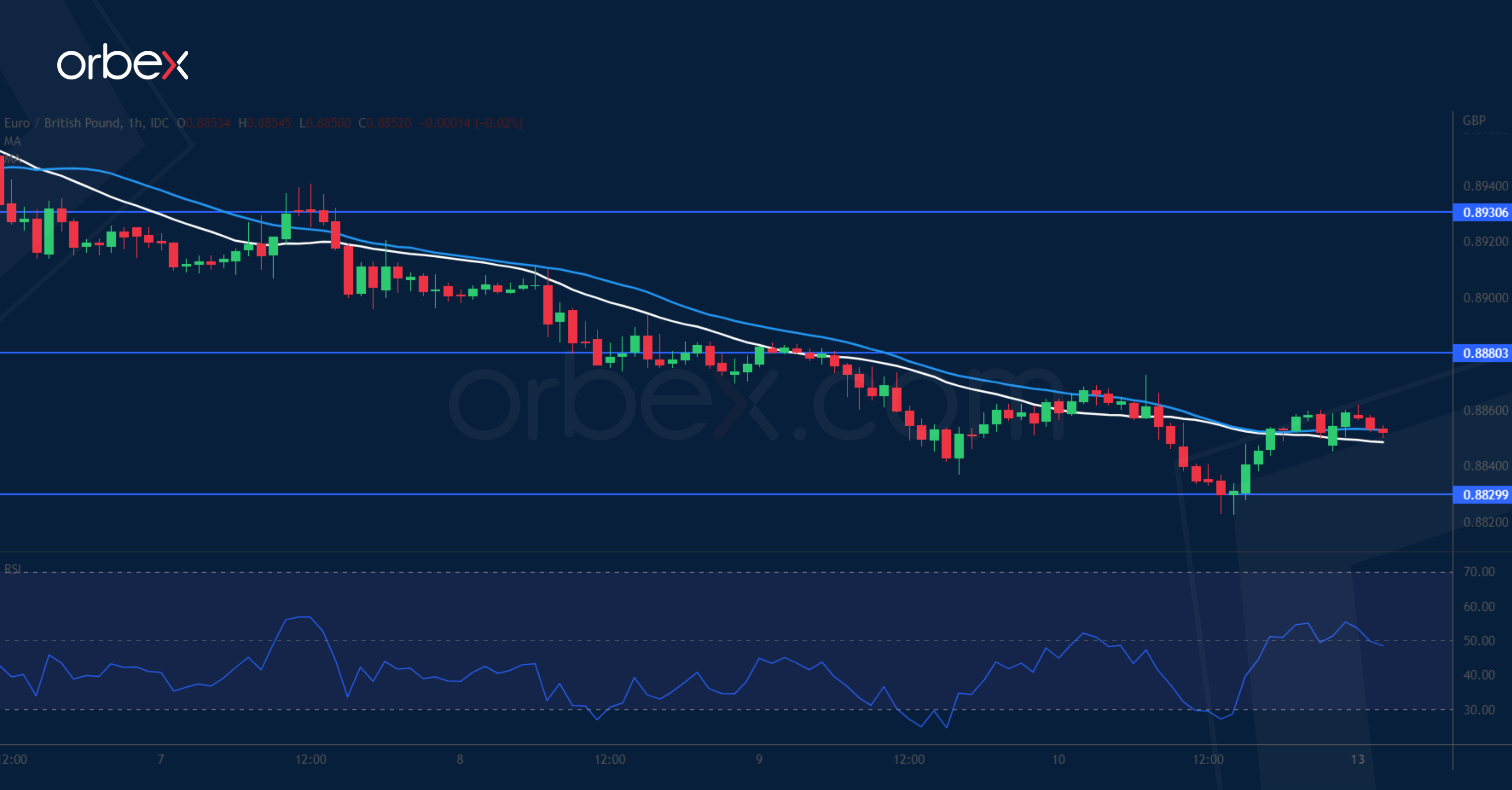
The pound slipped after December’s GDP showed a 0.5% contraction. The euro is still under pressure after a break below 0.8880, turning it into a resistance. The previous high of 0.8830 is the current support and coincides with the 30-day SMA on the daily chart. The RSI’s another venture into the oversold area attracted some interest but the bulls will need to reclaim 0.8930 before they could hope for a bullish continuation. A retest of the daily low and critical level at 0.8760 would threaten the uptrend in the medium-term.
USD/CAD to Test Major Support
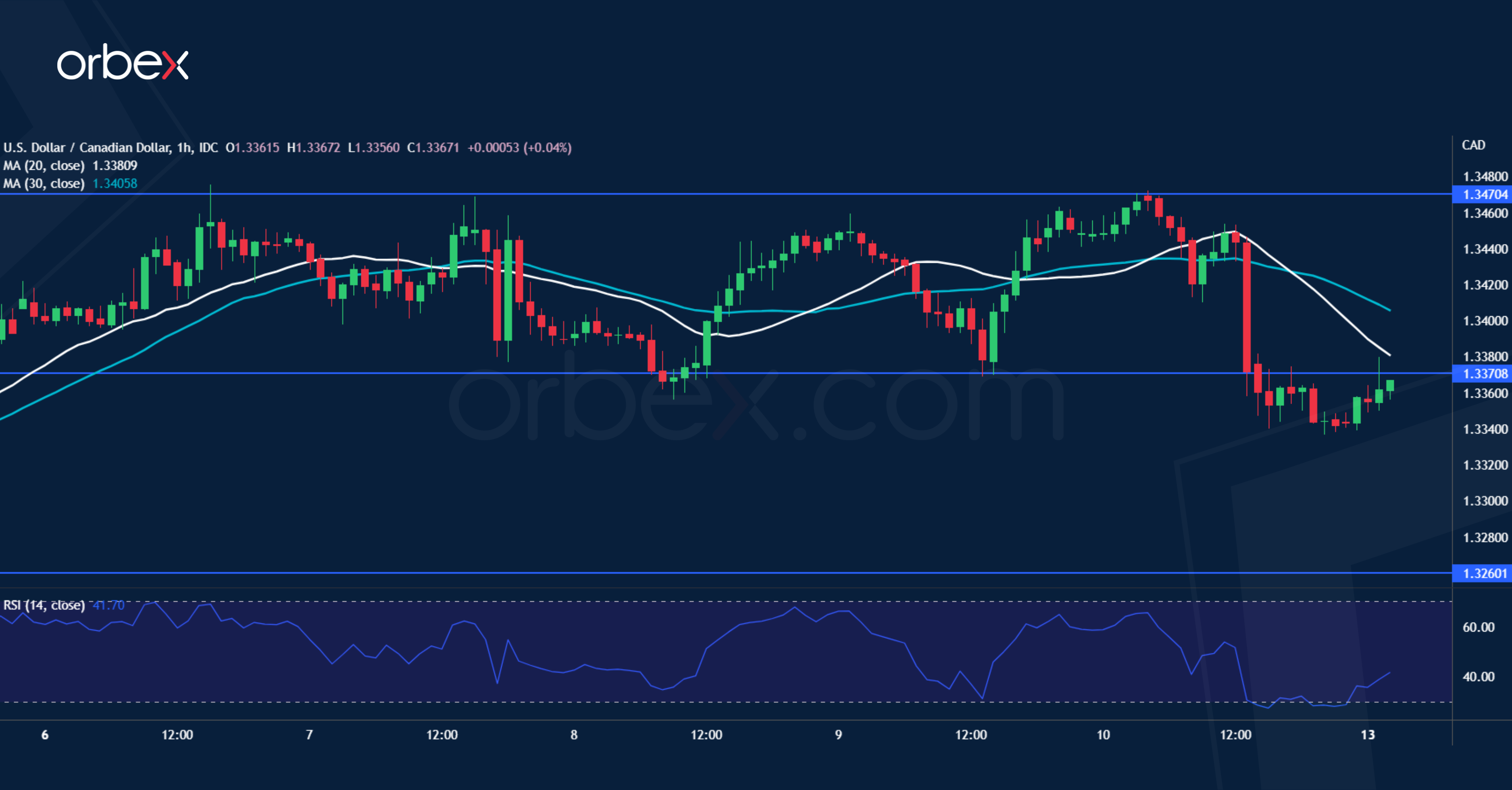
The Canadian dollar surged after a blowout jobs report fuelled speculation about further tightening. The recent consolidation has failed to secure a foothold above 1.3370, which has turned into a fresh resistance. This suggests that despite multiple tests, 1.3470, right under the daily resistance of 1.3520 may continue to keep the greenback in check. Looking at the bigger picture, the pair is still in a descending triangle on the daily chart and 1.3260 at the lower boundary is a major level to keep the pattern intact.
EURUSD Pauses Southern Move Slightly Below 1.0700
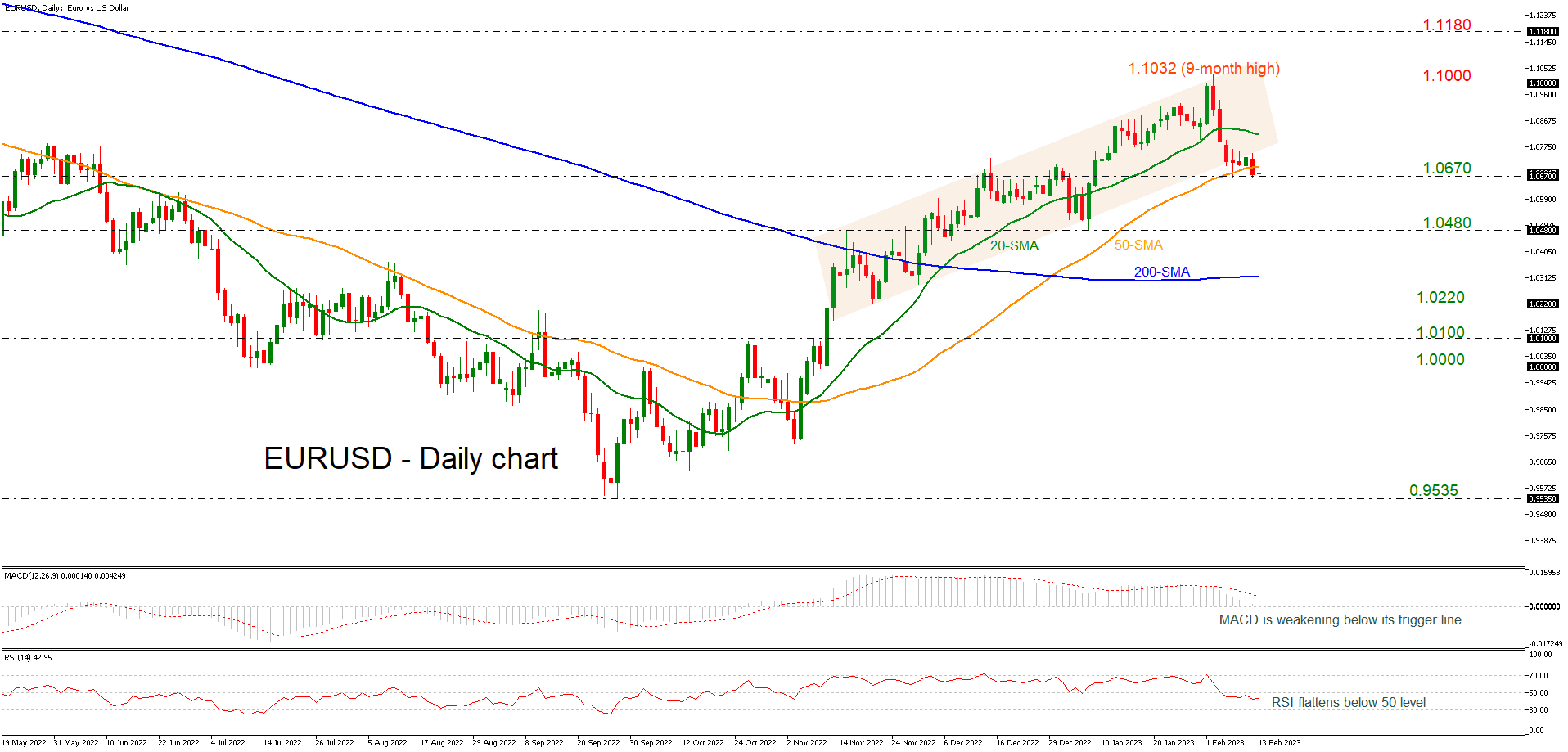
EURUSD is flirting with the 1.0670 support level, falling below the medium-term upward sloping channel and the short-term simple moving averages (SMAs). The MACD oscillator is weakening below its trigger line and near the zero level, while the RSI is moving sideways below the neutral threshold of 50.
If price action remains above 1.0670 (immediate support), there is scope to test the 50- and then the 20-day SMAs at 1.0710 and 1.0815 respectively. Clearing these key levels would see additional gains towards the 1.1000 psychological mark and the previous nine-month top at 1.1032. This is considered to be a strong resistance area which has been tested a few times in the past. Rising above it would see prices re-test the 1.1180 barrier, taken from the peak in March 2022.
If 1.0670 support fails, then the focus would shift to the downside towards 1.0480, shifting the bias to neutral. More declines would increase downside pressure, meeting the 200-day SMA at 1.0320 and bringing about a reversal of the trend.
Overall, EURUSD has been bullish since peaking at 1.1032. Near-term weakness is expected to remain as long as price action takes place in the lower end of the ascending channel.
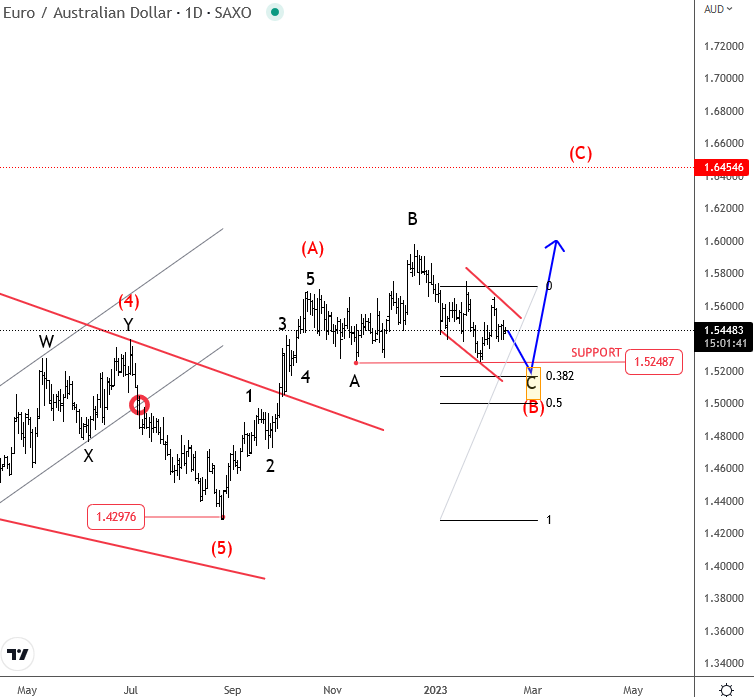
EUR/AUD Looking for Bigger Recovery
EURAUD is making a higher degree wave (A)-(B)-(C) corrective rally after potentially completing the leading diagonal at 1.43 area in summer 2022. Notice that recovery in wave (A) was impulsive, so more gains will be expected after the current wave (B) set-back which is still in progress as a complex correction, ideally A-B-C irregular/expanded flat. Support for a potential irregular correction is around 1.52 - 1.50, where bears may slow down and put bulls back in play for a wave (C) bounce.
Main Focus for Markets Remains on Tomorrow’s US CPI Release
Markets
On Friday, markets gradually moved further in the direction of central bankers holding rates higher, at least for a bit longer. We don’t draw any firm conclusion yet, but also the persistent trend of further inversion of the yield curve that dominated (US) interest rate markets of late at least took a breather. US yields gained between 3.5 bps (2-y) and 8.9 bps (30-y), with higher real yields driving the move. Eco data were few. Consumer confidence of the U. of Michigan improved from 64.9 to 66.4, but according to the University recent developments have led to mixed attitude among consumers as sentiment remains well below the historical average. Consumers’ inflation expectations for the next 12 months also rose from 3.9% to 4.2%. Earlier, the US BLS, amongst others, also upwardly revised inflation data for the last three months of last year. Fed’s Harker advocated to raise the policy rate above 5.0%, but at the same saw a chance of the Fed engineering a soft landing. German yields rose between 7.0 bps (5-y) and 5.1 bps (30-y). Equities initially traded in risk-off modus, probably at least partially due to Russia announcing another 500k b/month oil production cut starting in March (EuroStoxx50 -1.23%). Sentiment improved later in US dealings with indices closing mixed (Dow +0.50%; Nasdaq -0.61%). The dollar continued its rebound, even as the pace of the rally slowed as the session continued. Still, EUR/USD closed at 1.0678 (from 1.0739). The yen initially strengthened sharply on headlines that Kazuo Ueda likely would become the new BOJ governor. However, initial speculation on a big policy change evaporated soon. USD/JPY closed only modestly lower at 131.36. Sterling also gained slightly further against the euro (close EUR/GBP 0.8853).
Most Asian markets are starting the week in, admittedly mild, risk-off modus (Nikkei -0.88%, S&P/ASX 200 -0.21%; CSI 300 +0.84%). With little hard economic news available this morning, geopolitical noise (US again shot down an unidentified object above its territory) captures investors’ attention. The DXY index gains modestly (103.69) mainly driven by a further rebound in USD/JPY (132.15). EUR/USD trades little changed at 1.0675. Later today, the economic calendar is almost empty, with the European Commission economic forecasts the exception to the rule. An modestly better economic outlook gives the ECB more room to keep its focus on inflation. However, the main focus for markets remains on tomorrow’s US CPI release. Recently, markets tentatively grew a bit more concerned that persistent core/services inflation might cause the disinflationary process to develop more slowly than initially hoped for. If confirmed, this might put a floor for global core yields. Money market yields now discount a Fed cycle peak rate near 5.20%. The US 2-y yield regained the 4.5% barrier. Markets gradually shifting towards the higher for longer Fed interest rate scenario also supports the USD rebound. EUR/USD decisively dropped below the 1.0735 previous top. 1.0461/84 (38% retr. since Sept/YTD low) is next support.
News Headlines
Germany’s SPD lost the state elections in Berlin to the CDU. According to projections, the party of Chancellor Scholz gathered only 18.4% of the votes, down from 21% and about the same as the Greens. The CDU party soared more than 10 ppts, securing 28.2%. This does bring no guarantee about a CDU-led government coalition though as it lacks support from the other parties. Instead, if the SPD’s current leader Giffey can’t hold on to power, she could be replaced by someone from the Greens in a redo of the 2016 three-way coalition together with the Left Party. The Berlin state elections were a rerun of the 2021 edition that was so chaotic its results were annulled by the city’s top court.