

Sample Category Title
Main Focus for Markets Remains on Tomorrow’s US CPI Release
Markets
On Friday, markets gradually moved further in the direction of central bankers holding rates higher, at least for a bit longer. We don’t draw any firm conclusion yet, but also the persistent trend of further inversion of the yield curve that dominated (US) interest rate markets of late at least took a breather. US yields gained between 3.5 bps (2-y) and 8.9 bps (30-y), with higher real yields driving the move. Eco data were few. Consumer confidence of the U. of Michigan improved from 64.9 to 66.4, but according to the University recent developments have led to mixed attitude among consumers as sentiment remains well below the historical average. Consumers’ inflation expectations for the next 12 months also rose from 3.9% to 4.2%. Earlier, the US BLS, amongst others, also upwardly revised inflation data for the last three months of last year. Fed’s Harker advocated to raise the policy rate above 5.0%, but at the same saw a chance of the Fed engineering a soft landing. German yields rose between 7.0 bps (5-y) and 5.1 bps (30-y). Equities initially traded in risk-off modus, probably at least partially due to Russia announcing another 500k b/month oil production cut starting in March (EuroStoxx50 -1.23%). Sentiment improved later in US dealings with indices closing mixed (Dow +0.50%; Nasdaq -0.61%). The dollar continued its rebound, even as the pace of the rally slowed as the session continued. Still, EUR/USD closed at 1.0678 (from 1.0739). The yen initially strengthened sharply on headlines that Kazuo Ueda likely would become the new BOJ governor. However, initial speculation on a big policy change evaporated soon. USD/JPY closed only modestly lower at 131.36. Sterling also gained slightly further against the euro (close EUR/GBP 0.8853).
Most Asian markets are starting the week in, admittedly mild, risk-off modus (Nikkei -0.88%, S&P/ASX 200 -0.21%; CSI 300 +0.84%). With little hard economic news available this morning, geopolitical noise (US again shot down an unidentified object above its territory) captures investors’ attention. The DXY index gains modestly (103.69) mainly driven by a further rebound in USD/JPY (132.15). EUR/USD trades little changed at 1.0675. Later today, the economic calendar is almost empty, with the European Commission economic forecasts the exception to the rule. An modestly better economic outlook gives the ECB more room to keep its focus on inflation. However, the main focus for markets remains on tomorrow’s US CPI release. Recently, markets tentatively grew a bit more concerned that persistent core/services inflation might cause the disinflationary process to develop more slowly than initially hoped for. If confirmed, this might put a floor for global core yields. Money market yields now discount a Fed cycle peak rate near 5.20%. The US 2-y yield regained the 4.5% barrier. Markets gradually shifting towards the higher for longer Fed interest rate scenario also supports the USD rebound. EUR/USD decisively dropped below the 1.0735 previous top. 1.0461/84 (38% retr. since Sept/YTD low) is next support.
News Headlines
Germany’s SPD lost the state elections in Berlin to the CDU. According to projections, the party of Chancellor Scholz gathered only 18.4% of the votes, down from 21% and about the same as the Greens. The CDU party soared more than 10 ppts, securing 28.2%. This does bring no guarantee about a CDU-led government coalition though as it lacks support from the other parties. Instead, if the SPD’s current leader Giffey can’t hold on to power, she could be replaced by someone from the Greens in a redo of the 2016 three-way coalition together with the Left Party. The Berlin state elections were a rerun of the 2021 edition that was so chaotic its results were annulled by the city’s top court.
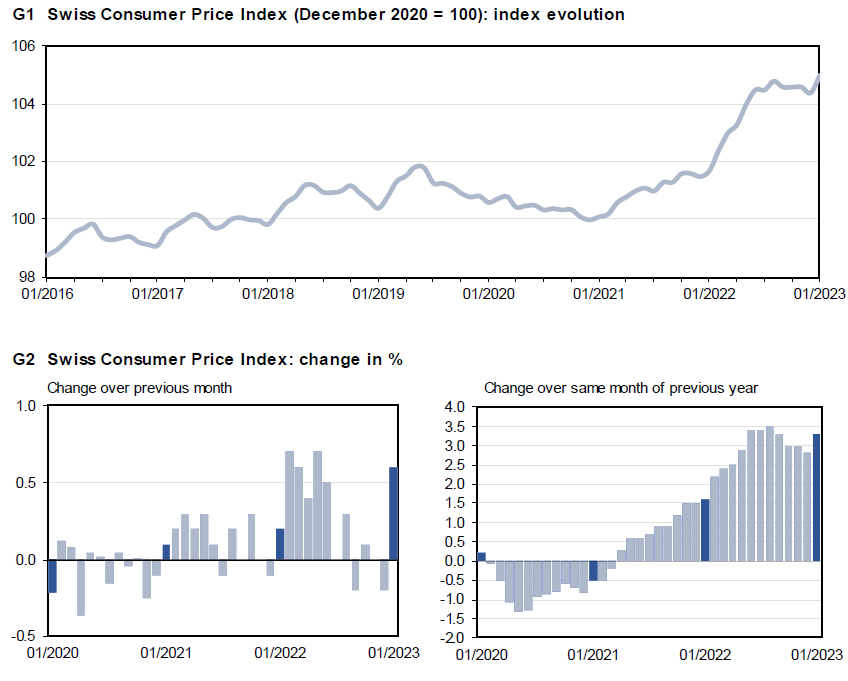
Swiss CPI bounce back to 3.3% yoy in Jan
Swiss CPI rose 0.6% mom in January, above expectation of 0.5% mom. Core CPI (excluding fresh and seasonal products, energy and fuel) was flat mom. Domestic product prices rose 1.0% mom while imported product prices dropped -0.6% mom.
Compared with the same month of the previous year, CPI accelerated from 2.8% yoy to 3.3% yoy, well above expectation of 2.9% yoy. Core CPI rose from 2.0% yoy to 2.2% yoy. Domestic product inflation jumped from 1.9% yoy to 2.6% yoy. Imported product inflation slowed from 5.8% yoy to 5.2% yoy.
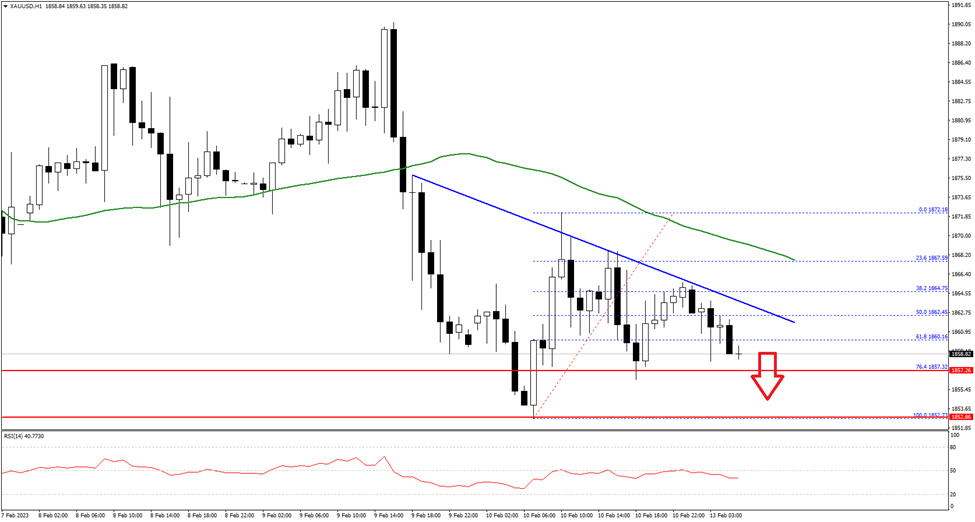
Gold Price Started a Fresh Decline from $1,890
Gold price started a fresh decline from the $1,890 zone against the US Dollar. The price declined steadily below $1,880 and moved into a bearish zone.
The bears even pushed the price below the $1,865 level and the 50 hourly simple moving average. The price traded as low as $1,852 and recently attempted a minor recovery wave. An immediate resistance on the upside is near the $1,860 level.
The first major resistance is near the $1,862 level and a bearish trend line on the hourly chart. The next main resistance could be near the $1,868 level, above which the price could start a steady increase towards the $1,880 level.
On the downside, an immediate support is near $1,857 on FXOpen. The next major support is near the $1,852 level, below which the price might decline towards the $1,840 support level in the near term.
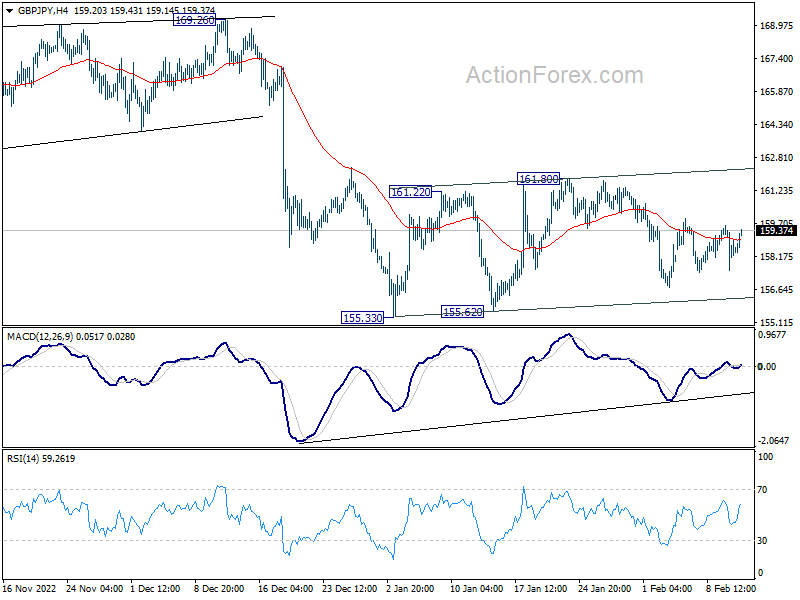
GBP/JPY Daily Outlook
Daily Pivots: (S1) 157.47; (P) 158.55; (R1) 159.56; More...
Range trading continues in GBP/JPY and intraday bias remains neutral. Further decline is mildly in favor. On the downside, break of 155.33 low will resume the fall from 172.11 to 153.70 fibonacci level next. On the upside, sustained trading above 55 day EMA (now at 160.99) will turn bias to the upside, for stronger rise back to 169.26/172.11 resistance zone.
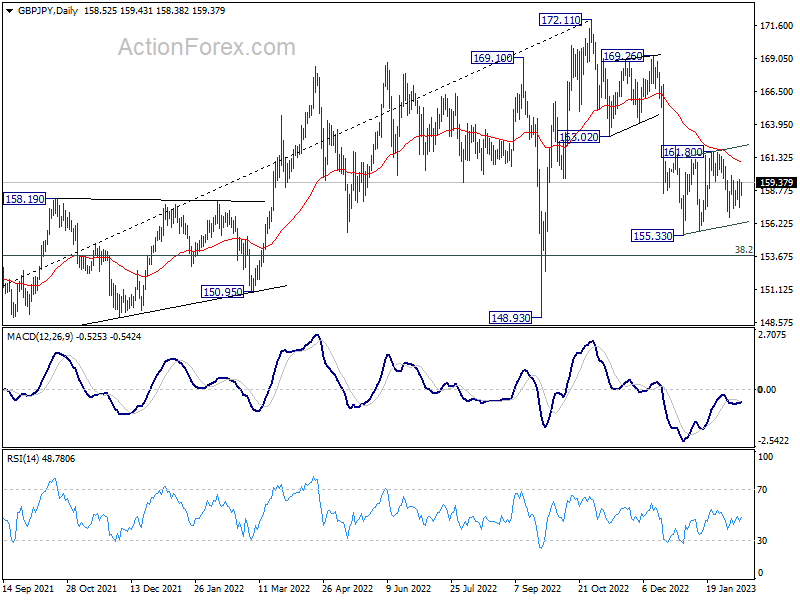
In the bigger picture, as long as 163.02 support turned resistance holds, decline from 172.11 medium term top is expected to continue to 38.2% retracement of 123.94 to 172.11 at 153.70. Sustained break there will raise the change of trend reversal and target 61.8% retracement at 142.34. Nevertheless, break of 163.02 support turned resistance will argue that the decline has completed, and retain medium term bullishness.
EUR/JPY Daily Outlook
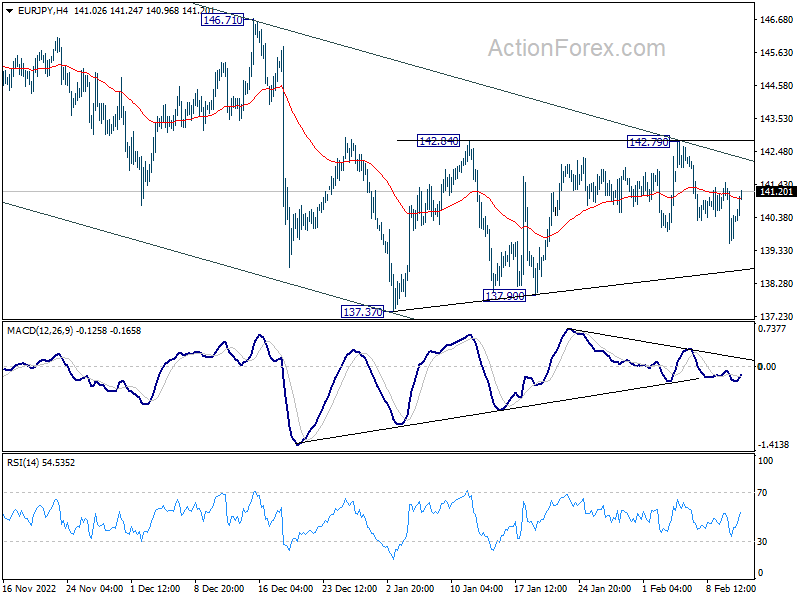
Daily Pivots: (S1) 139.44; (P) 140.47; (R1) 141.38; More....
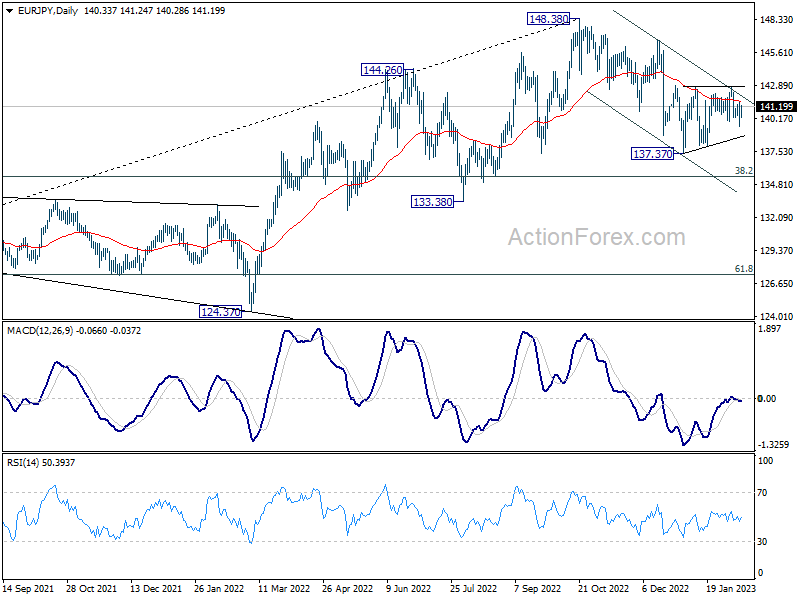
Range trading continues in EUR/JPY and intraday bias stays neutral. Further decline is mildly in favor. Break of 137.37 will resume the whole fall from 148.38 to 135.40 fibonacci level. On the upside, however, break of 142.84 will argue that the correction from 148.38 has completed at 137.37 already. Further rise would be seen to 146.71 resistance next.
In the bigger picture, as long as 55 week EMA (now at 138.87) holds, larger up trend from 114.42 (2020 low) is still in progress for 149.76 long term resistance. However, firm break of 55 week EMA will bring deeper fall to 38.2% retracement of 114.42 to 148.38 at 135.40. Sustained break there will raise the chance of trend reversal, and target 61.8% retracement at 127.39.
EUR/GBP Daily Outlook
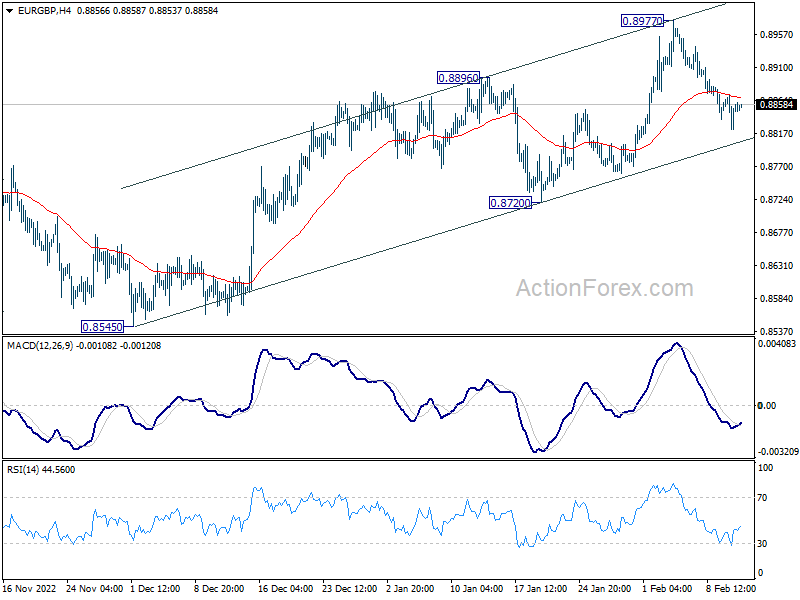
Daily Pivots: (S1) 0.8828; (P) 0.8851; (R1) 0.8877; More...
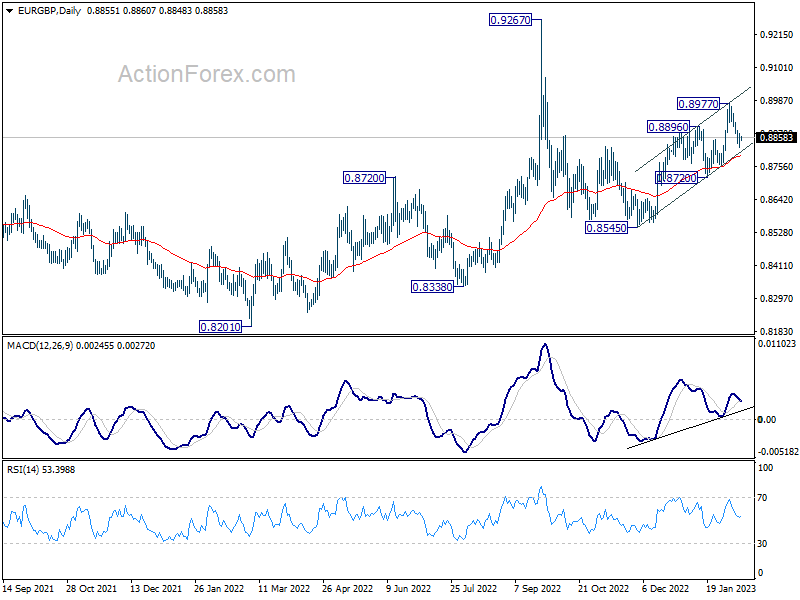
Intraday bias in EUR/GBP remains neutral for the moment. Further rally is expected as long as 0.8720 support holds. On the upside, break of 0.8977 will resume whole rebound from 0.8545 towards 0.9267 high. On the downside, however, break of 0.8270 will turn near term outlook bearish again.
In the bigger picture, the notable support from 55 day EMA (now at 0.8780) retains near term bullishness. Break of 0.8896 should target 0.9267 (2022 high) and possibly above, to resume whole up trend from 0.8201 (2022 low). However, break of 0.8270 support and sustained trading below 55 day EMA will set the stage for 0.8545 and below.
EUR/AUD Daily Outlook
Daily Pivots: (S1) 1.5377; (P) 1.5445; (R1) 1.5498; More...
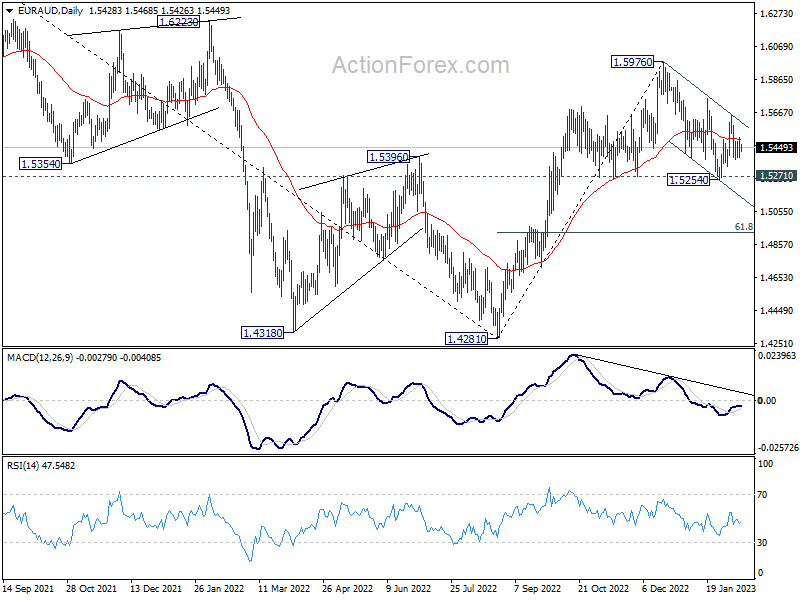
Intraday bias in EUR/AUD remains neutral for the moment. On the downside, firm break of 1.5254/71 will carry larger bearish implication and resume the fall from 1.5976. On the upside, above 1.5650 will resume the rebound to 1.5749 resistance.
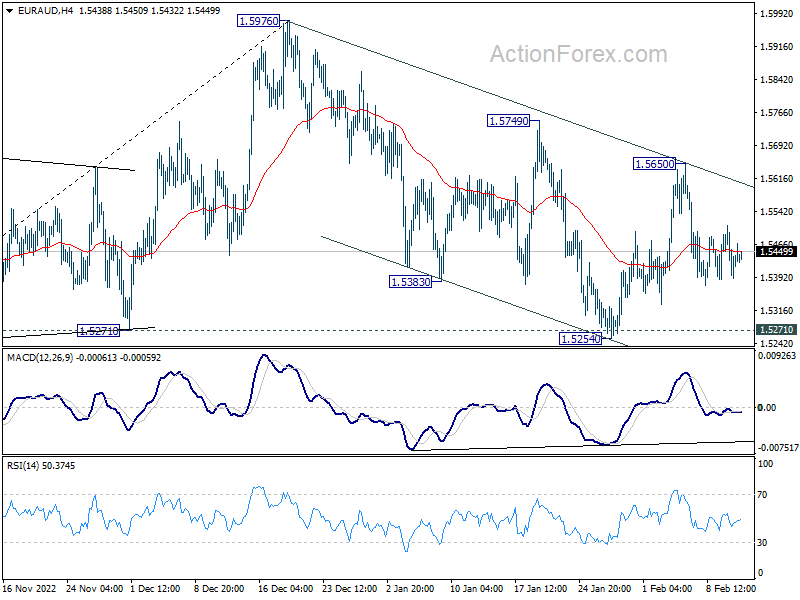
In the bigger picture, it's still early to confirm if rise from 1.4281 represents bullish trend reversal. But as long as 1.5271 support holds, such rally is in favor to continue. Break of 1.5976 will target 1.6434 key resistance next. On the other hand, firm break of 1.5271 will retain medium term bearishness instead.
EUR/CHF Daily Outlook
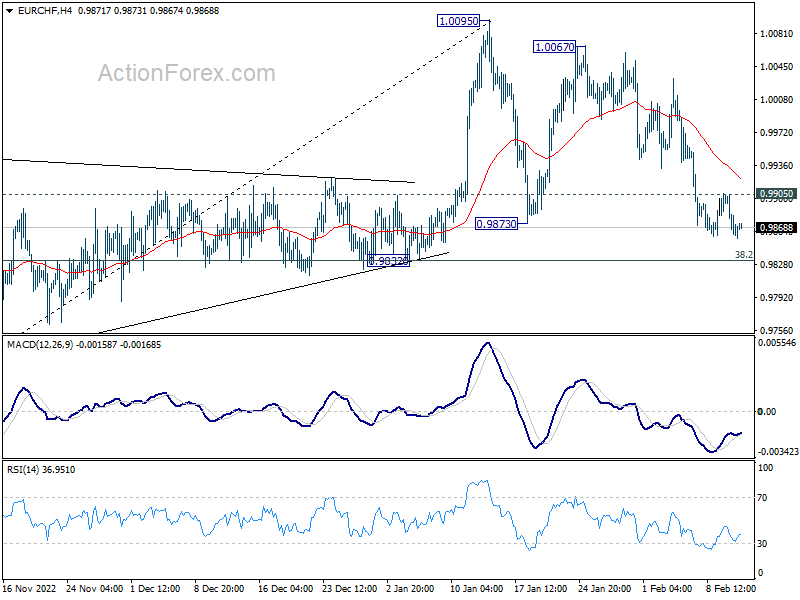
Daily Pivots: (S1) 0.9847; (P) 0.9877; (R1) 0.9893; More....
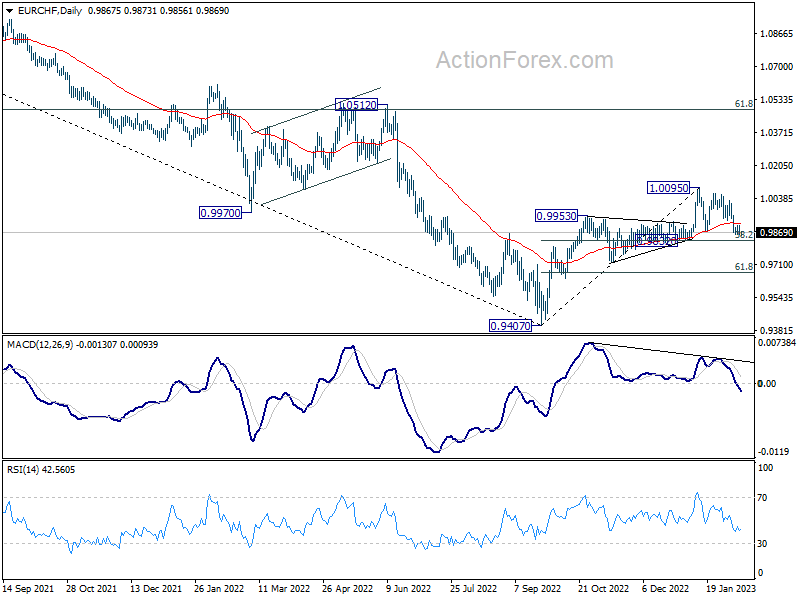
EUR/CHF's fall form 1.0067 could still extend lower. But downside should be contained by 38.2% retracement of 0.9407 to 1.0095 at 0.9832 to complete the corrective pattern from 1.0095. On the upside, break of 0.9905 minor resistance will turn bias back to the upside for 4 hour 55 EMA (now at 0.9923) and above.
In the bigger picture, the rejection by 55 week EMA (now at 1.0025) mixed up the outlook. On the upside, sustained trading above 55 week EMA will raise the chance of bullish trend reversal. Rise from 0.9407 should then target 1.0505 cluster resistance (2020 low at 1.0505, 61.8% retracement of 1.1149 to 0.9407 at 1.1484). However, firm break of 0.9832 support will revive medium term bearishness and bring retest of 0.9407 low instead.
What If US Inflation Didn’t Ease as Much as Expected?
US equities recorded their worst week since the year started.
Hawkish comments from many Federal Reserve (Fed) members hammers sentiment, as stress mounts before the much-important US CPI data due Tuesday.
If US inflation hasn’t eased, or eased enough, or God forbid, ticked unexpectedly higher on yearly basis, we could rapidly see the post-NFP optimism, and the pricing on the goldilocks scenario to leave its place to fear and chaos.
And I say on a yearly basis, because on monthly basis, the consensus is, in fact, an uptick to 0.4% in January from 0.1% printed a month earlier.
The surprise U-turn in used-car prices, and a rally in commodity prices on the Chinese reopening may have impacted the US prices more than what the polls predict.
So, investors are holding their breath before they see how the recent developments impacted the US inflation, and how the US inflation will impact the Fed expectations and the market sentiment.
At the start of the week, the activity on Fed fund futures hints at around 91% chance for a 25bp in the next FOMC meeting, and around 9% chance for a 50bp hike.
Note that the pricing for a 50bp is already in play. An unpleasant surprise from the CPI front could boost the odds. Remember, a single CPI print could change the expectation from 50 to 25bp for the last FOMC meeting. And there is no guarantee that the opposite won’t happen this time.
FX and energy
The US dollar index finally cleared the 50-DMA offers on Friday - which I think could be premature if tomorrow’s US inflation number is sufficiently soft.
Besides a broadly better-bid US dollar, a wave of fresh buying in the Japanese yen also marked the latest mood in the currency markets, as Masayoshi Amamiya refused to take over the Bank of Japan (BoJ), and the role will finally go to Kazuo Ueda, who is seen as being more hawkish than Amamiya.
But the first thing Ueda told reporters since the news that he will take over the BoJ broke was that the easy policy will stay in place.
The dollar-yen is testing the 50-DMA to the upside this morning, and it could be just a matter of time before we see the pair jump over this level.
The EURUSD, on the other hand, is already below both the 50-DMA and the 23.6% retracement on October to January rally. Trend and momentum indicators look bearish, with the next key support seen at 1.0470/1.05 range, the major 38.2% retracement that will distinguish between the actual positive trend and a bearish reversal, and an important psychological mark.
But because the US dollar is what leads the dance, what’s next in the EURUSD will mostly depend on what’s next in the dollar, simply.
Across the Channel, good news came on Friday: the UK avoided a technical recession. The bad news may be that a jump in sales due to the World Cup may have made a difference in the latest numbers, and the positive vibes may not last. At the end of the day, Britain is the only G7 yet to recover from Covid weakness.
Anyway, the general state of the British economy is not a concern for the FTSE 100 stocks, where 80% of the revenues are made abroad. Therefore, any weakness in the UK economy, hence strerling remain, on the contrary, supportive of the British big cap index, which hit a fresh high last week.
We could see the index coming lower this week along with other major indices, but the energy and commodity exposure of the British index is still a good thing to have.
BP’s value hit the £100 billion mark for the first time in three years, and I can assure you that last week’s price action was nothing less exciting than Bitcoin’s in its good, old days.
And speaking of energy, US crude oil jumped past the $80pb on Friday, as Russia announced to cut its production by 500’000 barrels per day, which is roughly 5% of its daily production. But gains remain limited by an overall bearish mood and recession fears, and offers remain strong into the 100-DMA, which currently stands near $81pb level.
All Eyes on US CPI this Week
Market movers today
We start the week in a quiet fashion. The European Commission will release its new winter forecast and it will be interesting to see what they expect on the recession question and how fast inflation will slow down. Euro-area finance ministers also meet in Brussels to discuss energy markets and other topics.
Later this week the market highlight will be the US CPI print for January on Tuesday (read more in Research US - Soft landing to no landing?, 9 February). US retail sales will also give more input on the state of the US consumer.
The 60 second overview
US shoots down more objects: Another three objects have been shot down by the US air force following the shoot-down of the Chinese balloon a week ago. It is unclear where the objects come from and what they are exactly. They were not categorized as balloons. A US general Glen VanHerck said "I would be hesitant, and would urge you, not to attribute it to any specific country. We don't know". A State Department official last week said that Chinese President Xi Jinping may not have known about the Chinese balloon that flew into US airspace, see more here. In China, local authorities said they had spotted an unidentified flying object and were preparing to shoot it down.
Markets await US CPI: Markets in Asia are quiet, awaiting the important US CPI report tomorrow, which will be key for the next move in markets. On Friday, the University of Michigan consumer confidence report showed a rise in 1-year inflation expectations from 3.9% to 4.2% while 5-10 year inflation expectations stayed flat at 2.9%. Overall consumer confidence improved in a further sign that the headwinds for consumers and the overall economy seems to be easing.
Oil price higher: The oil price rose on Friday on the news that Russia plans to cut oil output 500kb/d in March and OPEC does not plan to increase output in response. Russia's oil production already dropped more than 1mb/d, or 10%, since the war broke out and we do not want to overstate the impact of a further drop. Buyers have shun Russian oil amid Russia's invasion of Ukraine and sanctions and forcing Russia to cut output. The additional drop in production in March may be involuntary. In the meantime, other producers have stepped in to reap market shares from Russia - mainly producers in Latin America. Finally, if the oil market tightens, i.e. and oil price rise above USD100/bbl, we expect OPEC+ to respond and hike output.
FI: European rates sold off from the opening by 5bp in core countries in the 10y point, but then range traded through most of the day. The entire yield curve ended higher, but the very front end rose the most, where ECB peak policy hike was 6bp higher on the day at 3.50% (€STR). 2y German Schatz reached 2.77% which is the since 2008. Banks chose to repay EUR36.6bn in ECB's voluntary TLTRO repayment option, which was a non-event for markets. Focus this week is clearly the US CPI print for January tomorrow, but otherwise this is a relatively quiet week. We also get the EC's new winter forecast.
FX: EUR/USD, currently back below 1.07, is expected to head lower over the coming months as global financial conditions re-tighten and this week's highlight in that regard could be tomorrow's US CPI report. The Riksbank sent EUR/SEK lower last week as they made a U-turn in terms of communication, and now the SEK seems to be back on the Riksbank's agenda. Short-term, this support should help EUR/SEK venture back towards the 11.00-region, which is fair according to our short-term model. The NOK was also supported by the Riksbank's shift, and last Thursday we entered a tactical short position in EUR/NOK. This Thursday's expectations survey from Norges Bank might be of interest near-term.
Credit: The credit markets ended last week on a rather negative note. During Friday, iTraxx Main widened 3.5bp to 78.7bp while iTraxx Crossover widened 16.9bp to 410.4bp. The weakness in the CDS market was also visible in the cash bond market, where secondary bond trading saw more balanced axes. Primary markets remained most of the week very active with a high issuance pace of both investment grade and high-yield rated instruments.
Nordic macro
There are no key movers in the Nordics today. Later this week we get Swedish house prices from Valueguard and unemployment while Norway releases the Q1 expectations survey and GDP for Q1. Governor of Norges Bank, Ida Wolden Bache, will also hold the annual address.