Sample Category Title
RBNZ survey: OCR expected to rise to 5% by year end
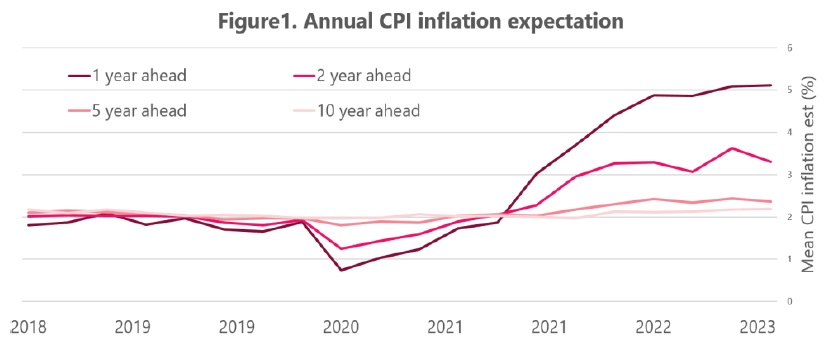
According to RBNZ Survey of Expectations (Business), one-year inflation expectations rose slightly from 5.08% to 5.11% in February quarter. The reading was similar to value from the 1990 survey when actual CPI was 7.60%.
On the other hand, two-year inflation expected dropped further from 3.62% to 3.30%. The spread also narrowed, with no respondent answering below 2.00% or above 6.00%.
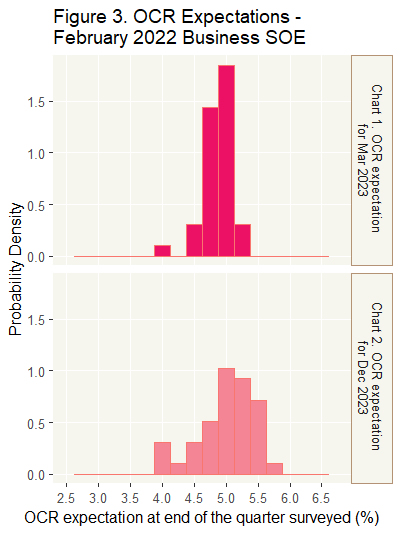
Official Cash Rate (OCR) expectations increased notably by 74 basis points from 4.25% to 4.89% by the end of this quarter. OCR is expected rise further to 5.00% by the end of the year, up from 4.67%.
Australia NAB business confidence rose to 6, conditions rose to 18
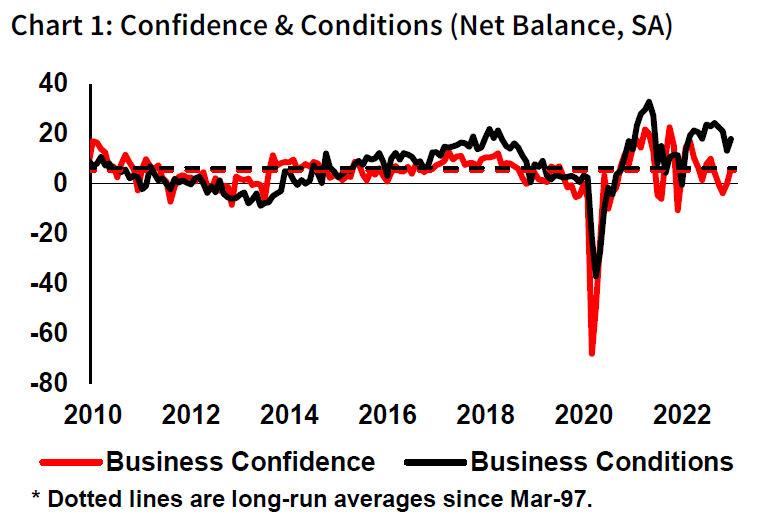
Australia NAB Business Confidence rose further from 0 to 6 in January. Business Conditions also improved from 13 to 18. Looking at some details, trading conditions rose from 20 to 28. Profitability conditions rose from 13 to 17. Employment conditions rose from 9 to 10.
NAB Chief Economist Alan Oster: "Business conditions picked back up in January after three months of softening in late 2022. There were strong increases in conditions for 'upstream' sectors such as wholesale, construction and manufacturing, and importantly, conditions in the more consumer-facing industries remained very strong."
"Confidence dipped into negative territory late in 2022 but is now back around the average after rebounding over the past two months. The improvement in confidence suggest firms have a more optimistic outlook as concerns about global growth prospects ease, while strong conditions are also providing evidence that the economy is more resilient than previously expected."
Australia consumer sentiment dropped back to 78.5, pressures bearing down on consumer becoming intense
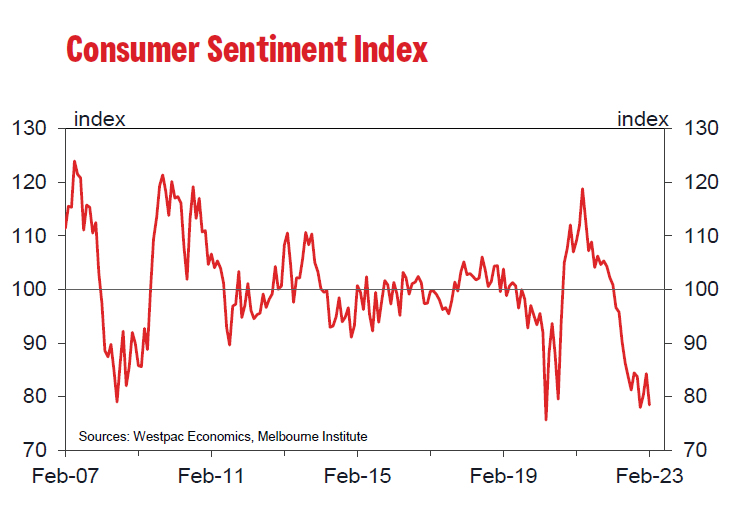
Australia Westpac-Melbourne Institute Consumer Sentiment Index fell -6.9%mom from 84.3 to 78.5 in February. The reading was already below the trough of 79.0 as seen in the global financial crisis, but above the 75.6 low in April 2020 when the pandemic first hit.
Westpac noted: "Cost of living pressures and interest rate rises continue to weigh heavily. Hopes of some easing in both have been dashed by the strong December quarter CPI and the RBA's resumption of its interest rate tightening cycle."
Regarding RBA policy, Westpac expects another 25bps hike to 3.60% on March 7, a pause in April, and then a final 35bps hike in May to 3.85%.
It added, "The consumer sentiment survey continues to give a very clear warning that the pressures bearing down on the consumer are becoming intense. While spending has held up relatively well to date, we expect an abrupt slowdown to show through in coming months."
GBP/USD Recovery Could Fade Above 1.2150
Key Highlights
- GBP/USD is attempting a recovery wave from the 1.2000 support.
- It is facing resistance near 1.2180 and 1.2220 on the 4-hours chart.
- EUR/USD declined to 1.0655 and remains at a risk of more losses.
- The US Consumer Price Index could decline from 6.5% to 6.2% in Jan 2023 (YoY).
GBP/USD Technical Analysis
The British started a major decline from well above the 1.2350 level against the US Dollar. GBP/USD declined below the 1.2200 support to move into a bearish zone.
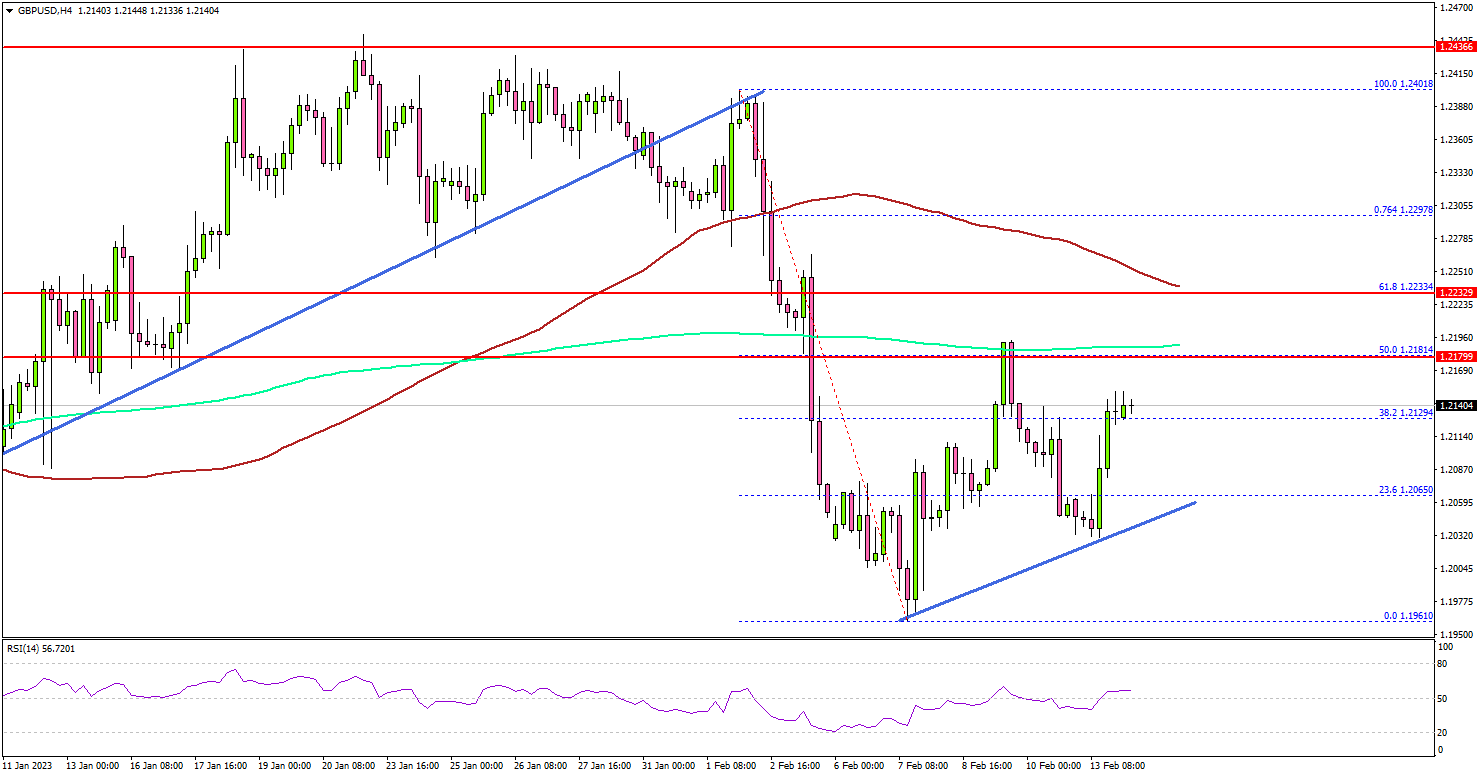
Looking at the 4-hours chart, the pair declined below the 1.2160 support zone, the 100 simple moving average (red, 4-hours), and the 200 simple moving average (green, 4-hours).
There was also a close below the 1.2150 support zone. Finally, it tested the 1.1960 support zone. Recently, the pair started an upside correction and traded above 1.2120. It cleared the 38.2% Fib retracement level of the key decline from the 1.2401 swing high to 1.1961 low.
However, the pair struggled to clear 1.2180 and the 200 simple moving average (green, 4-hours). It is near the 50% Fib retracement level of the key decline from the 1.2401 swing high to 1.1961 low.
The next major resistance is near the 1.2220 level. A clear move above the 1.2220 resistance might start a steady increase towards the 1.2300 resistance zone.
Any more gains could open the doors for a move towards the 1.2400 level, above which the bulls may perhaps aim a retest of the 1.2440 resistance.
Looking at EUR/USD, the pair traded to a new monthly low near 1.0655 and remains at a risk of more losses in the near term.
Economic Releases
- UK Claimant Count Change for Jan 2023 – Forecast 3.0K, versus 19.7K previous.
- UK ILO Unemployment Rate for Dec 2022 (3M) – Forecast 3.7%, versus 3.7% previous.
- US Consumer Price Index for Jan 2023 (MoM) – Forecast +0.5%, versus +0.1% previous.
- US Consumer Price Index for Jan 2023 (YoY) – Forecast +6.2%, versus +6.5% previous.
- US Consumer Price Index Ex Food & Energy for Jan 2023 (YoY) – Forecast +5.5%, versus +5.7% previous.
GBPCAD Wave Analysis
- GBPCAD reversed from key support level 1.6110
- Likely to rise to resistance level 1.6325
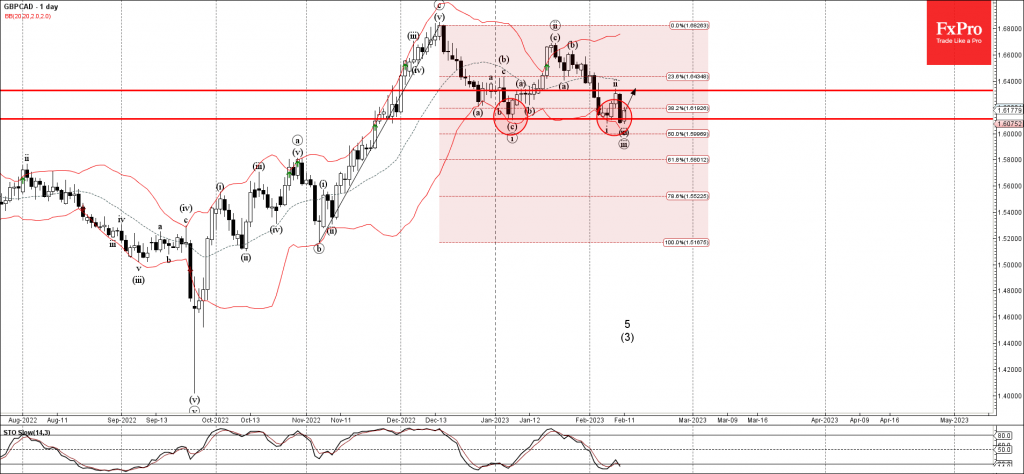
GBPCAD currency pair recently reversed up from the key support level 1.6110 (previous monthly low from January), standing near the lower daily Bollinger Band and the 50% Fibonacci correction of the upward impulse from November.
The upward reversal from the support level 1.6110 stopped the previous minor impulse wave (iii).
Given the oversold daily Stochastic, GBPCAD can be expected to rise further toward the next resistance level 1.6325 (top of the previous short-term correction (ii)).
Sunset Market Commentary
Markets
Markets started off in good spirits. European equities add 0.75%, Wall Street opens 0.2% higher. There weren’t any data scheduled for release but the European Commission’s updated forecasts helped support sentiment. Brussels turned more upbeat on the European economy, predicting a narrow escape from a recession and growth this year of 0.9% vs 0.3% previously. Reasons include a resilient labour market, the mild winter & high gas storage levels. As it happens, the Dutch gas TTF future (€52.05/MWh) is on track for the lowest close since September 2021. Growth for 2024 stayed at 1.5%. Inflation for this year and the next was brought down from 6.1% to a still-high 5.6% and from 2.6% to 2.5% respectively. Some ECB members took the floor today. Governing council member Centeno said the March forecasts will be very important in determining and communicating the path and peak of the policy rate. VP de Guindos underscored the ECB’s data dependence. He said they turned a bit more positive on the economy as well. Fed’s Bowman said the central bank will keep hiking rates to bring inflation back down to 2%. She cited the too-strong labour market. Their comments didn’t really affect core bond markets though. Investors are counting down to tomorrow’s US January CPI reading. The US yield curve’s inversion deepens a tad with the front end adding a few bps (1.6-3.2 bps). The 2y yield (4.54%) is further closing in on its previous cycle high (4.72% close). German yields moves are similar but in more choppy trading. Japan’s 10y yield closed at about the 0.50% upper bound as we go into the official announcement of the new BoJ governor tomorrow. The yen is the notable underperformer in FX space though. USD/JPY rallies to 132.77, testing recent highs/resistance levels. EUR/JPY soars to 141.77. Other currency pairs trade muted. EUR/USD was testing the 1.068 support level this morning … and is still there 10 hours later. It is a strong reference though, coinciding with the 23.6% dollar recovery on the Sep 2022-Feb 2023 decline and the lower bound of the upward sloping EUR/USD trend channel. The trade-weighted greenback holds near recent highs at around 103.67. Sterling awaits a load of economic data later this week, including the labour market report, January inflation and retail sales. That doesn’t prevent the pound from gaining a few ticks on the upbeat risk environment. EUR/GBP again went for a test of the 0.882 support before paring losses to 0.884 after a break lower failed.
News & Views
Inflation in Switzerland in January reaccelerated at a faster pace than expected. Headline inflation rose 0.6% M/M bringing the Y/Y measure at 3.3% (compared with -0.2% M/M and 2.8% Y/Y in December). The rise was mainly due to higher electricity and gas prices. Prices at restaurants and hotels also rose substantially (2.1% M/M). Goods prices gained 1.1% M/M and 5.9% Y/Y. For services this was respectively 0.3% M/M and 1.3% Y/Y. Core inflation was unchanged from December, but 2.2% higher compared to the same month last year. While Swiss inflation stays low compared the other European countries, (headline and core) inflation holding above the 0.0%/2.0% zone remains a source of concern for the Swiss National Bank. The SNB raised the policy rate by a cumulative 175 bps starting in June of last year to currently 1.0%. The next SNB policy meeting is scheduled on March 23. Above target inflation and decisive action from the ECB keep the debate open on even an additional 50 bps SNB hike. After some modest losses mid-January the Swiss franc recently rebounded back below the EUR/CHF parity (currently 0.9855).
The current account balance in Poland deteriorated in December to a deficit of PLN 11.8 bln consisting amongst others of a negative trade balance of goods (PLN 12.7 bln), negative primary and secondary income balance (PLN 11.8 bln) and positive balance of services (PLN 12.7 bln). With respect to trading of goods, volumes of both exports and imports declined substantially from November, but still were respectively 13.0% and 13.7% higher compared to December 2021. The increase in the value of exports was driven primarily by the performance of the automotive sector. Fuel continued to have the largest impact on the growth of imports. The trade balance deficit at PLN 12.7 bln was PLN 2.2 bigger compared to the same month last year. While smaller than the peak deficit in March 2022, the trade deficit remains rather high by historical standards. The polish zloty recently underperformed the Czech koruna and the Hungarian forint and this trend continued today. The zloty weakened to currently trade at EUR/PLN 4.7925.
Brent: One Step Forward, Two Steps Back
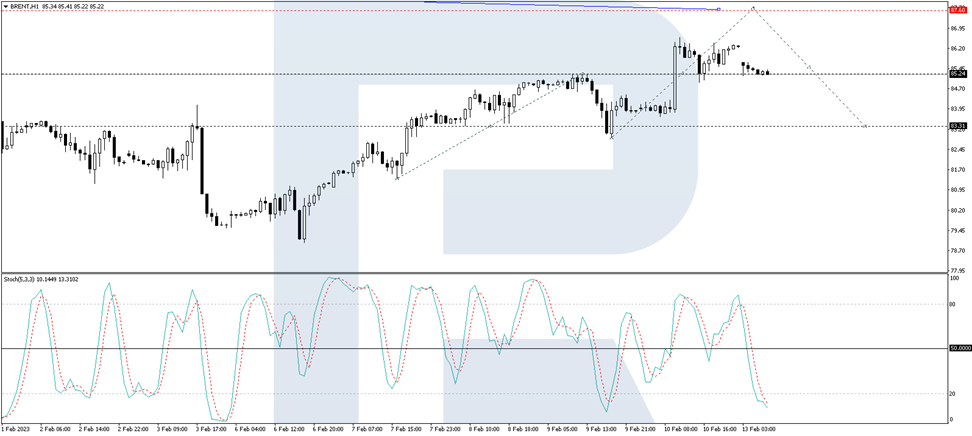
On Monday, a Brent barrel is declining to 85.50 USD.
At the end of last week, crude oil prices grew by almost 2%. This was the market reaction to the decision of the Russian Federation to cut down on oil mining by 0.5 million barrel a day starting March 2023. Decreased production volumes might balance out the supply/demand ratio and will let suppliers wait for the recovery of the Chinese economy without extra emotions.
At the same time, the growth of the USD holds back too obvious growth of oil prices.
Drilling activity in the US has increased. According to Baker Hughes, over a week the number of oil drilling rigs grew by 10 facilities to 609 drilling rigs.
On H4, a wave of growth to 87.60 is continuing. After this level is reached, a correction to the low of 83.30 should become possible, followed by growth to 92.10. The goal is local. Technically, this scenario is confirmed by the MACD. Its signal line is headed strictly upwards to new highs.
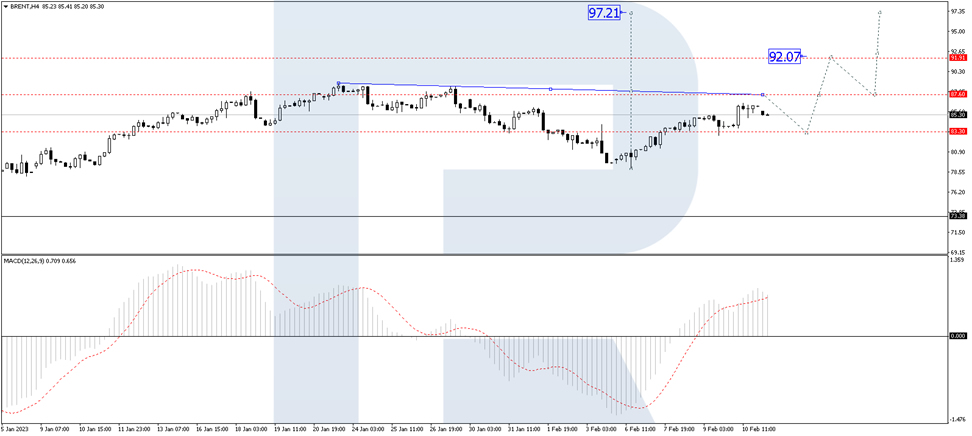
On H1, Brent keeps developing the fifth structure of growth to 87.60. After this level is reached, a decline to 82.54 should follow (a test from above), and next – growth to 88.00. Technically, this scenario is confirmed by the Stochastic oscillator. Its signal line is under 20, getting ready to start growing. It should reach 50, break through it and even reach 80.
Fed Bowman: It will be necessary to further tighten monetary policy
Fed Governor Michelle Bowman said in a speech, "we are still far from achieving price stability, and I expect that it will be necessary to further tighten monetary policy to bring inflation down toward our goal".
"My views on the future path of monetary policy will continue to be informed by the incoming data and its implications for the outlook," she said.
"I will continue to look for consistent evidence that inflation remains on a downward path when considering further rate increases and at what point we will have achieved a sufficiently restrictive stance for the policy rate."
GBP/USD Mid-Day Outlook
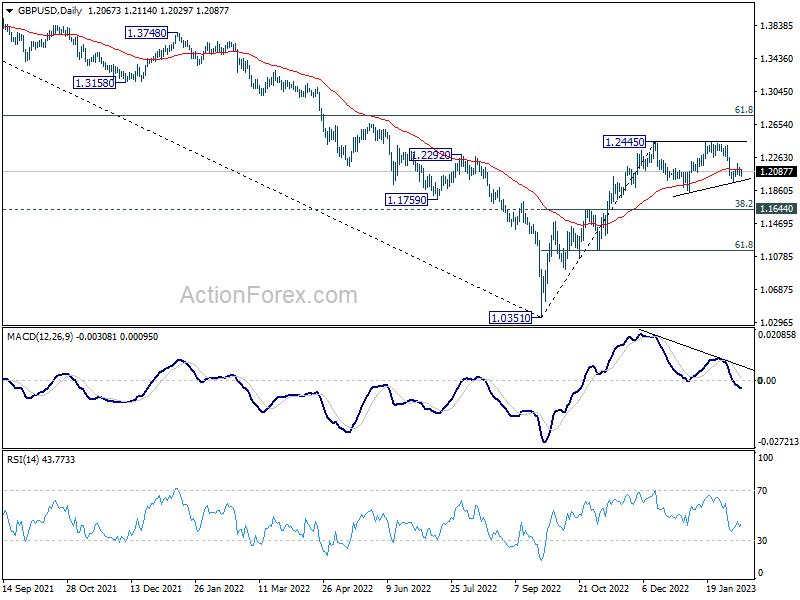
Daily Pivots: (S1) 1.2023; (P) 1.2081; (R1) 1.2116; More...
Intraday bias in GBP/USD stays neutral at this point. Further decline is still mildly in favor. On the downside, break of 1.1960 will resume the fall from 1.2446, as the third leg of the corrective pattern from 1.2445, to 1.1840 support, and possibly below. On the upside, though, break of 1.2192 will resume the rise from 1.1960 to retest 1.2445/6.
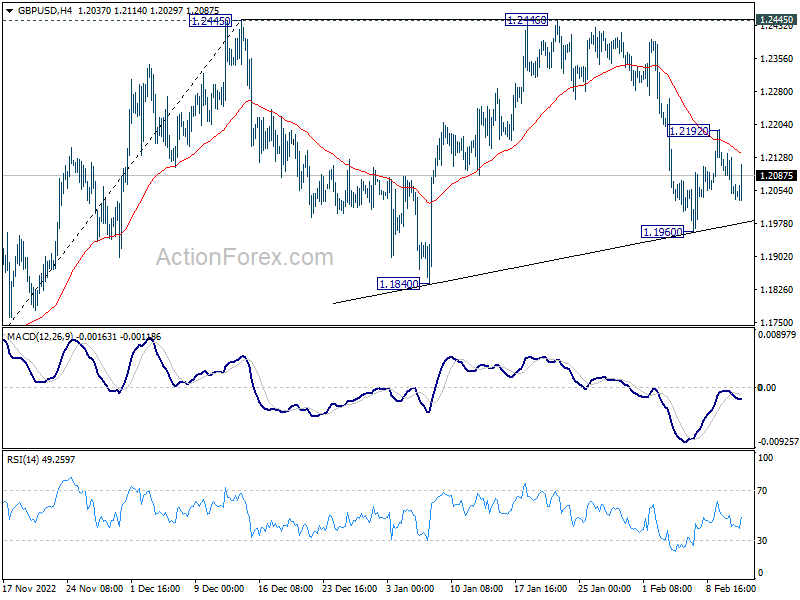
In the bigger picture, rise from 1.0351 medium term bottom is at least correcting whole down trend from 1.4248 (2021 high). Further rise is expected as long as 1.1644 resistance turned support holds. Next target is 61.8% retracement of 1.4248 to 1.0351 at 1.2759. Sustained break there will pave the way back to 1.4248.