Sample Category Title
GBP/JPY Daily Outlook
Daily Pivots: (S1) 159.04; (P) 160.11; (R1) 161.84; More...
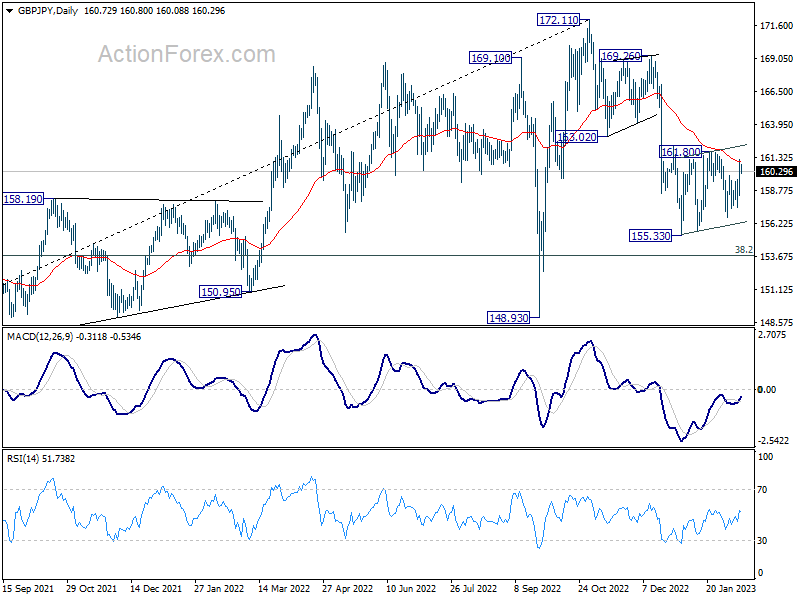
Intraday bias in GBP/JPY remains neutral for the moment. Further decline is mildly in favor. On the downside, break of 155.33 low will resume the fall from 172.11 to 153.70 fibonacci level next. On the upside, sustained trading above 55 day EMA (now at 160.99) will turn bias to the upside, for stronger rise back to 169.26/172.11 resistance zone.
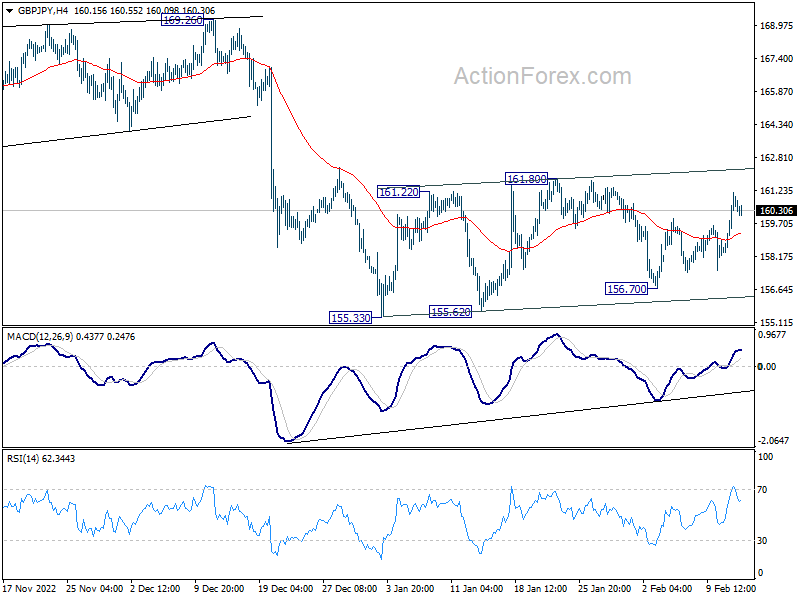
In the bigger picture, as long as 163.02 support turned resistance holds, decline from 172.11 medium term top is expected to continue to 38.2% retracement of 123.94 to 172.11 at 153.70. Sustained break there will raise the change of trend reversal and target 61.8% retracement at 142.34. Nevertheless, break of 163.02 support turned resistance will argue that the decline has completed, and retain medium term bullishness.
EUR/JPY Daily Outlook
Daily Pivots: (S1) 140.70; (P) 141.54; (R1) 142.87; More....
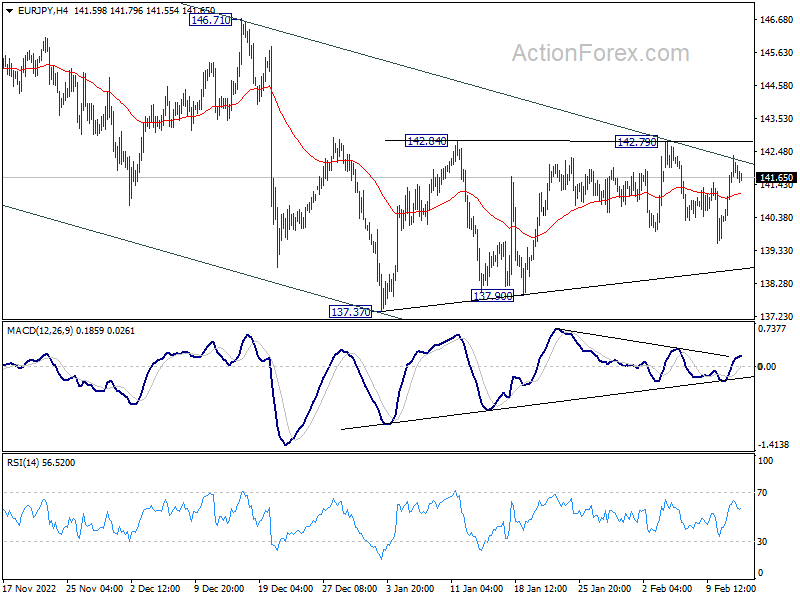
Intraday bias in EUR/JPY stays neutral at this point. Further decline is mildly in favor. Break of 137.37 will resume the whole fall from 148.38 to 135.40 fibonacci level. On the upside, however, break of 142.84 will argue that the correction from 148.38 has completed at 137.37 already. Further rise would be seen to 146.71 resistance next.
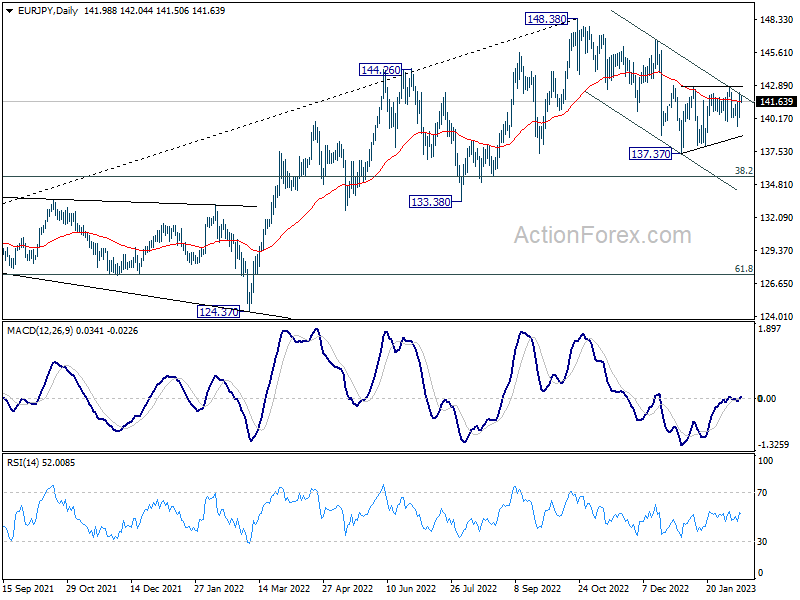
In the bigger picture, as long as 55 week EMA (now at 138.87) holds, larger up trend from 114.42 (2020 low) is still in progress for 149.76 long term resistance. However, firm break of 55 week EMA will bring deeper fall to 38.2% retracement of 114.42 to 148.38 at 135.40. Sustained break there will raise the chance of trend reversal, and target 61.8% retracement at 127.39.
EUR/GBP Daily Outlook
Daily Pivots: (S1) 0.8814; (P) 0.8844; (R1) 0.8865; More...
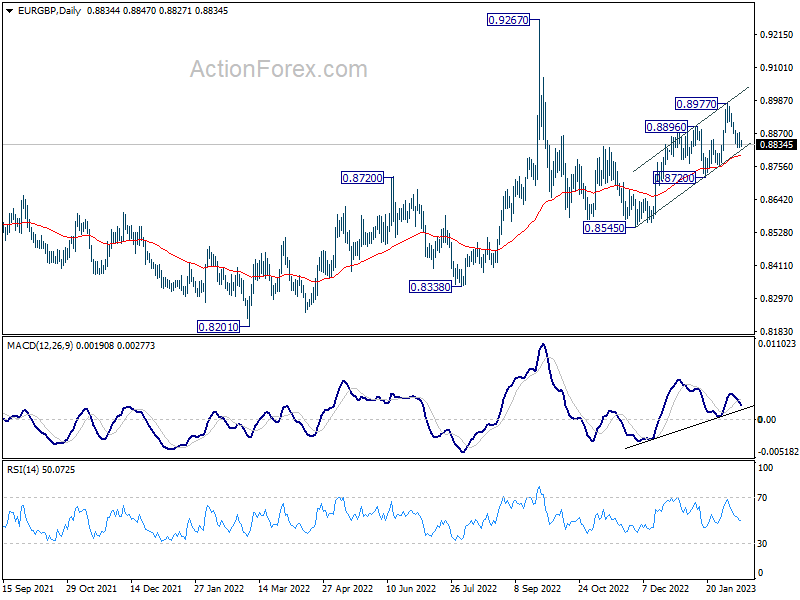
Intraday bias in EUR/GBP remains neutral and outlook is unchanged. Further rally is expected as long as 0.8720 support holds. On the upside, break of 0.8977 will resume whole rebound from 0.8545 towards 0.9267 high. On the downside, however, break of 0.8270 will turn near term outlook bearish again.
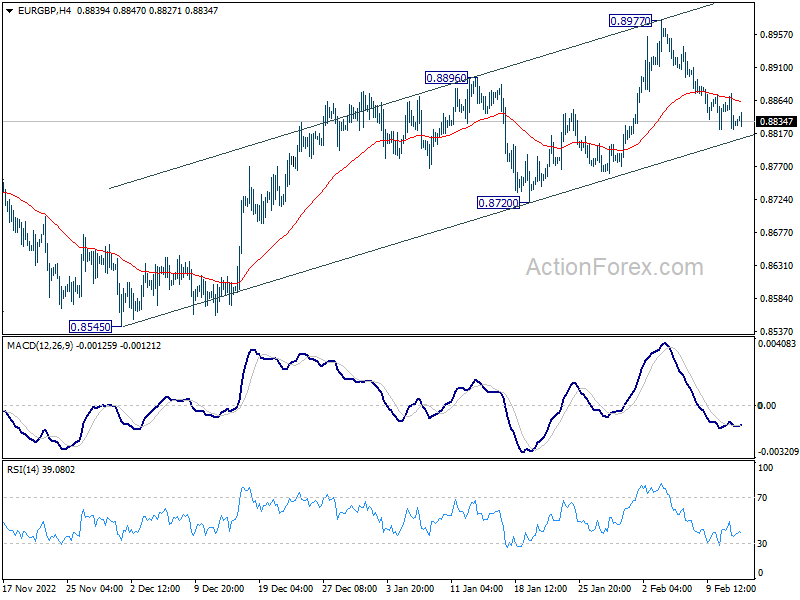
In the bigger picture, the notable support from 55 day EMA (now at 0.8780) retains near term bullishness. Break of 0.8896 should target 0.9267 (2022 high) and possibly above, to resume whole up trend from 0.8201 (2022 low). However, break of 0.8270 support and sustained trading below 55 day EMA will set the stage for 0.8545 and below.
EUR/AUD Daily Outlook
Daily Pivots: (S1) 1.5360; (P) 1.5416; (R1) 1.5453; More...
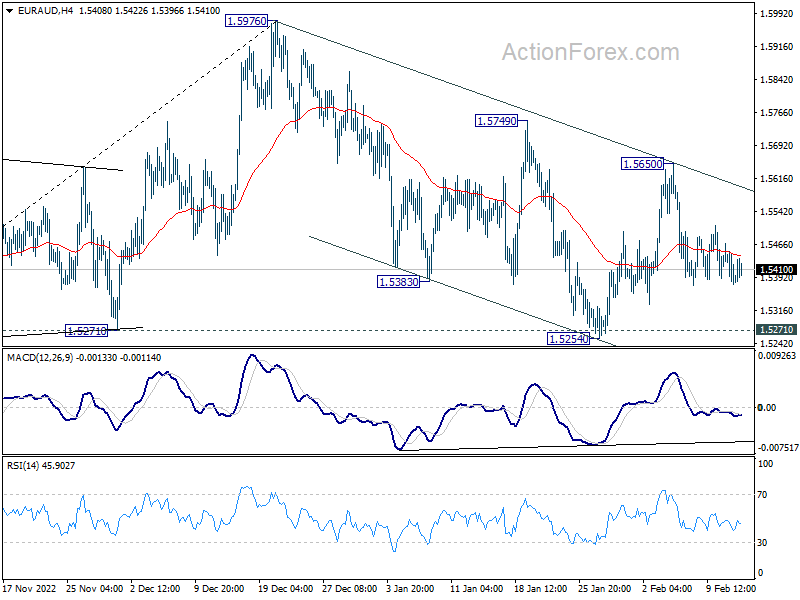
Intraday bias in EUR/AUD stays neutral and outlook is unchanged. On the downside, firm break of 1.5254/71 will carry larger bearish implication and resume the fall from 1.5976. On the upside, above 1.5650 will resume the rebound to 1.5749 resistance.
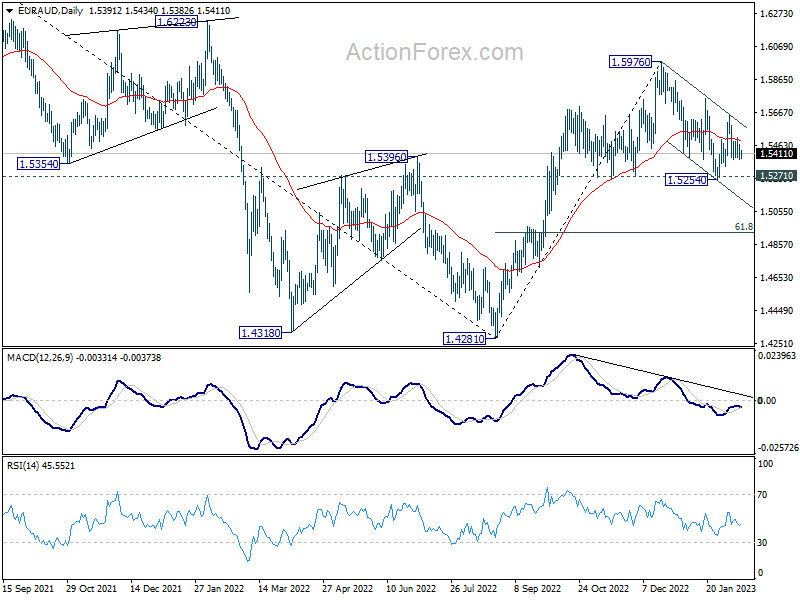
In the bigger picture, it's still early to confirm if rise from 1.4281 represents bullish trend reversal. But as long as 1.5271 support holds, such rally is in favor to continue. Break of 1.5976 will target 1.6434 key resistance next. On the other hand, firm break of 1.5271 will retain medium term bearishness instead.
EUR/CHF Daily Outlook
Daily Pivots: (S1) 0.9846; (P) 0.9862; (R1) 0.9877; More....
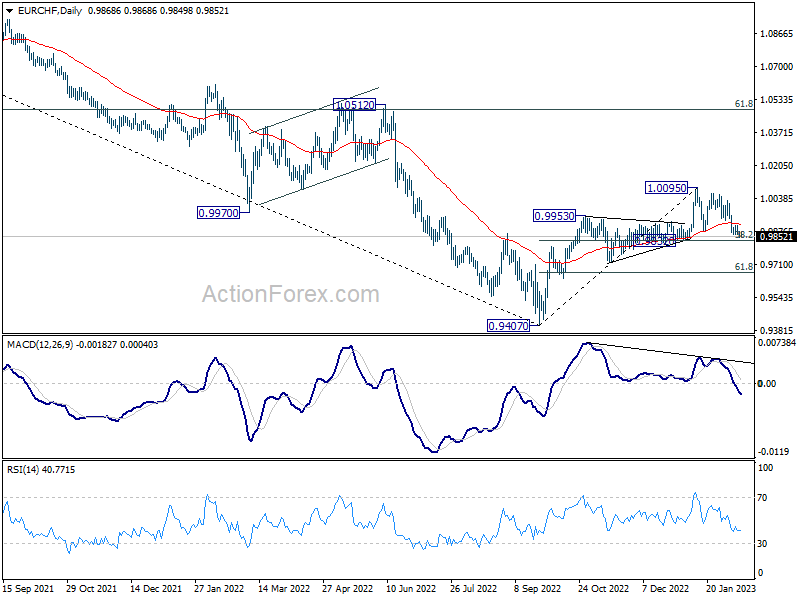
No change in EUR/CHF's outlook as fall from 1.0067 could extend lower. But downside should be contained by 38.2% retracement of 0.9407 to 1.0095 at 0.9832 to complete the corrective pattern from 1.0095. On the upside, break of 0.9905 minor resistance will turn bias back to the upside for 1.0067/95 resistance zone. However, sustained break of 0.9832 will carry larger bearish implications.
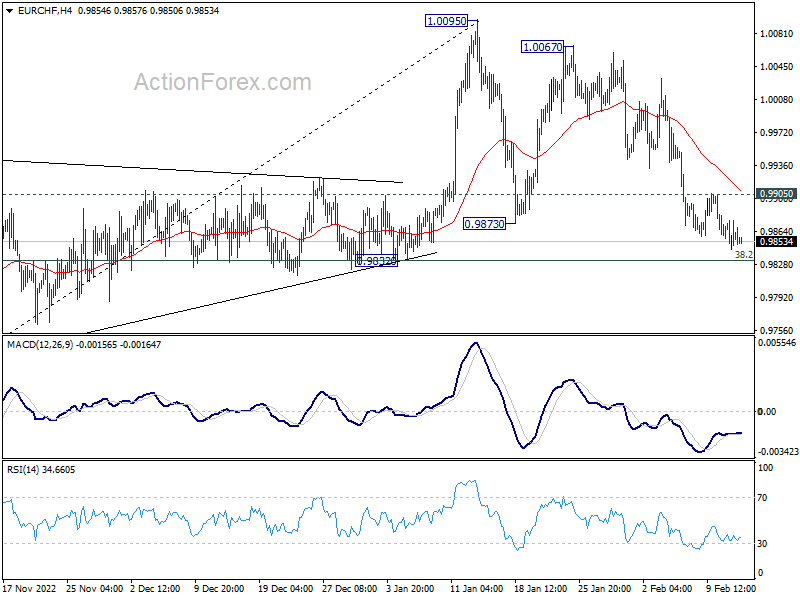
In the bigger picture, the rejection by 55 week EMA (now at 1.0025) mixed up the outlook. On the upside, sustained trading above 55 week EMA will raise the chance of bullish trend reversal. Rise from 0.9407 should then target 1.0505 cluster resistance (2020 low at 1.0505, 61.8% retracement of 1.1149 to 0.9407 at 1.1484). However, firm break of 0.9832 support will revive medium term bearishness and bring retest of 0.9407 low instead.
Today It’s All Counting Down to this Afternoon’s US January CPI Report
Markets
Upcoming key US inflation data didn’t prevent a constructive start to the new trading week. Equities gradually gained traction during European and US dealings. The economic forecasts of the European Commission lowered this and next year’s inflation outlook to 5.9% (from 6.1%) and 2.5% (from 2.6%). 2023 growth was upwardly revised to 0.9% from 0.3%. Lower inflation and higher growth evidently are good news for risk assets, but the revision was no big surprise. Still the Euro Stoxx 50 gained 1.03%. US indices closed higher between 1.1% (Dow) and 1.4% (Nasdaq). Bond markets showed a mixed picture. In the end, the US curve again inverted further with the 2-y yield unchanged but the 30-y ceding 4.3 bps. German short term yields (2y & 5y) added about 2 bps. Longer maturities were little changed. On FX markets, the dollar struggled as risk sentiment stayed mild. DXY failed to try a new attack on last week’s 103.96 correction top (close 103.34). USD/JPY closed at 132.41 (from 131.28), but this was mainly yen weakness as markets scaled back expectations for a real hawkish BoJ policy change under new governor Ueda.After setting a new ST correction low early in the session, EUR/USD also captured a better bid in line with equities to close the day at 1.0723. EUR/GBP declined quite sharply intraday. The pair tested last week’s low near EUR/GBP 0.8825, but a break didn’t occur (close 0.8836).
This morning, Asian equites again underperform compared to the US and Europe yesterday (gains of <1.0%, China little changed). US yields are easing marginally and so does the dollar (DXY 103.15; USD/JPY 132.0; EUR/USD 1.0735). Of course, today it’s all counting down to this afternoon’s US January CPI report. The monthly dynamics for headline CPI is expected to reaccelerate to 0.5% (from 0.1%) bringing the Y/Y measure at an expected 6.2% (from 6.5%). Core inflation is expected at 0.4% M/M and 5.5% (from 5.7%). The data might be an indication that easy part of the deceleration in inflation might be behind us. An upward surprise (which we see as possible) could reinforce the Fed-rhetoric to bring the policy rate well above 5.0% and keep it at an elevated level for longer. US short-term yields already discount a Fed peak policy rate close to 5.20%. In case of upward surprise, the key question is whether this will trigger a further inversion of the US yield curve or whether expectations for interest rates to stay high for longer will also lift yields at the belly of the curve. First resistance for the US 5y and 10-y yield respectively stand at 4.03% and 3.90%. Signs of stubbornly high inflation, annex a hawkish Fed reaction also could support recent USD rebound. For EUR/USD first support comes in at 1.0680/56. UK labour market data this morning came out strong with a monthly job growth of 107k and weekly earnings ex-bonus at 6.7% from 6.4%. Sterling jumps higher in a first reaction with EUR/GBP again closing in on the 0.8825 support area.
News Headlines
The Biden administration yesterday announced the sale of another 26 million barrels of oil from its Strategic Petroleum Reserve. These will be released on the market in April and will take the SPR to a new low dating back to 1983. The US sold an unprecedented amount of 180 mln barrels from the reserves last year to counter surging energy prices after the Russian invasion. This time however, the sale is actually required by 2015 legislation. US lawmakers have used SPR sales as a way to finance spending proposals, often through mandates that the sales occur years in the future, as is the case now. But with SPR at historically low levels, the move draws criticism and the Energy Department itself has sought to stop it. The US WTI oil reference after the announcement dropped from intraday highs around $80.5/barrel to just north of $79.
US CPI Will Determine Whether the S&P 500 Deserves a Further Rally, or Not
Market bulls have endless optimism this year, it is amazing. Whether it is funded or not, is yet to be seen.
Because the major market action happens against the Federal Reserve (Fed), and its claim that it will take the rates higher than 5% and keep it there and not cut it before the year ends, there is not much consensus.
Some see ‘the recent move higher in front-end rates is supportive of the notion that the Fed may remain restrictive for longer than expected’ but that ‘the equity market is refusing to accept this reality’ (JP Morgan). While some think that the bear market is over, and that ‘healthy balance-sheets at both the corporate and consumer level suggest a subdued level of systemic risk, meaning the catalyst for an extended market downturn is largely absent’ (Wells Fargo).
I don’t necessarily see a solid funding for an extended rally in the markets, unless we have fundamentally good news.
And slowing inflation is the type of fundamentally good news that I am looking for.
Because slower inflation doesn’t only mean a healthier economy and less pain for the future, but it means that the Fed could indeed soften the tone as the policy rate approaches the 5% level, and a weakening pressure on borrowing costs could give a loving hand to the stocks and bonds.
The problem is, nothing is less sure than the idea that we will see a sufficiently soft inflation report from the US today.
A few indicators point at a certain uptick in inflation in January figures, as
- Energy and commodity prices were up for the first three weeks of the year, though they gave a part of gains, January prices were impacted by higher energy and commodity prices.
- The prices of used cars in the US unexpectedly rose in January.
- The rapid fall in inflation since last summer was due to the retreat in energy and second-hand car prices, but also due to the easing tensions on supply chains and falling transportation costs post-pandemic. But nowadays, warehouses and distribution centers are reportedly pushing rates higher. According to a CNBC news, US storage prices went up 1.4% over the month and nearly 11% over the year, and that could apply some fresh pressure on consumer prices.
What we know is, there will be a point where inflation will be harder to pull lower, than it has been when the CPI was flashing above 9%.
Where is that point, is anybody’s guess. But as the CPI numbers move lower, it may be difficult to see big chunks of easing.
For today, the expectation is that the US headline CPI may have slowed to 6.2% in January, from 6.5% printed a month earlier, on a yearly basis. The core inflation is seen going down to 5.5% from 5.7% from a month earlier.
On a monthly basis, core inflation is seen stable around 0.4%, while headline inflation is seen ticking higher from 0.1% to 0.5%.
A sufficiently soft, or ideally a softer-than-expected CPI read today should give an additional boost to the equity bulls and push the S&P500 to fresh highs in the actual positive trend.
A stronger inflation read, on the other hand, could easily bring the Fed hawks back to the marketplace and send the S&P5600 tumbling. The next key support stands at 4030, the minor 23.6% retracement level on October to February.
In the FX
The US dollar has seen a crowd of sellers above the 50-DMA. A strong inflation data could finally send the dollar index sustainably above its 50-DMA, while a soft reading will be a good reason to sell the rebound.
The EURUSD continues its own struggle around the 50-DMA. The EU raised its growth forecast generously from 0.3% to 0.9% for this year. All member states will grow except from Sweden.
But but… Germany and Austria will still suffer two straight negative quarters while Italy will feel the pain during the first three quarters.
It’s not brilliant. But at least it doesn’t get on the way of rate hikes expectations from the European Central Bank (ECB).
In Japan, Kazuo Ueda has been nominated as the next Bank of Japan (BoJ) governor. There are rumours that the new BoJ leader could scrap the YCC policy. The yen was better bid in Tokyo, but the US CPI data is probably what will determine the short-term direction both in EURUSD and the USDJPY.
What do we really, really want?
What everyone wants to see is a soft US CPI figure, a softer US dollar, strong equities, improved bonds, and stronger other currencies.
What everyone fears however is a figure that’s not convincingly softer.
The only sure thing is, the CPI days are known for their high intraday volatility.
Bracing for US CPI
Market movers today
Today's market highlight will be the US CPI print for January. We forecast core CPI at 0.4% m/m, which is on the upper end of consensus forecasts. An upside surprise to 0.5% m/m or above would mark a clear upturn in the broader underlying inflation pressures and could take EUR/USD another leg lower (read more in Research US - Soft landing to no landing?, 9 February). We will also hear from Fed's Harker and Williams later today.
In the UK the jobs report for December is on the agenda. Although Bank of England has signalled it is nearing the end of its hiking cycle, a still tight labour market and sticky wage pressure could keep it from pausing just yet.
In Norway and Denmark GDP figures for Q4 2022 will be released.
The 60 second overview
Fed survey shows drop in wage expectations: The monthly New York Fed survey of consumer expectations showed a drop in median expectations for income growth to 3.3% from 4.6% suggesting that wage pressures may be easing. 1-year inflation expectations were unchanged at 5.0% while the 3-year inflation expectations dropped from 2.9% to 2.7%. It is a slightly better picture than what the survey from University of Michigan showed on Friday, where 1-year inflation expectations increased a bit. However, the probability of losing a job dropped to 12.0%, still below the pre-pandemic average around 14.5% and in line with other indicators showing a robust employment picture.
US and China weigh meeting in Munich: US and China consider a meeting between Secretary of State Anthony Blinken and China's top foreign diplomat Wang Yi at the side lines of the Munich Security Conference starting on Friday. It would be the first face-to-face meeting since the shoot-down of the alleged Chinese 'spy balloon' 10 days ago. While a meeting would likely be tense, it would be positive to see a willingness to resume dialogue from both sides. It is still unclear if a meeting will be put in place, though. US Deputy Secretary of State Wendy Sherman yesterday said that "we are open to dialogue when it is in our interest to do so and we believe the conditions are right".
Fed Vice Chair Lael Brainard to be top adviser for Biden: A source close to the White House reports that Brainard has been picked to head the National Economic Council in the Biden administration, leaving a new open seat in an influential role at the Fed.
NATO says Russian offensive is under way: NATO Chief Jens Stoltenberg yesterday backed reports that a major new Russian offensive had begun with the city of Bakhmut under heavy shelling. "We see how they are sending more troops, more weapons, more capabilities," Stoltenberg said. Defence ministers from several NATO countries will meet in Germany on Tuesday to discuss possible further military aid.
Equity optimism returned yesterday with indices in Europe and US cruising higher before close. No surprise to see the group of cyclical growth companies leading advances on a day when sentiment slowly but steadily improved during the day. Investor positioning has changed a lot in the first six weeks of 2023 but the pain trade is still higher as it takes time for people to leave the expectation of a near-term recession. In US Dow +1.1%, S&P 500 +1.1%, Nasdaq +1.5% and Russell 2000 +1.2%. Asian markets are catching this morning with most market higher while European and US futures are slightly lower.
FI: Global rates were mostly range trading through the day, amid a few central bank comments. The 10y point ended broadly unchanged on the day across European jurisdictions. Markets added more tightening on ECB pricing which is now priced to a peak policy rate at 3.65% from currently 2.5%. Generally curves bear flattened, with the 2y ending 2bp higher at 2.77% (Germany). The EC followed the general upward revisions from market participations of growth outlook in the euro area by 0.6pp to 0.9% for 2023 - and lower inflation by 0.5pp to 5.6%.
FX: Overnight, Kazuo Ueda has been nominated new head of Bank of Japan, and the Yen strengthens somewhat on the back of this news. The USD is weakening slightly in anticipation of today's US CPI report, which should stake out direction both for FX but also risk near-term. EUR/USD once again above 1.07 and Scandies gaining a tad as well.
Nordic macro
Norwegian GDP growth was much stronger than expected towards the end of last year. Although we expect it to slow in December, with mainland GDP falling 0.2% m/m, this would still give solid growth of 0.7% q/q for Q4. That said, it will be worth keeping an eye out for any revisions of previous data, as these can sometimes change the picture quite considerably.
In Sweden, Riksbank governor Erik Thedéen will speak at a seminar on the current economic situation and monetary policy. Given that the minutes will not be released until 20 February, he will have to stick to the official script from last week's MPR. That said, the market will likely be attentive to any flash comments from the seminar.
EUR/USD Moving into 1.08 Resistance ahead of US CPI
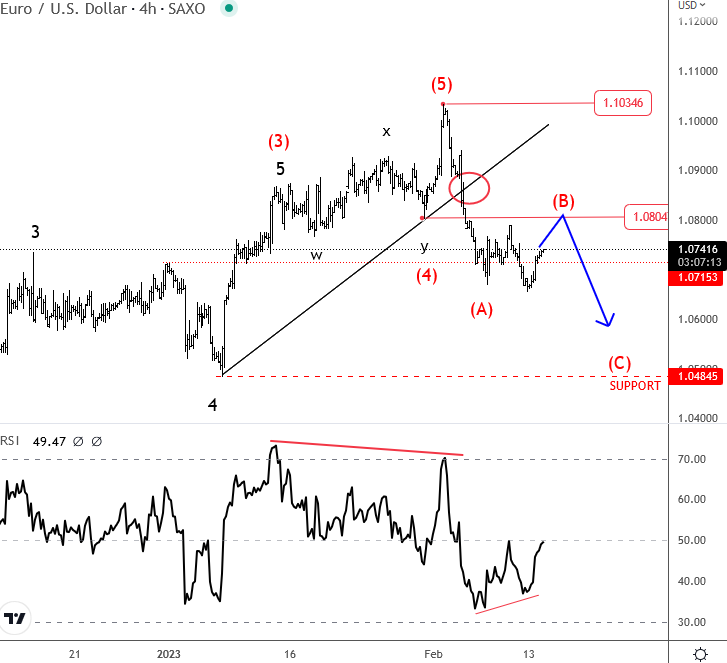
Welcome to a very important US CPI day, which is widely expected as numbers can give us more clarity about what's the FED going to do next. Will they look for more hikes, even to 50bp if data disappoints, or will inflation come even lower, and they are done with hikes soon? No one knows the answer at this point, but what we know is that the corrective drop on EURUSD looks incomplete and that we are waiting on A-B-C formation.
Notice that EURUSD pair came sharply down since start of February following FED, ECB and BoE policy decisions. We can see a strong sell-off through the rising trendline support when the price accelerated lower after good US jobs data reported for January. From an Elliott wave perspective we see that drop as an impulse so ideally there will be more weakness coming. However, we will be tracking only a three-wave drop, an A-B-C structure; currently still in subwave wave (B) so more weakness can be seen after the rally back to 1.08 resistance.
If you want more detailed outlook on USD and other markets, make sure to check our video below.
https://www.youtube.com/watch?v=5CJplx_ZsxA
UK payrolled employees rose 102k in Jan, unemployment rate at 3.7% in Dec
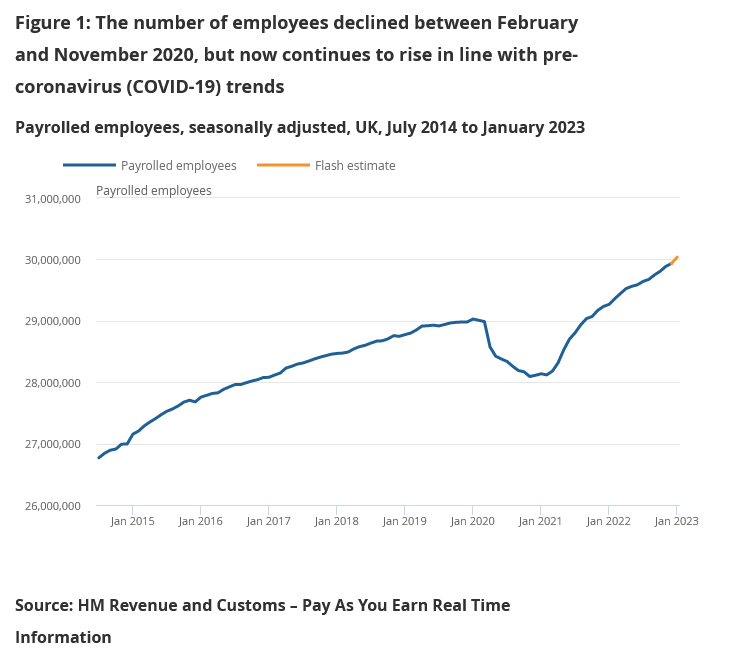
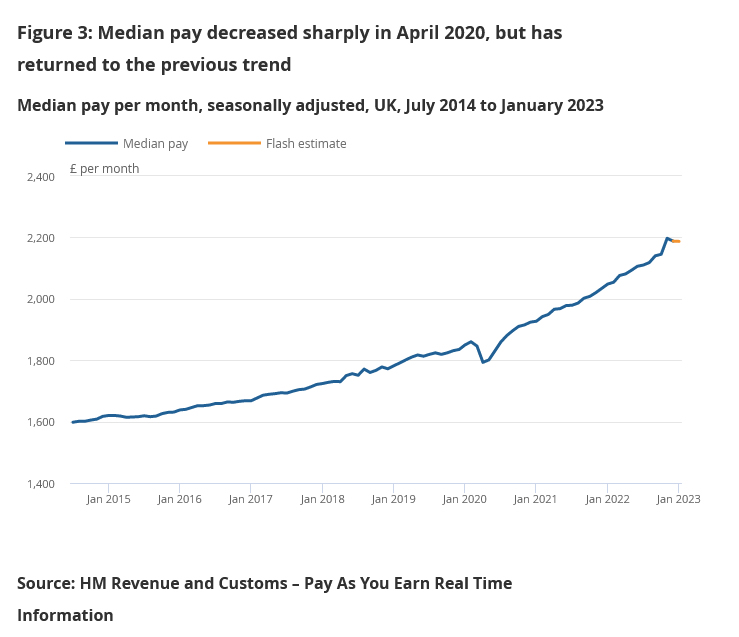
In January, UK payrolled employees rose 0.3% mom or 102k. Comparing with the same month a year ago, payrolled employees rose 2.6% yoy or 768k. Median monthly pay rose 6.8% yoy. Claimant count dropped -12.9k, versus expectation of 9k rise.
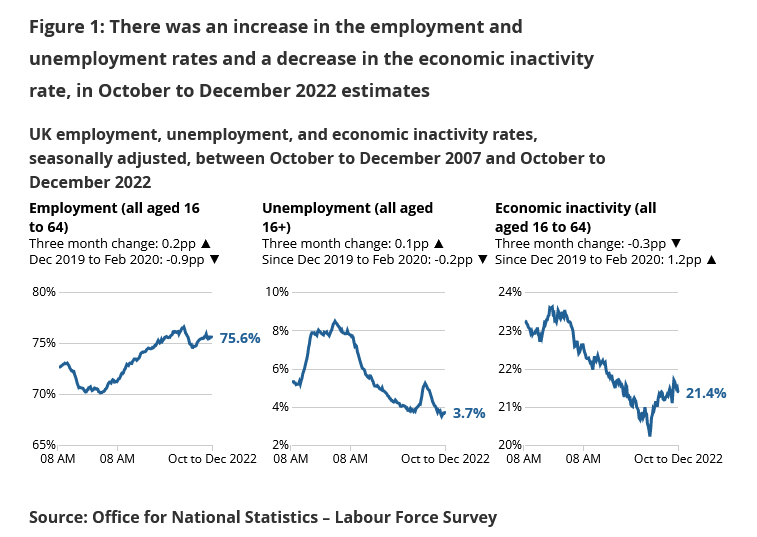
In the three months to December, unemployment rate came in at 3.7%, 0.1% higher than the three-month period. Employment rate was at 75.6%, 0.2% higher than the previous three-month period. Economic inactivity rate was at 21.4%, 0.3% lower than the previous three-month period. Average earnings excluding bonus was up 6.7% 3moy, above expectation of 6.5%. Average earnings including bonus was up 5.9% 3moy, below expectation of 6.2%.