Sample Category Title
Summary 11/28 – 12/2
Monday, Nov 28, 2022
| GMT | Ccy | Events | Consensus | Previous |
|---|---|---|---|---|
| 00:30 | AUD | Retail Sales M/M Oct | 0.50% | 0.60% |
| 09:00 | EUR | Eurozone M3 Money Supply Y/Y Oct | 6.50% | 6.30% |
| 13:30 | CAD | Current Account (CAD) Q3 | 2.7B | |
| 23:30 | JPY | Unemployment Rate Oct | 2.60% | 2.60% |
| 23:50 | JPY | Retail Trade Y/Y Oct | 5.00% | 4.50% |
| GMT | Ccy | Events | |
|---|---|---|---|
| 00:30 | AUD | Retail Sales M/M Oct | |
| Forecast: 0.50% | Previous: 0.60% | ||
| 09:00 | EUR | Eurozone M3 Money Supply Y/Y Oct | |
| Forecast: 6.50% | Previous: 6.30% | ||
| 13:30 | CAD | Current Account (CAD) Q3 | |
| Forecast: | Previous: 2.7B | ||
| 23:30 | JPY | Unemployment Rate Oct | |
| Forecast: 2.60% | Previous: 2.60% | ||
| 23:50 | JPY | Retail Trade Y/Y Oct | |
| Forecast: 5.00% | Previous: 4.50% | ||
Tuesday, Nov 29, 2022
| GMT | Ccy | Events | Consensus | Previous |
|---|---|---|---|---|
| 08:00 | CHF | GDP Q/Q Q3 | 0.20% | 0.30% |
| 09:30 | GBP | M4 Money Supply M/M Oct | 2.10% | |
| 09:30 | GBP | Mortgage Approvals Oct | 67K | |
| 10:00 | EUR | Eurozone Economic Sentiment Nov | 93 | 92.5 |
| 10:00 | EUR | Eurozone Industrial Confidence Nov | -0.8 | -1.2 |
| 10:00 | EUR | Eurozone Services Sentiment Nov | 3.4 | 1.8 |
| 10:00 | EUR | Eurozone Consumer Confidence Nov F | -23.9 | |
| 13:00 | EUR | Germany CPI M/M Nov P | 2.00% | 0.90% |
| 13:00 | EUR | Germany CPI Y/Y Nov P | 10.90% | 10.40% |
| 13:30 | CAD | GDP M/M Sep | 0.20% | 0.10% |
| 14:00 | USD | S&P/Case-Shiller Home Price Indices Y/Y Sep | 10.70% | 13.10% |
| 14:00 | USD | Housing Price Index M/M Sep | -1.20% | -0.70% |
| 15:00 | USD | Consumer Confidence Nov | 100.0 | 102.5 |
| 21:45 | NZD | Building Permits M/M Oct | 3.80% | |
| 23:50 | JPY | Industrial Production M/M Oct P | -1.80% | -1.70% |
| GMT | Ccy | Events | |
|---|---|---|---|
| 08:00 | CHF | GDP Q/Q Q3 | |
| Forecast: 0.20% | Previous: 0.30% | ||
| 09:30 | GBP | M4 Money Supply M/M Oct | |
| Forecast: | Previous: 2.10% | ||
| 09:30 | GBP | Mortgage Approvals Oct | |
| Forecast: | Previous: 67K | ||
| 10:00 | EUR | Eurozone Economic Sentiment Nov | |
| Forecast: 93 | Previous: 92.5 | ||
| 10:00 | EUR | Eurozone Industrial Confidence Nov | |
| Forecast: -0.8 | Previous: -1.2 | ||
| 10:00 | EUR | Eurozone Services Sentiment Nov | |
| Forecast: 3.4 | Previous: 1.8 | ||
| 10:00 | EUR | Eurozone Consumer Confidence Nov F | |
| Forecast: | Previous: -23.9 | ||
| 13:00 | EUR | Germany CPI M/M Nov P | |
| Forecast: 2.00% | Previous: 0.90% | ||
| 13:00 | EUR | Germany CPI Y/Y Nov P | |
| Forecast: 10.90% | Previous: 10.40% | ||
| 13:30 | CAD | GDP M/M Sep | |
| Forecast: 0.20% | Previous: 0.10% | ||
| 14:00 | USD | S&P/Case-Shiller Home Price Indices Y/Y Sep | |
| Forecast: 10.70% | Previous: 13.10% | ||
| 14:00 | USD | Housing Price Index M/M Sep | |
| Forecast: -1.20% | Previous: -0.70% | ||
| 15:00 | USD | Consumer Confidence Nov | |
| Forecast: 100.0 | Previous: 102.5 | ||
| 21:45 | NZD | Building Permits M/M Oct | |
| Forecast: | Previous: 3.80% | ||
| 23:50 | JPY | Industrial Production M/M Oct P | |
| Forecast: -1.80% | Previous: -1.70% | ||
Wednesday, Nov 30, 2022
| GMT | Ccy | Events | Consensus | Previous |
|---|---|---|---|---|
| 00:00 | NZD | ANZ Business Confidence Nov | -42.7 | |
| 00:01 | GBP | BRC Shop Price Index Y/Y Oct | 6.60% | |
| 00:30 | AUD | Private Sector Credit M/M Oct | 0.60% | 0.70% |
| 00:30 | AUD | Building Permits M/M Oct | -2.00% | -5.80% |
| 00:30 | AUD | Construction Work Done Q3 | 2.00% | -3.80% |
| 01:00 | CNY | Manufacturing PMI Nov | 49.2 | 49.2 |
| 01:00 | CNY | Non-Manufacturing PMI Nov | 48 | 48.7 |
| 05:00 | JPY | Housing Starts Y/Y Oct | -0.50% | 1.00% |
| 07:45 | EUR | France Consumer Spending M/M Oct | 0.70% | 1.20% |
| 07:45 | EUR | France GDP Q/Q Q3 | 0.20% | 0.20% |
| 08:00 | CHF | KOF Leading Indicator Nov | 89.5 | 90.9 |
| 08:55 | EUR | Germany Unemployment Change Nov | 10K | 8K |
| 08:55 | EUR | Germany Unemployment Rate Nov | 5.50% | 5.50% |
| 09:00 | CHF | Credit Suisse Economic Expectations Nov | -53.1 | |
| 10:00 | EUR | Eurozone CPI Y/Y Nov P | 10.40% | 10.60% |
| 10:00 | EUR | Eurozone CPI Core Y/Y Nov P | 4.90% | 5.00% |
| 13:15 | USD | ADP Employment Change Nov | 195K | 239K |
| 13:30 | USD | GDP Annualized Q3 P | 2.60% | 2.60% |
| 13:30 | USD | GDP Price Index Q3 P | 4.10% | 4.10% |
| 13:30 | USD | Wholesale Inventories Oct P | 0.50% | 0.60% |
| 13:30 | USD | Goods Trade Balance (USD) Oct P | -90.2B | -92.2B |
| 14:45 | USD | Chicago PMI Nov | 45.4 | 45.2 |
| 15:00 | USD | Pending Home Sales M/M Oct | -0.40% | -10.20% |
| 15:30 | USD | Crude Oil Inventories | -3.7M | |
| 21:30 | AUD | AiG Performance of Mfg Index Nov | 49.6 |
| GMT | Ccy | Events | |
|---|---|---|---|
| 00:00 | NZD | ANZ Business Confidence Nov | |
| Forecast: | Previous: -42.7 | ||
| 00:01 | GBP | BRC Shop Price Index Y/Y Oct | |
| Forecast: | Previous: 6.60% | ||
| 00:30 | AUD | Private Sector Credit M/M Oct | |
| Forecast: 0.60% | Previous: 0.70% | ||
| 00:30 | AUD | Building Permits M/M Oct | |
| Forecast: -2.00% | Previous: -5.80% | ||
| 00:30 | AUD | Construction Work Done Q3 | |
| Forecast: 2.00% | Previous: -3.80% | ||
| 01:00 | CNY | Manufacturing PMI Nov | |
| Forecast: 49.2 | Previous: 49.2 | ||
| 01:00 | CNY | Non-Manufacturing PMI Nov | |
| Forecast: 48 | Previous: 48.7 | ||
| 05:00 | JPY | Housing Starts Y/Y Oct | |
| Forecast: -0.50% | Previous: 1.00% | ||
| 07:45 | EUR | France Consumer Spending M/M Oct | |
| Forecast: 0.70% | Previous: 1.20% | ||
| 07:45 | EUR | France GDP Q/Q Q3 | |
| Forecast: 0.20% | Previous: 0.20% | ||
| 08:00 | CHF | KOF Leading Indicator Nov | |
| Forecast: 89.5 | Previous: 90.9 | ||
| 08:55 | EUR | Germany Unemployment Change Nov | |
| Forecast: 10K | Previous: 8K | ||
| 08:55 | EUR | Germany Unemployment Rate Nov | |
| Forecast: 5.50% | Previous: 5.50% | ||
| 09:00 | CHF | Credit Suisse Economic Expectations Nov | |
| Forecast: | Previous: -53.1 | ||
| 10:00 | EUR | Eurozone CPI Y/Y Nov P | |
| Forecast: 10.40% | Previous: 10.60% | ||
| 10:00 | EUR | Eurozone CPI Core Y/Y Nov P | |
| Forecast: 4.90% | Previous: 5.00% | ||
| 13:15 | USD | ADP Employment Change Nov | |
| Forecast: 195K | Previous: 239K | ||
| 13:30 | USD | GDP Annualized Q3 P | |
| Forecast: 2.60% | Previous: 2.60% | ||
| 13:30 | USD | GDP Price Index Q3 P | |
| Forecast: 4.10% | Previous: 4.10% | ||
| 13:30 | USD | Wholesale Inventories Oct P | |
| Forecast: 0.50% | Previous: 0.60% | ||
| 13:30 | USD | Goods Trade Balance (USD) Oct P | |
| Forecast: -90.2B | Previous: -92.2B | ||
| 14:45 | USD | Chicago PMI Nov | |
| Forecast: 45.4 | Previous: 45.2 | ||
| 15:00 | USD | Pending Home Sales M/M Oct | |
| Forecast: -0.40% | Previous: -10.20% | ||
| 15:30 | USD | Crude Oil Inventories | |
| Forecast: | Previous: -3.7M | ||
| 21:30 | AUD | AiG Performance of Mfg Index Nov | |
| Forecast: | Previous: 49.6 | ||
Thursday, Dec 1, 2022
| GMT | Ccy | Events | Consensus | Previous |
|---|---|---|---|---|
| 00:30 | AUD | Private Capital Expenditure Q3 | 1.20% | -0.30% |
| 00:30 | JPY | Manufacturing PMI Nov F | 49.4 | 49.4 |
| 01:45 | CNY | Caixin Manufacturing PMI Nov | 48.6 | 49.2 |
| 05:00 | JPY | Consumer Confidence Nov | 30.2 | 29.9 |
| 07:00 | EUR | Germany Retail Sales M/M Oct | -0.60% | 0.90% |
| 07:30 | CHF | Real Retail Sales Y/Y Oct | 3.30% | 3.20% |
| 07:30 | CHF | CPI M/M Nov | 0.20% | 0.10% |
| 07:30 | CHF | CPI Y/Y Nov | 2.60% | 3.00% |
| 08:30 | CHF | Manufacturing PMI Nov | 53 | 54.9 |
| 08:45 | EUR | Italy Manufacturing PMI Nov | 47.3 | 46.5 |
| 08:50 | EUR | France Manufacturing PMI Nov F | 49.1 | 49.1 |
| 08:55 | EUR | Germany Manufacturing PMI Nov F | 46.7 | 46.7 |
| 09:00 | EUR | Eurozone Manufacturing PMI Nov F | 47.3 | 47.3 |
| 09:30 | GBP | Manufacturing PMI Nov F | 46.2 | 46.2 |
| 10:00 | EUR | Eurozone Unemployment Rate Oct | 6.60% | 6.60% |
| 12:30 | USD | Challenger Job Cuts Y/Y Nov | 48.30% | |
| 13:30 | CAD | Labor Productivity Q/Q Q3 | 0.30% | 0.20% |
| 13:30 | USD | Personal Income M/M Oct | 0.40% | 0.40% |
| 13:30 | USD | Personal Spending Oct | 0.80% | 0.60% |
| 13:30 | USD | PCE Price Index M/M Oct | 0.50% | 0.30% |
| 13:30 | USD | PCE Price Index Y/Y Oct | 6.20% | 6.20% |
| 13:30 | USD | Core PCE Price Index M/M Oct | 0.40% | 0.50% |
| 13:30 | USD | Core PCE Price Index Y/Y Oct | 4.80% | 5.10% |
| 13:30 | USD | Initial Jobless Claims (Nov 25) | 245K | 240K |
| 14:30 | CAD | Manufacturing PMI Nov | 50 | 48.8 |
| 14:45 | USD | Manufacturing PMI Nov F | 47.6 | 47.6 |
| 15:00 | USD | ISM Manufacturing PMI Nov | 50.5 | 50.2 |
| 15:00 | USD | ISM Manufacturing Prices Paid Nov | 47.3 | 46.6 |
| 15:00 | USD | ISM Manufacturing Employment Index Nov | 50 | |
| 15:00 | USD | Construction Spending M/M Oct | -0.10% | 0.20% |
| 15:30 | USD | Natural Gas Storage | -80B | |
| 21:45 | NZD | Terms of Trade Index Q3 | 1.50% | -2.40% |
| 23:50 | JPY | Monetary Base Y/Y Nov | -4.50% | -6.90% |
| GMT | Ccy | Events | |
|---|---|---|---|
| 00:30 | AUD | Private Capital Expenditure Q3 | |
| Forecast: 1.20% | Previous: -0.30% | ||
| 00:30 | JPY | Manufacturing PMI Nov F | |
| Forecast: 49.4 | Previous: 49.4 | ||
| 01:45 | CNY | Caixin Manufacturing PMI Nov | |
| Forecast: 48.6 | Previous: 49.2 | ||
| 05:00 | JPY | Consumer Confidence Nov | |
| Forecast: 30.2 | Previous: 29.9 | ||
| 07:00 | EUR | Germany Retail Sales M/M Oct | |
| Forecast: -0.60% | Previous: 0.90% | ||
| 07:30 | CHF | Real Retail Sales Y/Y Oct | |
| Forecast: 3.30% | Previous: 3.20% | ||
| 07:30 | CHF | CPI M/M Nov | |
| Forecast: 0.20% | Previous: 0.10% | ||
| 07:30 | CHF | CPI Y/Y Nov | |
| Forecast: 2.60% | Previous: 3.00% | ||
| 08:30 | CHF | Manufacturing PMI Nov | |
| Forecast: 53 | Previous: 54.9 | ||
| 08:45 | EUR | Italy Manufacturing PMI Nov | |
| Forecast: 47.3 | Previous: 46.5 | ||
| 08:50 | EUR | France Manufacturing PMI Nov F | |
| Forecast: 49.1 | Previous: 49.1 | ||
| 08:55 | EUR | Germany Manufacturing PMI Nov F | |
| Forecast: 46.7 | Previous: 46.7 | ||
| 09:00 | EUR | Eurozone Manufacturing PMI Nov F | |
| Forecast: 47.3 | Previous: 47.3 | ||
| 09:30 | GBP | Manufacturing PMI Nov F | |
| Forecast: 46.2 | Previous: 46.2 | ||
| 10:00 | EUR | Eurozone Unemployment Rate Oct | |
| Forecast: 6.60% | Previous: 6.60% | ||
| 12:30 | USD | Challenger Job Cuts Y/Y Nov | |
| Forecast: | Previous: 48.30% | ||
| 13:30 | CAD | Labor Productivity Q/Q Q3 | |
| Forecast: 0.30% | Previous: 0.20% | ||
| 13:30 | USD | Personal Income M/M Oct | |
| Forecast: 0.40% | Previous: 0.40% | ||
| 13:30 | USD | Personal Spending Oct | |
| Forecast: 0.80% | Previous: 0.60% | ||
| 13:30 | USD | PCE Price Index M/M Oct | |
| Forecast: 0.50% | Previous: 0.30% | ||
| 13:30 | USD | PCE Price Index Y/Y Oct | |
| Forecast: 6.20% | Previous: 6.20% | ||
| 13:30 | USD | Core PCE Price Index M/M Oct | |
| Forecast: 0.40% | Previous: 0.50% | ||
| 13:30 | USD | Core PCE Price Index Y/Y Oct | |
| Forecast: 4.80% | Previous: 5.10% | ||
| 13:30 | USD | Initial Jobless Claims (Nov 25) | |
| Forecast: 245K | Previous: 240K | ||
| 14:30 | CAD | Manufacturing PMI Nov | |
| Forecast: 50 | Previous: 48.8 | ||
| 14:45 | USD | Manufacturing PMI Nov F | |
| Forecast: 47.6 | Previous: 47.6 | ||
| 15:00 | USD | ISM Manufacturing PMI Nov | |
| Forecast: 50.5 | Previous: 50.2 | ||
| 15:00 | USD | ISM Manufacturing Prices Paid Nov | |
| Forecast: 47.3 | Previous: 46.6 | ||
| 15:00 | USD | ISM Manufacturing Employment Index Nov | |
| Forecast: | Previous: 50 | ||
| 15:00 | USD | Construction Spending M/M Oct | |
| Forecast: -0.10% | Previous: 0.20% | ||
| 15:30 | USD | Natural Gas Storage | |
| Forecast: | Previous: -80B | ||
| 21:45 | NZD | Terms of Trade Index Q3 | |
| Forecast: 1.50% | Previous: -2.40% | ||
| 23:50 | JPY | Monetary Base Y/Y Nov | |
| Forecast: -4.50% | Previous: -6.90% | ||
Friday, Dec 2, 2022
| GMT | Ccy | Events | Consensus | Previous |
|---|---|---|---|---|
| 07:00 | EUR | Germany Trade Balance (AUD) Oct | 4.3B | 3.7B |
| 10:00 | EUR | Eurozone PPI M/M Oct | 1.40% | 1.60% |
| 10:00 | EUR | Eurozone PPI Y/Y Oct | 39.30% | 41.90% |
| 13:30 | USD | Nonfarm Payrolls Nov | 200K | 261K |
| 13:30 | USD | Unemployment Rate Nov | 3.70% | 3.70% |
| 13:30 | USD | Average Hourly Earnings M/M Nov | 0.30% | 0.40% |
| 13:30 | CAD | Net Change in Employment Nov | 108.3K | |
| 13:30 | CAD | Unemployment Rate Nov | 5.20% |
| GMT | Ccy | Events | |
|---|---|---|---|
| 07:00 | EUR | Germany Trade Balance (AUD) Oct | |
| Forecast: 4.3B | Previous: 3.7B | ||
| 10:00 | EUR | Eurozone PPI M/M Oct | |
| Forecast: 1.40% | Previous: 1.60% | ||
| 10:00 | EUR | Eurozone PPI Y/Y Oct | |
| Forecast: 39.30% | Previous: 41.90% | ||
| 13:30 | USD | Nonfarm Payrolls Nov | |
| Forecast: 200K | Previous: 261K | ||
| 13:30 | USD | Unemployment Rate Nov | |
| Forecast: 3.70% | Previous: 3.70% | ||
| 13:30 | USD | Average Hourly Earnings M/M Nov | |
| Forecast: 0.30% | Previous: 0.40% | ||
| 13:30 | CAD | Net Change in Employment Nov | |
| Forecast: | Previous: 108.3K | ||
| 13:30 | CAD | Unemployment Rate Nov | |
| Forecast: | Previous: 5.20% | ||
The Weekly Bottom Line: FOMC Eyes Half-Point Hike
U.S. Highlights
- Minutes from the November FOMC meeting showed a sizeable majority of members were receptive to the idea of slowing the pace of rate hikes in the near-term.
- New home sales jumped 7.5% month-on-month (m/m), far outpacing expectations for a moderate decline, but remain down 5.8% year-on-year (y/y).
- Consumer sentiment declined in November for the first time since June, marking a return to the downward trend which started in the third quarter of 2021.
Canadian Highlights
- We expect Canadian consumer spending to post tepid growth moving forward. September’s weak print for retail sales volumes (released this week) is consistent with this view.
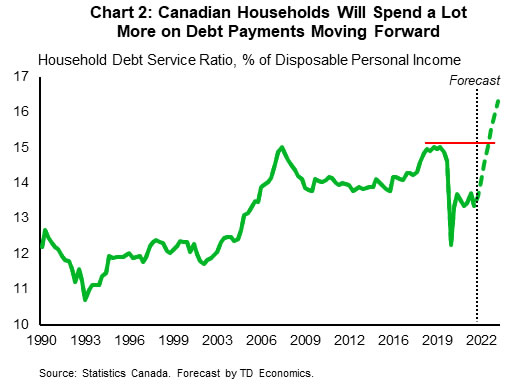
- The consumer is facing several headwinds next year, including the lagged impact of higher rates. Household debt servicing costs will likely rise to a new high in 2023.
- The vulnerability caused by elevated household debt was noted in a speech by Senior Deputy Governor Rogers this week, and is a key reason why the Bank’s rate hike campaign is likely nearing its end.
U.S. - FOMC Eyes Half-Point Hike
The holiday-shortened week was quiet overall, but did provide a healthy dose of Fed speak, new home sales data, and updated consumer sentiment readings. Due to lower trading volumes and shorter trading hours in the lead-up to the holiday, market movements this week were muted. The S&P 500 rose 1.5% on the week, while Treasury yields continued their gradual decline, with the 10-Year yield dropping 9 bps to 3.73% as of the time of writing.
October’s CPI report has been the centerpiece of market thinking since its release two weeks ago. Fed speakers this week attempted to strike a balanced tone. San Francisco Fed President Daly started the week stating, “although one month of data does not a victory make, the latest inflation report had some encouraging numbers”. Cleveland Fed President Mester in a separate media appearance added that more work still needed to be done, but that “it makes sense that we can slow down a bit”.
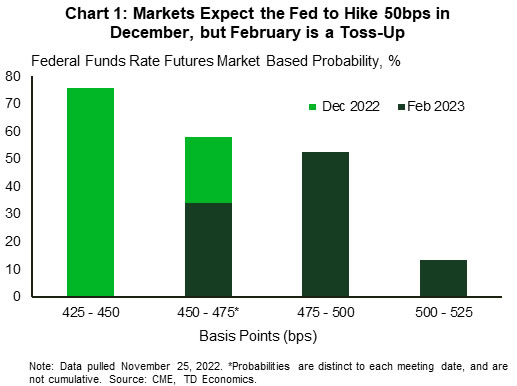
The November FOMC minutes released on Wednesday echoed this sentiment, noting that “a substantial majority of [FOMC] participants judged that a slowing in the pace of increase would likely soon be appropriate”. As of the time of writing, markets are expecting the Fed to raise rates by 50bps in December (Chart 1). Next week’s October PCE inflation and November jobs reports should provide further clarification on the Fed’s progress thus far and how much further it may have to go.
November new home sales surprised to the upside, rising 7.5% month-on-month (m/m) versus an expected decline. However, sales are still down on the year (-5.8% year-on-year, y/y). We don’t expect November’s uptick to be sustained. Mortgage rates remain elevated, homebuilder senitment is at its lowest level since June 2012 (excluding the early pandemic low), and existing home sales have declined for nine consecutive months as of November.
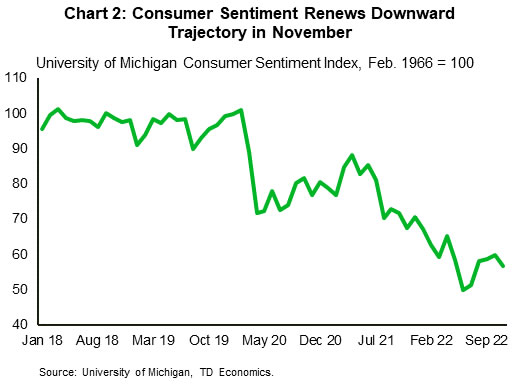
On the consumer front, we saw the University of Michigan consumer sentiment index reading for November drop 3.1 points to 56.8 (Chart 2). The index had previously notched four consecutive months of gains after a precipitous drop in the second quarter of this year, as the robustness of the labor market, combined with a build-up of savings had provided a cushion to consumers. However, with the unemployment rate ticking higher, job growth slowing, and excess savings winding down, the dual shock of higher rates and higher prices present a stronger headwind.
On a cheerier note, holiday air travel is expected to roughly return to its pre-pandemic level this week. Coupled with the expected spike in retail sales driven by Black Friday deals, the Thanksgiving holiday should provide partial short-term insulation from some aspects of the impending economic slowdown. Next week we’ll see whether job growth decelerated in November, or whether the Fed may have more to think about at its last meeting of the year.
Canada – Headwinds Mounting for the Consumer
Due to the U.S. Thanksgiving holiday, it was a lighter than normal trading week. Canadian bond yields traded slightly lower on the week (as of writing), while broad-based gains across major sub-indices were pushing the TSX higher. Oil prices were on track to end the week lower, partly on the back of concerns about Chinese demand. Prices dropped significantly early in the week on reports that OPEC+ was considering increasing production. However, they rebounded later on, as major producers refuted these claims.
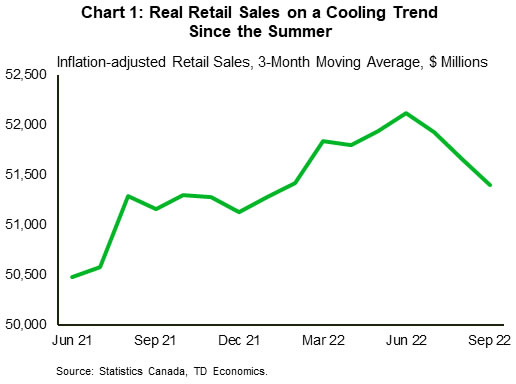
The September retail sales report was this week's marquee data release. Retail volumes were down 0.1% m/m, capping a weak third quarter (Chart 1). However, activity showed some signs of resilience in October, with Statistics Canada's advance estimate of retail sales showing a 1.5% m/m gain. This should work out to an increase in volumes once the full report comes out, even with goods prices showing a large increase during the month. However, we doubt this resilience is sustainable as the Canadian consumer deals with high inflation, rising interest rates and declining wealth. Next year, we expect a weaker job market to be added to that list, with the pace of job gains to cool considerably.
Higher interest rates will be one of the main drags on household spending in 2023. The Bank of Canada has been hiking rates since March, but it can take 12-24 months for the full effects of policy tightening to be felt. Part of this story is the sizeable increase in mortgage payments faced by homeowners who took out variable rate mortgages when interest rates were at rock bottom levels last year. In a research note released this week, Bank of Canada staff indicated that 50% of outstanding variable rate mortgages (or 13% of all mortgages) hit their "trigger rate" at the end of October. This is the interest rate at which the entire payment on a variable rate mortgage (with fixed monthly payments) goes towards interest, with zero put towards principal. In some cases, when borrowers hit their trigger rate, their monthly payments go up automatically. For these borrowers who took out mortgages in 2021, the Bank estimates that their payment would have increased by about 20% by October's end.
More broadly, our latest quarterly Q&A outlook report (see here) discussed how after spending an additional $18.6 billion on debt servicing this year, we estimate Canadian households will see their debt servicing costs increase by $34.4 billion in 2023 (Chart 2). This elevated vulnerability to interest rate increases is a key reason why the Bank of Canada opted to scale back the pace of rate hikes in October. In her speech on financial stability this week, Bank of Canada Senior Deputy Governor Carolyn Rogers stated that "the risk of a trigger that may affect financial stability has increased" due to elevated inflation and the higher interest rates that it's brought on. Policymakers don't want to under-tighten, but are wary of the risks of overtightening as well. With this in mind, Governor Macklem noted this week that, with respect to the end of the Bank's tightening campaign, policymakers are "getting closer, but are not there yet".
Week Ahead – All Eyes on the Jobs Report
Wall Street returns after the Thanksgiving holiday and what a week we have in store. The jobs report on Friday is the obvious highlight, with Fed policymakers keen to see further signs of inflationary pressures easing and less tightness in the labour market.
There’s a whole host of other data due next week as well including the core PCE price index – the Fed’s preferred inflation measure – GDP, income, spending, jobless claims, and more. We’ll also hear from Fed policymakers throughout the week including Chair Jerome Powell on Wednesday.
An action-packed week for Europe, with a plethora of key economic data and ECB policymaker appearances. In the run-up to the ECB rate decision on 15 December, that commentary is going to provide crucial insight into which way the committee is leaning, with another 75 basis points currently heavily priced in. With that in mind, the flash CPI release stands out as the one to watch on Wednesday.
The UK has repaired some of its tarnished reputation in recent weeks but the economy is still likely in recession and it won’t be an easy road back. There isn’t much data next week to support or refute that but there are appearances from various BoE policymakers that will be of interest.
Russia
A few economic numbers of note next week include GDP, retail sales, unemployment, real wages, and the manufacturing PMI. Unemployment is expected to tick higher again to 4.1% from its September low of 3.8%.
South Africa
The SARB continued its aggressive tightening cycle in November with another 75 basis point hike, taking the repo rate to 7%. The central bank expects inflation to remain above its 3-6% target range until the second quarter of next year and only return to the mid-point in the second quarter of 2024.
Next week brings the release of unemployment data on Tuesday.
Turkey
As expected, the CBRT cut rates by 1.5% in November and ended its easing cycle, leaving the policy rate at 9%. Next week its quarterly GDP and the manufacturing PMI on offer as traders look for clues as to the cost of the monetary policy experiment on the economy.
Switzerland
A data-heavy week that includes the PMI survey and inflation on Thursday – which the SNB has repeatedly stressed is too high – GDP on Tuesday, and KOF and ZEW surveys on Wednesday.
China
Official Chinese manufacturing and non-manufacturing PMIs for November will be released on Wednesday as well as the Caixin Manufacturing PMI. As these figures have been fluctuating above and below the 50-the threshold separating contraction from expansion for the past few months, they suggest that the Chinese economy is still hovering between contraction and expansion.
However, the long-term positive fundamentals of the Chinese economy remain unchanged. Industrial profits figures are also released over the weekend.
India
A number of interesting economic releases next week including GDP on Wednesday and the manufacturing PMI on Thursday.
Australia & New Zealand
Inflation in Australia and New Zealand remains high, and the new Governor of the Reserve Bank of Australia, Philip Lowe, has said in a speech that he is determined to ensure that the current high inflation is temporary, while the RBA is expected to raise interest rates further in the future.
The RBNZ’s 23 November central bank rate meeting hawkishly raised rates by 75 basis points to 4.25% to continue the fight against inflation, and the market now expects the RBNZ’s terminal rate may rise to 4.75%.
Next week, the focus will be on Australian retail sales and CPI for October on Monday and the speech by the new RBA Governor Philip Lowe on Wednesday. Other data released throughout the week will also be of interest.
Japan
Coming up next week is data on unemployment, retail sales, and industrial production for October as well as the latest manufacturing PMI for November.
Singapore
At the 29th APEC Economic Leaders’ Meeting on 17 November, President Xi Jinping met with Singaporean Prime Minister Lee Hsien Loong in Bangkok. The China-Singapore relationship is forward-looking, strategic, and exemplary, Xi said.
Lee Hsien Loong said Singapore sees China’s development as positive, wishes the GDI well, and will explore ways to participate. Both countries expressed their willingness to continue to deepen their cooperative relationship and work together to promote new progress in the all-around partnership between the two countries as they move with the times.
According to Caixin Global, on 22 November, Singapore police said it was investigating Binance. This comes after the Monetary Authority of Singapore noted that Binance was being investigated as it may have violated the Payment Services Act.
Canada’s Economy Eked Out Positive Growth in Q3
Canada looks on track to deliver a GDP reading next week that’s just above our 1% (annualized) forecast for Q3. Still, that’s a marked slowdown from the 3.2% average rate over the first half of 2022—a figure that captured much of the initial “reopening” rebound in economic activity as pandemic restrictions eased. Growth in household consumption of services continued to rise in Q3 (based on our own tracking of consumer purchases) but the pace nevertheless slowed after surging more than 16% in Q2. And purchases of physical goods likely declined outright for the first quarter this year.
Residential investment is expected to have fallen again in Q3 following an already substantial drop in Q2 amid cooling housing markets. Other non-residential business investment likely declined too, as more businesses anticipate a weaker outlook in the quarters ahead. An increase in net trade will mechanically add to GDP growth in Q3, but will be offset by declining inventory growth. Indeed, a surge in exports appears to have been largely drawn from existing stocks rather than new production.
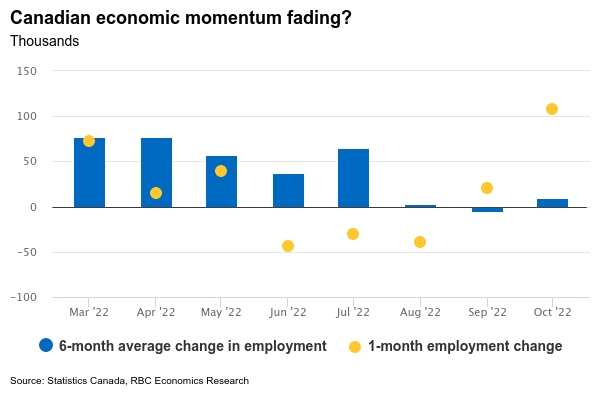
We see some upside risk to StatCan’s preliminary report of a 0.1% increase in September GDP, with the surprise mostly driven by higher than expected growth in non-conventional oil and gas extraction. And growth in October probably remained positive. Total hours worked rose by a solid 0.7% in October, and advance readings for manufacturing, wholesale and retail sales were all positive. But there are still signs that broader growth momentum in the Canadian economy is losing strength. Higher interest rates continue to filter through to household borrowing costs and inflation is cutting into purchasing power. Though labour markets surged back in October, average employment growth still slowed to under 10,000 per month over the last half a year (following softer numbers in the summer and early fall). We are looking for a smaller 5,000 position increase in employment in November and a tick up in the unemployment rate (though to a still very low 5.3% rate from 5.2% in October).
Slowing growth prospects and early signs of easing inflation pressures over the past months are all supportive of the view that the Bank of Canada could be close to the end of its current interest rate hiking cycle with our own base case assumption calling for one more 25 basis point increase in the overnight rate in December.
Week ahead data watch
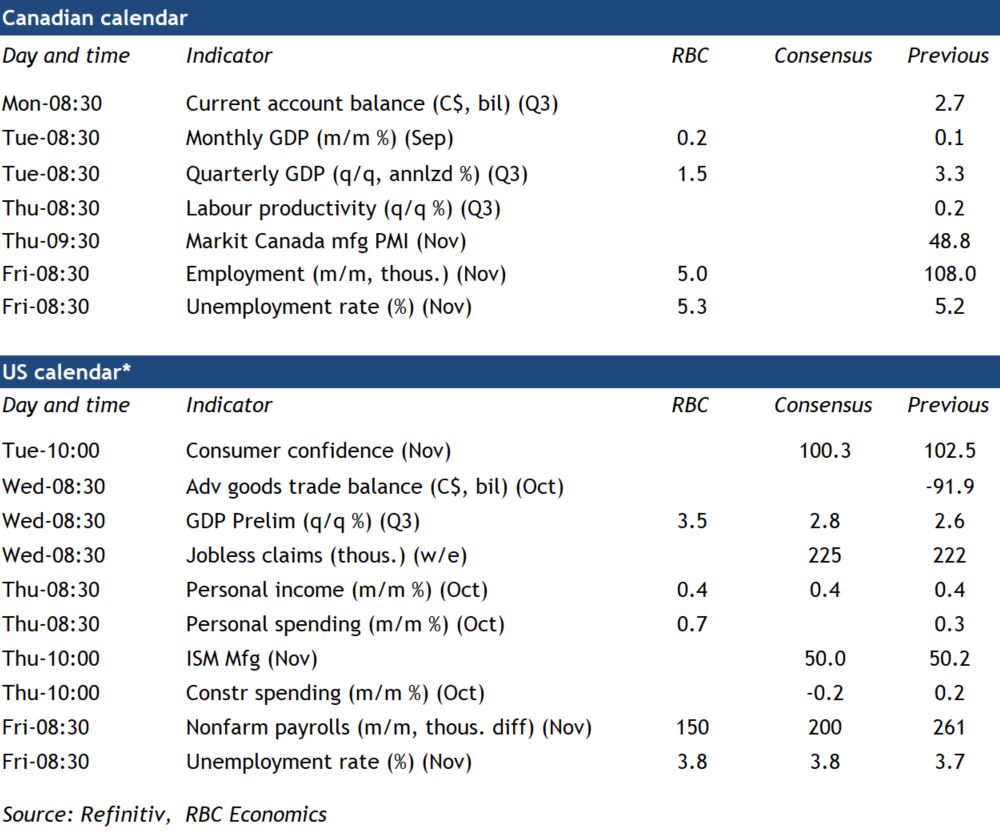
U.S. personal spending likely revised up to 0.69% in October, mainly driven by relatively strong retail sales (1.3%). We expect U.S. personal income to edge up 0.4% in October (the same rate as in September) with a 0.4% increase in average hourly earnings and a 261,000 rise in payroll employment during this period.
The second estimate of U.S. Q3 GDP growth looks likely to be revised significantly higher than the 2.6% initial estimate on stronger consumer spending, business investment, and net trade
U.S. payroll employment likely trended up in November, by 150,000, and the unemployment rate is expected to tick up to 3.8% from 3.7% in October. Job openings are still high but have been edging lower.
Week Ahead – Decisive Week for the Dollar as PCE Inflation and NFP Reports Coming Up
After the Thanksgiving downtime that generated some further weakness for the greenback, investors will be looking for fresh direction from the barrage of US economic data that will be dominating the agenda in the coming week. The latest payrolls report will be the main attraction along with PCE inflation readings. CPI data out of Australia, the Eurozone and Switzerland as well as Canadian GDP numbers will be important too, while OPEC’s monthly decision will be another one to watch amid speculation of an output increase.
Jobs report to headline busy week for the dollar
Hawkish language from the Fed may have put a halt to the US dollar’s slide but it wasn’t enough to spur much of a recovery. With the November jobs report and a raft of other key indicators on the way, it could go either way for the greenback, although the risk seems tilted more to the downside.
The week will initially get off to a slow start, with only home prices and the consumer confidence index drawing some attention on Tuesday. On Wednesday, the second estimate of third quarter GDP growth might show a small upward revision. Other releases will include the ADP employment report – considered a precursor to Friday’s official numbers, the Chicago PMI and pending home sales.
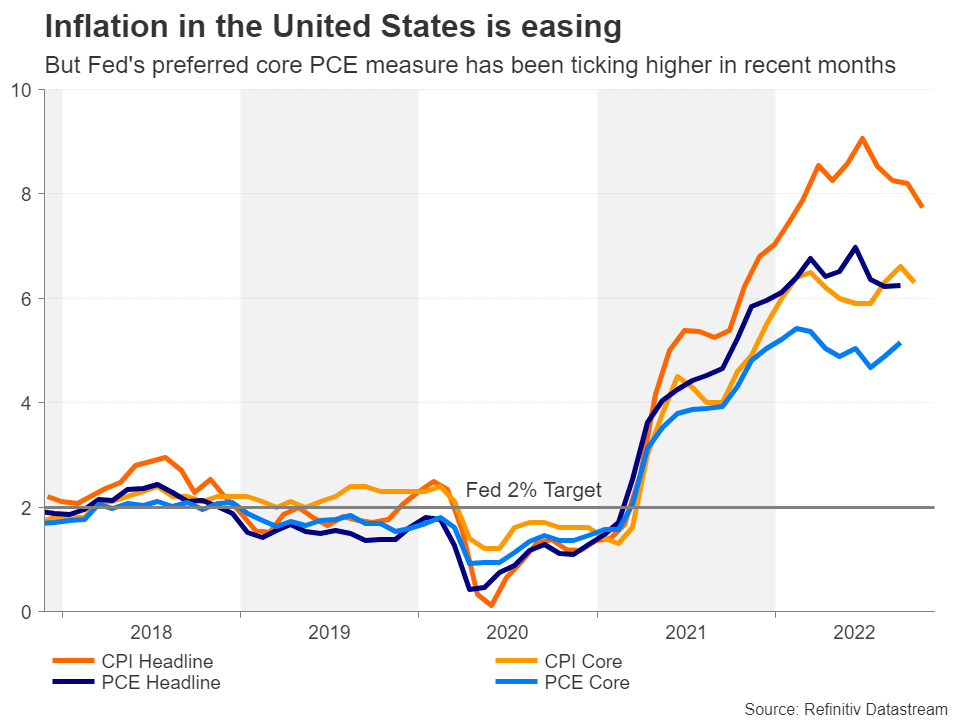
After the surprisingly soft CPI readings, investors will be watching on Thursday to see whether the Fed’s preferred inflation metric of the core PCE price index will also cool off substantially. It is forecast to rise 0.3% month-on-month in October versus 0.5% previously. Included in this report are the personal income and spending figures.
Just as crucial on Thursday will be the ISM manufacturing PMI. The alternative S&P Global manufacturing PMI slipped below 50 in November but according to the forecasts, the ISM measure will avoid a contraction by easing to 50.0.
However, any recession worries from potentially weak data are likely to be more pronounced if Friday’s nonfarm payrolls report disappoints too. The US economy is expected to have added 200k jobs in November, down from 261k in October. The unemployment rate is projected to inch up slightly to 3.8%, while a slight monthly moderation is anticipated in average hourly earnings growth.
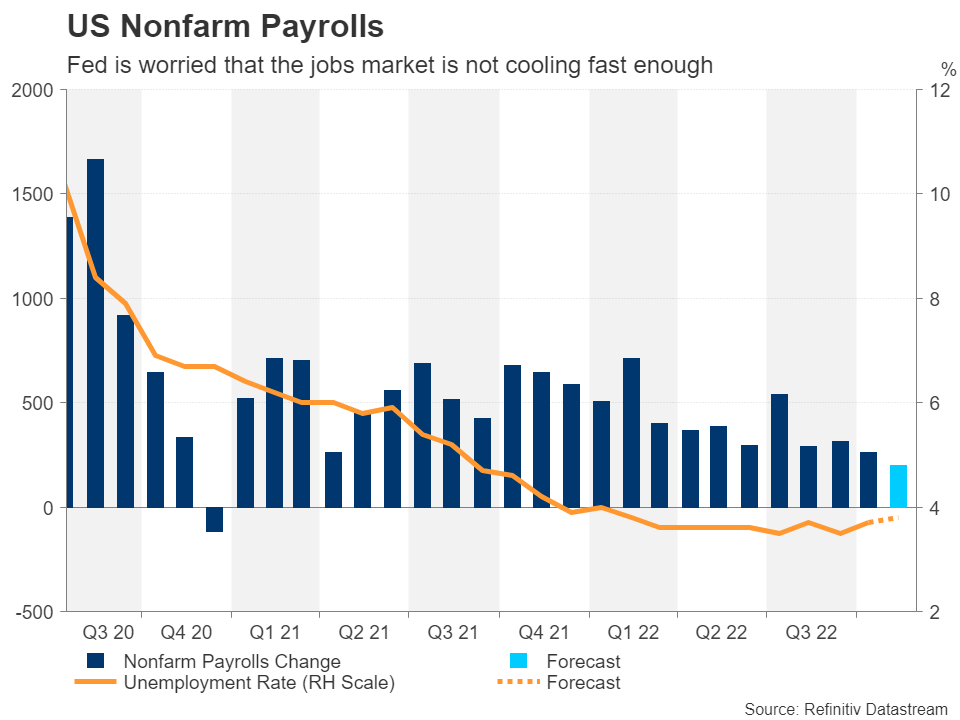
At this point, where inflation appears to have peaked and Fed officials are seemingly in agreement with each other that the Fed funds rate should reach about 5% in this tightening cycle, any bad news on the economy is good news for risk appetite. Signs that the jobs market as well as the broader economy are slowing would not only eliminate the threat of a further hawkish shift, but it would also increase the odds of a rate cut sooner rather than later.
This could be detrimental for the dollar, though it would probably boost sentiment on Wall Street.
Euro looks to flash CPI for ECB clues
Inflation may finally be on the way down in America, but in the euro area, it hit double digits in October. The flash estimates for November out on Wednesday should reveal whether price pressures continued to simmer in November. The headline rate of the harmonized index of consumer prices (HICP) is expected to ease slightly to 10.4% y/y. The core rate that excludes food and energy prices is also forecast to edge lower, dropping 0.1 percentage point to 6.3%.
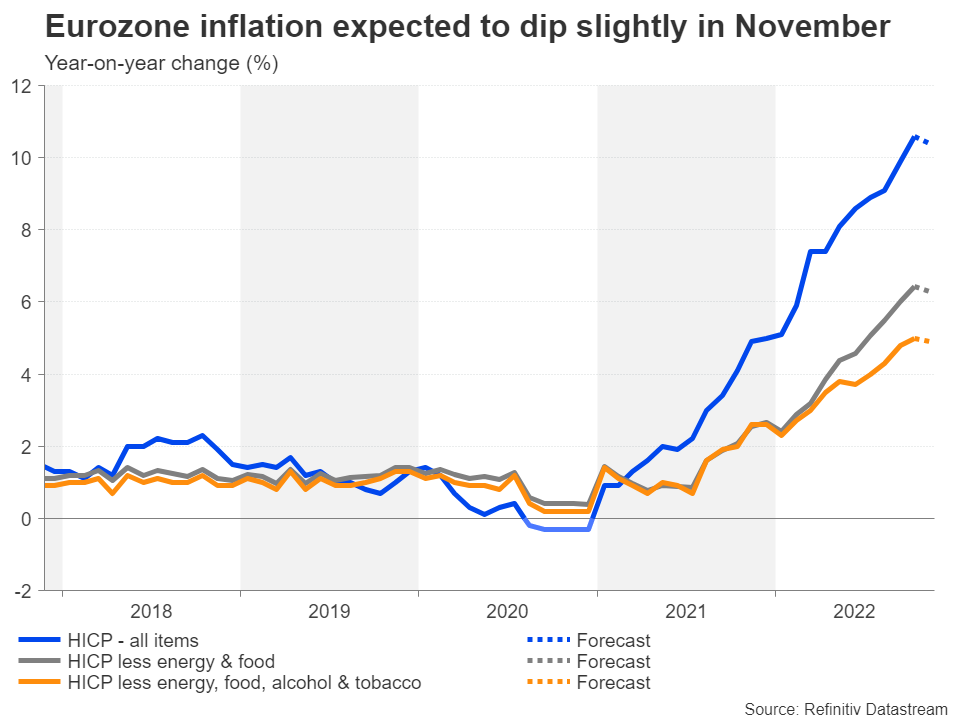
With policymakers at the European Central Bank still undecided about the size of the next rate rise when they meet on December 15, stronger-than-expected figures would increase the probability of a 75-basis-point hike versus a 50-bps one.
However, even in the event of a very hot print, it’s doubtful how many additional 75-bps increases the ECB will be able to carry out amid growing signs that the Eurozone may have already entered a recession. After the latest flash PMI surveys pointed to another contraction in economic activity in November, investors will be watching the economic sentiment indicator on Tuesday for further signs of a deteriorating economic backdrop, while the producer price index on Friday may attract some interest too.
Nevertheless, the euro could extend its latest gains, at least in the interim, should investors up their bets of a 75-bps increase.
Swiss CPI eyed as franc rebound stalls
As the ECB ponders its next move, the Swiss National Bank also has to decide how big to go in December. But Switzerland isn’t plagued with the same high inflation problem like the rest of Europe is, with its consumer price index running at a ‘mere’ 3% annual clip in October.
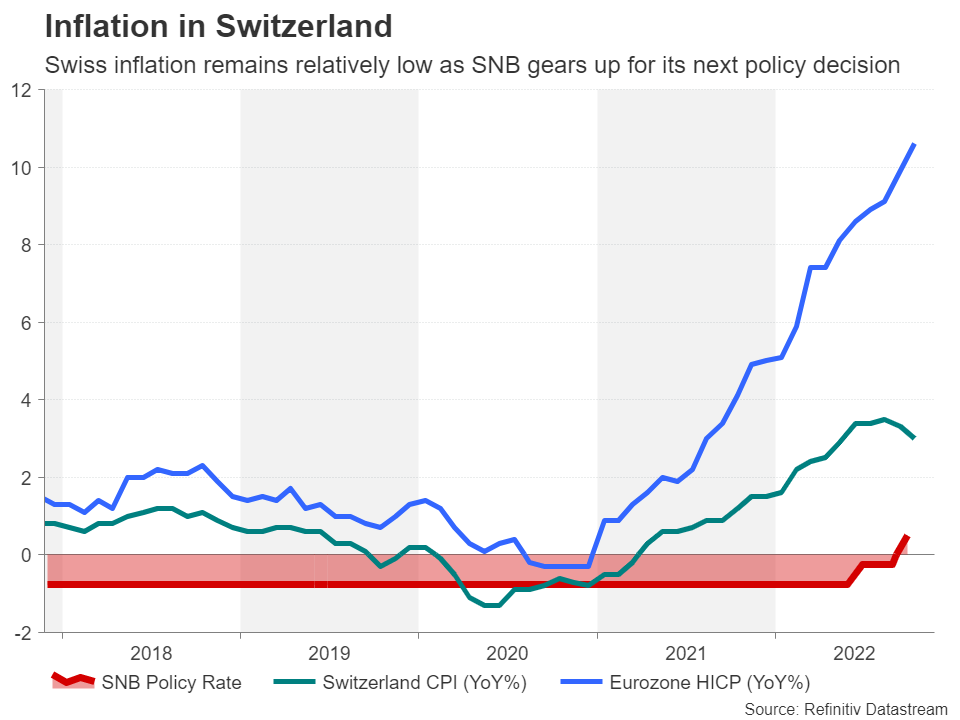
Neither does the country face the same recession risk, having recorded quarterly growth of 0.3% in the second quarter.
Both data points will fall under the microscope next week. The GDP estimate is up first on Tuesday and the inflation numbers will follow on Thursday.
The Swiss franc has rallied strongly on the back of the dollar’s retreat, but the rebound hit a wall at 0.9355 per dollar. Hotter-than-expected CPI figures might be what it takes to tip the franc over that barrier as the SNB would more likely hike rates by 50 bps than 25.
Conflicting risks racking up for the loonie
Another country reporting GDP data next week is Canada, though this may be eclipsed by the employment stats that are due on Friday. GDP growth likely slowed in the third quarter Tuesday’s data is expected to reveal. But a bigger priority for the Bank of Canada is the tight labour market, which added a whopping 108k jobs in October. Should employment again rise at such a rapid pace in November, policymakers might have a rethink about further reducing the pace of rate increases.
The BoC hiked rates by only 50 bps at its last meeting and investors think a 25-bps increment is the most probable outcome at the December meeting.
The Canadian dollar could enjoy a significant lift if the job numbers help move those odds in favour of a 50-bps hike. However, there are downside risks for the loonie from the meeting of OPEC and non-OPEC countries on Thursday. There have been some reports suggesting that Saudi Arabia might push for an increase in oil production at the upcoming gathering on concerns that the EU’s price cap on Russian oil exports due to come into effect next month might cut off Russian supply from the market.
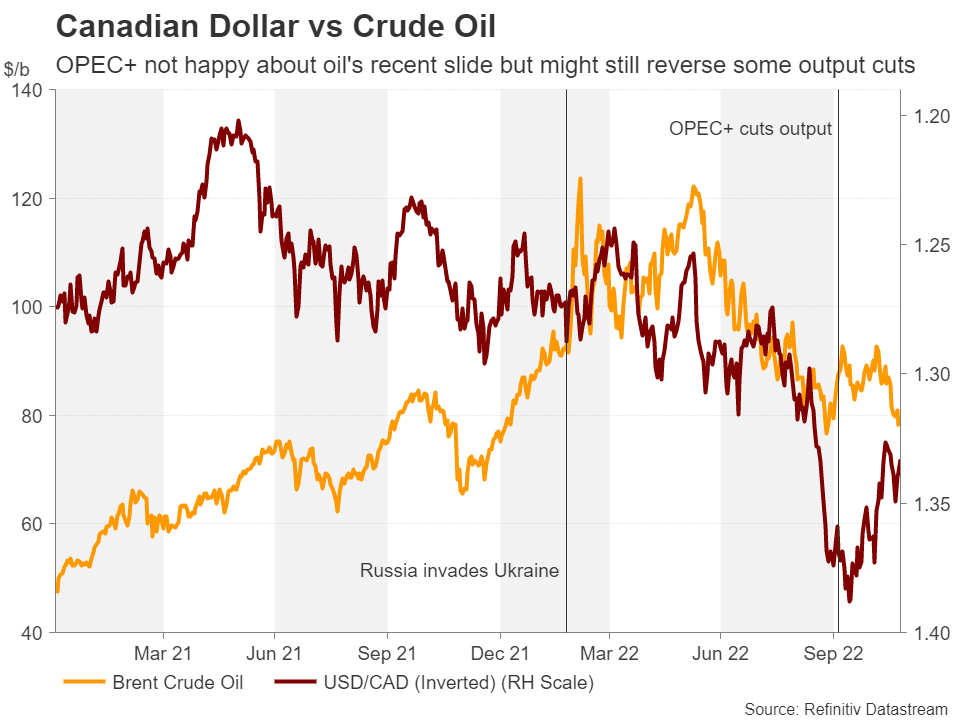
If the alliance does agree on raising output, oil-linked currencies such as the loonie might take a hit should oil prices plummet in response, although dollar weakness would go some way in mitigating the losses and risk assets in general would react positively to the prospect of lower energy prices.
China woes still weighing on aussie
In Australia, the Reserve Bank is in a similar predicament and the highlight for the local dollar will be Wednesday’s inflation figures. Australia has only just started reporting monthly CPI readings and these could be vital in shaping the steepness of the policy path in the coming months.
Quarterly data on capital expenditure will be monitored too on Thursday but traders will probably be paying more attention to Chinese indicators a day earlier when the manufacturing PMIs are due.
The Australian dollar has enjoyed a decent rally against the greenback despite disappointment that China is not about to abandon its zero-Covid policy anytime soon. But if the PMIs point to more pain for the Chinese economy, the aussie’s rebound might start to lag its peers amid the somewhat uncertain demand outlook for Australian exporters.
Trade Idea: What’s Next for Yen Crosses?
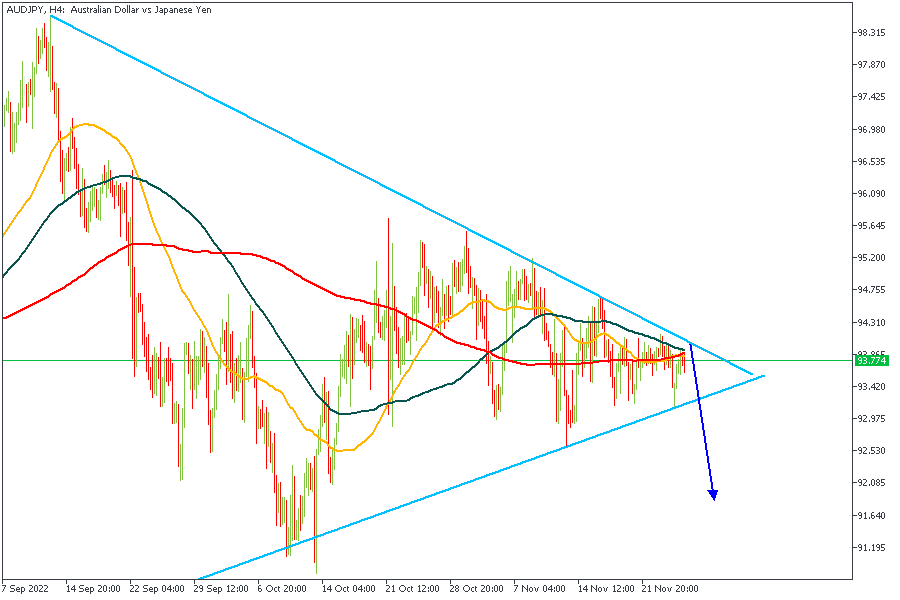
AUDJPY
The wedge scenario on AUDJPY is such that the upper trendline dates as far back as September, whilst the trendline support dates even farther. As a result, the trendline with the most touches is naturally expected to be the weaker one, and thus, my bias for a bearish breakout. The real impulse is expected to begin after the breakout of the wedge.
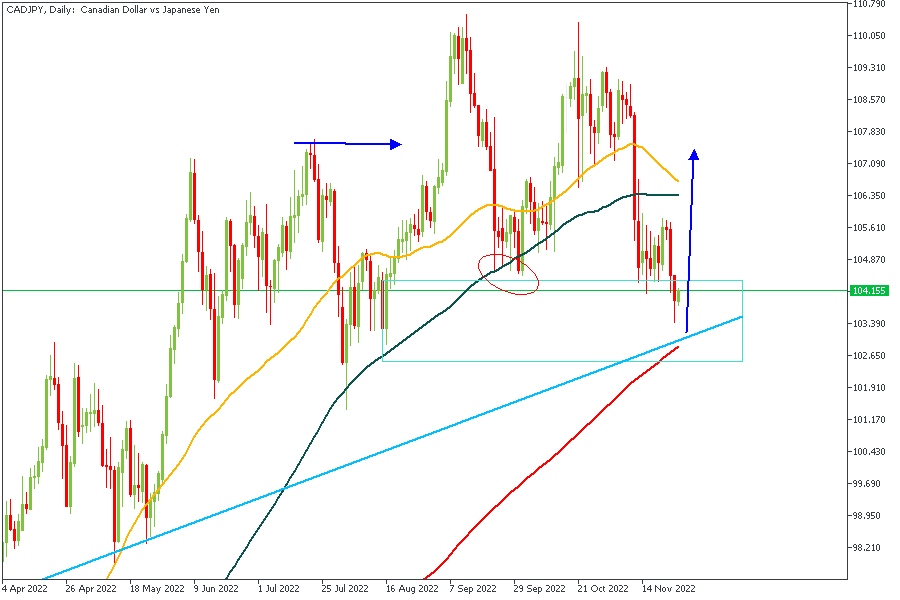
CADJPY
After the bullish break of structure that occurred at the horizontal blue arrow, we can see that price retraced lower and liquidity was taken out at the circled region. Based on these schematics from an SMC (Smart Money Concept) point-of-view) the area between 104.5 and 102.0 is expected to act as a drop-base-rally demand zone. Coupled with the trendline support, 200-day Moving Average, and the 88.2% Fibonacci retracement zone, I am expecting a bullish reaction from the marked zone, possibly to the 107 area.
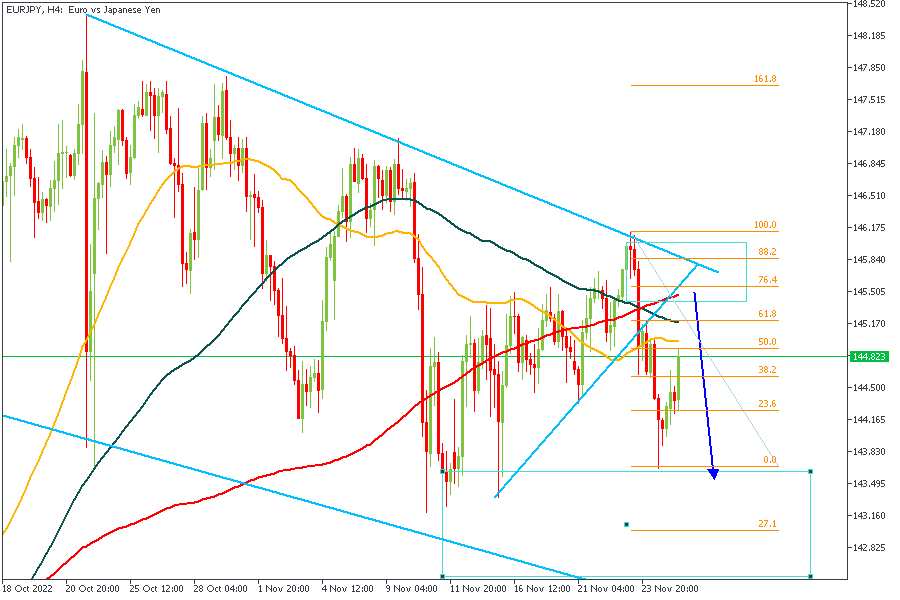
EURJPY
EURJPY can be seen trading within this huge wedge with a recent bearish break of structure as well as a break of the internal trendline. Based on these factors, the current bullish impulse can be considered a retracement. The marked rectangular zone at the 76.4% retracement level is my expected area of interest since a confluence of other important factors like the 200-SMA, 50-SMA, and internal trendline retest all align around the area.
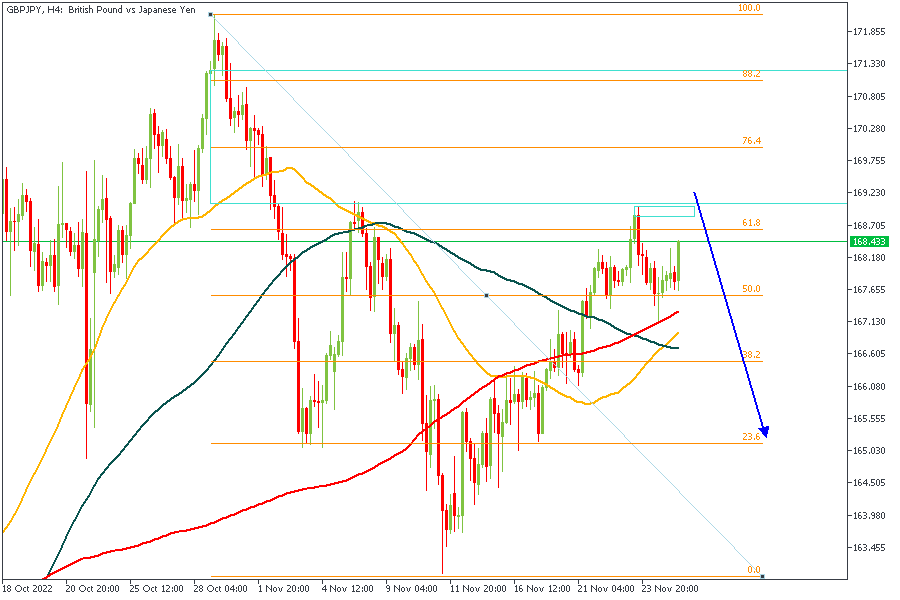
GBPJPY
GBPJPY is currently approaching a major supply zone as spotted on the Daily timeframe. There is a possibility of a temporary bullish impulse in the meantime in order to clear out liquidity from the equal highs. We can therefore expect to see a bearish continuation from the 76.4% retracement area.
NZDJPY
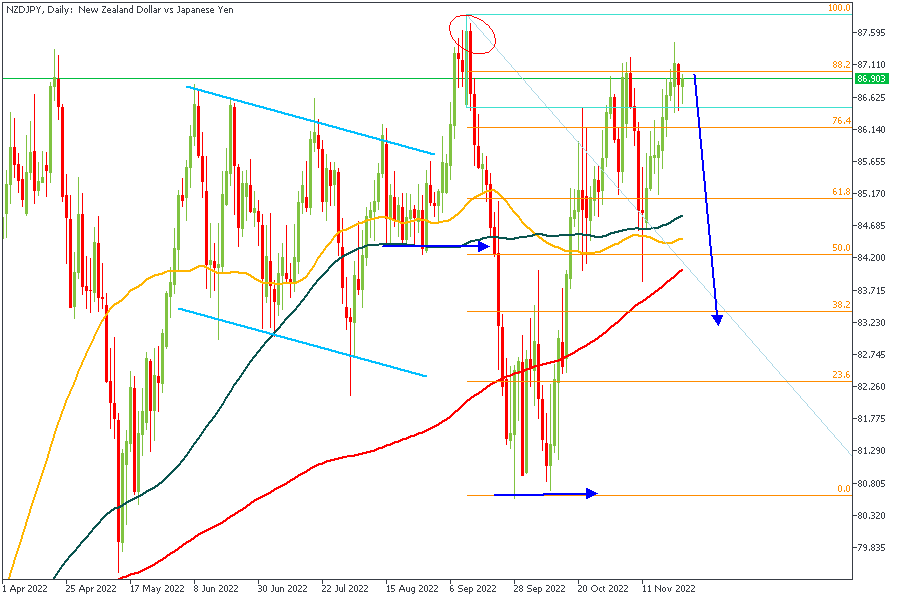
NZDJPY seems to be seeking to complete the AMD (Accumulation-Manipulation-Distribution) schematic which means we can expect a bearish impulse from within the current rally-base-drop supply zone to move toward the 200-MA.
USDJPY
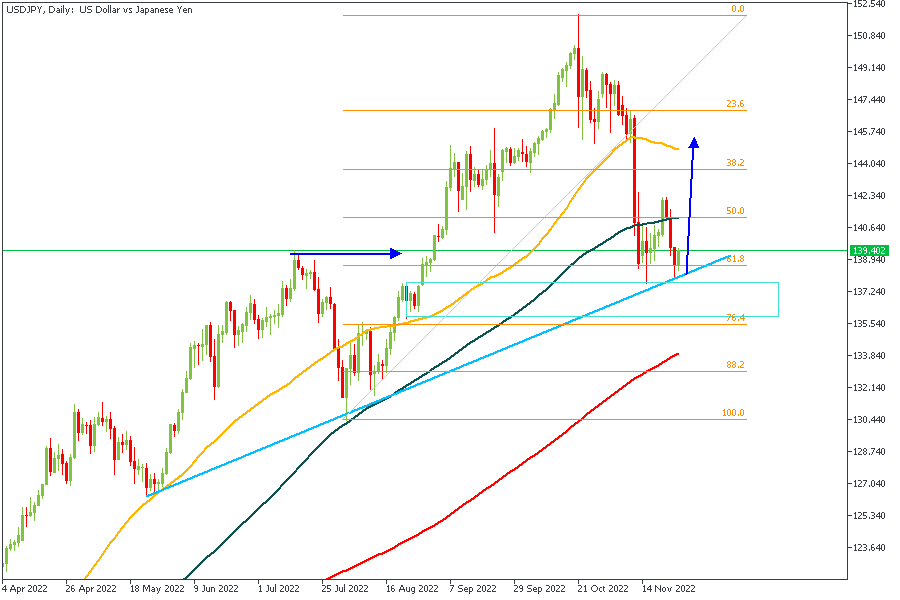
The previous break of structure on USDJPY as seen from the horizontal blue arrow on the chart above is bullish. Right now we're seeing a retest of the rally-base-rally demand zone that aligns perfectly with the trendline support and the 61.8% retracement level. This means that we can expect to see some bullish impulse from USDJPY going into the new week.
CONCLUSION
The views above are solely based on Technical Analysis techniques using my personal Smart Money approach. Hence, it is important to understand that the trading of CFDs comes at a risk; if not properly managed, you may lose all of your trading capital. To avoid costly mistakes while you look to trade these opportunities, be sure to do your own due diligence and manage your risk appropriately.
Weekly Focus – Euro Inflation Key to Size of Next ECB Hike
Flash PMI's for November turned out to be a mixed bag. US data disappointed as the manufacturing PMI dropped to 47.6 from 50.4 and service PMI pushed lower as well to 46.1 from 47.8. It is broadly in line with our view that the US economy is heading into a mild recession in early 2023. Investments still look resilient as durable goods orders were decent in October. However, leading indicators suggest investments will slow down soon. For once the picture was a little more positive in the euro area as both PMI manufacturing and service were better than expected. The German ifo business confidence also surprised to the upside rising to 86.3 from 84.5. Despite the improvement the indicators are still at low levels and point to a euro area recession. But on the margin it is positive and fits with our view that the recession will not be deep, although it could be protracted as we have yet to feel the full effects of the sharp rise in bond yields and ECB policy rates.
The PMI's also showed easing price pressures and a further normalisation of delivery times, which is a further sign that goods price inflation is in the process of normalising on the back of a sharp drop in freight rates, easing supply chain problems and lower commodity prices. Oil prices turned lower again this week to USD85 per barrel, a decline of USD35 per barrel from the peak in June. Despite easing pressures, inflation will likely stay elevated for some time as some industries have yet to pass through previous price hikes and wage inflation are pushed up by tight labour markets.
With more signs of easing price pressures in the medium term, central banks increasingly consider to lower the pace of hikes. Minutes from the recent Fed meeting and Fed speeches suggest a majority within the Fed lean towards lowering the size of Fed hikes to 50bp from 75bp. However, we still have another jobs report and inflation print ahead of the meeting on 14 December, which will be key for the size of the rate hike. The ECB may also move to a 50bp pace but it depends a lot on how next week's inflation for November turns out. Another high print would likely trigger a 75bp hike on the 15 December meeting, but our baseline scenario is a 50bp rate increase.
In China tweaks to the zero-covid policy led to more widespread outbreaks triggering restrictions in more than a third of China's provinces. China could be facing a chaotic winter as it is hard to contain covid without reacting fast and forceful. Unless, they are willing to live with more spread of the virus, the result could eventually be harsh lockdowns during the winter to knock down the covid waves. Our baseline is that China will not open up fully until summer next year. But uncertainty prevails around which strategy China is going to follow after they took the first steps towards leaving the zero-covid policy.
Stock markets got a lift this week from the softer tone from central banks and easing price pressures, which also pushed bond yields lower. EUR/USD has also seen a lift on the back of better risk sentiment and markets pricing a central bank pivot.
Next week focus turns to US payrolls and Euro inflation. We expect US job growth to decline from 261k to a still decent 220k (consensus 200k). We look for euro inflation to rise to 10.8% y/y from 10.6% y/y but that core inflation holds steady at 5.0% y/y.
Inflation in Japan Out of Line, But Signs of Cooling Emerging
Tokyo’s headline inflation estimates put the annual price growth rate at 3.8% in November against 3.5% a month earlier and the 3.6% expected. The core index, which excludes food and energy prices, accelerated from 2.2% to 2.5% (the highest since 1992), suggesting that nationwide inflation continues to accelerate beyond the 2% target.
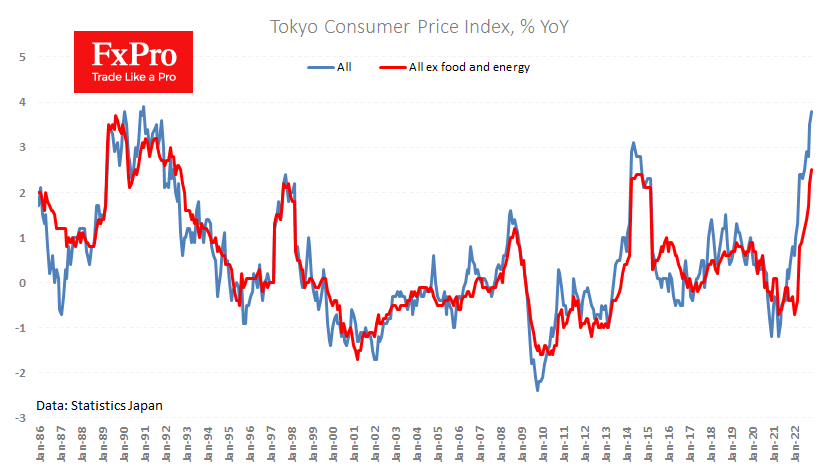
Nevertheless, a country accustomed to deflation is in no hurry to let go of its habits. Rising prices only lead to a temporary activity drop rather than causing consumers to run to the shops for fear that tomorrow will be even more expensive. Household spending rose 2.3% YoY in September, and wages rose by 2.1%.
And while Domestic Corporate Product prices rose 0.6% m/m and 9.1% y/y in October, the Bank of Japan reported today that the Corporate Services Price Index rose only 1.8% y/y vs 2.1% a month earlier. Annual rate increases in both indices have stalled, showing the first signs of a reversal to a slowdown.
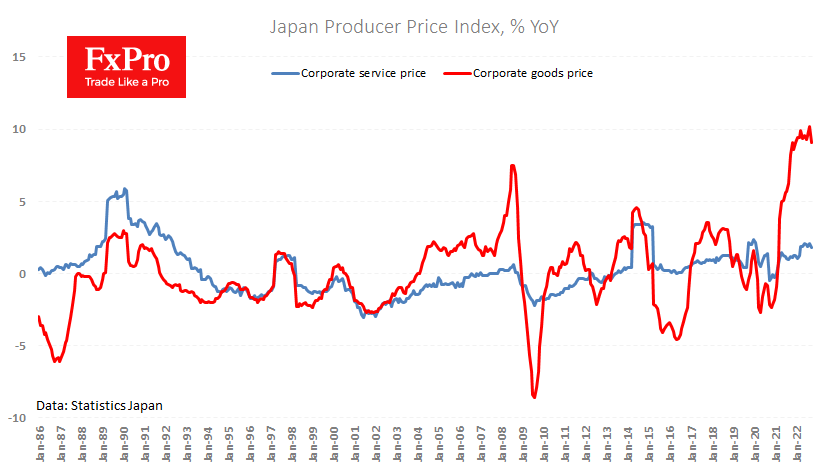
It may take 2 to 4 months before the stabilisation of producer prices spreads to consumer price inflation. Nevertheless, we are already getting the first early signs, with Japan not having implemented any policy tightening but benefiting from globally lower commodity prices and a slowdown in economic activity.
Also, in November, the Japanese finance ministry intervened, reinforcing the effect of the weaker dollar against other main competitors (euro, pound, franc). The appreciation of the domestic currency should further reduce domestic inflationary pressures. However, the increasing interest rate differential between the yen and other reserve currencies raises doubts about whether the yen will continue to rise.
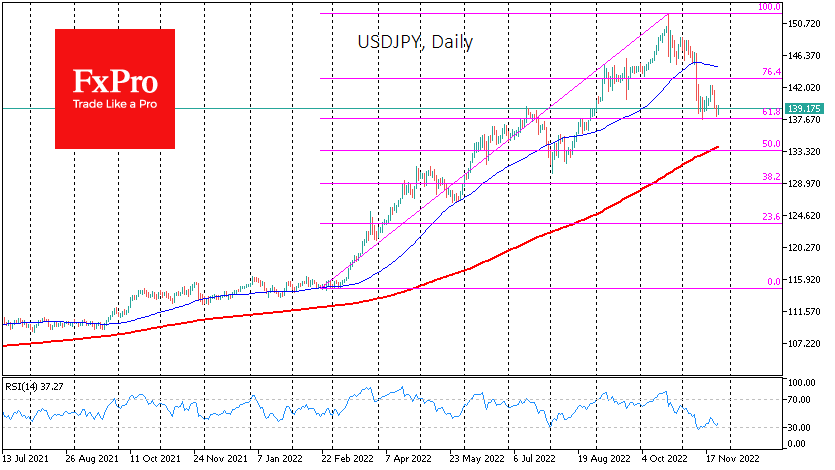
The critical question is whether global financial markets have entered the path of normalisation. If so, the primary trend in the months or years to come could be the carry trade strategy forgotten in 2008, where a low-interest rate currency funds purchases of a high-interest rate currency. Traders capitalise on the difference in overnight rates and the general upward trend of the high-yielding currencies.
In such a scenario, the pullback of the USDJPY from the peak of 152 in October to the current 139 should be seen as a correction before a new growth impulse. Suppose the world growth will lose momentum sharply and markets regain appetite for defensive assets. In that case, a rapid unwinding of carrying trade positions could deepen the USDJPY correction to 125 by the end of March next year.
XAU/USD: Dovish Fed and Safe-Haven Buying Underpin Gold Price
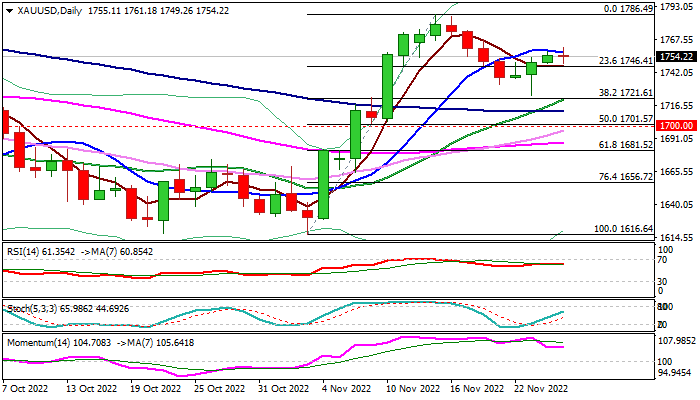
Gold price edges lower in European trading on Friday, after the action repeatedly failed at 10DMA ($1756), with daily techs remaining bullishly aligned after a pullback from Nov 15 peak ($1786) found firm ground just above pivotal Fibo support (38.2% of $1616/$1786), reinforced by rising 20DMA.
The metal is on track for a marginal weekly gains that would partially offset negative signal from previous week’s bearish candle with long upper shadow, with more positive signals from monthly performance, as the yellow metal advanced strongly in December and on track for the first bullish monthly close after seven straight months in red ( November’s rally marks so far the biggest rally since May 2021).
Initial support at $1746 (cracked Fibo 23.6%/5DMA) should ideally hold, however, deeper dips should not exceed key supports at $1721, to keep near-term bulls in play.
Res: 1762; 1771; 1786; 1800.
Sup: 1746; 1732; 1721; 1712.
USD/JPY Rises in Subdued Trading
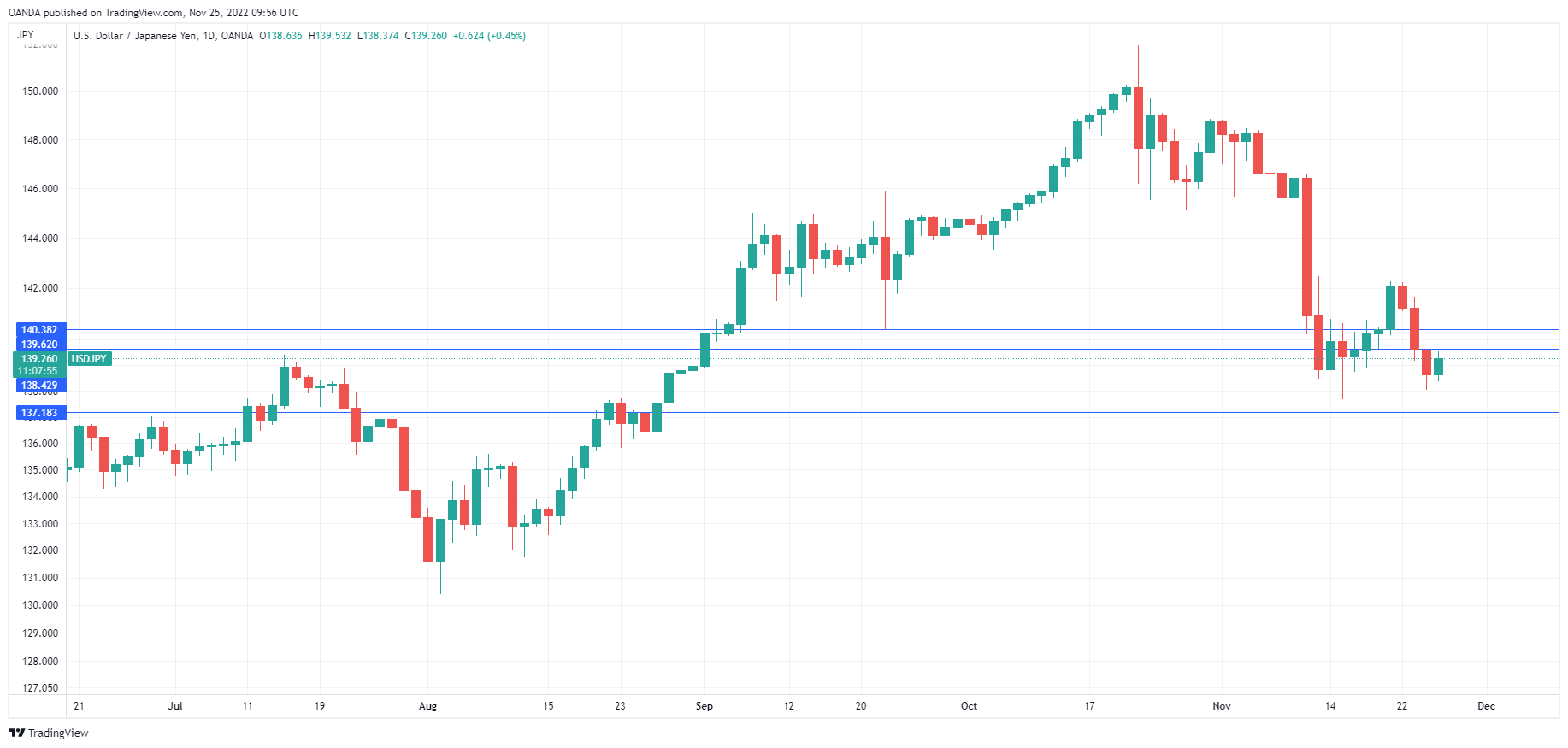
USD/JPY has reversed directions and posted gains on Friday, after three straight losing sessions. The yen is trading at 139.39, up 0.54% on the day. US markets are open for limited hours due to the Thanksgiving holiday, and there are no US releases on the schedule.
Tokyo inflation hits 40-year high
The caption above may sound dramatic, but inflation in Japan is far from the levels we’re seeing elsewhere, such as double-digits in the UK and the eurozone. Still, Japan finds itself dealing with rising inflation, after decades where deflation seemed a permanent part of the economic landscape. Tokyo Core CPI rose to 3.6% in November, nudging above the consensus of 3.5% and the consensus of 3.4%. This marked the highest reading since April 1982.
There’s no arguing that core inflation isn’t accelerating – Tokyo Core CPI has strengthened for six straight months and BOJ Core CPI for ninth consecutive months. This extended uptrend belies BOJ Governor Kuroda’s insistence that cost-push inflations is only temporary and that an ultra-accommodative policy is needed to ensure that inflation becomes sustainable. The BOJ is not showing any inclination to change policy and the recent improvement in the yen means one less headache, as the need for a currency intervention has diminished. It’s likely to be business as usual for the BOJ until the spring of 2023, with two key developments on the calendar – wage negotiations and a new governor for the central bank.
The Federal Reserve remains in a hawkish mode, sort of. The Fed’s stance, reiterated in this week’s minutes, remains somewhat mixed. On the one hand, the Fed has signalled that it will reduce the size of rate hikes “soon”, and the markets have priced in a ‘modest’ 50 bp hike in December after four consecutive 75-bp increases. At the same time, some Fed members are projecting that the terminal rate will be higher than previously expected. This mixed message has created uncertainty about what it means for the US dollar – will “lower for longer” raise risk sentiment and weigh on the dollar, or will investors view the Fed as remaining hawkish and stick with the US dollar? We’ll have to wait and see how the markets answer this question.
USD/JPY Technical
- USD/JPY faces resistance at 139.62 and 140.37
- There is support at 138.43 and 137.19