

Sample Category Title
EUR/USD Daily Outlook
Daily Pivots: (S1) 1.0359; (P) 1.0394; (R1) 1.0433; More...
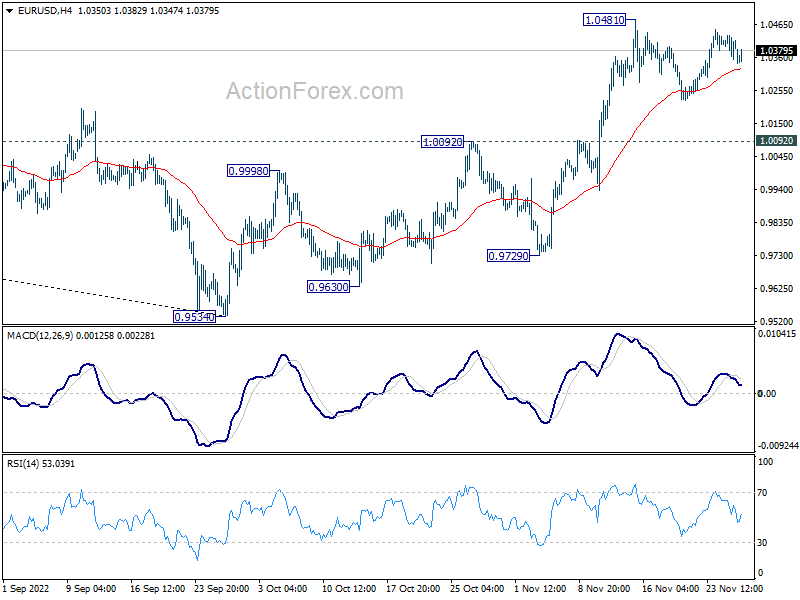
Intraday bias in EUR/USD remains neutral as consolidation from 1.0481 is extending. As long as 1.0092 resistance turned support holds, further rally is expected. On the upside, break of 1.0481 will resume the rise from 0.9534 and target 1.0609 fibonacci level. However, sustained break of 1.0092 will argue that rebound from 0.9534 has completed, and turn bias back to the downside.
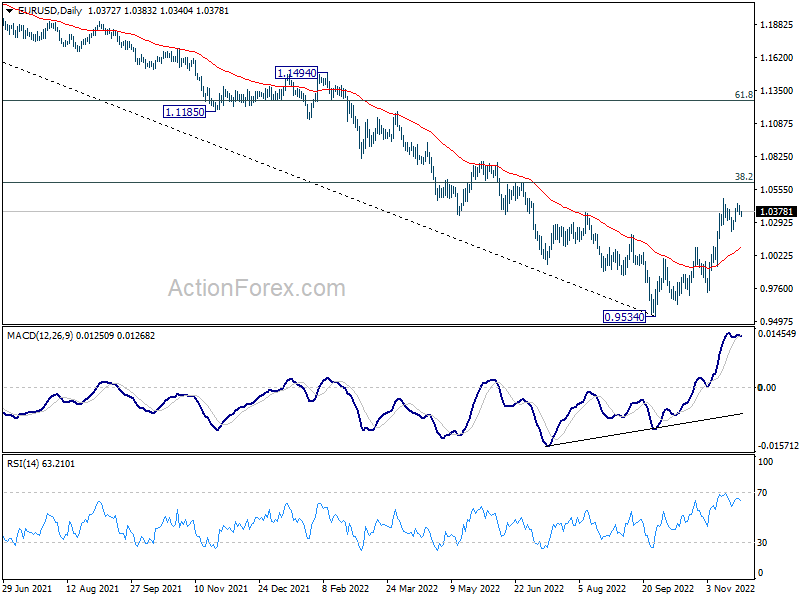
In the bigger picture, a medium term bottom was in place at 0.9534, on bullish convergence condition in daily MACD. Even as a corrective rise, rally from 0.9534 should target 38.2% retracement of 1.2348 (2021 high) to 0.9534 at 1.0609. Sustained trading above 55 week EMA (now at 1.0566) will raise the chance of trend reversal and target 61.8% retracement at 1.1273. This will now remain the favored case as long as 1.0092 resistance turned support holds.
GBP/USD Daily Outlook
Daily Pivots: (S1) 1.2060; (P) 1.2094; (R1) 1.2129; More...
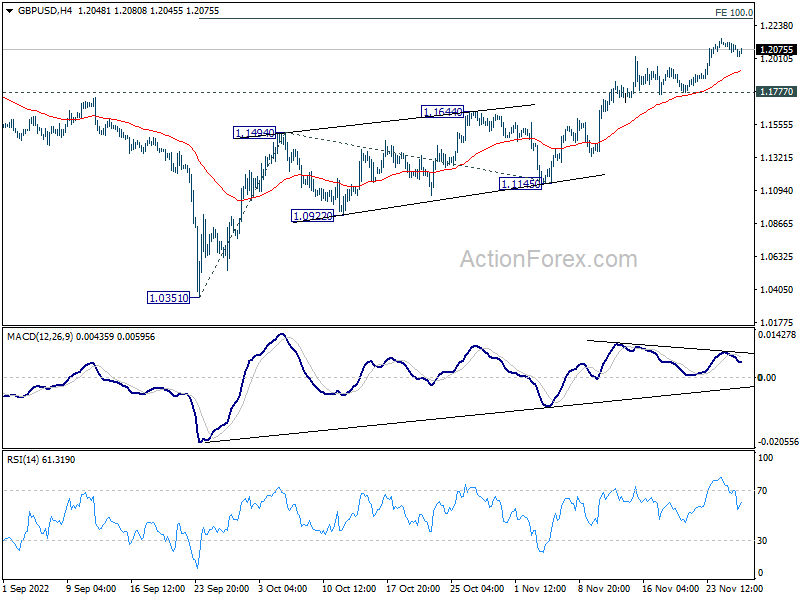
GBP/USD is losing some upside momentum as seen in 4 hour MACD. But further rally is expected as long as 1.1777 support holds. Next target is 100% projection of 1.0351 to 1.1494 from 1.1145 at 1.2288 first. Sustained break there will pave the way to 1.2759 medium term fibonacci level.
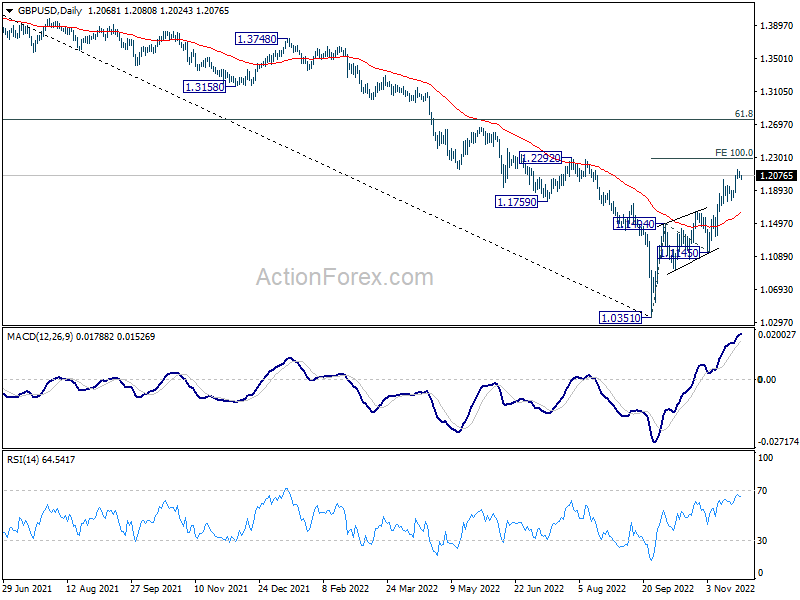
In the bigger picture, rise from 1.0351 medium term bottom is at least correcting whole down trend from 1.4248 (2021 high). Further rise is expected as long as 1.1145 support holds. Next target is 61.8% retracement of 1.4248 to 1.0351 at 1.2759. Sustained break there will pave the way back to 1.4248.
USD/CHF Daily Outlook
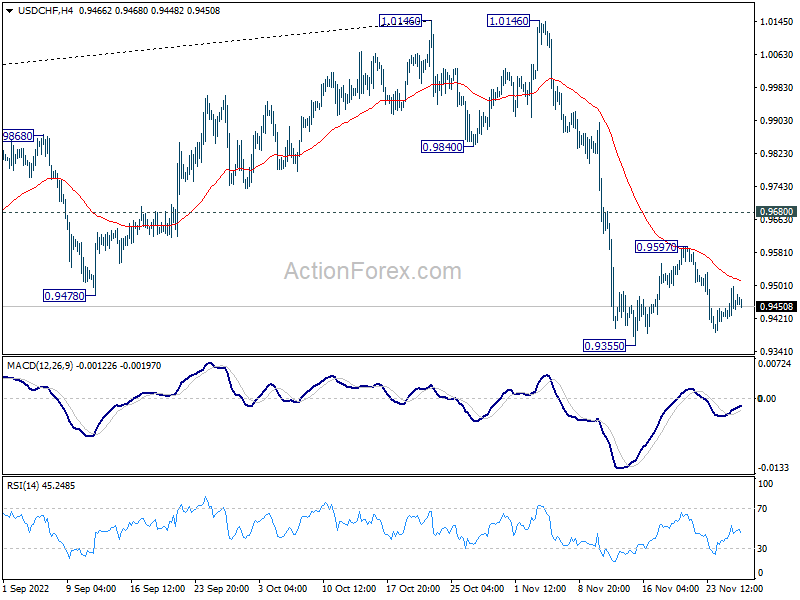
Daily Pivots: (S1) 0.9422; (P) 0.9461; (R1) 0.9499; More...
Intraday bias in USD/CHF remains neutral at this point. On the downside, firm break of 0.9355 will resume the decline from 1.0146 to 0.9287 fibonacci level. Near term outlook will remain bearish as long as 0.9680 minor resistance holds, in case of another recovery.
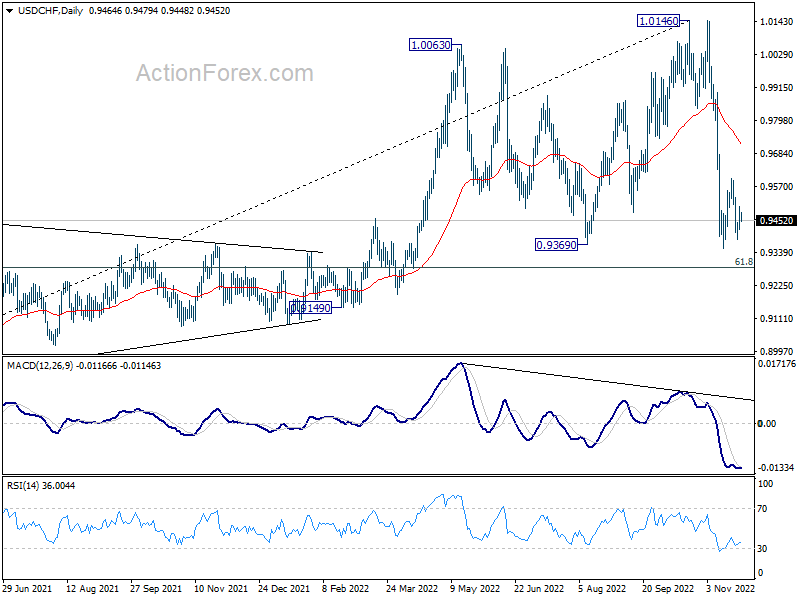
In the bigger picture, rise from 0.8756 (2021 low) has completed at 1.0146, well ahead of 1.0342 long term resistance (2016 high). Based on current downside momentum, fall from 1.0146 might be a medium term down trend itself. Break of 61.8% retracement of 0.8756 to 1.0146 at 0.9287 will pave the way to 0.8756. In any case, risk will stay on the downside as long as 55 day EMA (now at 0.9726) holds.
USD/JPY Daily Outlook
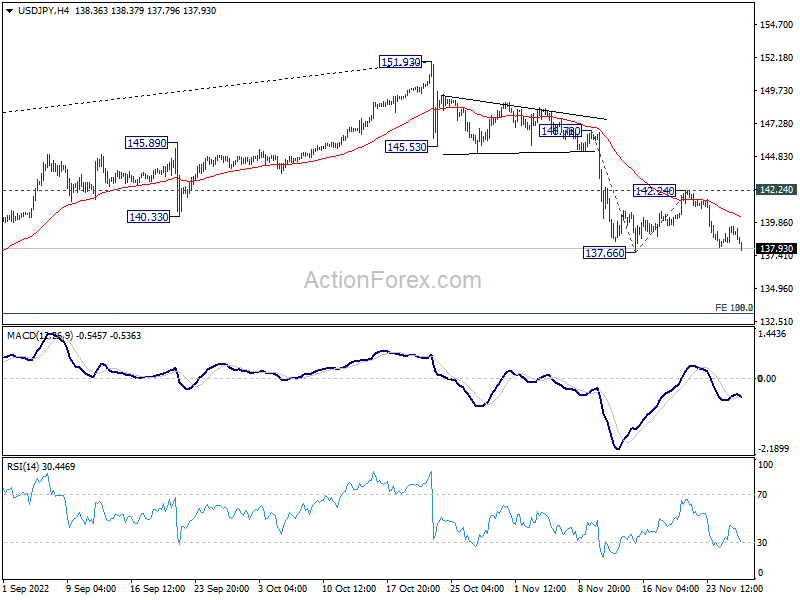
Daily Pivots: (S1) 138.49; (P) 139.04; (R1) 139.71; More...
Immediate focus is now on 137.66 support in USD/JPY. Firm break there will resume the decline from 151.93, as a correction to larger up trend, to 100% projection of 146.78 to 137.66 from 142.24 at 133.12, which is close to 133.07 medium term fibonacci level. In any case, outlook will stay bearish as long as 142.24 resistance holds.
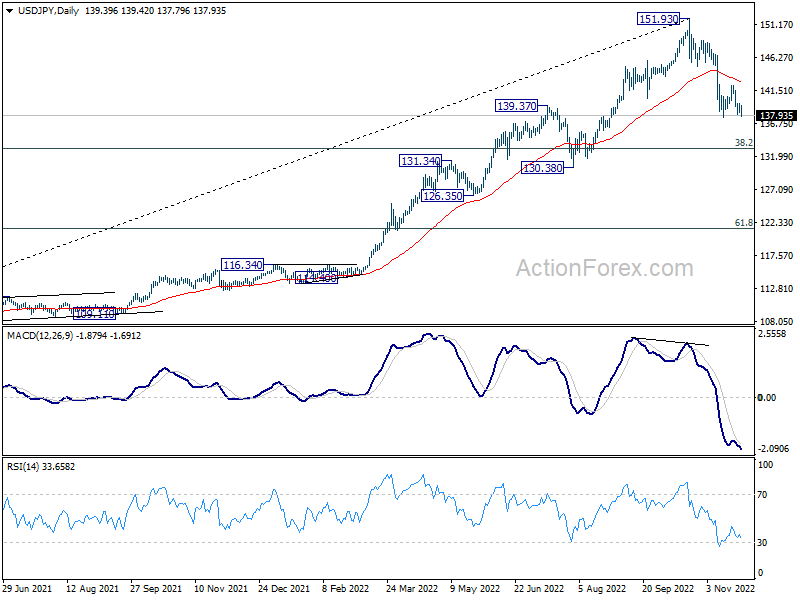
In the bigger picture, a medium term top should be formed at 151.93. Fall from there is correcting larger up trend from 102.58. It's too early to call for bearish trend reversal. But even as a corrective move, such decline should target 38.2% retracement of 102.58 to 151.93 at 133.07, or further to 55 week EMA (now at 131.22).
AUD/USD Daily Report
Daily Pivots: (S1) 0.6724; (P) 0.6752; (R1) 0.6784; More...
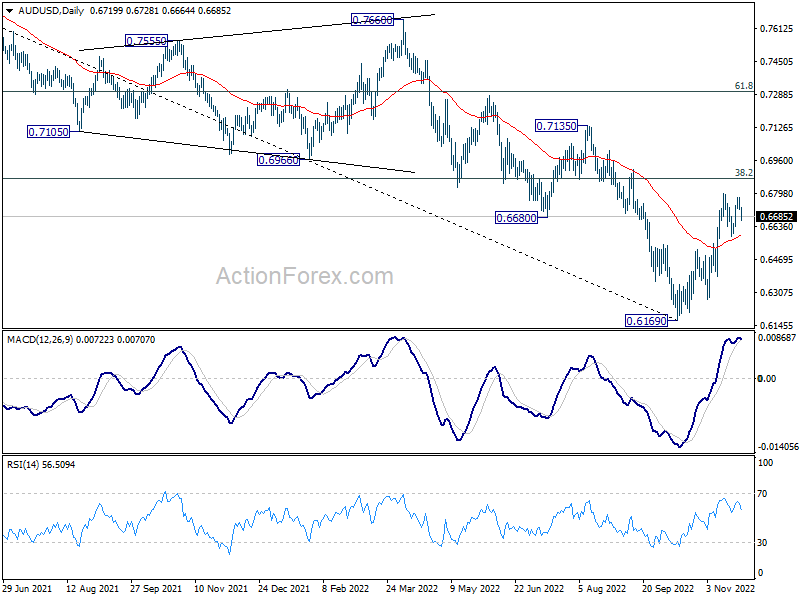
Intraday bias in AUD/USD remains neutral for the moment. Outlook is unchanged too. Further rise is expected as long as 0.6521 resistance turned support holds. On the upside, break of 0.6796 will resume the rise from 0.6169 to 0.6871 fibonacci level. However, sustained break of 0.6521 will argue that whole rebound from 0.6169 is over, and bring deeper fall to retest this low.
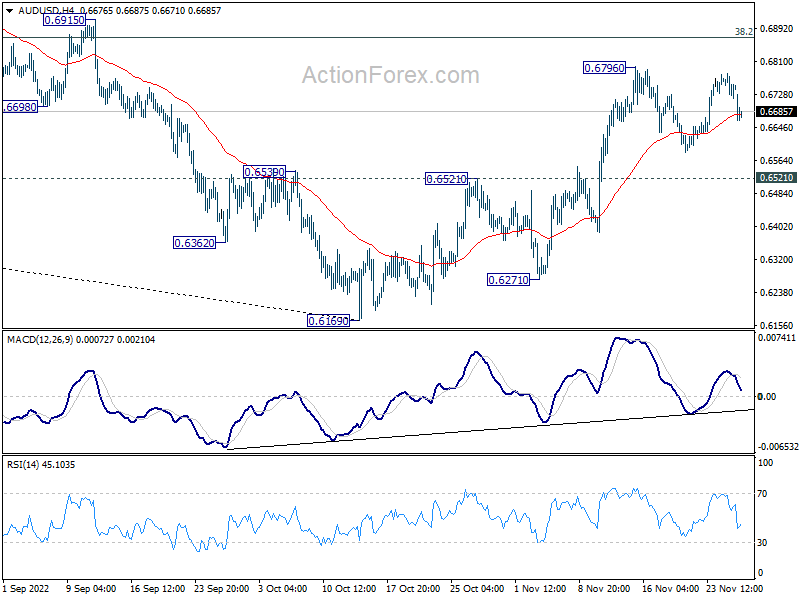
In the bigger picture, a medium term bottom is in place at 0.6160 already. But it's too early to call for trend reversal. Nevertheless, even as a corrective move, rise from 0.6169 should target 38.2% retracement of 0.8006 to 0.6169 at 0.6871. Sustained trading above 55 week EMA (now at 0.6927) will raise the chance of the start of a bullish up trend. This will now remain the favored case as long as 0.6521 resistance turned support holds.
China Protests
Massive anti-Covid protests in the biggest Chinese cities marked the weekend. Despite rising Covid cases and renewed Covid measures, thousands of Chinese citizens gathered to show their discontent with Xi Jinping’s Covid zero strategy, that nailed millions at home for months, without any progress.
As a result, three years have gone by since the pandemic started, and the health risks in China are higher than ever. Due to extremely strict lockdown measures, the Chinese population had no chance to develop collective immunity, the vaccination rate is low, and the vaccines are not efficient.
The new Covid variants are less deadly, but they spread more rapidly. And experts say, if China reopened tomorrow, Covid would spread like wildfire and kill thousands, simply because people are not immune enough and the health system is not ready for the shock.
This means the Chinese reopening won’t be a piece of cake; it looks like the Chinese economy may further suffer, either from endless and pointless lockdown measures, or from a severe health crisis.
Weak sentiment on China COVID-19 worries
The week kicked off on a bad mood in the Asian markets. Australian and Chinese stock markets were painted in red. The Hang Seng index dived more than 2% in Hong Kong, and crude oil has already lost more than 3% at the time of writing.
Uncertainty around the Chinese reopening sent the barrel of US crude below the $75/76 support, and the next natural target for the oil bears stands at the $70 psychological support.
One factor that could slow down bleeding in oil is the upcoming OPEC meeting, scheduled for December 4. OPEC could use the Chinese excuse to further restrict outlook and hope to throw a floor under the crude selloff.
But the bears have the upper hand right now, and any price rallies should bump into solid resistance within the $77/80 range.
Record Black Friday sales hammer the idea of a consumer-led recession in the US
Had there been no protests in China, I would’ve started writing about the record Black Day sales in the US this year, that should hammer the joy around a potential Federal Reserve (Fed) pivot on softening US economy.
But the US shoppers spent more than $9 billion in online sales on Friday, and Cyber Monday is also expected to be a record-breaking one, with more than $11 billion to be spent.
This is not exactly what you expect to hear when you think that the US will enter a consumer-led recession in couple of weeks from now.
The strength of the latest retail sales data, combined to Black Friday figures may revive the Fed hawks this week, especially if the US jobs data, and the latest GDP update print strong numbers.
On Wednesday, the US Q3 growth could be revised slightly higher, and due Friday, the nonfarm payrolls are expected to print 200’000 job additions in November. It’s still a lot.
The US dollar kicked off the week on a bullish note. The EURUSD slipped below the 200-DMA, near 1.0380. The S&P500 index closed last week at the highest levels since mid-September, and stands a couple of points from the year-to-date descending channel top, which could bring topsellers in, especially if strong data revives the idea that the Fed has no reason to stop hiking its interest rates.
Chinese Protests Give Hit to Risk Sentiment
Market movers today
We have no tier-1 data today but will get euro M3 growth, Norwegian retail sales and some Fed speakers tonight.
This week focus turns to Euro Flash CPI for November on Wednesday, which will be important for the size of the ECB hike at the 15 December meeting, see Weekly Focus - Euro inflation key to size of next ECB hike, 25 November.
US payrolls on Friday will be important for the Fed's rate decision on 14 December. We expect US job growth to decline from 261k to a still decent 220k (consensus 200k). US ISM manufacturing, core PCE inflation and house prices are also due this week.
The 60 second overview
New Global Outlook: This morning we published Big Picture - Recession with different undercurrents in which we present new forecasts for the global economy. Various shocks challenge the global economy, with different undercurrents driving the economic outlook across regions. The euro area and the US are headed for recession, while the Chinese growth engine is sputtering. However, the outlook starts to brighten in 2024, once China leaves its zero-Covid behind and the US economy exits from its downturn. Inflation pressures will slowly recede, allowing central banks to gradually exit their tightening mode and rate cuts could return to top the central bank agenda in early 2024. Risks primarily stem from renewed geopolitical tensions, energy shocks and a return of the pandemic through new variants.
Chinese protests widen over zero-Covid policy: Protests spread to more big cities across China after mourning ceremonies over a fire that killed 10 people in Xinjiang turned into protests against the government and the zero-Covid policy. Normally protests in China are aimed at local governments but a crowd in Shanghai directed their protest against the Communist Party and Xi Jinping. The protests come as the recent tweaks in the zero-Covid policy seems to have backfired as it led to rising cases across the country that subsequently triggered new restrictions being implemented. We do not expect China to abandon zero-Covid policy before a vaccination campaign has been rolled out but if protests widen, we could very well see some relaxation and an earlier exit from the zero-Covid policy than our baseline scenario of second half of 2023. The Communist Party's mouthpiece People's Daily reiterated the need for "timely detection and control of infected persons" but refrained from using the 'dynamic zero-Covid policy' phrase. Xinhua, another key news outlet for CCP, called on the country to stick "unswervingly" to the principle of putting the people's lives first" and prevent a domestic rebound, phrases that are associated with the zero-Covid policy.
The challenge for China's government now is that it is unlikely it can ease rules without seeing sharply higher cases and more difficulties in reining in outbreaks. It seems to be closer to a cross roads where it has to choose between allowing the virus to spread more or implement tighter restrictions which could lead to even more protests.
Oil prices lowest since January: The rising uncertainty in China led to another drop in oil prices, with the spot Brent price falling below USD80 for the first time since January.
Equities: A quiet session on Friday and equities little changed and without a clear direction. US saw a small preference for defensive sectors on Friday but with minuscular differences between sectors. The lower conviction in markets comes from lower support from positioning: VIX ticked slightly higher on Friday close to the important 20-level. Previous bear market rallies this year have always ended when VIX hit 20. Dow +0.45%, S&P500 (0.03%), Nasdaq (0.52%), Russell 2000 +0.30%.
FI: The hit to risk sentiment sent US bond yields lower in Asian trading falling to 3.63%, the lowest in close to two months. We are likely to see German yields open lower as well reversing some of the increase on Friday.
FX: CNH declined overnight following the Chinese protests. USD/CNH jumped from 7.19 to 7.26 on the open. The cross came back down to 7.21 during the night, though. The development in protests and the government's response will be key to watch over the coming week. The multi-week rally in EUR/USD, which brought the cross to new five-month highs, has taken a breather and is back below 1.04. USD/JPY testing lows around 138.50. After a 30-figure drop EUR/NOK is off lows at 10.30. EUR/SEK starts the week around 10.85.
Credit: The credit market ended the strong performance last week on a more tempered note, with iTraxx main widening 1.5bp to 89.1bp and Xover widening 10.4bp to 452.0bp. Primary activity also took a breather with only minor local currency deals being announced. As we are approaching the December lull, we remain optimistic that we will see a good deal of primary activity in the coming couple of weeks ahead of investors closing down for the year.
Nordic macro
Norway releases retail sales, which is expected to decline -0.5% m/m. Later this week we get preliminary GDP and NIER confidence indicators out of Sweden while Norway releases unemployment numbers.
USD/CAD Daily Outlook
Daily Pivots: (S1) 1.3332; (P) 1.3366; (R1) 1.3414; More....
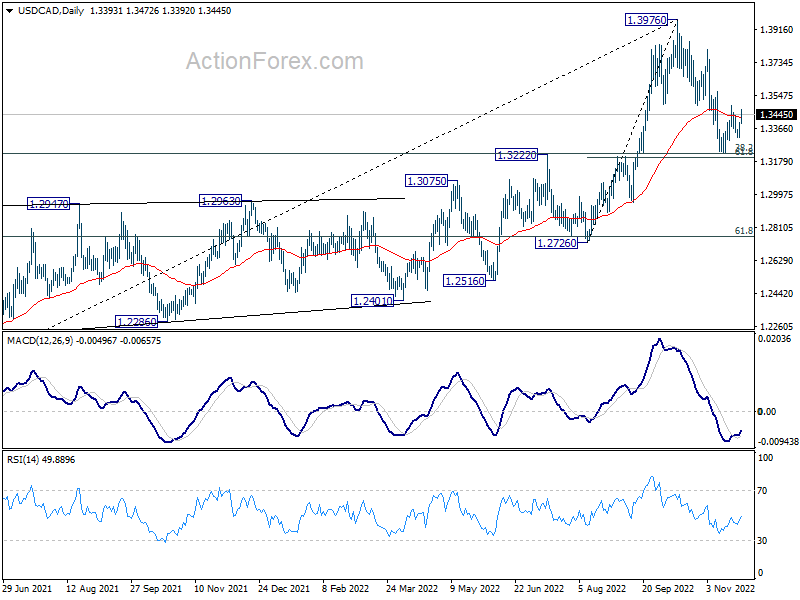
Intraday bias in USD/CAD stays neutral for the moment. On the upside, firm break of 1.3494 will indicate that correction from 1.3976 has completed at 1.3224, ahead of 1.3207 cluster support (61.8% retracement of 1.2726 to 1.3976 at 1.3204). Intraday bias will be turned back to the upside for 1.3807/3976 resistance zone. However, on the downside, sustained break of 1.3204/7 will carry larger bearish implication and target 1.2952 support next.
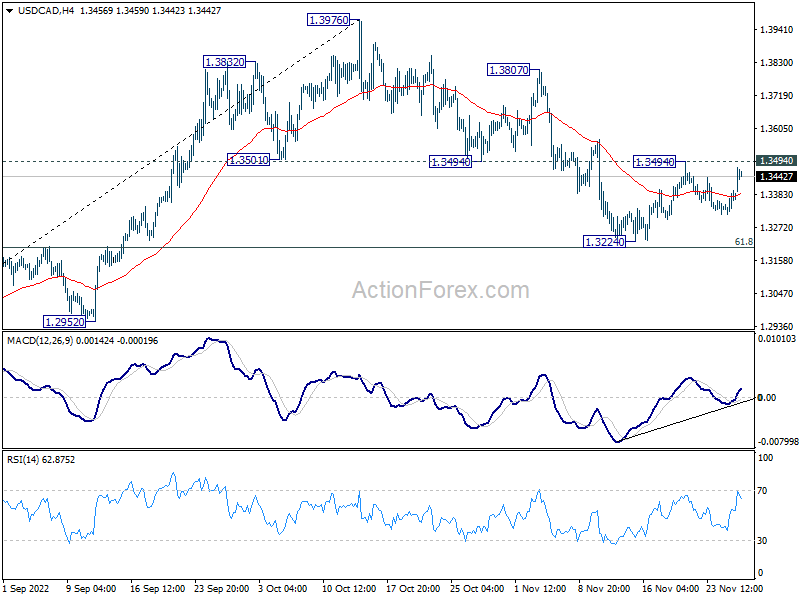
In the bigger picture, as long as 1.3222 cluster support (38.2% retracement of 1.2005 to 1.3976 at 1.3223) holds, larger up trend from 1.2005 (2021 low) is still expected to resume through 1.3976 high at a later stage. However, firm break of 1.3222/3 will indicate that the trend might have reversed. Deeper fall would be seen to next cluster support at 1.2726 (61.8% retracement at 1.2758).
Aussie Down as China Unrest Triggers Risk Aversion
Yen and Dollar rise broadly in Asian session today while Australian Dollar leads commodity currencies lower. Markets are trading with risk-off sentiment, with deeper selloff in China and Hong Kong markets. Large scale protests were carried out in multiple cities in China over the weekend, and the theme has escalated from anti-lockdown to anti-President Xi Jinping and the Chinese Communist Party. The development in China will be a key factor for sentiment over the next few days, along with US job data and Eurozone inflation later in the week.
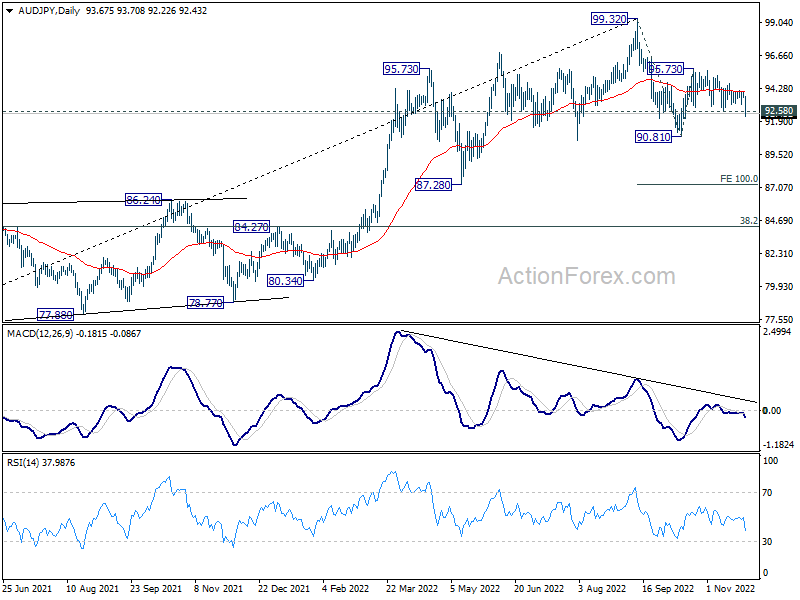
Technically, the break of 92.58 minor support in AUD/JPY suggests that recovery from 90.81 has completed after failing to sustain above 55 day EMA. Deeper decline is now in favor back to retest 90.81 first. Firm break there will extend the decline from 99.32, as a correction to larger up trend from 2020 low at 59.85. Next target is 100% projection of 99.32 to 90.81 from 95.73 at 87.22.
In Asia, Nikkei dropped -0.42%. Hong Kong HSI is down -2.15%. China Shanghai SSE is down -1.39%. Singapore Strait Times is down -0.52%. Japan 10-year JGB yield dropped -0.0053 to 0.255.
Australia retail sales fell -0.2% mom in Oct, first decline this year
Australia retail sales turnover dropped -0.2% mom to AUD 35.02B in October, much worse than expectation of 0.5% mom rise. That's also the first monthly decline in 2022.
Ben Dorber, ABS head of retail statistics said: "The October fall in retail turnover ends a run of nine straight monthly rises and suggests increased cost of living pressures including interest rate rises have started to weigh on consumer spending."
"Turnover fell in all industries in October except for food retailing, which rose 0.4 per cent boosted by flood-related spending in parts of Australia and continued high food prices."
RBA Lowe: Best outcome is for wages to pick up but not too much further
RBA Governor Philip Lowe told a parliamentary committee that the central bank is keeping an eye on electricity prices and housing. "If we can address those two issues then that will make a substantial contribution in bringing inflation back down over the next couple of years," he said.
Also, he added that a massive spike in wages would make it harder to bring inflation down. "If wage growth was 7 or 8 per cent then inflation would be 6 or 7 per cent … we were in this world in the 1970s and it worked out very badly," Lowe said. "The best outcome for the country is for wages to pick up but to not go too much further."
RBNZ Silk: The persistence factor of inflation was most surprising
RBNZ Assistant Governor Karen Silk said in an interview, "What we have seen is actual inflation continue to surprise on the upside, but more importantly inflation expectations have moved higher as well... And it's the persistence factor that has probably been the most surprising."
On tightening, "obviously we started way earlier than other central banks, so other central banks had to move an awful lot faster basically to play catch up," she said. "So no, I don't believe that the MPC has dilly-dallied around on this at all."
"If the information shows that we've reached that peak (5.5% interest rate) and we see that turn and we're starting to see real impacts on inflation and inflation expectations, then that does offer us the opportunity to revisit," she said.
US NFP and Eurozone CPI to confirm size of Dec rate hikes
Job data from the US and inflation data from Eurozone are the biggest events this week. Both could be the final piece of data that decide the size of rate hikes of Fed and ECB. In addition, US will release consumer confidence, ISM manufacturing, and PCE inflation.
Elsewhere data to be watched include Japan industrial production and retail sales, Swiss GDP and CPI, Canada GDP, New Zealand ANZ business confidence, and China PMIs.
Here are some highlights for the week:
- Monday: Australia retail sales; Eurozone M3 money supply; Canada current account.
- Tuesday: Japan unemployment rate, retail sales; Germany CPI flash; Swiss GDP; UK M4 money supply, mortgage approvals; Canada GDP; US house price index, consumer confidence.
- Wednesday: New Zealand ANZ business confidence; Australia building approvals, construction work done; Japan industrial production, housing starts; China PMIs; France consumer spending, GDP revision; Swiss KOF; Germany unemployment; Eurozone CPI flash; US ADP employment; GDP revision, goods trade balance, Chicago PMI, pending home sales, Fed Beige Book.
- Thursday: Australia AiG manufacturing, private capital expenditure; Japan PMI manufacturing final, capital spending, consumer confidence; China Caixin PMI manufacturing; Germany retail sales; Swiss CPI, retail sales; Eurozone PMI manufacturing final, unemployment rate; UK PMI manufacturing final; US Challenger job cuts, jobless claims, personal income and spending, ISM manufacturing, construction spending.
- Friday: New Zealand terms of trade; Japan monetary base; Germany import prices, trade balance; Eurozone PPI; Canada employment; US non-farm payroll.
USD/CAD Daily Outlook
Daily Pivots: (S1) 1.3332; (P) 1.3366; (R1) 1.3414; More....
Intraday bias in USD/CAD stays neutral for the moment. On the upside, firm break of 1.3494 will indicate that correction from 1.3976 has completed at 1.3224, ahead of 1.3207 cluster support (61.8% retracement of 1.2726 to 1.3976 at 1.3204). Intraday bias will be turned back to the upside for 1.3807/3976 resistance zone. However, on the downside, sustained break of 1.3204/7 will carry larger bearish implication and target 1.2952 support next.
In the bigger picture, as long as 1.3222 cluster support (38.2% retracement of 1.2005 to 1.3976 at 1.3223) holds, larger up trend from 1.2005 (2021 low) is still expected to resume through 1.3976 high at a later stage. However, firm break of 1.3222/3 will indicate that the trend might have reversed. Deeper fall would be seen to next cluster support at 1.2726 (61.8% retracement at 1.2758).
Economic Indicators Update
| GMT | Ccy | Events | Actual | Forecast | Previous | Revised |
|---|---|---|---|---|---|---|
| 00:30 | AUD | Retail Sales M/M Oct | -0.20% | 0.50% | 0.60% | |
| 09:00 | EUR | Eurozone M3 Money Supply Y/Y Oct | 6.50% | 6.30% | ||
| 13:30 | CAD | Current Account (CAD) Q3 | -4.0B | 2.7B |
RBNZ Silk: The persistence factor of inflation was most surprising
RBNZ Assistant Governor Karen Silk said in an interview, "What we have seen is actual inflation continue to surprise on the upside, but more importantly inflation expectations have moved higher as well... And it's the persistence factor that has probably been the most surprising."
On tightening, "obviously we started way earlier than other central banks, so other central banks had to move an awful lot faster basically to play catch up," she said. "So no, I don't believe that the MPC has dilly-dallied around on this at all."
"If the information shows that we've reached that peak (5.5% interest rate) and we see that turn and we're starting to see real impacts on inflation and inflation expectations, then that does offer us the opportunity to revisit," she said.