

Sample Category Title
Dollar Index: Bears Pressure Key Support Zone
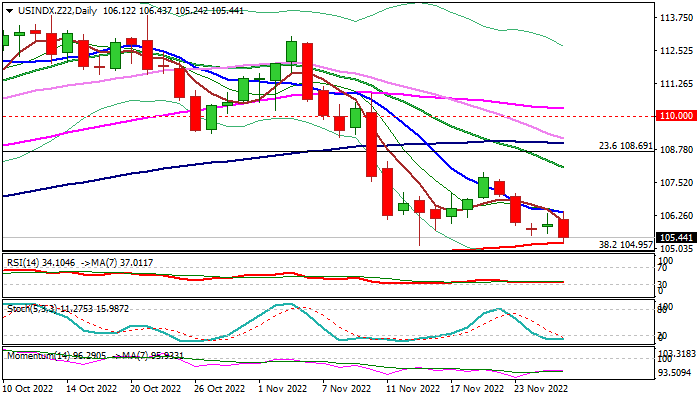
The dollar’s sentiment weakened on Monday, pushing the index lower and signaling possible bearish continuation after a double-Doji (Thu/Fri).
Fresh bears cracked pivotal 200DMA (105.25) the upper boundary of key support zone at 105.25/104.96, defined by 200DMA, Nov 15 spike low and Fibo 38.2% of 89.15/114.72 uptrend, with sustained break here to signal further weakness of the greenback, already on track for strong monthly fall in November.
Bearish daily techs contribute to dollar-negative fundamentals as signals that Fed would soften its aggressive approach to policy tightening, weigh strongly.
Res: 106.43; 107.11; 107.88; 108.06.
Sup: 105.15; 104.96; 104.49; 103.40.
Bitcoin’s Never-Ending Search for a Bottom
Market picture
Bitcoin closed last week with a new formal decline, losing $100 to $16490. At the start of trading on Monday, it loses another $360 to $16150. The week starts with a subdued risk appetite on global markets due to China unrest. Ethereum is performing better, adding 3.3% over the week to $1170. Other leading altcoins in the top 10 are changing from -2.5% (Polkadot) to 22.2% (Dogecoin).
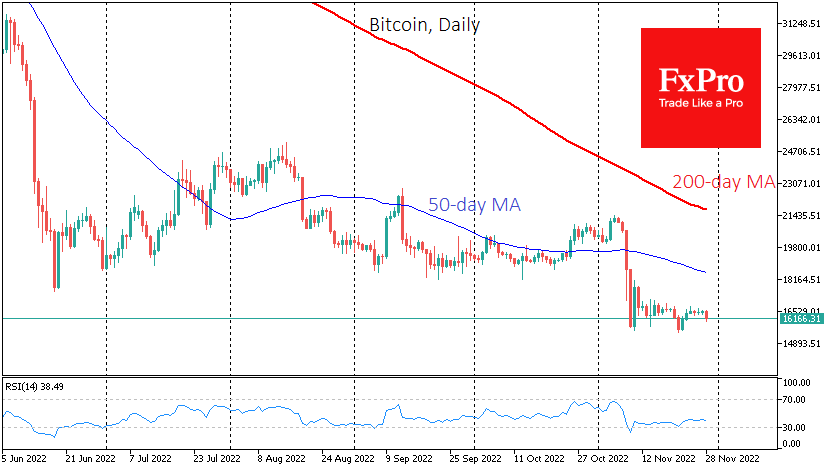
Total crypto market capitalisation, according to CoinMarketCap, was up 2% for the week, to $817bn. The cryptocurrency Fear & Greed Index rose to 28 by Monday, moving into “fear” versus “extreme fear” at 21 a week earlier.
Bitcoin has updated two-year lows below $15,500 in the past week on news of the possible bankruptcy of cryptocurrency lending service Genesis Global Capital. Bitcoin is under pressure from institutionalists whose risk appetite is firmly tied to stock markets. Bitcoin continues to look for a bottom from which it can push back, but the negative external backdrop is not yet conducive to buying.
News background
According to Barron’s, Genesis Global Capital has been the subject of an investigation by US regulators over the suspension of withdrawals and the company’s liquidity crisis. It is unclear whether US federal regulators are involved, but at the very least, Alabama state supervisory agencies are investigating.
The DeFi-project Ardana team from the Cardano blockchain ecosystem has said it has suspended its development due to “uncertainty over funding and the timing of the project”.
Bloomberg, a news agency, reports that Cryptocurrency lender Matrixport is seeking funding for $100 million. And while the company says the moves have nothing to do with a lack of liquidity, investors are little reassured.
Analysis of Bitcoin transactions helped British police arrest over 100 people in the biggest anti-fraud operation in UK history, led by Scotland Yard. The iSpoof website was taken down, and phone fraud suspects were caught.
USD/JPY: Signals of Bearish Continuation Expose Fibo Target at 135.47
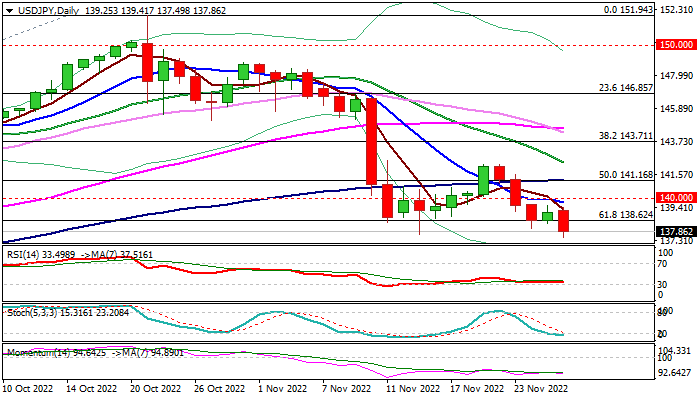
Fresh bearish acceleration on Monday (down 1.1% since opening), broke clearly through pivotal Fibo support at 138.62 (61.8% of 130.39/151.94) which recently contained several attacks and cracked Nov 15 spike low at 137.67, hitting the lowest since late August.
This signals continuation of larger downtrend from multi-decade peak (151.94), which paused for consolidation in past two weeks after a massive losses in the first week of November.
Bears focus target at 135.47 (Fibo 76.4%) but see a minimum requirement on close below 138.62 (Fibo 61.8%) for confirmation.
Daily studies show strong negative momentum and MA’s in full bearish setup that reinforces bearish structure, along with a massive monthly bearish candle (USDJPY is on track for a drop of over 7% in November).
Res: 138.62; 139.50; 139.79; 140.00.
Sup: 137.49; 136.17; 135.81; 135.47.
ECB Knot: Risk of doing too little clearly more pronounced
ECB Governing Council member Klaas Knot said, "My worry is still inflation, inflation, inflation... As long as the risks to our inflation outlook are so clearly tilted to the upside, I think the risk of us doing too little is clearly more pronounced than us doing too much... We should not give up too early and not cry victory too early."
Knot also said a recession is "not a foregone conclusion". "If you look at Germany, where actually the economy is doing better than then was feared, it's not a foregone conclusion that we will get a recession", he said. "We will get weaker growth, that's for sure. But we also need weaker growth to bring inflation back to target."
EURUSD Fights Stubbornly for 1.0400
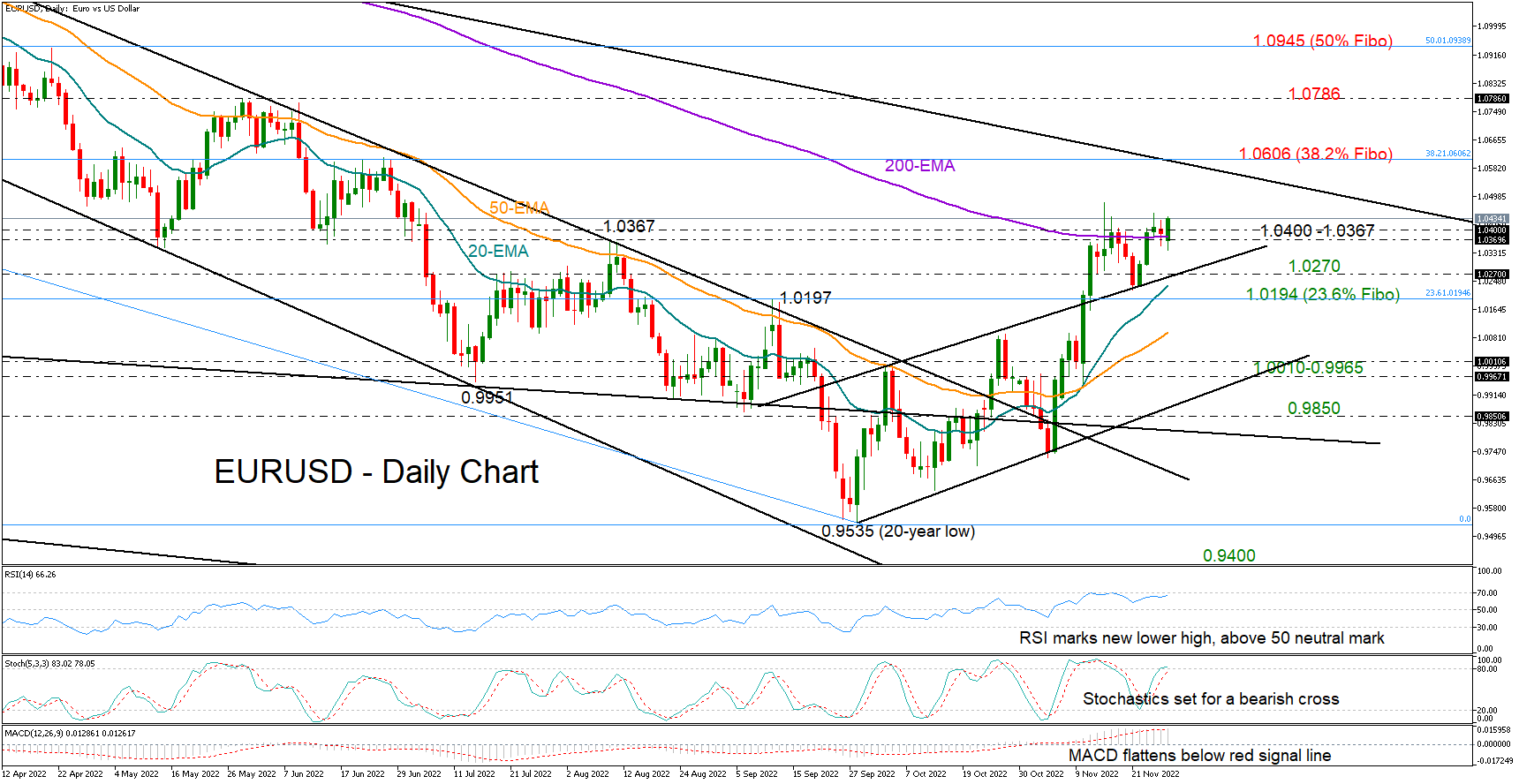
EURUSD opened with a slight negative gap on Monday after getting rejected around the 1.0400 psychological level for the second time last week.
The bulls are currently making another attempt to breach that wall and keep the bullish bias intact above the 200-day exponential moving average (EMA). But the momentum indicators are reflecting some cracks in buying interest. Specifically, the RSI has made a new lower high after peaking near its 70 overbought level, the stochastics are looking to change direction to the downside, while the MACD is flattening marginally below its red signal line, increasing the risk for a downside reversal.
That said, a potential downside correction may not discourage buyers unless the price flips back into the channel at 1.0270 and beneath the 20-day EMA. In this case, the 23.6% Fibonacci retracement of the 1.2348-0.9535 downleg at 1.0194 may immediately attract attention. The 50-day EMA could next come into the spotlight ahead of the 1.0010-0.9965 constraining area, while even lower, all eyes will turn to the channel’s lower band seen around 0.9900.
Alternatively, should the price successfully claim the 1.0400 bar, the recovery is expected to pick up steam towards the tentative long-term descending trendline from May 2021. Note that the 38.2% Fibonacci level of 1.0606 is positioned in the same location. Hence, another victory at this point could bolster buying appetite up to May’s bar of 1.0786. Running higher, the pair may give more credence to the uptrend, if it manages to overcome the 50% Fibonacci of 1.0938 too.
Summarizing, although buying appetite seems to be showing some weakness, traders may keep supporting EURUSD as long as the floor around 1.0270 stays valid.
Gold Consolidates after Advance Pauses
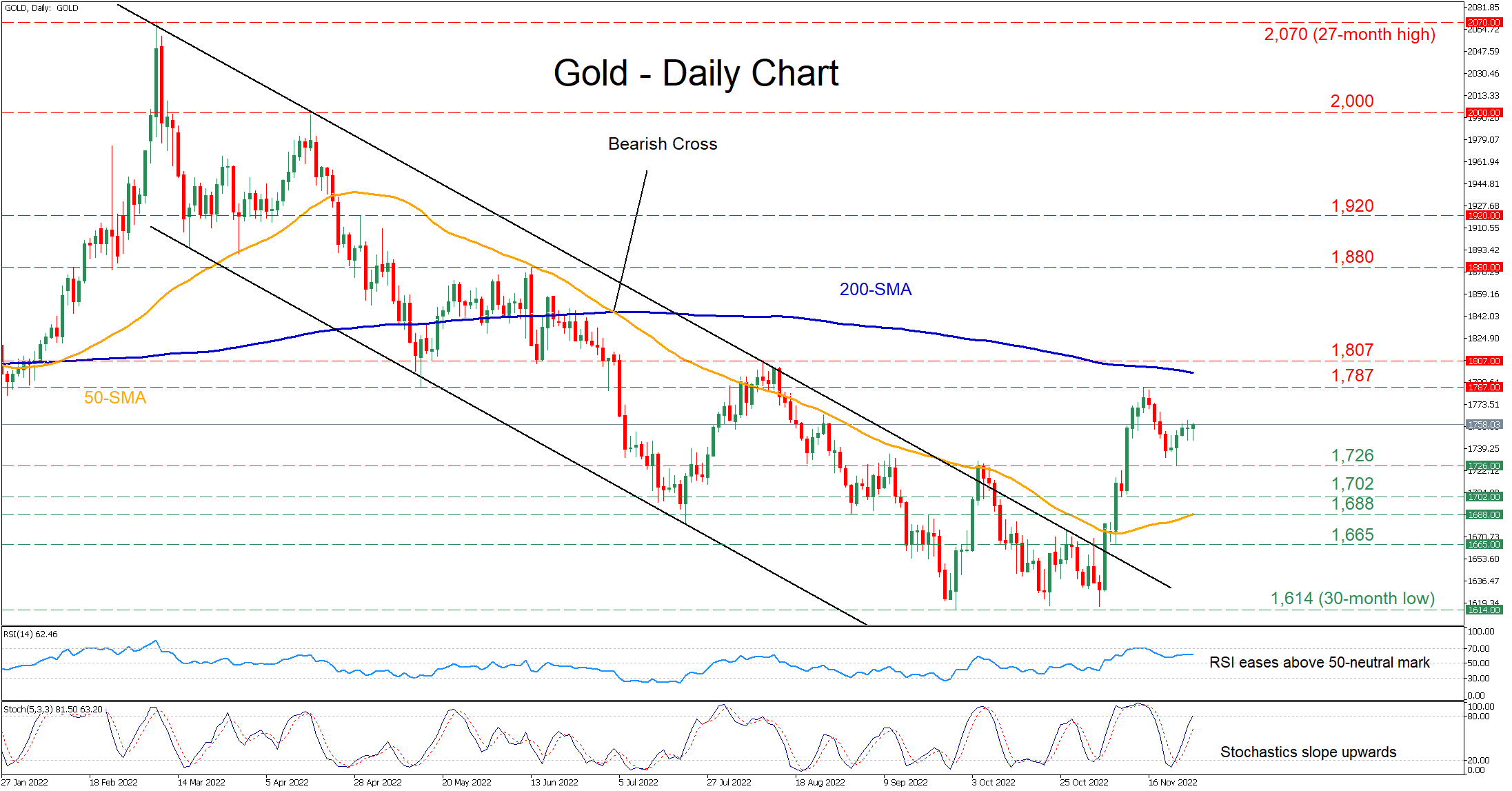
Gold has been losing ground since early March, generating a profound structure of lower highs and lower lows within a descending channel. Even though bullion recovered some ground after managing to cross above its restrictive trendline in early November, its rebound currently appears to be running out of steam.
The momentum indicators currently suggest that bullish forces are holding the upper hand. Specifically, the RSI has flatlined above its 50-neutral mark, while the stochastic oscillator is ascending near the 80-overbought zone.
To the upside, bullish actions could propel the price towards the recent rejection region of 1,787. Conquering this barricade, the bulls could aim for the August high of 1,807. Piercing through the latter, gold may ascend towards the June peak of 1,880 or higher to test the 1,920 barrier.
Alternatively, if the positive momentum wanes and the price reverses lower, initial support could be met at the recent low of 1,726. Failing to halt there, the commodity could test the 1,702 support before the spotlight turns to the 50-day simple moving average (SMA), currently at 1,688. Even lower, the 1,665 support might provide further downside protection.
Overall, gold’s recovery appears to be on hold for now, but near-term risks remain tilted to the upside. Hence, a break above the 1,787 ceiling is needed to validate the continuation of the short-term uptrend.
Aussie Sinks on China Unrest, Retail Sales
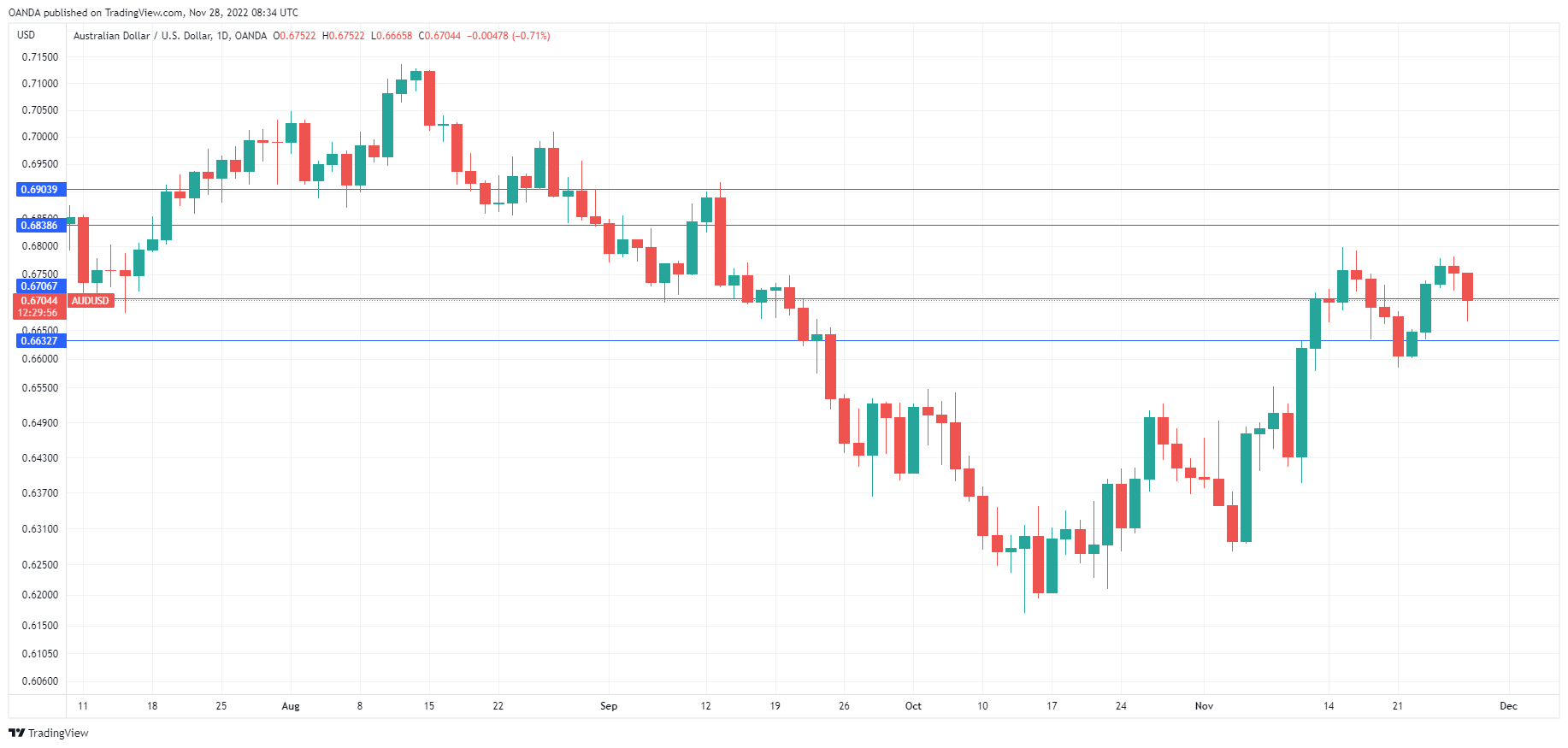
The Australian dollar has started the trading week with sharp losses. AUD/USD is down 0.70% in Europe, trading at 0.6704.
China jitters send Australian dollar tumbling
Covid cases continue to rise in China despite the government’s zero-Covid policy, and the mass lockdowns have triggered protests across China. The demonstrators have clashed with police and some have even called for Chinese President Xi to step down. The scale of the unrest has sent jitters through the global markets, which are expected to cause new supply-chain issues and chill domestic demand.
The unrest in China has put a damper on risk appetite and sent the US dollar higher. The Australian dollar is particularly sensitive to developments in China, as the Asian giant is Australia’s number one trading partner. The Australian dollar fell more than 1% earlier today but has pared some of those losses. Still, if there is further negative news out of China, the Aussie will likely lose more ground.
Adding to the Australian dollar’s woes was a soft retail sales report for October. Retail sales fell 0.2% MoM, down from 0.6% in September and below the consensus of 0.4%. It was the first decline since December 2021 and will renew concerns that the domestic economy is slowing down due to the Reserve Bank of Australia’s steep rate-hike cycle. The RBA has eased the pace of hikes but remains wary of a wage-price spiral, and Governor Lowe has warned that the central bank will not hesitate to return to oversize rate hikes if needed.
After an abbreviated week due to the Thanksgiving holiday, it’s a busy week for US releases. CB Consumer Confidence will be released on Tuesday, with the November report expected to dip to 100.0, down from 102.5. The key release of the week is nonfarm payrolls on Friday, which could have a major impact on the Fed’s decision to raise rates by 50 or 75 basis points at the December 14th meeting. Currently, the likelihood of a 50-bp hike is about 75%, versus 25% for a larger 75-bp increase.
AUD/USD Technical
- AUD/USD is testing support at 0.6706. Below, there is support at 0.6633
- There is resistance at 0.6820 and 0.6903
EUR/USD: Sustained Break Above 200DMA Signals Further Advance
The Euro regained traction and jumped on Monday, generating signal that larger bulls are resuming after last Thu/Fri consolidation.
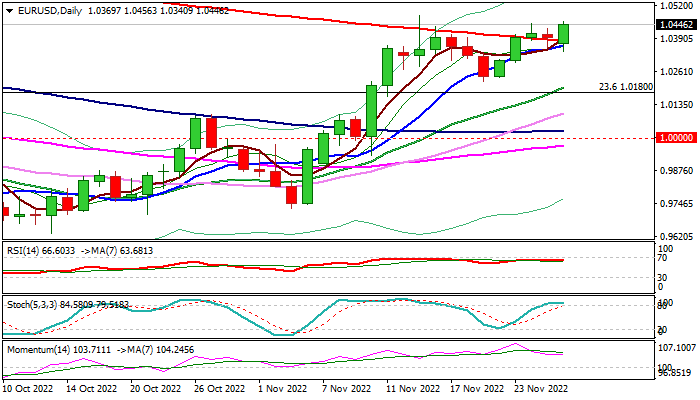
Fresh weakness of the US dollar lifts the single currency and bulls look for attack at key near-term barrier at 1.0481 (Nov 15 high), break of which would expose next key level at 1.0578 (Fibo 38.2% of 1.2266/0.9535 fall).
Repeated close above 200DMA (Thu/Fri) generated bullish signal, which is reinforced by 5/200DMA golden-cross, while 10 and 200DMA’s are converging and on track to form another bullish cross.
Bullish daily studies support the action, though overbought stochastic warns that bulls may face headwinds.
Dips should be limited (ideally to be contained by 200DMA at 1.0383) which guard 10DMA (1.0362) and daily Tenkan-sen (1.0339).
Res: 1.0481; 1.0578; 1.0620; 1.0700.
Sup: 1.0383; 1.0362; 1.0339; 1.0238.
WTI Falls to 11-month Low as Sentiment Sours Further
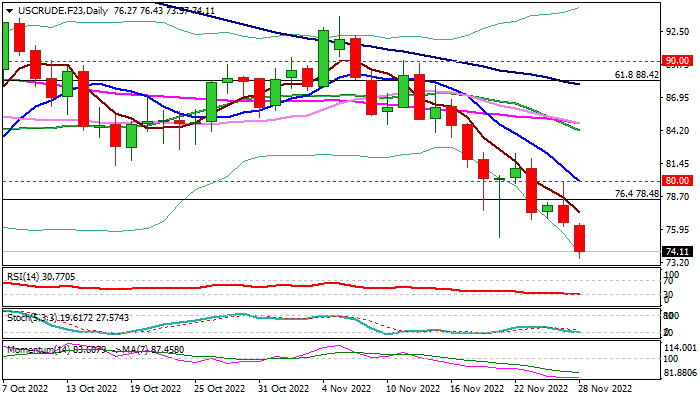
WTI oil price fell 3% and hit the lowest levels since late December 2021, in early Monday’s trading.
The sentiment remains weak and was further soured by Sunday’s protest in Shanghai over China’s strict Covid measures, boosting concerns about further weakening of demand, as China is world’s biggest oil importer.
Investors also focus on upcoming OPEC+ meeting on oil output, due on Dec 4 and the impact of G7 decision to cap price on Russian oil.
Markets fear on lack of signals that oil producers would cut output and contribute to tighter oil market, as well as the US decision to not start reloading its strategic reserves that would add pressure to already bearish oil market and push the price further down.
The WTI contract is on track for a heavy monthly losses in November (around 15% so far) and entered the fourth consecutive week in red.
Last Friday’s and weekly close below Fibo support at $78.48 (76.4% of $62.42/$130.48) generated additional negative signal,, as bearish engulfing pattern is forming on a monthly chart.
Daily techs are in full bearish setup and contribute to negative outlook, as bears pressure immediate target at $72.45 (200MMA), violation of which would risk test of psychological $70 level.
Corrective actions are expected to be limited (unless substantial change in fundamentals) and offer better levels to re-enter firmly bearish market, while capped under $80 barrier (psychological/falling 10DMA).
Res: 76.43; 77.41; 78.48; 80.00.
Sup: 73.57; 72.45; 71.62; 70.00.
The Market Stays Cautious ahead of Jerome Powell’s Speech and the NFP Report
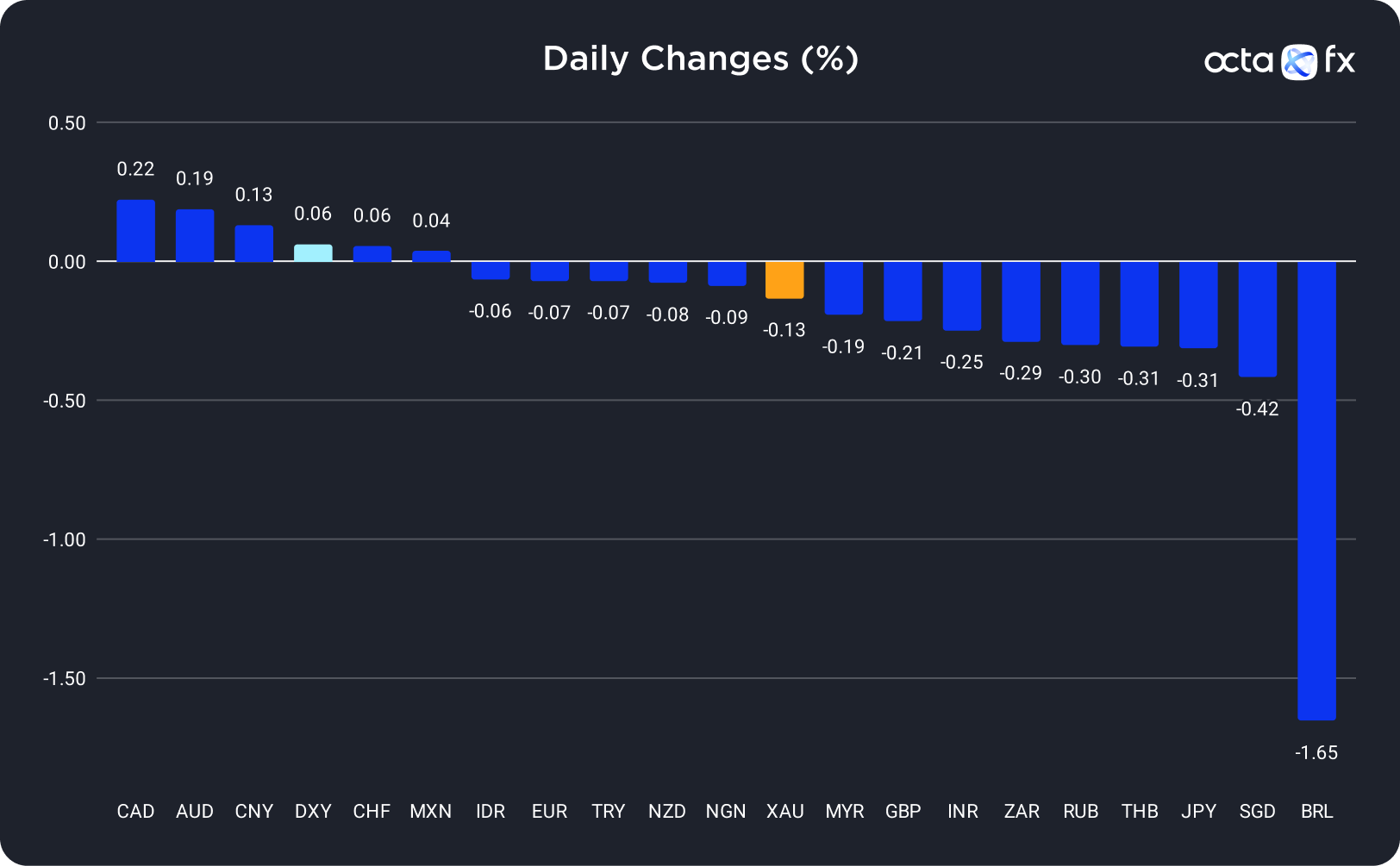
On Friday, the Canadian dollar was the best-performing currency among the 20 global currencies we track, while the Brazilian real showed the weakest results. The Chinese yuan was the leader among emerging markets, while the Japanese yen underperformed among majors.
In focus today
U.S. Dollar Index
The U.S. Dollar Index (DXY) slightly strengthened on Friday's low liquidity trading.
Possible effects for traders
The Friday session was calm following the U.S. Thanksgiving. This morning DXY reached 106.500 as investors turned to the safe-haven instrument on the back of anti-lockdown protests in China. Now, the market will focus on the Federal Reserve (Fed) Chairman Jerome Powell's speech on Wednesday that may support the greenback. It will come out a week after the FOMC Minutes showed the regulator's willingness to adopt a more dovish policy. Simon Harvey, a senior FX analyst at Monex Europe, commented that 'Powell's first comments since the 2 November meeting will be crucial. If he doesn't push back on the recent loosening in financial conditions, the dollar's near-term support may slip.'
XAUUSD
XAUUSD traded flat and closed at 1,756.06.
Possible effects for traders
The gold price slightly changed following the U.S. dollar movements on Friday. This morning, XAUUSD decreased to 1,746 as the firm greenback pushed the pair lower. Jerome Powell's speech on Wednesday and the anticipated NFP data on Friday will influence gold's price this week. XAUUSD will likely continue trading within the bearish sentiment. If it drops below 1,745, the pair can target the support at 1,736.
EURUSD
EURUSD fluctuated during the day but closed almost unchanged.
Possible effects for traders
The pair was turbulent as the European Central Bank (ECB) officials disagreed on the monetary policy outlook. Chief economist Philip Lane and board member Isabel Schnabel gave controversial opinions on whether the ECB should slow down its rate increases. The regulator will hold the next meeting in mid-December, and traders are discussing what are the ECB's next steps will be. EURUSD fluctuated from 1.03550 to 1.04300, and the pair will likely continue its sideways trading today.
Other events
XTIUSD
U.S. crude oil declined for the third consecutive week, closing below 77.00 on Friday.
Possible effects for traders
XTIUSD was primarily bullish, reaching the resistance at 80.00. However, news about record-high COVID-19 cases in China sent the market into a huge downwards move, and the pair broke below 77.35. Moreover, crude oil consumption reached a seven-month low in China, signalling the country's demand will not recover soon. At the same time, G7 countries cancelled the scheduled meeting on the Russian oil price cap, and XTIUSD found support at 76.70 by Friday night. The pair dropped slightly during the Asian session today and consolidated at 74.20 due to the weekend's huge anti-lockdown protests in China. Then the price rebounded but remained heavily oversold. Overall, traders will stay cautious ahead of the G7 meeting this week, which can resolve political tensions.