

Sample Category Title
AUD/USD Pair is Currently Consolidating Losses Below 0.6700
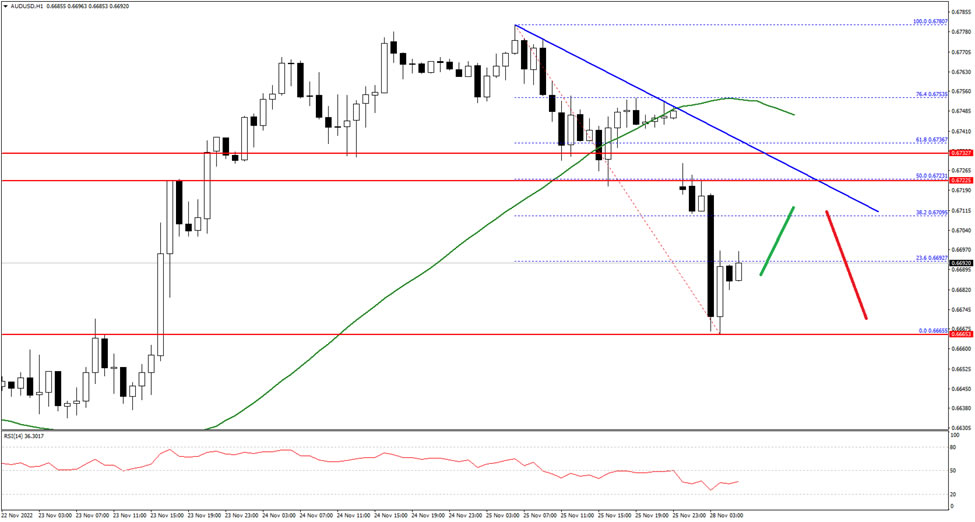
The Aussie Dollar failed to clear the 0.6800 resistance against the US Dollar. The AUD/USD pair started a downside correction below the 0.6780 and 0.6750 support levels.
There was a clear move below the 0.6720 level and the 50 hourly simple moving average. The pair even spiked below the 0.6700 and is currently consolidating losses. An immediate resistance on the upside is near the 0.6710 level and a connecting bearish trend line on the hourly chart.
If there is an upside break above the 0.6710 zone, the pair could rise steadily towards the 0.6750 level in the near term. The main resistance now sits near the 0.6800 level.
An immediate support is near 0.6670 on FXOpen. The next key support is near the 0.6650 level. A downside break below the 0.6650 support could lead the pair towards the 0.6600 support.
GBP/JPY Daily Outlook
Daily Pivots: (S1) 167.66; (P) 168.23; (R1) 168.82; More...
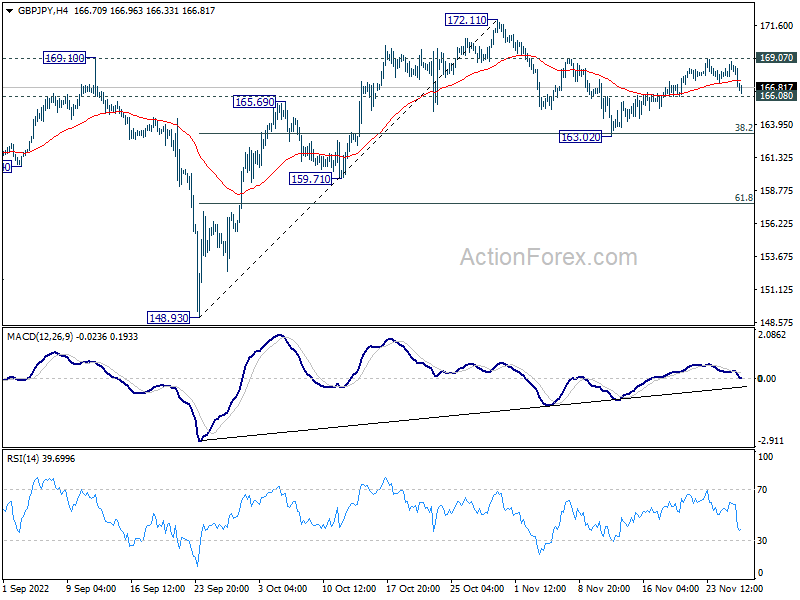
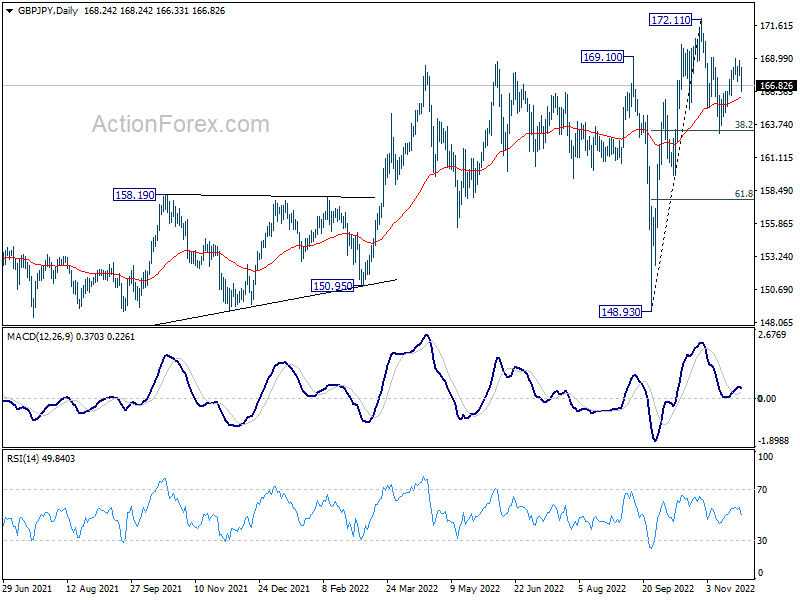
Intraday bias in GBP/JPY remains neutral and outlook is unchanged. On the upside, break of 169.07 resistance will argue that larger up trend is ready to resume through 172.11 high. However, break of 166.08 minor support will turn bias back to the downside to extend the corrective pattern from 172.11 with another fall.
In the bigger picture, there is no clear sign of medium term topping yet. Up trend from 123.94 (2020 low) could still resume through 172.11 high at a later stage. However, firm break of 159.71 support will argue that it's already in correction to the up trend from 123.94, and deeper decline would be seen back towards 148.93 support.
EUR/JPY Daily Outlook
Daily Pivots: (S1) 144.14; (P) 144.65; (R1) 145.17; More....
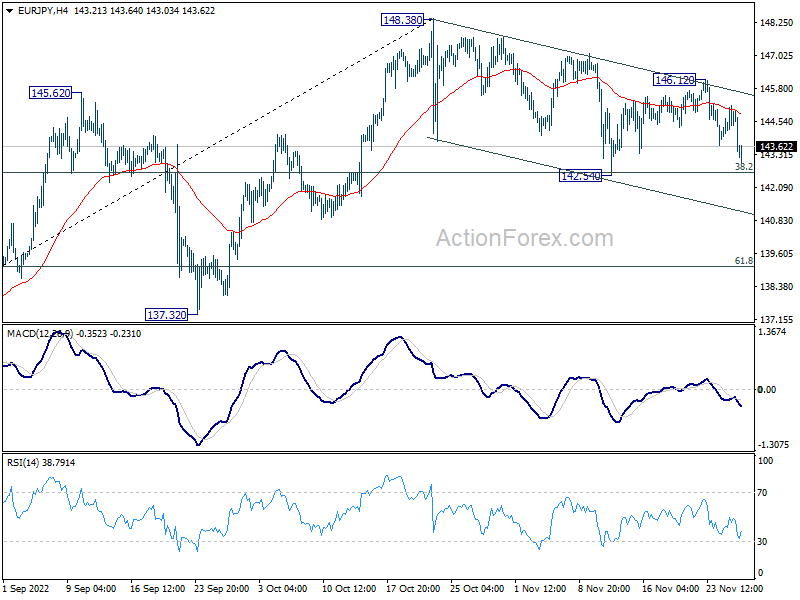
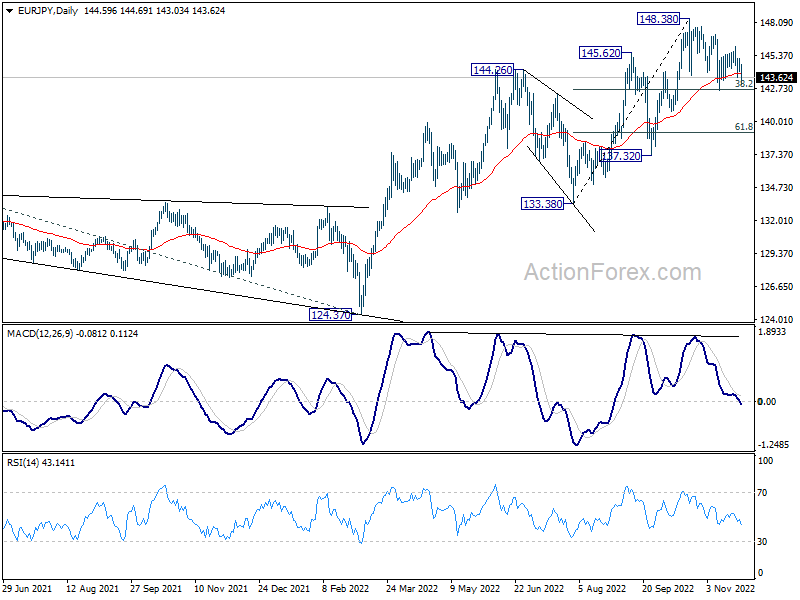
Intraday bias in EUR/JPY remains neutral first. Break of 142.52 support will extend the decline from 148.38, to 61.8% retracement of 133.38 to 148.38 at 139.11. On the upside, though, above 146.12 minor resistance will bring stronger rally back to retest 148.38 high instead.
In the bigger picture, there is no clear sign of medium term topping yet. Up trend from 114.42 (2020 low) could still resume through 148.38 to 149.76 (2014 high). However, break of 137.32 support argue that a medium term correction has already started to correct the whole up trend from 114.42.
EUR/GBP Daily Outlook
Daily Pivots: (S1) 0.8579; (P) 0.8597; (R1) 0.8618; More...
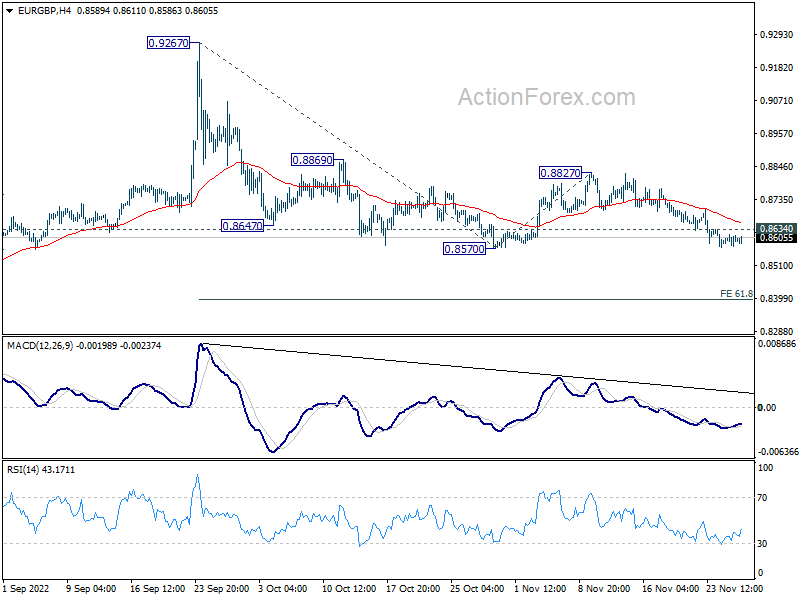
Focus stays on 0.8570 support in EUR/GBP. Firm break there will resume the fall from 0.9267 and target 61.8% projection of 0.9267 to 0.8570 from 0.8827 at 0.8369. On the upside, above 0.8634 minor resistance will turn bias back to the upside for recovery. But outlook will stay bearish as long as 0.8827 resistance holds.
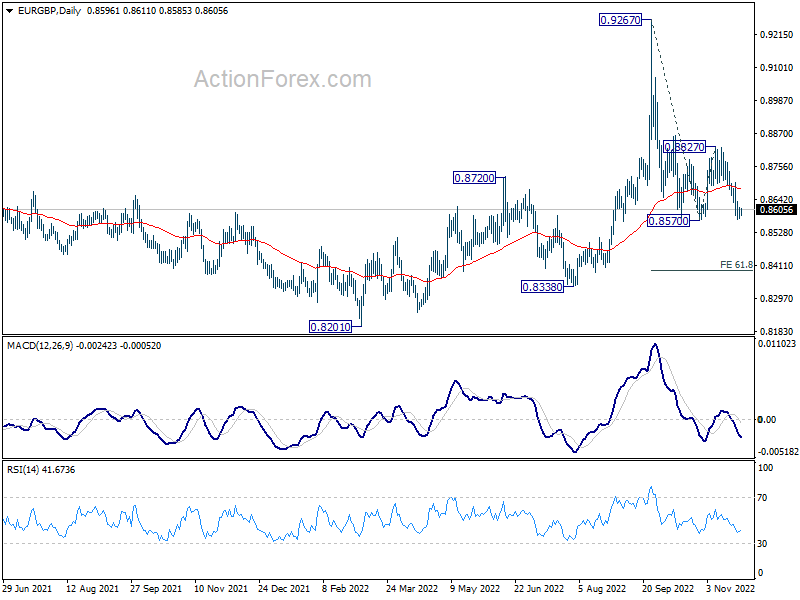
In the bigger picture, current development suggests that fall from 0.9267 is a down leg inside long term range pattern. Deeper fall could be seen towards 0.8201/8338 support zone. But strong support should be seen there to bring reversal. Nevertheless, firm break of 0.8827 resistance will turn favor to the case that such decline is merely a correction in the up trend from 0.8201. That is, further rally would be seen at a later stage through 0.9267.
EUR/AUD Daily Outlook
Daily Pivots: (S1) 1.5368; (P) 1.5410; (R1) 1.5440; More...
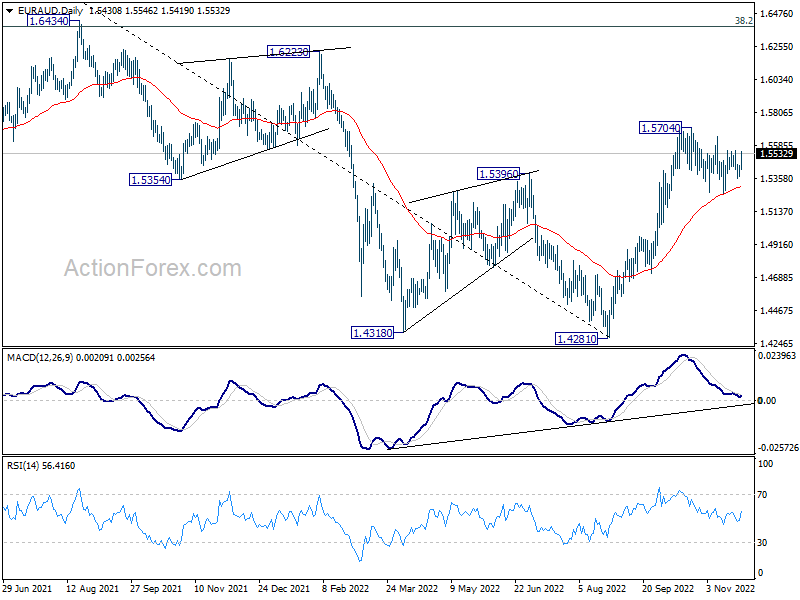
EUR/AUD rises notably today but stays below 1.5551 resistance, intraday bias remains neutral first. On the upside firm break of 1.5551 will argue that larger up trend is ready to resume. Intraday bias will be back on the upside for 1.5740 resistance and above. In case of another fall, downside should be contained by 55 day EMA (now at 1.5298) to bring rebound.
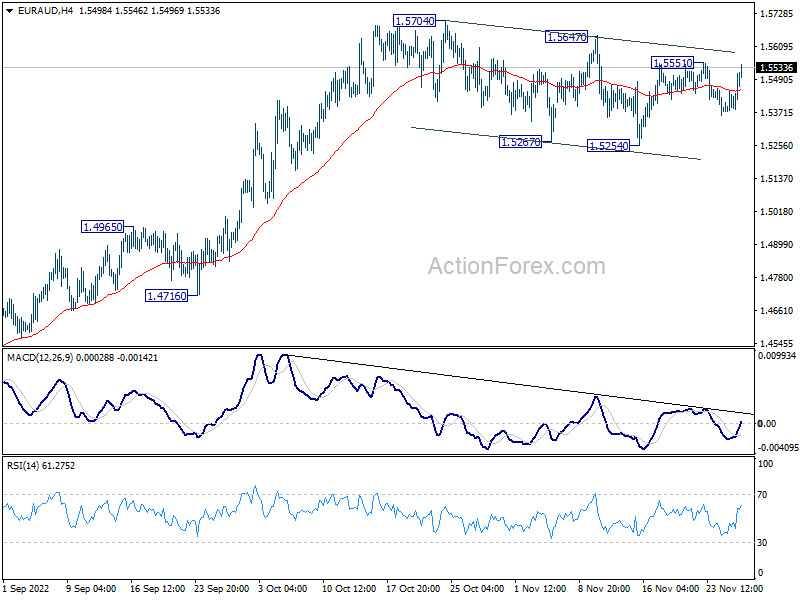
In the bigger picture, a medium term bottom should be in place at 1.4281, on bullish convergence condition in daily MACD. Further rise would be seen back to 1.6434 key resistance next. Break of 1.4965 resistance turned support is needed to indicate reversal. Otherwise, further rally will remain in favor.
EUR/CHF Daily Outlook
Daily Pivots: (S1) 0.9812; (P) 0.9835; (R1) 0.9855; More....
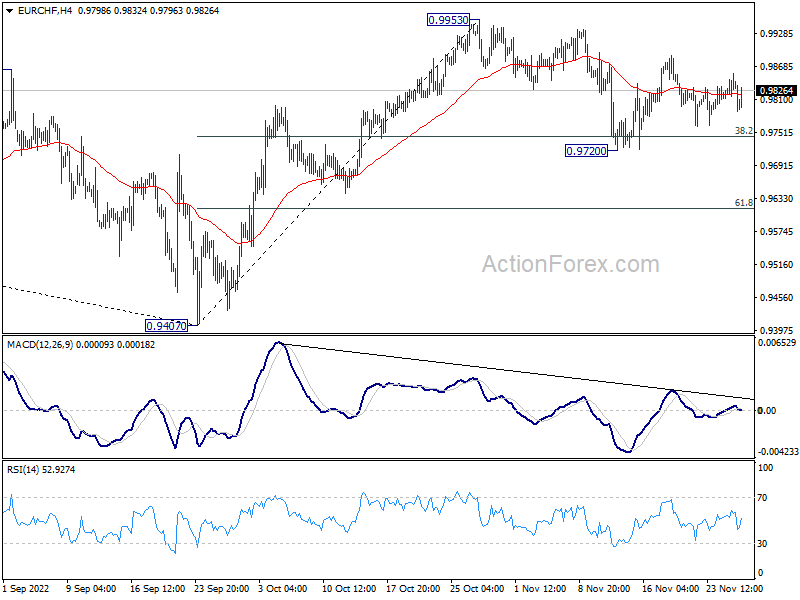
Range trading continues in EUR/CHF and intraday bias remains neutral at this point. On the upside, firm break of 0.9953 resistance will resume larger rally from 0.9407 to 1.0072 fibonacci level. However, break of 0.9720 will extend the decline from 0.9953 to 61.8% retracement of 0.8407 to 0.9953 at 0.9616.
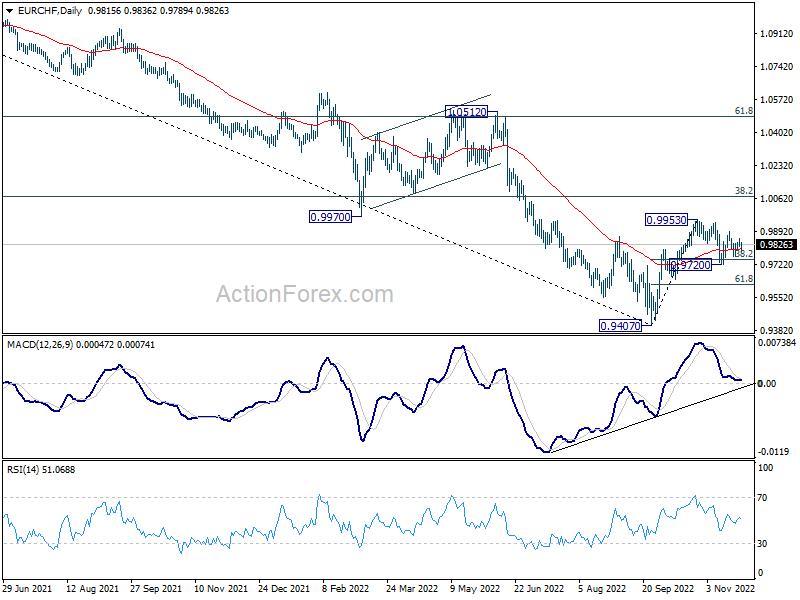
In the bigger picture, rejection by 0.9970 support turned resistance retains medium term bearishness. That is, while 0.9407 is a medium term bottom, price actions from there would develope into a corrective pattern rather than a reversal. Down trend resumption through 0.9407 is mildly favored at a later stage. This will remain the favored case now, as long 38.2% retracement of 1.1149 to 0.9407 at 1.0072 holds.
GER 40 Hits Critical Resistance
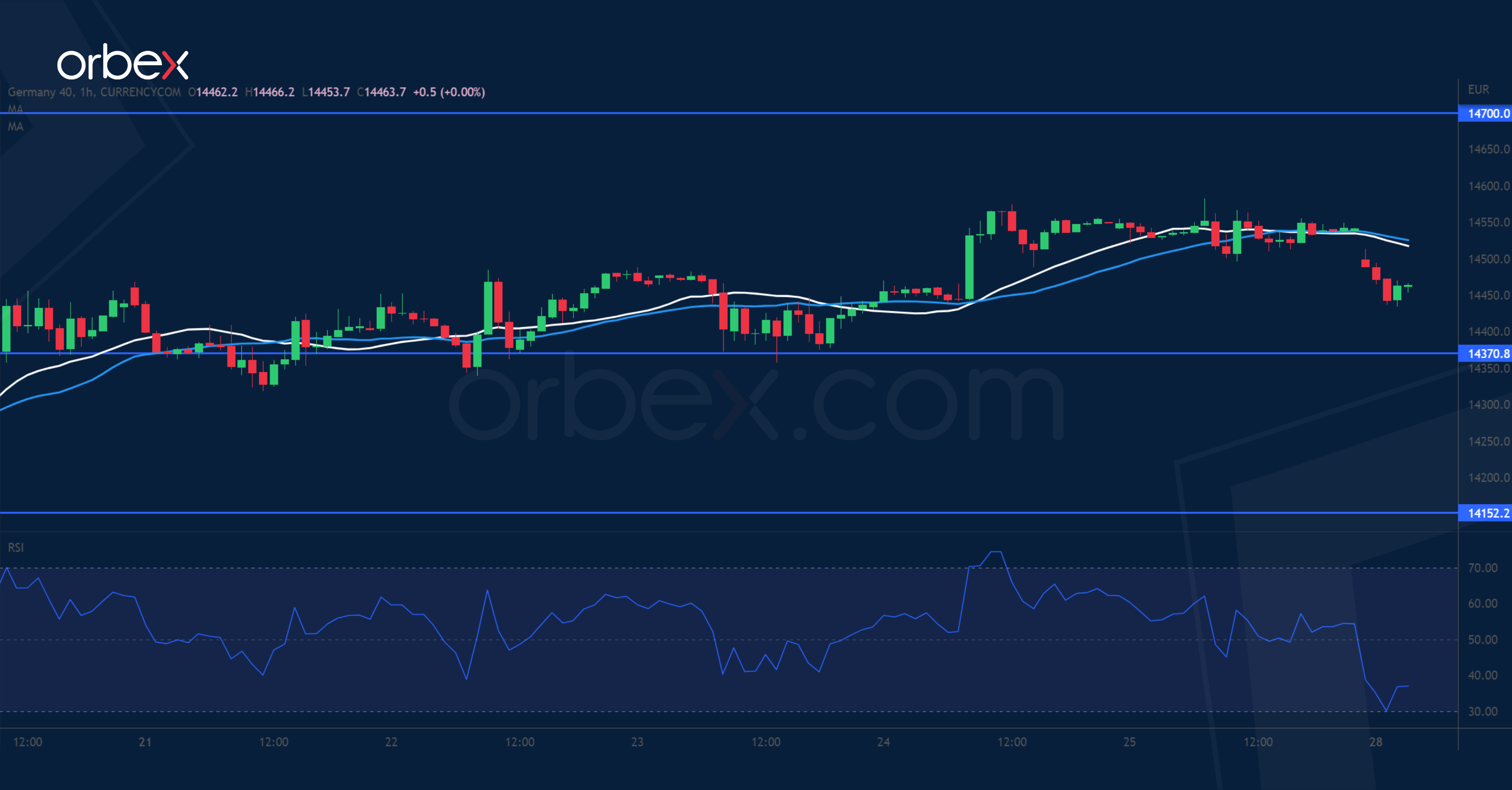
The Dax 40 steadies over upbeat German Q3 GDP. The RSI’s overbought condition is a sign of overextension. As the index tests June’s high of 14700, short-term traders may look to trim their exposure. 14370 is the first support and its breach might give buyers an excuse to bail out. Then 14150 at the confluence of a recent daily low and the 20-day moving average would be a key level to prevent broader liquidation. On the upside, a break above the ceiling could lay the groundwork for a bullish reversal in the medium-term.
EUR/CHF Awaits Breakout
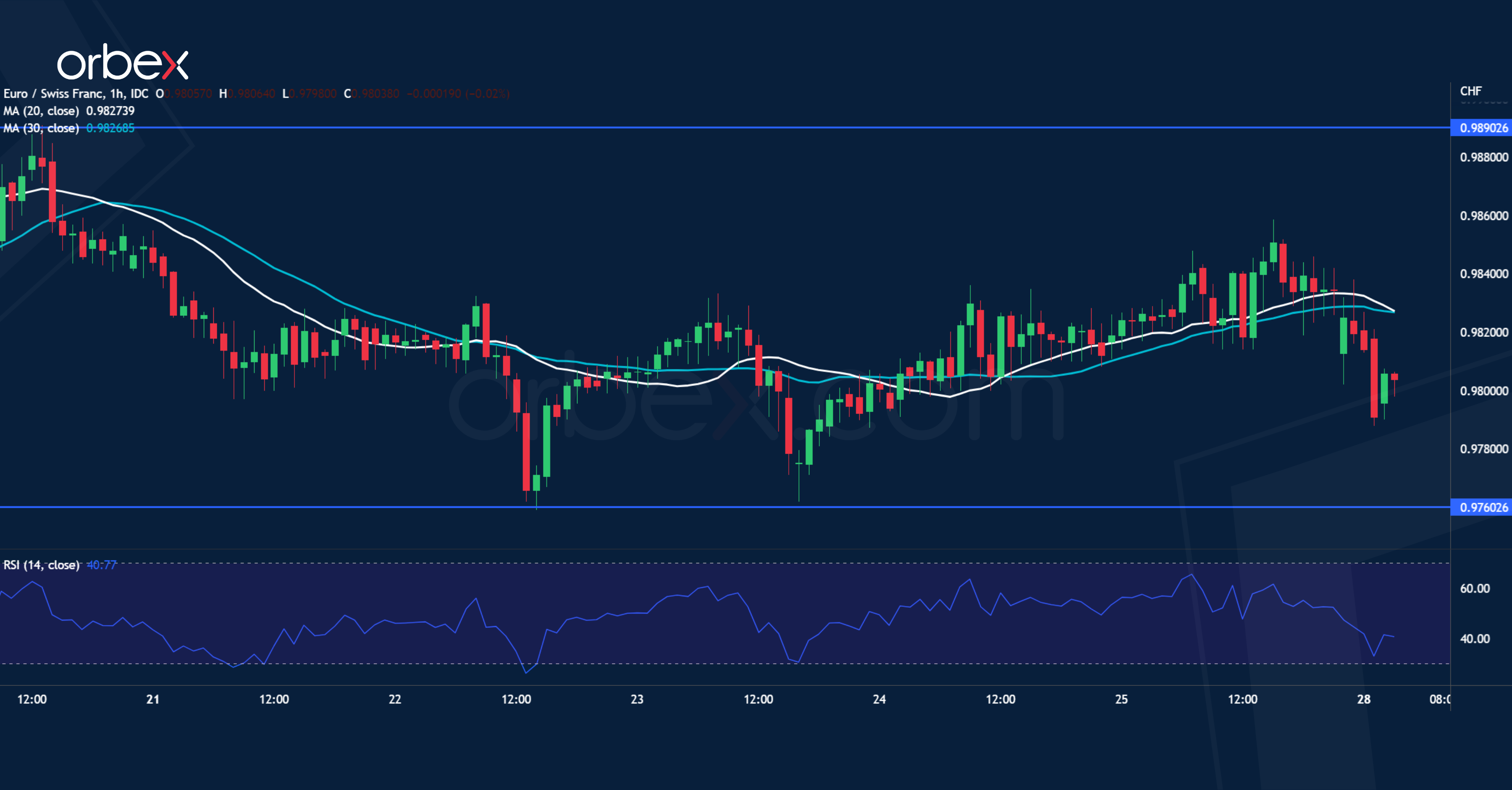
The euro softened after ECB officials played down wage pressure. Following a break above September’s high of 0.9830, the euro has found robust support over 0.9720. Then higher lows show rising interest in keeping the pair afloat. 0.9890 is a major resistance to clear before the rebound could break free. A rally above the recent peak of 0.9950 would put the single currency on a bullish trajectory in the weeks to come. On the downside, 0.9760 is the support to monitor in case hesitation leads to a prolonged sideways action.
GBP/USD to Test Major Ceiling
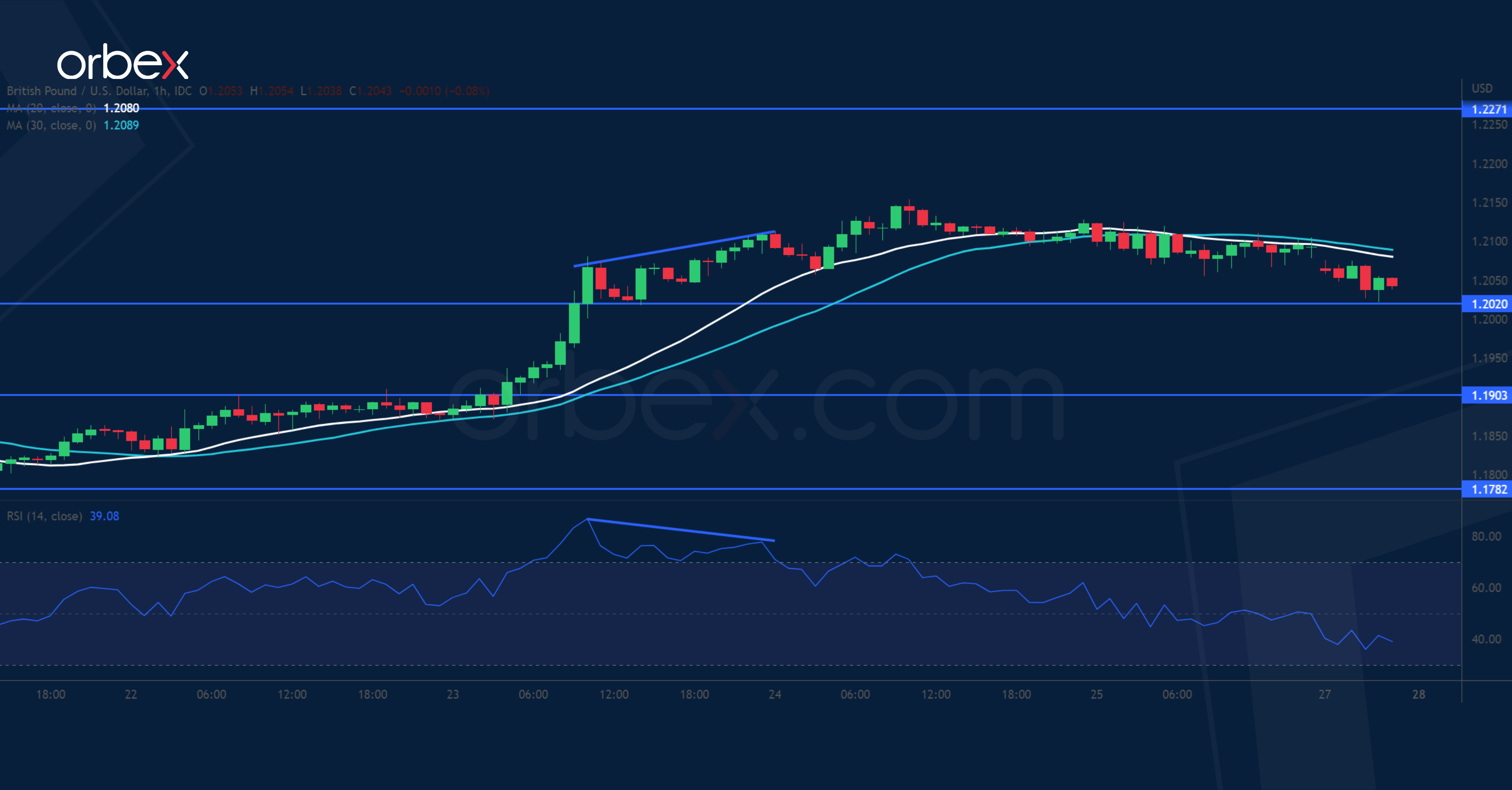
The pound holds onto its gains after the PPI for October was revised upwards. As the pair approaches the August high of 1.2270, a bearish RSI divergence is a warning sign that the rally may be running out of juice. Profit-taking could be expected in this major supply area while those who hold a bearish view in the medium-term may look to sell. However, a bullish breakout could pave the way for a reversal. 1.2020 is the first support should Sterling start to drift lower and 1.1900 another level to gauge followers’ interest.
Growing Unrest in China Setting the Stage for a Risk-off Start
Markets
On Friday, US and European bond markets showed a divergent picture as US markets reopened after the Thanksgiving Holiday. US Treasuries continued to outperform. A disappointing US PMI released earlier last week only reinforced the view that there is a strong enough case for the Fed to slow the pace interest rate hikes to a 50 bps step at the December meeting. US yields in the 2-10-y sector eased 1-2 bps with the 30-y gaining marginally. The US 10-y closed the week at the 3.67% support (recent low). The picture in Europe was different. German yields jumped 8.3 bp (2-y) to 12.4 bps (10-y). There was not one unequivocal driver. ECB comments (Schnabel, Muller) suggested that the debate on a 50 bps or 75 bps next step isn’t really decided yet. Recent EMU eco data also were slightly better/less worse than expected (including an upward revision to German Q3 GDP to 0.4% Q/Q on Friday). The German 10-y yield closed exactly at 1.97%, returning the neckline that was broken earlier last week. Equities in the US and Europe both closed little changed. The dollar also showed no clear trend. EUR/USD finished the week at 1.0395 with recent peaks at 1.0448 & 1.0479. DXY closed the week at DXY 105.96, with recent correction lows still nearby. Similar story for the EUR/GBP cross rate (close at 0.8599; with key support at 0.8560 still looming).
This morning, the growing unrest related the new covid restrictions in China is setting the stage for a risk-off start to the new trading week as investors ponder the impact on (global) demand. Early indications on Back Friday spending in the US also show a mixed picture. Asian equities mostly trade in negative territory (Nikkei -0.4%) with Chinese indices underperforming (CSI 300 -1.15%; Hang Seng currently -1,7%). US Treasuries remain well bid with yields declining 3/5 bps currently. Despite the risk-off, USD gains remain modest. (DXY 106.25; EUR/USD 1.0365).The yen even outperforms, with USD/JPY (currently 138.3 near the 137.68 support). China/commodity related currencies underperform (AUD/USD 0.6685, USD/CAD 1.3445) as does the yuan (USD/CNY 7.20, breaking above the 7.17 ST resistance). Uncertainty on global/Chinese demand is pushing Bent oil ($ 81.5 p/b) to the lowest level since January.
Later today, the eco calendar in the US and Europe is thin. We keep an eye at speeches of ECB’ Lagarde, Fed Williams and Fed’s Bullard as the countdown the December ECB & Fed meetings has started. Core bond yields this morning feel some downward pressure due to the China related risk-off. However, the upcoming data (German CPI tomorrow, EMU CPI Wednesday, US consumer confidence (Tuesday), US manf. ISM and PCE deflator (Thursday) and the US payrolls on Friday probably are more important to shape markets view on the pace of Fed and ECB rate hikes. Breaking below 3.67%, the US 10-y yield finds next support at 3.55%. The 10-y Bund stays below the 2.0% barrier. The USD performance this morning is far from impressive. Even so, it’s probably too early for EUR/USD to return to recent peak levels.
News Headlines
CNB governor Michl in his weekly column for Mlada Fronta Dnes reiterated that stable policy rates are appropriate because growth in the quantity of money is significantly slowing and household consumption declining. His column referred to several points raised in a speech last week where he focused on long term views one of which is that a strong koruna should become a priority for both the government and the CNB. Policy rate will stay high during his term at the helm of the CNB to encourage consumers, businesses and the state to borrow less and save money. He also called on the government to slash the budget deficit, and said wages could only grow hand in hand with productivity to help bring inflation down to the 2% target.
Australian retail sales disappointed in October, dropping 0.2% M/M vs a 0.5% monthly gain expected. Weakness was broad-based across industries with food retailing being the positive outlier. Higher interest rates and faster inflation are effecting Australian households. Part of tourism spending is also back done offshore as borders reopened.