Sample Category Title
USD/CHF Mid-Day Outlook
Daily Pivots: (S1) 0.9819; (P) 0.9867; (R1) 0.9952; More...
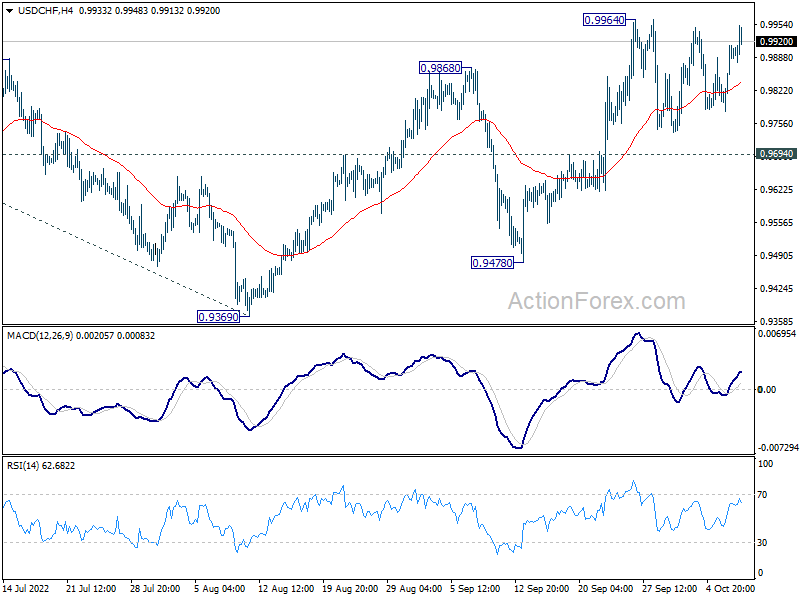
USD/CHF is still staying below 0.9964 resistance and intraday bias remains neutral. Consolidation from 0.9964 could extend but further rally is in favor as long as 0.9694 support holds. On the upside, above 0.9964 will resume the rally from 0.9369 to retest 1.0063 high. On the downside, however, break of 0.9694 support will extend the corrective pattern from 1.0063 with another falling leg, towards 0.9478 support first.
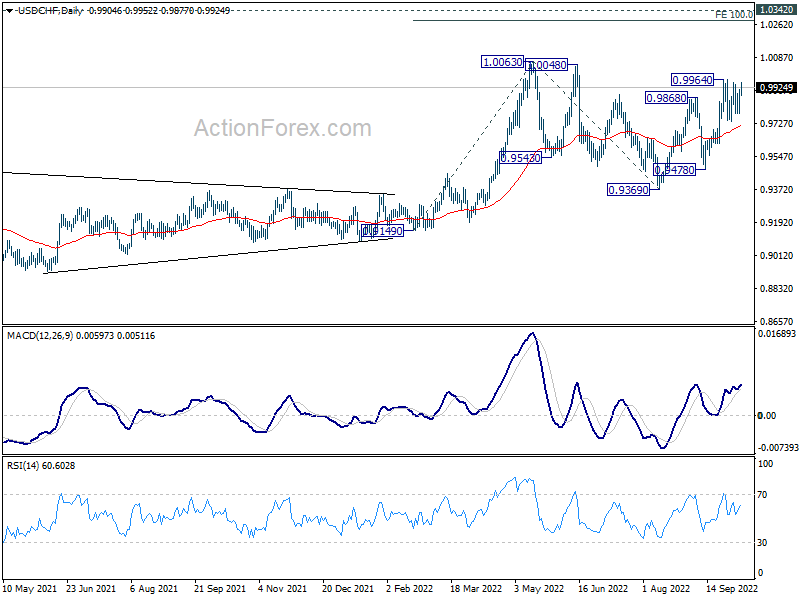
In the bigger picture, current development suggests that up trend from 0.8756 (2021 low) is still in progress. Sustained break of 1.0063 will target 100% projection of 0.9149 to 1.0063 from 0.9369 at 1.0283, and then 1.0342 (2016 high). For now, this will remain the favored case as long as 0.9369 support holds, even in case of deep pull back.
GBP/USD Mid-Day Outlook
Daily Pivots: (S1) 1.1054; (P) 1.1219; (R1) 1.1323; More...
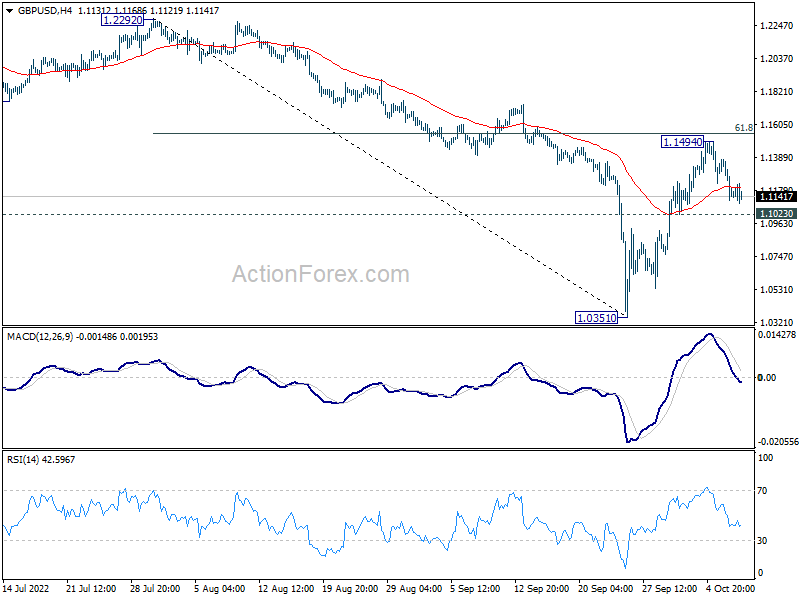
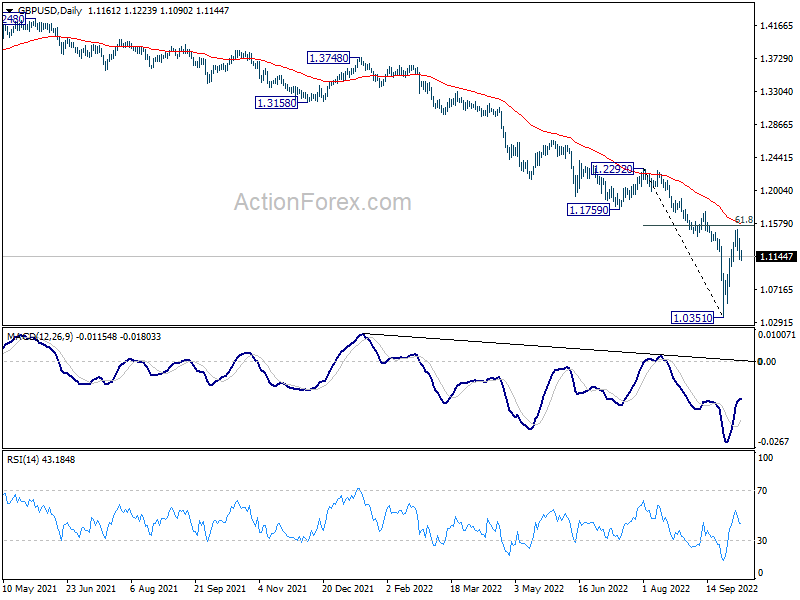
Intraday bias in GBP/USD remains neutral for the moment. On the downside, break of 1.1023 minor support will indicate that rebound from 1.0351 is over. Intraday bias will be back on the downside for retesting 1.0351. On the upside, firm break of 61.8% retracement of 1.2292 to 1.0351 at 1.1551 will pave the way to 1.2292 resistance.
In the bigger picture, fall from 1.4248 (2018 high) is resuming long term down trend from 2.1161 (2007 high). Next target is 100% projection of 2.1161 to 1.3503 from 1.7190 at 0.9532. There is no scope of a medium term rebound as long as 1.1759 support turned resistance holds.
US: Hiring Remains Strong in September, But Some Evidence of Slowing
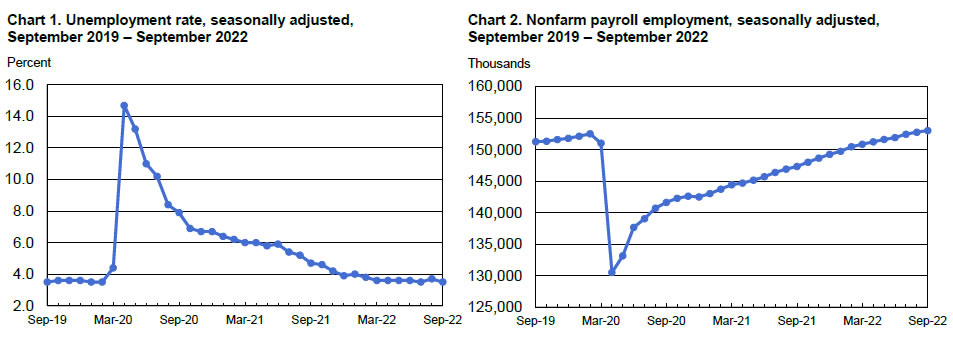
The U.S. economy added 263k jobs in September, coming in slightly above the consensus forecast of 250k. Revisions to the two prior months were slightly positive, with July's reading adding an additional 11k jobs to the previously reported figures, while August was unchanged at 315k.
Employment gains on the service-side (+244k) were largely concentrated in leisure & hospitality (+83k), health care & social assistance (+75k) and professional & business services (+46k). Financial activities (-8k), transportation & warehousing (-7.9k), and retail trade (-1.1k) all shed jobs on the month. Goods producing industries (+44k) had another decent month, with gains spread across manufacturing (+22k) and construction (+19k). The public sector lost 25k jobs last month.
In the household survey, civilian employment rose by 204k, while the labor force declined by 57k. As a result, the unemployment rate ticked down 0.2 percentage points (pp), falling back to 3.5% – matching its previous cyclical low. The participation rate edged lower by 0.1pp, falling to 62.3.
Average hourly earnings rose 0.3% month-over-month (m/m) – unchanged from the gain recorded in August. Compared to September 2021, wage growth was up 5.0%.
Key Implications
Another month, another solid employment report. That being said, both August and September's gain came in below the average recorded in each of the respective three months prior, suggesting we are starting to see some slowing in the pace of hiring. This is particularly evident with outright jobless coming through in several service industries.
After having recorded a sizeable gain in August, the pullback in labor force participation was disappointing but somewhat expected given the lackluster growth seen so far through this year. While we do expect labor force participation to edge modestly higher over the remainder of the year, aging demographics would suggest there's not a lot more room to run, and the participation rate is likely to peak by early-2023.
"Good news is bad news" has been the mantra touted more recently, and that tone is certainly ringing true across financial markets following this morning's release. Equity futures have sold-off, while expectations that the Federal Reserve will deliver on another 75-basis point hike on November 2nd are holding steady at 78%. With the FOMC only seeing one more inflation report before they meet next, another super-sized rate hike seems likely.
Euro Dips after Solid US Jobs Report
EUR/USD is unchanged today after a nasty two-day slide, trading at 0.9792 in the European session. The euro flirted with the symbolic parity line on Wednesday, but then plunged 200 points.
German retail sales underperforms
Germany wrapped up the week with soft data, although the euro shrugged off the weak numbers. Retail sales fell 1.3% in August, following a 0.7% gain in June and below the consensus of -1.0%. Industrial Production came in at -0.8% in August, following the July reading of -0.3% and missing the forecast of -0.5%. Like the rest of the eurozone, Germany is struggling with the unhappy combination of weak growth and soaring inflation, which hit a record 10% in September. The catalyst behind soaring inflation has been energy prices, which have skyrocketed as Russia has sharply reduced energy exports to Europe. How bad is the energy crisis? Eurozone energy prices jumped a staggering 40.8% in September, following 38.6% in August, according to Eurostat.
The ECB will have some time to digest key economic data, as the next policy meeting is not until October 27th. The central bank showed up late to the global rate-tightening dance, and the current benchmark rate of 1.25% lags behind other central banks and will not have much impact on soaring inflation. With inflation accelerating to 10.0% in September, up from 9.1%, it’s likely that the ECB will deliver a second-straight rate increase of 0.75% at the October meeting.
The US nonfarm payroll report was a bit stronger than expected, at 263,000. This was down from 300,000 but beat the consensus of 250,000. Wage growth remained strong at 5.0%, edging down from 5.2% prior and just below the consensus of 5.1%. The US dollar has responded with broad gains, as the strong data support further outsized rate hikes from the Federal Reserve in order to curb inflation.
EUR/USD Technical
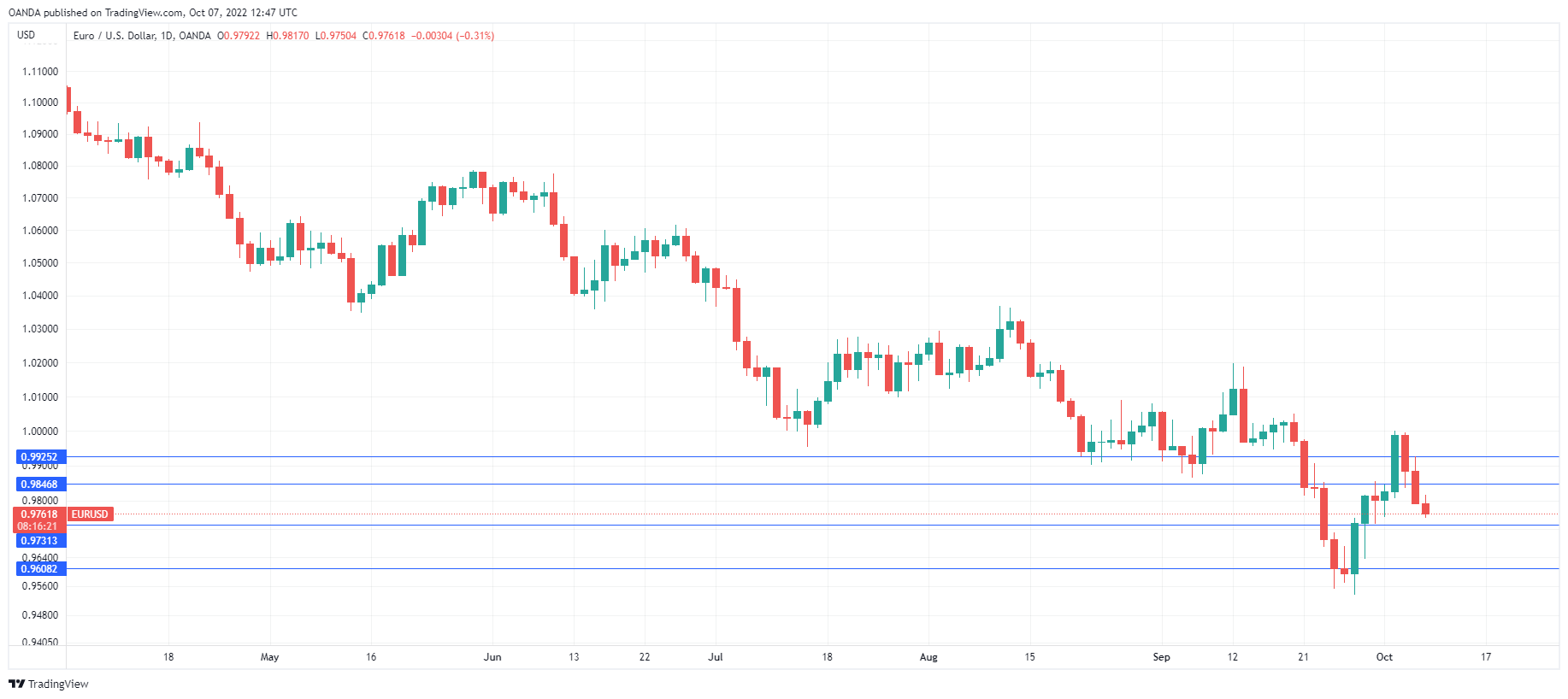
- EUR/USD faces resistance at 0.9846 and 0.9925
- There is support at 0.9731 and 0.9608
EUR/USD Mid-Day Outlook
Daily Pivots: (S1) 0.9745; (P) 0.9835; (R1) 0.9883; More...
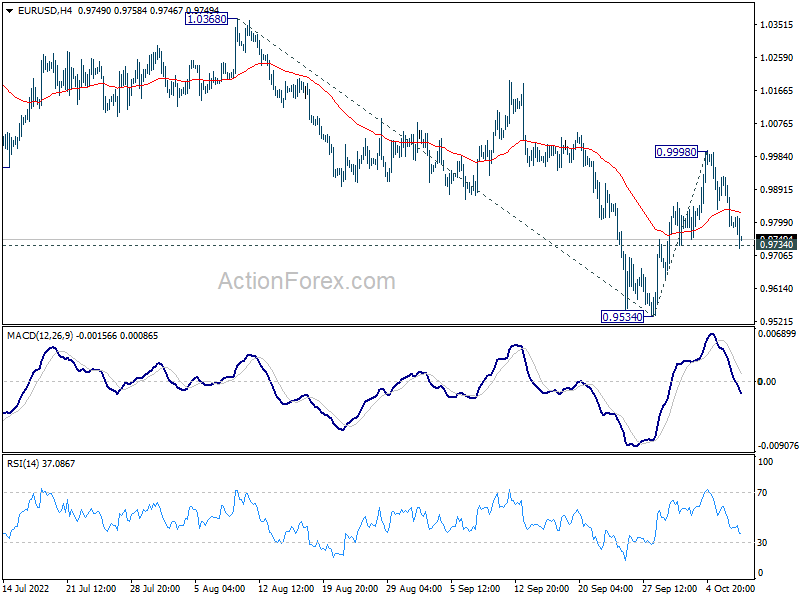
Immediate focus is now on 0.9734 minor support in EUR/USD. Firm break there will argue that larger down trend is ready to resume through 0.9534. Next target is 100% projection of 1.0368 to 0.9534 from 0.9998 at 0.9163. For now, risk will stay on the downside as long as 0.9998 resistance holds, in case of recovery.
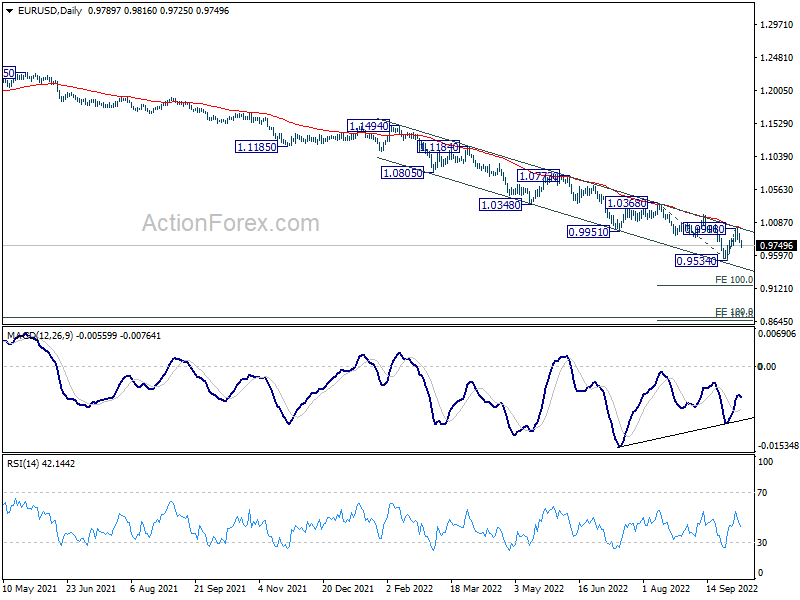
In the bigger picture, down trend from 1.6039 (2008 high) is still in progress. Next target is 100% projection of 1.3993 to 1.0339 from 1.2348 at 0.8694. In any case, break of 1.0197 resistance is needed to be the first sign of medium term bottoming. Otherwise, outlook will stay bearish even with strong rebound.
Dollar Jumps as Robust NFP Gives Greenlight to Aggressive Fed
Dollar rises broadly after US published another set of robust non-farm payroll job data. As Fed got a nod from the report for continuing its aggressive tightening, US stock futures are trading knocked down while treasury yields jump. Canadian Dollar is also lifted slightly by solid employment data too. In immediate actions, Euro and Swiss Franc seem to suggest most, but Aussie could quickly catch up if risk-off sentiment intensifies. Meanwhile, watch out for intervention by Japan if Yen selling tries to take off.
In Europe, at the time of writing, FTSE is flat. DAX is down -0.52%. CAC is down -0.33%. Germany 10-year yield is up 0.117 at 2.203. Earlier in Asia, Nikkei dropped -0.71%. Hong Kong HSI dropped -1.51%. Singapore Strait Times dropped -0.18%. Japan 10-year JGB yield rose 0.007 to 0.254.
US NFP grew 263k in Sep, unemployment rate dropped to 3.5%
US non-farm payroll employment grew 263k in September, just slightly below expectation of 265k. Monthly job growth has averaged 420k in 2022, comparing with 562k in 2021.
Unemployment rate rose dropped from 3.7% to 3.5%, below expectation of 3.7%. Labor force participation rate dropped from 62.4% to 62.3%.
Average hourly earnings rose 0.3% mom, matched expectations.
Canada employment rose 21k in September, slightly below expectation of 22.5k. Unemployment rate dropped from 5.4% to 5.2%, below expectation of 5.4%.
BoE Ramsden: The central question is how forceful we need to be
BoE Deputy Governor Dave Ramsden said in a speech that before the November MPC meeting, policymakers will be seeking answers to "a range of questions" to assess how quickly inflation will return to target.
For him, the questions include: "is there any evidence that the tight labour market is easing; what is the revised outlook for demand in view of the Government's fiscal announcements; are domestically generated inflation pressures consistent with returning inflation to the 2 per cent target; and what do financial market developments tell us."
Meanwhile, the "central question" for all MPC members is "how forceful do we need to be, to ensure inflation does return sustainably to the 2% target".
ECB survey shows inflation expectations might have peaked
According to ECB's Consumer Expectations Survey (CES) in August, inflation expectations were largely unchanged comparing with July. Nevertheless, mean inflation expectations for the 12 month ahead dropped slightly, and could have peaked. Growth expectations also improved.
On inflation:
- Mean expectations for 12 months ahead dropped from 7.1% to 6.9.
- Median expectations for 12 months ahead was unchanged at 5.0%.
- Mean expectations for 3 years ahead was unchanged at 4.7%.
- Median expectations for 3 years ahead was unchanged at 3.0%.
On growth:
- Mean growth expectations for next 12 months improved from -1.9% to -1.7%.
- Median growth expectations for next 12 months improved from -0.1% to 0.0%.
EUR/USD Mid-Day Outlook
Daily Pivots: (S1) 0.9745; (P) 0.9835; (R1) 0.9883; More...
Immediate focus is now on 0.9734 minor support in EUR/USD. Firm break there will argue that larger down trend is ready to resume through 0.9534. Next target is 100% projection of 1.0368 to 0.9534 from 0.9998 at 0.9163. For now, risk will stay on the downside as long as 0.9998 resistance holds, in case of recovery.
In the bigger picture, down trend from 1.6039 (2008 high) is still in progress. Next target is 100% projection of 1.3993 to 1.0339 from 1.2348 at 0.8694. In any case, break of 1.0197 resistance is needed to be the first sign of medium term bottoming. Otherwise, outlook will stay bearish even with strong rebound.
Economic Indicators Update
| GMT | Ccy | Events | Actual | Forecast | Previous | Revised |
|---|---|---|---|---|---|---|
| 23:30 | JPY | Labor Cash Earnings Y/Y Aug | 1.70% | 1.40% | 1.80% | |
| 23:30 | JPY | Overall Household Spending Y/Y Aug | 5.10% | 6.80% | 3.40% | |
| 05:00 | JPY | Leading Economic Index Aug P | 100.90% | 99.20% | 98.90% | |
| 05:45 | CHF | Unemployment Rate Sep | 2.10% | 2.10% | 2.10% | |
| 06:00 | EUR | Germany Import Price Index M/M Aug | 4.30% | 2.20% | 1.40% | |
| 06:00 | EUR | Germany Retail Sales M/M Aug | -1.30% | -1.00% | 1.90% | |
| 06:45 | EUR | France Trade Balance (EUR) Aug | -15.3B | -13.2B | -14.5B | -14.8B |
| 07:00 | CHF | Foreign Currency Reserves (CHF) Sep | 807B | 860B | 859B | |
| 08:00 | EUR | Italy Retail Sales M/M Aug | -0.40% | 1.00% | 1.30% | |
| 12:30 | USD | Nonfarm Payrolls Sep | 263K | 265K | 315K | |
| 12:30 | USD | Unemployment Rate Sep | 3.50% | 3.70% | 3.70% | |
| 12:30 | USD | Average Hourly Earnings M/M Sep | 0.30% | 0.30% | 0.30% | |
| 12:30 | CAD | Net Change in Employment Sep | 21.1K | 22.5K | -39.7K | |
| 12:30 | CAD | Unemployment Rate Sep | 5.20% | 5.40% | 5.40% | |
| 14:00 | USD | Wholesale Inventories Aug F | 1.30% | 1.30% |
US NFP grew 263k in Sep, unemployment rate dropped to 3.5%
US non-farm payroll employment grew 263k in September, just slightly below expectation of 265k. Monthly job growth has averaged 420k in 2022, comparing with 562k in 2021.
Unemployment rate rose dropped from 3.7% to 3.5%, below expectation of 3.7%. Labor force participation rate dropped from 62.4% to 62.3%.
Average hourly earnings rose 0.3% mom, matched expectations.
BoE Ramsden: The central question is how forceful we need to be
BoE Deputy Governor Dave Ramsden said in a speech that before the November MPC meeting, policymakers will be seeking answers to "a range of questions" to assess how quickly inflation will return to target.
For him, the questions include: "is there any evidence that the tight labour market is easing; what is the revised outlook for demand in view of the Government's fiscal announcements; are domestically generated inflation pressures consistent with returning inflation to the 2 per cent target; and what do financial market developments tell us."
Meanwhile, the "central question" for all MPC members is "how forceful do we need to be, to ensure inflation does return sustainably to the 2% target".
ECB survey shows inflation expectations might have peaked
According to ECB's Consumer Expectations Survey (CES) in August, inflation expectations were largely unchanged comparing with July. Nevertheless, mean inflation expectations for the 12 month ahead dropped slightly, and could have peaked. Growth expectations also improved.
On inflation:
- Mean expectations for 12 months ahead dropped from 7.1% to 6.9 (compares to 6.6% in June).
- Median expectations for 12 months ahead was unchanged at 5.0%.
- Mean expectations for 3 years ahead was unchanged at 4.7%.
- Median expectations for 3 years ahead was unchanged at 3.0%.
On growth:
- Mean growth expectations for next 12 months improved from -1.9% to -1.7%.
- Median growth expectations for next 12 months improved from -0.1% to 0.0%.
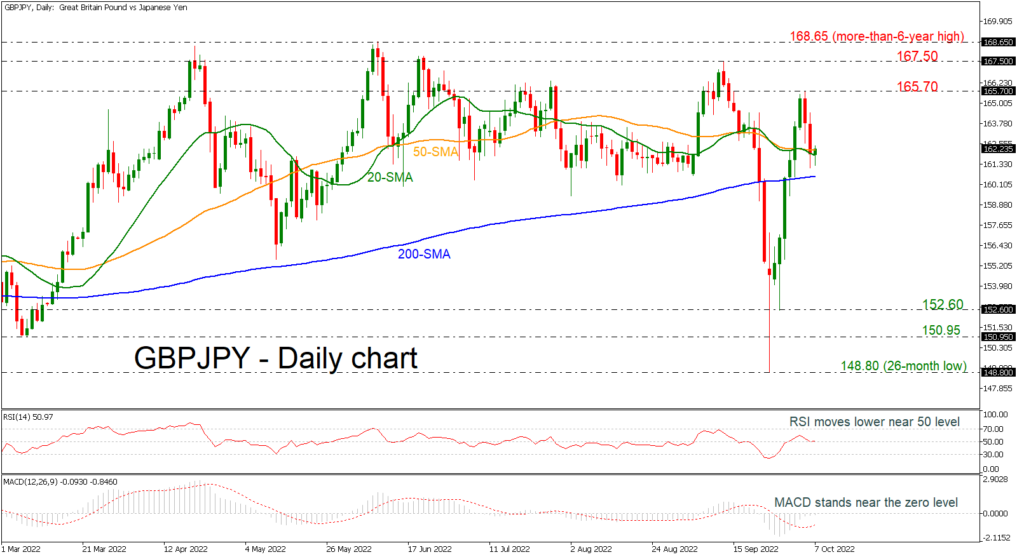
GBPJPY Flirts With short-Term SMAs after Declining Move
GBPJPY is posting a bearish correction after the 11% gain and the rebound off the 26-month low of 148.80. Currently, the price is testing the 20- and 50-day simple moving averages (SMAs) and slightly lower the 200-day SMA is acting as significant support. The RSI is consolidating near the 50 level, while the MACD is standing near the zero level.
To the downside, immediate support could come from the 200-day SMA at 160.50 before diving towards the 152.60 barrier. The next hurdles could come at the 150.95 and the 26-month trough of 148.80.
Otherwise, if buyers push above the moving averages, initial resistance could come from the 165.70 barrier ahead of the 167.50 line. Climbing higher, the more-than-six-year high of 168.65 could interrupt the test of a key region of 175.00, reached in April 2015.
Summarizing, the very short-term bias has turned bearish but if the price shifts above the 165.70 mark, and especially beyond 168.65 the picture could turn positive.