Sample Category Title
AUD/USD Dips after RBA Minutes
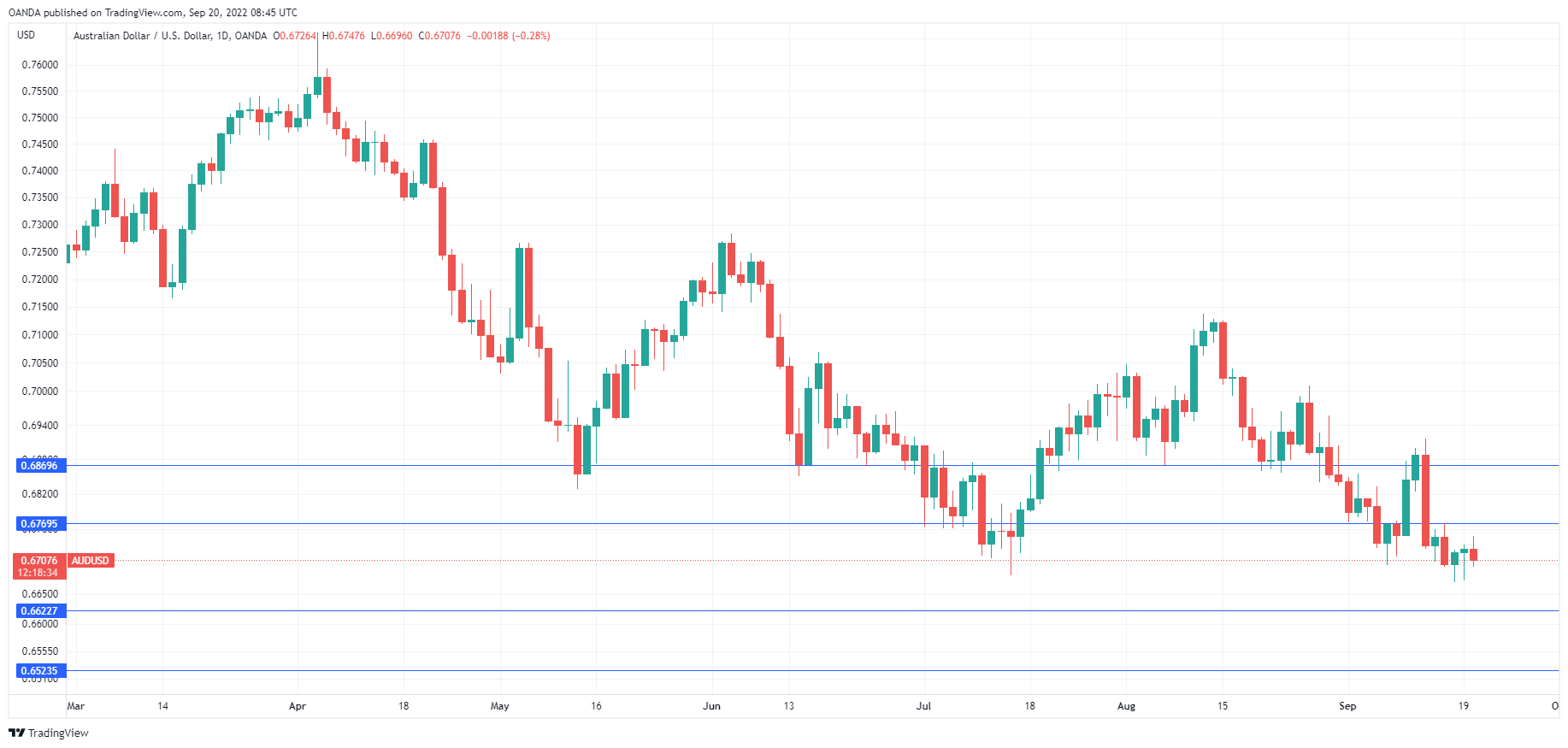
The Australian dollar is in negative territory today. AUD/USD is trading at 0.6706, down 0.30% on the day.
RBA says rates to increase
The RBA minutes of the September 6th meeting didn’t shed any new light on the central bank’s rate policy, and the Australian dollar’s response has been muted. The minutes reiterated the message that the markets have already heard from Governor Lowe – additional rate hikes are coming, but the size of the hikes will depend on inflation and growth.
The minutes noted that rates are approaching “normal settings”. At the meeting, members argued over whether to raise rates by 25bp or 50bp – in the end, the Bank went for the latter option, bringing the cash rate to 2.35%. With no inflation or employment data prior to the October meeting, the RBA may still be up in the air with regard to the size of the rate hike right up to decision time. This will make for an interesting meeting which could trigger volatility from the Australian dollar.
There are arguments to be made on both sides. Inflation rose to 6.1% in the second quarter, and as the RBA’s number one priority, Lowe may want to keep the pedal on the floor until there are clear signs that inflation is moving lower. On the other hand, inflation expectations have slowed over three straight months, a possible indication that inflation may have peaked or will do so shortly. Lowe would very much like to guide the economy to a soft landing, which would be facilitated by a modest 0.25% hike.
The Federal Reserve meets on Wednesday, with the markets expecting a 0.75% hike. There is about a 20% chance of a massive full-point hike. The markets will be listening carefully to the Fed’s guidance – if it is hawkish, the US dollar should respond with broad gains.
AUD/USD Technical
- AUD/USD has support at 0.6623 and 0.6523
- There is resistance at 0.6769 and 0.6869
EUR/USD: Euro Loses Steam on Disappointing Economic Data, All Eyes on Fed
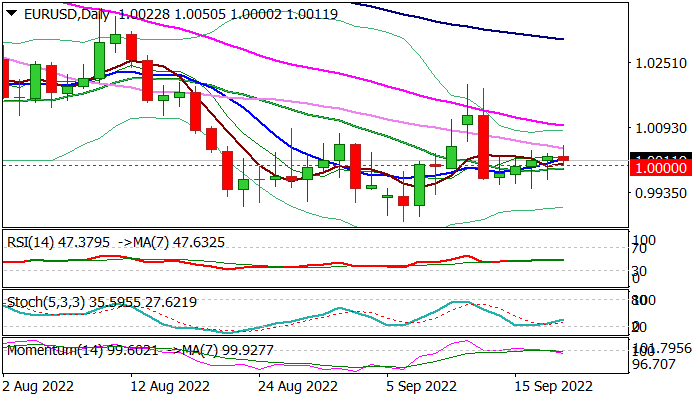
The Euro turned to red in European trading on Tuesday, following a four-day recovery after a sharp post-US inflation report’s drop.
Bounce rose above parity level but failed to register a clear break higher.
Underlying bears received fresh support today from downbeat EU data, which showed the record current account deficit of 19.9 billion euros in July after a surplus of 4.2 billion Euros in June and compared to the same period last year, when the surplus was 28.9 billion Euros.
Deep trade gap was mainly driven by surging costs of imports of oil and gas, as well as raw materials, adding to negative outlook for the bloc’s economy.
Overall picture remains bearish and prolonged consolidation as likely scenario, before bears regain full control.
Conflicting signals from fresh bearish momentum and bullish setup of daily Tenkan-sen / Kijun-sen are likely to keep near-term action in directionless mode until Fed’s announcement late
Wednesday, which would spark stronger volatility.
The US central bank is widely expected to raise rates by another 75 basis points in September that should provide fresh support to the dollar, but some economists do not rule out more aggressive stance and 1% hike, that would accelerate dollar’s larger rally and push the single currency significantly lower.
Res: 1.0050; 1.0087; 1.0076; 1.0105.
Sup: 1.0000; 0.9955; 0.9900; 0.9864.
Bank of Japan unlikely to throw life jacket to sinking yen
Faced with stubbornly low inflation, the Bank of Japan is now among the few central banks not tightening policy. There is little appetite for any strategy changes when the BoJ meets on Thursday and even if the government resorts to FX intervention, it won’t be enough to turn the tide in the sinking yen. Of course, some caution is still warranted as ‘short yen’ is already a crowded trade.
Lowflation
It has been a devastating year for the yen, which has lost almost 25% of its value against the US dollar. With central banks across the world raising interest rates at an incredible pace to vanquish inflation but the Bank of Japan refusing to play this game, rate differentials have widened, crushing the yen as capital flows out of the country in search of higher returns abroad.
The reason the BoJ is so reluctant to tighten policy is that inflation in Japan is mild. Excluding food and energy, inflation is running at 1.6%, in contrast to the sky-high prints in other developed economies. Wage growth and inflation expectations remain suppressed too, dispelling the notion that inflation will be persistent.
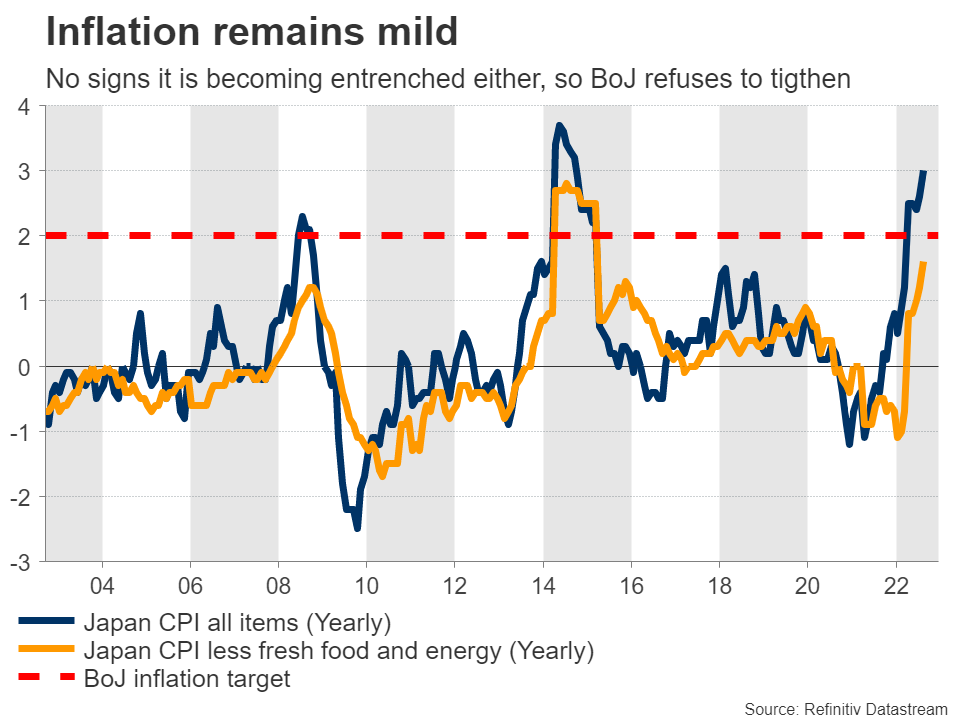
As such, the BoJ argues this inflationary wave is simply the product of a global supply shock. Without it, Japan might still be trapped in deflation, so there is no reason to withdraw the stimulus that has ravaged the yen. In fact, Governor Kuroda recently said that even if the BoJ raised rates a little, it still wouldn’t stop the yen’s bleeding.
No (real) changes
At this meeting, the BoJ is unlikely to roll out any meaningful policy changes. Most officials have been adamant that inflation dynamics are too muted, forcing them to keep their foot heavy on the accelerator.
That means keeping in place the ceiling on longer-dated Japanese yields, which is the strategy responsible for the yen’s suffering. Since the BoJ prevents domestic yields from rising beyond a certain level, interest rate differentials automatically widen against the yen as foreign central banks raise rates.
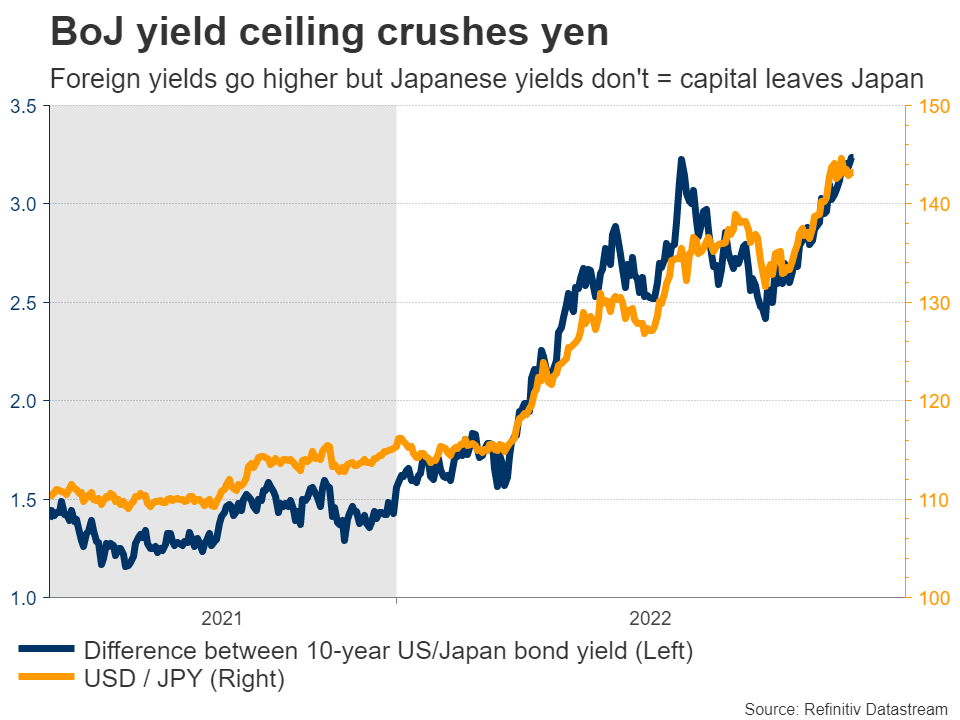
This policy has to be scrapped before the yen can make a real comeback, as that would enable Japanese yields to play catch-up with their global counterparts. However, since this meeting doesn’t even include updated inflation forecasts, it would be strange for the BoJ to take such drastic measures.
Instead, some reports suggest the only change this time might be a rollback of the emergency schemes the BoJ introduced during the pandemic, to provide funding to smaller businesses impacted by lockdowns. The market didn’t care much for these measures back then, and is unlikely to do so now.
Crowded trade
Threats of FX intervention to shore up the yen from Japanese authorities have fallen on deaf ears, mostly because market participants think they are bluffing. Solo intervention would cost a ton of FX reserves to execute, it has a low probability of success, and could backfire by inviting more speculators if it does fail.
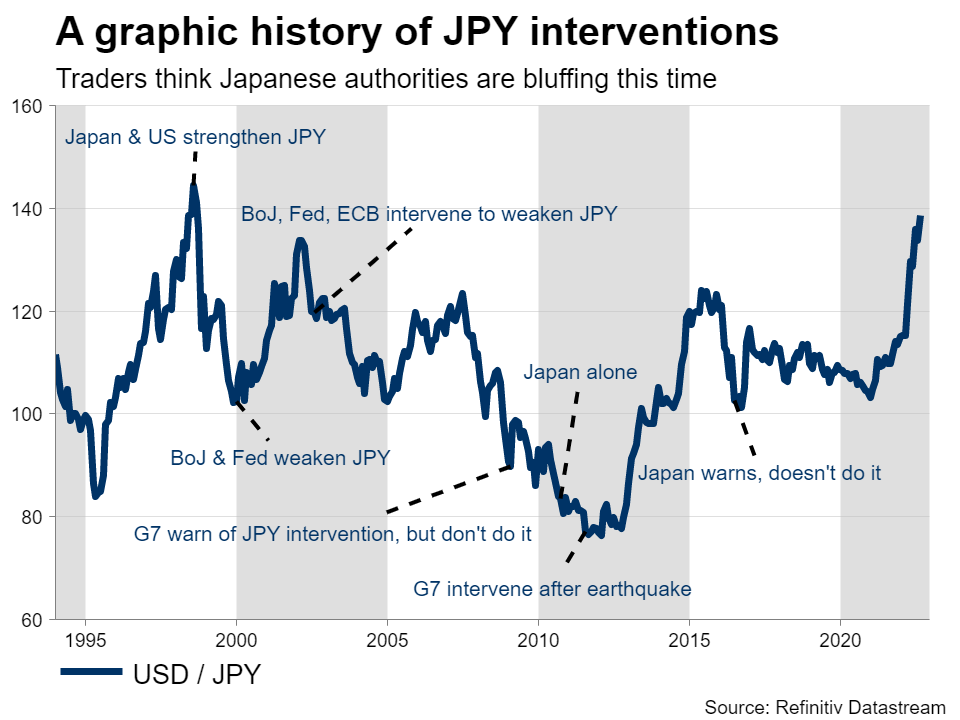
Hence, it’s a gamble the government doesn’t really want to take. It might still pull the trigger in case the yen’s freefall becomes too extreme, and that could flush out some speculators, but it wouldn’t have a lasting impact beyond the psychological shock-and-awe.
With the BoJ refusing to play ball and the government unable to turn the tide, it is hard to envision any trend reversal in the yen, especially while foreign central banks continue to raise rates so rapidly. That said, shorting the yen into the ground on rate divergence is already a very crowded trade, which can lead to violent corrections.
This makes the yen difficult to trade in either direction. The outlook remains negative but it has already depreciated quite dramatically. Looking at the charts, dollar/yen could fall all the way to 139.30 before it even touches its previous high.
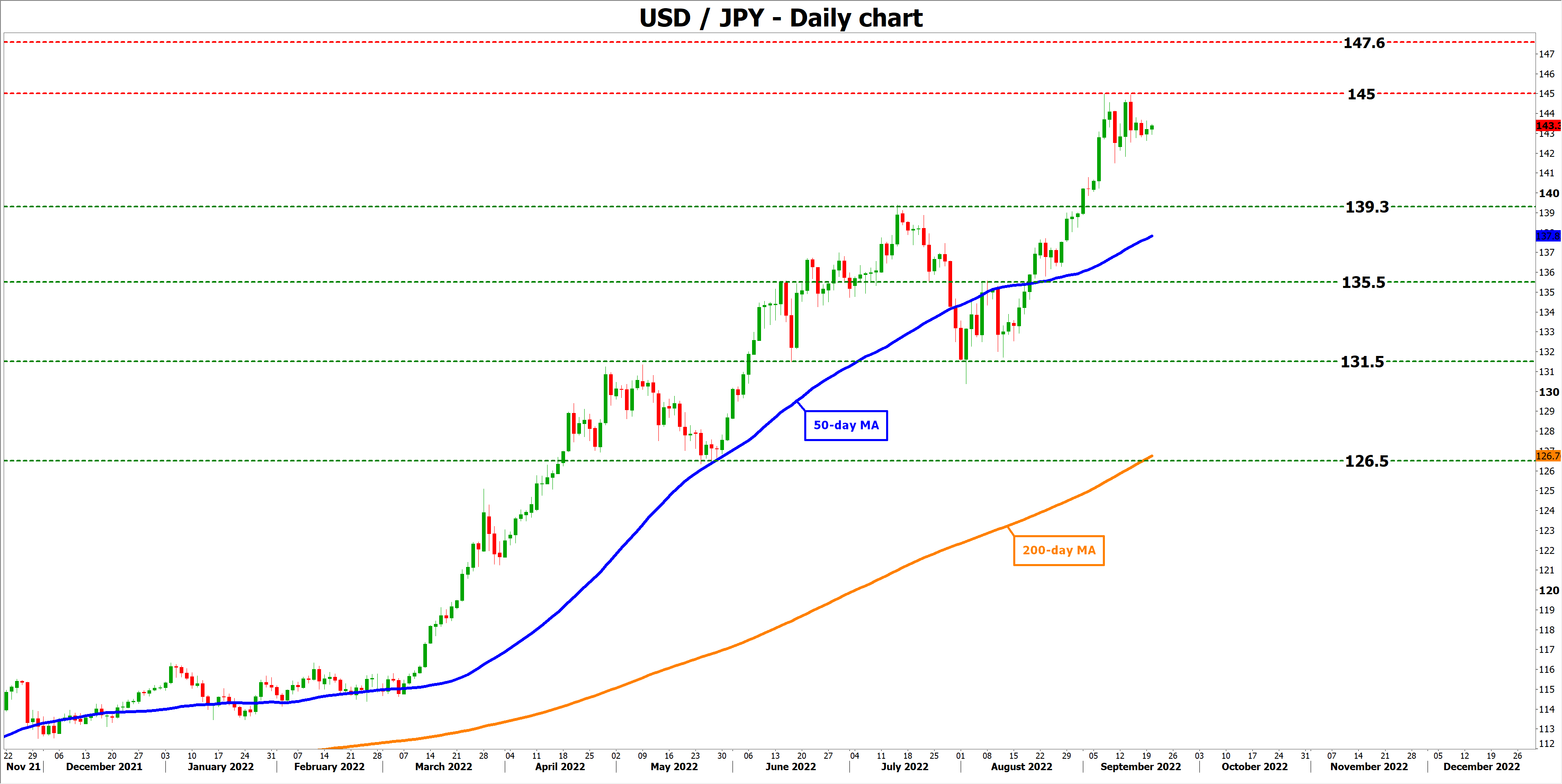
On the upside, a break above the 145 region would signal a resumption of the uptrend, turning the spotlight towards 147.60, which was the reversal point a quarter century ago.
EURJPY Aims for Higher Highs; June’s Resistance in Focus
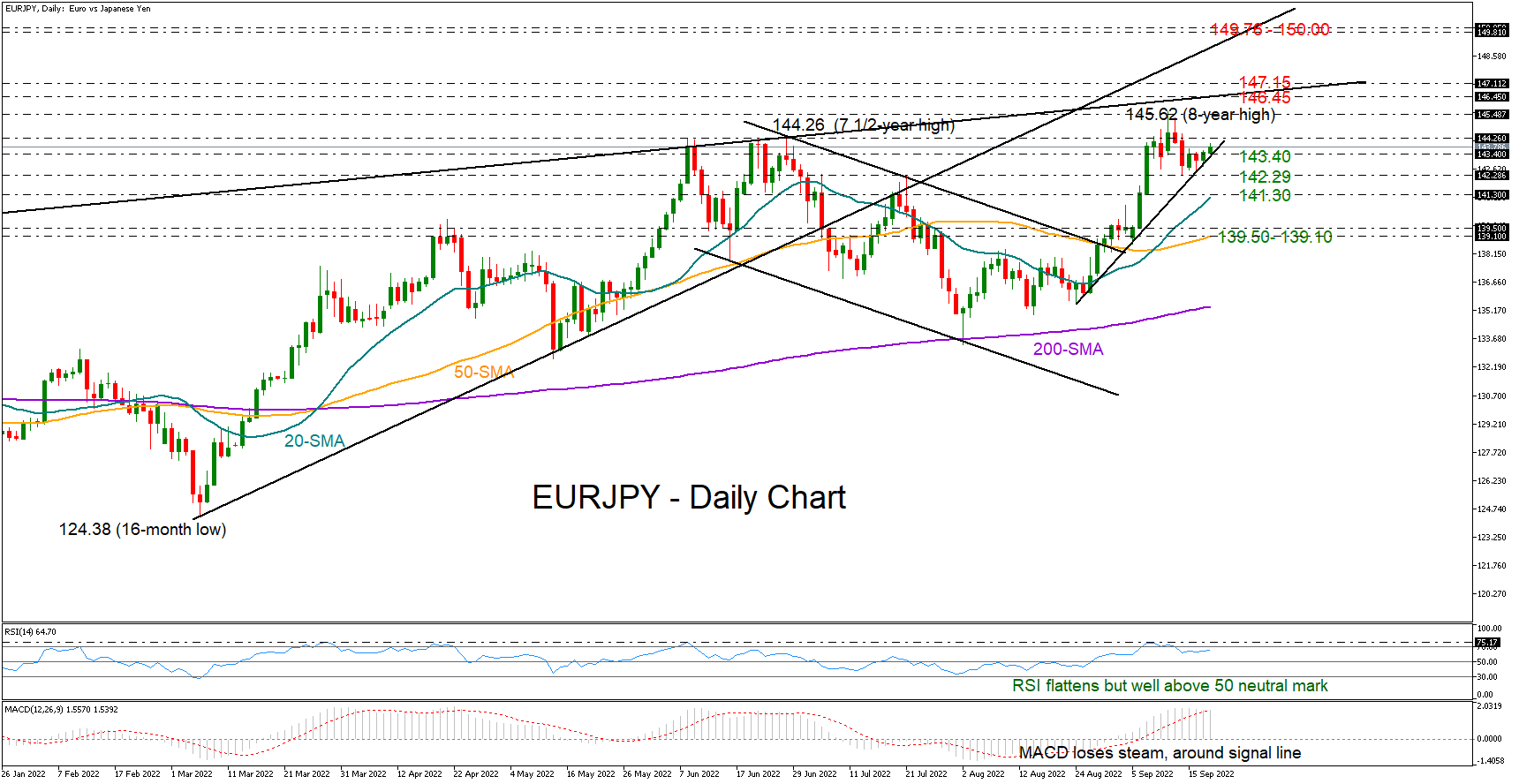
EURJPY stepped on the short-term ascending trendline, as it halted last week’s pullback from the new eight-year high of 145.62.
With the price trading comfortably above its upward-sloping simple moving averages (SMAs) and the momentum indicators hovering within the bullish territory despite their flat trajectory, upside moves are more likely than downside ones. Specifically, the RSI is a long distance above its 50 neutral mark, while the MACD is well elevated within the positive zone and near its red signal line.
A durable move above June’s tough ceiling of 144.26 could be the key for an acceleration towards the important long-term resistance line that joins all the highs from August 2020, currently seen around 146.45. A break above the 147.15 barrier could then pave the way towards the 2014 top of 149.76 and the 150 psychological mark, where the ascending line drawn from March lows is positioned.
In the bearish scenario, a cross below the support trendline at 143.40 could confirm an extension towards the 142.29 handle, while lower, the price could meet the 20-day SMA around 141.30. Failure to bounce from there may enhance selling interest towards the 139.50 – 139.10 region.
All in all, EURJPY may push for higher highs in the short term, with traders waiting for a clear confirmation signal above 144.26 to boost buying exposures.
GBP/JPY Daily Outlook
Daily Pivots: (S1) 163.17; (P) 163.50; (R1) 164.06; More...
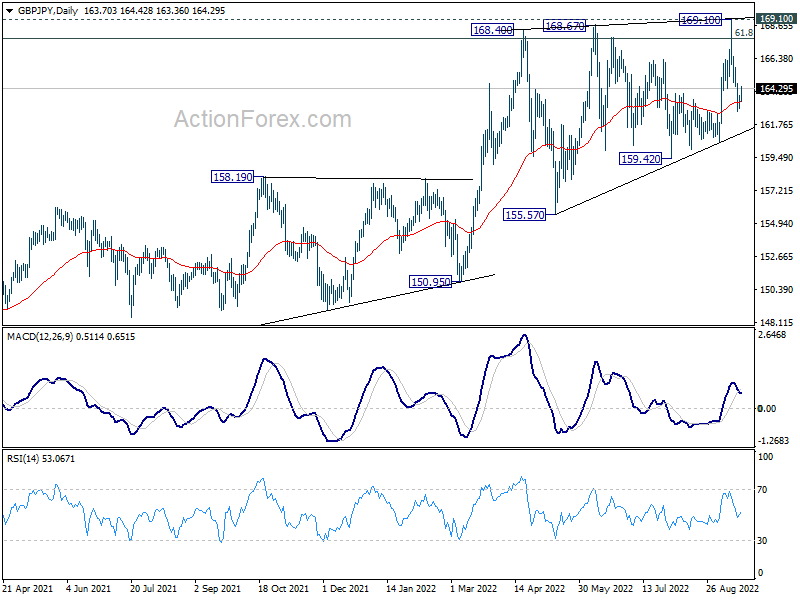
Intraday bias in GBP/JPY is turned neutral with current recovery. Overall, consolidation from 168.40 is still extending. Below 162.72 will turn bias back to the downside for 159.42. . But downside should be contained there to bring rebound. Firm break of 169.91 will resume larger up trend. However, break of 159.42 support will now be a sign of bearish reversal and target 155.57 support next.
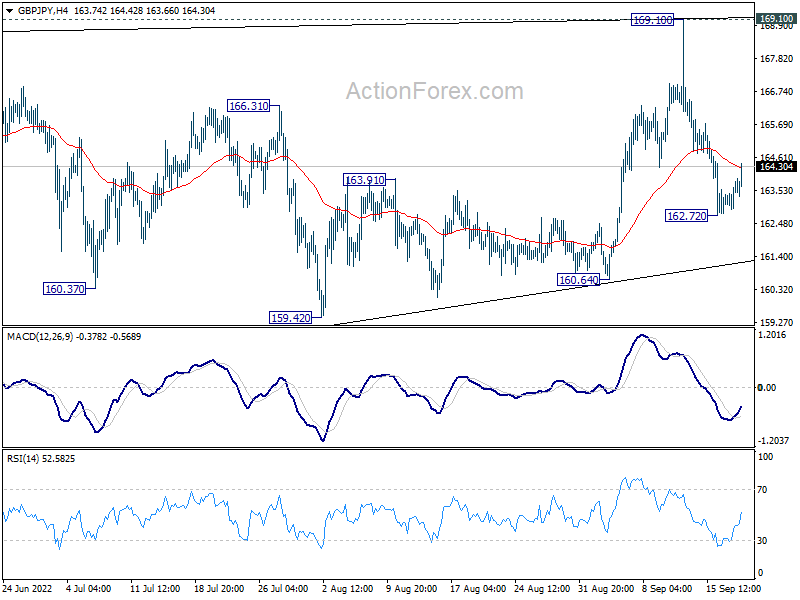
In the bigger picture, up trend from 123.94 (2020 low) is still in progress. Sustained break of 61.8% retracement of 195.86 (2015 high) to 122.75 (2016 low) at 167.93 will be a long term bullish signal, and could pave the way back to 195.86 high. This will remain the favored case as long as 155.57 support holds, even in case of deep pull back.
EUR/JPY Daily Outlook
Daily Pivots: (S1) 143.03; (P) 143.32; (R1) 143.85; More....
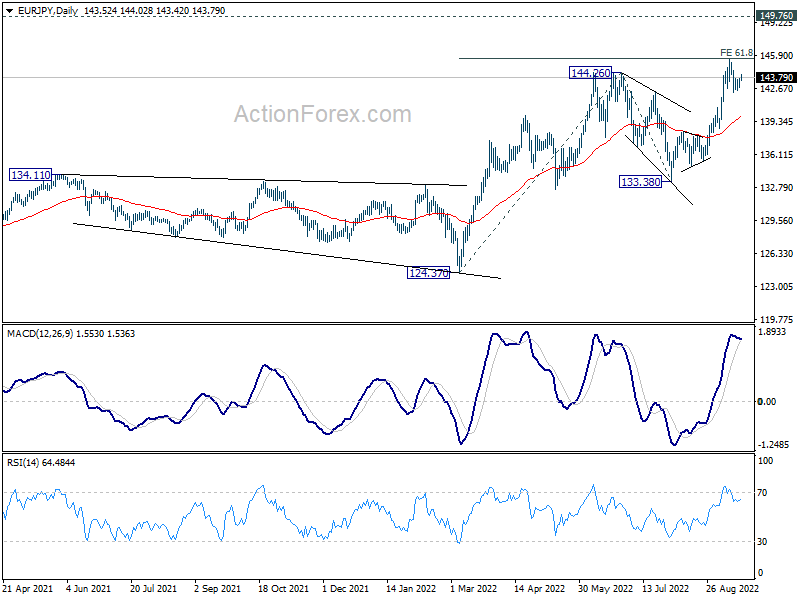
Intraday bias in EUR/JPY remains neutral as consolidation from 145.62 extends. Deeper pull back cannot be ruled out. But downside should be contained above 138.38 resistance turned support bring another rally. On the upside, decisive break of 145.62 will pave the way to 149.76 long term resistance, and then 100% projection of 124.37 to 144.26 from 133.38 at 153.27.
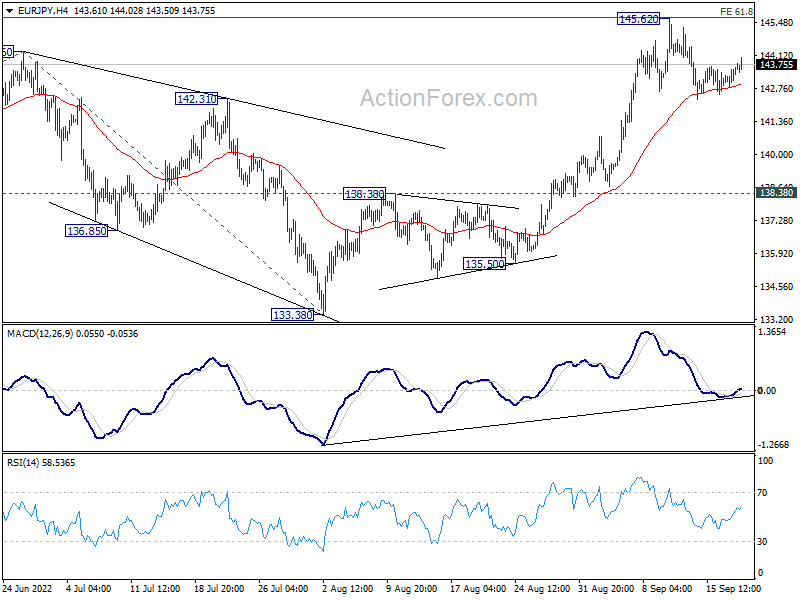
In the bigger picture, up trend from 114.42 (2020 low) is seen as the third leg of the pattern from 109.30 (2016 low). Further rally is in favor as long as 133.38 support holds. Next target is 149.76 (2015 high). However, sustained break of 133.38 will be a sign of medium term bearish reversal and turn focus to 124.37 support for confirmation.
EUR/GBP Daily Outlook
Daily Pivots: (S1) 0.8747; (P) 0.8768; (R1) 0.8788; More...
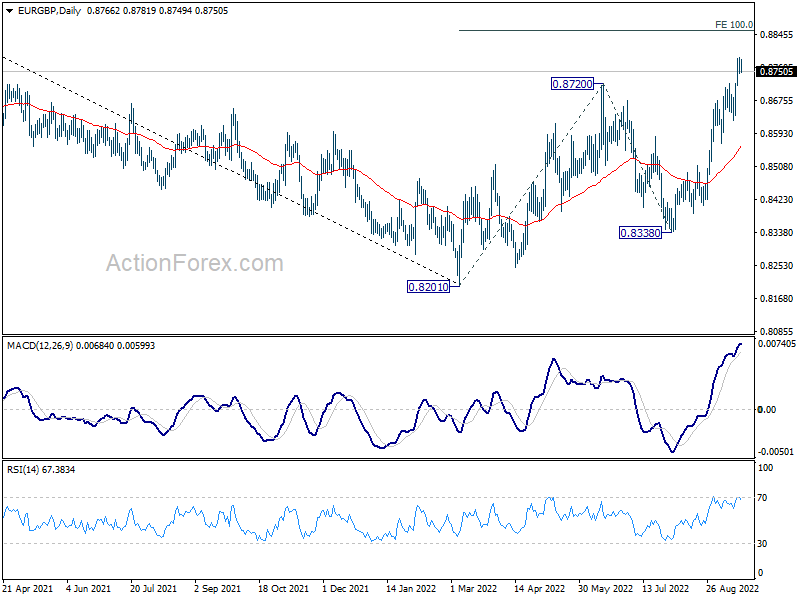
Intraday bias in EUR/GBP is turned neutral with current retreat. Some consolidations could be seen but downside should be contained by 0.8624 support to bring another rally. On the upside, break of 0.8786 will resume larger rise from 0.8201 to 100% projection of 0.8201 to 0.8720 from 0.8338 at 0.8857.
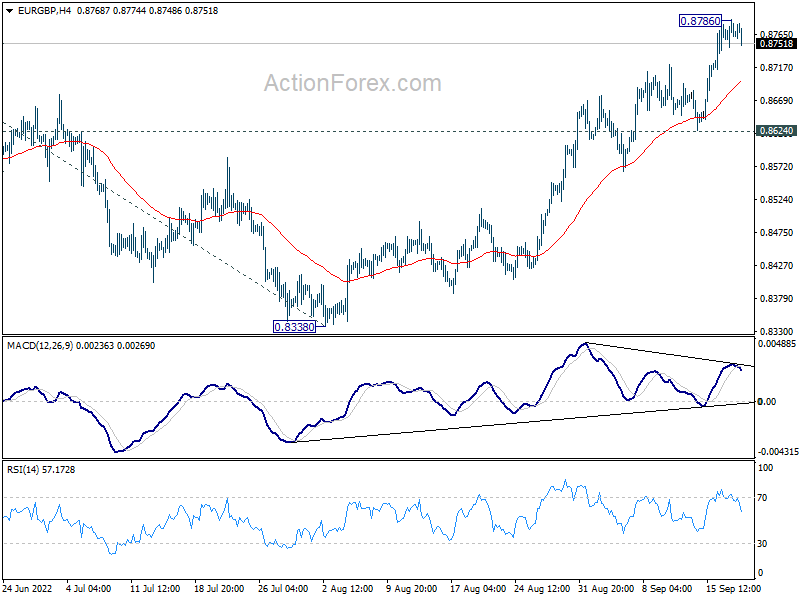
In the bigger picture, current development suggests that the down trend from 0.9499 has (2020 high) has completed at 0.8201. Rise from there is developing into a medium term up trend. Further rally would be seen to 61.8% retracement of 0.9499 to 0.8201 at 0.9003 next. This will now remain the favored case as long as 55 day EMA (now at 0.8545) holds.
EUR/AUD Daily Outlook
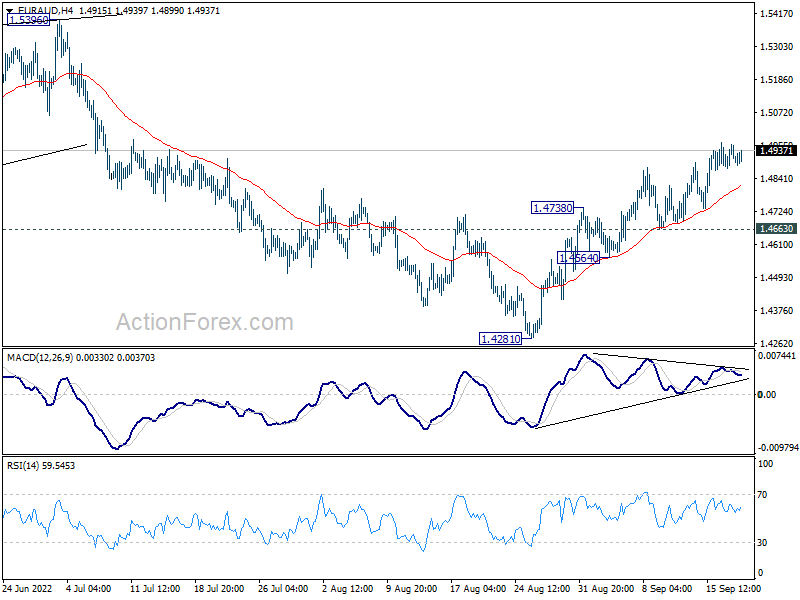
Daily Pivots: (S1) 1.4868; (P) 1.4916; (R1) 1.4952; More...
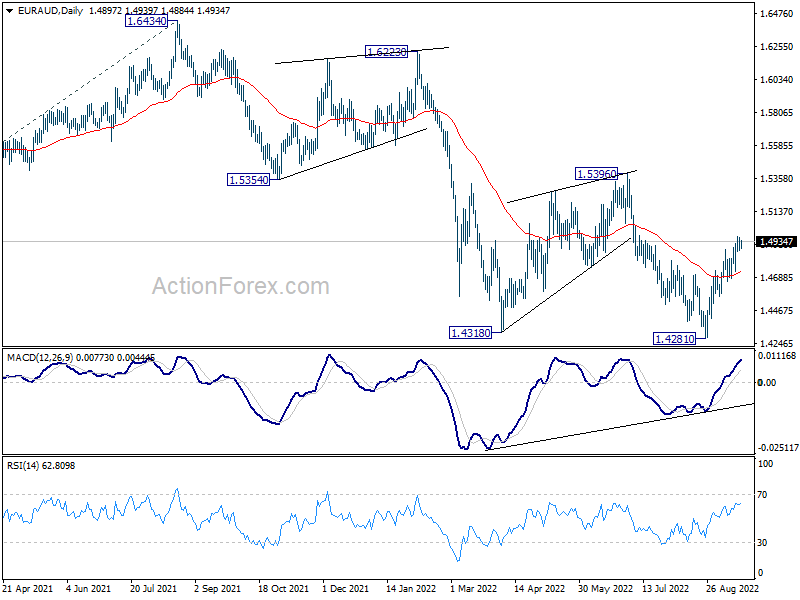
With 1.4663 support intact, rise from 1.4281 should still be in progress. Further rise would be seen to 1.5396 resistance. On the downside, however, break of 1.4663 minor support will turn bias back to the downside for retesting 1.4281 low.
In the bigger picture, down trend from 1.9799 is still in progress. Break of 1.4318 low will target 61.8% projection of 1.9799 to 1.5250 from 1.6434 at 1.3623, which is close to 1.3624 long term support (2017 low). This will remain the favored case now as long as 1.5396 resistance holds.
EUR/CHF Daily Outlook
Daily Pivots: (S1) 0.9642; (P) 0.9657; (R1) 0.9680; More....
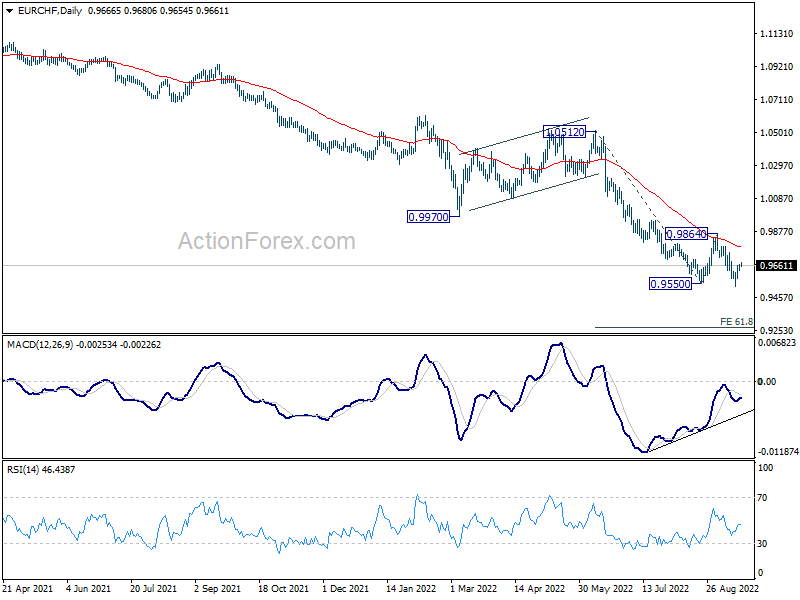
Intraday bias in EUR/CHF stays neutral as recovery from 0.9530 extends. But outlook remains bearish with 0.9864 resistance intact. On the downside, break of 0.9530 will extend larger down trend to 61.8% projection of 1.0512 to 0.9550 from 0.9864 at 0.9269.
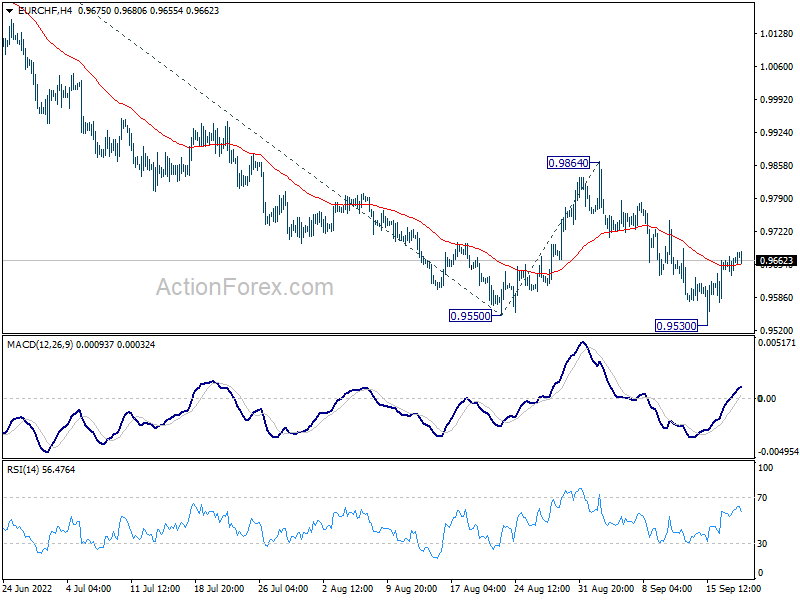
In the bigger picture, long term down trend from 1.2004 (2018 high) is still in progress. Next target is 138.2% projection of 1.2004 to 1.0505 to 1.1149 at 0.9033. On the upside, break of 0.9864 resistance is needed to be the first sign of medium term bottoming. Otherwise, outlook will stay bearish in case of strong rebound.
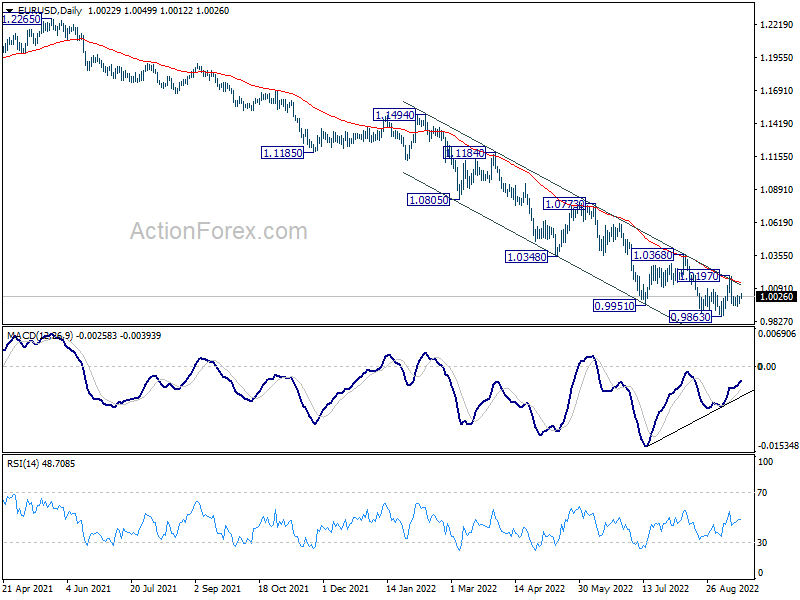
EUR/USD Daily Outlook
Daily Pivots: (S1) 0.9984; (P) 1.0007; (R1) 1.0047; More...
Range trading continues in EUR/USD and intraday bias stays neutral. Outlook also remains bearish. On the downside, firm break of 0.9863 support will resume larger down trend. On the upside, break of 1.0197 resistance will now raise the chance of larger trend reversal, and target 1.0368 resistance.
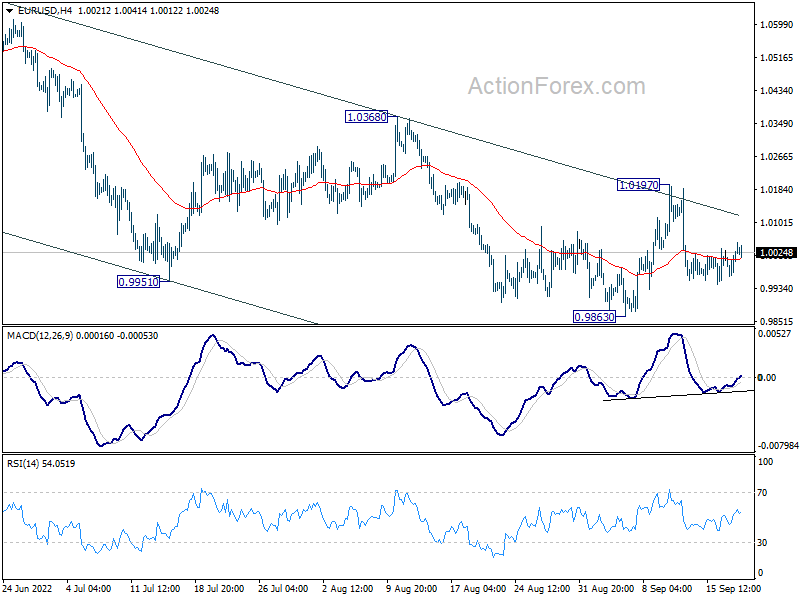
In the bigger picture, down trend from 1.6039 (2008 high) is still in progress. Next target is 100% projection of 1.3993 to 1.0339 from 1.2348 at 0.8694. In any case, outlook will stay bearish as long as 1.0368 resistance holds, in case of strong rebound.