

Sample Category Title
AUD/USD Consolidates
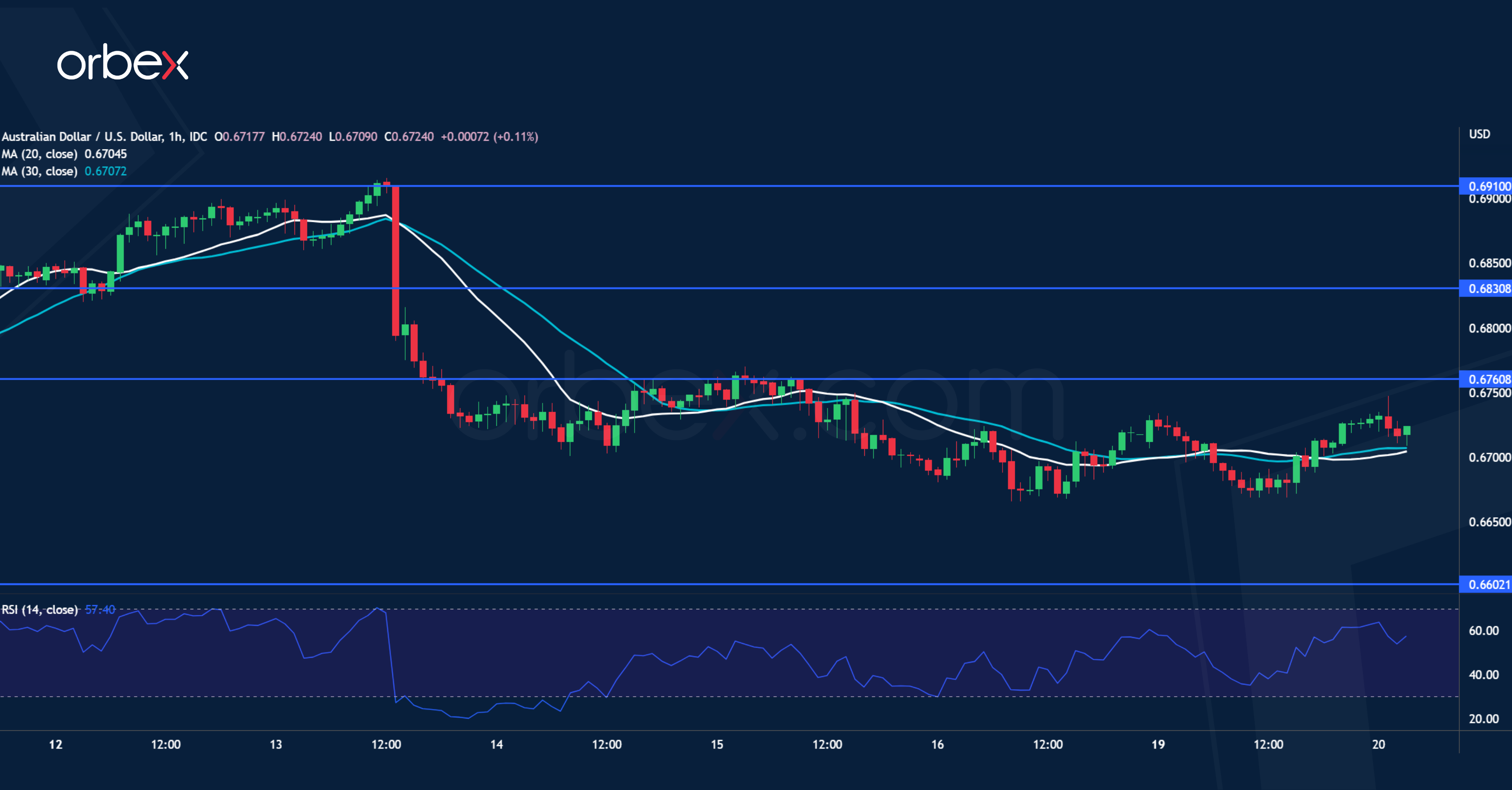
The Australian dollar steadied after the RBA minutes hinted at a slowdown in hikes. A lack of support for the recent rebound is a sign that the bulls struggle to hold onto their gains. A drop below the daily support at 0.6680 may have prompted the last buyers to bail out and resumed the downtrend in the medium-term. 0.6600 from May 2020 is an intermediate support and its breach could extend losses towards 0.6510. On the upside, trend followers could be expected to sell into strength in the former demand zone at 0.6760.
A Turbulent Week Ahead
It's been quite a volatile start to the week which is unlikely to abate considering what's to come over the next few days.
Central banks are lining up this week to deliver huge rate hikes as the desperate fight against inflation continues. The Fed headlines on Wednesday but others will follow including the BoE, SNB, SARB and the Norges Bank on Thursday.
The BoJ will also meet on Thursday but the topic of conversation there will likely be how to generate sustainable inflation, not fight it, and the spiralling yen. The CBRT meanwhile will ponder how much to cut rates again despite inflation topping 80%.
PBOC between a rock and a hard place
Benchmark lending rates in China were left unchanged overnight as the central bank continues the balancing act of supporting the economy as well as a falling currency. The one-year LPR was left unchanged at 3.65% while the five-year was also left unchanged at 4.3%. This didn't come as a surprise after the MLF was also unchanged last week. The PBOC is truly between a rock and a hard place at the moment, made all the worse by lockdown uncertainty amid various Covid outbreaks and an ongoing zero-tolerance approach.
Oil rebounds as OPEC+ struggle again with output targets
Oil prices bounced back well at the start of the week, as choppy trading conditions were seen across various asset classes. Brent is trading back around $90 a barrel after briefly dipping back towards the lows of the last six months where we continue to see substantial support.
OPEC+ fell short of its output target by 3.583 million barrels per day in August in a further reminder to the markets of the tight conditions we continue to operate within. It also highlights how irrelevant the 100,000 barrel increase and subsequent cut really were. Still, I expect more warnings of output cuts if prices do break their six-month lows.
A troubling week for gold
It hasn't been the best week for gold, although it did manage to find its feet a little over the last couple of sessions. Still, it could be in for a lot more turbulence this week considering the scale of tightening that's coming on Wednesday and Thursday, alone.
If the Fed takes the plunge with a 1% hike, it could turn into a very unpleasant week for gold. It's run into resistance around $1,680 over the last couple of sessions which makes sense from a technical perspective, being such a long-standing level of support. We may see it linger below here in the run-up to the Fed decision amid fear of a nasty rate surprise.
Will Bitcoin break the June low?
Another turbulent session for bitcoin at the start of the week in which it came close to its June low before recovering alongside other risk assets. While that may come as a relief in the short term, it may also generate some nerves as a break of that low could see it spiral lower once more. It's not a great environment for risk assets and central banks could deliver another blow this week.
Dollar Found a Short-Term Equilibrium Going into Fed Policy Decision
Markets
The new week didn’t bring any change to market trends/narrative going into multiple central banks decisions, including the FOMC announcement on Wednesday. Markets continue to prepare for (or is it rather push?) inevitable bold central bank action to finally break a stubborn inflationary dynamic. Curve inversion/flattening trends continued unabatedly.US yields rose between 6.9 bps (2-y) and 0.2 bps (30-y), with the 10-y US real yield building on its break beyond 1.0%. EMU swaps showed similar gains rising between 8.8 bps (2-y) and 3.7 bps (3.7%).Yields at shorter maturities aren’t hampered anymore by nearby technical barriers and continue to set multi-year peak levels on a daily basis (2-y US 3.96%, highest since 2007; EMU 2-y swap 2.61%, highest since 2019). Yields at longer maturities are close but continue to struggle to clear the cycle highs touched earlier this year. The US 10-y yield yesterday briefly surpassed the 3.5% cycle top (close 3.49%). EMU 10-y swap closed at 2.57% vs 2.72% (intraday June peak). The intraday dynamics yesterday suggested that the upside drift at least as much originated from Europe rather than the US. Initially, higher (real) yields put further pressure on equity markets with major indices near important support levels. Selling pressure eased during US trading. The EuroStoxx 50 closed almost unchanged. US indices even closed moderately higher (Dow +0.64%/Nasdaq +0.76%). The dollar again ‘decoupled’ from a persistent fragile risk sentiment and expected bold Fed action. The DXY index (close 109.74) even finished a few ticks lower compared to Friday. EUR/USD overcame some initial weakness to close at 1.002. USD/JPY maintained a sideways trading pattern to close marginally stronger at 143.20.
Asian (equity) markets are joining the more constructive close on WS yesterday. US yields stabilize. The dollar is trading marginally softer (DXY 109.58). Japanese inflation (Cf infra) surprised on the upside, but for now doesn’t change expectations on BoJ policy in a profound way yet (USD/JPY unchanged at 143.2). Later today, the eco calendar is thin. US building permits and housing data are expected to confirm a deteriorating momentum (Cf further decline in NAHB home builders confidence yesterday). Data probably won’t support the established trend in yields. That said, the uptrend recently didn’t need much concrete news. The dollar found a short-term equilibrium going into the Fed policy decision with 0.9864 and 1.02 the borders for EUR/USD’s consolidation pattern. Yesterday’s close of the UK markets didn’t help sterling much. EUR/GBP’s break above 0.8721/31 looks confirmed. The Swedish Riksbank will likely double its policy rate to 1.50% this morning. The risk, if any, is for even bolder action.
News Headlines
Japanese inflation accelerated to its highest level since the early 90s in August (when excluding periods around sales-tax hikes). The August headline national CPI quickened from 2.6% Y/Y to 3% Y/Y (vs 2.9% expected) while the BoJ’s preferred gauge excluding fresh food increased from2.4% Y/Y to 2.8% Y/Y. Food and energy prices are still the main culprit from the upward price pressure, but imported goods and services contributed as well. Inflation momentum makes it hard for Bank of Japan governor Kuroda to keep defending its ultra-easy monetary policy. The BoJ sticks with its negative policy rate policy while defending the 0.25% yield cap at the 10-yr tenor. They want to help the sinking yen by (verbally) intervening. Lack of interest rate support and high energy prices pushed the Japanese currency to multidecade lows near USD/JPY 145 of late.
Minutes of the Australian central bank meeting earlier this month showed that the RBA contemplated a smaller rate hike than the 50 bps move it eventually conducted (to 2.35%). Eventually they opted for the higher pace given the importance of returning inflation to target, the potential damage to the economy from persistent high inflation and the still relatively low level of the cash rate. The RBA stressed that it remains on tightening course, but a return to more normal settings could imply a slower tightening path going forward. AUD swap rates lose 4 bps (30-yr) to 6.5 bps (2-yr) this morning. The Aussie dollar is a tad weaker at AUD/USD 0.6715 and stays near the YTD low at 0.6670..
Big Week for Central Banks
The week kicked off on quite mixed sentiment. The German stocks gained, while CAC40 posted a small loss on Monday. The UK was closed due to Queen Elizabeth’s funeral and the US indices closed the session in the positive thanks to a late trading rally, that boosted appetite in Big Tech stocks. Apple jumped 2.50% to above its 100-DMA, while Tesla rallied some 1.90%. Yet, the S&P500 closed a couple of cents below the closely watched 3900 level, as Nasdaq rallied 0.77% but remained below the 13000 into the first day of the Fed meeting. The US treasuries continued their selloff. The US 2-year yield advanced to 3.97%, and the 10-year yield was above 3.50%.
So the FOMC begins its two-day policy meeting today, and is expected to deliver the third 75-bp hike tomorrow. Activity on Fed funds futures gives more than 80% chance for a 75bp hike this morning, and less than 20% chance for a 100bp hike. Although the probability of a full percentage point hike spiked up to 35% after last week’s disappointing inflation reports, we still believe that the Fed has nothing to gain by surprising the market with a bigger than expected rate hike. The strength of the US dollar is too threatening for the Fed to pull out the bazooka.
Therefore, a 75bp hike at tomorrow’s announcement has the potential to give some relief to the US dollar and the equity markets, as it would help de-pricing the scenario of 100bp hike. Yet, the size of an eventual relief, or whether we would see a relief or not will also depend on the economic projections and the dot plot. If there is any hint that the Fed members move away from the idea of ‘soft landing’, the doves would be more aggressively back, and we could see a bigger relief across risk assets, whereas if Powell insists on the fact that the US jobs market remains resilient to the policy tightening, it would be taken as a sign that the Fed will carry on with sustained rate hikes, and the relief – if any - would be much smaller. And I think that the second scenario is more likely at this stage. We will see what the dot plot says.
So remember, the so-called ‘dot plot’ plots on a chart how the FOMC members see the rates evolve. It gives very important hints about the future of the Fed policy, and I can even say that this week, the dot plot will be more carefully watched than the rate decision itself, as it will certainly show a higher terminal rate for 2023. The Fed may take its rates to around 4.0 - 4.2% from 3.8% plotted in June. That means that after this week’s 75bp hike, there would be at least another 75bp hike to reach that level, whereas the expectation so far was a 50bp hike in November, and a 25bp in December.
And the global tightening winds will continue to blow beyond the US this week. We have an army of central banks around the world which are due to announce their latest policy decisions: Bank of Japan, Sweden, Norway, Brazil, South Africa, Philippines, Indonesia, Taiwan, Turkey, the Bank of England and the Swiss National Bank will announce their latest decisions throughout this week. Most of these banks are expected to raise their interest rates, and/or sound hawkish in an effort to slow the depreciation of their currencies against the Fed-boosted US dollar.
The Swiss National Bank (SNB) is expected to hike by 75bp.
The Bank of England (BoE) could stick to a 50bp hike, given that the energy support package could ease the pressure of looser fiscal policy on consumer prices.
The Bank of Japan (BoJ) is expected to stay pat, but voice concerns regarding abnormal USD appreciation against the yen.
The Central Bank of Turkey (CBT) will continue its free-style rate policy and keep the benchmark rate at 13%.
Riksbank in Focus
Market movers today
The key event today in the Nordic region is the Riksbank decision, where we expect a 75bp hike of the policy rate to 1.50% and a policy rate path signalling more near-term rate hikes (we expect 75bp again in November), for more details, please see the Nordic section below.
The German producer price inflation may stabilise, but at very high levels with energy continuing to the big inflation driver.
In the US, the building permits and housing starts for August will provide important signs of how fast the US housing sector is slowing amid higher interest rates.
The 60 second overview
Markets: Global risk sentiment took a turn in thin trading yesterday and stock market closed the session in green in the US. Asia is also recovering, and after a five days losing streak in most European indices, futures point to a session of relief. Overall, markets remain choppy ahead of the flurry of central bank meetings later this week. The US 2-year yield is creeping towards 4% while the 10-year is closing in on 3.5%. After this week's hike (75bp widely expected but 100bp also being possible), the fed funds rate will have reached a restrictive territory. The markets now price the peak hiking cycle at 4.5%.
Japan: Japanese inflation data is not usually something to watch out for, but with a BOJ meeting coming up on Thursday and pressure on its yield control curve policy rising, price data this morning drew some attention. The BOJ's preferred measure, inflation excluding fresh food, increased to a three-decade high at 2.8% y-o-y, topping analyst expectations at 2.7%. We expect the BOJ to stay put as inflation continues to be largely driven by energy and food prices. Yet, it is worth noticing that also the core measure increased from 0.4% y-o-y in July to 0.7% in August and the falling yen is adding to inflation pressures with the USD having gained 25% against JPY this year.
China-US: In the clearest signal yet, US President Biden said yesterday the US would defend Taiwan if attacked - moving one step further towards China's 'red line'. This is the fourth time in about a year that Biden sends this message despite White House officials every time stating afterwards that the US has not changed policy. However, this time the journalist asked further if it meant that unlike in Ukraine, US forces - American men and women - would defend the island, Biden replied "yes". This is the clearest signal that the US has shifted policy to so-called 'strategic clarity' away from 'strategic ambiguity' and this is likely to infuriate China. Beijing will see this as one step closer to formally supporting Taiwan independence and in that sense we have moved one step closer to China's red line of a formal declaration of Taiwan being a sovereign state. We expect China to respond with a further very high level of military exercises around Taiwan. We still do not expect the US and Taiwan to cross the 'red line' by formally declaring independence for Taiwan but moving as close as possible to the 'red line' also entails risks and we do see a 20% probability a war could be triggered by mishaps or errors that lead to a tit-for-tat spiral.
FI: With UK out, European rates markets were driven by hawkish comments from ECB GC members amid thinly volume trading. European curves bear-flattened, while spreads were broadly unchanged on the day. 10y bunds rose 5bp yesterday.
FX: FX is in waiting mode ahead of seven (including Turkey that is) important central bank decisions this week. EUR/USD stayed close to parity. GBP, NOK and SEK edged slightly lower, though NOK erased some of its losses amid a late rebound in equities and crude oil. US 10Y temporarily reached 3.50% which gave temporary support to USD/JPY.
Credit: With UK markets closed to mark the Queen's funeral there was no trading in iTraxx indices yesterday. Today, trading commences in the new iTraxx series (series 38). Based on Friday's levels, we estimate the roll should take Main 7-8bp wider (almost exclusively due to index extension) while Xover should open c.40bp wider on a combination of extension and constituent change.
Nordic macro
Today we have the Riksbank kicking off this very important central bank week. We expect a 75bp hike of the policy rate to 1.50% and a policy rate path signalling more near-term rate hikes (we expect 75bp again in November). Market pricing is for a more hawkish Riksbank today, pricing in around 90bp. While a 100bp hike cannot be ruled out, we do not find last week's inflation print or inflation expectations survey to be enough to flip our base case from 75bp to 100bp. We also expect the Riksbank to reduce QE reinvestments further, where we find it reasonable with a complete stop of reinvestments (reducing to a marginal amount just to keep a presence in markets is also an option). The Monetary Policy Report with new projections will be released in conjunction with the decision at 9.30 CET. Governor Stefan Ingves will hold a press conference at 11.00 CET (in Swedish). The policy rate becomes effective Wednesday 21 September.
USD/CAD Daily Outlook
Daily Pivots: (S1) 1.3217; (P) 1.3281; (R1) 1.3316; More...
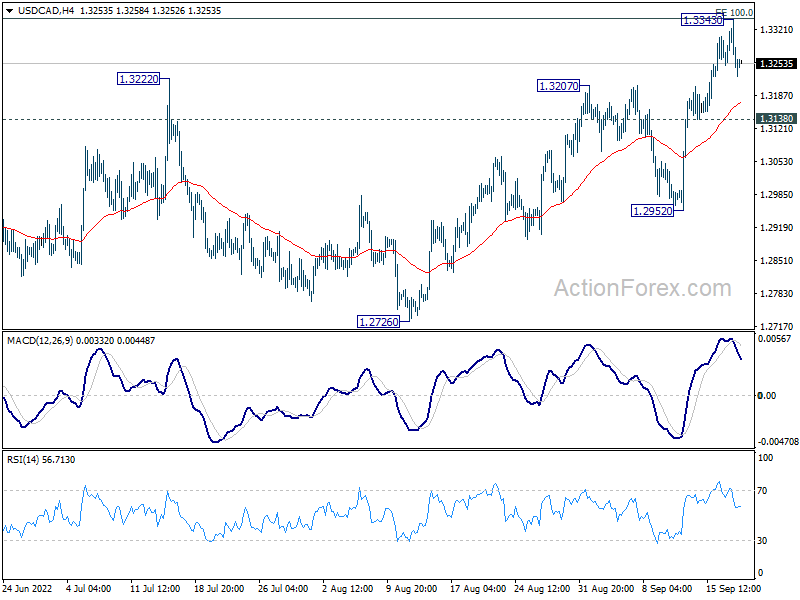
USD/CAD retreated after hitting 1.3343, meeting 100% projection of 1.2005 to 1.2947 from 1.2401 at 1.3343. Intraday bias is turned neutral for consolidations first. Downside of retreat should be contained by 1.3138 support to bring another rally. Sustained break of 1.3343 will pave the way to medium term fibonacci level at 1.3650. However, firm break of 1.3138 will bring deeper pull back towards 1.2952 support instead.
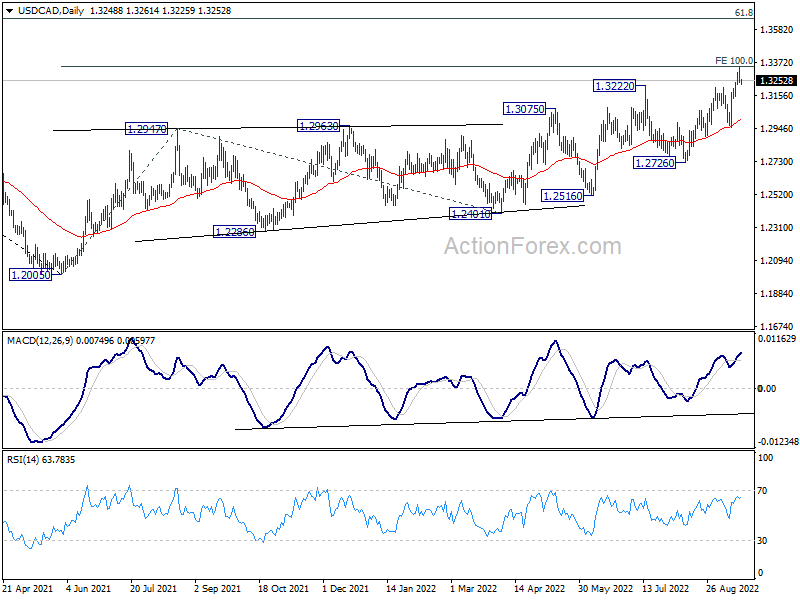
In the bigger picture, down trend from 1.4667 (2020 high) should have completed at 1.2005, after defending 1.2061 long term cluster support. Rise from there should target 61.8% retracement of 1.4667 to 1.2005 (2021 low) at 1.3650. This will remain the favored case now as long as 1.2716 support holds.
Markets Mixed Ahead of Central Bank Bonanza, CAD Awaits CPI
The forex markets are overall mixed. Dollar retreated overnight following the rebound in stocks, but regained some ground in Asian session. Traders are holding their bets for now, ahead of the meetings of four major central banks later in the week, including Fed, BoE, SNB and BoJ. Canadian inflation data, nevertheless, could trigger some volatility in Loonie today first.
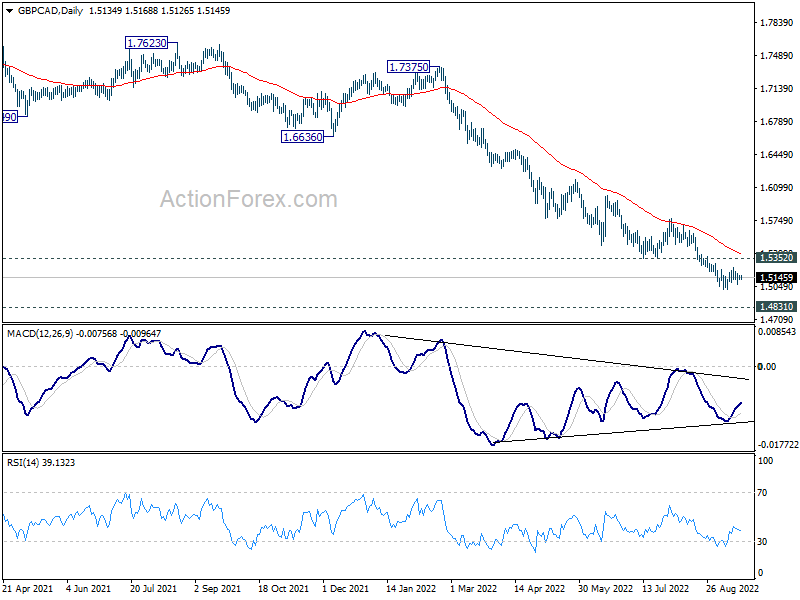
Technically, GBP/CAD is one that worth watching in the coming days. While the Pound has been weak, even GBP/USD could's get rid of 1.14 handle (pandemic low) cleanly for now. Considering loss of downside momentum in GBP/CAD, as seen in daily MACD, and the proximity to 2010 low at 1.4831, there is prospect of a bounce. But, break of 1.5352 support turned resistance is needed to confirm short term bottoming first. The development will hinge on today's Canada CPI data, and BoE rate decision on Thursday.
In Asia, at the time of writing, Nikkei is up 0.39%. Hong Kong HSI is up 1.41%. China Shanghai SSE is up 0.40%. Singapore Strait Times is up 0.44%. Japan 10-year JGB yield is down -0.0071 at 0.250. Overnight, DOW rose 0.64%. S&P 500 rose 0.69%. NASDAQ rose 0.76%. 10-year yield rose 0.042 to 3.490.
Japan CPI core rose to 3% yoy in Aug, highest in 31 years
Japan CPI accelerated from 2.6% yoy to 3.0% yoy in August, above expectation of 2.6% yoy. CPI core (ex-fresh food), rose from 2.4% yoy to 2.8% yoy, above expectation of 2.7% yoy. CPI core-core (ex-fresh food, energy), also rose from 1.2% yoy to 1.6% yoy, but missed expectation of 1.7% yoy.
CPI core, the BoJ watched reading, hit the highest level in 31 years since 1991, excluding the effect of sales tax hike. Even including the impact of sales tax, the reading was still the highest in nearly 8 years.
BoJ is widely expected to continue to stand pat, and maintain negative interest rate later this week. But there are expectations that core inflation could hit 3% later in the year, and stay above the 2% target in the near term. That might start to change BoJ's view on prices and policy at a later stage.
RBA minutes: Slower tightening comes with higher rates
Minutes of RBA's September 6 meeting revealed that there were discussions on whether to hike by 25bps or 50bps. But, "given the importance of returning inflation to target, the potential damage to the economy from persistent high inflation and the still relatively low level of the cash rate, the Board decided to increase the cash rate by a further 50 basis points."
RBA reiterated that there will be further interest rate hikes "over the months ahead", but it's it "not on a pre-set path". The full effects of higher interest rates were "yet to be felt" on mortgages, activity and inflation.
The board was "mindful" that the path to bring inflation back to target "needed to account for the risks to growth and employment. RBA is seeking to return inflation to target "while keeping the economy on an even keel".
Size of timing of future rate hikes will be "guided by the incoming data" and outlook for inflation and job market, and risks. "All else equal, members saw the case for a slower pace of increase in interest rates as becoming stronger as the level of the cash rate rises".
Looking ahead
Germany PPI, Swiss SECO economic forecasts, and Eurozone current account will be released in European session. Later in the day, Canada CPI will take center stage. US will publish building permits and housing starts.
USD/CAD Daily Outlook
Daily Pivots: (S1) 1.3217; (P) 1.3281; (R1) 1.3316; More...
USD/CAD retreated after hitting 1.3343, meeting 100% projection of 1.2005 to 1.2947 from 1.2401 at 1.3343. Intraday bias is turned neutral for consolidations first. Downside of retreat should be contained by 1.3138 support to bring another rally. Sustained break of 1.3343 will pave the way to medium term fibonacci level at 1.3650. However, firm break of 1.3138 will bring deeper pull back towards 1.2952 support instead.
In the bigger picture, down trend from 1.4667 (2020 high) should have completed at 1.2005, after defending 1.2061 long term cluster support. Rise from there should target 61.8% retracement of 1.4667 to 1.2005 (2021 low) at 1.3650. This will remain the favored case now as long as 1.2716 support holds.
Economic Indicators Update
| GMT | Ccy | Events | Actual | Forecast | Previous | Revised |
|---|---|---|---|---|---|---|
| 23:30 | JPY | National CPI Core Y/Y Aug | 2.80% | 2.70% | 2.40% | |
| 01:30 | AUD | RBA Minutes | ||||
| 06:00 | EUR | Germany PPI M/M Aug | 1.50% | 5.30% | ||
| 06:00 | EUR | Germany PPI Y/Y Aug | 37.50% | 37.20% | ||
| 07:00 | CHF | SECO Economic Forecasts | ||||
| 08:00 | EUR | Current Account (EUR) Jul | 5.3B | 4.2B | ||
| 12:30 | USD | Building Permits Aug | 1.62M | 1.69M | ||
| 12:30 | USD | Housing Starts Aug | 1.46M | 1.45M | ||
| 12:30 | CAD | CPI M/M Aug | -0.10% | 0.10% | ||
| 12:30 | CAD | CPI Y/Y Aug | 7.30% | 7.60% | ||
| 12:30 | CAD | CPI Common Y/Y Aug | 5.60% | 5.50% | ||
| 12:30 | CAD | CPI Median Y/Y Aug | 5.10% | 5.00% | ||
| 12:30 | CAD | CPI Trimmed Y/Y Aug | 5.50% | 5.40% |
Technical Outlook and Review
USD/JPY:
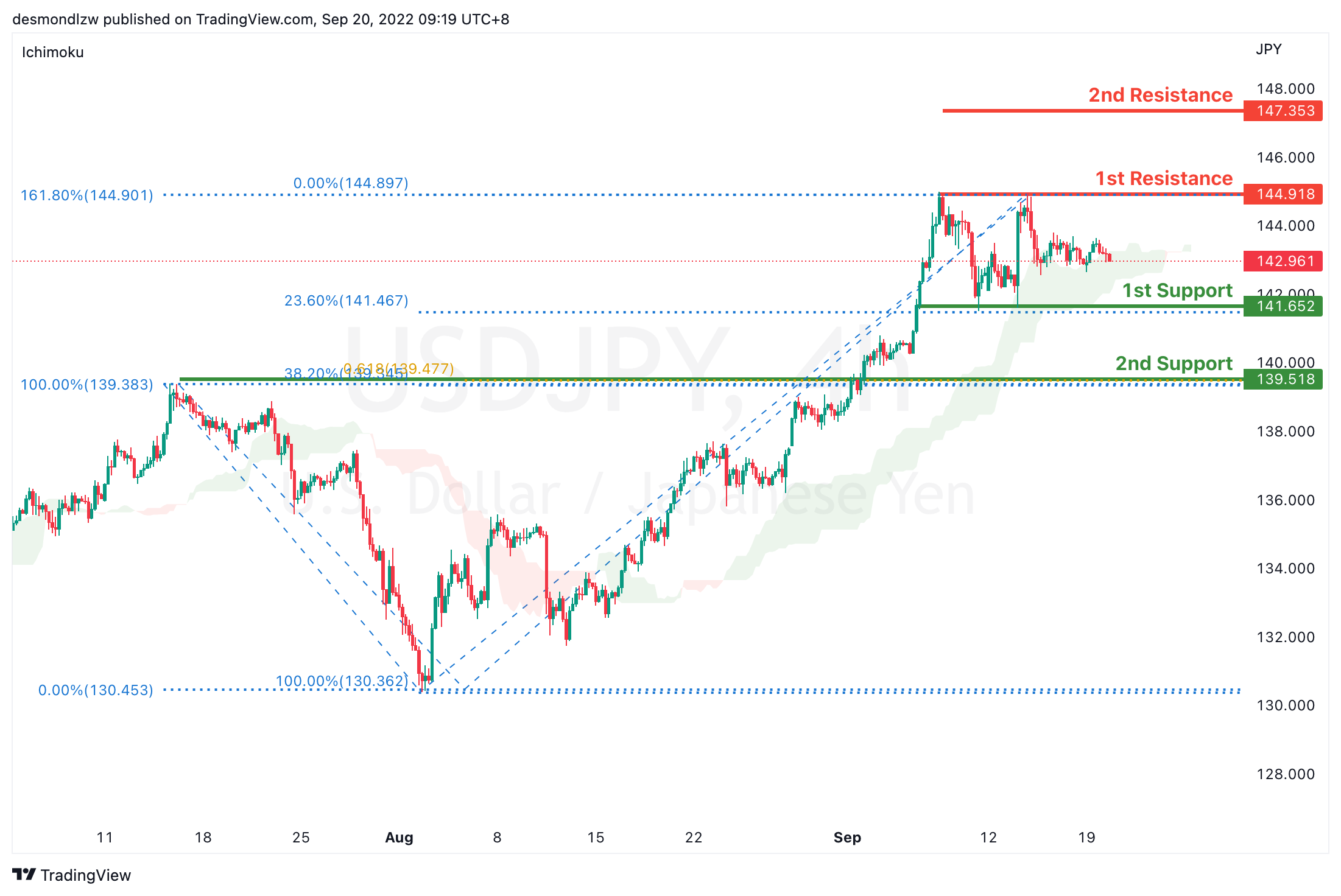
On the H4 chart, price is still respecting the ascending momentum. We are still bullish bias- Price is testing above the previous low and if bullish momentum continues, it should bring price to first resistance at 144.918 where the 161.8% extension sits. If it breaks this level, it should bring price to 147.353 where the previous swing high sits. Alternatively it could pull back to the first support at 141.652 where the 23.6% retracement and 100% projection sits then to the second support at 139.381 where the 38.2% retracement and overlapping support sits.
Areas of consideration:
- H4 time frame, 1st resistance at 144.918
- H4 time frame, 1st support at 141.652
DXY:
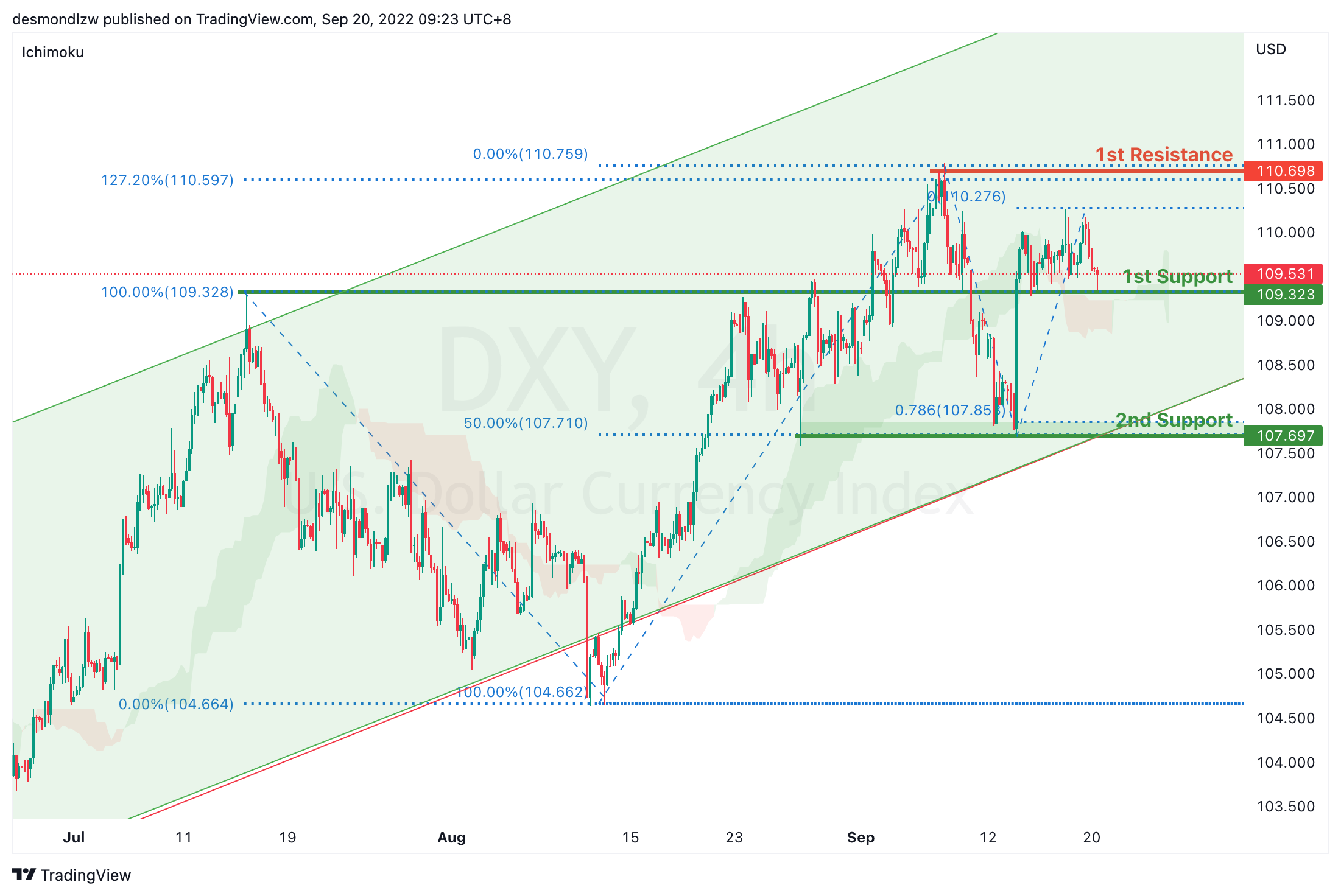
On the H4, price is still respecting the bullish channel and has failed to break the first support- we are bullish bias. Price is currently testing the first support at 109.323 where the 23.6% retracement sits. If bullish momentum continues, it should bring price toward the first resistance at 110.698 levels where the previous swing high sits. Alternatively, it could break the first support to bring price to the second support at 107.697 where the 78.6% projection, 50% retracement and previous swing low sits
Areas of consideration:
- H4 time frame, 1st resistance at 110.698
- H4 time frame, 1st support at 109.323
EUR/USD:
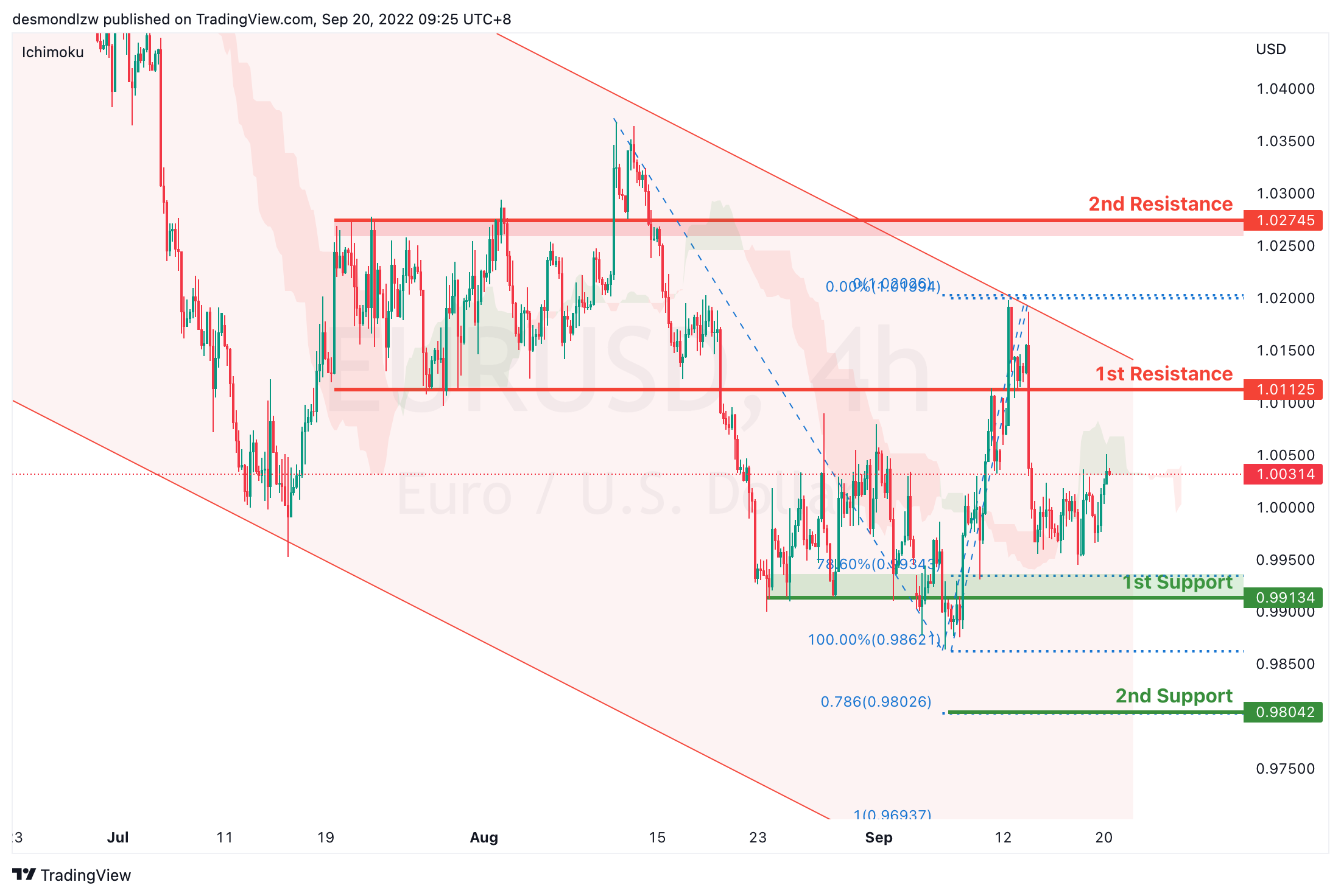
On the H4, price is moving within the channel, we are currently bullish bias as price fails to break the first support. Price seems like its moving to first resistance at 1.0112 level where the 50% retracement and previous swing low sits. If bullish momentum continues, it should bring price to second resistance at 1.0274 where the 78.6% retracement and previous swing high sits. Alternatively, price could pull back to test the first support at 0.9913 where the 78.6% projection and previous swing low sits, subsequently the second support at 0.9804 where the 100% projection sits
Areas of consideration :
- H4 1st resistance at 1.0112
- H4 1st support at 0.9913
GBP/USD:
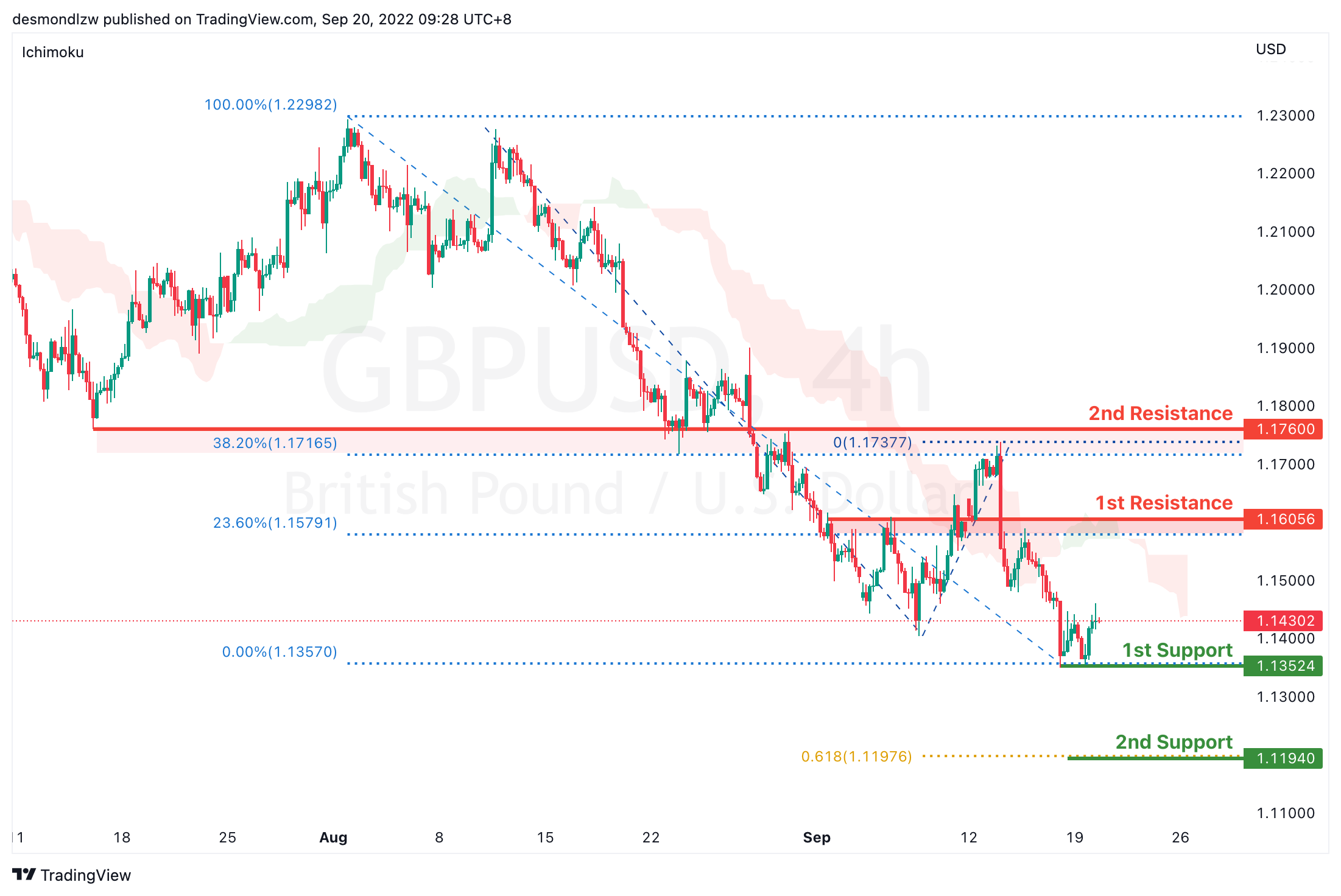
On the H4, prices are still moving in a bearish momentum hence we are bearish biassed. Prices have pulled back slightly but if bearish momentum continues, it should test the first support again at 1.1352 levels where the previous swing low sits then the second support at 1.1194 where the 161.8% extension and 61.8% projection sits. Alternatively, price could pull back to test the first resistance at 1.1605 where the 23.6% retracement and overlapping support sits then the second resistance at 1.1760 where the 38.2% retracement and previous swing high sits
Areas of consideration:
- H4 1st resistance at 1.1605
- H4 1st support at 1.1350
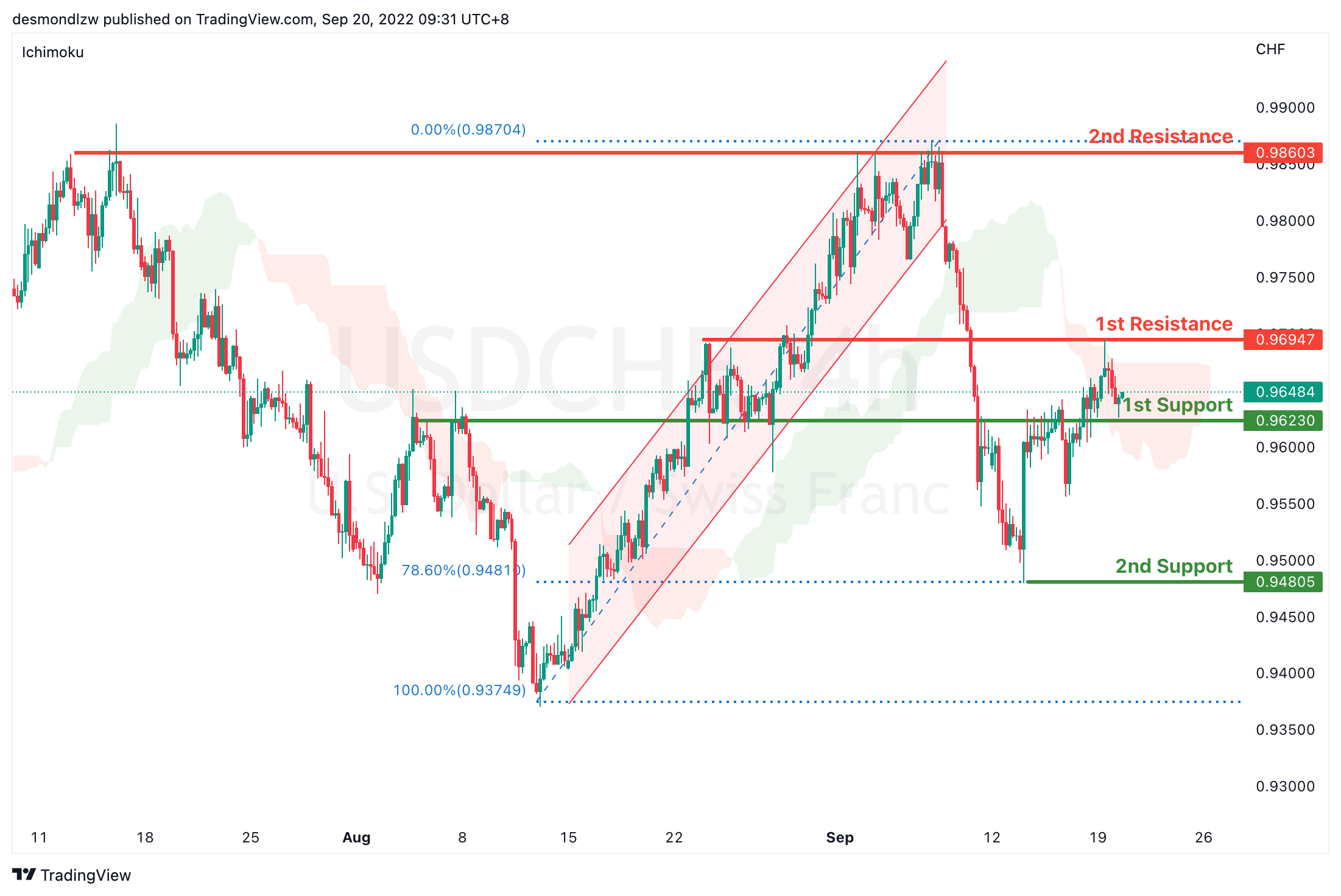
USD/CHF:
On the H4, prices have broken the ascending channel and we are currently bearish bias. Price is currently testing around the first support at 0.9623 where the overlapping resistance sits but prices are ranging. If price continues with the bearish momentum, it should bring price back to test the 0.9623 levels again before testing the second support at 0.9480 where the 78.6% projection and 78.6% retracement sits. Alternatively, price could pull back to test the first resistance at 0.9694 then the second support at 0.9860 where the swing high sits
Areas of consideration
- H4 1st support at 0.9623
- H4 1st resistance at 0.9694
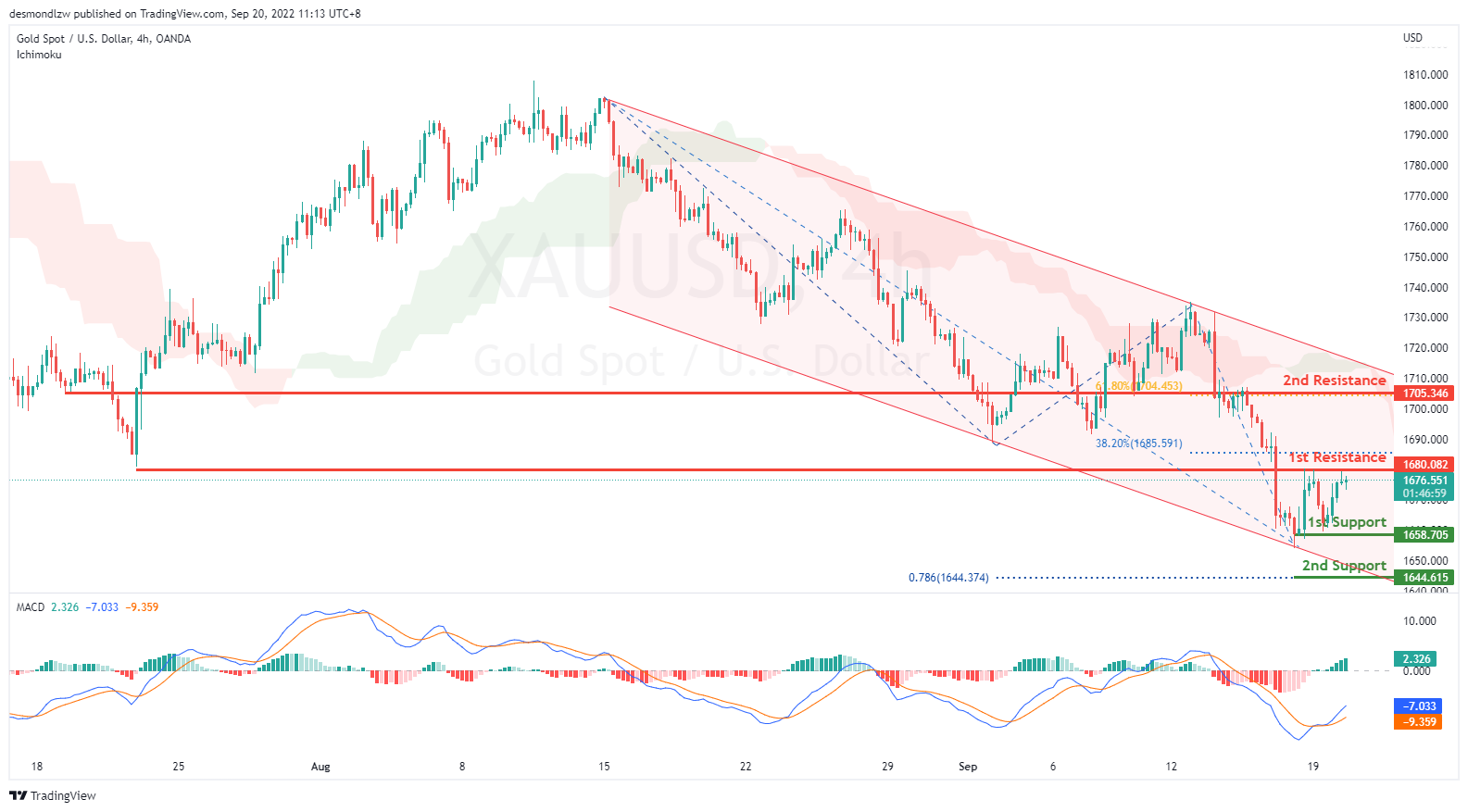
XAU/USD (GOLD):
On the H4, with the price testing the 1st resistance and MACD showing a golden cross, we have a weak bullish bias that the price may break the 1st resistance at 1680.082, which is in line with the overlap resistance. If the 1st resistance is broken, the price may try to test the 2nd resistance at 1705.346, which is in line with the 61.8% fibonacci retracement. Alternatively, the price may drop to the 1st support at 1658.705, where the swing low is. If the 1st support is broken, we can expect the price drop to the 2nd support at 1644.615, which is in line with the 78.6% fibonacci projection.
Areas of consideration:
- H4 time frame, 1st resistance at 1680.082
- H4 time frame, 1st support at 1658.705
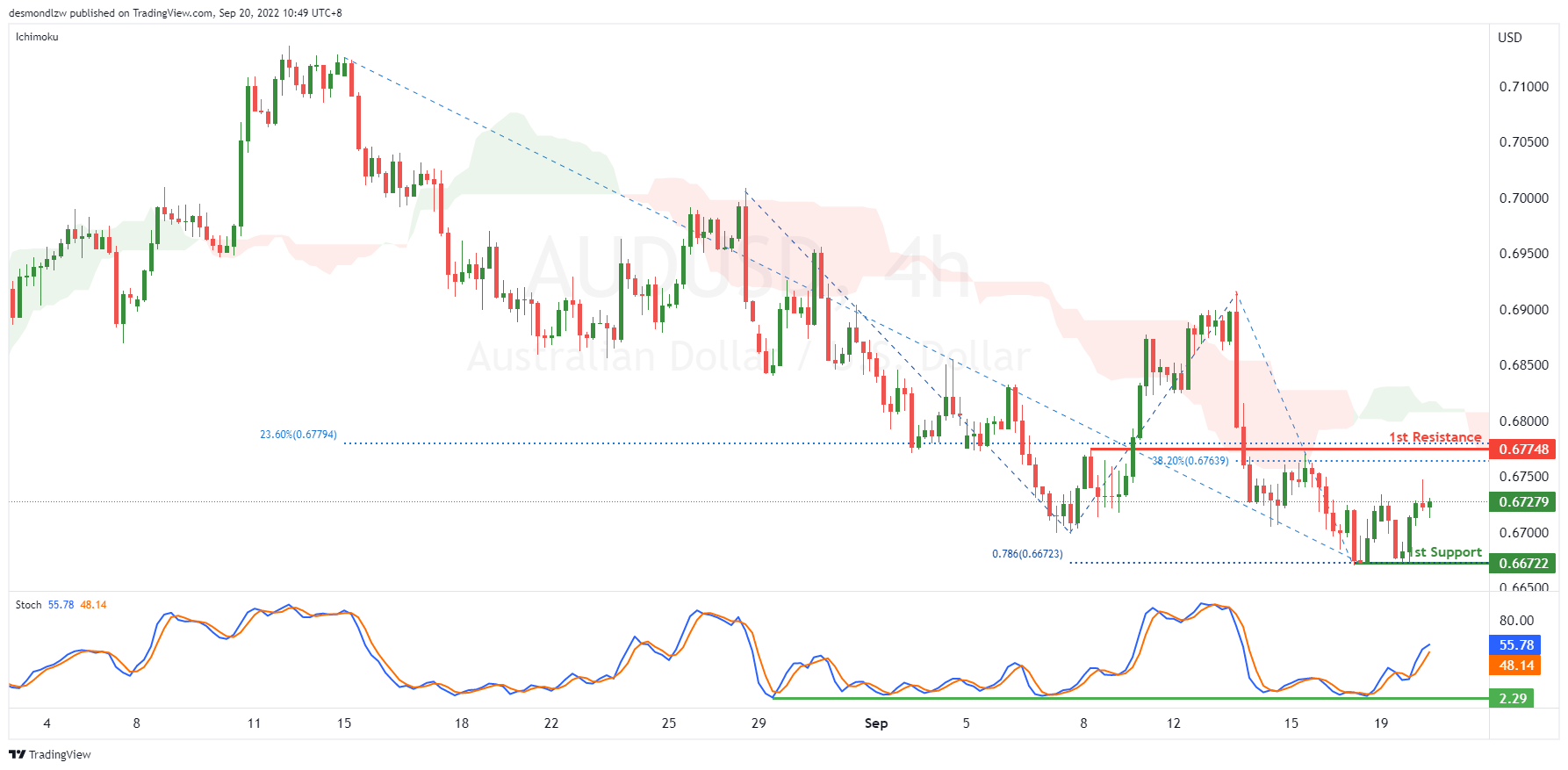
AUD/USD:
On the H4, with the Stoch is rising from the support level, we have a weak bullish bias that the price may rise to the 1st resistance at 0.67748, which is in line with the 23.6% fibonacci retracement and 38.2% fibonacci retracement. Alternatively, as the price is below ichimoku cloud, the price may retest the 1st support at 0.66722, which is in line with the 78.6% fibonacci retracement and swing low.
Areas of consideration
- H4, 1st resistance at 0.67748
- H4, 1st support at 0.66722
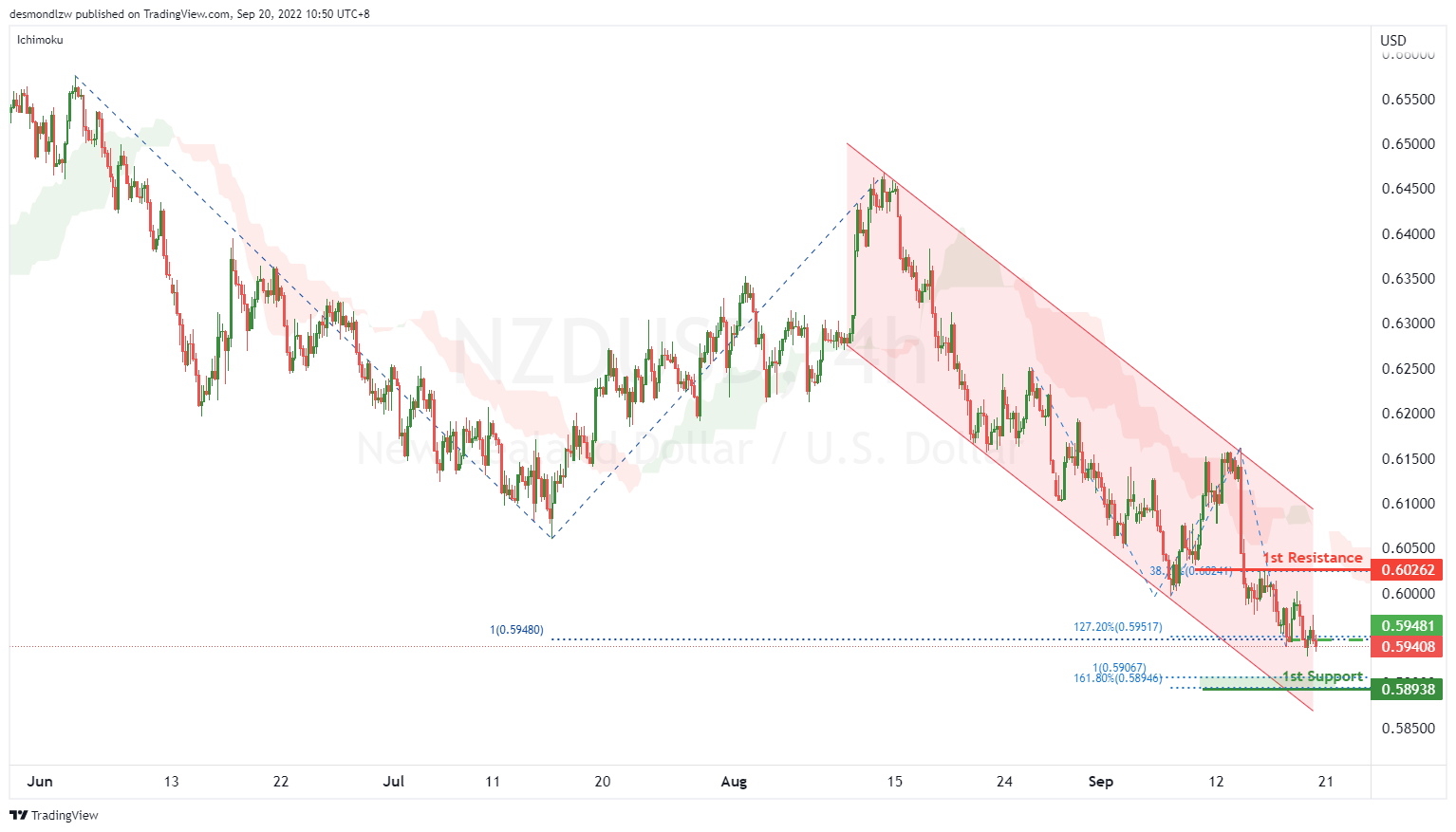
NZD/USD:
On the H4, with the price moving within the descending channel, below ichimoku cloud, and breaking the previous key support level at 0.59481, which is in line with the 100% fibonacci projection and 127.2% fibonacci extension, we have a bearish bias that the price may drop to the 1st support at 0.58938, which is in line with the 100% fibonacci projection and 161.8% fibonacci retracement. Alternatively, the price may pull back to the 1st resistance at 0.60262, where the 38.2% fibonacci retracement is.
Areas of consideration:
- H4 time frame, current price
- H4 time frame, 1st support at 0.58938
USD/CAD:
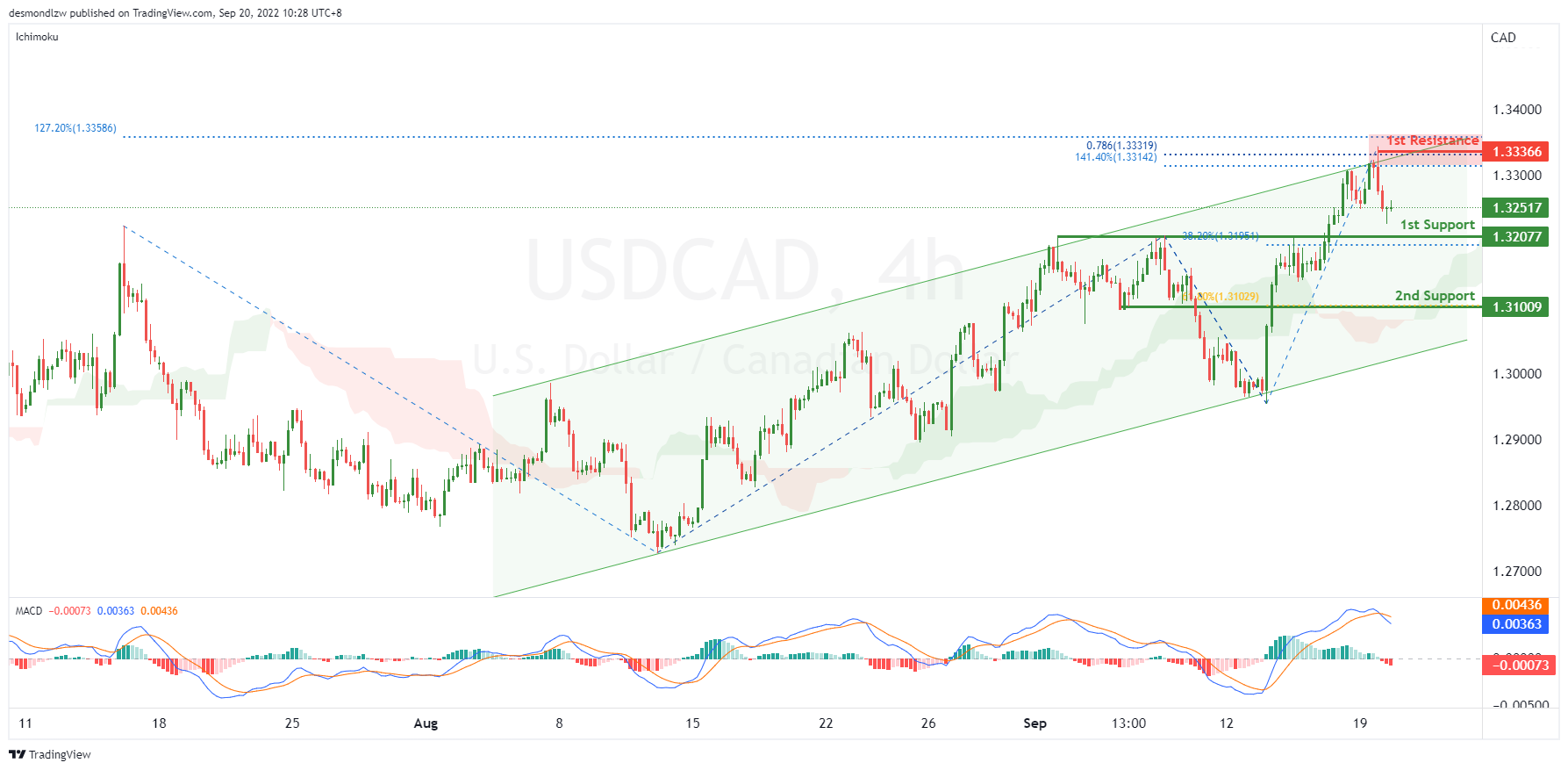
On the H4, with the price moving testing the upper bond of the ascending channel and MACD is showing a death cross, we have a bearish bias that the price may drop to the 1st support at 1.32077, which is in line with the previous swing highs and 38.2% fibonacci retracement. If the 1st support is broken, the 2nd support could be at 1.31009, where the 61.8% fibonacci retracement is. Alternatively, as the price is moving within the ascending channel and above ichimoku cloud, the price may rise to the 1st resistance at 1.33366, which is in line with the 127.2% fibonacci extension, 78.6% fibonacci retracement and 141.4% fibonacci extension.
Areas of consideration:
- H4 time frame, 1st support at 1.32077
- H4 time frame, 1st resistance at 1.33366
OIL:
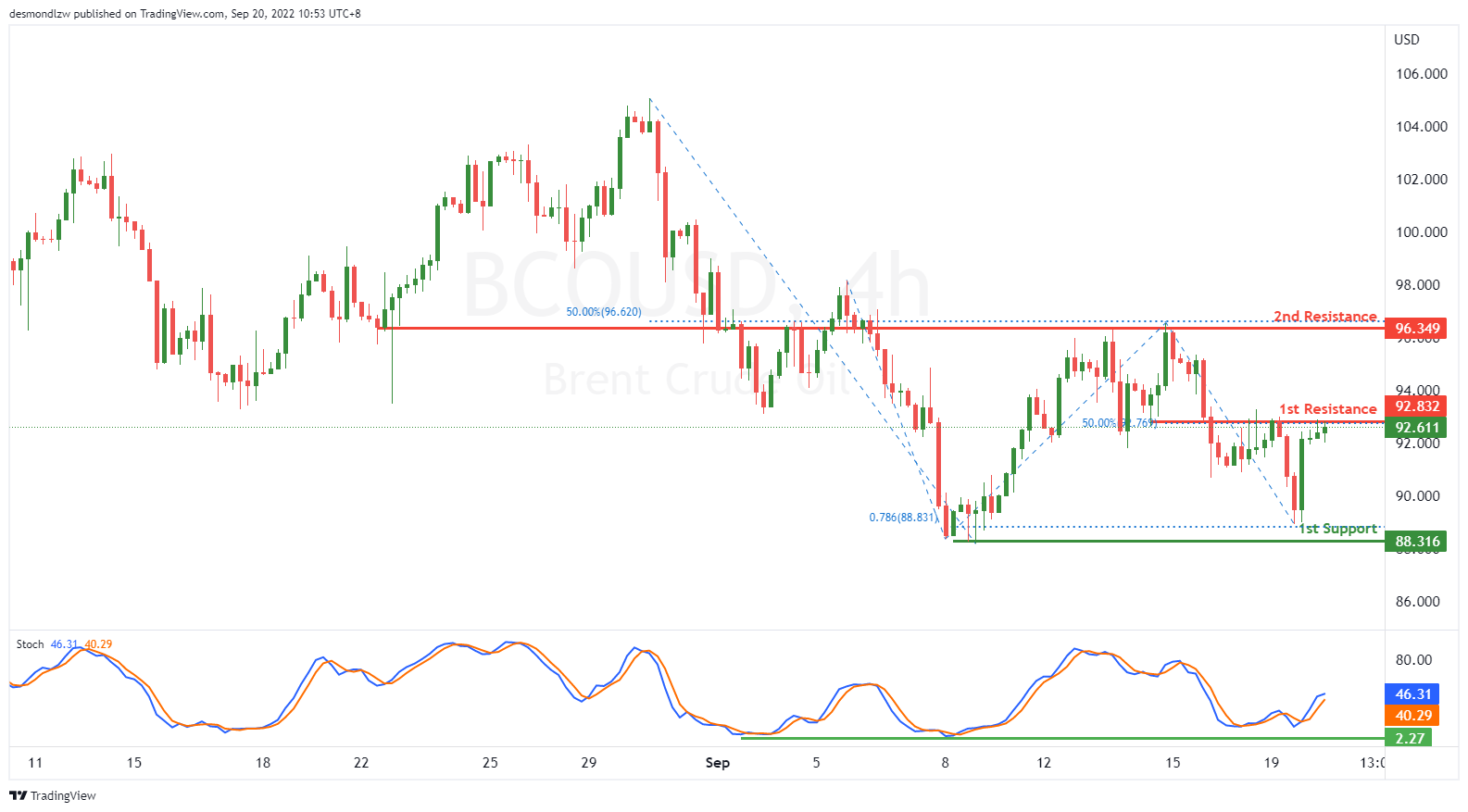
On the H4, with the stoch is reversing from the support line and here is a golden cross, we have a bullish bias that the price may test the 1st resistance at 932.832, which is in line with the 50% fibonacci retracement. If the 1st resistance is broken, the next key resistance could be at 96.349, which is in line with the overlap resistance and 50% fibonacci retracement. Alternatively, the price may pull back and drop to the 1st support at 88.316, where the 78.6% fibonacci retracement and swing low are.
Areas of consideration:
- H4 time frame, 1st resistance at 932.832
- H4 time frame, 1st support at 88.316
Dow Jones Industrial Average:
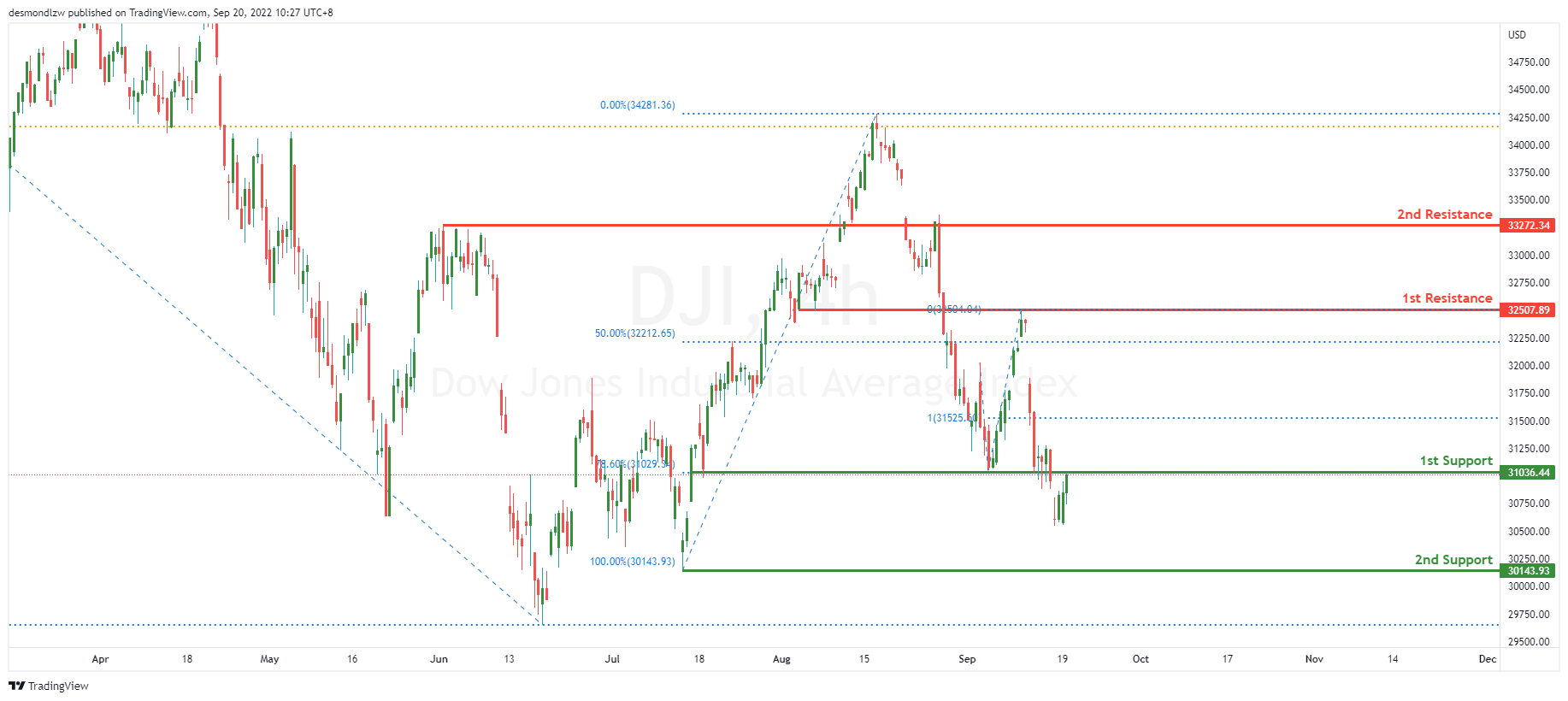
On the H4, price is reflected off nicely at the first resistance at 32500.85 where the 50% Fibonacci retracement is and broke right through the first support at 31029.34 where the 78.6% Fibonacci retracement is. Price might continue heading downwards towards the second support at 30343.73 where the previous swing low is.
Areas of consideration:
- H4 time frame, 1st support at 31029.34
- H4 time frame, 2nd support at 30343.73
DAX:
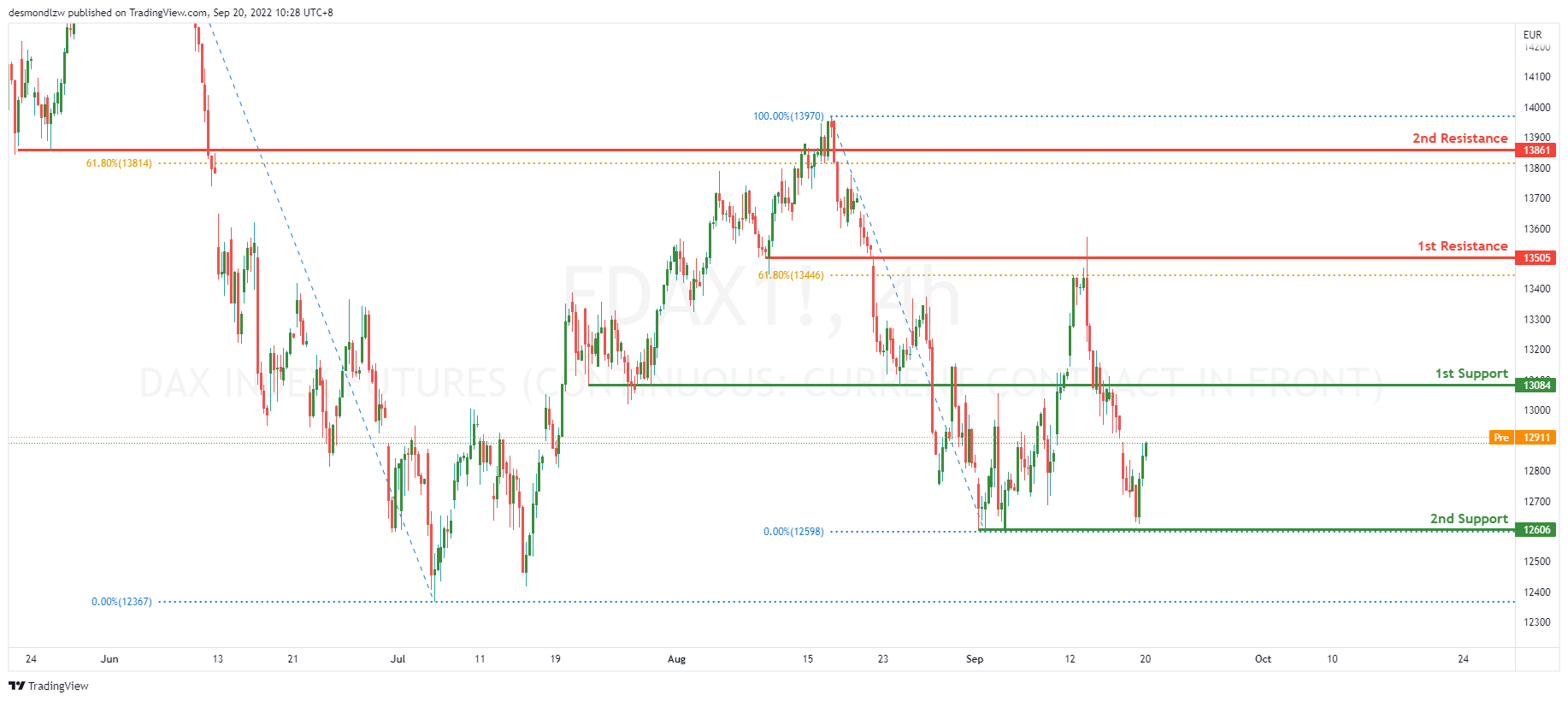
On the H4, price has reflected of the first resistance at 13505 where the 61.8% retracement is and got a big reaction breaking through the first support at 13084. Price might continue going down towards the second support at 12606 where the swing low is.
Areas of consideration:
- H4 time frame, 1st support at 13084
- H4 time frame, 2nd support at 12606
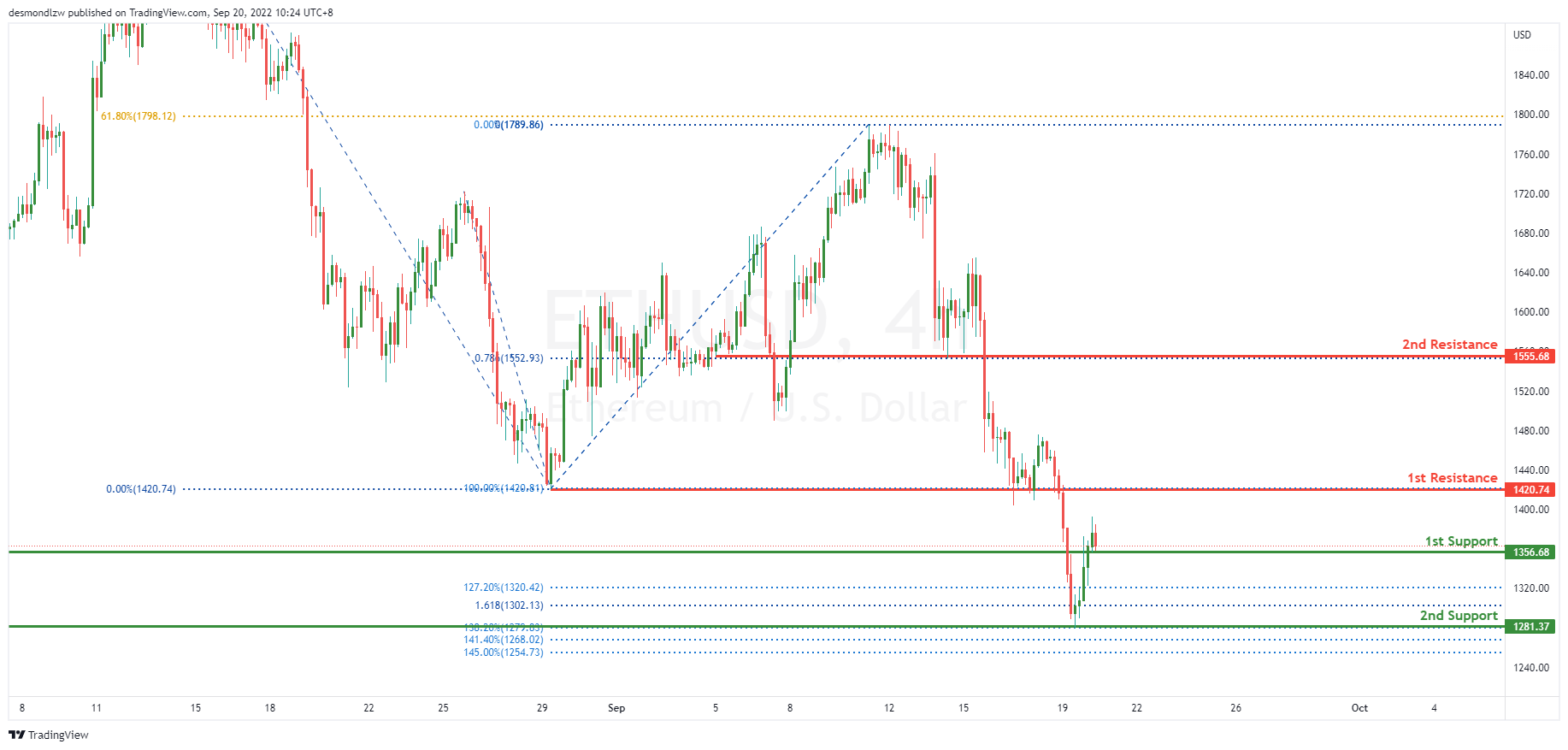
ETHUSD:
On the H4, price has pushed through the 1st Resistance at 1420.81 where the previous swing low sat. Price has also pushed through the 1st support at 1356.35 where the 127.2% Fibonacci extension lies and reflected off the second support at 1281.37 where the 138.2% Fibonacci Extension lies. Expecting a pull back on price back up to the first resistance.
Areas of consideration:
- H4 time frame, 1st resistance of 1420.81
- H4 time frame, 1st support at 1356.35
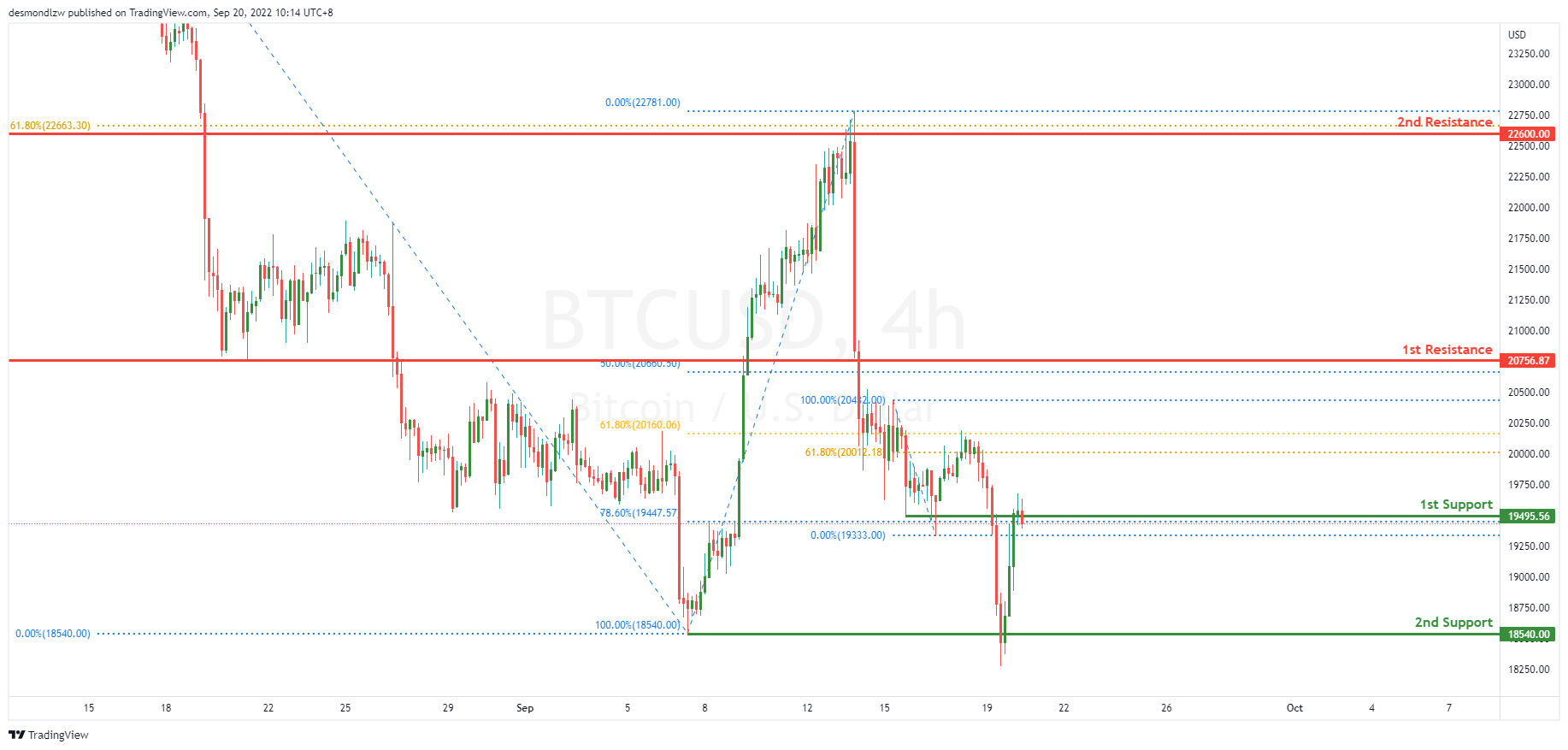
BTCUSD:
On the H4, price has broke through the second support 18540.00 where the previous swing low sits and reflected back up above the first support at 19557.00 where the 78.6% Fibonacci retracement sits. Price could possibly head back up to the first resistance at 22600.00 or price could reflect off the first support and go back to the second support area.
Areas of consideration:
- H4 time frame, 1st resistance of 22600.00
- H4 time frame, 1st support at 19557.00
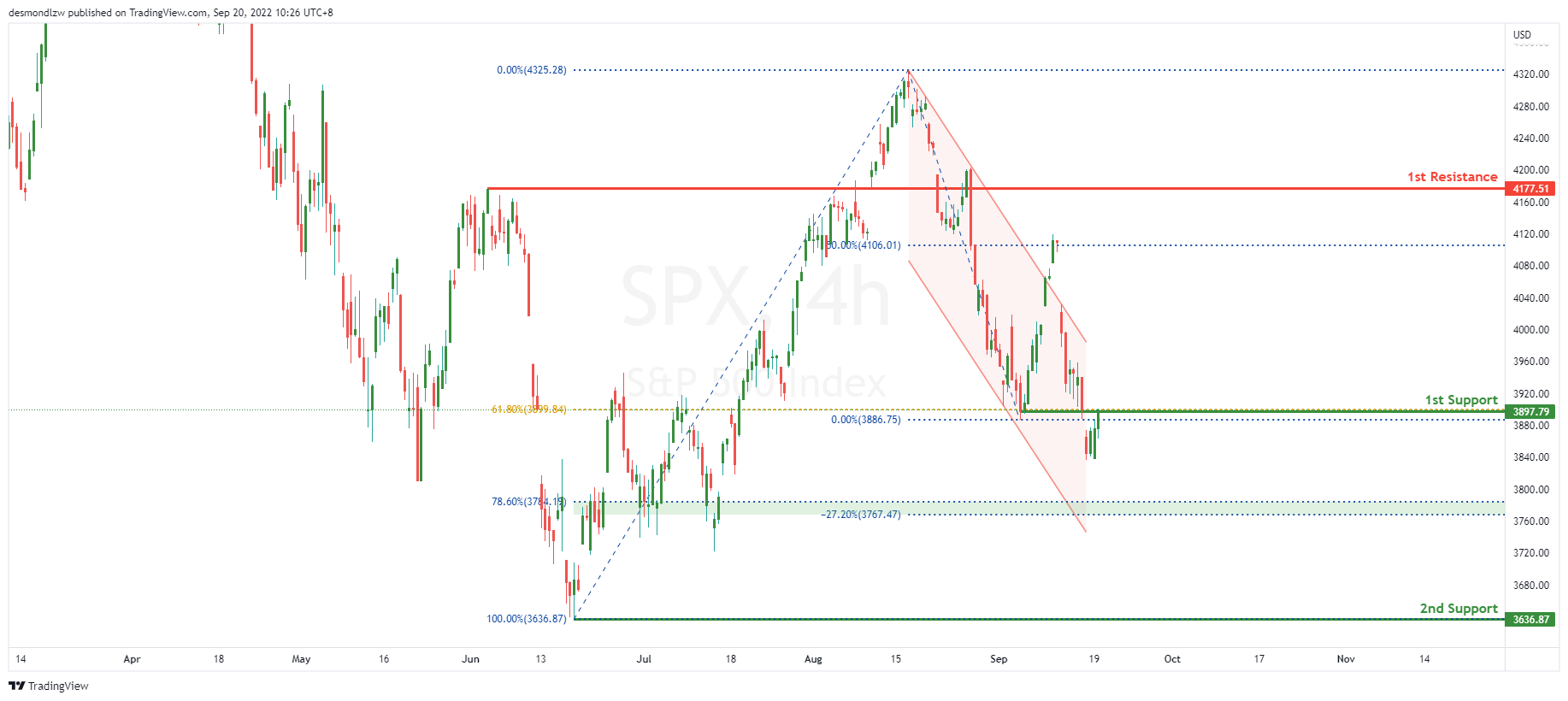
S&P 500:
On the H4, the price reversed from the 4100 price area forming a bearish channel, with the price falling towards the 1st support are of 3900. With our bearish bias still valid, as price trades back towards the 61.8% Fibonacci retracement, look for price to test the 1st support area. Price has broken below the 1st support level, the price could fall towards the 78.6% Fibonacci retracement level of 3784.19. There could be some pullback up towards the 1st Support level area else it could head towards the 2nd support of 3636.87. As the price falls towards the 2nd support, it could find some pullback towards the 78.6% Fibonacci retracement pullback support area.
Areas of consideration:
- H4 time frame, 1st support at 3900
- H4 time frame, 2nd support at 3636.87
RBA minutes: Slower tightening comes with higher rates
Minutes of RBA's September 6 meeting revealed that there were discussions on whether to hike by 25bps or 50bps. But, "given the importance of returning inflation to target, the potential damage to the economy from persistent high inflation and the still relatively low level of the cash rate, the Board decided to increase the cash rate by a further 50 basis points."
RBA reiterated that there will be further interest rate hikes "over the months ahead", but it's it "not on a pre-set path". The full effects of higher interest rates were "yet to be felt" on mortgages, activity and inflation.
The board was "mindful" that the path to bring inflation back to target "needed to account for the risks to growth and employment. RBA is seeking to return inflation to target "while keeping the economy on an even keel".
Size of timing of future rate hikes will be "guided by the incoming data" and outlook for inflation and job market, and risks. "All else equal, members saw the case for a slower pace of increase in interest rates as becoming stronger as the level of the cash rate rises".
Minutes of the Monetary Policy Meeting of the Reserve Bank Board
Sydney – 6 September 2022
Members present
Philip Lowe (Governor and Chair), Mark Barnaba AM, Wendy Craik AM, Ian Harper AO, Carolyn Hewson AO, Steven Kennedy PSM, Carol Schwartz AO, Alison Watkins AM
Members had granted leave of absence to Michele Bullock (Deputy Governor), in accordance with section 18A of the Reserve Bank Act 1959.
Others present
Luci Ellis (Assistant Governor, Economic), Christopher Kent (Assistant Governor, Financial Markets), Andrea Brischetto (Head, Financial Stability Department)
Anthony Dickman (Secretary), David Jacobs (Deputy Secretary)
Marion Kohler (Head, Economic Analysis Department), Penelope Smith (Head, International Department), Carl Schwartz (Acting Head, Domestic Markets Department)
International economic developments
Members commenced their discussion by noting that global inflation was high and well above central banks' targets in many economies. High inflation was impinging on households' real incomes and sentiment, and the rapid increase in interest rates would further weigh on aggregate household disposable income. Fuel prices had declined recently and the latest data showed headline inflation had stopped rising in most economies, with the exception of Europe. However, underlying inflation remained high, so it was too early to conclude that this represented a change in trend. Upstream price pressures had continued to moderate, and supplier delivery times had edged closer to levels last seen prior to the pandemic. Shipping rates had also fallen over recent months. On the other hand, services inflation was still rising and wages growth in some economies was faster than would be compatible with inflation returning to targets.
Members observed that analysts had again downgraded the outlook for global growth, reflecting the deteriorating outlook in Europe and for interest-rate sensitive sectors in a number of economies. While some forward-looking business surveys had turned down in the past month or so, recent data in many economies pointed to ongoing expansion. Domestic final demand in advanced economies had remained firm in the June quarter, supported by an increase in consumption of services. Strong growth in nominal labour incomes and, in some advanced economies, further declines in saving rates were cushioning the effect of higher inflation on households' spending. Labour markets remained strong, with job vacancies exceeding the number of unemployed in many cases. While business hiring intentions were slightly below their peaks, they remained at a very high level.
Energy availability had become a critical issue in Europe. Members noted that reduced gas supplies from Russia had coincided with a severe drought and other disruptions to production that had reduced the availability of hydro and nuclear power. European gas prices had surpassed their March peaks as Russian supplies to Europe had fallen 80 per cent below 2021 levels. The price of wholesale electricity was at record highs across the continent and was expected to remain at very high levels for the foreseeable future. Household and business energy costs were expected to surge later in the year as recent increases in wholesale gas prices are passed on to retail bills. Gas consumption had fallen significantly and authorities had committed to restrict consumption to 15 per cent below normal levels through winter.
The Chinese economy was recovering from recent lockdowns, but was facing significant headwinds, especially in the real estate sector. Policy remained accommodative and fiscal support had increased recently, with infrastructure investment expected to be a key driver of growth this year. Industrial production had increased moderately in July, although there had been some disruptions in a couple of provinces stemming from drought and associated electricity shortages. Members observed that the Chinese real estate sector remained very weak, despite some recent policy support. New housing sales had declined in July to be back around their lows during recent lockdowns. Liaison contacts had reported that market confidence had been affected by concerns about the solvency of developers. The weak outcomes for residential construction were exacerbating the outlook for steel production, which had already been constrained by government production caps. Iron ore prices had declined towards the bottom of their range over the past two years.
Members noted that high coal and gas prices were supporting Australia's terms of trade at record levels. In contrast to other energy commodities, crude oil prices were well below their peaks following Russia's invasion of Ukraine. This decline reflected concerns about the global outlook and improved supply. Even so, the price of crude oil remained about 20 per cent above the level at the beginning of 2022. Limited spare capacity and gas-to-oil substitution in Europe and elsewhere were likely to support crude oil prices in the period ahead. Base metals and food commodity prices had been fairly steady over the preceding month, but had declined from the peaks reached after Russia's invasion of Ukraine.
Domestic economic developments
Turning to the domestic economy, members observed that timely indicators pointed to inflation remaining high and broadly based in the September quarter. Some retailers expected to apply further large increases in their prices in coming quarters, in part reflecting the pass-through of earlier rises in input costs. By contrast, petrol prices had declined in August and were expected to subtract from headline inflation in the September quarter. The expiration of the fuel excise cut would boost headline inflation in the December quarter. Consistent with the decline in petrol prices, short-term measures of inflation expectations had declined modestly. Longer term inflation expectations generally remained within the inflation target range. Members noted that, from October, the Australian Bureau of Statistics would commence publishing a monthly CPI indicator, which would provide a timelier read on price pressures – though it could take some time for reliable trends to be discernible.
Household spending appeared to have held up in the September quarter to date. Strong labour market conditions and income growth were providing an important counterbalance for household budgets that faced increased pressure from rising prices and higher interest rates. Although payments data had softened a little of late, retail sales had increased strongly in July and most retailers in the Bank's liaison program had indicated that consumption behaviour was changing only slowly in response to cost-of-living pressures. Spending overseas by Australian residents had also grown strongly over prior months, which – although it would not add to domestic demand – was consistent with the ongoing rebalancing towards pre-pandemic patterns of spending. Members noted that domestic activity would benefit from increased numbers of foreign tourists and students, which are recorded as services exports.
Declines in housing prices had broadened out to most capital cities and regional areas, alongside weaker housing sales activity, rising interest rates and the expectation of further interest rate increases. By contrast, rental markets were tight. Vacancy rates in Sydney and Melbourne had declined from the high levels seen since the start of the year and were likely to decline further as international student numbers increased. Vacancy rates in other capital cities remained around historical lows.
Members noted that the June quarter National Accounts would be released the day after the meeting. GDP was expected to have grown strongly in the quarter, with growth in domestic final demand led by household consumption. Residential construction work done was expected to have declined in the June quarter, reflecting wetter-than-average weather conditions along the east coast of Australia, as well as ongoing shortages of materials and labour. Exports had grown strongly in the quarter, underpinned by resources exports, following several soft outcomes.
The outlook for business investment remained positive. The June quarter ABS Capital Expenditure Survey, conducted in July and August, indicated that non-mining firms expected to increase investment in the 2022/23 financial year, driven by investment in machinery and equipment. Capacity utilisation remained high across industries, with non-mining capacity utilisation at its highest level in over three decades.
The demand for labour remained robust, judging by the timely information from job ads and liaison. Most firms in the liaison program expected to increase headcount, but some had expressed concern about their ability to do so because of poor labour availability and strong competition from other firms. Measured employment had declined in July; however, looking through the monthly volatility, the labour market remained very strong. The employment-to-population ratio and participation rate were around record highs, and measures of spare capacity were at their lowest levels in decades. The unemployment rate had declined further to 3.4 per cent in July. Members noted recent announcements that staffing levels in visa processing would be increased to clear backlogs in this area. Immigration of skilled workers, students and working holidaymakers could all be anticipated to increase in the period ahead, which would add to labour supply as well as aggregate demand.
Wages growth was picking up as expected. A range of timely measures, including from liaison, business surveys and measures based on retail banking data, indicated that this pick-up had continued over prior months. In the June quarter, the Wage Price Index had increased by 0.7 per cent in the quarter and 2.6 per cent in year-ended terms. The pick-up in growth had been stronger in the private sector than in the public sector, where wages growth had remained more subdued. Wages growth had been strongest in the construction industry, consistent with information from liaison about labour costs and availability in that industry.
International financial markets
Members commenced their discussion of international financial markets by noting that central banks in most advanced economies had been increasing policy rates at a rapid pace to address high inflation and mitigate the risk that above-target inflation becomes embedded in wage- and price-setting behaviour. During the preceding month, the Bank of England, the Norges Bank and the Reserve Bank of New Zealand had raised their policy rates by 50 basis points, and the Bank of Korea had increased its policy rate by 25 basis points.
Central banks in most advanced economies had continued to signal that further policy rate increases are likely. Communication from the Federal Reserve and the European Central Bank emphasised that inflation is likely to be more persistent than earlier expected and that policy rates will need to remain higher for longer in order to bring inflation back to target. At the same time, these central banks acknowledged the adverse effect such outcomes would have on economic activity.
Government bond yields had risen over the preceding month, reflecting upward revisions to the policy rate paths implied by market pricing as well as increases in inflation expectations for the near term. Members noted that longer term inflation expectations had also increased, but remained within the 2 to 3 per cent range in most advanced economies. Sovereign yield curves in a number of advanced economies – including Canada, the United Kingdom and the United States – were flat or downward sloping, indicating market concerns about the possibility of recessions in these economies. Members observed that the Australian yield curve remained upward sloping.
Private sector financing conditions had become tighter than earlier in the year. Equity prices had fallen noticeably and corporate bond spreads were higher as market participants' expectations for policy rates had trended higher. The US dollar had appreciated further, consistent with another increase in short-term US Government bond yields relative to other economies.
The Australian dollar had depreciated against the US dollar over the year to date, but had appreciated on a trade-weighted basis over the same period. The RBA Index of Commodity Prices was around its levels at the beginning of the year, despite the decline in the price of iron ore.
The People's Bank of China had eased monetary policy further amid signs of increased weakness in the Chinese economy, particularly in the property sector; authorities had also announced lending support to help complete unfinished apartment projects. The further easing of policy rates had been associated with downward pressure on the renminbi, which had depreciated further from its recent lows against the US dollar as the interest rate differential between US and Chinese government bonds had widened.
Domestic financial markets
Members noted that, in the domestic market, yields had increased over the preceding month in line with global developments. Members observed that market pricing implied the cash rate was expected to be increased by a further 50 basis points in September, and to be around 3¼ per cent by the end of the year. The end-year pricing was a little above the median forecast of market economists. Banks' overall funding costs had increased significantly in recent months, as much of their wholesale funding is ultimately linked to money market rates. Retail deposit rates had also increased, but by a smaller amount.
As was the case in previous months, housing lenders had passed on the full amount of the increase in the cash rate in August to their standard variable rates. Members noted that, as the previous increases in the cash rate flowed through, mortgage interest payments were expected to increase to around 4½ per cent of household disposable income over the coming months, and to almost 5 per cent by the end of the year. These estimates assumed that maturing fixed rate loans would be replaced with variable rate loans. Overall interest payments on housing loans were expected to respond more gradually to changes in interest rates than in the past because of the higher fixed-rate share of credit (almost 35 per cent of housing credit at present, compared with 20 per cent prior to the onset of the pandemic). Net payments into offset and redraw accounts had remained strong up to July, in line with flows in 2021, despite the rise in interest payments.
Members observed that credit growth had remained strong overall. Demand for business credit had been supported in recent months by strong economic conditions and the lagged effects of a high level of mergers and acquisitions activity. In addition, bank credit had been favourably priced relative to the issuance of corporate bonds, and businesses had drawn down existing credit facilities to manage liquidity challenges arising from supply chain disruptions and cost increases. By contrast, housing credit growth had moderated in recent months, and the decline in housing loan commitments from their high level at the start of the year was expected to result in a further slowing in housing credit growth in the period ahead.
Review of the bond purchase program
Members reviewed the operation and effectiveness of the bond purchase program (BPP) introduced in November 2020 as part of the second package of monetary policy measures implemented by the Bank in response to the effects of the COVID-19 pandemic. The discussion was based on a staff review commissioned by the Board.
Members observed that the BPP, together with the other monetary policy measures put in place during the pandemic, had contributed to the strong recovery of the Australian economy, with unemployment having declined to its lowest rate in almost 50 years.
The BPP involved purchasing government bonds in order to lower yields at the 5–10 year part of the yield curve. The program was introduced to complement the price-based, three-year yield target introduced in March 2020 and the Term Funding Facility, along with the longstanding overnight cash rate target, which forms the anchor point for the risk-free interest rate term structure. Together, the policy measures had lowered the whole structure of interest rates in Australia and supported confidence in the economy. However, members noted that it is difficult to identify the exact effect of the BPP on the economy, because it was implemented as part of a broader package of policy measures that reinforced one another. Moreover, a key benefit of the policy package was to provide insurance against the significant downside risks the economy was facing during the pandemic – a benefit that is inherently very difficult to quantify, especially given that downside risks were avoided.
Members noted that the BPP had affected the public sector balance sheet in several ways. There is expected to be a financial cost to the Bank because the purchased bonds pay a fixed return, while the interest paid on the Exchange Settlement (ES) balances created to finance the bonds varies with monetary policy settings and so rises as monetary policy is tightened. The ultimate cost will be known only once the last of the purchased bonds matures in 2033. Members noted that it is important to assess this potential cost in the context of the wider benefits to the economy that have flowed from the BPP as part of the package of monetary policy measures. There are also expected to be a number of benefits to the public sector balance sheet. The reduction in yields lowered the cost of government debt issuance, while stronger economic activity than otherwise increased tax revenues and reduced government support payments. These benefits to government finances are material, although they are difficult to quantify. Members observed that the Bank would record an accounting loss in 2021/22 because the increase in bond yields (consistent with the higher expected path of the ES rate) had caused the market value of the purchased bonds to fall. At the same time, the overall Commonwealth financial position would incorporate some offsetting accounting gains, given issued bonds represent a liability on the general government balance sheet.
In light of the experience, members judged it appropriate to consider use of a BPP again only in extreme circumstances, when the usual monetary policy tool – the cash rate target – has been employed to the full extent possible. Compared with a yield target, a BPP provides more flexibility to respond to evolving economic circumstances, although it could entail larger financial costs. In considering any future use of a BPP, members noted that it would need to be evaluated against other policy options at the time, taking into account the costs of the BPP under a full range of scenarios.
Members agreed to the publication of the review of the BPP. A review of the Bank's approach to forward guidance is under way and will be published later in the year.
Considerations for monetary policy
In considering the policy decision, members noted that inflation in Australia was at its highest level in several decades and was expected to increase further over the months ahead. Global factors continued to explain much of the increase in inflation. However, domestic factors were also playing a role, with widespread upward pressure on prices from strong demand, a tight labour market and capacity constraints in some sectors of the economy.
Members noted that inflation was expected to peak later this year and then decline back towards the 2 to 3 per cent target range. The expected moderation in inflation reflected the ongoing resolution of global supply-side problems, recent declines in some commodity prices and the impact of rising interest rates. Medium-term inflation expectations remained well anchored, and it was seen as important that this remain the case. The Bank's central forecast was for CPI inflation to be around 7¾ per cent over 2022, a little above 4 per cent over 2023 and around 3 per cent over 2024.
The Australian economy was continuing to grow solidly. Consumer spending had so far been resilient to higher interest rates, and national income had been boosted by a record level of the terms of trade. At the same time, the increases in interest rates had seen an easing of conditions in the established housing market alongside a softening in household demand for credit.
The labour market had remained tight and continued to indicate that the economy was having difficulty meeting the level of aggregate demand. Many firms were finding it challenging to hire workers. The unemployment rate had declined further in July to 3.4 per cent, the lowest rate in almost 50 years, and the continued high level of job vacancies suggested a further decline was in prospect over the months ahead. Members noted that many Australians are benefitting from the greater opportunities for work provided by the tighter labour market, notably young people, women and longer term unemployed people. Beyond the near term, some increase in unemployment was expected as economic growth slows owing to the effects of higher interest rates, although members noted that changes in labour market conditions tended to lag some other indicators of economic activity.
Wages growth had picked up from the low rates of prior years and there were some pockets where labour costs were increasing briskly. However, members noted that the rate of base wages growth so far had not reached levels that would be inconsistent with achieving the inflation target on a sustained basis. Nevertheless, given the tight labour market and the upstream price pressures, the Board would continue to pay close attention to both the evolution of labour costs and the price-setting behaviour of firms in the period ahead.
Members noted that an important source of uncertainty continued to be the behaviour of household spending. Higher inflation and higher interest rates were putting pressure on household budgets. Consumer confidence had also fallen and housing prices were declining in most cities and regions after the earlier large increases. Working in the other direction, people were finding jobs, gaining more hours of work and receiving higher wages. Many households had built up large financial buffers and the saving rate remained higher than before the pandemic. While the high levels of payments into offset and redraw accounts suggested that some households remained in a favourable financial position, members acknowledged that other households were finding conditions difficult in the face of higher interest rates and higher inflation. The Board would be paying close attention to how these various factors balanced out as it assessed the appropriate setting of monetary policy.
The outlook for global economic growth had deteriorated and posed a key uncertainty. Central banks in several large advanced economies had expressed further resolve in tightening monetary policy to prevent high inflation from becoming entrenched, and this was likely to entail a period of significantly lower growth. High inflation was also placing pressure on real incomes, most significantly in Europe, related to the worsening effects on energy markets following Russia's invasion of Ukraine. In addition, COVID-19 containment measures and other policy challenges continued to weigh on the outlook for growth in China. Some slowing in the global economy would be important to returning inflation to central banks' targets, but the potential for a sharp slowing continued to present a downside risk to the outlook.
Members judged that a further increase in interest rates would help bring inflation back to target and create a more sustainable balance of demand and supply in the Australian economy. They discussed the arguments around raising interest rates by either 25 basis points or 50 basis points. Members emphasised that price stability is a prerequisite for a strong economy and a sustained period of full employment. They acknowledged that monetary policy operates with a lag and that interest rates had been increased quite quickly and were getting closer to normal settings. Given the importance of returning inflation to target, the potential damage to the economy from persistent high inflation and the still relatively low level of the cash rate, the Board decided to increase the cash rate by a further 50 basis points.
The Board expects to increase interest rates further over the months ahead, but it is not on a pre-set path given the uncertainties surrounding the outlook for inflation and growth. The full effects of higher interest rates were yet to be felt in mortgage payments, and the broader effects on activity and inflation would take some time to be apparent. The Board was resolute in the need to ensure inflation returned to target, but mindful that the path to achieve this needed to account for the risks to growth and employment. The Board is seeking to return inflation to target while keeping the economy on an even keel. The path to achieving this balance remains a narrow one and clouded in uncertainty.
The size and timing of future interest rate increases will continue to be guided by the incoming data and the Board's assessment of the outlook for inflation and the labour market, including the risks to the outlook. All else equal, members saw the case for a slower pace of increase in interest rates as becoming stronger as the level of the cash rate rises. The Board is committed to doing what is necessary to ensure that inflation in Australia returns to target over time.
The decision
The Board decided to increase the cash rate target by 50 basis points to 2.35 per cent. It also increased the interest rate on Exchange Settlement balances by 50 basis points to 2.25 per cent.