

Sample Category Title
Sunset Market Commentary
Markets
Yesterday, last week’s repositioning on US and European interest rate markets simply continued with European markets again underperforming. Chair Powell on Friday was very clear that the Fed will do ‘whatever it takes’ to bring inflation back to the 2.0% target, even as that may cause pain in terms of lower growth and higher unemployment. US yields rose further between 2.7 bps (2-y) and 6.2 bps (10-y). Interestingly, the move this time wasn’t the usual bear flattening that often dominated recent repositioning. Is the faster pace of QT in September weighing on bonds with longer maturities? Technical considerations might also be in play as the US 2-y yield is retesting the cycle top near 3.42%. Anyway the rise in US yields was fully driven by higher real yields. EMU swap yields jumped between 15.3 bps (2-y), 11.9 bps for the 10-y yield and 4.9 bps for the 30-y. The 2-y swap jumped above the 2.0% June top to close at a new cycle peak of 2.08% after hawkish ECB members on Friday and over the weekend started the debate on a 75 bps rate hike at next week’s meeting. ECB’s Lane isn’t in the camp of this kind aggressive frontloading yet and prefers a gradual/protracted approach to minimize negative consequences. Still current market pricing sees a chance of 75% of a 75 bps hike rather than a 50 bps step. The (broad) tightening of monetary conditions that the Fed is aiming for also continued via equity markets. US indices again lost up to 1.0% (Nasdaq). The EuroStoxx50 declined 0.92%, but a correction in European gas prices helped equities to close off the intraday lows. The dollar is holding strong, but a clean break higher didn’t occur (yet?). DXY touched a minor cycle top at 109.47, but gains couldn’t be sustained (close 108.83) despite the rise in US real yields. USD/JPY (close 138.72) also just missed the July top. The euro gains some reprieve from the catching up move in European yields (EUR/USD close 0.9997).
Asian equities this morning mostly trade in positive territory with China underperforming (-0.75/-1.0%). The PBOC with a stronger than expected fixing is again leaning against recent yuan depreciation. Still the onshore yuan weakens slightly further to USD/CNY 6.9165. Later today, the calendar is well filled with the preliminary German (and Spanish) August inflation, the EC confidence indicators, US house prices and consumer confidence (Conference Board). The Bund future gains some ground on a (mildly) softer than expected North Rhine Westphalia CPI. However, there is still a decent chance for the Y/Y figure to return to (or above) the 8.7% May top (HICP) . In a data-dependent approach, this leaves a solid case for bold frontloading ECB action. For now, we don’t anticipate a sustained correction to the established trend of higher US and European yields. On FX markets, the dollar apparently needs a clear sign to break beyond recent cycle peak levels. Maybe some consolidation might be on the cards with Friday’s payrolls a potential trigger to decide on the next directional move. The euro probably isn’t out of the woods yet, but a further correction in the gas price might help to keep the EUR/USD pair away from the 0.99 short-term.
News Headlines
European Commission President von der Leyen said that the EU was working on emergency intervention measures as well as structural reforms to the power market. She pointed to decoupling electricity prices from the gas price with the exorbitant surge of the latter influencing the former. The EU also wants to ensure that renewable energies are generated at lower costs, that those costs are transferred to consumers and that windfall profits are used to help vulnerable households. Von der Leyen wants those emergency instruments to be triggered very quickly, perhaps in weeks. The announcement helps explain yesterday’s setback in gas prices with the reference Dutch TTF future dropping 15% after last week’s test of the YTD high set in the wake of the start of the Russian invasion.
The Fed’s balance-sheet roll-off (Quantitative Tightening) is set to hit max speed. From Thursday, monthly caps for maturing assets will be raised to $60bn for Treasuries and $35bn for mortgage-backed securities. If the Fed’s portfolio doesn’t allow for such amounts, it will use its $326bn T-bill portfolio to make up for what’s left. More specifically, we’re already looking at $16.4bn of Bills in September and $13.6bn in October.
NZDUSD Gets Closer to the 0.6060 Support Zone
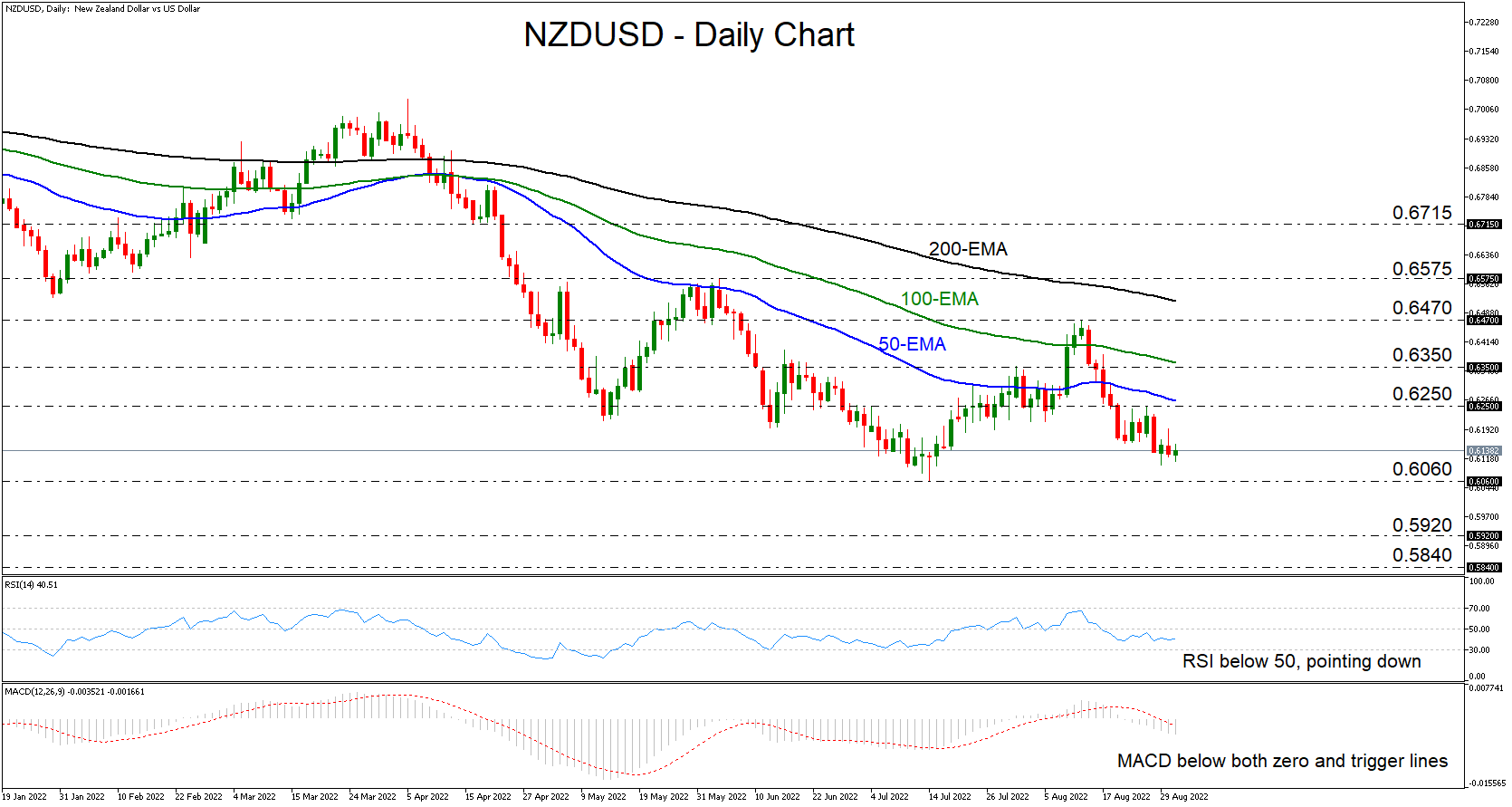
NZDUSD has been sliding since August 12, when it hit resistance at 0.6470, with the price now getting closer to the 0.6060 support zone, marked by the low of July 14. In the bigger picture, the pair has been in a downtrend since February 2021, and thus, there may be decent chances for the pair to break below 0.6060 soon.
The daily oscillators are also supporting the notion of further declines. The RSI lies below 50 and points down, while the MACD runs below both its zero and trigger lines.
A clear and decisive dip below 0.6060 would confirm a forthcoming lower low on bigger timeframes and take the pair into territories last seen in May 2020. That could encourage the bears to dive towards the 0.5920 area, which acted as a temporary floor in April and May 2020, and if they are not willing to stop there, they may push towards the 0.5840 barrier, defined as a support by the low of April 3.
On the upside, the outlook could become brighter upon a break above the August 12 high, at 0.6470. A higher high will be confirmed on the weekly chart and the advance may continue towards the high of June 3, at 0.6575. If that obstacle is not able to stop the bulls either, then extensions towards 0.6715 may be triggered. That zone is marked by the inside swing lows of April 18 and 19.
To sum up, NZDUSD is in a broader downtrend, with the latest impulsive wave approaching the 0.6060 support. A break below that barrier will confirm a forthcoming lower low and thereby a trend continuation.
Canada’s GDP Continues to Outperform Global Peers
The Canadian economy expanded by 3.3% quarter/quarter annualized (q/q) in Q2 2022. Meanwhile, the flash estimate for July showed a 0.1% month/month (m/m) drop in GDP.
Spending by households increased by 9.7% q/q annualized. Statistics Canada noted that this was "driven by spending on garments and footwear, household spending on semi-durable goods rose 5.6% in the second quarter." They also stated that "the increase was largely attributable to increased travel and many people returning to the office."
The report noted that "the opening of the economy also boosted outlays for services (+3.9%) in the second quarter—the eighth consecutive quarterly increase." The major contributors were travel abroad, food and non-alcoholic beverage services, air transport, alcoholic beverage services, games of chance, and accommodation services."
Gross capital formation declined 9.0% q/q annualized, driven by a 27.6% drop in residential structures following the Bank of Canada's move to more aggressive policy rate hikes. On the opposite side, investment in non-residential structures and machinery and equipment rose 13.9% q/q annualized. Statistics Canada noted, "with projects such as Kitimat Liquified Natural Gas in British Columbia and higher capital spending in oil and gas in Alberta, businesses continued to invest in engineering structures in the second quarter."
Business investment in inventories was a big driver, contributing 1.5% to GDP. The report stated that "non-farm inventory investment was bolstered mainly by increases in wholesale durables (machinery and building supplies), non-durables (fertilizers), and manufacturing durables (machinery and aircraft)".
Key Implications
Canada's economic outperformance continues. With GDP figures around the world raising recession fears, Canada's data are still looking pretty good. At 3.3% q/q annualized, this is the fourth straight quarter of above trend economic growth. Though the inventory build was the biggest contributor to growth, the contribution coming from Canadian consumers points to still strong underlying fundamentals.
Looking forward, the July flash estimate of -0.1% m/m is reflective of a deceleration that was always expected now that the economy has reached beyond full capacity. Not to mention, the impact of high inflation and the BoC's surprise 1% rate hike in July are starting to have an impact. We are already seeing this in residential investment but are expecting a greater impact on the consumer going forward. Given our expectation that the BoC will continue to raise rates at an aggressive pace next week, a slowing to below trend growth for Q3 is in the cards.
Euro Inflation Rises, But Euro Yawns
The euro continues to have a calm week. In the North American session, EUR/USD is showing little movement as it trades a whisker above the parity line.
Eurozone inflation tops 9%
Inflation in the eurozone continues to move higher. In August, CPI rose to 9.1%, up from the July gain of 8.9%, which was a record high. Core inflation climbed to 4.3%, up from 4.0%. With both the headline and core readings exceeding the forecast of 9.0% and 4.1%, respectively, there will be additional pressure on the ECB to tighten policy more at an accelerated pace. The central bank has been slow to shift its accommodative policy, which was in place for years in order to support the eurozone economy.
The ECB now finds itself playing catch-up with inflation, and is also far behind in the tightening cycle compared to other major central banks, with a benchmark rate of just 0.50%. Inflationary pressures remain broad-based, which means inflation is well-supported and unlikely to decline anytime soon. The eurozone inflation report comes just a day after Germany, the largest economy in the bloc, reported that August inflation jumped to 7.9%, up from 7.5% in July and nudging above the forecast of 7.8%. The central bank meets next on September 8th, and there is a strong possibility that the ECB could come out with guns blazing and deliver a super-size 75 basis point increase.
A potential energy crisis in Europe continues to hover like a dark cloud, and the uncertainty over whether Moscow will weaponise energy exports remains a massive concern. The Nord Stream 1 pipeline has been shuttered for a scheduled three-day maintenance, but there are fears that Russia will find some excuse and not renew gas flows on Saturday. Any disruptions would likely push European gas prices even higher. In the meantime, the waiting game is on, with Western Europe on edge while it anxiously waits for the gas taps to be turned back on.
EUR/USD Technical
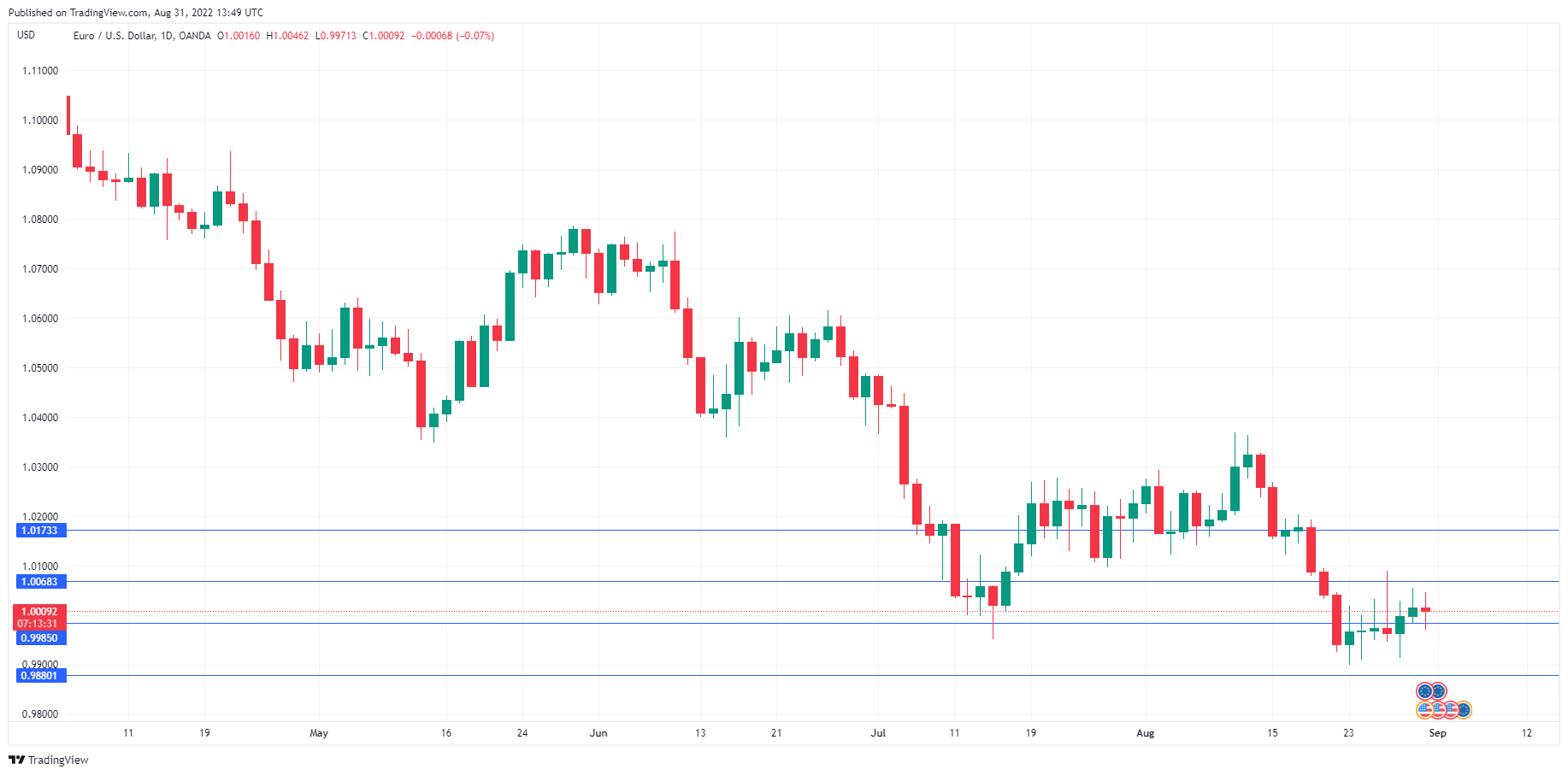
- EUR/USD has support at 0.9985 and 0.9880
- 1.0068 is a weak resistance line, followed by 1.0173
USD/JPY Mid-Day Outlook
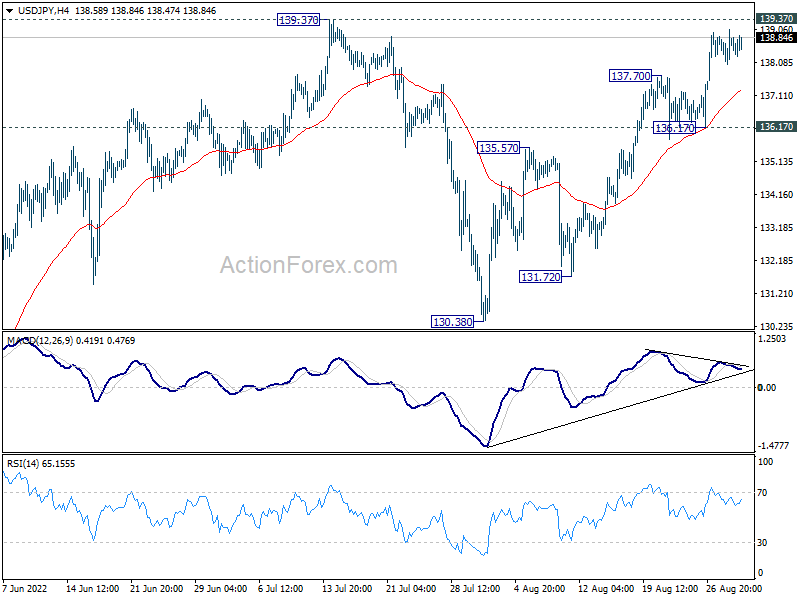
Daily Pivots: (S1) 138.21; (P) 138.64; (R1) 139.23; More...
Intraday bias in USD/JPY remains neutral and outlook is unchanged. Strong resistance could be seen from 139.37 to limit upside, to start the third leg of the corrective pattern from 139.37. Break of 136.17 minor support will turn bias back to the downside for 130.38 support. Nevertheless, decisive break of 139.37 will confirm up trend resumption for 147.68 long term resistance.
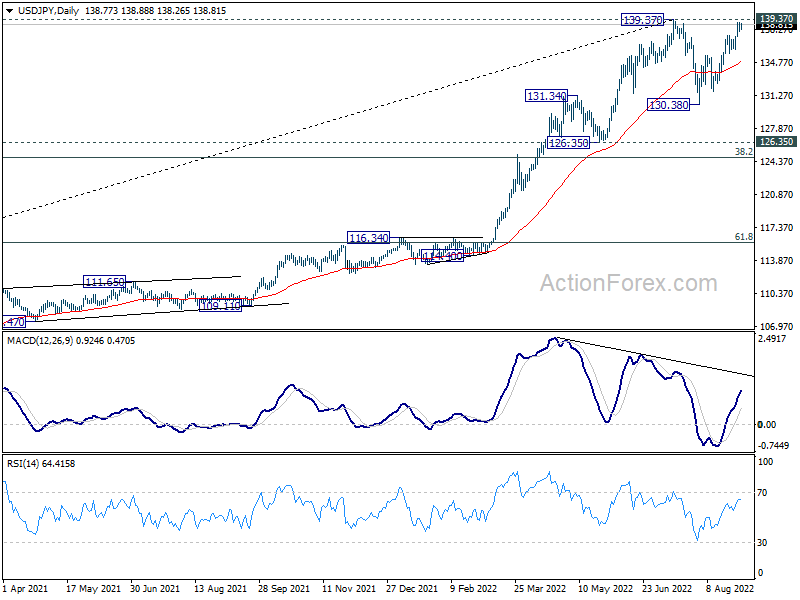
In the bigger picture, price actions from 139.37 medium term top are seen as a corrective pattern to up trend from 101.18 (2020 low). While deeper decline cannot be ruled out, outlook will stays bullish as long as 55 week EMA (now at 123.72) holds. Long term up trend is expected to resume through 139.37 at a later stage, after the correction finishes. Next target is 147.68 (1998 high).
USD/CHF Mid-Day Outlook
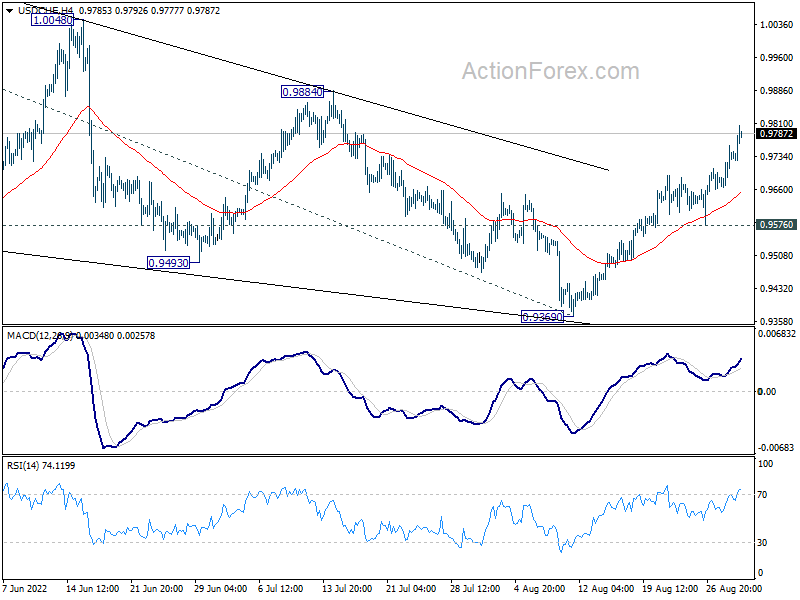
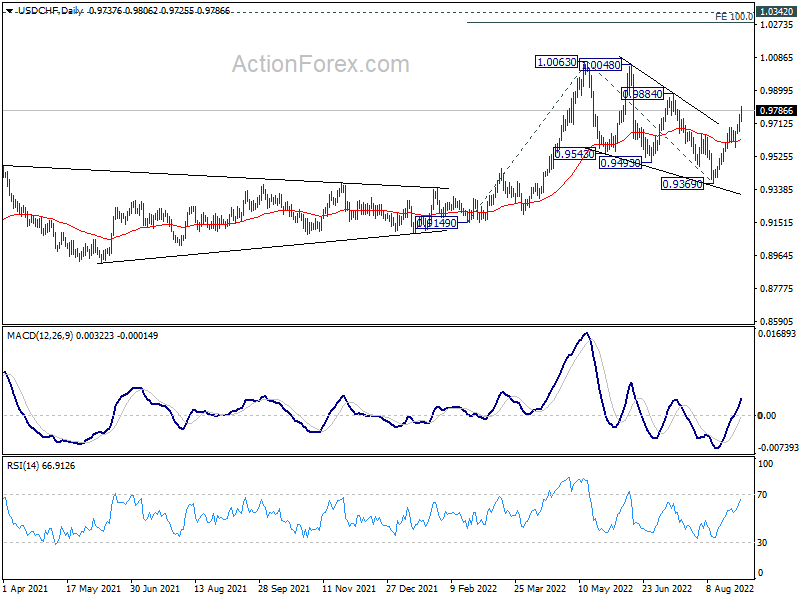
Daily Pivots: (S1) 0.9686; (P) 0.9724; (R1) 0.9782; More...
Intraday bias in USD/CHF remains on the upside for the moment. Current rise from 0.9369 should target 0.9884 resistance first. Break there will argue that larger up trend is ready for resumption through 1.0063. On the downside, break of 0.9576 support is needed to indicate completion of the rebound. Otherwise, further rise will remain in favor in case of retreat.
In the bigger picture, current development suggests that up trend from 0.8756 (2021 low) is still in progress. Sustained break of 1.0063 will target 100% projection of 0.9149 to 1.0063 from 0.9369 at 1.0283, and then 1.0342 (2016 high). For now, this will remain the favored case as long as 0.9369 support holds, even in case of deep pull back.
GBP/USD Mid-Day Outlook
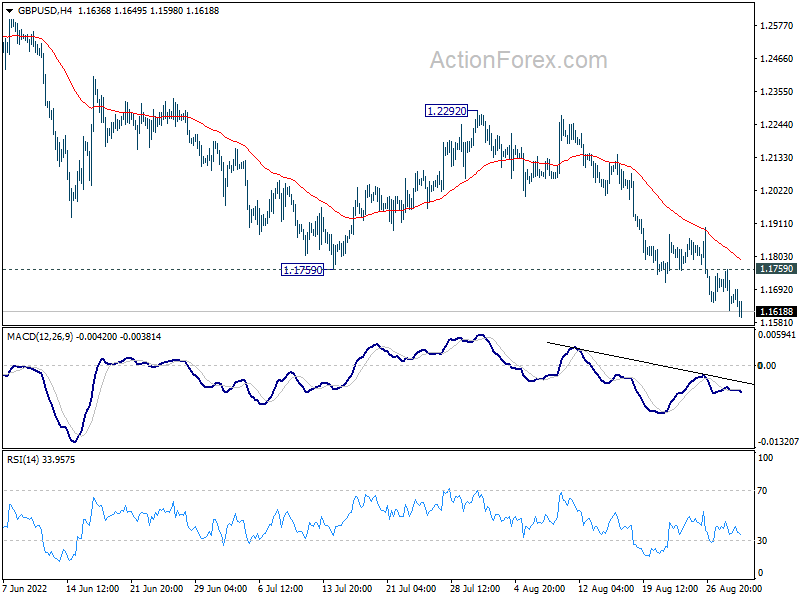
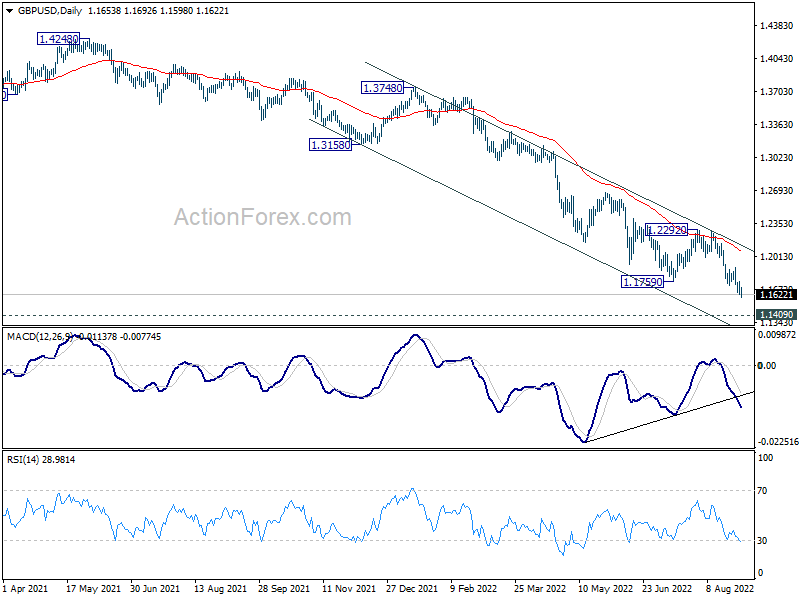
Daily Pivots: (S1) 1.1597; (P) 1.1679; (R1) 1.1736; More...
GBP/USD's down trend is still in progress and intraday bias stays on the downside for 1.1409 long term support. On the upside, above 1.1759 minor resistance will turn intraday bias neutral for consolidations. But outlook will stay bearish as long as 1.2292 resistance holds, in case of recovery.
In the bigger picture, fall from 1.4248 (2018 high) could be a leg inside the pattern from 1.1409 (2020 low), or resuming the longer term down trend. Deeper decline is expected as long as 1.2292 resistance holds. Next target is 1.1409 low. However, firm break of 1.2292 will bring stronger rise back to 55 week EMA (now at 1.2859).
EUR/USD Mid-Day Outlook
Daily Pivots: (S1) 0.9980; (P) 1.0018; (R1) 1.0053; More...
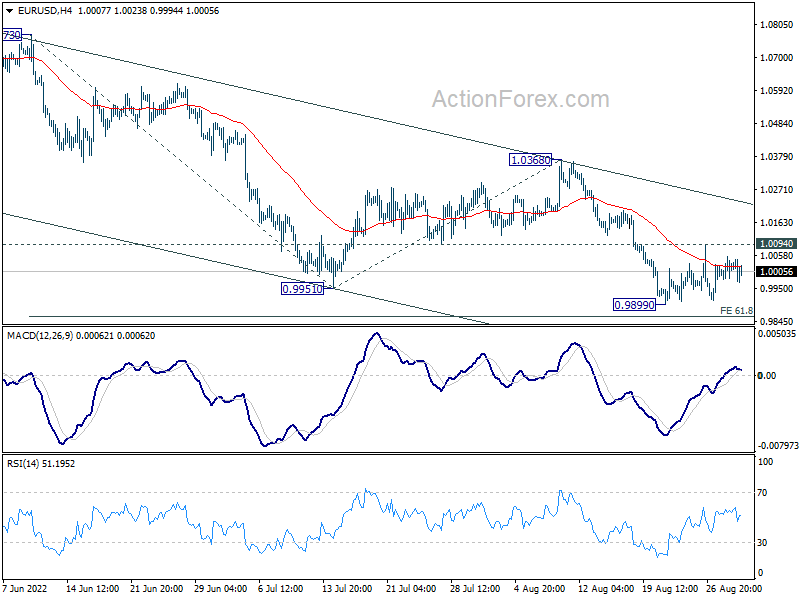
Intraday bias in EUR/USD stays neutral as range trading continues, and further decline is expected with 1.0094 resistance intact. On the downside, break of 0.9899 will resume larger down trend to 61.8% projection of 1.0773 to 0.9951 from 1.0368 at 0.9860. Firm break there should prompt downside acceleration to 100% projection at 0.9546. However, firm break of 1.0094 minor resistance will dampen this bearish view, and turn bias back to the upside for 1.0368 resistance instead.
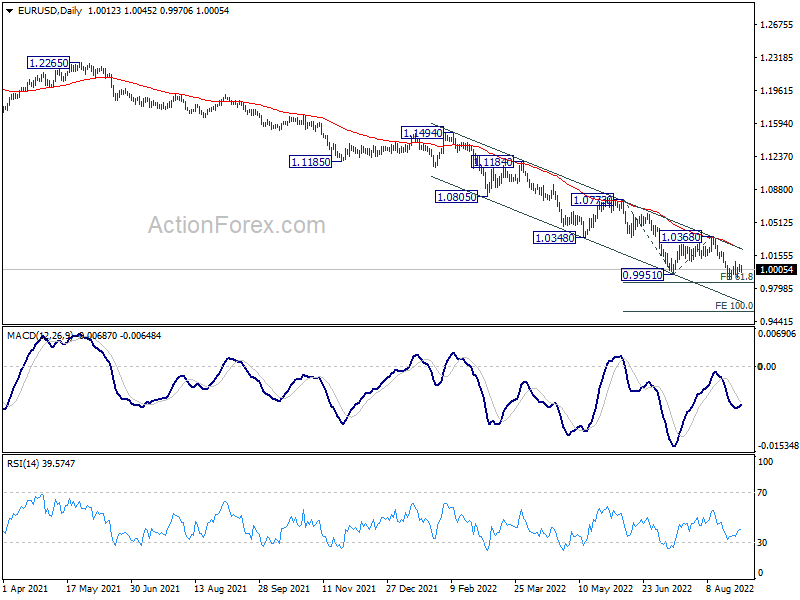
In the bigger picture, down trend from 1.6039 (2008 high) is still in progress. Next target is 100% projection of 1.3993 to 1.0339 from 1.2348 at 0.8694. In any case, outlook will stay bearish as long as 1.0368 resistance holds, in case of strong rebound.
Euro Up Against Europeans after CPI, Dollar Sluggish after ADP Miss
Euro is extending near term rally against Swiss Franc and Sterling after even higher than expected record inflation. But it's struggling to gain against most other currencies. Dollar is also sluggish after ADP employment disappointment, while Yen's is recovering. Commodity currencies are mixed for now. It seems like traders would continue to hold their bets until US non-farm payroll employment data.
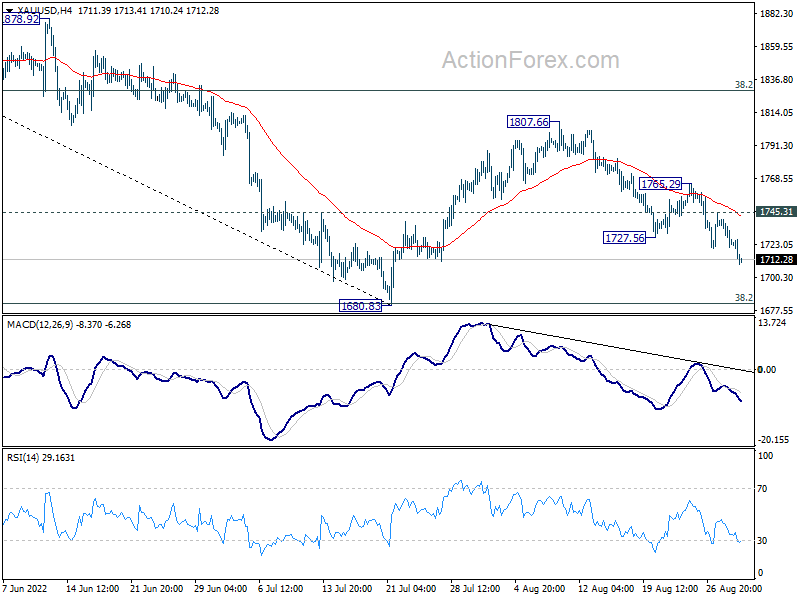
Technically, Gold's decline continues after brief recovery and it's on track to retest 1680.83 support holds. The question remains on whether this long term cluster support level would hold. Or, this level would be taken out decisively to complete confirm a long term trend reversal. In the latter case, it could be used as a confirmation for Dollar's up trend resumption, in particular against Euro.
In Europe, at the time of writing, FTSE is down -0.86%. DAX is up 0.02%. CAC is down -0.24%. Germany 10-year yield is up 0.049 at 1.557. Earlier in Asia, Nikkei dropped -0.37%. Hong Kong HSI rose 0.03%. China Shanghai SSE dropped -0.78%. Singapore Strait Times dropped -0.55%. Japan 10-year JGB yield rose 0.0027 to 0.230.
US ADP employment grew 132k, a shift towards more conservative hiring pace
US ADP private employment grew 132k in August, well below expectation of 300k. By sector, goods-producing jobs grew 23k. Services-providing jobs grew 110k. By company size, small businesses added 25k jobs, medium added 53k, large added 54k. Annual pay was up 7.6%.
"Our data suggests a shift toward a more conservative pace of hiring, possibly as companies try to decipher the economy's conflicting signals," said Nela Richardson, chief economist, ADP. "We could be at an inflection point, from super-charged job gains to something more normal."
Fed Mester expects rates above 4% by early next year, and hold it there
Cleveland Fed President Loretta Mester said, "my current view is that it will be necessary to move the fed funds rate up to somewhat above 4 percent by early next year and hold it there; I do not anticipate the Fed cutting the fed funds rate target next year." "It would be a mistake to declare victory over the inflation beast too soon. Doing so would put us back in the stop-and-go monetary policy world of the 1970s, which was very costly to households and businesses," she added.
Canada GDP grew 0.1% mom in Jun, but to contract -0.1% mom in Jul
Canada GDP grew 0.1% mom in June, matched expectations. Services-producing industries grew 0.2% mom while goods- producing industries rose 0.1% mom. 14 of 20 industrial sectors expanded in the month.
Advance information indicates that real GDP edged down by -0.1% mom in July. Output was down in the manufacturing, wholesale, retail trade and utilities sectors. Declines were partly offset by increases in the mining, quarrying, oil and gas sector and the agriculture, forestry, fishing and hunting sector.
Eurozone CPI rose to 9.1% yoy in Aug, core CPI up to 4.3% yoy
Eurozone CPI accelerated further from 8.9% yoy to 9.1% yoy in August, above expectation of 9.0%. CPI core (all items excluding energy, food, alcohol, and tobacco) rose from 4.0% yoy to 4.3% yoy, above expectation of 4.0% yoy.
Looking at the main components, energy is expected to have the highest annual rate in August (38.3%, compared with 39.6% in July), followed by food, alcohol & tobacco (10.6%, compared with 9.8% in July), non-energy industrial goods (5.0%, compared with 4.5% in July) and services (3.8%, compared with 3.7% in July).
France goods consumption volume dropped -0.8% mom in Jul, CPI slowed to 5.8% yoy in Aug
France household consumption in goods, in volume, dropped -0.8% mom in July. The decline was mainly due to further decrease of consumption of manufactured goods (–1.4% after –0.7%). Food consumption also decreased further (–0.4% after –0.3%). Energy consumption fell back (–0.4% after +2.7% in June).
All item CPI slowed from 6.1% yoy to 5.8% yoy in August. Food inflation rose from 6.8% yoy to 7.7% yoy. Energy inflation slowed from 28.5% yoy to 22.2% yoy. Manufactured products inflation rose from 2.7% yoy to 3.5% yoy. Services inflation was unchanged at 3.9% yoy.
BoJ Nakagawa: laid out three reasons for continuing powerful monetary easing
BoJ board member Junko Nakagawa said in a speech that it's "necessary for the Bank of Japan to persistently continue with the current powerful monetary easing," and she laid out three reasons for that.
Firstly, Japan is "still on its way to recovery" from the pandemic. "As demand remains insufficient compared with supply capacity, a shift in the direction of monetary policy toward tightening would likely drag down the economy and put significant downward pressure on the economic activity of firms and households."
Secondly, current inflation in Japan "differ considerably in terms of degree and the number of items" comparing to those in the US and Europe. The difference is "likely due to the disparity in wage inflation".
Thirdly, the 2% inflation target "needs to be achieved in a sustainable and stable manner". "Even if the higher price of some items pushes up the overall price level to 2 percent, unless household disposable income increases, spending on products and services will decline due to budget constraints." Japan is only "halfway to achieve the price stability target.
Japan industrial production rose 1.0% mom in Jul, auto jumped 12%
Japan industrial production grew 1.0% mom in July, way better than expectation of -0.5% mom decline. The Ministry of Economy, Trade and Industry maintained its output assessment, "fluctuates indecisively" reflecting the ups and downs in production in recent months.
Six of the 15 industries reported output increases while eight declined. The auto industry saw the biggest increase by sector, by 12.0% mom.
Based on a poll of manufacturers, the ministry expects industrial output to grow 5.5 percent in August and rise 0.8 percent in September.
Also released, retail trade rose 2.4% yoy in July, above expectation of 1.9% yoy. Housing starts dropped -5.4% yoy in July, worse than expectation of -3.4% yoy. Consumer confidence improved from 30.2 to 32.5 in August.
NZ ANZ business confidence improved to -47.8 in Aug
New Zealand ANZ Business Confidence rose from -56.7 to -47.8 in August. Own Activity Outlook rose from -8.7 to -4.0. Export intentions rose from -2.7 to 3.9. Investment intentions rose from -2.6 to -2.0. Employment intentions rose from 1.1 to 3.4. Pricing intentions dropped from 74.0 to 70.1. Cost expectations dropped from 91.3 to 90.9. Inflation expectations dropped slightly from 6.23 to 6.13.
ANZ said: "It would make sense that with inflation and wage inflation running so high, the neutral Official Cash Rate is creeping higher, meaning the sting of a given interest rate wears off. Risks are tilted towards the RBNZ having to continue on with OCR hikes next year to cool the economy sufficiently to feel comfortable they're getting on top of the inflation problem.
China PMI manufacturing rose to 49.4 in Aug, contraction continued
China's official PMI Manufacturing rose slightly from 49.0 to 49.4 in August, above expectation of 49.2. New orders ticked up from 48.5 to 49.2. Production was flat at 49.8. PMI Non-Manufacturing dropped from 53.8 to 52.6, above expectation of 52.2. PMI Composite dropped from 52.5 to 51.7.
The data showed manufacturing activity contracted for the second straight month. Also, the sector has been in contraction for five out of the past six months, briefly hitting 50.2 in June.
EUR/USD Mid-Day Outlook
Daily Pivots: (S1) 0.9980; (P) 1.0018; (R1) 1.0053; More...
Intraday bias in EUR/USD stays neutral as range trading continues, and further decline is expected with 1.0094 resistance intact. On the downside, break of 0.9899 will resume larger down trend to 61.8% projection of 1.0773 to 0.9951 from 1.0368 at 0.9860. Firm break there should prompt downside acceleration to 100% projection at 0.9546. However, firm break of 1.0094 minor resistance will dampen this bearish view, and turn bias back to the upside for 1.0368 resistance instead.
In the bigger picture, down trend from 1.6039 (2008 high) is still in progress. Next target is 100% projection of 1.3993 to 1.0339 from 1.2348 at 0.8694. In any case, outlook will stay bearish as long as 1.0368 resistance holds, in case of strong rebound.
Economic Indicators Update
| GMT | Ccy | Events | Actual | Forecast | Previous | Revised |
|---|---|---|---|---|---|---|
| 22:45 | NZD | Building Permits M/M Jul | 5.00% | -2.30% | -2.20% | |
| 23:01 | GBP | BRC Shop Price Index Y/Y Jul | 5.10% | 4.40% | ||
| 23:50 | JPY | Industrial Production M/M Jul P | 1.00% | -0.50% | 9.20% | 9.20% |
| 23:50 | JPY | Retail Trade Y/Y Jul | 2.40% | 1.90% | 1.50% | |
| 01:00 | NZD | ANZ Business Confidence Aug | -47.8 | -56.7 | ||
| 01:30 | CNY | NBS Manufacturing PMI Aug | 49.4 | 49.2 | 49 | |
| 01:30 | CNY | Non-Manufacturing PMI Aug | 52.6 | 52.2 | 53.8 | |
| 01:30 | AUD | Private Sector Credit M/M Jul | 0.70% | 0.70% | 0.90% | |
| 01:30 | AUD | Construction Work Done Q2 | -3.80% | 0.80% | -0.90% | -0.30% |
| 05:00 | JPY | Housing Starts Y/Y Jul | -5.40% | -3.40% | -2.20% | |
| 05:00 | JPY | Consumer Confidence Index Aug | 32.5 | 29.4 | 30.2 | |
| 06:00 | EUR | Germany Import Price Index M/M Jul | 1.40% | 1.60% | 1.00% | |
| 06:45 | EUR | France Consumer Spending M/M Jul | -0.80% | -0.30% | 0.10% | |
| 06:45 | EUR | France GDP Q/Q Q2 | 0.50% | 0.50% | 0.50% | |
| 07:55 | EUR | Germany Unemployment Change Aug | 28K | 27K | 48K | |
| 07:55 | EUR | Germany Unemployment Rate Aug | 5.50% | 5.50% | 5.40% | |
| 08:00 | CHF | Credit Suisse Economic Expectations Aug | -56.3 | -57.2 | ||
| 09:00 | EUR | Eurozone CPI Y/Y Aug P | 9.10% | 9.00% | 8.90% | |
| 09:00 | EUR | Eurozone CPI Core Y/Y Aug P | 4.30% | 4.00% | 4.00% | |
| 12:15 | USD | ADP Employment Change Aug | 132K | 300K | 128K | |
| 12:30 | CAD | GDP M/M Jun | 0.10% | 0.10% | 0.00% | |
| 13:45 | USD | Chicago PMI Aug | 53.2 | 52.1 | ||
| 14:30 | USD | Crude Oil Inventories | -0.4M | -3.3M |
Fed Mester expects rates above 4% by early next year, and hold it there
Cleveland Fed President Loretta Mester said, "my current view is that it will be necessary to move the fed funds rate up to somewhat above 4 percent by early next year and hold it there; I do not anticipate the Fed cutting the fed funds rate target next year."
"It would be a mistake to declare victory over the inflation beast too soon. Doing so would put us back in the stop-and-go monetary policy world of the 1970s, which was very costly to households and businesses," she added.