Sample Category Title
AUD/USD Daily Report
Daily Pivots: (S1) 0.6817; (P) 0.6861; (R1) 0.6885; More...
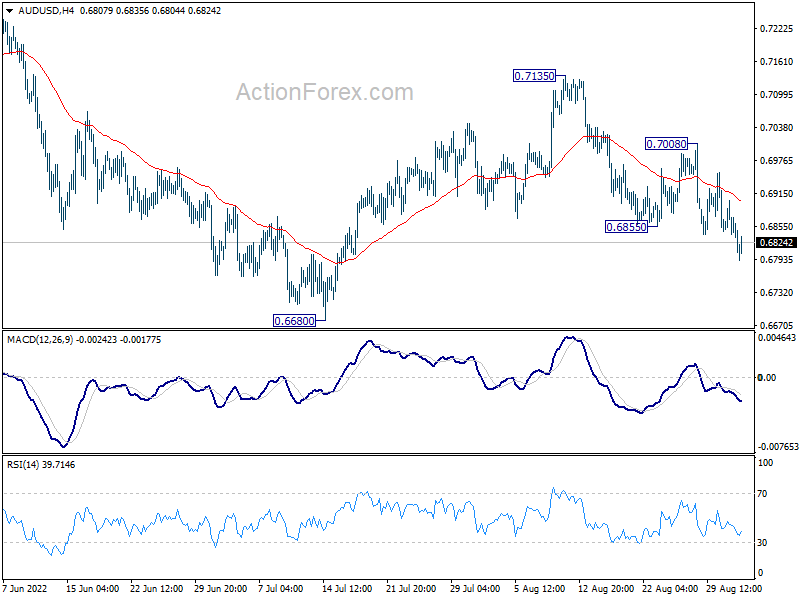
AUD/USD's fall from 0.7135 is in progress and intraday bias stays on the downside. As noted before, corrective rebound from 0.6680 could have completed with three waves up to 0.7135. Retest of 0.6680 should be seen next. Firm break there will resume larger down trend. However, break of 0.7008 will turn bias back to the upside for 0.7135 resistance instead.
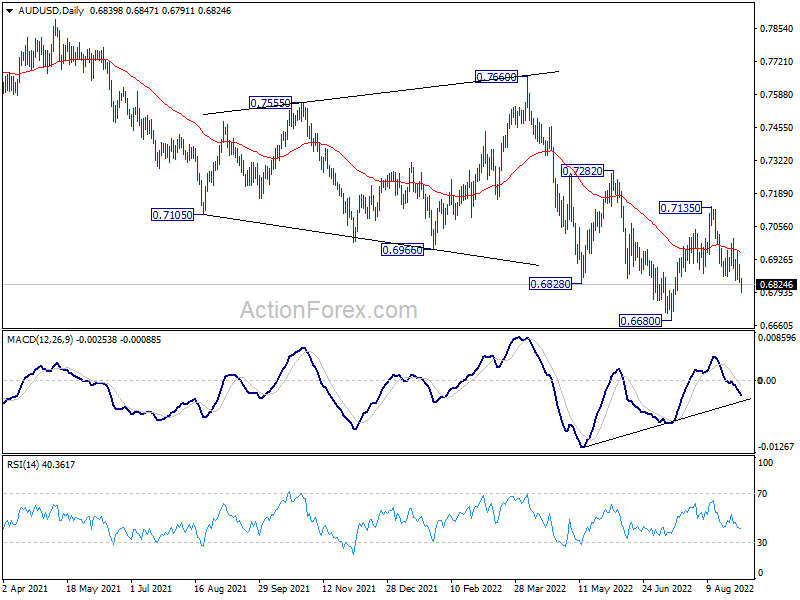
In the bigger picture, price actions from 0.8006 (2021 high) is seen more as a corrective pattern to rise from 0.5506 (2020 low). Or it could also be a bearish impulsive move. In either case, outlook will remain bearish as long as 0.7282 resistance holds. Next target is 61.8% retracement of 0.5506 to 0.8006 at 0.6461.
EUR/USD Daily Outlook
Daily Pivots: (S1) 0.9990; (P) 1.0035; (R1) 1.0097; More...
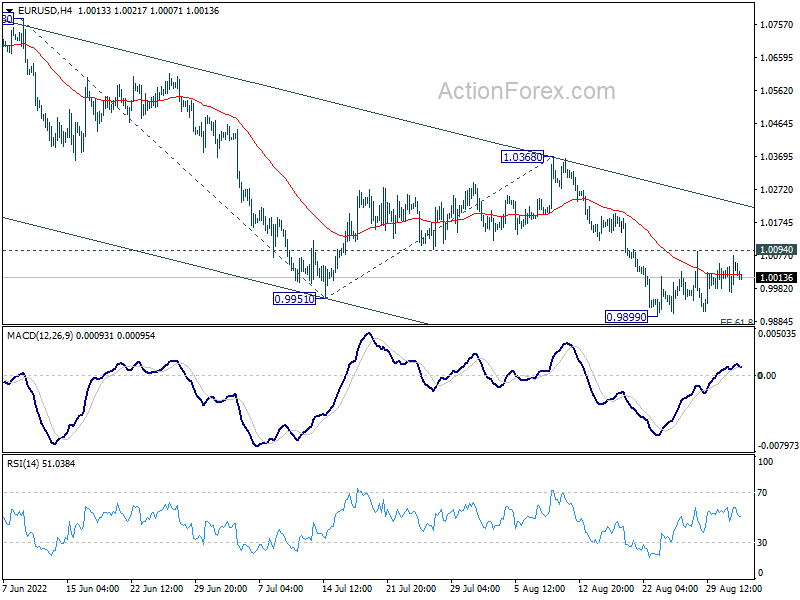
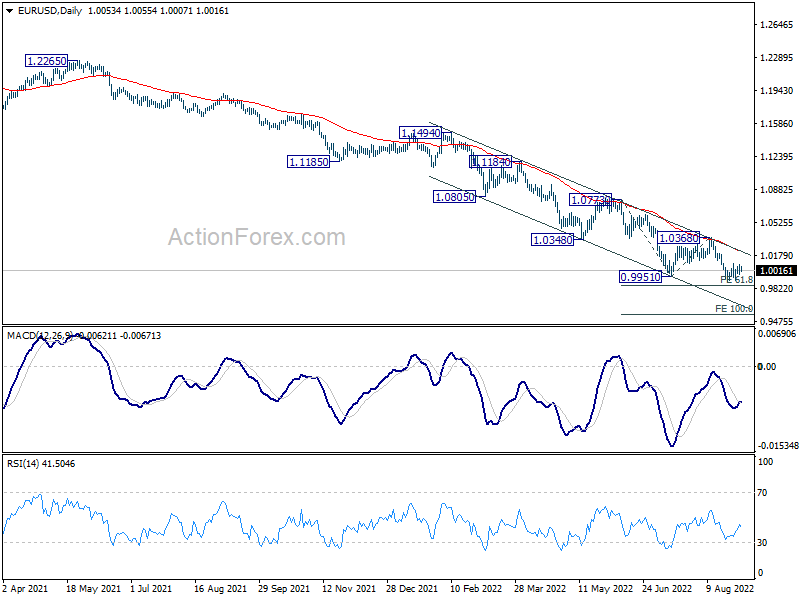
EUR/USD is still bounded in consolidation from 0.9899 and intraday bias remains neutral. Further decline is expected with 1.0094 resistance intact. On the downside, break of 0.9899 will resume larger down trend to 61.8% projection of 1.0773 to 0.9951 from 1.0368 at 0.9860. Firm break there should prompt downside acceleration to 100% projection at 0.9546. However, firm break of 1.0094 minor resistance will dampen this bearish view, and turn bias back to the upside for 1.0368 resistance instead.
In the bigger picture, down trend from 1.6039 (2008 high) is still in progress. Next target is 100% projection of 1.3993 to 1.0339 from 1.2348 at 0.8694. In any case, outlook will stay bearish as long as 1.0368 resistance holds, in case of strong rebound.
GBP/USD Daily Outlook
Daily Pivots: (S1) 1.1584; (P) 1.1639; (R1) 1.1679; More...
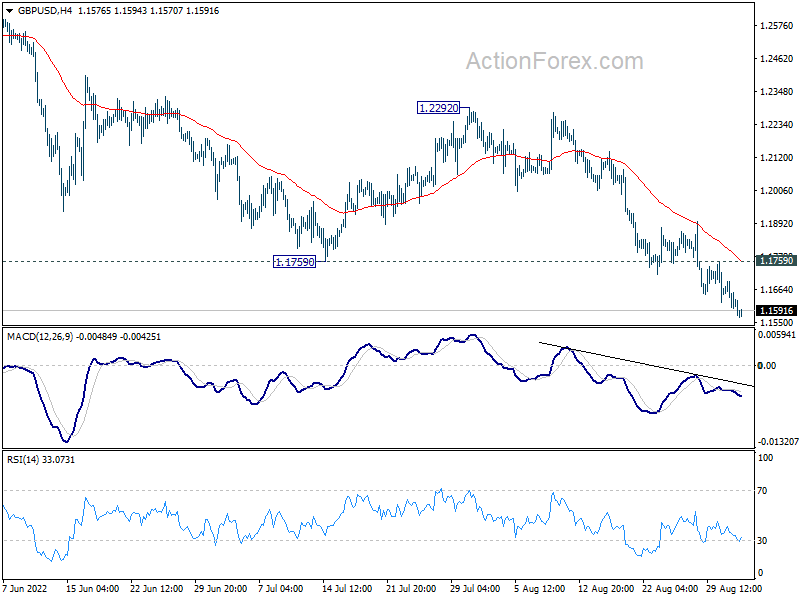
Intraday bias in GBP/USD remains on the downside at this point. Current down trend should target 1.1409 long term support. On the upside, above 1.1759 minor resistance will turn intraday bias neutral for consolidations. But outlook will stay bearish as long as 1.2292 resistance holds, in case of recovery.
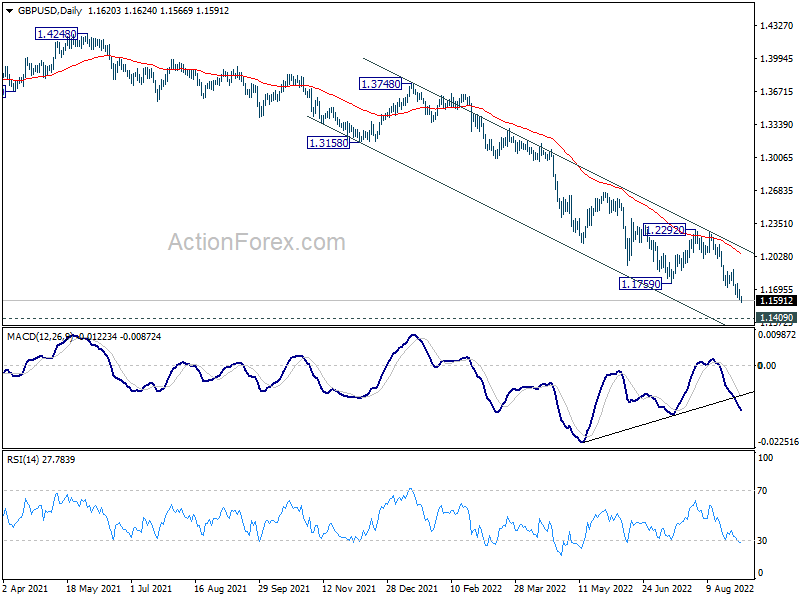
In the bigger picture, fall from 1.4248 (2018 high) could be a leg inside the pattern from 1.1409 (2020 low), or resuming the longer term down trend. Deeper decline is expected as long as 1.2292 resistance holds. Next target is 1.1409 low. However, firm break of 1.2292 will bring stronger rise back to 55 week EMA (now at 1.2859).
USD/CHF Daily Outlook
Daily Pivots: (S1) 0.9734; (P) 0.9771; (R1) 0.9814; More...
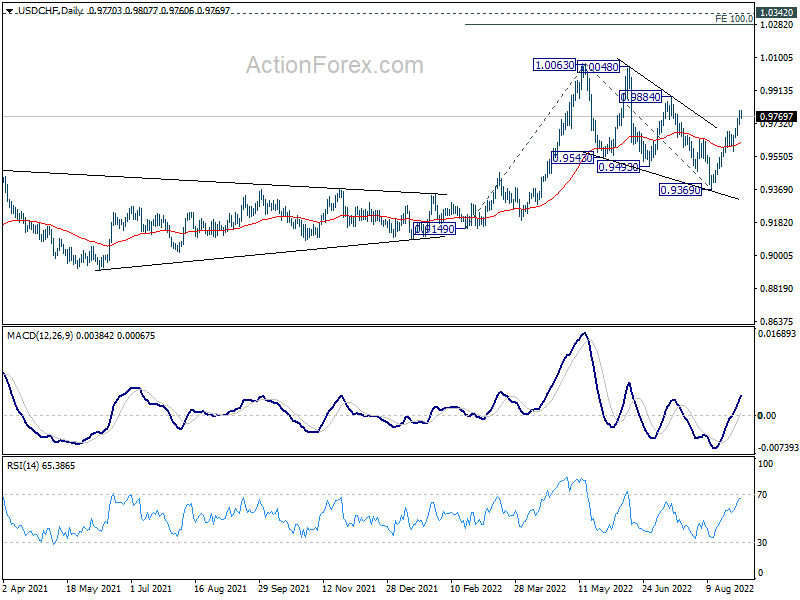
USD/CHF's rally from 0.9369 is still in progress and intraday bias stays on the upside. Current rally should target 0.9884 resistance first. Break there will argue that larger up trend is ready for resumption through 1.0063. On the downside, break of 0.9576 support is needed to indicate completion of the rebound. Otherwise, further rise will remain in favor in case of retreat.
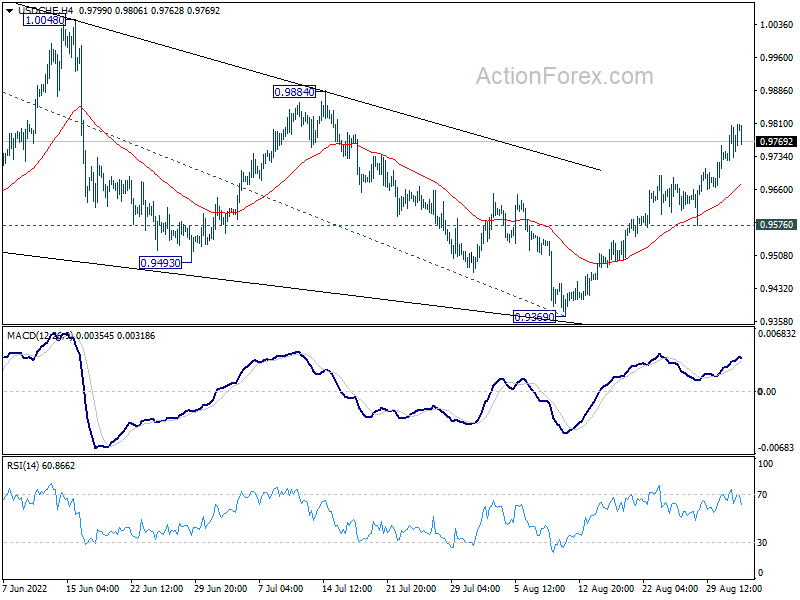
In the bigger picture, current development suggests that up trend from 0.8756 (2021 low) is still in progress. Sustained break of 1.0063 will target 100% projection of 0.9149 to 1.0063 from 0.9369 at 1.0283, and then 1.0342 (2016 high). For now, this will remain the favored case as long as 0.9369 support holds, even in case of deep pull back.
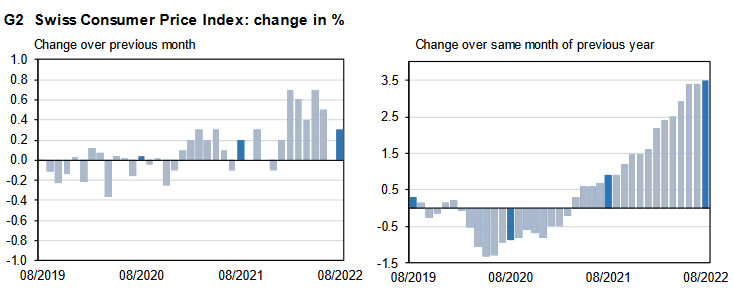
Swiss CPI rose to 3.5% yoy in Aug, core CPI at 2.0% yoy
Swiss CPI rose 0.3% mom in August, slightly below expectation of 0.4% mom. The monthly rise was due to several factors including rising prices for in-patient hospital services, social protection services and housing rentals. CPI core rose 0.3% mom. Domestic product prices rose 0.2% mom. Imported products prices rose 0.6% mom.
Comparing with August 2021, CPI rose 3.5% yoy, accelerated from 3.4% yoy, matched expectations. Core inflation came in at 2.0% yoy. Domestic product prices were up 1.8% yoy. Imported product prices were up 8.6% yoy.
Equities Extend Losses on Soft ADP Report
Good news is bad news, as good economic data supports the idea that the US economy could withstand an aggressive monetary policy tightening, therefore has a boosting effect on the US yields, and a negative effect on equity valuations.
But, bad news is also bad news, as the Federal Reserve (Fed) is so determined to bring inflation down, that it is ready to accept a certain slowdown in economy, and the jobs market.
This is why yesterday’s softer-than-expected NFP data didn’t please investors much. The data showed that the US economy added 132’000 new private jobs in August. That was less than about 300’000 expected by analysts.
If Friday’s NFP data shows a similar slowdown in the US jobs market, we will start talking about a potential shift from super-resilient job growth to something more understandable, and more in line with the actual tightening macroeconomic conditions.
And this is something that the Fed ultimately wants to achieve, because a cooler jobs market should also lead to cooler inflation.
Equities extend losses
The three major US indices extended losses yesterday. The S&P500 lost close to 0.80%, Nasdaq dropped another 0.56%, while the Dow Jones was the most heavily hit.
Even the energy stocks couldn’t weather yesterday’s selloff, as crude oil fell close to 4%. The barrel of American crude is again below the $90 level on growing global recession worries and prospects of lower demand.
But if you ask OPEC, the decline in oil prices is due to the disconnect between the reality and the financial markets. So, if we see further declines, they will certainly remind us how tight the oil market could be, no matter how much the global demand slows.
Why inflation doesn’t boost the euro, as much as it boosts the US dollar?
The US dollar index remained strong despite the soft ADP data yesterday, showing how much the employment data doesn’t matter for the Fed expectations. High inflation continues fueling the US dollar, but the same is not true for other currencies like the euro and sterling. Eurozone and Britain are also dealing with skyrocketing consumer prices, but we can’t really say that their currencies are benefiting from that.
The European Central Bank (ECB) for example hiked its policy rates by a 50bp at its last meeting and is now expected to hike by a turbo 75bp in September, as the flash CPI read yesterday revealed that inflation in the Eurozone advanced past the 9% mark in August. The market now gives 60% probability for a 75bp hike.
But no one is impressed, as the Fed is also expected to hike by 75bp this month. Therefore, the ECB must do something bigger to get the market by surprise and to reverse the negative trend in the euro.
And that’s not a piece of cake. European policymakers can’t just raise the rates when the continent is dealing with a deepening energy crisis. It was much easier to shoot the rates to the ground than bringing them back on feet.
As such, even with the rising inflation and the hawkish expectations regarding the ECB policy, the euro is expected to extend losses below parity against the US dollar, simply because the Fed hawks have stronger muscles than the ECB, or the BoE hawks. As a result, the higher inflation doesn’t necessarily lead to a higher euro or a higher sterling. CQFD.
It's also important to note that in period of high stress, like the one we are going through today with the pandemic, the war and the energy crisis, the US dollar becomes the go-to asset of investors.t The dollar also amassed the safe haven flows since last year, especially given that the sovereign bonds and gold couldn’t offer the protection that investors were looking for.
But, we also know that what goes up must come down. There should be a downside correction in the USD, but when, is the million-dollar question.
Global Manufacturing Slowdown
Market movers today
Manufacturing PMIs for August are released in a range of countries. We expect a further drop in Swedish PMI manufacturing from July's 53.1 in line with the drop in the euro area flash PMIs.
In the US, ISM manufacturing for August should probably remain above 50, although PMIs have pointed to downside risks.
German retail sales for July will give further insights into how consumers adjust spending in light of higher prices, since the last two months have already shown increasing signs of weakness in retail spending.
In Norway it will be very interesting to see whether the labour market is cooling or tightening further, while we look for a moderate fall in PMI manufacturing to 52.5.
The 60 second overview
European inflation: Euro area inflation took another leg higher, as October HICP inflation reached 9.1%, driven by core inflation and food. With higher gas and electricity prices yet to fully feed through to consumer prices, we doubt that we have seen the inflation peak in the euro area yet and overall yesterday's figures strengthen the case for a 75bp hike from ECB next week.
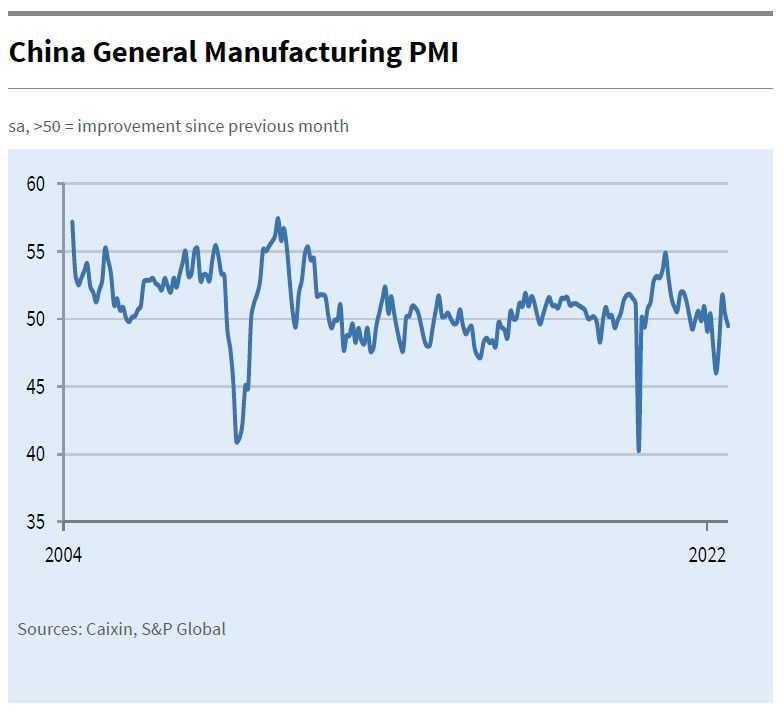
Asian manufacturing is slowing. Chinese private Caixin PMIs declined to 49.5 in August from 50.4 in July, short of expectations, confirming the slowdown from the official reading on Wednesday. Also Korean PMIs fell further below into contractionary territory to 47.6 while export growth slowed in August. Taiwan slowed even more to 42.7. ASEAN production on the other hand remained solid with still above 50 readings in Indonesia, the Philippines, Thailand and Malaysia.
Equities: Global equities lower again yesterday with broad based declines. However, we are starting to see a shift in the narrative as the inverse relationship between oil price and equities, or simply the energy sector versus the rest turning around. The last two days we have seen oil price down and equity markets lower. This for us suggests the market narrative is increasingly moving away from the oil-driven inflation fear of central banks tightening the global economy into recession. This fits well with the "Volcker message" we have received lately from Fed, ECB and BoE. In US yesterday indices ended at worst levels and unable to sustain an early rally for the third-straight time this week. With the move this morning, the S&P future is down close to 10%(!) from the peak just two weeks ago. Yesterday, Dow -0.9%, S&P 500 -0.8%, Nasdaq -0.6% and Russell 2000 -0.6%. Asian markets mostly lower this morning after some mixed PMIs. US and European futures down this morning led by the Nasdaq future, which is down 1.2% at time of writing.
FI: Global bond yields rose modestly yesterday and European yield curves flattened between 2Y and 10Y as well as 10Y and 30Y. We are now pricing in 75bp rate hike by the ECB after a string of comments during the Jackson Hole symposium during the weekend as well as comments this week from a string of ECB officials.
FX: Scandies dropped yesterday and in particular NOK was hit hard with EUR/NOK rising close to 10.00 level. EUR/USD was steady around parity and USD/JPY held close to 139 level.
Credit: Credit markets remained under pressure yesterday where iTraxx Xover closed 7bp wider in 588bp and Main 1bp wider in 119.5bp. The indices are now just 38bp and 7bp, respectively, from their 2022 highs.
Nordic macro
Much of the reason for Norges Bank's more aggressive tone recently has to do with high capacity utilisation and a tight labour market increasing the risk of high energy prices triggering a wage-price spiral. It will therefore be very interesting to see whether the labour market is cooling or tightening further. The first sign will be if the number of vacancies has peaked, as the monthly figures for new vacancies seem to suggest. Today also brings PMI data for August. We expect a moderate fall to around 52.5, partly because we have seen the new orders index dropping in recent months.
USD/JPY Daily Outlook
Daily Pivots: (S1) 138.48; (P) 138.75; (R1) 139.22; More...
Intraday bias in USD/JPY is back on the upside as rise from 130.38 resumes and picks up some momentum. Focus is now on 139.37 resistance. Sustained break there will confirm up trend resumption. Next target is 100% projection of 126.35 to 139.37 from 130.38 at 143.40. However, break of 137.70 resistance turned support will suggest rejection from 139.37, and turn bias to the downside to extend the corrective pattern from there with another falling leg.
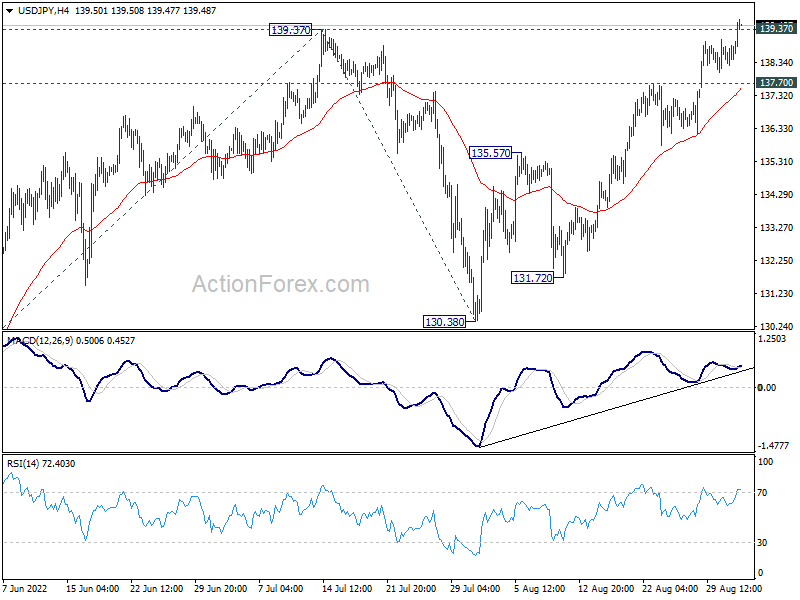
In the bigger picture, up trend from 101.18 is still in progress, as part of the whole up trend from 75.56 (2011 low). Further rise should be seen to 147.68 (1998 high). For now, break of 130.38 support is needed to be the first indicate of medium term topping. Otherwise, outlook will stay bullish even in case of deep pull back.
Dollar Back in Control on Risk Aversion and Rising Yields
Dollar is back in control in Asian session, with some help from risk averse sentiment. Euro is staying firm against Sterling and Swiss Franc, and is picking up upside momentum against commodity currencies. In particular, Aussie is sold off on poor manufacturing data from both Australia and China. Yen is also weak along with renewed rally in benchmark treasury yields.
Technically, US 10-year yield will be a focus today as could be trying to break away from 3.101 resistance decisively. In that case, a near term rally extension would be set up towards 3.483 high. Such development could push Yen pairs higher. In particular, USD/JPY could follow and break through 139.37 resistance in sustained way to resume larger up trend.
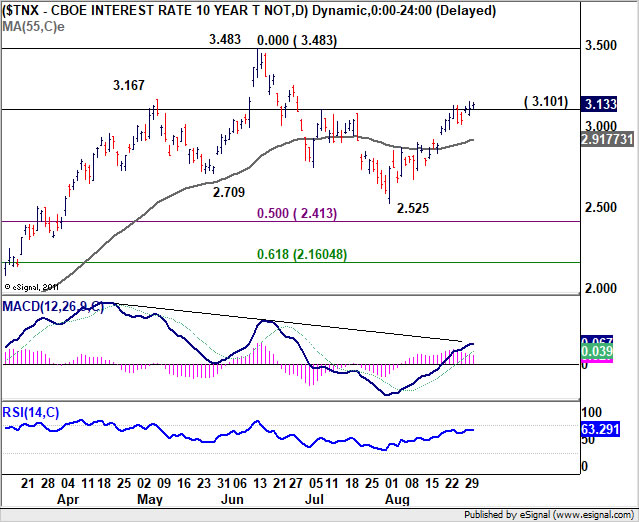
In Asia, at the time of writing, FTSE is down -1.05%. DAX is down -0.97%. CAC is down -1.37%. Japan 10-year JGB yield is up 0.0057 at 0.236. Overnight, DOW dropped -0.88%. S&P 500 dropped -0.78%. NASDAQ dropped -0.56%. 10-year yield rose 0.023 to 3.133.
Australia AiG manufacturing dropped to 49.3, back in contraction
Australia AiG Performance of Manufacturing Index dropped from 52.5 to 49.3 in August, indicating the first contraction since January. Production fell -1.8 pts to 45.7. Employment dropped -2.6 to 47.5. New orders dropped -4.1 to 55.8. Exports dropped -4.3 to 46.9. Sales tumbled -8.8 to 45.2. Input prices rose 2.0 to 81.7. Selling prices rose 4.6 to 69.1. Average wages rose 11.3 to 74.1.
Innes Willox, Chief Executive of Ai Group said: "The Ai Group Australian PMI for August points to the end of the recent expansion of manufacturing activity. Production, employment and sales were all down in August and most manufacturing sectors reported lower performance in the month.... Prices and wages continued to push higher and with the Reserve Bank seeking to ease these pressures by raising interest rates, further slowing in manufacturing looks increasingly likely over the coming months."
Also released, private capital expenditure dropped -0.3% in Q2, below expectation of 1.1%.
Japan PMI manufacturing finalized at 51.1 in Aug, dip likely to continue near term
Japan PMI Manufacturing was finalized at 51.1 in August, down from July's 52.1. The health of the sector that was the joint-weakest since February 2021. S&P Global also noted new orders had the sharpest reduction since October 2020. Backlogs of work decreased for the first time in 18 months. Rise in input prices was slowest for 8 months.
Usamah Bhatti, Economist at S&P Global Market Intelligence, said: "Latest PMI data pointed to deteriorating current activity in the Japanese manufacturing sector midway through the third quarter of 2022.... The dip is likely to continue in the near term... A benefit that has come from softer demand conditions is that pressure on supply chains has been given the opportunity to ease."
Also from Japan, capital spending rose 4.6% in Q2, above expectation of 3.0%.
China Caixin PMI manufacturing dropped to 49.5 in Aug
China Caixin PMI Manufacturing dropped from 50.4 to 49.5 in August, below expectation of 50.2, back in contraction. Caixin added that output growth slowed as firms faced power supply disruption amid heatwave. New orders declined for the first time in three months. Input costs fell at quickest rate since January 2016.
Wang Zhe, Senior Economist at Caixin Insight Group said: "Overall, the Covid-19 flare-ups, the extreme heat wave and restricted power usage resulted in a slight deterioration in overall business conditions in the manufacturing sector. Supply remained stronger than demand, with the latter recording a contraction. The job market remained weak, while lower input costs and output prices eased inflationary pressures. At the same time, firms were cautious about increasing purchases and inventory levels. Market sentiment remained optimistic, although some were worried about the global economic outlook."
Looking ahead
The calendar is rather busy today. Germany retail sales, Swiss CPI and PMI, Eurozone PMI final and unemployment rate, and UK PMI manufacturing final will be released in European session.
Later in the day, US will release jobless claims, non-farm productivity, ISM manufacturing and construction spending. Canada will release building permits and PMI manufacturing.
USD/JPY Daily Outlook
Daily Pivots: (S1) 138.48; (P) 138.75; (R1) 139.22; More...
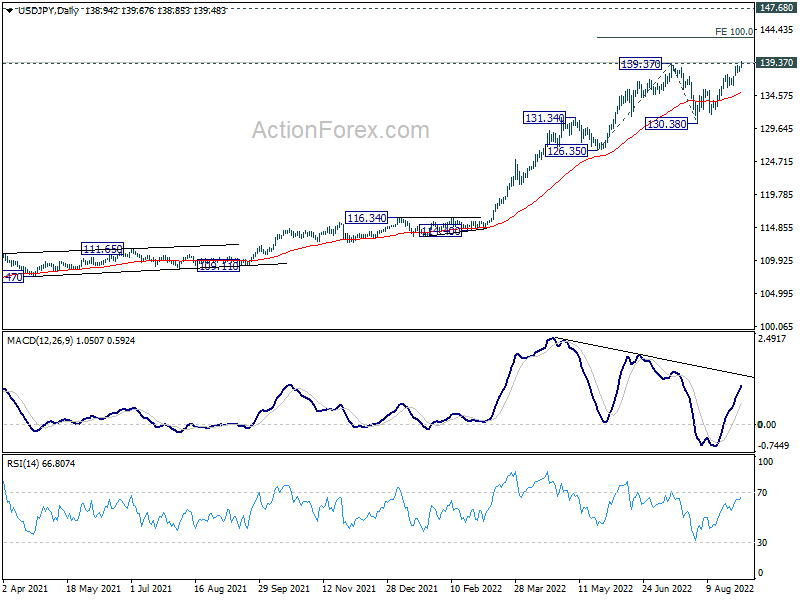
Intraday bias in USD/JPY is back on the upside as rise from 130.38 resumes and picks up some momentum. Focus is now on 139.37 resistance. Sustained break there will confirm up trend resumption. Next target is 100% projection of 126.35 to 139.37 from 130.38 at 143.40. However, break of 137.70 resistance turned support will suggest rejection from 139.37, and turn bias to the downside to extend the corrective pattern from there with another falling leg.
In the bigger picture, up trend from 101.18 is still in progress, as part of the whole up trend from 75.56 (2011 low). Further rise should be seen to 147.68 (1998 high). For now, break of 130.38 support is needed to be the first indicate of medium term topping. Otherwise, outlook will stay bullish even in case of deep pull back.
Economic Indicators Update
| GMT | Ccy | Events | Actual | Forecast | Previous | Revised |
|---|---|---|---|---|---|---|
| 22:30 | AUD | AiG Performance of Mfg Index Aug | 49.3 | 52.5 | ||
| 23:50 | JPY | Capital Spending Q2 | 4.60% | 3.00% | 3.00% | |
| 00:30 | JPY | Manufacturing PMI Aug F | 51.5 | 51 | 51 | |
| 01:30 | AUD | Private Capital Expenditure Q2 | -0.30% | 1.10% | -0.30% | |
| 01:45 | CNY | Caixin Manufacturing PMI Aug | 49.5 | 50.2 | 50.4 | |
| 06:00 | EUR | Germany Retail Sales M/M Jul | -0.40% | -1.60% | ||
| 06:30 | CHF | Real Retail Sales Y/Y Jul | 0.90% | 1.20% | ||
| 06:30 | CHF | CPI M/M Aug | 0.40% | 0.00% | ||
| 06:30 | CHF | CPI Y/Y Aug | 3.50% | 3.40% | ||
| 07:30 | CHF | SVME - PMI Aug | 58 | |||
| 07:45 | EUR | Italy Manufacturing PMI Aug | 48.4 | 48.5 | ||
| 07:50 | EUR | France Manufacturing PMI Aug F | 49 | 49 | ||
| 07:55 | EUR | Germany Manufacturing PMI Aug F | 49.8 | 49.8 | ||
| 08:00 | EUR | Eurozone Manufacturing PMI Aug F | 49.7 | 49.7 | ||
| 08:00 | EUR | Italy Unemployment Jul | 8.10% | 8.10% | ||
| 08:30 | GBP | Manufacturing PMI Aug F | 46 | 46 | ||
| 09:00 | EUR | Eurozone Unemployment Rate Jul | 6.60% | 6.60% | ||
| 11:30 | USD | Challenger Job Cuts Y/Y Aug | 25.81K | |||
| 12:30 | USD | Initial Jobless Claims (Aug 26) | 250K | 243K | ||
| 12:30 | USD | Nonfarm Productivity Q2 | -4.60% | -4.60% | ||
| 12:30 | USD | Unit Labor Costs Q2 | 10.60% | 10.80% | ||
| 12:30 | CAD | Building Permits M/M Jul | -1.50% | -1.50% | ||
| 13:30 | CAD | Manufacturing PMI Aug | 52.5 | |||
| 13:45 | USD | Manufacturing PMI Aug F | 51.3 | 51.3 | ||
| 14:00 | USD | ISM Manufacturing PMI Aug | 52.6 | 52.8 | ||
| 14:00 | USD | ISM Manufacturing Prices Paid Aug | 59.5 | 60 | ||
| 14:00 | USD | ISM Manufacturing Employment Index Aug | 49.9 | |||
| 14:00 | USD | Construction Spending M/M Jul | -0.10% | -1.10% | ||
| 14:30 | USD | Natural Gas Storage | 58B | 60B |
China Caixin PMI manufacturing dropped to 49.5 in Aug
China Caixin PMI Manufacturing dropped from 50.4 to 49.5 in August, below expectation of 50.2, back in contraction. Caixin added that output growth slowed as firms faced power supply disruption amid heatwave. New orders declined for the first time in three months. Input costs fell at quickest rate since January 2016.
Wang Zhe, Senior Economist at Caixin Insight Group said: "Overall, the Covid-19 flare-ups, the extreme heat wave and restricted power usage resulted in a slight deterioration in overall business conditions in the manufacturing sector. Supply remained stronger than demand, with the latter recording a contraction. The job market remained weak, while lower input costs and output prices eased inflationary pressures. At the same time, firms were cautious about increasing purchases and inventory levels. Market sentiment remained optimistic, although some were worried about the global economic outlook."