Sample Category Title
EUR/GBP Mid-Day Outlook
Daily Pivots: (S1) 0.8503; (P) 0.8526; (R1) 0.8566; More...
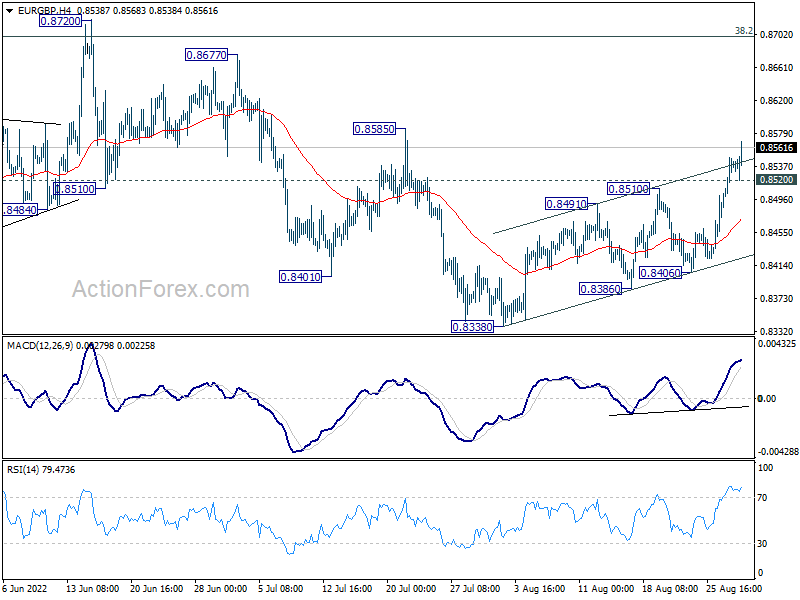
EUR/GBP's rise from 0.8338 continues today and the break of near term channel resistance is a sign of upside acceleration. Intraday bias stays on the upside for 0.8585 resistance first. Decisive break there should confirm that whole pattern from 0.8720 has completed, and bring further rally to retest this high. On the downside, below 0.8520 minor support will mix up the outlook and turn intraday bias neutral first.
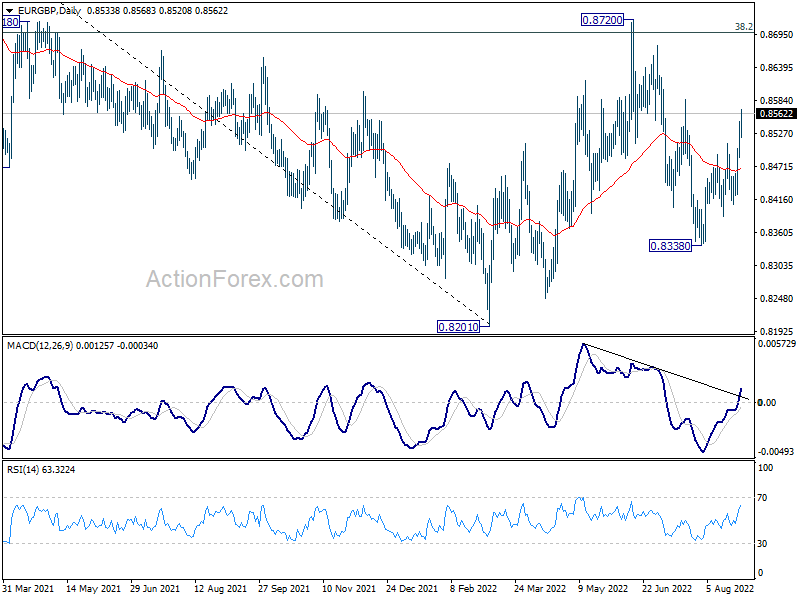
In the bigger picture, medium term bearishness is maintained with prior rejection by 38.2% retracement of 0.9499 to 0.8201 at 0.8697. Break of 0.8201 will resume larger down trend from 0.9499 (2020 high). Nevertheless, sustained break of 0.8697 will affirm the case that rise from 0.8201 is a medium term up trend itself.
ECB Knot: Swift normalization of interest rates is essential
ECB Governing Council member Klaas Knot said, "a swift normalization of interest rates is an essential first phase, and some front-loading should not be excluded. The broadening and deepening of our inflation problem generates the need to act forcefully."
Knot saw upside risks to inflation, including from higher food and energy prices, a weaker euro, copious budget spending and rising expectations. He added that even if the slowdown in the economy were to materialize, "this in itself is unlikely to bring inflation back to our objective over the medium term."
Knot said earlier last week that a rate hike of at least 50bps is needed next week.
ECB Comes to the Euro Defence
The fall in the single European currency has paused after briefly touching the 0.99 level earlier this month. As in July, the momentum of the EURUSD decline has sparked a resurgence of verbal interventions. Judging by the tone of recent comments, the ECB is reassuring the markets that it is soon ready to raise rates more aggressively.
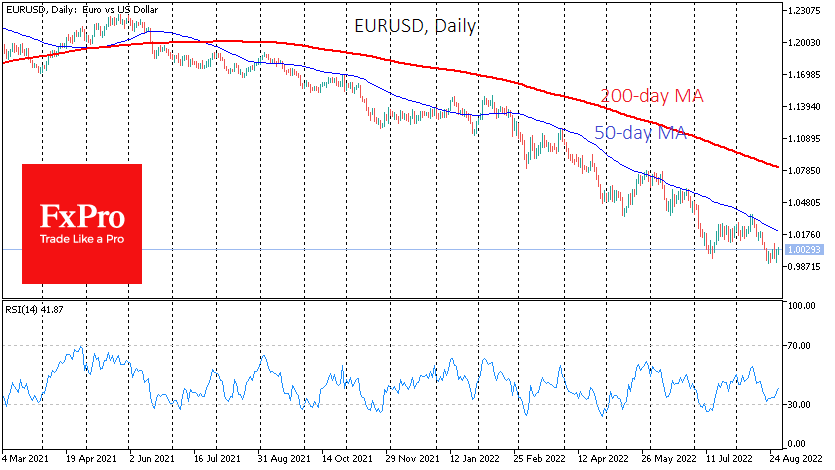
This sentiment supports interest in the single currency hovering around parity with the dollar. We recently heard from Lane that September would mark the start of a new phase of ECB policy.
As clearly as possible for central bankers, Rehn and Kazaks say that euro weakness worries the regulator and will influence the next rate decision.
The euro’s 15% fall against the dollar over the past 12 months is an additional pro-inflationary factor on top of skyrocketing energy prices, broken supply chains and a tight labour market.
With such a macroeconomic backdrop, it is not surprising that central bankers talk about the need to “take the pain” of policy tightening to suppress price increases and, more importantly, reverse inflation expectations.
The good news for the euro is that it responds well to the reassurances and threats from central bank officials. That was difficult for the BoJ to achieve earlier this year. At the same time, it is worth realising that verbal interventions in this situation can only buy a little time. Very soon, the ECB will confirm its intentions by effectively tightening monetary policy.
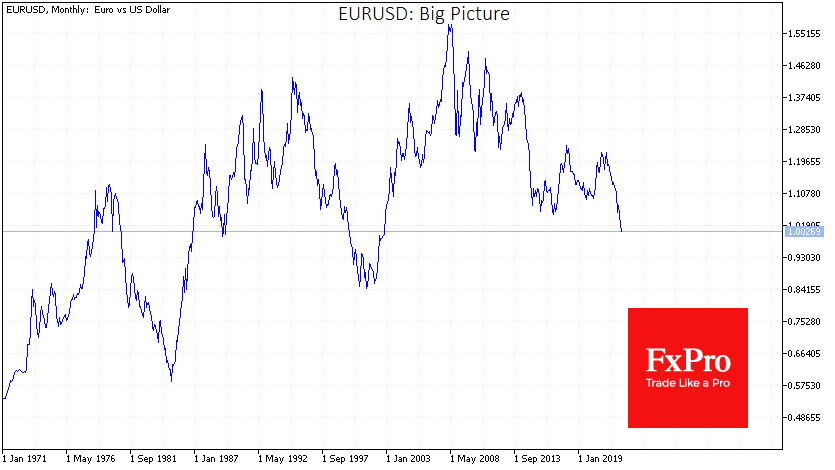
The fact is that not only energy prices are now at stake but also the credibility of the debt securities of smaller Eurozone countries. Last month, the ECB was forced to launch a sophisticated mechanism to hold down bond spreads of core and peripheral euro-region countries. The widening of spreads was another signal of a loss of confidence.
Uncontrolled current-level depreciation could permanently undermine the euro’s status as a reserve currency, quickly translating into higher debt-servicing costs. The debt problem is bad news for the euro. History is also not on the side of the buyers right now. In previous episodes of overcoming parity, it was not a turning point but only a temporary stopgap. Fundamentals are also on the bears’ side for now. Because, despite the attention on the euro exchange rate, the ECB is moving slower than Fed in policy normalisation and much further away from the point where policy becomes neutral.
A Curious Rebound
Stock markets are bouncing back on Tuesday following a rocky couple of weeks as investors grew nervous about the economic impact of tightening.
Fed Chair Jerome Powell could not have been more clear on Friday on the central bank's tightening stance and unlike the warnings from his colleagues, the message appeared to have finally gotten through.
Which makes today's move all the more curious. It's not the fact that we're seeing a rebound as equity markets don't move in straight lines, rather it's the strength of it that is interesting.
Prior to Friday's speech, investors appeared determined to cast aside warnings in favour of the dovish pivot narrative and today's moves may suggest the same could still be true after a brief pullback.
With a 75 basis point rate hike now viewed as the more likely outcome from the Fed in a few weeks and ECB officials putting a similar move on the table ahead of its meeting next week, how strong of a recovery can we really expect in equity markets?
Central banks have made it perfectly clear now that the fight against inflation is their primary concern and a hard landing may just be the price to pay. While that may change if we see any significant improvement on the inflation front over the coming months, the risks still appear more tilted to the downside for the economy.
Saudi Arabia reinforces support
Oil prices are easing a little with Brent potentially settling around $100 and WTI a little below around $95. While there remain many moving parts in the oil market at the moment, the comments last week from Saudi Arabia have reinforced support below the current price.
It seems OPEC+ isn't interested in the oil price slipping much below $100 a barrel and while those warnings would be put to the test in the event of a nuclear deal, which still looks very challenging, or a global recession, the words alone could keep prices high for now.
Gold failing to bounce back
Gold continues to struggle in the aftermath of Powell's comments on Friday, even though the dollar is falling on Tuesday and US yields are a little lower. The yellow metal continues to test $1,730 today; a sign that not all are on board with the recovery trade we're seeing elsewhere.
A significant break of $1,730 would be a real blow for gold, with the next area of notable support falling around $1,680-$1,700. A move back above $1,765 could get gold bulls excited once more but that may be easier said than done if trading over the last few sessions is anything to go by.
A big moment for Bitcoin
Bitcoin is enjoying a slight recovery today after surviving a brief dip below $20,000 over the weekend. The hawkish sentiment by Powell took its toll at the end of the week but crypto bulls are fighting back to defend what could be a key level. We may need to see more of the resilience displayed in recent months as a failure to do so could quickly see bitcoin retesting the June lows.
Bitcoin Clings to $20K
Market picture
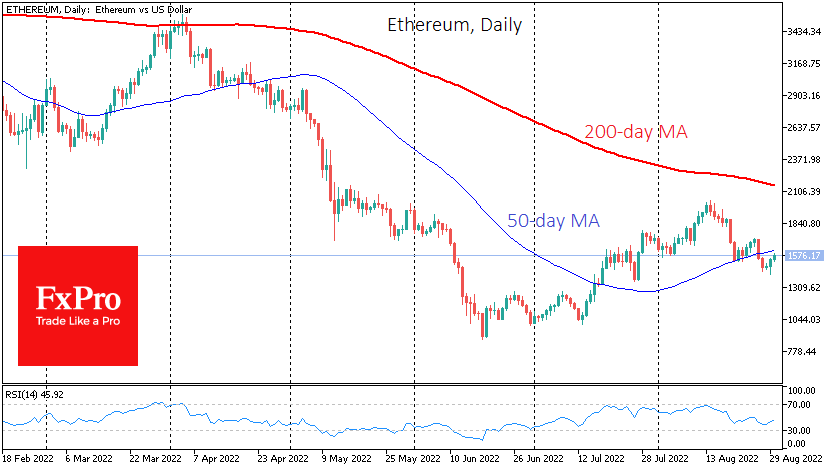
Bitcoin managed to claw its way to a meaningful round level early in the week, trading at $20,400 on Tuesday morning (+2.8% in 24 hours). Ethereum showed an even more decisive rebound, adding 8.5% at once to $1580. Top altcoins are up 3.5% (Dogecoin) to 7.1% (Solana).
Total cryptocurrency market capitalisation, according to CoinMarketCap, rose 4.2% overnight to $992bn. The cryptocurrency Fear and Greed Index rose 3 points to 27 by Tuesday and moved into “fear” from “extreme fear”.
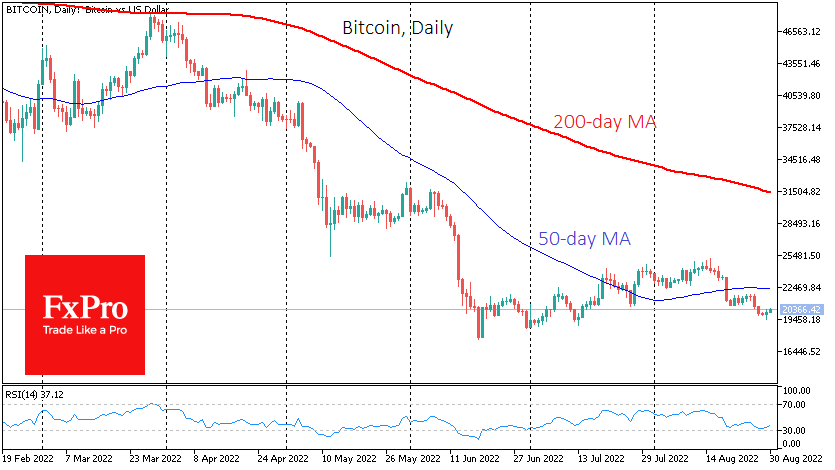
Bitcoin was getting support on Monday on declines under 19500. It attracted buyers roughly at the same levels in July. One can cautiously state that the bears’ impulsive attack has been stopped, preventing the first cryptocurrency from updating lows. Such buybacks slowly create a sense that the bottom is near. This dynamic has encouraged a broad layer of buyers, who quickly returned to buying one of the robust fundamentals of recent months, Ethereum.
News background
According to CoinShares, net capital outflows from cryptocurrencies last week were $27m, with investors taking money out for the third week. Meanwhile, outflows from bitcoin funds accounted for $29 million, with investments in funds that allow shorts on bitcoin up by $1 million.
BTC is unique because it is technically one of the worst cryptocurrencies and solely a speculative asset without utility, said Cyber Capital founder and chief investment officer Justin Bones. He was previously a supporter of the first cryptocurrency but changed his view due to the community’s refusal to increase the block size limit.
Cardano beat out bitcoin in MBLM’s Consumer Emotional Affection ranking, ranking 26th out of 600 global brands. Bitcoin ended up in the 30th position.
Former US broker Jordan Belfort, known as “The Wolf of Wall Street”, sees bitcoin and Ethereum as primarily solid digital assets because of their strong fundamentals but compares the cryptocurrency market to junk bonds from the 1980s.
Meanwhile, the Chicago Mercantile Exchange (CME Group) has launched euro-denominated futures on bitcoin and Ethereum.
Yen Stabilizes after Hitting 139
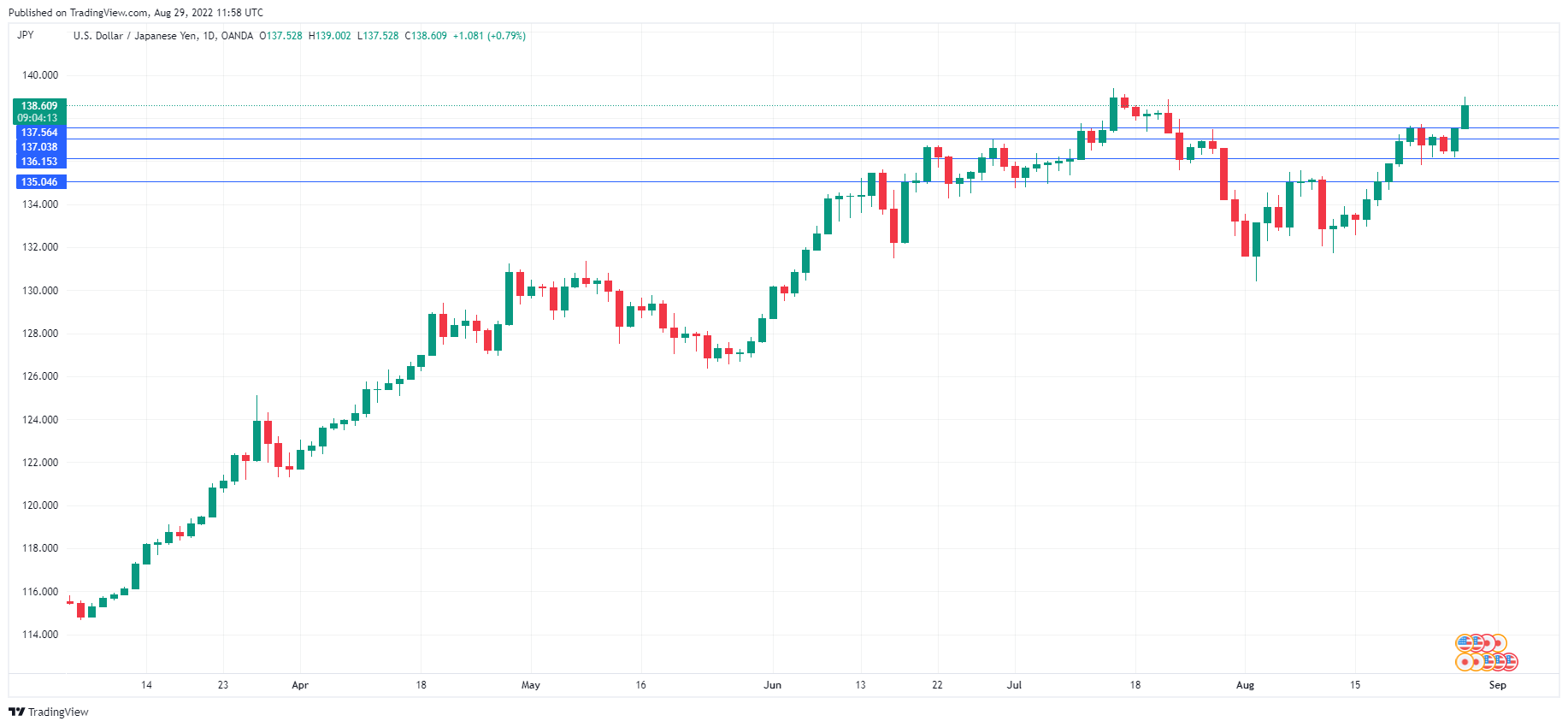
The Japanese yen is in positive territory today after starting the week with sharp losses. USD/JPY is trading at 138.22, down 0.34%.
Japan releases a host of events on Wednesday, including retail sales and consumer confidence. Retail sales for July is expected to come in at -0.5% MoM, following a 1.4% decline in June. Consumer confidence remains weak, with a July estimate of 31.0, following the June read of 30.2. The Japanese consumer is in a sour mood and nervous about the economy, so it’s no surprise that she is holding tight to the purse strings as inflation continues to rise.
Yen remains under pressure
The yen remains under pressure and took it on the chin after Fed Chair Powell’s speech at Jackson Hole on Friday. Powell’s brief speech went straight to the point, pledging to continue raising rates until inflation was brought under control. Powell pointedly said that one or two weak inflation reports would not cause the Fed to U-turn on its tightening, a veiled reference to the market euphoria which followed the July inflation report, which was lower than the June release. With the equity markets taking a tumble after Powell’s speech, it appears that investors have finally gotten the Fed’s hawkish message.
Powell’s speech removed any doubts about the Fed’s plans to continue raising rates, but the size of the increases will depend not just on inflation, but also on other economic data. Overshadowed by Jackson Hole, US Personal Income and Spending data was weaker than expected. As well, the Core PCE index, the Fed’s preferred inflation indicator, fell to 6.3%, down from 6.8% and below the forecast of 7.4%. If Friday’s non-farm payrolls report is weaker than expected, it would be a clear indication that the sharp increase in rates is having its desired effect and the economy is slowing. In such a scenario, Fed policy makers may be more inclined to raise rates at the September meeting by only 50 basis points, rather than 75bp.
USD/JPY Technical
- USD/JPY is testing support at 1.3822. The next support line is at 137.01
- 1.3891 and 1.4012 are resistance lines
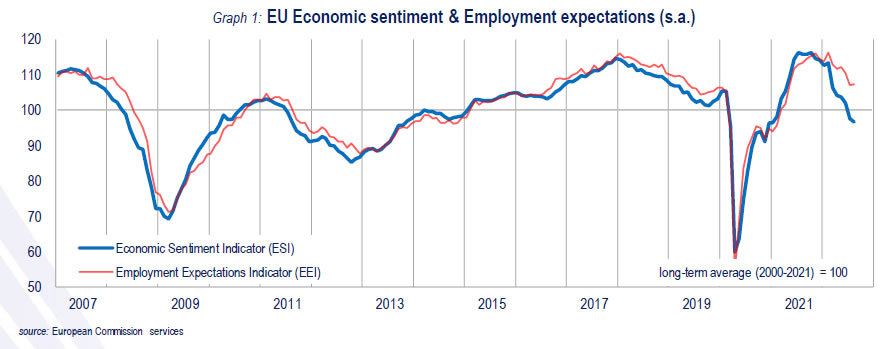
Eurozone economic sentiment dropped to 97.6 in Aug
Eurozone Economic Sentiment Indicator dropped from 98.9 to 97.6 in August, well below expectation of 102.0. Employment Expectation Indicator rose from 107.2 to 108.0. Industry confidence dropped from 3.4 to 1.2. Services confidence dropped from 10.4 to 8.7. Consumer confidence improved from -27.0 to -24.9. Retail trade confidence rose from -7.1 to -6.3.
EU Economic Sentiment Indicator dropped from 97.5 to 96.5. Amongst the largest EU economies, the ESI plummeted in the Netherlands (-4.8) and posted significant declines in Germany (-2.5), France and Poland (both -1.8), as well as Italy (-1.2). Spain stood out with a mild increase (+0.8).
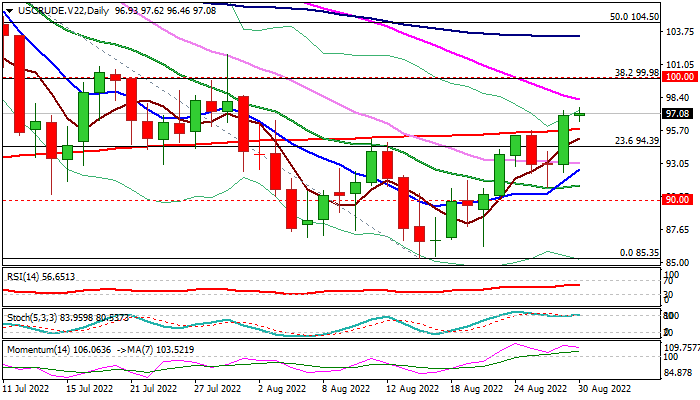
WTI Oil: Recovery Keeps Traction But Remains Weighed by Demand Concerns
WTI oil is consolidating after 4.2% advance on Monday (the biggest one-day gains since July 18), but keeping positive near-term stance, following a bullish signal on Monday’s close above 200DMA ($95.87) which capped the action for some time.
Profit-taking from a three-month fall from $123.65 to $85.35) lifted oil prices, along with improved sentiment, though investors remain concerned by high inflation which is near a double-digit level in a number of Western economies that may spark further aggressive actions in raising interest rates that would cool demand.
The price is also weighed by weakened risk appetite and increased Russia’s oil output that adds to signals of possible recovery stall.
Fresh bulls need a firm breakthrough pivots at $99.00 (daily cloud base( and $100 level (psychological/Fibo 38.2% of $123.65/$85.35) to signal stronger recovery and sideline larger bears.
Otherwise, recovery may lose traction on failure under these barriers, with return below 200DMA tio signal that bears are regaining control.
Res: 97.62; 98.25; 99.00; 100.00.
Sup: 95.87; 95.07; 94.39; 92.28.
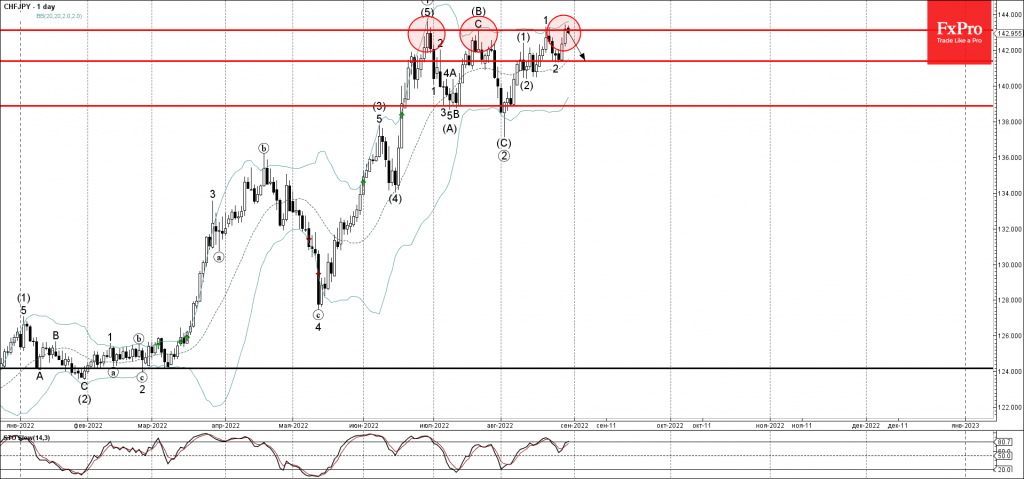
CHFJPY Wave Analysis
- CHFJPY reversed from resistance level 143.00
- Likely to fall to support level 141.35
CHFJPY currency pair recently reversed down from the key resistance level 143.00 (which stopped the previous impulse waves (5) and (B)) intersecting with the upper daily Bollinger Band.
The downward reversal from the resistance level 143.00 stopped the earlier short-term impulse wave 3.
Given strength of the nearby resistance level 143.00 and the overbought daily Stochastic, CHFJPY can be expected to fall further toward the next support level 141.35 (low of the previous wave 2).
GBPCHF Wave Analysis
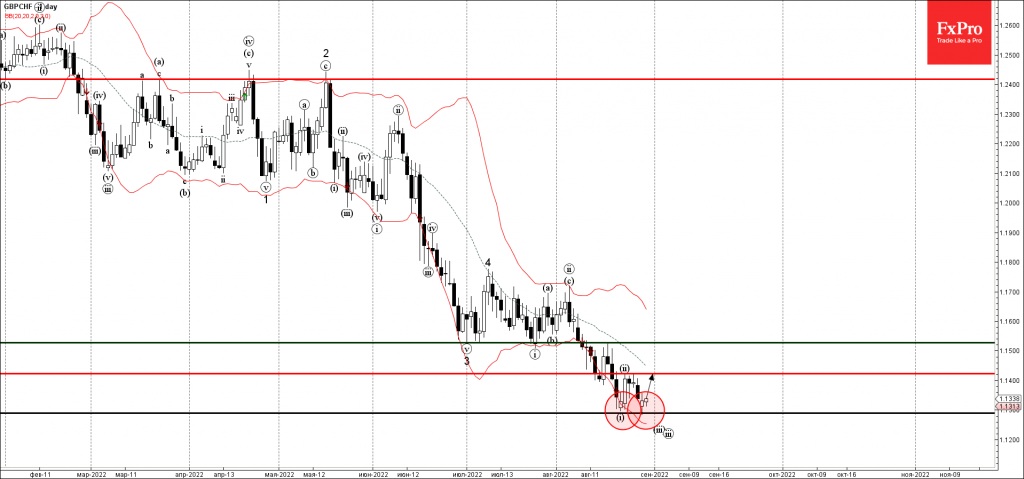
- GBPCHF reversed from support level 1.1290
- Likely to rise to resistance level 1.1420
GBPCHF currency pair recently reversed up from the support level 1.1290 (which stopped the previous minor impulse wave (i) earlier this month) standing near the lower daily Bollinger Band.
The upward reversal from the support level 1.1290 stopped the earlier impulse waves iii and (iii).
Given strength of the nearby support level 1.1290, GBPCHF can be expected to rise further toward the next resistance level 1.1420 (top of the previous wave (ii)).