

Sample Category Title
Risk of Dollar Pull Back Growing, After Breaching Parity With Euro
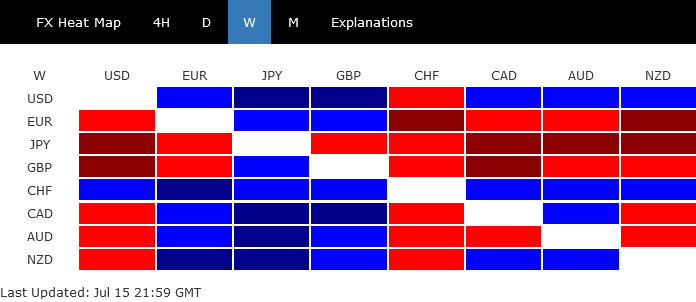
Dollar was the strongest one for most part of the week, and even breached parity against Euro. But the greenback pared gains on late turn in market sentiment, and ended as the second best only. Swiss Franc was surprisingly the best performer, while Kiwi was the third. Yen was the weakest one, as selloff continued on diverging central bank path with other peers. Sterling and Euro were the next weakest. Canadian Dollar just ended mixed even though BoC surprised the markets with a mega 100bps hike.
Investors are now still expecting "just" a 75bps rate hike by Fed this month, and that helped sentiment recovered. Considering the prospect of stronger rebound is stocks, risk of a pull back in the greenback is growing, except versus Yen. Additionally, Euro might finally rebound on short covering after failing to break through parity against Dollar decisively. Gold is also approaching a key support level.
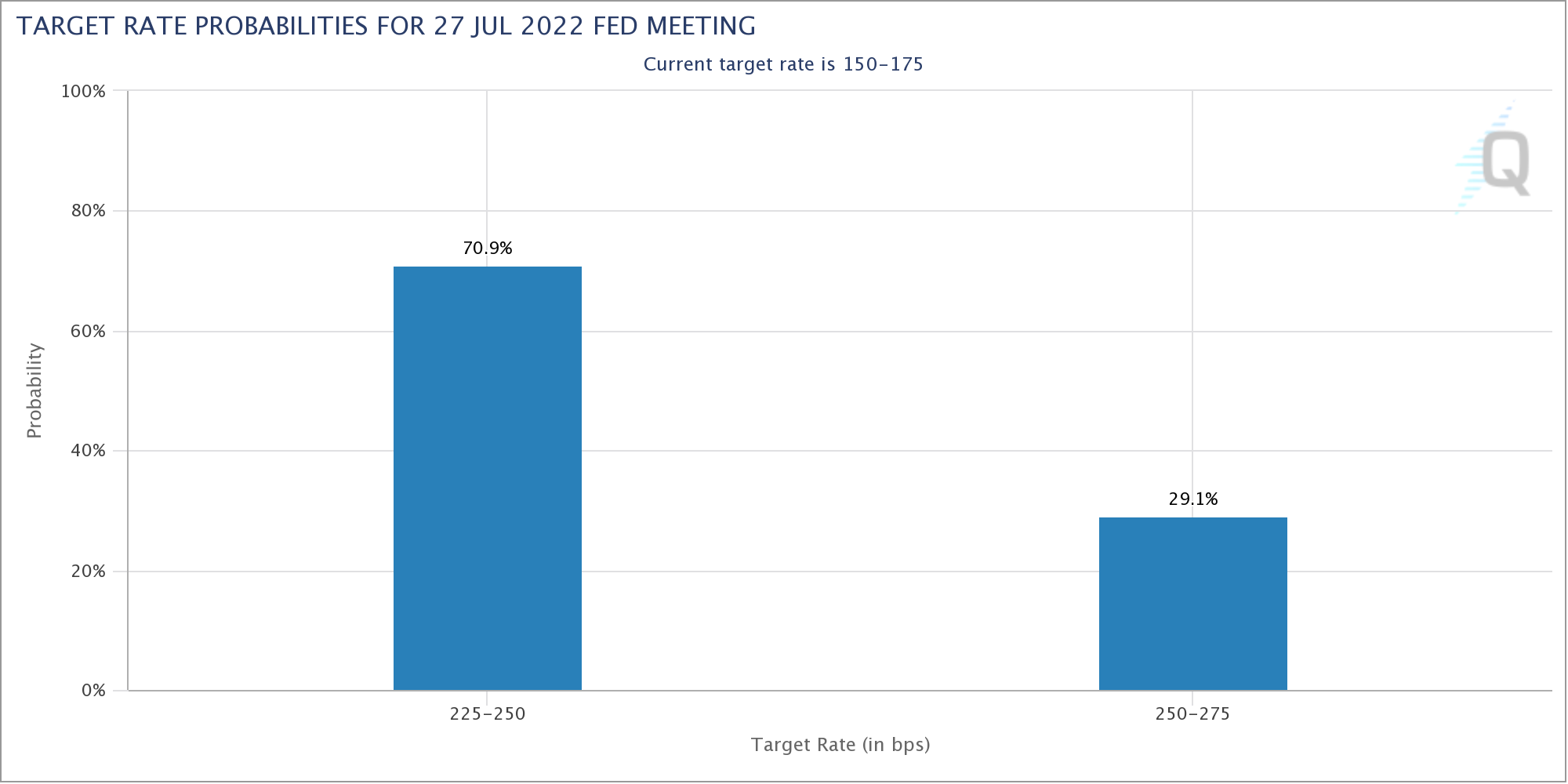
Markets pricing in 71% chance of 75bps Fed hike in Jul
There surprised mega hike of 100bps by BoC last week prompted speculations that Fed will follow at its July 27 decision. Markets were once pricing in 50/50 chance of that happening. But such speculations receded after comments from some Fed officials. The messages are that firstly, with a 75bps hike to 2.25% to 2.50%, federal funds rate will already be in the neutral range. Secondly, a 100bps won't make a huge difference from a 75bps at this point.
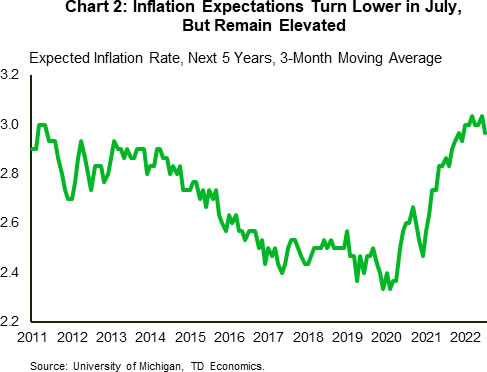
Additionally, the University of Michigan consumer survey showed that inflation expectations were easing. Five-year inflation expectations dropped from 3.1% to 2.8%, hitting the lowest level in a year. One-year inflation expectation also ticked down from 5.3% to 5.2%, lowest since February. There are hopes of realized inflation data to start reverse in the upcoming periods.
Fed will have nearly two months of data between July and September FOMC meeting, with interest rate at neutral, before gauging the next move. A 75bps hike is still sensible. Anyways, Fed fund futures are pricing in 71% chance of a 75bps hike, 29% of 100bps.
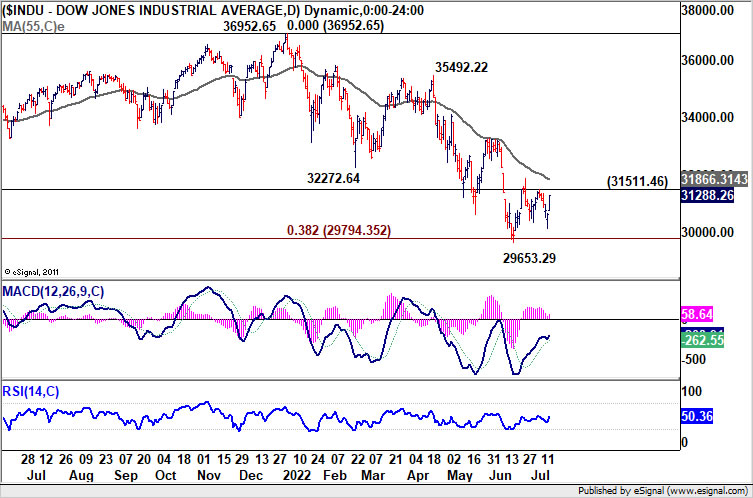
DOW staged relief rebound, more upside ahead?
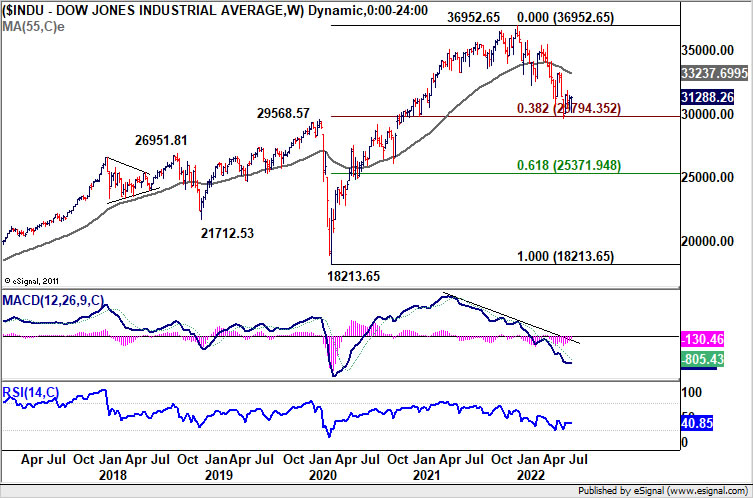
US stocks staged a relief rebound towards the end of the week. It's still early to conclude, but DOW's corrective fall from 36952.65 appears to have completed with three waves down to 29653.29. That came after hitting 30k handle, and 38.2% retracement of 18213.65 to 36952.65 at 29794.35.
Firm break of 31511.46 resistance will affirm this bullish case. Sustained trading above 55 day EMA (now at 31866.31) will pave the way to 55 week EMA (now at 33237.69). Such development could start happening in Q3, if incoming data really starts to show topping in US inflation, while keeping the economy robust, and as Fed starts to slow its pace of tightening.
10-year yield continues sideway consolidation
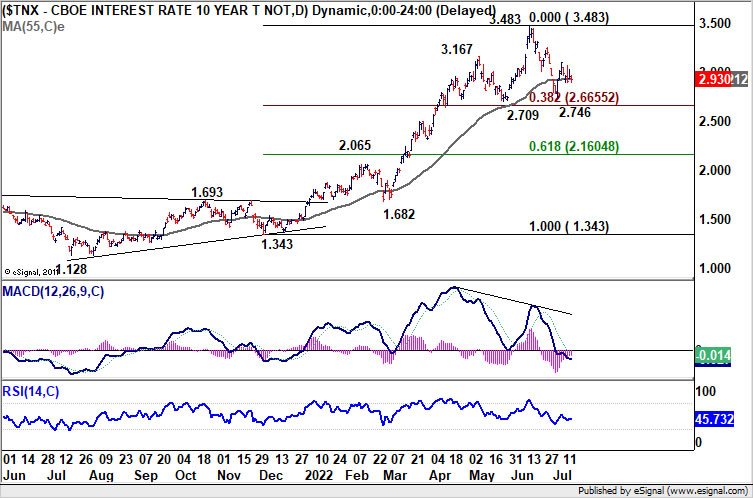
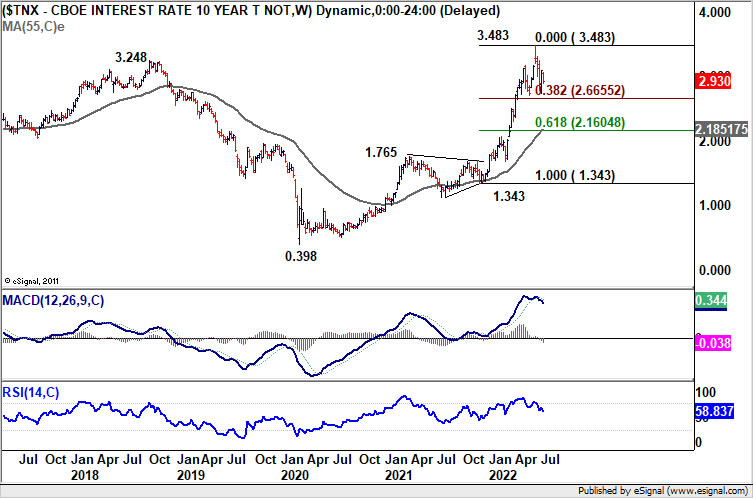
Outlook in 10-year yield is unchanged as it gyrated around 55 day EMA last week. Price actions from 3.483 are seen as a medium term consolidation pattern, with range set between 2.709 and 3.483). It's probably in the second leg of the pattern and further rise might be seen. But upside should be capped by 3.483. It will take a while more to complete the whole pattern.
Dollar index continued up trend, but looks a bit stretched
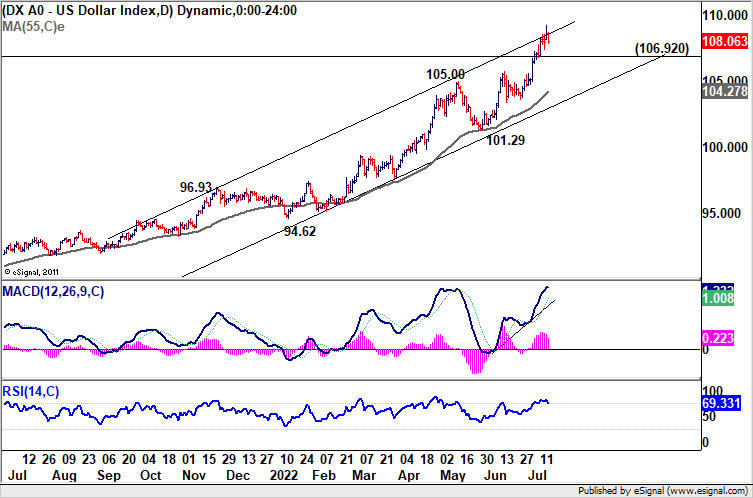
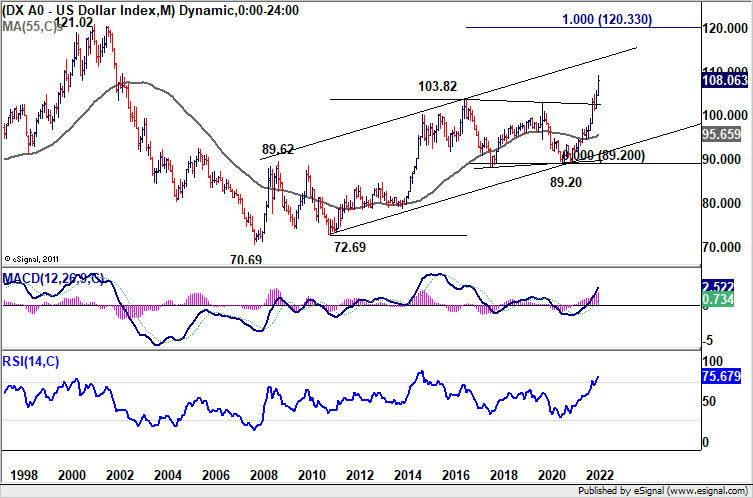
Dollar index's up trend continued last week but it's looking a bit stretched close to medium term channel resistance. Considering that risk-off sentiment might recede while treasury yield stay steady, a pull back in DXY is no unrealistic. Break of 106.92 support should indicate the start of a correction back to 55 day EMA (now at 104.27).
But of course, before break of 106.92 support, recent up trend is still in favor to continue, towards long term channel resistance (now at around 113).
EUR/USD to rebound after defending parity? Gold to reverse?
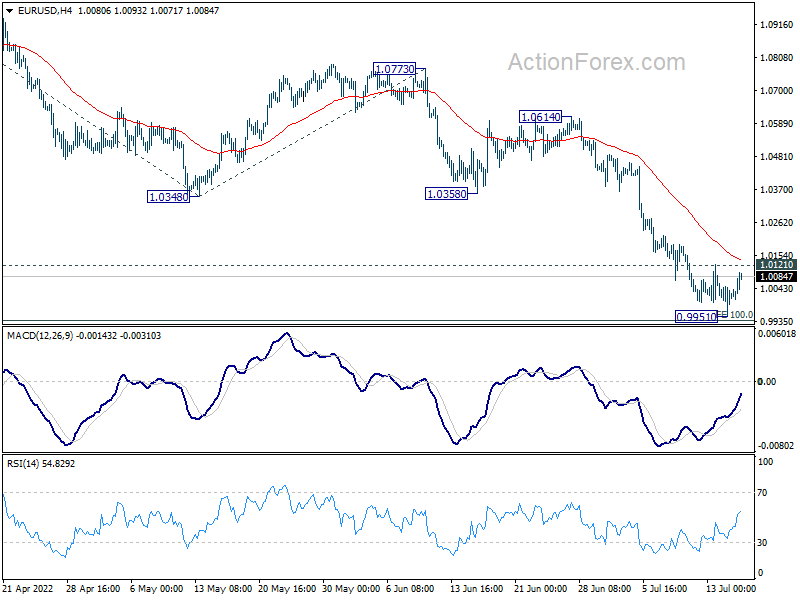
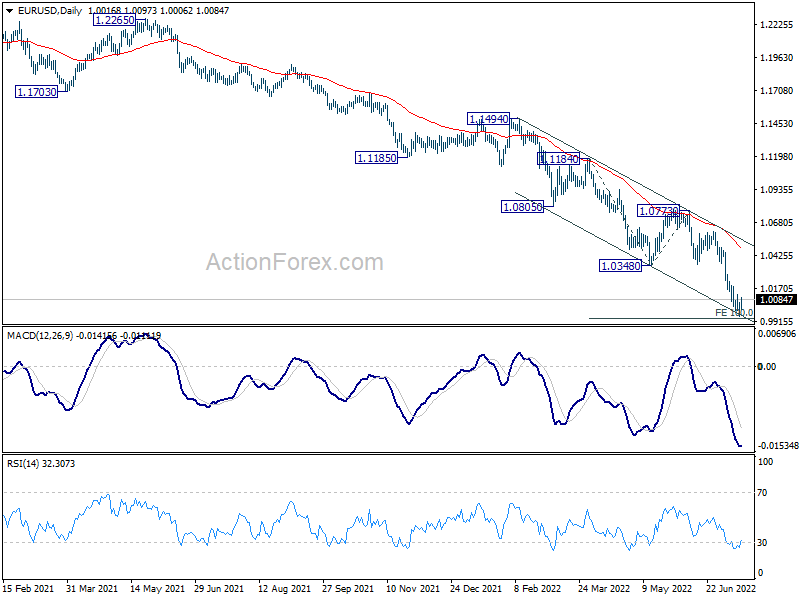
To further assess the chance of a pull back in Dollar, some attention is paid to both EUR/USD and Gold. EUR/USD is still defending parity, despite dipping to 0.9951. Downside momentum has been diminishing, as seen in 4 hour MACD, as it approached 100% projection of 1.1184 to 1.0348 from 1.0773 at 0.9937. A break above 1.0121 minor resistance will indicate short term bottoming, and bring stronger rebound back to 1.0348 support turned resistance.
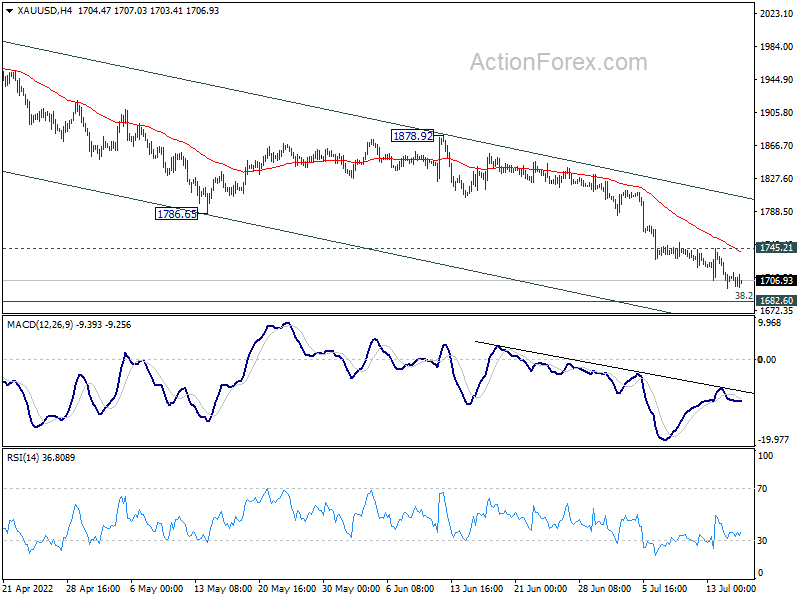
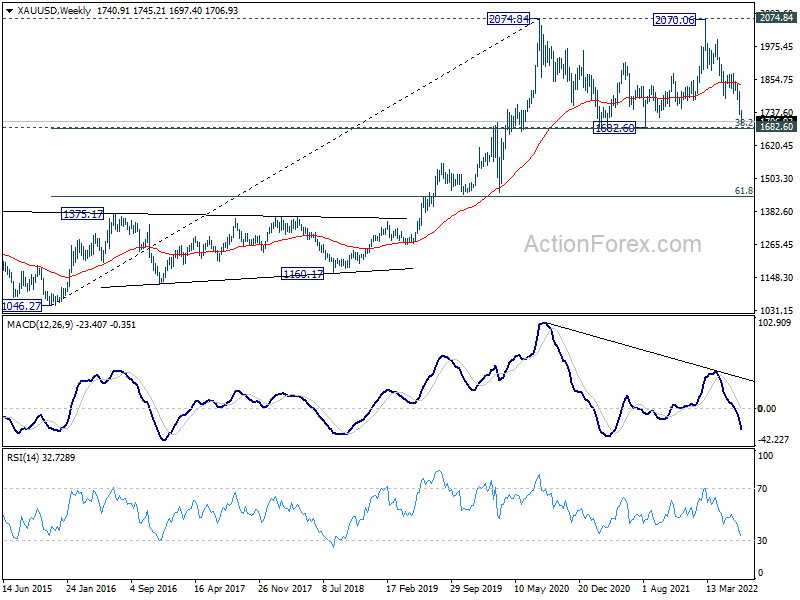
Gold is now close to an important long term support level at 1682.60, with 38.2% retracement of 1046.27 to 2074.84 at 1681.92. Strong support should be seen at this level to complete the three wave consolidation pattern from 2074.84 (2020 high). Break of 1745.21 minor resistance will be the first sign of reversal, and bring stronger rebound back to 1786.65/1878.92 resistance zone. If both EUR/USD and Gold manage to rebound, for the short term at least, Dollar should nautrally be starting a pull back.
USD/JPY Weekly Outlook
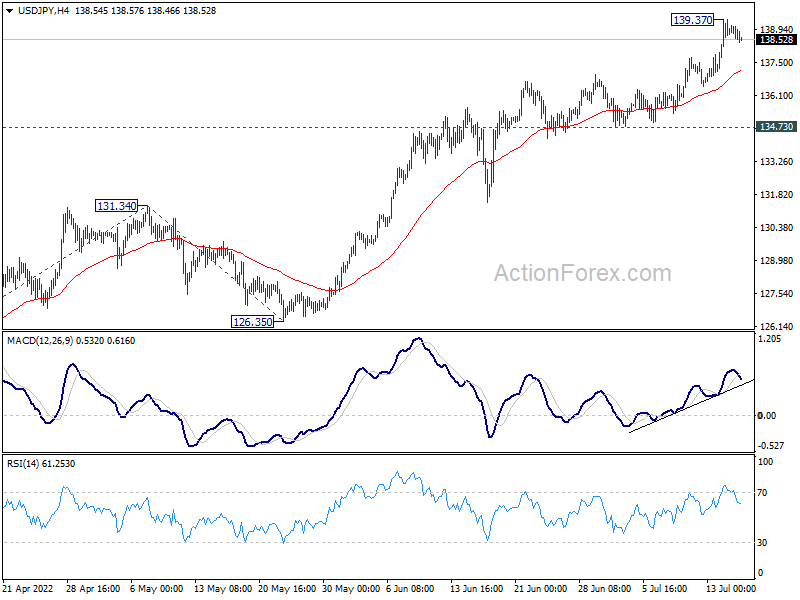
USD/JPY's up trend resumed last week and hit as high as 139.37. With a temporary top in place, initial bias is turned neutral this week for consolidations. But downside of retreat should be contained by 134.73 support. On the upside, break of 139.37 will resume larger up trend to 100% projection of 114.40 to 131.34 from 126.35 at 143.29.
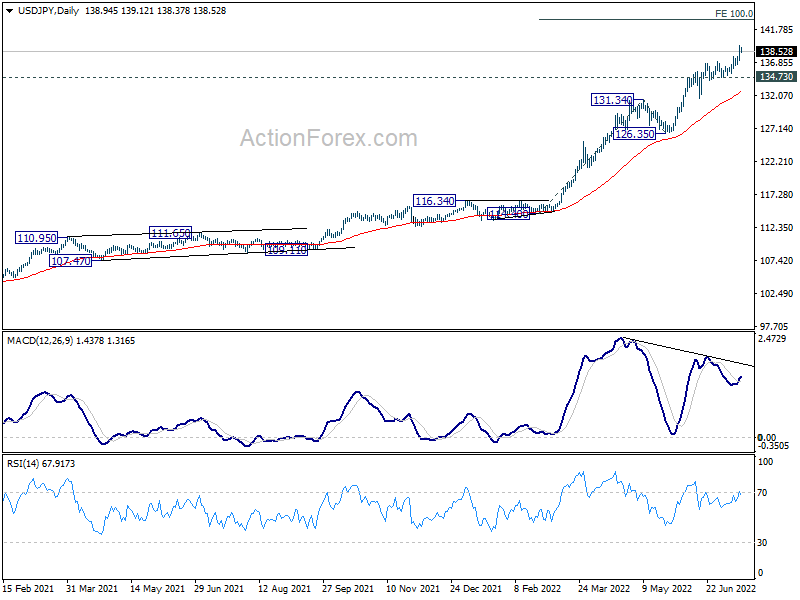
In the bigger picture, current rally is seen as part of the long term up trend from 75.56 (2011 low). Next target is 100% projection of 75.56 (2011 low) to 125.85 (2015 high) from 98.97 at 149.26, which is close to 147.68 (1998 high). This will remain the favored case as long as 126.35 support holds.
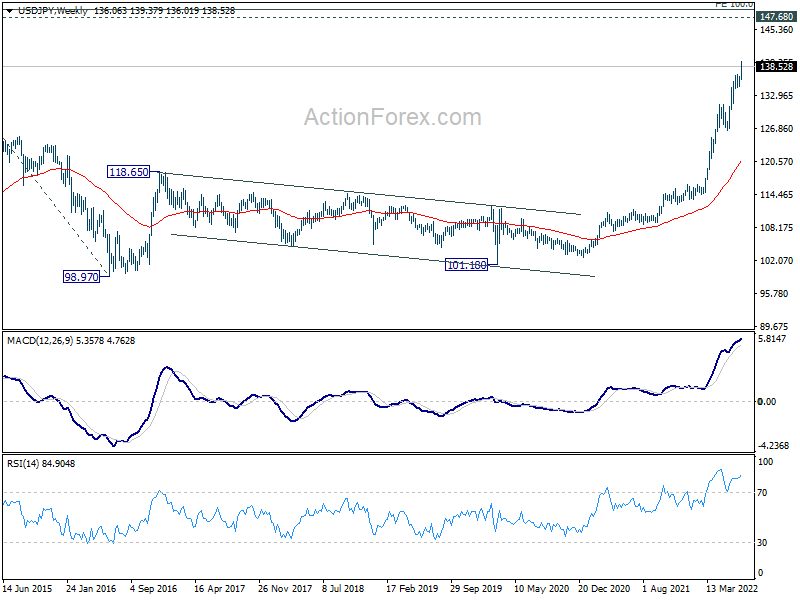
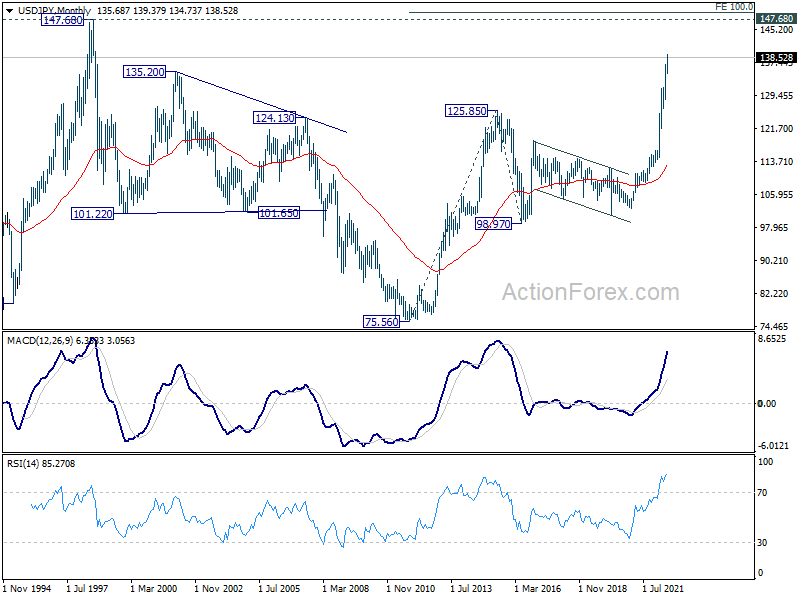
In the long term picture, the up trend from 75.56 (2011 low) long term bottom to 125.85 (2015 high) has just resumed. Next target is 100% projection of 75.56 (2011 low) to 125.85 (2015 high) from 98.97 at 149.26, which is close to 147.68 (1998 high).
Summary 7/18 – 7/22
Monday, Jul 18, 2022
[php_everywhere instance="1"]
Tuesday, Jul 19, 2022
[php_everywhere instance="2"]
Wednesday, Jul 20, 2022
[php_everywhere instance="3"]
Thursday, Jul 21, 2022
[php_everywhere instance="4"]
Friday, Jul 22, 2022
[php_everywhere instance="5"]
Weekly Economic & Financial Commentary: This Party Is Breaking Up Fast
Summary
United States: This Party Is Breaking Up Fast
- Signals of a slowdown are starting to flash across sectors. Business and consumer sentiment have faltered, real consumer spending has weakened, housing activity has stalled and business investment is downshifting in response. On the other hand, robust employment growth and solid gross domestic income suggest we are not in the hole just yet.
- Next week: Housing Starts (Tue), Existing Home Sales (Wed), Initial Jobless Claims (Thu)
International: U.K. Growth Surprises to the Upside, Bank of Canada Delivers a Super-Sized Hike
- U.K. GDP registered a gain in May, but some cracks in the economy may be starting to show, specifically with regard to the consumer sector. Elsewhere in the G10, the Bank of Canada delivered a super-sized 100 bps hike at its July monetary policy meeting, bringing the policy rate to 2.50% and signaling more rate hikes to come.
- Next week: U.K. CPI (Wed), Canada CPI (Wed), ECB Rate Decision (Thu)
Interest Rate Watch: Asset Inflation Is Already Being Curbed
- The Federal Reserve is continuing to reduce its balance sheet holdings of Treasuries and mortgage-backed securities (MBS), increasing the pace of the drawdown in September. However, the reduction of the MBS portfolio may prove to be difficult in the face of rising interest rates that have curtailed mortgage refinancing. We will also be on the lookout for liquidity challenges in the fall as the Fed's balance sheet is reduced.
Credit Market Insights: Record High for Monthly Auto Loan Payments
- The average monthly auto loan payment reached a record high of $712 in June with 12.7% of new car buyers paying at least $1,000 per month for their cars, according to Cox Automotive Inc. Ultimately, with peak inflation not yet behind us and a potential economic slowdown looming, household balance sheets may be further stressed by these large monthly payments.
Topic of the Week: Beige Book Heralds Slowing Growth, Inflation Fears, Recession Risk
- This week, the Federal Reserve released the Beige Book for its July meeting. Regional banks are describing situations seen across the country with some of the following language: slowing growth, inflation fears and even some risks of recession.
The Weekly Bottom Line: BoC Delivers Shock 1% Hike
U.S. Highlights
- Market sentiment soured this week on stronger than expected CPI data and a weak start to corporate earnings season.
- US CPI accelerated in June, rising 1.3% m/m, pushing the year-ago measure to a new multidecade high of 9.1%. Core inflation accelerated by 0.7% m/m, as hefty gains were seen across both goods (0.8% m/m) and service (0.7% m/m) categories.
- June retail sales surprised to upside, with both the headline (1% m/m) and control measure (0.8% m/m) recording decent nominal gains. However, sales were lower after adjusting for inflation.
Canadian Highlights
- The Bank of Canada delivered a surprise 1% rate hike this week as fears over high inflation persist.
- Existing home sales and house prices continue to decline as higher rates pressure markets.
- Next week, all eyes will be on the Canada CPI release, which is expected to show another leg up in inflation.
U.S. - Gotta Bend Before You Can Break
Market sentiment decisively shifted to risk-off mode this week, as a stronger than expected print on CPI and a weak start to corporate earnings season helped cast further doubt on the economic outlook. At the time of writing, the S&P 500 is down 2% on the week and has now had one of the worst starts to a year in nearly a century. The deteriorating market sentiment led to a further widening in the yield curve inversion – highlighting the growing fear among market participants that a recession may be on the horizon. The 10Y-2Y spread now sits at -20 basis points (bps). The sour market sentiment also spilled over to commodity markets, with WTI down 8% to $98 per-barrel on the week.
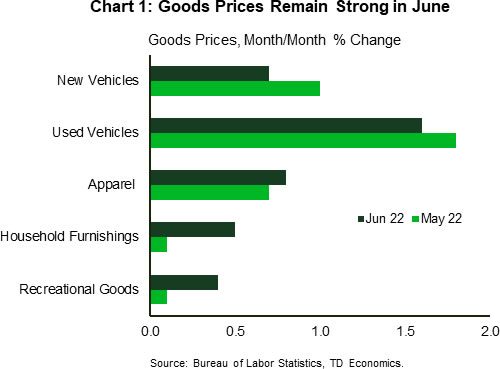
Any hopes of inflationary pressures easing in June were quickly dashed on Wednesday following the Bureau of Labor Statistics’ release of last month’s CPI data. Headline CPI accelerated by 1.3% month-on-month (m/m), pushing the year-ago measure to a new multidecade high of 9.1%. Indeed, with fuel prices having surged by 11% last month, and more recent gains in food prices showing incredible persistence, a further acceleration in the headline measure was inevitable. What was not anticipated, however, was the uptick in core inflation (0.7% m/m). Perhaps most disconcerting was the breadth in price gains across core, particularly among goods categories (Chart 1). Further gains in goods prices are at odds with more recent spending data, which has shown consumers pulling back on purchases of most discretionary goods in recent months. While inflation is notoriously a lagged indicator, it was thought that the combination of weakening demand and anecdotal reports of retailers carrying excess inventory would soon start to exert downward pressure on goods prices. That narrative has yet to come to fruition, and that detail will not be lost on policymakers when they meet later this month.
Perhaps one piece of encouraging news came from the July reading of the University of Michigan consumer confidence survey, which showed that expectations for inflation over the next five years now sit at 2.8% – down from last month’s reading of 3.1% (Chart 2). Chair Powell highlighted the recent upward drift in inflation expectations as being one of the key contributors in the FOMC’s decision to raise rates more forcefully in June. While the turn lower will provide some relief to policymakers, it won’t be enough to dissuade them from pushing ahead with another supersized hike later this month. This sentiment has been mirrored in market pricing, with odds a near coin toss on whether the Fed will raise by 75bps or 100bps.
The big question now is to what extent higher interest rates will ultimately weigh on domestic demand. Retail sales data for June showed that consumers are remaining somewhat resilient, with both headline (1.0% m/m) and the control (0.8% m/m) up on the month. That said, consumer spending is only tracking around 1% q/q (annualized) for the second quarter, which is a marked slowdown from the 4.5% averaged through the second half of last year. With inflation continuing to erode purchasing power and rates expected to move decisively higher through year-end, the hope is that consumers will only bend under the weight of the dual-income shock and not completely break.
Canada - BoC Delivers Shock 1% Hike
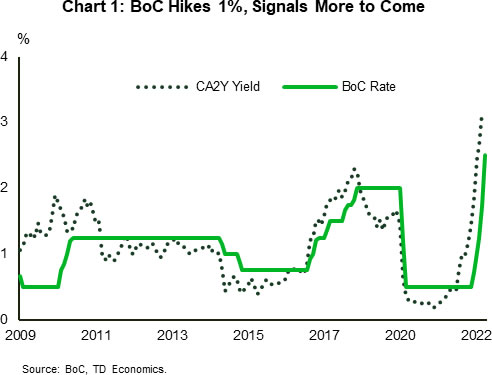
The Bank of Canada (BoC) made global headlines this week as it delivered on a super upsized rate hike of 1% (Chart 1). Though we are running out of superlatives to describe the magnitude of the BoC's actions, expectations are for more to come as inflation is poised to continue to run at elevated levels. Financial market participants are expecting 1% to 1.25% in additional rate hikes over this year.
BoC Cuts Growth, Upgrades Inflation
In the BoC's accompanying Monetary Policy Statement there were a number of nuggets the revealed insight into the Bank's thinking. The first is the change in their growth forecast. The Bank stated that economic growth will slow from 3.5% this year to 1.75% in 2023, as global economic momentum decelerates on the back of higher global interest rates and high inflation.
On inflation, the BoC's new forecast shows that it believes CPI will remain around 8% over the coming months and decelerate to only 7.5% by the end of this year, reaching 3.2% by the end of 2023. That means the central bank doesn't think it will be able to bring inflation down to the target band (1%-3%) within its 12-18 month monetary policy window. Given the recent Business Outlook Survey and Canadian Survey of Consumer Expectations, which showed an unmooring of inflation expectations over the forecast horizon, the Bank of Canada's forecast of higher inflation for longer hits the spot.
We also got data on Canadian existing home sales and home prices on Friday. Following the recent trend, sales declined another 5.6% month-over-month (m/m). Combined with the 4.1% m/m rise in new listings, the sales-to-listings ratio continued to fall further into balanced territory (51.7%). This caused the average Canadian home price to drop another 4.3% m/m, pushing the peak-to-trough decline to a whopping -14% since February.
Looking Ahead to Next Week
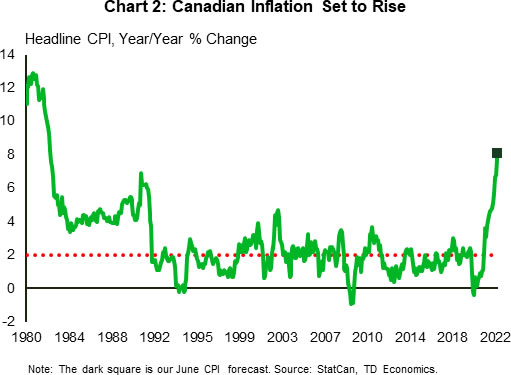
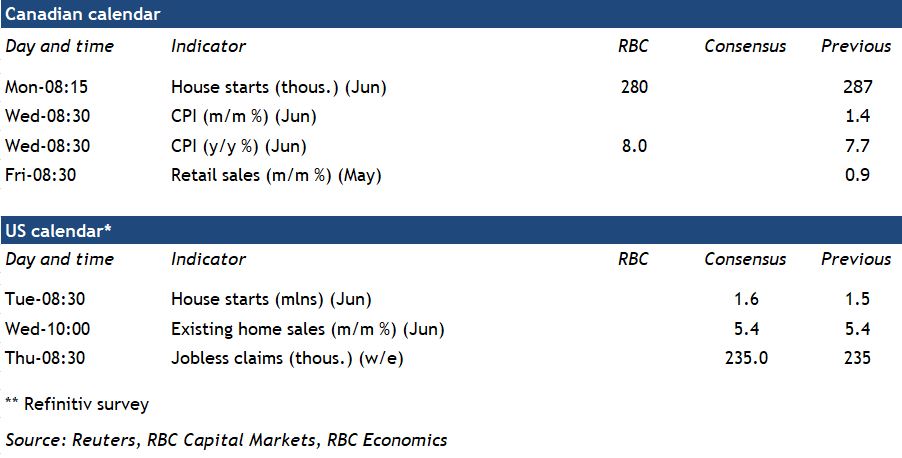
All eyes will be on Wednesday's CPI release next week. With inflation already at 7.7% year-on-year, expectations are for a +8% reading on the headline number (Chart 2). We are looking to see further increases in price pressures on food and fuel, which have been the main drivers of inflation over the last few months. Any surprise to the upside on inflation will likely cause markets to price even more hikes by the BoC. Recent re-pricing has caused the Canada 2-year to continue to rise, while the Canada 10-year has remained stable just above 3%. This has pushed the 10-year/2-year yield spread (a popular signal of recession) even deeper into negative territory. Though the BoC is still forecasting a soft landing, where it raises rates without causing recession, markets are preparing for a bumpy ride.
Week Ahead – Rate Hikes Galore
Fighting inflation
Next week offers a plethora of monetary policy meetings with the ECB, BoJ, CBRT, SARB and CBR among those. Central banks have mostly been racing to raise interest rates while watching official inflation data surpass their targets multiple times over. While those rate hikes will eventually bring inflation down, the economic cost is mounting.
The week ahead brings an interesting combination of those hiking aggressively, only just starting, not doing anything and one that has a bigger inflation problem than all of the others put together and that in the last year has cut the repo rate by 5%. It’s some mix.
The US is silent on the central bank front, with the blackout period that starts this weekend ahead of the Fed meeting on 26-27 July preventing policymakers from speaking publicly. Earnings season is underway though and there’s plenty of economic data which should keep us all busy.
US
It will be a busy week filled with the conclusion of President Biden’s Mideast trip, economic data and earnings. Wall Street will get a better handle on how quickly the economy is weakening and this might be the week that makes more traders price in a recession by the end of the year. Risk appetite will likely react to key earnings from Netflix, J&J, American Express, Bank of America, and Goldman Sachs.
The housing market is cooling but this week’s data is expected to show signs that sales and housing starts are stabilizing. Traders will closely watch the preliminary July PMI readings that are getting dangerously close to showing manufacturing activity is contracting.
EU
It’s not hard to see what the highlight next week will be. The ECB will be hoping for some good news ahead of the meeting on Tuesday when the final inflation data is released. Unfortunately for the central bank, it likely won’t be forthcoming, meaning policymakers will be left to choose between a 25 basis point hike or a super-sized lift-off. Markets are pricing in the former but there is an outside chance of more. The week wraps up with flash PMIs on Friday.
Scheduled maintenance on Nord Stream 1 remains a major concern for Europe facing an energy crisis this winter, with some suggesting gas may not flow once completed, as planned. That would severely disrupt attempts to fill storage ahead of the winter and potentially lead to much higher prices and power cuts.
UK
There is plenty of economic data to look forward to next week with labour market figures on Tuesday, inflation on Wednesday, and retail sales and PMIs on Friday. Among that, we’ll also hear from members of the MPC including Governor Andrew Bailey on Tuesday.
This takes place against the backdrop of the race to be Conservative party leader and therefore Prime Minister. The impact on the markets has been minimal so far.
Russia
The Russian central bank is expected to cut the key rate by 50 basis points to 9% next Friday, below the pre-invasion rate, but there is scope for a larger cut. A strong currency on the back of capital controls, strong commodity exports and weak imports has given the CBR room to cut the rate further in order to support the economy. As yet, it has done little to reverse the substantial appreciation in the rouble.
South Africa
The SARB will be hoping for a friendly CPI reading a day before its meeting next week although it will probably have little impact on the outcome. A 50 basis point rate hike is widely expected, bringing the repo rate to 5.25%, but it may be more aggressive with 75 possible. Inflation hit 6.5% in May and is expected to reach 7.2% in June, above its 3-6% target range.
Turkey
Inflation hit 78.62% in June and the lira is back trading around the December and June lows. So naturally, the CBRT is widely expected to leave interest rates unchanged next week at 14%, insist the new model will work and blame everything else for the inflation mess. Capital controls remain the policy of choice and any deviation from that towards normality would come as a massive shock to the markets.
Switzerland
Very little of interest next week, with trade balance data the only release.
China
It is a lighter week for data next week in China, with just the one and five-year Loan Prime rate decisions on Wednesday. Any cuts would be very unexpected given the MTF was left unchanged this week. A surprise cut could be an immediate boost for local equities.
China equities remain under pressure amid concerns over financial stability as more Chinese citizens refuse to pay mortgages due to apartments being incomplete or late. That has added pressure to the already embattled property developer sector.
Elsewhere, zero-covid lockdown worries persist, while concerns are rising about new tech clampdowns after Alibaba management were called to meet the police over a one billion person data theft from a police database hosted on the Alibaba cloud.
India
No significant data in the week ahead. Foreign investors have continued to sell out of Sensex holdings heavily, weighing on the rupee. USD/INR remains near record highs as the current account deteriorates due to high energy prices and domestic export restrictions. The RBI appears to be intervening to cap USD/IDR near 80.00, but strong US data could see another bout of INR selling. The RBI may well be considering another unscheduled rate hike, which could be negative for equities.
Australia
The Australian dollar remains at the mercy of international investor sentiment flows, and it must now also contend with slumping iron ore and copper prices which are also capping local equities.
Impressive Australian employment data has put more and faster tightening by the RBA on the agenda for markets. The RBA minutes on Tuesday and Governor Lowes’ speech on Wednesday will be closely watched for signs that the central bank is moving to a more hawkish stance. That could be negative for equities.
New Zealand
New Zealand releases key inflation data on Monday. The data has upside risks and could edge market sentiment towards more and larger rate hikes by the RBNZ, in much the same fashion as the RBA. That could be negative for local equities.
The New Zealand dollar remains at the mercy of international investor sentiment flows.
Japan
Japan has a heavy data week ahead with all attention on the Bank of Japan policy decision on Thursday. The BOJ should maintain rates at -0.10% with a 0.25% cap remaining on the 10-year JGBs. Any changes to this policy could cause major ructions in USD/JPY. It releases PMI and Inflation on Friday.
USD/JPY has continued to rally this past week, peering over 139.00. Rhetoric is coming out of Tokyo expressing concerns about the USD/JPY rally. A rise above 140.00 next week, if it happens in a disorderly manner, could spark some unilateral intervention by the BOJ.
Singapore
Having unexpectedly tightened monetary policy this past week, there should be no further moves by the MAS until October. SGD strength lasted for less than 24 hours suggesting that the trajectory of US interest rates is still the primary driver of weakness.
Singapore releases non-oil exports on Monday, which are expected to retreat from May’s data. A more modest fall could be a short-term positive for local equities, as could a healthy trade balance release, also on Monday.
Economic Calendar
Saturday, July 16
Economic Events
- Meeting of G20 finance ministers and central bank governors continues in Indonesia
Sunday, July 17
Economic Events
- US President Joe Biden finishes up his Mideast trip
Monday, July 18
Economic Data/Events
- US cross-border investment
- Italy trade
- Spain trade
- Singapore trade
- Canada housing starts
- New Zealand CPI
- BOE Monetary Policy Committee member Michael Saunders to deliver a speech at the Resolution Foundation
Tuesday, July 19
Economic Data/Events
- US housing starts
- Eurozone CPI
- Hong Kong jobless rate
- Mexico international reserves
- UK jobless claims, unemployment
- US Treasury Secretary Janet Yellen travels to South Korea
- Australia’s RBA Minutes of its July policy meeting; Deputy Governor Bullock speaks
- UK Chancellor Zahawi and BOE Governor Bailey address the annual Mansion House event
- Bloomberg Crypto Summit in New York
Wednesday, July 20
Economic Data/Events
- US existing home sales
- Canada CPI
- South Africa CPI
- UK CPI
- China loan prime rates
- Eurozone consumer confidence
- UK PPI
- EIA crude oil inventory report
Thursday, July 21
Economic Data/Events
- US initial jobless claims, Conf. Board leading index
- ECB rate decision: Expected to raise rates by 25bps
- BOJ rate decision: No change with policy rate and yield target expected
- South Africa (SARB) rate decision: Expected to raise rates by 50bps
- Turkey rate decision: No change with rates expected
- Japan Trade
- New Zealand Trade
- Nord Stream 1 pipeline is scheduled to reopen following maintenance
Friday, July 22
Economic Data/Events
- Japan CPI
- European Flash PMI Readings: Eurozone, France, Germany, U.K.
- Canada retail sales
- Russia rate decision: Expected to cut rates by 50bps
- Eurozone ECB survey of professional forecasters
- Bank of Russia board of directors meeting on monetary policy issues
Sovereign Rating Updates
- Hungary (Fitch)
- Ireland (Fitch)
- Poland (Fitch)
- Ukraine (Fitch)
- EFSF (DBRS)
- ESM (DBRS)
ECB Preview – We Have Lift Off
Stagflation risks are building in the euro area, sharpening the policy dilemma for ECB. With inflation still taking precedence over the clouding growth outlook, we expect ECB to go ahead with its intention to hike all three policy rates by 25bp in July.
The pace of further rate increases will depend on how the economy evolves, but we do not anticipate any guidance for the Q4 monetary policy outlook at the July meeting. As visibility remains low, we expect increased market volatility to persist in the near-term, but still see ECB as priced too aggressively by the market for 2023, especially with the Federal Reserve priced for a 50bp rate cut in 2023. Currently markets are pricing in a tightening of 141bp in 2022 from ECB and another 43bp in 2023. Any frontloading ECB hikes is unlikely to support EUR/USD in our view.
Designing a credible anti-fragmentation tool is key, for markets not to call the bluff on ECB and send Italian yields sharply higher again. We expect the new instrument to be implemented in a flexible manner, with focus on shorter maturities, but without a pre-set intervention amount or timeframe. We also expect purchases to be sterilized in order not to interfere with the monetary policy stance, but we see only a small probability of ECB outright selling bonds.
Forward Guidance: Canadian Inflation Continued to Heat Up in June
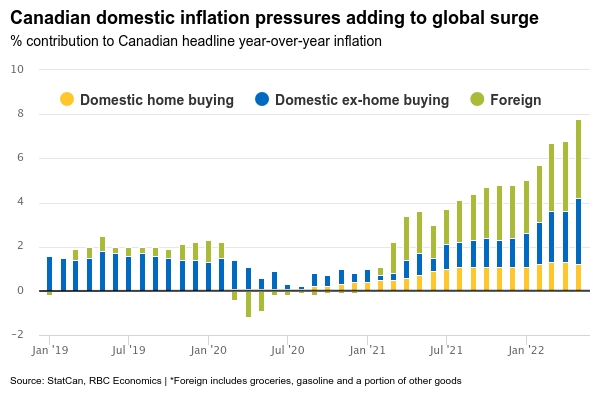
Canada’s June inflation report will be front and center next week after U.S. inflation reached its highest level in four decades (at 9.1%). We anticipate Canada’s inflation rate will edge up to 8.0% from a year ago. That would be the highest since 1982. This continued acceleration was likely largely driven by higher food and energy prices – both of which have been boosted by global pressures. Oil prices rose another 4.8% from May and consumer food prices have been surging in part due to higher commodity prices and acute supply chain disruptions. Roughly half of inflation recently has been driven by forces beyond our borders by our count.
Some of those global price pressures have shown clear signs of easing, and we are cautiously optimistic that price growth will slow in the near-term. Global shipping costs (and times) have declined and wheat prices have reversed their surge on the initial Russian invasion of Ukraine. Oil prices have fallen 20% from early June, pushing gasoline prices lower into July. The largest domestic driver of inflation to-date has been higher house prices – and those have also shifted into reverse as early interest rate hikes cool housing markets.
Still, businesses are grappling with acute labour shortages and surging wage growth. Consumer demand is still very strong and the persistence of very high price growth has been pushing longer-run inflation expectations higher. Against that backdrop, inflation pressures are unlikely to ease sustainably to the BoC’s 1% to 3% target range until the economy, and labour markets, have cooled substantially. This week, the Bank of Canada “forcefully” hiked rates by a full percentage point to 2.5% (the mid-point of what the central bank sees as a ‘neutral’ 2% to 3% range), and flagged more hikes to come.
Week ahead data watch:
Statistics Canada’s advance estimate of Canadian may retail sales was up 1.6% from May. Our own tracking of card transactions is pointing to still high levels of consumer demand in June, supported also by recovering travel and hospitality spending, although spending has shown signs of plateauing at high levels.
Canadian housing starts are expected to fall slightly in June to 280,000 units- a level that is still extremely strong and consistent with the 276,000 permits issued the prior month in May. Lingering effects of strikes in the construction industry may impact June data, but will not drag on since negotiations have since been settled.
Week Ahead – Pressure Mounts on ECB and BoJ After Latest Dollar Surge
After another sizzling-hot inflation report out of the United States, the European Central Bank and Bank of Japan will meet against the worrisome setting of their currencies plunging. The former is expected to launch its tightening cycle, but the latter may make a surprise policy move even though it has not signalled any action. It’s looking to be an eventful week on the data front as well, as the flash PMI estimates for July and inflation numbers are due in several countries.
ECB to hike by 25 bps but what will follow?
There can be no doubt that the ECB is late to the game when it comes to the tightening race, but policymakers will be hoping to send the right message when they hike rates for the first time in more than a decade on Thursday, by 25 basis point.
Eurozone inflation reached 8.6% y/y in June according to the flash reading and that figure is expected to be confirmed on Tuesday. The ECB’s decision to outline its plan for a series of rate increases rather than just a couple at the last meeting was seen as very hawkish and the bank will want to underscore its intentions by possibly flagging a 50-bps hike for September.
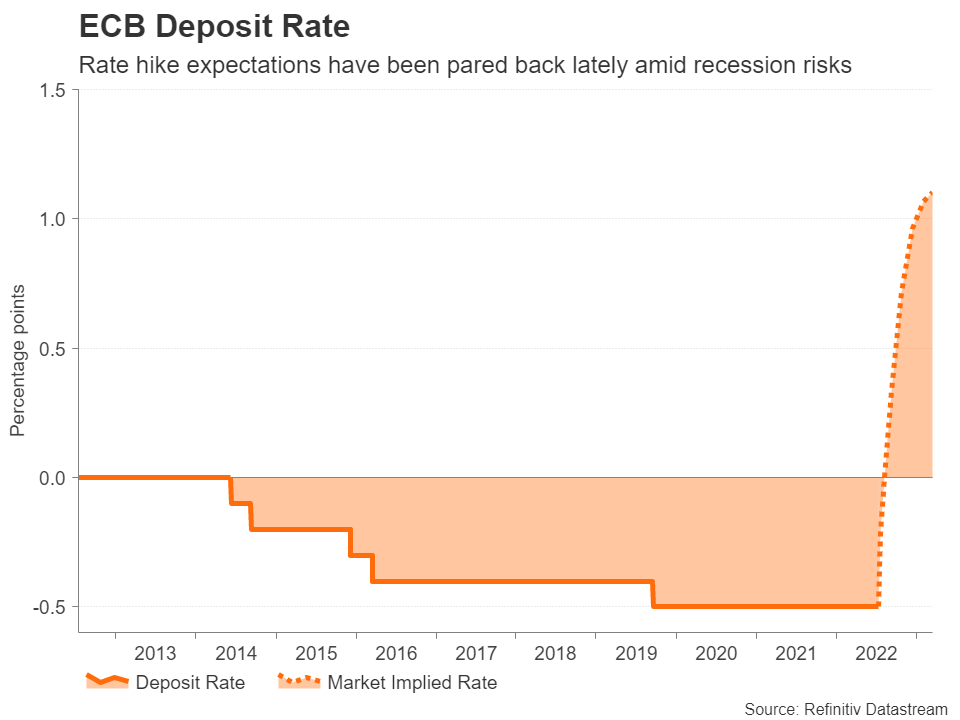
But the euro, which has been flirting with parity with the dollar all week, is unlikely to get much of a lift even if policymakers make another hawkish pivot as worries about the growth outlook are weighing on the currency, while the US dollar is being jointly boosted by an even more hawkish Fed and safe-haven flows.
If the ECB finalizes the details on how it intends to tackle fragmentation risks in Eurozone bond markets, that could turn out to be a bigger positive driver for the euro than hints that large rate hikes are on the way.
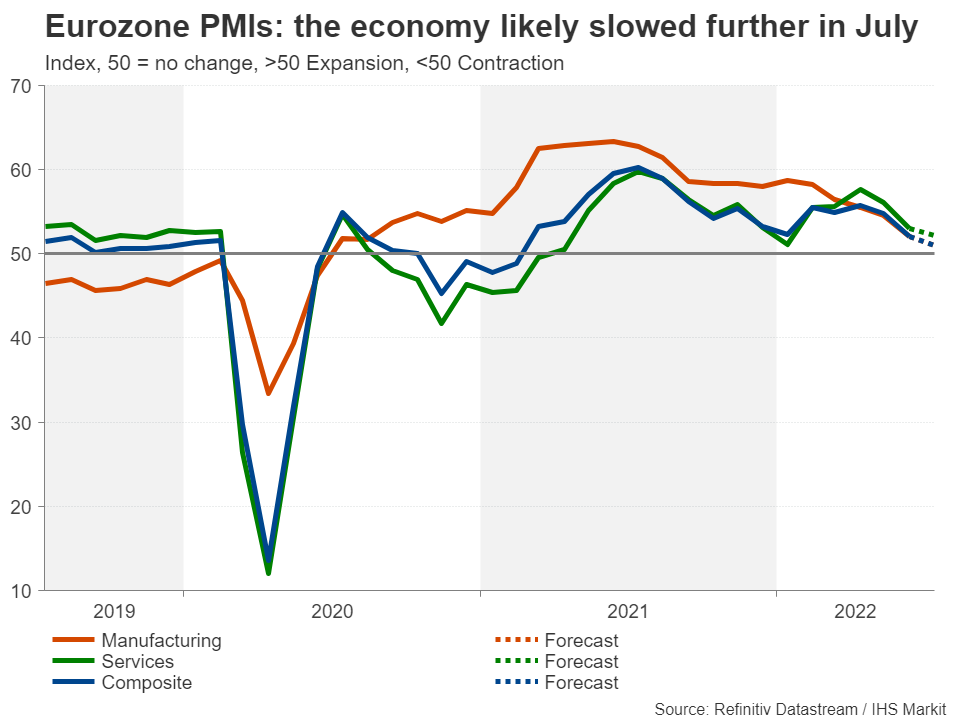
However, the euro will face more danger on Friday from S&P Global’s flash PMI data for July. Economic activity slowed markedly in June as businesses were impacted from soaring input costs and energy prices, as well as easing demand. A further slowdown is expected in July, with the composite PMI forecast to edge down from 52.0 to 51.0.
Bank of Japan is a wildcard
Another currency that has come under the wrath of the mighty dollar is the Japanese yen. The Bank of Japan’s refusal to abandon its controversial yield curve control policy at a time when all other central banks are aggressively raising interest rates has pushed the yen on the verge of hitting the 140 per dollar barrier for the first time in 24 years.
It can be argued that under the circumstances, the BoJ has been fairly successful in defending the 0.25% upper limit of its zero percent target on the 10-year yield. However, it may only be a matter of time before market forces take over and the BoJ suffers a humiliating U-turn. Hence, policymakers might decide that tweaking the policy now of their own accord when they meet on Thursday would save them a lot of headache later on.
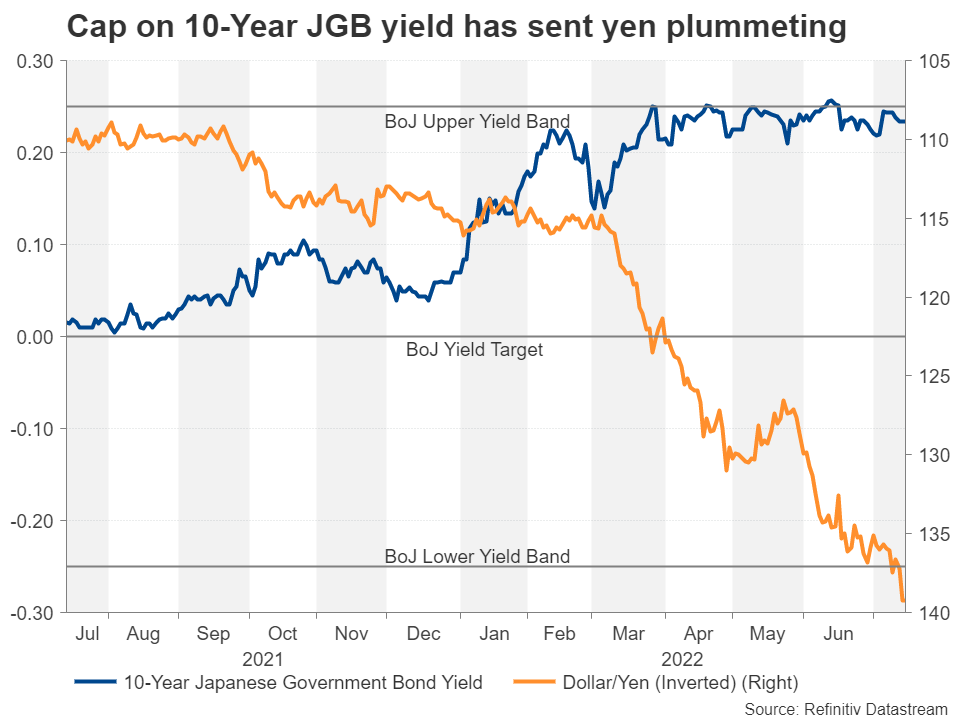
On Friday, policymakers will be keeping a close eye on the June CPI figures. The core consumer price index, which only excludes food prices and is targeted by the BoJ, stood at 2.1% y/y in May and is projected to edge up to 2.2% in June. But other underlying measures that additionally strip out energy prices remain below 1%. This is why Governor Haruhiko Kuroda has stuck to his guns, insisting that there is no sign yet of inflation meeting the 2% goal sustainably.
Pound doesn’t have a lot to cheer about
Over in the UK, the pound could hit some turbulence amid a flurry of data releases. Kicking things off on Tuesday is the employment report, followed by CPI numbers on Wednesday and retail sales and the flash PMIs on Friday.
The British economy eked out a surprise growth in May and GDP was revised higher in the prior two months. This puts the Bank of England in a much more comfortable position to speed up its rate increases in August. Yet, sterling has kept on slipping against the dollar.
Like the euro area, the UK is highly exposed to the energy crisis and the latest political developments in Westminster have cast a further shadow over the country’s economic prospects.
Headline inflation jumped to 9.1% y/y in May and another acceleration would boost the odds of the Bank of England raising rates by 50 bps at its next meeting.
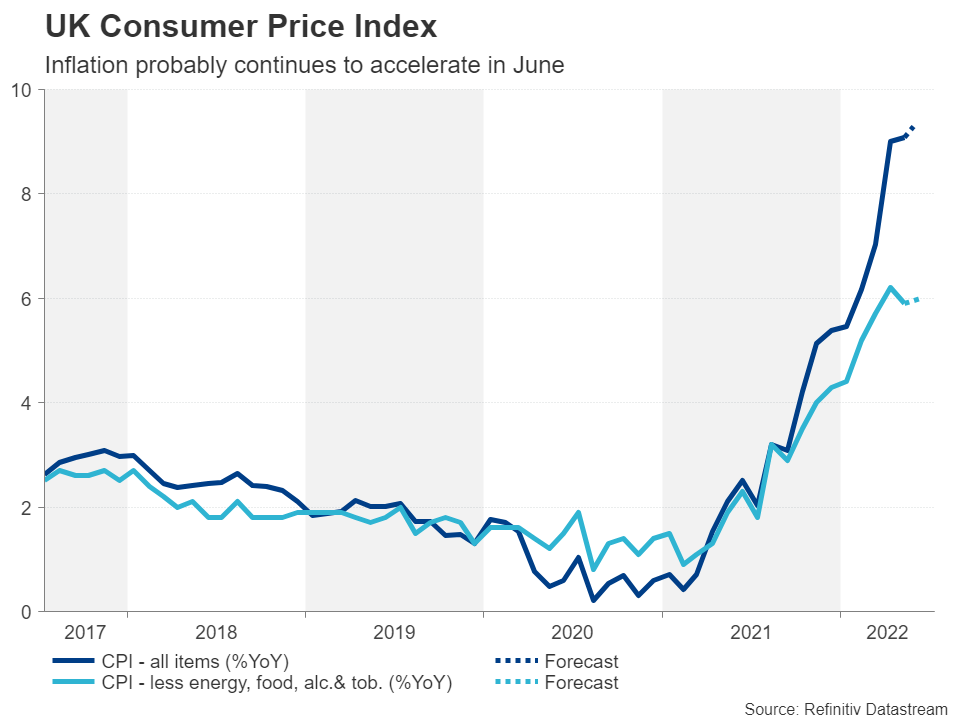
However, it’s unlikely that this would halt the pound’s slide as it may only add to stagflation fears. But there could be some support from any upbeat readings in the other data points.
Rising inflation is adding to recession bets
CPI and retail sales numbers are due in Canada too next week and the loonie may similarly not benefit from a further rise in inflation. The Bank of Canada shocked markets when it hiked rates by a whopping 100 bps. But the Canadian dollar has instead nosedived to the lowest since November 2020 versus the greenback.
Investors are clearly nervous that frontloading rate increases will only heighten the risk of a recession, even in Canada whose economy currently is among the strongest in the G20.
In Australia, the minutes of the Reserve Bank of Australia’s June meeting will be monitored on Tuesday for any clues that policymakers down under are considering going down the Fed and BoC route after two successive 50-bps hikes.
The Reserve Bank of New Zealand is in the same predicament and Q2 CPI data out on Monday might guide markets as to whether the pace of tightening is more likely to slow down or speed up.
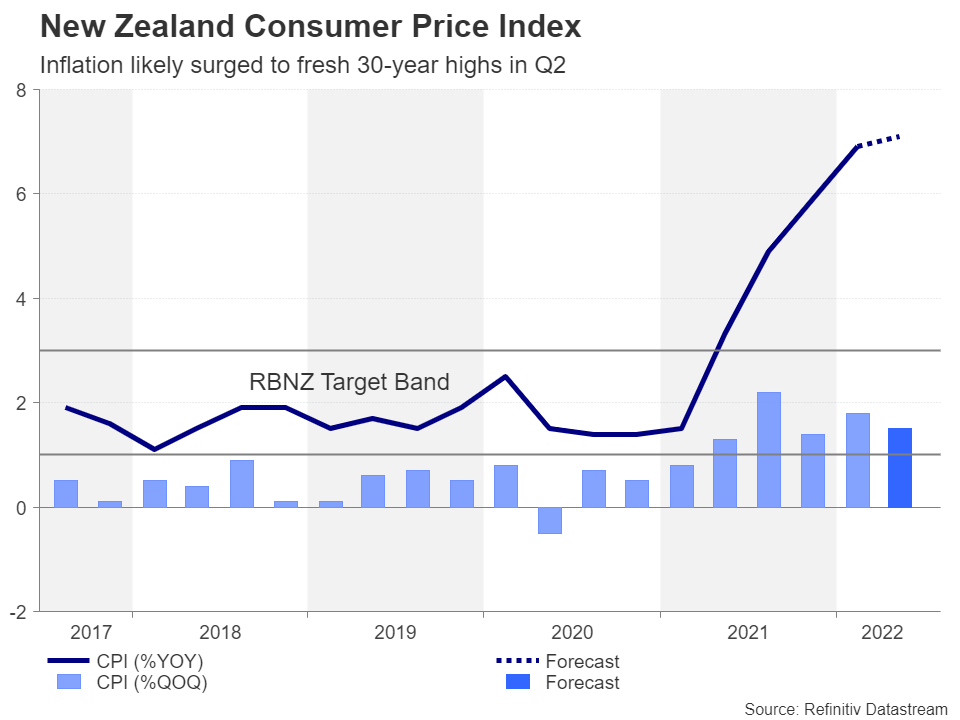
Overall, however, domestic tightening speculation will play second fiddle to bets about the Fed and general risk sentiment as far as the commodity-linked dollars are concerned.
Some downtime for USD bulls?
Expectations that the Fed could raise rates by 100 bps skyrocketed after US inflation hit a fresh four-decade high of 9.1% y/y in June, fuelling the dollar rally. The dollar index soared to 20-year highs above the 109 level in the aftermath.
But a batch of housing data for June next week pose some downside risks. Building permits are due on Tuesday along with housing starts, and existing home sales follow on Wednesday.
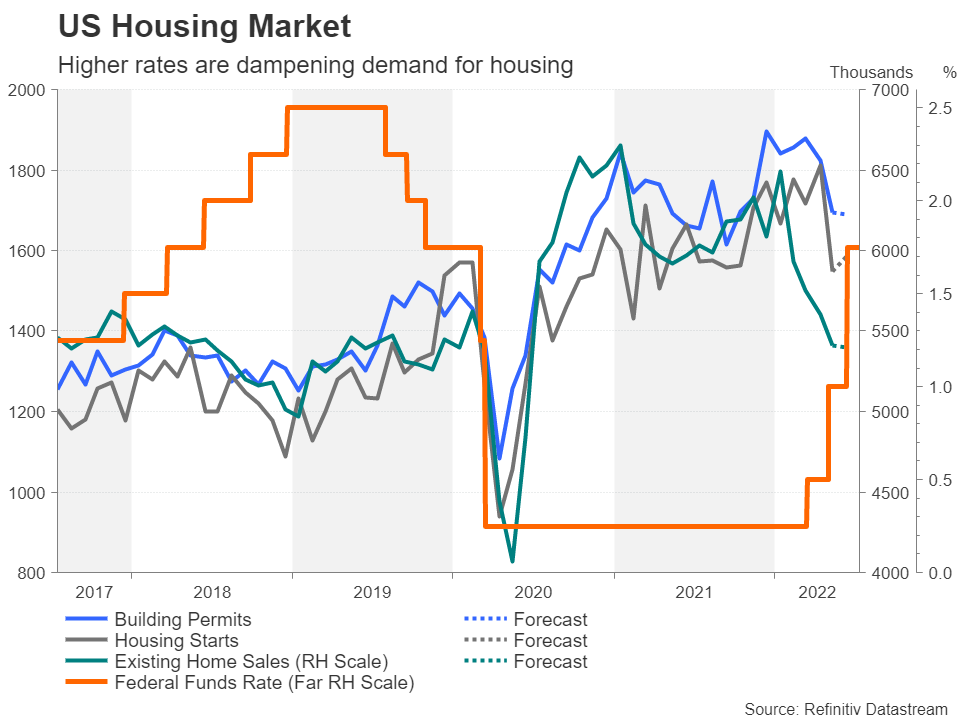
Also important will be the Philly Fed manufacturing index on Thursday and the flash July PMIs on Friday.
In a relatively quieter week, investors may sit on the sidelines as they await the next FOMC decision on July 27, unless of course there are fresh risk-off episodes that drive more funds into the world’s number one reserve currency.
One such episode to watch out for is whether Russia will turn the taps back on when scheduled maintenance on Europe’s Nord Stream 1 gas pipeline is completed on July 21.
With Signs of US Price Pressure Decline, Will Fed Soften its Approach?
Although US retail sales figures are often the more important news, their slight overshooting relative to expectations has, in our view, less impact on markets than the import price index.
According to preliminary estimates, US sales rose by 1% in June against expectations of 0.9% and a 0.1% contraction a month earlier. Not too much better than expected, given that volume is not price-adjusted, which was higher than expected earlier in the week.
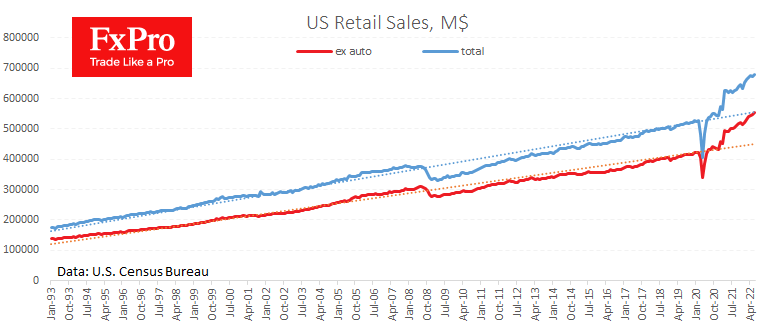
The good news for market participants is the cooling of import price increases. For the month, the index added 0.2% vs 0.7% expected and to 10.7% y/y versus 11.6% a month earlier, with 12.1% forecasted.
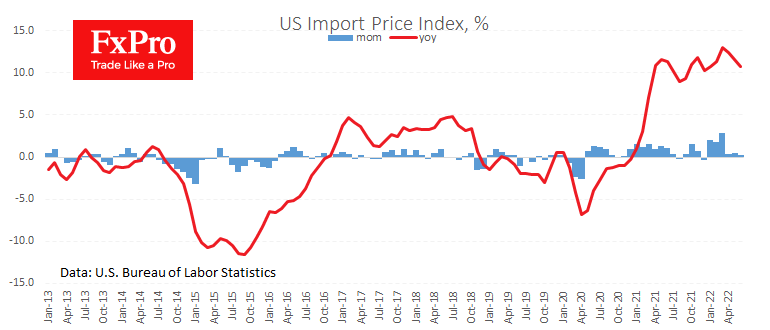
This deceleration results from the correction in commodity prices and the strengthening of the dollar in previous weeks. But most importantly, this index indicates that the peak of the rate of price increases is over.
More signs of a bullish trend reversal in prices might ease the Fed’s pressure on the key rate. Market participants are now trying to weigh the chances of a one percentage point hike in a week and a half. A softening of their expectations could trigger a corrective pullback in the dollar and an attempted equity market recovery.
Will the Euro Continue to Fall Below Parity?
EURUSD hit the so-called parity level of 1.0000 and dipped below it. Why there's so much talk about this? First, the euro dropping below the $1 level is rare. Still, what does the euro/dollar parity even mean? It means that the European and American currencies equal the same amount. One euro equals one dollar.
Why is the euro's parity with the dollar a big deal?
Since the birth of the single European currency in 1999, it has fallen below parity only once. That occurred between 1999 and 2002 when the euro plunged to a record low of $0.82 in October 2000. During the euro's relatively short history of about 20 years, it was the second most widely held currency in foreign exchange reserves after the US dollar.
What does drive the Euro's weakness?
1. The US Federal Reserve raised interest rates to fight the highest inflation in 40 years, which reached 9.1%. That boosted the dollar's attractiveness and strength, in addition to the growing global recession fears that pushed markets to the US dollar as a safe haven.
2. The ECB is not following the Fed-led tightening cycle. The European Central Bank is expected to raise rates at its next meeting on July 21. However, it won't be enough to keep pace with the Fed's fast speed, which is considering raising rates by 75 points, or a full 100 points (1%), at its next meeting on July 28.
3. Fears are growing that rising gas prices will make the Eurozone more vulnerable to recession risks. That explains why the euro is taking a heavy hit now. Some global banks expect a recession in the Eurozone in the third quarter of this year.
4. High energy prices and the highest inflation in the history of the Eurozone. Energy prices in Europe rose due to the war in Ukraine, the loss of Russian oil from world markets, and Russia's cutting off gas supplies to Europe. Europe relies more on Russian oil and natural gas than the US to maintain production, industry, and electricity generation. That drove inflation in the Eurozone to a record high of 8.6% in June, making everything from groceries to electricity and utility bills more expensive while the Euro's value has weakened.
5. The US economy is stronger than the European economy. The US is on the path to economic recovery faster than the Eurozone, which is on the verge of falling into recession.
The Euro is not the only one affected by the dollar's strength, but everything is weak against the US currency. This year, the British pound and the Japanese yen have fallen strongly against the dollar.
What does this mean for the ECB?
The current fall of the euro is a big headache and a terrifying challenge for the European Central Bank because the euro has weakened not only against the dollar but also against other currencies such as the Swiss franc and the Japanese yen.
The ongoing euro weakness will push already high inflation rates higher, increasing the risk of prices rooting above the ECB's 2% target. It requires more rapid rate hikes to stop the euro from bleeding against the dollar, which could add to the misery in Europe, which is already facing a possible recession.
If Europe enters recession, especially Germany, this might stop the ECB's rate hikes, as it will worsen the situation. In the meantime, the dollar and the US economy will grow stronger, widening the gap between USD and EUR.
Will the euro continue to fall below parity?
Unfortunately, the EUR's decline against the USD is expected to continue. It may drop to $0.97-$0.95 in the near term. The euro will remain stagnant as Europe's energy crisis worsens. Even if the ECB raises rates, the Fed is faster and more aggressive.