

Sample Category Title
GBPJPY Wave Analysis
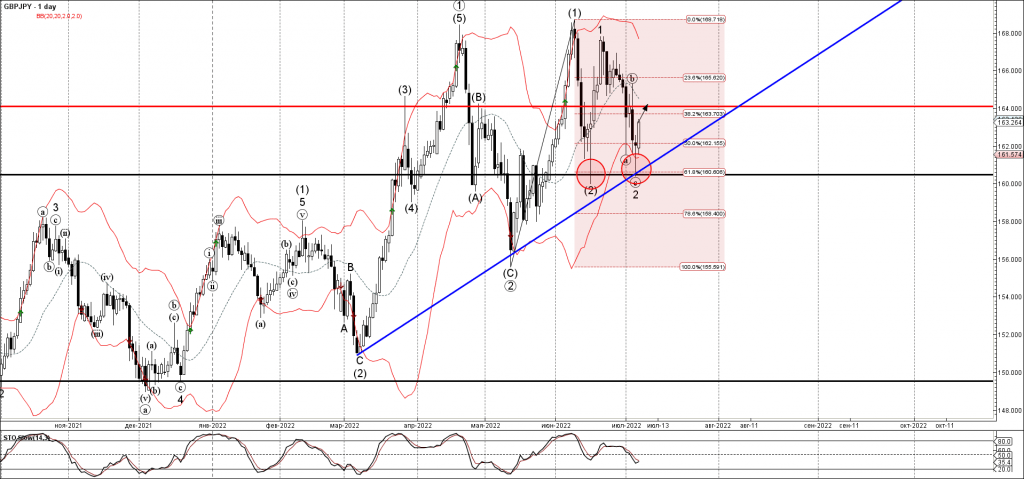
- GBPJPY reversed from support level 160.50
- Likely to rise to resistance level 164.00
GBPJPY currency pair recently reversed up from the key support level 160.50 (which stopped the previous wave (2) in the middle of June).
The support level 160.50 was further strengthened by the nearby lower daily Bollinger Band and the support trendline from March as well as the 61.8% Fibonacci correction of the upward impulse (1) from May.
Given the clear daily uptrend, GBPJPY can be expected to rise further toward the next resistance level 164.00.
Oil Outlook: Below $100 WTI Raises Eyebrows
As WTI’s price plunged below $100 a barrel on the 5th of July, it raised eyebrows across the markets, as analysts are pushed to the edge of their seats, pondering on what’s to follow. Without a doubt, recession fears and slowing demand helped bring down oil at levels once seen before during May 2022, however the question is raised to whether those were indeed the catalysts responsible for the turnaround from soaring prices in recent months. In this report we aim to shed light on the current developments of oil and present various opinions alongside a technical analysis at the end.
As post pandemic lockdown restrictions were lifted earlier this year, the strong demand for oil consumption collided with the persistent supply shortages, as the world turned to normalization. Fueling the fire, the disrupted energy supply lines from the Russian invasion in Ukraine, were an additional blow to the supply side, that urged the European continent to scramble for alternative solutions. As a result, we are seeing an upshot of ever-increasing inflationary pressures worldwide and central banks tighten their monetary policies by aggressively hiking interest rates, in an attempt to contain surging prices, to slow down economic growth and cool down their economies. Nonetheless, as oil supply remains scarce and since demand significantly outweighs it at the moment, the problem persists.
The address by US President Biden towards refiners in late June, accusing them of heavy price gauging at the expense of consumers and urging them to expand capacity, may have impacted oil prices recently, accelerating the downfall. Refiners are indeed, logging impressive profits lately as the S&P Energy sector is currently the only one in positive territory year-to-date. According also to U.S. Energy Information Administration “refiners have been running at almost 94% of operable capacity, close to the 96.6% peak reached in the past decade”. Moreover, in the recent OPEC meeting at the start of July, it was agreed to stick to a planned output increase in August. They decided to raise the output by 648,000 barrels per day for both months July and August, a decision hailed by President Biden’s administration which has repeatedly pushed for the group to pump more. Those targets if met, will set an end to the historic output cuts, implemented during the pandemic.
The unexpected death of Mohammad Barkindo, the OPEC Secretary General, announced on Wednesday the 6th of July, leaves the oil cartel without a head, during ambiguous times for the markets and could spark increased uncertainty in the grander scheme of this for the energy market.
Turning towards WTI price action, the drop below the psychological $100 a barrel level on the 5th of July may ignite short term speculative trading, not necessarily reflecting fundamentals, but instead grabbing the attention of technical analysts, traders and algos, rushing to jump onto the opportunity.
Looking ahead, oil prices flirt with a third consecutive weekly decline. On the other hand, according to some analysts, oil price may face a larger correction higher, should OPEC in the next meeting on the 3rd of August, fail to meet the agreed upon output projections. Also worth looking at the is release of US Baker Hughes report tomorrow 8th of July, reporting the active drilling rigs in the US and consequently hinting towards the increase or decrease in demand for oil.
Technical Analysis
WTI H4
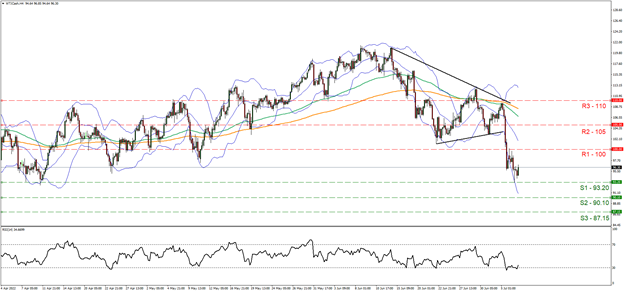
Looking at the WTI H4 chart we observe the downward trend was initiated on the 16th of June, where it dropped from the $121 level, broke below the $100 psychological level on the 5th of July and found support at the $93.20 (S1) level during yesterday’s session, the 6th of July, a level once saw before back in April 2022. In our view WTI appears overextended, having excessive selling pressure, causing the sharp decline from the $110 range to the where it is currently found, the $96 range. Thus, we believe a rebound towards the $100 level could be a possibility in the short-term horizon, followed by consolidation. Supporting our view in regard to the overextended scenario, is the RSI indicator shown below the 4-hour chart, with a reading of 26 crossing below the 30 oversold level. Should the bears continue to reign over, we may see the break of $93.20 support (S1) line and the $90.10 (S2) line as well. Should the bulls take over, we could expect a break above the $100 psychological hurdle, now serving as resistance (R1) line and move decisively towards the $105 resistance (R2) level.
Canadian Dollar Eyes Job Data in Canada, US
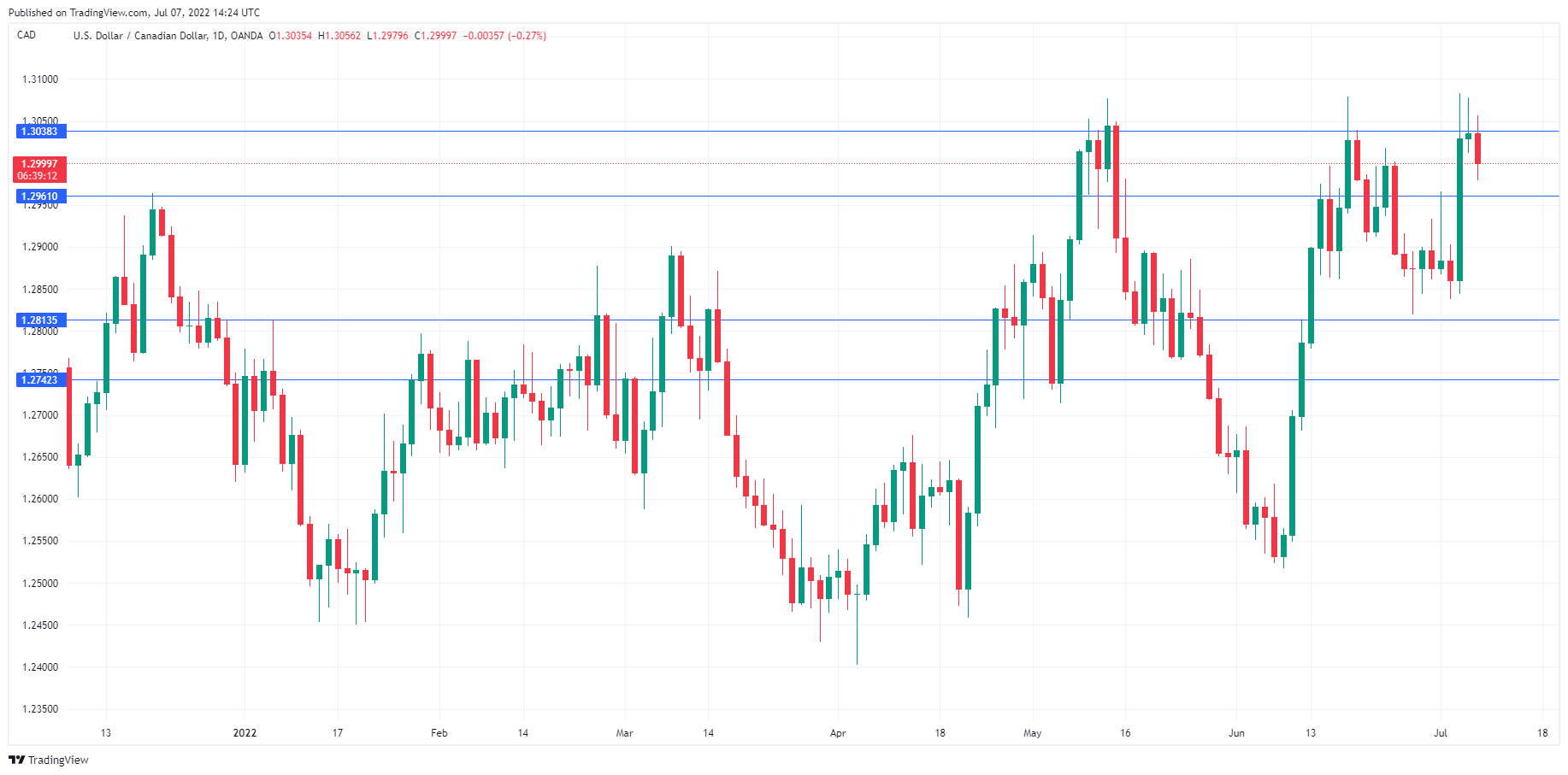
The Canadian dollar is back below the 1.3000 line today. USD/CAD is trading at 1.2987 in the North American session, down 0.37%. On the economic calendar, Canada’s Ivey PMI was a major disappointment, slowing to 62.2 in June from 72.0 in May (74.0 exp.).
US nonfarm payrolls expected to slow in June
Friday’s focus will be on job numbers, with both Canada and the US releasing employment reports for June. Canada is expecting a modest gain of 23.5 thousand new jobs, down from the 39.8 thousand gain in May. With the unemployment rate forecast to remain unchanged at 5.1%, the US numbers could prove to be more interesting to investors. US nonfarm payrolls used to be hotly anticipated as one of the most important indicators, but NFP has taken a step back as inflation and Fed rate policy have become the main focus of the markets. Still, tomorrow’s NFP could be a market-mover, as investors may rely on it for guidance on the health of the US economy.
Investors are hearing the “R” word bandied around more often, as fears of a recession in the US are rising. The economy showed negative growth in the first quarter, and another quarter of contraction would officially signify a recession. If NFP misses expectations, investors could view it as a sign that the economy is losing steam. That could well make the Fed ease up rate hikes and push the US dollar lower. The consensus for NFP stands at 275 thousand, after a gain in May of 390 thousand.
Canada has not been immune from soaring inflation, as headline CPI rose to 7.7% in May, its highest level since January 1983. Similar to the Federal Reserve, the Bank of Canada has scrambled to tighten policy in order to wrestle down inflation, which has become the central bank’s public enemy number one. There are expectations that the BoC may follow the Fed’s lead and deliver a super-size 0.75% rate hike at its July 12th meeting. Inflationary pressures are broad-based across the economy, which raises the risk of inflation and inflation expectations becoming entrenched, something the BoC is keen to avoid.
USD/CAD Technical
- 1.3038 is a weak resistance line. Above, there is resistance at 1.3109
- USD/CAD has support at 1.2961 and 1.2813
Sunset Market Commentary
Markets
Yesterday’s solid US ISM and hawkish Fed minutes provided the trigger for interest rate markets to rebalance away from risks to growth to central banks continuing to prioritize inflation at the upcoming meetings. Technical support levels in the US (2.70%) and German 10-y (1.15%/1.18%) yields also did their job. European interest rates still had some catching up to do after late yesterday’s jump in US yields. The account of the ECB June policy meeting also kept the focus on inflation, even as the language was less aggressive compared to the Fed. The ECB prefers to start with a 25 bps point rate hike to prevent an excessive market reaction. At the same time, the ECB signaled that gradualism shouldn’t mean small, slow steps. The German curve bear steepens with yields rising between 11 bps (2-y) and 4 bps (30-y). Intra-EMU spreads also widening. Recent spread narrowing was inspired both by lower core yields and by the ECB announcing a forceful mechanism to prevent market fragmentation. On the use of the instrument, ECB’s Villeroy suggested that if the tool was big enough to illustrate the ECB’s limitless commitment, maybe it actually may not need to be used. At least today, the 10-y Italian vs Germany widens 4 bps. Greece even adds 19 bps. US yields trade little changed maintaining yesterday’s rise. US jobless claims (235k) and the trade balance (deficit $85.5 bln from $86.7 bln) were close to expectations. Challenger US job cuts rose further from very low levels. The report suggests a gradual cooling in the job markets as some employers start to cut costs. A broader picture will be provided by tomorrow’s payrolls report. For now, the rebound in yields doesn’t hurt risk assets. European equities are rising 2.0% (Eurostoxx50). US indices open with gains of about 0.75%/1.0%. In the commodity complex, oil (Brent $101.4 p/b) and copper also are looking for a bottom after recent setback.
FX markets finally also enter calmer waters. The DXY (107) index stabilizes near the highest level in almost 20-y. USD/JPY hovers near the 136 big figure. Even so, the overall relative calm on other markets still doesn’t help euro. EUR/USD is holding losses well below the 1.02 barrier (currently 1.017). This doesn’t bode well for the single currency if sentiment would again deteriorate for one reason or another. Sterling recently didn’t react much to the political turmoil. However, the UK currency today made some further headway as UK PM Johnson finally resigned as Prime Minister. EUR/GBP moves further away from the broken uptrend line trading near 0.85.
News Headlines
People close to the German government reported a silent agreement among Chancellor Scholz’ cabinet members that they can’t stick to fiscal plans in case Russia ends gas flows for longer. German FM Lindner earlier indicated that EMU countries should scale back public debt from 2023 to avoid fiscal spending from fueling inflation further. In practice, Germany would again postpone a reintroduction of its debt brake. Scholz on Monday already suggested that more aid measures would be needed to tackle the brewing energy crisis. Later he accused Russian President Putin of using energy as a weapon.
Hungarian Cabinet Minister Gulyas said that the country decided to accept EC demands to secure EU funding. The two were at odds following breaches of the rule of law. The EU delayed the disbursement of €37bn, consisting both of subsidies in the multi-annual budget framework and pandemic-aid programs. Bloomberg reports that compromises include allowing courts to overrule the chief prosecutor on whether to initiate graft investigations; reducing the number of single bids for both EU and national tenders; narrowing the number of rapid legislative changes; and using part of the EU funding to diversify energy resources, now largely reliant on Russia. The timing of the Hungarian U-turn is interesting. The forint is in free-fall in current volatile market and couldn’t even profit from a jumbo 1-week deposit rate hike by the central bank earlier today (9.75% from 7.75%; EUR/HUF 4.15). Ending the dispute with EU pulled EUR/HUF back towards 406 at the time of writing.
USD/JPY Mid-Day Outlook
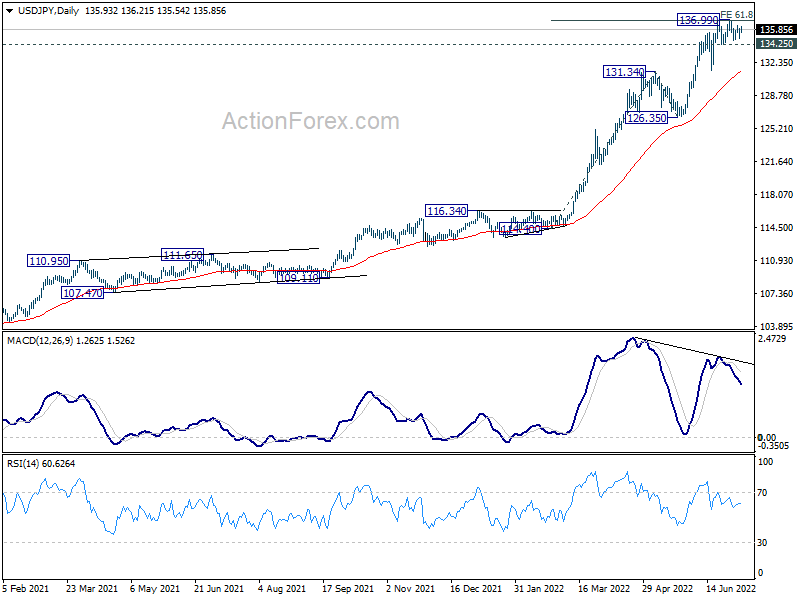
Daily Pivots: (S1) 135.24; (P) 135.63; (R1) 136.30; More...
Intraday bias in USD/JPY remains neutral at this point. On the downside, break of 134.25 support will confirm short term topping at 136.99. Considering bearish divergence condition in daily MACD, 136.99 might be a medium term top too. Intraday bias will be back on the downside for 131.34 support resistance turned support. Nevertheless, firm break of 136.99 will resume larger up trend to 100% projection of 114.40 to 131.34 from 126.35 at 143.29.
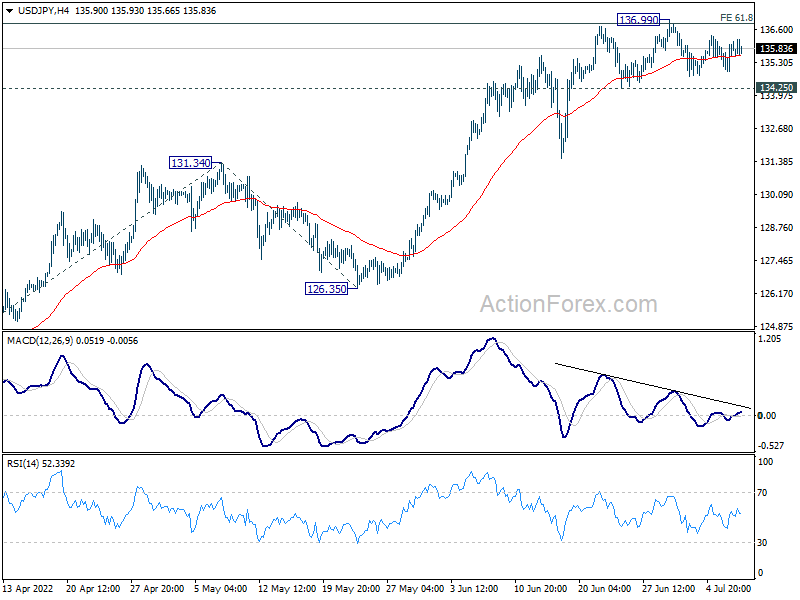
In the bigger picture, current rally is seen as part of the long term up trend from 75.56 (2011 low). Next target is 100% projection of 75.56 (2011 low) to 125.85 (2015 high) from 98.97 at 149.26, which is close to 147.68 (1998 high). This will remain the favored case as long as 126.35 support holds.
USD/CHF Mid-Day Outlook
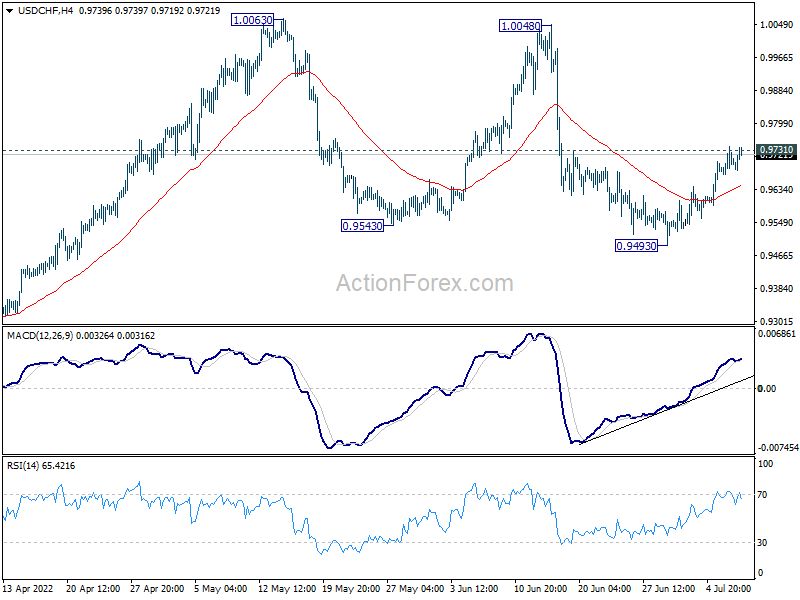
Daily Pivots: (S1) 0.9673; (P) 0.9708; (R1) 0.9745; More...
Outlook in USD/CHF is unchanged and focus stays on 0.9731 resistance. Firm break there will argue that the consolidation from 1.0063 has completed and bring stronger rally back to retest 1.0063 high. However, another fall below 0.9493 will dampen this view and target 0.9459 resistance turned support.
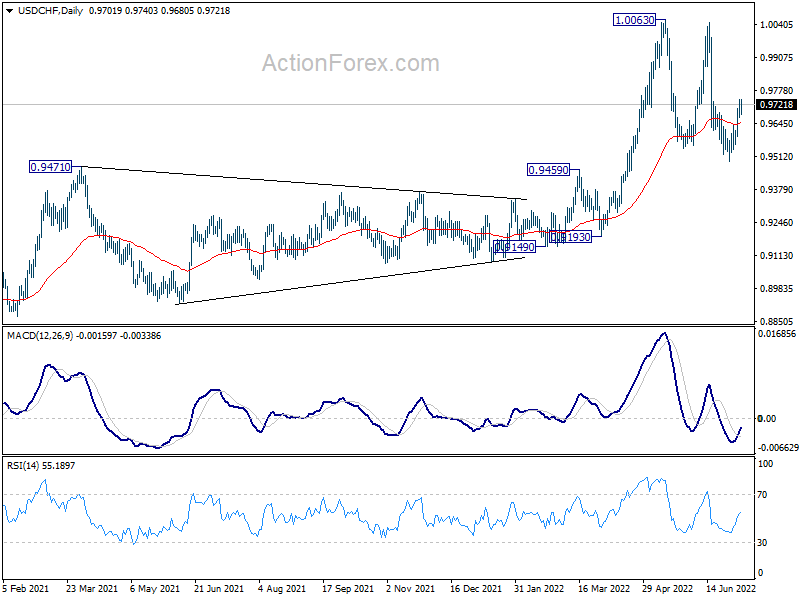
In the bigger picture, down trend from 1.0342 (2016 high) should have completed with three waves down to 0.8756 (2021 low) already. Rise from 0.8756 is likely a medium term up trend of its own. Next target is 1.0237/0342 resistance zone. This will remain the favored case as long as 0.9471 resistance turned support holds. However, sustained break of 0.9471 will extend long term range trading with another falling leg.
EUR/USD Mid-Day Outlook
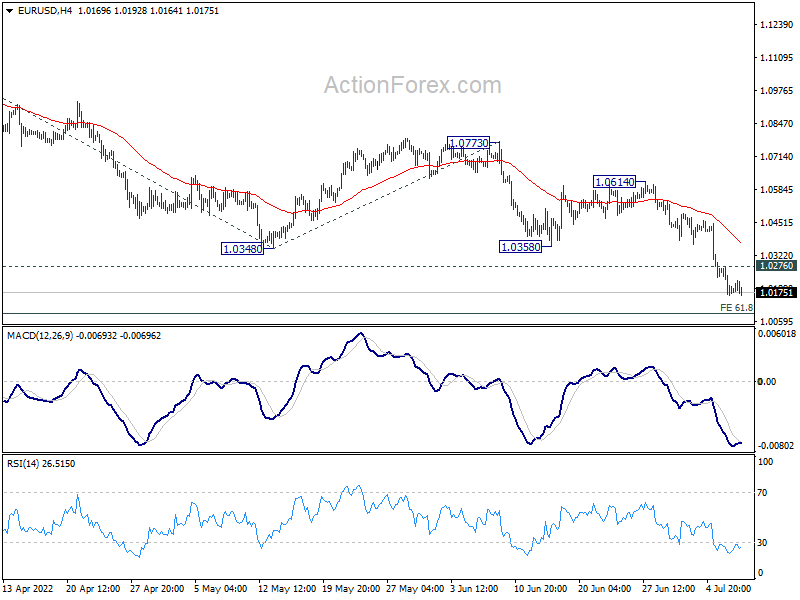
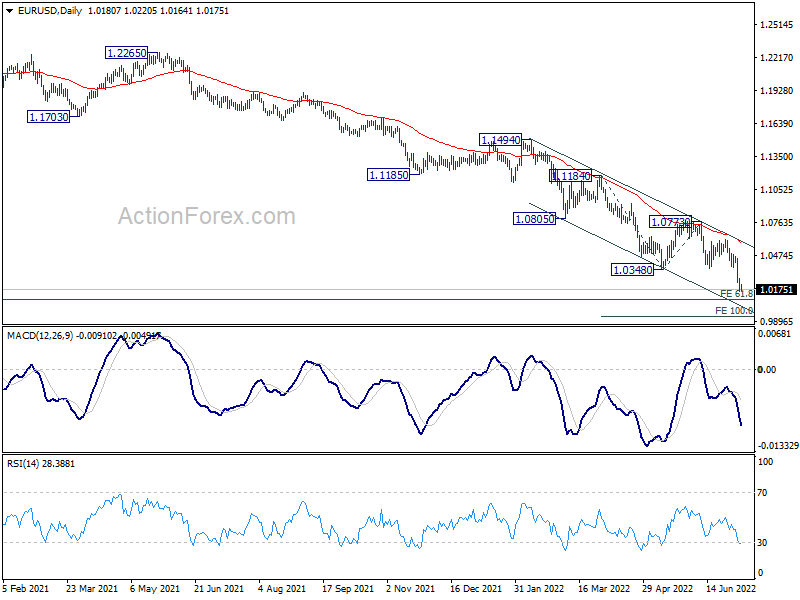
Daily Pivots: (S1) 1.0136; (P) 1.0207 (R1) 1.0251; More...
EUR/USD's fall is still in progress and intraday stays on the downside. Current down trend should target 1.0090 long term projection level. Break there will target 100% projection of 1.1184 to 1.0348 from 1.0773 at 0.9937, which is close to parity. On the upside, above 1.0276 minor resistance will turn intraday bias neutral and bring consolidations first. But recovery should be limited below 1.0614 resistance to bring another fall.
In the bigger picture, the break of 1.0339 long term support (2017 low) indicates resumption of whole down trend from 1.6039 (2008 high). Next target is 61.8% projection of 1.3993 to 1.0339 from 1.2348 at 1.0090. Sustained break there will pave the way to 100% projection at 0.8694. In any case, outlook will stay bearish as long as 1.0786 resistance holds, in case of recovery.
GBP/USD Mid-Day Outlook
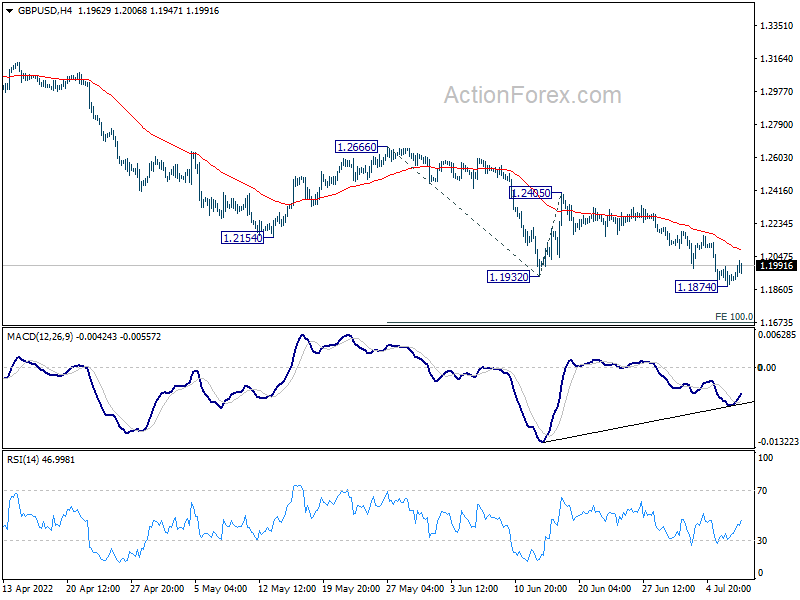
Daily Pivots: (S1) 1.1868; (P) 1.1929; (R1) 1.1982; More...
Intraday bias in GBP/USD is turned neutral with current recovery. Some consolidations could be seen but outlook stays bearish as long as 1.2405 resistance holds. On the downside, break of 1.1874 will resume larger down trend to t 100% projection of 1.2666 to 1.1932 from 1.2405 at 1.1671. Break there will target 1.1409 long term support.
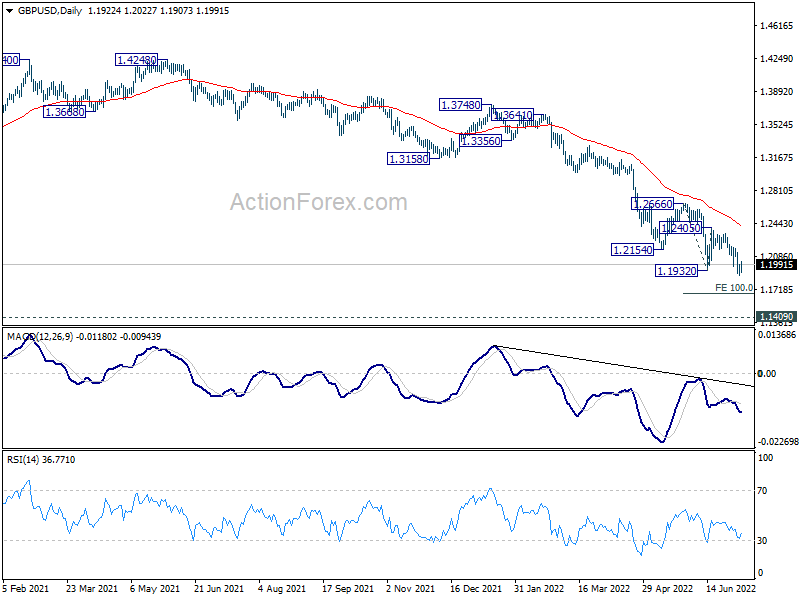
In the bigger picture, fall from 1.4248 (2018 high) could be a leg inside the pattern from 1.1409 (2020 low), or resuming the longer term down trend. Deeper decline is expected as long as 1.2666 resistance holds. Next target is 1.1409 low. However, firm break of 1.2666 will bring stronger rise back to 55 week EMA (now at 1.3103).
Sterling Recovers as Johnson Resigns as PM
Sterling recovers today, in particular against Euro and Swiss Franc, after Boris Johnson resigns as UK Prime Minister. But Aussie is so far still the strongest for the day. Euro remains generally weak but Dollar and Yen are also paring some recent gains. For the week, Aussie is the best performer for now, followed by Dollar and then Yen. Euro is now the runaway loser, followed by Swiss Franc and then Canadian. But the overall picture could still be changed by tomorrow's non-farm payrolls.
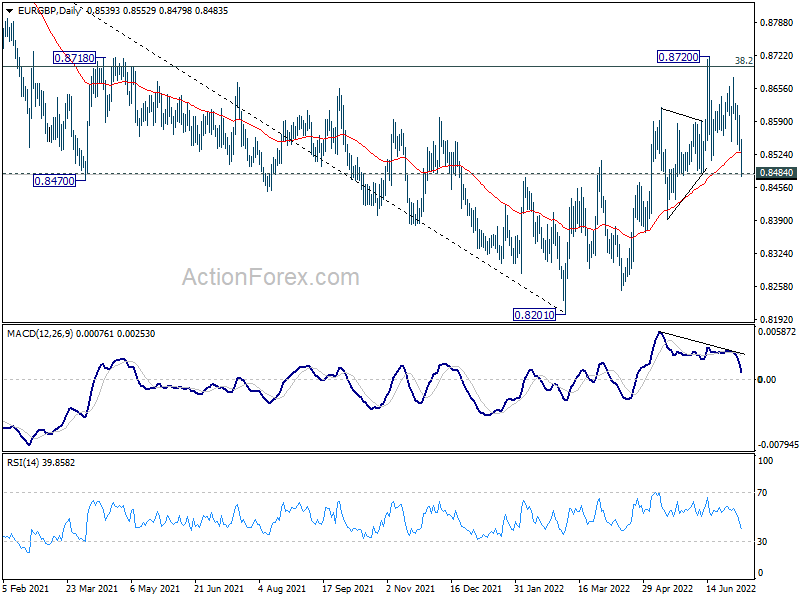
Technically, immediate focus is now on 0.8484 support in EUR/GBP. Sustained break there will argue that rebound from 0.8201 has completed at 0.8720, after rejection by 38.2% retracement of 0.9499 to 0.8201 at 0.8697. The would firstly retain medium term bearishness in the cross Secondly, deeper fall could be seen back to retest 0.8201 low.
In Europe, at the time of writing, FTSE is up 1.27%. DAX is up 1.84%. CAC is up 1.67%. Germany 10-year yield is up 0.071 at 1.232. Earlier in Asia, Nikkei rose 1.47%. Hong Kong HSI rose 0.26%. China Shanghai SSE rose 0.27%. Singapore Strait Times rose 0.83%. Japan 10-year JGB yield rose 0.0063 to 0.256.
US initial jobless claims rose to 235k
US initial jobless claims rose 4k to 235k in the week ending July 2, slightly above expectation of 230k. Four-week moving average of initial claims rose 750 to 232.5k.
Continuing claims rose 51k to 1375k in the week ending June 25. Four-week moving average of continuing claims rose 16.5k to 1335k.
ECB accounts: A number of members want door open for a larger hike in Jul
As noted in accounts of ECB's June 8-9 monetary policy meeting, "most members" supported to signal the 25bps rate hike at the July meeting. Starting the rate-hiking cycle with a step of this magnitude was seen as a "proportionate first step". But "a number of members expressed an initial preference for keeping the door open for a larger hike at the July meeting"
"It was broadly agreed that the Governing Council should at this point be more specific about its expectations for the September meeting and, in particular, open the door to an increase in the key ECB interest rates by more than 25 basis points," the accounts added.
"Looking beyond September, members widely agreed that, on the basis of the current assessment, a gradual but sustained path of further interest rate increases would be appropriate, with the pace of adjustment depending on incoming data and developments in the medium-term inflation outlook."
BoE Mann: It's important to front-load policy
BoE MPC member Catherine Mann said, "what the research shows is when there is uncertainty about persistence versus transitory nature of inflation dynamics, it's important to front-load policy."
Mann also noted the recent depreciation in Sterling is feeding into the high inflation rate. Yet, it's "not the point" to target exchanged rate. "The point is to have heightened awareness of the role of the currency, particularly in today's climate of very high inflation rates," she added.
Australia AiG services dropped to 48.8, two-speed pattern to gather pace
Australia AiG Performance of Services Index dropped -0.4 to 48.8 in June. Looking at some details, sales plummeted by -8.8 to 41.9. Employment surged 7.9 to 55.3. New orders ticked down by -0.8 to 58.9. Input prices rose 0.3 to 69.0. Selling prices rose 5.3 to 67.2. Averages jumped 10.3 to 67.7.
Innes Willox, Chief Executive Ai Group, said: "With interest rates rising for the first time in a decade, we have seen a 'two-speed' services sector emerge in June. Industries which are sensitive to sentiment changes – such as business & property, and personal & recreational services – declined into contraction. Less interest-rate-exposed services remained in a growth phase. With the RBA increasing rates by 50 basis points again this week, we would expect this two-speed pattern to gather pace."
Also from Australia, goods and services exports rose 9.5% mom to AUD 58.4B in May. Goods and services imports rose 5.8% mom to AUD 42.4B. Trade surplus widened from AUD 13.2B to AUD 16.0B.
GBP/USD Mid-Day Outlook
Daily Pivots: (S1) 1.1868; (P) 1.1929; (R1) 1.1982; More...
Intraday bias in GBP/USD is turned neutral with current recovery. Some consolidations could be seen but outlook stays bearish as long as 1.2405 resistance holds. On the downside, break of 1.1874 will resume larger down trend to t 100% projection of 1.2666 to 1.1932 from 1.2405 at 1.1671. Break there will target 1.1409 long term support.
In the bigger picture, fall from 1.4248 (2018 high) could be a leg inside the pattern from 1.1409 (2020 low), or resuming the longer term down trend. Deeper decline is expected as long as 1.2666 resistance holds. Next target is 1.1409 low. However, firm break of 1.2666 will bring stronger rise back to 55 week EMA (now at 1.3103).
Economic Indicators Update
| GMT | Ccy | Events | Actual | Forecast | Previous | Revised |
|---|---|---|---|---|---|---|
| 22:30 | AUD | AiG Performance of Services Index Jun | 48.8 | 49.2 | ||
| 01:30 | AUD | Trade Balance (AUD) May | 15.97B | 10.90B | 10.50B | 13.25B |
| 05:00 | JPY | Leading Economic Index May P | 101.40% | 101.60% | 102.90% | |
| 05:45 | CHF | Unemployment Rate Jun | 2.20% | 2.20% | 2.20% | |
| 06:00 | EUR | Germany Industrial Production M/M May | 0.20% | 0.40% | 0.70% | 1.30% |
| 07:00 | CHF | Foreign Currency Reserves (CHF) Jun | 850B | 925B | ||
| 11:30 | EUR | ECB Monetary Policy Meeting Accounts | ||||
| 12:30 | USD | Initial Jobless Claims (Jul 1) | 235K | 230K | 231K | |
| 12:30 | USD | Goods and Services Trade Balance (USD) May | -85.5B | -85.0B | -87.1B | -86.7B |
| 12:30 | CAD | International Merchandise Trade (CAD) May | 5.3B | 2.5B | 1.5B | 2.2B |
| 14:00 | CAD | Ivey PMI Jun | 62.2 | 74 | 72 | |
| 14:30 | USD | Natural Gas Storage | 75B | 82B |