Sample Category Title
Weekly Focus – Inflation Pressure Builds Further
Stock markets continue to struggle as inflation pressures build and both Fed's Powell and ECB's Lagarde, at the central banking forum in Sintra, stressed the need to fight inflation even if it involves some pain for the economy.
After supply worries drove oil prices higher, oil dropped again in the wake of OPEC+ confirmation of faster production hikes in July and August. IEA data released earlier in the week showed much larger drawdown of crude oil stock levels than expected, and US president Biden will travel to the Middle East and try to convince the Saudis to increase oil production further later this month. Natural gas and electricity prices continued to increase this week from already very high levels.
High energy prices are fuelling recession fears, which is particularly visible in industrial metals markets these days. Here we have seen a selloff across the board over the last couple of weeks. Copper in particular has declined to a 16-month low, driven not least by Chinese lockdowns. PMI figures indicated a strong rebound in the service sector on the back of an easing of restrictions, which also drove Chinese stock markets higher. That said, President Xi confirmed this week that zero COVID policy remains the right policy for China, which will likely pull economic growth below potential going forward. Easing restrictions also pulled manufacturing PMIs higher. The overall trend for the global manufacturing sector is still pointing down, though, with most Asian PMIs printing lower and the Bank of Japan's quarterly Tankan business survey also disappointing for the manufacturing sector. Chinese lockdown is a key drawdown here, and easing restrictions could maybe give some relief over the summer.
Inflation continues to increase across Europe. Spanish inflation increased above 10% in June. The German fuel tax rebate and cheap public transport over the summer pulled German inflation lower in June. That said, the underlying price pressure continues to build and we will likely see another spike here when we exit the summer months. The Riksbank reacted to the increased inflation pressure by hiking rates by 50 bps as expected.
Next week, in the euro area, we will look out for ECB minutes and different views in the Governing Council about the pace of monetary tightening. Also, we will keep an eye on a meeting between German chancellor Scholz, unions, employer representatives, Bundesbank staff and leading economists to discuss ways to support consumers while avoiding a wage-price-spiral from emerging.
In the US, we get a new jobs report. A tight labour market supports the case for further Fed tightening. The FOMC minutes will probably not be so important since we have heard from several members since the meeting. We expect the Reserve Bank of Australia to hike rates by 50 bps next week on the back of still persistent global inflation pressures and we expect the National Bank of Poland to hike by 75 bps but with risk of more. Over the summer we will follow how the headwinds for the global economy accumulate, not least inflation pressures. We expect ECB to hike by 25 and Fed by 75 bps in July.
Forward Guidance: Canadian Inflation Expectations Under the Microscope
With the Bank of Canada’s July interest rate decision looming, all eyes will be on next week’s business outlook and consumer surveys. The bank’s Q4 Business Outlook Survey (BOS) will very likely identify limits on production due to labour shortages as the biggest issue for businesses. There have been signs of easing in global supply chain disruptions. Shipping costs in particular are down sharply year-to-date. But inflation has continued to surge, and the bank will be concerned about that pressure seeping further into longer-run expectations.
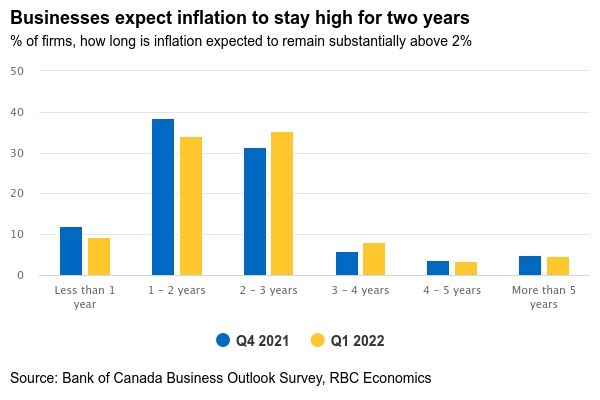
Following an uptick in medium-term consumer inflation expectations, the U.S. Fed announced a 75 basis point rate increase earlier this month. A similar uptick in Canada would raise the odds of the BoC following suit with a hike at least as large. The last BOS for Q1 showed business inflation expectations surging higher for the next 2 to 3 years, then holding around the central bank’s 2% price growth target beyond that. The separate survey of consumer expectations suggested a similar view. But with inflation continuing to surprise on the upside, the risk is both move higher.
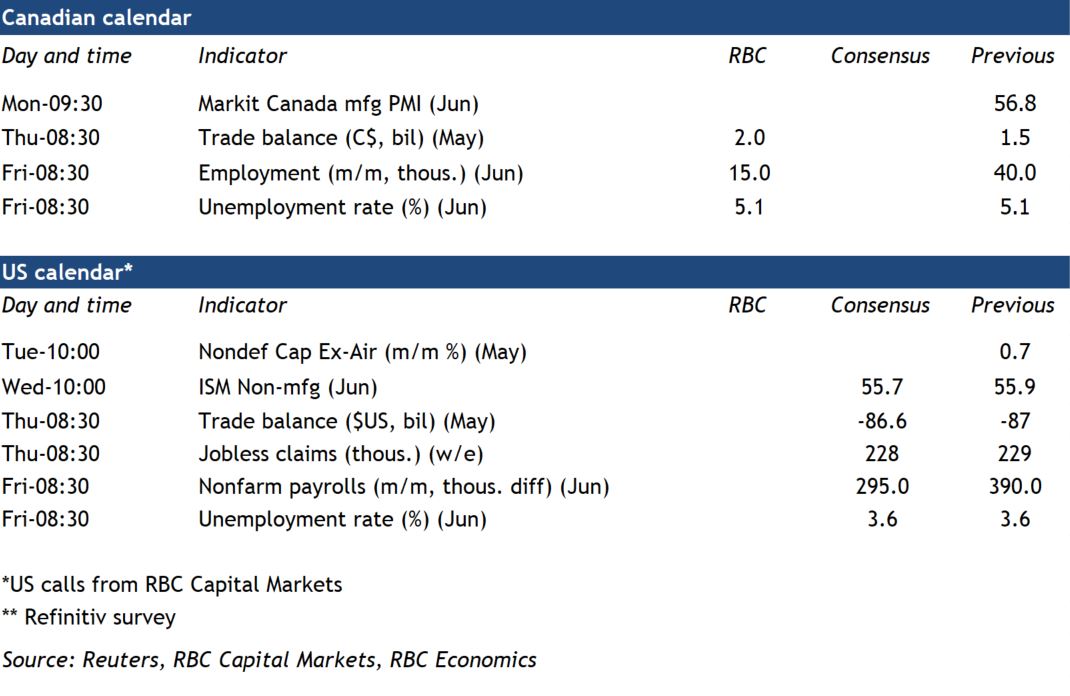
Friday’s labour market data won’t give the bank any pause about moving too quickly. We expect Canadian employment growth slowed to 15,000 in June—driven by a dwindling supply of workers rather than a lack of demand. The number of job openings edged lower, but is still running almost 70% above pre-pandemic levels. And with the unemployment rate already at its lowest level on record in May, those businesses are competing shrinking number of available workers. The travel and hospitality sector in particular has struggled to re-staff as demand soars.
Week ahead data watch:
Canada’s unemployment rate likely held at 5.1%. But wage growth probably accelerated again, as businesses compete for fewer available workers.
We expect an increase of 300,000 jobs in the U.S. in June fuelled by the recovery in close-contact service industries. As in Canada, tight labour markets will continue to limit employment growth. The unemployment rate is expected to hold steady at 3.6%
The Canadian trade surplus likely edged up to $2 billion with a jump in oil prices boosting the energy trade balance.
Silver and Gold in Search for a Bottom
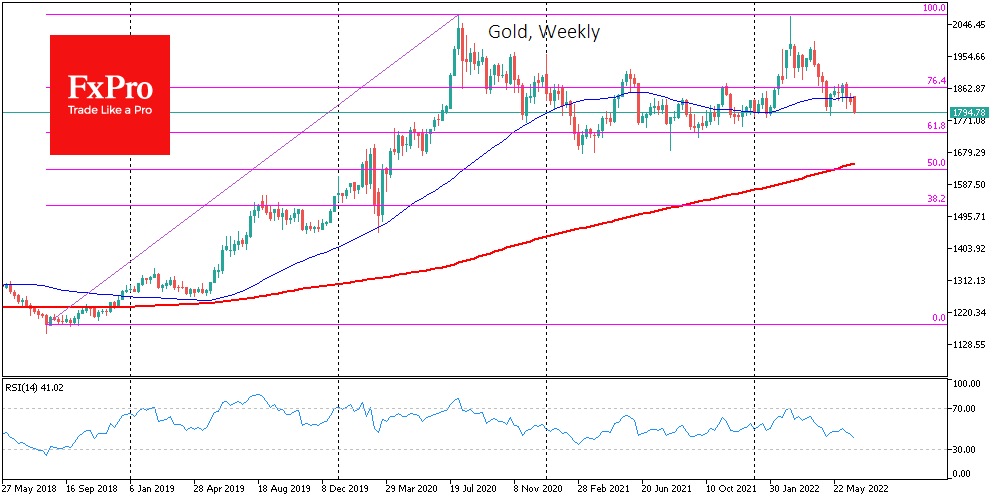
Gold dived below $1800 on Friday morning, testing this year’s low at $1790. It has managed to get support from buyers on a dip below the important round level in the last six months, but this time buyers may come to the rescue much later.
The latest financial market dynamics (falling equity prices and yields) suggest the markets are banking on a recession. Meanwhile, central banks are only picking up speed in tightening monetary policy, creating pressure on long-term inflation expectations. In such an environment, demand for gold as insurance against inflation promises to decline in the coming weeks. A reversal in gold may not occur until G7 central banks begin to soften their rhetoric, which could take months.
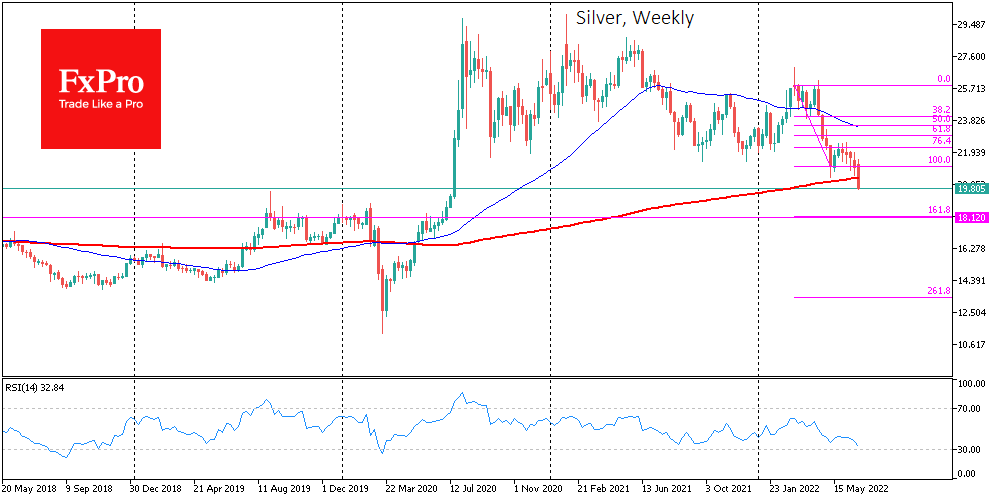
The performance of silver is even more pessimistic. Gold’s little sister is far more sensitive to production cycles. Since the beginning of last month, signs of an economic slowdown have formed a downward momentum in silver, forming a bearish technical picture.
The drop of silver below $21 earlier this week marked a consolidation below the local lows of early May after a corrective bounce. The next stopping point for silver might be the $18.10 (8.5% below today’s price), where the 161.8% level of the March-May decline lies. In addition, here is the former resistance area from 2017 to 2020. It now has the potential to become an equally important long-term support.
For gold, the significant downside milestone is now the $1700-1730 area, where last year’s lows and the 61.8% retracement level from the 2018 to 2020 rally are concentrated. If that level also falls in the coming weeks, the following line of gold defence gold could be the $1650 level, where the 200-week average and the 50% retracement level from the two-year rally pass through.
XAU/USD Outlook: Gold Dips Below $1800, on Track for the Third Consecutive Weekly Drop
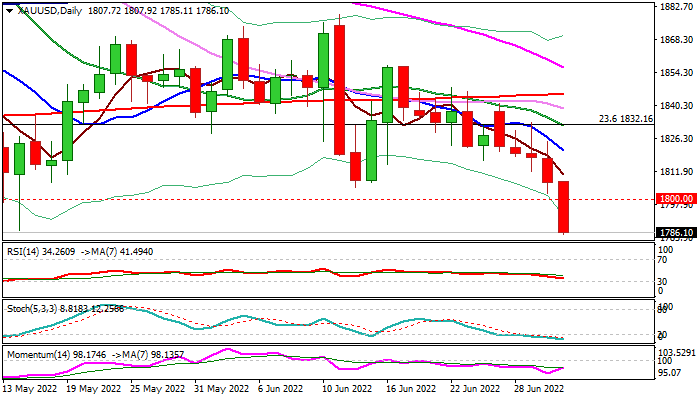
Spot gold price fell below $1800 level on Friday, on fresh bearish acceleration that extends into fifth straight day.
The yellow metal came under pressure from higher dollar, as well as prospects of higher interest rates in the US and India’s increase of import tax hike that hurt its safe-haven appeal.
Strong bears are also on track for the third consecutive weekly loss (around 2.5% drop this week) that adds to negative near-term outlook.
Clear break of $1800 level after several failures recently would add to bearish signals from negative daily technical studies and open way for further weakness.
Key support at $1680 zone (Mar/Apr higher base/Fibo 38.2% of $1046/$2074 rise) is coming in focus and break here would spark stronger acceleration lower on completion of a double-top ($2070/$2074).
Former low at $1805 marks initial resistance, followed by falling 10DMA ($1821) and 20DMA/broken Fibo 23.6% ($1832), guarding upper pivot at $1844 (200DMA).
Res: 1800; 1805; 1821; 1832.
Sup: 1764; 1753; 1740; 1729.
XAG/USD Outlook: Silver Drops Below $20 for the First Time in Two Years
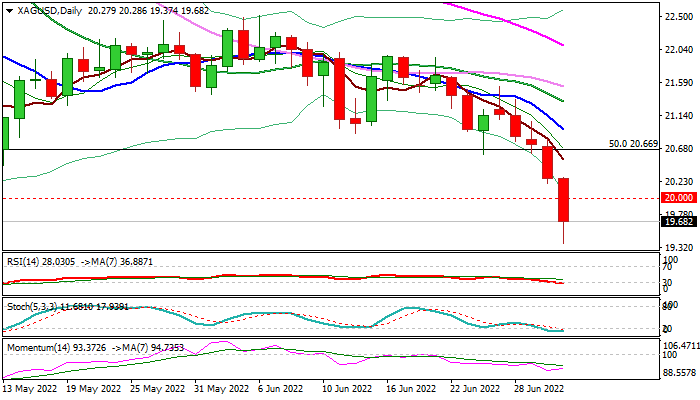
Spot silver broke through psychological $20 support for the first time in two years and hit the lowest since July 2020 on Friday.
The metal remains under increased pressure for three months on global economic and geopolitical turmoil which threatens of further deterioration that could push many economies into recession, denting metal’s strong industrial exposure.
Bearish techs on daily chart add to negative signals generated on break through pivotal supports at: $20.66 (50% retracement of $11.23/$30.10); 20.42 (200WMA) and psychological $20 level, though weekly close below $20 is needed to confirm and open way for extension towards target at $18.44 (Fibo 61.8%).
Silver is also on track for the fifth straight weekly drop, with this week’s fall being the biggest since the third week of June 2021 and large bearish weekly candle is expected to heavily weigh on the action in coming sessions.
Caution on oversold conditions on daily chart which signal possible price adjustment, with upticks to offer better opportunities to re-join bearish market.
Res: 20.00; 20.42; 20.66; 20.93.
Sup: 19.37; 19.00; 18.44; 17.75.
Euro Slides as Inflation Jumps
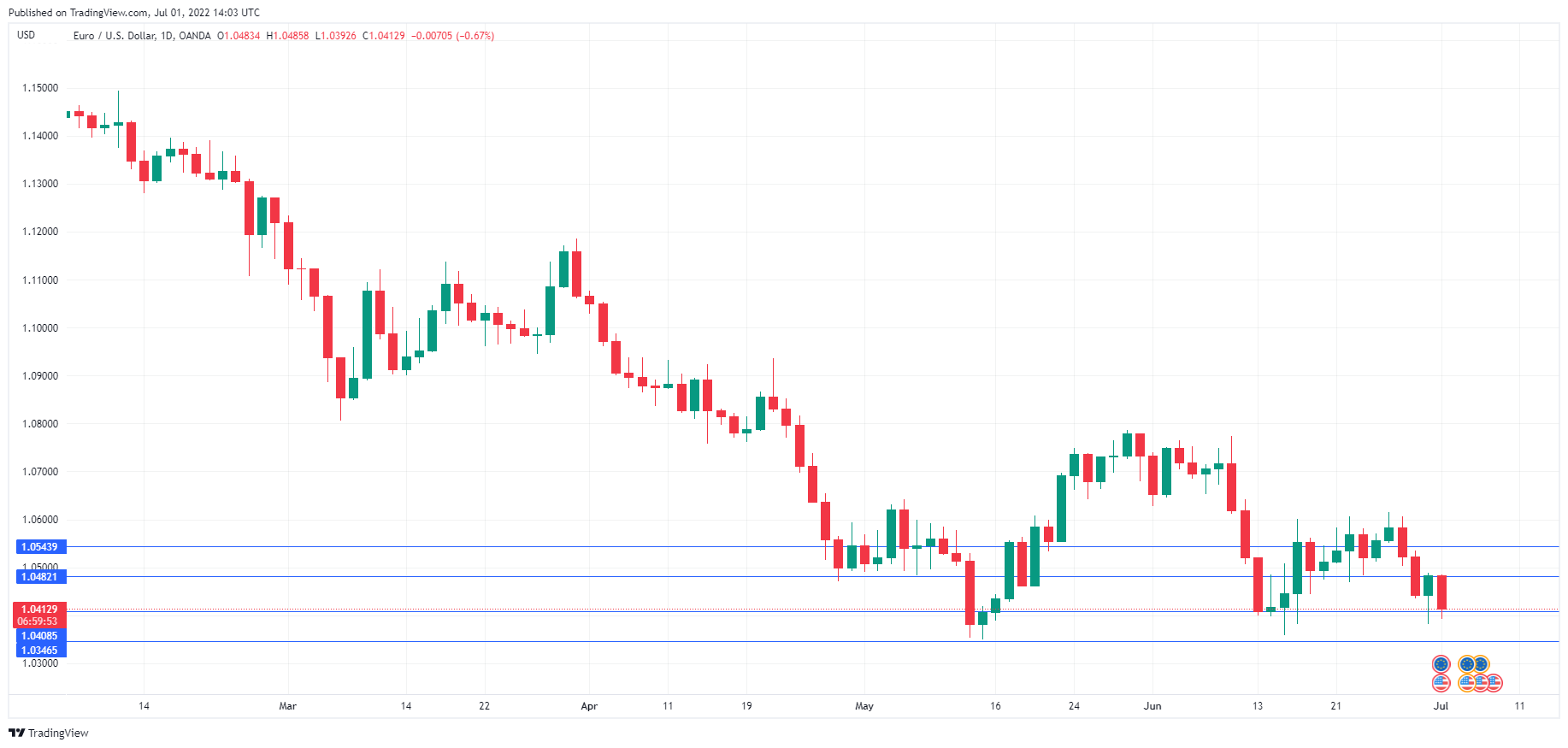
The euro is sharply lower on Friday and is currently trading just above the 1.04 line, down 0.76%.
Eurozone inflation outperforms
Eurozone CPI for June was higher than expected, at 8.6% YoY. The estimate stood at 8.4% and inflation rose sharply from the May reading of 8.1%. This marked a record-high. There was better news from the core reading, which dropped marginally to 3.7% YoY, down from 3.8% in May. Investors have given the inflation data a thumbs-down today and sent the euro tumbling ahead of the weekend.
With inflation continuing to accelerate and the ECB revising downwards its growth forecast, the spectre of stagflation in the bloc remains very real. The ECB is no doubt dismayed that inflation was higher than expected, but it’s unclear if the record-high CPI release will be enough to deliver a supersize 0.50% hike for its lift-off next month. At this week’s ECB forum, ECB head Lagarde talked tough and downplayed concerns over a recession, but there are plenty of dark clouds hovering above the eurozone economy. High inflation, weak growth and the energy crisis with Russia mean that there is certainly good reason to be concerned about a significant downturn in the eurozone economy.
In the US, there are worrying signs that the economy is weakening. US Personal Spending fell to 0.3%, down from 0.6% (0.4% exp.). Inflation appears to be declining slowly and the labour market is in solid shape. CME’s FedWatch is putting the likelihood of a supersize 0.75% rate increase at 75%, as markets expect the Fed to remain aggressive against inflation. Can a recession be avoided? Fed Chair Powell is saying all the right things in downplaying concerns about the “R” word, but many market participants have their doubts and feel that the US economy will not be able to avoid a recession.
EUR/USD Technical
- EUR/USD is testing support at 1.0408. The next support level is at 1.0346
- There is resistance at 1.0482 and 1.0544
Sunset Market Commentary
Markets
The June EMU inflation number tried to derail the short squeeze in core bonds. For a brief moment, it seemed to work, but eventually bonds rallied into the weekend. It immediately marks the start of a volatile summer where market focus will likely shift from inflation towards growth. We hold our view that short term corrections will be followed by a resumption of the bond sell-off later this year when it becomes clear that central banks won’t be in the position to loosen their grip on the normalization cycle because of still-elevated inflation. No matter how the growth picture looks like by then. Turning to the CPI print, inflation rose again by 0.8% M/M to a fresh record of 8.6% Y/Y, marginally beating consensus (8.5% Y/Y). Core inflation notched down a tick (3.7% Y/Y from 3.8% Y/Y) instead of the expected small increase (to 3.9% Y/Y) which was probably related to a one-off discount in German travel tickets (by rail). Today’s outcome suggests that the ECB will effectively step up the pace of its tightening cycle in September (+50 bps). At its June meeting, the central bank said that it would do so if the inflation outlook persisted or deteriorated. Especially for near term forecasts, we’re looking at that second scenario. It didn’t derail the bond rally though in a still sluggish risk environment. The German yield curve bull steepens with yields changes ranging between -11.2 bps (2-yr) and flat (30-yr). The German 2-yr yield (0.5%) loses the upward trend in place since early March. The German 5-yr yield drops below the neckline of double top formation (1.08%) and below the 1% mark for the first time since early June. The medium term uptrend holds just. The German 10-yr yield falls to 1.25% with key support at 1.19% (previous May top) to 1.15% (38% retracement on rally higher since March). 10-yr yield spreads vs Germany narrow by up to 4 bps with Italy outperforming (-9 bps). US yields drop 14.5 bps (5-yr) to 6 bps (30-yr) heading into the long weekend. US markets are closed on Monday for Independence Day. Later today, the US manufacturing ISM for June will still be released. We fear a continuation of the declining trend after the unexpected May uptick. Such outcome would amplify trends lower on stock markets and higher on bond markets. The Japanese yen and US dollar are in a close contest for today’s best FX performer in the tough market context, with JPY slightly gaining the upper hand (USD/JPY 135.40). EUR/USD for a second straight session explores territory below 1.04, suggesting a real test of key support 1.0350 might still be in the cards. Sterling loses out against both the dollar and the euro. EUR/GBP rises towards 0.8663, approaching the YTD high at 0.8721. News Headlines
Polish inflation in June rose 1.5% M/M to be up 15.6% Y/Y (13.9% in May). Electricity, gas and other fuels (3.0% M/M; 35.3% Y/Y) and fuels for personal transport (9.4% M/M; 46.7% Y/Y) remain major drivers. Even so, KBC estimates core inflation to be near 8.8% Y/Y. The NBP meets Thursday next week and today’s data suggest that expectations for a 75 bps hike to be reasonable. Still, the NBP faces a difficult balancing act. The Polish S&P global manufacturing PMI dropped sharply further into contraction territory, from 48.5 to 44.5. S&P global mentions ‘breath-taking downturns in orders and output, with rates of decline unheard of outside of the pandemic-related shutdowns of 2020 and the height of the global financial crisis in 2008’. Confidence about the future shrinks. S&P also sees signs of inflationary pressures easing, but they are likely driven by a contraction in demand. The mix of persistent high inflation, a sharp deterioration of the growth outlook and a global risk-off sentiment cause the zloty to weaken above EUR/PLN 4.70. In the Czech Republic, the S&P global PMI also signaled a deterioration operating conditions in the manufacturing sector due to lower production and orders. The headline index dropped to 49.0. The decline in output was the fastest since May 2020. Employment decreased for the first time since September 2020. Cost inflation softens but remains elevated. The koruna eased only marginally (EUR/CZK 24.75) as the CNB is expected to be active in the FX market to prevent any material CZK weakening.
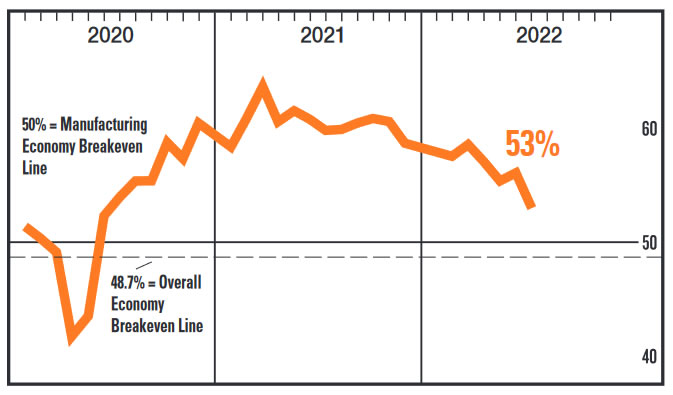
US ISM manufacturing dropped to 53 in Jun, lowest in two years
US ISM Manufacturing PMI dropped from 56.1 to 53.0 in June, below expectation of 55.0. That's the lowest level since June 2020.
New orders dropped from 55.1 to 49.2. Production rose from 54.2 to 54.9. Employment dropped from 49.6 to 47.3. Supplier deliveries dropped from 65.7 to 57.3. Prices dropped from 82.2 to 78.5.
ISM said: "The past relationship between the Manufacturing PMI and the overall economy indicates that the Manufacturing PMI for June (53 percent) corresponds to a 1.5-percent increase in real gross domestic product (GDP) on an annualized basis."
EUR/USD Mid-Day Outlook
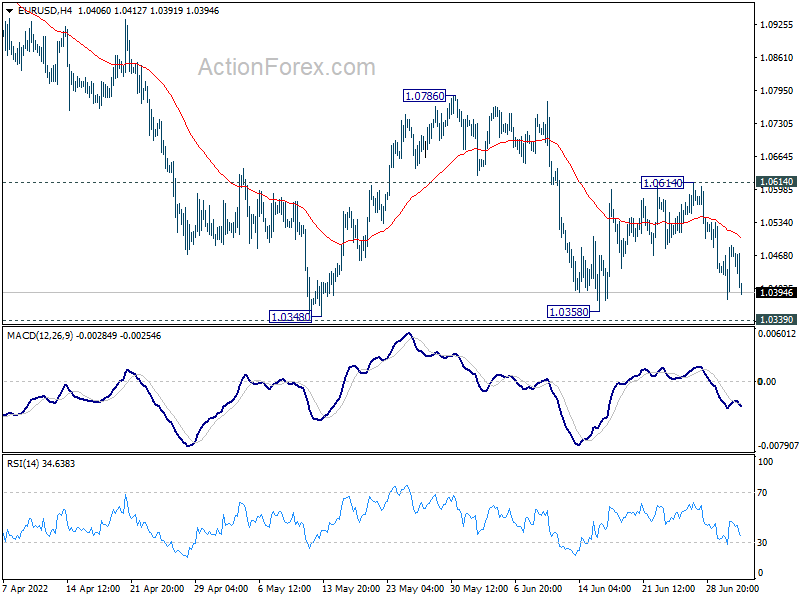
Daily Pivots: (S1) 1.0415; (P) 1.0452 (R1) 1.0521; More...
Intraday bias in EUR/USD remains neutral at this point. Further fall is in favor with 1.0614 minor resistance intact. On the downside, sustained break of 1.0339/48 will resume larger down trend. Next target is long term projection level at 1.0090. On the upside, above 1.0614 will turn bias back to the upside for 1.0786 resistance instead.
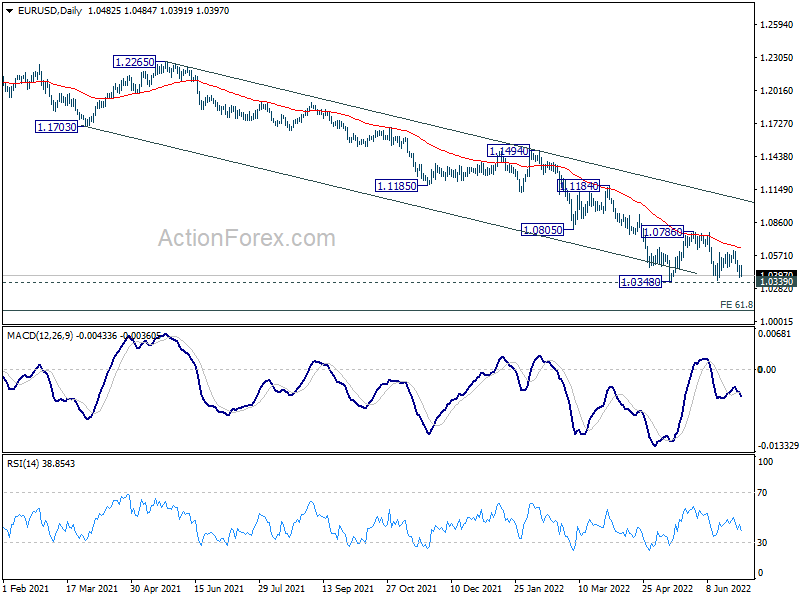
In the bigger picture, focus stays on 1.0339 long term support (2017 low). Decisive break there will resume whole down trend from 1.6039 (2008 high). Next target is 61.8% projection of 1.3993 to 1.0339 from 1.2348 at 1.0090. However, firm break of 1.0805 support turned resistance will delay this bearish case, and bring stronger rebound first.
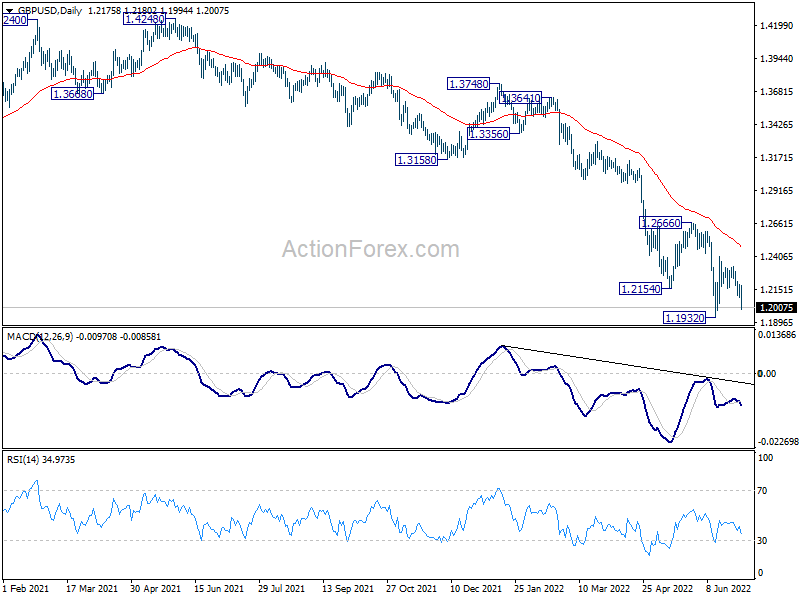
GBP/USD Mid-Day Outlook
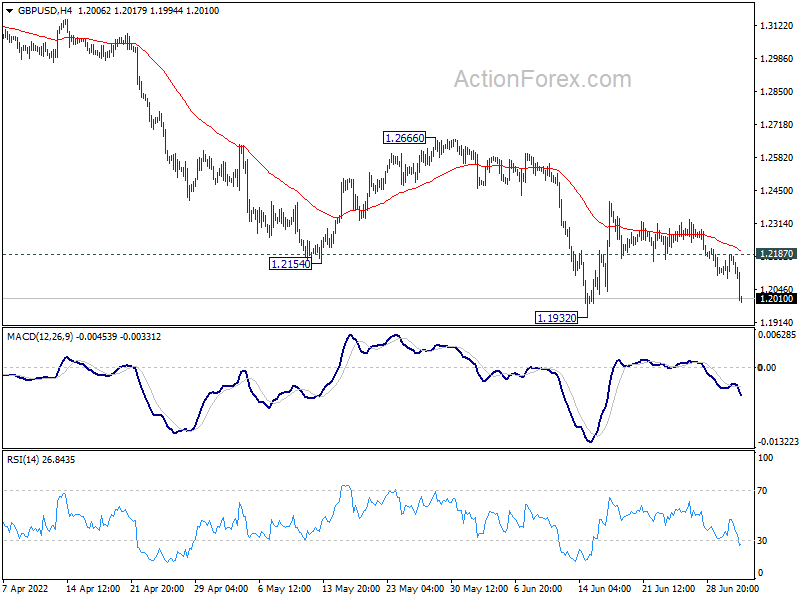
Daily Pivots: (S1) 1.2118; (P) 1.2153; (R1) 1.2215; More...
Intraday bias in GBP/USD stays neutral for the moment. Further fall is in favor as long as 1.2187 minor resistance holds. Firm break of 1.1932 will resume larger down trend from 1.4248. On the upside, above 1.2187 will resume the rebound from 1.1932 to 1.2666 resistance. Firm break there will indicate medium term bottoming.
In the bigger picture, fall from 1.4248 (2018 high) could be a leg inside the pattern from 1.1409 (2020 low), or resuming the longer term down trend. Deeper decline is expected as long as 1.2666 resistance holds. Next target is 1.1409 low. However, firm break of 1.2666 will bring stronger rise back to 55 week EMA (now at 1.3140).