

Sample Category Title
EUR/JPY Weekly Outlook
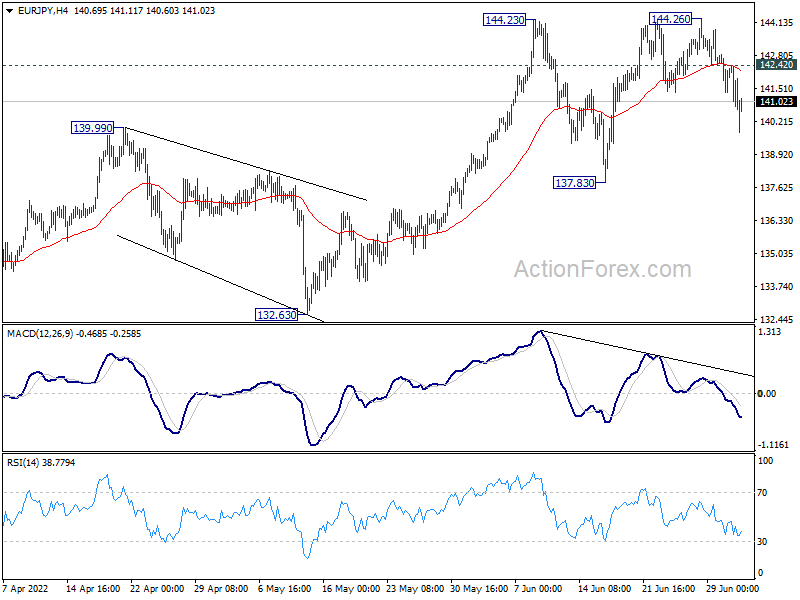
EUR/JPY edged higher to 144.26 last week but reversed from there. Initial bias stays mildly on the downside this week for 137.83 support first. Sustained break there will raise the chance of rejection by 144.06 long term projection level and target 132.63 support. On the upside, above 142.42 minor resistance will bring retest of 144.26 high instead.
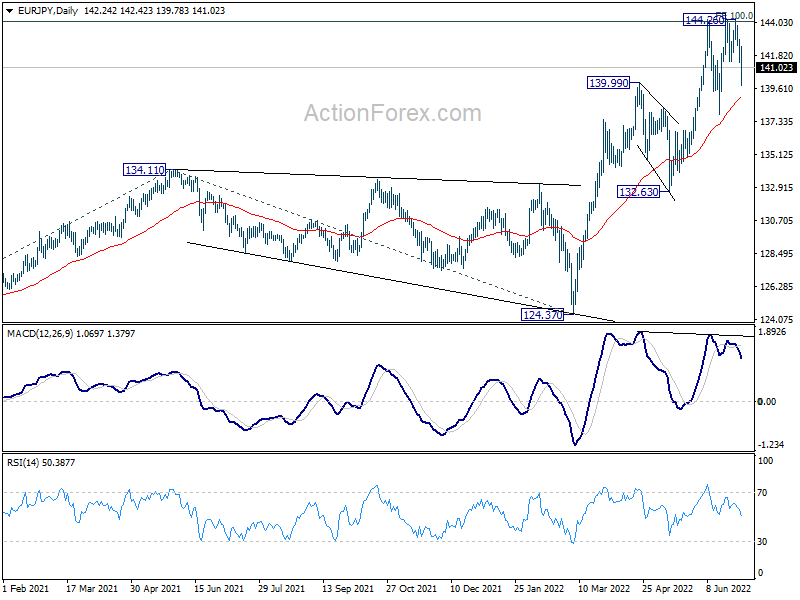
In the bigger picture, up trend from 114.42 (2020 low) is in progress. Such rise is seen as the third leg of the pattern from 109.30 (2016 low). Sustained trading above 100% projection of 114.42 to 134.11 from 124.37 at 144.06 will indicate upside acceleration and target 149.76 long term resistance (2014 high). In any case, outlook will remain bullish as long as 132.63 support holds, in case of deep pull back.
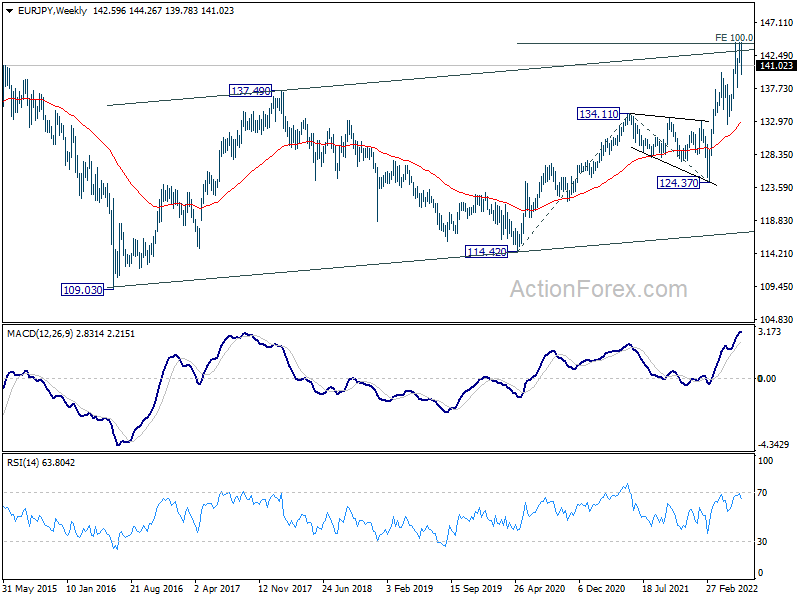
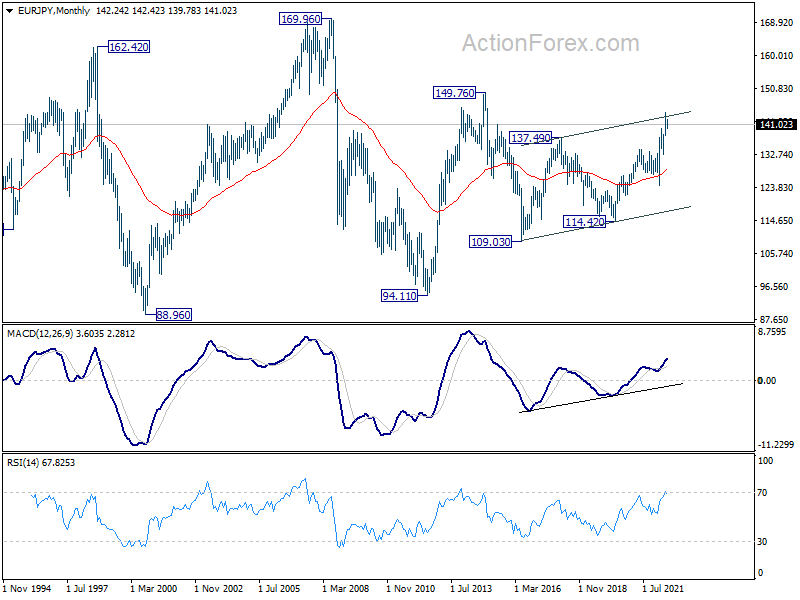
In the long term picture, current rally could be resuming whole rise from 94.11 (2012 low). Further rally would be seen to 149.76 resistance (2014 high) and above. This will remain the favored case as long as 132.63 support holds.
EUR/GBP Weekly Outlook
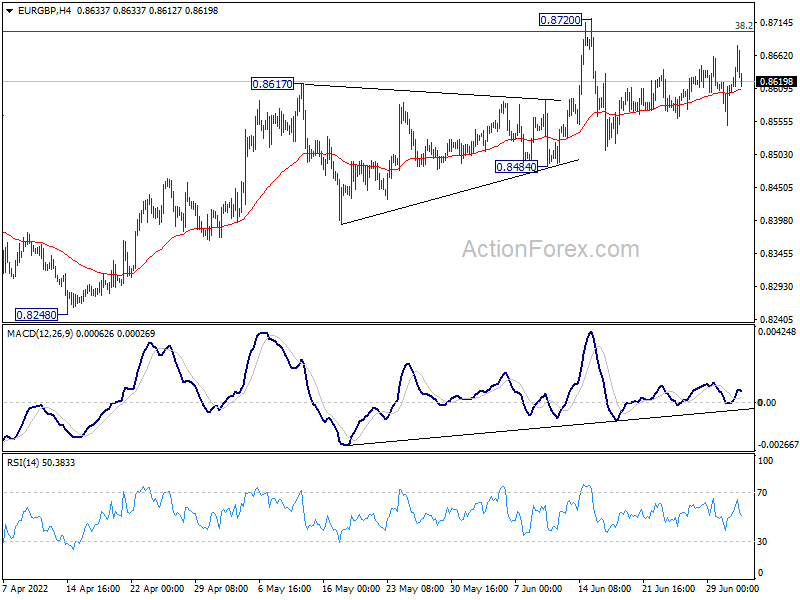
Range trading continued in EUR/GBP last week and outlook is unchanged. Initial bias remains neutral this week first. As long as 0.8484 support holds, further rise is in favor. Break of 0.8720 and sustained trading above 0.8697 medium term fibonacci level will carry larger bullish implication. Next target is 0.9003 fibonacci level. However, break of 0.8484 will indicate rejection by 0.8697 and turn near term outlook bearish.
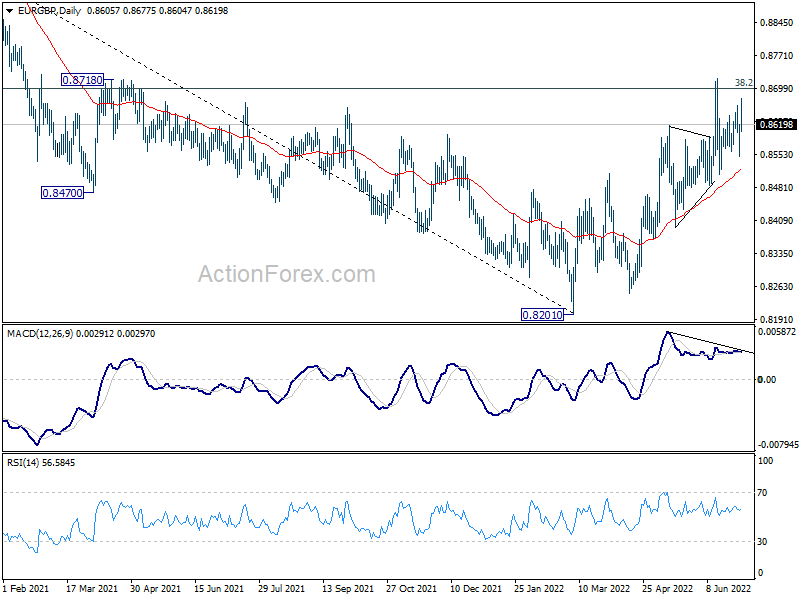
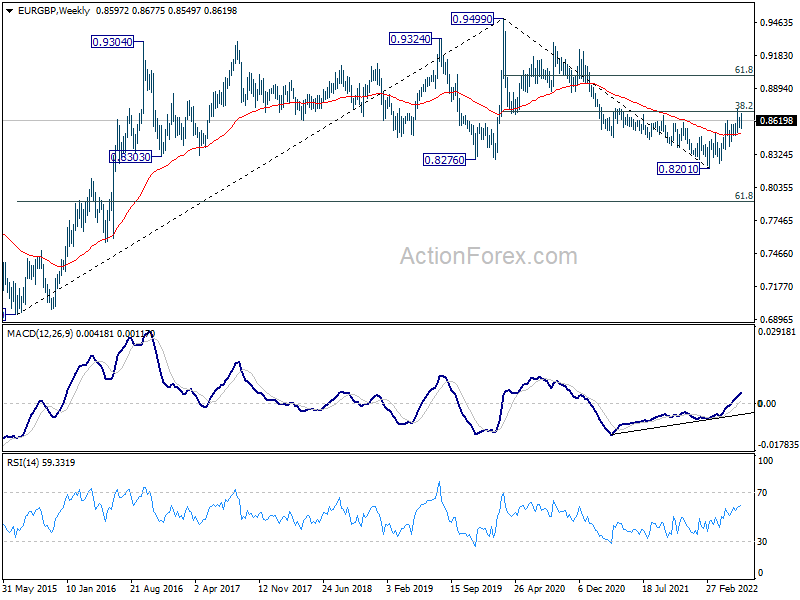
In the bigger picture, rise from 0.8201 medium term bottom could could either be a correction to the down trend from 0.9499 (2020 high), or a medium term up trend itself. Sustained break of 38.2% retracement of 0.9499 to 0.8201 at 0.8697 will affirm the latter case, and pave the way to 61.8% retracement at 0.9003. However, rejection by 0.8697 will maintain medium term bearishness.
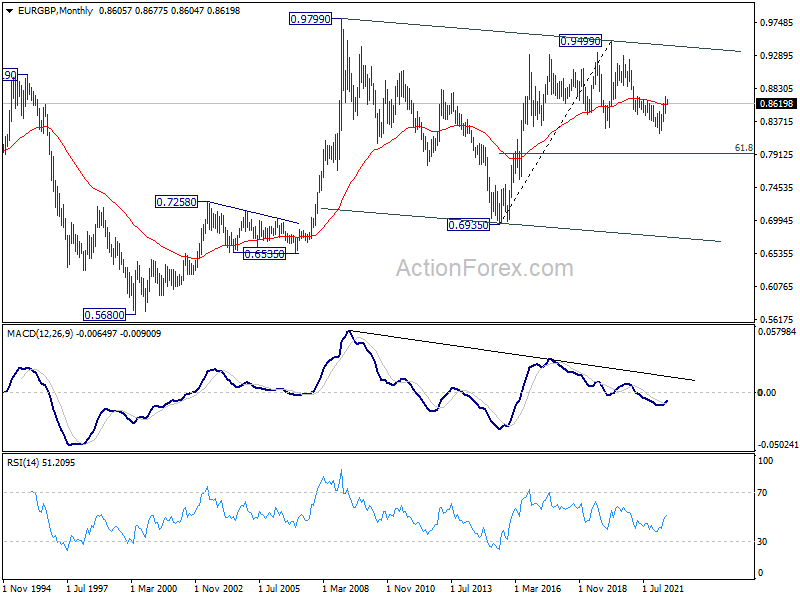
In the long term picture, the lack of medium term downside momentum suggests that fall from 0.9499 (2020 high) is merely a correction to rise from 0.6935 (2015 high). In case of another fall, downside should be contained by 61.8% retracement of 0.6935 to 0.9499 at 0.7917 to bring rebound. Sustained trading above 55 month EMA (now at 0.8604) will indicate that the correction has completed and bring retest of 0.9499.
EUR/AUD Weekly Outlook
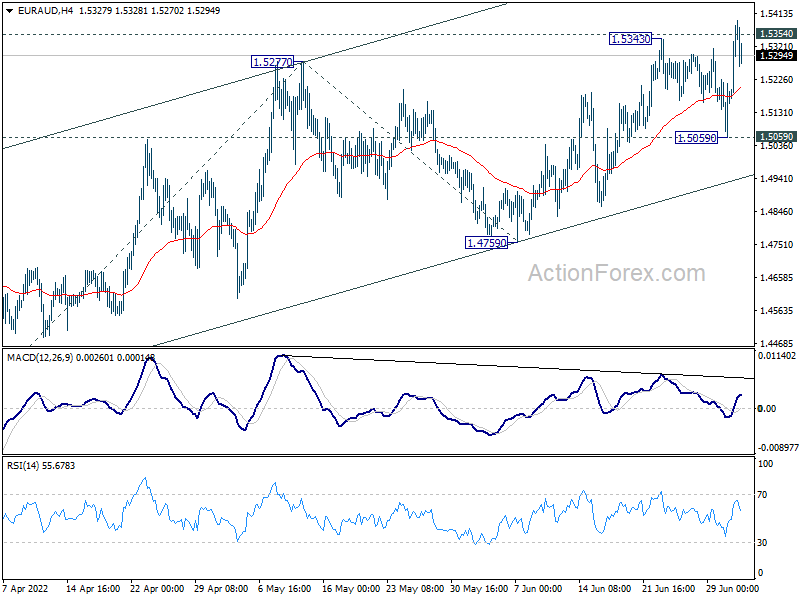
EUR/AUD's rise from 1.4318 resumed last week and breached 1.5354 support turned resistance. Initial bias stays on the upside this week. Sustained trading above 1.5354 should indicate medium term bottoming at 1.4318. Stronger rally would be seen back to 100% projection of 1.4318 to 1.5277 from 1.4759 at 1.5718. On the downside, however, break of 1.5059 will revive medium term bearishness and turn bias back to the downside.
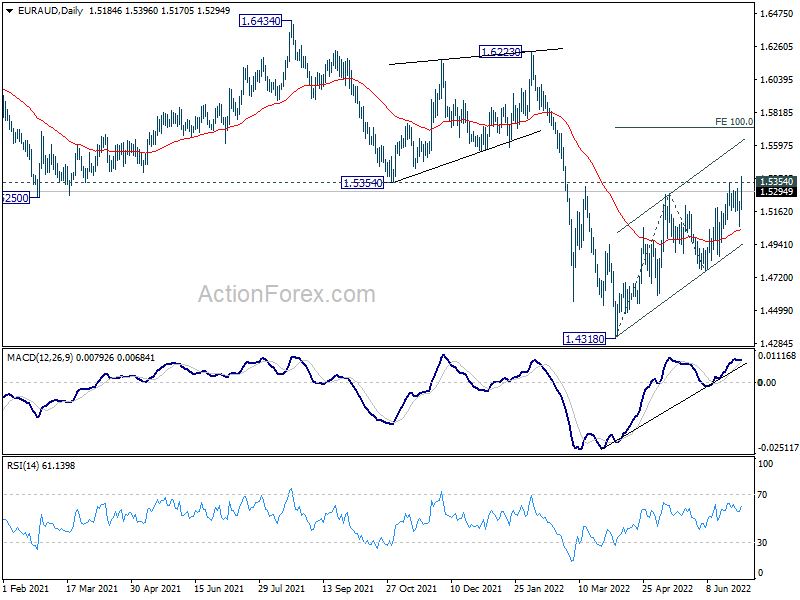
In the bigger picture, sustained break of 1.5354 support turned resistance will argue that a medium term bottom was formed at 1.4318 already. It would still be too early to call for long term trend reversal. But further rise would then be seen back towards 1.6434 resistance (2021 high). However, rejection by 1.5354 will retain bearishness for extending the down trend from 1.9799 (2020 high) through 1.4318 at a later stage.
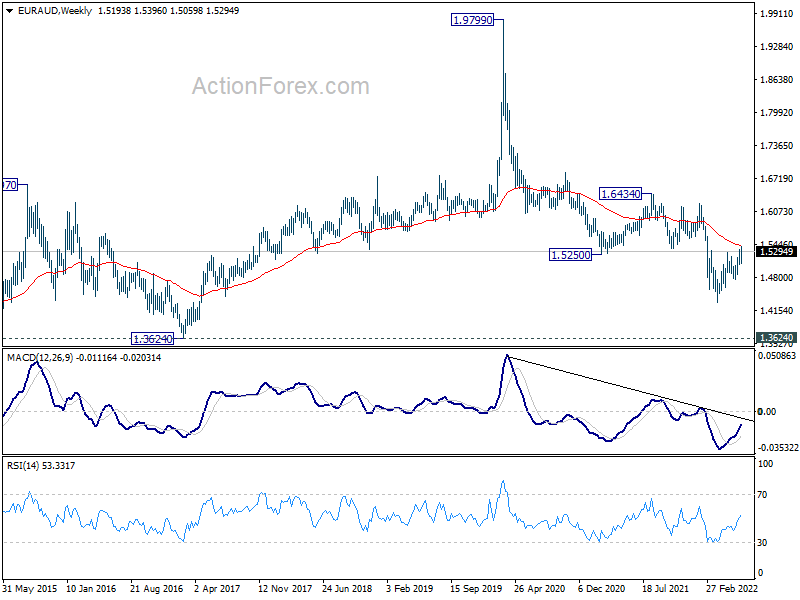
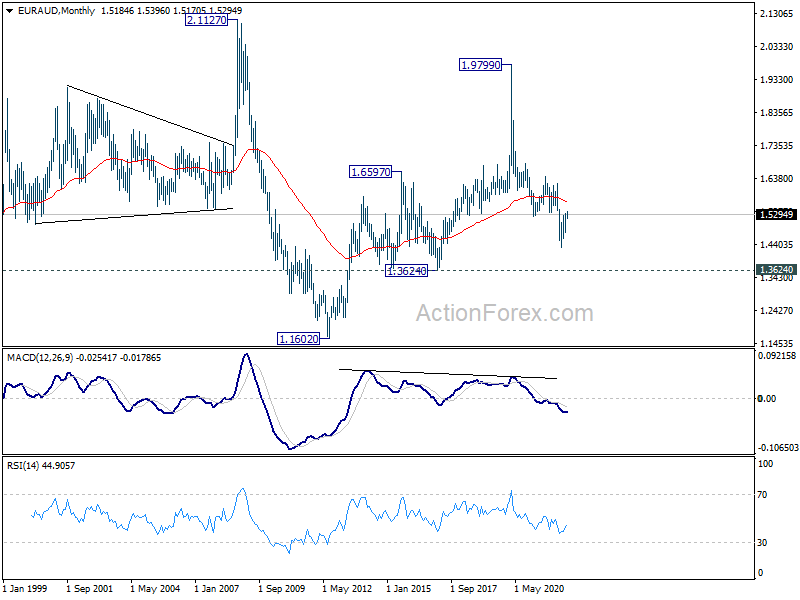
In the longer term picture, fall from 1.9799 (2020 high) is seen as the third leg of the pattern from 2.1127 (2008 high). Deeper fall should be seen to 1.3624 support. Decisive break there would pave the way back to 1.1602 (2012 low). This will remain the favored case as long as 55 month EMA (now at 1.5713) holds.
EUR/CHF Weekly Outlook
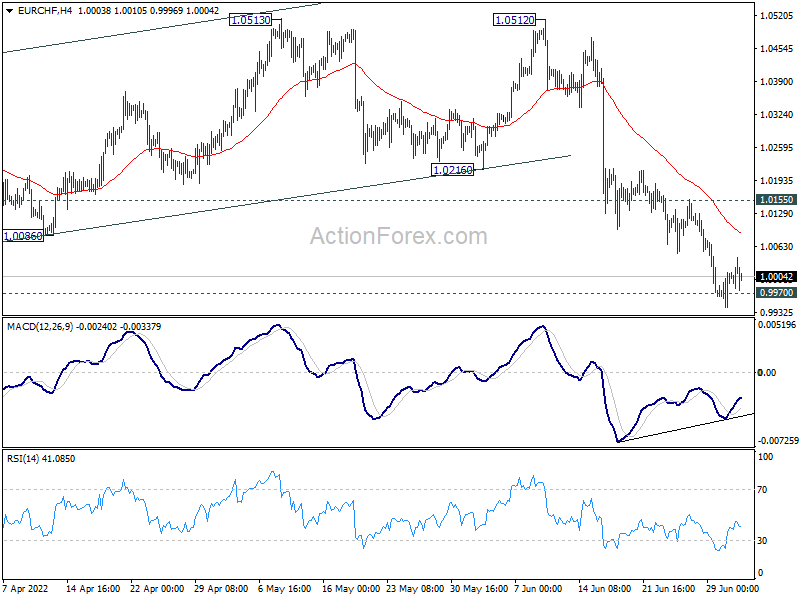
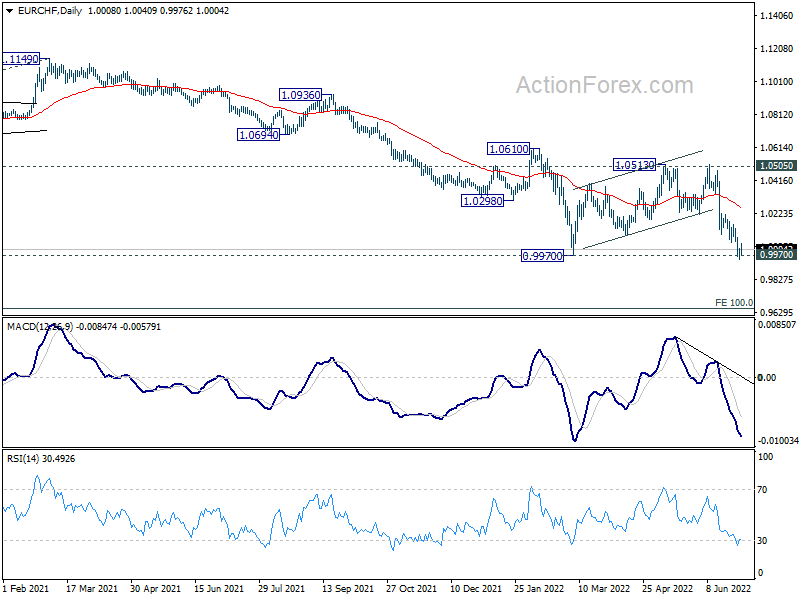
EUR/CHF dropped to as low as 0.9943 last week and breached 0.9970 low. But a temporary low was formed and it quickly recovered. Initial bias is neutral this week first. On the downside, sustained trading below 0.9970 will resume larger down trend for 0.9650 long term projection level. For now, outlook will stay bearish as long as 1.0155 resistance holds, in case of recovery.
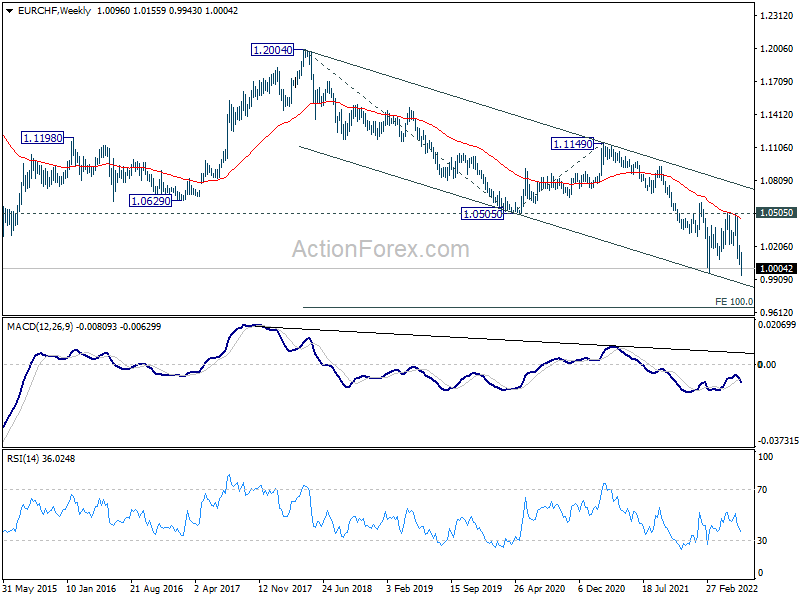
In the bigger picture, as long as 1.0505 support turned resistance (2020 low) holds, long term down trend from 1.2004 (2018 high) is expected to continue. Next target is 100% projection of 1.2004 to 1.0505 to 1.1149 at 0.9650. However, firm break of 1.0505 will suggest medium term bottoming, and bring stronger rebound towards 1.1149 structural resistance.
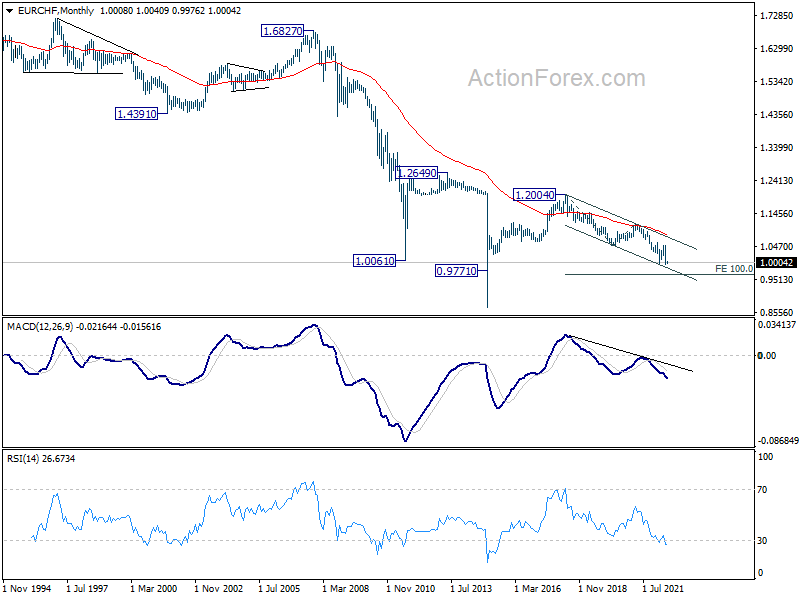
In the long term picture, capped below 55 month EMA, EUR/CHF is seen as extending the multi-decade down trend. There is no prospect of a bullish reversal until some sustained trading above the 55 month EMA (now at 1.0840).
Aussie Dived But a Bottom Around the Corner?
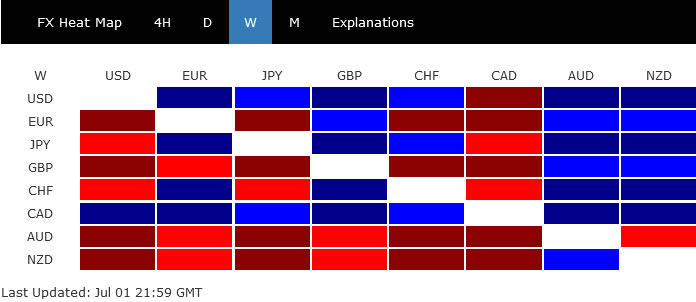
Extending fall in commodity prices and recession fears were the main theme in the markets last week. Australian Dollar ended as the worst performer, followed by New Zealand Dollar, and then Sterling. However, Canadian Dollar was surprisingly the strongest one, partly helped by resilient oil prices.
Meanwhile, extended pull back in US and European benchmark treasury yields boosted the Japanese Yen. Dollar was some what supported by mild risk-off sentiment, but capped by weakness in yields. Swiss Franc's appeared to be losing some momentum after a powerful, broad based rally. While Euro was weak initially, it was saved by buying in some crosses and ended mixed.
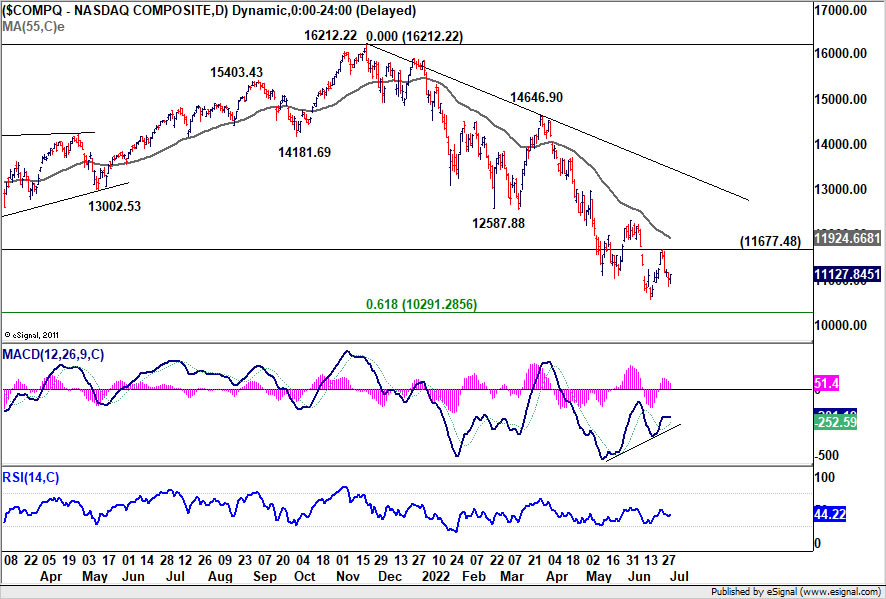
NASDAQ should bottom above 10k and stage bullish reversal
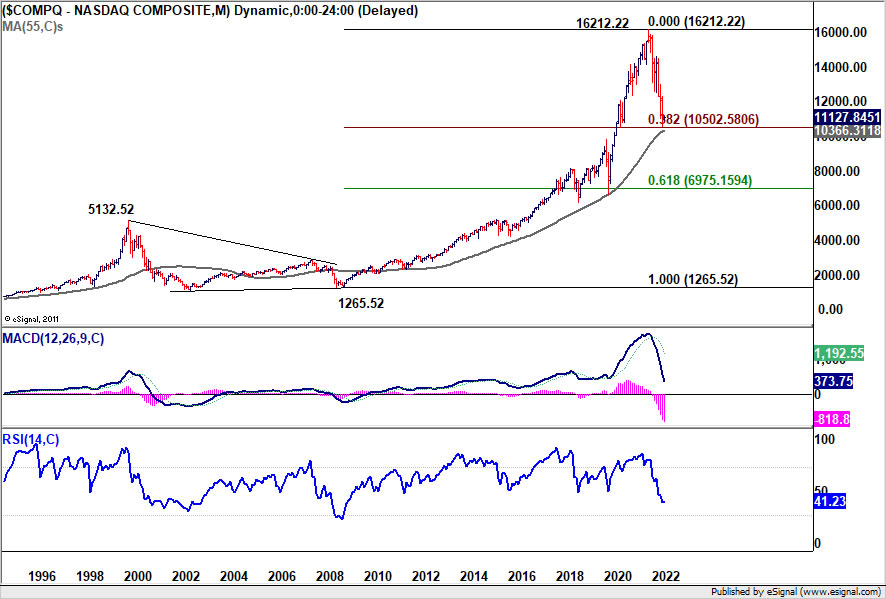
NASDAQ quickly retreated after edging higher last week and closed lower at 11127.84. Deeper decline cannot be ruled out yet. But downside potential should be limited and the case of reversal is building up. Bullish convergence condition is already seen in daily MACD. More importantly, NASDAQ is now close to a long term cluster support zone, including 55 month EMA (now at 10366.31, 61.8% retracement of 6631.42 to 16212.22 at 10291.28, and 38.2% retracement of 1265.52 to 16212.22 at 10502.58.
That is, NASDAQ should finally bottom above 10k handle. Break of 11677.68 resistance will turn focus back to 55 day EMA (now at 11924.66). Sustained break there should start the second leg of the corrective pattern from 16212.22, and target 14646.90/16212.22 resistance zone.
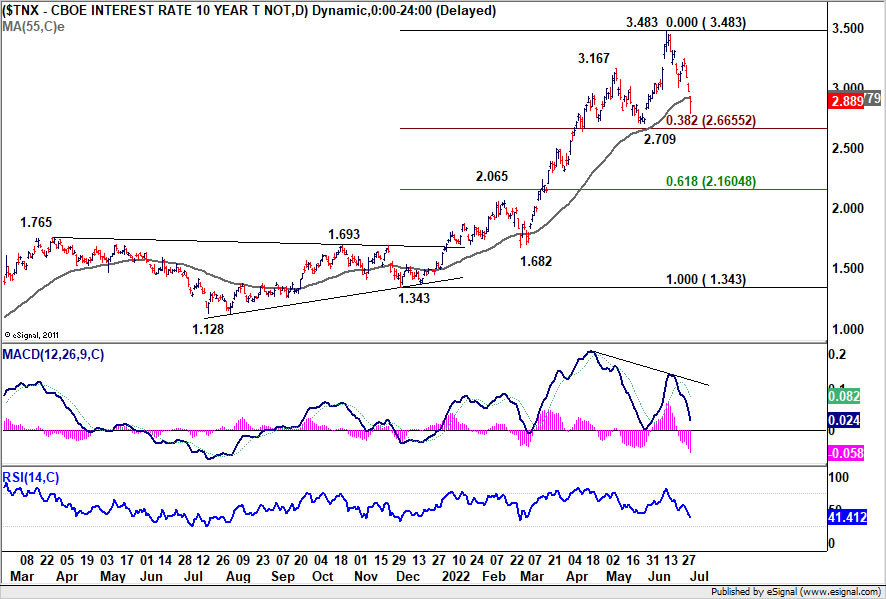
10-year yield lost 3% handle, but strong support expected at around 2.7%
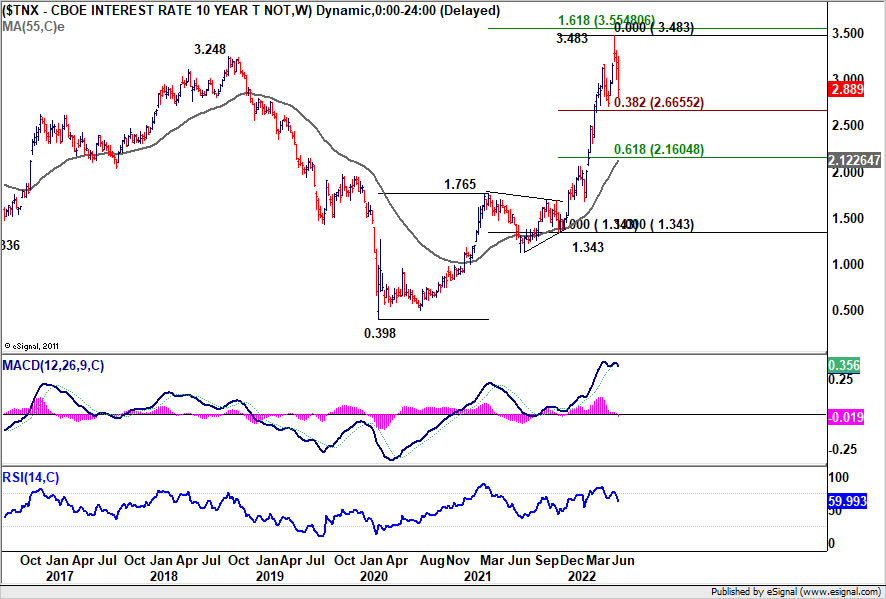
10-year yield tumbled last week as the correction from 3.483 high extended and lost 3% handle. Recession fears and disappointing economic data prompted some more recession fear. Nevertheless, it should noted that TNX did close notably higher than Friday's low at 2.791, which could be a sign of stabilization.
For now, it's in correction to the up trend from 1.343 and strong support is likely at 2.709, which is close to 38.2% retracement of 1.343 to 3.483 at 2.665, to contain downside, and set the range for a sideway pattern. However, sustained break of 2.6655 could trigger even steeper fall to 61.8% retracement at 2.160. If this unlikely scenario happens, it would be a rather negative sign.
Dollar index recovered but risk stays on downside
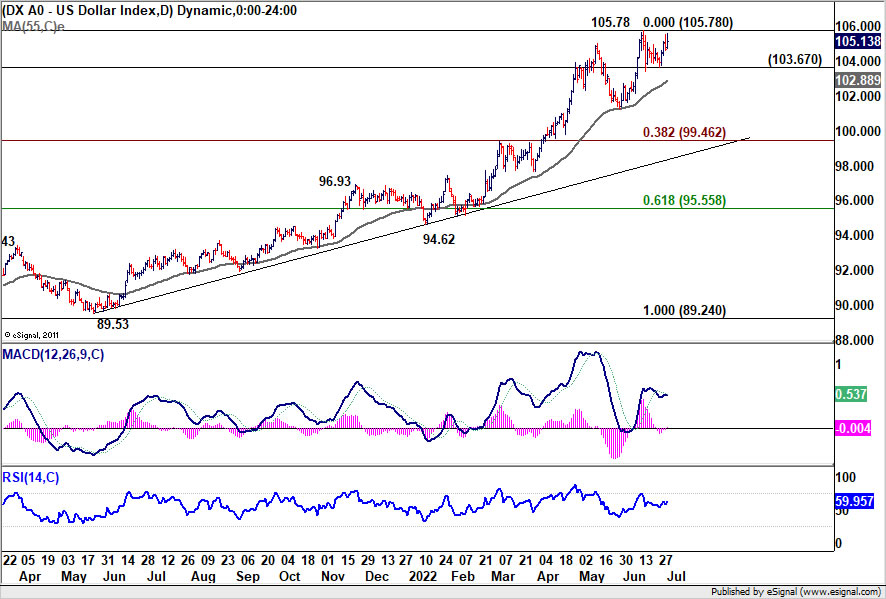
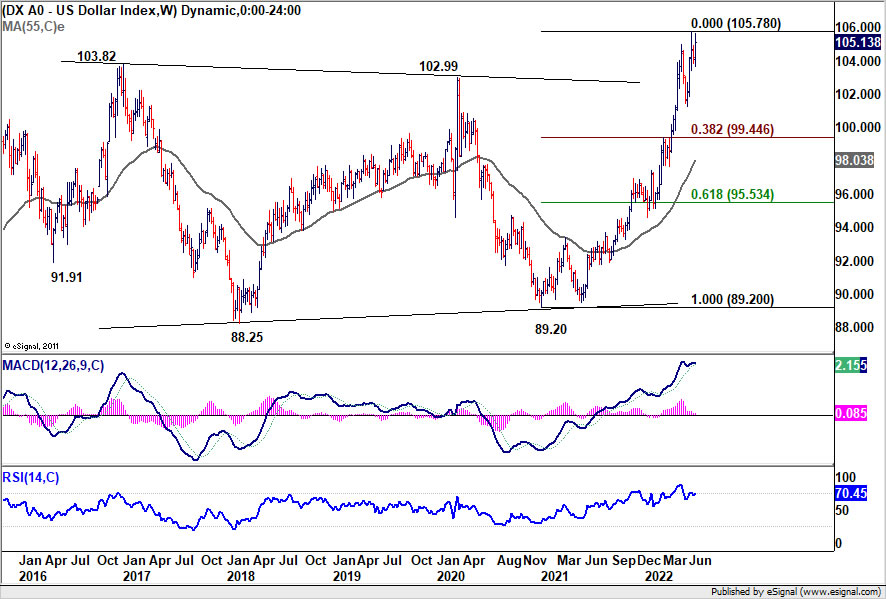
Dollar index recovered last week but failed to break through 105.78 high. It's partly supported by mild risk-off sentiment, but capped by falling treasury yields. But still, risk of a medium term correction is growing. In particular, the pull back could be quick sizeable if stocks do reverse. Break of 103.67 support will complete a small double top pattern. In this case, DXY should fall through 55 day EMA (now at 102.88), and possibly even further to 38.2% retracement of 89.52 to 105.78 at 99.46.
AUD/CAD extended down trend as Aussie weighed down by falling metal
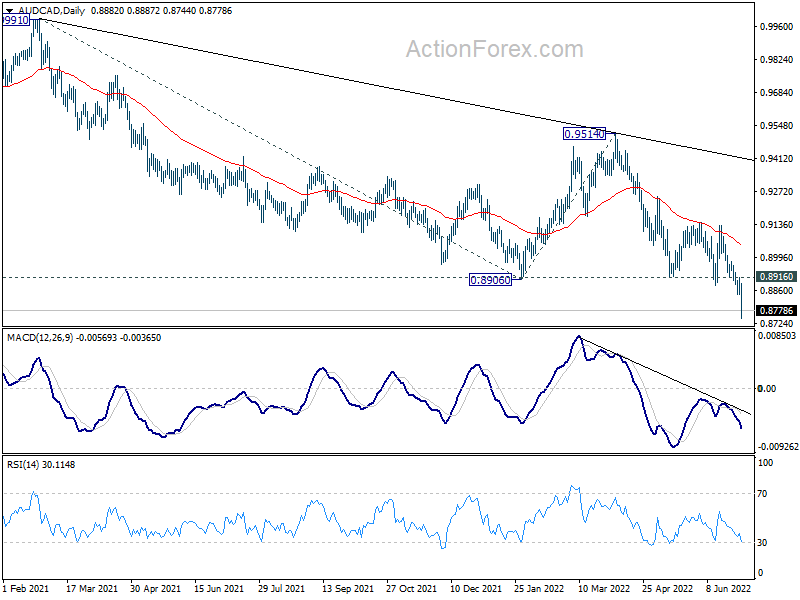
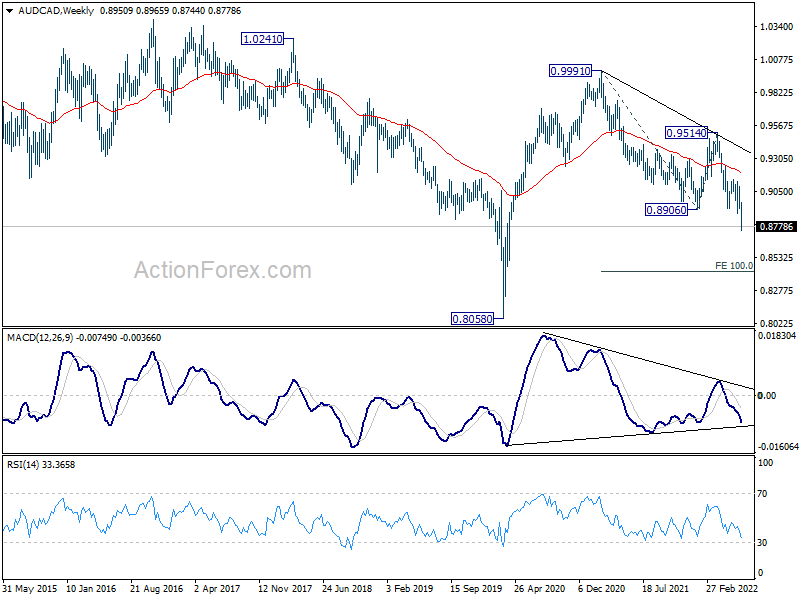
Aussie's falls broadly last week as weighed down heavily by falling base metal prices. On the other hand, Canadian Dollar was resilient as oil prices stayed range bound. AUD/CAD extended the medium term down trend from 0.9991 high. Such decline could still be a correction to the rebound from 0.8058 (2020 low). But whether or not, outlook will stay bearish as long as 0.8916 support turned resistance holds. Next target is 100% projection of 0.9991 to 0.8906 from 0.9514 at 0.8429.
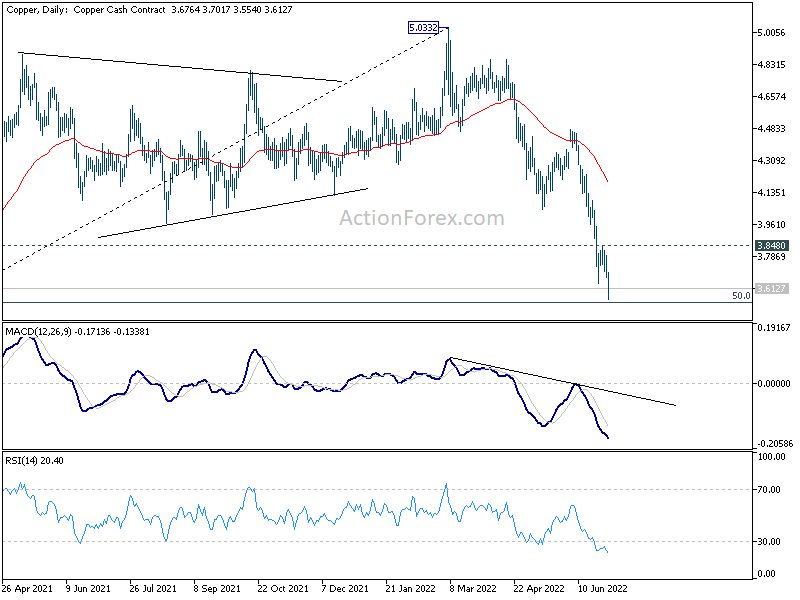
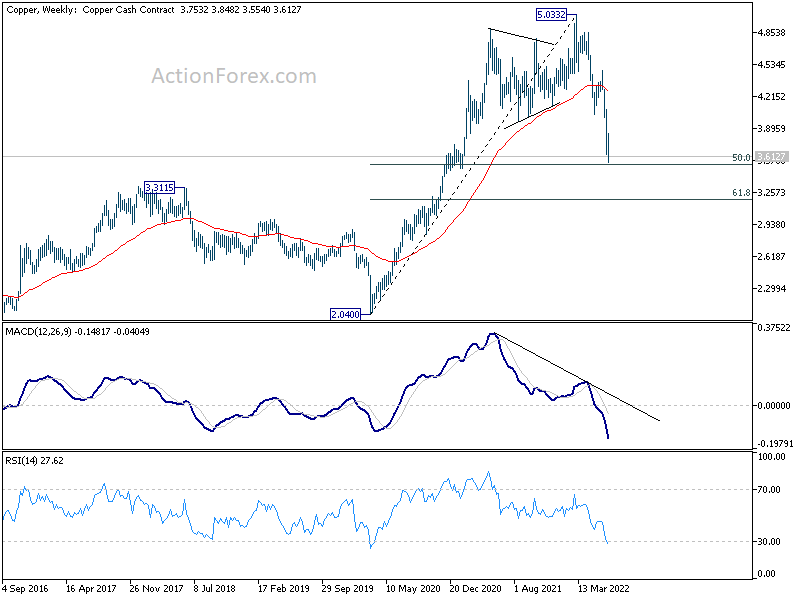
Copper's down trend continued last week and dipped further to as low as 3.554. It's now close to 50% retracement of 2.0400 to 5.0332 at 3.5366. Oversold condition (in both daily and weekly RSI) could help copper stabilizes at current level. Break of 3.848 resistance will argue that the five wave sequence from 5.0332 high has completed, and bring stronger rebound back to 55 day EMA (now at 4.191). Such development could at least help slow Aussie's selloff.
However, firm break of 3.5366 will bring deeper fall to 61.8% retracement at 3.1834 and possibly below. That would give Aussie additional selling pressure.
Gold hesitated to follow the even weaker silver
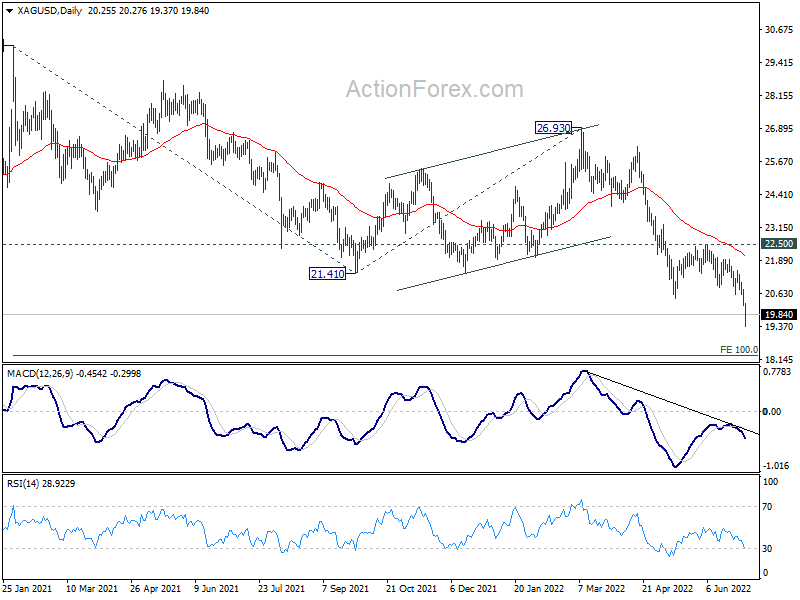
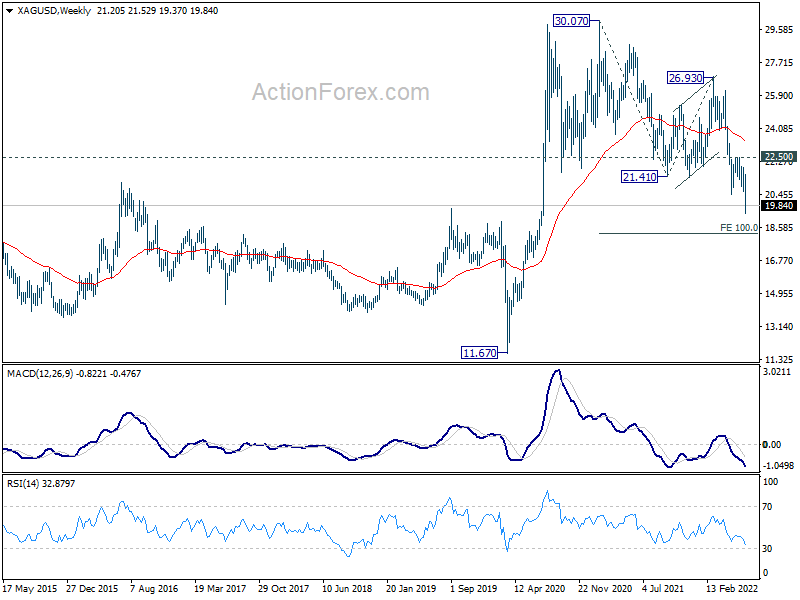
Talking about metals, the fortune of gold and silver was rather different. Silver reacted more to the selloff in industrial metal, and resumed the down trend from 30.07. Such decline could still be a corrective move to rise from 11.67 (2020 low). But whether or not, outlook will stay bearish as long as 22.50 resistance holds. Next target is 100% projection of 30.07 to 21.41 from 26.93 at 18.27.
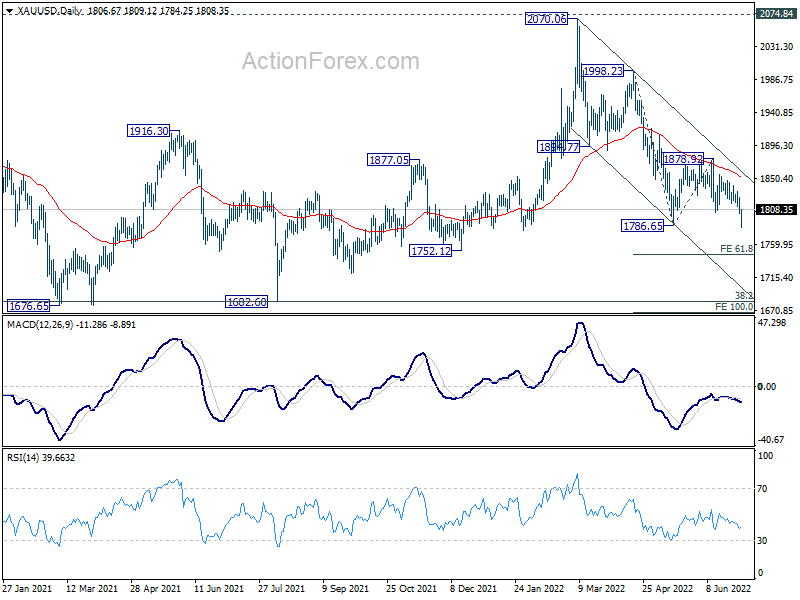
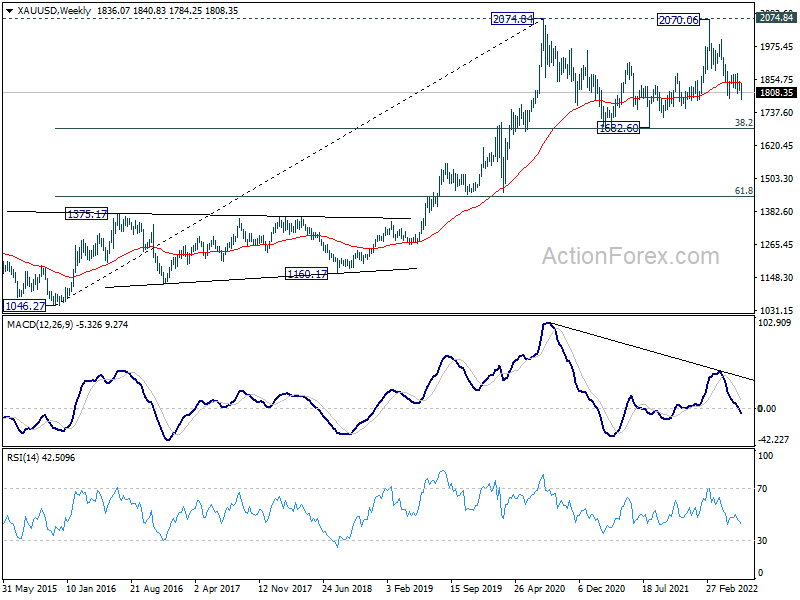
On the other hand, gold quickly recovered after breaching 1786.65 to 1784.25. It's partly supported by the extended pull back in treasury yields. But still, the decline from 2070.06 is still in progress and should target 61.8% projection of 1998.23 to 1786.65 from 1878.92 at 1748.16 on next fall.
Still, such decline is seen as the third leg of the consolidation pattern from 2074.84 (2020 high). Based on current structure, while break of 1748.16 cannot be ruled out, downside should be contained above 1682.60 support (38.2% retracement of 1046.27 to 2074.84 at 1681.92).
AUD/USD Weekly Outlook
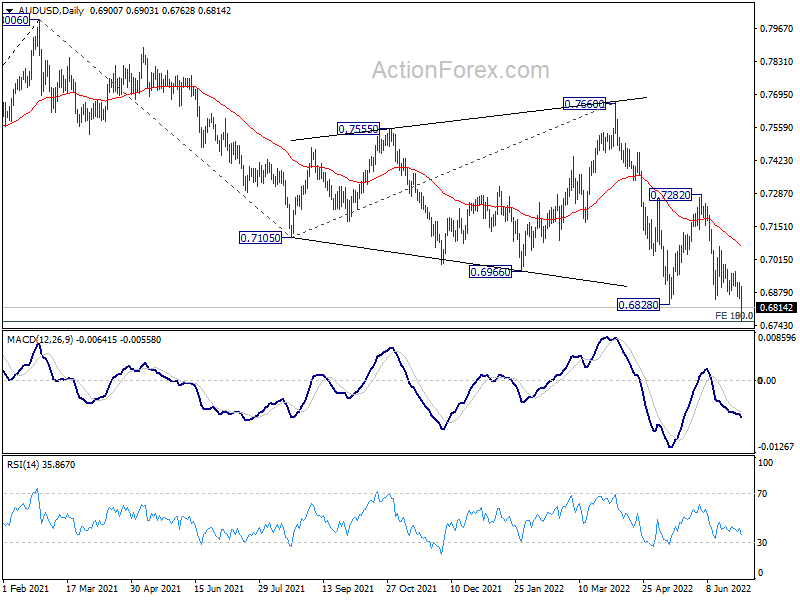
AUD/USD's down trend from 0.8006 resumed last week and dropped to as low as 0.6762. Strong support could still be seen from 0.6756/60 cluster support to bring rebound. On the upside, above 0.6918 resistance will indicate short term bottoming, and turn bias back to the upside for 0.7282 resistance. However, sustained break of 0.6756/60 will carry larger bearish implication and target 0.6461 fibonacci level next.
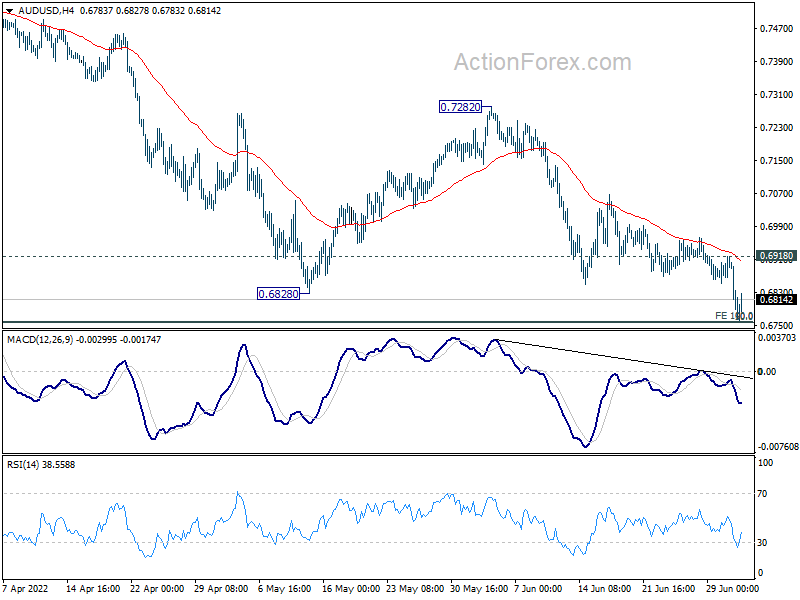
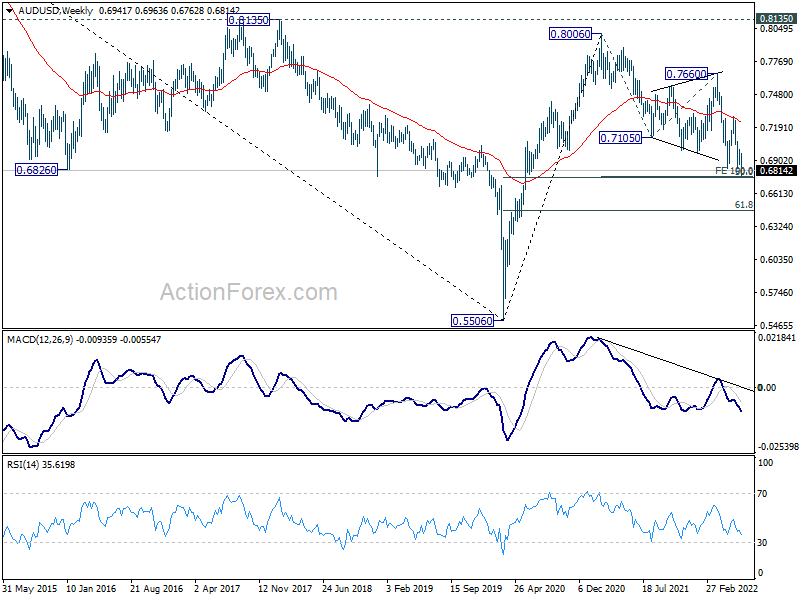
In the bigger picture, price actions from 0.8006 are seen as a corrective pattern to rise from 0.5506 (2020 low). Strong support is expected from 50% retracement of 0.5506 to 0.8006 at 0.6756 to complete the pattern. This coincides with 100% projection of 0.8006 to 0.7105 from 0.7660 at 0.6760. However firm break of 0.6756/60 will raise the chance of bearish reversal and target 61.8% retracement at 0.6461.
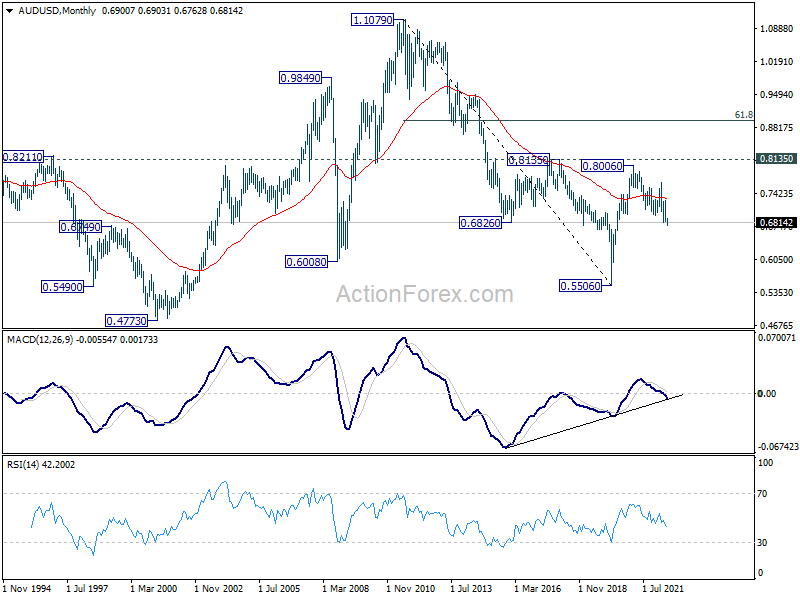
In the long term picture, rejection by 0.8135 resistance suggests that the long term down trend from 1.1079 (2011 high) is not ready to reverse. Yet, the structure of the fall from 0.8006 still argues that it's a corrective move. Hence, break of 0.5506 low is not envisaged for now. The long term outlook stays neutral first, and will be reassessed later after the fall from 0.8006 completes.
Summary 7/4 – 7/8
Monday, Jul 4, 2022
[php_everywhere instance="1"]
Tuesday, Jul 5, 2022
[php_everywhere instance="2"]
Wednesday, Jul 6, 2022
[php_everywhere instance="3"]
Thursday, Jul 7, 2022
[php_everywhere instance="4"]
Friday, Jul 8, 2022
[php_everywhere instance="5"]
Weekly Economic & Financial Commentary: U.S. Recession Is Likely, and Global Contagion Is Unavoidable
Summary
United States: Running on Empty
- Consumers staying power is showing signs of running out as inflation persists and confidence moves sharply lower. While consumers still have the ability to rely on their balance sheets to support spending, it's uncertain for how much longer they will continue to do so. Piling on the tough news was the weak ISM manufacturing report for June, which illustrates that we are not just seeing weakness out of the consumer, but investment spending as well.
- Next week: ISM Services (Wed), Trade Balance (Thu), Nonfarm Payrolls (Fri)
International: China's Economy Starting to Recover, U.K. Recession Seems Inevitable
- This week, we received further evidence that China's economy is on the road to recovery from its lockdown-induced slump. On the other hand, as U.K inflation accelerates further this year, and we expect the U.S. economy to slow late this year and fall into recession during 2023, we believe that could also be enough to tip the U.K. economy into recession by early next year.
- Next week: Reserve Bank of Australia (Tue), Central Bank of Peru (Thu), Mexico CPI (Thu)
Credit Market Insights: Pay Ya Later
- Consumers have increasingly relied on their balance sheets to fund spending, and as consumers tap credit, a less traditional service, Buy Now, Pay Later, has received increased attention. This week, we unpack what we know and importantly what we do not yet know about the service.
Topic of the Week: U.S. Recession Is Likely, and Global Contagion Is Unavoidable
- Inflation has trended uncomfortably high in many countries around the world, even as policymakers have ramped up monetary tightening cycles. The worldwide inflation problem has created an interesting dichotomy for the global economy, and as a result, we have made significant changes to our forecast profile for many central banks and economies.
Week Ahead – Peak Fed Tightening?
Or further to go?
The focus has shifted in recent weeks from how far central banks are going to go in their tightening cycles to how much of an economic slowdown we are facing and if a recession is still avoidable.
There’s no easy answer to that question and while there are signs that markets are starting to price in a recession, there is no consensus. Of course, the fate of some countries looks more certain than others but in most cases, it’s far from a foregone conclusion. For this reason, the economic data over the next week, as well as the views of policymakers, could be huge in determining how markets will behave.
The bank holiday on Monday means it’s a late start for the US but the rest of the week is anything but quiet. The US jobs report and Fed minutes are the obvious standouts but there’s plenty more on top that will ensure it’s another fascinating week.
US
A shortened trading week on Wall Street will have traders focusing on the FOMC minutes, a few Fed speakers, and the June nonfarm payroll report. The Fed’s minutes to the last meeting will likely bolster the case for another massive rate hike as inflation remains stubbornly high. The June nonfarm payroll report is expected to show the economy added 250,000 jobs in June, a deceleration from the 390,000 jobs added in the prior month. The unemployment rate is expected to remain steady at 3.6% and average hourly wages might maintain the same 0.3% pace from a month ago.
A couple of Fed hawks, Bullard and Waller will likely make the case for the Fed to be aggressive with the tightening of monetary policy. Fed’s Williams will also speak and has recently noted that 50 or 75 bps will be the debate at the July FOMC meeting.
EU
I don’t think there’s any such thing as a quiet week for Europe at the moment but next week is probably as close as it gets. The bulk of the week is made up of tier two and three data like final services PMIs which are typically not subject to large revisions.
The ECB meeting accounts will naturally be of interest although I’m not sure what we’ll get from them considering how explicit the central bank has been in its intentions. What’s happened since has probably been more significant as it could influence how aggressive they’ll be with the lift-off in a few weeks. For this reason, comments from President Lagarde and her colleagues will be more significant.
UK
A light week on the data front, with the highlight being the final services PMI on Tuesday. But there are a number of BoE policymakers appearing next week including Governor Bailey on Tuesday, with traders keen to know if the MPC will finally join the super-sized club or continue with the slow and steady approach.
Russia
Inflation and PMI data next week, with the former of particular note. That said, the central bank has made clear its intention to continue cutting rates as inflation falls. The Key Rate has already fallen back to 9.5% from 20% where it was hiked to after the invasion. But further cuts could follow in an attempt to support the economy and offset the strength of the rouble.
South Africa
The whole economy PMI on Tuesday is the only notable release next week.
Turkey
Restrictions on lira lending last week had the desired effect on the currency, seeing the USDTRY fall more than 8% over the next couple of days before pulling back. It’s now only 3.5% from the highs, suggesting the government has more to do. A 25% increase in the minimum wage announced on Friday will neither tame inflation nor make people’s lives dramatically easier. Further pain ahead. CPI data on Monday is expected to show annual inflation jumped to 78.35% in June from 73.5% in May.
Switzerland
Inflation data on Monday could support the argument for further rate hikes from the SNB. They do love to spring a surprise on the markets, in contrast to every other central bank, so we can’t ignore the possibility of an inter-meeting decision, even if it appears unlikely at the moment.
China
China continues to have relatively low inflation, in sharp contrast to skyrocketing inflation in most major economies. The June inflation report will be released on Friday. The estimate stands at 2.2% YoY, a notch higher than the 2.1% gain in May. The modest inflationary pressures have allowed the PBOC to continue to inject more stimulus into the economy in order to boost growth.
India
Services PMI is the only release of note next week.
Australia
The RBA holds its policy meeting on Tuesday. In June, the RBA raised rates by 0.50%, surprising the markets which had expected a much smaller increase. Still, with the cash rate currently below 1%, the central bank will have to press the rate pedal to the floor in order to curb soaring inflation. Another 0.50% increase is widely expected at the upcoming meeting, which would bring the cash rate to 1.35%.
New Zealand
It’s a quiet week out of New Zealand, with Wednesday’s Reserve Bank of New Zealand Statement of Intent the only tier-1 event. The RBNZ will present its objectives for the next three years and the markets will be looking for insights into the Bank’s future rate policy. The cash rate is currently at 2.0% and the Bank is expected to raise rates when it meets on July 13th.
Japan
Japan releases household spending on Friday. Japan’s inflation of 2.1% has been much more moderate than in the UK or the US, where inflation is close to double digits. Still, consumers are not used to prices rising, after 15 years of very low inflation. A weaker yen has made imports more expensive, and the Japanese consumer is holding tighter to their purse strings. Household spending is expected to fall by 0.9% in May, after a decline of 1.7% in April.
Singapore
Singapore releases retail sales on Tuesday. The May release came in at 12.1% YoY, pointing to a sharp gain in consumer spending.
Economic Calendar
Saturday, July 2
Economic Events
- ECB’s Schnabel speaks on the world economy, monetary policy and the Russia-Ukraine war
Sunday, July 3
Economic Events
- German Chancellor Scholz gives a traditional “summer interview” on ARD TV
Monday, July 4
Economic Data/Events
- US markets closed for Independence Day
- Turkey CPI
- Switzerland CPI
- Australia building approvals, inflation gauge, home loans value
- Canada Manufacturing PMI
- Euro area PPI
- Germany trade
- Japan monetary base
- Singapore electronics sector index, PMI
- Spain unemployment
- The Ukraine Recovery Conference occurs in Switzerland
Tuesday, July 5
Economic Data/Events
- US factory orders, durable goods
- Thailand CPI
- European PMIs: Eurozone, France, Russia
- Australia PMI
- RBA rate decision: Expected to raise rates by 50bps to 1.35%
- India PMI
- Singapore PMI
- South Africa PMI
- China Caixin PMIs
- France industrial production
- Japan labor cash earnings, PMI
- Mexico international reserves
- New Zealand commodity prices, house prices
- Singapore retail sales
- BOE releases financial stability report
Wednesday, July 6
Economic Data/Events
- US PMIs, ISM services index, JOLTS job openings, FOMC minutes
- Euro area retail sales
- Germany factory orders
- Spain industrial production
- UK PM Johnson appears before Parliament’s Liaison Committee
- UN posts annual “The State of Food Security and Nutrition in the World” report.
- ECB’s Rehn speaks on a panel on Finnish foreign policy and security
- BOE Chief Economist Pill delivers the keynote speech on the second day of the Qatar Centre for Global Banking & Finance’s annual conference in London
- BOE Deputy Governor Cunliffe speaks on a panel about central bank digital currency
Thursday, July 7
Economic Data/Events
- US ADP employment change, initial jobless claims, trade
- G20 foreign ministers meet in Bali
- Fed’s Waller speaks at National Association for Business Economics event
- Fed’s Bullard speaks at an event hosted by Little Rock Regional Chamber
- BOE releases its decision maker survey.
- ECB publishes accounts of its June policy meeting.
- ECB’s Stournaras, Centeno and Herodotou speak at the Annual Economist Government Roundtable in Athens
- BOE’s Mann speaks at the LC-MA Forum on current monetary-policy issues
- Mexico CPI
- China foreign reserves
- Australia Foreign reserves, trade
- Singapore foreign reserves
- Germany industrial production
- Poland rate decision: Expected to raise rates by 75bps to 6.75%
- Canada trade
- Switzerland unemployment rate
- Chile copper exports
- Hungary one-week deposit rate
- Japan leading index
- Mexico releases monetary policy minutes
- Russia foreign exchange, gold reserves
- Thailand consumer confidence
- EIA crude oil inventory report
Friday, July 8
Economic Data/Events
- US nonfarm payrolls, unemployment, wholesale inventories, consumer credit
- Fed’s Williams speaks at an event hosted by the University of Puerto Rico
- ECB’s Lagarde, Schnabel, Villeroy and Stournaras speak at The French Davos, Recontres Econmiques forum
- ECB posts climate-risk stress test results for European banks
- Russia CPI
- Italy industrial production
- France trade
- Canada unemployment
- Japan household spending, BoP, trade balance, bank lending, bankruptcies
- New Zealand heavy traffic index
- Thailand forward contracts, foreign reserves
- Turkey current account
Sovereign Rating Updates
- Greece (Fitch)
- Turkey (Fitch)
- EFSF (Fitch)
- ESM (Fitch)
- Netherlands (DBRS)
U.K. Recession Now on the Economic Horizon
Summary
- While the U.K. economy showed some resilience at the start of 2022, there are increasing signs that a more meaningful slowdown is approaching. Elevated inflation should contribute to declining real incomes, weighing on consumer spending and overall GDP. With the U.S. economy, in our view, now expected to fall into recession in 2023, we also expect the U.K. to experience an economic recession by early next year.
- Activity indicators for the second quarter suggest that a slowdown might already be underway. Activity data on retail sales, the service sector and overall GDP, along with recent confidence surveys, all hint at U.K. economic contraction in Q2 2022.
- Still even with this uncertain outlook, intensifying inflation pressures suggest the Bank of England will need to continue with its monetary tightening cycle for a while yet. We expect a steady series of 25 bps policy rate increases at upcoming meetings in August, September and November, which would lift the policy rate to 2.00%. Eventually, once the U.K. economy stumbles and inflation recedes, we expect the Bank of England to beginning lower interest rates by late 2023.
- Overall, this mix of measured monetary tightening and rapid inflation, combined with a U.K. economic downturn, provides an underwhelming backdrop for the U.K. currency. We have revised our forecast for the pound lower, and now see a trough in the GBP/USD exchange rate around $1.1700 in mid-2023.
The U.K.'s Early 2022 Economic Resilience Seems Unlikely to Last
The U.K. economy displayed resilience during the early part of 2022, but there are increasing signs a more meaningful slowdown is approaching. Indeed, given that we now see a U.S. recession as more likely than not, and with the global economic and market backdrop unsettled as well, we now also anticipate a U.K. economic recession by early 2023.
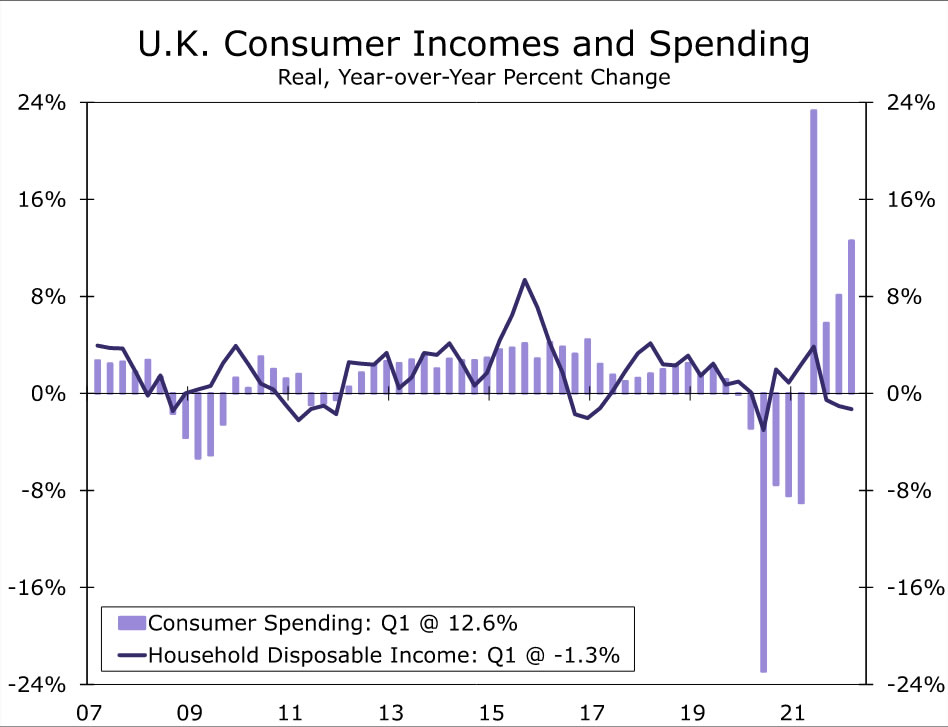
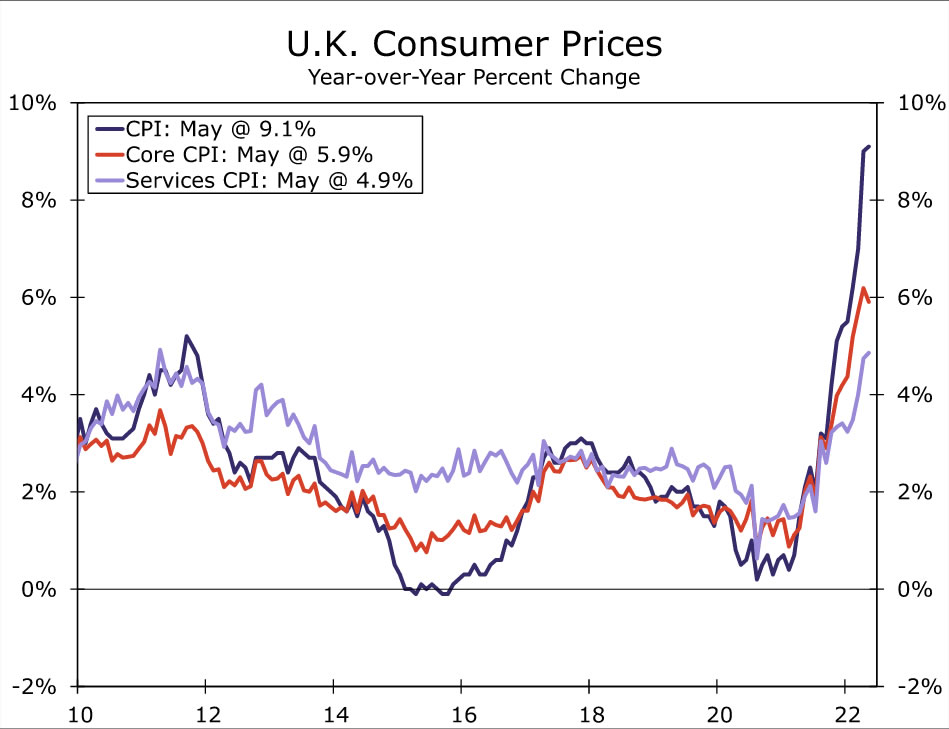
The final estimate of U.K. Q1 GDP showed a still respectable pace of economic growth of 0.8% quarter-over-quarter and 8.7% year-over-year. Within the details, consumer spending rose 0.6% quarter-over-quarter, but business investment fell 0.6%. While U.K. inflation has been on a rising trend for some months now, price growth appeared to have only a modest dampening effect on Q1 economic growth. That said, inflation pressures have intensified even further since April, with the latest round of electricity price increases now in effect. Indeed, for April alone, electricity prices jumped 40.5% month-over-month and natural gas prices jumped 68.8%. Those increases contributed to a headline inflation rate of 9.1% year-over-year as of the latest read, for May. Those energy price increases, as well as broader prices increases more generally, are increasingly expected to weigh on real household incomes and consumer purchasing power going forward. Another sizable electricity price increase is slated for October, perhaps in the region of 30%-40%, which the Bank of England estimates could lift headline CPI inflation up to, or above, 11% year-over-year.
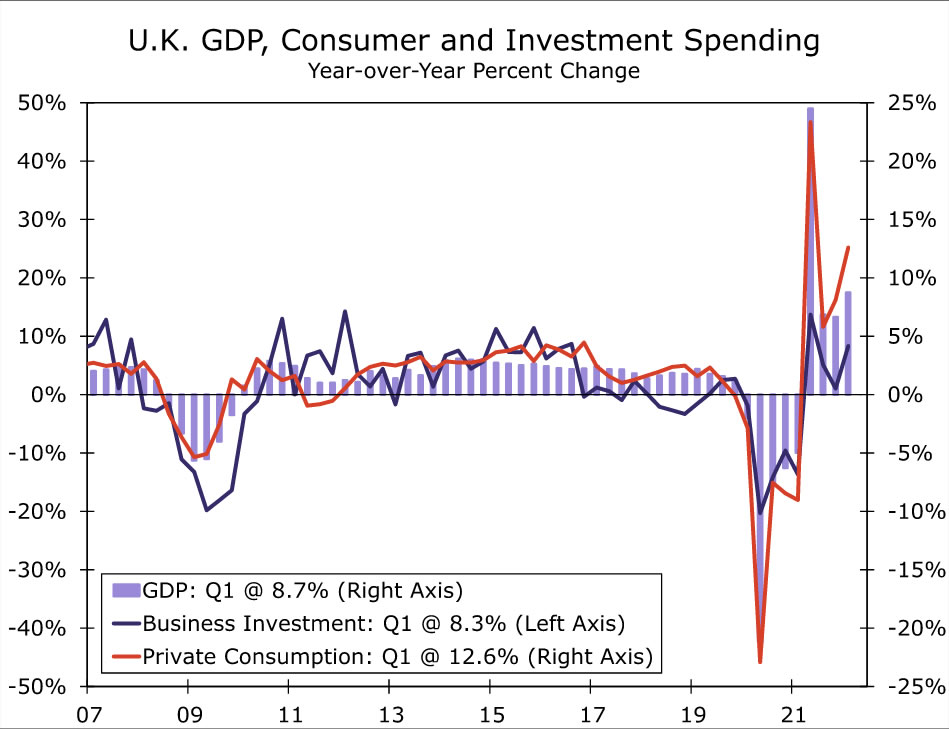
It is against this backdrop that the household income and spending trends from the first quarter GDP report were somewhat worrisome. In nominal terms household disposable income rose by 1.5% quarter-over-quarter, but that increase in nominal incomes was outstripped by higher inflation, meaning the real household disposable income dipped 0.2% quarter-over-quarter, the fourth quarter in a row that real incomes have declined on a sequential basis. As a result, real household disposable income is down 1.3% compared to Q1 2021, in contrast to a 12.6% increase in real consumer spending over the same period. Meanwhile, the household saving rate held steady at 6.8% of disposable income in Q1, which is actually slightly below the historical average that prevailed in the two decades prior to the pandemic of 7.1%. With price pressures intensifying even further over the balance of 2022, and even given some additional fiscal stimulus announced by the government in May, it seems clear that declining real household incomes will weigh even more heavily on consumer spending and overall GDP growth in the months and quarters ahead.
Signs of A Slowdown Showing Through
Indeed, more recent data for the second quarter is starting to reveal the contours of that economic growth slowdown. On the consumer side, April retail sales rose 0.4% month-over-month, but that was more than offset by a 0.5% decline in May sales. As a result, the level of retail sales for the April-May period is 0.8% below their Q1 average, hinting at potential drop in consumer spending in the second quarter. Meanwhile, the broader activity data from the monthly GDP figures is more dated, but still hints at a possible contraction in activity in Q2. For April, the level of overall GDP was 0.4% below its Q1 average and services activity was 0.3% below its Q1 average. Without a sharp rebound in activity in either May or June—which seems rather unlikely—the U.K. economy seems on course for a contraction in the second quarter. Finally, the U.K. PMI surveys also point to moderate growth. In particular the U.K. services PMI fell sharply to 53.4 in May and held at that more subdued level in June, an indicator of slowing economic momentum ahead.
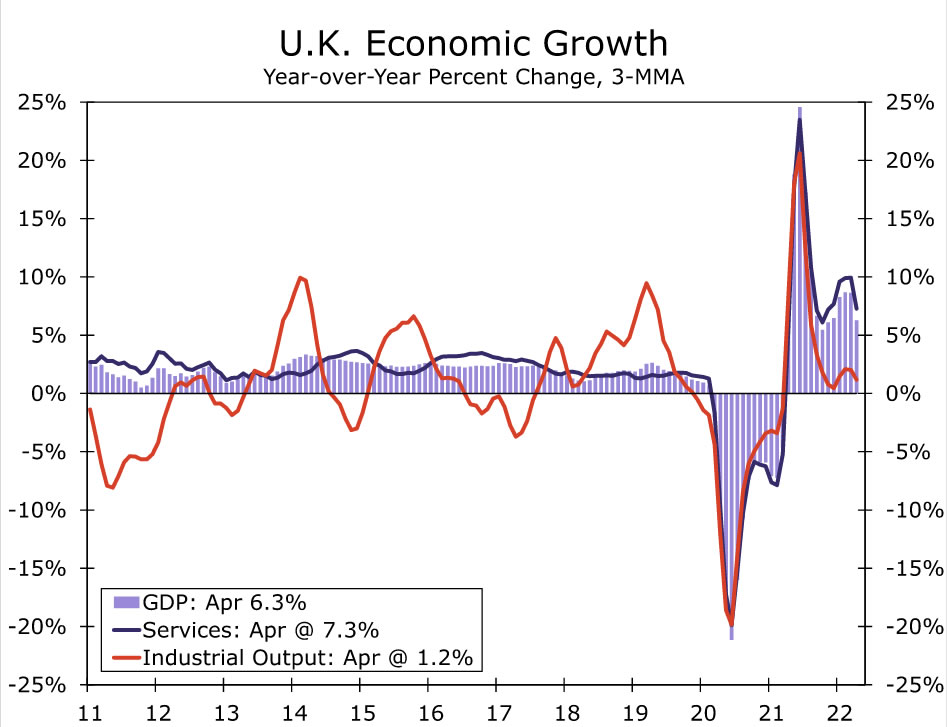
Overall, both the consensus forecast and the Bank of England forecast is for GDP to decline in the second quarter. However, it is not just Q2 2022 that could spell trouble for the British economy. As U.K inflation accelerates further this year, and as the U.S. economy slows late this year and falls into recession during 2023, we believe that could also be enough to tip the U.K. economy into recession by early next year. We expect U.K. GDP growth to come to a standstill by Q4 this year, and with respect to sequential growth, see U.K. GDP declining 0.4% quarter-over-quarter (not annualized) in both Q1 and Q2 of 2023. In terms of calendar year growth, we expected U.K. GDP to rise 3.8% in 2022, but to dip by 0.1% in 2023.
However, even against this uncertain growth backdrop, intensifying inflation pressures suggest the Bank of England will need to continue with its monetary tightening cycle for a while yet. In fact, at its latest monetary policy announcement in June the Bank of England raised its policy rate 25 bps to 1.25%, while policymakers also said they would be "particularly alert to indications of more persistent inflationary pressures, and will if necessary act forcefully in response." Six policymakers voted in favor of the 25 bps increase, while three policymakers dissented in favor of a larger 50 bps increase. Clearly further Bank of England tightening will be forthcoming and while we do not, at this time, expect the Bank of England to deliver the larger 50-75 bps rate increases that some other central banks have delivered, we do anticipate a short, sharper rate hike cycle from the U.K. central bank. Specifically we see a steady series of 25 bps policy rate increases at upcoming meetings in August, September and November, which would lift the policy rate to 2.00%. We expect a pause from the Bank of England in December, a pause that we believe will ultimately prove to be the end of the rate hike cycle. As the U.K economy tips into recession by early 2023, and inflation begins to slow meaningfully from the current elevated levels, we anticipate eventual monetary easing from the Bank of England. We expect the U.K. central bank to begin lowering its policy interest rate during the second half of 2023, by a cumulative 50 bps to 1.50% by the end of next year.
Overall, this mix of gradual monetary tightening and rapid inflation (meaning that real U.K. policy interest rates will remain substantially in negative territory), combined with a U.K. economic downturn, provides an underwhelming backdrop for the U.K. currency. We have revised our forecast for the pound lower, and now see a trough in the GBP/USD exchange rate around $1.1700 in mid-2023. Even as the U.S. economy falls into its own recession and the Fed begins to lower interest rates by late next year, we believe that headwinds facing the U.K. economy will mean only a modest rebound for the pound, and we target a GBP/USD exchange rate of $1.1900 by the end of 2023.
Week Ahead – RBA to Hike Again But Spotlight on NFP Amid Recession Angst
Worries about a looming recession are dragging stock markets lower again. There’s a raft of data on the way that could lessen or heighten those concerns, most notably, the latest jobs report in the United States. But even if there is some possibility of positive relief from next week’s releases, central banks pose a downside risk to sentiment. The minutes of the Federal Reserve’s and European Central Bank’s policy meetings will likely reiterate their hawkish stance, while the Reserve Bank of Australia is expected to deliver another double rate hike.
RBA to raise by 50 bps; can it go bigger?
In May, the RBA began its rate hike cycle in earnest, lifting the cash rate by a total of 75 basis points. It is widely expected to follow up June’s 50-bps increment with a similar move at its July meeting on Tuesday. Given all the panic about the surge in inflation globally, a bigger rise cannot be ruled out as policymakers are in a rush to front load as many rate increases as they can now while their economies are on a solid footing.
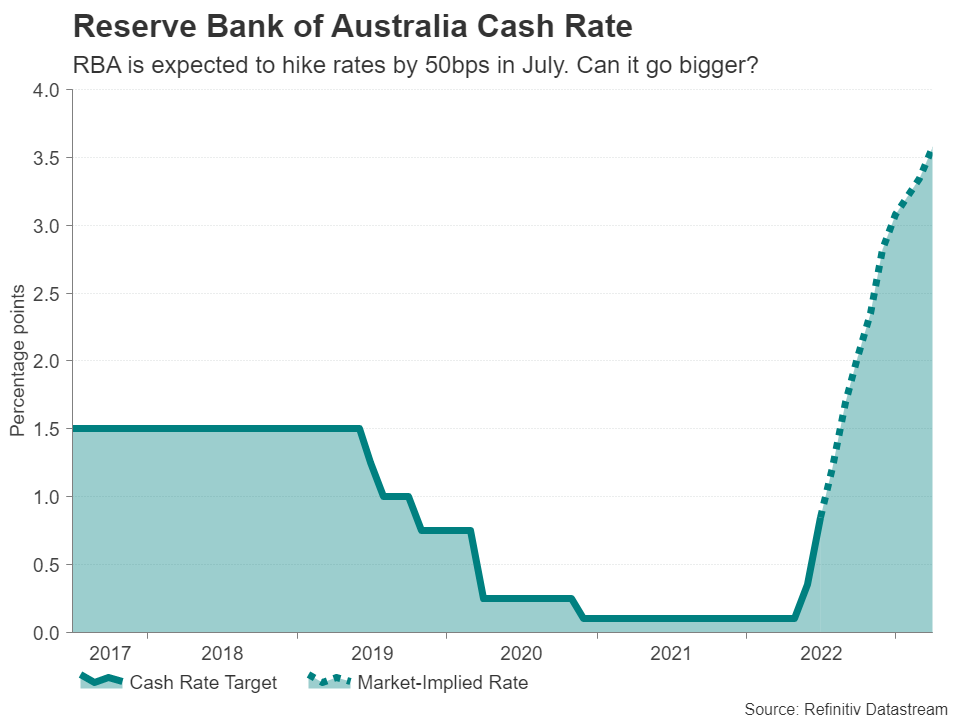
However, rate hike bets in money markets have cooled lately as investors are becoming more wary about the need for aggressive tightening by central banks amid all the pessimism about the growth outlook. A 50-bps rate rise by the RBA was almost fully priced in just over a week ago, but expectations have now fallen to about 85%.
With markets so fearful about a recession, a hawkish surprise would probably only modestly boost the risk-sensitive Australian dollar. The currency is back testing the key $0.68 level and its best chances of re-establishing a foothold above $0.70 is if risk appetite bounces back. Next week’s mid-tier data (building approvals are due Monday and the AIG services index is out Wednesday) are unlikely to offer much support either.
Bullish dollar to turn sights to NFP
There’s just no keeping the US dollar down these days as the world’s reserve currency can’t hide its haven appeal at a time when there’s so much doom and gloom about sky-high inflation and the real risk of a major economic downturn. One of the pivotal moments for investor sentiment has been signs that consumption in America has already started to soften and businesses are scaling back some of their hiring plans.
Friday’s all-important nonfarm payrolls report will probably confirm this trend. The US economy is expected to have added 295k jobs in June, slowing from May’s print of 390k. The unemployment rate is projected to hold steady at 3.6% and average hourly earnings are forecast to maintain monthly growth of 0.3%, which would point to real wage growth remaining negative in June in a further red flag about future spending.
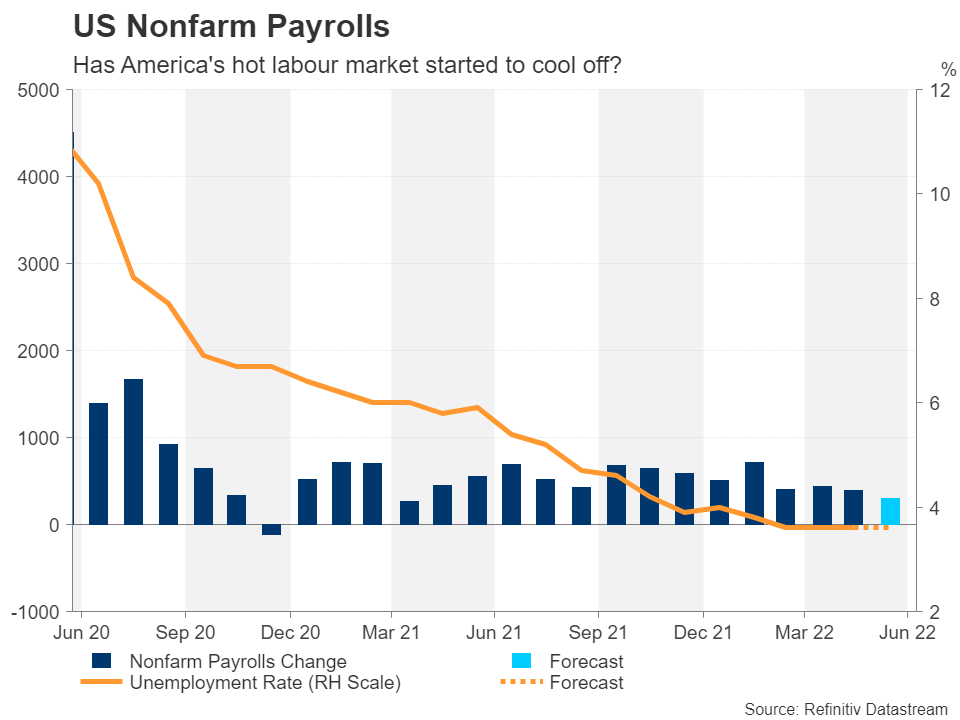
A day earlier, the ADP private employment report will be watched for clues as to what to anticipate on Friday. The ADP figures are normally released on a Wednesday but will be delayed next week due to US markets being shut on Monday for Independence Day. Factory orders (Monday) and the JOLTS job openings (Wednesday) will be eyed too.
But aside from the NFP data, a more crucial indicator for traders is the ISM non-manufacturing PMI for June due Wednesday, as they will want to gauge the impact of the Fed’s recent hefty rate increases as well as oil’s resurgence in late May/early June on business activity and cost pressures.
Fed minutes might pose a threat to premature rate cut bets
In the current climate, the dollar could find support whichever way the data go, but there is a danger that markets may get caught off guard by the FOMC minutes that will be published on Wednesday. Investors have priced out about 50-bps out of the Fed’s tightening cycle, bringing forward the date at which rates are expected to peak as recession fears have intensified. Not only that, but they are also anticipating that the Fed will begin cutting rates as early as the second half of 2023.
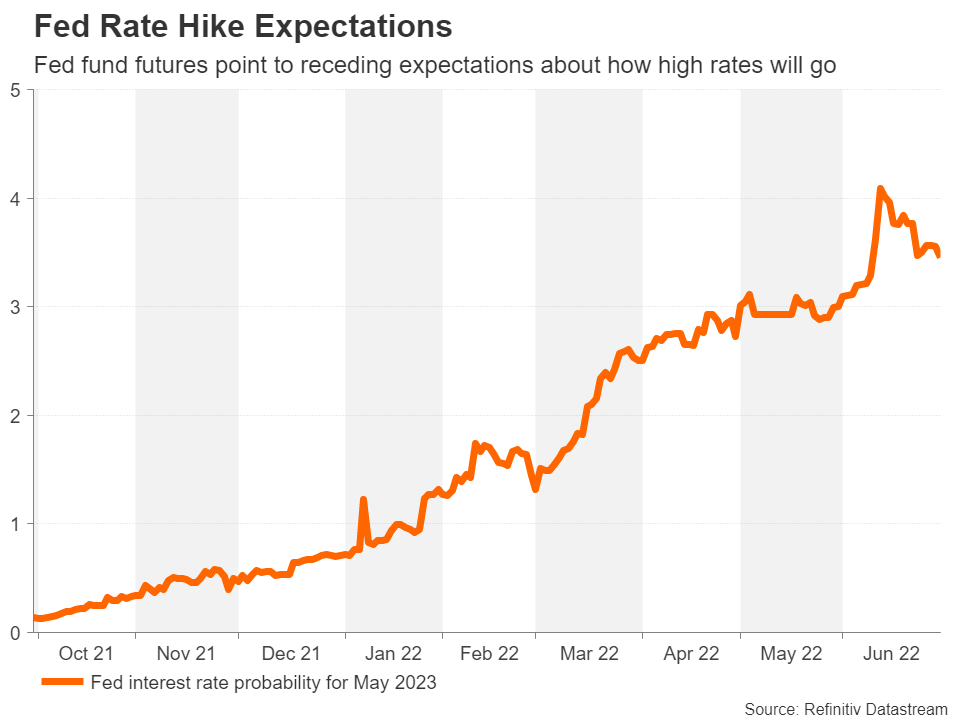
However, the message from Chair Powell has been pretty clear – inflation is their number one priority. Hence, growth jitters won’t deter them from moving aggressively just yet and so the minutes of the June meeting could provide a bit of a reality check for traders thinking that the Fed will balk at the first sign of trouble.
Loonie outshines its rivals
The Canadian dollar is one of the better performing currencies of 2022 so far, and although it has been on a steady downtrend versus the greenback for the past year, it has logged impressive gains against most other majors. One of the reasons for the loonie’s relative strength is of course the big rally in oil prices as the commodity is Canada’s largest export. The other is the tight labour market.
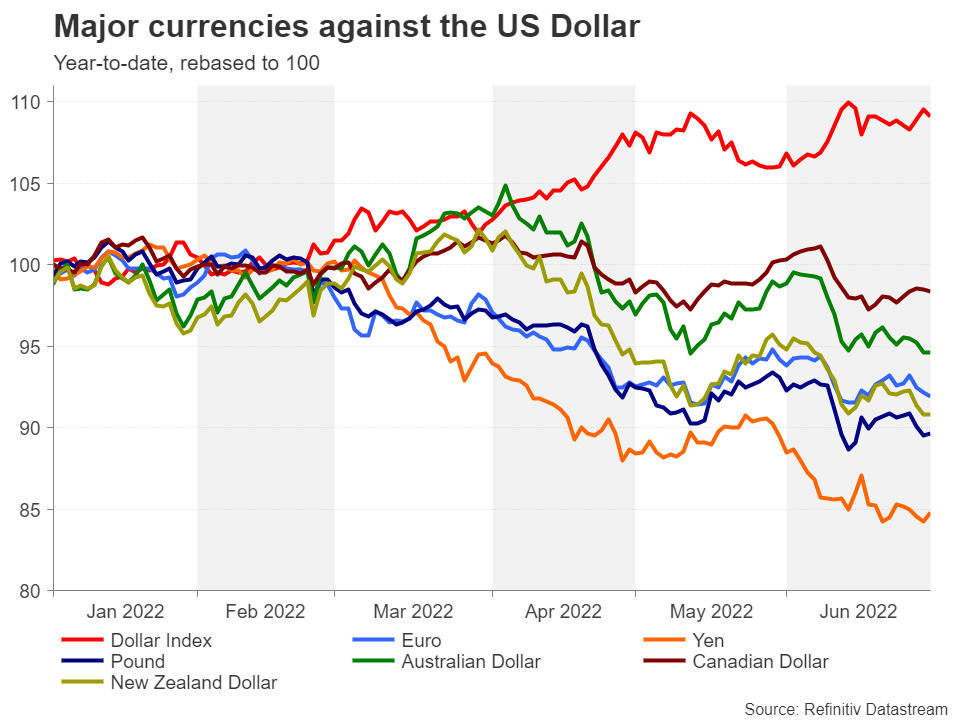
That puts the Bank of Canada in a position to match the Fed in its hawkish rhetoric and a 75-bps rate hike is almost fully priced in for the next meeting on July 13.
Unless there is a massive miss, the June employment numbers out on Friday are not anticipated to alter those expectations significantly. Yet, the loonie might find it difficult to navigate through stormy seas if the market mood doesn’t perk up in the coming days.
Euro is battling recession blues
In the euro area, the ECB is prepping a new tool to keep periphery yield spreads down before it kicks off its first rate rise in more than a decade in July. But investors have doubts and they remain nervous about how tighter policy will affect not just Eurozone yield spreads but the broader economy as well.
The flash PMI readings for June raised some alarm bells about slowing growth in the euro bloc. Any revisions to the final services PMI on Tuesday will be carefully scrutinized. May retail sales figures on Wednesday might attract some attention too and German industrial output data on Thursday could also sway opinion on recession risks.
However, in an otherwise quiet week, the account of the ECB’s June meeting on Thursday could be a more important driver for the euro. Several ECB policymakers are pushing for rate increases of 50-bps or higher for the subsequent meetings after July and the minutes might offer some insights as to how widely this view is shared among Governing Council members.
The question for the euro is, would hawkish sounding minutes bolster or weaken it? If optimism continues to fade, aggressive rate hike talk is more likely to hurt the single currency against the likes of the dollar and Swiss franc.
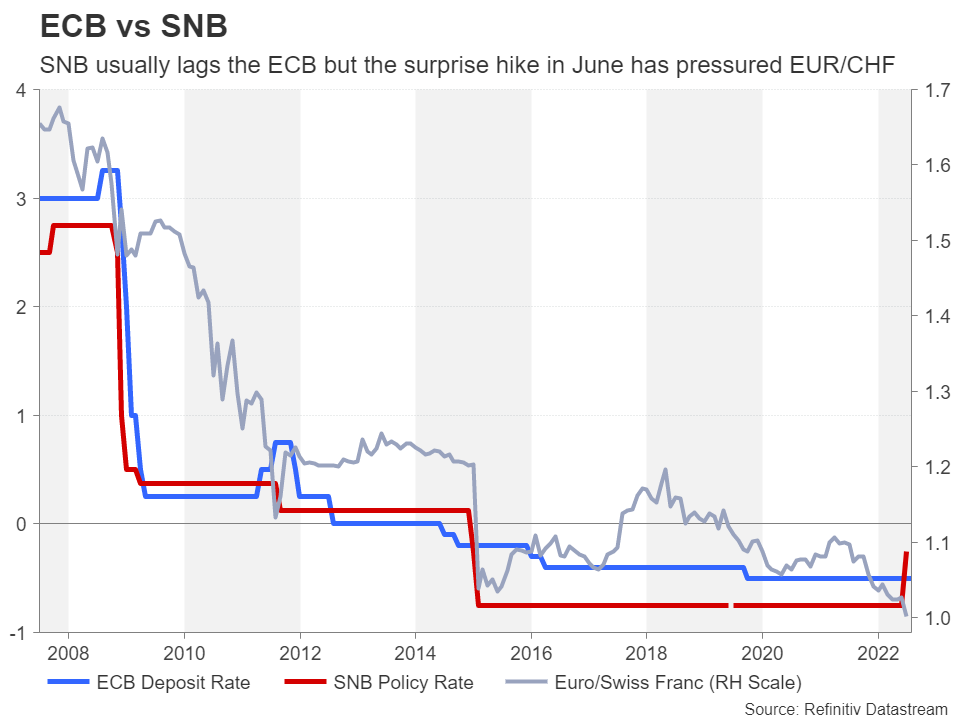
The euro just broke below parity versus the franc for a second time this year, hitting 7½-year lows, as the Swiss currency is benefiting from the combination of safe-haven flows and the SNB’s unexpected early liftoff.
CPI numbers for June out of the Alpine nation on Monday will be monitored for any acceleration in inflation as investors are trying to decipher for how long SNB rate increases will outpace the ECB’s.