Sample Category Title
Japanese Yen Might Change the Trend
At the beginning of the new week, the Japanese yen against the US dollar is consolidating but looks quite weak yet.
USD/JPY buyers are not gone: they are lying low, waiting for a good time to resume action.
Market players are saying that the devaluation of the yen has become one of the main trading ideas in the currency market this year. The Japanese yen has lost more than 16% and can lose more but investors are ready to change the trend. The reason isthat the Bank of Japan will most probably have to correct its monetary policy to catch up with other regulators.
This viewpoint is based on certain livening up of inflation, while the BoJ had been fighting its low rates for decades. The situation has changed, hence, foundation for changing the monetary policy has appeared.
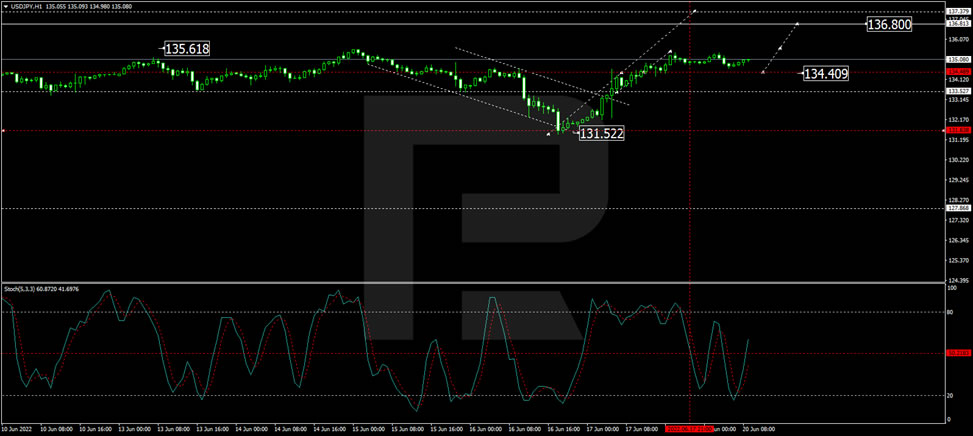
On H4, USD/JPY has corrected to 131.50. At the moment, the market continues developing a growing wave to 136.80 (at least). Currently, there is a consolidation range forming around 134.40. We expect an escape upwards and growth to 136.80, followed by a decline to 131.50. This tech picture is confirmed by the MACD. Its signal line is trading above zero. So, we expect growth to new highs.

On H1, USD/JPY has completed a correction to 131.51. Today the market continues developing another growing wave. Currently, there is a consolidation range forming around 134.40. We expect a test of the range from above, followed by growth to 135.10. If this level is broken away, a pathway for growth to 136.80 might open. Technically, this scenario is supported by the Stochastic oscillator. Its signal line is forming a structure of growth to 50. And as soon as it is broken away, a pathway to 80 will open.
Sunset Market Commentary
Markets
End of last week, investors concluded that EMU and US yields are discounting a ‘reasonable’ amount of tightening given the highly uncertain path for growth and inflation in the second half the year. US markets have incorporated the Fed’s dots scenario projecting a 3.4% policy rate end of this year and 3.8% next year. 2.25% is discounted for the ECB next year. These levels exceed what is commonly seen as the neutral rate. Above-neutral interest rates are ‘logic’ given the inflation overshoot. Still, as tightening will at least partially restore the demand-supply balance via lower demand, there was good reason for yield markets to move to a more neutral positioning, awaiting CB’s reaction function in case growth indeed were to slow down materially. With US markets closed, there was little ‘new news’ to guide this debate today. German May PPI inflation printed as expected at 1.6% m/m and 32.6% Y/Y (was 33.5% in April). If anything, the good news was it didn’t bring an upward surprise. Commodities including oil, copper and iron ore keep last week’s decline as investors ponder the impact of lower demand. European yields early in the session eased slightly, but the move was reversed later. German yields are rising op to 5.0 bps (5-y). The rise in natural gas prices to some extent complicates the narrative of potentially lower inflation due to lower demand (cf infra). European equities on average gain about 0.50%. Given recent sell-off, it’s much too early to label this as a rebound. Intra-EMU bond spreads show a mixed picture. France slightly underperforms after President Macron fails to secure a majority in Parliament (10-y spread vs Germany +3 bps). Greece (-7 bps) and Italy (-6 bps) narrow further as the ECB prepares an instrument to prevent market fragmentation.
No clear trends on FX markets as the US markets are unable to give guidance (Juneteenth Holiday). The DXY index eases a few ticks (104.30). USD/JPY (134.95) is holding near last week’s multiyear peak. The yen struggles as the BOJ continues its lonely journey of more policy accommodation. The euro gains marginally (EUR/USD 1.051), but the technical picture hasn’t changed with first resistance at 1.0601 needed to be broken to open the way for a return to 1.0806 range top. Sterling cedes (modest) further ground (EUR/GBP near 0.858). UK CPI and retail sales (Wed/Fri) are next reference to assess chances for the BoE to step up the pace of rate hikes in H2. The Swiss franc continues to shine (EUR/CHF 1.014) after last week’s SNB interest rate hike, annex U-turn in its assessment on the valuation of the franc (no longer overvalued). In Central Europe, the zloty outperforms (EUR/PLN 4.66). The Czech koruna doesn’t profit (EUR/CZK 24.73) in the run-up to an expected (final) CNB jumbo rate hike on Thursday (100 or 125 bps).
News Headlines
European gas futures extend an almost 40% rise last week by adding another 8% today. The Dutch gas future trades at €126/MWh, the highest level since mid-March when it shot up following the Russian invasion. The price surge relates to Russia cutting supply to top buyers including Germany, Italy and France, citing technical issues that prevent the pipeline from functioning. Nord Stream now operates at just 40% of capacity. The European Commission said Russia uses energy as “blackmail”. An outage at the Texas Freeport LNG plant, which made fewer cargoes available from the US that Europe counted on to restore reserves, adds to upward price pressures. Germany’s government already asked inhabitants to reduce consumption and said on Sunday it would pass emergency laws to reopen coal plants for electricity generation.
US corporate bond funds saw billions of dollars flowing out last week, suffering a double blow from rising yields and mounting fears over an economic downturn as the Fed tightens to combat inflation. From the week to June 15, $6.6bn was withdrawn from high-yield bond funds, the FT reported using EPFR data. It was the biggest outflow since the big sell-off in March 2020 and brings the YTD amount already to almost $35bn. Funds that buy investment-grade bonds saw an outflow of $2.1bn that week, the biggest weekly withdrawal since April 2021. CDS spreads (high-yield vs investment-grade) have risen from multiyear lows mid-2021 to almost 500 bps – the highest level since May 2020.
Will Canada Face a US-Style Inflation Spike?
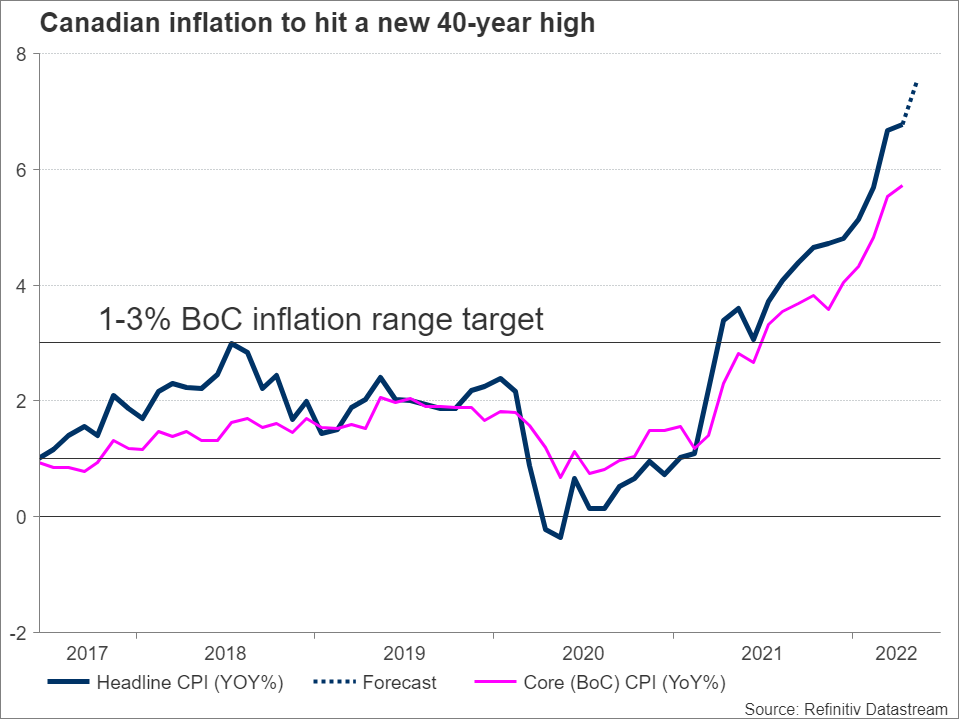
Canadian CPI inflation figures for May will make headlines on Wednesday at 12:30 GMT as investors look for clues to justify a potential Fed-style triple rate hike from the Bank of Canada next month. Given the unforeseen inflation spikes elsewhere, an upbeat report in Canada would not be surprising, likely making a super-sized rate increase imminent as the economy is already running hot.
Will the BoC follow in the Fed's footsteps?
During June’s policy meeting, the Bank of Canada (BoC) hiked its benchmark interest rate by a half percentage point, underlining its intention to act even more forcefully if that’s what it’s going to take to cool inflation. Overnight swaps are now suggesting a probability of 67% for a Fed-like episode of a 75 bps rate hike in July, and despite growing concerns of an economic contraction, BoC chief Tiff Macklem did not play down the case a few weeks ago. Instead, he argued that surging borrowing costs are much needed to cool the housing market while setting a goal for a soft, manageable landing, although the finance minister advised to not take the latter as granted.
Therefore, May’s inflation report will be the next test for rate expectations on Wednesday. Following the sudden inflation pickup in the US, traders are forecasting a spike to 7.5% y/y from 6.8% previously in Canada - the highest since 1983. If estimates are right or in an extreme case, they are underestimating the inflation risk, a rate hike of a bigger magnitude in July might become a done deal.
The economy is running hot
Although households are indebted and therefore relatively sensitive to any rate increases, the Canadian economy may have the capacity to handle faster monetary tightening. The labor market is extremely tight, delivering its lowest unemployment rate on record in May. On top of that, Statistics Canada revealed that an all-time high of more than a million job vacancies were still hard to fill as of March, flagging a potential pickup in wage growth, which could consequently result in another inflation wave, and therefore toughen the BoC’s efforts to balance price growth.
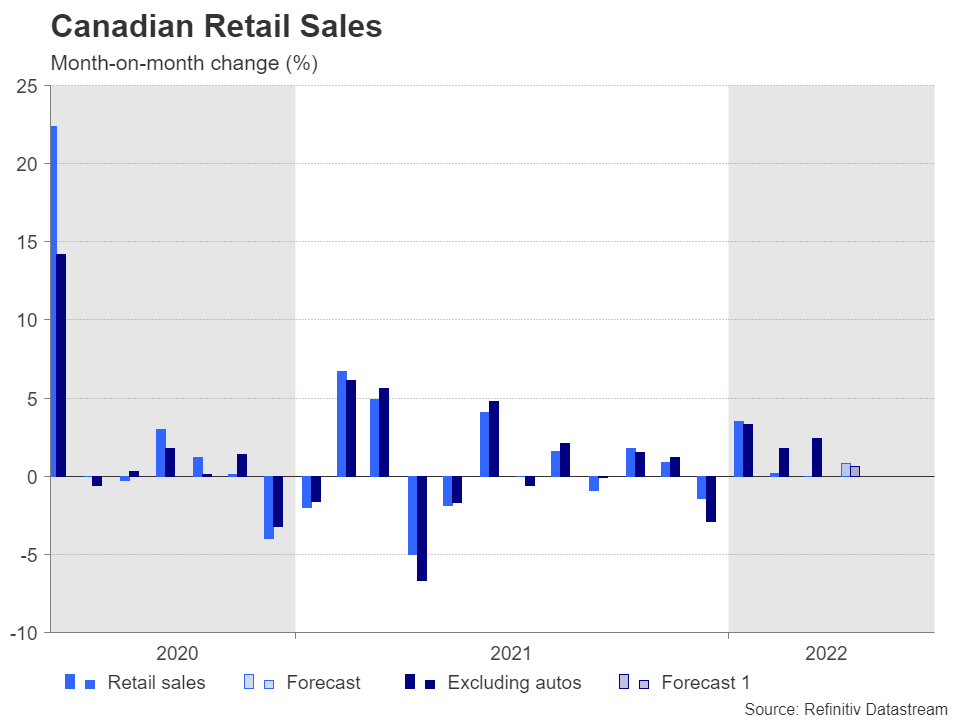
Retail sales for April could shed some light on how resilient consumption is on Tuesday at 12:30 GMT. Total retail sales, which stagnated in March, are projected to gear up by 0.8% m/m, whereas the core measure is expected to diminish significantly from 2.4% to 0.6%. Even if recession fears come and go these days, the latter may do little to cancel a triple quarter rate increase next month if price growth marks a new multi-decade high. Besides, oil is an important export product for Canada and global galloping oil prices may bode well for the economy in the foreseeable future.
USD/CAD
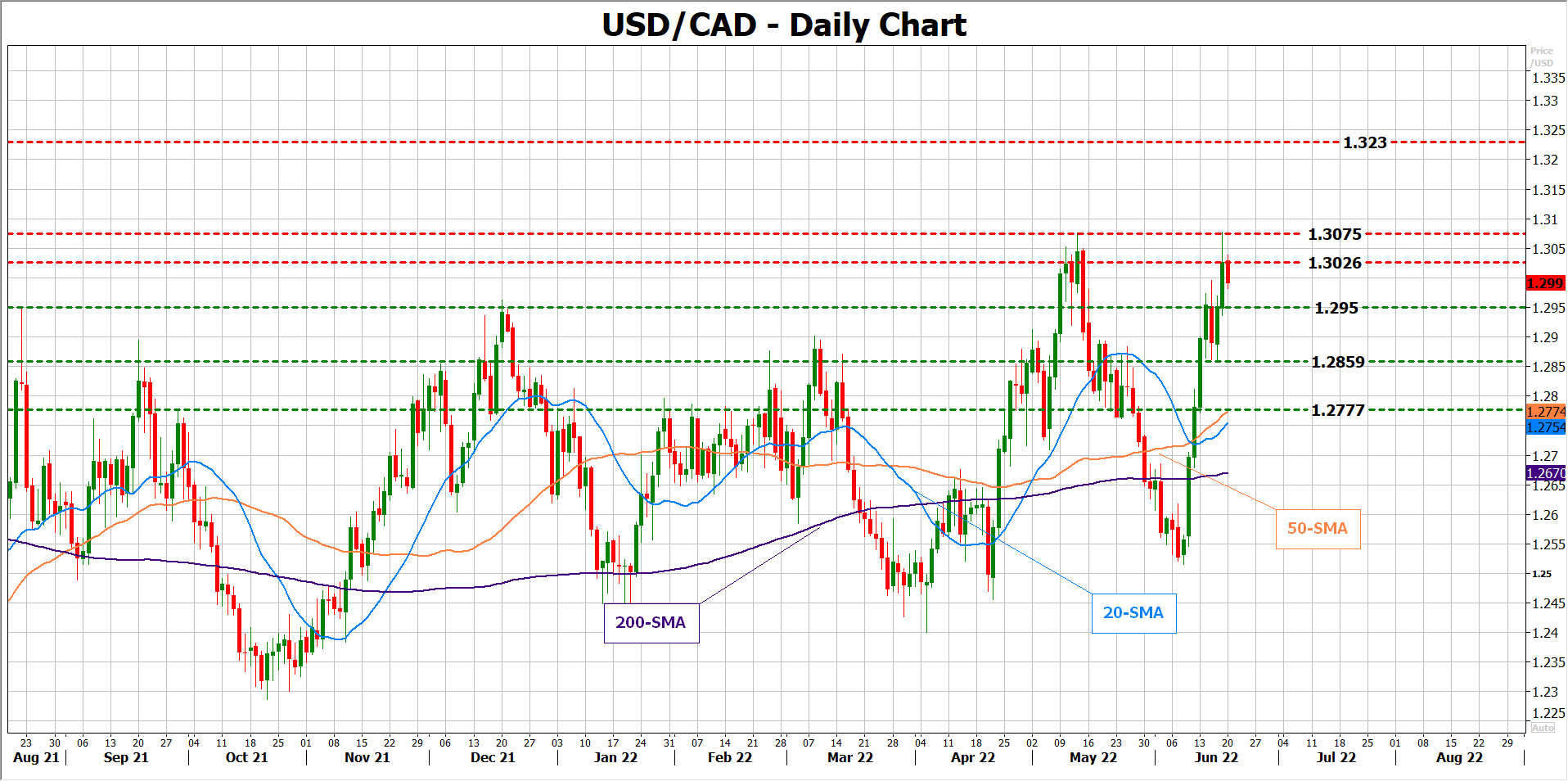
If the headline CPI rate outpaces forecasts, the loonie may attempt to heal its wounds against the US dollar. In this case, dollar/loonie may reverse southwards to seek immediate support around 1.2950, while lower, the pair may retest the 1.2859 region ahead of the 1.2777 mark. However, with forecasts positioned wide off April’s readings, a milder CPI pickup cannot be ruled out, though that might barely pressure the commodity-linked currency.
The question that arises at this point is how far the loonie’s recovery could go. The BoC and the Fed will both likely drive their borrowing costs up to 2.25% by September and should the central banks continue to move in lockstep for the rest of the year, eliminating monetary divergence, the loonie might hardly stage any meaningful rally, unless oil prices press sustainably higher. On the other hand, the greenback could still find support from safe haven flows in case the global outlook deteriorates.
In the bearish scenario, where Canadian inflation fizzles out and retail sales portray softening domestic demand, dollar/loonie may rechallenge the ceiling at 1.3026 – 1.3075. A successful close higher could stretch towards the 1.3230 barrier.
USD/JPY Mid-Day Outlook
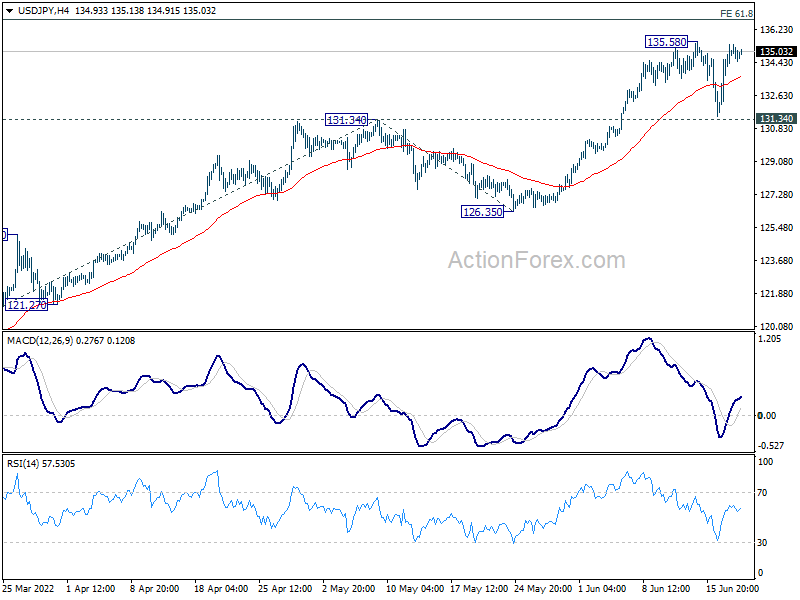
Daily Pivots: (S1) 132.98; (P) 134.20; (R1) 136.24; More...
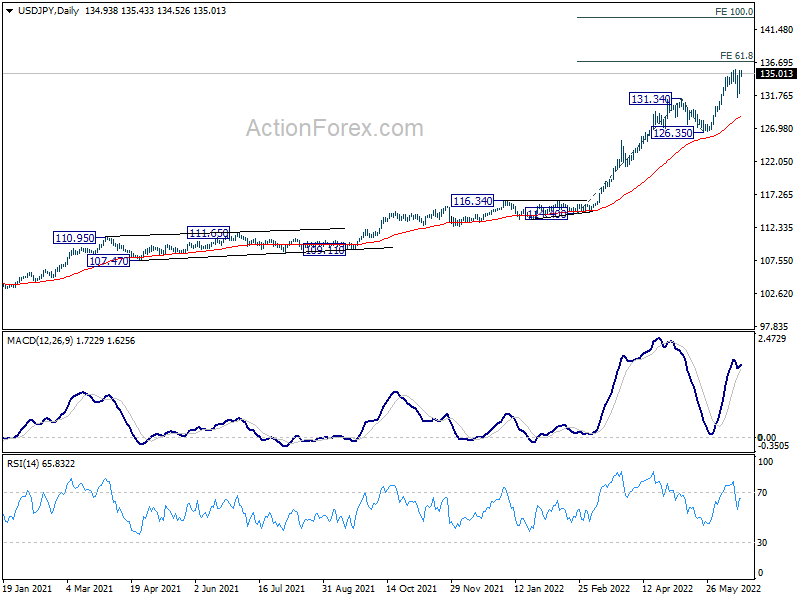
Range trading continues in USD/JPY and intraday bias remains neutral first. More consolidations could be seen below 135.58. But further rally is expected as long as 131.34 support holds. On the upside, break of 135.58 will resume larger up trend to 61.8% projection of 114.40 to 131.34 from 126.35 at 136.81. Firm break there will target 100% projection at 143.29.
In the bigger picture, current rally is seen as part of the long term up trend from 75.56 (2011 low). Next target is 100% projection of 75.56 (2011 low) to 125.85 (2015 high) from 98.97 at 149.26, which is close to 147.68 (1998 high). This will remain the favored case as long as 126.35 support holds.
USD/CHF Mid-Day Outlook
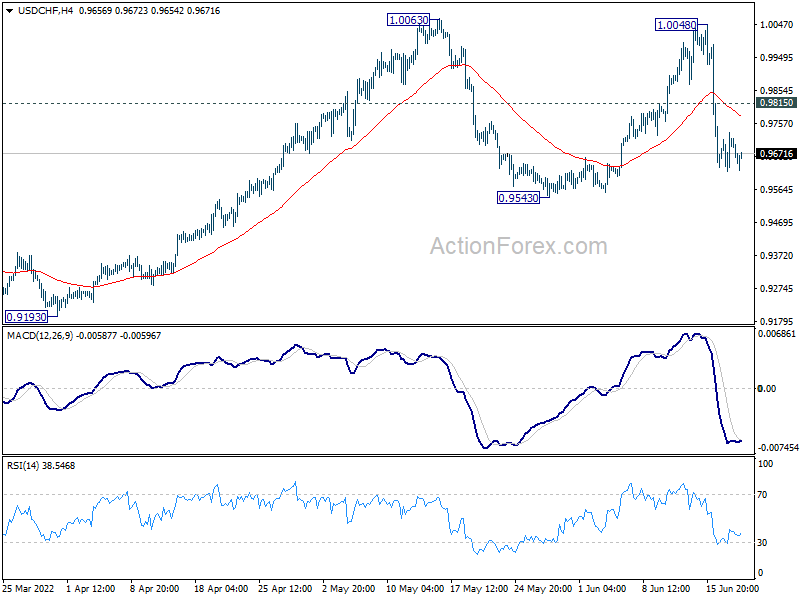
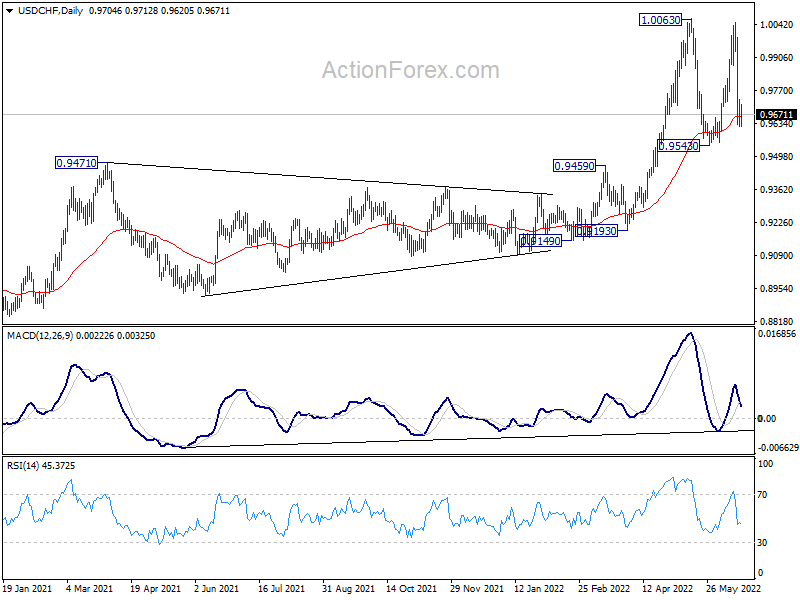
Daily Pivots: (S1) 0.9636; (P) 0.9685; (R1) 0.9750; More...
Deeper fall could be seen in USD/CHF. But such decline from 1.0048 is viewed as the third leg of the corrective pattern from 1.0063. Strong support should be seen at around 0.9543 to contain downside to bring rebound. On the upside, above 0.9815 minor resistance will turn bias back to the upside for retesting 1.0063 resistance.
In the bigger picture, down trend from 1.0342 (2016 high) should have completed with three waves down to 0.8756 (2021 low) already. Rise from 0.8756 is likely a medium term up trend of its own. Next target is 1.0237/0342 resistance zone. This will remain the favored case as long as 0.9471 resistance turned support holds. However, sustained break of 0.9471 will extend long term range trading with another falling leg.
GBP/USD Mid-Day Outlook
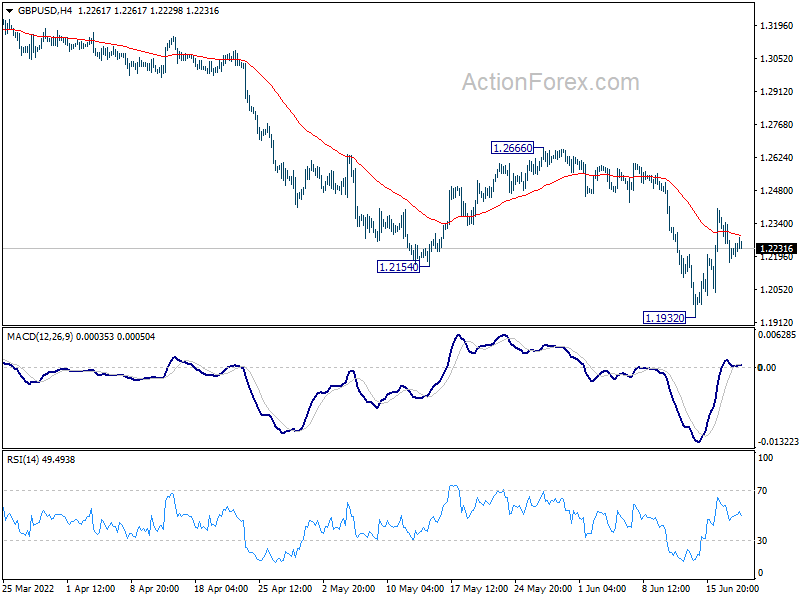
Daily Pivots: (S1) 1.2141; (P) 1.2254; (R1) 1.2335; More...
Range trading continues in GBP/USD and intraday bias remains neutral. Outlook stays bearish as long as 1.2666 resistance holds. On the downside, break of 1.1932 will resume larger down trend from 1.4248. However, firm break of 1.2666 will suggest medium term bottoming and bring stronger rebound back towards 1.3158 support turned resistance.
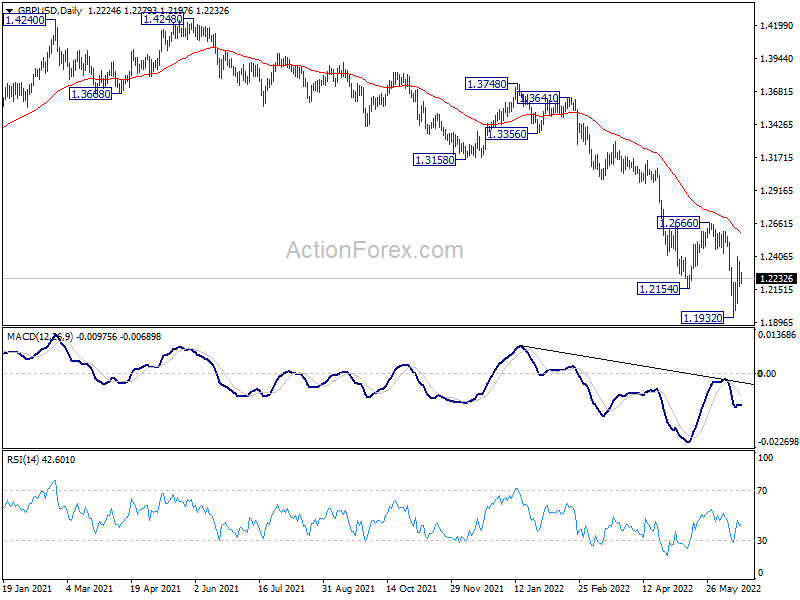
In the bigger picture, fall from 1.4248 (2018 high) could be a leg inside the pattern from 1.1409 (2020 low), or resuming the longer term down trend. Deeper decline is expected as long as 1.2666 resistance holds. Next target is 1.1409 low. However, firm break of 1.2666 will bring stronger rise back to 55 week EMA (now at 1.3175).
EUR/USD Mid-Day Outlook
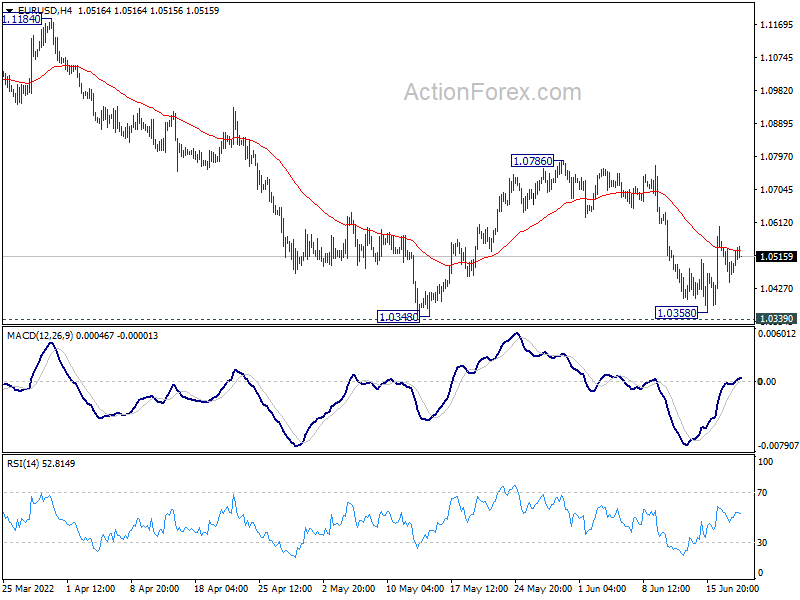
Daily Pivots: (S1) 1.0441; (P) 1.0500 (R1) 1.0556; More...
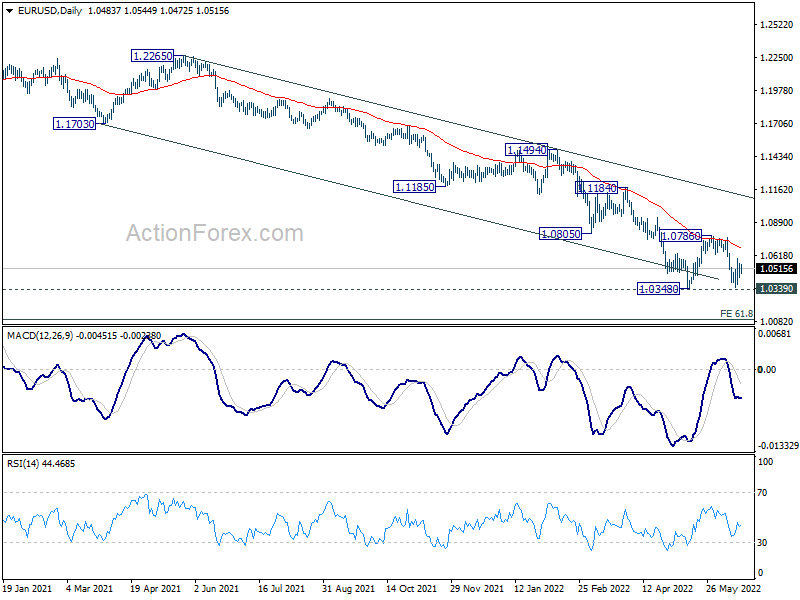
Range trading continues in EUR/USD and intraday bias remains neutral at this point. Further fall is in favor with 1.0786 resistance intact. On the downside, sustained break of 1.0339/48 will resume larger down trend. Next target is long term projection level at 1.0090.
In the bigger picture, focus stays on 1.0339 long term support (2017 low). Decisive break there will resume whole down trend from 1.6039 (2008 high). Next target is 61.8% projection of 1.3993 to 1.0339 from 1.2348 at 1.0090. However, firm break of 1.0805 support turned resistance will delay this bearish case, and bring stronger rebound first.
Markets Tread Water With US on Holiday, Dollar and Yen Soft
Markets are generally quiet today, with a near empty European calendar and US holiday. Major European indexes are recovering slightly but lack follow through buying. Gold and oil are staying in tight range. In the currency markets, Aussie and Kiwi recover mildly while Dollar, Yen and Euro are the softer ones. But with the exception of some Kiwi pairs, most major pairs and crosses are stuck inside Friday's range.
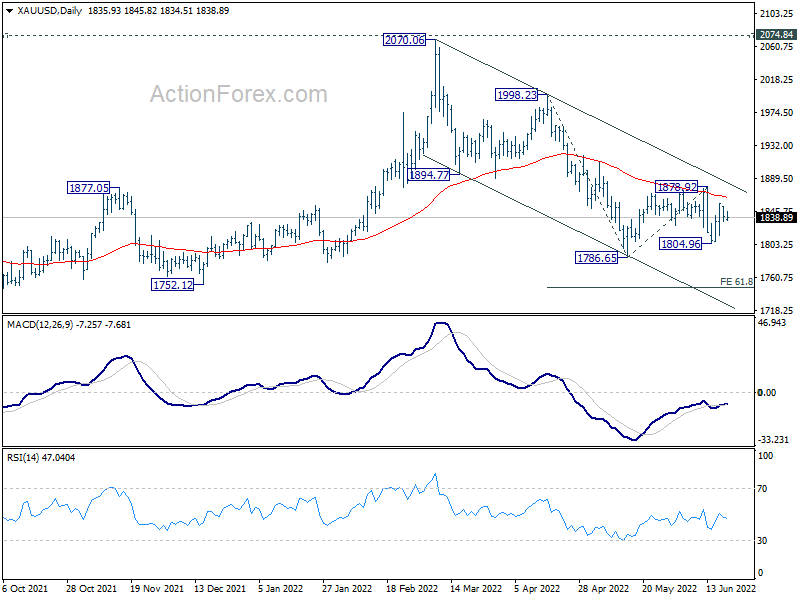
Technically, Gold's price actions have been very indecisive recently. But bearish bias is maintained as it's staying comfortably below falling 55 day EMA (now at 1866.60). Break of 1804.96 minor support should resume the larger fall from 2070.06 through 1786.65 low. 61.8% projection of 2070.06 to 1786.65 from 1878.92 at 1748.16 could be the place where the five-wave sequence ends.
In Europe, at the time of writing, FTSE is up 1.33%. DAX is up 0.48%. CAC is up 0.22%. Germany 10-year yield is up 0.043 at 1.701. Earlier in Asia, Nikkei dropped -0.74%. Hong Kong HSI rose 0.42%. China Shanghai SSE dropped -0.04%. Singapore Strait Times dropped -0.05%. Japan 10-year JGB yield rose 0.0002 to 0.233.
ECB Kazaks supports 25bps hike in Jul, 50bps in Sep
ECB Governing Council member Martins Kazaks said he would support 25bps rate hike in July and 50bps in September. He added that inflation would "need to surprise on the low side" for it not to be 50bps in September.
But he emphasized that investors should not think that 50 bps rate hikes are "the new default."
Japan: Industrial production appears to be pausing for picking up
In June economic report, Japan's government said "industrial production appears to be pausing for picking up." That's a downgraded assessment from May's "industrial production shows movements of picking up." Exports continued to be "almost flat".
It reiterated that "full attention should be given to the downside risks due to rising raw material prices, supply-side constraints and fluctuations in the financial and capital markets while there are concerns regarding the effects of lengthening the state of affairs of Ukraine and suppression of economic activities in China."
Nevertheless, for the short-term, the economy is "expected to show movements of picking up, supported by the effects of the policies while all possible measures are being taken against infectious diseases, and economic and social activities proceed to normalization".
BoJ Kuroda: PM Kishida didn't say anything special about exchange rate
After a meeting with Japan Prime Minister Fumio Kishida, BoJ Governor Haruhiko Kuroda said "I told the prime minister that recent rapid yen moves were undesirable".
"(Kishida) did not say anything special but I told him that it was important for currencies to move stably reflecting economic fundamentals," he added. "I'll fully watch currency movements carefully from now on as well and will appropriately respond to them while liaising with the government."
New Zealand BusinessNZ services rose to 55.2, back above average
New Zealand BusinessNZ Performance of Services Index rose from 52.2 to 55.2 in May. Activity/sales rose sharply from 53.3 to 59.6. But employment dropped from 51.0 to 48.5. New orders/business rose from 55.2 to 62.0. Stocks/inventories ticked down from 55.0 to 54.6. Supplier deliveries rose from 40.5 to 45.0.
BNZ Senior Economist Doug Steel said that "while the improvement was far from universal across components, reflecting many ongoing challenges across segments of the service sector, the overall outcome was the first above average result since the outbreak of Delta in August last year."
EUR/USD Mid-Day Outlook
Daily Pivots: (S1) 1.0441; (P) 1.0500 (R1) 1.0556; More...
Range trading continues in EUR/USD and intraday bias remains neutral at this point. Further fall is in favor with 1.0786 resistance intact. On the downside, sustained break of 1.0339/48 will resume larger down trend. Next target is long term projection level at 1.0090.
In the bigger picture, focus stays on 1.0339 long term support (2017 low). Decisive break there will resume whole down trend from 1.6039 (2008 high). Next target is 61.8% projection of 1.3993 to 1.0339 from 1.2348 at 1.0090. However, firm break of 1.0805 support turned resistance will delay this bearish case, and bring stronger rebound first.
Economic Indicators Update
| GMT | Ccy | Events | Actual | Forecast | Previous | Revised |
|---|---|---|---|---|---|---|
| 22:30 | NZD | Business NZ PSI May | 55.2 | 51.4 | 52.2 | |
| 06:00 | EUR | Germany PPI M/M May | 1.60% | 1.50% | 2.80% | |
| 06:00 | EUR | Germany PPI Y/Y May | 33.60% | 33.50% | 33.50% |
New Signs that the Price of Oil has Passed its Peak
Friday’s collapse added signs of oil’s reversal to a bear market. Brent losses exceeded 5% over Friday, and the pressure continued into Monday morning. Brent dropped more than 11% from the highs of June 8 to around $110, which was last seen four weeks ago.
Several technical factors now favour oil being taken over by the bears.
Firstly, oil has been losing in seven of the last eight trading sessions, while we have seen mixed movements in the currency and equity markets. Such a single-digit drop in oil is a sure sign of a sustained sell-off, suggesting that peak oil may be behind us.
At $111, the 50-day moving average and the upside support line of the last seven months converged. Oil closed below that critical point, and intraday trades are in the area below these one-time essential support levels.
The day’s close below $110 promises to be another tough reminder of the start of a deep correction in the oil market.
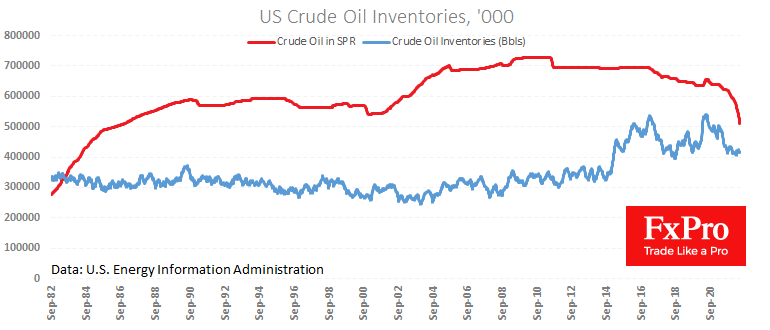
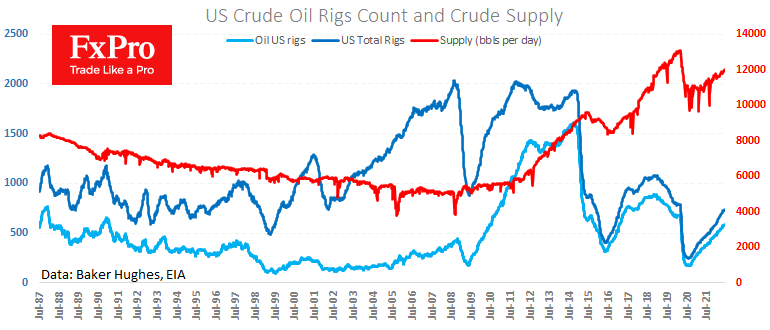
There is more and more oil in the USA. The Energy Agency has reported an increase in production of up to 12 million barrels per day. Active sales of crude stocks from the Strategic Reserve are helping to maintain the balance of commercial reserves.
At the same time, producers are ramping up drilling activity. Data last Friday showed an increase of 7 drilling rigs working to 740.
The US Presidential Administration has promised to return to filling reserves in September, which looks like good news for producers, who can get a steady buyer from the government, potentially keeping the price from an uncontrollable decline. The balance of market forces now suggests that the market has hit its high point in the trend of the last seven months. In the coming weeks, we should be prepared for a correction to $100 or even $90 with negative surprises in the global economy and a stock market crash. However, for the rest of this year and most of the next, Brent crude may stay mainly within the $90-120 range.
Pound Steady after Rough Week
The British pound is slightly higher at the start of the week, and I expect a quiet session, with US markets closed for a holiday.
British pound under pressure
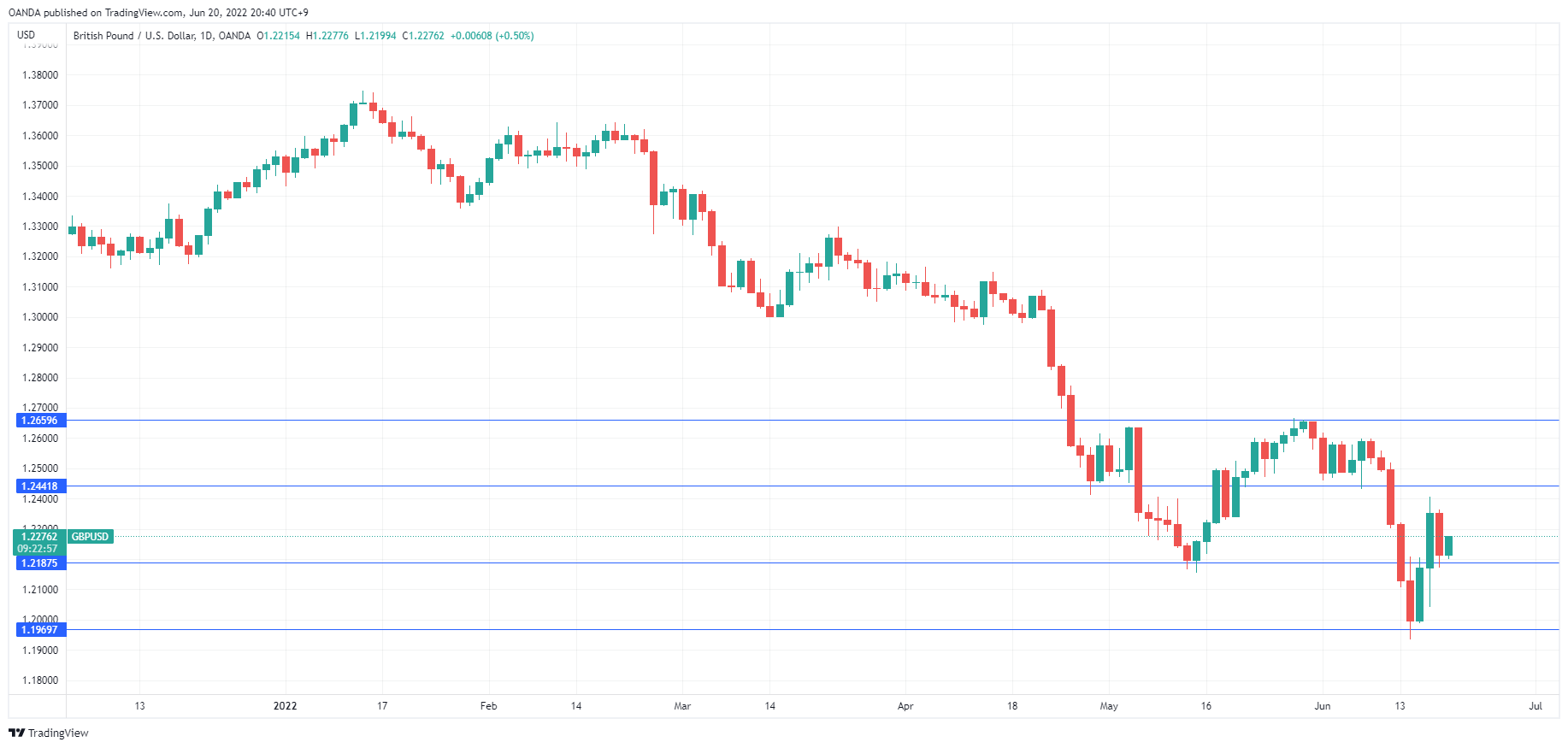
There was plenty of volatility from GBP/USD last week, as the currency started the week with gains, only to reverse directions and end the week in the red, the third losing week in a row. Perhaps the biggest red flag from the pound’s slide was the break below the symbolic 1.20 level last week, for the first time since 2020. The pound has been hammered in 2022, plunging as much as 1500 points.
The BoE rate hike of 0.25% on Thursday failed to impress the markets, with GBP/USD sliding 1.37% in the Thursday session. Three of the nine MPC members voted for a 0.50% increase, and it appears that the 0.25% was too feeble a move by the BoE, even though the benchmark rate is now at its highest level since 2009. The markets have priced in a 60% chance of a 0.50% rise at the next meeting in August, and there will be strong pressure for the BoE to deliver a 0.50% salvo unless inflation unexpectedly begins to ease. The UK releases May CPI on Wednesday, with an estimate of 9.1%, up slightly from the April reading of 9.0%.
The dark clouds hovering above the UK economy are not good news for the struggling pound. GDP fell by 0.3% in April after a 0.1% decline in March, the first back-to-back contractions since March 2020, at the start of the Covid pandemic. J.P. Morgan said on Friday that the likelihood of a recession in the UK has increased over the next year or two, warning that a recession in the US would spill over to the UK.
GBP/USD Technical
- GBP/USD has support at 1.2187 and 1.1969
- There is resistance at 1.2441 and 1.2659