

Sample Category Title
USD/JPY Daily Outlook
Daily Pivots: (S1) 132.98; (P) 134.20; (R1) 136.24; More...
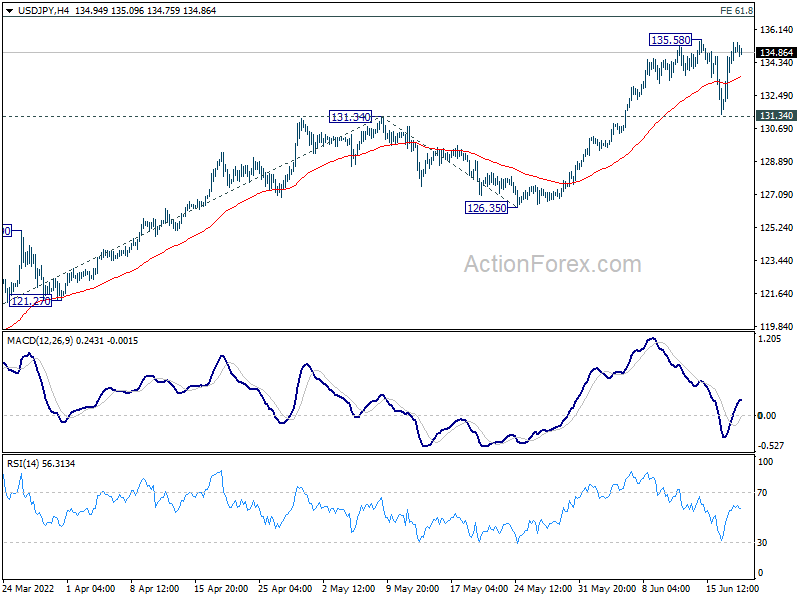
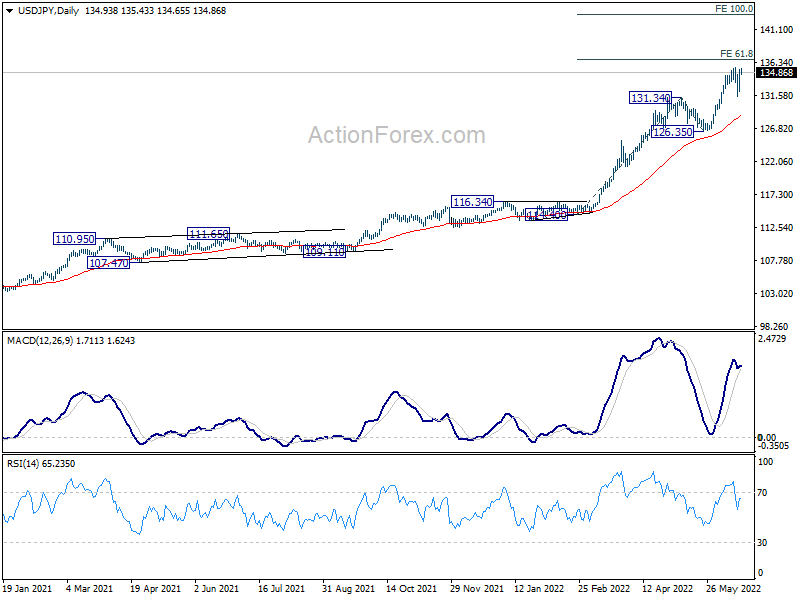
Intraday bias in USD/JPY remains neutral and consolidation from 135.58 could extend. But further rally is expected as long as 131.34 support holds. On the upside, break of 135.58 will resume larger up trend to 61.8% projection of 114.40 to 131.34 from 126.35 at 136.81. Firm break there will target 100% projection at 143.29.
In the bigger picture, current rally is seen as part of the long term up trend from 75.56 (2011 low). Next target is 100% projection of 75.56 (2011 low) to 125.85 (2015 high) from 98.97 at 149.26, which is close to 147.68 (1998 high). This will remain the favored case as long as 126.35 support holds.
USD/CHF Daily Outlook
Daily Pivots: (S1) 0.9636; (P) 0.9685; (R1) 0.9750; More...
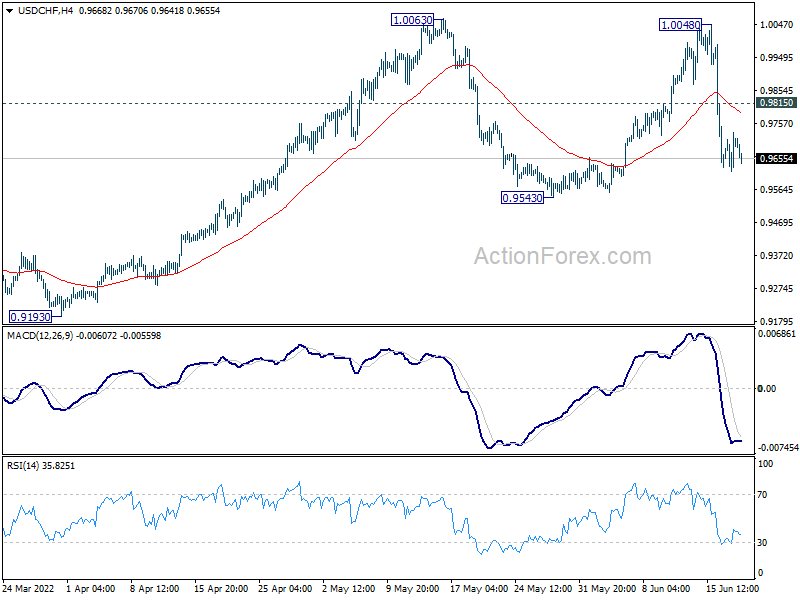
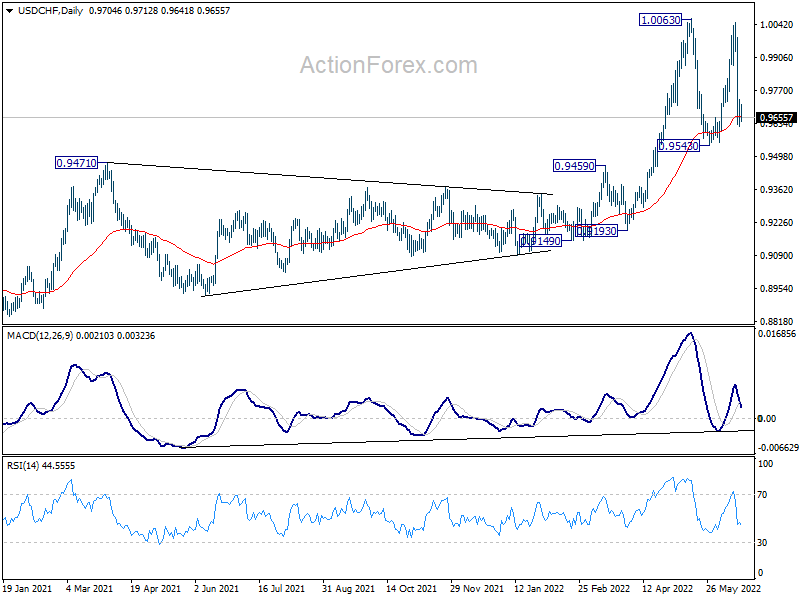
Intraday bias in USD/CHF stays mildly on the downside and further decline could be seen. However, fall from 1.0048 is viewed as the third leg of the corrective pattern from 1.0063. Strong support should be seen at around 0.9543 to contain downside to bring rebound. On the upside, above 0.9815 minor resistance will turn bias back to the upside for retesting 1.0063 resistance.
In the bigger picture, down trend from 1.0342 (2016 high) should have completed with three waves down to 0.8756 (2021 low) already. Rise from 0.8756 is likely a medium term up trend of its own. Next target is 1.0237/0342 resistance zone. This will remain the favored case as long as 0.9471 resistance turned support holds. However, sustained break of 0.9471 will extend long term range trading with another falling leg.
EUR/USD Daily Outlook
Daily Pivots: (S1) 1.0441; (P) 1.0500 (R1) 1.0556; More...
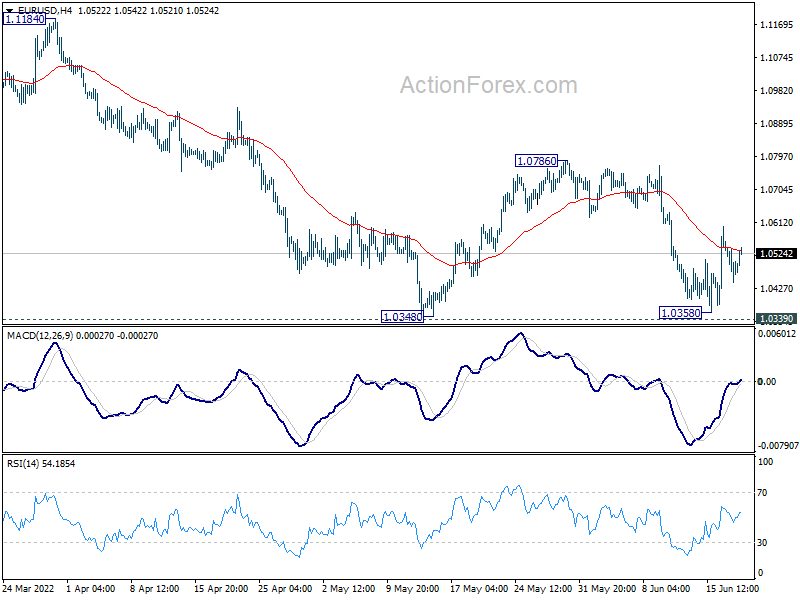
Intraday bias in EUR/USD remains neutral for the moment. Further fall is in favor with 1.0786 resistance intact. On the downside, sustained break of 1.0339/48 will resume larger down trend. Next target is long term projection level at 1.0090.
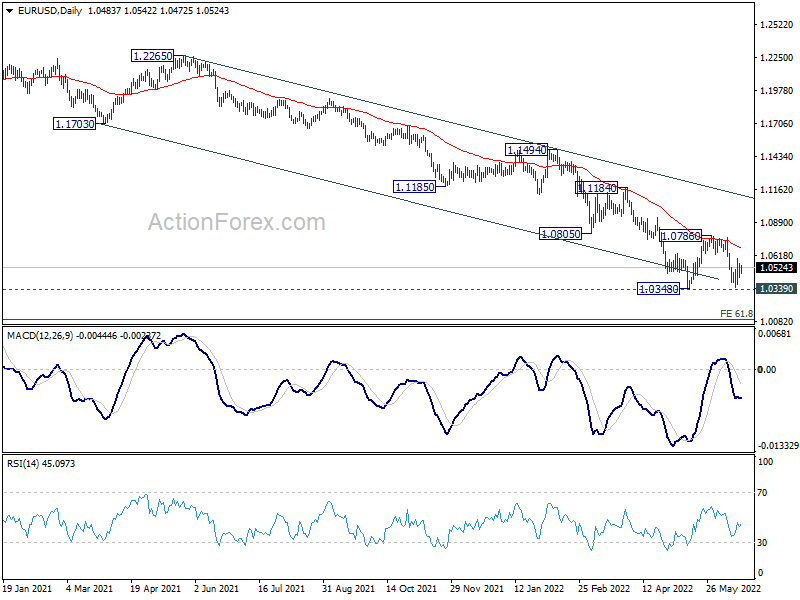
In the bigger picture, focus stays on 1.0339 long term support (2017 low). Decisive break there will resume whole down trend from 1.6039 (2008 high). Next target is 61.8% projection of 1.3993 to 1.0339 from 1.2348 at 1.0090. However, firm break of 1.0805 support turned resistance will delay this bearish case, and bring stronger rebound first.
Inflation Fears Have Once Again Made Way for Growth Concerns
Markets
A hectic week ended on a calmer note. The wild bond swings eased somewhat – at least compared to the moves in the days before. US Treasuries forfeited some of the sharp gains that intensified in the final trading hours on Thursday. Yields rebounded between 2.4 bps (20y) to 8.6 bps (2y). German Bunds outperformed after having missed out on that late-session UST acceleration. The German yield curve bull steepened with changes ranging from -8.6 bps (5y) to flat (30y).
Commodity prices turned a bit less red-hot too. The likes of oil fell more than 6% (Brent closed at $113/b). Copper extends a two-week slide by almost 3% to close at the lowest level since September last year. Easing commodities may suggest inflation fears have once again made way for growth concerns.
But this didn’t stop equities from catching a breather after some significant losses earlier. Both European and US indices stabilized or even gained marginally. The dollar strengthened from below 104 (trade-weighted DXY) to 104.70, erasing much of Thursday’s yield-driven declines. USD/JPY, with the help of the stubborn BoJ, skyrocketed back to the multi-decade highs at 135. EUR/USD retreated from 1.055 to 1.05. Commodity currencies including the Aussie dollar suffered. Sterling was not in a great shape either with markets already paring back bets on BoE hikes again. EUR/GBP found support from the upward sloping line that is holding up the pair since mid-April. The couple rose from 0.854 to 0.859. The Swiss franc continued to appreciate after the CNB shocker hike. EUR/CHF dipped sub 1.02.After last week’s hawkish actions and language, focus turned back from inflation to growth. Asian equity markets trade in the red with South Korea underperforming (-4%). Core bond futures trade near Friday’s closing levels. US cash markets are closed in observance of Juneteenth. The dollar is a bit in the defensive, depreciating against most of the G10 peers. EUR/USD surpasses 1.05 again. USD/JPY’s attempt north of 135 is unsuccessful as of yet. The yuan strengthens back below USD/CNY 6.70.US markets are closed and the European economic calendar is vast emptiness. We do note the avalanche of ECB speakers, including president Lagarde and chief economist Lane. But we don’t expect them to deviate from the narrative told two weeks ago. Attention later this week goes to the Fed’s semi-annual testimony before Congress of which the text was already publish last Friday. PMIs are also due this Thursday while the UK braces for 9%+ inflation on Wednesday and dire retail sales on Friday. For core bond markets we stick to the view of sideways consolidation as we feel that enough tightening has been priced in for the time being. That should also rein in the dollar a bit. The upcoming string of probably not very rosy UK data combined with the technicals may keep sterling under pressure.
News Headlines
French President’s Macron Ensemble group remained the biggest group in the French national Assembly after the second round of the Parliamentary election. However, Ensemble failed to reach an absolute majority of 289 seats out of 577 seats. Ensemble currently is expected to gain 245 seats. The leftist coalition led by Jean-Luc Mélenchon (Nupes) is reported to have gained 131 sets. The far right national party surprised with bigger than expected 89 seats. The center right Republicans and its allies secured 61 seats. Having no majority in the National Assembly might complicate President Macron’s reform agenda as he probably will need to look for support mainly with Nupes or the center right Republicans on specific policy issues.
Erik Thedeen, currently the head of the Swedish Financial Supervisory Authority will become the new Governor of the Swedish Riksbank. He will replace Stefan Ingves who was head of the Swedish central bank for 17-years. Thedeen will take up its new job starting on January 1 of next year and is appointed for a term of six years. Ingves during his term mainly focused on bringing inflation sustainably back to the inflation target in a context of low inflation. Thedeen comes at the helm of the Riksbank as policy needs to bring excessive inflation back down to the Bank’s inflation target. In this move, new Riksbank governor, amongst others, will have to take into account the financial stability risks due to high household debt.
Crypto Hemorrhage
Cryptocurrencies had a rough weekend. A massive selloff hit the sector on Saturday and sent the price of Bitcoin below the $18K mark, the lowest level since the end of 2020. Ethereum fell below $900, as smaller cryptocurrencies followed their major peers to the south.
Sunday saw a rebound as some dip buyers piled in on belief that Bitcoin may have cheapened enough to catch an interesting dip, but cryptocurrencies remain at a slippery ground as factors that triggered this weekend’s selloff are still in play. And the level of stress in the market intensifies, both from the macro and industry specific perspectives.
From the macro perspective, the Federal Reserve (Fed) is pulling back monetary support to fight the soaring inflation, and the tighter monetary conditions pull the rug from under the feet of risky assets like cryptocurrencies. Unfortunately, the worry of a tightening Fed - and other central banks - is here to stay until we see a significant and a persistent drop in inflation. At this week’s semi-annal testimony, the Fed Chair Jerome Powell will repeat the bank’s strong commitment to fighting inflation, which could send the risk assets further south.
From the industry perspective, as the money pours out of the crypto industry, we see some industry giants having trouble to keep their business together, and that adds another level of sector-specific stress. Over the past couple of weeks, we saw the Terra, which was supposed to be a stable coin collapse to zero. Last week, Celsius, which is one of the biggest crypto lenders suspended withdrawals and even account to account transfers to prevent people from a virtual bank. On Friday, Babel finance froze withdrawals and redemptions hinting that if the crypto meltdown continues, we could see more of the crypto institutions take similar measures. And, again on Friday, Three Arrows Capital, said it considers asset sales, and bailout following heavy losses it incurred during this year’s selloff.
The mix of discouraging news, and the sharp price declines now convince the long-term hodlers to pull out the white flag.
Pricewise, given that the $20K has been cleared, the next wave of selloff would be a test for the $15/17K support. Below, we could see a further meltdown to $10K.
On the upside, we will likely see some decent resistance within the $22/25K range. But a positive breakout will take a stronger collective effort and belief to happen, as the FOMO, the fear of missing out a skyrocketing train is no longer the reality. The reality is that Bitcoin could fall further, and it’s no longer a piece of cake to be a crypto investor, as it is no longer a piece of cake to be a stock investor.
Traditional markets
Stock markets saw some relief at the end of a heavily stressful trading week, which saw the biggest weekly loss since March 2020 on the back of a 75bp hike from the Fed, a 50bp hike from the Swiss National Bank, a 25bp hike from the Bank of England, and emergency meeting from the European Central Bank to fix the fragmentation issue at the heart of the Europe to be able to fasten the rate hikes as well, without causing a renewed debt crisis in the eurozone.
Sentiment is mixed and investors lack direction this morning. European futures are in the negative and US futures are in the positive before the European opening bell.
FTSE futures are down on cheaper oil and firmer pound.
In the FX space, the US dollar index is softer this morning, leaving some space to breath for other currencies. The EURUSD is better bid above the 1.05 and Cable gains above 1.22. Gold is a touch below the 200-DMA. The precious metal remains under the pressure of soaring yields, which also reduces its potential as a safe haven hedge to falling markets.
US crude is below $110 per barrel this morning, which is perhaps the best news this Monday. Joe Biden sent a letter to US oil refiners last week, telling the industry that he is unhappy that they are making above normal profits at a time of war, and asking them to find solutions to increase efforts to refine more. Some producers, including Exxon responded that it’s possible that the US uses short term solutions, the ones that are put in place in case of natural catastrophes and unexpected events to allow increasing supplies, but in the longer term, the government should also promote investment through clear and consistent policy supports. The problem is, the US, as other countries, wants to move away from fossil fuel, which in term makes investing in refining facilities – that has a payback period of around a decade, significantly less meaningful for oil companies.
As such, falling demand due to a global economic slowdown is the most effective short-term solution to pause the oil rally.
Macron Looks set to Loose Parliamentary Majority
Market movers today
This week starts with a fairly quiet data calendar although we have several ECB speakers out. US markets are closed today for the Juneteenth holiday.
After a very eventful last week with several notable central bank decisions, this week on paper looks quieter. On Wednesday we get UK CPI and Fed Chair Jerome Powell testifies to Congress. On Thursday, Norges Bank's rate decision marks the highlight alongside preliminary PMIs for the euro area (including country-specific indices for Germany and France), the UK, Japan and the US. On Friday, German IFO expectations and US new home sales are due.
We are closing in to the 30 June Riksbank June meeting which means that the blackout-period starts later this (7 days before). Today, Ingves will attend a seminar today with the headline "The new world of payments - the central bank's role" where markets will look for any policy signals.
The 60 second overview
Markets: Elevated inflation and rising recession risks remain the key themes in markets following a week where several central banks announced more monetary tightening. Fed comments over the last sessions including the weekend remarks from Fed Governor Waller in our view support the call for yet another 75bp US rate hike at the next monetary policy meeting in July. Tighter US monetary conditions is one of the key reasons behind the sharp tightening in global financial conditions this year including the sell-off in equities, higher bond yields, a stronger USD and wider credit spreads.
French politics: President Emmanuel Macron and his group of parties 'Ensembe' looks set to lose their absolute majority in the National Assembly following a surprise late surge from Marine Le Pen's the far right in yesterday's legislative elections. Initial results and projections leave Ensemble winning 245 seats - well short of the 289 seats needed for an absolute majority. If confirmed by final results it would mark the first time since 2002 that an elected French President will only have a relative parliamentary majority.
While Macron will probably be spared a 'cohabitation' government with a hostile prime minister, as his group remains the largest faction, he will still face difficulties in implementing his ambitious reform agenda to modernize public services and the pension system. Weeks of negotiations will now follow, as Macron has to seek allies from rival parties on the centre-right and -left.
The election result clearly points towards an increasingly divided France, and political uncertainty is just returning at a time when the economy has also lost steam, as high living costs are weighing on consumers and fiscal vulnerabilities have resurfaced with rising public borrowing costs. While he retains significant powers over foreign and defence policy, a challenging second term awaits Macron on the domestic front.
Change of Riksbank governor: On Friday it was announced that Governor Stefan Ingves, who leaves the Riksbank by the end of the year (after 17 years) will be succeeded by the current head of the Swedish FSA, Erik Thedéen. Speculations as to whether Thedéen is a monetary policy hawk or a dove have now started. Meanwhile, either way with inflation at 7.2% the consensus view clearly is to hike the repo rate to bring down inflation.
Equities: Equities closed higher on Friday measured by the MSCI world index. However, there was big regional, style and sector differences. Most notable the energy sector in another massive underperformance, losing almost 5%. Looking at the performance last week, the energy sector fell 15% and hence not as good a stagflation hedge as some would argue. One of the key takeaways in dreadful last week for equities was the drop in oil price and underperformance of the energy sector. This is a big change from what we have seen so far this year where higher oil price has been one of the major reasons for weak equity performance due to the link into inflation scare.
Also worth nothing last week, MSCI cyclicals outperformed MSCI defensives despite the massive sell-off in equities. For us, this just underscores one need to be careful in being to defensive and current stage. In US on Friday, Dow -0.1%, S&P 500 +0.2%, Nasdaq +1.4% and Russell 2000 +1.0%. The positive tone from Wall Street on Friday has not carried over to Asia this morning where most indices are lower, dragged down by South Korea and Japan. US futures are slightly higher this morning while European once are flat.
FI: One of the Federal Reserve members Christopher Waller has during the week-end been calling for another 75bp in July. The call for more front-loading of Fed hikes will support the flattening bias and increase the risk of a recession. In Europe, Olli Rehn said the ECB is committed to containing bond-market panic. We have a string of ECB speeches today including Lagarde.
FX: NOK led losses among majors last week and we do not expect Norges Bank this week to add any support to the heavily battered NOK. Inflation data remains top of everyone's mind as the key market topic. The Riksbank will be forced to act more aggressively after new serious inflation misses.
Credit: The European credit markets ended a historic bad week on a slightly positive footing, with iTraxx main tightening by 0.7bp to 112.1bp and Xover tightening by 6.9bp to 562.4bp. There were no clear drivers for the pause in bearishness and we mostly see it as temporary breather in an otherwise very sour market that is pricing in a rising recession risk.
Nordic macro
We have now reached the week of the long-awaited Norges Bank meeting (on Thursday). In short, we expect NB to hike policy rates for the fourth time in this cycle by 25bp. We expect NB to stick to its 'gradual' strategy but also open the door for an August hike. We expect a forward guidance signal of close to a 50/50 split between August and September as the timing for the next 25bp hike but still with a verbal guidance towards September. We expect the top point of the rate path to fall in the 2.50-2.75% range by end-2023 and that the subsequent inversion will prove steeper than in the March Monetary Policy Report leaving a close to unchanged end-point of around 2.3% in Q4 2025. The steeper inversion reflects a much worse employment-inflation trade-off than expected in the last monetary policy report. If this calls proves right it would be a disappointment to markets and lead to lower short-end rates. Admittedly, the balance of risk to our call is skewed towards a more aggressive NB.
The “R” Word
The “R” word is being used more and more as recessionary winds start blowing more loudly through economic data and the price actions across the asset class spectrum. On Friday, US manufacturing and industrial production data were soft. That follows weaker US retail spending and housing market data previously. Even oil prices cracked under the weight of recession noise. A classic case perhaps, of high prices being the best cure for high prices?
US yields eased lower in response as well, but not by much. The US Dollar remained firm while US equities had a mixed session. The Dow Jones edged lower while the S&P 500 edged higher, but the Nasdaq jumped by over 1.40%. One could argue that a recession in the US means less tightening, a boon for the interest-rate-sensitive Nasdaq. But as I mentioned last week, there were a galactic amount of options expiries on US equity markets on Friday, so take the price action with a grain of salt. A US holiday today will keep volumes thin.
In China today, iron ore, steel rebar and coal futures have all plummeted as local markets join the US ones in pricing in a slowdown. Chest thumping over the weekend by China around the Taiwan Strait, and legislation allowing Russian-style “special operations” won’t be giving regional Asia much comfort either.
You can choose from an extensive drop-down menu of recessionary drivers. Rising inflation and interest rates in the developed world, the Ukraine-Russia war and ensuing commodity disruption, the covid-19 slowdown in China, and the list goes on. It is clear that sentiment is turning though and given the appalling track record of forecasting these past couple of years, the more central banks say, “soft landing,” the more nervous markets become, and rightly so.
Unfortunately, with all your monetary bullets fired and stagflation at your doorstep, as a central bank you don’t have any pleasant choices. Do nothing, and inflation continues to rise, but growth may not; expect protests on the streets. Hike rates to dampen inflation but with growth already slowing or falling, you know how the story ends. The best I see it is that the recession, when it arrives, is short and sharp and, at least in much of the developed world, it's starting from a relatively high base.
Asset price volatility is an inevitable consequence as the street tries to price in the next direction of travel. Currency markets are saying the Fed won’t blink on rates. Bond markets are saying that to, although is US 1-years drop back below 3.0%, then perhaps they are wavering. Gold doesn’t seem to care. Oil is cracking like a refining spread, but has yet to reach my longer-term support lines, although we’re not far away. It would be ironic if falling energy prices from a recession torpedoed the funding for Vladimir Putin’s war machine.
Nowhere has been more frantic than the crypto space which endured some emotional volatility over the weekend as expected. Bitcoin fell 15-odd per cent on Saturday as support at $20,000.00 cracked, finishing 7.50% lower for the day at $18,955.00. It rallied yesterday by 8.40% to $20,550.00, only to fall 3.50% this morning after another Solend Labs, which allows you to lend or borrow in something called Solana, granted itself emergency powers to take over a (very) large account to manage its exposure. The more the merde hits the fan in the DeFi space, the less decentralised it seems to be becoming as reality bites. I can’t help but think of George Orwell’s Animal Farm. “All animals are created equal, but some are more equal than others.”
That said, the price action on Saturday looked very much like forced margin stop-outs triggered by the failure of the $20,000.00 support level. Yesterday’s price action suggests that as well. I don’t rule out a rally by cryptos this week as enough lambs appear to have been silenced for now. Equity markets in the real world may also have had the herd thinned enough temporarily.
Leaving central bank-induced speculative exuberance-based digital Ponzi schemes behind, for now, the week is somewhat thin on tier one data. China has left its One and Five-year Loan Prime Rates unchanged today and may have added fire to the local market commodity price falls. Markets appear disappointed that no stimulus crumbs were thrown to the markets, even a 5 or 10 basis point trim of the 5-year LPR. I still contend that China’s biggest short-term threat is more covid-19 lockdowns. I’ll say it till I’m blue in the face, China is unlikely to be “one and done,” and the virus only has to get lucky once under covid-zero.
Elsewhere in the Asia-Pacific, tomorrow's Reserve Bank Of Australia Minutes is released tomorrow, with markets picking over the carcass searching for any clues on the direction of RBA interest rate policy. How high, and for how long, will rates move higher? Friday’s Japan Inflation Rate will have more interest than any time over the last 20 years I expect as the Bank of Japan defied the word and maintained super-easy monetary policy last Friday.
We received a swath of PMI data from across the globe on Thursday. The US calendar sees New Home Sales tomorrow and Existing Home Sales on Friday. Both have downside risks and may add to the recessionary noise. The week’s highlight is likely to be testimony from Fed Chairman Jerome Powell on Wednesday and Thursday. But we also have a plethora of Fed speakers throughout the week as well. With a dearth of tier-1 data, Fed speakers are likely to drive intraday volatility, although it wouldn’t surprise me that after last week’s bonfire, risk assets in general consolidated higher this week. Either way, we can expect plenty of intraday noise, but ultimately directionless volatility this week in my opinion.
Asian equities start the week lower
Asian markets are off to a weak start as the recessionary fears sweeping the US on Friday, continue to weigh on sentiment in Asia. For once Asian markets are not moving in lockstep with the US ones, and I put that down to the distortions of options expiries on Wall Street on Friday. The S&P 500 closed up just 0.22% on Friday, but the Nasdaq leapt 1.43% higher, while the Dow Jones edged 0.16% lower after soft US Manufacturing and Industrial Production data. In Asia, US futures are rising, although with it being a US holiday today, I am not placing too much emphasis on the price action. S&P futures are 0.17% higher, Nasdaq futures are 0.50% higher, while Dow futures are unchanged.
Another outperformer is China, which is well and truly bucking the trend in Asia today. Mainland China markets have reversed sharply higher after China left its 1 and 5-year LPRs unchanged, a counterintuitive move. News that Shenzhen has apparently locked some neighbourhoods in virus curbs should also be a headwind. Nevertheless, the Shanghai Composite is now unchanged, but the CSI 300 has risen by 0.65%, with Hong Kong’s Hang Seng edging 0.15% higher. The price action looks to be “buy at worst” and “smoothing.”
Over in Japan, the Nikkei 225 has fallen by 1.0%, with South Korea’s Kospi slumping by 2.20% today. Taipei is 1.10%, with Singapore remaining unchanged. Kuala Lumpur has lost 1.25%, while Jakarta id 0.90% lower, and Bangkok and Manila have eased by 0.10%. In Australia, falling China resource prices have pushed the ASX 200 down by 0.45%, with the All Ordinaries losing 0.65%.
After such a torrid week last week, a corrective bounce by equity markets cannot be ruled out this week. However, that may have to wait for another 24 hours as US markets are closed today. With nothing on the calendar of note today, European markets may take some solace from lower energy and commodity prices, although European natural gas supplies are tighter than ever as Russian flows reduce.
For US markets, the plethora of Fed speakers this week, including a double-header from Jerome Powell, are likely to drive intraday volatility in the absence of many tier-1 data releases.
US Dollar remains firm but choppy
The US Dollar held onto its intraday gains on Friday, as US bond inflows seemed to support it as investors preferred safety over risk into the weekend and today's US holiday. With the weekend being relatively uneventful, the US Dollar has eased in Asia, but overall continues a pattern of choppy range trading. The dollar index rose 0.82% to 104.65 on Friday, thanks mostly to a weak yen. In Asia, it has eased 0.26% to 104.38. The dollar index has support at 1.0350 with resistance now distant at 1.0570.
EUR/USD eased by 0.56% to 1.0495 on Friday in another 100-point session, climbing by 0.31% to 1.0525 in Asia as weekend hedges are taken off. Dutch natural gas futures prices remain elevated, so the single currency is not receiving much of a boost from last Friday’s oil retreat. It has initial resistance at 1.0600, with challenging resistance at 1.0650. Support is at 1.0450 and 1.0400 now although I note that EUR/USD has based twice at 1.0350. That leaves the door open slightly to a corrective recovery this week.
Sterling has another awful day as its economic picture darkens, falling by 1.10% to 1.2215 on Friday, edging 0.22% higher to 1.2240 in Asia. GBP/USD has initial resistance at 1.2400 and 1.2500, with support at 1.2200 and then 1.1950.
USD/JPY powered higher on Friday as the Bank of Japan left monetary policy unchanged and continues to heavily intervene to cap ultra-low JGB yields. With Japan's inflation only expected to hit 2.50% this Friday, I can’t really blame them, but with the US, Switzerland, the United Kingdom, et al hiking, the interest rate differential continues to power USD/JPY higher. USD/JPY leapt 2.10% higher to 135.00 on Friday, with last week's 131.50 low a distant memory and a bargain for somebody. Having probed 135.45 today, USD/JPY has eased back to 134.85 this morning, as commodity prices fell. It is likely to be only a respite though as unless US yields move sharply lower this week. USD/JPY has resistance at 135.60with support distant at 132.20.
Swings in investor sentiment continue to generate all the two-way volatility in the Australian and New Zealand Dollars. AUD/USD fell 1.60% on Friday to 0.6935 before rising to 0.6955 in Asia. NZD/USD fell 0.80% to 0.6315 on Friday before rising to 0.6330 in Asia. A US holiday is dampening volumes but both Australasians have traced out bottoming patterns on the charts. As long as 0.6850 and 0.6200 hold respectively, further gains to 0.7150 and 0.6450 cannot be ruled out.
On a 24-hour basis, Asian currencies are mostly unchanged today after the losses on Friday, and were mostly unwound this morning. The main reason has been a rally by China’s CNY and CNH after the PBOC left both the 1 and 5-year LPRs unchanged. USD/CNY has fallen 0.60% to 6.6760, while USD/CNH has fallen by 0.50% to 6.6745, dragging USD/Asia lower. Although the KRW, INR, MYR, THB, and IDR look the most vulnerable and remain near last week’s lows, a US holiday today should mean range-trading continues into Wednesday.
Oil slumps on recession fears
Oil prices plummeted on Friday as increasing recession fears after soft US Manufacturing and Industrial Production data saw a mess sell-off in futures markets. Brent crude fell by 5.0% to $113.15 a barrel, but WTI plummeted by 6.0% to $110.00 a barrel. In Asia Brent has edged 0.25% lower to $112.85, while WTI has fallen by 0.75% to $109.20 a barrel.
Looking at the price action, I am undecided whether Friday’s capitulation is the start of a repricing of oil lower as the world economy slows dramatically in the months ahead, or whether it was a capitulation of extended speculative long positioning in the futures markets. Chinese Customs reported record oil imports for May this morning, suggesting demand remains as strong as ever. That remains so around the world, and the squeeze on refined products like diesel and gasoline remain as tight as ever.
Friday’s falls have bought my six-month support lines back into focus. On Brent crude, that is at $107.00 a barrel today, just below its 100-day moving average (DMA) at $107.95. Ahead of this, it has support at $112.00, with resistance at $114.25 and $116.00 a barrel. WTIs six-month support line is at $106.00 a barrel, just ahead of its 100-DMA at 105.00. It has interim support at $108.25, and resistance at $112.50 a barrel.
Of the two, WTI looks the more vulnerable, having fallen further and closed closer to its multi-month support zone. If the US cuts federal fuel taxes, that could be enough to tip the scales lower. It is hard to see either contract moving lower than $100.00 a barrel given the state of the physical market. From a technical perspective though, I would ideally like to see one or both contracts tracing out a couple of daily closes below the support lines mentioned and the 100-DMAs, before reassessing my longer-term bullish outlook.
Gold range continues
It was another wax on, wax off day for gold on Friday as it retraced Thursday’s gains and fell by 0.88% to $1840.00 an ounce on US Dollar strength. In Asia, it has gained slightly by 0.25% to $1845.00 an ounce.
Despite the noise of the past week, it remains anchored in the middle of its one-month range. The overnight price action shows that the inverse correlation to the US Dollar is as strong as ever
Gold has resistance at $1860.00 and $1880.00, the latter appearing an insurmountable obstacle for now. Support is at $1805.00 and then $1780.00 an ounce. Failure of the latter sets in motion a much deeper correction, while I would need to see a couple of daily closes above $1900.00 to get excited about the upside.
GBP/USD Daily Outlook
Daily Pivots: (S1) 1.2141; (P) 1.2254; (R1) 1.2335; More...
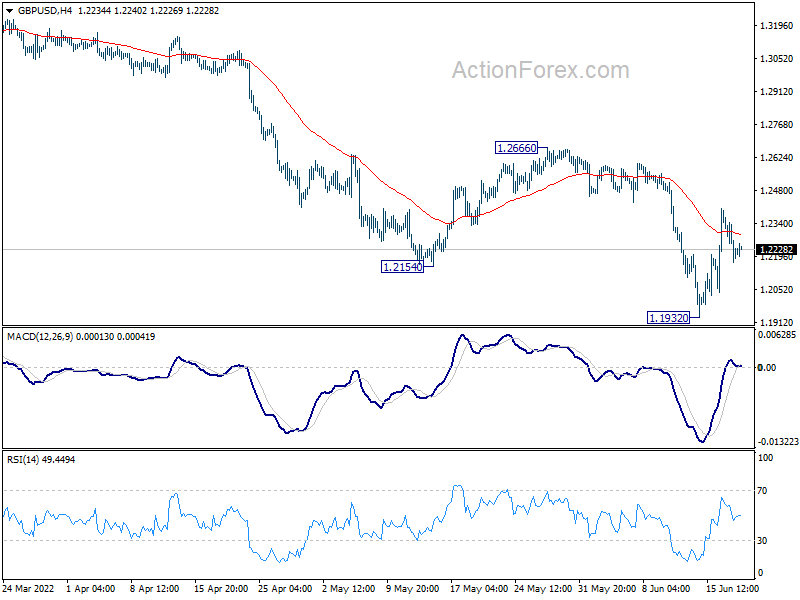
Intraday bias in GBP/USD stays neutral as consolidations continues. But outlook stays bearish as long as 1.2666 resistance holds. On the downside, break of 1.1932 will resume larger down trend from 1.4248. However, firm break of 1.2666 will suggest medium term bottoming and bring stronger rebound back towards 1.3158 support turned resistance.
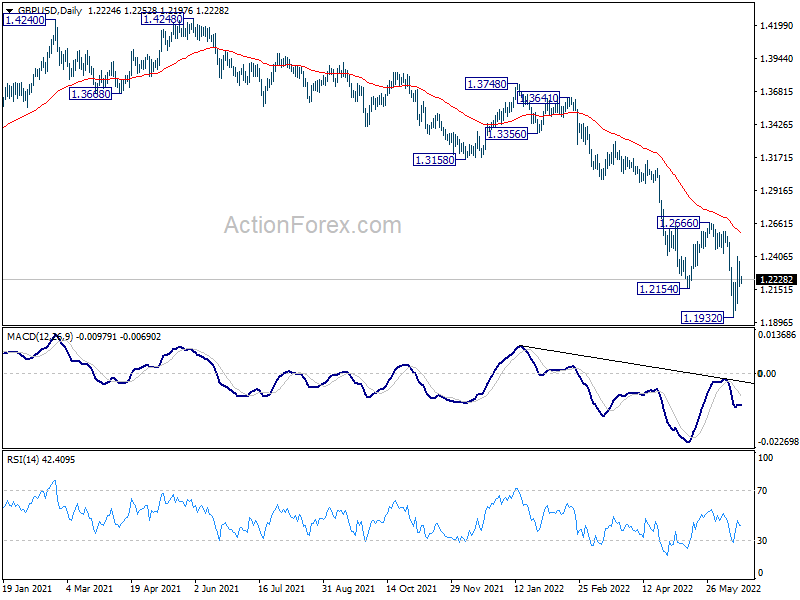
In the bigger picture, fall from 1.4248 (2018 high) could be a leg inside the pattern from 1.1409 (2020 low), or resuming the longer term down trend. Deeper decline is expected as long as 1.2666 resistance holds. Next target is 1.1409 low. However, firm break of 1.2666 will bring stronger rise back to 55 week EMA (now at 1.3175).
Bitcoin Breaks 20k, Sterling Awaits UK Data
Overall markets are rather steady in Asian session today. Even the free falling crytocurrencies are stabilizing slightly. Major Asian indexes, except Nikkei, are treading water. Dollar and Yen are softening slightly with Sterling. Aussie and Euro and mildly higher. But most major pairs and crosses are just stuck inside Friday's range. Sterling would be a focus this week with a string of economic data featured, including CPI, retail sales, and PMIs.
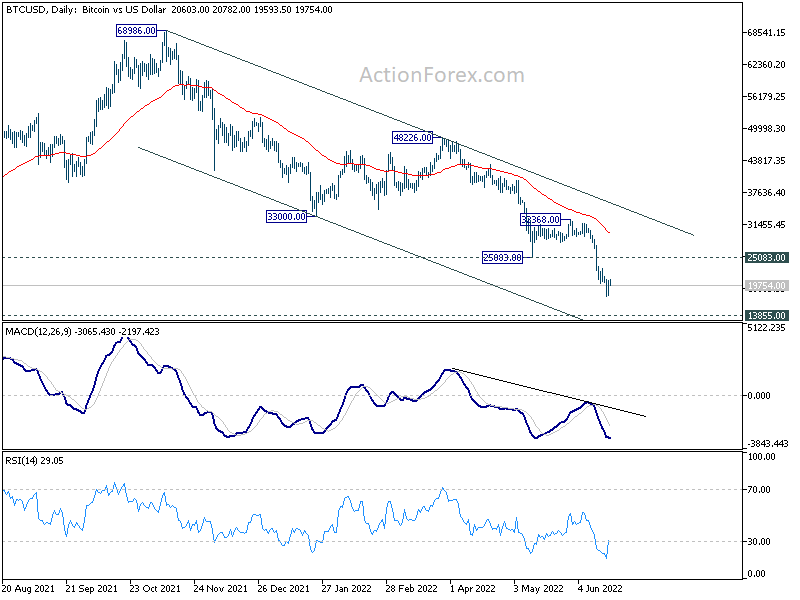
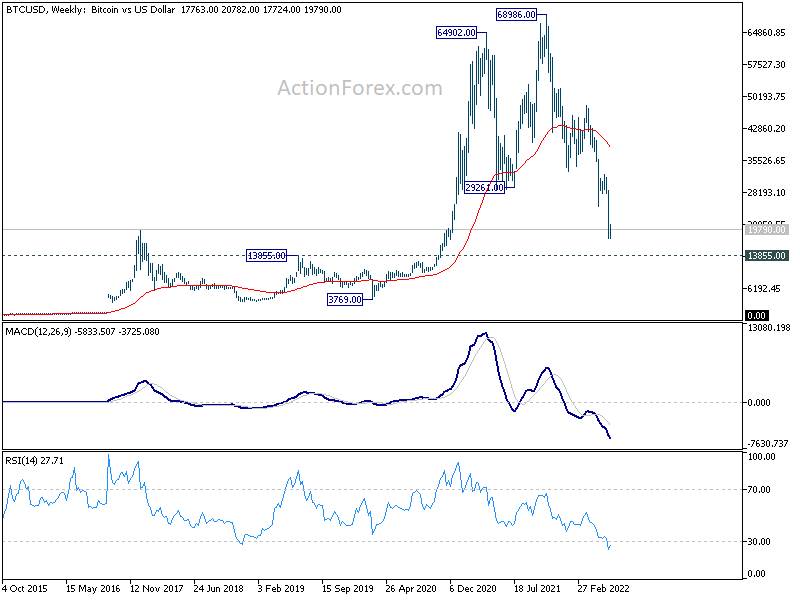
Technically, Bitcoin broke through 20k handle over the weekend and stays below. It could now be heading back to pre pandemic high at 13855. In any case, firm break above 25083 resistance turned support is needed to be the first sign of bottoming. But even so, upside potential should be limited below 32368 resistance.
In Asia, at the time of writing, Nikkei is down -1.11%. Hong Kong HSI is down -0.30%. China Shanghai SSE is down -0.20%. Singapore Strait Times is up 0.08%. 10-year JGB yield is down -0.0263 at 0.206.
Fed Waller: Fed is all in on re-establishing price stability
Fed Governor Christopher Waller said in a speech over the weekend that "if the data comes in as I expect, I will support a similar-sized move at our July meeting," referring to the 75bps hike at the June meeting. He added, "the Fed is 'all in' on re-establishing price stability."
"It should not have been a surprise that the policy rate would rise fast in 2022. Rate hikes would need to be larger and more frequent, relative to the 2015-2018 tightening pace, to get back to neutral."
"Looking back, should the Committee have signaled a steeper rate path once the liftoff criteria had been met? Perhaps another lesson is that giving forward guidance about liftoff should also include forward guidance about the possible path of the policy rate after liftoff."
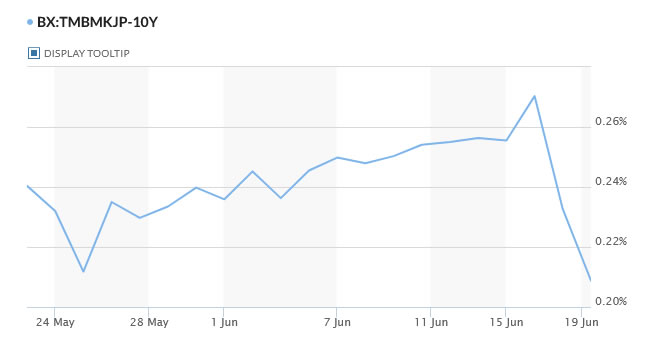
10-yr JGB yield back below 0.21% after massive BoJ purchases
BoJ offered to purchase unlimited amounts of 5- and 10-year JGBs today. That's part of the central bank's move to cap 10-year yield at 0.25%, after doubling down on maintaining this position and the overall ultra loose policy stance last Friday. Just last week, BoJ bought JPY 10.9T yen of government bonds, the most on record according to data compiled by Bloomberg.
BoJ's move seems to be working well finally with 10-year JGB yield now down below 0.21% handle, after breaking above 0.27% last week.
New Zealand BusinessNZ services rose to 55.2, back above average
New Zealand BusinessNZ Performance of Services Index rose from 52.2 to 55.2 in May. Activity/sales rose sharply from 53.3 to 59.6. But employment dropped from 51.0 to 48.5. New orders/business rose from 55.2 to 62.0. Stocks/inventories ticked down from 55.0 to 54.6. Supplier deliveries rose from 40.5 to 45.0.
BNZ Senior Economist Doug Steel said that "while the improvement was far from universal across components, reflecting many ongoing challenges across segments of the service sector, the overall outcome was the first above average result since the outbreak of Delta in August last year."
UK CPI, retail sales, consumer confidence and PMIs highlights the week
UK data this week carry some weight, including CPI, consumer confidence and retail sales. For now, recession risks look higher than other major economies. The key lies in the dynamics between inflation and consumption. That's the key to how far BoE's tightening could continue. On the business side, PMIs will also be watched.
Other data to be watched include Eurozone PMIs, Germany Ifo, Canada CPI and retail sales; Australia PMIs; Japan PMIs and CPI, New Zealand consumer sentiment.
On central banks front, Fed Chair Jerome Powell will deliver his semi-annual testimony to Congress. No change in tune is expected, not that soon after last week's FOMC press conference. RBA and BoJ will release meeting minutes while ECB will publish monthly economic bulletin.
Here are some highlights for the week:
- Monday: New Zealand BusinessNZ services index; Germany PPI.
- Tuesday: New Zealand Westpac consumer sentiment; RBA minutes; Swiss Trade balance; Eurozone current account; Canada retail sales, new housing price index; US existing home sales.
- Wednesday: New Zealand trade balance; BoJ minutes; UK CPI, PPI; Canada CPI; Eurozone consumer confidence.
- Thursday: Australia PMIs; Japan PMI manufacturing; Eurozone PMIs, ECB monthly bulletin; UK PMIs; US jobless claims, PMIs.
- Friday: Japan CPI, SPPI; UK Gfk consumer confidence, retail sales; Germany Ifo; US new home sales.
GBP/USD Daily Outlook
Daily Pivots: (S1) 1.2141; (P) 1.2254; (R1) 1.2335; More...
Intraday bias in GBP/USD stays neutral as consolidations continues. But outlook stays bearish as long as 1.2666 resistance holds. On the downside, break of 1.1932 will resume larger down trend from 1.4248. However, firm break of 1.2666 will suggest medium term bottoming and bring stronger rebound back towards 1.3158 support turned resistance.
In the bigger picture, fall from 1.4248 (2018 high) could be a leg inside the pattern from 1.1409 (2020 low), or resuming the longer term down trend. Deeper decline is expected as long as 1.2666 resistance holds. Next target is 1.1409 low. However, firm break of 1.2666 will bring stronger rise back to 55 week EMA (now at 1.3175).
Economic Indicators Update
| GMT | Ccy | Events | Actual | Forecast | Previous | Revised |
|---|---|---|---|---|---|---|
| 22:30 | NZD | Business NZ PSI May | 55.2 | 51.4 | 52.2 | |
| 06:00 | EUR | Germany PPI M/M May | 1.50% | 2.80% | ||
| 06:00 | EUR | Germany PPI Y/Y May | 33.50% | 33.50% |
10-yr JGB yield back below 0.21% after massive BoJ purchases
BoJ offered to purchase unlimited amounts of 5- and 10-year JGBs today. That's part of the central bank's move to cap 10-year yield at 0.25%, after doubling down on maintaining this position and the overall ultra loose policy stance last Friday. Just last week, BoJ bought JPY 10.9T yen of government bonds, the most on record according to data compiled by Bloomberg.
BoJ's move seems to be working well finally with 10-year JGB yield now down below 0.21% handle, after breaking above 0.27% later week.