

Sample Category Title
USD/CAD Weekly Outlook
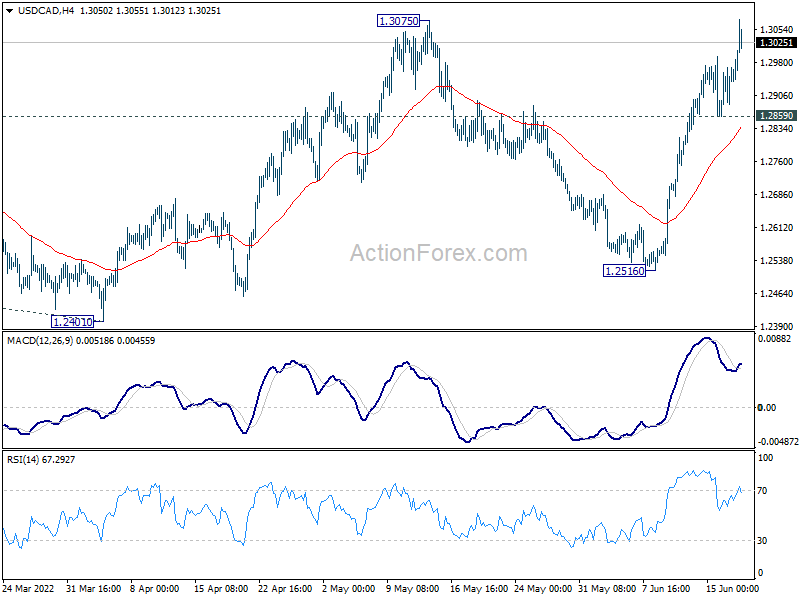
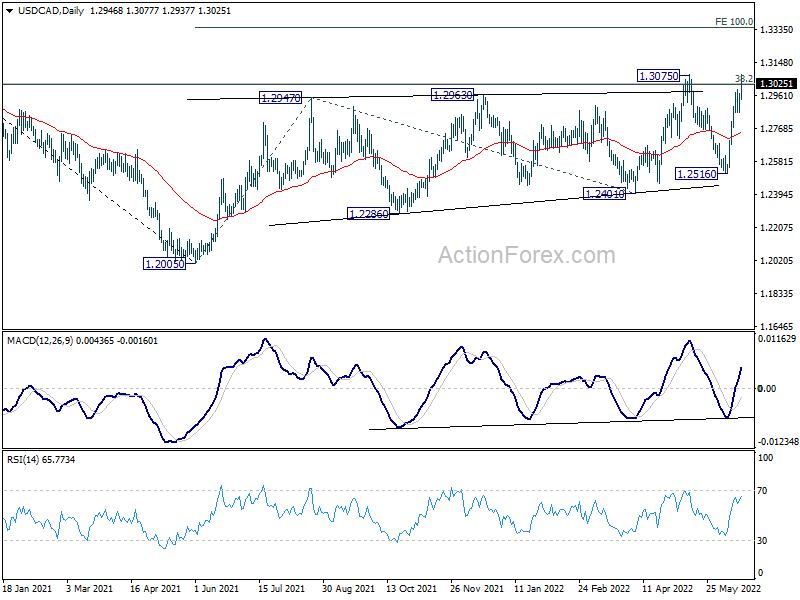
USD/CAD rose to as high as 1.3077 last week. The breach of 1.3075 resistance suggests that rise from 1.2005 is resuming. Initial bias stays on the upside this week. Sustained trading above 1.3022 fibonacci level will carry larger bullish implications. Next target is 100% projection of 1.2005 to 1.2947 from 1.2401 at 1.3343. For now, outlook will stay bullish as long as 1.2859 support holds, in case of retreat.
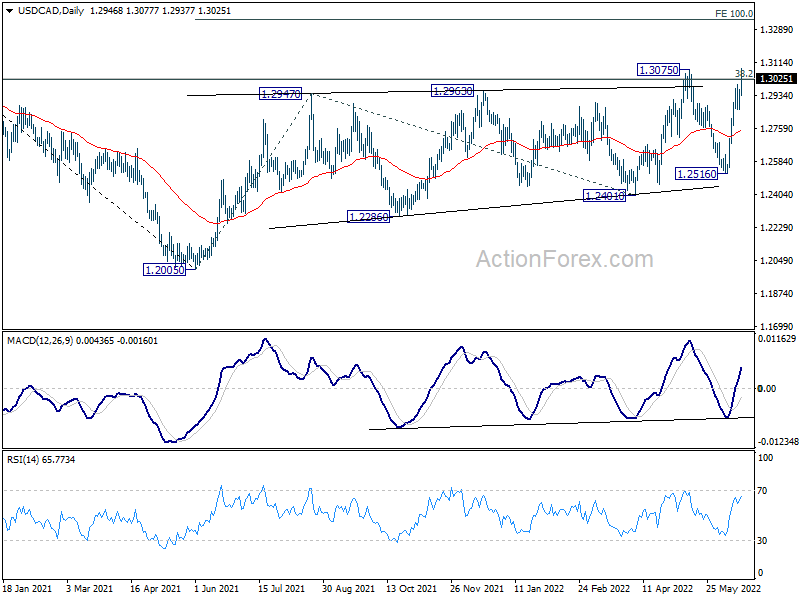
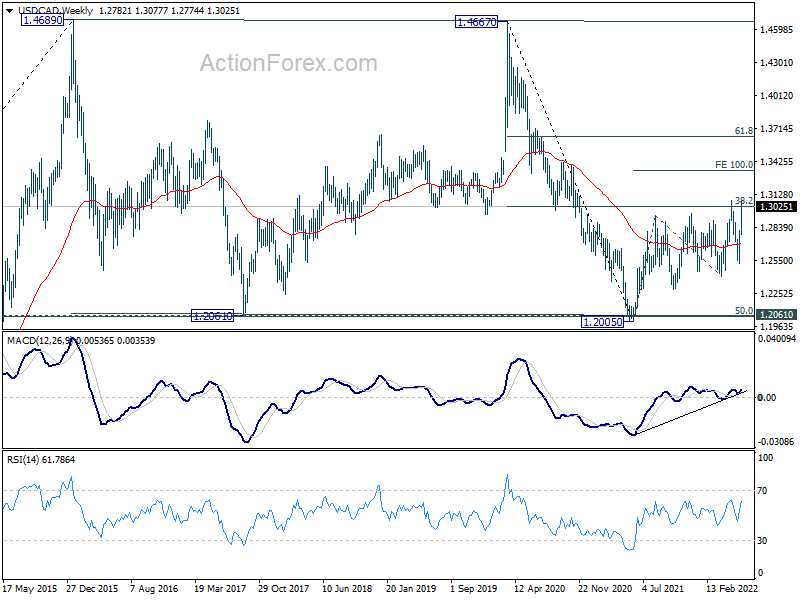
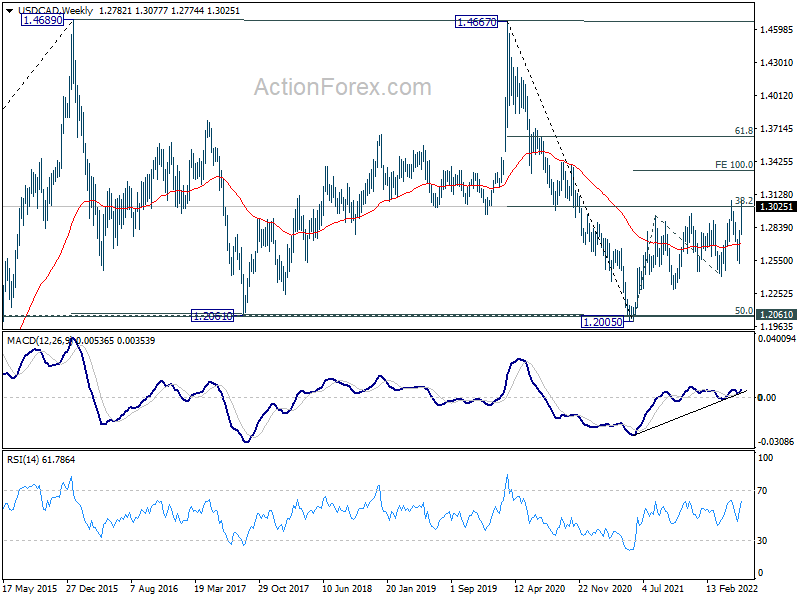
In the bigger picture, focus stays on 38.2% retracement of 1.4667 (2020 high) to 1.2005 (2021 low) at 1.3022. Sustained break there should confirm that the down trend from 1.4667 has completed after defending 1.2061 long term cluster support. Further rise would then be seen towards 61.8% retracement at 1.3650. However, rejection by 1.3022 will maintain medium term bearishness.
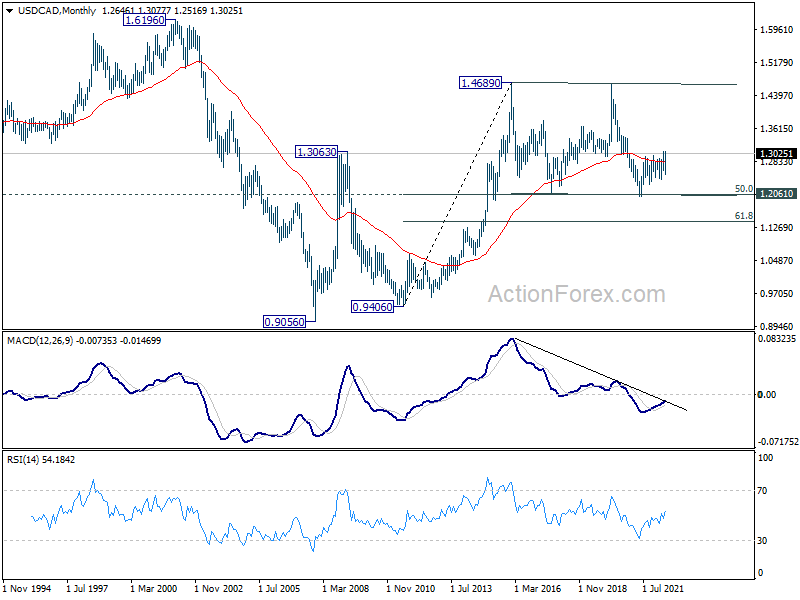
In the longer term picture, price actions from 1.4689 (2016 high) are seen as a consolidation pattern only. That is, up trend from 0.9506 (2007 low) is still expected to resume at a later stage. This will remain the favored case as long as 1.2061 support holds, which is close to 50% retracement of 0.9406 to 1.4689 at 1.2048. However, firm break of 1.2061 support will argue that USD/CAD has already started a long term down trend. Next target is 61.8% retracement of 0.9406 to 1.4689 at 1.1424.
GBP/JPY Weekly Outlook
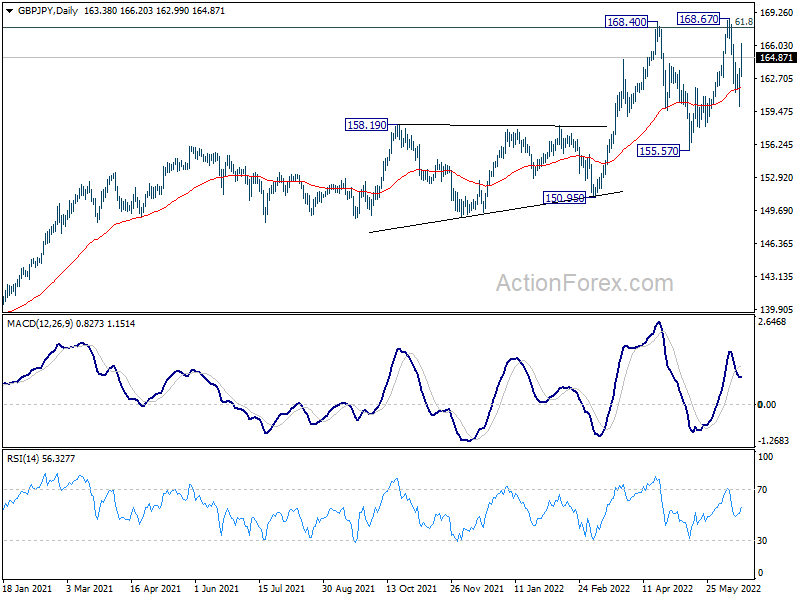
GBP/JPY's correction from 168.57 should have completed at 159.97 last week. Initial bias is now mildly on the upside for retesting 168.67. Decisive break there will resume larger up trend. On the downside, however, break of 159.97 will bring deeper fall back towards 155.57 support instead.
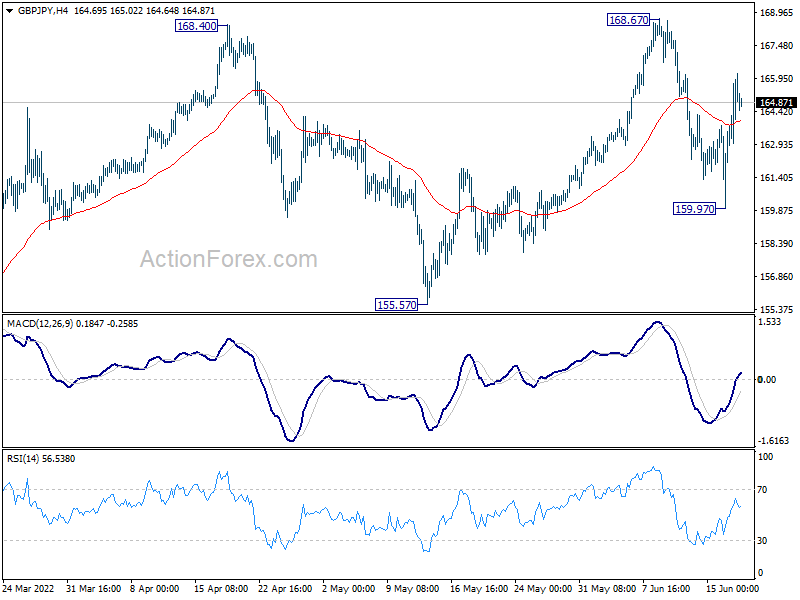
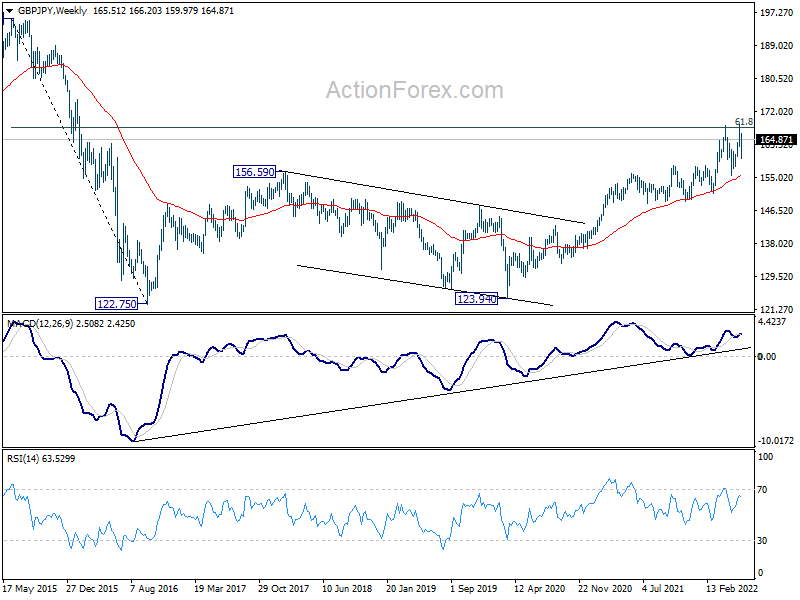
In the bigger picture, up trend from 123.94 (2020 low) is still in progress. Sustained break of 61.8% retracement of 195.86 (2015 high) to 122.75 (2016 low) at 167.93 will be a long term bullish signal, and could pave the way back to 195.86 high. This will now remain the favored case as long as 155.57 support holds, even in case of deep pull back.
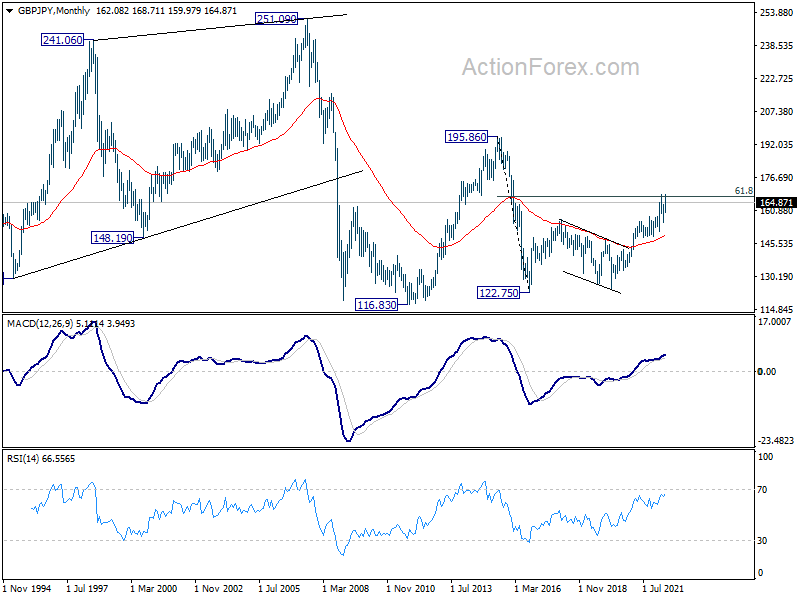
In the longer term picture, rise from 122.75 could be the third leg the the pattern from 116.83 (2011 low). Further rise will remain in favor as long as 55 month EMA (now at 149.32) holds. Sustained break of 61.8% retracement of 195.86 to 122.75 at 167.93. will pave the way to 195.86 (2015 high).
EUR/JPY Weekly Outlook
EUR/JPY's correction from 144.23 extended to 137.83 last week but rebounded from there. Initial bias stays mildly on the upside this week for retesting 144.23. Firm break there will resume larger up trend. On the downside, below 137.83 will turn bias back to the downside to extend the correction from 144.23.
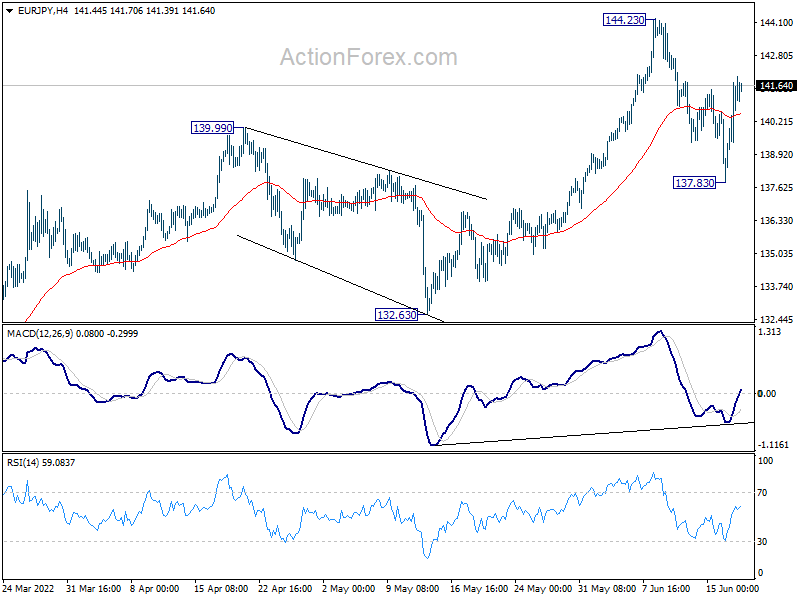
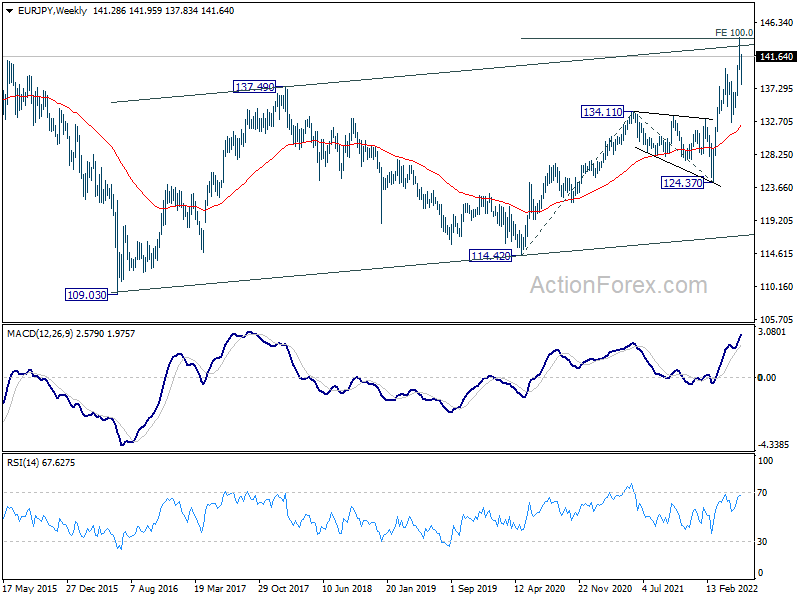
In the bigger picture, up trend from 114.42 (2020 low) is in progress. Such rise is seen as the third leg of the pattern from 109.30 (2016 low). Sustained trading above 100% projection of 114.42 to 134.11 from 124.37 at 144.06 will indicate upside acceleration and target 149.76 long term resistance (2014 high). In any case, outlook will now remain bullish as long as 132.63 support holds, in case of deep pull back.
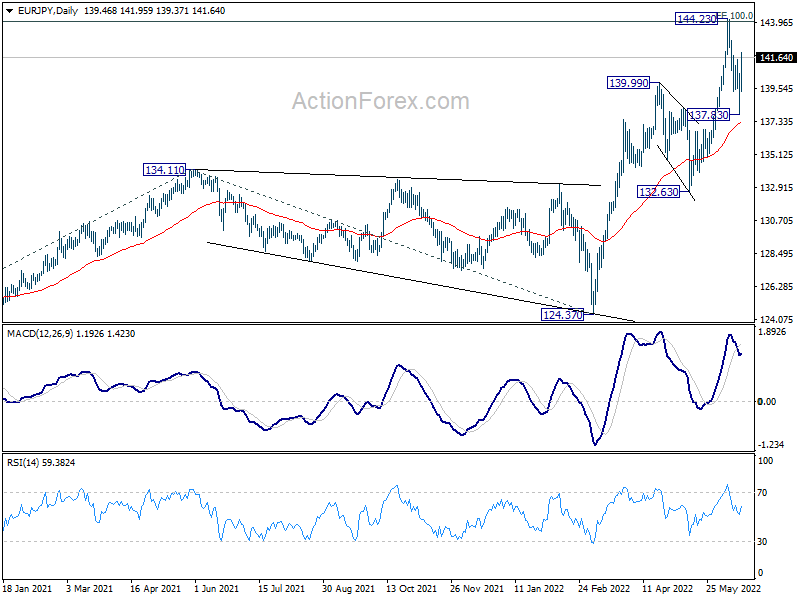
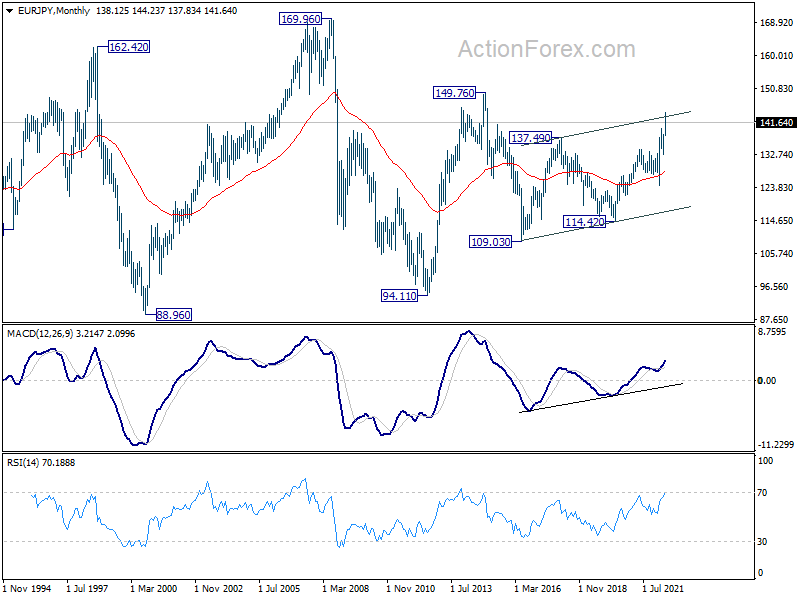
In the long term picture, current rally could be resuming whole rise from 94.11 (2012 low). Further rally would be seen to 149.76 resistance (2014 high) and above. This will remain the favored case as long as 132.63 support holds.
EUR/GBP Weekly Outlook
EUR/GBP rose to 0.8720 last week but failed to sustain above 0.8697 fibonacci level and retreated sharply. Initial bias is neutral this week first. Further rise is expected as long as 0.8484 support holds. Break of 0.8720 and sustained trading above 0.8697 medium term fibonacci level will carry larger bullish implication. Next target is 0.9003 fibonacci level. However, break of 0.8484 will indicate rejection by 0.8697 and turn near term outlook bearish.
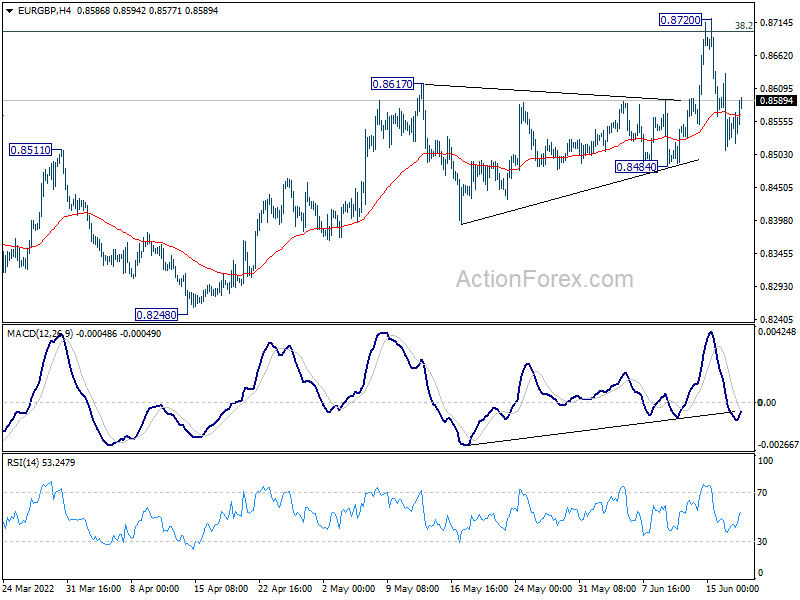
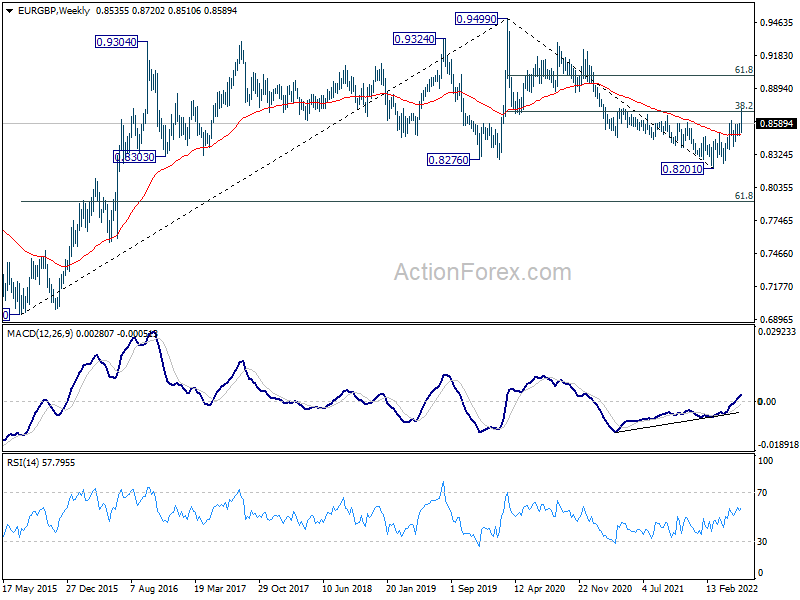
In the bigger picture, rise from 0.8201 medium term bottom could could either be a correction to the down trend from 0.9499 (2020 high), or a medium term up trend itself. Sustained break of 38.2% retracement of 0.9499 to 0.8201 at 0.8697 will affirm the latter case, and pave the way to 61.8% retracement at 0.9003. However, rejection by 0.8697 will maintain medium term bearishness.
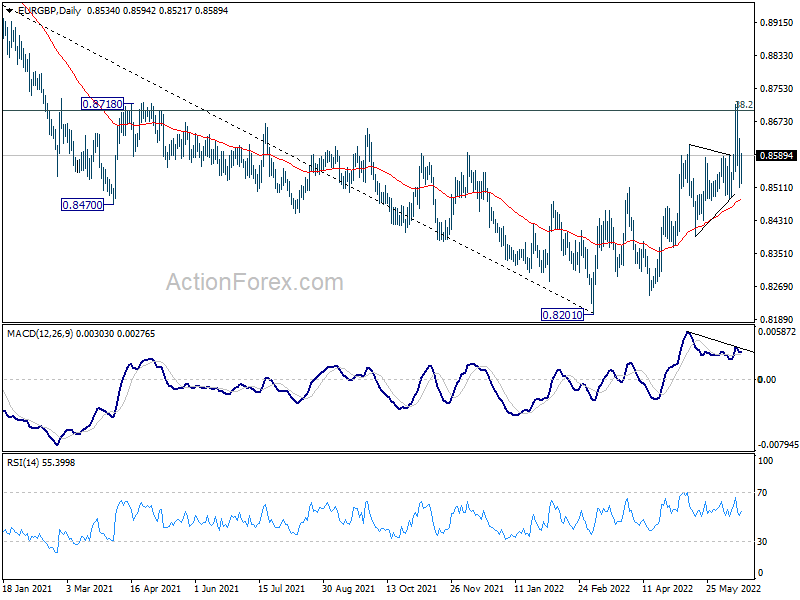
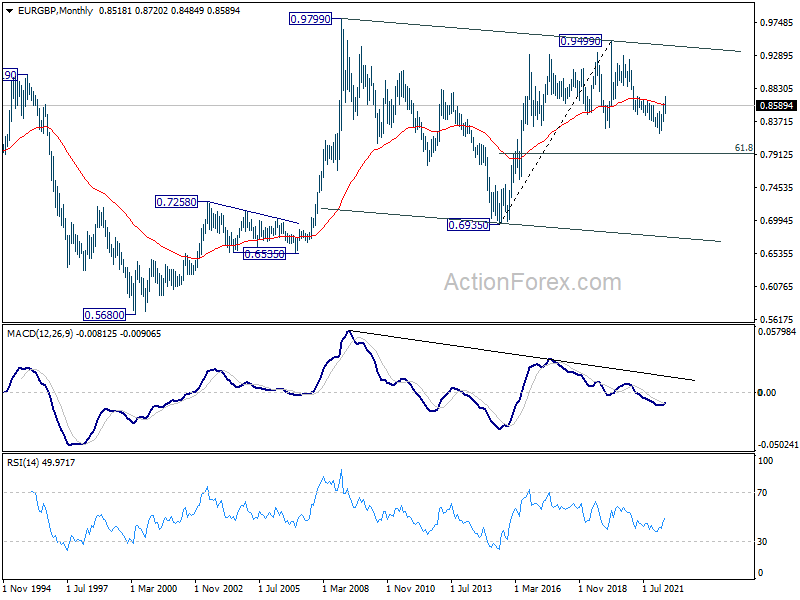
In the long term picture, the lack of medium term downside momentum suggests that fall from 0.9499 (2020 high) is merely a correction to rise from 0.6935 (2015 high). In case of another fall, downside should be contained by 61.8% retracement of 0.6935 to 0.9499 at 0.7917 to bring rebound. Sustained trading above 55 month EMA (now at 0.8604) will indicate that the correction has completed and bring retest of 0.9499.
EUR/AUD Weekly Outlook
Some volatility was seen in EUR/AUD last week but it's staying in range after all. Initial bias remains neutral this week first. On the upside, above 1.5187 will target 1.5277 resistance and than 1.5354 support turned resistance next. On the downside, break of 1.4759 support will suggest that rebound from 1.4318 has completed. Intraday bias will be turn back to the downside for retesting 1.4318 low.
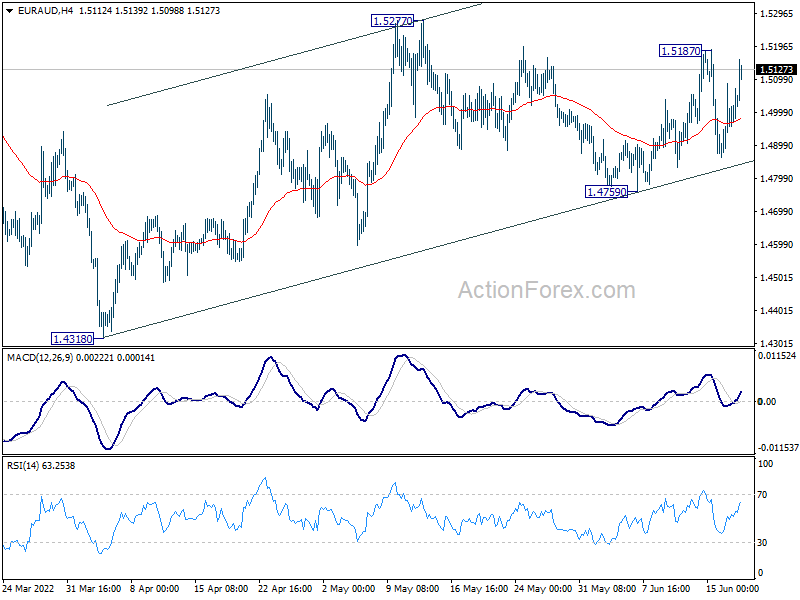
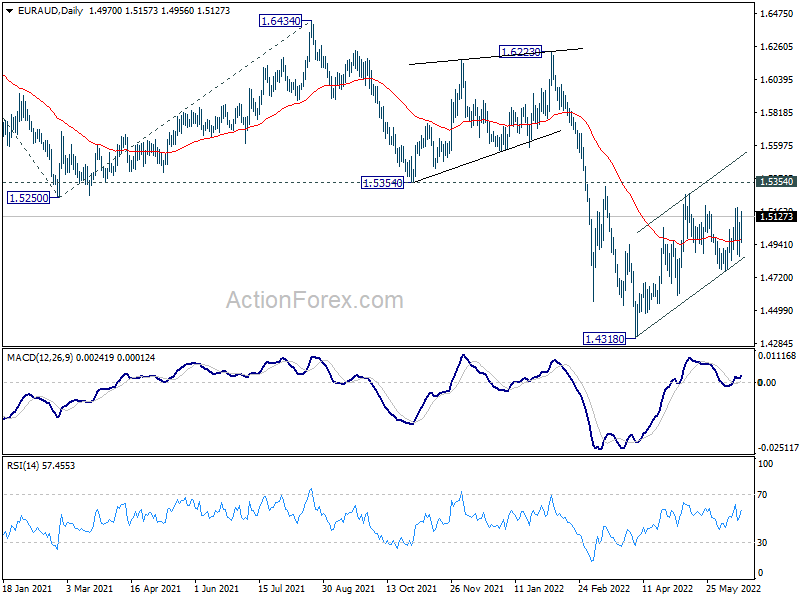
In the bigger picture, as long as 1.5354 support turned resistance holds, larger down trend from 1.9799 (2020 high) is still expected to continue. On resumption, next target is 61.8% projection of 1.9799 to 1.5250 from 1.6434 at 1.3623, which is close to 1.3624 long term support (2017 low). However, firm break of 1.5354 will indicate medium term bottoming and bring stronger rally back to 1.6434 key resistance.
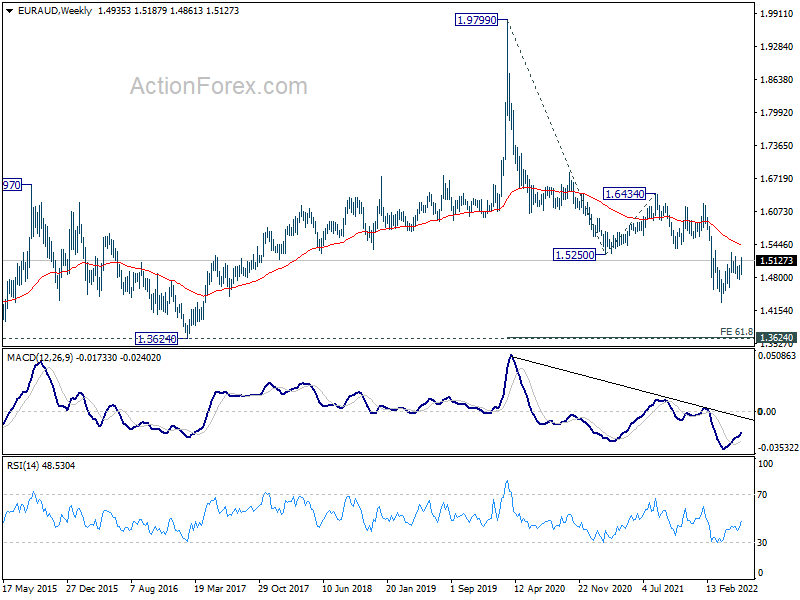
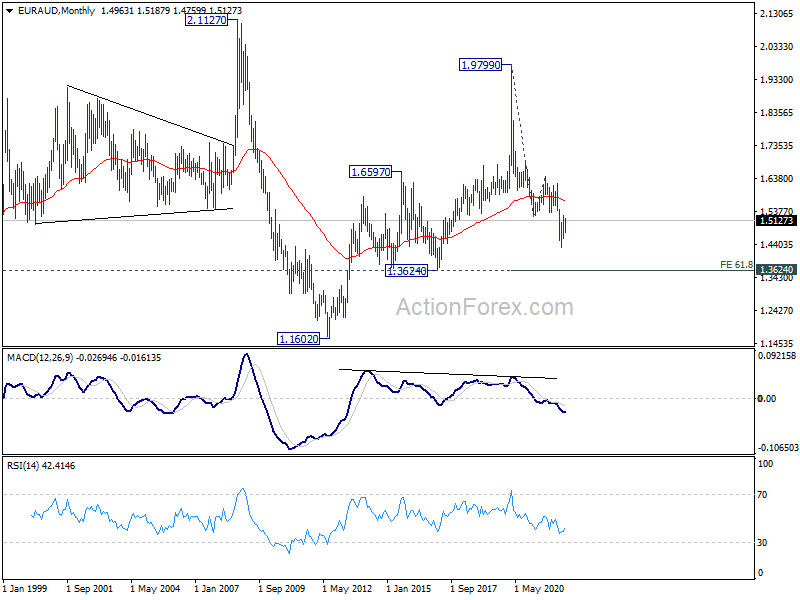
In the longer term picture, fall from 1.9799 (2020 high) is seen as the third leg of the pattern from 2.1127 (2008 high). Deeper fall should be seen to 1.3624 support. Decisive break there would pave the way back to 1.1602 (2012 low).
EUR/CHF Weekly Outlook
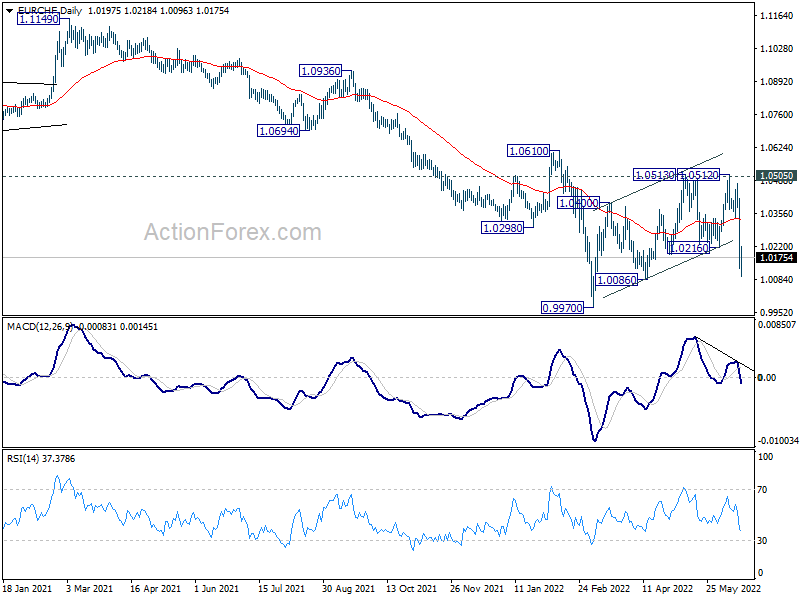
EUR/CHF's sharp decline last week and break of 1.0216 support suggests that corrective rebound from 0.9970 has completed after failing 1.0505 long term resistance, as well as 55 week EMA. Initial bias stays on the downside this week. Break of 1.0086 support will affirm this bearish case and bring retest of 0.9970 low. On the upside, above 1.0232 minor resistance will turn intraday bias neutral first. But risk will stay on the downside as long as 1.0513 resistance holds.
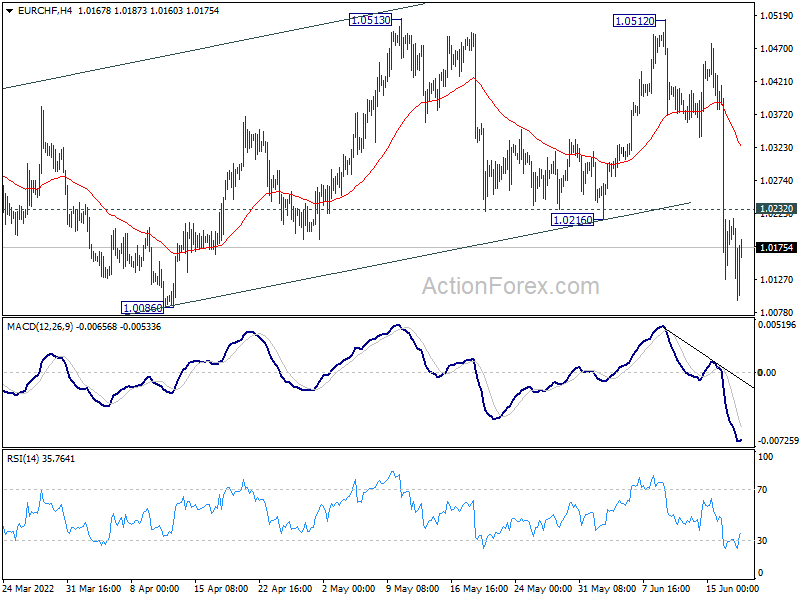
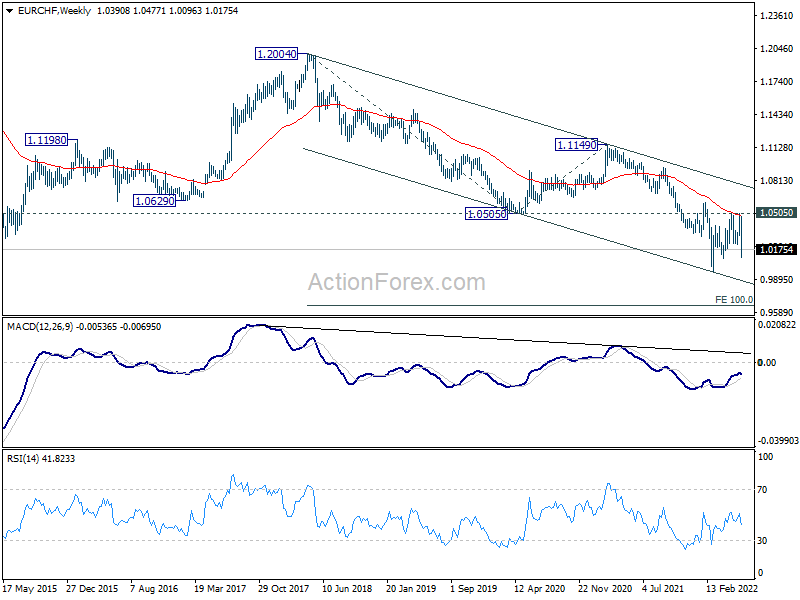
In the bigger picture, as long as 1.0505 support turned resistance (2020 low) holds, long term down trend from 1.2004 (2018 high) is expected to continue. Next target is 100% projection of 1.2004 to 1.0505 to 1.1149 at 0.9650. However, firm break of 1.0505 will suggest medium term bottoming, and bring stronger rebound towards 1.1149 structural resistance.
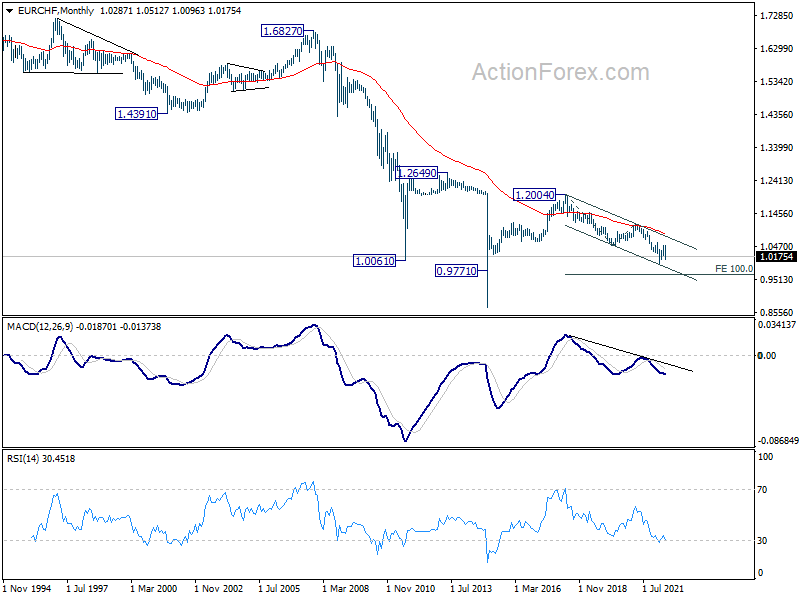
In the long term picture, capped below 55 month EMA, EUR/CHF is seen as extending the multi-decade down trend. There is no prospect of a bullish reversal until some sustained trading above the 55 month EMA (now at 1.0846).
Markets Reacted Negatively to Rate Hikes, Franc and Dollar Shone
Net reactions of the global markets to Fed's 75bps rate hike were rather negative. Global stocks ended generally lower after initial recovery. Additionally, SNB delivered a surprised 50bps rate hike while BoE's 25bps had a hawkish undertone with three members wanted more. BoJ stayed calm and kept interest rate unchanged while maintaining the 10-year JGB yield cap at 0.25%.
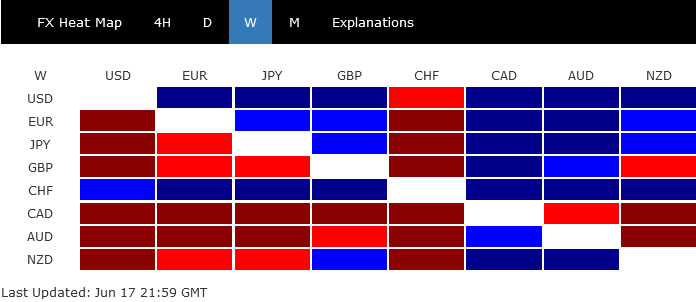
In the currency markets, Swiss Franc was overwhelmingly the strongest one. Dollar followed as second but there was clearly some hesitation towards the end, in particular against Euro. Canadian Dollar was the worst as dragged down additionally by falling oil prices. Australian Dollar was also weighed down by overall risk averse sentiment.
Could DOW defend 30k cluster support level?
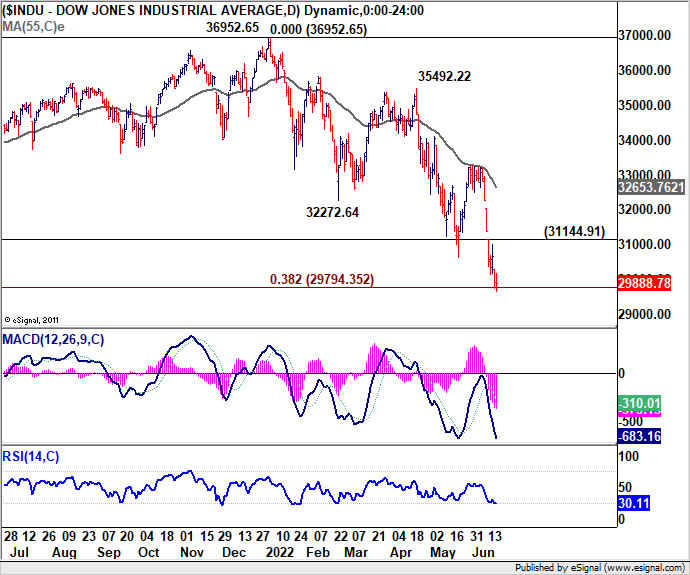
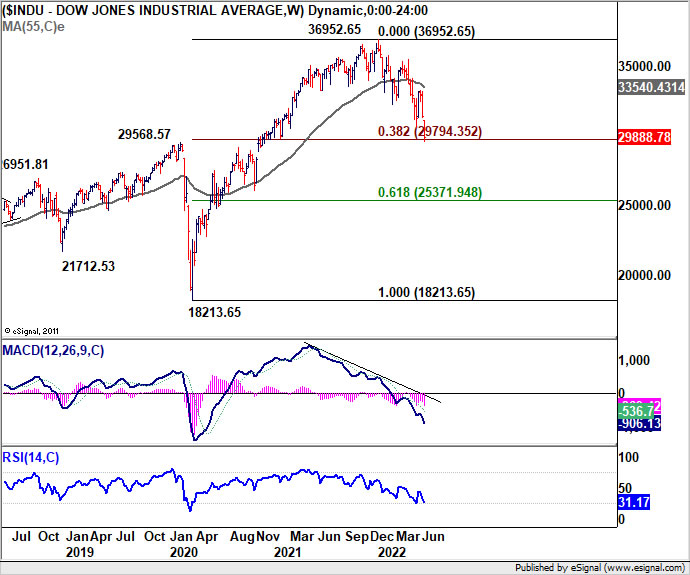
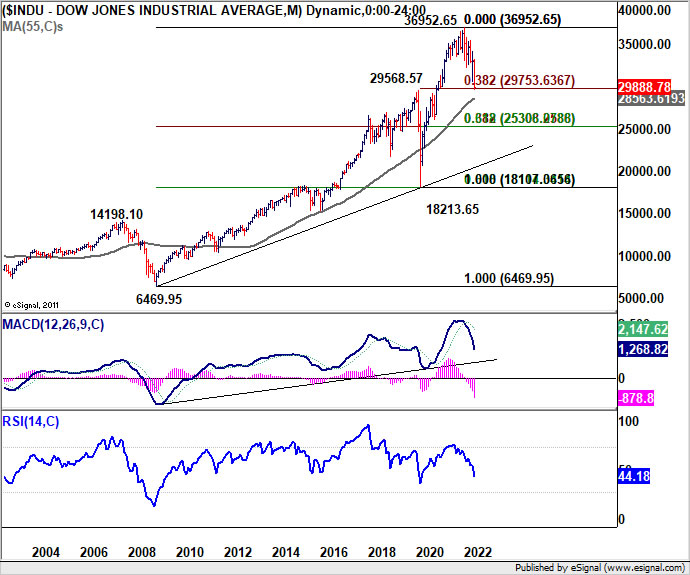
DOW extended the correction from 36952.65 to close at 29888.78 last week, losing 30k handle. Ideally, it's a zone for bottoming, with 38.2% retracement of 18213.65 to 36952.65 at 29794.35, and 29568.57 resistance turned support (2020 pre-pandemic high). Also, it's now reasonably close to 55 month EMA (now at 38563.61) which should provide strong support.
However, break of gap resistance at 31144.91 is needed to be the first sign of bottoming. Or risk will stay heavily on the downside. Sustained trading below 29794.35 could bring even deeper fall to long cluster level at 25308/71 (61.8% retracement of 18213.63 to 36952.56 at 25371.94, 38.2% retracement of 6469.95 to 36952.56 at 25308.25).
Near term upside potential in 10-year yield limited
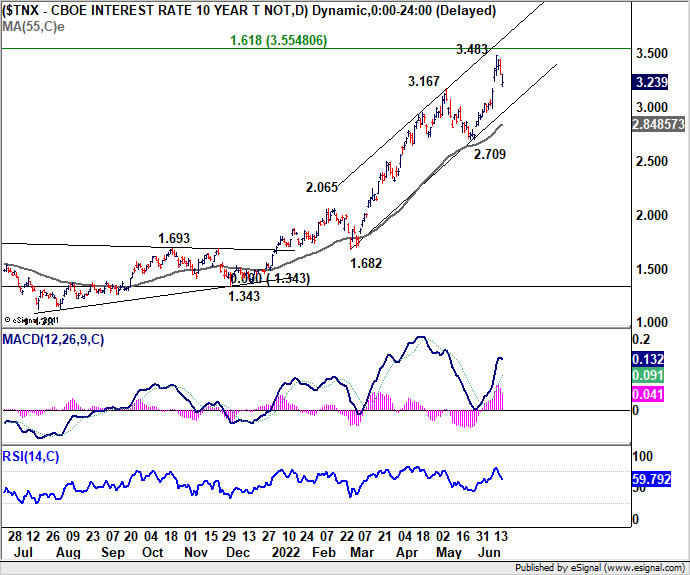
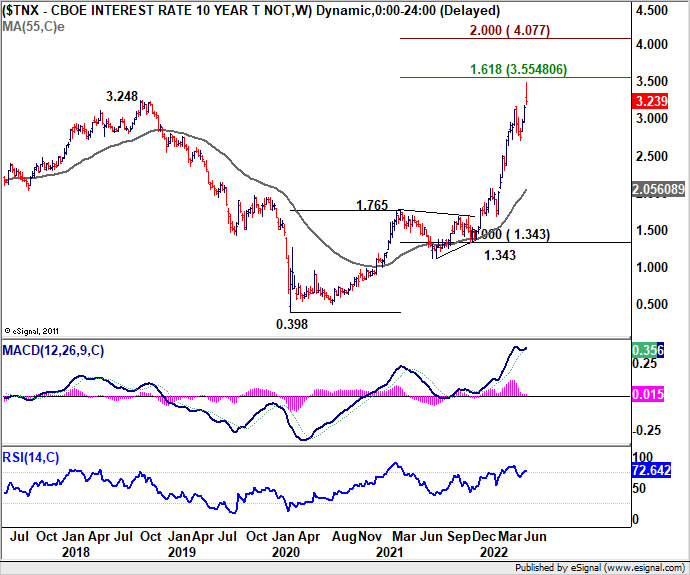
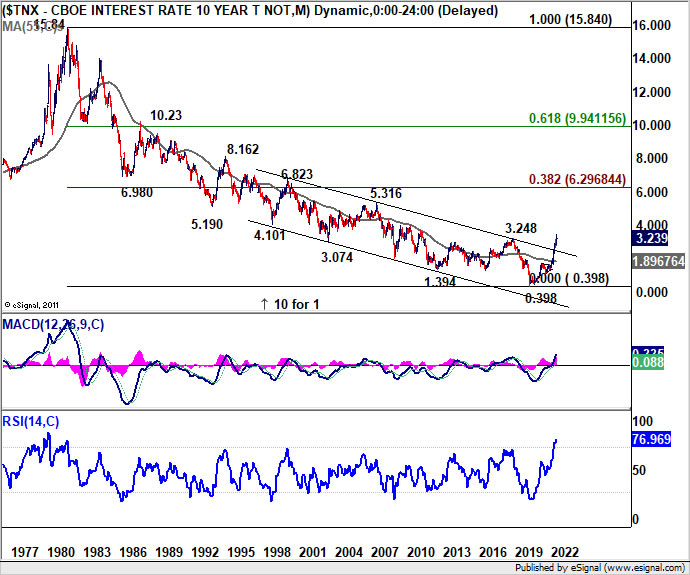
10-year yield surged to as high as 3.483 last week but retreated to close at 3.239. Another rise cannot be ruled out yet but upside potential should be limited for now. 161.8% projection of 0.398 to 1.765 from 1.343 at 3.554 should limited upside to bring consolidations. Indeed, break of 3.167 support should confirm that a near term correction has started for 55 day EMA (now at 2.848). However, firm break of 3.554 could bring another round of upside acceleration to 200% projection at 4.077.
Dollar index lost momentum quickly after up trend resumption
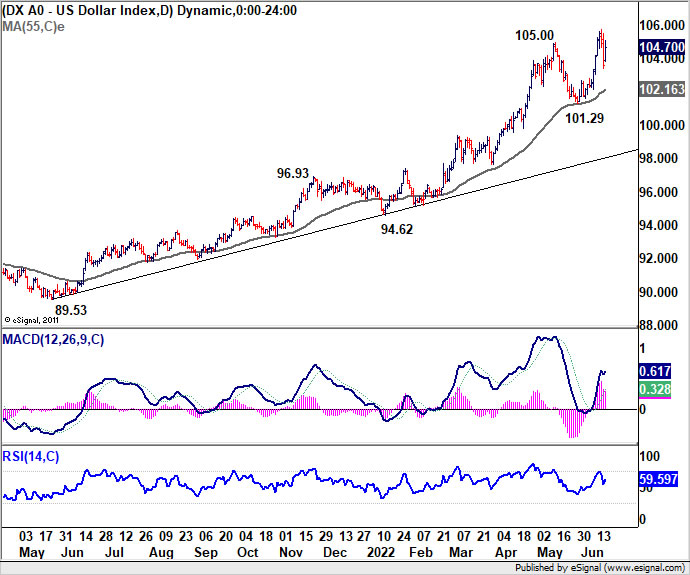
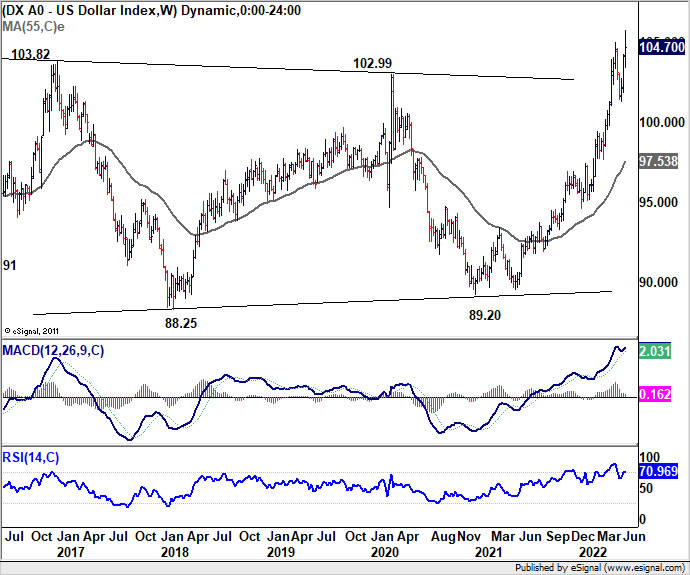
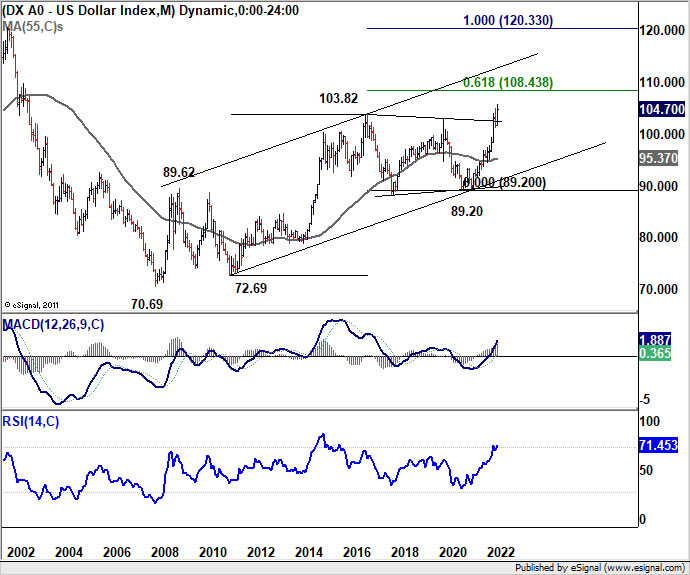
Dollar index also resumed recent up trend and hit as high as 105.78, but quickly lost momentum and retreated. Some more consolidations would likely be seen in the near term, but downside should be contained by 55 day EMA (now at 102.16) to bring rally resumption. Current up trend should target 61.8% projection of 72.69 to 103.82 from 89.20 at 108.43 at a later stage. But to do so, risk aversion will need to continue while 10-year yield should extend up trend, while EUR/USD will need to break through 1.0339 support.
WTI crude oil in third leg of pattern from 131.82
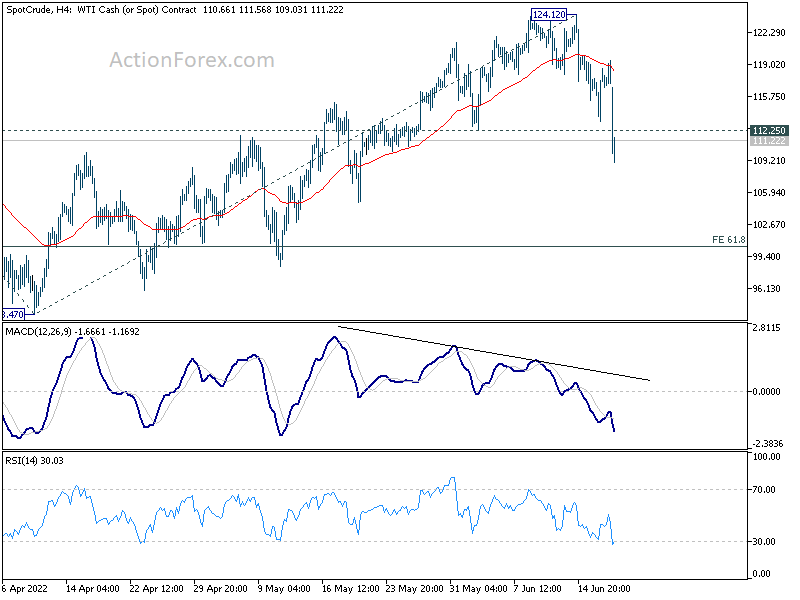
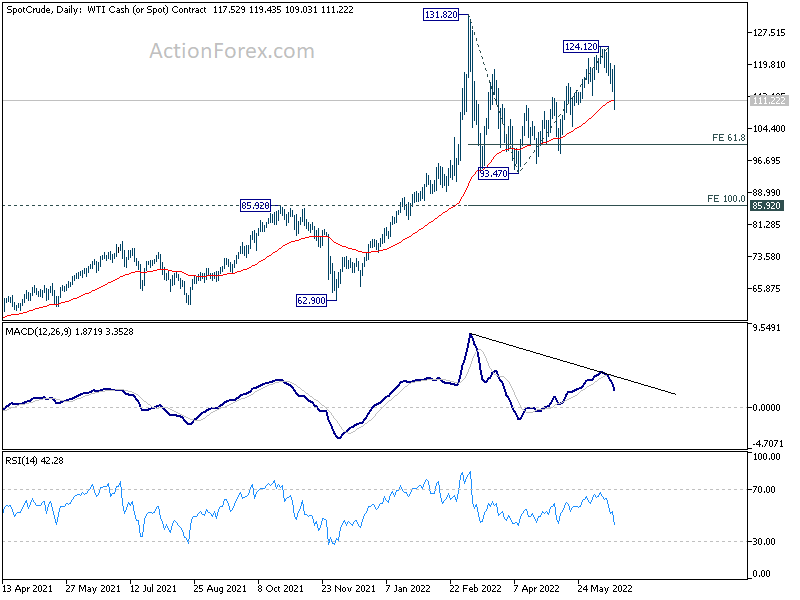
The steep decline in oil price last week could be offering some hope to inflation outlook and risk sentiment ahead. WTI's break of 112.25 support argues that a short term top was already formed at 124.12. The whole rebound from 93.47 might be finished too. Sustained trading below 55 day EMA (now at 111.18) will affirm this case. Fall from 124.12 would then be seen as the third leg of the pattern from 131.82 high. Deeper decline should then be seen to 61.8% projection of 131.82 to 93.47 at 124.12 at 100.41 first. Firm break there could bring downside acceleration through 93.47 to 100% projection at 85.77, which is close to 85.92 resistance turned support.
USD/CAD is breaking through 1.3 key resistance
But of course, the reversal in oil price could also be seen as a result of lower demand due to dimmer economic outlook. That is, it's part of risk-aversion trades. If that's the case, Canadian Dollar could be double hit. USD/CAD has already breached 1.0375 resistance last week. Sustained trading above 38.2% retracement of 1.4667 (2020 high) to 1.2005 (2021 low) at 1.3022 will suggest that it's reversal whole down trend from 1.4667. Further rally would be seen to 100% projection of 1.2005 to 1.2947 from 1.2401 at 1.3343. The dynamics between oil, stocks and Loonie is worth a close watch in the next two weeks.
EUR/CHF Weekly Outlook
EUR/CHF's sharp decline last week and break of 1.0216 support suggests that corrective rebound from 0.9970 has completed after failing 1.0505 long term resistance, as well as 55 week EMA. Initial bias stays on the downside this week. Break of 1.0086 support will affirm this bearish case and bring retest of 0.9970 low. On the upside, above 1.0232 minor resistance will turn intraday bias neutral first. But risk will stay on the downside as long as 1.0513 resistance holds.
In the bigger picture, as long as 1.0505 support turned resistance (2020 low) holds, long term down trend from 1.2004 (2018 high) is expected to continue. Next target is 100% projection of 1.2004 to 1.0505 to 1.1149 at 0.9650. However, firm break of 1.0505 will suggest medium term bottoming, and bring stronger rebound towards 1.1149 structural resistance.
In the long term picture, capped below 55 month EMA, EUR/CHF is seen as extending the multi-decade down trend. There is no prospect of a bullish reversal until some sustained trading above the 55 month EMA (now at 1.0846).
Summary 6/20 – 6/24
Monday, Jun 20, 2022
[php_everywhere instance="1"]
Tuesday, Jun 21, 2022
[php_everywhere instance="2"]
Wednesday, Jun 22, 2022
[php_everywhere instance="3"]
Thursday, Jun 23, 2022
[php_everywhere instance="4"]
Friday, Jun 24, 2022
[php_everywhere instance="5"]
Recapping A Swiss Surprise
Summary
- Central banks were in the limelight this week, including the Swiss National Bank (SNB). At its June monetary policy meeting, SNB policymakers opted to raise its policy rate, which was a surprise in terms of timing, and also magnitude as the central bank delivered and 50 bps policy rate increase to -0.25%.
- With inflation having moved significantly higher, the SNB highlighted their actions were in an effort to protect against elevated inflation from becoming entrenched within the economy. In addition to the rate hike, SNB policymakers noted that the Swiss franc is no longer highly valued, and they now stand ready to intervene in FX markets in either direction.
- Going forward, we believe economic conditions are supportive of further SNB policy rate hikes. Activity growth is still sound, while SNB projections suggest inflation should remain somewhat elevated for the time being. In that context, we also forecast the SNB to lift policy rates by 25 bps in September 2022 as well as December 2022. In addition, we believe SNB rate hikes will continue in 2023 and expect another 25 bps rate hike in March 2023.
Swiss National Bank Delivers Sizeable Surprise Rate Hike
Among a flurry of central bank policy announcements this week, the Swiss National Bank (SNB) caught the attention of financial markets by delivering a surprise tightening of monetary policy. While SNB policymakers had in recent weeks expressed some increased inflation concerns and hinted at possible interest rate increases, only one of twenty economists surveyed by Bloomberg had forecast a policy change at the June meeting. In the event, not only did the SNB raise its policy rate at its June meeting, but also lifted that policy rate by a larger 50 bps to -0.25%.
In making the monetary policy adjustment, the SNB noted there were signs inflation was spreading to goods and services not directly affected by the war in Ukraine or by the pandemic. As a result, the central bank acted in an effort to avoid higher inflation becoming entrenched as a result of increased second-round effects, and added that it cannot be ruled out that further increases in the policy rate will be necessary over time. Indeed, the SNB's updated inflation forecasts hint at some possibility of those further rate increases. While CPI inflation is seen slowing gradually over much of the forecast horizon, the SNB projects some renewed pickup of inflation from mid-2024, a hint perhaps that further rate increases my still be needed.
In another significant change, the SNB also said the Swiss franc is no longer "highly valued". Indeed, the central bank said the franc had depreciated in trade-weighted terms, and that was adding to imported inflation in Switzerland. The SNB said it was willing to be active in the foreign exchange market as necessary, but also that such intervention could be in either direction - that is, it could be foreign currency purchases or foreign currency sales. Clearly, the SNB is less sensitive to Swiss franc strength than previously, and would be more likely to accommodate a stronger franc going forward in our view.
Swiss Economic Backdrop Consistent With Further Rate Hikes
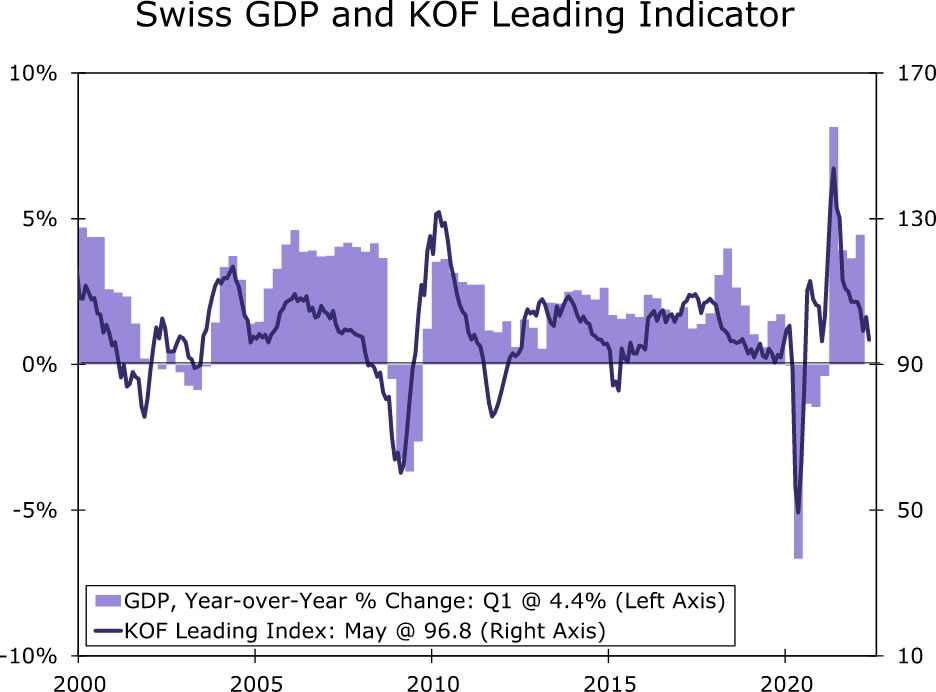
In assessing recent Swiss data and indicators, we believe the economic backdrop will be supportive of further policy rate increases from the Swiss National Bank. From a growth perspective, the SNB projects GDP growth of around 2.5% in 2022, while we also note the Swiss economy started this year on a reasonable footing. Q1 GDP rose 0.5% quarter-over-quarter and by 4.4% year-over-year. With respect to quarterly sequential growth, private consumption rose 0.4%, government consumption rose 1.4% and goods exports rose 1.4%, and investment spending was disappointing, declining in Q1. We also note some decline in confidence surveys in recent months, including a decline in the KOF leading indicator to 96.8 in May. While that might portend a moderate slowing in economic growth going forward, our own outlook for Swiss GDP growth of 2.6% in 2022 is broadly consistent with the central bank's view, and overall supportive of further monetary tightening.
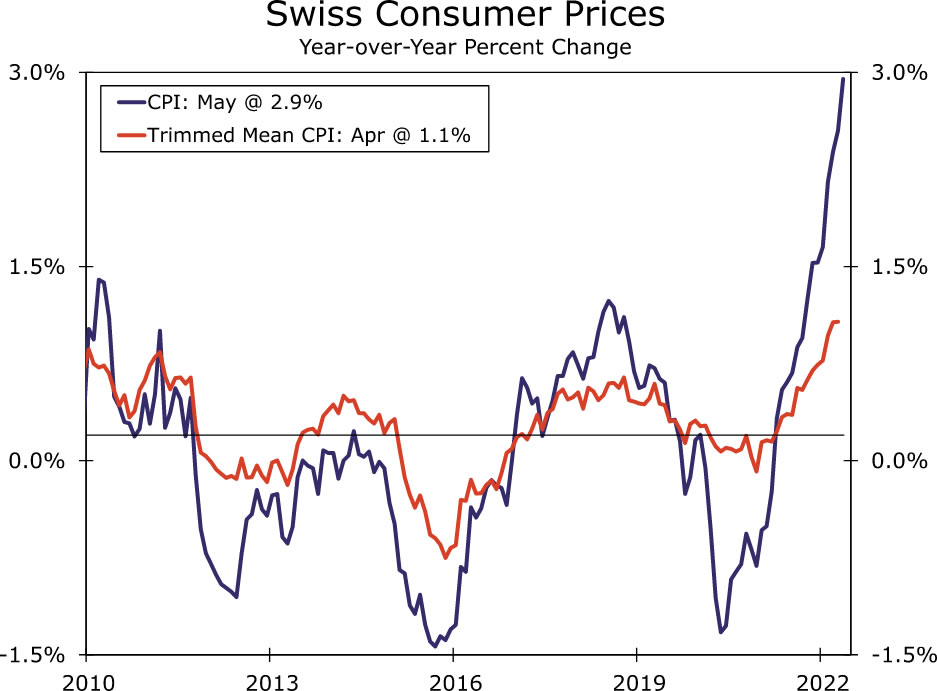
Meanwhile, CPI has quickened in recent months, with the headline CPI rising 2.9% year-over-year in May and trimmed mean CPI (a core inflation measure) rising 1.1% in April. We will be paying particular attention to trimmed mean inflation, as that could offer the best insight as to what extent broader second-round inflation pressures are emerging. In particular, should trimmed mean inflation move closer the 2% (the central bank's inflation target), that would in our view reinforce the likelihood of additional central bank tightening. Previously, we had forecast a cumulative 75 bps of rate hikes, with 25 bps increases anticipated at the December 2022, March 2023 and June 2023 announcement. However, after the surprise and large SNB policy rate increase in June, we now forecast a slightly more pronounced rate hike cycle. We expect the Swiss National Bank to follow through with 25 bps rate increases at the September 2022, December 2022 and March 2023 announcements, which would see the SNB's policy rate rise to +0.25% by the end of 2022, and to +0.50% by early next year.
Week Ahead – Acceptance
Heading for a recession?
This past week felt like a big moment for central banks, collectively, as well as financial markets more broadly. It was the moment when the majority accepted that inflation isn’t just a problem, it’s one that needs to be dealt with powerfully in order to prevent it from spiralling out of control and becoming ingrained in the economy.
There are still those like the BoE that still believe that slow and steady will win the race, or the BoJ that doesn’t actually have an inflation problem, but rather a currency and policy conundrum, or the CBRT that is in so deep that it doesn’t know what to do next. But for the majority, large rate hikes are the way forward, it’s just a case of how many.
What that means is volatility in the markets is probably going nowhere. Recessions are increasingly becoming a strong possibility, if not the base case, and central banks are content with that if it means inflation falls back to where it should be. Everything is going to be scrutinized going forward and could cause surges in volatility at any moment. Just look at Friday which was comparatively calm on the headline front.
US
A brutal week on Wall Street that included a wrath of central banks tightening monetary policy has many traders focused on how soon the US economy will see a recession. The Fed has signalled that it will take some time to tame inflation and that has driven expectations for a steady stream of massive rate hikes that will soon lead to a broader slowdown in the economy.
The upcoming week is filled with Fed regional surveys, housing data, the flash PMI readings, and the final consumer sentiment survey. On Tuesday, the May existing home sales report is expected to show the housing market continues to cool. Wednesday is all about Fed Chair Powell’s semi-annual testimony before the Senate panel. Thursday is day 2 of Powell on Capitol Hill and has 2 big economic releases; initial jobless claims is expected to rise and the flash PMI readings could show further weakness with manufacturing activity and steady service sector activity. Friday has the final University of Michigan sentiment readings and new home sales data that might bounce back after the prior month’s plunge.
EU
If there’s one thing we learned this week it’s that the ECB won’t necessarily wait for scheduled meetings when it comes to big monetary policy decisions. This time it was fragmentation issues but next time it may be something more.
Next week we have a variety of surveys that will be poured over for an indication of inflationary pressures abating and/or economic fears taking hold. There’s enormous scrutiny on the data now, as well as central bank speak, which will continue to be a major driver of market volatility.
Russia is cutting off some gas supplies to Germany and Italy, two of the remaining countries that have agreed to rouble terms. It’s been done under the guise of maintenance issues but many see it as a threat as countries try to build reserves ahead of the winter months.
French parliamentary second-round elections take place on Sunday and Emmanuel Macron appears concerned about the prospect of losing his party’s majority.
UK
The BoE this week forecast inflation to peak above 11% in October while showing no urgency to do much about it. The economic cost is clearly weighing heavily on their judgement, with the belief being that 80% of the inflation overshoot is driven by energy and core goods and therefore not impacted by changes in rates. It’s hard to know at this point if the Bank is taking a massive gamble or preventing a severe recession. Either way, markets are forecasting another 1.75% of hikes between now and the end of the year.
Next week offers inflation and retail sales data, along with flash PMI surveys. Central Bank speak will naturally be closely monitored as well.
Russia
Russia isn’t shying away from economic confrontation with Europe, targeting gas flows to Germany and Italy and that could ramp up over the next week. That aside, it’s looking quiet on the economic front.
South Africa
The SARB ramped up its tightening last month with a 50 basis point hike, the fourth consecutive meeting of increases. Inflation data next week could tell us whether this will become a trend or not, with the CPI number currently running at 5.9%, barely within the 3-6% inflation target band.
Turkey
The CBRT meeting next week is obviously the highlight as the central bank’s resilience to the reality of its spineless, damaging economic experiment continues to be put to the test. Even if you put to one side the misguided beliefs that have driven such a bizarre policy action, it’s conducting the experiment at arguably the worst time in decades. How long until the CBRT accepts its poor judgement, swallows its pride and does the right thing? Inflation is running at 73.5% and the lira is back near last December’s lows. Life isn’t going to get any easier until it does.
China
China’s calendar week is quiet with just the one and two-year Loan prime Rate decisions on Monday. Given they declined to cut the MTF this week, further cuts are unlikely. A surprise cut could be a short-term positive for local equities.
It appears China’s “national team” has been supporting equities this week ahead of mass testing of the city of Shanghai this weekend (something they will keep doing each weekend into July). A threat to China’s covid-zero remains the biggest risk point in China right now. If cases are discovered over the weekend that threatens a return to lockdowns, Chinese and regional equities could fall, as well as regional currencies.
India
No significant data. Attention remains focused on the Indian rupee which has traced out record lows this week. A rise again in energy prices next week could trigger more weakness.
Australia
RBA Governor Lowe speaks on Monday and Tuesday and the RBA Minutes are released. Markets will be looking for more signs of increased hawkishness by Lowe and the minutes and could be a negative for local equities.
The Aussie dollar continues to move entirely on global sentiment, and new lockdowns in China, or a stronger US dollar, could unwind the gains of this week.
New Zealand
New Zealand releases consumer confidence and the balance of payments data on Wednesday. Given the weak GDP this week, both numbers have downside risk as the cost of living spirals out of control in New Zealand. The New Zealand dollar has underperformed the Aussie dollar this week as sentiment recovered post-FOMC, and seems likely to continue doing so.
Japan
Japan releases manufacturing and services PMIs on Thursday, but the only game in town is USD/JPY after the BOJ left monetary policy unchanged. USD/JPY is rallying into the end of the week and the BOJ has had to offer to buy unlimited amounts of JGBs to keep the yield cap in place. USD/JPY could continue to rise next week as markets test the BOJ’s mettle, with 140.00 now in sight as the US/Japan interest rate differential widens.
The Nikkei continues to slavishly track overnight Nasdaq moves.
Japan’s inflation release on Friday could heap more pressure on the BOJ and the yen if the reading is high.
Singapore
Singapore releases May inflation data on Wednesday, and a very high print will add pressure on the MAS to announce an unscheduled tightening of policy after NODX data outperformed as well today. That could be positive for the Singapore dollar and negative for equities,
Economic Calendar
Saturday, June 18
Economic Data/Events
- Fed’s Waller Discusses Monetary Policy
Sunday, June 19
Economic Data/Events
- Colombian presidential elections runoff
- IATA Annual General meeting in Doha
- Second round of France parliamentary elections
Monday, June 20
Economic Data/Events
- China loan prime rates
- New Zealand performance services index
- US markets closed for Juneteenth holiday
- EU foreign affairs ministers talk about Ukraine
Tuesday, June 21
Economic Data/Events
- US existing home sales
- Canada retail sales
- New Zealand consumer confidence
- Mexico international reserves
- RBA Gov Lowe speaks at an American Chamber of Commerce event in Sydney
- Primaries in Virginia and Washington, DC. Alabama, Georgia run-off elections
- RBA minutes of its June interest rate meeting
- German Chancellor Scholz, Economy Minister Habeck, Finance Minister Lindner speak at the BDI congress
- South Africa President Ramaphosa, Finance Minister Godongwana and SARB Gov Kganyago speak at investor conference
Wednesday, June 22
Economic Data/Events
- Fed’s Powell delivers semi-annual testimony before Senate panel
- UK CPI
- Canada CPI
- South Africa CPI
- New Zealand Trade
- Thailand Trade
- Australia leading index
- Japan machine tool orders
- New Zealand credit card spending
- Eurozone consumer confidence
- Bank of Japan minutes of April meeting
- IEA World Energy Investment annual report
Thursday, June 23
Economic Data/Events
- Fed’s Powell testifies before House Financial Services Panel
- US initial jobless claims, US flash PMIs
- Fed releases bank stress test results
- European flash PMIs: Eurozone, France, Germany
- UK PMIs
- Australia PMIs
- Mexico Rate Decision: Expected to raise rates by 25bps to 7.75%
- Norway Rate Decision: Expected to raise rates by 25bps to 1.00%
- Turkey Rate Decision: Expected to keep rates steady at 14.00%
- Japan PMI, department store sales
- Singapore CPI
- China SWIFT payments, Bloomberg economic survey
- South Korea PPI
- Taiwan jobless rate, industrial production
- Summit of EU leaders starts in Brussels
- Eurozone ECB Publishes Economic Bulletin
- EIA Crude Oil Inventory Report
Friday, June 24
Economic Data/Events
- US new home sales, University of Michigan consumer sentiment
- Germany IFO business climate
- Japan CPI
- Thailand forward contracts, foreign reserves, capacity utilization, production index
- China BoP
- Singapore industrial production
- Spain GDP
- RBA Gov Lowe speaks at a UBS panel discussion about global monetary policy challenges in Zurich
- BOJ Gov Amamiya speaks at the National Shinkin Conference