Sample Category Title
Weekly Economic & Financial Commentary: Recession Risks Rise
Summary
United States: Recession Risks Rise
- Last week's stronger-than-expected CPI print laid the groundwork for this week, sending markets into a churn and raising the risks of recession. We now look for the U.S. economy to experience a mild contraction in mid-2023. Economic data released this week add to evidence that the chances of a soft landing are fading.
- Next week: Existing Home Sales (Tues), New Home Sales (Fri)
International: Bank of England Raises Rates by 25 bps as Growth Unexpectedly Contracts
- The outlook for the U.K. economy may be starting to cloud, as the economy saw an unexpected contraction, with GDP falling 0.3% month-over-month in April. Against a backdrop of slowing growth and high inflation, the BoE delivered a 25 bps rate hike at its June monetary policy meeting, bringing the Bank Rate to 1.25%.
- Next week: Canada CPI (Wed), U.K. CPI & PMIs (Wed/Thurs), Eurozone PMIs (Thurs)
Interest Rate Watch: Treasuries Tumble as Yields React to CPI, Fed
- New economic data and aggressive Federal Reserve actions sent Treasury yields up sharply this week.Monday, in particular, was one of the most volatile days of the year for bond markets as yields spiked roughly 30 bps across most parts of the Treasury curve.
Topic of the Week: So What's Happening with Our Old Friend Supply Chains?
- There is still ample backlog to be chipping away at, but overall things tend to be gradually improving on the supply front. That doesn't mean we are out of the woods yet, as there are still mentions of supply chain disruptions among many industries, particularly in reference to lockdowns in China.
Forward Guidance: Canadian Inflation Reading Likely Rose in May
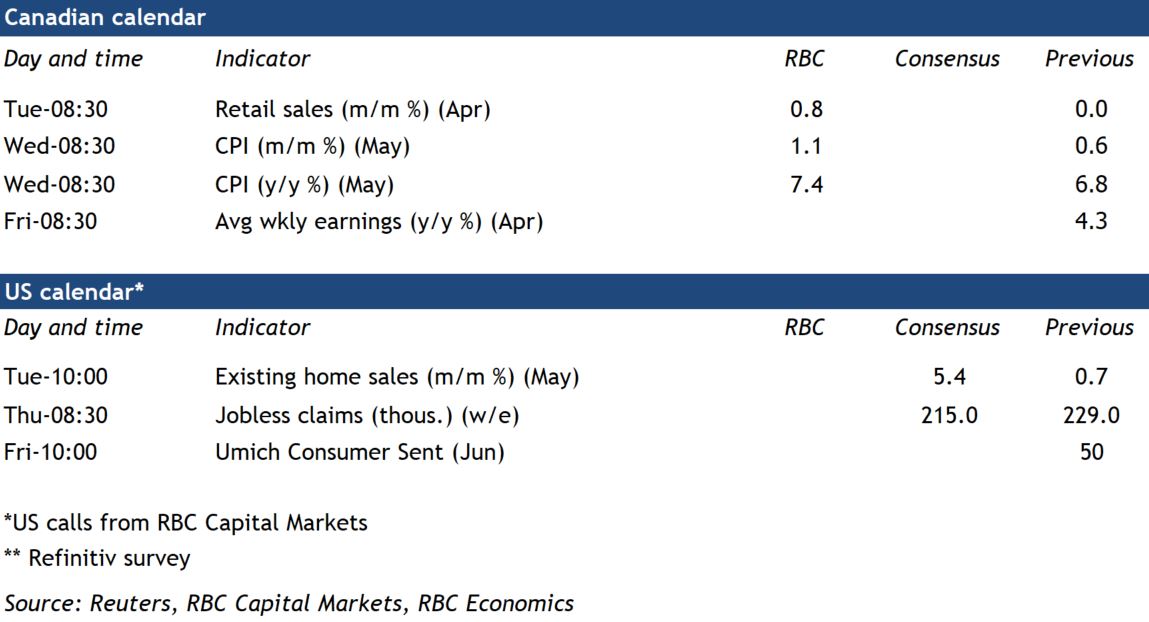
Canada’s May inflation report will be the main event next week—especially in the wake of a surprisingly large U.S. reading (8.6%) for the same month. We expect Canadian CPI to have jumped yet again, to 7.4% from 6.8% in April, driven mainly by surging prices at the pump and grocery bills. Pressure on energy and food prices in particular will persist as the war in Ukraine continues to raise agricultural and oil prices. But prices are rising across the board. Almost 60% of the CPI basket was growing faster than the top end of the Bank of Canada’s 1% to 3% target range as of April. These factors, together with the U.S. Fed’s large rate hike (75 bp) this week—raise the odds that the Bank of Canada will follow suit with their next policy decision in July.
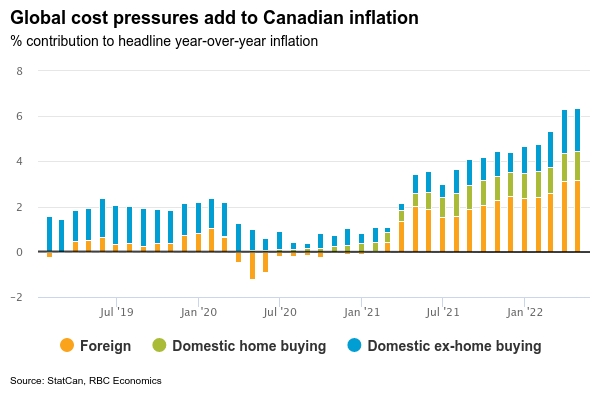
The pace and magnitude of future central bank rate hikes still depends heavily on inflation going forward. And roughly half of Canada’s current headline rate is driven by global rather than domestic cost pressures. That includes food and energy products that are directly tied to the war but also a portion of other goods purchases (like motor vehicles) that are being affected by global supply chain disruptions. Growth in domestic home buying related expenses has accounted for roughly 20% of headline inflation, and will start to slow in coming months as home resale markets cool . Higher interest rates are lifting mortgage interest costs, but not enough to offset the downward contribution from other shelter components in coming months, we expect. Supply chain constraints that have underpinned goods inflation over the pandemic have also shown early signs of easing, with ocean transport times and shipping costs dropping in recent weeks. Overall, we still expect global central banks to hike interest rates aggressively near-term to take the heat off consumer demand and bring inflation back closer to the target range.
Week ahead data watch:
- We don’t expect April’s Canadian retail sales to deviate from StatCan’s preliminary estimate for a 0.8% month over month increase. Sales likely ticked lower in May on lower auto purchases but remain elevated from levels pre-pandemic. Spending on services including travel have also continued to bounce back according to tracking of our own card spending data.
Fed George: 75bps hike adds to policy uncertainty
In a statement explaining her dissent to Fed's 75bps rate hike this week, Kansas City Fed President Esther George said, "I viewed that move as adding to policy uncertainty simultaneous with the start of balance sheet runoff."
"The speed with which we adjust the policy rate is important," she explained. "Policy changes affect the economy with a lag, and significant and abrupt changes can be unsettling to households and small businesses as they make necessary adjustments. It also has implications for the yield curve and traditional bank lending models, such as those prevalent among community banks."
Fed Kashkari supports another 75bps hike in Jul, and 50bps afterwards
Minneapolis Fed President Neel Kashkari said in an article, " I supported increasing the federal funds rate by 75 basis points at this week's meeting, and could support another such move in July". But he also warned to "too much more front-loading".
"A prudent strategy might be, after the July meeting, to simply continue with 50-basis-point hikes until inflation is well on its way down to 2 percent," he said. "Obviously, in such a scenario, the FOMC would still need to remain data-dependent and have the flexibility to account for economic developments that might arise."
Week Ahead – Flash PMI and Inflation Data in Focus after Mammoth Fed Rate Hike
Recession worries are mounting as central banks around the world step up their fight against soaring inflation. The flash PMI readings for June will be watched for any clues that tighter monetary policy is choking economic growth. In the meantime, inflation numbers in Canada, Japan and the United Kingdom could add yet more pressure on policymakers to do more. However, after hiking rates by the most in 28 years, Fed chief Jerome Powell could steal the limelight again in the coming week when he testifies before lawmakers.
June PMIs might worsen euro’s woes
A hawkish European Central Bank has been unable to come to the euro’s aid despite Eurozone government bond yields surging to multi-year highs. An even more hawkish Federal Reserve is keeping the bias in the dollar’s favour. But that’s not the only reason for the euro’s weakness. Investors are worried that the risk of a sharp economic downturn is greater in Europe where the spike in energy prices has been more pronounced than in America as the continent is more reliant on Russian oil and gas.
So far, Eurozone growth has held up relatively well, but the picture is deteriorating fast as the situation in Ukraine remains dire. With energy prices staying elevated and loose monetary conditions coming to an end, Thursday’s flash PMI reports are expected to point to a further moderation in business activity in June.
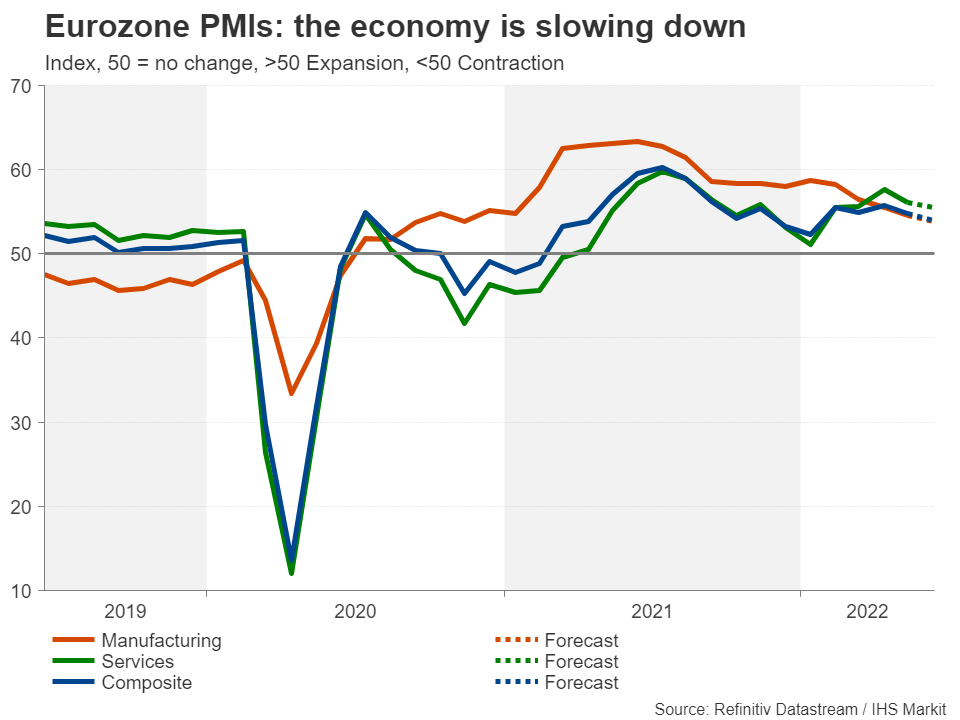
However, a lot of the pessimism has already been priced into the markets by now, so unless the PMIs are substantially lower than forecast, the euro might not necessarily suffer significant losses. Germany’s Ifo business climate index will follow on Friday.
Pound on recession alert amid a slew of UK data
Across the channel, the economic pain from the Ukraine conflict and supply chain problems is proving to be even more acute in the United Kingdom. Inflation is rampant, the government keeps stepping from one crisis into another, supply and labour shortages have been exacerbated by Brexit, and tensions between London and Brussels are simmering again over Northern Ireland.
It’s no wonder that businesses are feeling gloomy and the June PMIs due Thursday are expected to reflect the worsening climate. However, before that, all eyes will be on the latest consumer price index on Tuesday.
The UK’s headline inflation rate jumped to 9.0% y/y in April and is projected to have inched up to 9.1% in May – the highest among the major economies. The Bank of England raised interest rates by 25 basis points for the fifth consecutive meeting in June as it attempts to rein in spiralling prices. If CPI continues to rise rapidly, the BoE may have no choice but to switch to a more aggressive pace of tightening, threatening to push the economy into a full-blown recession.
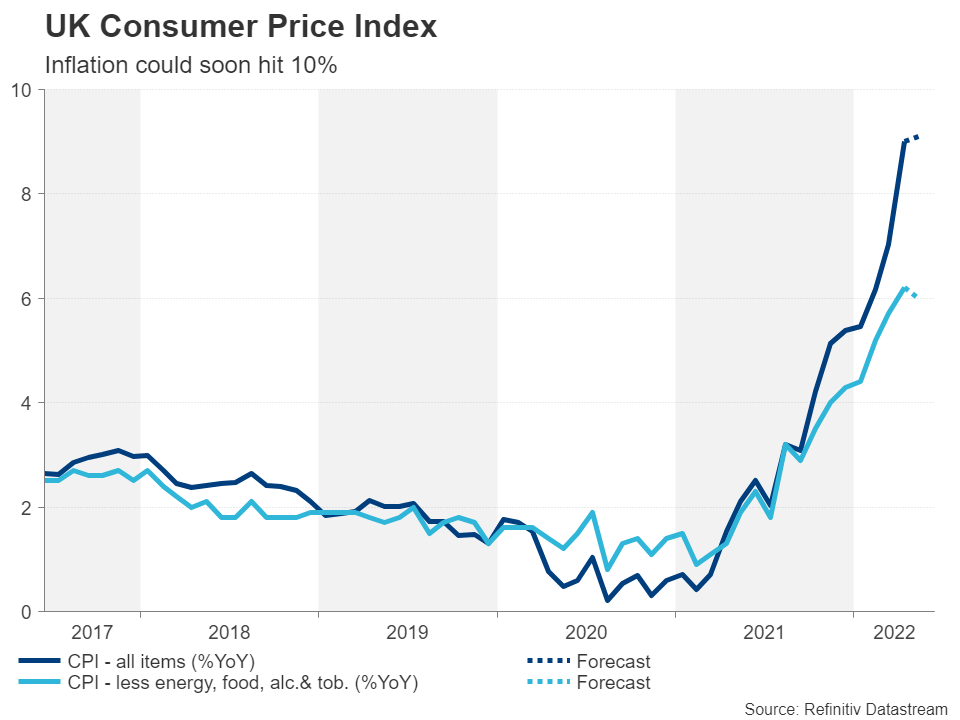
Many indicators already suggest UK GDP is headed for contraction in the second quarter. Retail sales figures out on Friday will be watched to gauge the strength of consumer spending in May.
Given the risks of stagflation, hot inflation numbers are unlikely to provide much support to sterling, but better-than-expected retail sales data might, as it would ease concerns about growth turning negative.
Canadian CPI could boost hawkish BoC bets
Inflation and retail sales will be the focal point for traders in Canada too. The Canadian economy is booming and is possibly in better shape than America’s. But that hasn’t stopped the Canadian dollar from coming under pressure against its US counterpart as the commodity-linked loonie is sensitive to risk sentiment.
Bank of Canada Governor Tiff Macklem hinted earlier this month that the central bank is open to hiking rates by 75-basis-point increments. And after the Fed did exactly that in this past week, the odds of the BoC doing the same at its next meeting have risen.
Tuesday’s retail sales report and Wednesday’s CPI readings will likely support the need for bigger rate hikes, while slightly disappointing numbers would probably not get in the way of policymakers stepping on the brakes much harder.
Aussie: one eye on RBA and another on China
Another risk-driven currency is the Australian dollar. Worries about a slowdown in China and elsewhere have partially offset the boost from higher commodity prices. Nevertheless, the aussie’s year-to-date losses are notably less than many of its peers’.
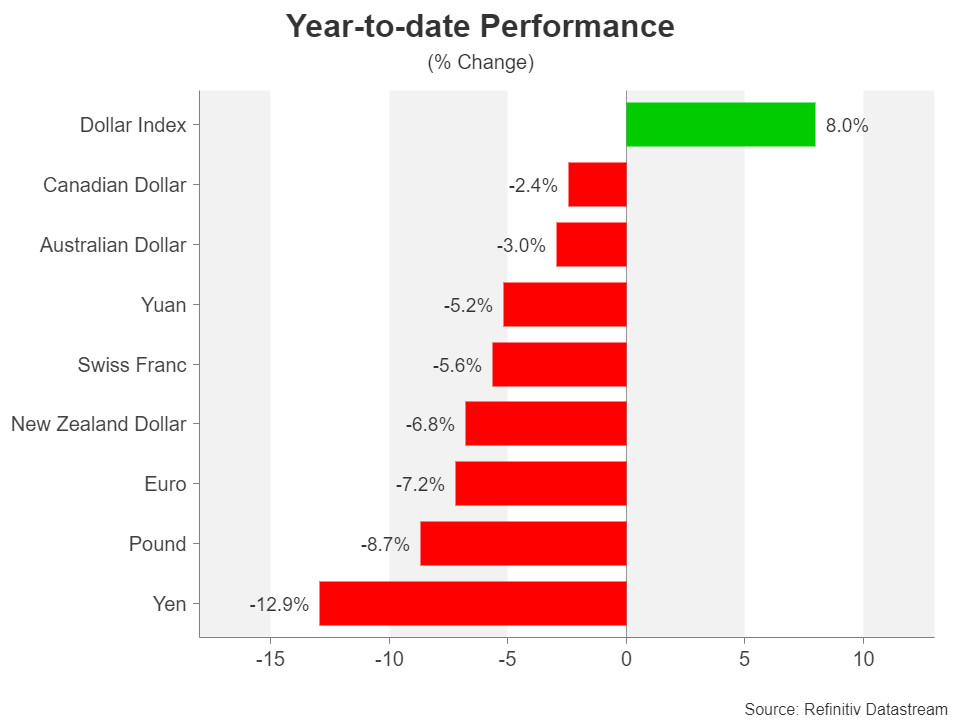
The Reserve Bank of Australia will publish the minutes of its last policy meeting on Tuesday. Any signs of a further hawkish shift could give the aussie a modest nudge up, though there could be some downside risks from Thursday’s flash PMIs.
Aussie traders will also be keeping an eye on the People’s Bank of China policy decision on Monday. There is some speculation that the prime rate will be cut for the second straight meeting. Such a move could lift sentiment at the start of the week’s trading.
No inflation joy for the yen
The Bank of Japan is now the only central bank not to join the global tightening race after the Swiss National Bank took markets by surprise and hiked its policy rate by 50 bps. However, it will likely be only a matter of time before the BoJ is forced to change course as well and begin withdrawing some of its massive stimulus.
The 10-year Japanese government bond yield has been stuck at the upper limit of the BoJ’s yield target while the yen has nosedived against the US dollar to 24-year lows. But the Bank of Japan is not budging as it wants the rise in inflation to be sustainable.
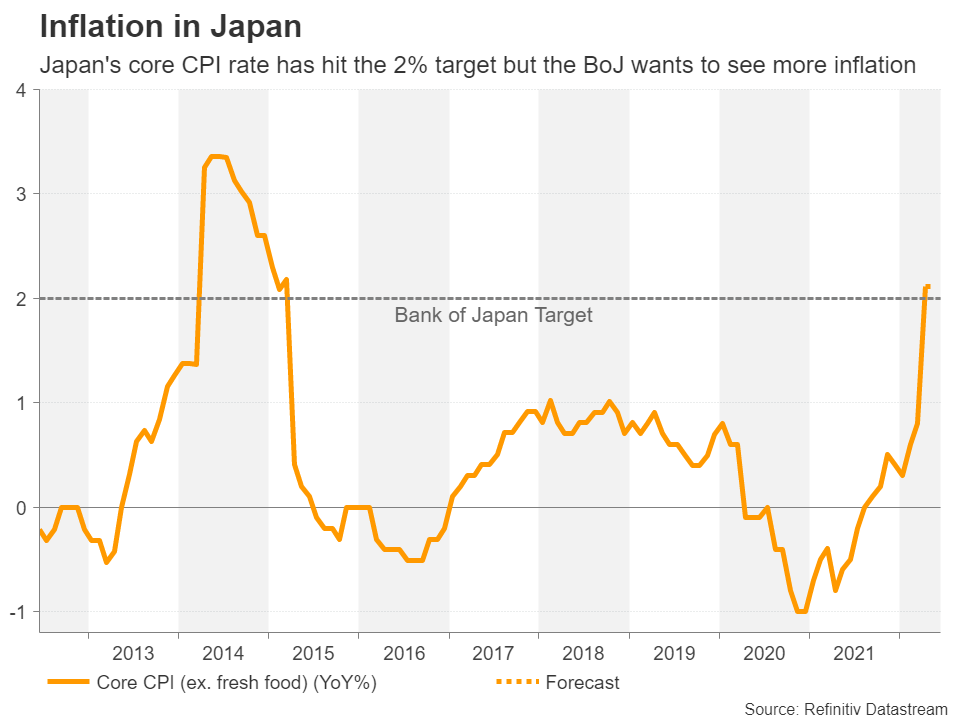
CPI data out on Friday is expected to show the core print holding steady just above the target in May at 2.1% y/y. But until the BoJ sees evidence that inflation is becoming broad based and is not driven solely by surging energy prices, the yen will probably continue to struggle.
In other data, the flash manufacturing PMI on Thursday will be important too.
Dollar to take cues from Powell’s testimony
It will be a relatively quieter week in the United States as the only key releases are existing home sales (Tuesday), manufacturing and services PMIs (Thursday), and new home sales (Friday). The PMIs by S&P Global do not tend to attract as much attention as the ISM ones but the flash estimates will be particularly crucial over the coming months as investors will want to get an earlier warning on possible recession risks.
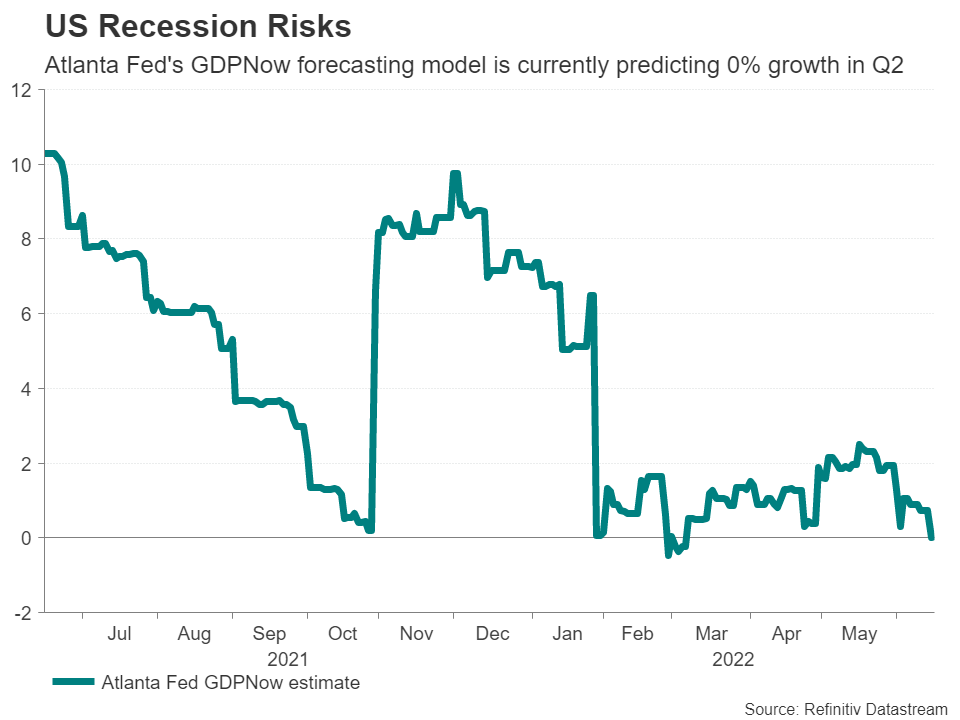
After the Fed hiked interest rates by 75 basis points, there is a heightened sense of anxiety about a hard landing in the world’s largest economy as the Fed battles to keep a lid on exploding prices. Chair Powell is not ruling out another 75-bps hike so his words will be scrutinized when he testifies before Congress on the Semi-Annual Monetary Policy Report.
The dollar rally could catch more fire if Powell reinforces his hawkish stance on the need to bring inflation down. On the other hand, Powell will likely be mindful not to stoke any more panic, so the greenback could pull back from its recent highs if he plays down the danger of the Fed tipping the economy into recession.
Weekly Focus – Another Week, Another Rise in Bond Yields
It has been an eventful week on the central bank front. The Fed delivered a historical 75bp hike to a target range of 1.5-1.75% and signalled that another 75bp hike in July is possible if there are no signs inflation pressures ease. It is striking that just one year ago, the Fed did not expect to deliver any hikes in 2022. And now we are looking at the steepest hiking cycle since the 1980's. We look for another 75bp in July as we see no sign that inflation pressure is easing in the short term. We expect it to be followed by 50bp hikes in September, November and December to take the Fed funds rate to 3.75-4.00% by year-end, which is 25bp higher than current market pricing.
Since the 75bp hike was already signalled on Monday, the market reaction was quite muted. Initially yields dropped but on Thursday they rebounded again with the US 10-year yield trading close to 3.5%. German yields increased yet again to a new cycle high at 1.83%, partly lifted by a 'hawkish' 25bp hike by Bank of England, and a surprise 50bp hike by the Swiss central bank SNB. Equity markets also moved lower again on concerns that the aggressive rate hikes can trigger a deeper recession than already priced.
The ECB held an extraordinary meeting on Wednesday to discuss 'fragmentation' on the back of the recent sharp widening of the 10-year Italy-Germany bond yields spread, which had increased from 100bp in September last year to 240bp early this week. With the end of ECB's purchasing programmes investors have less confidence in holding Italian bonds setting off a negative spiral. In the meeting statement, the ECB said it would a) use flexibility in reinvesting redemptions in ECB's portfolio and b) accelerate the design of a new anti-fragmentation instrument for consideration by the Governing Council. The 10-year Italy-Germany spread has narrowed to 205bp in response. Whether the improvement will last will ultimately, depend on the details of the new instrument once it is ready.
On the data front, US data disappointed again. US retail sales was weaker than expected with total sales declining 0.3% m/m (corresponding to a real decline of 1.3% m/m due to the high inflation). Housing starts dropped 14.4% m/m in May and the Philadelphia Fed business outlook declined to the lowest level in two years. In the euro area, the German ZEW increased to -28 from -34.3 but is still at quite low level. China saw a new small covid outbreak in Beijing but seems to have it under control. Shanghai is going to test the whole city every weekend until end-July in order to catch outbreaks as early as possible and use more targeted lockdowns in order to avoid city-wide lockdowns. Chinese data on industrial production and retail sales showed a small rebound in May and they will likely recover further in June and July due to a re-opening effect and more forceful stimulus.
Looking into next week, we have a fairly light calendar with Flash PMI's in the US and euro area as well as German ifo business confidence being the most interesting. We look for a further decline due to the strong financial headwinds currently. Fed chairman Jerome Powell will deliver the semi-annual testimony in Congress but we doubt it will provide much news. On the political front EU leaders will meet for a summit on Thursday and Friday to discuss Ukraine's EU membership application, and economic issues. On Sunday France goes to the polls for the second round in the parliamentary election.
Sunset Market Commentary
Markets
It has been quite the roller coaster ride the past week. Sometimes it takes months to get to the same number of huge, surprising, market-moving events. From the ECB’s firm commitment to hike policy rates by 25 bps in July and likely accelerate to 50 bps from September, over the renewed US inflation acceleration which prompted a last-minute 75 bps Fed rate hike to the Swiss National Bank’s 50 bps rate hike shocker which leaves ECB policy rate as the lowest in town. Not to mention the Bank of England’s fifth consecutive 25 bps rate hike which will likely morph into a 50 bps rate hike path from August onwards or the Hungarian National Bank’s silent retreat in letting the base rate prime again over the 1-week depo rate (lifted by 50 bps yesterday to defend the forint around EUR/HUF 400). The icing on the cake would have been a U-turn by the Bank of Japan this morning, but governor Kuroda and his colleagues remain the sole defenders of an ultra-easy monetary policy setting for now. Even Japanese inflation is on the rise though, proving that Kuroda’s Peter Pan approach to central banking is working: “the moment you doubt whether you can fly, you cease forever to be able to do it”. The BoJ’s verbal interventions against JPY, together with the Ministry of Finance, only work against them. USD/JPY is on course to revisit the cycle high at 135. Put your money where your mouth is.
This week’s core bond sell-off smells like a short term exhaustion move with markets now discounting aggressive tightening cycles. Especially in the US, but also in Europe. We argue in favour of a consolidation period with next inflation numbers at least a fortnight away and central bank meetings out of the way. Economic activity can in the mean time bring the growth/inflation dilemma back to the fore. In such context, we think that stock markets will have a tough time to recover some of this week’s heavy losses. Medium term, we hold our view that both core bonds and stocks are in a sell-on-upticks pattern. It could take the sting out of the peripheral spread widening as well together with the ECB’s promise to come up with some back-up bond buying programme to avoid an unwarranted market fragmentation amongst EMU sovereigns. The dollar set a new multiyear high on a trade-weighted basis, north of 105, but couldn’t hold onto gains. If our consolidation scenario turns out right, we could be up for some sideways dollar trading as well. For DXY, we’re looking at a range between roughly 101.50 and 105.50. For EUR/USD – which didn’t set a new recovery low by the way – that’s 1.0350 to 1.08. EUR/GBP yesterday attempted to escape the upward trend channel in place since mid-April, but failed. We hold our sterling-negative bias longer term.
News Headlines
Polish CPI excluding food and energy prices rose 1.0% M/M to be up 8.5% Y/Y. This compares to 1.7% M/M and 7.7% Y/Y in April. The figure was close to expectations. The series excluding the most volatile prices (1.3% M/M and 10.4% Y/Y) and the measures excluding administered prices (1.9% M/M and 14.0% Y/Y) still printed substantially higher. Earlier this month, the Polish Statistical office already reported the headline inflation at 1.7% and 13.9%. The NBP has an inflation target of 2.5% with a tolerance band of +/- 1.0%. After the June 8 policy meeting, NBP governor Glapinski suggested that the NBP might be coming closer to the end of the rate hike cycle. However, other MPC members indicated that it is probably too early. Money market rates still see room for the Polish policy rate to be raised toward the 8% area (from 6% currently). The zloty regained modest ground today (EUR/PLN 4.70).
The European Commission today recommended that Ukraine and Moldova can become candidate to join the EU. The move still is only a first step in a long procedure that will take years as the countries will have to work to comply with a long list of EU regulation. To formally become a candidate, both countries also need unanimous approval from all the member countries at next week’s EU summit. With respect to the candidacy of Georgia, the Commission said that the country still should make further reforms to be ready to receive the same status.
EUR/USD Mid-Day Outlook
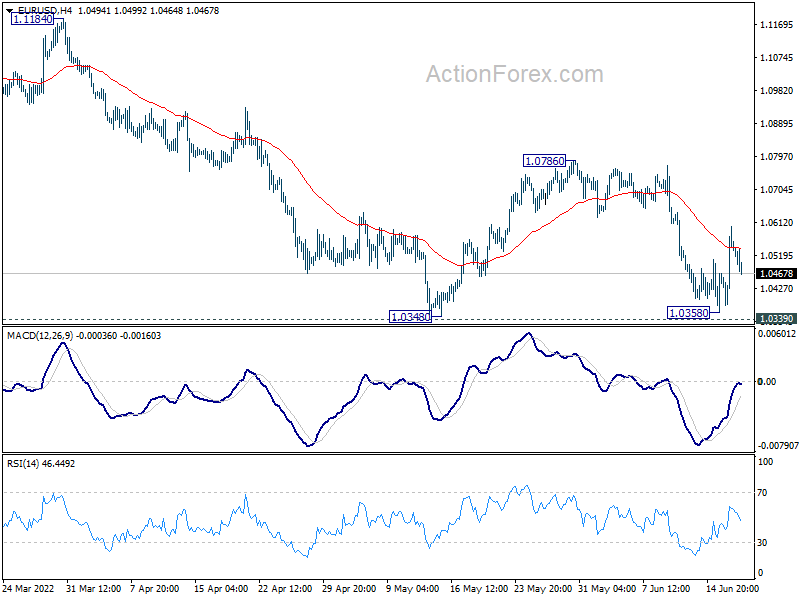
Daily Pivots: (S1) 1.0422; (P) 1.0511 (R1) 1.0642; More...
Intraday bias in EUR/USD remains neutral for the moment. Outlook will stay bearish as long as 1.0786 resistance holds. Sustained break of 1.0339/48 will resume larger down trend. Next target is long term projection level at 1.0090..
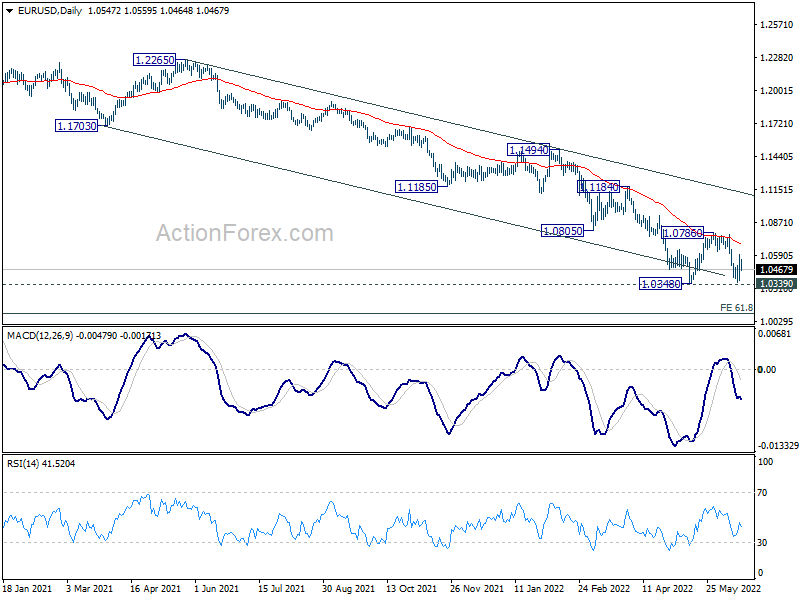
In the bigger picture, focus stays on 1.0339 long term support (2017 low). Decisive break there will resume whole down trend from 1.6039 (2008 high). Next target is 61.8% projection of 1.3993 to 1.0339 from 1.2348 at 1.0090. However, firm break of 1.0805 support turned resistance will delay this bearish case, and bring stronger rebound first.
GBP/USD Mid-Day Outlook
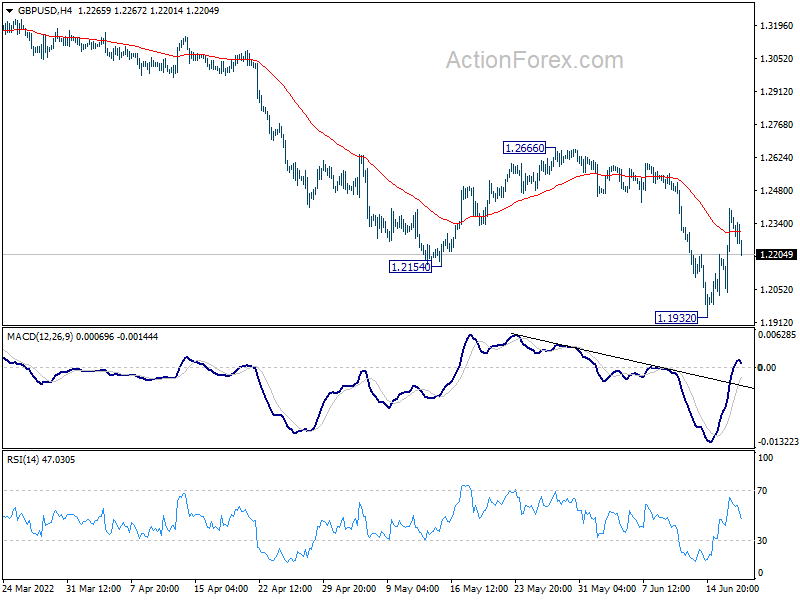
Daily Pivots: (S1) 1.2126; (P) 1.2266; (R1) 1.2491; More...
Range trading continues in GBP/USD and intraday bias remains neutral. Outlook stays bearish with 1.2666 resistance intact. On the downside, break of 1.1932 will resume larger down trend from 1.4248. However, firm break of 1.2666 will suggest medium term bottoming and bring stronger rebound back towards 1.3158 support turned resistance.
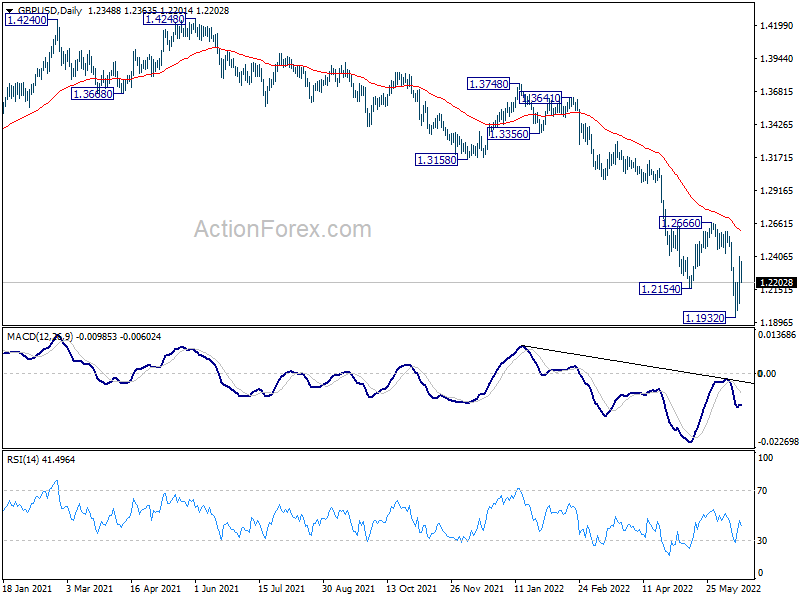
In the bigger picture, fall from 1.4248 (2018 high) could be a leg inside the pattern from 1.1409 (2020 low), or resuming the longer term down trend. Deeper decline is expected as long as 1.2666 resistance holds. Next target is 1.1409 low. However, firm break of 1.2666 will bring stronger rise back to 55 week EMA (now at 1.3175).
USD/CHF Mid-Day Outlook
Daily Pivots: (S1) 0.9535; (P) 0.9762; (R1) 0.9894; More...
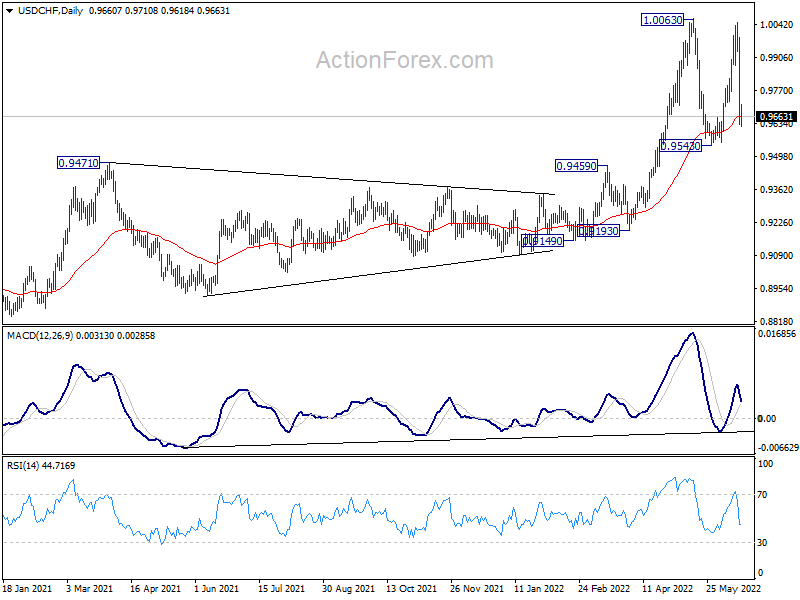
Intraday bias in USD/CHF remains on the downside and deeper decline could be seen to 0.9543 support. It's viewed as the third leg of the corrective pattern from 1.0063. Strong support should be seen at around 0.9543 to contain downside to bring rebound. On the upside, above 0.9815 minor resistance will turn bias back to the upside for retesting 1.0063 resistance.
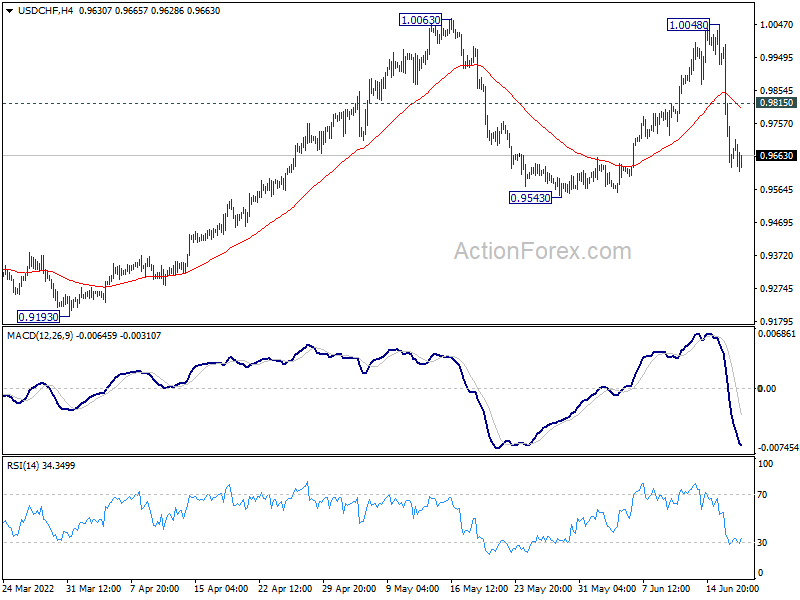
In the bigger picture, down trend from 1.0342 (2016 high) should have completed with three waves down to 0.8756 (2021 low) already. Rise from 0.8756 is likely a medium term up trend of its own. Next target is 1.0237/0342 resistance zone. This will remain the favored case as long as 0.9471 resistance turned support holds. However, sustained break of 0.9471 will extend long term range trading with another falling leg.