

Sample Category Title
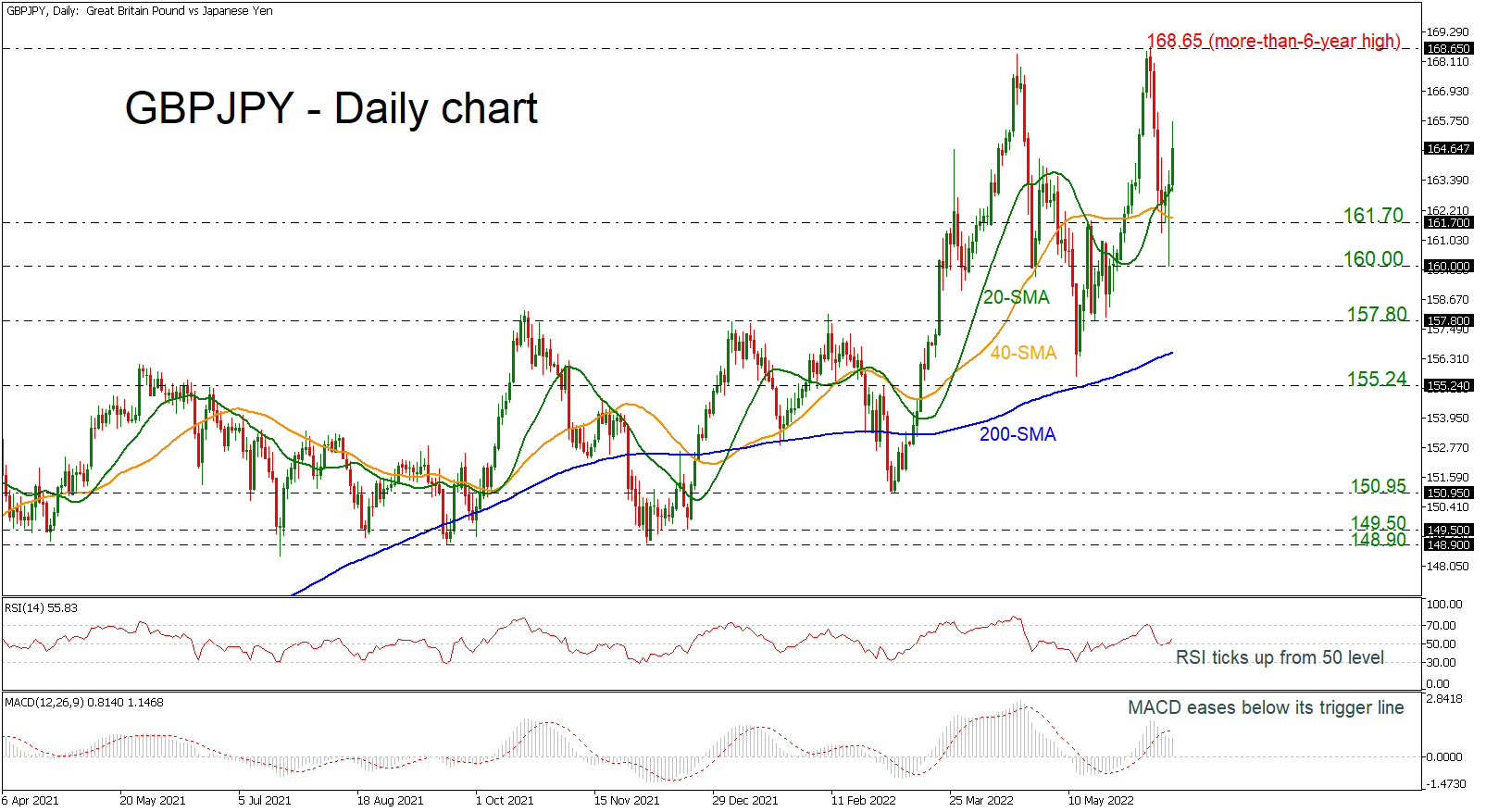
GBPJPY Advances Following Bounce Off 160.00
GBPJPY has been overperforming over the last few sessions after the rebound off the 160.00 psychological level. The RSI indicator is heading north above the neutral threshold of 50, while the MACD oscillator is falling below its trigger line in the positive region. In trend indicators, the 20- and 40-day simple moving averages (SMAs) posted a bullish crossover, confirming the recent bullish bias.
Should buyers drive towards the more-than-six-year high of 168.65 and jump above it, they could encounter initial strengthened resistance from the 175.00 round number, registered in April 2015.
Otherwise, if sellers take control, initial support could come from the 20-day SMA at 163.10 ahead of the 161.70 support and the 160.00 barrier underneath. Diving further, immediate limitations may arise from the 200-day SMA at 156.50.
All in all, the very short-term timeframe sustains the bullish mode for now. Also, a break above the more-than-six-year high could endorse the long-term positive outlook.
Elliott Wave Analysis: USD/JPY Back to the Highs
US stocks came down, this time with the USD as US yields found some resistance. But the main theme at the moment is JPY, which some sharp sell-off across the board following the latest BoJ policy remarks. »The bank will support financing, mainly of firms, and maintain stability in financial markets, and will not hesitate to take additional easing measures if necessary; it also expects short- and long-term policy interest rates to remain at their present or lower levels«. That sounds very dovish, so CB policy divergence between US and Japan is causing another bounce on USDJPY. We see nice intraday bounce that can take pair back to the highs, into wave five towards 136.50/137.00. Keep in mind that after every five waves market can slow down again, for another correction.

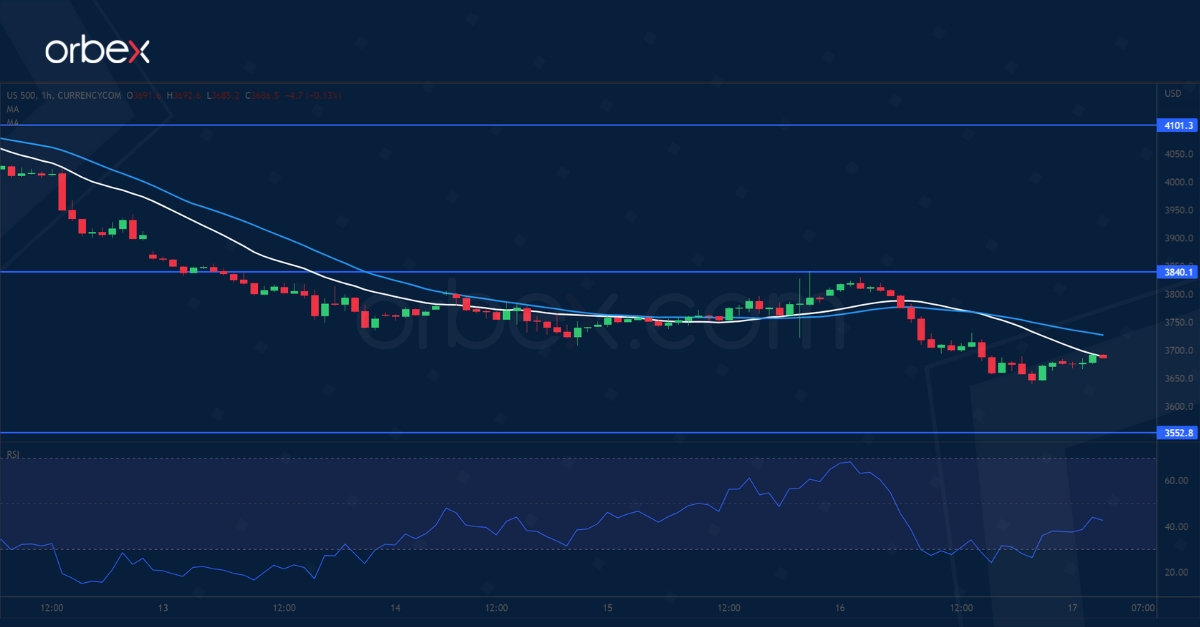
S&P 500 Falls into Bearish Trend
The S&P 500 struggles as the FOMC anticipates an economic downturn. A fall below the daily support at 3840 which has turned into a resistance might confirm the bear market. Sellers would continue to fade rebounds as sentiment deteriorates. The RSI’s dip into the oversold area may prompt some short-term sellers to cover. But unless the buy side manages to lift offers around 3840, the index could be vulnerable to a new round of sell-off. 3550 from November 2020 would be the next target.
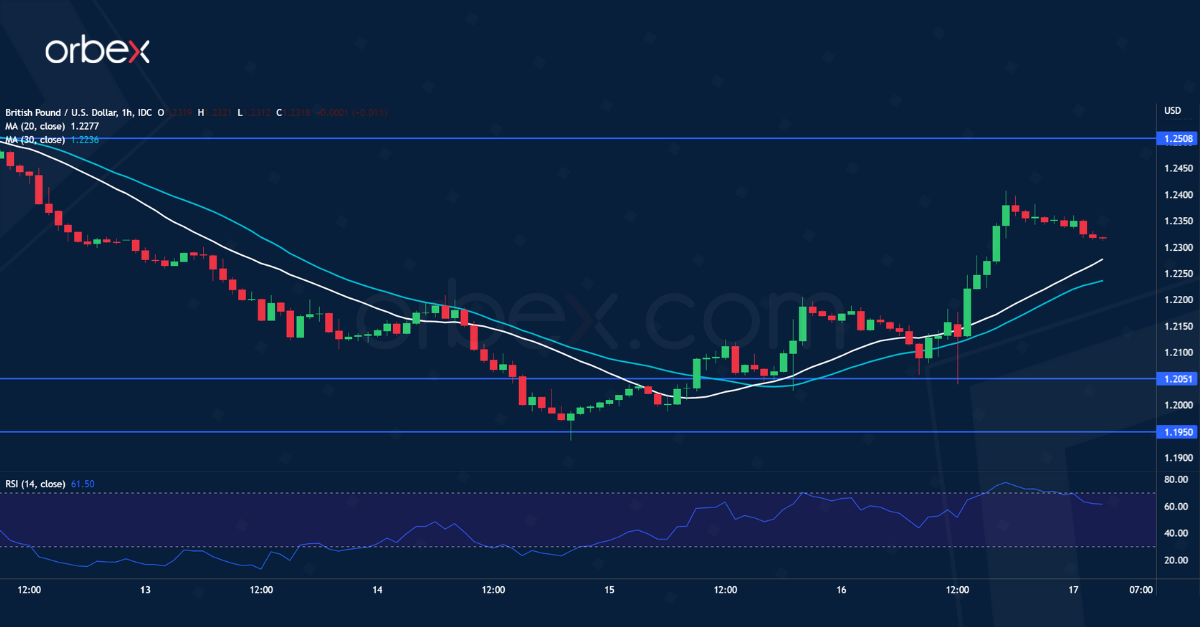
GBP/USD Attempts to Rebound
The pound rallied after the BoE raised its interest rates to 1.25%. A surge above 1.2200 has forced sellers to cover their positions, paving the way for a sharp rebound. A combination of profit-taking and momentum buying is propelling Sterling to the supply zone around 1.2500. Strong selling pressure could be expected though as the medium-term trend remains bearish. An overbought RSI may trigger a limited pullback as intraday traders take profit. 1.2050 at the origin of the rally is major support should this happen.
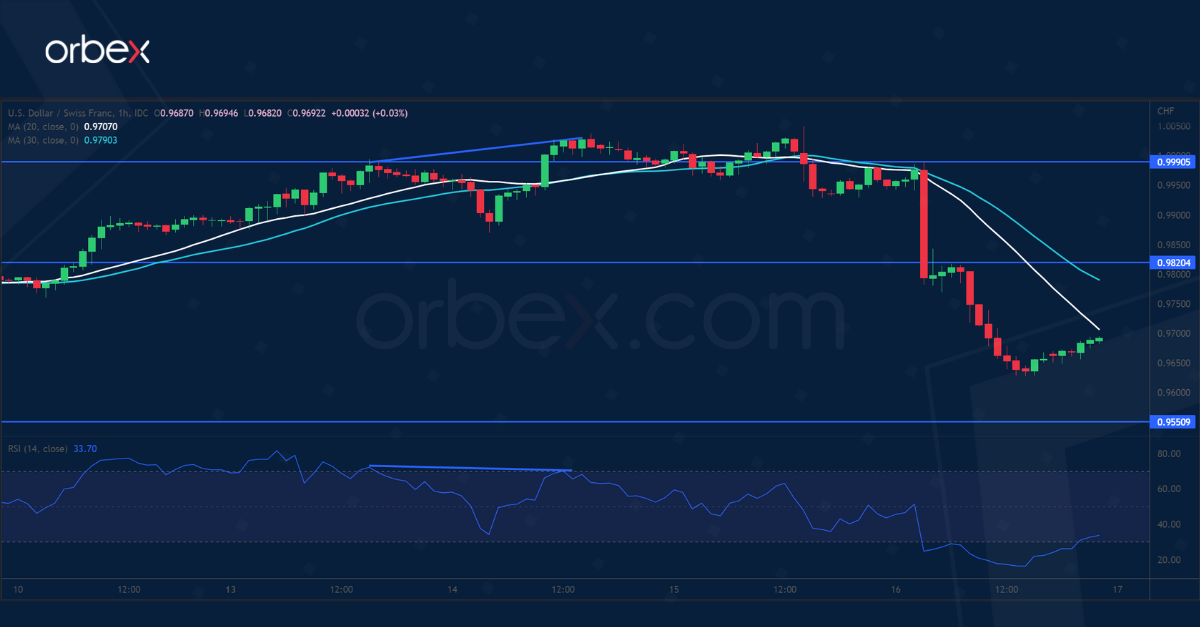
USD/CHF Breaks Support
The Swiss franc soared after the SNB delivered a surprise 50-basis-point rate hike. The dollar came to a halt at May’s peak at 1.0050. A bearish divergence indicated a slowdown in the upward momentum. Then a fall below the base of the latest rebound at 0.9880 acted as a confirmation of a correction. Heightened volatility suggests that short-term buyers have bailed out and a break below 0.9780 further weighs on sentiment. 0.9550 is a critical floor to keep June’s rally intact. The bulls need to clear 0.9820 first to ease the pressure.
Dow Jones and Nasdaq 100 Slip as Fear of Recession Jumps
The US dollar index rose as volatility jumped sharply following the interest rate decision by the Federal Reserve. The Fed delivered its biggest rate hike since 1994 and hinted that it will continue hiking interest rates in a bid to deal with inflation. Still, there are signs that the hawkish Fed could backfire. For example, data published on Thursday showed that the country’s initial jobless claims rose by 229k in the previous week. At the same time, building permits declined by 7% in May after falling by 3% in April. Housing starts declined by a whopping 14.4% in May after rising by 5% in the previous month.
American equities dropped sharply as investors reacted to the interest rate decision by the Fed and the rising cost of doing business. The Dow Jones dropped by 800 points while the tech-heavy Nasdaq 100 index declined by over 500 points. They declined sharply after mortgage rates rose to the highest levels in over 13 years. At the same time, Tesla announced that it was hiking prices because of surging costs. Prices of some car models will rise by as much as $6000. Other companies are expected to see smaller margins because of the rising cost of doing business.
The economic calendar will be muted on Friday. The most important data to watch will be the headline consumer price index (CPI) data. Based on the recent estimate, analysts expect the data to show that the bloc’s headline CPI rose to 8.1% in May while the core CPI rose to 3.8%. This inflation is expected to keep rising in the coming months because of the soaring cost of oil and gas. Other important data will be the latest industrial inflation numbers from Canada. Jerome Powell will deliver his first statement after the rate hike while the US will publish the latest industrial and manufacturing production data.
EURUSD
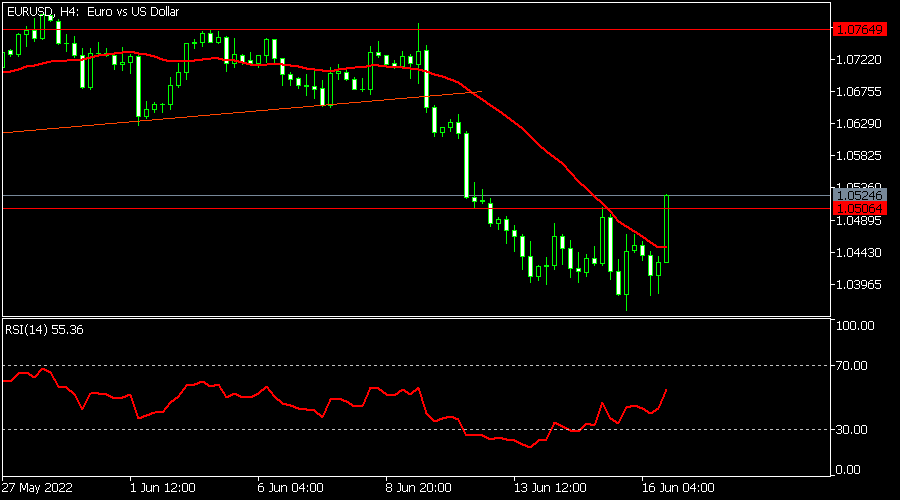
The EURUSD pair rose sharply ahead of the upcoming EU inflation data. It rose to a high of 1.0522, which was the highest level since June 13. The pair managed to move above the important resistance level at 1.0500. It has moved above the 25-day and 50-day moving averages while the RSI moved above the oversold level. In the long-term, the pair has formed an inverted cup and handle pattern, signaling that it will resume the downward trend.
USDCHF
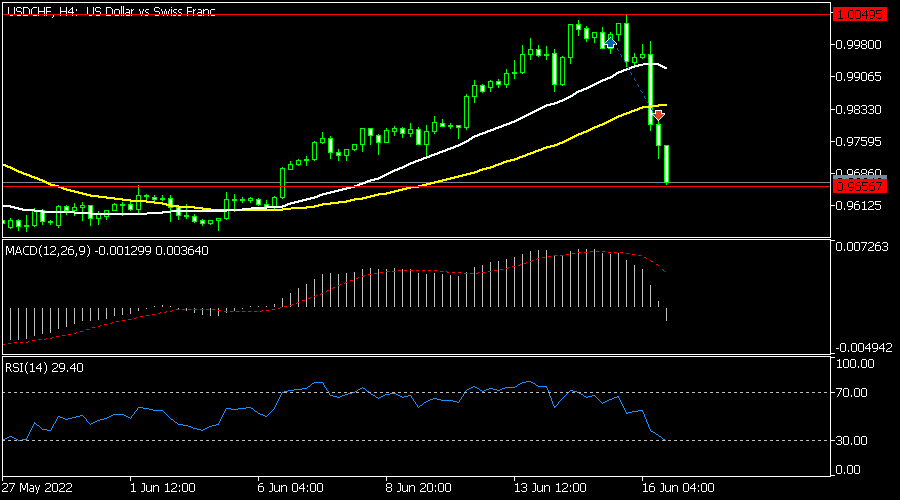
The USDCHF pair crashed hard after the surprise rate hike by the Swiss National Bank (SNB). The pair dropped to the important support level at 0.9645, which was the highest point on June 2. As it dropped, the pair invalidated the cup and handle pattern. The MACD and the Relative Strength Index (RSI) have been falling. The pair will likely have a relief rally on Friday.
USDCAD
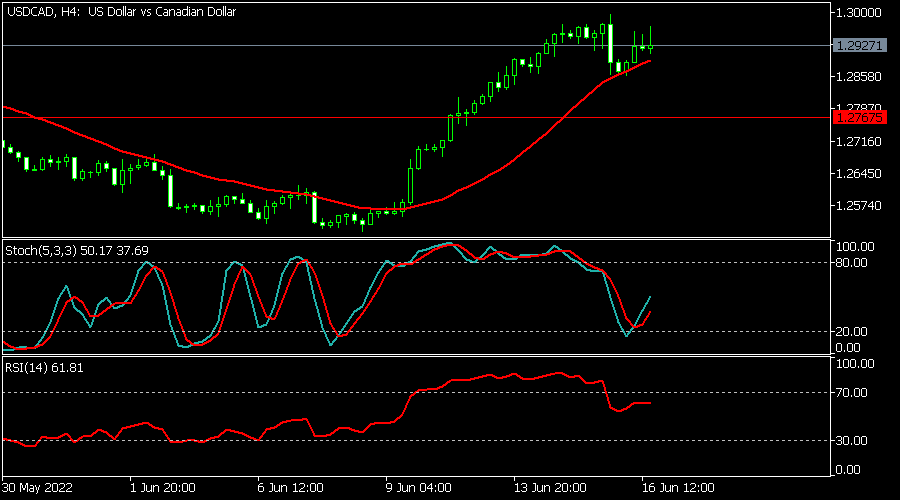
The USDCAD pair rose slightly as the US dollar strengthened. The pair is trading at 1.2927, which is slightly below this week’s high. The pair remains above the 25-day moving average while the Relative Strength Index (RSI) moved slightly below the overbought level. The Stochastic Oscillator moved slightly upwards. Therefore, the pair will likely keep rising as bulls target the key resistance at 1.300.
Daily Technical Analysis
EUR/USD
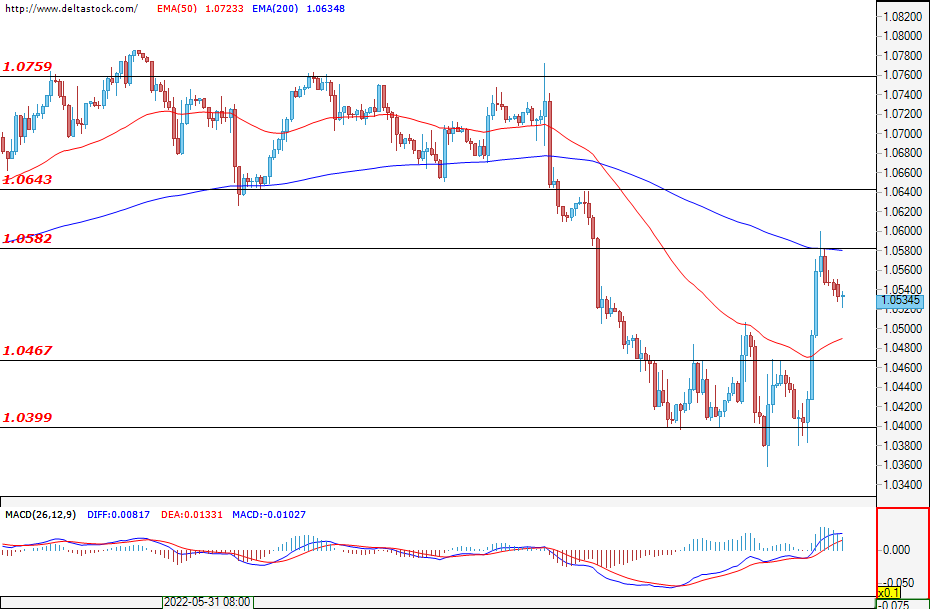
The euro ended the day deep in the green and managed to maintain momentum after the Fed's meeting earlier this week. The support at around 1.0400 once again managed to limit the declines, and the subsequent rally reached the resistance at around 1.0580. This is the first resistance for the day, and if the mood remains unchanged, then a breach and a test of the next zone at 1.0640 can be expected. Looking from the higher time frames, double-bottom formation can be expected at 1.0400, but in order to complete the configuration, we would first have to see a breach of the range above 1.0760. The general trend is still negative, and despite the bullish sentiment, the reversal has not yet been confirmed. The rally may be caused by speculative bets on the forthcoming interest rate increase by the ECB. If this scenario rings true, then the rally’s long-term targets could become 1.0760 and 1.1500. The main support zones remain 1.0460, 1.4000 and the annual support at 1.0350. Today, an increase in activity can be expected around the announcement of the CPI data for the euro area at 09:00 GMT and the statement of Fed chairman Jerome Powell at 12:45 GMT.
USD/JPY
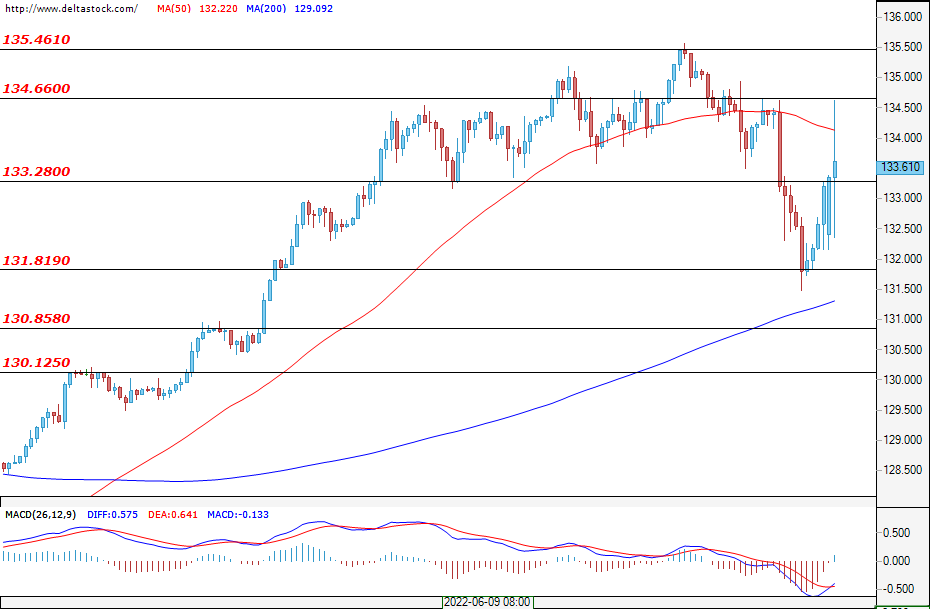
Following the decision of the Central Bank of Japan to keep its monetary policy and interest rates unchanged, the yen marked a new decline against the dollar. Prices are again moving in the range between the support at 133.28 and the resistance at 134.66. Market panic is expected to continue and the stress of bond markets is to be transferred to the yen. The resistance at 135.46 comes from a 20-year high and so a possible breakout may take a while. If it gets violated in spite of that, then the next zone is the distant level of 146.00. First supports for the bulls are 133.28 and yesterday's bottom at 131.81.
GBP/USD
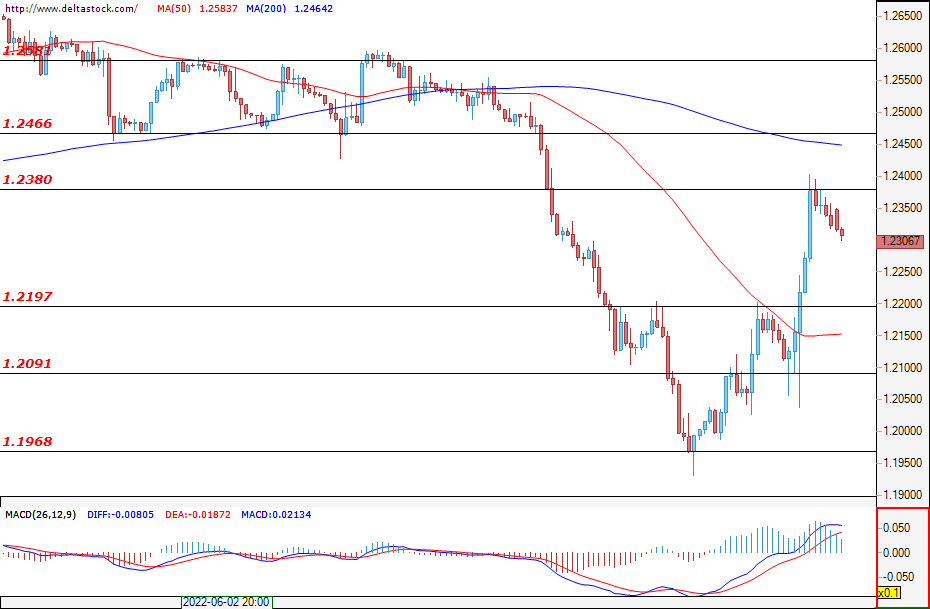
The sterling also booked some nice gains in the past session. The initial declines after the BoE raised its interest rates were quickly erased and the pair continued its rally until the end of the session. The bulls reached the resistance at 1.2380, and in the early hours of today, the market entered a pullback phase. The first support buyers can expect at about 1.2200. The downward trend is not over yet, and while prices remain below 1.2466, any bullish impulses may prove to be unsustainable. To change the market mood, the Cable would need to score new gains, otherwise a new drop towards 1.2000 or range-bound trading is the more likely scenario. When analysing the higher time frames it becomes clear that, although the bulls still have a chance to spark a more substantial rally, they would first need to defend the annual support at 1.1933.
EUGERMANY40
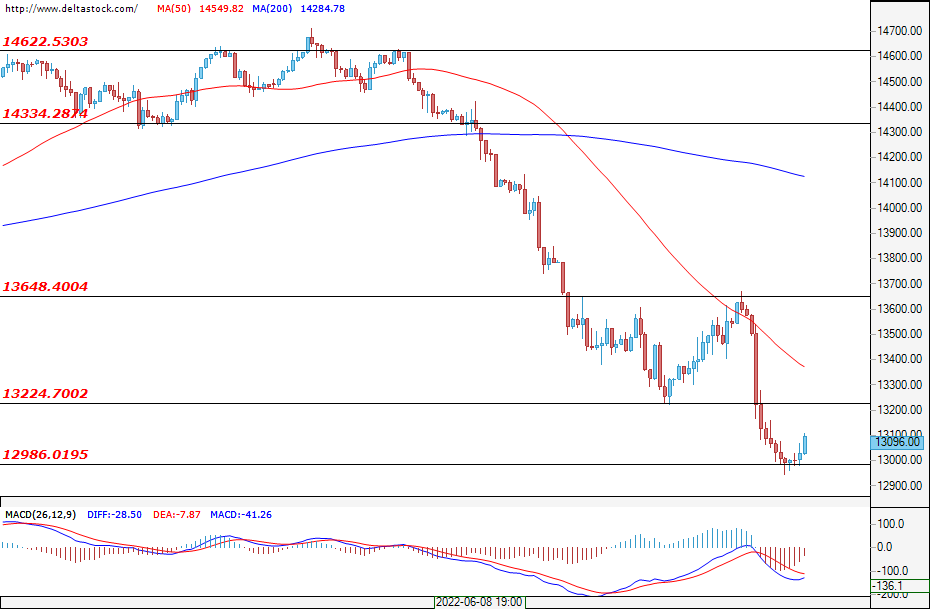
The strong sell-off waves tanked most of the global exchanges and the German index was not spared either. The blue chips lost more than 500 points, and the mood was further soured by the rise of the SNB interest rates and the news of asset sell-offs. In the early hours of today, prices rose after the BoJ announced that the country's monetary policy remains unchanged. The first resistance is found at around 13224, and the other significant one is the distant level of 13650. If this negative trend continues, then there is a risk of the index reaching its low of 12470 from March this year. Expectations remain negative, and any pullbacks would likely be limited by the current resistance zones and therefore be short-lived.
US30
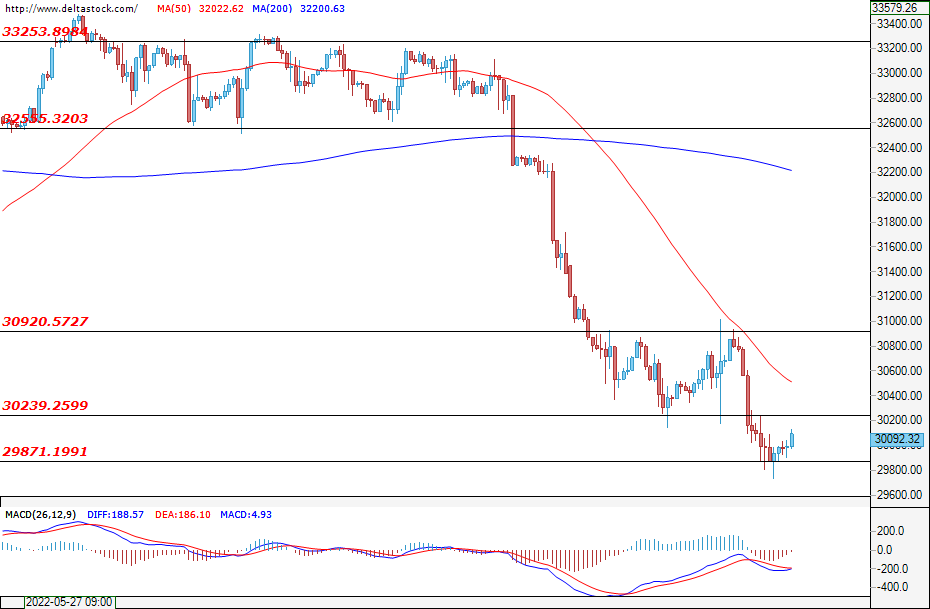
The U.S. equities also fell sharply, and the US30 ended the session below the psychological level of 30000. The declines are expected to continue and the markets are already pricing in the risks of a recession. Possible supports buyers can expect at about 29800 and 29360, with the first resistances currently being 30240 and 30920. Today, increased activity can be expected around the statement of Fed chairman Jerome Powell at 12:45 GMT.
Looking for ABE
The post-FOMC rally ran in equities out of steam within 24 hours with Wall Street plummeting overnight once again. Even the most ardent FOMO gnome had a conviction crisis as a swath of central banks followed the Fed’s lead and hiked policy rates. Taiwan hiked 12.50 bps, the Bank of England hiked 25 bps and the Swiss National Bank shocked markets, hiking policy rates by 50 bps.
It was probably the SNB that broke the camel's back because if the Swiss are worried about inflation, we all should be. Stock markets went looking for ABE (anything but stocks), and it looks like a US 10-year yield approaching 3.50% yesterday was just too tempting. US bonds saw some impressive ranges and as money poured into the US curve, the 10-year fell from near 3.50% to close around 3.25%.
That set of a negative feedback loop in the US Dollar which suffered heavy losses overnight. They were led by a post-SNB rally by the Swiss Franc, which spilt over into Euro and Sterling strength as well, helped along by the BOE hike. EUR/USD rallied by 1.0% and probably would have had an even better day if EUR/CHF wasn’t getting simultaneously crushed. Falling US yields also eroded US Dollar strength as did a huge rally of the Japanese Yen.
With hiking policy rates this season's new black for the world’s central banks, offshore markets moved to rapidly price in that the Bank of Japan would raise the 0.25% yield cap on 10-year JGBs at this morning's policy meeting. USD/JPY fell by just over 1.0% overnight helped along by falling US yields as well. Japanese markets are having none of it though, with USD/JPY rising by 0.80% already today to 133.25.
One side or the other is seriously wrong. We will know which sometime after 1100 SGT today. As a hint, the longer that no noise emerges from BOJ HQ after 1100SGT, the more likely it is we are going to get a surprise, from my experience. We should get a binary outcome once again from the decision. If the BOJ makes no changes and reiterates its commitment to a super-easy policy, USD/JPY will likely be trading on a 135.00 handle by Monday. If they do raise the cap, the correction lower by USD/JPY should continue, possibly in a quite disorderly manner. And I suspect 130.00 or lower wouldn’t be out of the question. You’ve got to love Fridays.
Gold also rallied overnight, but that was because the US Dollar fell, with the inverse correlation as strong as ever. The Yen gains overnight boosted Asian currencies although the KRW, THB, TWD, and CNH are moving lower with the Yen this morning as well. Oil held steady overnight despite probing the downside, no amount of noise elsewhere changes the fact the world doesn’t have enough of it or that refineries can’t refine enough of it. The underachiever overnight was the crypto space. Bitcoin ran into buyers again ahead of $20,000.00 overnight but remains uncomfortably close to the danger zone at $20.700.00 this morning. The weekend session promises to be emotional.
My overall take on the state of play for markets at the moment is that even the most ardent buy-the-dipper in the equity space is starting to realise inflation is a threat, with central bank banks prepared to hike the world into a slowdown and possible recession to get on top of it. A recession isn’t good news for pimped-up valuations either. The street is looking for anything but equities into the end of the week, and tasty government bond yields seem to be the preferred home.
In other data recently, US Housing Starts and Building Permits in May slumped from April. We can draw a line straight to rocketing mortgage rates on that one and the US won’t be the last to feel housing market pain. Singapore Non-Oil Exports (NODX), surprised to the upside today, rising by 12.40% YoY in May, boosted by electronics. That will be a welcome offset for slowing domestic consumption but unless China really reopens, will start to fade in the coming months.
We have the Bank of Japan meeting shortly, Eurozone Inflation this afternoon, and US Industrial Production and Manufacturing this evening. Federal Reserve Chairman Jerome Powell is also speaking at 2045 SGT. And apart from testing every resident of Shanghai for covid-19 this weekend, China releases its 1-year and 5-year Loan Prime Rates on Monday. Cryptos may generate some headlines this weekend as well if Bitcoin breaks $20,000.00.
Finally, there are apparently $3.40 trillion of options expiries on listed US equity markets today where liquidity may be reduced ahead of a US holiday on Monday. That may distort price action on Wall Street this evening. Tonight’s session could be a good one to avoid.
Asian equities follow Wall Street lower
Wall Streets' post-FOMC rally ended after less than 24 hours as a plethora of central banks from around the world followed the Fed’s lead and hiked interest rates. The S&P 500 closed 3.24% lower, the Nasdaq slumped by 4.08%, and the Dow Jones fell by 2.37%. In Asia, US futures have rallied on some short covering with S&P 500 futures rising 0.60%, Nasdaq futures gaining 0.90%, and Dow futures have added 0.40%.
The rally in US futures today has taken the edge off the bearishness in Asia, most of the region is in the red. Japan’s Nikkei 225 has fallen by 2.0%, with South Korea’s Kospi down 1.25%. In Mainland China though, markets have once again mysteriously and abruptly reversed early losses, suggesting China’s “national team” is around. The Shanghai Composite is now unchanged for the day, while the CSI 300 is now 0.25% higher, and Hong Kong has risen by 0.35%.
In regional markets, Singapore is unchanged, while Taipei has lost 1.30%. Kuala Lumpur has fallen by 1.35%, with Bangkok down 0.30%, Jakarta slumping 1.70%, and Manila retreating 1.50%. Australian markets have remained laser-focused on Wall Street’s main session and are deeply in the red. The ASX 200 and All Ordinaries have slumped by 2.25%.
European markets had the SNB rate hike to contend with, as well as a weak Wall Street session, leaving them deep in the red overnight. The price action in Asia will give Europe no reason to turn bullish today, and ahead of weekend risk, are likely to start the day lower once again. In the US, a holiday Monday and huge option expiries today mean it might be best avoided altogether.
US Dollar retreats as central banks hike
The US Dollar fell overnight as traders turned short of USD/JPY ahead of the BOJ meeting, and central banks in the UK and Switzerland hiked policy rates. A rotation from equities to bonds overnight drove down US yields, further eroding short-term support. The dollar index slumped by 1.0% to 1.0380 overnight but has recouped some of those losses in Asia, rising 0.37% to 104.18 as USD/JPY rallies on the just-released no change from the Bank of Japan. The dollar index has support at 1.0350 with resistance now distant at 1.0570.
EUR/USD rose 1.0% to 1.0550 overnight as USD/CHF weakness and lower US yields boosted the single currency. The rally looks more to do with temporary US Dollar weakness and the SNB, rather than a vote of confidence in the Eurozone. It has eased 0.20% to 1.0530 in Asia, and has initial resistance at 1.0600, the overnight high, with challenging resistance at 1.0650. Support is distant below 1.0400 now although I note that EUR/USD has traced out to bottoms at 1.0350. It is a bit too soon to judge whether the current Euro bearish outlook has turned though.
Sterling traded in a 300 point overnight, but a 0.25% Bank of England hike, with hints of more to come, won the day for Sterling, GBP/USD closing 1.45% higher at 1.2353. Probably the main supportive factor was the BOE split decision on a 0.25% versus 0.50% rate hike, suggesting the latter is possible at later meetings with UK inflation expected to hit 11.0% this year. GBP/USD has initial resistance at 1.2400 and 1.2500, with support distant at 1.2200 and then 1.1950.
USD/JPY slumped 1.20% to 132.20 overnight as the offshore market positioned for a possible lifting of the Bank of Japan JGB target of 0.25% today. Japanese markets spoke loudest though, immediately lifting USD/JPY through 133.00 this morning. The BOJ has just announced no change to its policy setting and USD/JPY is now 1.05% higher at 133.65 today. With the BOJ unchanged, and the Federal Reserve now on an aggressive hiking path, it seems just a matter of time before the US/Japan rate differential reasserts full control of the cross. A return to 135.00+ appears to be the path of least resistance. Last night's low of 131.50 could well be the bargain of the month for some lucky buyer.
A weaker US Dollar lifted the AUD and NZD overnight. AUD/USD rose by 0.70% to 0.7050, and NZD/USD rose 1.23% to 0.6365. A stronger greenback in Asia has pushed both 0.35% lower to 0.7025 and 0.6340 today. Both Australasians have traced out bottoming patterns this week on the charts and as long as 0.6850 and 0.6200 hold respectively, further gains to 0.7150 and 0.6450 cannot be ruled out initially.
Asian currencies rallied overnight, led by the usual sentiment indicators, the KRW, THB, and CNH, with SGD, MYR, INR, and IDR having little to show for overnight US Dollar weakness. USD/THB has risen by 0.70% today, unwinding most of the THB strength, while USD/CNH has gained 0.36% to 6.7100 as the USD/JPY rallies. The price action in the Asian currency space has not given to many clues this week, other than USD/Asia continues to consolidate at or near its recent highs. That suggests that they remain vulnerable to further weakness into next week, despite the US Dollar retreating against the DM space overnight.
Oil trades sideways
Oil, once again, endured big ranges overnight, only to finish not far from where it opened. Once again, Brent crude and WTI saw some heavy selling intraday as markets tried to price in a plethora of central bank hikes and potential recessions. Unfortunately, none of that changes the fact that despite those risks, the world remains short of crude supply from OPEC+, and global refining capacity, squeezing gasoline and diesel prices higher in a stagflationary embrace. Little surprise then that physical buyers eagerly lapped up the overnight futures selling.
Brent crude fell to $115.60 intraday, only to reverse and finish 0.20% higher at $119.05 a barrel. WTI plummeted to $112.40 intraday, only to reverse impressively to finish 1.10% higher at $117.05 a barrel. In Asia, Brent has eased to $118.90, and WTI to $116.65 a barrel in what looks like a nothing session today.
With the battle between the physical buyers and the speculative sellers, either closing longs or turning short, set to continue, I won’t rule other another crazy intraday spike lower today in New York. but once again, I suspect it is doomed to failure. Brent crude has initial support is at $115.50, with resistance at $120.25 a barrel. WTI has support at $112.50, with resistance at $118.00 a barrel.
Gold's range continues
Gold staged a decent recovery overnight as the US Dollar fell and US yields retreated. Gold rose by 1.25% to $1857.00 an ounce, before retreating just as quickly on US Dollar strength in Asia today. It has fallen 0.73% to $1843.50 in regional trading.
The overnight recovery, and equally fast retreat in Asia, demonstrate that gold’s fate is not it's own. Despite the noise of this week, it still remains anchored in the middle of its one-month range. The overnight price action shows that the inverse correlation to the US Dollar is as strong as ever.
Gold has resistance at $1860.00 and $1880.00, the latter appearing an insurmountable obstacle for now. Support is at $1805.00 and then $1780.00 an ounce. Failure of the latter sets in motion a much deeper correction, while I would need to see a couple of daily closes above $1900.00 to get excited about the upside.
Hikes from BoE and SNB While BoJ Sticks to Dovish Stance
Market movers today
The final Eurozone inflation data for May will provide more details as we get more sub components in this release.
In the US we get data on industrial production as well as the leading indicator from Conference Board. Industrial production has been robust but the leading indicator dropped 0.3% m/m in April warning of weaker activity ahead.
Fed chairman Jerome Powell will give welcoming remarks at a conference on the international role of the dollar hosted by the Fed. There is not Q&A, though, and we doubt it will provide much news compared to the press conference Wednesday.
The 60 second overview
Bank of Japan holds steady this morning and reaffirms its commitment to unlimited purchases of 10-year JGBs at 0.25% to defend its yield curve control. 10-year rates went below the 0.25% cap today after testing levels way above yesterday. With also FX markets pricing in some risk of action from the BoJ, USD/JPY has increased back to 134 levels following some relief yesterday. We continue to believe in BoJ's commitment to reflate the economy. In the end, it is Tokyo's call whether to counter the BoJ's efforts by stepping in to support the yen.
More rate hikes: Yesterday, the Swiss National Bank hiked by 50 bp to curtail increasing global inflation pressures. It came as a big surprise to both markets and analysts. Bank of England stuck to a 25 bp hike but toughened its forward guidance and stands ready to act forcefully in case of indications of more persistent inflation pressures.
Equities: Alike the last Fed meeting, markets collapsed the day after. Markets were in deep sell-off for another day, with S&P 500 -3.3%, Nasdaq -4.1% and small caps plunging with Russell 2000 -4.7%. Sector performance reversed, but only mildly so as weakness was broad-based. Cyclicals underperforming defensives by 1.5p.p. and growth selling off 1p.p. to defensives. Futures are rebounding somewhat this morning.
FI: It was an unusually busy and volatile session yesterday. First, markets digesting the FOMC decision to hike 75bp on Wednesday night, then SNB's decision to surprise with a 50bp rate hike as well as market speculation that SNB might sell some of its FX reserves to intervene in the FX markets (FX reserve WAM at 4.9y, 37% in EUR, 64% in government bonds) and finally an ECB sources story suggesting that ECB's anti-fragmentation tool 'would probably involve selling other securities' sent core yields markedly higher. The 5y point suffered the most and ended only 11bp wider after being almost 20bp higher during the day. The move was a general bearish flattening move, except for Italy that rallied on the day. The markets were generally very volatile with for example the 10s30s EUR swap trading in the 10y intraday.
FX: Yesterday was a very volatile session across all asset classes, also in FX space, as risk took a major hit the day after the FOMC meeting. EUR/USD rose from just below 1.04 to now nearly 1.06 at the time of writing. EUR/GBP ended the day slightly lower after the BoE meeting but still traded above 0.85 at the time of writing. EUR/CHF fell below 1.02 after the SNB took everyone by surprise by hiking 50bp. EUR/NOK rose significantly during the day and was at one point approaching 10.55 but at the time of writing the cross is below 10.47.
Credit: Central bank hawkishness and focus on recession risks once again took centre-stage in the credit markets yesterday. Spreads landed at new record wide levels post the corona-crisis with iTraxx main widening 7.6bp and Xover widening 30.8bp. These indices are now at 112.8bp and 600bp, respectively. Both the primary and secondary cash market sees very little activity.
Nordic macro
With less than one week to the long awaited Norges Bank (NB) meeting on 23 June we have decided on our baseline expectation. In short, we expect NB to hike policy rates for the fourth time in this cycle by 25bp. We expect NB to stick to its 'gradual' strategy but also open the door to an August hike. We expect a forward guidance signal of close to a 50/50 split between August and September as the timing for the next 25bp hike but still with verbal guidance towards September. We expect the top point of the rate path to fall in the 2.50-2.75% range by end-2023 and that the subsequent inversion will prove steeper than in the March Monetary Policy Report leaving a close to unchanged end-point of around 2.3% in Q4 2025. The steeper inversion reflects a much worse employment-inflation trade off than expected in the last monetary policy report. If this calls proves right it would be a disappointment to markets and lead to lower short-end rates. Admittedly, the balance of risk to our call is skewed towards a more aggressive NB.
Risk-Off – Shall We Go Back to the Franc?
The US stocks were battered on Thursday, as the soft US data in the wake of a 75bp hike from the Federal Reserve (Fed) fueled the recession fears and triggered a heavy risk selloff.
The Philly Fed index fell unexpectedly for the first time since spring 2020, the US weekly jobless claims rose more than expected, the building permits and housing starts disappointed, as well.
The S&P500 nosedived 3.25% as Nasdaq dropped more than 4%.
The US treasury yields softened, and the dollar fell, but the US dollar is firmer this morning as a confirmation that even the set of upsetting data could hardly cheer up the Fed doves, who know that the Fed won’t do much to help before the inflation data softens. And unfortunately, inflation won’t soften until the energy prices ease significantly.
Oil down then up
The barrel of US rebounded aggressively after hitting the $112 per barrel yesterday, as the oil bulls came back with a revenge on expectation that the Chinese recovery, the travel boom and the tight supply would keep the market bullish in the medium run. News that the US is stepping up production, and Permian oil and gas production advanced to record barely helped.
We shall, however, see the rally lose pace into the $120pb as the recession fear dent the global demand outlook.
Fireworks in Switzerland
The Swiss National Bank surprised with a 50bp hike at yesterday’s monetary policy meeting and sent an important message to the market: the SNB is now shifting its focus to fight inflation, and partially abandon its battle to soften the Swiss franc.
The SNB President Jordan stated that the tighter monetary policy is ‘aimed at preventing inflation from spreading more broadly to goods and services in Switzerland’ and that ‘it cannot be ruled out that further increases in the SNB policy rate will be necessary in the foreseeable future’. That means Switzerland will say goodbye to the negative rates by the end of summer, or by fall – the latest, and the strong franc will hopefully slowdown the inflationary pressures.
And because the goal of the SNB action is to tame inflation via a stronger currency, the franc will likely appreciate in the medium run. The question is, by how much?
90% of SMI earnings are generated overseas and the strong franc has a clear negative implication on the Swiss corporate profits. Therefore, the Swiss policymakers will let the franc appreciate, but not by too much. As a result, the Swiss franc has certainly a limited upside potential, even with a hawkish central bank policy. In this respect, a fall below parity in the euro-franc will likely get the Swiss to sell francs to prevent the currency from getting too strong and to keep the volatility low.
And the SNB has unlimited power when it comes to FX operations, as the central bank can print and sell as much as francs as needed.