

Sample Category Title
AUD/USD Finds Support
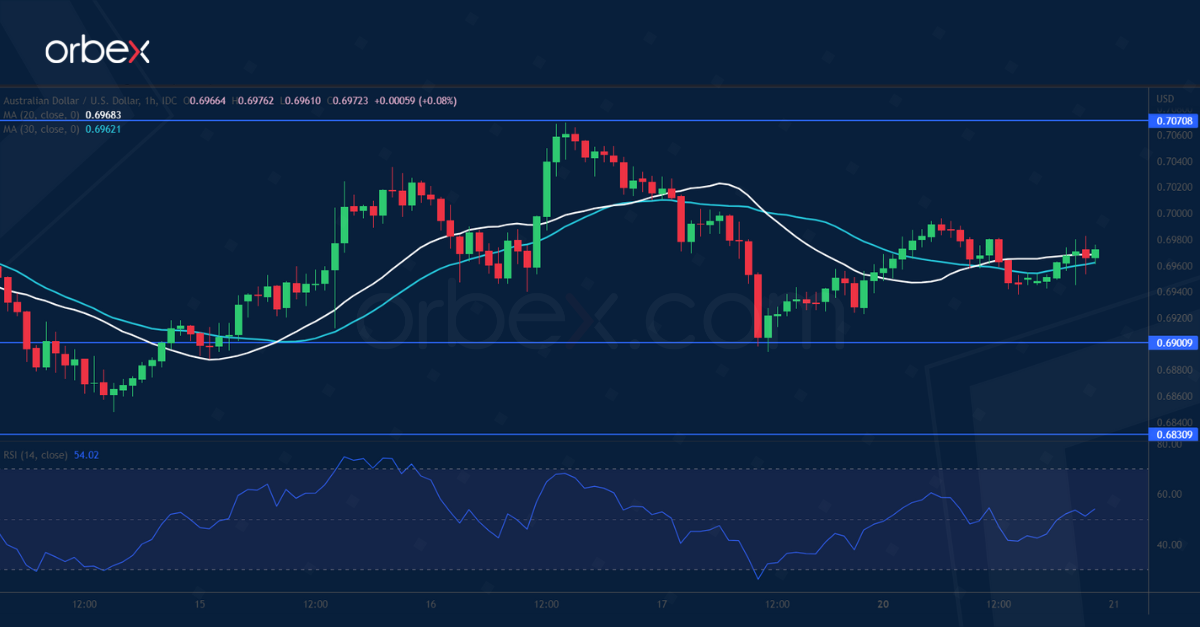
The Australian dollar rallies as the RBA minutes show its commitment to rate hikes. The pair is hovering above May’s lows around 0.6830 as the bulls seek to safeguard the previous rebound. The price saw support at the base of the recent rally over 0.6900. An oversold RSI in this demand zone might have triggered a ‘buy-the-dip’ behaviour. A rally back above 0.7070 would show that the path of least resistance is up and the recent top at 0.7270 could be within reach. A bearish breakout may cause a deeper correction.
US Markets Join the Rest in the Waiting Game
Markets
With US markets closed for Juneteenth, trading was confined to Asia and Europe yesterday. The economic calendar contained no important data but several high-profile speeches, including from president Lagarde as she appeared before the European Parliament. She didn’t spill the beans though and simply sticked to the normalization path laid out at the June meeting. Neither did she dwell on the outcome of the emergency meeting or on the details of the new bond-buying tool. Turning to markets, core/German bonds initially looked as if economic growth would once again take over from the inflation & tightening narrative. Further easing commodity prices (eg. oil) provided similar clues. But that soon changed with German yields eventually adding 5.9 bps (2y) to 9 bps (30y), be it in low-volume trading. European stock markets rose about 1%. The dollar traded a tad softer. The trade-weighted index (DXY) stabilized near Friday’s closing levels but EUR/USD eked out a gain to close just north of 1.05. EUR/GBP tried to reconquer the 0.86 barrier but failed to do so (close at 0.858). Norway’s krone outperformed G10 peers after a losing streak that brought EUR/NOK to the highest level since August last year. The pair eased from 10.5 to 10.42 yesterday. The Norges Bank is meeting on Thursday. Equities in the Asian-Pacific region are better off than yesterday. Gains mount up to 2.5% in Japan. US yields add about 5 bps across the curve after cash markets reopen from a long weekend. Yields in Australia went in reverse after RBA governor Lowe dampened expectations for a 75 bps hike. He added that policy rates of 4% by year-end, as expected by markets, is unlikely. The Aussie dollar trades stable sub AUD/USD 0.70. Moves on other currency markets are muted too. The Japanese yen (USD/JPY 135.02) is unimpressed by an umpteenth verbal intervention by Japanese MinFin Suzuki. US markets join the rest in the waiting game today. The economic calendar only starts to heat up from Wednesday with UK CPI, EMU consumer confidence and Fed chair Powell’s semi-annual testimony before Congress. It may mean a quiet trading day within the bigger picture of some short-term consolidation on core bond markets. As dust settles a bit after a volatile last week, we expect the dollar to continue topping out for the time being. EUR/USD 1.0601 serves as first intermediate resistance. Sterling investors will probably stick to the sidelines, awaiting key data (CPI, PMI and retail sales) that may affect Bank of England tightening expectations.
News Headlines
Israelian PM Bennett yesterday announced that he and foreign minister Lapid had decided to dissolve parliament, making way for the fifth election in four years and setting the stage for a potentially sooner than hoped for return of current opposition leader Netanyahu. Lapid will become caretaker PM in the run-up to a ballot which should take place before the end of October. Bennet’s fragile coalition, which centered more around the will to oust than sitting PM Netanyahu rather than around political ideas, already lost its majority earlier this year following the resignation of two MP’s.
That Mysterious Instrument
The week started on a calm note, with small gains in European indices and US futures.
The selloff in cryptocurrencies slowed as Bitcoin could throw itself above the psychological $20K level, and is catching its breath right now. The risk of a further selloff cannot be ruled out as the tighter Federal Reserve (Fed) expectations, the global selloff in risk assets and the fact that the massive outflows in cryptocurrencies started showing some cracks in the freshly born crypto industry make the cryptocurrencies increasingly less appetizing. Therefore, we could see a limited recovery in cryptocurrencies in the near future. what we must see is the cryptocurrency companies survive to the chaotic market conditions.
Gold and oil
Crude oil consolidated above the $110 per barrel as the bullish trades were held back by increased risk of global recession.
Gold remained offered as the improved risk appetite, and the prospects of higher US yields weighed on appetite.
The mysterious tool
The currency markets were calm as well, with the US dollar giving back some field against most majors. The EURUSD consolidated above the 1.05 level. The European Central Bank (ECB) Chief Christine Lagarde warned that there is a ‘severe’ risk of disorderly financial correction in Europe, especially in financial and housing markets as a result of a tighter ECB policy that is about to hit the fan.
The spread between the Italian and German 10-year yields narrowed since the ECB announced that they will invent another financial instrument to deal with the diverging pace of rising yields between the core and the periphery. At her speech yesterday, Lagarde defended once again this new instrument, yet the euro bulls will likely remain in retreat until we have more details on this mysterious new anti-fragmentation tool. The 50-DMA, which stands near 1.0620 will likely act as resistance in the short run.
In France, Macron lost majority in the National Assembly in the latest legislative elections of the weekend. It’s something rare in France, and it will force the French to find compromise to make new laws, which is a situation they are not used to, and they don’t like. The problem is, there is now such a huge opinion divergence in the Parliament that no one sees how this will play out in the next five years of Macron’s rule. The far left and far right gained a lot of seats, with Le Pen’s party increasing its seats by 10 folds compared to 2017. So it won’t be easy, and even less given the chaotic situation on the continent with the pandemic and the war.
Elsewhere, Cable was bid above 1.22 as Brits are holding their breath before tomorrow’s inflation data, and the Aussie-dollar approached the 70 cents mark, as the minutes from the latest Reserve Bank of Australia (RBA) meeting reiterated that the Australian policymakers are ready to whatever is necessary to tame inflation, and that more rate hikes would follow the latest rate hike from the RBA.
Calm before the testimony
We have certainly a couple of more hours of calm in the markets. But the things will start getting serious with Jerome Powell’s semi-annual testimony due Wednesday and Thursday, where he will reiterate how strong the Fed is committed to fight the soaring inflation in the US. Recovery in US equities should remain limited into Powell’s testimony. But, from a pricing perspective, we may not see an aggressive pricing this week, as the fed funds futures already price an almost 100% chance for a 75bp hike in FOMC’s July meeting.
A Quiet Day In Asia
With the US on holiday yesterday, activity was muted overnight. Currency, precious metal, and crypto markets traded sideways, while equities used a slow news night to stage a modest recovery, led by European equities. The modest equity market recovery continues in Asia, thanks to US index futures grinding higher since the early morning opening yesterday in Asia.
Energy markets have continued unwinding the Friday capitulation at a steady pace this week. Reduced Russian natural gas flows are supporting European prices, with a number of countries looking to reactivate coal-fired power plants to make up potential energy shortfalls. Chinese energy demand is hitting record highs in the North of the country thanks to a heat wave. Reuters is reporting that Iran is preparing to step up uranium enrichment, and US Treasury Secretary Yellen is circulating a plan to put a price cap on Russian oil to deprive them of revenues.
Taken in totality, the physical market is as tight as ever, and thus, the speculative capitulation in futures markets probably shouldn’t be taken as a picture of the reality on the ground in the real world. Iran’s measures, if correct, likely mean we won’t be seeing a return of Iranian crude to greater world markets anytime soon either. The bottom line seems to be that until we see physical demand destruction, oil and other energy markets are, as tight as ever.
In Asia today, South Korean 20-day exports for June fell unexpectedly by 3.40% YoY. Most of that though will be down to the trucker's strike this month, and a recovery should occur in July. The Bank of Korea put out a statement saying that “CPI would likely remain over 5.0% for the time being.” The BoK seems to be priming markets for a 50bps hike in July and a couple more hikes shortly thereafter. Some concern around the currency is clearly evident as they warned they would take action over “herd-like” behaviour. Translating as “if you all keep buying USD/KRW, we’ll intervene.” They won’t be the only Asian central bank with that problem this year.
The Reserve Bank of Australia Minutes were released this morning. The minutes signalled potentially another 50bps hike next month followed by a series of 25bps hikes for the rest of the year. They also mentioned that the RBA had lost some credibility in how it exited its yield control policy. They shouldn’t feel too bad about this. There are plenty of other central banks with eggs on their face, and their trans-Tasman neighbours, the Reserve Bank of New Zealand, have put on a veritable Muppet Show with monetary policy and will make the RBA look good, no matter what.
That is about it for data releases today in both Asia and Europe, leaving markets to continue quietly reversing Friday’s price moves until the US walks in the door, or we get a headline bomb. The Fed’s Barkin speaks this evening, but most eyes will be on US Existing Home Sales for May. There is downside risk to the 5.40 million forecasts with stresses in the US housing market evident for some time now as mortgage rates rose precipitously. I’m not sure what the reaction will be to a bad number. Theoretically, the gnomes of Wall Street will price in less Fed tightening and send US yields lower and equities higher and buy risk sentiment currencies. But I can’t see how a slowing US housing market is a positive environment for equities going forward either. I think I’ll sit this one out and watch from the sidelines.
Asian equities move higher.
US futures moved higher in Asia yesterday and continued gaining through European time as a lack of really negative headlines allowed the buy-the-dippers to dip their toes in the market. That also helped European equities sage a decent recovery as well, with markets ignoring the shock result in the French parliamentary elections. S&P, Nasdaq and Dow futures rose around 1.0% overnight, and all three have added another 0.55% this morning.
With US index futures maintaining their gains into today’s session, some confidence has returned to Asian markets, which are mostly higher today. The speculative FOMO herd has sent the Nikkei 225 1.90% higher, with South Korea’s Kospi adding 0.45%. In Mainland China, both the Shanghai Composite and CSI lost ground early doors, after suspiciously artificial gains yesterday. Those losses have once again reversed, with the Shanghai Composite now 0.05% higher, and the CSI 300 edging 0.15% higher. Hong Kong’s Hang Seng has jumped by 1.30%, helped perhaps by signals from Evergrande of a timetable for debt repayments and relisting of its shares.
In other markets, Singapore has climbed by 0.75%, with Taipei jumping 1.85% higher, Kuala Lumpur and Jakarta have gained 0.45%, Bangkok 0.25%, but Manila has fallen by 0.45%. Australian markets have wasted no time in reversing yesterday’s losses, thanks to firm US futures. The ASX 200 and All Ordinaries are 1.45% higher today.
Assuming the news ticker stays quiet, and with little data out this afternoon, European markets should continue recouping some recent losses, and as long as the US housing data holds steady, I can see Wall Street maintaining its recent gains as well.
Currency markets trade sideways over the US holiday.
Not a lot has changed in currency markets overnight despite some decent intraday ranges. The US holiday and a slow news reel ensured that currency traders took the option of easing into the week, awaiting the US return this evening. The dollar index edged 0.16% to 104.48 overnight, easing another 0.14% to 104.34 in Asia. thanks mostly to a weak yen. The dollar index has support at 1.0350 with resistance now distant at 1.0570.
EUR/USD rose just 0.17% to 1.0511 overnight, adding another 10 pips to 1.0525 in Asia. It has initial resistance at 1.0600, with challenging resistance at 1.0650. Support is at 1.0450 and 1.0400 now although I note that EUR/USD has based twice at 1.0350. That leaves the door open slightly to a corrective recovery this week. Sterling rose just 0.27% to 1.2248 overnight, edging 0.20% higher to 1.2270 in Asia. GBP/USD has initial resistance at 1.2360 and 1.2400, with support at 1.2200 and then 1.1950.
USD/JPY is holding steady at 135.00 today, almost unchanged for the past 24 hours. It is likely awaiting the reopening of the OTC US bond market this evening. It once again failed ahead of 135.45 overnight and the 135.45/60 region is shaping up as decent resistance now. Unless US yields move higher again this week, the odds of a USD/JPY correction lower are rising. USD/JPY has support at 134.50 and then 132.20.
AUD/USD and NZD/USD have booked modest gains to 0.6975 and 0.6345 over the last 24 hours, with trading volumes muted, but a tentative rise in sentiment proving supportive to both. A US holiday is dampened volumes but both Australasians have traced out bottoming patterns on the charts. As long as 0.6850 and 0.6200 hold respectively, further gains to 0.7150 and 0.6450 cannot be ruled out.
Asian currencies are barely changed overnight as regional markets await the return of the US later today. Noises from officials in Seoul and Tokyo about currency speculation are probably limiting US Dollar gains for now. Two notable exceptions are the Indonesian Rupiah and Philippine Peso, with weakened sharply by around 0.65% to $14,825.00 and $54.10 overnight. It is no coincidence that both have monetary policy meetings this week and both are reluctant rate hikers, as they prioritise the pandemic recovery. More selling pressure this week could force their hand on Thursday, but if both hold policy unchanged, could see more waves of selling into the end of the week.
Oil prices start reversing the Friday slump.
As I outlined above, oil futures have started reversing the Friday price slump as speculative capitulation collides with the reality of tight energy markets in the real world. Brent crude held $112.00 overnight, finishing 0.92% higher at $114.05 a barrel. It has added another 0.85% to $115.15 a barrel in Asian trading today. WTI held $108.50 overnight, finishing 0.20% higher at $110.05 a barrel. It has jumped 1.20% higher to $111.50 a barrel in Asian trading.
Friday’s falls have bought my six-month support lines back into focus. On Brent crude, that is at $107.00 a barrel today, just below its 100-day moving average (DMA) at $107.95. Ahead of this, it has support at $112.00, with resistance at $116.00 a barrel. WTIs six-month support line is at $106.25 a barrel, just ahead of its 100-DMA at 105.25. It has interim support at $108.50, and resistance at $112.50 a barrel.
Of the two, WTI looks the more vulnerable, having fallen further and closed closer to its multi-month support zone. If the US cuts federal fuel taxes this week, or US housing data is very soft, that could be enough to tip the scales lower. It is hard to see either contract moving lower than $100.00 a barrel given the state of the physical market. From a technical perspective, I would like to see one of either contract tracing out a couple of daily closes below the longer-term support lines and the 100-DMAs, before reassessing my longer-term bullish outlook.
Gold range continues.
It was another wax-on, wax-off day for gold overnight thanks to US markets being closed. It edged 0.11% lower to $1839.00 an ounce. In Asia, it has gained slightly by 0.12% to $1840.60 an ounce as comatose trading conditions continue.
Despite the noise of the past week, it remains anchored in the middle of its one-month range. The overnight price action shows that the inverse correlation to the US Dollar is as strong as ever
Gold has resistance at $1860.00 and $1880.00, the latter appearing an insurmountable obstacle for now. Support is at $1805.00 and then $1780.00 an ounce. Failure of the latter sets in motion a much deeper correction, while I would need to see a couple of daily closes above $1900.00 to get excited about the upside.
NZD Dips after Poor Consumer Confidence, Markets Staying in Consolidations
The markets are rather mixed in Asian session today, engaging in mostly consolidative moves. New Zealand Dollar trades broadly lower following record low consumer confidence data. But Canadian and Australian Dollars are firmer on steady risk sentiment. Dollar is also weak together with Yen while European majors are mixed.
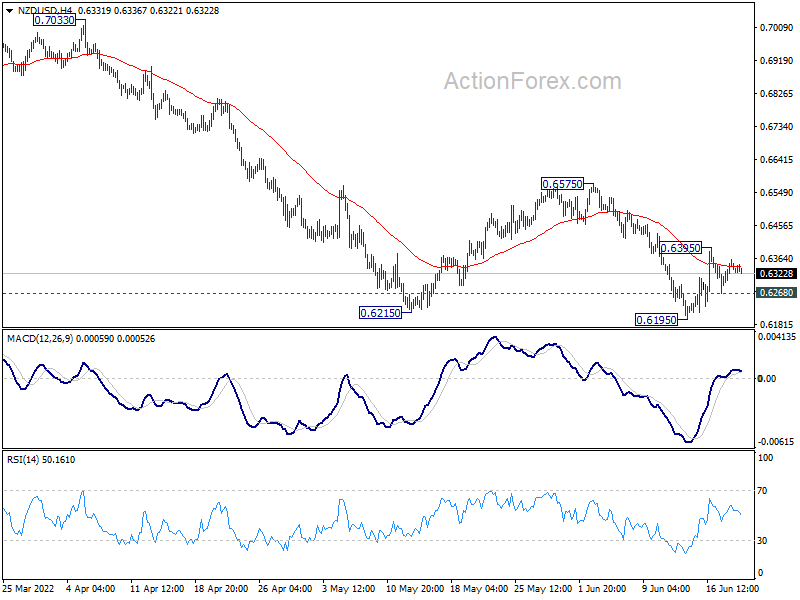
Technically, NZD/USD dips slightly after failing to stand above 4 hour 55 EMA again today. Overall development suggests that recovery from 0.6195 is merely a corrective move and outlook stays bearish. Break of 0.6286 minor support will likely resume larger down trend through 0.6195 low. Though, bring of 0.6395 will bring stronger rise back to 0.6575 structural resistance.
In Asia, at the time of writing, Nikkei is up 2.37%. Hong Kong HSI is up 1.59%. China Shanghai SSE is down -0.12%. Singapore Strait Times is up 0.88%. 10-year JGB yield is down -0.0003 at 0.233.
ECB Lane: Initial policy normalization steps clear and robust
ECB Chief Economist Philip Lane said yesterday, "we have very high inflation rates now, and clearly we could be in a world where inflation psychology is taking hold."
In a presentation, he said that Eurozone is facing three inflation shocks: pandemic cycle, energy shock and Russia-Ukraine war. Risks to inflation outlook include catch-up adjustment in wages, re-set of long term inflation expectations, inflation psychology, downward revision in potential output, and rise in real interest rate.
He added that monetary policy normalization is "appropriate" with "clear and robust" initial steps. That is, ECB will be stopping asset purchases, raise interest rate by 25bps in July, and again in September. Though, the size of the September hike is undecided. As for further steps, they will be state-contingent (gradualism, optionality, flexibility, data-dependency).
RBA Lowe: Going to be some years before inflation back in target range
RBA Governor Philip Lowe said the larger than expected 50bps hike at last meeting was driven by "additional information suggesting a further upward revision to an already high inflation forecast".
He also emphasized, "as we chart our way back to 2 per cent to 3 per cent inflation, Australians should be prepared for more interest rate increases."
"In the next month or so, we'll be doing a full forecast update, but it's going to be some years, I think, before inflation is back in the 2-3 per cent range, he added.
"I don't see a recession on the horizon," Lowe said. "If the last two years has taught us anything, it's that you can't rule anything out. But our fundamentals are strong, the position of the household sector is strong, and firms are wanting to hire people at record rates. It doesn't feel like a precursor to a recession," he said.
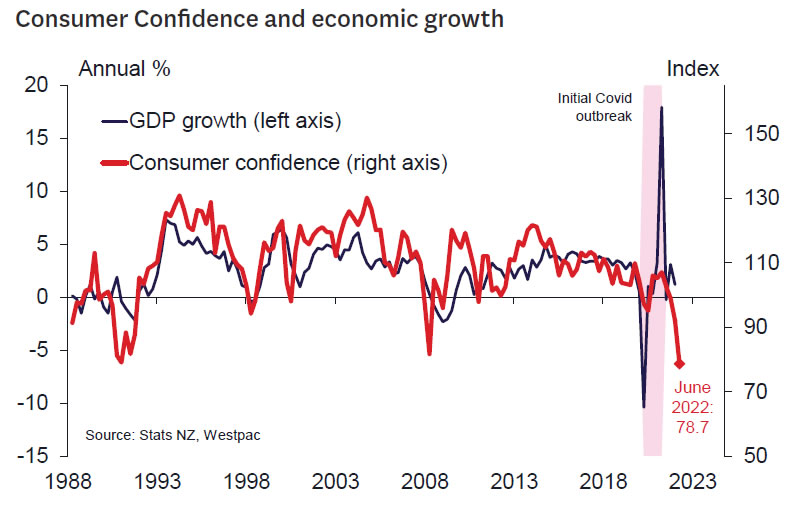
New Zealand Westpac consumer confidence dropped to 78.7 in Q2, record low
New Zealand Westpac consumer confidence dropped sharply from 92.1 to 78.7 in Q2. That's the lowest level on record, and well below long-term average at 110.2.
Westpac said: "The pressure on household finances and sharp fall in confidence reinforces our expectations for a downturn in household spending – and economic growth more generally – over the coming months".
"The RBNZ's own projections show the cash rate rising to 3.9%, while financial markets have started to price in the chance that it could go as high as 4.5%...
"If there is a more abrupt slowdown in spending than the RBNZ anticipates, then it's likely that increases in the cash rate will be more measured."
Japan PM Kishida and opposition Tamaki agree BoJ to keep loose monetary policy
Japan Prime Minister Fumio Kishida asked opposition DDP's Yuichiro Tamaki on monetary policy. Tamaki said the BOJ must keep current ultra-low interest rates, arguing that tightening monetary policy was "unthinkable". Kishida said afterwards, "I agree with you on the point that Japan shouldn't alter monetary policy,"
Kishida also said, "monetary policy affects not just currency rates, but the economy and smaller firms' businesses. Such factors must be taken into account comprehensively."
Separately, Finance Minister Shunichi Suzuki said, "I'm concerned about the rapid yen weakening seen recently." He added that the government will "closely liaise" with BoJ on watching the exchange markets with "even greater sense of urgency".
"We will respond appropriately if necessary while keeping close communication with currency authorities from other countries," Suzuki said.
Looking ahead
Swiss trade balance and Eurozone current account will be release in European session. Later in the day, Canada retail sales will take center stage. US will release existing home sales.
USD/JPY Daily Outlook
Daily Pivots: (S1) 134.62; (P) 135.03; (R1) 135.52; More...
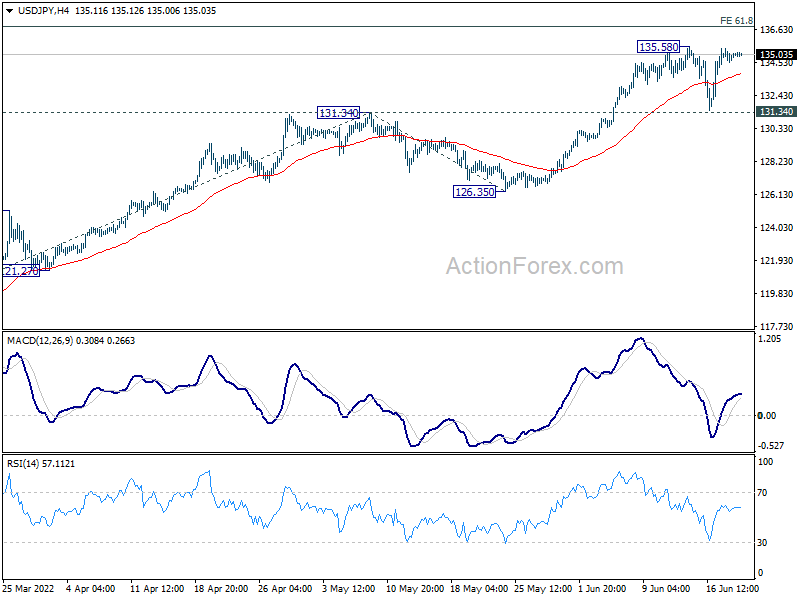
USD/JPY is still bounded in range below 135.58 and intraday bias remains neutral first. More consolidations could be seen but further rally is expected as long as 131.34 support holds. On the upside, break of 135.58 will resume larger up trend to 61.8% projection of 114.40 to 131.34 from 126.35 at 136.81. Firm break there will target 100% projection at 143.29.
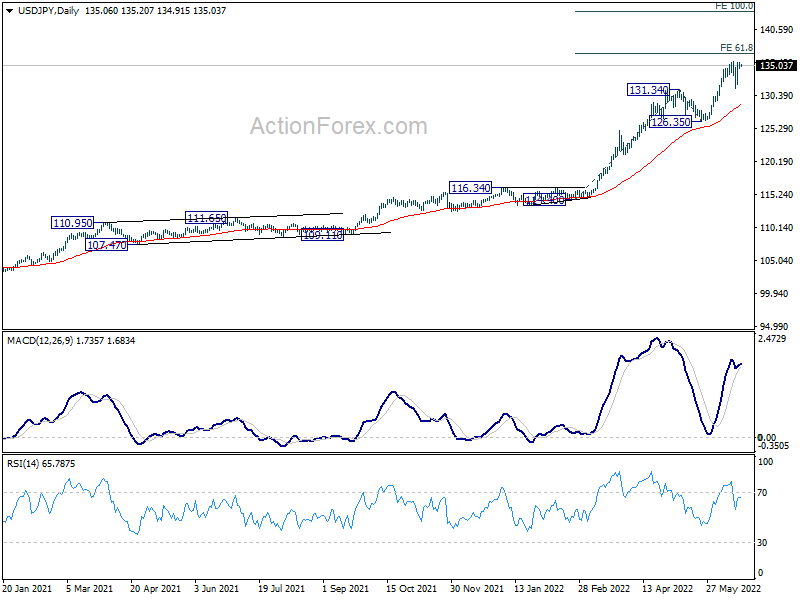
In the bigger picture, current rally is seen as part of the long term up trend from 75.56 (2011 low). Next target is 100% projection of 75.56 (2011 low) to 125.85 (2015 high) from 98.97 at 149.26, which is close to 147.68 (1998 high). This will remain the favored case as long as 126.35 support holds.
Economic Indicators Update
| GMT | Ccy | Events | Actual | Forecast | Previous | Revised |
|---|---|---|---|---|---|---|
| 21:00 | NZD | Westpac Consumer Survey Q2 | 78.7 | 92.1 | ||
| 01:30 | AUD | RBA Meeting Minutes | ||||
| 06:00 | CHF | Trade Balance (CHF) May | 3.78B | 4.13B | ||
| 08:00 | EUR | Eurozone Current Account Apr | -3.2B | -1.6B | ||
| 12:30 | CAD | New Housing Price Index M/M May | 0.40% | 0.30% | ||
| 12:30 | CAD | Retail Sales M/M Apr | 0.80% | 0.00% | ||
| 12:30 | CAD | Retail Sales ex Autos M/M Apr | 0.50% | 2.40% | ||
| 14:00 | USD | Existing Home Sales May | 5.41M | 5.61M |
Japan PM Kishida and opposition Tamaki agree BoJ to keep loose monetary policy
Japan Prime Minister Fumio Kishida asked opposition DDP's Yuichiro Tamaki on monetary policy. Tamaki said the BOJ must keep current ultra-low interest rates, arguing that tightening monetary policy was "unthinkable". Kishida said afterwards, "I agree with you on the point that Japan shouldn't alter monetary policy."
Kishida also said, "monetary policy affects not just currency rates, but the economy and smaller firms' businesses. Such factors must be taken into account comprehensively."
Separately, Finance Minister Shunichi Suzuki said, "I'm concerned about the rapid yen weakening seen recently." He added that the government will "closely liaise" with BoJ on watching the exchange markets with "even greater sense of urgency". "We will respond appropriately if necessary while keeping close communication with currency authorities from other countries," Suzuki said.
RBA Lowe: Going to be some years before inflation back in target range
RBA Governor Philip Lowe said the larger than expected 50bps hike at last meeting was driven by "additional information suggesting a further upward revision to an already high inflation forecast".
He also emphasized, "as we chart our way back to 2 per cent to 3 per cent inflation, Australians should be prepared for more interest rate increases."
"In the next month or so, we'll be doing a full forecast update, but it's going to be some years, I think, before inflation is back in the 2-3 per cent range, he added.
"I don't see a recession on the horizon," Lowe said. "If the last two years has taught us anything, it's that you can't rule anything out. But our fundamentals are strong, the position of the household sector is strong, and firms are wanting to hire people at record rates. It doesn't feel like a precursor to a recession," he said.
(RBA) Minutes of the Monetary Policy Meeting of the Reserve Bank Board
Sydney – 7 June 2022
Members present
Philip Lowe (Governor and Chair), Michele Bullock (Deputy Governor), Mark Barnaba AM, Wendy Craik AM, Ian Harper AO, Carolyn Hewson AO, Steven Kennedy PSM, Carol Schwartz AO, Alison Watkins AM
Others present
Luci Ellis (Assistant Governor, Economic), Christopher Kent (Assistant Governor, Financial Markets)
Anthony Dickman (Secretary), Penelope Smith (Deputy Secretary)
Alexandra Heath (Head, International Department), Bradley Jones (Head, Economic Analysis Department), Marion Kohler (Head, Domestic Markets Department)
International economic developments
Members commenced their discussion of international developments by noting that inflation had increased further in April and May, and the outlook for global growth had become more uncertain. Many central banks and professional forecasters expected headline inflation to be approaching a peak, but to remain well above central banks' targets until at least 2023. Measures of underlying inflation remained high in most advanced economies and had not yet shown signs of easing. Persistent supply chain disruptions, tightening labour market conditions and the ongoing recovery in private demand were contributing to strong underlying inflationary pressures. Members noted that the sources of inflation were broadening. Services inflation, which is typically more persistent than goods inflation, had picked up noticeably in advanced economies over the preceding year to be well above pre-pandemic levels.
Wages growth remained strong or had increased in a number of advanced economies as labour markets tightened further, but remained lower than inflation. The resulting decline in purchasing power had been substantial for many households, particularly in the United Kingdom and the euro area. This had contributed to sharp declines in consumer sentiment. Household consumption in advanced economies had nevertheless been resilient in the March quarter, notwithstanding the Omicron outbreak, supported by declining rates of household saving. While many advanced economies still had high household saving rates, those in the United States and the United Kingdom had fallen to pre-pandemic levels or below. Members agreed that a key uncertainty for the global economic outlook was how household consumption would respond to lower real wages and rising interest rates.
In China, economic activity had slowed sharply in April, with COVID-19 containment measures weighing heavily on consumer spending and manufacturing production in some parts of the country. Chinese authorities had extended further support to the economy, including by providing significant tax concessions to COVID-19-affected firms, and some analysts expected additional stimulus measures in the near term. Public investment had become an increasingly important source of growth since late 2021. Timely data suggested the disruptions from lockdowns in parts of China had not yet affected supply chains in Asia to a significant degree. Nevertheless, export volumes from Shanghai had been affected and members noted that the prospect of rolling lockdowns in China could disrupt global supply chains further and add to goods price inflation.
Global commodity prices had remained high and volatile. Limited spare capacity in global oil refining at a time of strengthening demand had boosted refinery margins, in turn feeding into higher retail fuel prices. Global gas prices had eased from peaks earlier in the year while thermal coal prices had increased further, reflecting a boycott of Russian coal by some countries and the substitution of gas with coal by electricity producers in Asia. Agricultural commodity prices had also increased, particularly wheat as disruptions to the supply from Ukraine had been compounded by India's decision to restrict wheat exports. These commodity price movements had resulted in Australia's terms of trade reaching a record high in the March quarter, with the terms of trade forecast to rise further in the June quarter.
Domestic economic developments
Members agreed that the Australian economy had significant underlying momentum and inflationary pressures were pronounced. Domestic demand had been resilient to disruptions from Omicron outbreaks and the floods on the east coast in the March quarter. A pick-up in GDP growth was anticipated for the June quarter. Labour market conditions were the tightest they had been in many years and wage pressures were emerging. Timely measures of wages indicated that labour cost pressures were likely to broaden and pick up further in the period ahead. Members observed that capacity constraints were binding in some parts of the economy. Information from the Bank's liaison program indicated that firms were more willing and able to pass higher global and domestic input prices through to final consumer prices.
Although GDP growth had slowed in the March quarter, household consumption had been resilient and timely indicators pointed to solid growth in the June quarter. The recovery in spending on discretionary services, including for travel, was well under way and further increases were anticipated. Household consumption was expected to be supported in the period ahead by solid growth in disposable income, a decline in the saving rate towards more normal levels and the large increase in liquid savings and wealth that had been accumulated during the pandemic. Nevertheless, there were several sources of uncertainty surrounding the outlook for consumption, including the response of households to rising prices, rising interest rates and declining housing prices in some cities.
Members noted that an upswing in private and public investment was under way. However, shortages of materials and labour were an ongoing challenge for residential construction and infrastructure projects. Dwelling investment had declined in the March quarter as the Omicron outbreak and weather-related disruptions had exacerbated ongoing supply constraints, although there remained a large pipeline of residential construction work. Business investment had increased in the March quarter, led by strength in spending on machinery and equipment. Firms' surveyed investment intentions from the Capital Expenditure Survey pointed to further growth in the year ahead. Supply constraints and cost overruns were slowing the rollout of public investment plans, including a number of major infrastructure projects. Some projects that had not been started were being deferred, while others were at risk of being cancelled.
The decline in national housing prices over recent months had been concentrated in Sydney and Melbourne, following strong nationwide gains over the prior year. In some other capital cities and regional areas, growth in housing prices had also moderated recently. Overall, housing prices remained more than 25 per cent higher than prior to the pandemic, supporting household wealth and spending. Conditions in rental markets had continued to tighten in Sydney and Melbourne and remained tight in most other cities, as indicated by very low vacancy rates. Advertised rents had continued to increase strongly in most housing markets. This was expected to flow through to the Consumer Price Index measure of rents, following several years of subdued growth.
Turning to the labour market, members noted that labour market conditions were the tightest in decades. At 3.9 per cent in April, the unemployment rate was at its lowest level in nearly 50 years, when the participation rate was also much lower than it is currently. Other measures of spare capacity in the labour market had also declined to levels not seen for many years. Leading indicators of labour demand pointed to a further tightening in labour market conditions in the near term, and many firms in the Bank's liaison program had indicated that they intended to increase headcount over coming months.
Members agreed that tight labour market conditions and higher inflation were likely to support a further lift in growth in labour costs in the period ahead. Early in the year, wages growth had remained around its pre-pandemic pace. This had been confirmed by the Wage Price Index (WPI), which had increased by 0.7 per cent in the March quarter to be 2.4 per cent higher in year-ended terms. For those jobs with wage changes, the average size of wage rises had increased to its highest level since 2014, while the share of jobs that received a wage rise of 4 per cent or more had also increased. Since the mid-February reference period for the WPI survey, more timely evidence from liaison and surveys continued to suggest a further pick-up in growth in labour costs. Around 40 per cent of firms reporting wages information in the Bank's liaison program indicated that wages growth was exceeding 3 per cent, and about 60 per cent of firms expected wages growth over the year ahead to be higher than current growth rates; this reflected firms responding to higher job turnover, a tighter labour market and higher inflation. It was also probable that adjustments to public sector wages policies and the upcoming Fair Work Commission ruling on new minimum and award rates would result in faster wages growth for affected workers in the period ahead.
Members agreed that inflation in Australia had increased significantly owing to both global and domestic factors; it had also become more broadly based. Domestically, capacity constraints in some sectors and the tightening in labour market conditions had contributed to this. Higher prices for electricity and gas and recent increases in petrol prices meant that inflation was likely to peak at a higher level than expected a month earlier. More broadly, information from the Bank's liaison program indicated that upstream price pressures were being passed on by firms, as global and domestic supply chain pressures had persisted and demand had remained strong. Indeed, the domestic demand deflator, which is the broadest measure of domestic prices in the national accounts, had increased at its fastest rate in more than two decades in the March quarter. Measures of long-term inflation expectations remained in the 2 to 3 per cent target band, although members noted there was a risk that a sustained period of higher inflation could result in a shift up in expectations of inflation. A particular source of uncertainty related to future wage outcomes during a period of high inflation and tight labour market conditions.
International financial markets
Members observed that global financial conditions had tightened since the start of the year, when they had been highly accommodative. This tightening was partly a result of central banks withdrawing some of the substantial monetary policy stimulus that had been implemented in response to the pandemic and partly because markets had revised upwards the expected path of policy rates in response to persistently high inflation. Government bond yields had risen substantially over the year, particularly at shorter tenors.
Central banks in several advanced economies had increased their policy rates further over the prior month, as expected. Generally, these central banks had indicated that they would need to return policy rates towards a neutral setting quickly; some had noted that policy rates might need to move into restrictive territory to ensure inflation returned to levels consistent with their targets. Members observed that policy rate expectations in many advanced economies had been little changed overall since the May meeting. Central banks in most emerging market economies, including in Asia, had also increased policy rates in preceding months in response to rising inflation. An important exception was China, where authorities had eased monetary policy a little further given the effects of COVID-19 restrictions on economic activity and continued weakness in the property sector.
Concerns about the global growth outlook relating to declining real household incomes, the withdrawal of stimulatory monetary policies and COVID-19 restrictions in China had contributed to a further increase in corporate bond spreads over the prior month. Members noted that the increase in uncertainty around the economic outlook had also meant that investors had become more cautious about investing in more innovative and risky businesses. Equity prices had been little changed over the prior month, but had declined significantly since the beginning of the year; however, the decline in equity prices in Australia had been relatively modest given the boost to profitability for resource companies from very high commodity prices.
The US dollar had appreciated since the start of 2022 in line with the more pronounced rise in US Government bond yields compared with those in most advanced economies. The Australian dollar had moved in a relatively wide range over the course of the year, but in trade-weighted terms had appreciated over recent months, partly reflecting the increase in Australian Government bond yields relative to those in most other advanced economies.
Domestic financial markets
Members noted that Australian Government bond yields had increased a little over the prior month. Yields had risen noticeably following the decision at the May meeting to lift the cash rate by more than anticipated by market pricing and the release of upwardly revised inflation forecasts, although yields had declined over subsequent days in line with global yields. Money market rates had also increased. Market pricing at the time of the June meeting implied that market participants expected cash rate increases of more than 25 basis points on average at each meeting over the remainder of the year, with an expected cash rate of 2¾ per cent by December 2022. This was considerably higher than the median of market economists' expectations.
Banks' funding costs had begun to increase from historically low levels owing to the rise in market rates over preceding months and the increase in the cash rate in May. Members noted that most lenders had passed on the increase in the cash rate in full to existing variable-rate housing and small business borrowers. Pass-through to deposit rates had been more limited.
Growth in total credit in April had remained around the fastest pace of the preceding decade. Business credit growth had been particularly strong, driven by lending to large- and medium-sized business, and supported by merger and acquisitions activity and solid economic growth. Demand for housing finance remained strong, although credit growth for owner-occupiers had declined, as had commitments for housing loans for both owner-occupiers and investors, consistent with signs of an easing in activity in the housing market.
Review of the yield target
Members reviewed the operation and effectiveness of the three-year yield target introduced in March 2020 as part of the Bank's COVID-19 pandemic response. The discussion was based on a staff review that the Board had earlier commissioned. Members commenced their discussion by noting that the environment in which the yield target was introduced was one of extreme downside risks for the Australian economy. At the time, there were credible forecasts of significant loss of life, very high rates of unemployment and prolonged economic scarring. In this environment, the Board had sought to build a bridge to the day when the pandemic was contained and to provide a high level of insurance against the catastrophic downside risks.
The yield target was one element of the broader policy package announced in March 2020. The package also included lowering the cash rate to 25 basis points and introducing the three-year Term Funding Facility. The Board agreed that the package had served its purpose of lowering funding costs and supporting the provision of credit in Australia. In doing so, it had assisted with the recovery of the Australian economy.
The yield target was initially set at 25 basis points and subsequently lowered to 10 basis points in November 2020, before being discontinued a year later in November 2021. The Board adopted the yield target as an alternative to a program of bond purchases. A bond purchase program was subsequently adopted.
Members noted that the yield target, along with the three-year Term Funding Facility, could be construed as a form of time-based forward guidance, implying that the Board's decisions were dependent on the calendar, when in fact they depended on the state of the economy. They agreed to undertake a review of the Bank's general approach to forward guidance later in 2022.
Members also noted that, by the later part of the targeting period, the transmission of the yield target to other interest rates in the economy had weakened, which reduced its effectiveness as a policy tool. The exit from the policy in late 2021 had been disorderly and resulted in some dislocation in markets. Members agreed that this experience had caused reputational damage to the Bank and accepted that earlier communication from the Bank could have avoided this. At the same time, the ending of a target that is losing credibility is always likely to produce some volatility in market prices.
The staff review discussed the various decision points during the operation of the yield target and the focus of the Board in providing insurance against the downside risks. Members acknowledged that different decisions could have been made at particular times if alternative weighting had been applied to the upside and downside scenarios. Members also acknowledged that opinions would vary as to whether the Board achieved the right balance throughout a highly uncertain period. They agreed to strengthen the Board's analysis of the full range of scenarios in future decision-making.
Members concluded that the probability of using a yield target again was low, but did not rule out using this policy tool in extreme circumstances, and it would need to be evaluated against other policy options at the time.
Members agreed to the publication of the review of the yield target. They also agreed to undertake reviews of the bond purchase program and the Bank's approach to forward guidance. These reviews will be conducted and published later this year.
Considerations for monetary policy
In considering the policy decision, members observed that inflation in Australia had increased significantly and that the outlook for inflation had been revised higher over the prior month. Inflation was expected to increase further, before declining back towards the top of the 2 to 3 per cent range in 2023.
Global factors, including COVID-19-related disruptions to supply chains and the war in Ukraine, accounted for much of the increase in inflation. However, domestic factors were increasingly playing a role. Capacity constraints in some sectors and the tight labour market were contributing to upward pressure on prices. The east coast floods earlier in the year had also affected some prices.
Higher electricity and gas prices and recent increases in petrol prices meant that, in the near term, inflation was likely to be higher than expected a month earlier. As the global supply-side problems are resolved and commodity prices stabilise, even if at a high level, inflation was expected to moderate to the top of the target range. Members observed that these forecasts incorporated a technical assumption of further increases in the cash rate.
Members discussed the resilience of the Australian economy. Growth had been supported by household and business balance sheets that are generally in good shape, an upswing in business investment and the large pipeline of construction work to be completed. Macroeconomic policy settings were also supportive of growth and higher commodity prices had provided a boost to national income. The terms of trade were at a record high.
The resilience of the economy was most evident in the labour market. Employment had grown significantly in preceding months and the unemployment rate was at multi-decade lows. Job vacancies and advertisements were at high levels and further declines in unemployment and underemployment were expected. Information from the Bank's liaison program continued to indicate that wages growth would increase from the low rates of recent years as firms compete for staff in a tight labour market.
Members agreed that there was a material risk that inflation would not return to the target if current policy settings were maintained. The very low level of interest rates that had been put in place to support the economy during the pandemic was no longer appropriate. The increase in the cash rate at the previous meeting had been accompanied by communication that further increases in interest rates would be needed, with the timing and extent of the increases to be determined by incoming information and the evolving balance of risks. Recent information showed that inflation was high and rising, and there had been further upside surprises over the prior month.
Two options for the size of the cash rate increase were considered: raising the cash rate target by 25 basis points or by 50 basis points. Members noted that both options would leave the cash rate below 1 per cent, which would still be highly stimulatory, and that further increases would be required.
The main argument for an increase of 50 basis points was that the level of interest rates was still very low for an economy with a tight labour market and facing a period of higher inflation. Additionally, the inflation mindset in Australia appeared to be shifting. Firms had become more willing to pass on cost increases to consumers and, in a tight labour market, employees were demanding higher wages as compensation for higher living costs. In such an environment, there is a heightened risk of persistently high inflation, especially if expectations of higher inflation become entrenched. If that were to occur, the task of returning inflation to the target would become more difficult and come at a higher cost in terms of lower levels of economic activity and employment. Raising the cash rate by 50 basis points at the current meeting would help to mitigate this risk.
Members considered whether an increase of 50 basis points could add to the community's concerns that inflation was likely to stay high. While this was a risk, the Bank could communicate that inflation was expected to return to the target over time and that the Board was committed to this objective.
The argument for an increase of 25 basis points was that a sequence of 25 basis point moves represented a steady approach to withdrawing monetary policy stimulus and that this was appropriate in an uncertain environment. Members observed that if the cash rate were to be increased by 25 basis points at each meeting over the remainder of 2022, the cash rate would be 2.1 per cent by the end of the year. In a historical context, this would be quite a rapid tightening. While some central banks had been increasing policy rates in 50 basis points increments, these central banks meet less frequently than the Reserve Bank Board. Members also noted that, over the preceding couple of decades, increases in the cash rate had typically occurred in 25 basis point increments. The previous instance of the Board having increased the cash rate by 50 basis points was in February 2000.
Members also considered the evolving risks to household consumption, including how households would adjust their spending in response to higher prices and interest rates, and the impact of higher interest rates on the housing market. Housing prices had declined in some markets over preceding months, but remained more than 25 per cent higher than prior to the pandemic, thereby supporting household wealth and spending. Further, many households had built up large financial buffers during the pandemic and the household saving rate was very high. The central scenario, which was conditioned on the assumption of further rate rises, was for strong household consumption growth over the remainder of the year.
Given the current inflation pressures in the economy and the still very low level of interest rates, on balance, members agreed to a 50 basis point adjustment in the cash rate target. Members also agreed that further steps would need to be taken to normalise monetary conditions in Australia over the months ahead. The size and timing of future interest rate increases will continue to be guided by the incoming data and the Board's assessment of the outlook for inflation and the labour market, including the risks to the outlook. The Board remains committed to doing what is necessary to ensure that inflation in Australia returns to the target over time.
The decision
The Board decided to increase the cash rate target by 50 basis points to 85 basis points. It also increased the interest rate on Exchange Settlement balances by 50 basis points to 75 basis points.
New Zealand Westpac consumer confidence dropped to 78.7 in Q2, record low
New Zealand Westpac consumer confidence dropped sharply from 92.1 to 78.7 in Q2. That's the lowest level on record, and well below long-term average at 110.2.
Westpac said: "The pressure on household finances and sharp fall in confidence reinforces our expectations for a downturn in household spending – and economic growth more generally – over the coming months".
"The RBNZ's own projections show the cash rate rising to 3.9%, while financial markets have started to price in the chance that it could go as high as 4.5%...
"If there is a more abrupt slowdown in spending than the RBNZ anticipates, then it's likely that increases in the cash rate will be more measured."
ECB Lane: Initial policy normalization steps clear and robust
ECB Chief Economist Philip Lane said yesterday, "we have very high inflation rates now, and clearly we could be in a world where inflation psychology is taking hold."
In a presentation, he said that Eurozone is facing three inflation shocks: pandemic cycle, energy shock and Russia-Ukraine war. Risks to inflation outlook include catch-up adjustment in wages, re-set of long term inflation expectations, inflation psychology, downward revision in potential output, and rise in real interest rate.
He added that monetary policy normalization is "appropriate" with "clear and robust" initial steps. That is, ECB will be stopping asset purchases, raise interest rate by 25bps in July, and again in September. Though, the size of the September hike is undecided. As for further steps, they will be state-contingent (gradualism, optionality, flexibility, data-dependency)