

Sample Category Title
USD/CHF Mid-Day Outlook
Daily Pivots: (S1) 0.9627; (P) 0.9671; (R1) 0.9720; More...
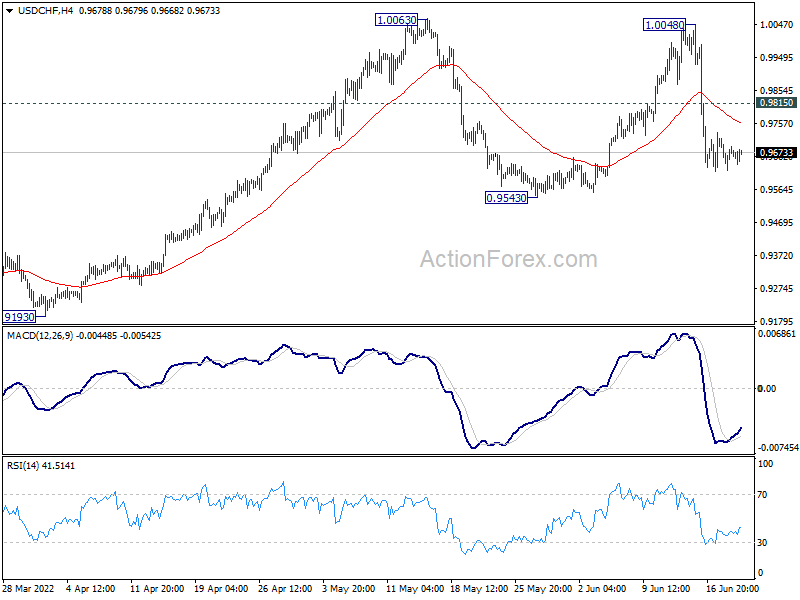
Intraday bias in USD/CHF stays neutral at this point. Another fall cannot be ruled out. But decline from 1.0048 is viewed as the third leg of the corrective pattern from 1.0063. Strong support should be seen at around 0.9543 to contain downside to bring rebound. On the upside, above 0.9815 minor resistance will turn bias back to the upside for retesting 1.0063 resistance.
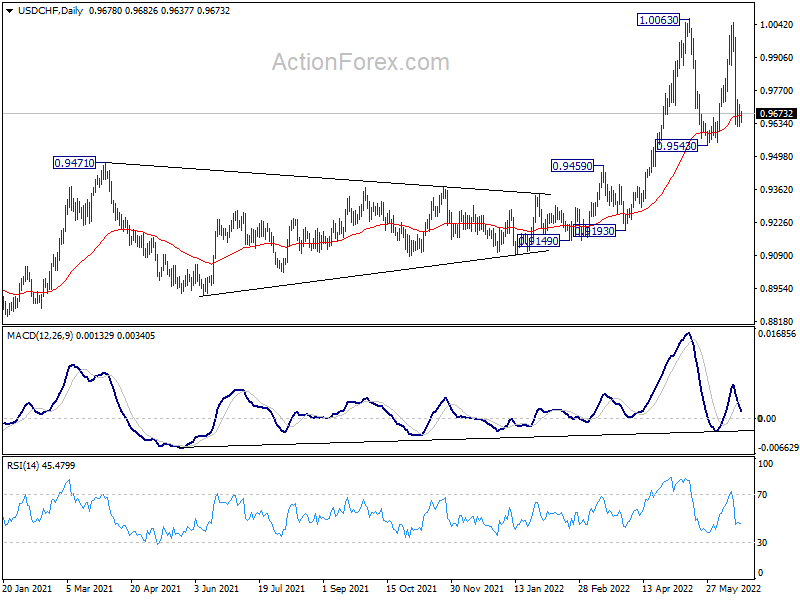
In the bigger picture, down trend from 1.0342 (2016 high) should have completed with three waves down to 0.8756 (2021 low) already. Rise from 0.8756 is likely a medium term up trend of its own. Next target is 1.0237/0342 resistance zone. This will remain the favored case as long as 0.9471 resistance turned support holds. However, sustained break of 0.9471 will extend long term range trading with another falling leg.
USD/JPY Mid-Day Outlook
Daily Pivots: (S1) 134.62; (P) 135.03; (R1) 135.52; More...
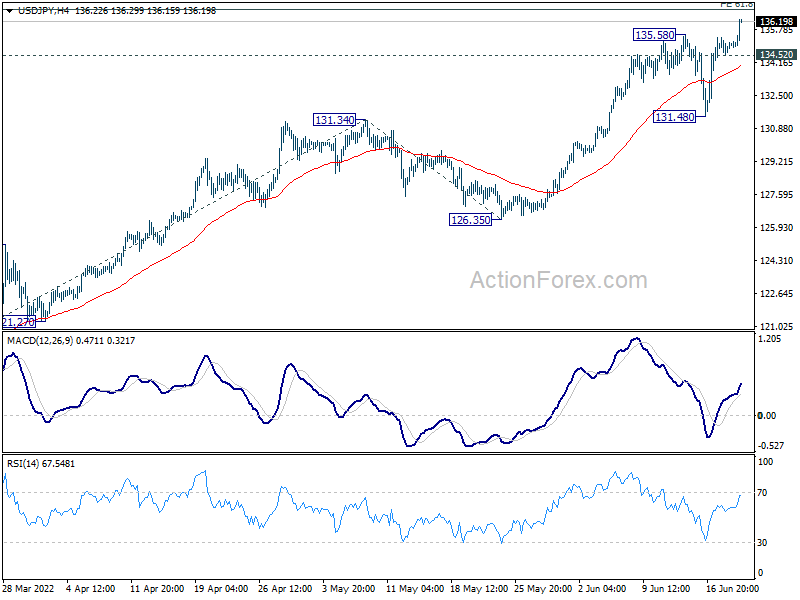
USD/JPY's up trend resumes by breaking through 135.58 today. Intraday bias is back on the upside for 61.8% projection of 114.40 to 131.34 from 126.35 at 136.81. Firm break there will target 100% projection at 143.29. On the downside, below 134.52 minor support will turn intraday bias neutral first. But outlook will remain bullish as long as 131.48 support holds.
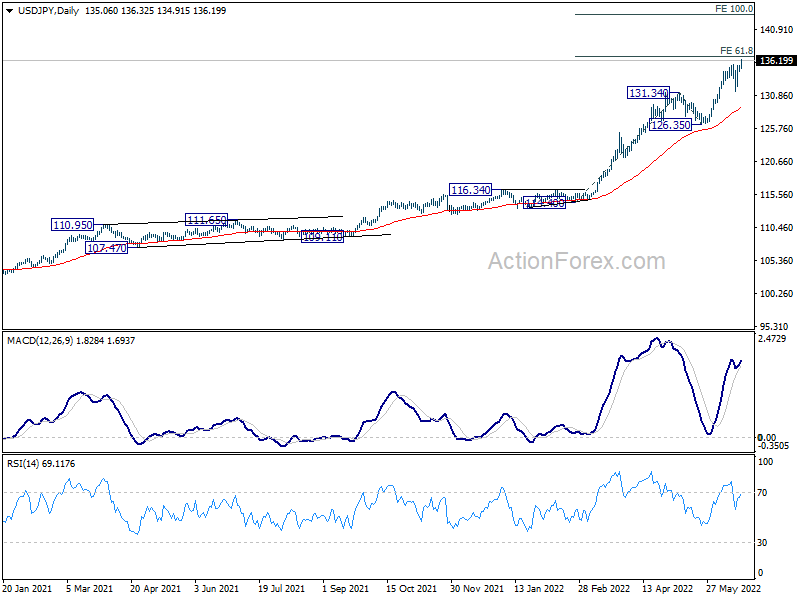
In the bigger picture, current rally is seen as part of the long term up trend from 75.56 (2011 low). Next target is 100% projection of 75.56 (2011 low) to 125.85 (2015 high) from 98.97 at 149.26, which is close to 147.68 (1998 high). This will remain the favored case as long as 126.35 support holds.
Yen Selloff is Back as USD/JPY Resumes Up Trend
Yen's selloff accelerates today as US stocks are set to stage a rebound after the long weekend. For now, Euro is the strongest one with help from rebound against Sterling and Swiss Franc. It's followed by Canadian Dollar, which is supported by slightly better than expected retail sales data. On the other hand, Kiwi and Aussie are the weakest one, following Yen.
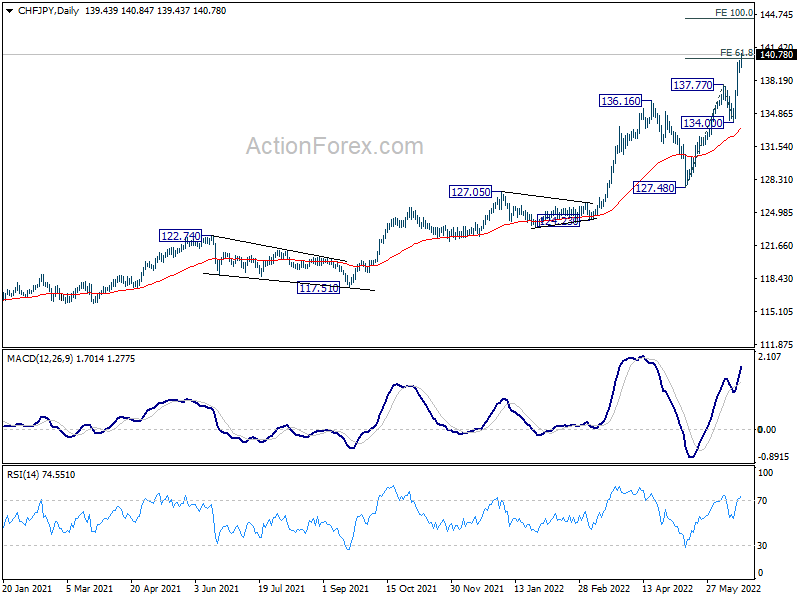
Technically, CHF/JPY's rally continues today and breaks through 61.8% projection of 127.48 to 137.77 from 134.00 at 140.35. Next target is 100% projection of 144.29. USD/JPY's break of 135.58 indicates up trend resumption. Now focus is on 144.23 resistance in EUR/JPY and 168.67 resistance in GBP/JPY. Break of these levels will also confirm resumption of recent up trends.
In Europe, at the time of writing, FTSE is up 0.45%. DAX is up 0.33%. CAC is up 0.86%. Germany 10-year yield is up 0.031 at 1.780. Earlier in Asia, Nikkei rose 1.84%. Hong Kong HSI rose 1.87%. China Shanghai SSE dropped -0.26%. Singapore Strait Times rose 0.68%. Japan 10-year JGB yield rose 0.0032 to 0.236.
Canada retail sales up 0.9% mom in Apr, to rise 1.6% mom in May
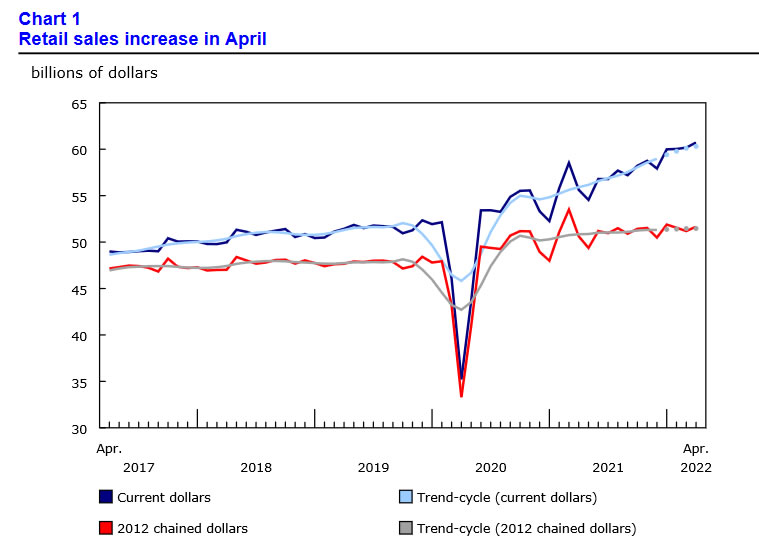
Canada retail sales rose 0.9% mom to CAD 60.7B in April, slightly above expectation of 0.8% mom. Sales were up in 6 of 11 subsectors. Excluding gasoline stations and motor vehicle and parts dealers, sales rose 1.0% mom.
Preliminary data suggests that sales rose 1.6% mom in May.
ECB Rehn: Sharply rising inflation justifies expedite policy normalization
ECB Governing Council member Olli Rehn said, "with inflation rising sharply, there has been good reason to expedite the normalization of monetary policy,"
"The impacts of Russia's brutal war are being felt around the world, and people are having to pay higher prices for energy and food," he said.
BoE Pill sees tightening of monetary policy over the coming months
BoE Chief Economist Huw Pill said today, "we will do what we need to do to get inflation back to target. And at least in my view, that will require further tightening of monetary policy over the coming months."
"When we assess inflation pressure, we need to take into account the exchange rate," he added. "We see ourselves as steering a narrow path between persistent inflation pressure and recession."
"Terms of trade shock means UK will be poorer, UK must decide how that reduction in income will be distributed."
RBA Lowe: Going to be some years before inflation back in target range
RBA Governor Philip Lowe said the larger than expected 50bps hike at last meeting was driven by "additional information suggesting a further upward revision to an already high inflation forecast".
He also emphasized, "as we chart our way back to 2 per cent to 3 per cent inflation, Australians should be prepared for more interest rate increases."
"In the next month or so, we'll be doing a full forecast update, but it's going to be some years, I think, before inflation is back in the 2-3 per cent range, he added.
"I don't see a recession on the horizon," Lowe said. "If the last two years has taught us anything, it's that you can't rule anything out. But our fundamentals are strong, the position of the household sector is strong, and firms are wanting to hire people at record rates. It doesn't feel like a precursor to a recession," he said.
New Zealand Westpac consumer confidence dropped to 78.7 in Q2, record low
New Zealand Westpac consumer confidence dropped sharply from 92.1 to 78.7 in Q2. That's the lowest level on record, and well below long-term average at 110.2.
Westpac said: "The pressure on household finances and sharp fall in confidence reinforces our expectations for a downturn in household spending – and economic growth more generally – over the coming months".
"The RBNZ's own projections show the cash rate rising to 3.9%, while financial markets have started to price in the chance that it could go as high as 4.5%...
"If there is a more abrupt slowdown in spending than the RBNZ anticipates, then it's likely that increases in the cash rate will be more measured."
Japan PM Kishida and opposition Tamaki agree BoJ to keep loose monetary policy
Japan Prime Minister Fumio Kishida asked opposition DDP's Yuichiro Tamaki on monetary policy. Tamaki said the BOJ must keep current ultra-low interest rates, arguing that tightening monetary policy was "unthinkable". Kishida said afterwards, "I agree with you on the point that Japan shouldn't alter monetary policy,"
Kishida also said, "monetary policy affects not just currency rates, but the economy and smaller firms' businesses. Such factors must be taken into account comprehensively."
Separately, Finance Minister Shunichi Suzuki said, "I'm concerned about the rapid yen weakening seen recently." He added that the government will "closely liaise" with BoJ on watching the exchange markets with "even greater sense of urgency".
"We will respond appropriately if necessary while keeping close communication with currency authorities from other countries," Suzuki said.
USD/JPY Mid-Day Outlook
Daily Pivots: (S1) 134.62; (P) 135.03; (R1) 135.52; More...
USD/JPY's up trend resumes by breaking through 135.58 today. Intraday bias is back on the upside for 61.8% projection of 114.40 to 131.34 from 126.35 at 136.81. Firm break there will target 100% projection at 143.29. On the downside, below 134.52 minor support will turn intraday bias neutral first. But outlook will remain bullish as long as 131.48 support holds.
In the bigger picture, current rally is seen as part of the long term up trend from 75.56 (2011 low). Next target is 100% projection of 75.56 (2011 low) to 125.85 (2015 high) from 98.97 at 149.26, which is close to 147.68 (1998 high). This will remain the favored case as long as 126.35 support holds.
Economic Indicators Update
| GMT | Ccy | Events | Actual | Forecast | Previous | Revised |
|---|---|---|---|---|---|---|
| 21:00 | NZD | Westpac Consumer Survey Q2 | 78.7 | 92.1 | ||
| 01:30 | AUD | RBA Meeting Minutes | ||||
| 06:00 | CHF | Trade Balance (CHF) May | 3.12B | 3.78B | 4.13B | 4.03B |
| 08:00 | EUR | Eurozone Current Account Apr | -5.8B | -3.2B | -1.6B | |
| 12:30 | CAD | New Housing Price Index M/M May | 0.50% | 0.40% | 0.30% | |
| 12:30 | CAD | Retail Sales M/M Apr | 0.90% | 0.80% | 0.00% | 0.20% |
| 12:30 | CAD | Retail Sales ex Autos M/M Apr | 1.30% | 0.50% | 2.40% | 2.60% |
| 14:00 | USD | Existing Home Sales May | 5.41M | 5.61M |
Canada retail sales up 0.9% mom in Apr, to rise 1.6% mom in May
Canada retail sales rose 0.9% mom to CAD 60.7B in April, slightly above expectation of 0.8% mom. Sales were up in 6 of 11 subsectors. Excluding gasoline stations and motor vehicle and parts dealers, sales rose 1.0% mom.
Preliminary data suggests that sales rose 1.6% mom in May.
Japanese Yen Punches Past 136
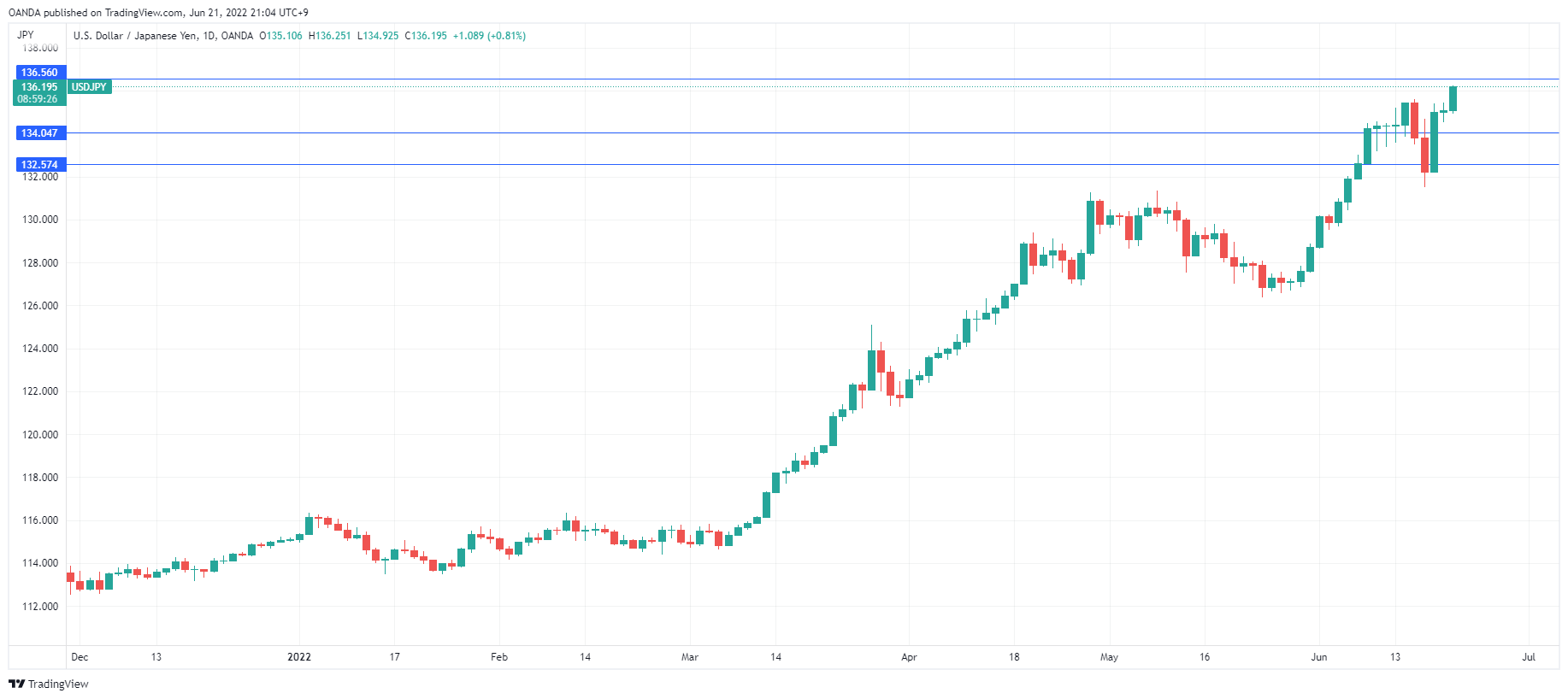
After a quiet start to the week, the US dollar is again rallying against the hapless Japanese yen. USD/JPY is currently trading at 136.18, up 0.78% on the day. The yen is trading at its lowest level since September 1998.
Yen gets no help from BoJ
It shouldn’t come as a surprise that the yen continues to lose ground. The currency has been left to the (dollar) wolves by the Bank of Japan. The BoJ signalled at Friday’s meeting that it would stick to its ultra-accommodative policy, despite pressure to adjust its yield curve control. The central bank has tenaciously capped the 10-year yield on JGBs at 0.25%, intervening to keep rates from moving higher. Governor Kuroda has defended this policy as critical to support the fragile economy and push inflation higher.
The price for the BoJ’s stance is being paid by the yen, which is losing ground as the US/Japan rate differential widens. The central bank purchased a record USD 81 billion in JGBs last week, after the 10-year yield breached above 0.25%. This has pushed the yield to 0.23%, but USD/JPY surged 2.11% on Friday and continues to move higher. With the Federal Reserve in the midst of an aggressive rate-tightening cycle, USD/JPY appears headed towards the lofty 140 level.
Will Japan intervene in order to stabilize the exchange rate? The Bank of Japan and the Ministry of Finance have resorted to verbal intervention, warning that they are concerned about the rapid descent of the yen and our monitoring the situation. The jawboning has not had much effect, as the yen shows no signs of rebounding. There has been speculation that the BoJ has a ‘line in the sand’ at which it will step in and defend the yen, but USD/JPY continues to rise without hindrance. Could a 140 yen be that line in the sand?
USD/JPY Technical
- There is resistance at 1.3657 and 1.3814
- USD/JPY has support at 1.3404 and 1.3247
Local Retreat in Gold
Despite attempts at rebounding equity markets, moderate pressure on gold has persisted for the third consecutive trading session. This pressure is directly linked to rising long-term bond yields on US debt and several other developed countries.
Bonds and gold work like communicating vessels: rising real long-term yields draw capital to the debt markets away from gold. Over the last two years, the inverse correlation between gold and US 10-year Treasury yields has been very strong: gold prices peaked in August 2020, while yields rose from 0.5%.
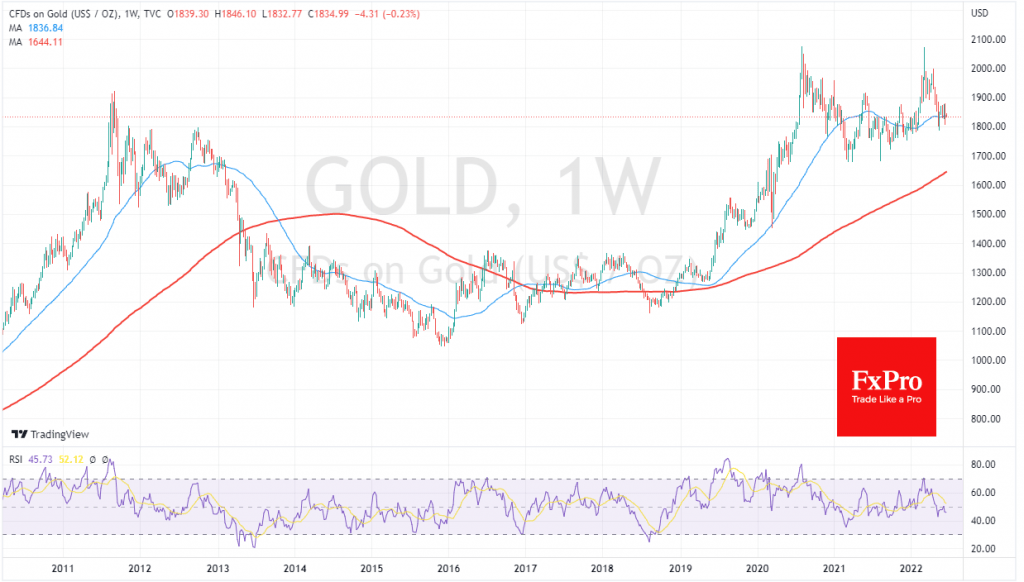
Last week, when the 10-year Treasury yield was rising temporarily to 3.5%, it tested the $1800 area.
However, there are several essential points to understand in this correlation.
First, the 10-year Treasury yields touched 11-year highs last week, while gold has retreated only to the levels last seen at the start of the year. In other words, an active capital outflow from gold only occurs when yields decline sharply, whereas the long-term trend favours the shiny metal. This correlation can easily be explained by inflation, which eats into the purchasing power of money in the long term.
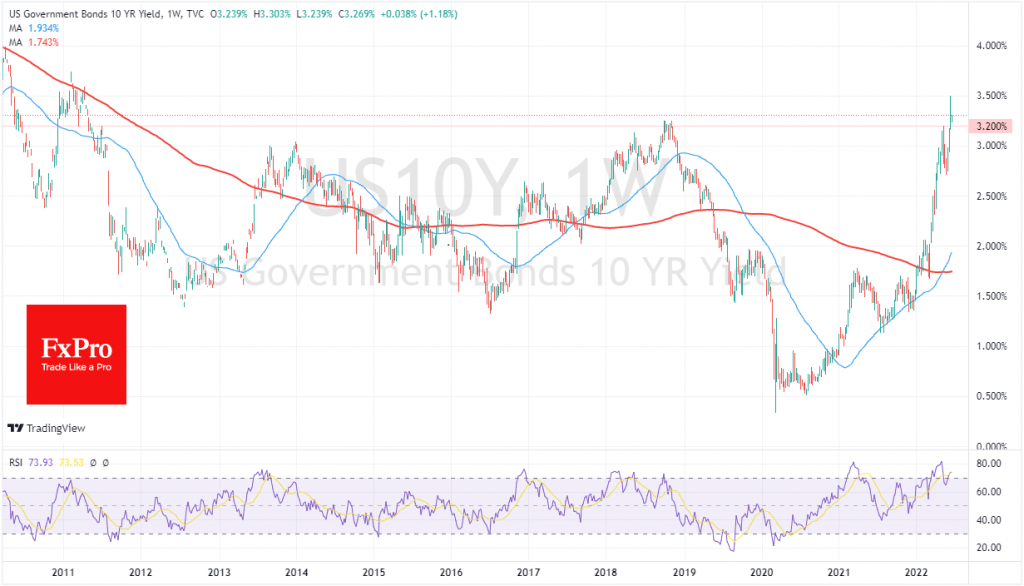
Secondly, 10-year yields are not so much influenced by short-term Fed interest rates as economic growth forecasts. Increased chances of a recession in the foreseeable future have dampened long-term yields. In addition, there are signs that the upward movement in UST yields was too fast, setting up a corrective pullback in the near term.
In our opinion, the potential danger for gold is a further tightening of the Fed’s tone, i.e. hints of new steps of a 75-point rate hike and a willingness to keep rates above inflation. But so far, we have seen a significant outperformance of inflation over key rates, and comments from FOMC members indicate a willingness to stop with a tightening in the 3.5-4.0% area, with no attempt to ride out inflation and a reversal to a rate cut as early as 2024. Such outlooks are keeping long-term bond yields in check and, at the same time fuelling interest in a strategy of buying gold during intense downturns.
Locally, creeping upward bond yields are working for sellers of gold. This also has a bearish signal in the form of consolidation below the 200-day (or 50-week) moving average.
However, gold’s resilience drew attention when markets overestimated expectations of a rate hike from 50 to 75 points and multiple buying gains on dips under the 200-day moving average since December last year.
RBA’s Lowe Signals 50-bps Hike
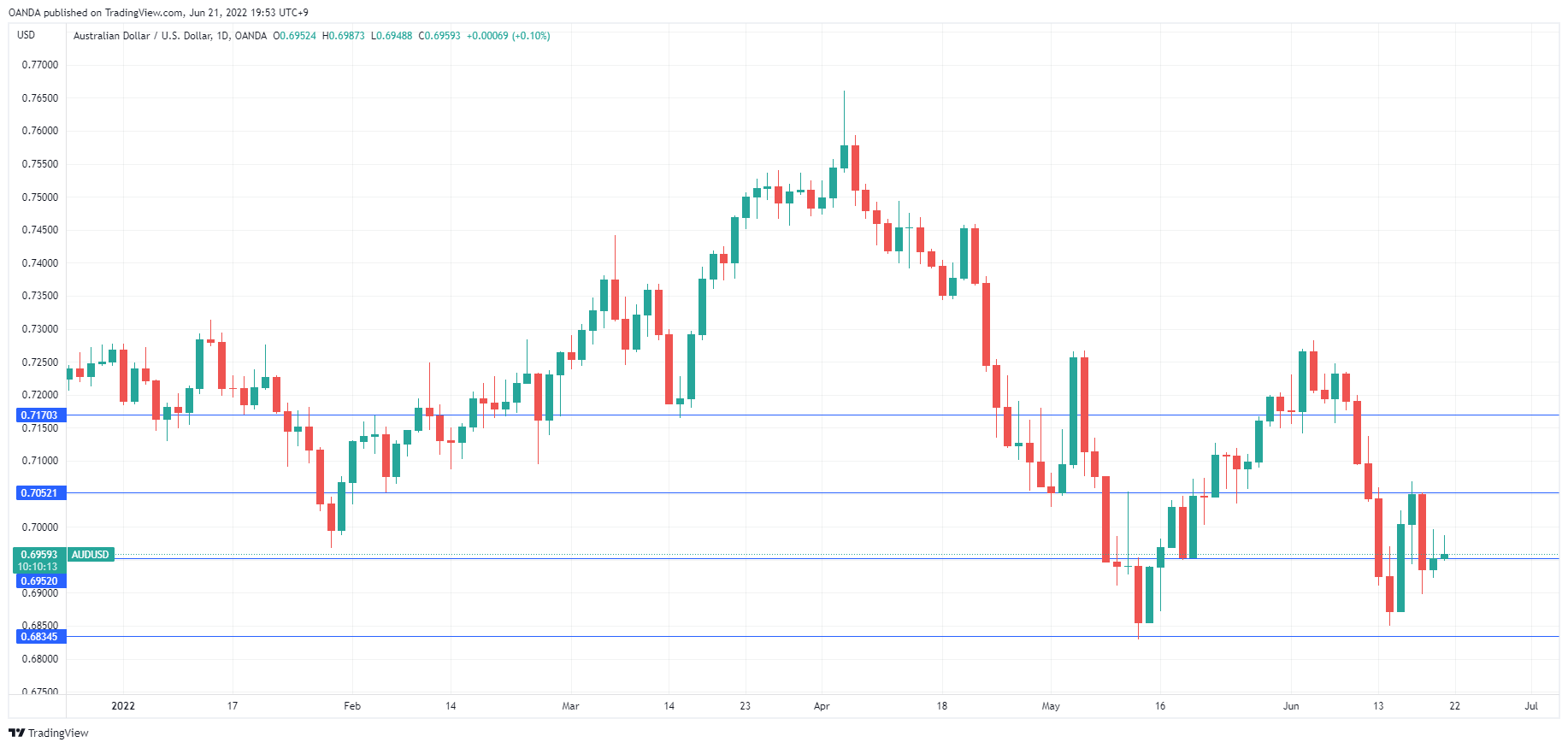
It continues to be a quiet week for the Australian dollar, in sharp contrast to last week’s roller-coaster ride. AUD/USD has edged higher today, as the market response to the RBA minutes and a speech from Governor Lowe has been muted.
RBA minutes, Lowe offer few clues
Anyone looking for some guidance from the RBA minutes came away disappointed, as the gist of the minutes was a defence of the surprise move to raise interest rates by 50bps at the meeting. The markets had expected a modest hike of 0.25%. The minutes noted that even with the supersize 50-bps move, the Cash Rate remained below 1%, and it was clear to members that policy remained highly stimulative and further rate hikes would be required. The minutes noted that the RBA was relying on strong consumer spending and a solid labour market to enable the central bank to continue to raise rates.
Inflation remains the RBA’s number one time on the agenda, with Q4 CPI rising to 7.0%. The minutes stated that the RBA expected inflation to continue to accelerate before easing and would move towards the top of the RBA’s target of 1%-3%. With an inflation peak still nowhere to be seen, the markets have priced in 95% odds of a 50bps move in July. RBC and Goldman Sachs are predicting a series of 50bps moves in July, August and September. It seems clear that the RBA will be in a very aggressive mode in the second half of 2022, which could provide key support for the Australian dollar.
In a speech after the minutes, Governor Lowe stated that a 75-bps hike was off the table in July. Analysts were quick to point out that Lowe only ruled out such a move in July, perhaps giving himself room for a super-size hike at a later date. Lowe also admitted that the exit from the RBA’s yield target in 2021 had been “disorderly” and the credibility of the bank had been damaged.
AUD/USD Technical
- AUD/USD is testing support at 0.6952. Below, there is support at 0.6834
- There is resistance at 0.7052 and 0.7170
EUR/USD: Recovery Continues to Face Strong Headwinds from Thick Daily Cloud
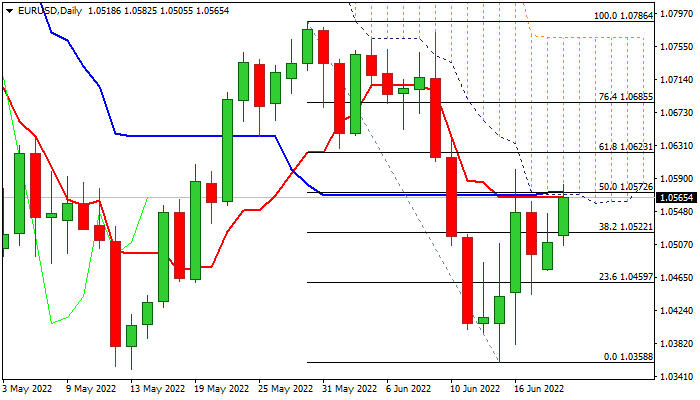
The Euro advances for the second consecutive day and cracks strong resistance provided by the base of thick daily cloud (1.0569) reinforced by converged daily Tenkan-sen/Kijun-sen.
Recovery was already rejected under the cloud base last week, as cloud heavily weighs on the single currency and adds to negative fundamentals.
Strong dollar’s safe-haven appeal and support from expectation that the Fed will remain aggressive in policy tightening, keeps the Euro in defensive.
I addition, the data released today, showed that EU’s current account balance slipped into deficit for the first time since 2012 that would have a negative impact on Euro, which was supported by a big surplus during past years.
The action is expected to continue to face strong headwinds from thick cloud and repeated failure to clearly break into cloud would signal another recovery stall and keep the downside at risk. Daily techs remain in bearish setup and add to negative outlook.
Res: 1.0601; 1.0623; 1.0641; 1.0686.
Sup: 1.0505; 1.0483; 1.0459; 1.0380.
Bitcoin’s Decline Oversold, But Too Early to Talk About a New Rally
Bitcoin has rebounded 5% in the past 24 hours, trading at $20,800. Ethereum has recovered 6.4% to $1130 in the same time frame. Leading altcoins in the top 10 are adding from a modest 3.5% (XRP) to an impressive 15% (Solana).
Total cryptocurrency market capitalisation, according to CoinMarketCap, rose 5% to $914bn. Tuesday, the cryptocurrency fear and greed index was unchanged at 9 points (“extreme fear”).
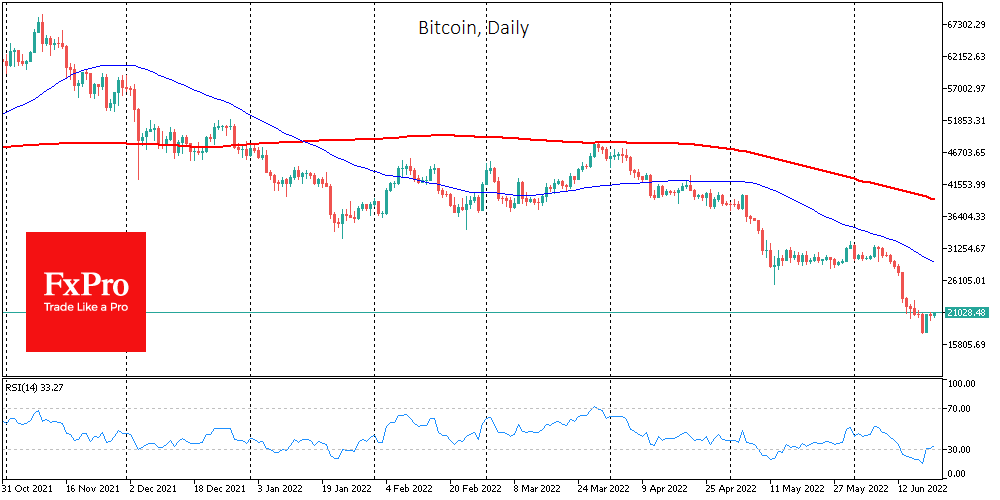
Bitcoin managed to hold above the $20,000 round level on Monday amid weak trading activity due to the US holidays and attracting enough speculative demand after dipping below the meaningful round level. This recovery removes some of the extreme oversold nature of the cryptocurrency. Still, it will be too early to talk about a long-term reversal: all negative fundamentals remain.
In our view, until sharp monetary policy tightening becomes the norm, financial market pressures can quickly negate bounces in cryptocurrencies. Even if we have seen a bottom, it could still be months before the next sustained rally.
Bitcoin’s return above $20,000 does not mean it has hit “the bottom”, warned renowned cryptocurrency critic and gold supporter Peter Schiff.
Kraken exchange marketing director Dan Held said bitcoin had chosen the most pessimistic scenario possible amid rising inflation and an impending recession. According to him, “those who survive will get HODLer status”.
El Salvador President Nayib Bukele urged the cryptocurrency community not to panic as the market falls. According to him, the decline is relatively standard, and market participants must be patient.
JPMorgan Bank said that the rising share of stable coins in the total market capitalisation of the crypto market indicates its growth potential. Changpeng Zhao, chief executive of cryptocurrency exchange Binance, denied media reports that the platform bought more than 100K BTC on a falling market.
ECB Rehn: Sharply rising inflation justifies expedite policy normalization
ECB Governing Council member Olli Rehn said, "with inflation rising sharply, there has been good reason to expedite the normalization of monetary policy,"
"The impacts of Russia's brutal war are being felt around the world, and people are having to pay higher prices for energy and food," he said.