Sample Category Title
Fed Delivers Biggest Rate Hike Since 1994
Market movers today
Markets will continue to digest the FOMC meeting yesterday while focus turns to meetings in Bank of England (BoE) and SNB today. We look for BoE to hike the Bank Rate by another 25bp but simultaneously still send mixed signals by repeating that "some degree of further tightening in monetary policy may still be appropriate in the coming months".
In Switzerland, we do not expect the SNB to hike but the pressure is increasing, as the ECB is about to hike policy rates and CPI inflation is running close to 3%.
In the US data releases for housing starts, initial jobless claims and the Philadelphia Fed business survey is due out.
We will also keep an eye on German Chancellor Scholz, French President Macron and Italian PM Draghi's visit to Ukraine for talks with President Zelenskiy.
Early Friday, Bank of Japan (BoJ) finishes up a two-day policy meeting. Our base case is that they will keep steady but the chance of a tweak to the yield curve control set-up in order to ease JPY headwinds has increased just as is the case for the chance of BoJ intervening in the FX market on behalf of Tokyo.
The 60 second overview
Fed: In line with expectations, the Federal Reserve decided to hike the target range by 75bp to 1.50-1.75%. We have emphasised for a long time that the Fed could be forced to follow the "emerging market central bank playbook" by out-hiking expectations and yesterday's announcement seems to be the first step in that direction. While the Federal Reserve now says it is "strongly committed" to get inflation back to 2%, Chair Jerome Powell's press conference was interpreted dovishly, as he indicated that the Fed is not going to make a string of 75bp rate hikes. EUR/USD moved higher and 2yr US Treasury yields declined after this comment. We change our Fed call now expecting the Fed to hike by 75bp in July and 50bp in September, November and December, see Fed Research - Review: big rate hikes until inflation pressure eases., 15 June.
ECB: To address the recent spread widening in particularly Italy, ECB decided to announce that they will flexibly implement the PEPP reinvestments as well as accelerate the work on a new anti-fragmentation work for the governing council to consider. The political signal is strong, but the exact details will determine the actual strength of a potentially new anti-fragmentation tool. We see the decision today as the most likely outcome for now. Further, with ECB tasking the committees they have sent a signal that they are fully committed to ensuring the functioning of the monetary policy transmission. However, they have also bought themselves some time. We will likely only hear from the committees at the July or September meeting.
Japan posted its biggest trade deficit in eight years in May, as import costs continue to weigh heavily for one of the world's biggest energy importers following the big nose dive in yen. Nearly half of Japanese firms see the weak yen as bad for business according to a private survey, see Reuters.
Equities: Equities in a relief rally after a convincing Fed and deflationary macro data. Sector performance reversed with cyclical growth sector (tech) outperforming defensives. Hence, big gap between indices with S&P 500 rebounded 1.5% but Nasdaq 2.5%. Futures are pointing somewhat higher this morning too.
FI: The market reaction to the FOMC meeting yesterday may seem surprising as US Treasury yields/rates declined on the back of a fairly aggressive Federal Reserve and we are revising our forecast for the monetary policy path upwards. Similar to others we change our Fed call and now expect the Fed to hike by 75bp in July and 50bp in September, November and December. However, the market is focusing on the recession risk as well as the comments from Powell that they are not expecting a string of 75bp moves. Yesterday, the ECB announced that they will prepare a backstop facility to stop market fragmentation sooner rather than later. This lead to a massive rally in the periphery and solid spread tightening.
FX: EUR/USD had quite a volatile session yesterday. At some point, EUR/USD was above 1.05 before moving down below 1.04. The cross ended the day slightly above 1.04 after the cross was supported by dovish comments (at least compared to market pricing) from Fed Chair Jerome Powell. EUR/GBP started the day by moving above 0.87 but ended below 0.86. We could see slight relief for NOK and SEK near-term as Fed did little to tighten financial conditions more than what was already priced going into the meeting.
Credit: Credit markets took a pause yesterday from the past several trading days of widening. The indices closed ahead of the Fed decision, with iTraxx main closing some 3.5bp tighter at 105bp and Xover closing some 16.6bp tighter at 527.9bp.
A False Relief
A relief was what I expected after the Federal Reserve’s (Fed) fully priced decision to hike the rates by 75bp yesterday, but a rally is what happened.
Nasdaq jumped 2.5% and the S&P500 recovered 1.5%.
The reason for the post-Fed rally is perhaps not that the market was happy to hear that Powell doesn’t think that 75bp hikes would become ‘common’ in the near future - as we may see at least one more 75bp hike this summer, but it was the fact that the market had gone well ahead of itself in terms of hawkish pricing, and a part of the hawkish bets were cut after the announcement.
And the announcement was all but dovish. The dot plot showed that the Fed officials mostly think that the rates would reach 3.4% late this year, up from 1.9% plotted in March.
US yields eased as the Fed hawks scaled back their expectations to a softer reality, and the US dollar index came down from a fresh two-decade high. The futures are in the positive at the time of writing, but the optimism may not last long, as the economic picture and the Fed news are, in fact, less than ideal.
Yesterday’s retail sales data printed an unexpected negative number in May, hinting that inflation may be taking a toll. Jerome Powell said he sees ‘no signs’ of a broader slowdown in the economy. But, he was also saying that inflation would be transitory last year.
What now?
We will likely continue seeing choppy market conditions.
One good news is the softening oil prices, as investors price a higher chance of recession, which would curb oil demand and ease prices. The barrel of US crude is down to $115 level this morning, even after the weekly data showed that the US inventories grew slower than expected.
But the price pullbacks will likely attract fresh long positions, as recovery in Chinese demand, the global pickup in travel, and the tight crude supplies should support the bullish market in the medium run.
Alors, Christine?
The aggressive hawkish shift in Fed policy, the rising US rates and the soaring US dollar are not a gift for the other central banks.
The European Central Bank had an emergency meeting yesterday, to discuss how to slow the soaring bond yields after they announced the end of the asset purchases program last week, but more importantly how to prevent the peripheral yields from soaring faster than the core yields.
Now that the Fed steps on gas to raise rates faster, the ECB and the other central banks need to catch up with the Fed. Otherwise, the stronger US dollar would make the other countries’ imports, especially the energy and commodity imports, way more expensive than they already are. And that would lead to higher inflationary pressures and hawkish central bank policies.
We know Christine Lagarde doesn’t want to conduct a catch-up policy with the Fed, and that Mario Draghi thinks that raising the interest rates in Europe is a terrible idea as the European inflation comes from high energy prices, and not from high demand.
But the European inflation is boosted by the soaring dollar as energy purchases happen in USD.
Therefore, the ECB must make sure that the highly indebted peripheral countries will be able to withstand a tighter ECB policy, to avoid throwing a renewed debt crisis on top of the pandemic, war and soaring inflation. As a result, the ECB will apparently invent another instrument, an anti-fragmentation instrument, to buy the most fragile countries’ debt, hoping to reduce the differential between the core and the periphery yields.
Good luck making the Germans buy the idea.
BoE & SNB: No fireworks expected
We watch two other monetary policy meetings today, the Bank of England (BoE) and the Swiss National Bank (SNB).
The BoE is set to raise the bank rate for the 5th straight meeting, but the pound will hardly gain on that decision unless we see a bigger hike.
Some expect the SNB to move in tandem with the ECB to tame inflation. But the truth is, the SNB has little incentive to tighten hurriedly as long as the franc helps tame inflation. The SNB is also expected to say goodbye to the negative policy rates in the coming quarters. We shall see the negative rates vanish by the end of the Q1 of next year. But there is probably no hurry from the SNB to tighten quickly. The longer the Swiss could keep the rates at supportive levels, the better it is for their economy!
USD/CHF Daily Outlook
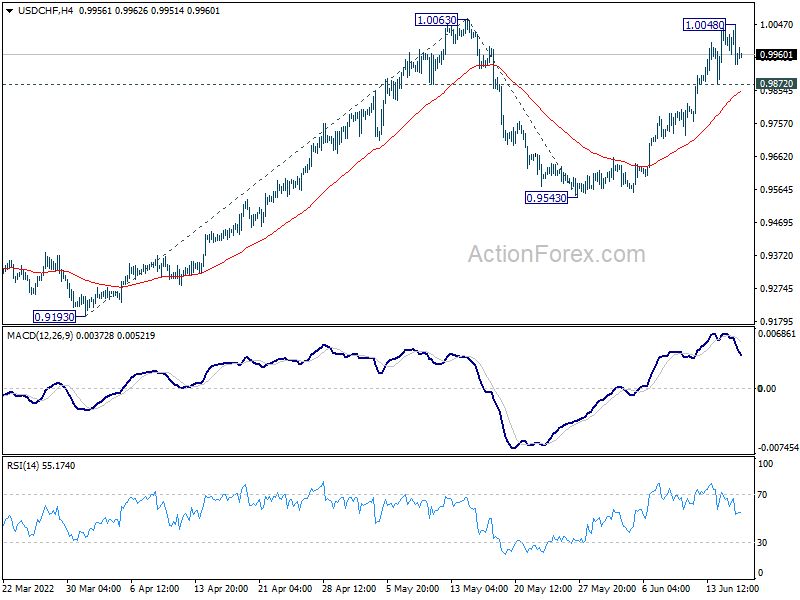
Daily Pivots: (S1) 0.9899; (P) 0.9974; (R1) 1.0017; More...
Intraday bias in USD/CHF is turned neutral again as it lost momentum ahead of 1.0063 resistance. On the upside, firm break of 1.0063 will resume larger up trend. Next target is 100% projection of 0.9193 to 1.0063 from 0.9543 at 1.0413. On the downside, below 0.9872 minor support will turn intraday bias to the downside, to extend the corrective pattern from 1.0063 with another falling leg.
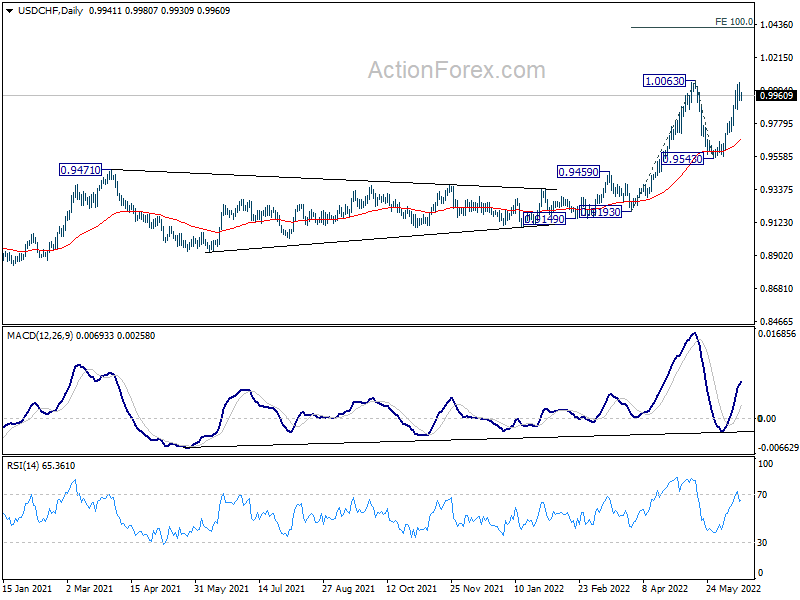
In the bigger picture, down trend from 1.0342 (2016 high) should have completed with three waves down to 0.8756 (2021 low) already. Rise from 0.8756 is likely a medium term up trend of its own. Next target is 1.0237/0342 resistance zone. This will remain the favored case as long as 0.9471 resistance turned support holds. However, sustained break of 0.9471 will extend long term range trading with another falling leg.
SNB and BoE Next after Fed Delivered
US stocks recovered overnight after Fed delivered the 75bps rate hike as market priced in, while Dollar and yields retreated. Asian markets are mixed with some weakness seen in Hong Kong HSI. For the week, the greenback remains the strongest one, except versus Yen which it's paring gains against. Sterling is the worst performing as focus now turns to SNB and then BoE rate decision.
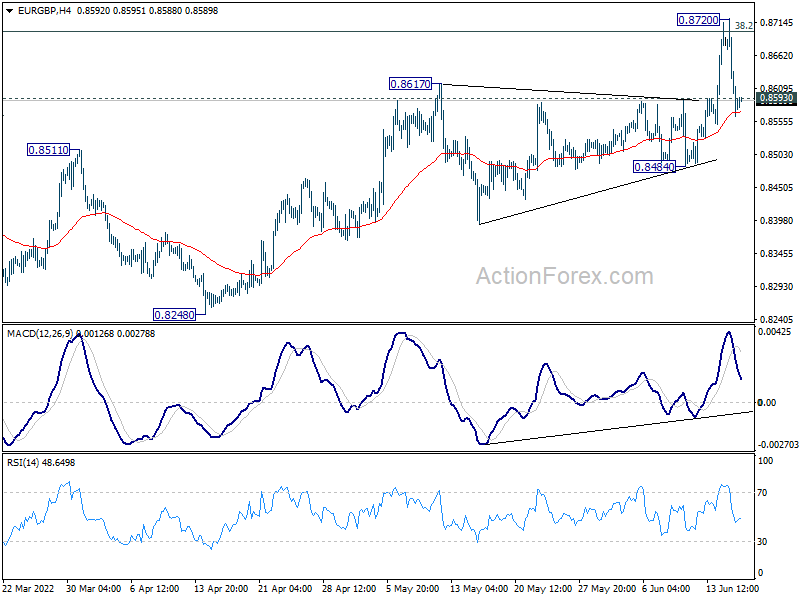
Technically, there is some downside prospect for Dollar for the near term, given then it was rejected against near term resistance levels against most peers. The levels include 1.0348 in EUR/USD, 0.6828 support in AUD/USD, 1.0063 resistance in USD/CHF and 1.3075 resistance in USD/CAD. Euro is the exception as it's clearly weak against Sterling, Aussie and Canadian. In particular, eyes will be on whether side of the range of 0.8484/8720 would EUR/GBP breaks through.
In Asia, at the time of writing, Nikkei is up 0.82%. Hong Kong HSI is down -1.14%. China Shanghai SSE is down -0.28%. Singapore Strait Times is up 0.69%. Japan 10-year JGB yield is down -0.0118 at 0.244. Overnight, DOW rose 1.00%. S&P 500 rose 1.46%. NASDAQ rose 2.50%. 10-year yield dropped -0.088 to 3.395.
Fed hikes by 25bps, forecasts rate at 3.4% by end of 2022
Fed hikes by 75bps to 1.50-1.75%. Esther George dissented and voted for a 50bps hike only. Fed said that it's "highly attentive to inflation risks" in the statement. Also, Fed now forecasts interest rate to be at 3.4% by the end of this year, sharply higher than prior estimate of 1.9%. Also, in the new dot plot, all members penciled in rate hikes to 3.125% and above by the end of 2022.
In the new median economic projections, federal funds rate is forecast to be at:
- 3.4% by the end of 2022 (up from 1.9%)
- 3.8% by the end of 2023 (up from 2.8%)
- 3.4% by the end of 2024 (up from 2.8%)
GDP growth is forecast to be at:
- 1.7% in 2022 (down from 2.8%)
- 1.7% in 2023 (down from 2.2%)
- 1.9% in 2024 (down from 2.0%)
PCE inflation is forecast to be at:
- 5.2% in 2022 (up from 4.3%)
- 2.6% in 2023 (down from 2.7%)
- 2.2% in 2024 (down from 2.2%)
Core PCE inflation is forecast to be at:
- 4.3% in 2022 (up from 4.1%)
- 2.7% in 2023 (up from 2.6%)
- 2.3% in 2024 (unchanged).
Unemployment rate is forecast to be at:
- 3.7% in 2022 (up from 3.5%)
- 3.9% in 2023 (up from 3.5%)
- 4.1% in 2024 (up from 3.6%)
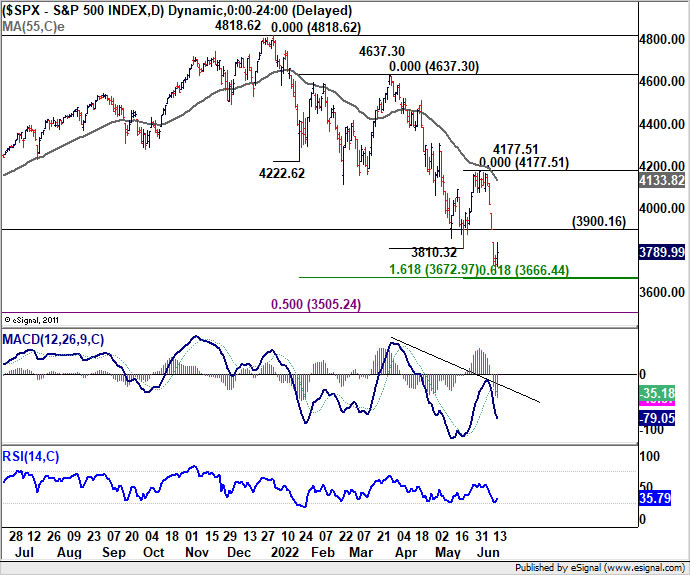
S&P 500 rose as traders covered on Fed news
US stocks closed higher overnight even though FOMC delivered an "uncommon" mega hike of 75bps. Fed Chair Jerome Powell also indicated at the post-meeting press conference that "either a 50 basis point or a 75 basis point increase seems most likely at our next meeting" while "ongoing rate increases will be appropriate."
The recovery in stocks is more seen as a "sell-on-rumors-cover on news" move. Fed delivered what the markets have expected and the selloff was already done earlier in the week. Also, some would give a nod to Fed's determination to combat inflation and create the conditions for a soft-landing, even though it's a big challenge.
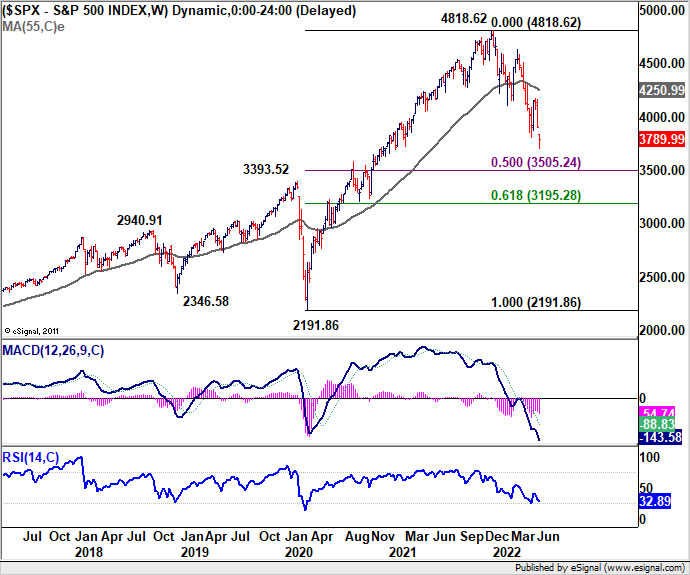
The condition for a stronger rebound in S&P 500 is there, give that it's close to 3666.44/3672.97 cluster projection (61.8% projection of 4637.30 to 3810.32 from 4177.51 at 3666.44, 161.8% projection of 4818.62 to 4222.62 from 4637.30 at 3672.97). Yet, SPX will need to break through the top end of the latest gap at 3900.16 to indicate stabilization first. Otherwise, risk will remain heavily on the downside. Deeper fall into support zone between 3195.28 and 3505.24 (61.8% and 50% retracement of 2191.86 to 4818.62) is too early to be ruled out at this point.
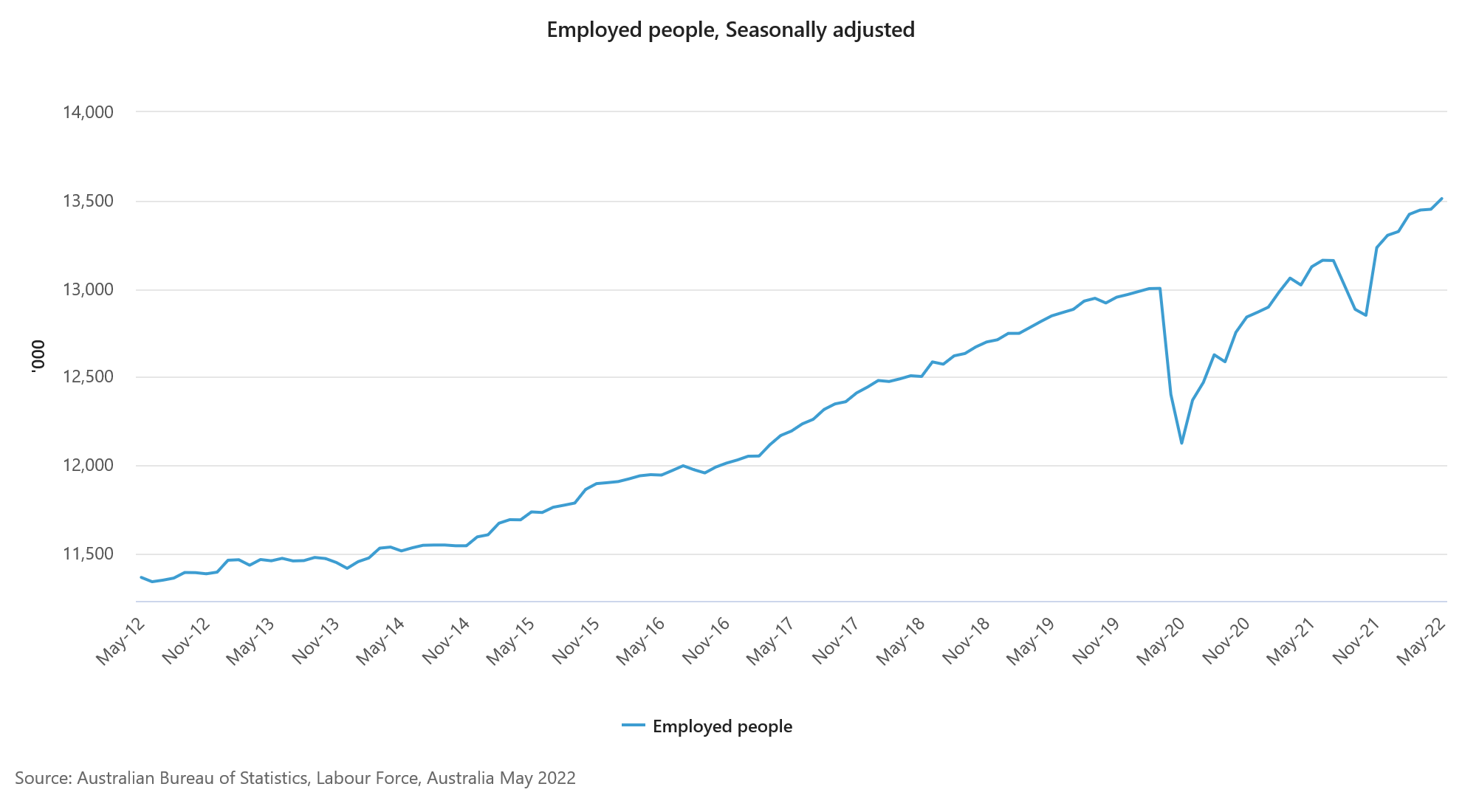
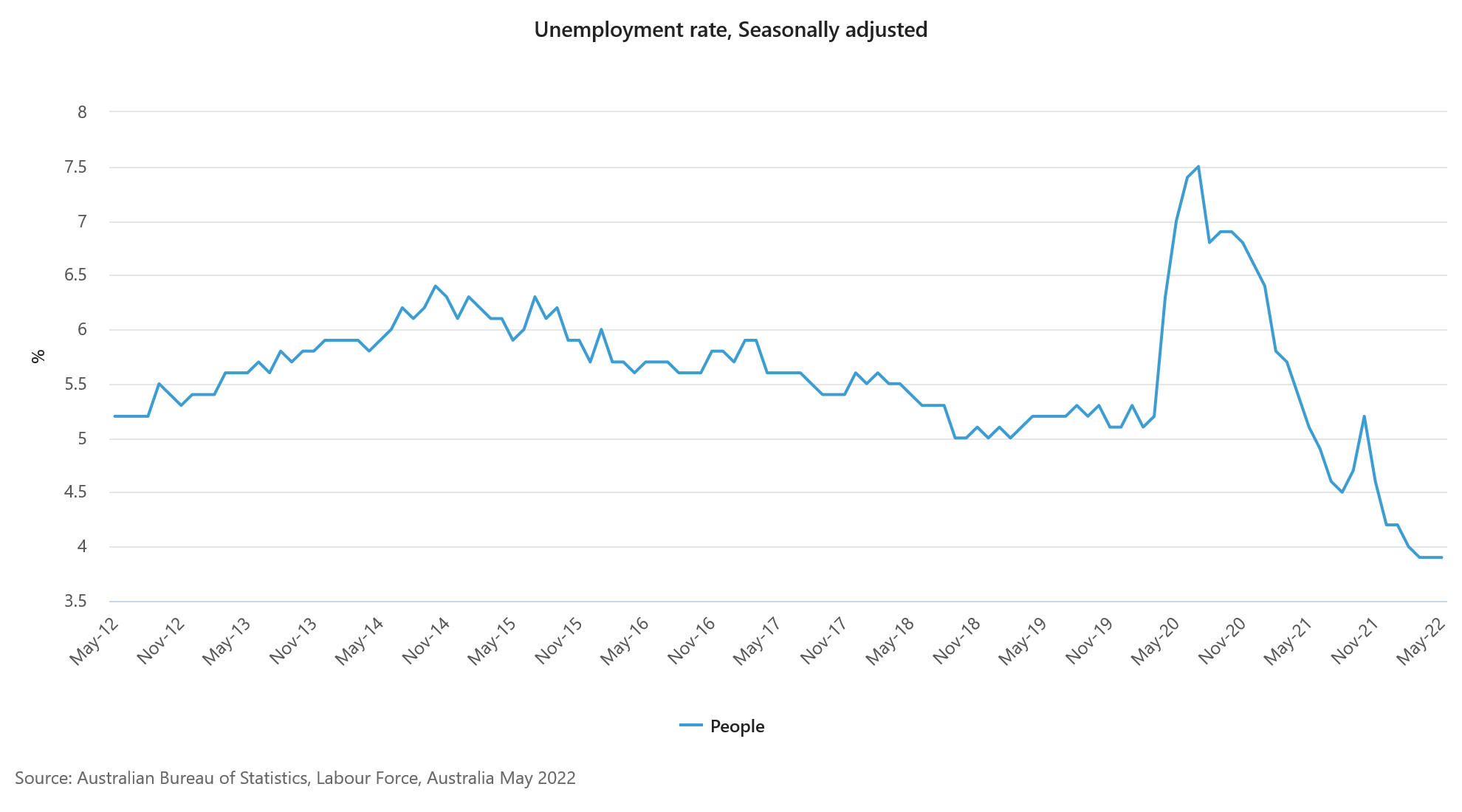
Australia employment rose 60.6k in May, strong growth in hours worked
Australia employment rose 60.6k in May, better than expectation of 25.0k. Full-time jobs rose 69.4k while part-time jobs dropped -8.7k. Unemployment rate was unchanged at 3.9%, above expectation of 3.8%. Participation rate rose 0.3% to 66.7%. Monthly hours worked rose 0.9% mom or 17m.
Bjorn Jarvis, head of labour statistics at the ABS, said: "The increase in May 2022 was the seventh consecutive increase in employment, following the easing of lockdown restrictions in late 2021. Average employment growth over the past three months (30,000) continues to be stronger than the pre-pandemic trend of around 20,000 people per month.
"In addition to the continuing trend of increasing employment, we have continued to see relatively stronger growth in hours worked. This is something we also saw this time last year, before the Delta outbreak."
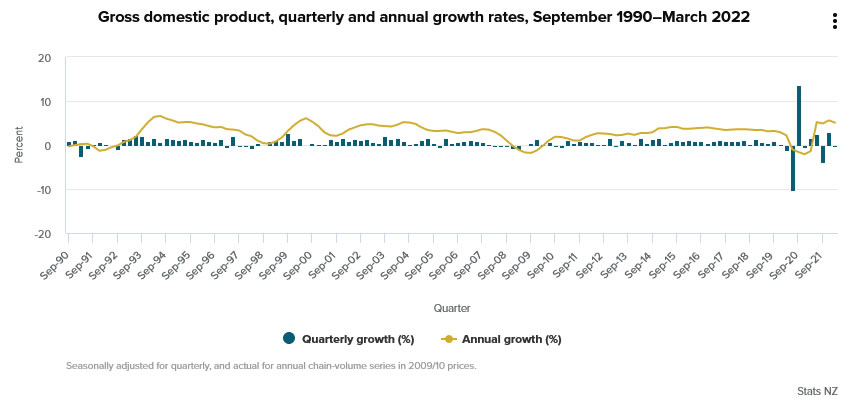
New Zealand GDP fell -0.2% qoq in Q1, primary industries drove contraction
New Zealand GDP contracted -0.2% qoq in Q1, much worse than expectation of 0.6% qoq.
StatsNZ said: "Primary industries drove the decrease in GDP, down 1.2 percent in the quarter. Goods producing industries also experienced a slight decline, down 0.1 percent.
"The service industry group, which makes up approximately two thirds of the economy, remained flat. This result reflects falls in some industries being offset by rises in others."
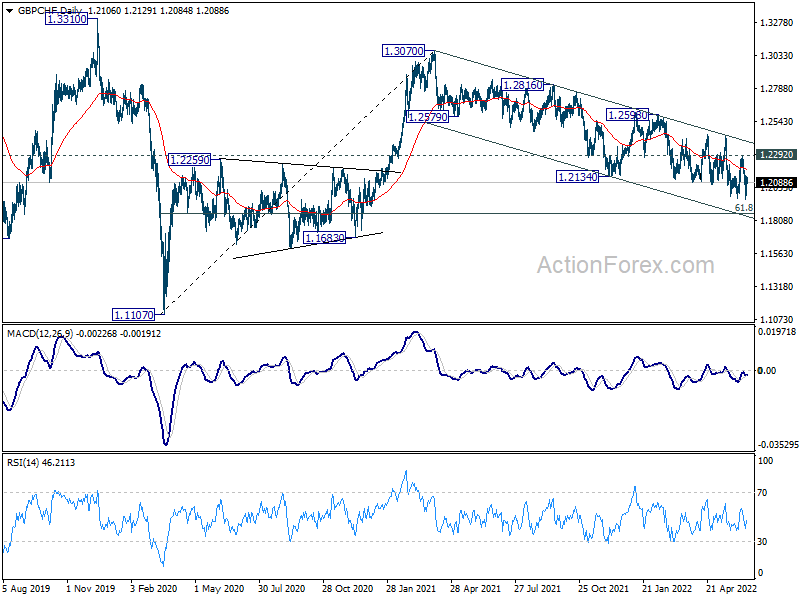
GBP/CHF staying bearish as SNB and BoE loom
SNB and BoE rate decisions are the next focuses for today. SNB is expected to policy unchanged today but start turning up a hawkish tone, setting the stage for the first rate hike in 15 years at the September meeting. Inflation reaching 2.9%, a 14-year high, in May isn't much of a problem comparing to other parts of the world. Yet, ECB's tightening stance is giving SNB much room to adjust policy now.
The situation for BoE is more complicated. A 25bps hike to 1.25% is the base case. There are arguments for a larger hike with inflation at 7.8% yoy. Yet, there are also arguments for a pause given that UK economy has already started a recession in Q2. The eventual decision and the voting could drive much volatility in the Pound.
Here are some previews for BoE and SNB:
- Bank of England Preview
- BoE Meeting Preview – 50bps or 25bps hike that is the question
- Bank of England: Steady as She Goes?
- SNB Meeting: Higher Rates or Patience?
GBP/CHF is staying in the down trend from 1.3070 for now and outlook remains bearish as long as 1.2292 resistance holds. But the structure of the decline suggests that it's more of a corrective move. Downside potential could be limited with strong support at around 61.8% retracement of 1.1107 to 1.3070 at 1.1857 to complete the down trend.
USD/CHF Daily Outlook
Daily Pivots: (S1) 0.9899; (P) 0.9974; (R1) 1.0017; More...
Intraday bias in USD/CHF is turned neutral again as it lost momentum ahead of 1.0063 resistance. On the upside, firm break of 1.0063 will resume larger up trend. Next target is 100% projection of 0.9193 to 1.0063 from 0.9543 at 1.0413. On the downside, below 0.9872 minor support will turn intraday bias to the downside, to extend the corrective pattern from 1.0063 with another falling leg.
In the bigger picture, down trend from 1.0342 (2016 high) should have completed with three waves down to 0.8756 (2021 low) already. Rise from 0.8756 is likely a medium term up trend of its own. Next target is 1.0237/0342 resistance zone. This will remain the favored case as long as 0.9471 resistance turned support holds. However, sustained break of 0.9471 will extend long term range trading with another falling leg.
Economic Indicators Update
| GMT | Ccy | Events | Actual | Forecast | Previous | Revised |
|---|---|---|---|---|---|---|
| 22:45 | NZD | GDP Q/Q Q1 | -0.20% | 0.60% | 3.00% | |
| 23:50 | JPY | Trade Balance (JPY) May | -1.93T | -1.70T | -1.62T | -1.58T |
| 01:00 | AUD | Consumer Inflation Expectations Jun | 6.70% | 5.00% | ||
| 01:30 | AUD | Employment Change May | 60.6K | 25.0K | 4.0K | 4.4K |
| 01:30 | AUD | Unemployment Rate May | 3.90% | 3.80% | 3.90% | |
| 07:30 | CHF | SNB Interest Rate Decision | -0.75% | -0.75% | ||
| 11:00 | GBP | BoE Interest Rate Decision | 1.25% | 1.00% | ||
| 11:00 | GBP | MPC Official Bank Rate Votes | 9--0--0 | 9--0--0 | ||
| 12:30 | CAD | Wholesale Sales M/M Apr | 0.50% | 0.30% | ||
| 12:30 | USD | Initial Jobless Claims (Jun 10) | 230K | 229K | ||
| 12:30 | USD | Housing Starts May | 1.71M | 1.72M | ||
| 12:30 | USD | Building Permits May | 1.79M | 1.82M | ||
| 12:30 | USD | Philadelphia Fed Manufacturing Survey Jun | 5.5 | 2.6 | ||
| 14:30 | USD | Natural Gas Storage | 92B | 97B |
GBP/CHF staying bearish as SNB and BoE loom
SNB and BoE rate decisions are the next focuses for today. SNB is expected to policy unchanged today but start turning up a hawkish tone, setting the stage for the first rate hike in 15 years at the September meeting. Inflation reaching 2.9%, a 14-year high, in May isn't much of a problem comparing to other parts of the world. Yet, ECB's tightening stance is giving SNB much room to adjust policy now.
The situation for BoE is more complicated. A 25bps hike to 1.25% is the base case. There are arguments for a larger hike with inflation at 7.8% yoy. Yet, there are also arguments for a pause given that UK economy has already started a recession in Q2. The eventual decision and the voting could drive much volatility in the Pound.
Here are some previews for BoE and SNB:
- Bank of England Preview
- BoE Meeting Preview – 50bps or 25bps hike that is the question
- Bank of England: Steady as She Goes?
- SNB Meeting: Higher Rates or Patience?
GBP/CHF is staying in the down trend from 1.3070 for now and outlook remains bearish as long as 1.2292 resistance holds. But the structure of the decline suggests that it's more of a corrective move. Downside potential could be limited with strong support at around 61.8% retracement of 1.1107 to 1.3070 at 1.1857 to complete the down trend.
Australia employment rose 60.6k in May, strong growth in hours worked
Australia employment rose 60.6k in May, better than expectation of 25.0k. Full-time jobs rose 69.4k while part-time jobs dropped -8.7k. Unemployment rate was unchanged at 3.9%, above expectation of 3.8%. Participation rate rose 0.3% to 66.7%. Monthly hours worked rose 0.9% mom or 17m.
Bjorn Jarvis, head of labour statistics at the ABS, said: "The increase in May 2022 was the seventh consecutive increase in employment, following the easing of lockdown restrictions in late 2021. Average employment growth over the past three months (30,000) continues to be stronger than the pre-pandemic trend of around 20,000 people per month.
"In addition to the continuing trend of increasing employment, we have continued to see relatively stronger growth in hours worked. This is something we also saw this time last year, before the Delta outbreak."
New Zealand GDP fell -0.2% qoq in Q1, primary industries drove contraction
New Zealand GDP contracted -0.2% qoq in Q1, much worse than expectation of 0.6% qoq.
StatsNZ said: "Primary industries drove the decrease in GDP, down 1.2 percent in the quarter. Goods producing industries also experienced a slight decline, down 0.1 percent.
"The service industry group, which makes up approximately two thirds of the economy, remained flat. This result reflects falls in some industries being offset by rises in others."
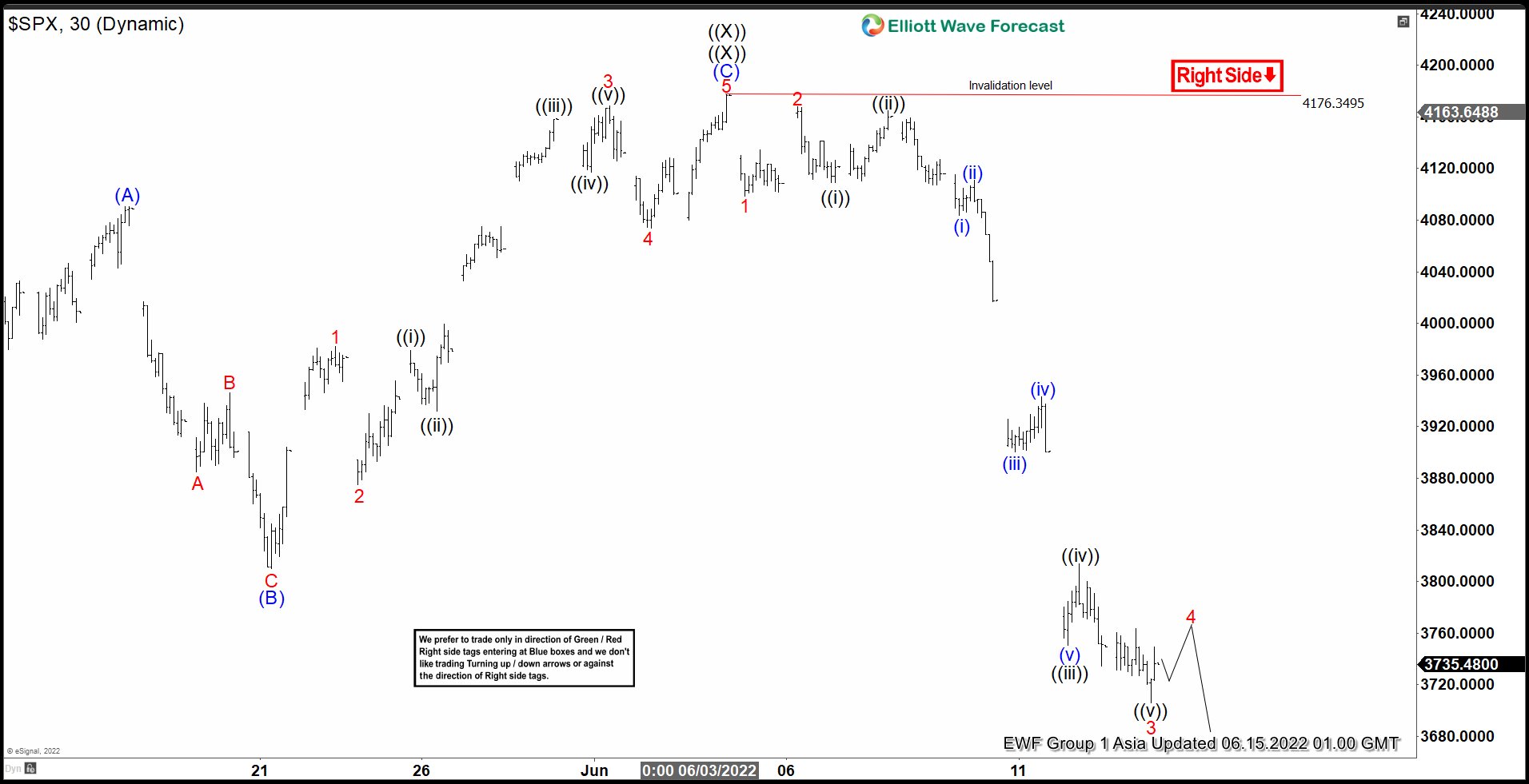
S&P 500 rose as traders covered on Fed news
US stocks closed higher overnight even though FOMC delivered an "uncommon" mega hike of 75bps. Fed Chair Jerome Powell also indicated at the post-meeting press conference that "either a 50 basis point or a 75 basis point increase seems most likely at our next meeting" while "ongoing rate increases will be appropriate."
The recovery in stocks is more seen as a "sell-on-rumors-cover on news" move. Fed delivered what the markets have expected and the selloff was already done earlier in the week. Also, some would give a nod to Fed's determination to combat inflation and create the conditions for a soft-landing, even though it's a big challenge.
The condition for a stronger rebound in S&P 500 is there, give that it's close to 3666.44/3672.97 cluster projection (61.8% projection of 4637.30 to 3810.32 from 4177.51 at 3666.44, 161.8% projection of 4818.62 to 4222.62 from 4637.30 at 3672.97). Yet, SPX will need to break through the top end of the latest gap at 3900.16 to indicate stabilization first. Otherwise, risk will remain heavily on the downside. Deeper fall into support zone between 3195.28 and 3505.24 (61.8% and 50% retracement of 2191.86 to 4818.62) is too early to be ruled out at this point.
Elliott Wave View: Dips in USD/CAD should find buyers
USD/CAD 45 minutes chart below shows that the pair has ended 3 wave pullback from June 15 high in wave 2. The pullback unfolded as double three Elliott Wave structure and ended at 1.3482 low. Afterwards, the pair resumed higher in wave 3. Up from 1.3482 low, wave ((i)) ended at 1.3559 high. Wave ((ii)) pullback ended at 1.3525 low. The pair then extended higher in wave ((iii)), which ended at 1.3666 high. The internal subwave of wave ((iii)) unfolded as 5 waves impulse Elliott Wave structure in lesser degree. The pullback in wave ((iv)) then unfolded as a triangle and ended at 1.3632 low. From there, the pair pushed higher in wave ((v)) which ended at 1.3715 high. This final move completed wave 3 in higher degree and ended cycle from June 23 low.
The pair is currently doing a pullback in wave 4 to correct the cycle from June 23 low. The correction is unfolding as a double three structure. Down from wave 3 high, the pair ended wave ((w)) at 1.3642 low. Wave ((x)) bounce ended at 1.3705 high. Wave ((y)) is currently in progress. While above 1.3482 low, expect the dips to find support in 7 or 11 swings for more upside. The 100 -161.8% extension of wave ((w))-((x)) where wave ((y)) can potentially end is at 1.3586 – 1.3631 area and shown with a blue box. That area, if reached later, can see a reaction for 3 waves bounce at least.
USD/CAD 45 Minutes Elliott Wave Chart
Technical Outlook and Review
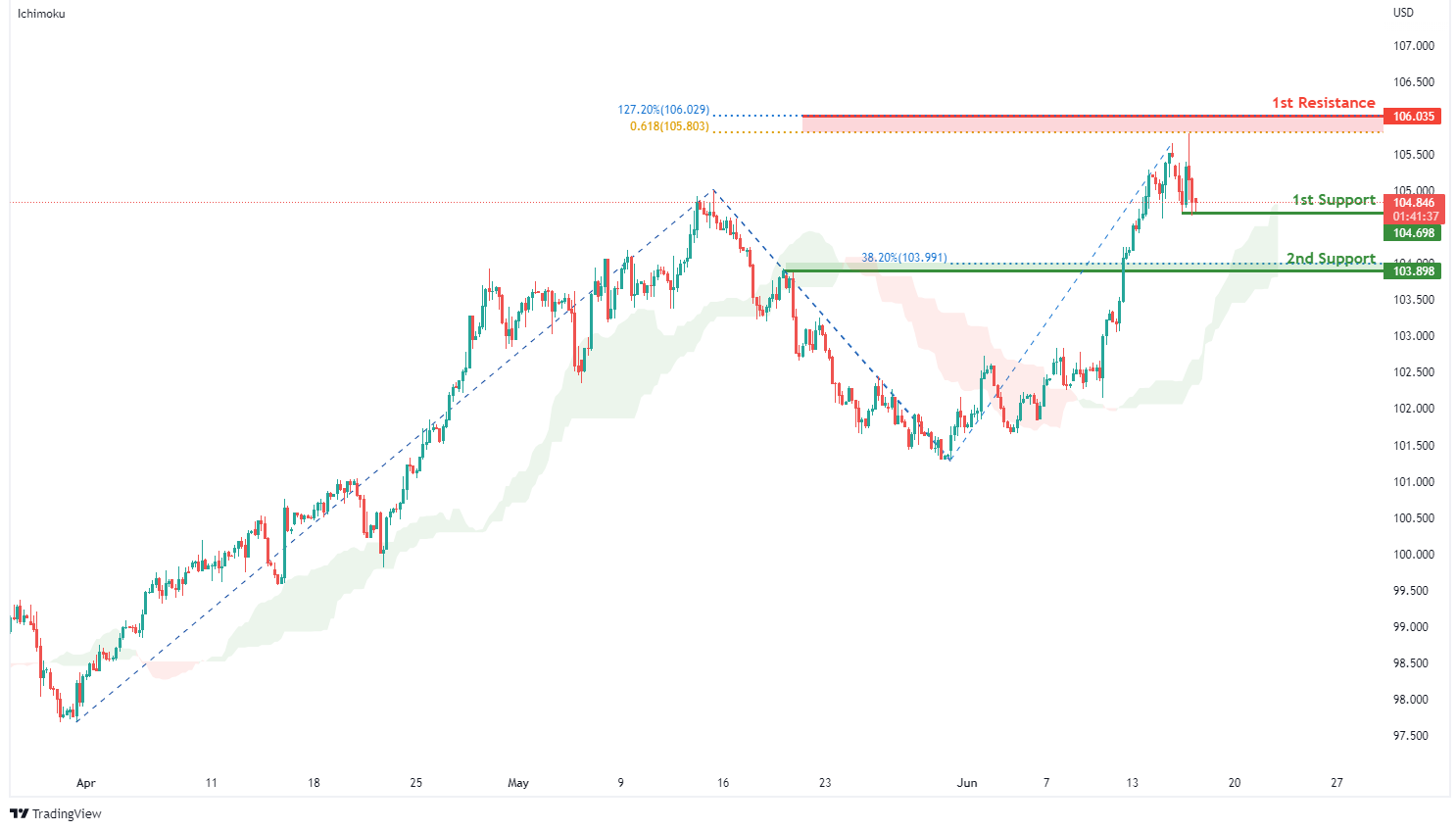
DXY:
On the H4, with prices moving above the ichimoku indicator, we have a bullish bias that price will rise to our 1st resistance at 106.035 where the 127.2% fibonacci extension and 61.8% fibonacci projection are from our 1st support at 104.698 in line with the horizontal overlap support. Alternatively, price may break 1st support structure and head for 2nd support at 103.898 where the horizontal pullback support and 38.2% fibonacci retracement are.
Areas of consideration:
- H4 time frame, 1st resistance at 106.035
- H4 time frame, 1st support at 104.698
XAU/USD (GOLD):
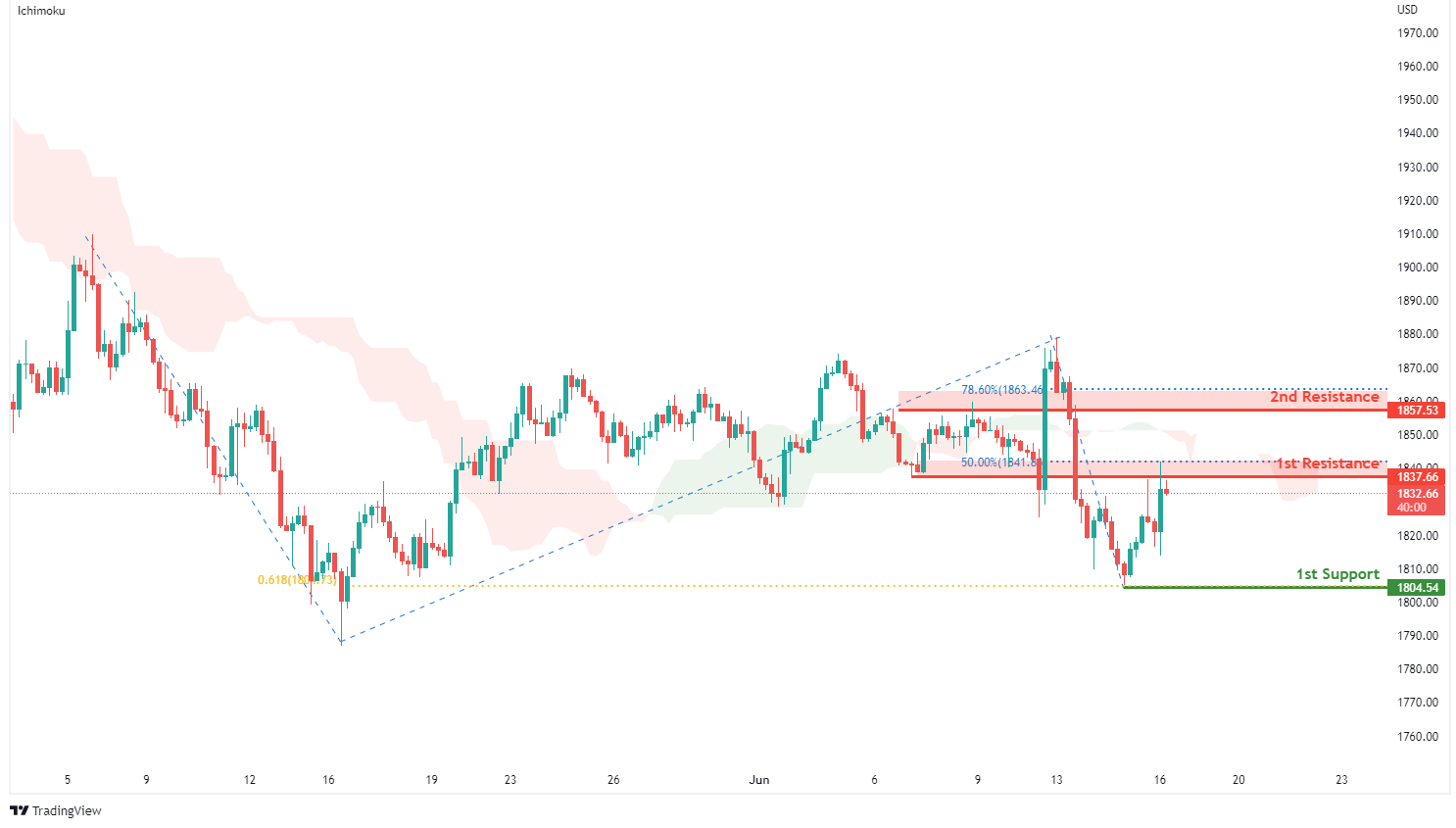
On the H4, with prices moving below the ichimoku indicator, we have a bearish bias that prices will drop from our 1st resistance at 1837.66 where the horizontal pullback resistance and 50% fibonacci retracement are to our 1st support at 1804.54 in line with swing low support and 61.8% fibonacci projection. Alternatively, price may break 1st resistance structure and head for 2nd resistance at 1857.53 in line with overlap resistance and 78.6% fibonacci retracement.
Areas of consideration:
- H4 time frame, 1st Resistance at 1837.66
- H4 time frame, 1st Support at 1804.54
GBP/USD:
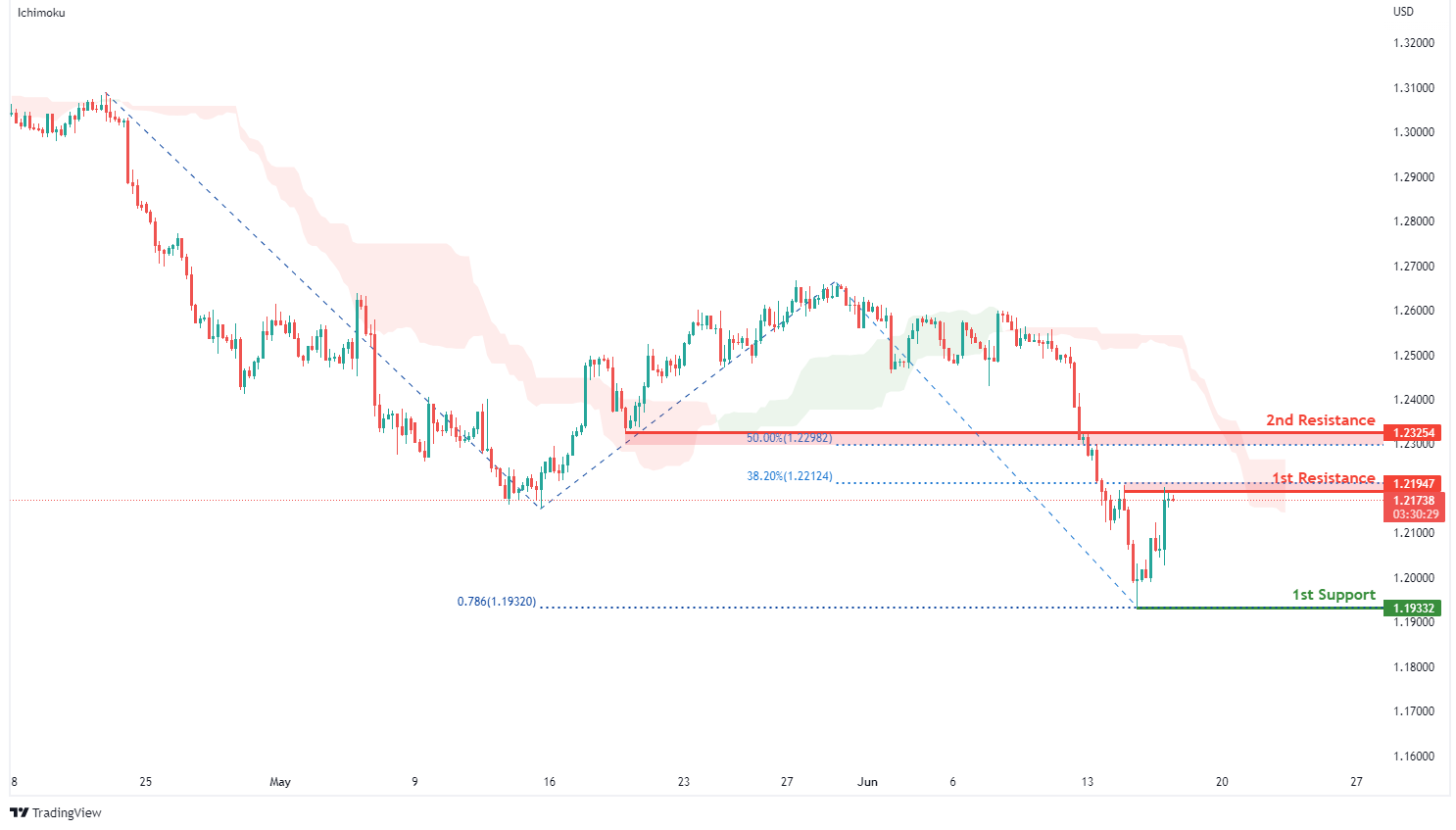
On the H4, with prices moving below the ichimoku indicator, we have a bearish bias that price will drop from our 1st resistance at 1.21947 where the horizontal swing high resistance and 38.2% fibonacci retracement are to our 1st support at 1.19332 in line with the 78.6% fibonacci projection and swing low support. Alternatively, price may break 1st resistance structure and head for 2nd resistance at 1.23254 where the horizontal pullback resistance and 50% fibonacci retracement are.
Areas of consideration:
- H4 1st resistance at 1.21947
- H4 1st support at 1.19332
USD/CHF:
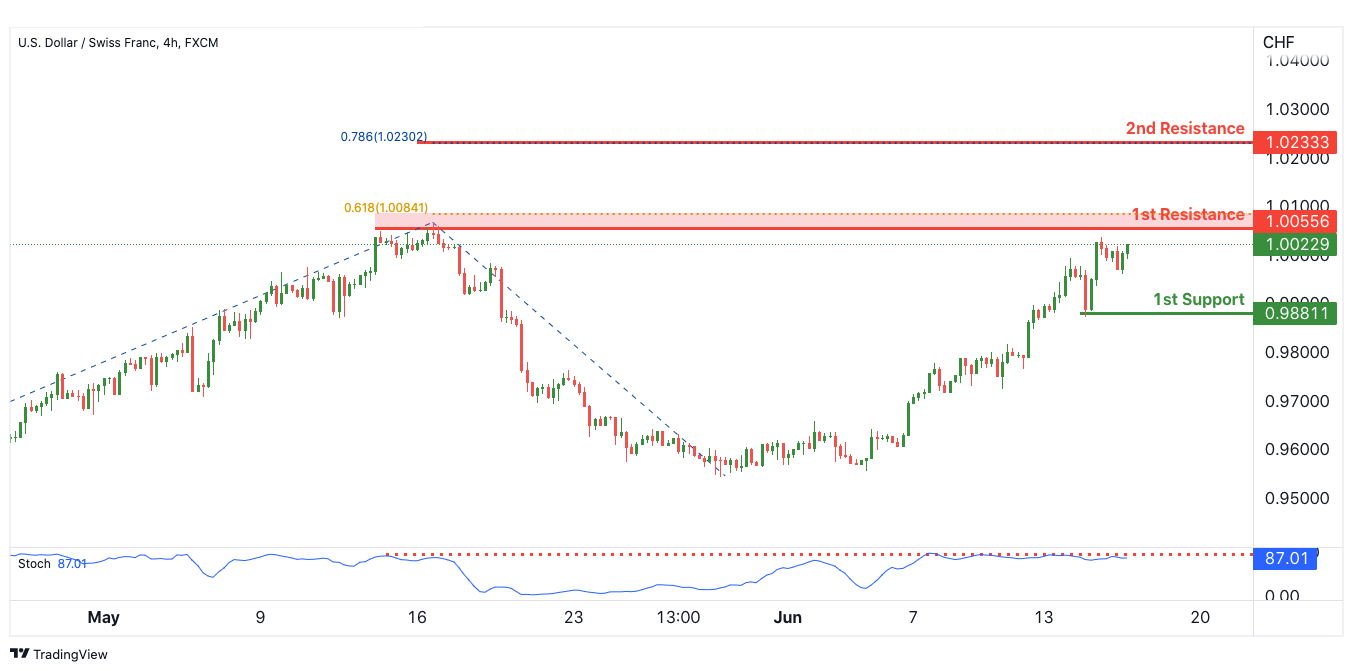
On the H4, with price expected to reverse off the stochastic indicator, we have a bearish bias that price will drop to our 1st support in line with the horizontal pullback support from our 1st resistance is where the pullback resistance is. Alternatively, price may break structure and head for our 2nd resistance in line with the horizontal swing high resistance and 78.6% Fibonacci projection.
Areas of consideration
- 1st support level at 0.98769
- 1st resistance level at 0.99786
EUR/USD :
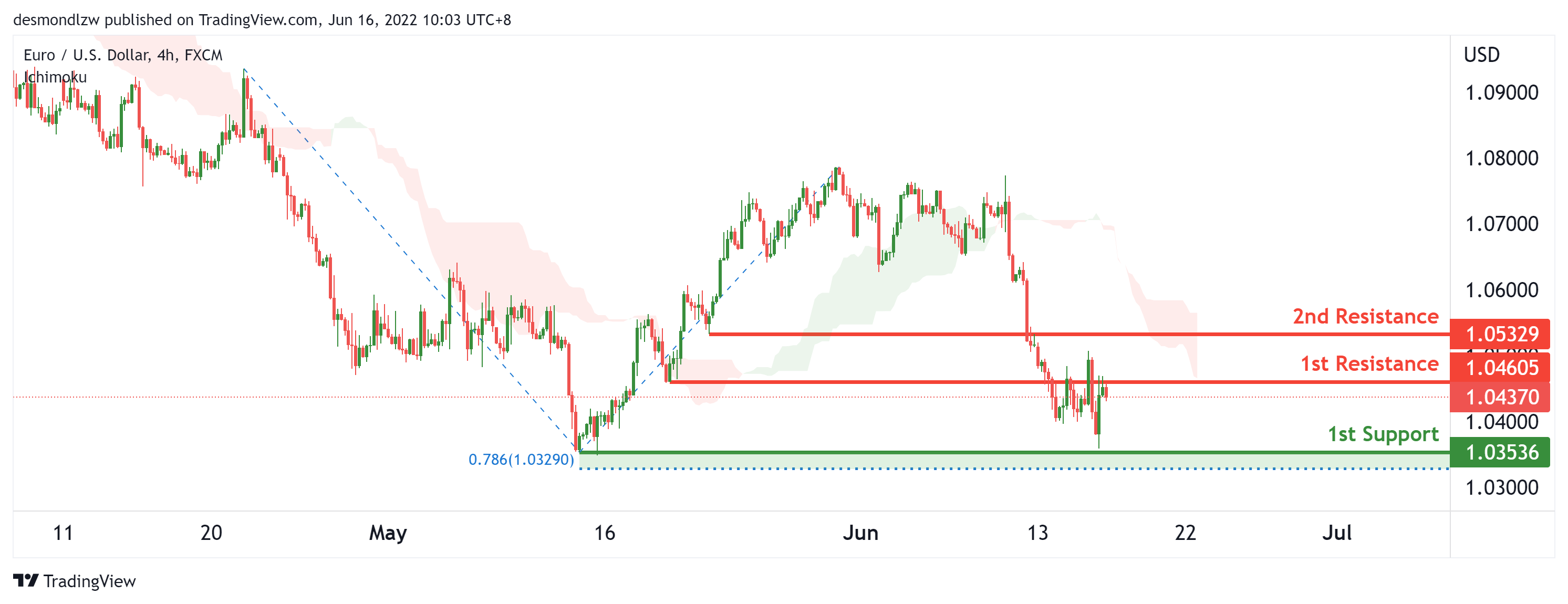
On the H4. with price moving below the ichimoku cloud, we have a bearish bias that price will continue to drop from our 1st resistance at 1.04605 in line with the pullback resistance to the 1st support at 1.03536 in line with the 78.6% fibonacci projection and horizontal swing low support. Alternatively, price may break the 1st resistance structure and rise to the 2nd resistance at 1.05329 in line with the pullback resistance.
Areas of consideration :
- H4 1st resistance at 1.04605
- H4 1st support at 1.03536
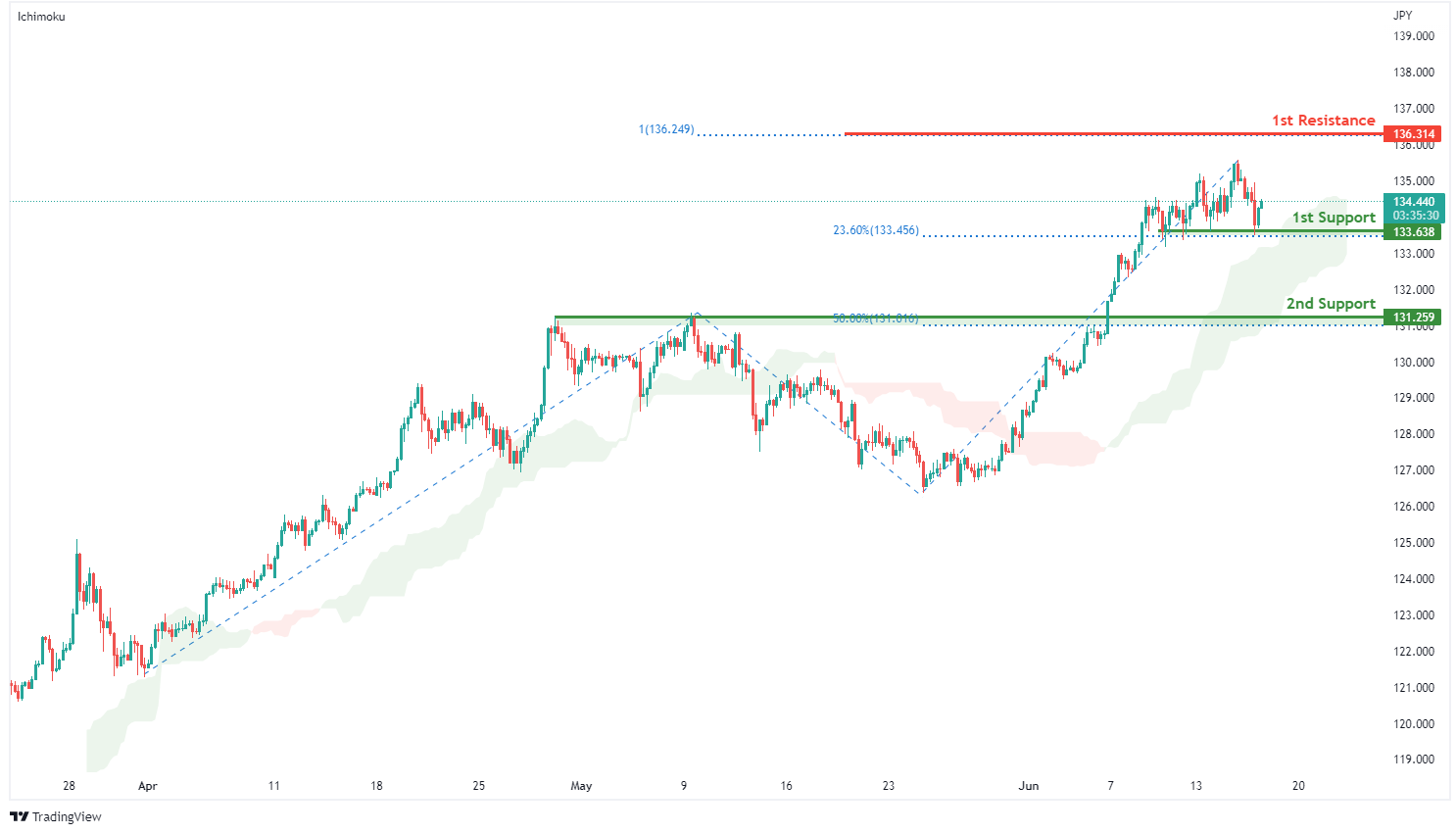
USD/JPY:
On the H4, with prices moving above the ichimoku indicator, we have a bullish bias that price will rise from our 1st support at 133.638 where the horizontal swing low support and 23.6% fibonacci retracement are to our 1st resistance at 136.314 in line with the 100% fibonacci projection. Alternatively, price may break 1st support structure and head for 2nd support at 131.259 where the horizontal overlap support and 50% fibonacci retracement are.
Areas of consideration:
- H4 time frame, 1st resistance at 136.314
- H4 time frame, 1st support at 133.638
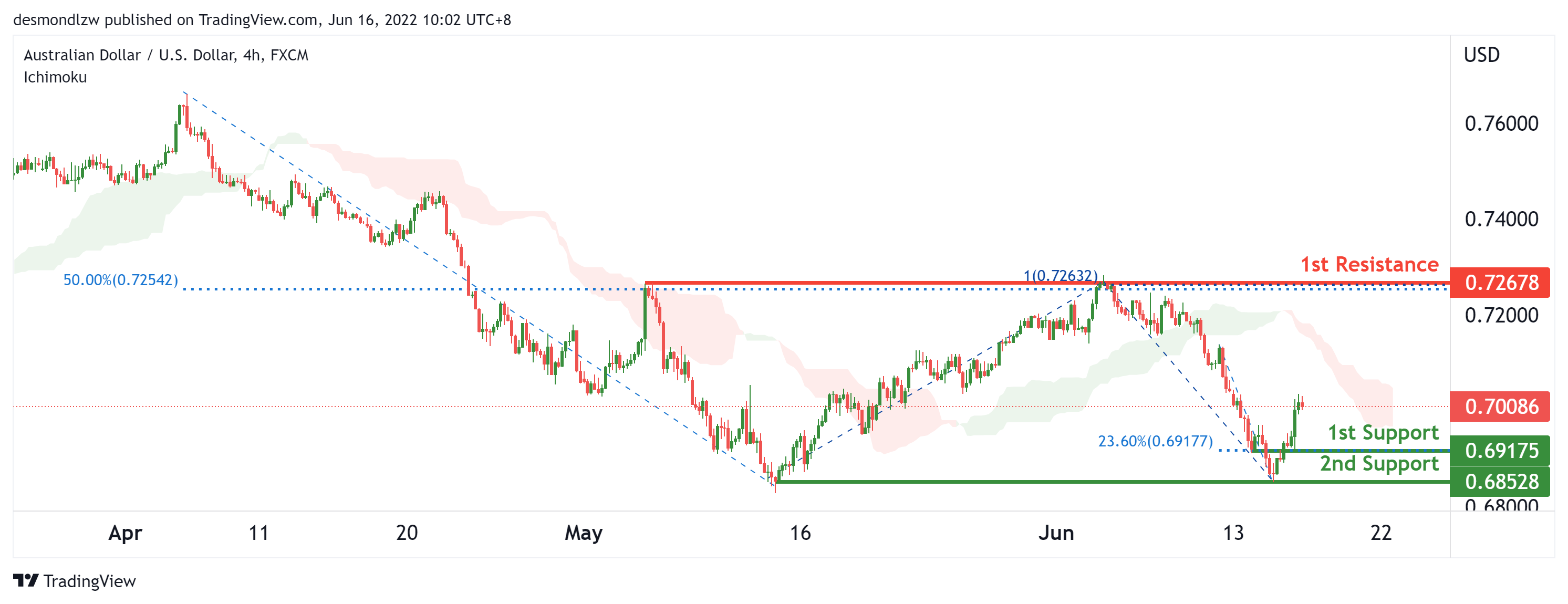
AUD/USD:
On the H4, price has recently reversed off the 2nd support at 0.68528 and we have a bullish bias that price will rise from the 1st support at 0.69175 in line with the 23.6% fibonacci retracement to the 1st resistance at 0.72678 in line with the 100% fibonacci projection and 50% fibonacci retracement. Alternatively, price may reverse off the 1st support and drop back down to the 2nd support in line with the multiple horizontal swing lows.
Areas of consideration
- H4 1st resistance at 0.72678
- H4 1st support at 0.69175
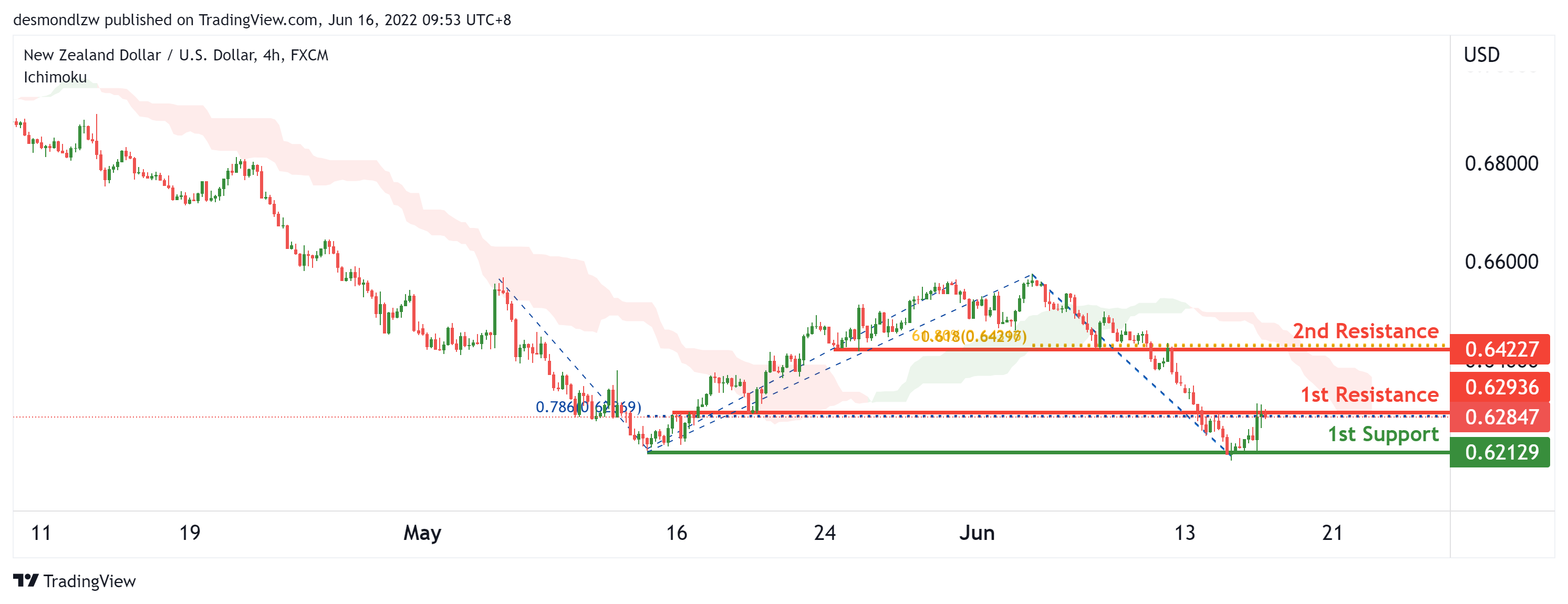
NZD/USD:
On the H4, with price moving below the ichimoku cloud, we have a bearish bias that price will drop from the 1st resistance at 0.62847 in line with the overlap resistance and 78.6% fibonacci projection to the 1st support at 0.62129 at the multiple swing lows. Alternatively, price may break the 1st resistance structure and rise to the 2nd resistance at 0.64227 in line with the 61.8% fibonacci retracement, 61.8% fibonacci retracement and overlap resistance.
Areas of consideration:
- H4 time frame, 1st support at 0.62129
- H4 time frame, 1st resistance at 0.62847
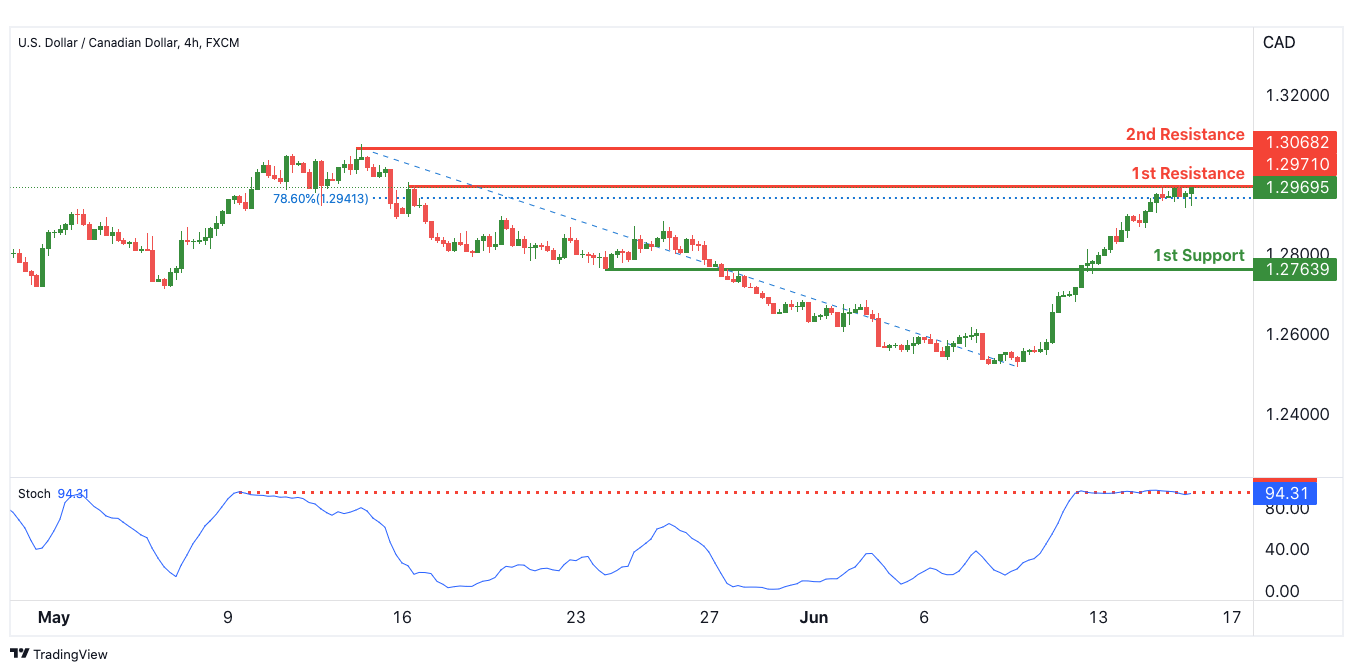
USD/CAD:
On the H4, with expected to reverse off the stochastics indicator, we have a bearish bias that price will drop to our 1st support at 1.27639 in line with the horizontal pullback support from our 1st resistance at 1.29710 where the pullback resistance and 78.6% Fibonacci retracement is. Alternatively, price may break structure and head for our 2nd resistance in line with the horizontal swing high resistance.
Areas of consideration:
- H4 time frame, 1st resistance at 1.29019
- H4 time frame, 1st support at 1.27639
OIL:
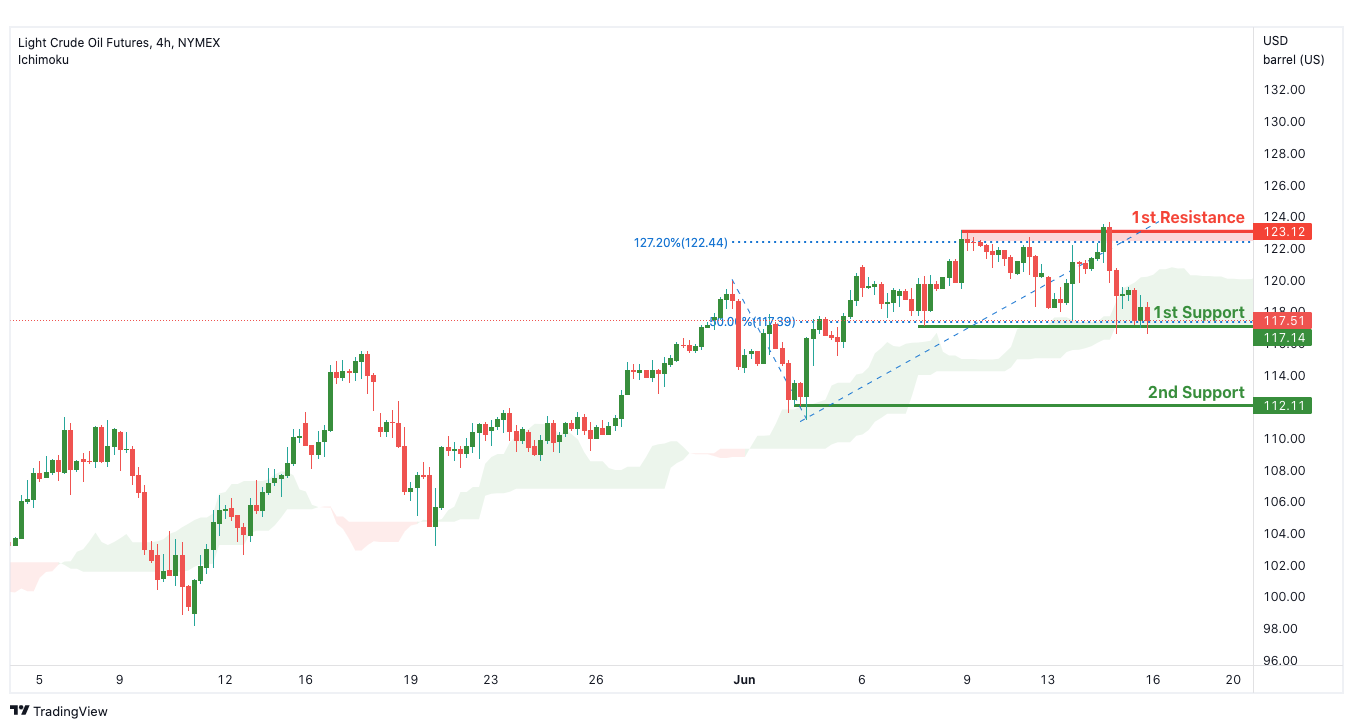
On the H4, with price moving above the ichimoku cloud, we have a bullish bias that price will rise from our 1st support at 117.14 where the horizontal swing low support and 50% Fibonacci retracement is to our 1st resistance at 123.12 in line with the horizontal swing high support. Alternatively, price may break structure and head for 2nd support where the horizontal swing low support is.
Areas of consideration:
- H4 time frame, 1st resistance of 123.12
- H4 time frame, 1st support of 117.14
Dow Jones Industrial Average:
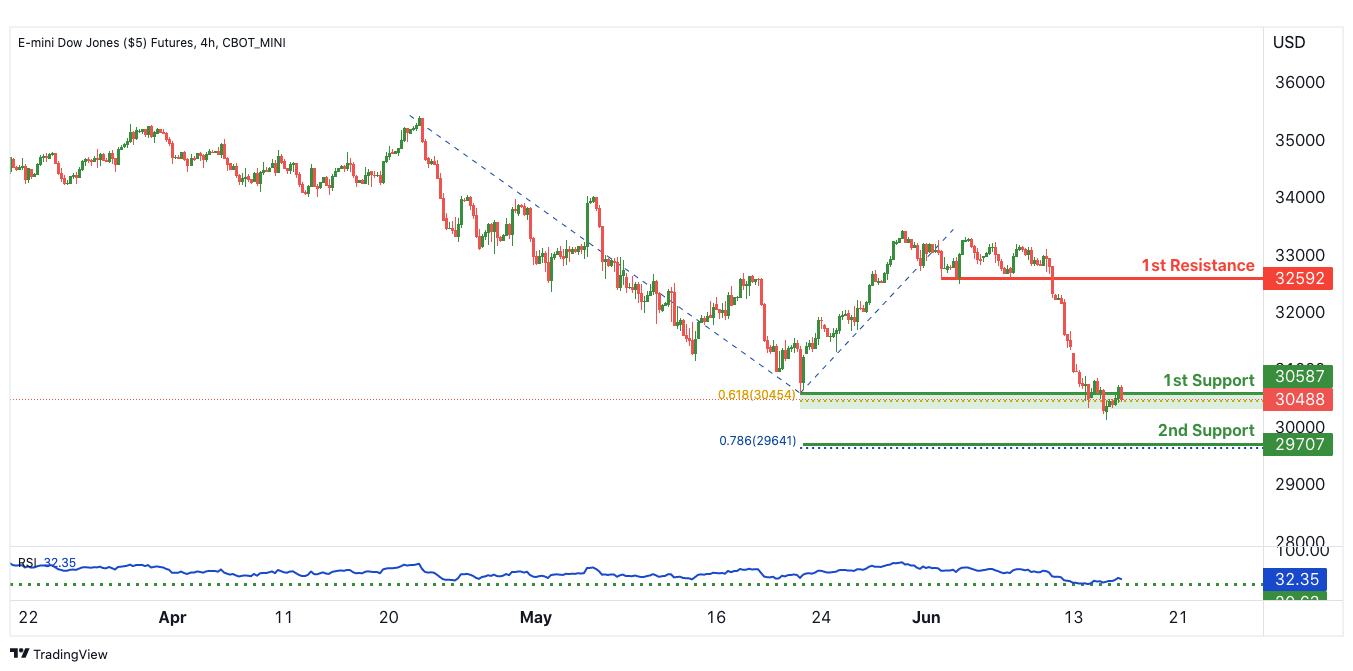
On the H4, with price expected to bounce off the stochastics indicator, we have a bullish bias that price will rise from our 1st support at 30568 where the horizontal swing low support and 61.8% Fibonacci projection is to our 1st resistance at 32592 in line with the horizontal pullback support. Alternatively, price may break structure and head for 2nd support where the 78.6% Fibonacci projection is.
Areas of consideration :
- H4 time frame, 1st resistance at 32587
- H4 time frame, 1st support at 30568