

Sample Category Title
Elliott Wave View: Oil (CL) to Correct Further Downside
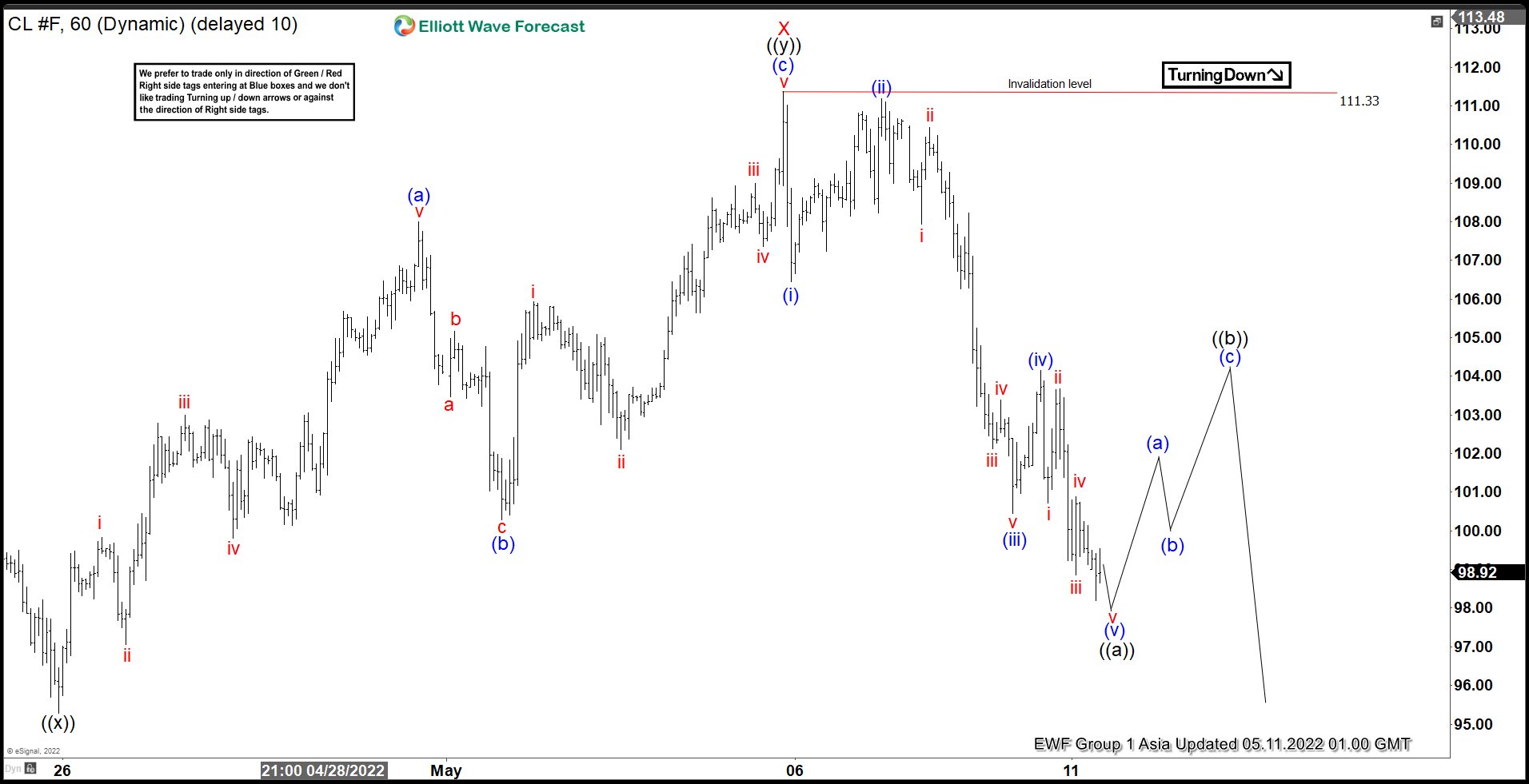
After spiking to 130.50 on March 7 at the height of the Russia-Ukraine war, Oil (CL) has started to pullback and consolidate. Oil shows an incomplete bearish sequence from the peak on March 7, 2022 favoring further downside. Short Term Elliott Wave View in Oil (CL_F) suggests the cycle from March 7, 2022 is unfolding as a double three Elliott Wave structure. Down from March 7 high, wave (W) ended at 93.53 and rally in wave (X) ended at 116.64. Wave (Y) is currently in progress as a double three in lesser degree. Down from wave (Y), wave W ended at 93.93. The 1 hour chart below shows the rally to 111.31 ended wave X.
Down from wave X, wave (i) ended at 106.45 and rally in wave (ii) ended at 111.18. Oil then extends lower in wave (iii) towards 100.44, and rally in wave (iv) ended at 104.16. Expect wave (v) of ((a)) to end soon, then Oil should rally in wave ((b)) to correct the decline from May 5, 2022 high before it resumes lower. Potential target lower is 100% – 123.6% Fibonacci extension from March 24, 2022 peak at 82.3 – 87.8 area.
Oil (CL) 60 Minutes Elliott Wave Chart
Silver Wave Analysis
- Silver under strong bearish pressure
- Likely to fall to support level 21.00
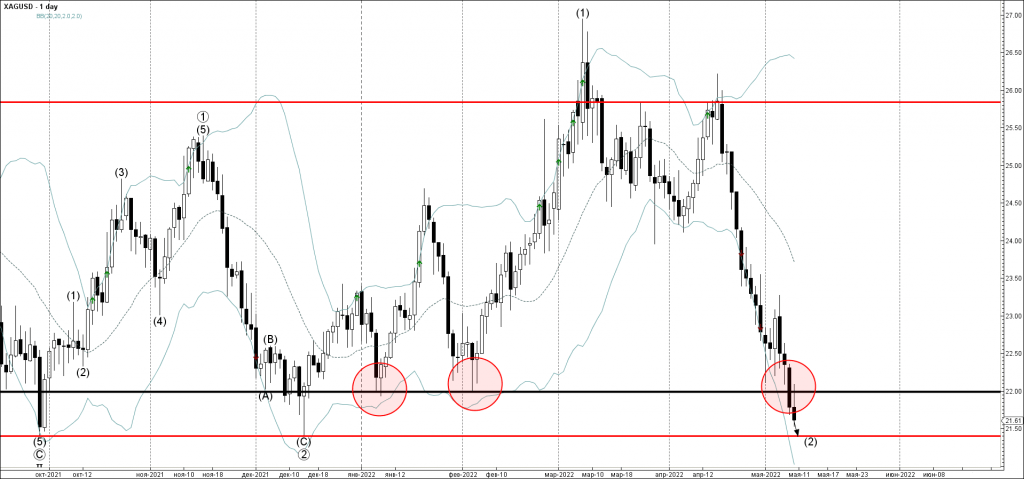
Silver under the strong bearish pressure after the price broke below the long-term support level 22.00 (the previous monthly low from January and February).
The breakout of support level 22.00 accelerated the active intermediate ABC correction (2) from the start of March.
Silver can be expected to fall further toward the next support level 21.00 (earlier multi-month low from December, target for the completion of the active wave (2)).
AUDUSD Wave Analysis
- AUDUSD broke support zone
- Likely to fall to support level 0.6900
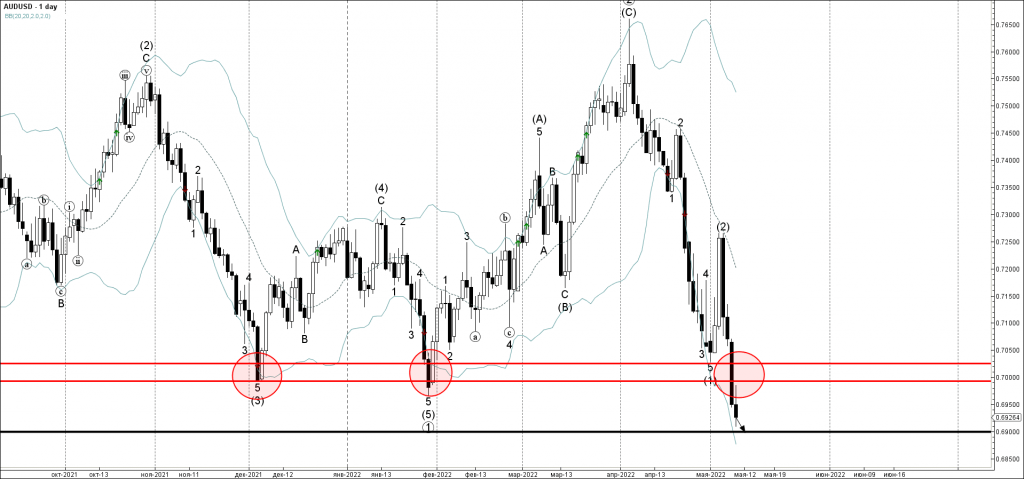
AUDUSD currency pair recently broke the support zone lying between support levels 0.7025 (low of the previous wave (1)) and 0.7000.
The breakout of this support zone accelerated the active impulse wave 3 of the medium-term impulse wave (3) from the start of May.
Given the strong AUD bearishness – AUDUSD can be expected to fall further toward the next support level 0.6900.
AUD/USD: Bears to Stay Intact While Upticks Limited Under Strong Barriers at 0.7000/29
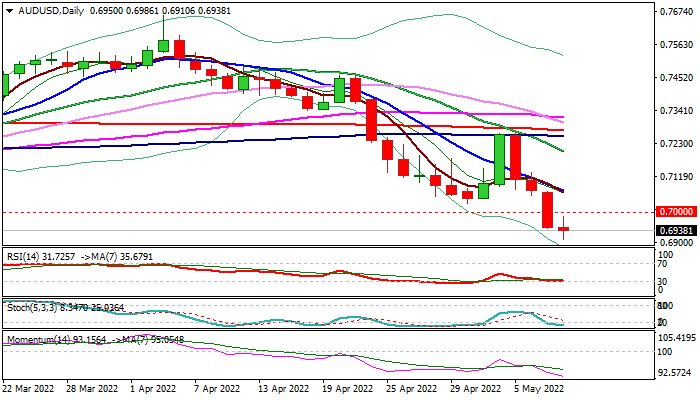
The AUDUSD edges higher from new 22-month low (0.6910) on Tuesday, as US dollar bulls lose pace and traders partially take profit after pair’s 4.2% loss in past three days.
Overall picture remains bearish, as larger downtrend from 2022 peak at 0.7661 made a textbook correction (0.7029/0.7265) capped by 100DMA and near Fibo 38.2% of 0.7661/0.7029 downleg, before resuming.
Break and weekly close below psychological 0.70 support added to negative signals from daily indicators, as 14-d momentum continues to trend lower deep in the negative territory and south-heading daily moving averages formed a number of bear-crosses, weighing on the Aussie.
Ideal scenario sees limited upticks by 0.7000 (reverted to resistance) and 0.7029 (previous low) to offer better selling opportunities for extension through 0.6910 (new 22-month low) towards the top of thick monthly cloud (0.6822).
Traders await Wednesday’s release of inflation data for April from China (1.8% y/y f/c vs 1.5% Mar) and the US (8.1% y/y f/c vs 8.5% Mar) which will provide fresh signals.
Res: 0.6986; 0.7000; 0.7029; 0.7075
Sup: 0.6910; 0.6877; 0.6822; 0.6758
ECB Nagel: Delaying monetary policy turnaround is a risky strategy
ECB Governing Council member Joachim Nagel said today, "as inflation in the euro area continues to run high, we need to act." He expects the asset purchases to end in June and "will advocate a first step normalizing ECB interest rates in July."
Nagel warned that risk of acting too late on inflation is "increasing notably". "Delaying a monetary-policy turnaround is a risky strategy," he said. "The more inflationary pressures spread, the greater the need for a very strong and abrupt interest rate hike."
GBPAUD Stabilizes, What’s the Big Picture?
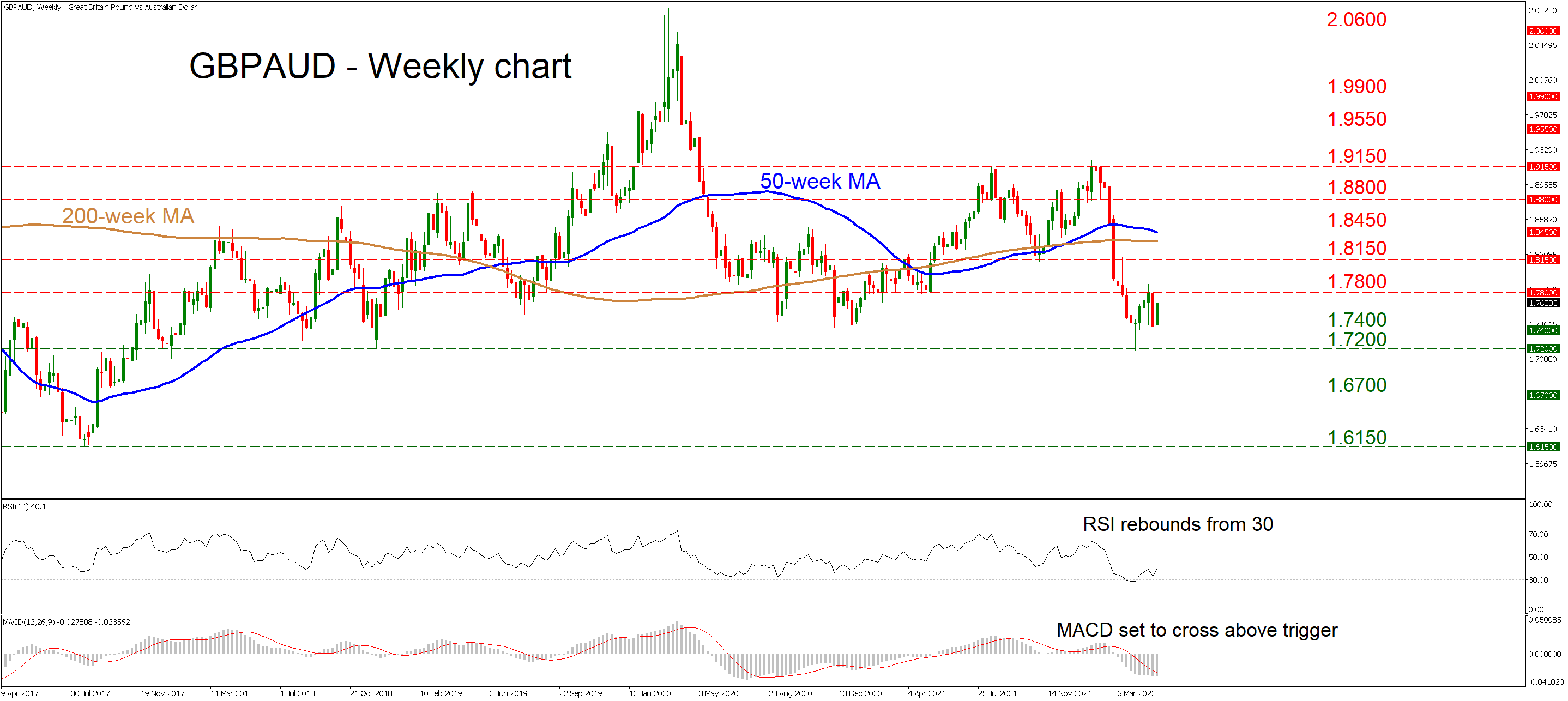
GBPAUD suffered a very sharp decline in recent months, sinking to fresh 4-year lows. That said, the pair has rebounded and a double bottom pattern seems to have formed on the daily chart.
Momentum indicators on the weekly chart mirror the latest bounce in the price action, with the RSI bouncing off its 30 line and the MACD looking ready to cross back above its red trigger line.
If the bulls remain in the driver’s seat and manage to pierce above the 1.7800 region, which halted the advance several times lately, the next barrier to the upside might be the 1.8150 area.
Now in the case the bears wrestle back control, initial support to declines could be found near the 1.7400 level. If that’s violated, the focus would turn towards the 4-year low of 1.7200.
Overall, the long term trend in the pair is neutral. However, a potential drop below 1.7200 could change that.
Pound Stable But Markets Uneasy
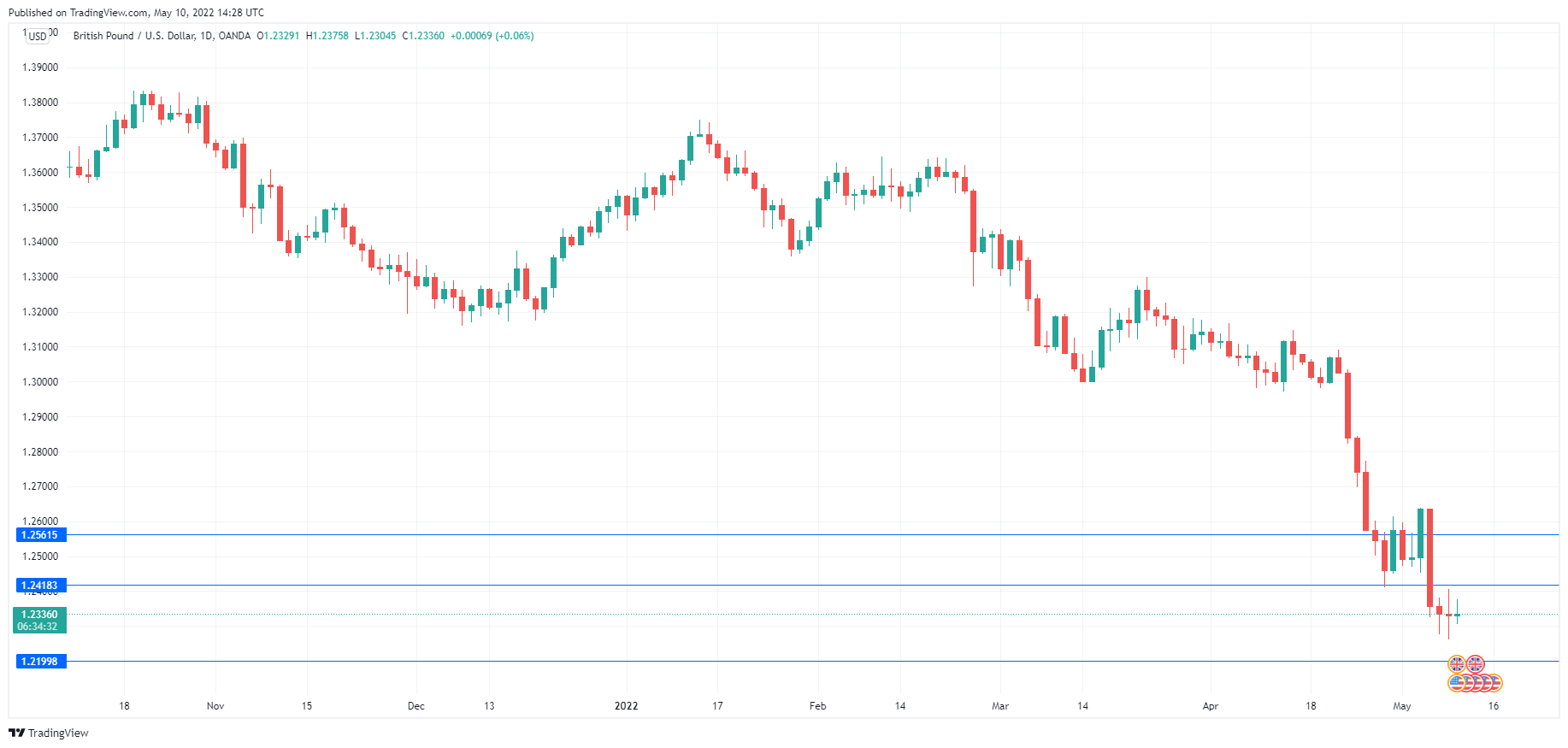
The British pound is in calm waters early in the week, as GBP/USD trades slightly above the 1.23 line. There are no major releases out of the UK or the US, which means that the pound should enjoy a quiet day.
Can the BoE get it right?
The British pound plunged over 2% last Thursday, a most difficult feat, considering that the Bank of England actually raised interest rates at its meeting that day. What went so wrong for the pound?
The BoE dutifully raised rates at the meeting, but investors lasered in on the central bank’s downbeat message which warned of a recession, while at the same time forecasting that inflation will top 10% this year. The UK is experiencing soaring inflation at growth remains weak, which are the ingredients for stagflation. The Bank slashed its growth forecast from 1.25% to -0.25%, and the spectre of negative growth may have shaken up investors and sent the pound on its laurels. The rate hike, which in any event was relatively small at 0.25%, failed to impress the markets.
BoE Governor Bailey was brutally honest when he said after the meeting that “It is a very weak projection, a very sharp slowdown”. I always appreciate when central bankers don’t hide behind gobbledygook, but the markets tend to reward good news, not honest news. There appears to be a heavy dose of scepticism as to whether the BoE can get it right, as it navigates between raising rates in order to curb inflation, while at the same time not choking economic growth. BoE Governor Bailey will need to show some achievements, such as lower inflation, in order to re-establish the central bank’s credibility, which has taken a blow in recent months.
The pound has stabilized for the time being but remains vulnerable. There is plenty of risk aversion in the air, with spiralling inflation, a slowdown in China and the Ukraine war. With the Federal Reserve in hawkish mode and the US economy performing well, the risk towards GBP/USD is tilted to the downside.
GBP/USD Technical
- There is support at 1.2199 and 1.2056
- GBP/USD faces resistance at 1.2418 and 1.2561
Sunset Market Commentary
Markets
Global markets entered calmer waters after yesterday’s wild risk-off. Even so, after losses of 3.0-4.0%, equities rebounding 2.0%/1.5% (EuroStoxx50/Nasdaq) isn’t enough to conclude that the repositioning has run its course. Eco data provided only secondary help for investors to make up their mind on how the triangular relationship between too high inflation, decelerating growth and CB tightening will turn out. Economic expectations as measured by the German ZEW survey remained deeply negative but improved modestly from -41.0 to -34.3, while a further decline was expected. The current situation index declined further to -36.5 from -30.8. ZEW indicated that lockdowns in China caused a strong decline in current assessment. Interestingly, the ZEW indicator for the EMU improved more significantly from -43.0 to -29.5. Also remarkable, both for Germany and for the EMU experts expect a substantial cooling of inflation (-10.5 from 26.8 and -10.6 from 25.9) as they see interest rates hikes in the next six months. In the US, NFIB small business confidence (93.2) stabilized at the weakest level post corona. Entrepreneurs still see inflation and quality of labour as their biggest headwinds. In a speech, NY Fed President Williams defended the Fed frontloaded approach that should lead to a soft landing route by bringing demand back in line with supply. As the Fed normalizes interest rates ‘expeditiously’, he expects PCE inflation to return to 2.5% next year and to the Fed’s 2.0% goal in 2024. Inspired by a better risk sentiment, US yields initially tried to regain some upward momentum, but the attemp never gained traction. The (corrective?) short squeeze resumed. US yields face another downleg with the belly of the curve (5/10-y minus 6 bps) outperforming the wings (2-y -1.5 bps; 30-y -4 bps). EMU/German bonds even outperform their US counterparts declining between 7.5 bps (2-y) and 8.8 bps (5-10-y). Evidently, there is no direct link with the ZEW assessment, but also this decline is driven by a further easing of inflation expectations. The 10-y EMU inflation swap trades at 2.76%, down from a peak of 3.14% 10 days ago. The combination of a risk rebound, lower nominal yields and easing inflation expectations is a more comfortable context for EMU peripheral bonds. After a protracted widening recently, 10-y spreads versus Germany are easing with Italy outperforming (minus 9 bps), bringing the 10-y yield back below the 3.0% handle (2.97%).
Very little to report on the major FX cross rates. DXY (103.60) hovers sideways off recent 104+ peak levels. EUR/USD (1.056) also trades near the middle of a sideways intraday range. Similar story for EUR/GBP (0.8560). USD/JPY is holding yesterday’s decline but fails to sustainably break below 130, despite the decline in core yields.
News Headlines
Norwegian inflation accelerated unexpectedly in April by 1.2% m/m to 5.4% y/y (from 4.5% in March vs 4.7% expected). It’s the highest level since 2008. Underlying core inflation rose more than forecast as well, by 0.9% m/m to 2.6% y/y (from 2.1% vs 2.4% expected). Details showed broad-based price increases with only alcoholic beverages and tobacco down on a monthly basis (-0.1% m/m). Housing & utilities (2%), clothing and footwear (1.8%), transport (1.3%) and recreation & culture (1.2%) showed the biggest increases. The Norges Bank last week indicated concern with the risk of accelerating price and wage inflation and readiness to raise the policy rate more quickly than indicated in the March policy rate (quarterly hikes towards a 2.5% top end 2023). Markets already discount such faster scenario, reaching the 2.5% mark early 2023 and a policy rate peak around 3.25% end 2023. The NOK stabilizes near EUR/NOK 1.1025 following a string of losses which deteriorated the NOK-technical picture (see graph).
Czech inflation reached its highest level since the independence of the Czech Republic, rising by 1.8% m/m in April to 14.2% y/y. Prices of goods in total went up by 1.9% m/m and prices of services by 1.6% m/m. The hot CPI-print comes in the immediate aftermath of last week’s CNB policy meeting and again fades the CNB’s ‘fresh’ inflation forecasts (13.8% y/y expected). It suggests that the policy rate cycle could reach beyond the often rumoured final finetuning. Czech money markets discount a 6.75% policy rate peak this year compared with the current 5.75% level. The Czech koruna trades a tad stronger today, just below EUR/CZK 25.
Fed Mester supports 50bps hikes at next couple FOMC meetings
Cleveland Fed President Loretta Mester said, she supports 50bps rate hikes at the next couple FOMC meetings. She also expects interest rate to go above 2.5% to bring inflation down.
"We need to get monetary policy in a more neutral and then we have to evaluate how much is needed to move that inflation needle down. It's going to be challenging… because there's things going down on the supply and demand sides," she said.
"It may very well be that the unemployment rate will have to move up a little bit, we may get another quarter of negative or slow growth, but that's going to have to happen if we want to get inflation down," she told Yahoo Finance. "I don't think what are planning to do with monetary policy, at least in my base case, is going to push the economy into a downturn that's sort of a sustained downturn."