Sample Category Title
Weekly Focus – Bond Rout Continues
The bond bears continue to have the upper hand at the moment getting fuel from high inflation and hawkish central banks. German 10-year yields continued the march higher reaching 0.95% Friday coming from -0.4% just four months ago. ECB Vice President Luis de Guindos said yesterday that the ECB might have to move early in Q3 putting a July hike increasingly in play. But ECB also highlights that it will be depending on data. In the short term inflation is likely to move higher in April putting pressure on the ECB to act. On the other hand, we also expect activity data to fall sharply in coming months pointing in the direction of a more cautious approach. Our forecast is two hikes coming in September and December.
US bond markets have also seen a fierce sell-off and especially mortgage bonds have moved significantly higher in yields. 30-year mortgage bonds now yield around 5.25%, a rise of 200bp in six months. It is the sharpest increase in more than three decades and is likely to put a break on US home sales and house price increases. Hawkish comments by the Fed also continue to push up yields. Fed chairman Jerome Powell on Thursday indicated a 50bp hike is likely in May and on the table for the following meetings as well. This is in line with our forecast of 50bp hikes in both May, June and July. The Fed's blackout period ahead of their meeting on 4 May starts on Saturday.
On the growth front this week Flash PMI's in the euro zone were mixed. French PMI held up well whereas German PMI manufacturing new orders dropped sharply from 54.7 to 47.8. Service PMI was fairly robust suggesting that this sector may see some tailwind from consumers spending more on restaurants, travelling etc. US home sales declined for the second month in a row and Philadelphia Fed future activity index dropped to a 10-year low. However, US jobless claims continue to point to a robust labour market. China continues to struggle with the Covid-19 outbreak in Shanghai, which is set to keep weighing on activity in April with negative spill-over to the rest of the world. It also delays ships coming out of Shanghai causing more challenges for supply chains. We have seen freight rates come down in recent months, though, pointing to some improvement.
Looking ahead, the presidential election run-off in France on Sunday will be an important event for European markets. Polls still favour Macron, but it is going to be a tight race with left-wing voters as the kingmakers. A Le Pen win would trigger a negative market reaction in our view, but even if Macron is re-elected, France is facing increasing headwinds, both from the economy and political fragmentation. We also have euro area inflation figures for April and Q1 22 GDP figures on Friday. Both manufacturing and services activity picked up at the start of the year, before the Ukraine war hit, so we still look for a positive Q1 quarterly growth rate (0.3% q/q). Inflation risks remain skewed to the upside despite the latest stabilization in oil, gas and electricity prices. We look for a further climb in the headline HICP rate above 8%, with core inflation remaining elevated at 3.1%, keeping the pressure high on ECB to proceed with its policy normalisation. In China the development in the Shanghai Covid outbreak will be important for the near-term outlook. In the US we will get GDP for Q1, durable goods orders, consumer confidence and new home sales, which will provide input to how economic activity and sentiment is evolving. We will listen closely to how the Bank of Japan addresses the global pressure for higher yields next week. So far they have defended their yield curve control fiercely.
Sunset Market Commentary
Markets
Yesterday’s risk correction spilled to Europe today. US stocks took a scare from a new fierce sell-off in US Treasuries following Fed Chair Powell’s call for a speedy return to neutral policy rate levels. Main US indices closed up to 2% lower and we see similar losses for Europe today. Front-end European and US bonds continue their underperformance today in a flattening move. Daily changes on the German yield curve vary between +8 bps (2-yr) and -1.0 bp (30-yr). US yields add up to 9 bps for the 2-yr and trade about flat at the very long end of the curve. The dollar regained momentum following the Powell comments with DXY testing the YTD high near 101. The mirror image in EUR/USD was a test of 1.08 as ECB President Lagarde for now withholds from joining the July rate hike chorus. Sterling underperformed following dismal UK PMI’s, sending EUR/GBP above 0.84. UK Gilts outperformed US Treasuries and German Bunds. Today’s eco calendar contained April EMU PMI figures, but they had no intraday impact on trading. The composite PMI unexpectedly increased from 54.9 to 55.8 in April, the highest level since September last year. The improvement hid a discrepancy between a stalling manufacturing sector (output & new orders) and booming business in the domestic services industry. Manufacturing suffers from production curbs owing to supply constraints which are being aggravated by the Russian war and by Chinese lockdowns. Lost orders were blamed on soaring prices. April has seen virus containment measures relaxed across the eurozone to the loosest since the start of the pandemic, explaining the improvement in services. Especially recreation and tourism profited, though IHS Markit warns for the outlook because of the developing cost-of-living crisis. Demand now shifted from goods to services, but they fear a slowdown as shown in low, but stable compared to March, forward looking PMI-components. Output prices surged to the highest level since the start of the PMI series with input prices (including rising wages!) still near peak levels. In its closing paragraph, chief business economist Williamson stressed that policymakers may tilt to a more hawkish stance, reflecting the persistence of unprecedented inflationary pressures at a time of encouragingly robust economic growth.
News Headlines
Germany’s Bundesbank said an immediate embargo on Russian gas would shave GDP by 5% in 2022, tipping it into a recession. That’s much bleaker than what academics have predicted earlier (0.3-3%). Before the invasion, Germany imported 55% of its gas from Russia and a third of that is consumed by the manufacturing sector. Under German law, the industry would be cut off from gas first in case supplies would fall short of demand, hurting output. Inflation would shoot up by another 1.5 ppts in such a scenario. On another note, the BuBa proposed to raise the annual limit of new borrowing under the constitutional debt brake framework from 0.35% to 0.5% of GDP if the debt ratio is higher than 60% or 1% if it is below that threshold. The debt brake has been suspended since 2020 until at least the end of this year and may turn into effect again in 2023 unless the war dictates otherwise.
UK PMIs diverged in April. Services retreated 4.3 points to 58.3 while manufacturing eked out a small gain to 55.3, bringing the composite figure to 57.6 (vs 60.9 in March). While still well above the neutral 50 growth barrier, cracks begin to emerge. New order growth came to a standstill in manufacturing and slumped to among the weakest since the early 2021 lockdowns in services. Respondents cited subdued consumer demand due to squeezed household finances, rising prices and geopolitical uncertainty. The effects overwhelmed any tailwinds from ending the Covid restrictions and caused business optimism for the future to drop to the lowest since October 2020. Employment still increased in April but the pace of job creation slowed to 12-month low. This was due to difficulties finding candidates but some also linked it to cost cutting initiatives. Input inflation was the second-fastest in more than 30 years for services and hit a record in manufacturing on energy, transport, raw materials and increased pay.
USD/JPY Mid-Day Outlook
Daily Pivots: (S1) 127.89; (P) 128.30; (R1) 128.79; More...
USD/JPY is extending the consolidation from 129.39 and intraday bias remains neutral. Deeper retreat cannot be ruled out but downside should be contained above 125.09 resistance turned support to bring another rally. On the upside, above 129.39 will resume larger up trend to 130.04 long term projection level next.
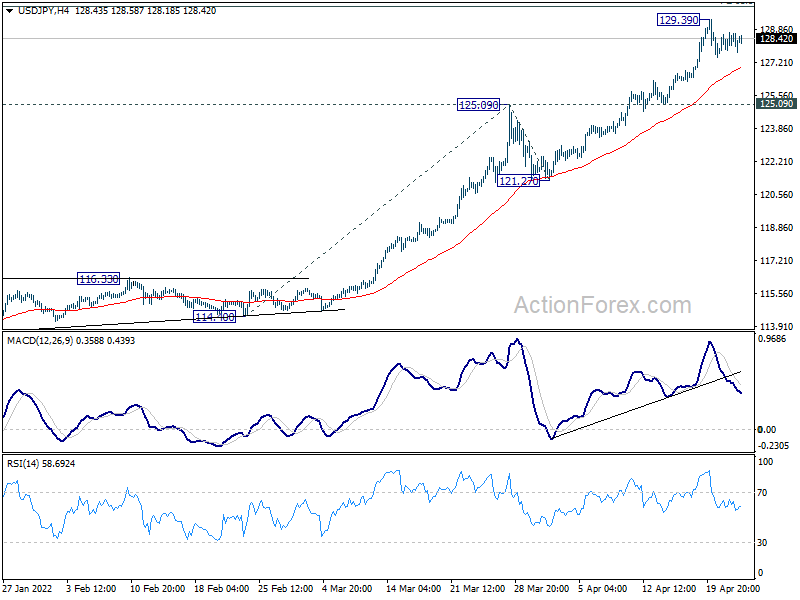
In the bigger picture, the break of 125.85 resistance (2015 high) suggests that whole up trend from 75.56 (2011 low) is resuming. Further rise should be seen to 61.8% projection of 75.56 (2011 low) to 125.85 (2015 high) from 98.97 at 130.04. Sustained break there wave the way to 147.68 (1998 high). For now, this will remain the favored case as long as 121.27 support holds.
USD/CHF Mid-Day Outlook
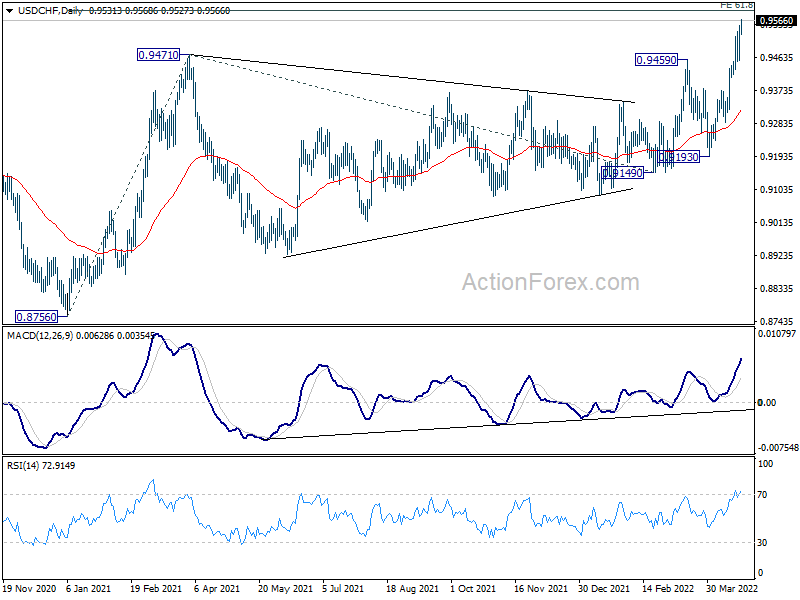
Daily Pivots: (S1) 0.9477; (P) 0.9515; (R1) 0.9573; More....
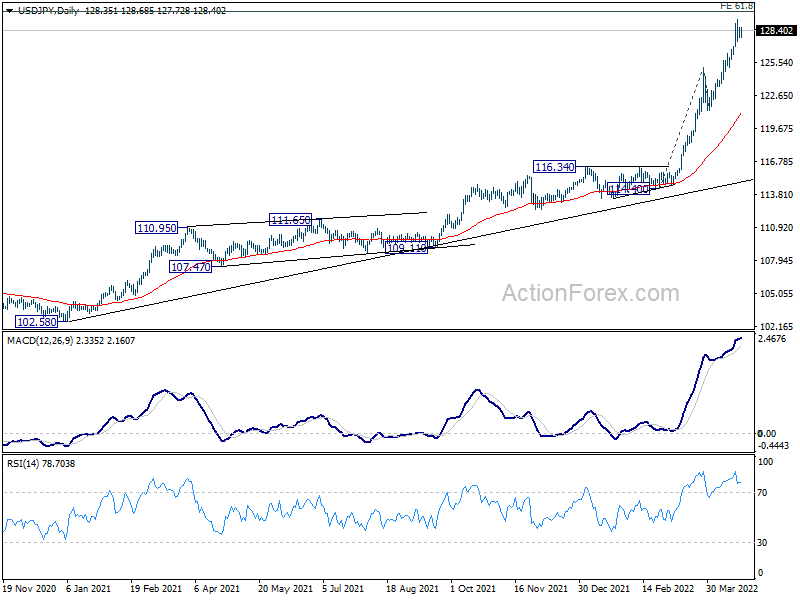
Intraday bias in USD/CHF remains on the upside for the moment. Current rally should target 0.9591 medium term projection level next. On the downside, below 0.9453 minor support will turn intraday bias neutral again and bring consolidations. But overall, further rally will remain in favor as long as 0.9372 resistance turned support holds.
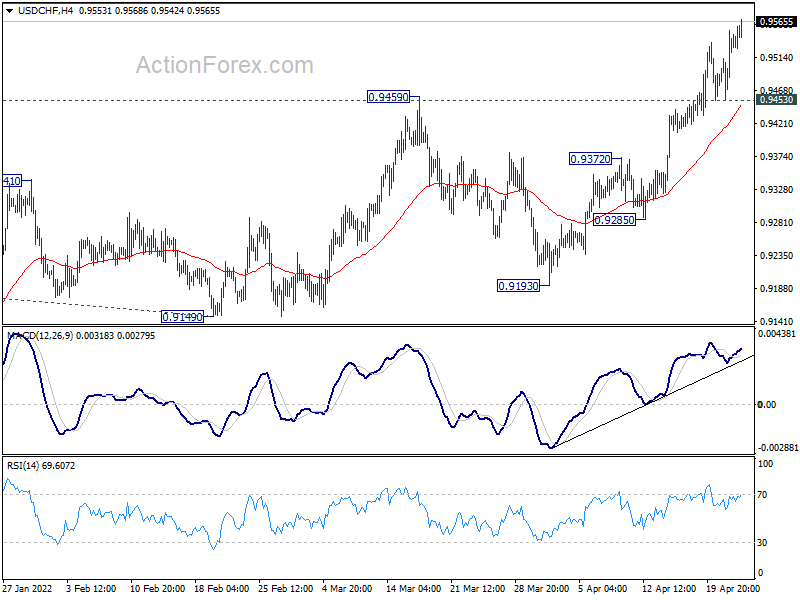
In the bigger picture, down trend from 1.0342 (2016 high) could have completed with three waves down to 0.8756 (2021 low) already. Rise from 0.8756 is likely a medium term up trend of its own. Next target is 61.8% projection of 0.8756 to 0.9471 from 0.9149 at 0.9591. Sustained break there will pave the way to 100% projection at 0.9864. This will now remain the favored case as long as 0.9149 support holds.
EUR/USD Mid-Day Outlook
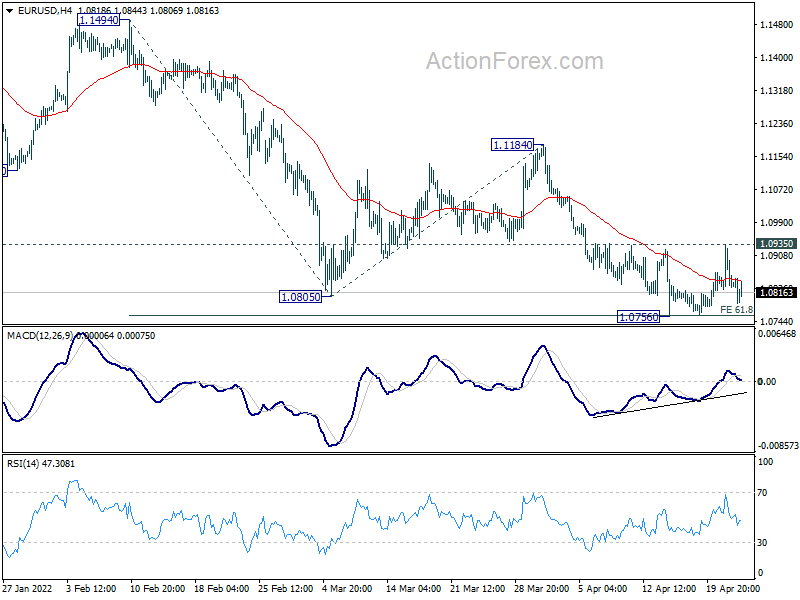
Daily Pivots: (S1) 1.0792; (P) 1.0864 (R1) 1.0904; More...
Range trading continues in EUR/USD and intraday bias remains neutral. On the downside, firm break o 1.0756 will resume larger down trend. Next target is 100% projection of 1.1494 to 1.0805 from 1.1184 at 1.0495. On the upside, firm break of 1.0935 resistance should confirm short term bottoming at 1.0756. Intraday bias will be back on the upside for 1.1184 structural resistance next.
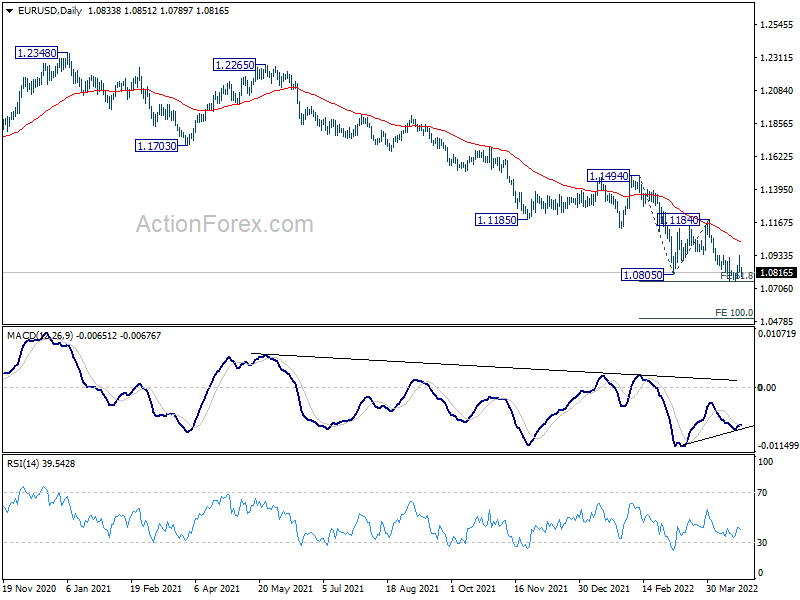
In the bigger picture, the decline from 1.2348 (2021 high) is expected to continue as long as 1.1494 resistance holds. Firm break of 1.0635 (2020 low) will raise the chance of long term down trend resumption and target a retest on 1.0339 (2017 low) next. Nevertheless, break of 1.1494 will maintain medium term neutral outlook, and extending term range trading first.
Canada: Soft Auto Sales Weigh on Retail Sales in February
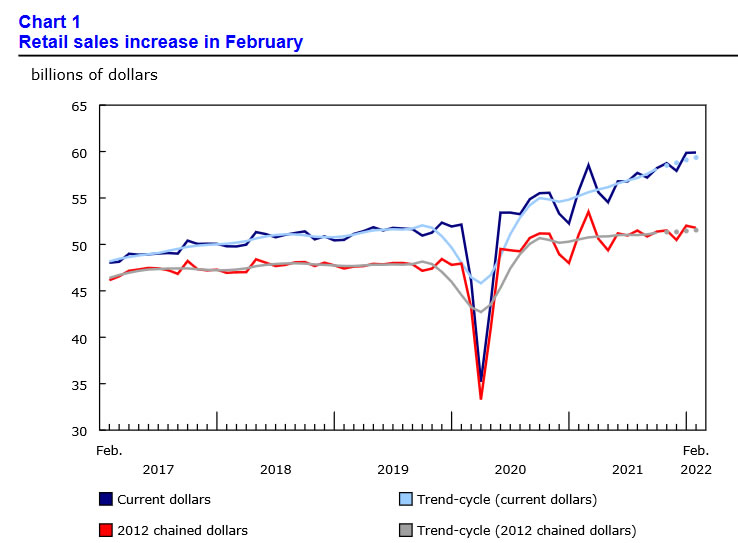
Coming on the heels of January's impressive gain, retail sales took a breather in February, edging up just 0.1% month-on-month. The performance was even softer after stripping away inflation, with sales declining by 0.4% in volume terms.
Sales look to have sprang back to life in March, with Statistics Canada's flash estimate pointing to a 1.4% monthly gain.
Regionally, sales were down in all but four provinces in February. Manitoba (+4.3%), Saskatchewan (+2.4%), and Nova Scotia bucked the trend with strong gains in sales, while Ontario churned out a modest increase (+0.3%).
Looking at the individual categories, sales of motor vehicles and parts pulled back in February (-5.1% m/m), weighing heavily on the headline print. However, receipts at gasoline stations were up both in nominal (+6.2%) and volume terms (+3.4%), lifted by higher gasoline prices and improved mobility trends.
Core sales, which exclude autos and gasoline, fared well for the second consecutive month, rising 1.4% in February, after a 3.3% gain in January.
- Sales at clothing and accessories stores led the increase in core sales, rebounding 15.1% on the month.
- Activity remained strong in some housing-related categories. Coming on the heels of 11% gain in January, sales at building materials, garden equipment and supplies rose by another 5.6% in February. Ditto for electronics and appliances stores (+1.1%), where sales increased in the past three months.
- By contrast, sales declined at furniture and home furnishings stores (-2.2%), general merchandise (-1.2%) and miscellaneous store retailers (-1.5%). Demand also appears to have cooled off a bit at health and personal care stores (-0.4%).
- E-commerce sales declined in February (-4.6%), as consumers resumed shopping at brick-and-mortar stores.
Key Implications
Following a very strong print in January, retail sales took a temporary pause in February. A large drop in motor vehicle and parts sales which accounts for more than a quarter of the retail sales was mostly to blame for the soft outturn. Core sales remained resilient for the second consecutive month. Statistics Canada preliminary estimate also points to a solid bounce back in total sales in March.
Consumer spending is expected to remain robust in the near-term, supported by easing public health restrictions, significant pent-up demand and a healthy labour market. But higher prices and interest rates will begin to weigh on household budgets in the second half of the year, prompting consumers to tighten their purse strings. Retail sales may also see some weakening as consumption continues to shift away from goods and toward services, such as travel and hospitality.
The distinction between the nominal versus real growth may become important in the coming months, with growth in nominal sales being inflated by rapidly rising consumer prices. The confluence of robust domestic demand and restricted supply due to lingering supply chain issues and tight labour market mean that prices for many categories of goods as well as services are starting show more heat. The war in Ukraine has also sent commodity prices higher, adding more fuel to the inflationary fire. These issues are unlikely to dissipate any time soon, and will keep inflation well-above the Bank of Canada 2% target this year.
GBP/USD Mid-Day Outlook
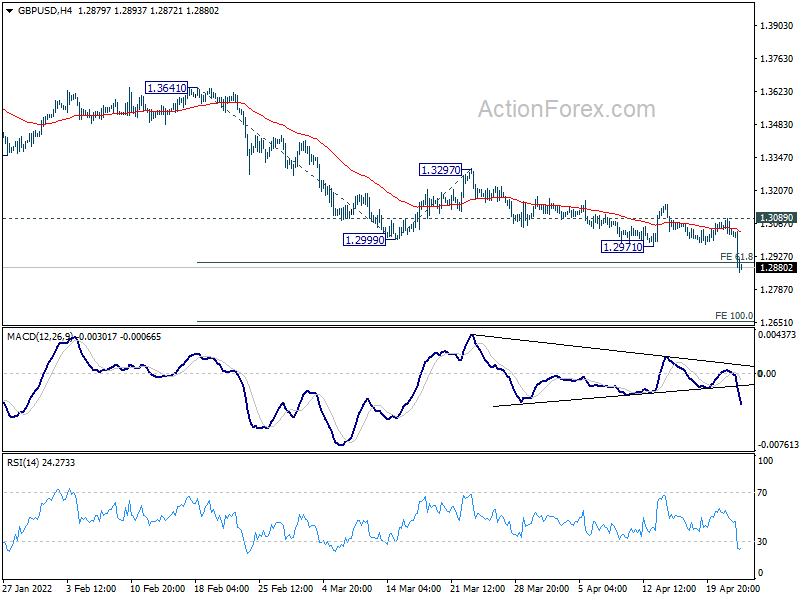
Daily Pivots: (S1) 1.3004; (P) 1.3047; (R1) 1.3071; More...
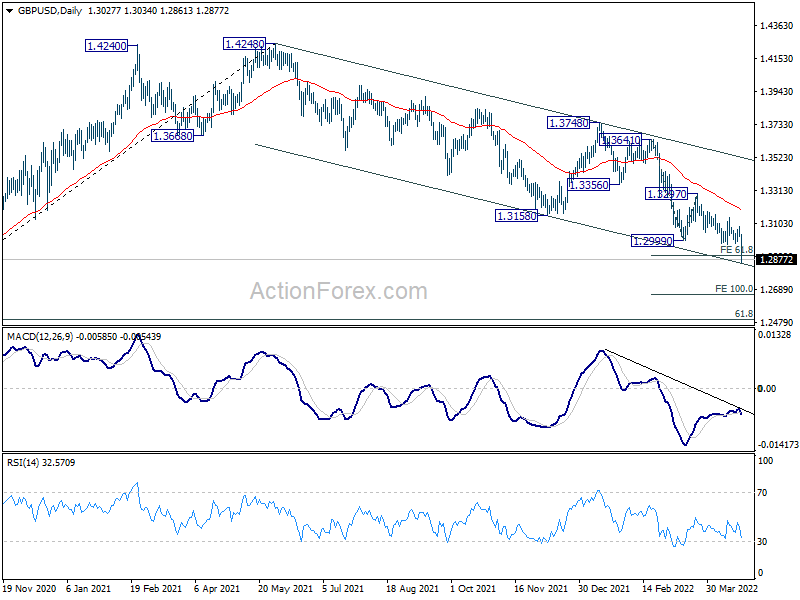
GBP/USD's down trend resumes today by breaking through 1.2971 support. Intraday bias back on the downside. Sustained trading below 61.8% projection of 1.3641 to 1.2999 from 1.3297 at 1.2900 will pave the way to 100% projection at 1.2655. On the upside, break of 1.3089 resistance is needed to indicate short term bottoming. Otherwise, outlook will stay bearish in case of recovery.
In the bigger picture, rise from 1.1409 (2020 low) has completed at 1.4248. Decline from 1.4248 could still be a corrective move, or it could be the start of a long term down trend. In either case, deeper decline would be seen back to 61.8% retracement of 2.1161 to 1.1409 at 1.2493. In any case, break of 1.3158 support turned resistance is needed to be the first sign of medium term bottoming. Otherwise, outlook will stay bearish in case of rebound.
Sterling Falls Broadly after Weak Retail sales, Dollar Up
Sterling drops broadly today as weak UK retail sales data argues that the expected consumption drag from high inflation might have arrived already. Aussie is currently the second worse for the day, then Kiwi. On the other hand, Dollar is rebounding broadly, followed with help from risk aversion again. Yen also strengthens slightly in tight range while Euro is also steady. Canadian little gives little reaction to retail sales data.
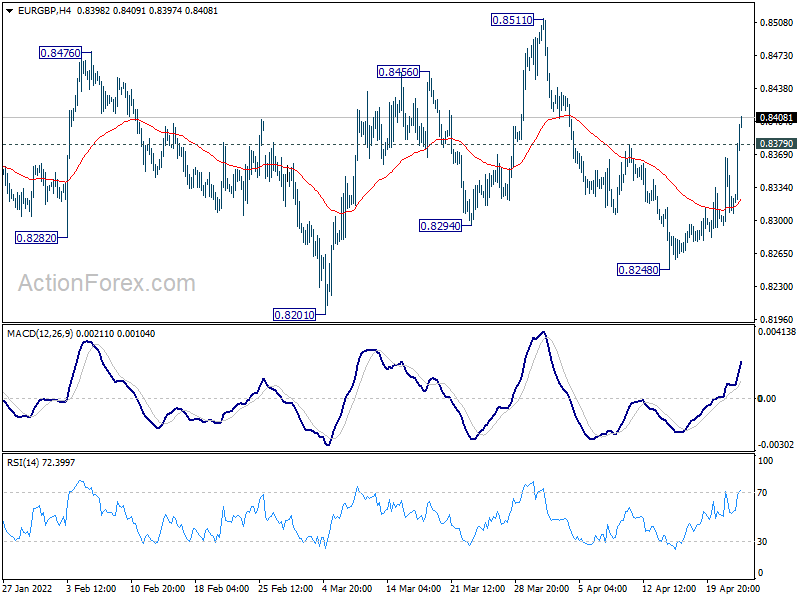
Technically, EUR/GBP has finally break through 0.8379 resistance today, but that's more about the Pound's selloff than Euro's strength. Anyway, further rise is now expected back to 0.8511 resistance. Firm break there will reaffirm the case of medium term bottoming at 0.8201. A key to such development would be on downside acceleration in GBP/USD below 1.29 handle.
In Europe, at the time of writing, FTSE is down -0.67%. DAX is down 1.42%. CAC is down -1.50%. Germany 10-year yield is up 0.010 at 0.956. Earlier in Asia, Nikkei dropped -1.63%. Hong Kong HSI dropped -0.21%. China Shanghai SSE rose 0.23%. Singapore Strait Times rose 0.38%. Japan 10-year JGB yield dropped -0.0042 to 0.250.
Canada retail sales rose 0.1% mom in Feb, to rise 1.4% in Mar
Canada retail sales rose 0.1% mom to CAD 59.9B in February, better than expectation of -0.5% mom decline. That's the fourth increase in the last five months. Higher sales at clothing and clothing accessories stores (+15.1%) and gasoline stations (+6.2%) were offset by lower sales at motor vehicle and parts dealers (-5.1%).
Sales were up in 6 of the 11 subsectors, representing 47.2% of retail trade. Core retail sales—which exclude sales at gasoline stations and motor vehicle and parts dealers—increased 1.4%.
According to advance estimate, sales increased 1.4% mom in March.
UK PMI composite dropped to 57.6 in Apr, a marked cooling in growth
UK PMI Manufacturing ticked up from 55.2 to 55.3 in April, above expectation of 54.9. PMI Services dropped from 62.6 to 58.3, below expectation of 60.3. PMI Composite dropped from 60.9 to 57.6.
Chris Williamson, Chief Business Economist at S&P Global said: "The survey data signal a marked cooling in the pace of UK economic growth during April, caused by an abrupt slowing in demand... High prices and the associated rising cost of living were often cited as a principal cause of lower demand, with covid also continuing to affect many businesses. Brexit and transport delays were seen as having further impeded export sales, while the Ukraine war and Russian sanctions also led to lost overseas trade... Concerns over the worsening inflation picture are meanwhile flamed by another near-record leap in firms' costs."disruptions and rising interest rates."
UK retail sales dropped -1.4% mom in Mar, led by non-store retailing
UK retail sales dropped -1.4% mom in March, much worse than expectation of -0.3% mom. The largest contribution to the fall came from non-store retailing in which sales volumes fell by -7.9% mom. Food store sales volumes fell by -1.1% mom. Automotive fuel sales volumes fell by -3.8% mom.
Overall, sales volumes were still 2.2% above their pre-coronavirus level in February 2020.
Eurozone PMIs: Two-speed economy with common cost pressures
Eurozone PMI Manufacturing dropped from 56.5 to 55.3 in April, above expectation of 54.5. That's the lowest level in 15 months. PMI Services rose from 55.6 to 57.7, above expectation of 55.0. That's the highest level in 8 months. PMI Composite rose from 54.9 to 55.8, a 7-month high.
Chris Williamson, Chief Business Economist at S&P Global said: "April saw a two-speed eurozone economy. Manufacturing came close to stalling due to ongoing supply constraints, rising prices and signs of spending being hit by risk aversion due to the war. However, April also saw manufacturers suffer due to a shift in demand from goods to services amid looser pandemic restrictions, most notably via a record surge in spending on activities such as travel and recreation.
"Common across both sectors, however, was a further surge in cost pressures, driven by soaring energy and raw material costs, as well as rising wages. Average prices charged for goods and services rose at an unprecedented rate in April as these higher costs were passed on to customers, sending a worrying signal that inflationary pressures continue to build."
Germany PMI Manufacturing dropped from 56.9 to 54.1 in April, below expectation of 54.4. That's also the lowest in 20 months. PMI Services rose from 56.1 to 57.9, above expectation of 55.5. That's a 3-month high. PMI Composite dropped from 55.1 to 54.5 a 3-month low.
France PMI Manufacturing rose from 54.7 to 55.4 in April, below expectation of 56.4. PMI Services rose from 57.4 to 58.8, above expectation of 53.7, highest in 51 months. PMI Composite jumped from 56.3 to 57.5, also a 51-month high.
Bundesbanks: Germany to lose 5% of GDP on suspending all trade with Russia
In the latest monthly report, Bundesbank presented the scenario analysis on the impact of further escalation of invasion of Ukraine, with the assumption that trade with Russia, including energy imports, will be suspended.
Germany GDP could be up to -5% lower than March forecast by the ECB. Comparing to 2021, GDP would fall by almost -2% in 2022.
Price incase could be significant, with inflation 1.5% higher in 2022, and 2% higher in 2023 than ECB forecast. "The upward risks of inflation predominate, since price increases in downstream production stages or wage increases could be greater."
Japan CPI core accelerated to 0.8% yoy in Mar
Japan all item CPI rose fro 0.9% to 1.2% in March, below expectation of 1.3% yoy. CPI core (ex-food) rose form 0.6% yoy to 0.8% yoy, matched expectations. CPI core-core (ex-food and energy) improved from -1.0% yoy to -0.7% yoy, better than expectation of -1.1% yoy.
The core CPI rate was the fastest in over 2 years. Energy prices jumped 20.8% yoy, largest gain since 1981, with kerosene up 30.6% and gasoline up 19.4%.
Japan PMI manufacturing dropped to 53.4 in Apr, services rose to 50.5
Japan PMI Manufacturing dropped from 54.1 to 53.4 in April, above expectation of 53.3. PMI Services rose from 49.4 to 50.5, signalling the first expansion since last December. PMI Composite rose from 50.3 to 50.9.
Usamah Bhatti, Economist at S&P Global, said: "The latest Flash PMI data showed that Japanese private sector activity improved at a sharper rate at the start of the second quarter of 2022. Services companies recorded an expansion in activity for the first time since last December, while manufacturers saw output levels rise for the second successive month.
"April data signalled the sharpest expansion in four months, though the pace of growth was only marginal. Moreover, growth in incoming business in the private sector stagnated amid increased headwinds.
Australia PMI manufacturing rose to 57.9, services rose to 56.6
Australia PMI Manufacturing rose from 57.7 to 57.9 in April, a 5-month high. PMI Services rose from 55.6 to 56.6. PMI Composite rose from 55.1 to 56.2.
Jingyi Pan, Economics Associate Director at S&P Global said: "The expansion of the Australian economy continued in April, according to the S&P Global Flash Australia Composite PMI, buoyed by the easing of COVID-19 disruptions. Foreign demand played a part as well with new export business rising for the first time since December 2021.
"Price pressures persisted, however, for private sector firms that faced higher costs across raw material to wages. Input costs rose at the fastest pace since data collection began in May 2016, reflecting the impact from both the Ukraine war and lockdowns in China.
"Higher employment levels in April remained a bright spot to highlight, though the lack of suitable candidates have contributed to a slowdown of hiring activity. Meanwhile, despite better output growth, business confidence eased in April which is a worrying trend."
GBP/USD Mid-Day Outlook
Daily Pivots: (S1) 1.3004; (P) 1.3047; (R1) 1.3071; More...
GBP/USD's down trend resumes today by breaking through 1.2971 support. Intraday bias back on the downside. Sustained trading below 61.8% projection of 1.3641 to 1.2999 from 1.3297 at 1.2900 will pave the way to 100% projection at 1.2655. On the upside, break of 1.3089 resistance is needed to indicate short term bottoming. Otherwise, outlook will stay bearish in case of recovery.
In the bigger picture, rise from 1.1409 (2020 low) has completed at 1.4248. Decline from 1.4248 could still be a corrective move, or it could be the start of a long term down trend. In either case, deeper decline would be seen back to 61.8% retracement of 2.1161 to 1.1409 at 1.2493. In any case, break of 1.3158 support turned resistance is needed to be the first sign of medium term bottoming. Otherwise, outlook will stay bearish in case of rebound.
Economic Indicators Update
| GMT | Ccy | Events | Actual | Forecast | Previous | Revised |
|---|---|---|---|---|---|---|
| 23:00 | AUD | Manufacturing PMI Apr P | 57.9 | 57.7 | ||
| 23:00 | AUD | Services PMI Apr P | 56.6 | 55.6 | ||
| 23:01 | GBP | GfK Consumer Confidence Apr | -38 | -33 | -31 | |
| 23:30 | JPY | National CPI Core Y/Y Mar | 0.80% | 0.80% | 0.60% | |
| 00:30 | JPY | Manufacturing PMI Apr P | 53.4 | 53.3 | 54.1 | |
| 06:00 | GBP | Retail Sales M/M Mar | -1.40% | -0.30% | -0.30% | -0.50% |
| 06:00 | GBP | Retail Sales Y/Y Mar | 0.90% | 2.80% | 7.00% | 7.20% |
| 06:00 | GBP | Retail Sales ex-Fuel M/M Mar | -1.10% | -0.50% | -0.70% | -0.90% |
| 06:00 | GBP | Retail Sales ex-Fuel Y/Y Mar | -0.60% | 0.60% | 4.60% | 4.70% |
| 07:15 | EUR | France Manufacturing PMI Apr P | 55.4 | 56.4 | 54.7 | |
| 07:15 | EUR | France Services PMI Apr P | 58.8 | 53.7 | 57.4 | |
| 07:30 | EUR | Germany Manufacturing PMI Apr P | 54.1 | 54.4 | 56.9 | |
| 07:30 | EUR | Germany Services PMI Apr P | 57.9 | 55.5 | 56.1 | |
| 08:00 | EUR | Eurozone Manufacturing PMI Apr P | 55.3 | 54.5 | 56.5 | |
| 08:00 | EUR | Eurozone Services PMI Apr P | 57.7 | 55 | 55.6 | |
| 08:00 | EUR | Current Account (EUR) Feb | 20.8B | 22.8B | 22.6B | |
| 08:30 | GBP | Manufacturing PMI Apr P | 55.3 | 54.9 | 55.2 | |
| 08:30 | GBP | Services PMI Apr P | 58.3 | 60.3 | 62.6 | |
| 12:30 | CAD | Industrial Product Price M/M Mar | 4.00% | 2.00% | 3.10% | 2.60% |
| 12:30 | CAD | Raw Material Price Index Mar | 11.80% | 7.10% | 6.00% | 6.40% |
| 12:30 | CAD | Retail Sales M/M Feb | 0.10% | -0.50% | 3.20% | 3.30% |
| 12:30 | CAD | Retail Sales ex Autos M/M Feb | 2.10% | 0.20% | 2.50% | 2.90% |
| 13:45 | USD | Manufacturing PMI Apr P | 58.3 | 58.8 | ||
| 13:45 | USD | Services PMI Apr P | 58.1 | 58 |
WTI Oil: Oil price eases on growth concerns and China lockdowns but still lacking clear direction
WTI oil edges lower on Friday, pressured by prospects of weaker global growth and higher interest rates, as the International Monetary Fund cut its global economic growth forecast and Fed Chair Powell signaled that half percentage point rate increase will be on the table in central bank’s next policy meeting in May.
New Covid lockdowns in China hurt demand outlook from the world’s biggest oil importer and so far offsetting threats of EU’s ban on Russian oil that would further tighten oil supply.
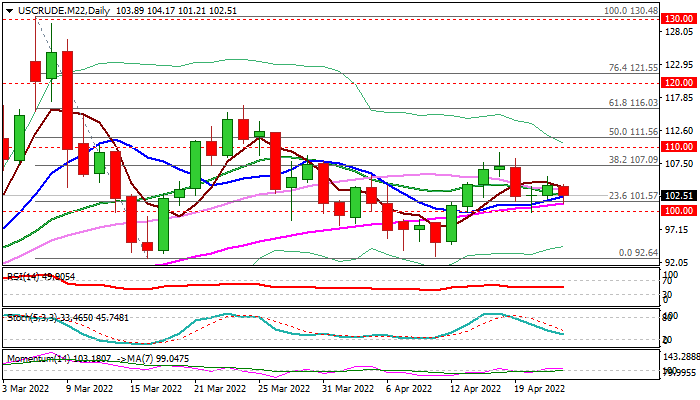
Fresh weakness emerged after the recovery action penetrated daily cloud (spanned between $103.49 and $110.26) but failed to hold within the cloud.
Near-term action is holding between $101.57 (broken Fibo 23.6% of $130.48/$92.64) and $107.09 (Fibo 38.2%) with lower range boundary being under pressure again, after previous attempts repeatedly failed to register close below this level.
Mixed daily studies lack clearer direction signal, which could be expected on firm break of supports at $101.57/$100.00 (Fibo / psychological) that would bring bears in play and risk deeper fall.
Daily Kijun-sen ($104.76) marks pivotal barrier, break of which would ease downside pressure.
Res: 104.17; 104.76; 105.39; 107.09
Sup: 101.57; 101.21; 100.00; 98.54
Canada retail sales rose 0.1% mom in Feb, to rise 1.4% in Mar
Canada retail sales rose 0.1% mom to CAD 59.9B in February, better than expectation of -0.5% mom decline. That's the fourth increase in the last five months. Higher sales at clothing and clothing accessories stores (+15.1%) and gasoline stations (+6.2%) were offset by lower sales at motor vehicle and parts dealers (-5.1%).
Sales were up in 6 of the 11 subsectors, representing 47.2% of retail trade. Core retail sales—which exclude sales at gasoline stations and motor vehicle and parts dealers—increased 1.4%.
According to advance estimate, sales increased 1.4% mom in March.