

Sample Category Title
USD/CAD Weekly Outlook
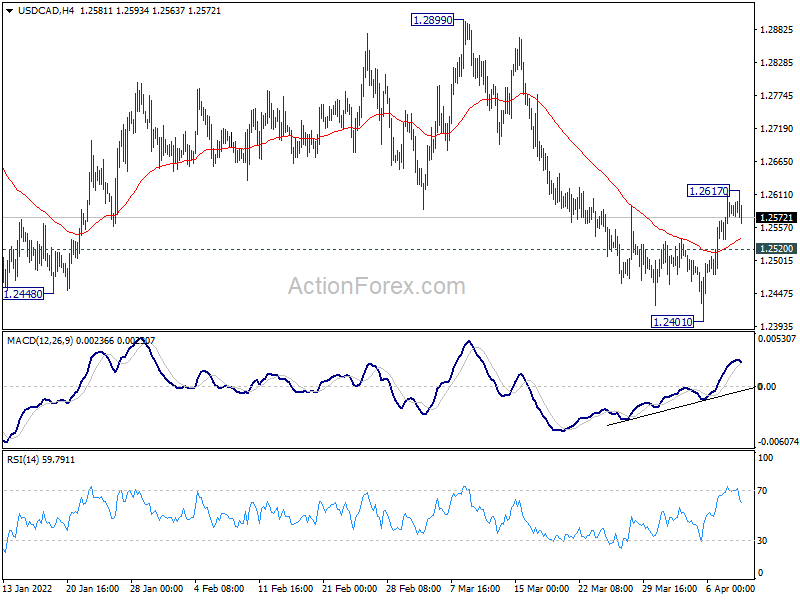
USD/CAD rebounded strongly after dipping to 1.2401 last week, but lost momentum after hitting 1.2617. Initial bias is neutral this week first. On the upside, break of 1.2617 will resume the rebound from 1.2401 to 1.2899 resistance. On the downside, break of 1.2401 will revive near term bearishness and target 1.2005 low.
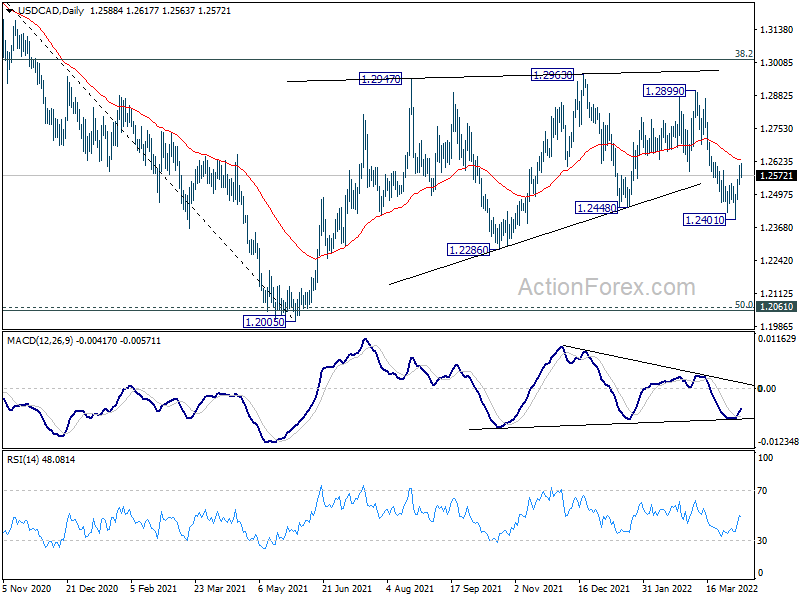
In the bigger picture, focus stays on 38.2% retracement of 1.4667 (2020 high) to 1.2005 (2021 low) at 1.3022. Sustained break there should confirm that the down trend from 1.4667 has completed after defending 1.2061 long term cluster support. Further rise would then be seen towards 61.8% retracement at 1.3650. However, rejection by 1.3022 will maintain medium term bearishness. Break of 1.2005 will resume the down trend from 1.4667 and that carries larger bearish implications too.
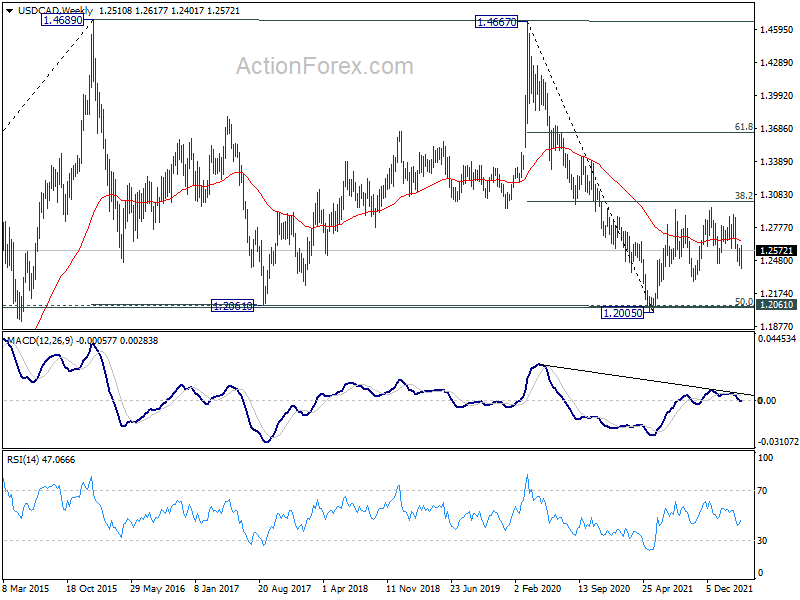
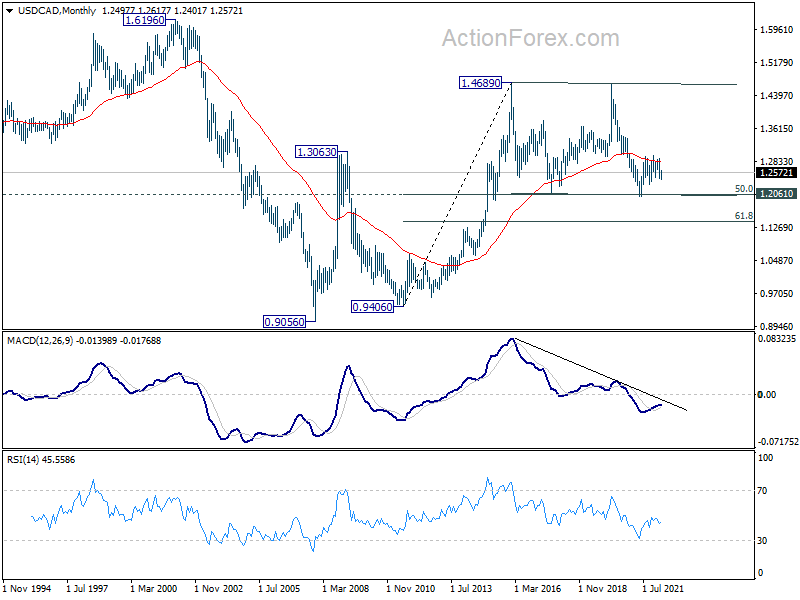
In the longer term picture, we're viewing price actions from 1.4689 as a consolidation pattern. Thus, up trend from 0.9506 (2007 low) is still expected to resume at a later stage. This will remain the favored case as long as 1.2061 support holds, which is close to 50% retracement of 0.9406 to 1.4689 at 1.2048. However, firm break of 1.2061 support will argue that USD/CAD has already started a long term down trend. Next target is 61.8% retracement of 0.9406 to 1.4689 at 1.1424.
GBP/JPY Weekly Outlook
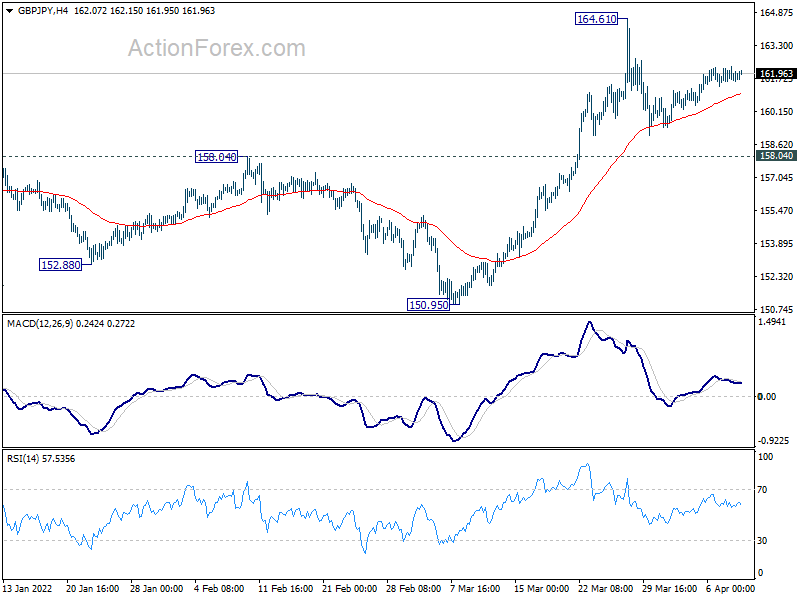
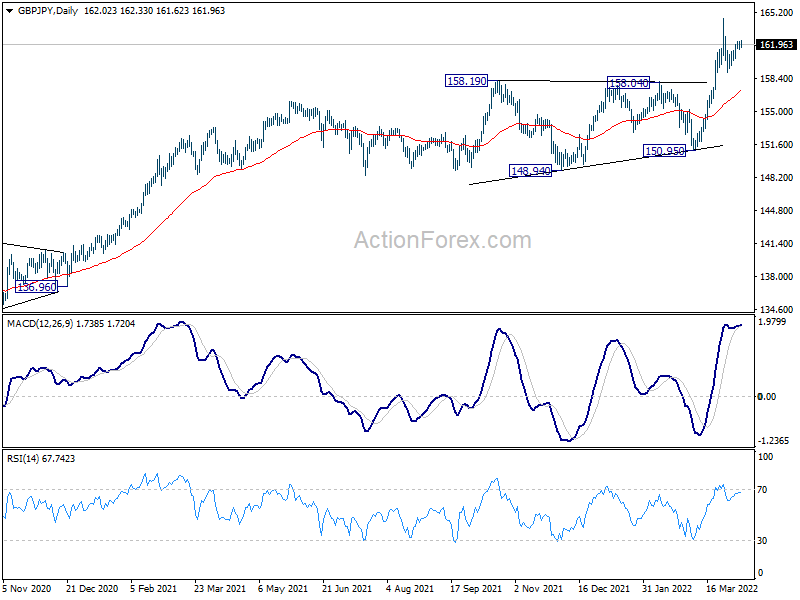
GBP/JPY's consolidation from 164.61 extended last week and outlook is unchanged. Initial bias remains neutral this week and further rise is expected with 158.04 support intact. On the upside, break of 164.61 will resume larger up trend to long term fibonacci level at 167.93. However, firm break of 158.19 will turn bias to the downside and bring deeper pull back.
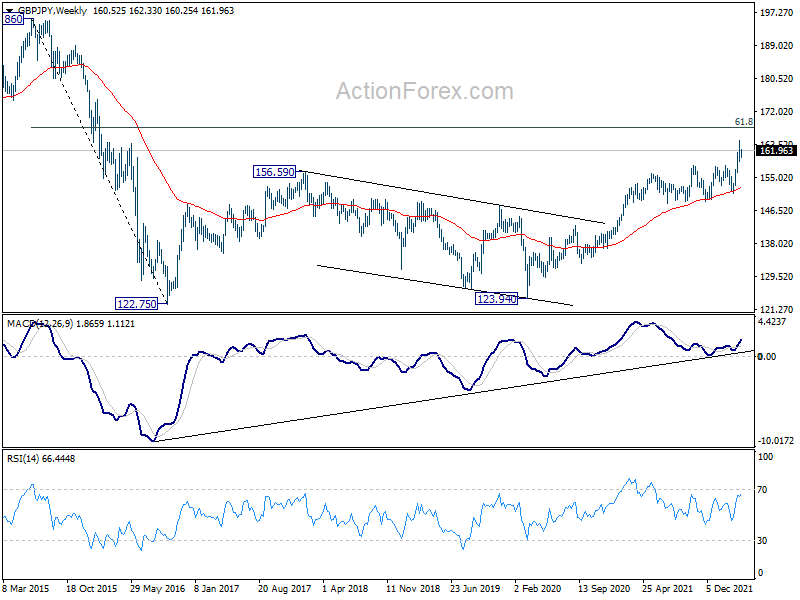
In the bigger picture, up trend from 123.94 (2020 low) is still in progress, and notable support from 55 week EMA affirms medium term bullishness. Next target is 61.8% retracement of 195.86 (2015 high) to 122.75 (2016 low) at 167.93. Sustained break there will be a long term bullish signal. This will now remain the favored case as long as 150.95 support holds.
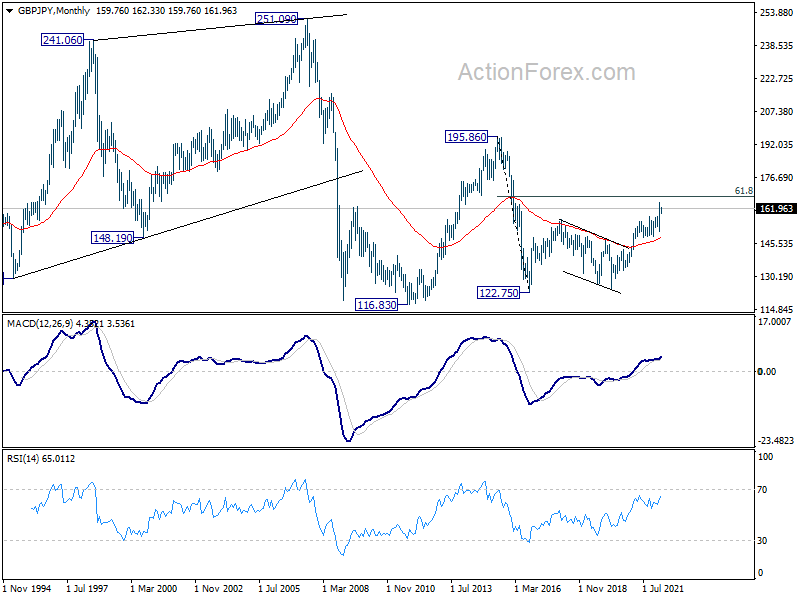
In the longer term picture, as long as 55 month EMA (now at 148.20) holds, we'd still favor more rally to 61.8% retracement of 195.86 to 122.75 at 167.93. Sustained break there will pave the way to 195.86 (2015 high).
EUR/JPY Weekly Outlook
EUR/JPY extended the consolidation from 137.50 last week. Initial bias stays neutral this week first, but further rally is expected with 133.70 support intact. On the upside, sustained break of 137.49 resistance will resume larger up trend for 144.06 projection level next. However, firm break of 133.70 will turn bias back to the downside for deeper pull back.
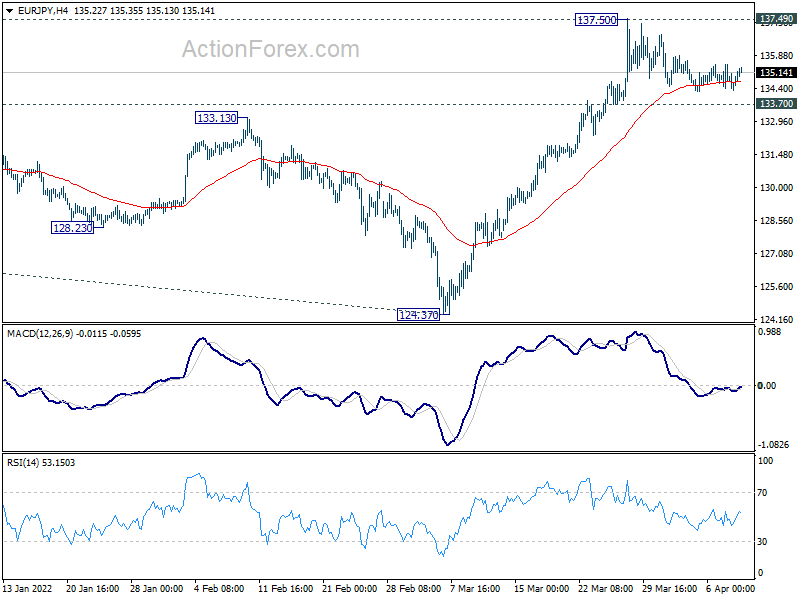
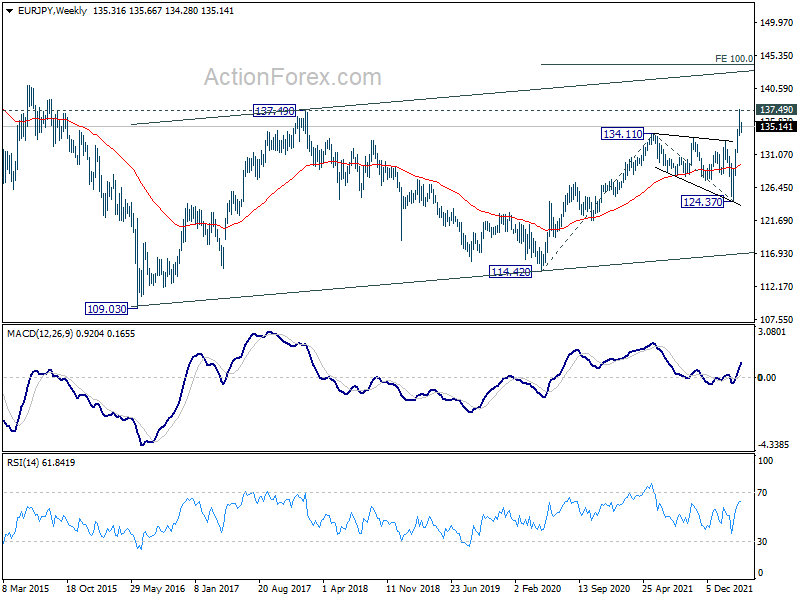
In the bigger picture, up trend from 114.42 (2020 low) is in progress. Sustained break of 137.49 (2018 high) will resume larger pattern from 109.30 (2016 low). Next target will be 100% projection of 114.42 to 134.11 from 124.37 at 144.06. In any case, outlook will now remain bullish as long as 124.37 support holds, in case of deep pull back.
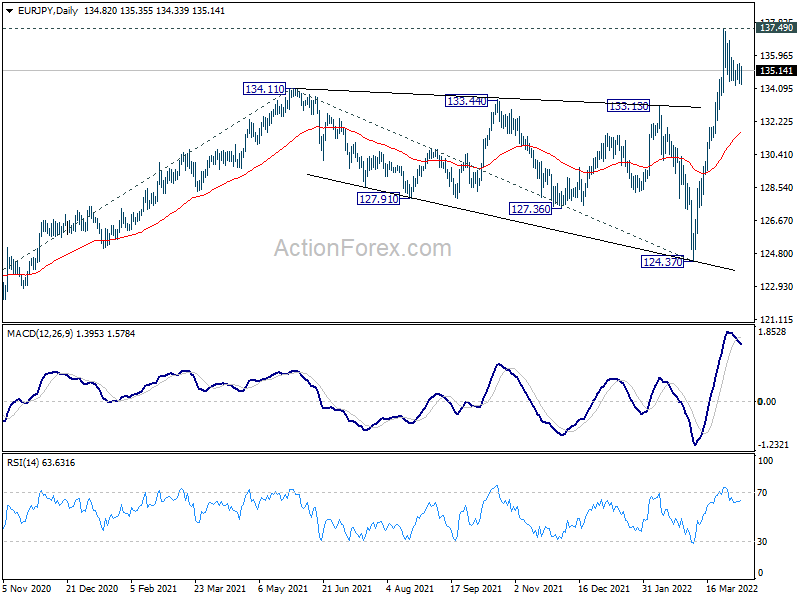
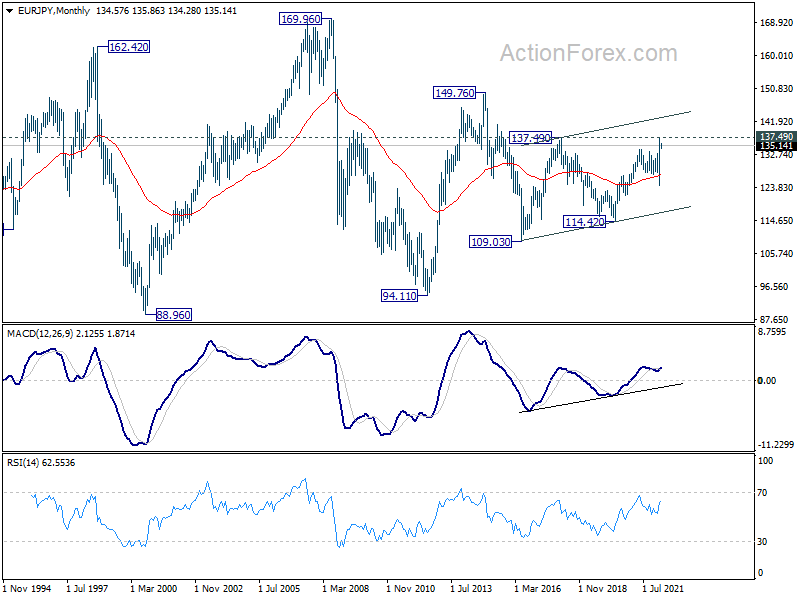
In the long term picture, focus is now on 137.49 resistance (2018 high). Sustained break there will raise the chance that whole rise from 94.11 (2012 low) is resuming through 149.76 resistance. This will be a slightly favored case for now, as long as 124.37 support holds.
EUR/GBP Weekly Outlook
EUR/GBP's fall from 0.8511 extended lower last week but it's still staying above 0.8294 support. Initial bias remains neutral this week first. On the downside, break of 0.8294 will argue that rebound from 0.8201 has completed at 0.8511, and revive near term bearishness. Intraday bias will be back on the downside for retesting 0.8201 low. On the upside, however, break of 0.8511 will reaffirm that 0.8201 is a medium term bottom, and target 0.8697 medium term fibonacci level next.
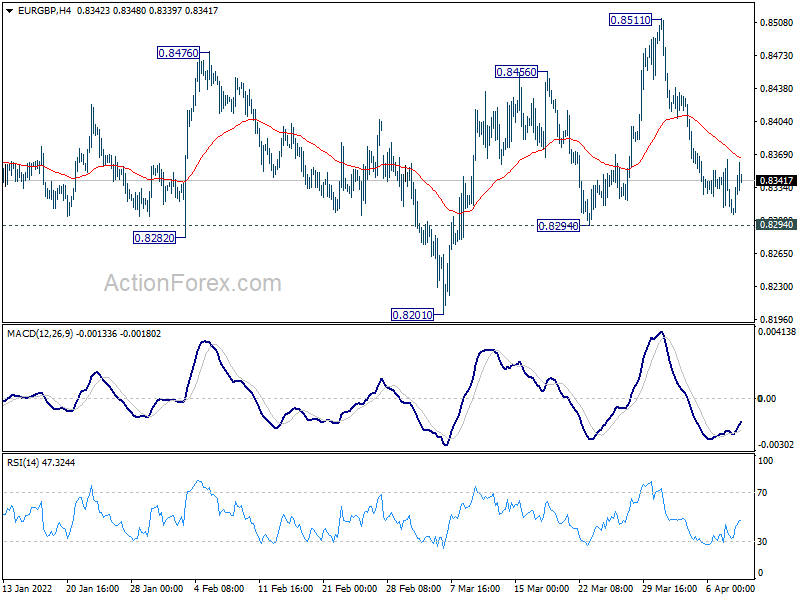
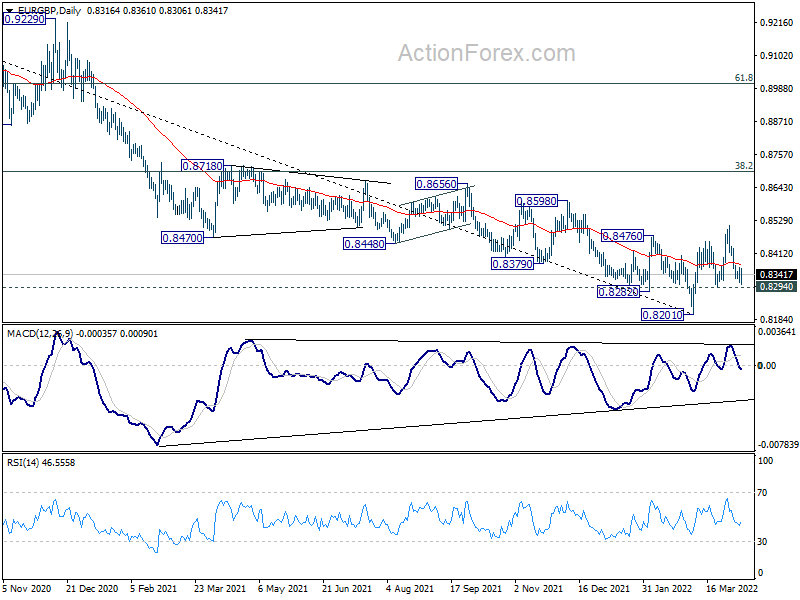
In the bigger picture, a medium term bottom should be in place at 0.8201, on bullish convergence condition in daily and weekly MACD. Rise from there could either be a correction to the down trend from 0.9499 (2020 high), or a medium term up trend itself. In either case, further rise should be seen to 38.2% retracement of 0.9499 to 0.8201 at 0.8697. Sustained break there will target 61.8% retracement at 0.9003. This will remain the favored case as long as 0.8294 support holds.
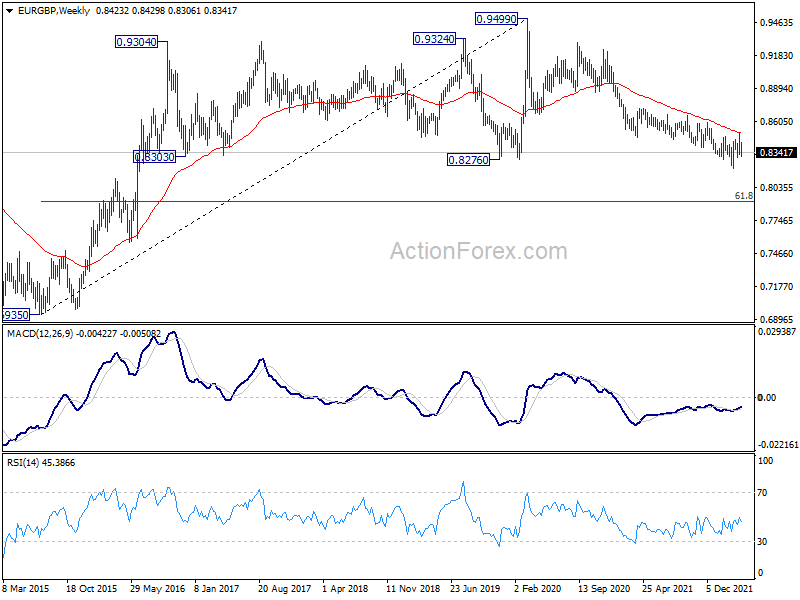
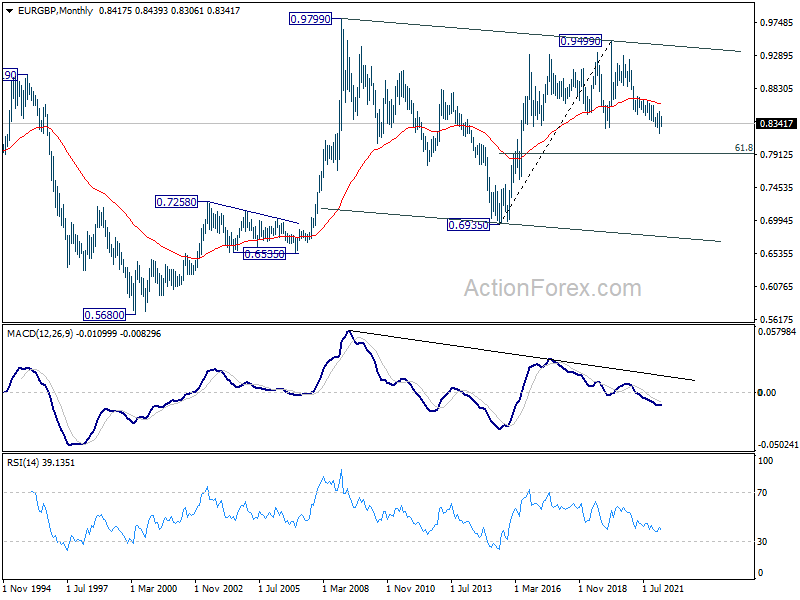
In the long term picture, current development argues that fall from 0.9499 is probably the third leg of the pattern from 0.9799 (2008 high). Sustained break of 61.8% retracement of 0.6935 to 0.9499 at 0.7917 will pave the way back to 0.6935 (2015 low) and probably below.
EUR/AUD Weekly Outlook
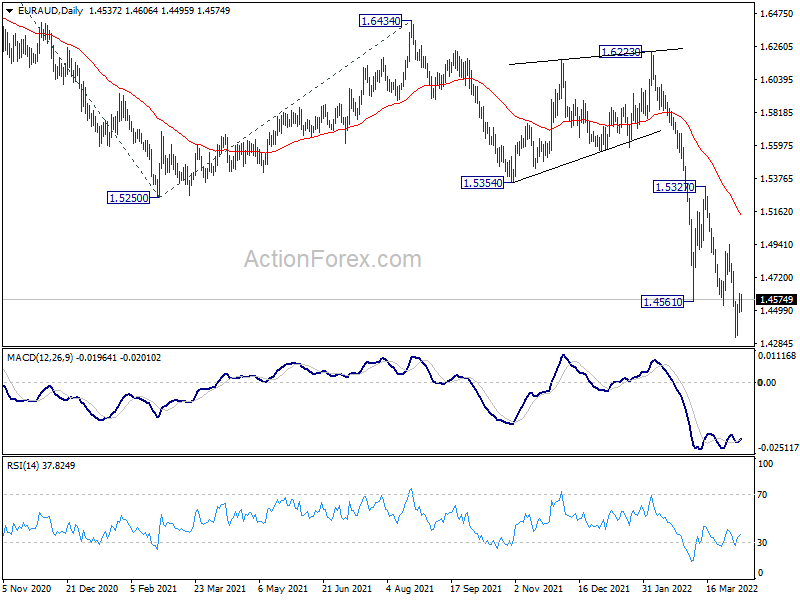
EUR/AUD's down trend resumed last week but recovered after hitting 1.4318. Initial bias is neutral this week for some consolidations. But outlook will remain bearish as long as 1.4940 resistance holds. On the downside, break of 1.4318 will resume larger down trend to 1.3624 long term support next. On the upside, however, firm break of 1.4940 will indicate short term bottoming and turn bias back to the upside for 1.5327 resistance instead.
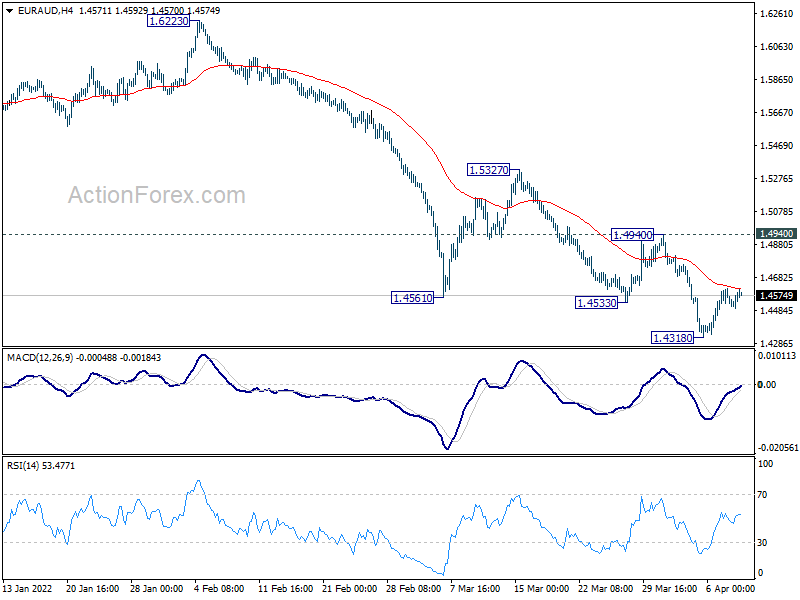
In the bigger picture, fall from 1.9799 is seen as a long term impulsive move. Next target is 61.8% projection of 1.9799 to 1.5250 from 1.6434 at 1.3623, which is close to 1.3624 long term support (2017 low). Some support could be seen there to bring interim rebound. But overall, break of 1.5354 support turned resistance is needed to be the first sign of medium term bottoming. Otherwise, outlook will stay bearish in case of recovery.
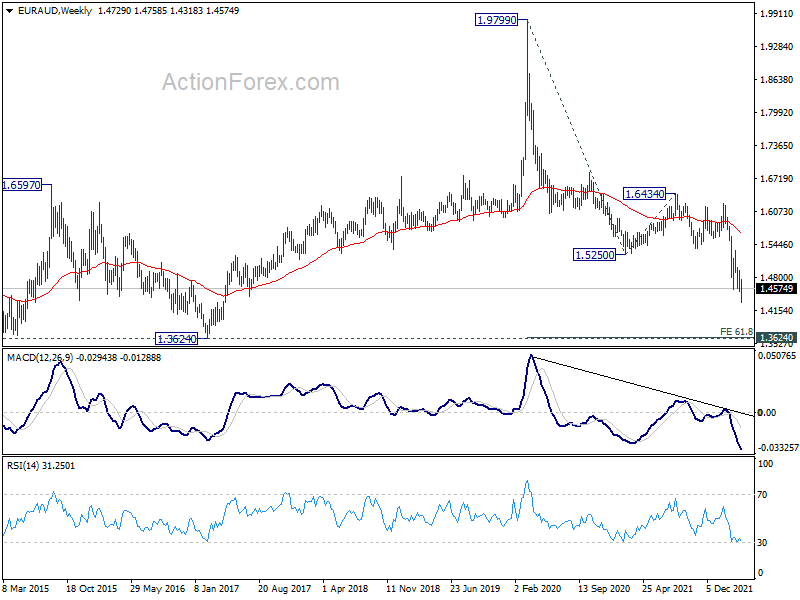
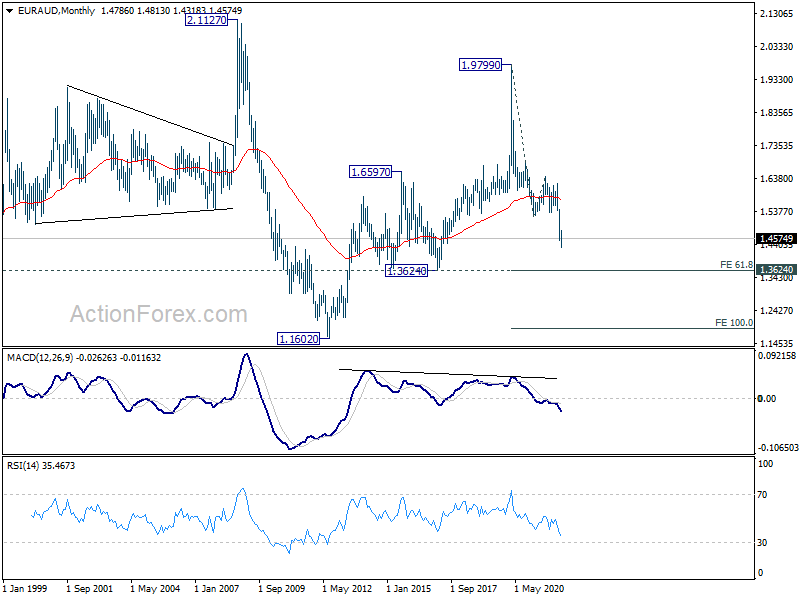
In the longer term picture, fall from 1.9799 (2020 high) is seen as the third leg of the pattern from 2.1127 (2008 high). Deeper fall should be seen to 1.3624 support. Decisive break there would pave the way back to 1.1602 (2012 low).
EUR/CHF Weekly Outlook
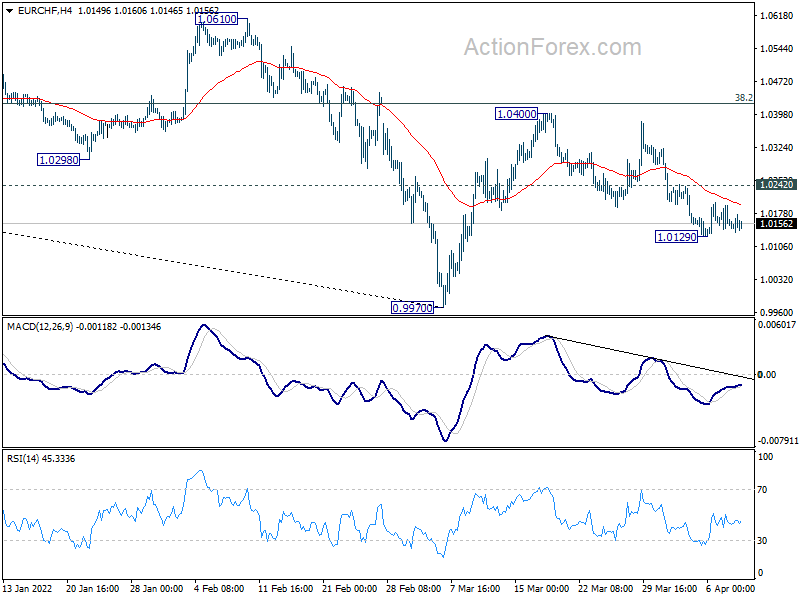
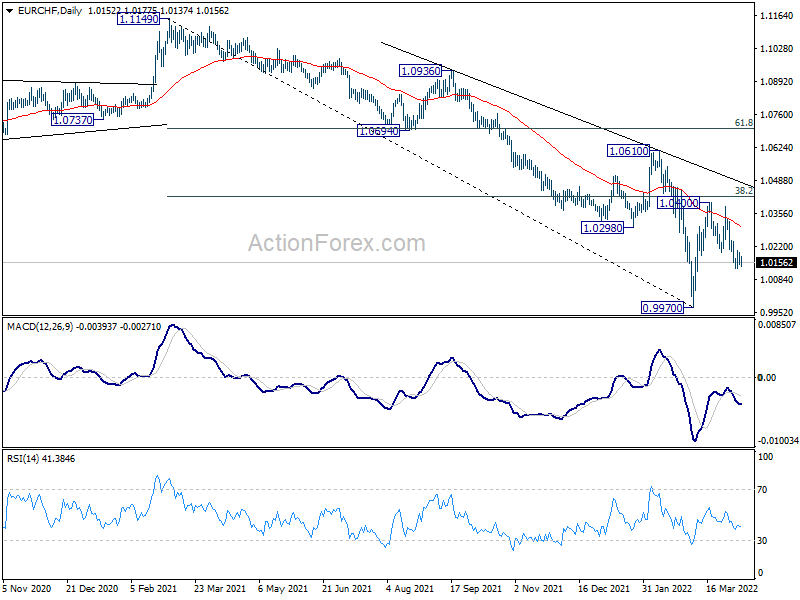
EUR/CHF's fall from 1.0400 extended lower last week but turned sideway after hitting 1.0129. Initial bias is neutral this week first. Rebound from 0.9970 might have completed at 1.0400 already, ahead of 38.2% retracement of 1.1149 to 0.9970 at 1.0420. . Further fall is in favor as long as 1.0242 minor resistance holds. Below 1.0129 will target a retest on 0.9970 low. On the upside, however, break of 1.0242 will turn bias back to the upside for 1.0400 resistance instead.
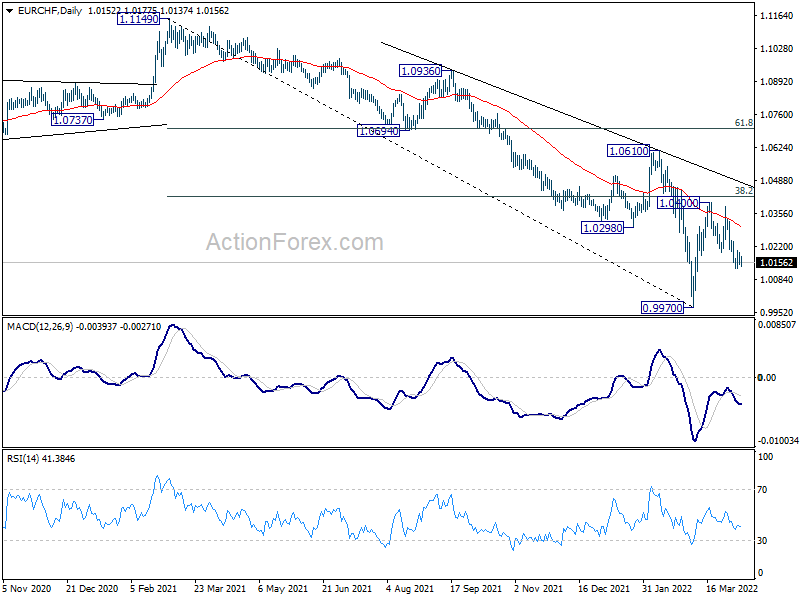
In the bigger picture, long term down trend from 1.2004 (2018 high) is still in progress. Next target is 100% projection of 1.2004 to 1.0505 to 1.1149 at 0.9650. In any case, sustained break of 1.0505 support turned resistance (2020 low) is needed to be the first sign of medium term bottoming. Otherwise, outlook will remain bearish.
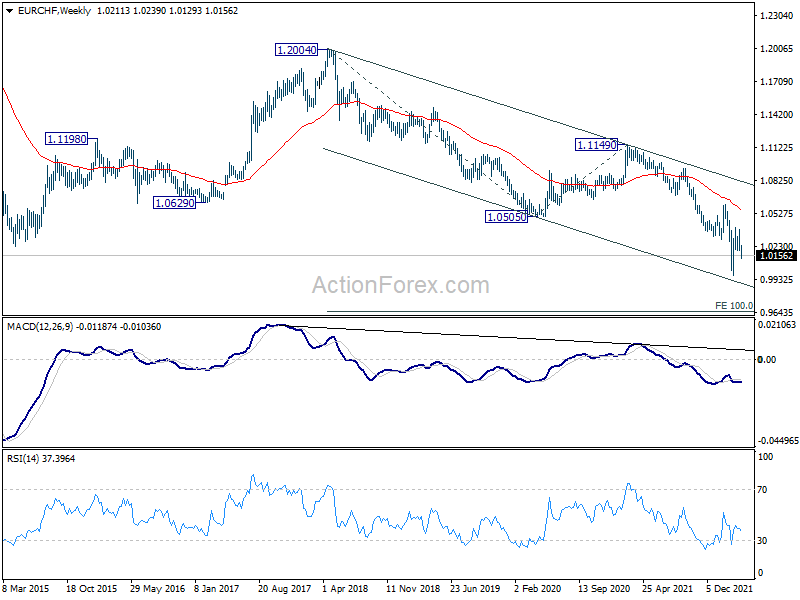
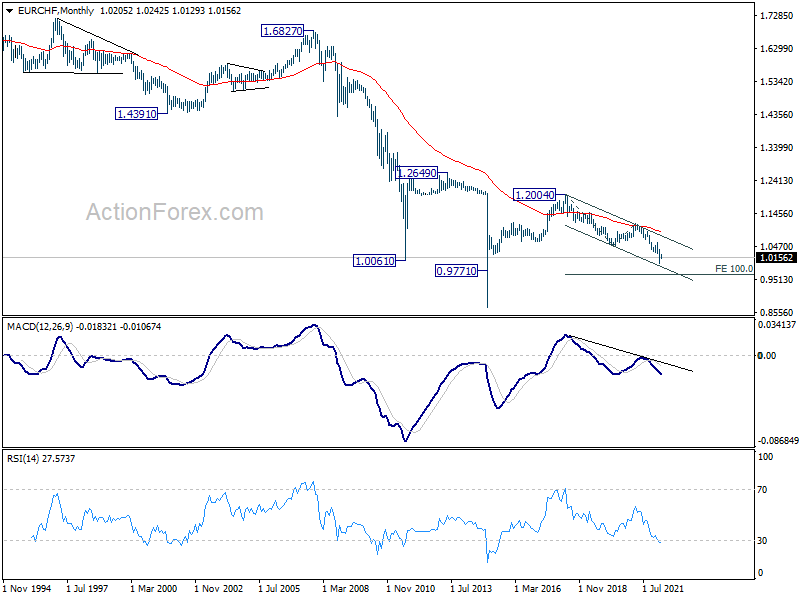
In the long term picture, capped below 55 month EMA, EUR/CHF is seen as extending the multi-decade down trend. There is no prospect of a bullish reversal until some sustained trading above the 55 month EMA (now at 1.0891).
Dollar Ended Broadly Higher as 10-Yr Yield Hit 2.7
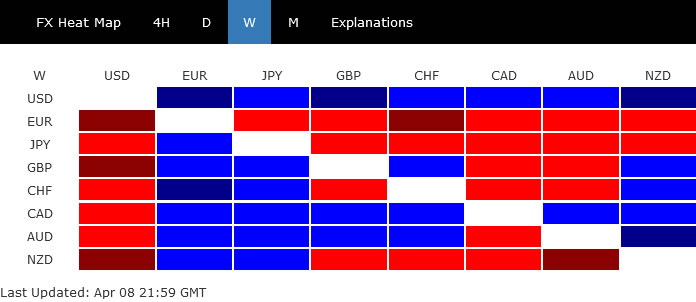
Dollar was initially mixed last week but buyers jumped in after FOMC minutes revealed the quantitative tightening plan. US benchmark treasury yields also surged to highest level since 2019. Both Canadian and Australian Dollars followed as second and third strongest. Aussie was boosted by RBA's hints on earlier rate hike while Loonie was supported by strong job data.
While ECB delivered a hawkish twist in the meeting minutes, Euro ended as the worst performer as the Ukraine war dragged on. Yen was the next weakest, and continued its inverse relationship with global benchmark yields. Sterling and Swiss Franc were mixed.
US 10-year yield jumped as Fed laid out QT plan
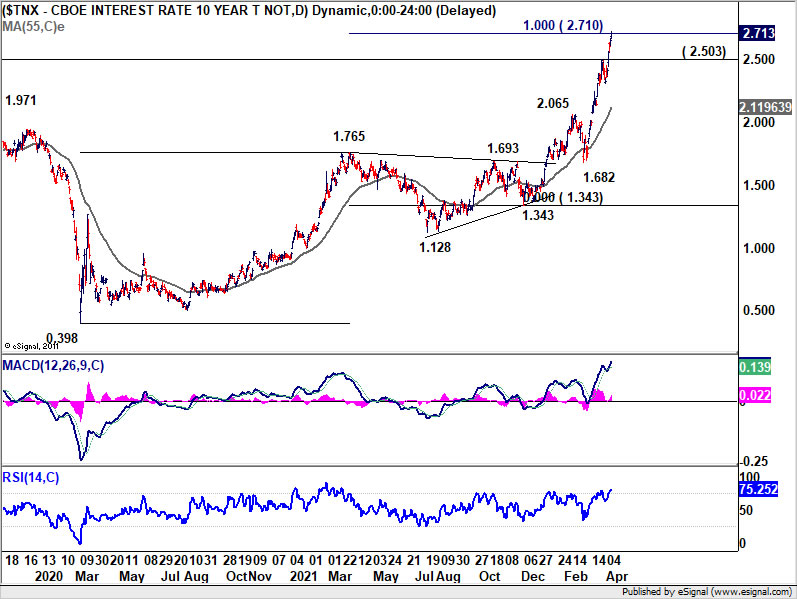
US 10-year yield surged sharply last week to close at 2.713%, highest since March 2019. Yield curve also steepened somewhat, with 2-yield yield closing at 2.466%. But 5-year yield, closing at 2.756%, was higher than 10-year yield. The moves were in reaction to March FOMC minutes, which laid down a plan of USD 95B per month balance sheet runoff, (USD 60B in treasury securities and USD 35B in MBS holdings). The so-called quantitative tightening should start in May.
10-year yield is now pressing a medium term projection level at 100% projection of 0.398 to 1.765 to 1.343 at 2.710. Further rise would remain in favor for the near term as long as 2.503 resistance turned support holds. Sustained trading above 2.710 should prompt upside acceleration.
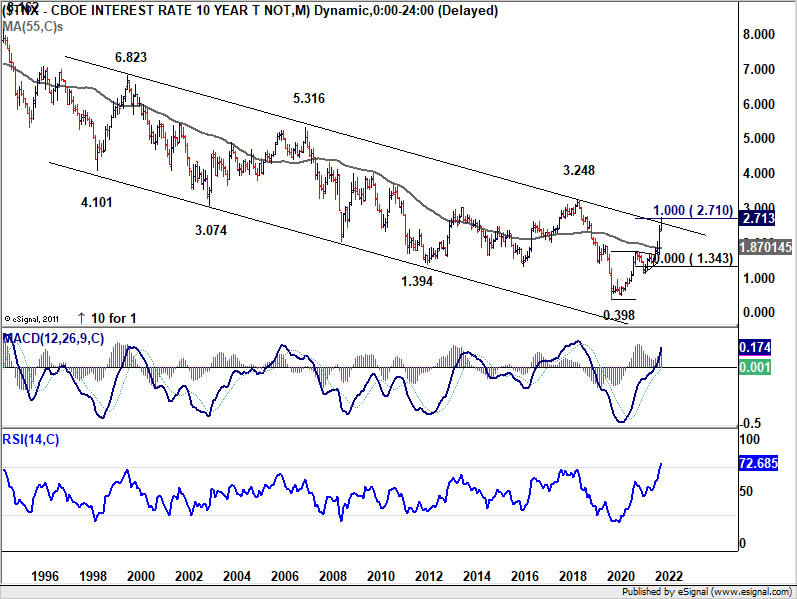
More importantly, further rise would confirm the break of a multi-decade channel resistance as seen in the monthly chart. Such development could mark the start of a near era, of finally a long term trend of rising treasury yield and interest rates, probably accompanied by persistently strong inflation. If this happens, the next focus will be 3.248 level (2018 high).
Dollar index resumed up trend, but failed 100 t first attempt
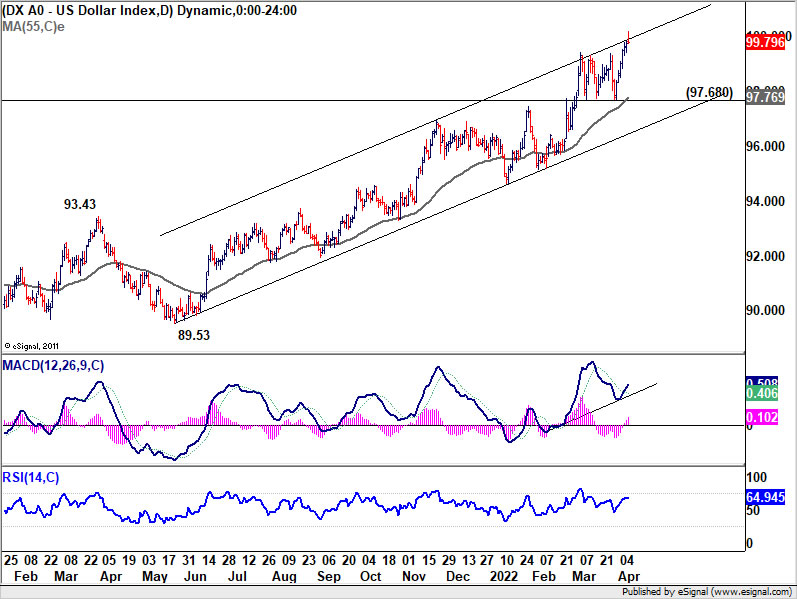
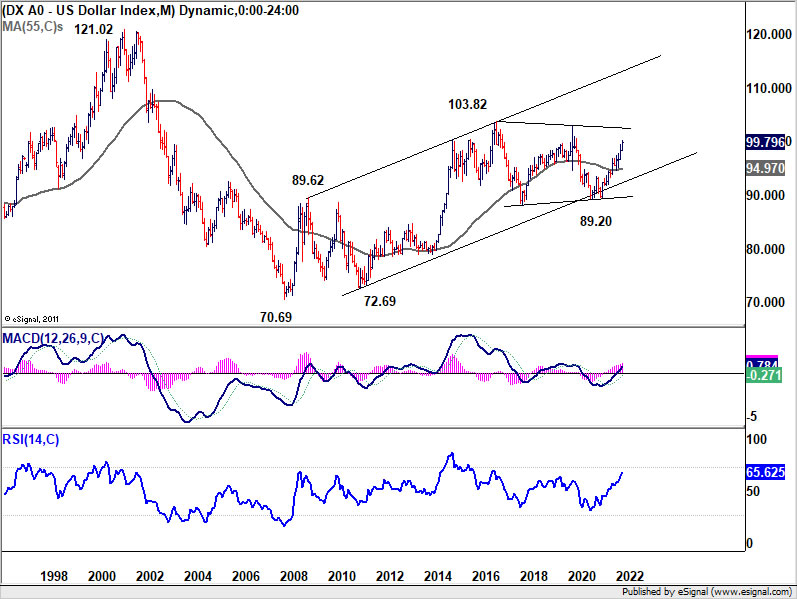
Dollar index resumed its medium term up trend last week, but failed to close above 100 handle. Still, outlook will remain bullish as long as 97.68 support holds. The question is whether DXY could break through 100 with some conviction at next attempt. Also, sustained break of the medium term channel resistance could be a sign of upside acceleration.
Overall, the rise from 89.20 is taken as a leg inside the long term consolidative pattern from 103.82 (now at 2017 high). Hence, some focuses will be on topping signal as DXY approaches 103.82. However, if TNX could break through 3% handle and set its eye on above mentioned 3.248 resistance, DXY could be given the needed fuel to have a genuine challenge 103.82, or even break through it.
EUR/CHF gyrated lower despite hawkish twist in ECB
The minutes of ECB's March meeting turned out to be more hawkish than expected, with some members argued in favor of putting a firm end date to asset purchases. Comments from some Governing Council members also indicated their getting more concerned with persistently high inflation.
There are some expectations that ECB would deliver and announce to conclude the APP in this week's meeting. It would maintain that adjustment in interest rate would come "some time" after that, while President Christine Lagarde will reiterate the importance of graduality, flexibility and optionality. Still, there are some speculations that tightening cycle would come in September, followed by another hike before the end of the year.
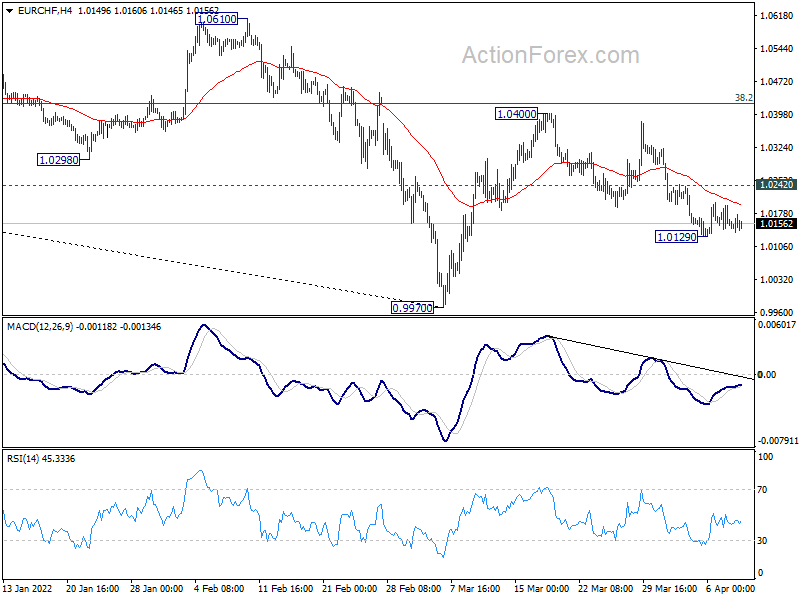
Yet, the hawkish twist in ECB provided little support to Euro. Firstly, ECB is still going to lag behind other major central banks in tightening. Secondly, the ongoing impact of Russia invasion of Ukraine remains highly uncertain.
EUR/CHF gyrated lower last week but lost momentum after dipping to 1.0129. The structure of the fall from 1.0400 doesn't warrant down trend resumption. But further decline will remain in favor as long as 1.0242 minor resistance holds. Break of 1.0129 will put EUR/CHF back on track to retest 0.9970 low. Nevertheless, break of 1.0242 minor resistance will likely revive some near term bullishness, and resume the rebound from 0.9970 through 1.0400 resistance.
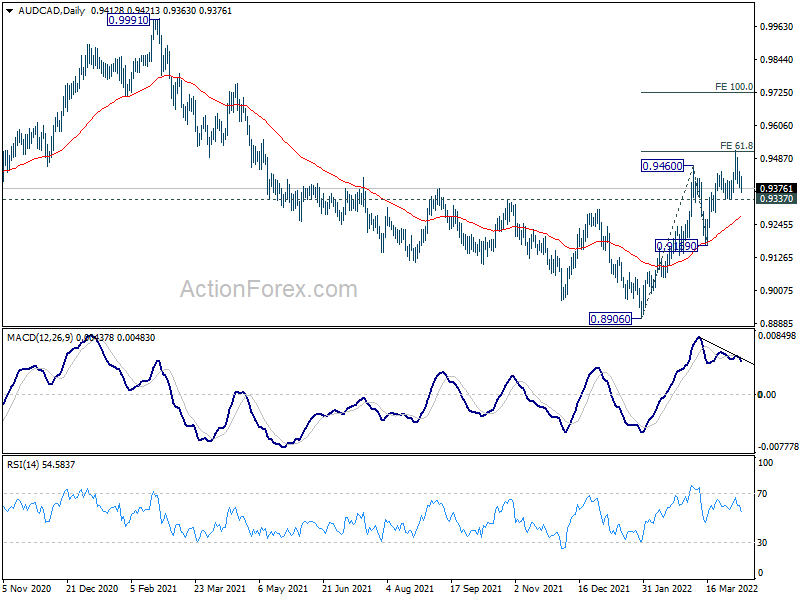
AUD/CAD rally capped at 0.9514, awaits BoC for next move
Aussie was boosted higher last week after RBA abandoned its "patient" stance. The change in language is seen as an indication of pull ahead the first rate hike, probably to June meeting. Still RBA is lagging behind both BoC and RBNZ. Indeed, both the Canadian and New Zealand central banks are expected to continue with their tightening cycle this week. BoC is even expected to raise interest rate by 50bps, after recent strong inflation and job numbers.
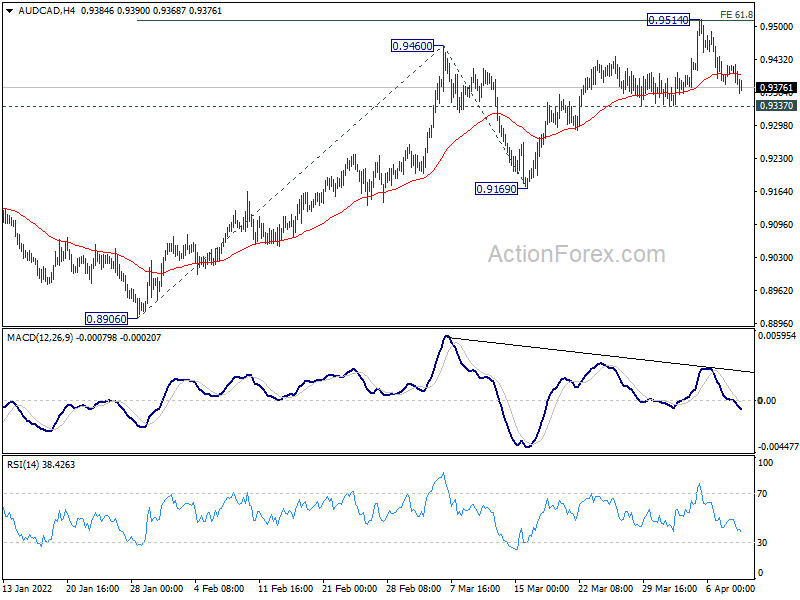
AUD/CAD edged higher to 0.9514 last week but the rally was capped by 61.8% projection of 0.8906 to 0.9460 from 0.9169 at 0.9511. Another rise will remain mildly in favor as long as 0.9337 support holds. Break of 0.9514 will extend the whole rise from 0.8906 to 100% projection at 0.9723. However, firm break of 0.9337 will raise the chance that whole rebound from 0.8906 has completed, and bring deeper fall back to 0.9169 support. The next development would very much depend on how BoC rate decision plays out.
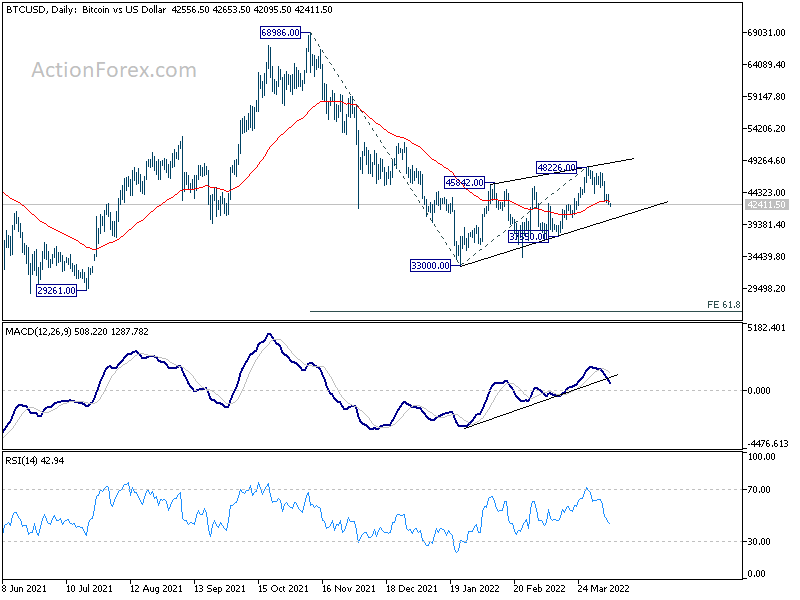
Bitcoin's corrective recovery finished at 48226?
Bitcoin's fall from 48226 extended lower last week and closed below 55 day EMA (now at 43005). The development raises the chance that recovery from 33000 is merely a corrective pattern, that's even completed with three waves up to 48226. If bitcoin cannot move back and sustain above 55 day EMA soon, risk will be on the downside. Further break of 37550 support will argue that the down trend from 68986 is ready to resume through 33000 low.
USD/JPY Weekly Outlook
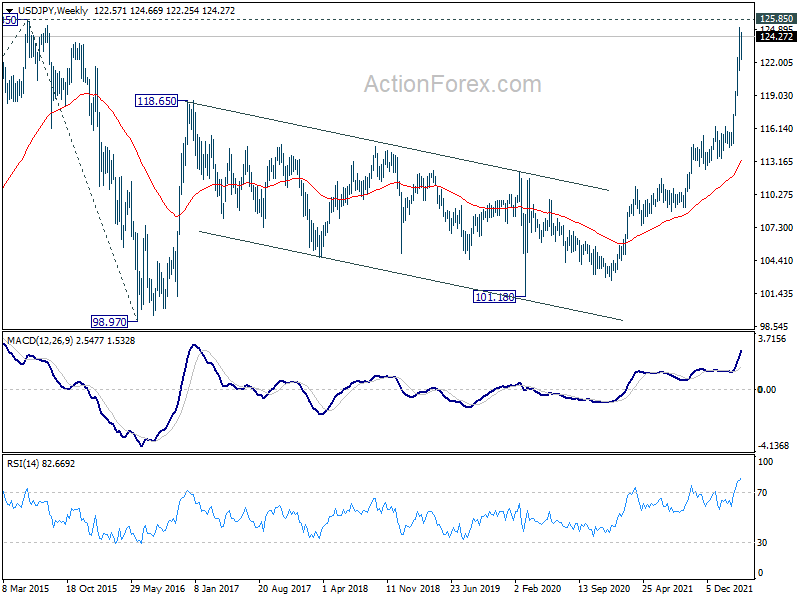
USD/JPY's rebound from 121.27 extended higher last week but upside was capped below 125.09 resistance. Initial bias remains neutral this week first. On the upside, firm break of 125.09 will resume larger up trend from 102.58. Further break of 125.85 long term resistance will pave the way to 130.04 long term projection level. Consolidation from 125.09 could still extend with another falling leg. But overall outlook will remain bullish as long as 121.17 support holds.
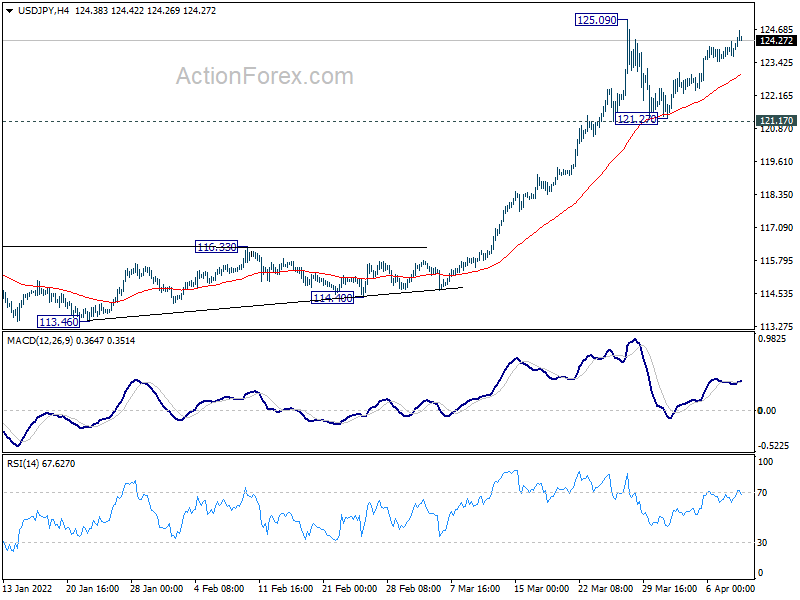
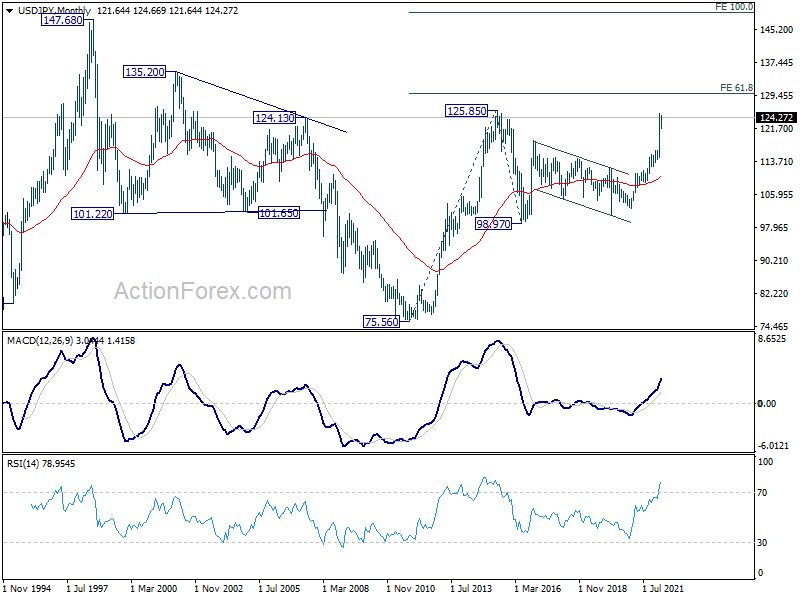
In the bigger picture, up trend from 98.97 (2016 low) is in progress for retesting 125.85 (2015 high). Sustained break there will confirm long term up trend resumption. Next target will be 61.8% projection of 75.56 (2011 low) to 125.85 (2015 high) from 98.97 at 130.04. This will now remain the favored case as long as 116.34 resistance turned support holds.
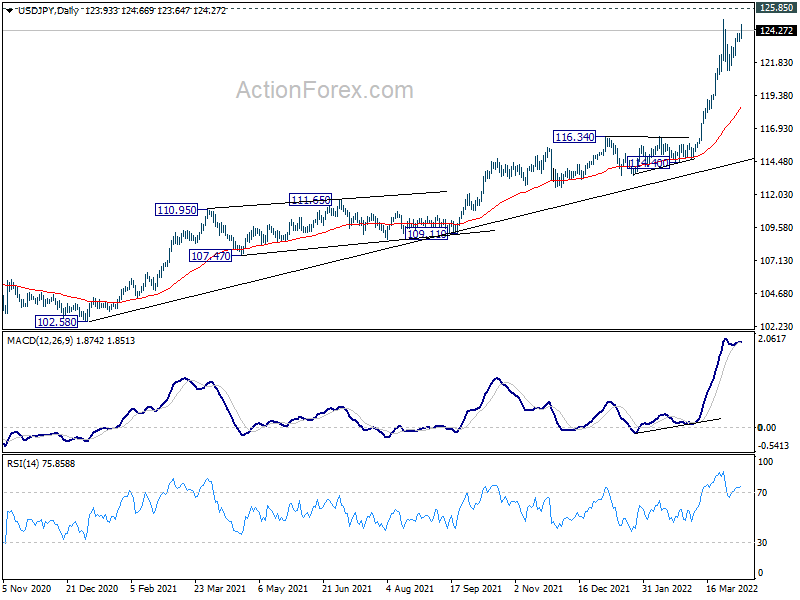
In the long term picture, the rise from 75.56 (2011 low) long term bottom to 125.85 (2015 high) is viewed as an impulsive move, no change in this view. Price actions from 125.85 are seen as a corrective pattern that might have completed at 98.97 already. Firm break of 125.85 will target 61.8% projection of 75.56 to 125.85 from 98.97 at 130.04. Next is 100% projection at 149.26, which is close to 147.68 (1998 high).
Summary 4/11 – 4/15
Monday, Apr 11, 2022
[php_everywhere instance="1"]
Tuesday, Apr 12, 2022
[php_everywhere instance="2"]
Wednesday, Apr 13, 2022
[php_everywhere instance="3"]
Thursday, Apr 14, 2022
[php_everywhere instance="4"]
Friday, Apr 15, 2022
[php_everywhere instance="5"]
Weekly Economic & Financial Commentary: Minutes Put All Eyes on the Fed, but Economic Activity Remains Strong
Summary
United States: Minutes Put All Eyes on the Fed, but Economic Activity Remains Strong
- In an otherwise calm week of data, Wednesday's release of the FOMC minutes stirred things up as they showed committee members agreeing that elevated inflation and the tight labor market warrant balance sheet reduction to start soon. The minutes also stressed that current economic indicators point to strong activity, which was affirmed by the robust domestic demand that drove the ISM services index higher in March and kept the February trade balance at a record deficit.
- Next week: CPI (Tuesday), Retail Sales (Thursday), Industrial Production (Friday)
International: Commodity Price Spike Keeps Latam Inflation Elevated
- In our view, one of the regions that is most at risk to elevated commodity prices is Latin America. This week, we received evidence that inflation is indeed moving higher as a result of the push higher in commodity prices. Furthermore, the Canadian economy continues to demonstrate a robust recovery from the COVID pandemic.
- Next week: India CPI (Tuesday), Bank of Canada (Wednesday), European Central Bank (Thursday)
Interest Rate Watch: Balance Sheet Runoff Takes Shape
- The minutes of the March FOMC meeting released this week signaled the committee is likely to begin balance sheet reduction in May. Monthly caps for Treasury and MBS runoff are likely to reach $60B and $35B, respectively, and be phased in over just three months. The expedited timeline helped the yield curve steepen.
Credit Market Insights: Consumer Credit Expands in February
- The Federal Reserve Board reported that consumer credit increased at an annualized rate of 11.3% in February, with revolving credit leading the way, increasing 20.7%.
Topic of the Week: Last Week's Positive Russia and Ukraine Headlines Appear to Be a False Start
- Toward the end of last week, headlines suggested the Russia-Ukraine conflict may have reached a turning point. While reports suggest the Russian military is indeed withdrawing from Kyiv, Russian troops seem to be reinforcing their positions in other areas of Ukraine in an effort to establish stronger control.
The Weekly Bottom Line: Canada – Rate Hikes Ahead
U.S. Highlights
- The first full week of the second quarter was sparse on economic data. The service sector showed signs of modest acceleration, while vehicle sales declined for the second consecutive month in March.
- The Federal Open Market Committee (FOMC) March meeting minutes reiterated members’ unwavering commitment to moving fast to restore price stability.
- The minutes provided a blueprint of the Fed’s balance sheet runoff, which will be more aggressive and ramp up faster than before. At such pace, the runoff should finish by the end of 2024.
Canadian Highlights
- The economic news was non-stop this week, from the Business Outlook Survey, to the Federal Budget, and capping it off with another banner jobs number.
- The job market keeps getting tighter, with the unemployment rate reaching a series low of 5.3%. Wage growth is picking up but remains slightly lower than the latter half of 2019.
- Combined with strong business sentiment, and a steady federal fiscal picture, it is all systems go for a rate hike next week. Given inflation and economic strength, a 50 basis-point move is justified.
U.S. - The Fed’s Most Important Task
The first full week of the second quarter was sparse on economic data. On Tuesday, the Institute for Supply Management released its report on services that provided signs of modest acceleration in economic activity in the sector. Still, the report was full of contrasting elements. On the one hand, demand indicators were higher with business activity, and both new domestic and export orders up on the month. This was likely supported by stronger employment and the recent improvement in delivery times allowing businesses to rebuild depleted inventories.
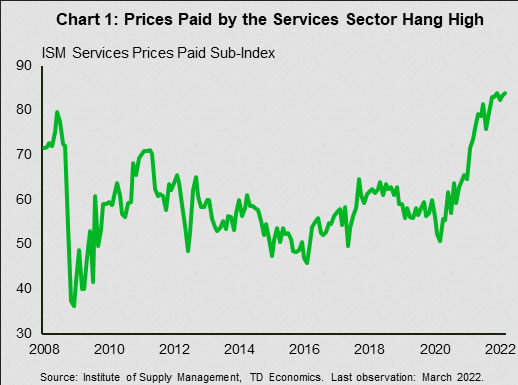
On the other hand, the imports sub-index fell into a contractionary territory while ongoing supply chain issued lowered purchasing managers’ inventory sentiment to an all-time low. The prices paid indicator was unsurprisingly higher given the energy shock dealt by the Russia-Ukraine war with all 18 industries reporting higher prices (Chart 1). In addition, respondents’ comments were quite negative, reflecting the pessimism over increasing cost and ongoing supply chain disruption.
This pessimism was echoed in the vehicle sales release, which showed the second consecutive month of decline in March. While underlying demand remains strong and improving, sales will remain constrained by limited inventory. Furthermore, production may suffer another blow should the war in Ukraine result in semiconductor shortages later in this year. As a result of strong demand and tight supply, the inventory-to-sales ratio – a measure of adequacy of supply relative to current demand – remains historically low. This will continue to put upward pressure on car prices over the near-term.
Fighting persistent price pressures remains the Fed’s most important task. The Federal Open Market Committee (FOMC) March meeting minutes reiterated members’’ unwavering commitment to moving fast to restore price stability and reach a neutral policy stance by year end. Many participants expressed their concerns about inflationary risk and voiced their preference to tighten the policy rate by 50 basis points at the next meeting on May 3rd-4th.
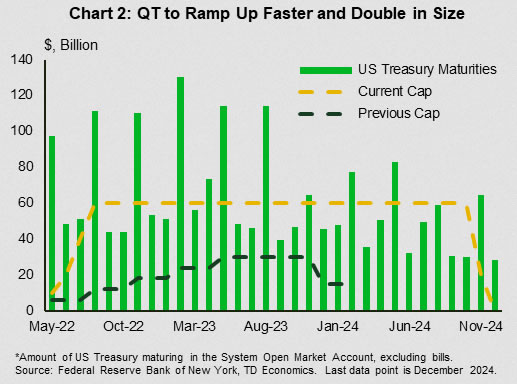
Chart 2 shows the dollar amount of maturing U.S. Treasuries (in billions) in the System Open Market Account (SOMA) from March 2022 to December 2024 alongside the series for monthly cap of the previous runoff cycle of 2017-2019 and the one expected this time. In the previous cycle the Fed limited the caps to $6 billion per month, steadily raising the level to $30 billion over the period of 12 months, and then reducing it to $15 billion in 2019. This time the Fed is expected to phase-in within three months reaching the cap of $60 billion – double the maximum size of the previous runoff cycle.
The minutes also provided a plan for the Fed’s balance sheet runoff (aka Quantitative Tightening or QT). As we wrote in this report, the monthly caps will be larger than in the previous QT cycle, scaled up by the increase in asset holdings (Chart 2). The participants agreed to shed $60 billion Treasury securities and about $35 billion agency MBS monthly, but the phase-in period will be shorter than we expected at just three months. The runoff may start as early as May, which suggests that the balance sheet could shrink by $2.7 trillion by the end of 2024. By this time, we expect that the Fed will reach $1.7 trillion in reserves – the level of reserves “consistent with the Committee’s ample-reserves operating framework”.
Bond markets reacted by selling longer-dated US Treasury securities, which led to yield-curve steepening. At the time of writing, the 10-year Treasury yield was at 2.69% - up 0.3 percentage points relative to where it closed last week.
Canada - Rate Hikes Ahead
The economic news was non-stop this week, from the Business Outlook Survey, to the Federal Budget, and capping it off with another banner jobs number. The overall takeaway is there was nothing in any of it to give the Bank of Canada pause before raising rates by half a point next Wednesday.
The Bank of Canada's Business Outlook Survey showed that firms remained quite upbeat about the outlook. Investment intentions remained elevated and labour markets remained tight – a pain point for businesses, but a sign of a healthy economy. The survey was largely conducted before Russia invaded Ukraine, though a recent special survey indicated, not surprisingly, that businesses expect the war to add to inflationary pressures through higher input costs. The lower-profile companion survey on consumer expectations echoed the same themes – strong labour markets and inflation worries. However, spending intentions remained strong, and the probability that people would quit their jobs in the next year rose to a series high of 22%.
One economic player that inflation is helping is the federal government, where higher inflation has improved the fiscal outlook presented in Budget 2022 relative to what was presented in the Fall Economic Statement (see analysis). However, the budget does not get back to black over the forecast horizon, thanks to close to $60 billion in additional spending (Chart 1). The Federal debt-to-GDP ratio remains on a downward trajectory, however, due to a growing economy.
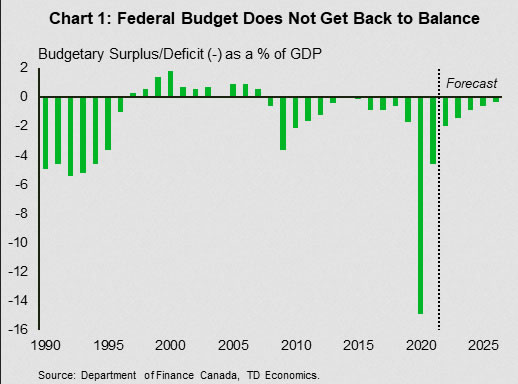
New spending measures were spread across priorities on housing, climate and environmental action, childcare, defense, dental care, and measures to further reconciliation with Indigenous peoples. Revenue raising measures were targeted: a tax on large financial institutions and increased efforts to close tax loopholes are expected to generate $17 billion over five years.
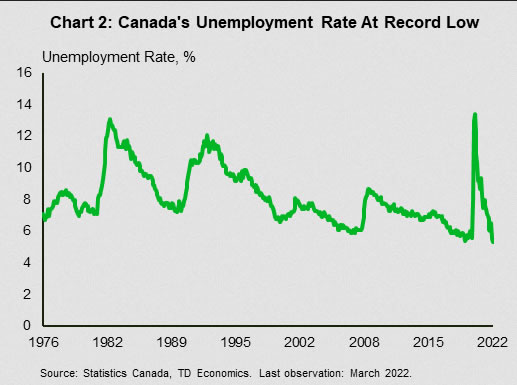
Topping off the week, March's employment data revealed that Canada's job market shows no sign of cooling down, with 73k new jobs created. The unemployment rate fell even lower, to 5.3% – the lowest level since comparable data became available in 1976. Not surprisingly, wage growth has also picked up, with average hourly wage growth up 3.4% versus a year ago. Abstracting from the distortions in wages over the pandemic – as job losses were skewed to lower wage positions, lifting the average – wage growth is still not as strong as it was in late 2019. Wage growth is also not keeping pace with inflation, which was 5.7% year/year in February. But, with the labour market this tight, wage growth is sure to heat up.
The Bank of Canada is widely expected to raise rates 50 basis points next Wednesday. It would be an aggressive move by the Bank, which has only hiked in 25 basis point increments over the past 20 years. Given the hot economy, the move is justified.