

Sample Category Title
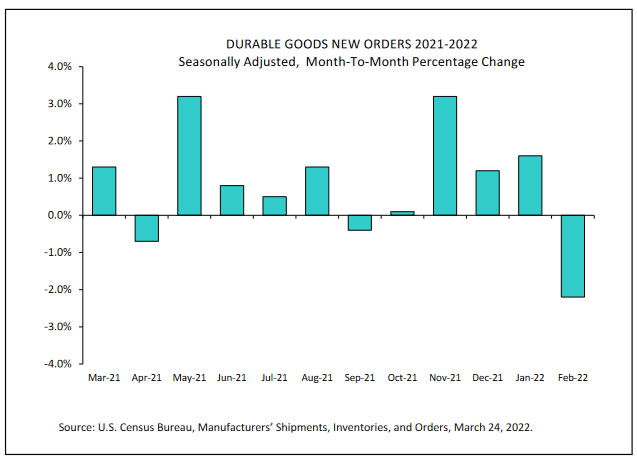
US durable goods orders dropped -2.2% mom in Feb, ex-transport orders dropped -0.6% mom
US durable goods orders dropped -2.2% mom in February to USD 271.5B, worse than expectation of -0.6% mom. Ex-transport orders dropped -0.6% mom, below expectation of 0.6% mom. Ex-defense orders dropped -2.7% mom. Transportation equipment dropped for the third straight month, by -5.6% mom to USD 82.6B.
US initial jobless claims dropped to 187k, lowest since 1969
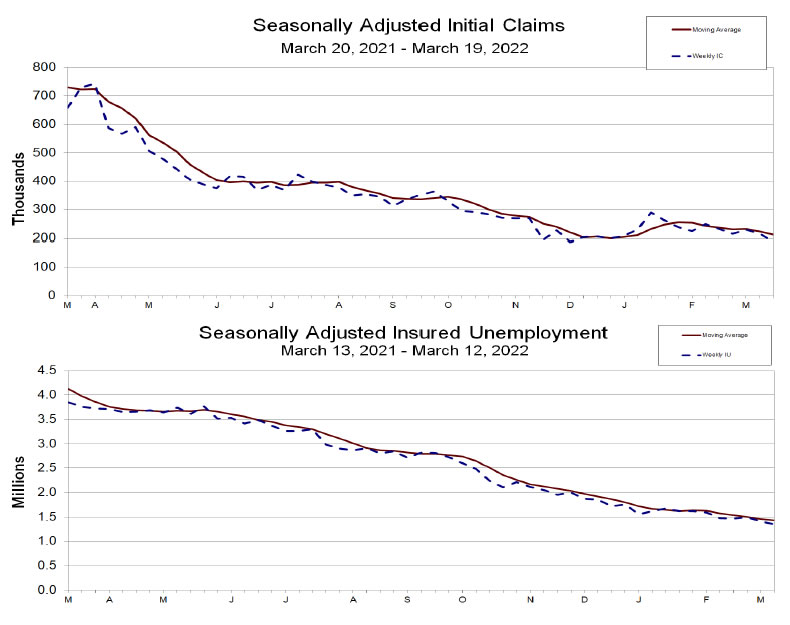
US initial jobless claims dropped -28k to 187k in the week ending March 19, much better than expectation of 210k. That's also the lowest level since September 6, 1969, when it was 183k. Four-week moving average of initial claims dropped -12k to 212k.
Continuing claims dropped -67k to 1350k in the week ending March 12. That's the lowest since January 3, 1970, when it was 1332k. Four-week moving average of continuing claims dropped -31k to 1432k, lowest since February 28, 1970, when it was 1421k.
British Pound Stabilizes at 1.32
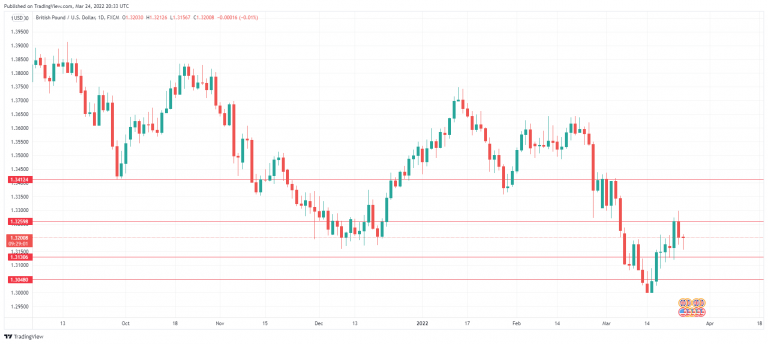
The British pound has shown some volatility this week but is flat on Thursday. In the European session, GBP/USD is trading at the round number of 1.3200.
The currency markets have been taking a breather and sticking to the sidelines. The pound lost ground on Wednesday, despite inflation rising in February and exceeding expectations. CPI hit 6.2% YoY, a new 30-year high. This was up from 5.5% in January and above the consensus estimate of 5.9%. Core CPI rose 5.2%, up from 4.4% and ahead of the forecast of 5.0%.
UK inflation powers upwards
The rise in inflation has been driven by soaring food and energy costs and if oil prices continue to rise, inflation will only get worse. The Bank of England has projected that inflation will hit 8% in the second quarter and has warned that it could rise to 10% by the end of the year. The Bank has raised rates at three successive meetings, from 0.10% to 0.75%, but so far, the tightening hasn’t curbed inflation.
BoE policy makers face an unenviable task when it comes to rate policy – the rate tightening cycle will have to continue to wrestle inflation lower, but the war in Ukraine and rising energy prices could slow the economy later this year, and aggressive tightening could choke off economic growth.
British PMIs for February were a mixed bag. Manufacturing PMI fell from 58.0 to 55.5, shy of the estimate of 57.0 points. There was better news from Services PMI, which rose to 61.0, up from 60.5 and above the forecast of 58.0 points. The Manufacturing PMI reading was the lowest in 13 months, but investors didn’t get worked up. That could change, however, if the downswing continues.
The week wraps up with the retail sales report on Friday. The markets are braced for weaker February numbers, and a poor showing would likely weigh on the British pound.
GBP/USD Technical
- GBP/USD faces resistance at 1.3259 and 1.3341
- There is support at 1.3130 and 1.3048
Euro Holds Steady at 1.10
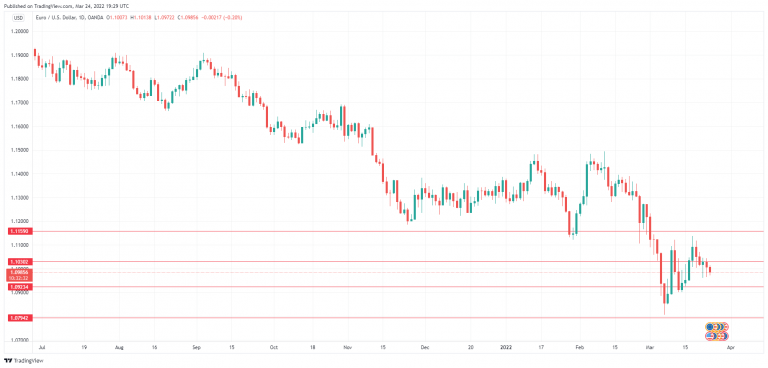
EUR/USD is calm, trading on both sides of the 1.1000 level. In the European session, the currency is at 1.0988.
Roubles only, please
The euro continues to trade in choppy waters, unable to maintain any momentum due to the uncertainties over the war in Ukraine. Russian President Putin through a monkey wrench into the mix on Wednesday, when he announced that payments for Russian natural gas by “unfriendly nations” would have to be paid in Russian roubles. This appears to be an illegal move by Putin, but then again, he does hold the cards when it comes to supplying the energy needs of Western Europe. The crafty move by Putin, which has shaken up the energy markets, is another headwind for the euro to contend with.
The surge in global inflation has seen the major central banks respond with tighter policy, with the notable exception of the European Central Bank. Earlier this week, ECB President Lagarde acknowledged that the Fed and ECB were moving out of sync, a clear sign that Lagarde does not intend to change the Bank’s dovish stance, even though inflation continues to accelerate in the eurozone. Lagarde noted that Europe was more exposed to the war in Ukraine than the US, due to geographical proximity, and the war will have very different effects on the US and on the eurozone, which required different monetary policies.
As expected, German PMIs slowed in February. Manufacturing PMI dropped from 58.4 to 57.6, and Services PMI fell from 55.8 to 55.0 points. Investors didn’t seem all that concerned, as the readings managed to beat the forecasts. It was a similar story for the eurozone PMIs, as the manufacturing and services sectors continue to show growth.
EUR/USD Technical
- 1.0923 is the first line of support, followed by 1.0794
- There is resistance at 1.1030, followed by 1.1159
ECB Elderson: War impacts outlook through channels of confidence and energy prices
ECB Executive Board member Frank Elderson said in a speech that there are two channels through which Russia invasion of Ukraine weighs Eurozone outlook. They are "negative confidence effects, which have an impact on both international trade and on financial markets, and high energy prices."
But he noted that outlook prevailing the invasion was "quite favorable". And, "this implies that in our updated baseline outlook, and also in more adverse and severe scenarios for the impact of the war, stagnation is not foreseen."
"It is a well-established practice in monetary policy that in times of uncertainty prudent policy calls for gradualism," Elderson said. "This holds particularly true when we approach potential turning points in the monetary policy cycle."
"If the evolution of the inflation outlook supported by incoming data allows a further normalisation of monetary policy, we stand ready to adjust our instruments accordingly."
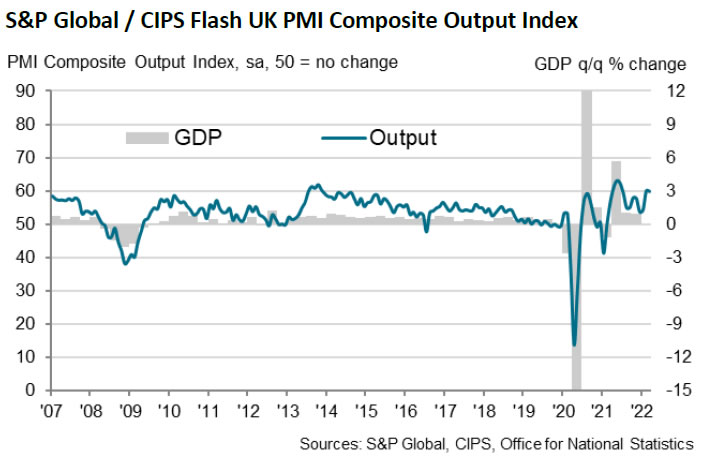
UK PMI manufacturing dropped to 55.5, but services rose to 61.0
UK PMI Manufacturing rose dropped from 58.0 to 55.5 in March, below expectation of 57.7, a 13-month low. PMI Services rose from 60.5 to 61.0, above expectation of 58.0, a 9-month high. PMI Composite dropped from 59.9 to 59.7.
Chris Williamson, Chief Business Economist at S&P Global said: "The survey indicators point to potentially sharply slower growth in the coming months, accompanied by a further acceleration of inflation and a worsening cost of living crisis, which paints an unwelcome picture of 'stagflation' for the economy in the months ahead."
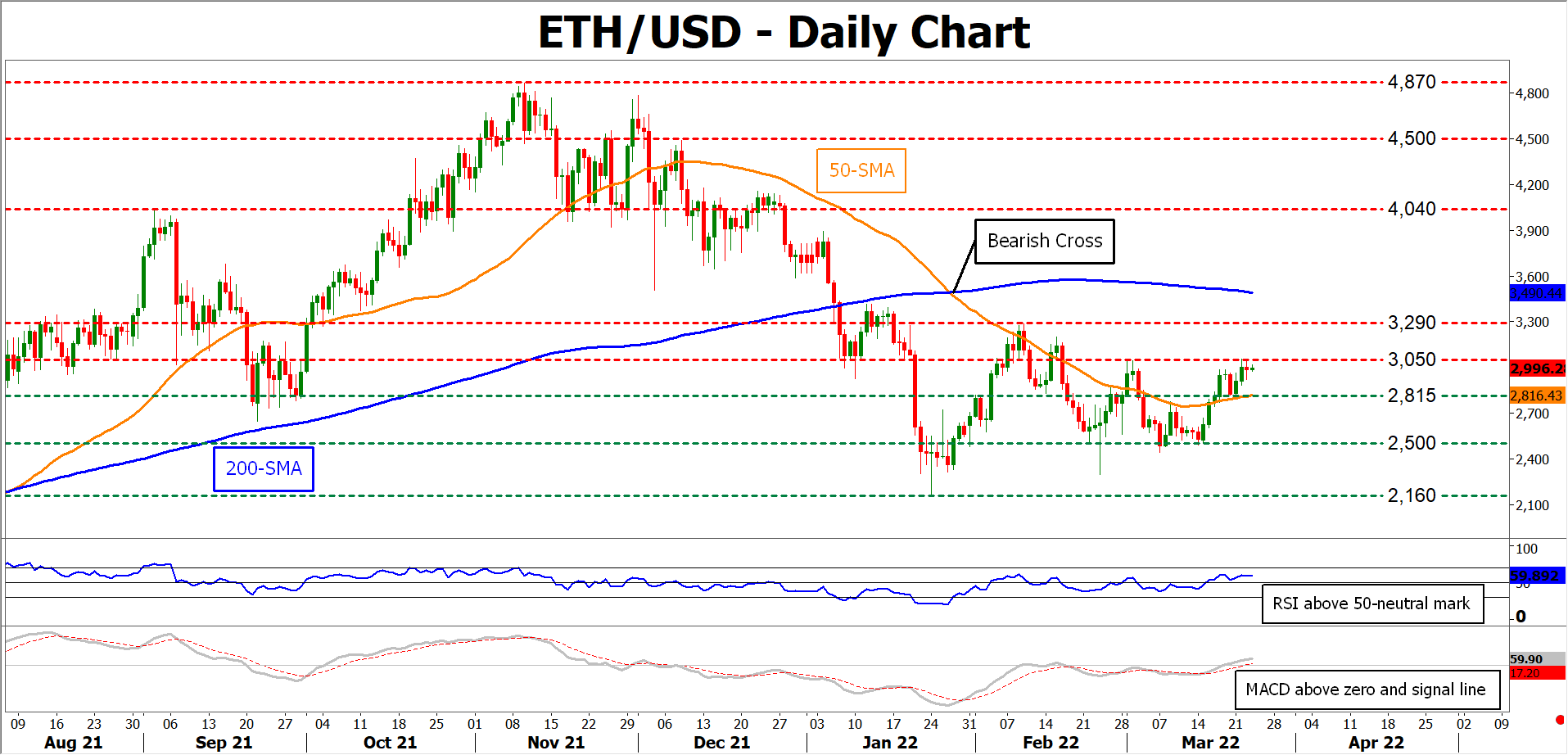
ETHUSD Ticks Upwards But its Rangebound Pattern Holds
ETHUSD (Ethereum) has been moving sideways since the beginning of 2022, when its downside trajectory halted. However, the technical picture seems to be improving for the cryptocurrency, with the ascending 50-day simple moving average (SMA) endorsing a bullish near-term bias.
The momentum indicators suggest that bullish forces have gained the upper hand. Specifically, the RSI is hovering above its 50-neutral mark, while the MACD histogram is currently beyond zero and its red signal line.
Should buying interest intensify further, the recent high of 3,050 could be the initial point of resistance for the cryptocurrency. Piercing through this level, the price may ascend towards the February high of 3,290 before the spotlight turns to the September peak of 4,040. Conquering these barricades, the bulls could then target the crucial 4,500 barrier.
On the flipside, if sellers manage to retake control, the price might encounter resistance at the recent low of 2,815, which overlaps with the 50-day SMA. Should that floor collapse, the price could test the 2,500 obstacle. Failing to halt there, the January low of 2,160 may appear on the radar.
Overall, despite being stuck in a tight range, ETHUSD seems ready to march higher as broader near-term risks are tilted to the upside. For that scenario to materialize, the price needs to initially jump above the 3,290 ceiling.
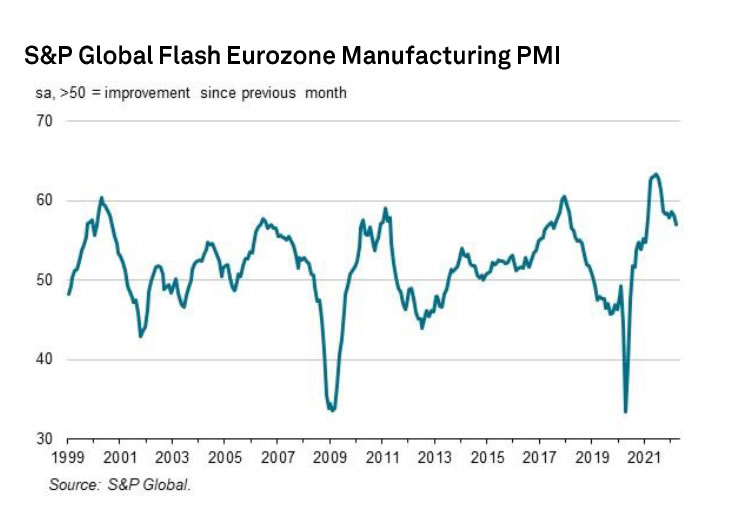
Eurozone PMI manufacturing dropped to 57.0, war having immediate and material impact
Eurozone PMI Manufacturing dropped from 58.2 to 57.0 in March, above expectation of 55.9. But that's still a 15-month low. PMI Services dropped from 55.5 to 54.8, above expectation of 54.3. PMI Composite dropped from 55.5 to 54.5.
Chris Williamson, Chief Business Economic at S&P Global said: "The survey data underscore how the Russia-Ukraine war is having an immediate and material impact on the eurozone economy, and highlights the risk of the eurozone falling into decline in the second quarter...
"The war has aggravated existing pandemic-related price pressures and supply chain constraints, leading to record inflation rates for firms' costs and selling prices, which will inevitably fee through to higher consumer prices in the months ahead...
"Businesses are themselves bracing for weaker economic growth, with expectations of future output collapsing in march as firms growth increasingly concerned about the impact of the war".
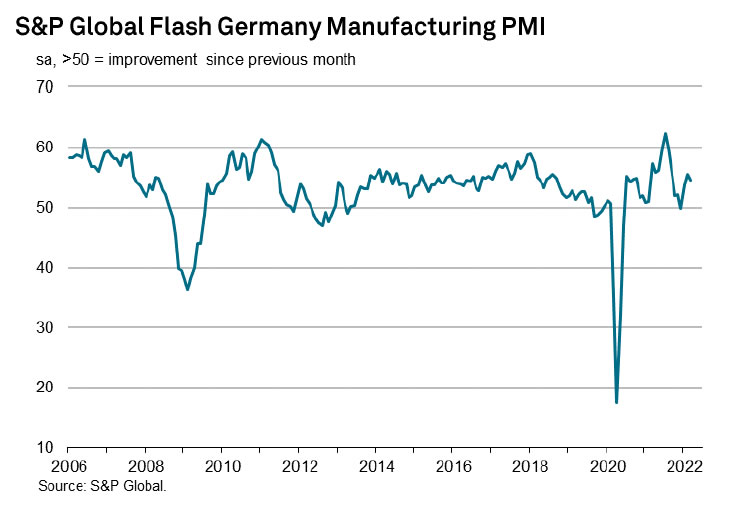
Germany PMI manufacturing dropped to 57.6, starting to drag on overall growth
Germany PMI Manufacturing dropped from 58.4 to 57.6 in March, above expectation of 55.9. PMI Services dropped from 55.8 to 55.0, above expectation of 54.3. PMI Composite dropped from 55.6 to 54.6.
Phil Smith, Economics Associate Director as S&P Global said: "Manufacturing is already starting to drag on overall growth, due to its greater exposure to the supply chain disruption and drop in export demand that have resulted from the war in Ukraine and sanctions on Russia.... Already-high inflation pressure has been exacerbated by the war... business confidence has taken a considerable hit."
SNB keeps rate at -0.75%, upgrade inflation forecasts
SNB keeps sight deposit rate unchanged at -0.75% as widely expected. It reiterated that is is "willing to intervene in the foreign exchange market as necessary, in order to counter upward pressure on the Swiss franc". The Swiss franc remains "highly valued".
SNB said, "the war in Ukraine has had an effect on the Swiss economy above all via the strong increase in commodity prices", and are likely to "weigh on consumption and increase companies' production costs". Trade is likely to be affected by "albeit not severely given Switzerland's limited direct economic ties to Ukraine and Russia". Supply bottlenecks "could deteriorate further" and uncertainty could have an "adverse impact on investment activity.". 2022 growth forecasts was revised lower to around 2.5%.
The inflation forecast, conditioned on policy rate at -0.75%, was raised in general. But inflation is projected to peak at 2.2% in Q2 2022, then slow gradually to 0.7% in Q2 2023, then climb back to 1.1% in Q1. For the year as a whole, inflation is projected to be 2.1% in 2022 (upgraded from 1.0%), 0.9% in 2023 (up graded from 0.6%), and then 0.9% in 2024 (new).