

Sample Category Title
US oil inventories rose 4.3m barrels, WTI pull back slows
US commercial crude oil inventories rose 4.3m barrels in the week ending March 100, versus expectation of -1.8m barrels decline. At 451.9m barrels, oil inventories are about -12% below the five year average for this time of year.
Gasoline inventories dropped -3.6m barrels. Distillate rose 0.3m barrels. Propane/propylene dropped -2.2m barrels. Total commercial petroleum inventories dropped -3.6m barrels.
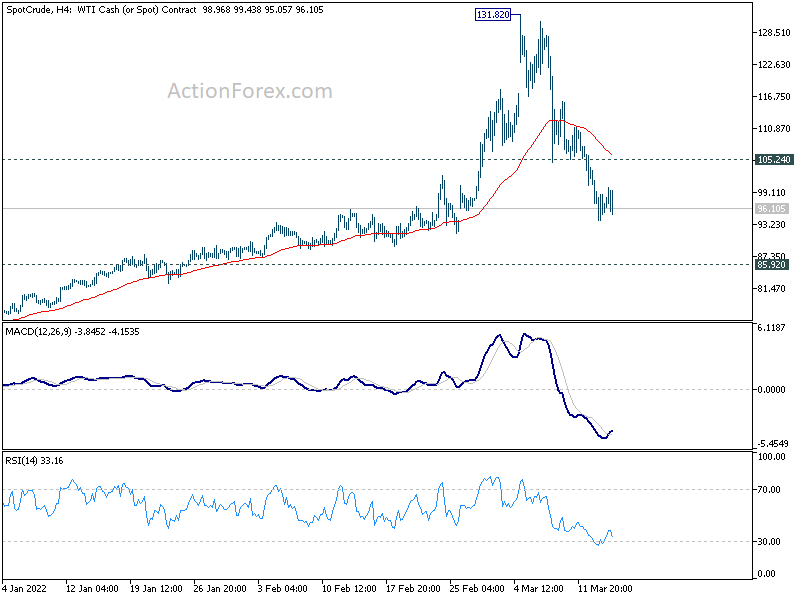
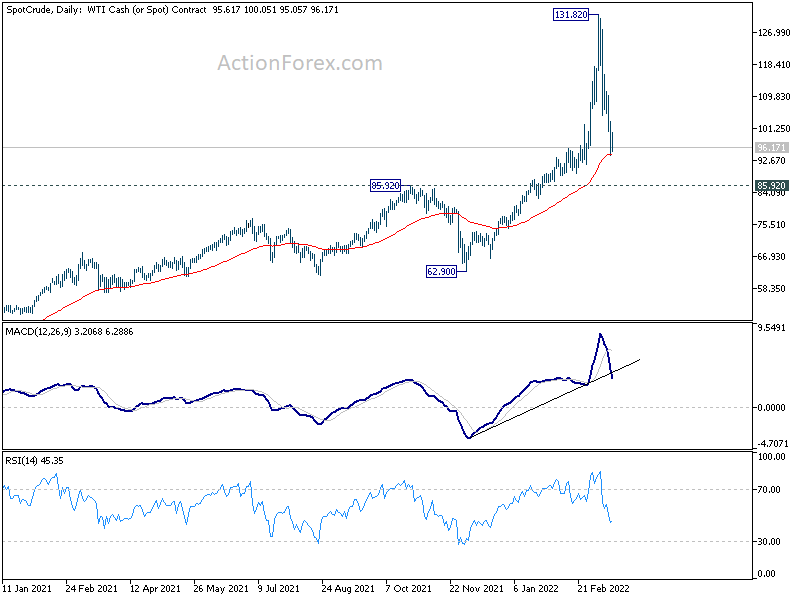
WTI crude oil in hovering in tight range at around 96 after the release. The pull back from 131.82 high was much deeper than expected. But still, it's seen as developing into a corrective pattern for now. Selloff is slowing as it's trying to draw support from 55 day EMA. There is prospect of a rebound from current level. Break of 105.24 minor resistance will indicate that a rebound is underway, back towards 131.82 high.
US: Retail Sales Growth Remains Solid
Retail sales continued to make progress with an increase of 0.3% month-on-month (m/m), just a notch below the consensus estimate for an increase of 0.4%. January's reading was revised up by a more than a full percentage point to 4.9% m/m from 3.8% m/m reported earlier. This makes February's showing stronger than the headline appears.
Sales at autos & parts dealers continued to grow, rising 0.8% m/m even after January's upward revision to 4.6% vs. (5.7% reported earlier). Growth was concentrated in auto dealers, while sales in automotive parts & tire stores declined. Excluding autos, retail sales were up 0.2% m/m.
Sales at gasoline stations were up 5.3% m/m, but most of it is explained by hefty price growth, with gasoline prices up by 6.6% m/m. Building materials retailers saw a gain of 0.9% m/m in February.
Sales in the "control group", which exclude the above categories and are used in calculating personal consumption expenditures (and GDP), were down by 1.2% m/m. However, January's sales were revised to stronger +6.7% m/m from the advance reading of +4.8% m/m.
- Within the group, the biggest contributors to growth were sales at food services & drinking places (+2.5% m/m), miscellaneous stores retailers sporting goods (+1.9% m/m), hobby, book & music stores (+1.7% m/m), clothing & accessory stores (+1.1% m/m).
- The fortunes of non-store retailers reversed this month with a decline of 3.7%, but that's after an upwardly revised gain of 20.6% m/m in January (from +14.5% m/m reported earlier). Another contributor to the decline were health & personal care stores (-1.8% m/m) while all other categories reported marginal losses.
Key Implications
Retail sales continued to grow for the second month even after sizeable revisions in January, setting the first quarter up for another solid gain. Unlike last month, when gains concentrated in ecommerce – consumers' favorite in the time of rising COVID cases, February sales were more diversified, which is a testament to a solid rebound in activity as Omicron waned.
Although sales are reported in nominal terms, we estimate that real sales were actually down by roughly 0.5% month-on-month in February (after a gain of 4.2% m/m in January). Prices had an outsized impact on several categories that saw some of the largest nominal gains during the pandemic. Notably, sales at gas stations and food & beverage stores showed a decline of more than 1% m/m in real terms.
Indeed, we would put the risk of higher inflation on top of the list for future spending growth. We expect price pressures to ease in the second half of the year but recent acceleration of energy and food costs may still have an impact on spending, despite notable progress in employment and sizeable excess savings accumulated during the pandemic. Surely, price growth will take the center stage in the Fed's policy deliberations, which we will report on in a few hours. Stay tuned
Canada: Inflation Hits 5.7% in February, Set to Move Even Higher in March
Consumer price inflation accelerated to 5.7% year-on-year (y/y) in February, up from 5.1% in January, ahead of the consensus forecast for 5.5% and the highest rate in over 30 years.
Energy price growth accelerated to 24.1% (from 23.1% in January), as gasoline price growth hit 32.3% year-on-year (up from 31.7% in January). Food price inflation also moved higher, to 7.4% (from 6.5% in January) – the highest in over decade.
The acceleration in price growth was not just a food and energy story, however. Excluding these categories, inflation was up 3.9% y/y (from 3.4% in January).
Seasonally adjusted, month-on-month prices were up a robust 0.6% for a second straight month. Once again, price growth was broad and swift across categories in February, led by transportation (+1.1%), food (+1.0%), and shelter (+0.6%). Only clothing and footwear pulled back in the month, while price growth was soft for recreation and alcohol and tobacco after strong lifts in January.
All three of the Bank of Canada's core inflation metrics rose in February. CPI-trim rose 0.3 percentage points to 4.3%, CPI-common by 0.2 percentage points to 2.6%, and CPI-median by 0.1 percentage points to 3.5%. At 3.3%, the average of the three measures is the highest since August 1991, the same record as the headline.
Key Implications
Once again inflation has surprised to the upside. The shock is wearing off. The outlook for inflation is clouded by the fog of war. Commodity price volatility has soared in recent weeks. Prices skyrocketed at the outset of the conflict, but have since fallen back. It is difficult to predict with any confidence their path from here, but it will depend in no small part on whether the conflict escalates further or moves toward peaceful resolution.
Even if prices are more staid from here, the impact will be felt in higher inflation in March. Prices are running well ahead of income growth, but with a robust labor market, nominal wage growth is also showing signs of accelerating. That is a good sign for ongoing economic growth but demands attention from a central bank set on guiding inflation back to its 2% target.
Rising commodity prices increase inflation and hurt consumers, but are not necessarily negative for the Canadian economy overall, whose producers benefit from higher prices that are born in part by our trading partners. As such, they should do little to dissuade the Bank of Canada from normalizing monetary policy.
Stocks Rise as Russia’s Stance Softens, Fed in Focus
US stocks are pointing to a strong open as hope of a truce in Ukraine grow, as Beijing pledges more support to the economy and ahead of the Fed rate decision.
US futures
- Dow futures +1.09% at 33924
- S&P futures +1.2% at 4315
- Nasdaq futures +1.71% at 13670
In Europe
- FTSE +1.4% at 7273
- Dax +3.1% at 14353
- Euro Stoxx +3.7% at 3875
Truce hopes build, China brings more stimulus
The US is set to bound higher on the open, adding to solid gains in the previous session as investors grow increasingly optimistic of a diplomatic solution in Ukraine. China pledges more support to the economy and ahead of the Federal Reserve rate decision.
The Kremlin appears to be adopting a softer stance towards Ukraine as the two countries try to find a compromise. Russia would now accept neutrality from Ukraine while allowing it to have its own army, marking a significant shift in position and boosting the chances of a truce being reached.
Chinese ADRs are set for a surge higher on the open as the Chinese central bank and government issued a joint pledge to support the economy and financial markets. The news overshadowed concerns over rising covid cases and fears of delisting in the US.
On the data front, US retail sales rose by a less than expected 0.3%, down from an upwardly revised 4.9% in January and missing the 0.4% forecast.
Fed rate decision
The Fed is expected to raise interest rates by 25 basis points later in the session. This would be the first rate hike since 2018. The market has 100% prices in the hike, so the question is, what comes next – will the Fed prioritise inflation or growth? Any signs that the Fed is adopting a slightly more dovish stance in light of the impact of the Ukraine crisis and Western sanctions, the USD could come under pressure, and stocks could have further to run.
Where next for the Nasdaq?
The Nasdaq is extending its rebound from the 12950 low it reached yesterday. It has retaken its 50 sma and is testing the 100 sma. The RSI is supportive of more gains. A move over the 100 sma exposes 13880 the confluence of the falling trendline resistance and 11th March high. Beyond here, buyers will look for 14000 round number before taking aim at 14400, the March high. On the downside, a move below the 50 SMA at 13470 could negate the near-term uptrend, with support seen at 12950, the 2022 low.

FX markets USD falls, EUR rises, AUD shines
USD is heading lower, tracing yields lower ahead of the Fed rate decision. Falling oil prices are helping to ease inflation fears.
EURUSD is rising amid continued optimism surrounding the Russia, Ukraine cease-fire talks. Progress towards a truce appears to be gathering momentum, boosting the EUR.
AUDUSD the Aussie is rising, outperforming peers, boosted by the improving market mood and on hopes of further stimulus in China. Vice Premier Liu He affirmed that Beijing would bring in more measures to support the Chinese economy.
- GBP/USD +0.4% at 1.3058
- EUR/USD +0.48% at 1.0993
Oil steadies below $100
Oil prices fell 11% over just two days, closing below $100 per barrel for the first time this month. Today prices are holding steady. Hopes of a truce between Russia and Ukraine are helping to ease supply fears.
The price also came under pressure after the International Energy Agency’s monthly report, which showed that it had cut its oil demand forecast for 2022.
Concerns over demand in China are rising as COVID cases spread quickly and 45 million inhabitants are under lockdown restrictions.
The API oil inventory report showed that oil stocks rose by 3.8 million barrels. EIA data is due shortly.
- WTI crude trades +0.2% at $95.26
- Brent trades +0.2% at $98.70
Looking ahead
- 15:30 EIA oil inventory
- 18:00 Fed interest rate decision
US Futures Head North and Dollar Struggles as Risk Sentiment Improves
Dollar remains sluggish ahead of crucial FOMC decision
The US dollar is extending yesterday’s retreat despite the minor uptick in US Treasury yields, while attention is now shifting to the outcome of the Fed’s monetary policy meeting later today. The Fed is highly anticipated to proceed with what is set to be the first in a series of rate hikes as an effort to tackle the persistently high inflation. Moreover, the Fed will also reveal the dot plot of each member’s interest rate projections, which is expected to reflect how the ongoing surge in commodity prices and the financial sanctions imposed on Russia have influenced policymakers’ views over the upcoming tightening cycle. Finally, the markets will be eyeing for concrete guidance over the reduction of the Fed’s balance sheet as well as the renewed inflation and growth forecasts.
On the data front, retail sales in the US rose by 0.3% on a monthly basis in February against the expectation of a 0.4% increase. Nevertheless, the disappointment was offset by January's print that got revised higher to 4.9% from 3.8%. The greenback did not react significantly on that dataset.
Euro resumes its advance despite negative outlook
The euro is nudging higher in the current session, capitalizing on the moderate risk-on mood in the markets following Russian foreign minister Sergey Lavrov’s remarks that peace talks are not easy but there is certainly hope for compromise. Meanwhile, Ukrainian President Volodymyr Zelensky also communicated that peace negotiations with Russia are beginning to sound more realistic. However, ECB chief Christine Lagarde stated that the Russia-Ukraine war continues to dampen economic growth and increase inflationary pressures in the Eurozone through higher energy and commodity prices. Therefore, it seems that the ECB is unwilling to proceed with aggressive monetary tightening for now, leaving the single currency in a disadvantageous spot against the higher-yielding currencies.
US stock futures inch higher amid renewed optimism over the ceasefire talks
Wall Street is set to open higher today and extend yesterday’s gains as investors seem to be feeling more optimistic over the developments in the Russia-Ukraine peace negotiations, while also awaiting the Fed’s monetary policy decision. More specifically, e-mini futures for the Nasdaq, S&P 500 and Dow Jones are edging higher in pre-market trade, currently gaining 1.5%, 1% and 0.9% on the day, respectively. Additionally, most major European indices are trading modestly higher today, benefiting from the improving risk sentiment.
Oil trades slightly higher; gold stabilizes
WTI futures are up 1% in a volatile session despite being pressured by worries about the demand outlook, originating from the progress in Russia-Ukraine peace talks and China’s new wave of lockdowns. Gold is also holding steady today as the downside pressures stemming from the risk-on sentiment and rising Treasury yields appear to be offset by the softer dollar.
In other news, nickel trading on the London Metal Exchange (LME) resumed today but it already triggered the new limits set out by the exchange, which state that price moves will be constrained to 5% above or below the last closing price
EUR/USD Mid-Day Outlook
Daily Pivots: (S1) 1.0914; (P) 1.0967; (R1) 1.1008; More...
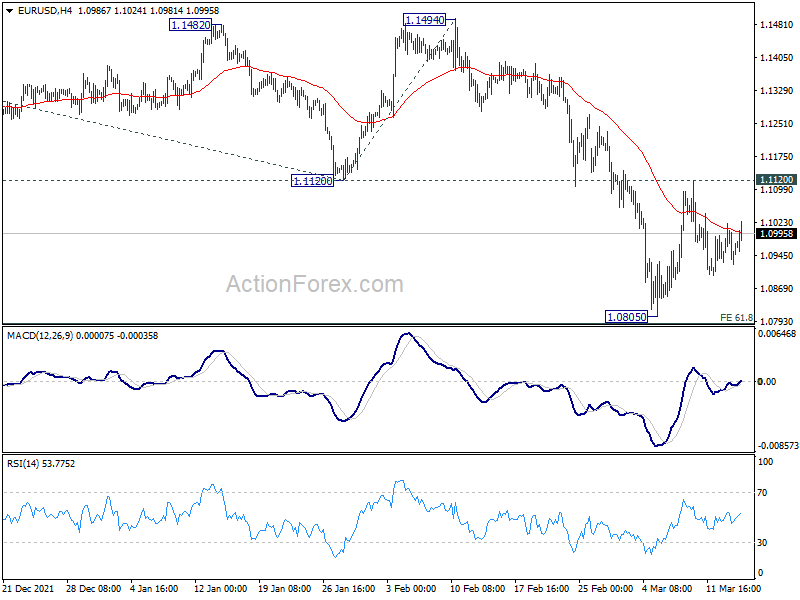
Intraday bias in EUR/USD remains neutral as range trading continues. Further decline is still expected with 1.1120 support turned resistance intact. On the downside, firm break of 61.8% projection of 1.2265 to 1.1120 from 1.1494 at 1.0786 will pave they way to 100% projection at 1.0349 next. However, strong break of 1.1120 will confirm short term bottoming, at least, and bring stronger rebound back towards 1.1494 structural resistance instead.
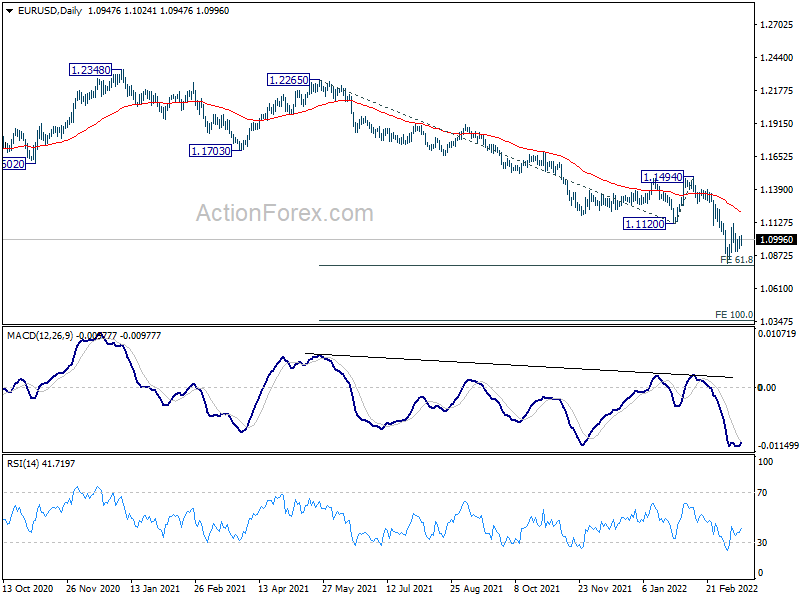
In the bigger picture, the decline from 1.2348 (2021 high) is expected to continue as long as 1.1494 resistance holds. Firm break of 1.0635 (2020 low) will raise the chance of long term down trend resumption and target a retest on 1.0339 (2017 low) next. Nevertheless, break of 1.1494 will maintain medium term neutral outlook, and extend range trading first.
GBP/USD Mid-Day Outlook
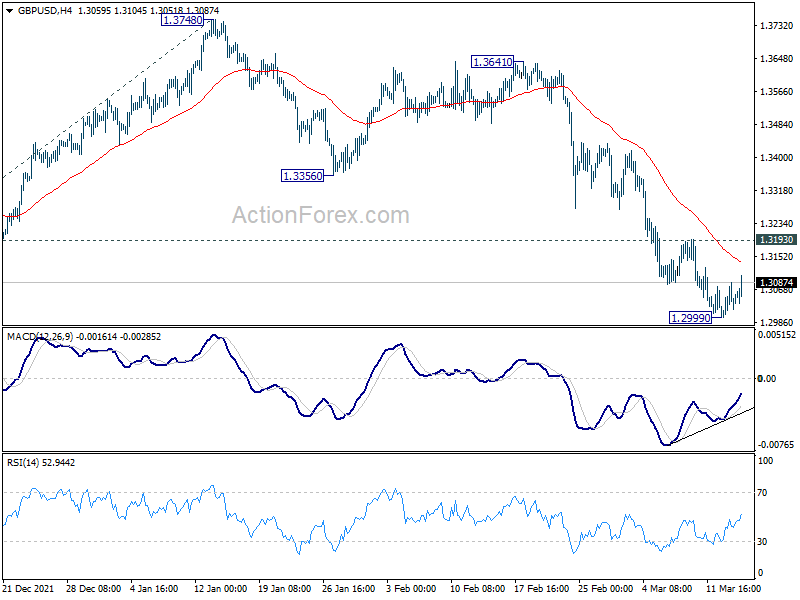
Daily Pivots: (S1) 1.2998; (P) 1.3044; (R1) 1.3087; More...
GBP/USD is staying in consolidation from 1.2999 and intraday bias remains neutral. Further decline is expected as long as 1.3193 resistance holds. On the downside, below 1.2999 will target 100% projection of 1.4248 to 1.3158 from 1.3748 at 1.2658 next. However, firm break of 1.3193 will indicate short term bottoming, and turn bias back to the upside for stronger rebound.
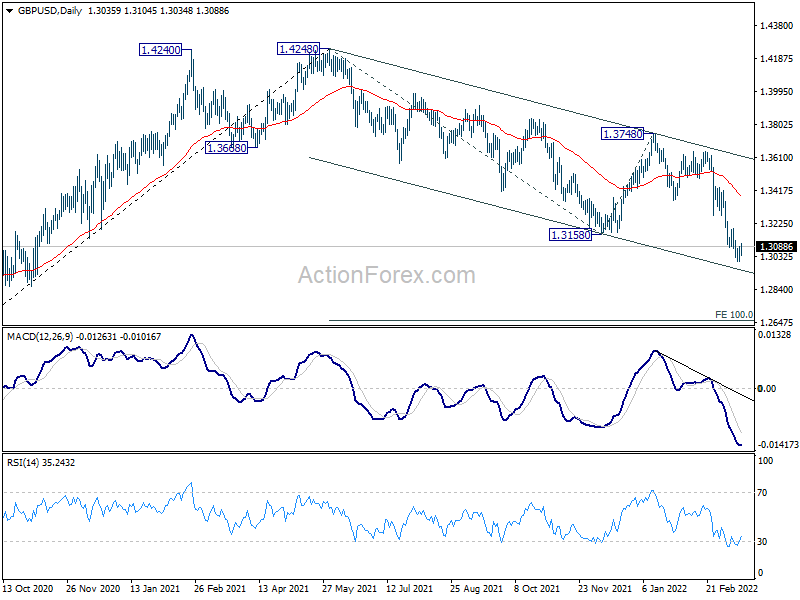
In the bigger picture, current development suggests that the up trend from 1.1409 (2020 low) has completed at 1.4248. Decline from 1.4248 could still be a corrective move, or it could be the start of a long term down trend. In either case, deeper decline would be seen back to 61.8% retracement of 2.1161 to 1.1409 at 1.2493. In any case, break of 1.3748 resistance is needed to indicate medium term bottoming, or outlook will stay bearish.
USD/JPY Mid-Day Outlook
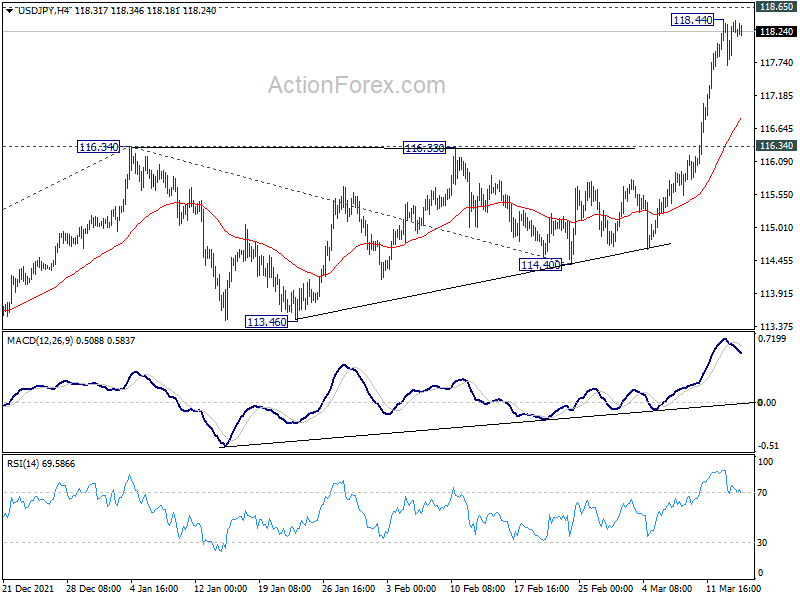
Daily Pivots: (S1) 117.86; (P) 118.15; (R1) 118.59; More...
USD/JPY is staying in consolidation below 118.44 temporary top and intraday bias remains neutral. In case of deeper retreat, downside should be contained above 116.34 resistance turned support to bring rally resumption. On the upside, firm break of 118.65 will target 100% projection of 109.11 to 116.34 from 114.40 at 121.63.
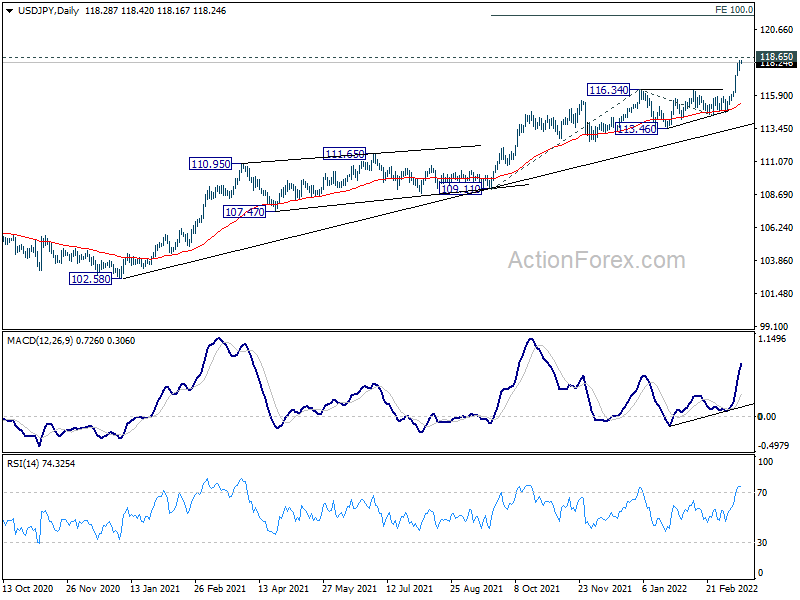
In the bigger picture, no change in the view that rise from 102.58 is the third leg of the up trend from 101.18 (2020 low). Such rally should target a test on 118.65 (2016 high). Sustained break there will pave the way to 125.85 (2015 high) and raise the chance of long term up trend resumption. This will remain the favored case as long as 113.46 support holds.
USD/CHF Mid-Day Outlook
Daily Pivots: (S1) 0.9380; (P) 0.9406; (R1) 0.9438; More....
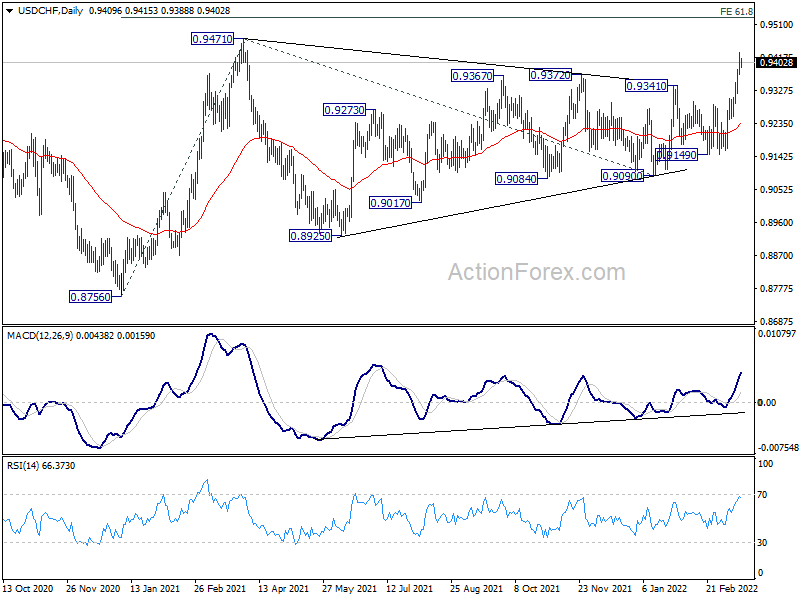
Intraday bias in USD/CHF remains neutral for consolidation below 0.9430. Downside of retreat should be contained above 0.9305 resistance turned support to bring another rally. On the upside, above 0.9430 will target 0.9471 resistance first. Break there will resume whole rally from 0.8756 to 61.8% projection of 0.8756 to 0.9471 from 0.9090 at 0.9532.
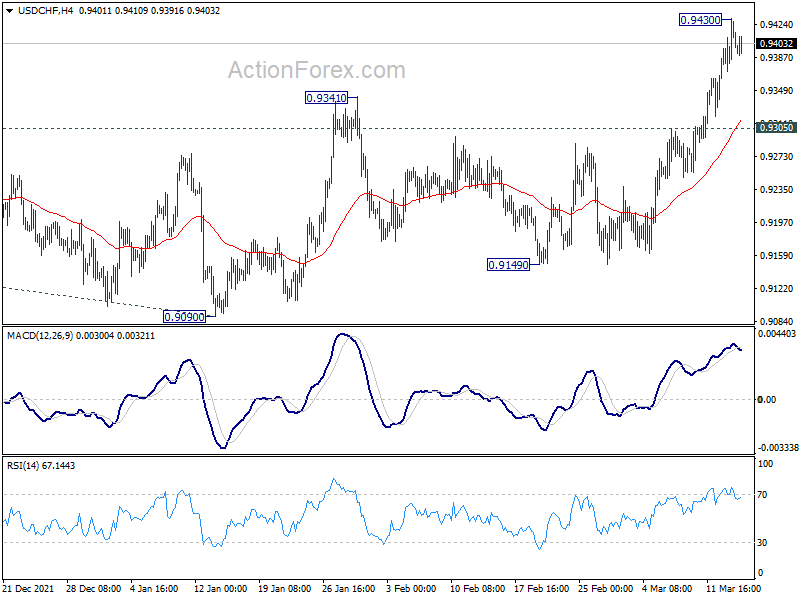
In the bigger picture, medium term outlook will be neutral at best as long as 0.9471 resistance holds. Larger down trend could still extend through 0.8756 (2021 low). However, firm break of 0.9471 will argue that whole down trend form 1.0342 (2016 high), has completed with waves down to 0.8756. A medium term up trend should be set up to target 1.0237/0342 resistance zone.
Canadian Dollar Surges on Strong CPI, FOMC Next
Canadian Dollar surges broadly in early US session after stronger than expected consumer inflation reading, which solidifies the case for more tightening from BoC. Though, as for today, Aussie is still the strongest, as helped by the massive rebound in China stocks earlier. Yen is turning soft again but following global risk rebound, and more importantly, rally in US and European benchmark yields. European majors are mixed.
Dollar is also soft in consolidation, awaiting FOMC's 25bps rate hike, There are three questions to answer. Firstly, where would interest be by the end of the year? Secondly, is FOMC going to "front-load" some of the rate hikes? And thirdly, will the estimated longer run federal funds rate be lifted from the current 2.50%? The new economic projections would hopefully provide something concrete.
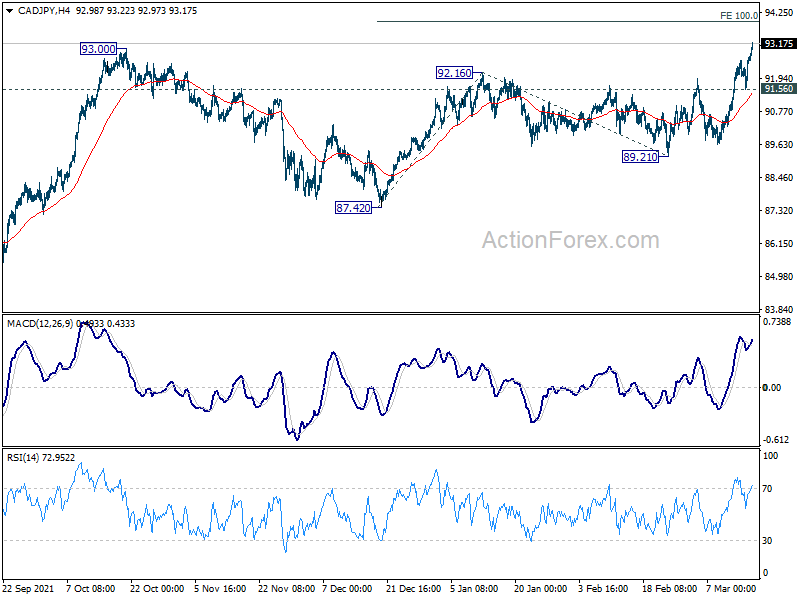
Technically, CAD/JPY rises through 93.00 high to resume the medium term up trend from 73.80. Next target is 100% projection of 87.42 to 92.16 from 89.21 at 93.95. Attention is now on when AUD/JPY would follow and break through 86.24 resistance to resume the up trend from 59.85.
In Europe, at the time of writing, FTSE is up 1.39%. DAX is up 2.82%. CAC is up 3.26%. Germany 10-year yield is up 0.0544 at 0.390. Earlier in Asia, Nikkei rose 1.64%. Hong Kong HSI rose 9.08%. China Shanghai SSE rose 3.48%. Singapore Strait Times rose 1.70%. Japan 10-year JGB yield dropped -0.0068 to 0.204.
US retail sales rose 0.3% mom in Feb, ex-auto sales rose 0.2% mom, missed expectations
US retail sales rose 0.3% mom to USD 658.1B in February, below expectation of 0.6% mom. Ex-auto sales rose 0.2% mom, below expectation of 0.9% mom. Ex-gasoline sales dropped -0.2% mom. Ex-auto, ex-gasoline sales dropped -0.4% mom. Total sales for December 2021 through February 2022 period were up 16.0% from the same period a year ago.
Import price index rose 1.4% mom in February, below expectation of 1.6% mom.
Canada CPI jumped to 5.7% yoy in Feb, highest since 1991
Canada CPI accelerated sharply form 5.1% yoy to 5.7% yoy in February, above expectation of 5.5% yoy. That's the largest gain since August 1991, and it's the second consecutive month where headline inflation exceeded 5% level. Excluding gasoline, CPI rose 4.7% yoy up from January's 4.3% yoy, fastest since its introduction in 1999. On a monthly basis, CPI rose 1.0% mom in February, largest monthly increase since February 2013.
CPI common rose from 2.3% yoy to 2.6% yoy, above expectation of 2.4% yoy. CPI median rose from 3.3% yoy to 3.5% yoy, matched expectations. CPI trimmed rose from 4.0% yoy to 4.3% yoy, above expectation of 4.2% yoy.
ECB Nagel doesn't expect stagflation at the moment
ECB Governing Council member Joachim Nagel told German newspaper Handelsblatt, "I don't expect stagflation at the moment, even though the fallout of the war will boost inflation rates and weaken economic growth." He added that there are currently "no signs" of a wage-price spiral.
He said ECB's current approach of tapering asset purchases while being non-committal on rate hike was a "good and balanced" approach. He said, ""I consider it very important that we don't pre-commit in times of high uncertainty, but stay flexible."
Japan imports surged 34% yoy in Feb on Yen depreciation and higher energy prices
Japan exports rose 19.1% yoy to JPY 7190B in February. That's the 12th straight month of growth. Auto exports increased 8.3% yoy, rebounding from January's -1.0% yoy decline. Exports to the US rose 16.0% yoy to JPY 1.3T. Exports to China rose 25.8% yoy to JPY 1.5T.
Imports rose 34.0% yoy to 7858B. That's the 13th consecutive month of growth. Crude oil imports surged a massive 93.2% yoy to JPY 08.6B, up for the 11th straight months, on the back of Yen's depreciation and higher oil prices. Trade deficit came in at JPY -668B.
In seasonally adjusted terms, exports dropped -0.5% mom to JPY 7432B. Imports rose 2.7% mom to JPY 8463B. Trade deficit widened to JPY -1031B.
Australia Westpac leading index improved slightly in Feb
Australia Westpac-MI leading index improved slightly from -0.50% to -0.25% in February. But Westpac is expecting "strong above trend growth in 2022", largely due to the aftermath of the extraordinary emergency policy measures from both the fiscal and monetary authorities during 2020 and 2021.
Westpac expects RBA to stand pat in April meeting with its "patience" stance. But after Q1 inflation data and further progress on wages growth, RBA would moving to a tightening bias over June and July, prior to raising the cash rate in August.
USD/CHF Mid-Day Outlook
Daily Pivots: (S1) 0.9380; (P) 0.9406; (R1) 0.9438; More....
Intraday bias in USD/CHF remains neutral for consolidation below 0.9430. Downside of retreat should be contained above 0.9305 resistance turned support to bring another rally. On the upside, above 0.9430 will target 0.9471 resistance first. Break there will resume whole rally from 0.8756 to 61.8% projection of 0.8756 to 0.9471 from 0.9090 at 0.9532.
In the bigger picture, medium term outlook will be neutral at best as long as 0.9471 resistance holds. Larger down trend could still extend through 0.8756 (2021 low). However, firm break of 0.9471 will argue that whole down trend form 1.0342 (2016 high), has completed with waves down to 0.8756. A medium term up trend should be set up to target 1.0237/0342 resistance zone.
Economic Indicators Update
| GMT | Ccy | Events | Actual | Forecast | Previous | Revised |
|---|---|---|---|---|---|---|
| 21:45 | NZD | Current Account (NZD) Q4 | -7.26B | -6.49B | -8.30B | -8.25B |
| 23:30 | AUD | Westpac Leading Index M/M Feb | -0.20% | 0.10% | ||
| 23:50 | JPY | Trade Balance (JPY) Feb | -1.03T | -0.39T | -0.93T | -0.78T |
| 04:30 | JPY | Industrial Production M/M Jan F | -0.80% | -1.30% | -1.30% | |
| 12:30 | CAD | Wholesale Sales M/M Jan | 4.20% | 4.00% | 0.60% | |
| 12:30 | CAD | CPI M/M Feb | 1.00% | 0.90% | 0.90% | |
| 12:30 | CAD | CPI Y/Y Feb | 5.70% | 5.50% | 5.10% | |
| 12:30 | CAD | CPI Common Y/Y Feb | 2.60% | 2.40% | 2.30% | |
| 12:30 | CAD | CPI Median Y/Y Fed | 3.50% | 3.50% | 3.30% | |
| 12:30 | CAD | CPI Trimmed Y/Y Fed | 4.30% | 4.20% | 4.00% | |
| 12:30 | USD | Retail Sales M/M Feb | 0.30% | 0.60% | 3.80% | |
| 12:30 | USD | Retail Sales ex Autos M/M Feb | 0.20% | 0.90% | 3.30% | |
| 12:30 | USD | Import Price Index M/M Feb | 1.40% | 1.60% | 2.00% | |
| 14:00 | USD | Business Inventories Jan | 1.10% | 2.10% | ||
| 14:00 | USD | NAHB Housing Market Index Mar | 81 | 82 | ||
| 15:30 | USD | Crude Oil Inventories | -1.8M | -1.9M | ||
| 18:00 | USD | Fed Interest Rate Decision | 0.50% | 0.25% | ||
| 18:30 | USD | FOMC Press Conference |