Sample Category Title
Gold Report: Market Braces for FOMC Interest Rate Decision
A notable correction to the downside has captured Gold’s price in the most recent daily sessions. At the moment, Gold is trading below the $2000 round level, after performing a swift run to the new 2022 high price in the past week. The large swing for Gold’s price seems to imply a drastic change in economic developments around the world and this report aims at bringing these factors to light. Leaving aside the fundamental updates presented in this outlook, our Gold report can also be used as a guidance to trading through our technical analysis, which will point out important levels and possible trends.
The fact that Gold has made a substantial correction to lower grounds, can be attributed to several reasons. First Gold’s price rushed to a new 2022 high on the 8th of March as sanctions against Russia where announced. In this case the risk on sentiment which sometimes fuels Gold’s price may have been removed. It is also possible that Gold may have been undertaken by a technical correction, as traders that joined the bullish side of Gold early in March, may have booked significant profits allowing them to lock in the gains. Furthermore, in the past sessions the U.S. 10-year Treasury yields rose above 2.10% a sign which maybe considered bearish for Gold prices. Another bearish sign for Gold could be its adverse relationship to the US dollar. In the previous report we noted the correlation between Gold and the USD may have been positive but as the greenback stabilized higher in the past days, Gold prices dropped confirming the competitive nature is back on track. In addition, Gold could be in a positive correlation with Oil prices at this time, as Oil is trading notably lower compared to last week.
In the current week, Gold traders are in the favorable position to have an exciting economic calendar to work with. The events are spread throughout the next days and may create substantial volatility for Gold’s price. Starting on the 16th of March, during the early US session, we get the US February Retail Sales rate while later the same day, we expect the key economic event of the week which is the FOMC meeting. This event is of great importance for the Gold market as the central bank is expected to announce a rate hike of 25 basis points. On a side note, FFF currently imply a probability of 91% for a 25-basis points rate hike, while the remaining 9% is in favor of a 50-basis points rate hike. In this case the actual outcome of the meeting could create different price reaction. Even though a 25-basis points rate hike may have already been priced in by the market, in our view, a 50-basis points rate hike could create an extraordinary volatile session for the markets. This will be the first time the Fed will hike rates since December 2018. The event will take place during the mid US session and will consist of the Economic Projections, the FOMC Statement and the FOMC Interest Rate decision. 30 minutes after the release we will also get the FOMC press conference with Chairman Jerome Powell’s speech where he will also be replying to questions. This event has the potential of moving Gold prices abruptly and traders may have to approach the market with caution as risks could be elevated. On the 17th of March we get from the US the weekly Initial Jobless Claims, the February Housing Starts Number the February Industrial Production rate and the March Philly Fed Business Index. Finally, on the 18th of March, we get the US Existing Home Sales for February.
Moreover, traders are also considering action carried out by other major central banks in the world. At this point it could be useful to note the fact that BOE is expected to impose a rate hike on the 17th of March. Additionally, during the past week the ECB announced a faster than expected reduction of its Asset purchase programme (APP). These actions could be signaling a post pandemic economic transitioning period for some of the major economies of the world and some of Gold’s recent price action may have been a result of these changes.
On a separate note, Gold traders continue to monitor developments of Russia’s war in Ukraine. Even though no signs of progress to cease fire have been made, Gold’s price has returned to lower grounds and may not reflect the fact that Russia’s military operations seem to have intensified recently.
Technical Analysis
XAU/USD H4
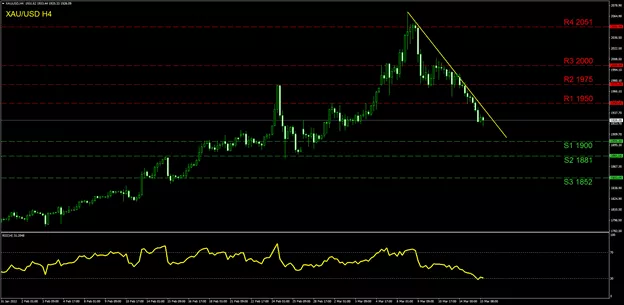
Gold’s downward trendline has intensified in the most recent four-hour sessions and the trend is highlighted with the yellow descending line on our chart. At the moment Gold is trading at 1925 which is exactly in the middle of our range between the (R1) 1950 resistance and the (S1) 1900 support. Yet if the downward movement persists, the (S1) 1900 could be engaged and tested. In this scenario, traders may turn their attention to even lower ground picturing the (S2) 1881 line which was approached briefly in the last days of February. At the end the (S3) 1852 is noted as our final support. In the opposite scenario if Gold regains upward momentum, we may see the (R1) 1950 line being targeted. Higher the (R2) 1975 level which has been the February high level is imminent while even higher the (R3) 2000 line may act as a barometer for the bullish trend. For this analysis we have selected to insert also the (R4) 2051 which is also the 2022 high reached in the past week. Currently, Gold remains in a downward trendline yet if the price action continues to move withing the (R2) and (S1) range we may see a sideways motion forming. The RSI indicator is currently testing the 30 level giving the notion for a bearish sentiment.
Crude Oil Price Retreats as China Concerns Remain
The price of crude oil continued its downward trend as investors focused on the sweeping lockdowns announced in China. In the past few days, the number of Covid-19 cases in some Chinese cases has been in a strong upward trend. They have risen to the highest level in about two years. In response, the government has announced a major lockdown that is affecting over 50 million people. Therefore, analysts believe that this lockdown will lead to slower recovery of demand. Brent dropped below $100 for the first time in two weeks while West Texas Intermediate (WTI) moved below $95. Other commodities like gold and silver also plummeted.
The US dollar index retreated in the overnight session as investors refocused on the upcoming interest rate decision by the Federal Reserve. It comes at a time when the US is facing significant inflationary pressure. For example, the headline consumer inflation has jumped to a 40 year high of 7.9% while the producer price index rose to 10%. The unemployment rate has dropped to 3.8%. Therefore, the Fed’s challenge is on how quickly to raise interest rates without affecting the economic recovery. In a recent statement, Jerome Powell hinted that the bank would start with a 0.25% hike.
The economic calendar will have several important events. The US will publish the latest retail sales numbers which will provide more details about the financial health of the American consumer. Analysts expect the data to show that the country’s retail sales rose by 0.4% from the previous 4.8%. They also expect that the core retail sales fell from 3.3% to 0.9%. Meanwhile, the Energy Information Administration (EIA) will publish the latest inventories data. Statistics Canada will release February’s inflation data.
XBRUSD
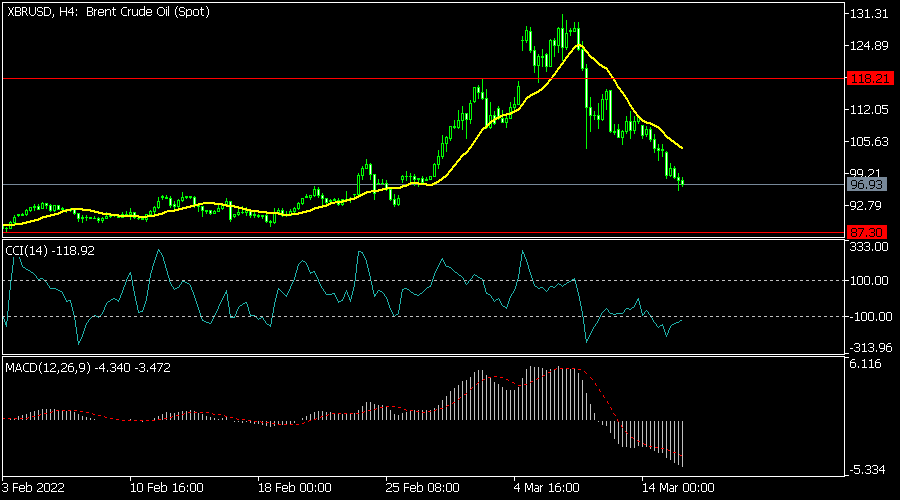
The XBRUSD pair declined sharply as concerns about demand rose. It dropped to a low of 96.75, which was the lowest level since February 28th. It is also significantly lower than this month’s high of 131.35. On the four-hour chart, the pair moved below the 25-day and 50-day moving averages while the Commodity Channel Index (CCI) and MACD have kept falling. Therefore, the pair will likely have a relief rally on Wednesday.
EURUSD
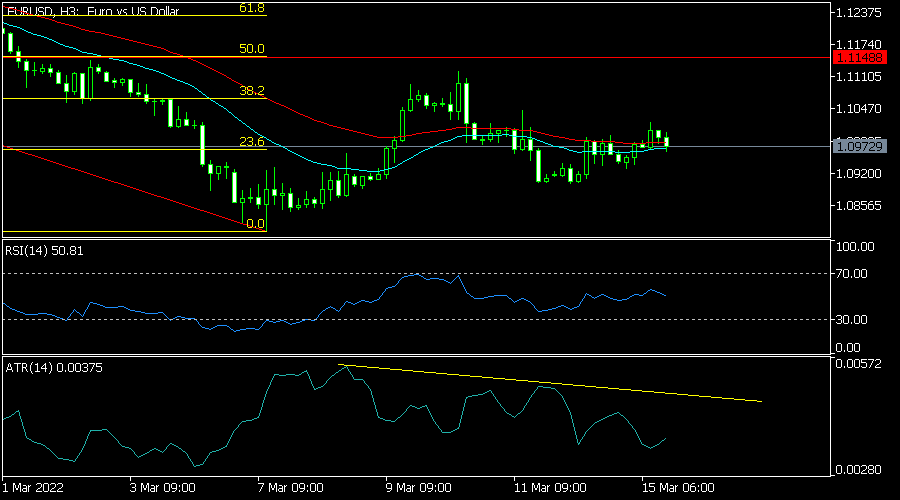
The EURUSD pair moved sideways ahead of the Fed decision. It is trading at 1.0970, which is along the 23.6% Fibonacci retracement level on the three-hour chart. The pair has moved to the 25-day moving average while the Relative Strength Index (RSI) has moved to the neutral level of 50. The Average True Range (ATR) has also been in a downward trend. Therefore, the pair will likely remain in this range ahead of the FOMC decision.
XAGUSD
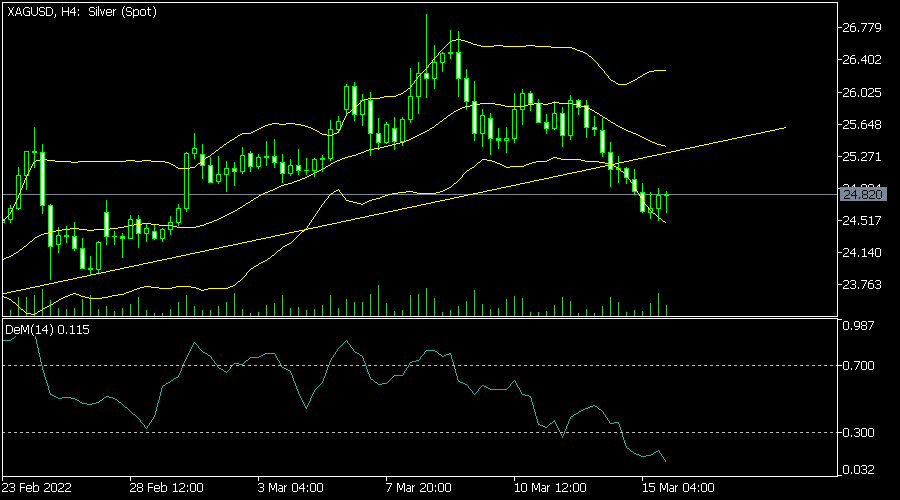
The XAGUSD pair has been in a bearish trend in the past few days. It is trading at 24.81, which is slightly above this week’s low of 24.50. On the four-hour chart, it has moved below the ascending trendline that is shown in yellow. It has also moved between the lower and middle lines of the Bollinger Bands while the DeMarker indicator has moved below the oversold level. Therefore, the pair will likely keep falling ahead of the Fed decision.
USDJPY Challenges the More than 5-Year Peak Again
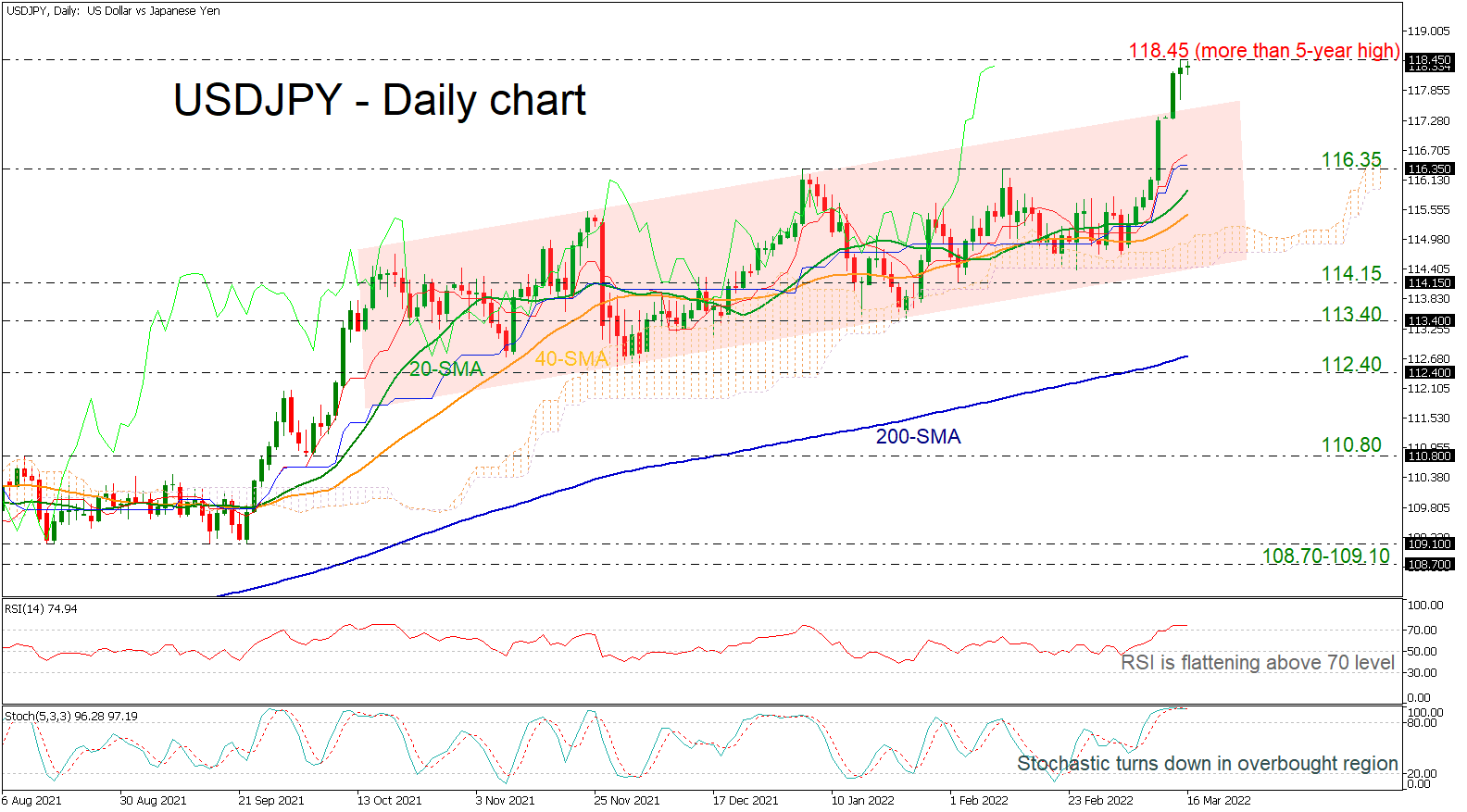
USDJPY is heading north towards the more-than-five-year high of 118.45 and any advances beyond this top would endorse the long-term bullish outlook. The pair penetrated the ascending channel to the upside; however, the technical indicators are suggesting an overbought market. The RSI is flattening above the 70 region, while the stochastic is turning lower in the overstretched region.
Should the pair manage to strengthen its positive momentum, the next resistance could come around the 124.00 psychological mark, taken from the high in November 2015. A break above it would shift the bias to a more bullish one and open the way towards the 125.40 resistance, registered in August 2015.
However, if prices are unable to break the multi-year high the risk would shift to the downside, with the 116.35 support coming into focus. A drop below the short-term simple moving averages (SMAs) would signal a bearish correction towards 114.15 and 113.40.
All in all, USDJPY has been in a strong upside rally over the last few days and only a decline below the 20- and 40-day SMAs may change the short-term bias to neutral.
Daily Technical Analysis
EUR/USD
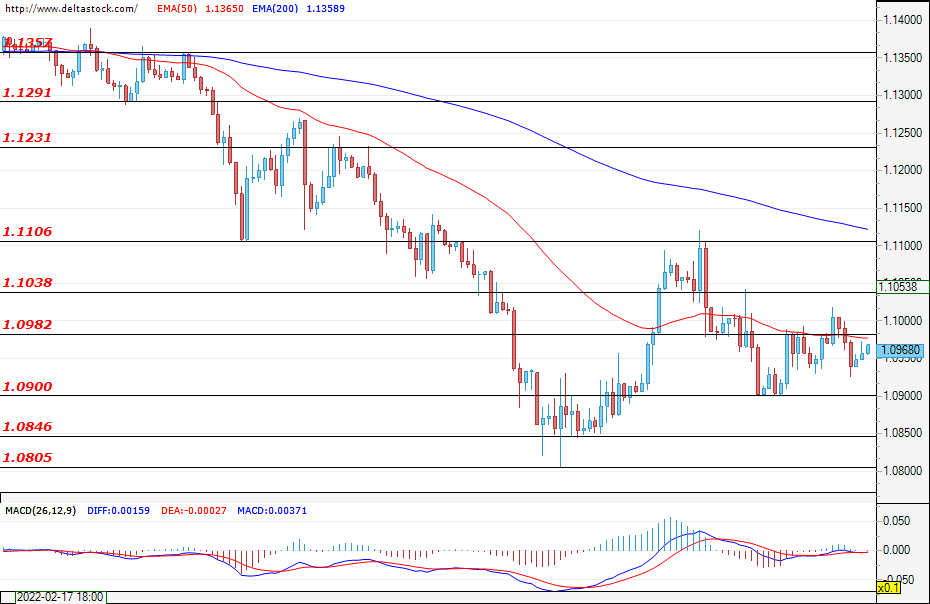
The bulls did not manage to gain enough momentum to confirm the breach of the resistance at 1.0982 and the EUR/USD continued to trade under the mentioned zone. A new successful attack, followed by a violation of the target at 1.1038, could continue the recovery and easily pave the way for a test of the important resistance at 1.1106. The first support for the bears can be found at the level of 1.0900. A breach of the lower zone at 1.0846 could lead to some losses for the euro against the dollar and strengthen the negative expectations for the future path of the pair. The most important news for investors is the expected Fed Interest Rate decision (today; 18:00 GMT) and the following press-conference at 18:30 GMT.
USD/JPY
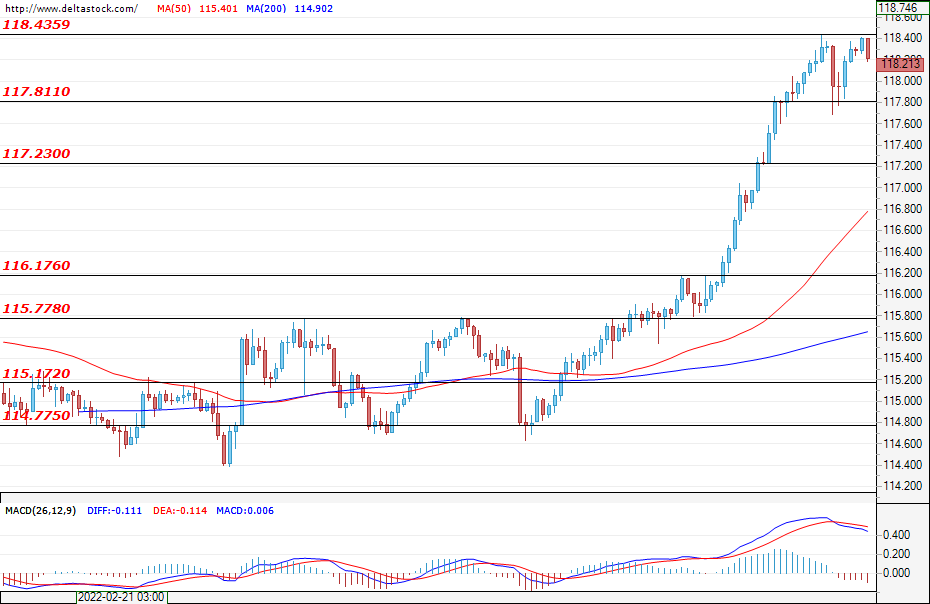
The correction was limited to the zone at 117.80, and during the early hours of today`s trading, the currency pair is heading for a new test of the resistance at 118.43. A successful breach for the bulls could lead to future gains for the Ninja and could further fuel the rally towards the levels at around 118.60. If the bullish momentum fades and the bears enter the market and violate the zone at 117.81, then the decline could deepen towards the support level at 117.23.
GBP/USD
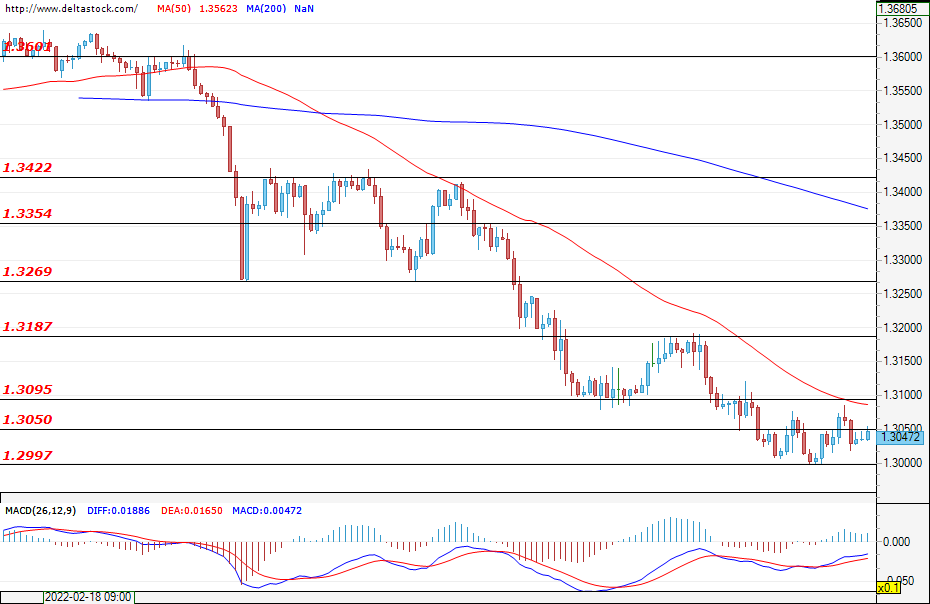
Neither the bears, nor the bulls managed to gain enough momentum and trading for the Cable remained locked in the zone between 1.2997 and 1.3050. A breach of the upper border, followed by a violation of the next target at 1.3095, could lead to a recovery and a move towards the major resistance at 1.3187. If the bears take control, then a breach of the support zone at 1.2997 could deepen the sell-off and could easily lead to new future losses for the sterling against the greenback.
EUGERMANY40
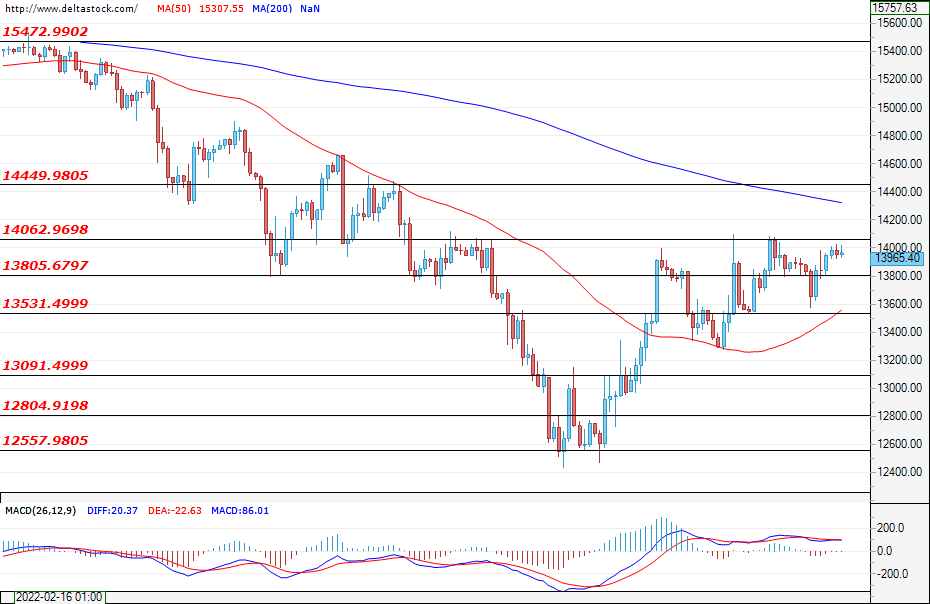
The German index recovered its recent losses from the beginning of the week, and at the time of writing, the price is hovering just below the resistance at 14062. A successful attack on the aforementioned resistance could easily lead to a test of the zone at 14449 and strengthen the positive expectations for the future path of the EUGERMANY40. The first support is the level at 13805. During today's session, the correlation with the U.S. indices will be quite high as all eyes will be on Jerome Powell and the future of the Fed’s monetary policy.
US30
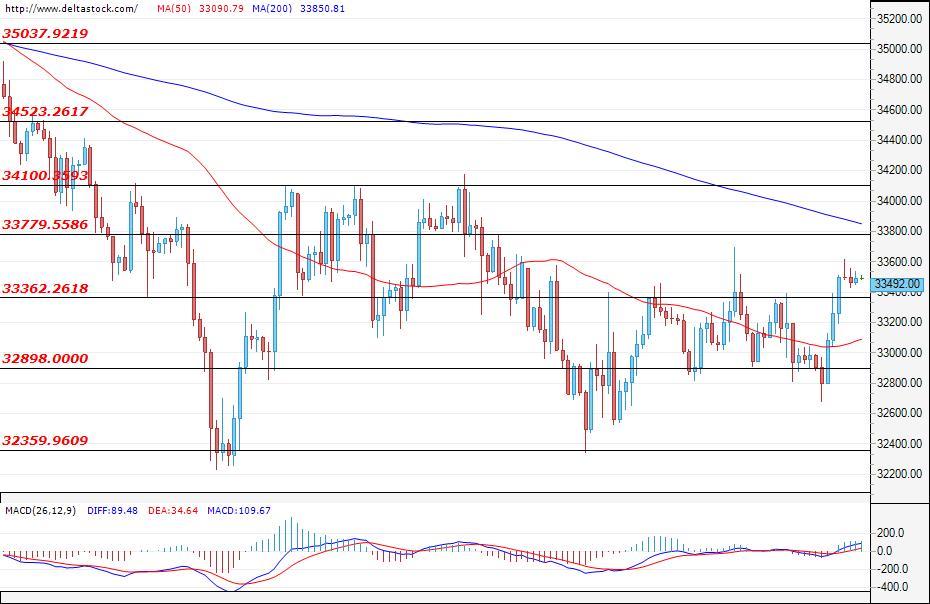
The bulls managed to prevail and breach the resistance zone at 33362. During the early hours of today`s trading, the price is holding positions above the mentioned level, and if the bullish attack continues, then the expectations would be for a test of the next target at 33379. If the mentioned level does not hold, then the recovery will most likely continue towards the resistance zone at 34100. If the bears re-enter the market, then their first target would be the zone at 33362, which is now acting as a support, followed by the lower level at 32898. Today, an increase in market volatility can be expected around the announcement of the Fed Interest Rate Decision (18:00 GMT), as well as during the following FOMC Press conference (18:30 GMT).
Dollar Can Take the Upper Hand Short Term
Markets
US stock markets had a better run yesterday with main indices closing up to 3% higher. Support in the Nasdaq at 12552 (38% retracement on 2020-2021 post-Covid-rally) held for a second time, but the technical picture obviously doesn’t improve yet. We hold our view that 2022 will be tough year for riskier assets as they’ll have to stomach a hawkish Fed in reaction to/on top of surging costs. Core bonds stabilized/recovered somewhat after this month’s heavy beating with some investors locking in profits ahead of tonight’s verdict. Daily changes on the US yield curve range between -1.1 bp (2-yr) and +1.1 bp (10-yr). The German yield curve bull flattened with yields sliding 7.2 bps (2-yr) to 1.9 bps (30-yr). The euro didn’t really mind the relative loss of interest rate support with EUR/USD and EUR/GBP closing broadly flat at respectively 1.0956 and 0.8399.
The Fed will start its interest rate tightening cycle tonight by delivering a 25 bps rate hike. Some Fed governors suggested a 50 bps inaugural move, but Fed Chair Powell earlier this month told lawmakers that uncertainty and market volatility related to the Russian invasion in Ukraine meant that the US central bank shouldn’t become a source of additional market stress. He nevertheless suggested that >25 bps steps could be a possibility later in the cycle if warranted by inflation (expectations) and/or the tight US labour market.
The new Summary of Economic Projections is expected to show yet another upgrade to inflation forecasts but focus will turn to governors thoughts on the future interest rate path (dot plot). Markets currently discount the equivalent of 25 bps rate hikes at every remaining Fed meeting this year (7 including today). We think that the Fed will show readiness to more or less walk that line.
Apart from this year’s projections, the key question will be on where Fed governors see the terminal rate. The market currently discount a neutral top just under 2.5% at the end of 2023. Will the Fed be more hawkish in this respect by signaling readiness to apply a restrictive monetary policy stance (exceeding the 2.5% neutral rate)?
Apart from the guidance on interest rates, there’s the second important pillar of the Fed’s normalization plans: running down the balance sheet. The US central bank indicated that this process would start shortly after raising interest rates, but provided little intel on the pace and target of the current $9tn balance sheet. We think the Fed could delay any such detailed plans for its May or June meeting, in line with Powell’s guidance not to become a source of additional market stress.
From a market point of view, we don’t expect any significant correction yet in core bond sell-off. If the focus turns to interest rates rather than the BS run-off, this implies a further bear flattening of the curve.
While the European central bank last week finally gave some backing for the euro medium term, we think the dollar can take the upper hand short term. Because of a hawkish Fed, fragile risk sentiment and ongoing tensions in Ukraine. The YTD low at EUR/USD 1.0806 is the final reference ahead of the March 2020 low (1.0636).
News Headlines
Sarah Bloom Raskin withdrew as President Biden’s nominee to be the Fed’s vice chair of supervision yesterday. She faced stiff Republican opposition ever since her nomination in January. But Raskin’s chances for what is seen as the most powerful banking regulator post really diminished significantly after Senator Manchin from the Democratic Party announced he wouldn’t support her in the 50-50 split Senate. Biden hasn’t come up with an alternative candidate yet. The post may even remain open heading into the US midterm elections in November.
Australian house prices rose 4.7% q/q in the last quarter of 2021. That’s slightly down from the 5% the quarter before but more than the 3.5% expected. The year-on-year rise hit a new record with 23.70% (up from 21.70% in Q3) since recording began in 2003. From the eight capital cities, Brisbane (9.6% q/q) and Adelaide (6.8%) registered the biggest increases. “Days on market fell and sales transaction volumes increased”, the statistics bureau said, referring to record low interest rates and ongoing strong demand to have supported growth in property prices.
Fed to Announce First of Many Rate Hikes to Come
Market movers today
The highlight for markets today will be the FOMC meeting, where we expect the Fed to hike policy rates by 25bp given the strong inflation pressures, which are likely to be further fuelled by the rise in commodity prices. We had previously expected a 50bp hike, but the uncertainty from the war in Ukraine will make the Fed a tad more cautious in our view.
Earlier today, US retail sales figures for February are also released and higher energy prices could start to have a negative impact on spending.
Ukraine war developments will remain in focus for markets and we look out for headlines from the NATO defence ministers meeting today.
Germany is due to present his 2022 budget and finance planning through 2026. The clouding economic outlook and accelerated expenditure on energy, defence and climate could bring net borrowing above EUR 200bn in 2022.
Two Riksbank speeches (Ingves and Ohlsson) are also on the agenda, which will be interesting in light of the recent inflation upside surprises.
The 60 second overview
Risk sentiment: Overall risk sentiment was positive yesterday, and Asian markets are also clearly up overnight. Ukrainian officials continue to signal cautiously positive progress in the negotiations with Russia, although we still have little concrete information about the topics being discussed. While oil prices have rebounded slightly overnight, with Brent now trading just above USD100/bbl, energy prices have clearly declined over the past days as EU has not signalled joining US and UK with an import ban on Russian energy. Despite EU's ambitions to quickly reduce dependency on Russian natural gas, Germany's largest power supplier warned that a sudden stop to the imports would have dire consequences.
Fed: The key event today will naturally be the FOMC meeting, where consensus and markets are looking for a 25bp hike. Fed will also release its updated economic and rate projections. With oil prices declining from the recent highs, the direct war impact on US economy could be lighter than perhaps initially feared, and markets are now back to pricing in a cumulative 96bp worth of hikes over the next three meetings, which would mean also one 50bp hike either in May or June. Given that US financial conditions overall still remain expansionary, we expect that Fed will have to tighten monetary policy significantly this year to bring down the increasingly broad-based inflation pressure.
Macro: First economic indicators capturing the initial war effect are now starting to get released, yesterday the German ZEW economic sentiment index plunged to -39.3 from 54.3, as 58.9% of respondents now see Germany's economic conditions weakening over the next 6M. While the steep drop indicates a risk of clear downturn in economic activity, the ZEW is still based on analyst assessments, and we will look for the March Flash PMIs next week for a clearer gauge of the impact. In the US, the New York Fed Manufacturing index declined to -11.8 (from 3.1), which is the lowest level since May 2020. Among Nordic countries, especially the Finnish economy stands out as exposed to the crisis, and yesterday we updated our economic forecasts for Finland now calling for 1.7% GDP growth in 2022 (from 2.8%) (see more in Finland Outlook - Eastern headwinds take the speed out of the economy, 15 March).
Equities: Equities were higher yesterday despite the big drop in Chinese tech stocks. With a strong US session yesterday, US outperformed China by 5% in just one day. The optimism was building through day although no big news arrived from Ukraine and macro data were outright weak. However, oil price dropped another 5%, down 20% the last five trading days and hence one of biggest fears from financial markets abating. Just one week ago headlines about oil in 200 and 300 dollars got a lot of attentions and very few were talking about the other side of this, that oil price could drop just like it has been the case with both commodities, agriculture products and the gas price. The move higher in US equities supported by lower oil price and stabilizing yields resulted in tech outperforming energy and hence growth outperforming value. In US Dow +1.8%, S&P 500 +2.1%, Nasdaq +2.9% and Russell 2000 +1.4%. Relief in Asia this morning with all markets higher and Hang Seng leading the advances. However, even with the relief in tech stocks this morning leaves them 65% below the peak a year ago. US futures are flat this morning while European futures in the ballpark of 0.5% higher.
FI: Yesterday, European yields declined as the commodity prices eased. The main event today is the FOMC meeting this evening. We expect a 25bp rate hike rather than a 50bp rate hike given the uncertainty surrounding the war in Ukraine. This has also been indicated by Fed Chairman Powell. We will be looking for comments on the rate path relative to the market pricing and thus how hawkish the Federal Reserve will be relative to market pricing.
FX: After weeks characterised by big inter-day moves in FX the latest sessions have been characterised by more modest close-to-close price action. This is except for offshore USD/RUB, which has completed a 30 figure move lower.
Credit: Yesterday we saw a modest positive risk sentiment in the credit markets. iTraxx main tightened 0.8bp to 79.3bp while Xover tightened 3.2bp to 278.7bp. We saw similar moves in the IG cash space tightening 1bp, whereas the HY market widened slightly.
Nordic macro
Sweden: Two Riksbank speeches on the agenda. First Governor Ingves at 12:00 (local time) and at 14:00 Deputy Governor Ohlsson, both addressing their views on the current economic situation. So far, the Riksbank has taken a relatively relaxed attitude to the run-up in inflation stressing that higher inflation is mainly a matter of energy prices. However with Monday's inflation data that is no longer true, CPIF ex energy jumped to 3.4% in February. The Riksbank usually does not hint about policy shifts in speeches but maybe this time around will be different.
Fed Meets, Oil Rebounds and Russia Risks Default
‘Difficult and vicious’ are the talks between Ukraine and Russia according to the Ukrainian President Zelensky, but there is room for compromise as he also recognized that being part of the EU or NATO is perhaps a faraway dream for Ukraine. Yet, he had already said that, to prevent an invasion when the tensions were escalating a couple of weeks earlier. Therefore the diplomatic efforts are only a slim hope for a resolution.
But the market sentiment is better today. We saw a strong rebound in three major US indices on Tuesday. The S&P 500 gained more than 2%, while Nasdaq jumped close to 3%, as Apple bounced higher from the $150 dip of the day before on news that one of its iPhone suppliers in Shenzhen had to halt production due to the Covid lockdown.
Don’t mistaken: Bad news is bad news
The overall positive mood is put partially on the back of a terrifying Empire State Manufacturing index which dived to -11.80 in March whereas analysts were expecting an improvement from 3 to 7 level. The bad news could’ve acted as ‘good news’ for the market as the weak data may have revived the Fed doves. But the US producer prices hitting 10% in February certainly rules out that explanation as inflation is what matters the most for the Fed policy at the moment.
Therefore, the rebound could be just a short-term positive correction in a comfortably bearish medium term trend.
The dot plot
The Fed starts its newest tightening cycle today, and investors stand ready for a steep tightening to tame the 40-year high infaltion. The ‘dot plot’ will give more clarity on what the US policymakers think about the potential implications of the Ukrainian war on the future of the Fed policy. But there is a chance that we discover a more hawkish FOMC due to the rising inflation that is triggered by the skyrocketing energy and commodity prices, than a dovish outlook because of a slower growth due to the geopolitical tensions. The US 10-year yield is now at the levels it was before the pandemic started.
The US dollar? Tighter Fed policy is, in theory, a booster for the valuation of the greenback and should lead to a further appreciation in the US dollar across the board, but the historical data confirms that the dollar weakened on average 4.1% during the four latest tightening cycles, as a tighter Fed suggests an improving global growth and a greater demand for raw materials and stronger currencies other than the US dollar.
But this time, the Fed isn’t necessarily tightening because the economy is doing well, it’s tightening because there is an urgent need to tame the skyrocketing inflation despite the threat of a slower global growth.
The news from Ukraine will certainly be the major driver of the US dollar in the coming weeks. A diplomatic solution will certainly trigger a rapid downside correction in the dollar despite a more hawkish Fed, while the lack thereof could support a further appreciation of the US dollar.
Oil
US crude dipped to $93 per barrel yesterday than rebounded back above the $98 mark this morning. The Covid lockdown in China, and the news that India bought discounted Russian crude, potentially diminishing the hit to global supplies from import bans in the US, UK, and Canada, have certainly helped, along with the failure to break above the $130 mark after the announcement of the Russian oil ban which triggered a massive cut in long positions.
I expect a solid support near $88/90 per barrel range, including the major 61.8% Fibonacci retracement on December – March rally. Above this level, the price outlook will remain positive, while a break below, will certainly hint at a deeper and more sustainable downside correction. But that’s not my base case due to a globally tight supply. UBS also says that they expect the global oil demand reaching record highs in the second half of the year, and the impact of the latest Chinese lockdown will be limited in the medium run.
Default?
Russia is due to pay $117 million in interest on its dollar-denominated bonds today, and the failure to service debt could lead to a massive $150 billion default next month. Russia has means to pay back the interest, yet they can’t pay in US dollars that they can’t access.
A default could be a blow to the banking stocks due to their exposure to the Russian debt, because the latter was investment grade just a couple of weeks ago. The good news is, though an eventual Russian default will give a shake to the financial markets, it is not a systemic threat to the global economy. Phew.
US Oil Drops Towards Key Support
WTI crude falls back over a new round of ceasefire talks between Russia and Ukraine.
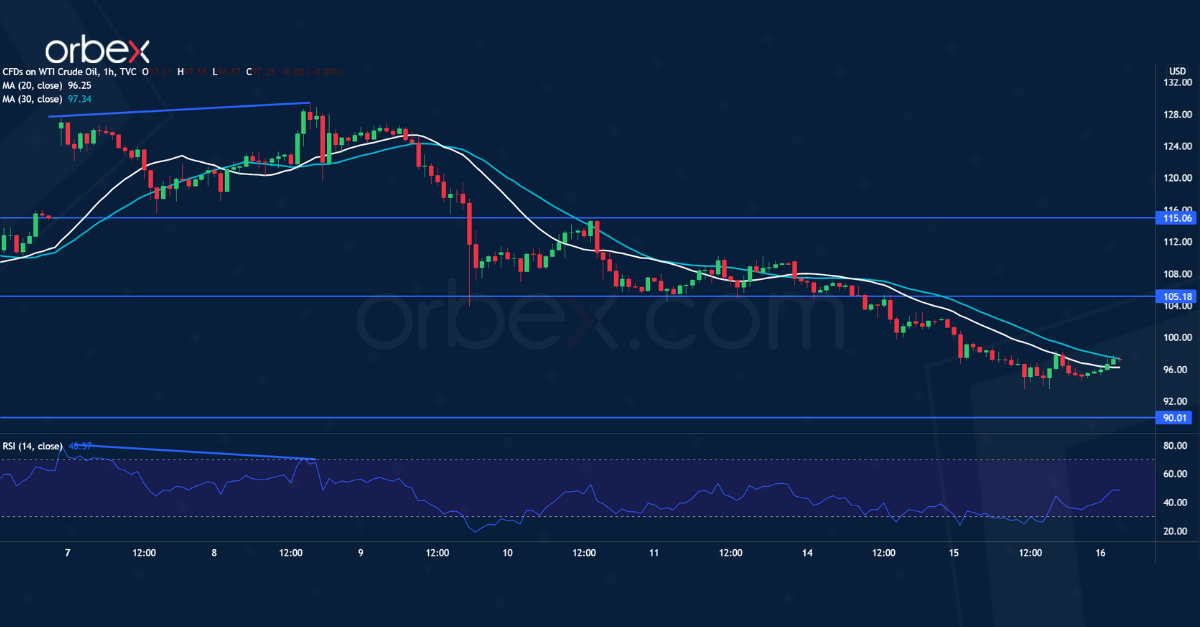
Previously, a bearish RSI divergence indicated a loss of momentum as the price went parabolic. Then a steep fall below 107.00 was a sign of liquidation.
Buyers continue to unwind their positions as the price slides back to its pre-war level. The psychological level of 90.00 is an important support on the daily chart. An oversold RSI may attract buying interest in this demand zone. 105.00 is the first resistance before buyers could regain control.
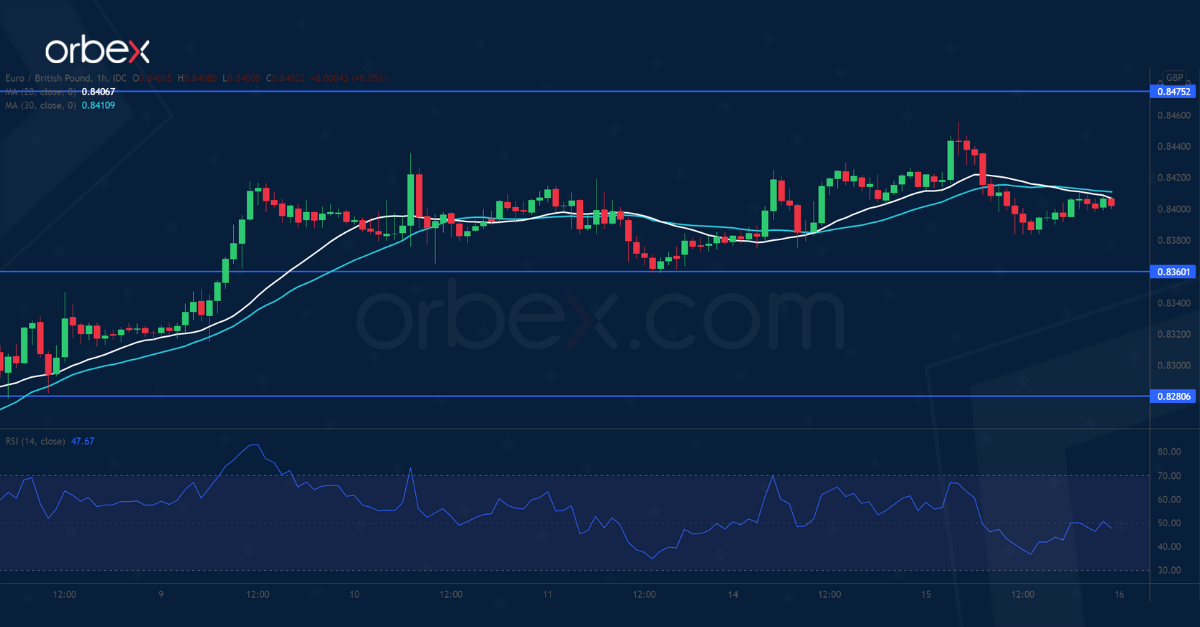
EUR/GBP Tests Key Resistance
The sterling found support after a drop in Britain’s unemployment rate in January. A break above the daily resistance at 0.8400 has prompted sellers to cover, easing the downward pressure.
Sentiment remains downbeat unless buyers push the single currency past 0.8475. In turn, this could pave the way for a reversal in the weeks to come.
Otherwise, the bears might double down and drive the euro back into its downtrend. A fall below 0.8360 would force early bulls to liquidate and trigger a sell-off to 0.8280.
USD/CHF Breaks Major Resistance
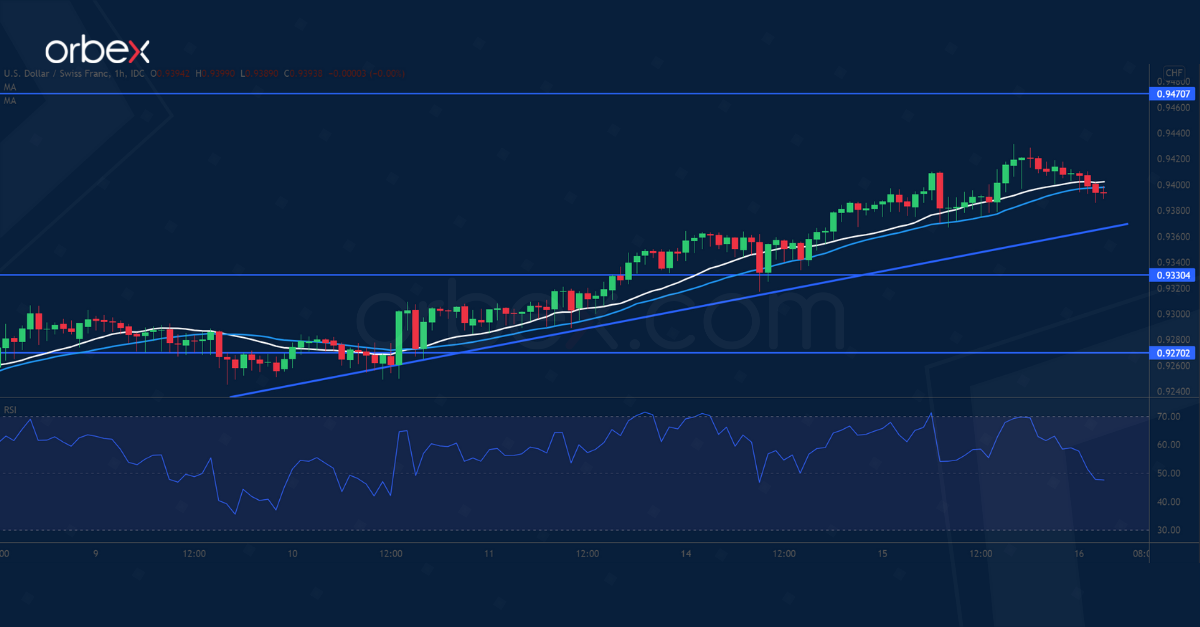
The US dollar continues upward as the Fed is set to increase its interest rates by 25bp. The rally sped up after it cleared the daily resistance at 0.9360.
The bullish breakout may have ended a 9-month long consolidation from the daily chart perspective. The rising trendline confirms the optimism and acts as an immediate support.
Solid momentum could propel the greenback to April 2021’s high at 0.9470. Buyers may see a pullback as an opportunity to jump in. 0.9330 is the closest support should this happen.