Sample Category Title
Bitcoin Pinned Around $39,000 as Ukraine War Proves a Blessing and a Curse
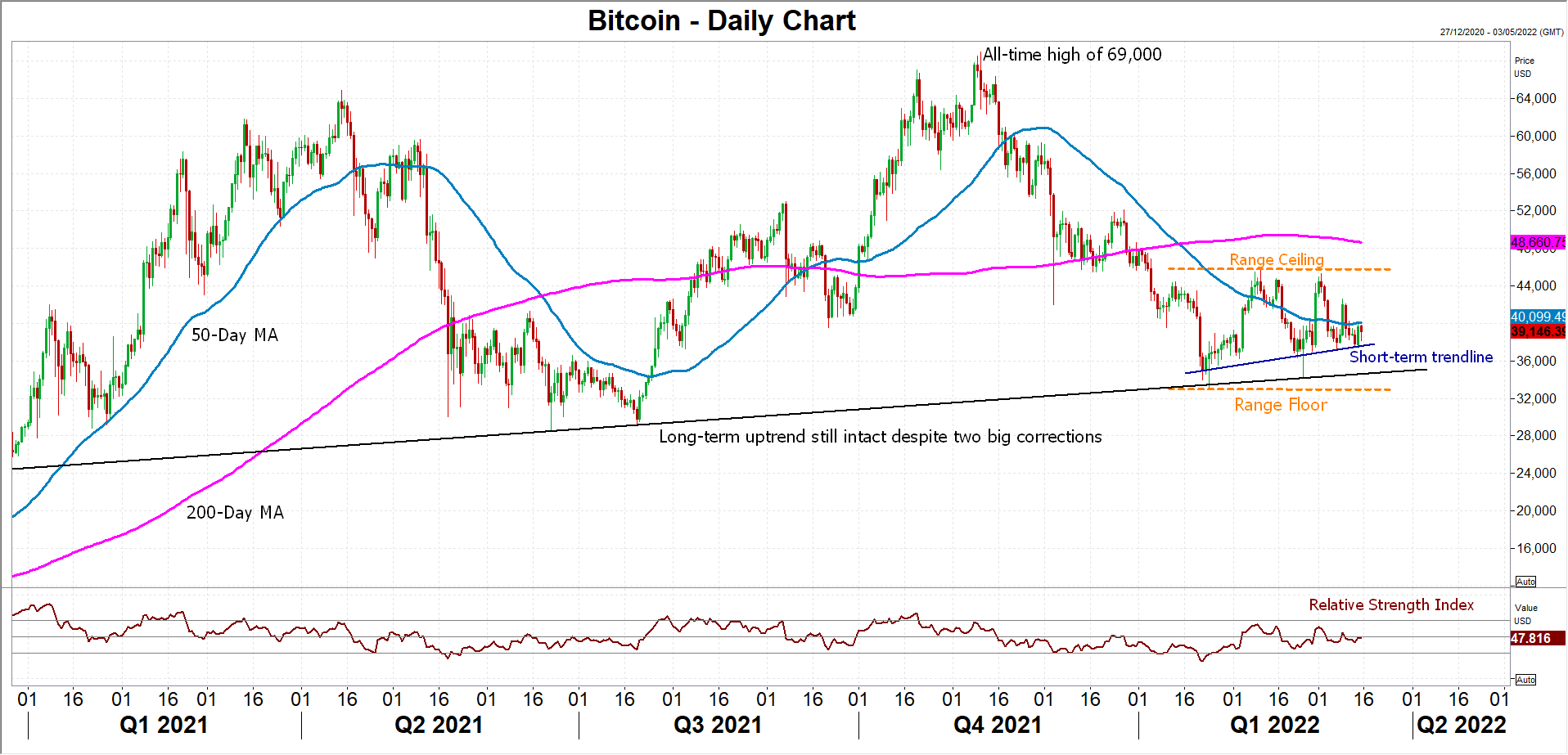
Bitcoin has been trading in a range since late January when fears about sky-high inflation took hold over the markets and tensions between Russia and Ukraine first started to escalate. The sideways pattern isn’t showing any signs of breaking up, so why is the price so unusually disciplined at such a tumultuous period for financial markets?
The halving effect
The price of Bitcoin – still the largest cryptocurrency by market cap – exploded higher in 2020 and 2021. Whilst the rising popularity of Bitcoin, both as an asset class as well as its use as a payment method, undoubtedly magnified this spectacular growth, the main driving force behind this rally was likely the halving that takes place every four years, and which last happened in May 2020.
In previous such occasions in 2012 and 2016, the price also rallied, though, with a slightly longer lag from the date of halving, which was then followed by a steep correction. Within this context, Bitcoin’s downfall from its all-time high of $69,000 set in November 2021 is to have been expected. Nonetheless it’s still very puzzling why Bitcoin and the other major cryptocurrencies have been consolidating for so long when volatility has been extremely elevated in the broader markets.
Not much of a safe haven
The price bottomed at a six-month low of $32,950.72 on January 24, halting a two-month slide. But despite some very choppy trading since then amidst the geopolitical storm with Ukraine, it has been unable to rise further than $45,850 or even brush new lows, instead fluctuating around $39,000.
Many market pundits were hoping that Bitcoin would shine as a safe haven from the war. But although cryptocurrencies have come under the spotlight, with the Ukrainian government encouraging donations in cryptos and many Russians using them to evade sanctions, the latter may also be having the opposite effect. Some wealthy Russians are reportedly liquidating their digital coins as they find themselves frozen out of their other assets due to Western sanctions.
Bitcoin’s increasing adoption by institutional investors may also be working against it as the fact that it has not proven to be a good inflation hedge nor a ‘digital gold’ during this torrid time for the markets suggests portfolio managers see it mostly as a speculative trade than anything else.
Regulatory worries have eased lately
On the positive side, both the European Union and United States seem to be only taking baby steps as far as regulating cryptocurrencies is concerned. All the indications are that most governments don’t want to stifle innovation in the field of digital currencies and blockchain technology despite ongoing concerns about fraud and money laundering. This bodes well for Bitcoin, at least in the medium term.
When factoring in all these different forces, it appears that they are negating each other. But what could also be keeping the floor and ceiling of the range in place is dip buyers stepping in to take advantage of the discounted price, while those that entered the market when Bitcoin was near record highs are possibly selling it at every opportunity that the price spikes higher to minimize their losses.
Is the price getting ready for an upside break?
It is encouraging to note, however, that during this consolidation phase, not only is the long-term ascending trendline still in place, but a short-term uptrend has also been forming. With momentum indicators like the Relative Strength Index (RSI) looking fairly neutral, an upward push seems more likely than a downward one, assuming of course that the 50-day moving average doesn’t get in the way.
How Many Fed Rate Hikes the USD Will Like?
The Federal Reserve is expected to raise the interest rate by 25 basis points during the upcoming meeting on Wednesday, at 20:00 GMT+2. As inflation keeps surging, this will be the first small attempt to curb it. What does it mean for the US dollar? Let’s find out.
What Led To Rate Hikes
The rise of inflation is undoubtedly a huge problem for the United States right now. The annual inflation rate reached 7.9% in February 2022, the highest level since January 1982. At the same time, the economy is expanding at an ultra-fast pace. For example, the US unemployment rate dropped to 3.8% - a new post-pandemic low. Another factor that triggers Fed to act sooner rather than later is the Russia-Ukraine military conflict. The US sanctions against Russia and the ban of Russia's oil export boosted commodity prices and left no doubt about upcoming rate hikes.
How Many Rate Hikes to Expect
In addition to the Fed Interest Rate Decision, the regulator will release a so-called dot-plot. This is a report, where the Fed members post their expectations of rate hikes. The economists surveyed by Bloomberg see 5 rate increases with the rate reaching 1.25% this year. However, some analysts see an even more hawkish Fed with seven interest rate changes.
The US dollar will likely react to the actual data in these projections. If the Fed turns out to be more hawkish than the market expects it to be (with more than seven rate hikes or half-point rate hike) the USD will soar.
The USD ahead of the Event
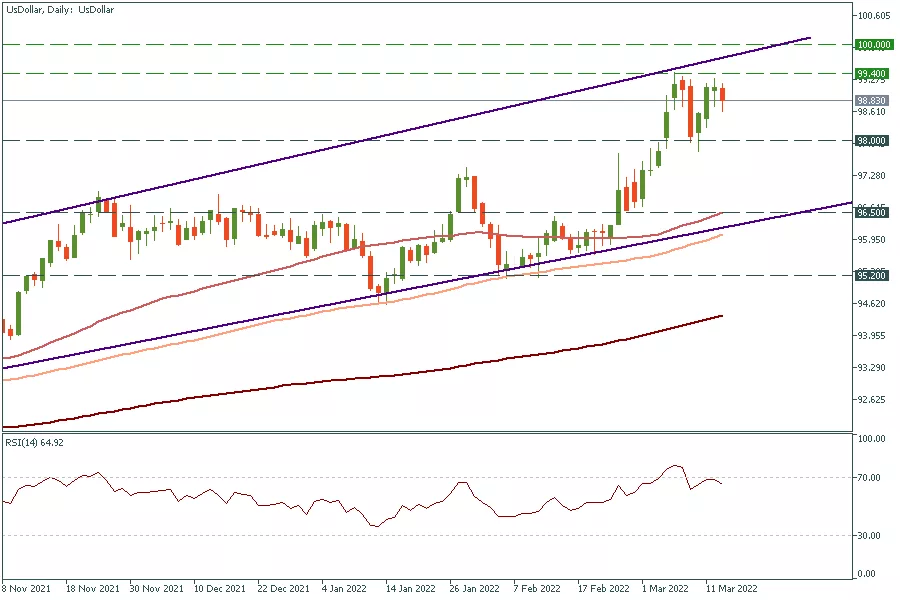
If you look at the chart of the US Dollar Index, which tracks the performance of the American currency, you can notice that the decision has already been priced into the market. As a result, the USD has reached the 99.40 level. Thus we can expect a sharp reversal after the meeting unless the Fed surprises. In that case, the US Dollar index can plunge to 98 and even lower to 96.50. Keep in mind that the Federal Reserve may express cautiousness amid the ongoing tensions in Eastern Europe and the possible slowdown of economic growth.
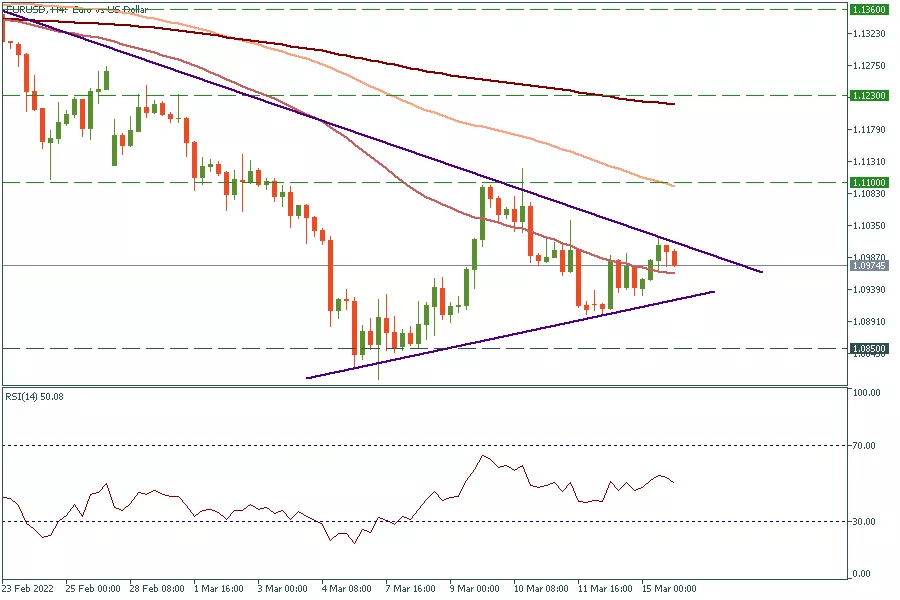
EURUSD has been trading within a symmetrical triangle. That is, after a downtrend, we may see a continuation of the downtrend and reach the support levels at 1.0900 and 1.0850. However, if the Fed fails to surprise the market, the upside momentum to the resistance of 1.1100 (50-period MA) on H4 will be in focus.
Crude: Oil Prices Move in Bear Territory!
It looks like the "Putin trade" is back on: A few moments ago. stocks, which had rallied sharply, came off their earlier highs, while oil and gold both bounced off their lows... on this:
*PUTIN: KYIV NOT SERIOUS TO FIND MUTUALLY ACCEPTABLE SOLUTION
Whether or not we will see some traction now remans to be seen. But after slumping more than 20% off last week’s highs, crude oil has entered the bear market territory. Will it now rebound?
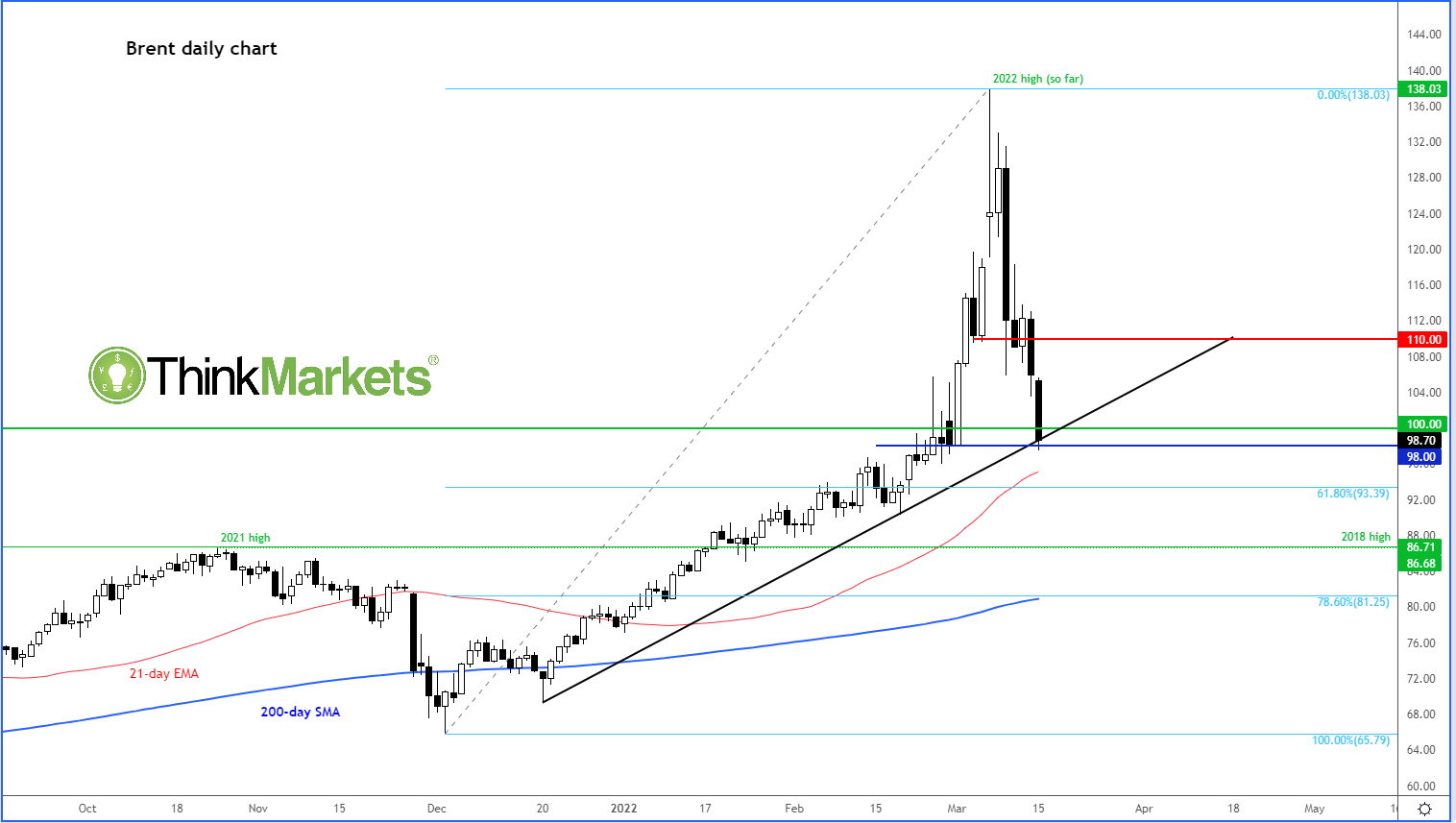
Source: ThinkMarkets and TradingView.com
Today saw Brent prices collapse further, dipping below the $100 per barrel level, to reach a low so far of around $97.50. WTI has likewise fallen sharply to $94.50. Last week, these contracts were trading at highs of around $138 and $129, respectively.
The collapse has been spectacular.
I think the biggest driver behind the sell-off in oil has been this: investor realisation that Europe is not going to wean off Russian oil supply immediately. Everything else is secondary, including the potential return of Iranian oil supply. Meanwhile, the OPEC has highlighted the risk to the oil demand outlook arising from the Ukraine war and surging inflation.
Also weighing on oil prices is something that had sent prices into the negative last year: surging covid cases and lockdowns. This time, in China, the biggest oil importer in the world. Here, covid cases have spiked sharply, and very sharply in certain regions. Consequently, the government has put tens of millions of people in lockdown. The most important regions are the entire Jilin province and technology hub Shenzhen.
The lockdowns have also weighed heavily on the Chinese yuan. Speaking of which, a report from WSJ says talks over pricing oil in yuan have accelerated as Saudis "have grown increasingly unhappy with decades-old U.S. security commitments to defend the kingdom."
Given the sharp sell-off in oil prices, I would imagine we will see a bit of “bargain” hunting at these levels, especially as the threat of Russian supply disruptions remain high. But we need to see evidence of a rebound first, ideally on a daily closing basis, before bullish speculators start to dip their toes in.
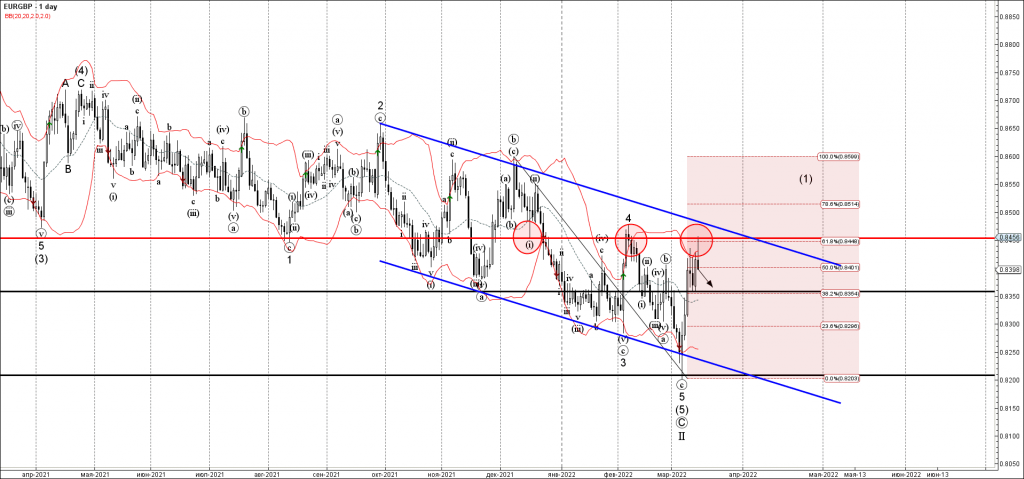
EURGBP Wave Analysis
- EURGBP reversed from resistance level 0.8450
- Likely to fall to support level 0.8360
EURGBP recently reversed down from the key resistance level 0.8450 (which has been reversing the price from the start of February).
The resistance zone near the resistance level 0.8450 was strengthened by the upper daily Bollinger Band, resistance trendline of the dialy down channel from October and by the 61.8% Fibonacci correction of the downward impulse from December.
Given the strong daily downtrend – EURGBP can be expected to fall further toward the next support level 0.8360.
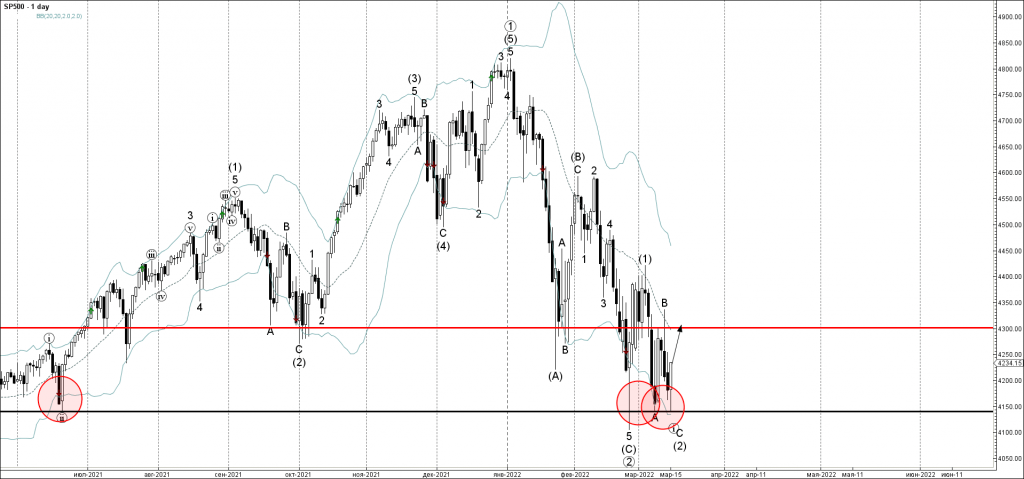
S&P 500 Wave Analysis
- S&P 500 reversed from support level 4140.00
- Likely to rise to resistance level 4300.00
S&P 500 index recently reversed up from the key support level 4140.00 (which has been reversing the index from the middle of last year).
The support zone near the support level 4140.00 was strengthened by the lower daily Bollinger Band.
Given the strength of the support level 4140.00 and the improvement of the risk sentiment across the equities markets – S&P 500 index can be expected to rise further toward the next resistance level 4300.00.
Euro Rises, Flirts with 1.10
The euro has gained ground for a second straight day and broke above the symbolic 1.10 line before retreating.
German economic sentiment slides
German ZEW Economic Sentiment took a plunge in March, falling from 54.3 to -39.3. The massive decline of 93.6 points was the sharpest on record. The survey of financial experts shows that expectations that Germany will be hit by a recession. The war in Ukraine and the sanctions slapped on Russia have clouded the economic outlook and the survey also showed a huge jump in inflation expectations. Eurozone ZEW Economic Sentiment also tumbled, falling from 48.6 points to -38.7 points.
The euro is particularly sensitive to war in Ukraine, due to the eurozone’s geographic proximity as well as its dependence on Russia for energy supplies. Negotiations between Ukraine and Russia remain deadlocked, but any tangible progress towards a ceasefire would revive risk appetite and provide a boost to the euro.
Investors are keeping an eye on the FOMC meeting on Wednesday. A quarter-point rise is a virtual certainty and a hawkish rate statement could give a boost to the dollar. US Treasury yields have been rising, reflecting market expectations that the upcoming meeting will signal the lift-off for a series of rate hikes in the coming months. The 10-year yield has broken above the 2% line and is currently at 2.10%. The markets have priced in six or seven rate hikes this year, but there are strong reasons in favor of scaling back this projection. The war in Ukraine has caused massive uncertainty in the markets and the Fed would prefer not to make aggressive moves in such a fluid situation. As well, the surge in oil has raised worries about stagflation, so the Fed will have to be doubly cautious about the pace of its tightening.
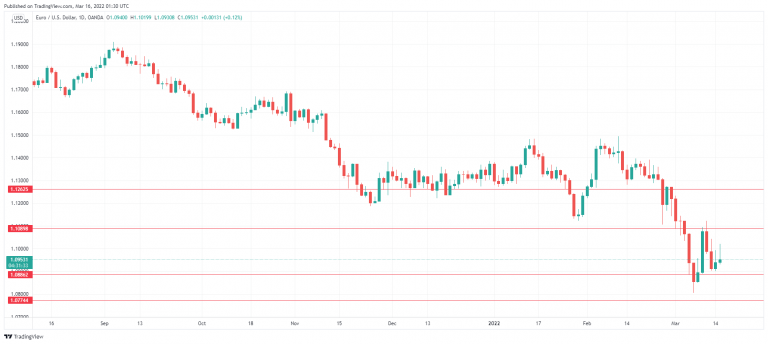
EUR/USD Technical
- 1.0886 is the first line of support, followed by 1.0774
- There is resistance at 1.1089 and 1.1262
EUR/USD Clings to Multi-Year Lows ahead of the Fed
EUR/USD, despite rebounding late last week, is still clinging to uncomfortably low levels ahead of Wednesday’s Fed interest rate decision.
A textbook symmetrical triangle, thrice tested on either side, is now fully formed on the weekly chart. EUR/USD looks ripe to move big, but the big question is when and in what direction.
If I were a technical purist, I’d say given that price is well past half and closer to two-thirds through the pattern, EUR/USD looks ripe for a big breakout. Traditionally, analysts look to the widest point of the triangle to get a sense of the size of the potential breakout, which in this case is 2,051 pips wide. Any break to the downside could easily see EUR/USD fall below parity.
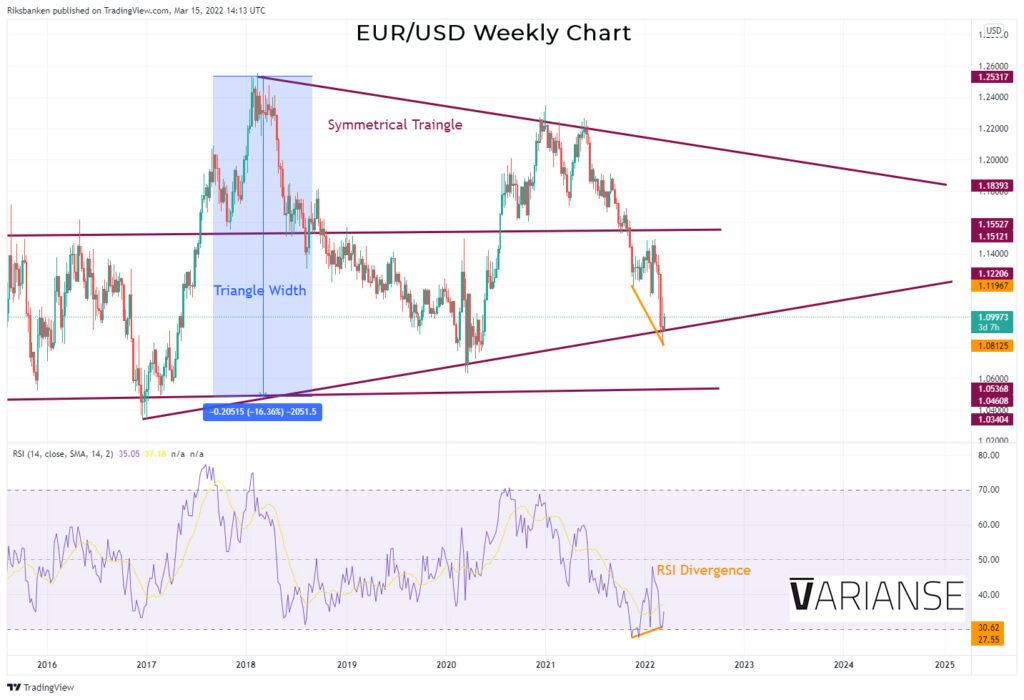
That said, buyers haven’t hesitated to step in and buy EUR/USD between the 1.08 to 1.03 range, including at the depth of the COVID-19 pandemic. Also, price sharply rejected the bottom support of the triangle last week as downside moment shows sign of divergence and the last weekly candle is a definitive hammer. Likewise, already elevated geopolitical risk due to war in the Ukraine has yet to convince markets of parity.
Just how the Fed could shift the calculus around EUR/USD isn’t entirely clear. US interest rate markets are already pricing in substantial amount of interest rate hikes this year. This includes 25 bps on Wednesday. What is much clearer, however, is if EUR/USD doesn’t get up from current levels soon, a bigger fall in EUR/USD begins to look more probable.
Sunset Market Commentary
Markets
Persistent uncertainty on the economic impact of the war in Ukraine combined with country specific themes caused some ‘diffuse price action’ on global markets today. This morning, Chinese equities again faced hefty selling despite solid eco data as markets pondered the impact of further regulation, elevated commodity prices and persistent political and trade tensions with the US. The risk-off initially spilled over to Europe with regional indices, at some point recording losses of 2.5%+. However, selling pressure gradually subsided. European equities currently are losing about 0.50% . US indices are rebounding 1.0%/1.5%. Eco data for sure weren’t the driver for this improvement. The expectations component of German ZEW investor confidence tumbled more sharply than ever before in March, from + 54 to minus 39.3, the biggest drop since the start of the series in 1991. ZEW President Achim Wamback commented that ‘The experts … expect a stagflation in the coming months. The worsened outlook affects practically all sectors of the German economy’ General business conditions of the manufacturing sector as measured by the NY Fed also nosedived to the lowest level since May 2020 (from 3.1 to 11.8). The survey responses were collected at the start of the Russian invasion in Ukraine (between 2 & 9 March). On the positive side of the economic story, pressure on some commodities continues to ease, with brent oil falling below $100/b. US and German yields are correcting lower after yesterday’s steep rise. US yields are ceding between 6 bps (2-y) and 2 bps (30-y). German yields are easing between 4 bps (2 & 5-y) and 1.8 bps (30-y). The move was supported by a limited decline in inflation expectations. At the same time, lingering global uncertainty and technical/tactical repositioning ahead of tomorrow’s Fed decision probably are also in play. Intra-EMU spreads narrowed modestly (Italy -3 bps).
On Fx markets, the decline in the oil price apparently is providing some breathing space to the euro and the yen. EUR/USD briefly surpassed the 1.10 barrier (currently 1.099). The USD/JPY rally finally did run into resistance, with the pair currently hovering around 118. Sterling initially didn’t profit from solid UK labour market data published the morning. EUR/GBP even briefly tested the 0.8455 area. However, sterling later staged a an intraday rebound, both against the euro. EUR/GBP currently trades near 0.841. Cable tested the psychological barrier of 1.30 this morning in Asia but is now changing hands in the 1.3065 area. CE currencies (Czech koruna, forint, zloty) all record modest gains. Polish February inflation eased from 9.4% to 8.5% on government measures/tax cuts to slow prices rises. Still the figure was higher than expected.
News Headlines
The Norwegian central bank published its quarterly regional network survey today. Interviewed contacts indicated that business activity continues to rise and they expect even stronger growth over the next six months. Over half of the interviewees reported capacity constraints, the highest share since autumn 2007. That’s even without taking into account the consequence of the Russian invasion in Ukraine as the survey was conducted early February. Contacts have revised up their estimate for annual wage growth this year from 3.3% in November to 3.7%. The main reason for concern is uncertainty related to capacity constraints and a rapid rise in prices. The NOK benefited from the rather hawkish survey with EUR/NOK dropping from an intraday top around 9.98 to 9.85 currently. The move comes even as oil prices drop below $100/barrel (Brent) for the first time since end February. Norwegian money market expect the Norges Bank to deliver (25 bps) rate hikes at every remaining meeting this year (7). The policy rate currently stands at 0.50%.
The WSJ reports that Saudi Arabia is in active talks with China to price some of its oil sales to China in yuan instead of dollar. Talks accelerated this year because of Saudi unease over the US’s security commitments to defend the kingdom. China buys more than a quarter of all Saudi oil exports. Switching the oil denomination would boost the international appeal of the Chinese currency.
Aussie Stems Slide
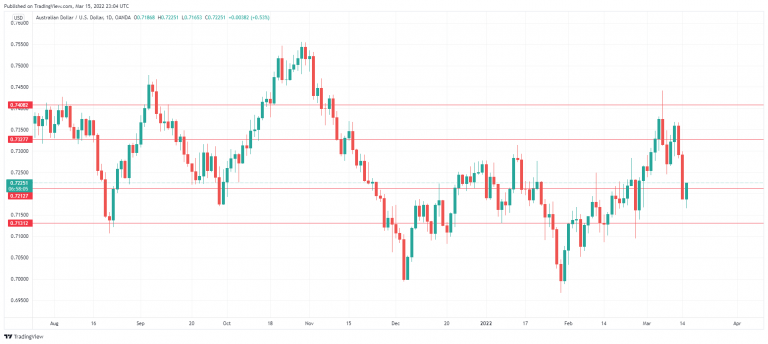
The Australian dollar has finally managed to stem the bleeding on Tuesday, after two days of sharp losses. In the North American session, AUD/USD is trading at 0.7225, up 0.56% on the day.
With the war continuing to rage in Ukraine, markets remain fragile and risk apprehension is high. There have been hints of slight progress in the negotiations between Ukraine and Russia which have given hope that a ceasefire can be reached, but Moscow appears determined to continue the fight, despite facing crippling sanctions from the West.
Has the Lucky Country’s luck run out for the Australian dollar? The currency enjoyed a run of five straight winning weeks, but dropped 1.13% last week and slid 1.44% on Monday before edging higher today. The surge in commodity prices had buoyed the Aussie in recent weeks but the ongoing conflict in Ukraine has sapped risk appetite and is weighing heavily on the risk-sensitive Australian dollar. The markets remain volatile, and we can expect developments in Ukraine to have a strong impact on the direction of the Australian dollar.
Patience, please
Patience was one of the messages that the RBA minutes conveyed, with the central bank saying it would continue to be patient before raising interest rates. RBA members noted that inflation was expected to continue to rise, as supply disruptions persist. However, the minutes noted that the war in Ukraine and the rise in energy prices had “created additional uncertainty about the inflation outlook”.
RBA Governor Lowe has insisted that inflation must remain “sustainably” in the 2%-3% target range. Even though inflation is currently running at a 3.5% clip, Lowe has the luxury of being able to wait until he is convinced that a rate hike is needed to contain inflationary pressures. If inflation continues to accelerate, Lowe will be under strong pressure to raise rates, with a June lift-off a strong possibility.
AUD/USD Technical
- 0.7212 is under pressure as support. Below, there is support at 0.7131
- There is resistance at 0.7327 and 0.7408