Sample Category Title
GBP/USD Mid-Day Outlook
Daily Pivots: (S1) 1.3247; (P) 1.3399; (R1) 1.3524; More...
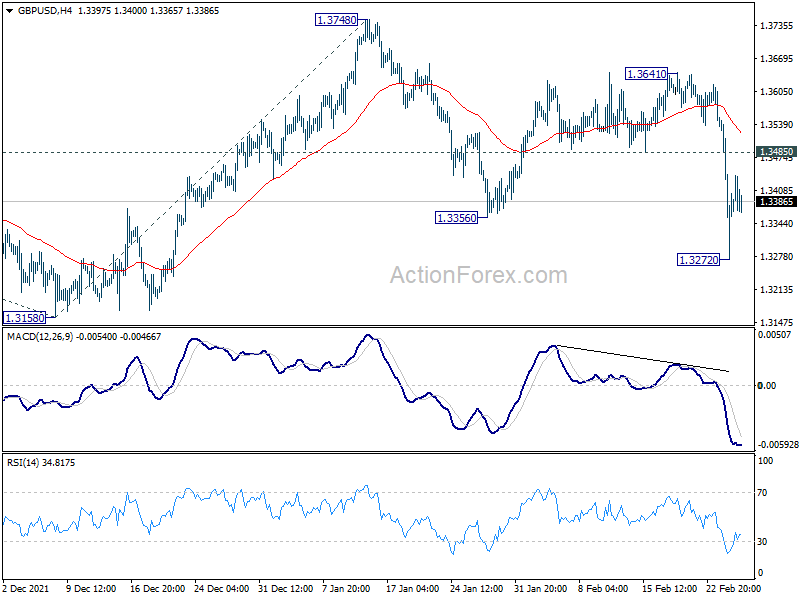
Intraday bias in GBP/USD is turned neutral for consolidation above 1.3272 temporary low. But further fall is still expected with 1.3485 support turned resistance intact. Current development suggest larger decline from 1.4240 is still in progress. Firm break of 1.3158 will target 61.8% projection of 1.4248 to 1.3158 from 1.3748 at 1.3074 next. However, firm break of 1.3485 will dampen this bearish view and turn bias back to the upside for 1.3641 resistance.
In the bigger picture, as long as 38.2% retracement of 1.1409 to 1.4248 at 1.3164 holds, up trend from 1.1409 (2020 low) is still in progress. On resumption, next target will be 38.2% retracement of 2.1161 to 1.1409 at 1.5134. Nevertheless sustained break of 1.3164 will argue that whole rise from 1.1409 has completed and bring deeper fall to 61.8% retracement at 1.2493.
EUR/USD Mid-Day Outlook
Daily Pivots: (S1) 1.1096; (P) 1.1204; (R1) 1.1301; More...
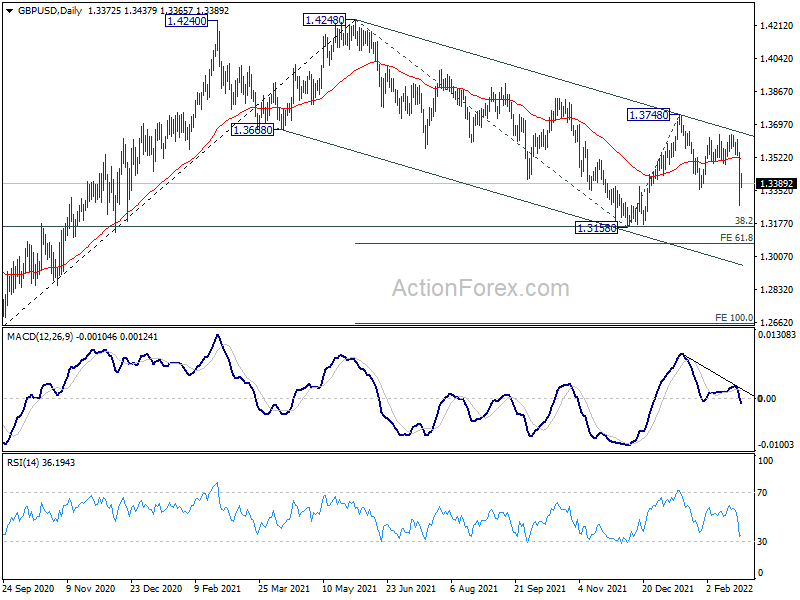
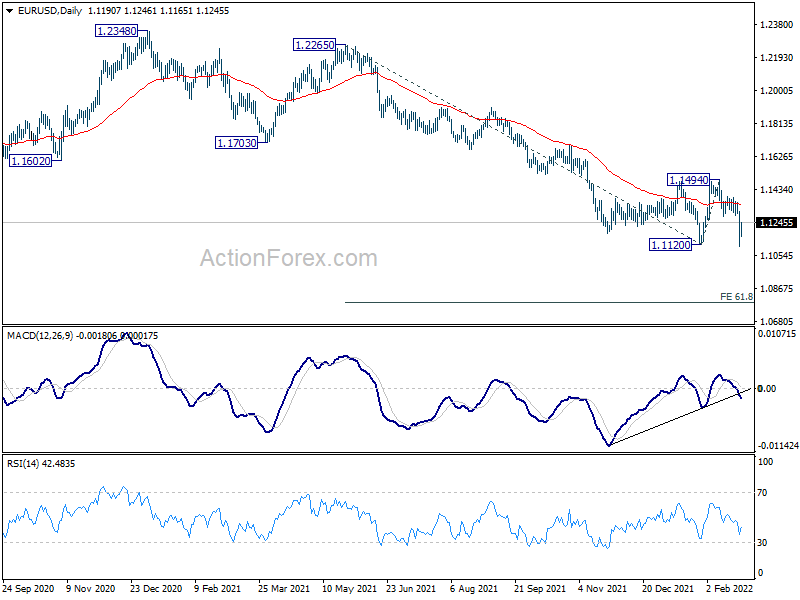
Intraday bias in EUR/USD is turned neutral as it's now consolidating above 1.1105 temporary low. But Further fall is still expected with 1.1287 support turned resistance intact. Sustained break of 1.1120 will confirm resumption of larger down trend from 1.2348. Next target is 61.8% projection of 1.2265 to 1.1120 from 1.1494 at 1.0786. However, firm break of 1.1287 will dampen this bearish view and turn bias back to the upside for 1.1494 resistance.
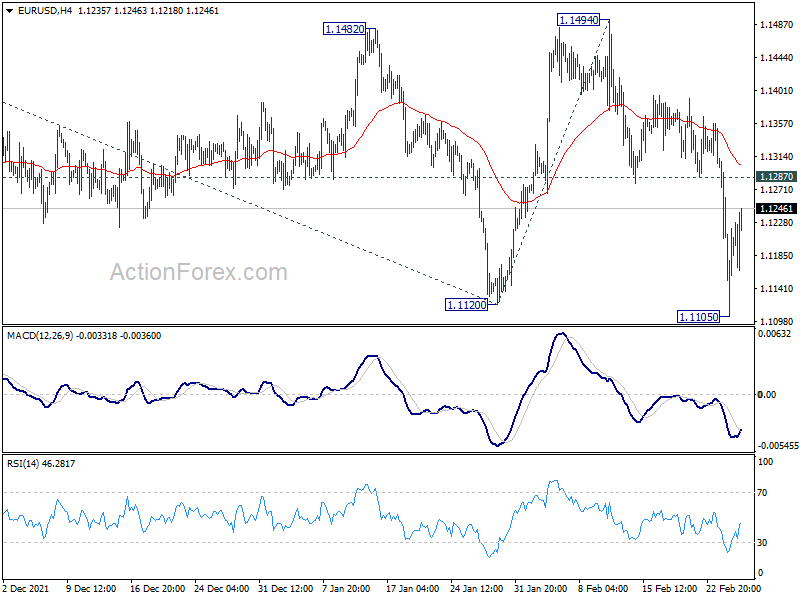
In the bigger picture, the decline from 1.2348 (2021 high) is seen as a leg inside the range pattern from 1.2555 (2018 high). Sustained trading above 55 week EMA (now at 1.1593) will argue that it has completed and stronger rise would be seen back towards top of the range between 1.2348 and 1.2555. However, firm break of 1.0635 (2020 low) will raise the chance of long term down trend resumption and target a retest on 1.0339 (2017 low) next.
Stocks Extend Rebound, EUR/GBP Turning Around
Global stocks continue to rebound today. The West's refrain from excluding Russia out of SWIFT was seen as a relief. But still risks remain, in particular if war spreads to NATO countries. Economic data continue to take a back seat, and even another surge in US inflation doesn't move markets. As for currencies, Aussie is currently the strongest for the week, followed by Kiwi. Sterling and Euro are the worst performing ones.
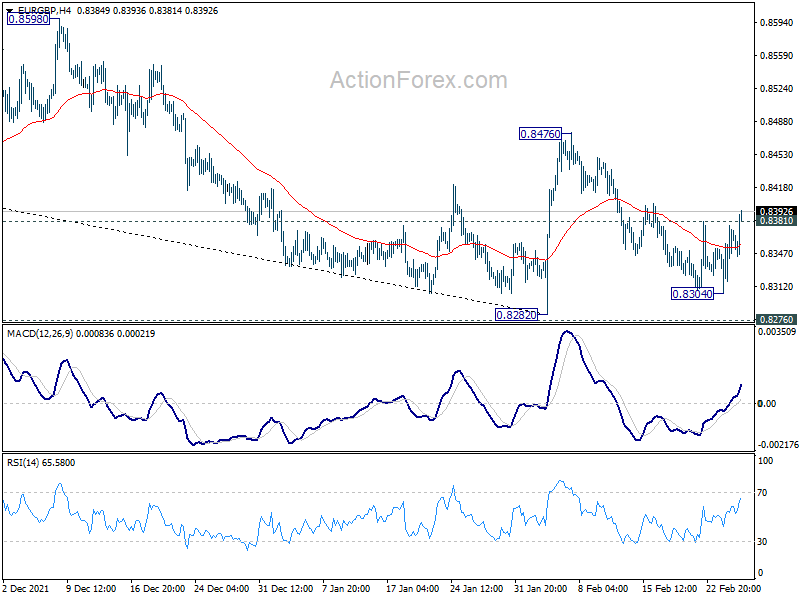
Technically, EUR/GBP's break of 0.8381 minor resistance argues that pull back from 0.8476 might have completed at 0.8304. The tide between Euro and Sterling could be turning for the near term, as EUR/GBP could now try to head back to 0.8476 resistance level.
In Europe, at the time of writing, FTSE is up 2.95%. DAX is up 2.83%. CAC is up 2.90%. Germany 10-year yield is up 0.051 at 0.223. Earlier in Asia, Nikkei rose 1.95%. Hong Kong HSI dropped -0.59%. China Shanghai SSE rose 0.63%. Singapore Strait Times rose 0.56%. Japan 10-year yield rose 0.0212 to 0.208.
US PCE inflation rose to 6.1% yoy in Jan, core PCE rose to 5.2% yoy
US personal income rose 0.0%, or USD 9B in January, better than expectation of -0.3% decline. Personal spending rose 2.1%, or USD 337.2B, above expectation of 1.5%.
Headline PCE price index accelerated from 5.8% yoy to 6.1% yoy, above expectation of 5.5% yoy. Core PCE price index rose from 4.8% yoy to 5.2% yoy, above expectation of 5.1% yoy. Energy prices rose 25.9% yoy while food prices rose 6.7% yoy.
US durable goods orders rose 1.6% in Jan, ex-transport orders up 0.7%
US durable goods orders rose 1.6%, or USD 4.3B to USD 277.5B in January, above expectation of 0.6%. Ex-transport orders rose 0.7%, above expectation of 0.4%. Ex-defends orders rose 1.6%. Transportation equipment rose 3.4%, or USD 2.9B to USD 87.6B.
BoE Mann: Important to dampen very robust inflation expectations
BoE MPC member Catherine Mann said, "to me, the data was still showing very robust (inflation) expectations and I thought it was important to dampen those expectations using a 50 basis point increase."
"There was very little in the data that showed any diminution of expected wage increases, expected price increases or for that matter in financial markets ... other than in gilts," she added.
Mann was among the four policymakers who voted for a 50bps at last BoE meeting, which lost to a 5-4 vote.
Eurozone economic sentiment indicator rose to 114.0 in Feb, EU rose to 112.8
Eurozone Economist Sentiment Indicator rose from 112.7 to 114.0 in February. Industry confidence rose from 13.9 to 14.0. Services confidence rose from 9.1 to 13.0. Consumer confidence rose from -8.5 to -8.8. Retail trade confidence rose from 3.7 to 5.4. Employment Expectation Indicator rose from 112.7 to 116.2, highest since May 2000.
EU Economic Sentiment Indicator rose from 111.6 to 112.8. Employment Expectation Indicator rose from 113.4 to 115.8, an all time high. Amongst the largest EU economies, the ESI improved in Spain (+2.4), France (+1.9), Germany (+1.2) and Italy (+1.0), whereas it weakened in the Netherlands and Poland (both -1.7).
Also released, Germany GDP was finalized at -0.3% qoq in Q4, versus expectation of -0.7% qoq. Import price index rose 4.3% mom in January, versus expectation of 0.2% mom.
France consumer spending dropped -1.5% mom in January, versus expectation of -0.3% mom. GDP was finalized at 0.7% qoq.
RBNZ Orr: Raising rates sooner prevents the need for even higher rates
RBNZ Governor Adrian Orr said in a speech, "amongst many of our central bank peers, we were one of the first to begin removing monetary stimulus and start the tightening cycle".
"Financial market pricing for future interest rate levels have been very responsive to our signalling," he added. "Market pricing of future central bank policy rates continue to indicate that New Zealand is expected to tighten policy sooner than many other comparable economies."
"By getting on top of inflation pressures quickly, by raising interest rates sooner, we aim to prevent the need for even higher rates in the future," he said. "In other words, we are taking our foot off the accelerator now to minimise having to use the brakes harder in future."
EUR/USD Mid-Day Outlook
Daily Pivots: (S1) 1.1096; (P) 1.1204; (R1) 1.1301; More...
Intraday bias in EUR/USD is turned neutral as it's now consolidating above 1.1105 temporary low. But Further fall is still expected with 1.1287 support turned resistance intact. Sustained break of 1.1120 will confirm resumption of larger down trend from 1.2348. Next target is 61.8% projection of 1.2265 to 1.1120 from 1.1494 at 1.0786. However, firm break of 1.1287 will dampen this bearish view and turn bias back to the upside for 1.1494 resistance.
In the bigger picture, the decline from 1.2348 (2021 high) is seen as a leg inside the range pattern from 1.2555 (2018 high). Sustained trading above 55 week EMA (now at 1.1593) will argue that it has completed and stronger rise would be seen back towards top of the range between 1.2348 and 1.2555. However, firm break of 1.0635 (2020 low) will raise the chance of long term down trend resumption and target a retest on 1.0339 (2017 low) next.
Economic Indicators Update
| GMT | Ccy | Events | Actual | Forecast | Previous | Revised |
|---|---|---|---|---|---|---|
| 21:45 | NZD | Retail Sales Q/Q Q4 | 8.60% | 6.20% | -8.10% | -8.20% |
| 21:45 | NZD | Retail Sales ex Autos Q/Q Q4 | 6.80% | 5.50% | -6.70% | -6.80% |
| 23:30 | JPY | Tokyo CPI Core Y/Y Feb | 0.50% | 0.40% | 0.20% | |
| 00:01 | GBP | GfK Consumer Confidence Feb | -26 | -16 | -19 | |
| 07:00 | EUR | Germany Import Price Index M/M Jan | 4.30% | 0.20% | 0.10% | |
| 07:00 | EUR | Germany GDP Q/Q Q4 F | -0.30% | -0.70% | -0.70% | |
| 07:45 | EUR | France Consumer Spending M/M Jan | -1.50% | -0.30% | 0.20% | |
| 07:45 | EUR | France GDP Q/Q Q4 | 0.70% | 0.70% | 0.70% | |
| 09:00 | EUR | Eurozone M3 Money Supply Y/Y Jan | 6.40% | 6.70% | 6.90% | |
| 10:00 | EUR | Eurozone Economic Sentiment Indicator Feb | 114 | 113 | 112.7 | |
| 10:00 | EUR | Eurozone Services Sentiment Feb | 0.8 | 10.3 | 9.1 | |
| 10:00 | EUR | Eurozone Industrial Confidence Feb | 14 | 14.2 | 13.9 | |
| 10:00 | EUR | Eurozone Consumer Confidence Feb F | -8.8 | -8.8 | -8.8 | |
| 13:30 | USD | Personal Income M/M Jan | 0.00% | -0.30% | 0.30% | 0.40% |
| 13:30 | USD | Personal Spending Jan | 2.10% | 1.50% | -0.60% | -0.80% |
| 13:30 | USD | PCE Price Index M/M Jan | 0.60% | 0.30% | 0.40% | 0.50% |
| 13:30 | USD | PCE Price Index Y/Y Jan | 6.10% | 5.50% | 5.80% | |
| 13:30 | USD | Core PCE Price Index M/M Jan | 0.50% | 0.50% | 0.50% | |
| 13:30 | USD | Core PCE Price Index Y/Y Jan | 5.20% | 5.10% | 4.90% | |
| 13:30 | USD | Durable Goods Orders Jan | 1.60% | 0.60% | -0.70% | |
| 13:30 | USD | Durable Goods Orders ex Transportation Jan | 0.70% | 0.40% | 0.60% | |
| 15:00 | USD | Pending Home Sales M/M Jan | -0.20% | -3.80% | ||
| 15:00 | USD | Michigan Consumer Sentiment Index Feb F | 61.7 | 61.7 |
EUR/USD Correcting Losses from 1.1106 Low
The Euro started a major decline from well above 1.1320 against the US Dollar. The EUR/USD pair traded below the 1.1265 support zone to enter a bearish zone.
There was a move below the 1.1150 level the 50 hourly simple moving average. A low was formed near 1.1106 and the pair is now correcting losses. It is now trading above the 1.1200 resistance level.
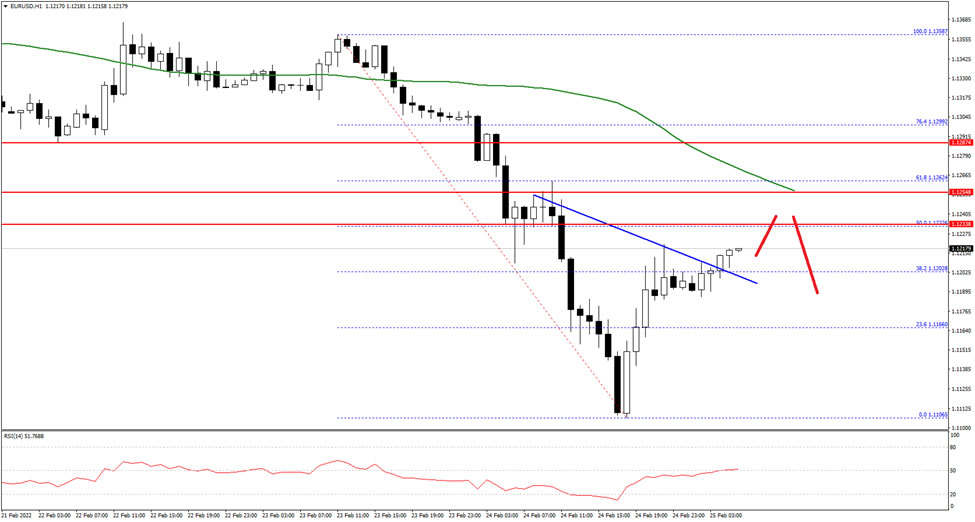
An immediate resistance near 1.1230 on FXOpen. The next major resistance is near the 1.1250 level and the 50 hourly simple moving average. A break above the 1.1230 and 1.1250 resistance levels could start a decent increase towards the 1.1320 level in the near term.
On the downside, an initial support is near the 1.1200 level. The next key support is near 1.1165, below the pair could decline towards the 1.1120 level in the near term.
Japanese Yen Yawns as CPI Rises
Japan’s CPI hits 2-year high
In Japan, the spotlight this week was on inflation indicators. After decades of deflation, Japan is experiencing inflationary pressures, although nothing on the scale that we’re seeing in the US or the UK. Inflation remains below the BoJ’s target of around 2%, but if the upswing continues, it could lead to a more hawkish stance from the BoJ.
Tokyo CPI for February jumped 1.0% y/y, up from 0.6% in January. This was the fastest annual pace since December 2019. The primary drivers of Japan’s inflation are increases in price of food and fuel. The crisis in Ukraine has already pushed oil above the 100-dollar level and a further jump in oil prices will dampen consumption and could derail the fragile economic recovery. Earlier in the week, BoJ Core CPI, the central bank’s preferred inflation gauge, rose 0.8%, lower than the 0.9% gain beforehand.
The Russian attack on Ukraine led to a torrent of condemnations from western leaders, but US President Biden’s announcement of sanctions actually boosted the financial markets, which had feared event tougher measures against Moscow. Biden is clearly unwilling to take any steps that would raise gasoline prices for US consumers, so he has avoided any sanctions against Russian energy entities. Also, the US could not get Europe to agree to exclude Russia from SWIFT, the global interbank payment system, which would have significantly hurt the Russian financial system. As things stand, the bark of sanctions is worse than the bite, leaving Russian President Putin a free hand to make changes in Ukraine as he sees fit.
USD/JPY Technical
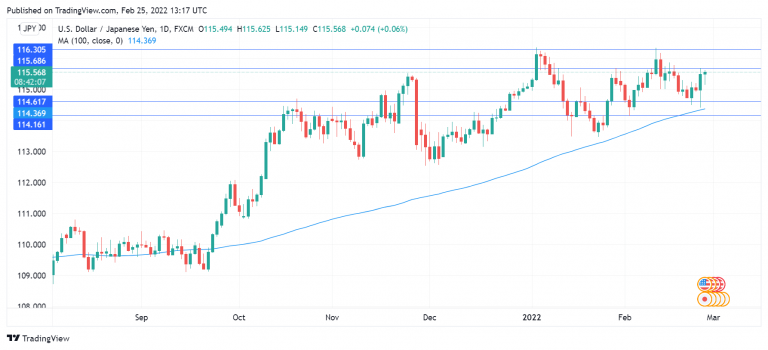
- The 100-DMA at 114.37 is providing support. Close by, there is support at 114.16
- There is resistance at 115.68. This line was tested on Thursday and remains under pressure. Above, there is resistance at 116.30
Pound Settles after Massive Drop
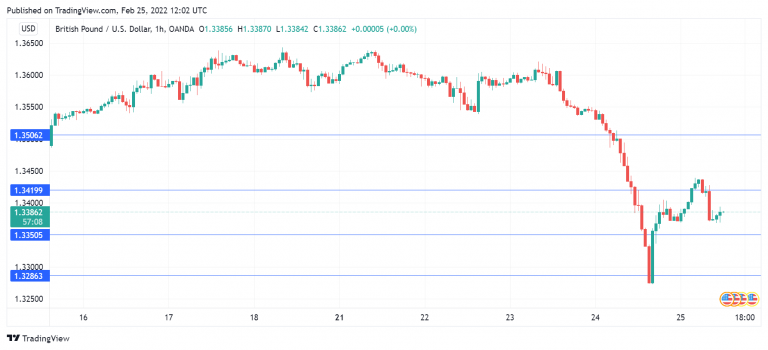
The pound is calm on Friday, after taking a tumble on Thursday and falling 1.28%. It was the pound’s worst one-day performance since November 2021. Investors appear to be taking a wait-and-see attitude on Friday, as the fighting continues in Ukraine, with Russian forces reported in the suburbs of the capital Kyiv.
BoE says inflation to hit above 7%
A day before the Russian invasion of Ukraine, The Bank of England policymakers had a grim message for a parliamentary committee. Deputy Governor Ben Broadbent noted that the BoE is facing its toughest challenge in decades. Inflation continues to rise and the BoE feels compelled to respond by raising rates, but this will exacerbate the cost of living crisis faced by households. Governor Bailey made reference to the crisis in Ukraine, saying that the surge in energy prices would hurt consumers and that the Ukraine crisis meant there was an upside risk on energy prices.
The BoE is projecting that inflation will rise above 7%, and there is little doubt that the central bank will have to hike rates in order to bring inflationary pressures back down. The BoE has raised rates in the past two meetings and a third hike would be unprecedented, but the bank is under strong pressure to put a lid on inflation which shows no signs of easing, especially with the Russian invasion of Ukraine which could send oil prices soaring.
The Russian attack on Ukraine sent the US dollar soaring on Thursday, as panicky investors sought the safety of the greenback. This sent the pound sharply lower, but the currency did recover some ground after President Biden announced additional sanctions. These were not as severe as feared, as they did not target energy companies in Russia nor was Russia excluded from using SWIFT, the global internet payment network. With western Europe dependent on Russia for 40% of its natural gas needs, it appears that the West’s bark against Russia will be tougher than its bite.
- There is resistance at 1.3662 and 1.3731
- There is support at 1.3506 and 1.3419
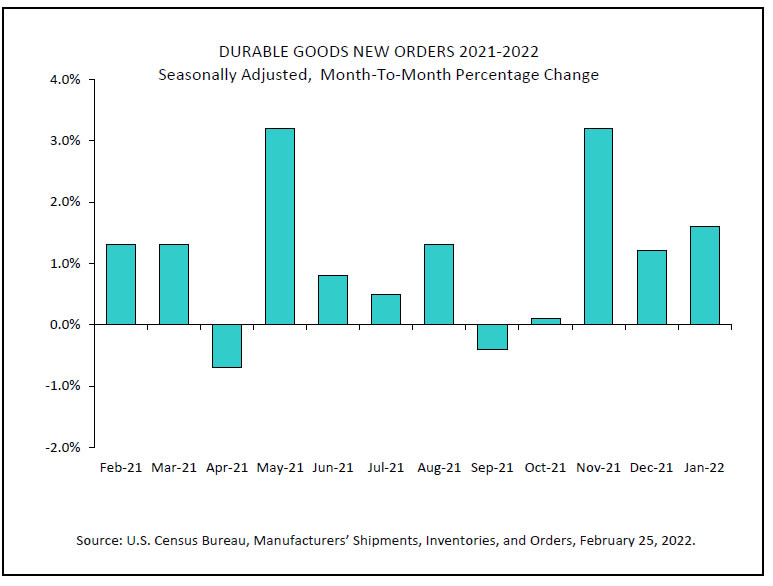
US durable goods orders rose 1.6% in Jan, ex-transport orders up 0.7%
US durable goods orders rose 1.6%, or USD 4.3B to USD 277.5B in January, above expectation of 0.6%. Ex-transport orders rose 0.7%, above expectation of 0.4%. Ex-defends orders rose 1.6%. Transportation equipment rose 3.4%, or USD 2.9B to USD 87.6B.
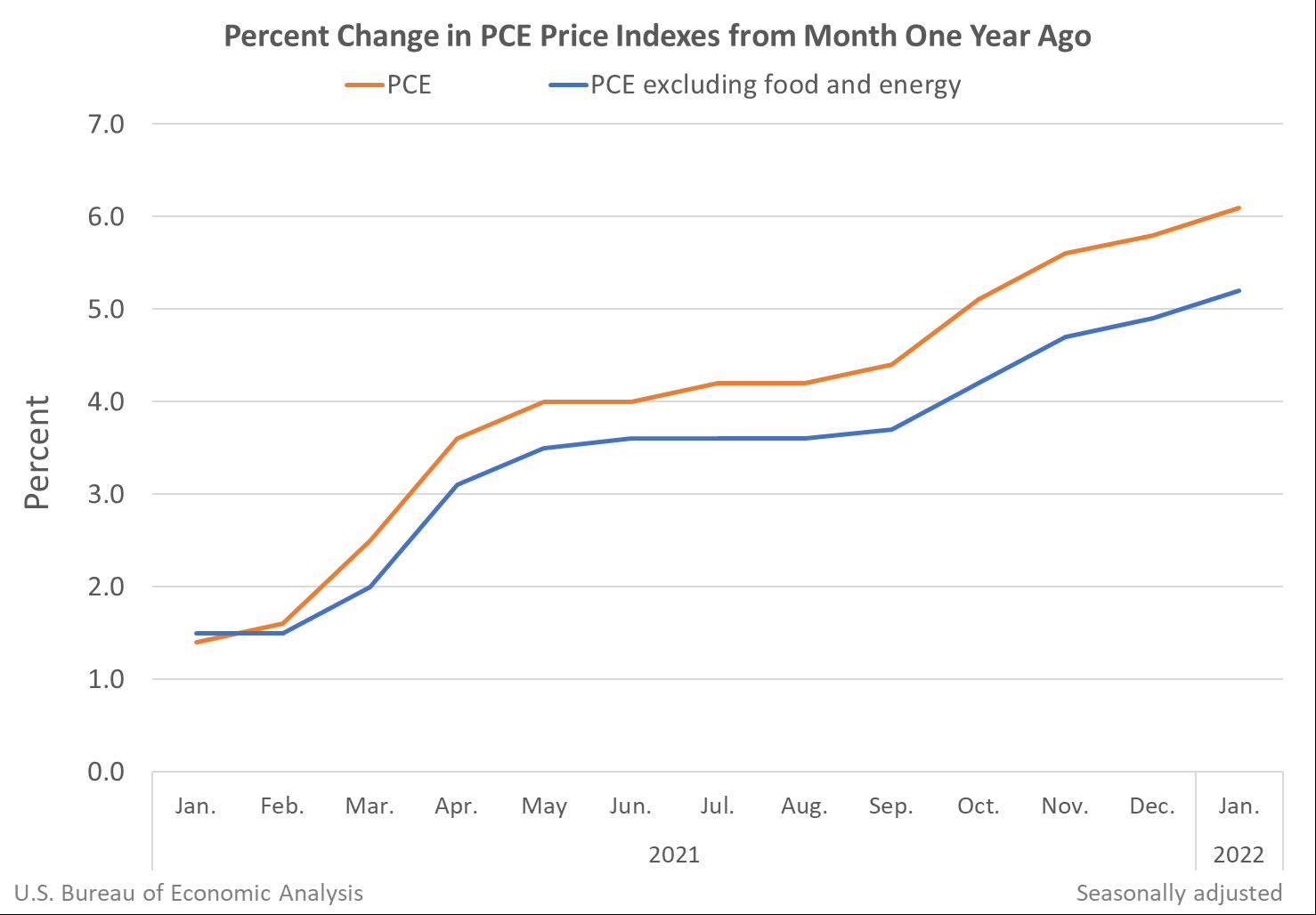
US PCE inflation rose to 6.1% yoy in Jan, core PCE rose to 5.2% yoy
US personal income rose 0.0%, or USD 9B in January, better than expectation of -0.3% decline. Personal spending rose 2.1%, or USD 337.2B, above expectation of 1.5%.
Headline PCE price index accelerated from 5.8% yoy to 6.1% yoy, above expectation of 5.5% yoy. Core PCE price index rose from 4.8% yoy to 5.2% yoy, above expectation of 5.1% yoy. Energy prices rose 25.9% yoy while food prices rose 6.7% yoy.
BoE Mann: Important to dampen very robust inflation expectations
BoE MPC member Catherine Mann said, "to me, the data was still showing very robust (inflation) expectations and I thought it was important to dampen those expectations using a 50 basis point increase."
"There was very little in the data that showed any diminution of expected wage increases, expected price increases or for that matter in financial markets ... other than in gilts," she added.
Mann was among the four policymakers who voted for a 50bps at last BoE meeting, which lost to a 5-4 vote.
Stock Markets Will Likely Remain Under Pressure
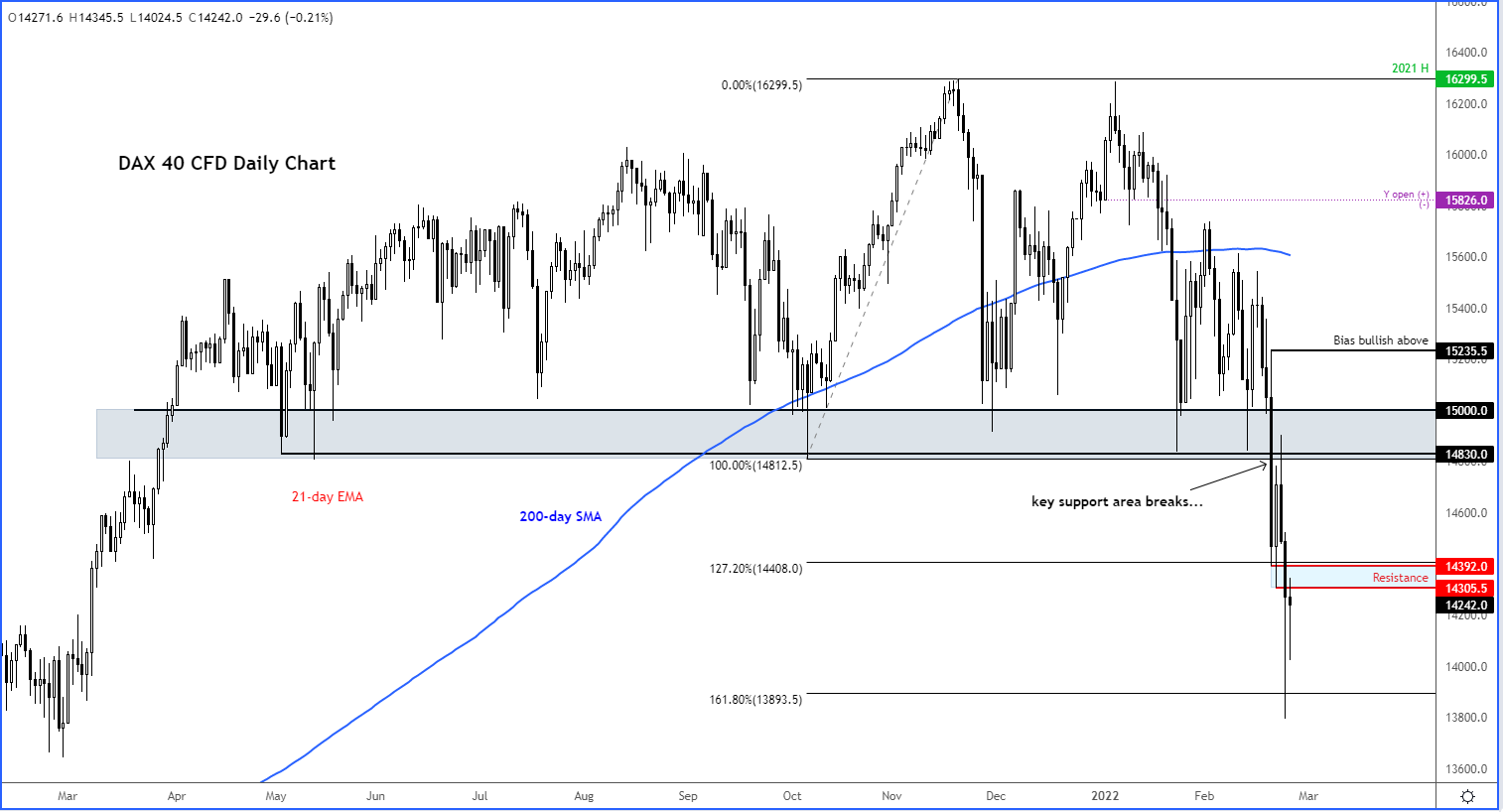
The key question investors would be asking themselves is whether Thursday’s sharp recovery off the lows for global indices marked a turning point. So far, we haven’t seen much bullish follow-through in US index futures to suggest that is the case, and you can understand why with everything happening on the ground in Ukraine. What’s more, the existing macro concerns – soaring inflation and the upcoming interest rate hikes – are further discouraging stock market investors. Today’s Core PCE Price Index, the Fed’s favourite inflation gauge, could revive those worries with a print well north of the 5.1% y/y expected.
Meanwhile safe-haven gold is currently flat on the session, after a remarkable session on Thursday when at one point it looked like it was heading to $2000, only for the sellers to step in aggressively as the US dollar rebounded sharply. But the metal is going to react more to the risk-on/risk-off trade, which means gold investors will be watching the stock markets closely today, and news from Russia and the West as they engage in a bit of tit for tat in terms of sanctions after Moscow’s invasion of Ukraine.
Given the potential for inflation to accelerate further with crude oil and gas prices finding renewed support from the Russian invasion, risk seeking might remain out of favour. There is the additional factor of the weekend risk to take into account. You wouldn’t want to go into the weekend knowing there is a good chance the market could gap against you at the next week’s open, as the situation in Ukraine could deteriorate and tensions between Russia and the West could boil over.
Against this backdrop, I wouldn’t be surprised if the markets come under renewed pressure heading into the close today.