Sample Category Title
USD/CAD Daily Outlook
Daily Pivots: (S1) 1.2683; (P) 1.2719; (R1) 1.2768; More...
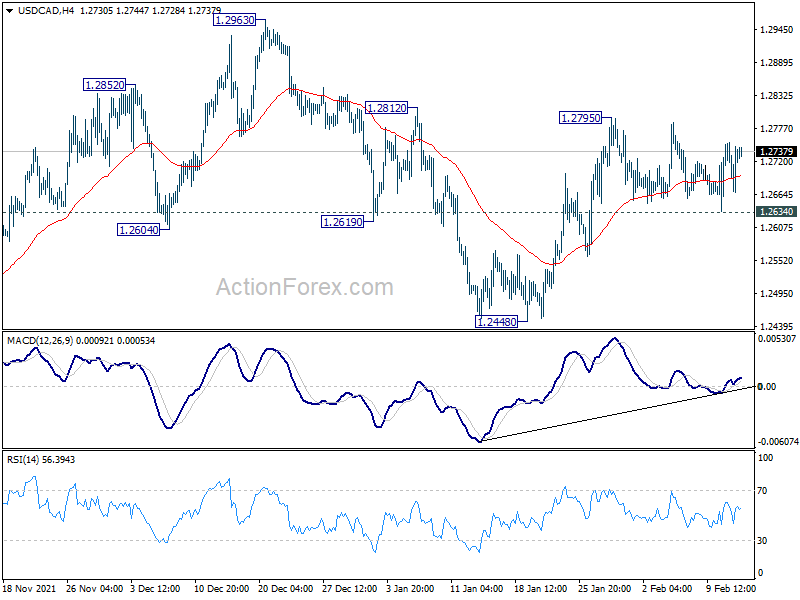
Intraday bias in USD/CAD remains neutral for the moment, and further rise is still mildly in favor. On the upside, break of 1.2795 will resume the rally from 1.2448 to 1.2963 resistance next. However, break of 1.2634 support will turn bias back to the downside for 1.2448 support instead.
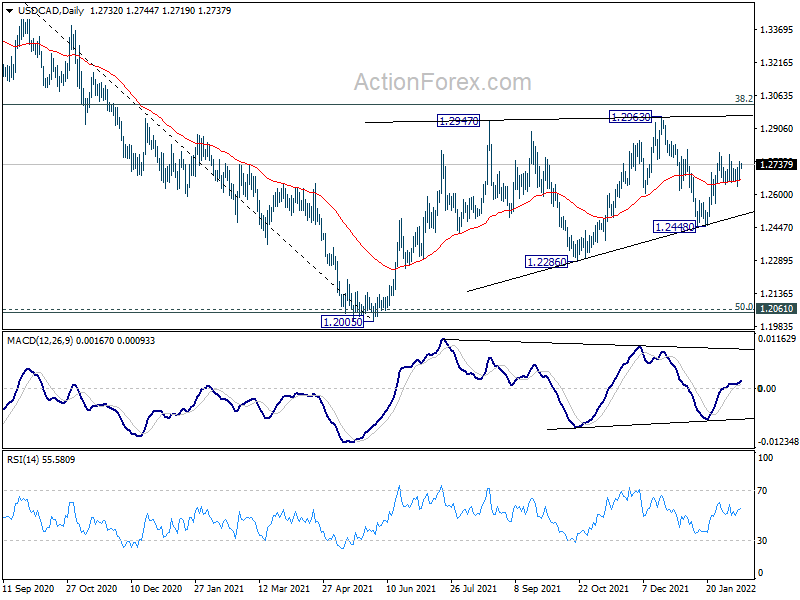
In the bigger picture, focus stays on 38.2% retracement of 1.4667 (2020 high) to 1.2005 (2021 low) at 1.3022. Sustained break there should confirm that the down trend from 1.4667 has completed after defending 1.2061 long term cluster support. Further rise would then be seen towards 61.8% retracement at 1.3650. However, rejection by 1.3022 will maintain medium term bearishness. Break of 1.2005 will resume the down trend from 1.4667 and that carries larger bearish implications too.
EUR/CHF Daily Outlook
Daily Pivots: (S1) 1.0455; (P) 1.0517; (R1) 1.0551; More....
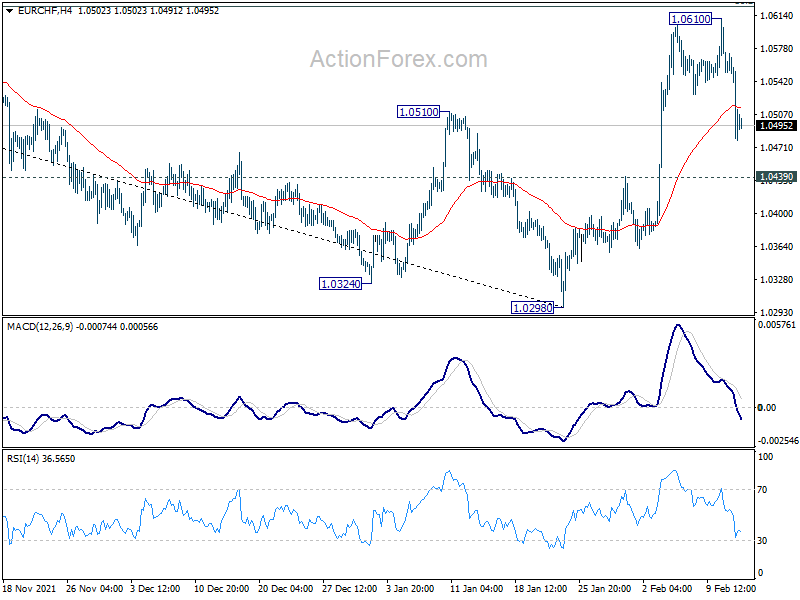
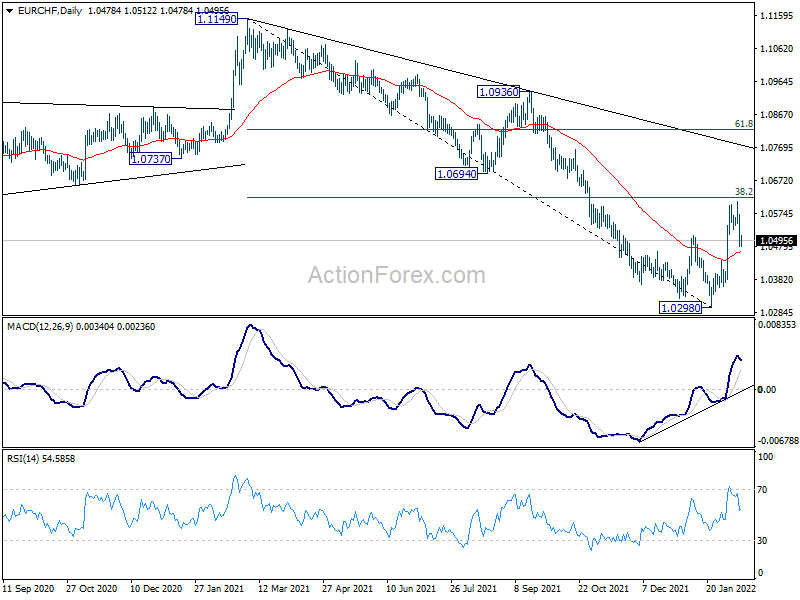
Intraday bias in EUR/CHF remains neutral for the moment. On the downside, break of 1.0439 support will argue that rebound from 1.0298 has completed, ahead of 38.2% retracement of 1.1149 to 1.0298 at 1.0623. Deeper fall will then be seen back to retest 1.0298 low. On the upside, sustained break of 1.0623 will raise the chance of trend reversal and target 61.8% retracement at 1.0824 next.
In the bigger picture, a medium term bottom was formed at 1.0298 on bullish convergence condition in daily MACD. Rebound from there is still tentatively viewed part of a corrective pattern. That is, larger down trend from 1.2004 (2018) could still extend through 1.0298 to 61.8% projection of 1.2004 to 1.0505 to 1.1149 at 1.0223. However, sustained trading above 55 week EMA (now at 1.0673) will argue that the down trend is over, and bring stronger rise back to 1.1149 next.
EUR/GBP Daily Outlook
Daily Pivots: (S1) 0.8342; (P) 0.8386; (R1) 0.8412; More...
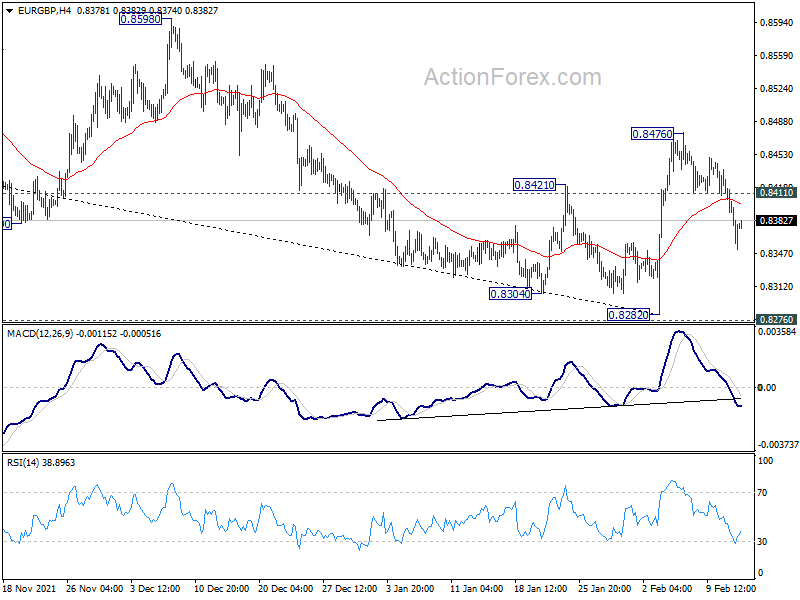
Intraday bias in EUR/GBP remains on the downside for retesting 0.8282 low. Sustained break of 0.8276 key long term support will carry larger bearish implication. On the upside, above 0.8411 minor resistance will turn bias back to the upside for 0.8476 resistance. Break there will resume the rebound from 0.8282.
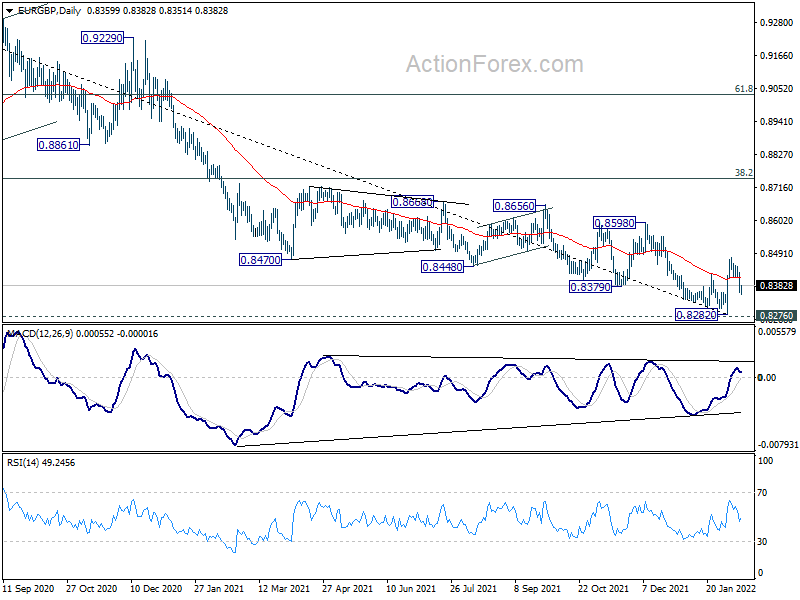
In the bigger picture, price actions from 0.9499 (2020 high) are still seen a corrective pattern that should be contained by 0.8276 long term support (2019 low). Bullish convergence condition in daily MACD and break of 55 day EMA raises the chance that it might be completed. Sustained trading above 38.2% retracement of 0.9499 to 0.8282 at 0.8747 will affirm this bullish case. However, sustained break of 0.8276 will argue that the long term trend has reversed.
EUR/AUD Daily Outlook
Daily Pivots: (S1) 1.5841; (P) 1.5922; (R1) 1.5983; More...
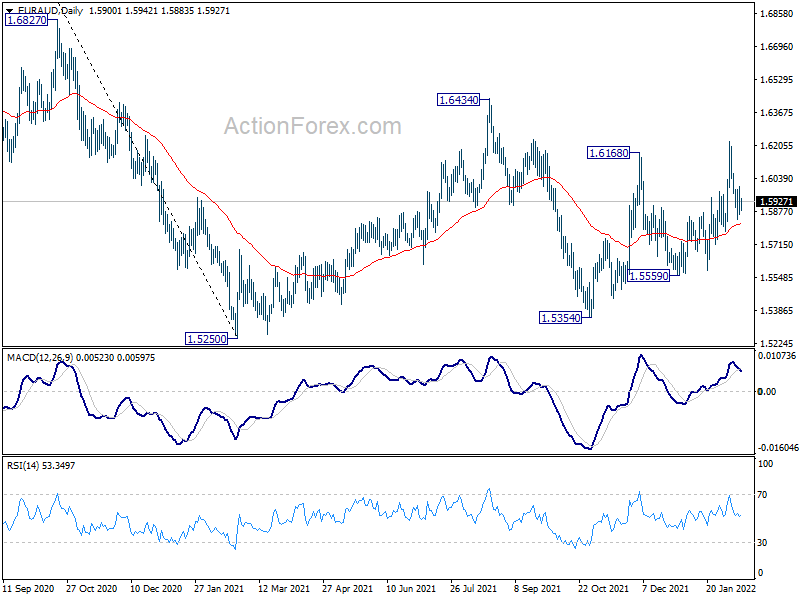
Intraday bias in EUR/AUD remains neutral at this pint. Further rise remains mildly in favor with 1.5776 support intact. Above 1.6223 will resume whole rise from 1.5354 to 1.6434 resistance first. However, break of 1.5776 will turn bias back to the downside for 1.5559 support instead.
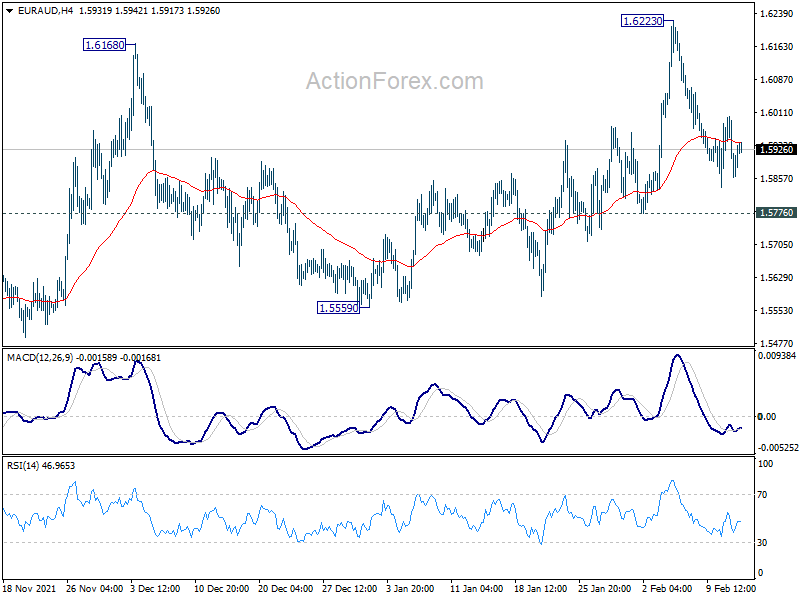
In the bigger picture, rise from 1.5354 is seen as the third leg of the corrective pattern from 1.5250 low. Further rise cannot be ruled out, but even in that case, strong resistance should be seen at 38.2% retracement of 1.9799 to 1.5250 at 1.6988. Larger down trend from 1.9799 is in favor to extend through 1.5250 at a later stage.
EUR/JPY Daily Outlook
Daily Pivots: (S1) 130.05; (P) 131.34; (R1) 132.29; More....
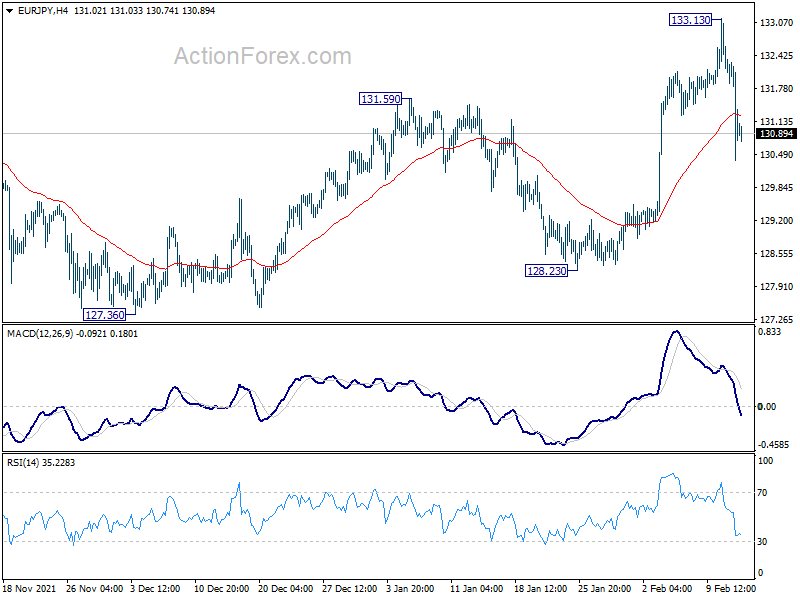
Intraday bias in EUR/JPY remains on the downside at this point. Corrective pattern from 134.11 is extending with another falling leg. Deeper fall would be seen to 128.23 support first. break will target 127.36 support and below. On the upside break of 133.13 will bring retest of 134.11 high.
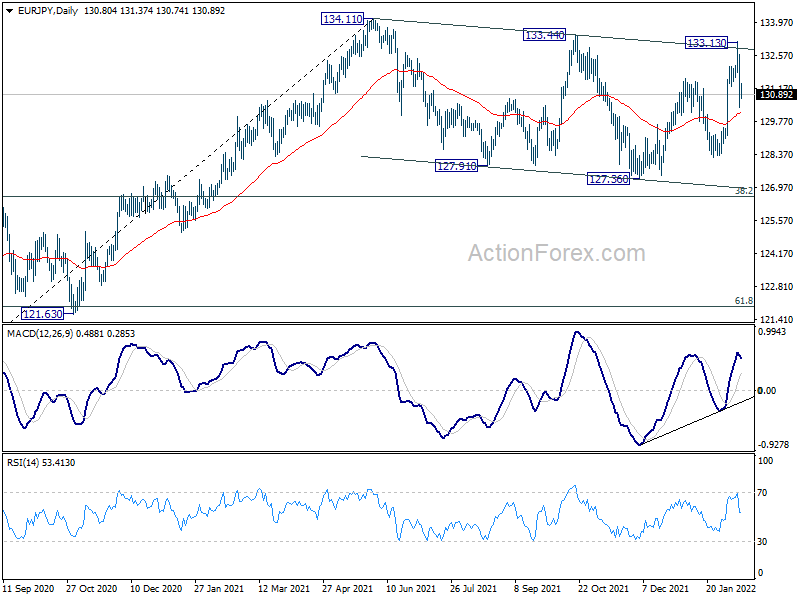
In the bigger picture, price actions from 134.11 are currently seen as a consolidation pattern only. As long as 38.2% retracement of 114.42 (2020 low) to 134.11 at 126.58 holds, up trend from 114.42 is still in favor to continue. Break of 134.11 will target long term resistance at 137.49 (2018 high). However, sustained break of 126.58 will raise the chance of bearish reversal. In this case, deeper decline would be seen to 61.8% retracement at 121.94, and possibly below.
How Does Raising Interest Rates Reduce Inflation?
US Inflation has skyrocketed in January to 7.5%, recording the largest annual increase in 40 years. This jump in prices is the fastest pace of inflation since 1982.
Part of the Fed's job is to prevent inflation from getting out of control — and bring it back every time it rises to the bank's 2% target. To curb current inflation, the Fed plans to increase interest rates several times this year - possibly as many as five times.
Investors are waiting for the Fed to raise rates at its next March meeting. The question now is not whether the Fed will raise rates, but whether it the rate hike is by 50 basis points or 25 basis points.
How does raising interest rates curb inflation?
1. Higher interest rates reduce demand
The Federal Reserve controls the federal funds rate, which is often referred to as the target rate. It is also the rate banks use for providing overnight loans to each other. Banks borrow money to be able to deliver loans to consumers and businesses. Therefore, when the Fed hikes rates, it raises the cost of borrowing for banks that need money to lend to others or meet their regulatory requirements. Of course, banks pass these higher costs on to consumers and businesses. If the Fed raises the interest rate by 25 basis points or 0.25%, consumers and businesses will also have to pay more to borrow money.
As the cost of borrowing increases, demand and economic activity decline. For example, if a car loan becomes more expensive, you as a consumer may decide that now is not the time to buy that new car. Or, perhaps, a company is less likely to invest in a new factory and hire additional workers if the interest it has to pay to get a loan to finance its business increases. That is the cost to pay when the Fed raises rates.
2. Lower demand reduces inflation
Since raising rates lowers demand and puts the brakes on the economy, that's exactly what slows down inflation. Usually, the prices of goods and services rise when the demand for them increases, fuelling inflation. However, as borrowing becomes more expensive, the demand for goods and services decrease throughout the economy.
Prices may not necessarily decrease and return to their old rates after raising rates, but at least their inflationary rate will decrease. The Fed follows this cycle to control inflation. Inflation rises strongly, so the US central bank hikes rates until the demand for goods and services decreases, and thus prices calm down, and so does inflation. Will the Fed succeed this time?
Oil Prices Head Higher Amid Risk of Imminent Ukraine-Russia Conflict
Market movers today
The tense situation between Russia, Ukraine and the West remains a key focus for markets, as German chancellor Olaf Scholz travles to Kyiv today and meets president Putin in Moscow tomorrow.
While there are no economic releases of significance in the euro-area today, ECB President Lagarde is scheduled to speak late in the day.
Given the high inflation pressures in the US, Fed speakers this week will be in focus, starting with Barkin Today. Key focus this week is also US retail sales and minutes of the January Fed meeting on Wednesday.
The 60 second overview
Russia-West stand-off intensifies again: On Friday the US lead the way in warning a conflict is coming to Ukraine advising all non-essential staff to leave the country. This was followed by other western countries over the weekend. It remains quite unclear as to what is geopolitical grandeur and what is reality on both sides of the conflict. In addition, politicians across EU and US have had calls with president Putin - generally without appearance of progress. Following the increasing concerns about an imminent conflict, EUR/RUB went higher together with oil prices and EUR/USD lower. Needless to say, if conflict becomes public and evident, there will be a substantial sell-off in RUB and we think the news flow since Friday does suggest an escalation of the risk premium embedded in RUB.
Growing pressure on Fed to take action: This morning we published a new Fed call in light of the strong inflation print last week together with very hawkish comments from Fed governor James Bullard. We now expect the Fed to deliver 200bp rate hikes this year (versus 125bp previously). We expect the Fed to hike by 50bp in March and 25bp on each of the following six meetings. If so, the Fed funds target range should be 2.00-2.25% by the end of the year. The door is open to an emergency rate hike before the March meeting (like on 18 April 1994), but it is not our base case, as it is very rare. We would not be surprised if the Fed announces it ends QE immediately although it did not happen over the weekend. Fed Update - We expect a total of 200bp rate hikes this year starting with 50bp in March, 14 February.
Equities: Risk-off in Friday markets as investors digested inflation, the new Fed route, weakening consumer spending - topped with increased geopolitical tension. While the latter is usually ignored by the market, the escalation comes at a time when least resistance has shifted. Hence, geopolitics can get more air time than usual in the coming weeks - particularly if the oil price continues to surge. Defensives outperformed cyclicals by roughly 2pp in the US session, while the distinction between value vs growth was less pronounced. All sectors lower, except energy on the booming oil prices. VIX rose just south of 30, while S&P closed down -1.9% and just off the lows in January. Nasdaq -2.8%, Russell 2000 -1% and Dow -1.4%. Asian markets are following the move lower this morning, while US futures have turned positive.
FI: Relative to the price movements early last week, the European session saw more modest price moves on Friday. Bunds ended broadly unchanged on the day at 0.29%, while the rest of EGB space underperformed Germany. Unsurprisingly Italy was the weakest performance with now 166bp spreads to Bunds (10y), although Friday's Italian supply probably did not make the situation better. However, the biggest moves were observed by the US markets, where the 10y UST yield dropped more than 10bp late in the session, on headline of geopolitical concerns and military action possible relatively soon.
FX: The end to last week in FX markets was characterised by rising geopolitical risk (Russia) and speculations of a potential in-between-meetings policy announcement from the Federal Reserve. While oil prices rose on higher geopolitical risk, commodity (and risk) sensitive currencies followed RUB lower with the Russian currency being the clear underperformer among majors. USD/RUB moved back above the 76-figure while EUR/USD has moved below 1.1350. In the Scandies, EUR/NOK is trading at 10.05 while EUR/SEK is trading just below 10.60.
Credit: CDS indices were under severe pressure on Friday where iTraxx Xover widened 12bp and Main 2.3bp. Cash bonds were more stable and HY bonds widened 3bp while IG was unchanged.
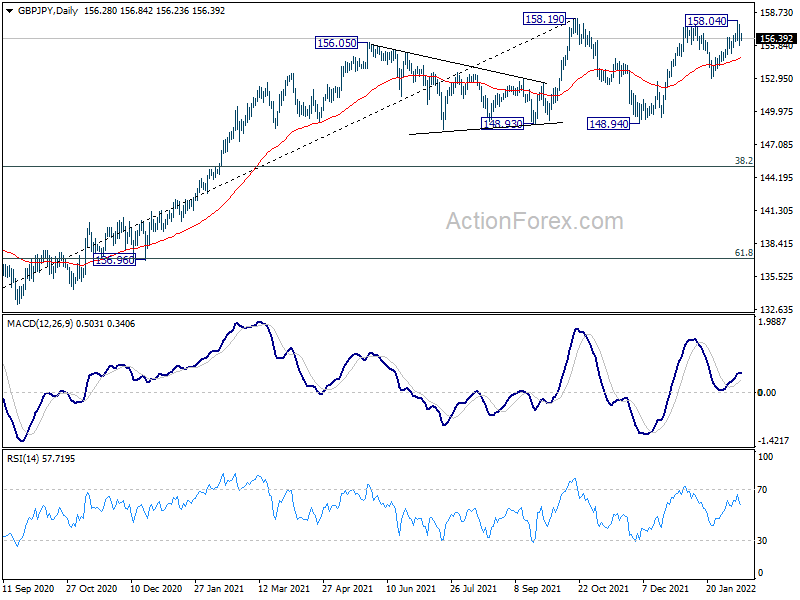
GBP/JPY Daily Outlook
Daily Pivots: (S1) 155.71; (P) 156.71; (R1) 157.55; More...
Intraday bias in GBP/JPY remains neutral for the moment. On the downside, break of 155.11 resistance should confirm rejection by 158.19 resistance. Intraday bias will be turned to the downside for 152.88 support, to extend the corrective pattern from 158.19 with another falling leg. However, on the upside, sustained break of 158.19 will resume larger up trend.
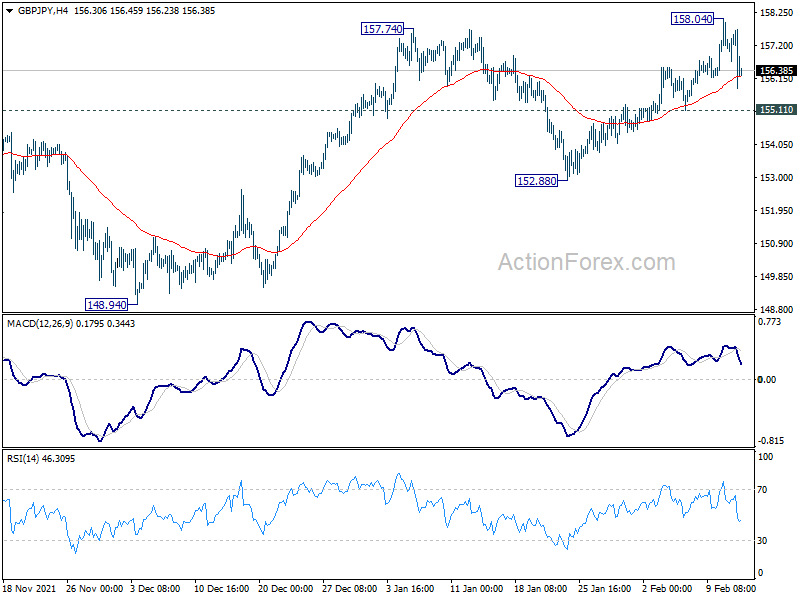
In the bigger picture, price actions from 158.19 are seen as developing into a consolidation pattern to up trend from 123.94 (2020 low). Downside should be contained by 123.94 to 158.19 at 145.10 to bring rebound. Firm break of 158.19 will resume the up trend to long term fibonacci level at 167.93. However, sustained break of 145.10 will raise the chance of trend reversal and target 61.8% retracement at 137.02.
Asian Markets Open on Risk Aversion, Russia-Ukraine Situation Still in Focus
Asian markets open with heavy selling today as worries remain that Russia could invade Ukraine "any day now". New Zealand Dollar is leading Aussie lower on risk aversion. But Canadian Dollar is the stronger one with WTI crude oil staying comfortably at around 94.5. Dollar, and Euro are also slightly stronger. FOMC minutes and comments from Fed officials on the idea of a 50bps March hike would be closely watched. But this should be overwhelmed by news on Russia-Ukraine situations.
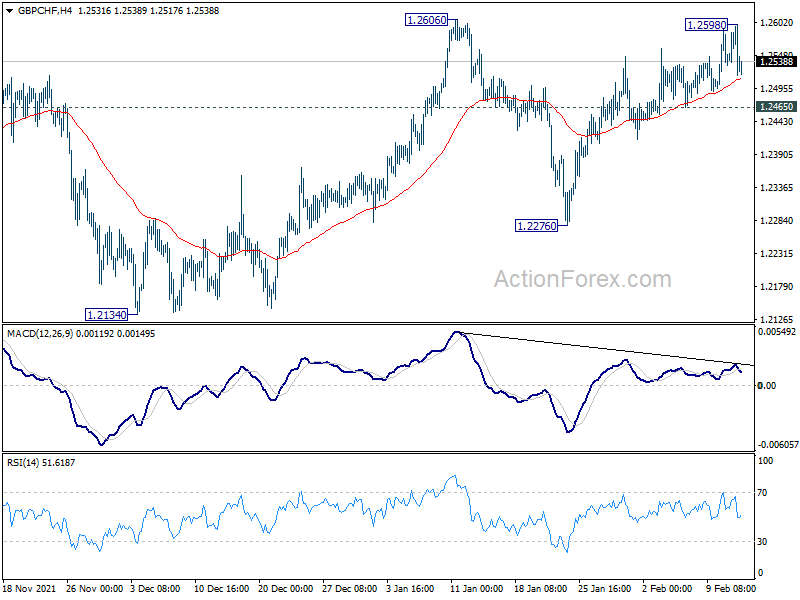
Technically, attention will be on some Swiss Franc pairs to gauge the sentiments in Europe. Break of 1.0439 minor support in EUR/CHF will suggest that rebound form 1.0298 has completed at 1.0610 already and bring deeper fall to retest this low. that would reaffirm medium term bearishness for downtrend resumption later. Also, break of 1.2465 minor support will argue that rebound from 1.2276 has completed at 1.2598, after rejection by 1.2606. Deeper decline would be seen back to 1.2276 support, with prospect of retesting 1.2134 low.
In Asia, at the time of writing, Nikkei is down -2.18%. Hong Kong HSI is down -1.25%. China Shanghai SSE is down -0.63%. Singapore Strait Times is up 0.01%. Japan 10-year JGB yield is down -0.0055 at 0.224.
Fed Daly prefers measured approach after March hike
San Francisco Fed President Mary Daly told CBS on Sunday, "it is obvious that we need to pull some of the accommodation out of the economy". However, "history tells us with Fed policy that abrupt and aggressive action can actually have a destabilizing effect on the very growth and price stability that we're trying to achieve," she warned.
"What I would favor is moving in March and then watching, measuring, being very careful about what we see ahead of us — and then taking the next interest rate increase when it seems the best place to do that. And that could be in the next meeting or it could be a meeting away," Daly said.
ECB Rehn: Better to look beyond short-term inflation
ECB Governing Council member Olli Rehn said on Saturday, "If we reacted strongly to inflation in the short term, we would probably cause economic growth to stop. It's better to look beyond short-term inflation and look at what inflation is in 2023, 2024." He expected inflation to be close to the 2% target in the coming years.
"We will have time to react in the March meeting and in later meetings if it looks like the situation is markedly different than it now appears," Rehn added.
Another Governing Council member Ignazio Visco said, "the monetary policy stance remains expansionary, though the gradual normalization will continue at a pace consistent with the economic recovery and changes in the outlook for prices."
"I do not believe that the overall picture underlying this stance has changed significantly," Visco said. Still, "in the short term, there has been an increase in the risk of consumer prices growing faster than expected and production activity growing more slowly."
New Zealand BNZ services dropped to 45.9, lowest since Oct
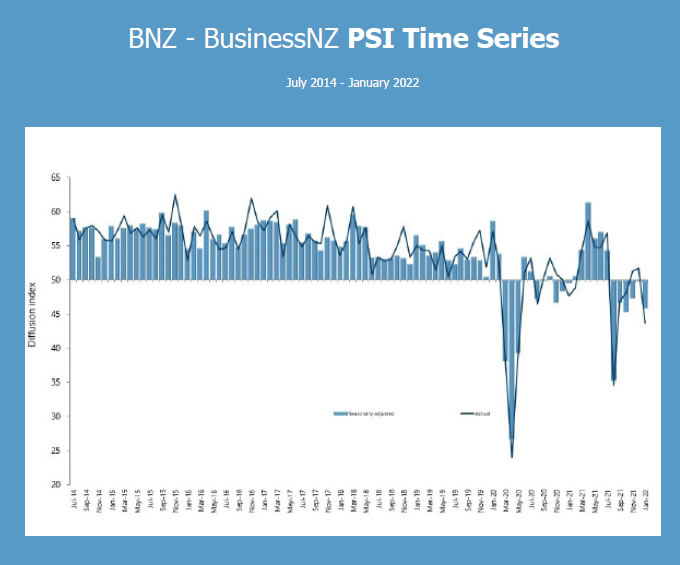
New Zealand BusinssNZ Performance of Services index dropped -3.9 to 45.9 in January. That was the lowest result since October 2021. Looking at some details, activity/sales dropped sharply from 50.7 to 44.1. Employment ticked down from 49.1 to 48.1. New orders/businesses dropped deeply from 52.0 to 41.8. Stocks/inventories dropped from 51.0 to 47.6. Supplier deliveries also tumbled from 49.8 to 43.6.
BNZ Senior Economist Craig Ebert said that "the PSI can jag around quite a lot from month to month – upwards and downwards. However, it's also worth pointing out that the long-term average of the PSI is 53.6, which is starting to feel some distance away. So much for the new traffic light system releasing the brakes on activity."
A week with FOMC minutes and inflation data from UK, Canada and Japan
FOMC minutes are a major focus of the week. Currently, markets are heading towards fully pricing in a 50bps rate hike in March. The minutes might reveal any discussion for a more aggressive tightening cycle. Of course, comments from Fed officials on this topic will be closely watched too. US PPI and retail sales will also catch some attention.
A wave of data will be release from the UK, including employment CPI and PPI, retail sales. CPI data will be the focus. Eurozone GDP and Germany ZEW economic sentiment; Canada CPI and retail sales; Japan GDP and CPI; RBA minutes and Australia employment and New Zealand PPI will also be watched.
Here are some highlights for the week:
- Monday: Swiss PPI.
- Tuesday: Japan GDP, industrial production final; RBA minutes; UK employment; Germany ZEW economic sentiment; Eurozone GDP, employment change, trade balance; US PPI, Empire state manufacturing; Canada housing starts.
- Wednesday: China CPI, PPI; Japan tertiary industry activity index; UK CPI, PPI; Eurozone industrial production; Canada CPI, manufacturing sales, whole sales sales; US retail sales, import prices, industrial production, business inventories, NAHB housing market index, FOMC minutes.
- Thursday: Japan trade balance, machine orders; Australia employment; Swiss trade balance; ECB monthly bulletin; Canada foreign securities purchases; US Philly Fed survey, jobless claims, housing starts and building permits.
- Friday: New Zealand PPI, Japan CPI; UK retail sales; Eurozone current account; Canada retail sales, new housing price index; US existing home sales.
GBP/JPY Daily Outlook
Daily Pivots: (S1) 155.71; (P) 156.71; (R1) 157.55; More...
Intraday bias in GBP/JPY remains neutral for the moment. On the downside, break of 155.11 resistance should confirm rejection by 158.19 resistance. Intraday bias will be turned to the downside for 152.88 support, to extend the corrective pattern from 158.19 with another falling leg. However, on the upside, sustained break of 158.19 will resume larger up trend.
In the bigger picture, price actions from 158.19 are seen as developing into a consolidation pattern to up trend from 123.94 (2020 low). Downside should be contained by 123.94 to 158.19 at 145.10 to bring rebound. Firm break of 158.19 will resume the up trend to long term fibonacci level at 167.93. However, sustained break of 145.10 will raise the chance of trend reversal and target 61.8% retracement at 137.02.
Economic Indicators Update
| GMT | Ccy | Events | Actual | Forecast | Previous | Revised |
|---|---|---|---|---|---|---|
| 07:30 | CHF | Producer and Import Prices M/M Jan | 0.10% | -0.10% | ||
| 07:30 | CHF | Producer and Import Prices Y/Y Jan | 5.60% | 5.10% |
New Zealand BNZ services dropped to 45.9, lowest since Oct
New Zealand BusinssNZ Performance of Services index dropped -3.9 to 45.9 in January. That was the lowest result since October 2021. Looking at some details, activity/sales dropped sharply from 50.7 to 44.1. Employment ticked down from 49.1 to 48.1. New orders/businesses dropped deeply from 52.0 to 41.8. Stocks/inventories dropped from 51.0 to 47.6. Supplier deliveries also tumbled from 49.8 to 43.6.
BNZ Senior Economist Craig Ebert said that "the PSI can jag around quite a lot from month to month – upwards and downwards. However, it's also worth pointing out that the long-term average of the PSI is 53.6, which is starting to feel some distance away. So much for the new traffic light system releasing the brakes on activity."