Sample Category Title
The Weekly Bottom Line: All Eyes on the Price
U.S. Highlights
- U.S. prices continued to heat up in January as headline inflation accelerated to 7.5% year-on-year from 7.0% in December. Excluding food and energy, core prices also rose notably over the year to 6.0% with broad-based increases across index components.
- High inflation has firmed market expectations for aggressive tightening of monetary policy as the Fed is set to meet in mid-March. Financial markets responded with bonds yields generally heading higher, while equities retreated.
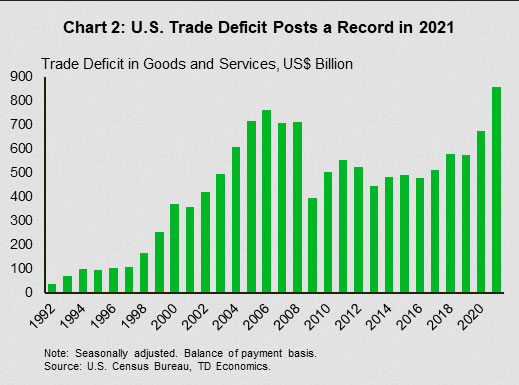
- For 2021, the U.S. posted a record trade deficit of $859 billion as imports surged.
Canadian Highlights
- Census data released this week showed strong population growth in Canada from 2016 to 2021, laying the foundation for solid long-term economic prospects.
- The rate hiking cycle is just around the corner as Governor Macklem highlighted that “a significant shift in monetary policy” is going to be needed to bring inflation to its 2% target.
- Several provinces laid out plans for a roll-back of public health restrictions, offering optimism for economic growth in the spring.
U.S. - All Eyes on the Price
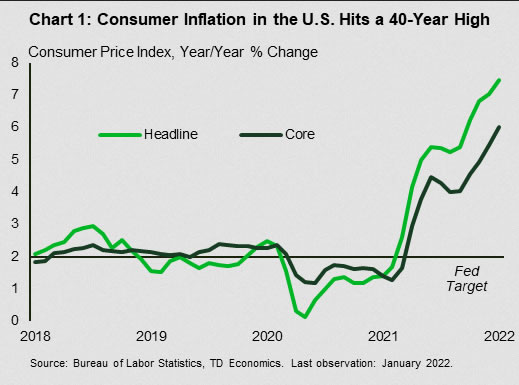
It was all about inflation this week, as the January CPI surpassed expectations and markets recalibrated their expectations for rate hikes. Headline inflation accelerated 0.5 percentage points to 7.5% year-on-year (y/y) in January, reaching the highest level in 40 years (Chart 1). Strong consumer demand coupled with pandemic-related supply constraints resulted in the strong price gains. Core prices were also up significantly relative to year ago levels at 6.0% (up from 5.5% in December). Price increases were relatively broad based across the index, with categories such as used motor vehicles (up 40.5%) and gasoline (up 40%) recording some of the largest gains versus a year ago.
Inflation is increasingly a top concern for small businesses. A survey of independent businesses showed that 22% of owners viewed inflation as their single most important problem in January. This matched the highest level previously recorded in 1981. High input prices coupled with rising labor costs are cutting into small firms’ profits. In response, 61% of firms reported having already raised prices. However, fewer firms (a net 47%) are planning to do so in the next three months, suggesting that firms may be nearing their limit for passing on cost increases to consumers.
Financial markets also responded to the inflation report as equities fell and yields on the 10-Year Treasury touched 2% for the first time since 2019. These movements occurred on the expectation that persistent high inflation will result in tighter Fed policy. The market-implied probability of at least a 50-basis point rate hike at the Fed’s March meeting shifted to over 50% after the report, from 24% the day before, suggesting expectations of more aggressive tightening.
In other data, the U.S. trade deficit widened from $79.3 billion in November to $80.7 billion in December. The nation hit a record trade deficit of $859.1 billion for the full calendar year – a 27% increase over 2020 and blowing past the previous record of $763.5 billion in 2006 (Chart 2). For the year, imports were up 20.5% while exports grew by 18.5%. The notable rise in the trade deficit, highlights the strength of the U.S. economy as it rebounded from the pandemic. Consumers, supported by generous fiscal policy, shifted their spending patterns more towards goods over services during the pandemic, and consumer goods are heavily imported.
As the pandemic enters its third year, governments and citizens are more and more learning to just live with it. Many states, including California, Oregon, New Jersey, Connecticut, Delaware, New York, Illinois, Massachusetts and Rhode Island, have announced that rules requiring masks and/or proof of vaccinations will end by March. Local governments and school boards, however, have the discretion to maintain their own requirements.
These announcements are a step towards returning to normal, even as recently introduced cross-border vaccine mandates for truck drivers have sparked protests resulting in blockage of the busiest land border crossing between the U.S. and Canada. The slowdown at the Ambassador bridge crossing caused several car manufacturers to halt or slow production due to delays in delivery schedules. As the border re-opens and normal flow of traffic resumes, these disruptions are expected to dissipate.
Canada - Reopening Plans Come Into Focus
This week saw bond yields rise, prompted by the impending rate hiking cycle and an upside surprise on U.S. consumer price inflation. Equities managed to hold on to their gains on optimism that demand will bounce back as public health restrictions are rolled back.
First, in a bit of good news for long-term economic prospects, initial estimates for Canada's 2021 Census were released this week showing Canada's population grew by 5.2% between 2016 and 2021 (1% annually) – a rate that puts it at the top of the G-7 pack. As immigration was the main driver of population growth, most of these gains occurred between 2016 and 2019, before the pandemic led to border closures and a reduction in international arrivals. Indeed, major population centers relying heavily on new immigrant arrivals saw population growth nosedive when the pandemic closed international travel. For instance, the Toronto Census Metropolitan Area saw population growth slow from 1.4% in 2019/2020 to an estimated 0.2% in 2020/2021. Not surprisingly, amid public health restrictions, Statistics Canada noted Toronto and Montreal posted record population outflows to surrounding areas in 2020/2021.
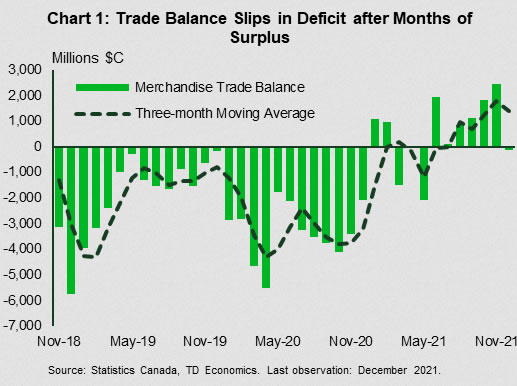
On the trade front, Tuesday's release of international trade statistics showed Canada's trade balanced dipped back into a deficit position in December (Chart 1). Electronic and electrical equipment and parts (+16.2%) and motor vehicles and parts (+5.1%) lifted imports for the month, in part due to restocking after difficulties in acquiring supplies earlier in the year. Nominal exports meanwhile, were dragged lower by a steep decline in energy products, as prices fell.
Yet, maybe the most important pieces of information this week came from provincial leaders who began announcing plans to roll back public health restrictions. As of Wednesday, Alberta ended its vaccine mandates and Saskatchewan is set to follow on February 14th. Prince Edward Island set February 17th as the start date of its easing, while Quebec will increase seating limits at restaurants this weekend. These moves signal the start of the economic reopening that should help lift consumer activity. As the services sector reopens, spending will continue to reorient away from goods, relieving some of the pressures on supply chains that have lifted inflation.
Indeed, these were the dynamics Bank of Canada (BoC) Governor Macklem addressed during his speech to the Canadian Chamber of Commerce on Wednesday. The BoC sees easing supply chain constraints helping to bring inflation to "about 3% by the end of the year". However, the BoC's target inflation rate is 2%, and to get price growth the rest of the way there, interest rates will be moving higher. As Governor Macklem noted, "a significant shift in monetary policy" is on the way.
All Eyes on Canadian Inflation Rate as U.S. Prices Soar
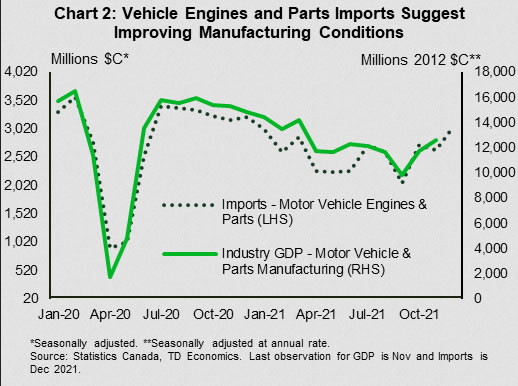
Canada’s January inflation report will be the headline event next week after another acceleration in the U.S. numbers. The Canadian CPI year-over-year growth rate is expected to have ticked down to 4.7% in January, little changed from December. Gasoline and home buying costs combined are expected to once again account for just under half of the headline price gain—as they did in December. Price growth is still being biased higher by so-called ‘base effects,’ or comparisons with a year ago when prices were lower and the pandemic economic impact was more severe. But price pressures have been broadening out into more goods as well. By our count, close to 60% of the consumer price basket has been running at more than 2% per year versus pre-pandemic levels.
Travel spending has deteriorated substantially since December and the employment count dropped sharply in January. But household purchasing power will have held up much better thanks to government support programs. Early indicators are pointing to a quick rebound in spending with containment measures easing into February. A resurgence in employment, strong household demand, and higher oil prices are expected to keep a floor under inflation growth in the near term, even as pandemic base effects ease. Given ongoing inflation pressure and the expectation that Omicron will ultimately have a temporary impact on labour markets, there is little reason for the Bank of Canada to delay rate hikes further. We expect a 25 basis point increase in March and could see a follow-up hike as soon as April.
Week ahead data watch:
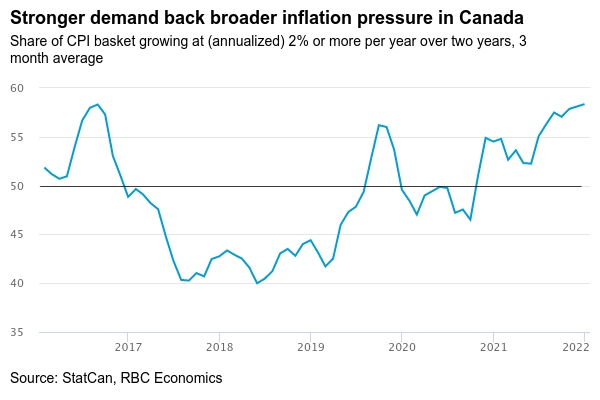
- The home resale market remained exceptionally tight in January with early regional reports pointing to strong resales limited only by lack of listings and price pressures remaining exceptionally firm.
- The flash estimate of December manufacturing sales was 0.8%. Plastic and rubber product shipments, reportedly, rose sharply while an easing of supply chain pressures allowed another increase in motor vehicle production. Petroleum and coal sales likely declined on lower prices with oil prices dipping in December on early Omicron worries.
- Retail sales fell 2.1% in December according to preliminary Statistics Canada data, broadly in line with our own tracking of credit card transactions in the month. More attention will be paid to the January preliminary estimate, where we expect another 1% dip with weakness earlier in the month.
Week Ahead: 14 February 2022
It has been one hell of a week in the markets, and a Super Thursday for volatility. Consumer inflation once again exceeded expectations in the US, rising to its highest level since 1982 at 7.5 per cent. This caused at least one Fed official to panic and investors ramped up their rate hike bets. The result? Yields spiked and expensive technology stocks led a slump on Wall Street. But at the time of writing on Friday morning, dip buying saw the major US indices rebound. It remains to be seen whether the bulls will be able to defend their ground, however, given Thursday’s events.
How high will yields go?
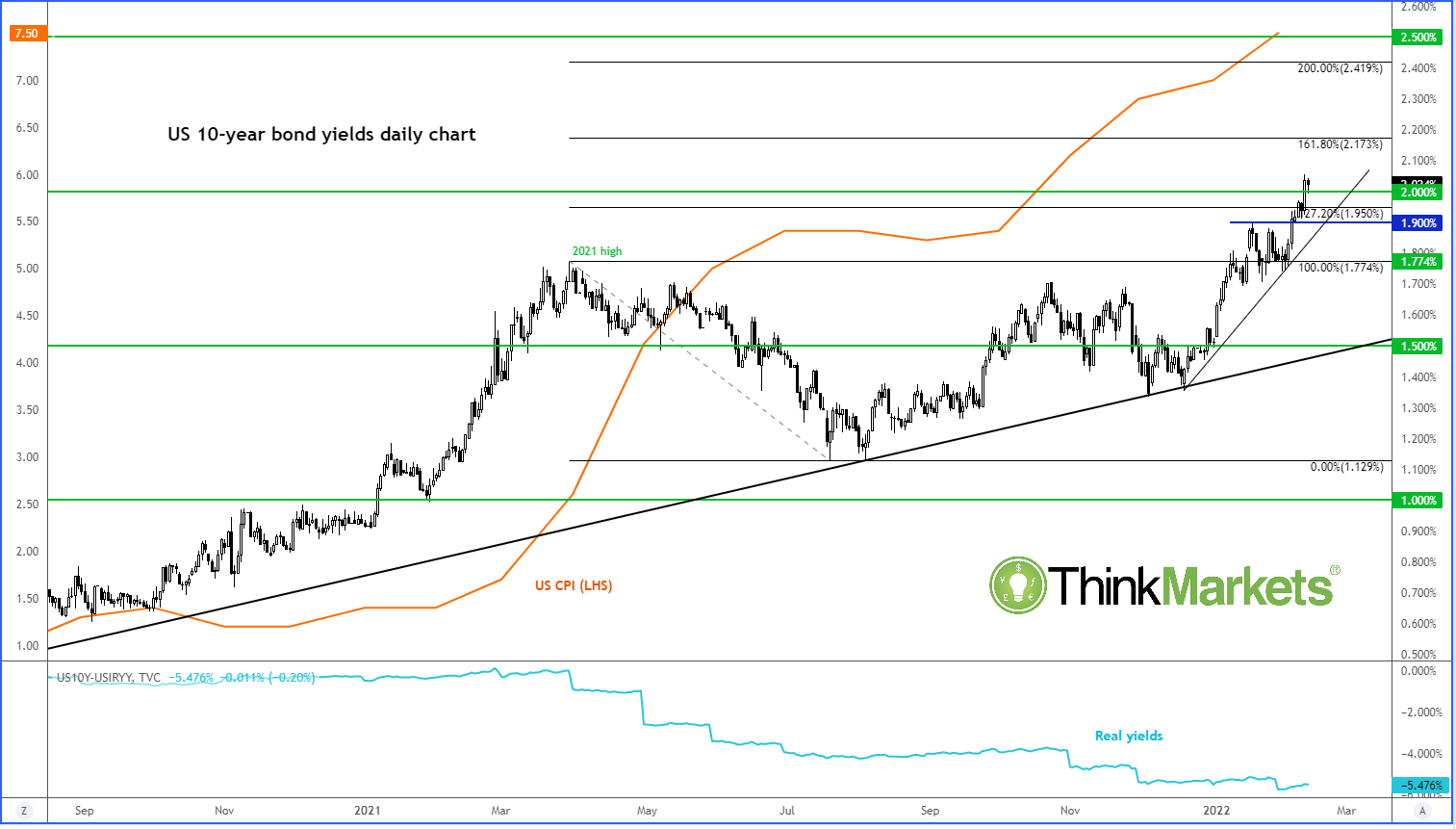
At just over 2.0%, the 10-year yield is way lower than the 7.5% inflation rate. This means that real yields are actually -5.5%. This is bizarre, to say the least. The Fed’s QE programmes and strong foreign demand for US debt are the main reasons for this mis-match. The question is, why aren’t yields higher? Is it because the market is expecting nominal inflation rates to fall back, and quickly? Perhaps. Even if inflation falls back to around 3%, real yields would still be negative. Therefore, it is reasonable to expect yields to catch up with inflation. I reckon we will be heading towards 3.00% on the 10-year in the coming weeks, the speed of which will depend on incoming data and whether more Fed officials will turn as hawkish as Bullard. This should keep tech stocks under pressure, but support financials.
How many rate hikes?
The strong CPI print was a game changer on Thursday. The market is now eyeing about 7 rate increases of 25 basis points apiece, starting from March. There is a good chance, however, that we will see a 50 basis point hike in March, judging by the rates futures and Bullard’s comments. If the Fed becomes concerned about the economy falling into a wage-price spiral, then it is even possible we could see more hikes. But it all depends on incoming data.
Key economic highlights
In the week ahead, there won’t be an awful lot in the way of US macro pointers or Fed speeches, although we will still have PPI and FOMC meeting minutes to look forward to. The key question is what will happen to yields, which will, of course, have repercussions for other financial markets, not least US tech stocks. It is possible that if we see a stronger-than-expected PPI print that this will lead to further strength for yields.
Here are the week’s data highlights:
Monday
- Japan GDP q/q
- UK average earnings and jobless claims
- Eurozone quarterly GDP and employment change estimates; German ZEW Economic Sentiment
- US PPI and Empire State Manufacturing Index
- CPI estimates from China, UK and Canada
- US retail sales, industrial productions and FOMC meeting minutes
- Australian employment data
- FedSpeak: FOMC members Bullard and Mester
- Retail sales data from UK and Canada
- FedSpeak: FOMC members Waller and Williams
Chart to Watch: 10-year bond yields
Source: ThinkMarkets and TradingView.com
Clearly, all the focus will be on the 10-year yields after breaking through the 2.00% barrier. How high will it go and how fast will have ramifications for the rest of the financial markets.
Week Ahead – Inflation Woes Continue
How will central banks respond?
Inflation and interest rates have been at the forefront of investors’ minds so far this year and that’s unlikely to change for some time yet. Earnings season provided a welcome and timely distraction and enabled markets to find some stability but as we saw towards the end of last week, inflation continues to dominate.
While many expect inflation to peak over the next couple of months, for various reasons, and then fall quite quickly, there’s not an enormous amount of confidence that everything will go according to plan. And there’s plenty of evidence over the last few months of inflation catching central banks and the rest of us by surprise.
Next week offers plenty of economic data from around the globe and unsurprisingly, it’s the inflation indicators that will attract the most attention. As will the commentary from the various policymakers that are scheduled to speak, with some slowly accepting that a big policy response is necessary and others continuing to push back against market expectations with little success. Whatever happens, it promises to be another fascinating week.
US
With Wall Street completely fixated on inflation, the upcoming round of economic data should confirm that peak of inflation is nearing and that the US consumer is still strong. Tuesday’s release of producer price data should show that suppliers are still charging businesses higher prices while the Empire manufacturing survey is expected to return back to positive territory. On Wednesday, retail sales should bounce back as December’s slump was driven by the omicron hit to demand and supply disruptions. Also in the middle of the week, Industrial production is expected to rebound. Thursday is a busy day that includes initial jobless claims, Philly Fed business outlook, housing starts, and building permits.
Fed speak will include speeches from James Bullard and Loretta Mester on Thursday. Fed’s Evans and Waller will participate in a panel that discusses the Fed’s new policy strategy.
EU
A relatively quiet week on the economic side of things, with the bulk of next week’s notable data coming on Tuesday. GDP and employment data for the euro area will be notable but no game-changer, the same can be said for the ZEW surveys although they will contain some hint over how the economy is expected to perform amid higher levels of inflation. Once again, it’s the ECB speak that will be the highlight but we can probably expect more pushback against market expectations ahead of next month’s meeting when we will likely see a significant policy shift.
Olaf Scholz is scheduled to travel to Russia to meet Vladimir Putin on Tuesday in an attempt to ease tensions between NATO and Russia over Ukraine.
UK
Next week is when we get the UK data dump and, unsurprisingly, all of the focus will be on the CPI data and just how bad the situation has got. We don’t seem to get too many positive surprises at the moment and markets are already pricing in another four or five hikes this year, including another two consecutive increases in March and May. The BoE appears on board with the latter but has indicated market expectations over the year are excessive. Perhaps next week will change their mind.
Boris Johnson continues to hang in there as we await the outcome of the police inquiry into numerous lockdown parties.
Russia
The CBR raised interest rates by 100 basis points on Friday to 9.5%, in line with expectations. It did leave the door open to more increases though, despite the belief that inflation will return to target and peak soon.
Next week’s highlight will be the meeting between Putin and Scholz, with PPI data being of some interest.
South Africa
CPI data will be key next week as it currently sits right at the upper end of its target range and the SARB has raised rates at the last two meetings while signalling more could follow.
Turkey
The first test of the year for the CBRT is next week as it meets to decide whether to keep cutting interest rates or not. Inflation has hit 48.7% if the official data is to be believed after the head of the agency was sacked. We could see a more restrained central bank over the next year as Erdogan will not want to go into an election next year with sky-high inflation, which may explain the relentless cutting exercise last year. Whether or not that gamble pays off is another thing but we should learn more next week.
China
China releases CPI for January on Wednesday. Inflation is expected to slow to 1.0%, down from 1.5% in December. A decline in food prices likely offsets the rise in energy and gasoline prices.
India
On Monday, India releases CPI for January. Inflation came in at 5.6% in December and is expected to rise to 6%, which is the upper end of the central bank’s target of 2%-6%. The expected upswing in inflation is a result of higher food and telecom prices as well as supply chain issues.
India, the world’s largest democracy, will hold elections in five states, including Goa and Uttarakhand. Some 180 million people are eligible to vote, and the results could determine the political future of Prime Minister Narendra Modi and his Bharatiya Janata Party (BJP).
Australia
Australia releases the January employment report on Thursday. Job growth sparkled in December (64,800), but is expected to have ground to halt in January, with a consensus of a negligible 2,500 new jobs. This is a result of the Omicron outbreak in January, which significantly dampened job growth.
The unemployment rate is projected to have inched lower to 4.1%, down from 4.2% in December.
New Zealand
Mostly tier two and three data being released over the course of the next week.
Japan
Japan releases fourth-quarter GDP on Monday. The economy is expected to have rebounded in Q4 as the government lifted health restrictions due to the Omicron wave at the end of September. The consensus for GDP Q4 stands at 6.0% y/y, after a contraction of 3.6% in Q3.
On Friday, Japan releases National CPI for January. Core CPI is expected to have posted a small gain of 0.3%, down from 0.5% in December. The drop in inflation can be attributed to the renewal of health restrictions across most of Japan, which put a dent in consumer spending.
Economic Calendar
Saturday, Feb. 12
- US Secretary of State Blinken speaks to Japanese and South Korean officials about North Korea’s nuclear and missile programs
- ASSIOM FOREX annual congress of financial market operators continues, with a speech by Bank of Italy Governor Visco
Sunday, Feb. 13
- Informal meeting of EU trade ministers in Marseille, France
Monday, Feb. 14
Economic Data/Events
- Australia RBA Minutes
- ECB President Lagarde participates in European Parliament debate on ECB’s 2020 Annual Report
- Assembly elections for India’s Uttarakhand, Goa to take place
- Germany’s Scholz travels to Ukraine for talks with President Zelensky
- Informal meeting of EU ministers in Bordeaux, France
- Czech CPI
- India CPI
- India wholesale prices
- New Zealand food prices
Tuesday, Feb. 15
Economic Data/Events
- US cross-border investment, PPI, empire manufacturing
- Germany’s Scholz travels to Moscow for talks with President Putin.
- Germany ZEW survey expectations
- Eurozone GDP
- Japan GDP
- Hungary GDP
- Poland GDP, CPI
- India Trade
- Norway Trade
- Canada housing starts, existing home sales
- Japan industrial production
- Mexico international reserves
- New Zealand home sales
- Philippines overseas remittances
- UK jobless claims, unemployment
- Turkey central government budget balance
- Denmark PPI, GDP indicator
- Norway consumer confidence
Wednesday, Feb. 16
- NATO defense ministers meet in Brussels. Through Feb. 17
- North Korea celebrates its Day of the Shining Star holiday to mark what would have been the 80th birthday of former leader Kim Jong Il, with satellite imagery pointing to a possible military parade to mark the occasion.
Economic Data/Events
- Fed Minutes
- US Retail Sales, business inventories, industrial production
- Canada CPI
- South Africa CPI
- Russia CPI
- Norway GDP
- South Africa Retail Sales
- China CPI, PPI
- Eurozone industrial production
- Japan tertiary index
- UK House prices, PPI, CPI
- EIA Crude Oil Inventory Report
Thursday, Feb. 17
- G20 finance ministers and central bank governors meet
- Fed’s Mester speaks at an event at the NYU Stern School of Business
- Fed’s Bullard speaks at SGH Macro Advisors and Columbia University fireside chat
- EU-African Union Summit in Brussels
- ECB publishes its economic bulletin
- ECB Chief Economist Philip Lane joins an MNI webcast
- Norway’s Norges Bank governor’s annual address
Economic Data/Events
- US housing starts, initial jobless claims
- G20 finance ministers and central bank governors meet
- Fed’s Mester speaks at an event of the NYU Stern School of Business
- Fed’s Bullard speaks at SGH Macro Advisors and Columbia University fireside chat
- EU-African Union Summit in Brussels
- ECB publishes its economic bulletin
- ECB Chief Economist Lane joins an MNI webcast
- Norway’s Norges Bank governor’s annual address
- Italy Trade
- Japan Trade
- Singapore Trade
- Turkey Rate decision
- Australia unemployment
- Eurozone new car registrations
- Singapore GDP
- Russia gold and forex reserves
Friday, Feb. 18
Economic Data/Events
- ECB’s Panetta and the Fed’s Evans; Waller and Brainard to speak at the US Monetary Policy Forum.
- US existing home sales, US Conference Board leading index
- UK retail sales
- Japan CPI
- France CPI
- Sweden CPI
- Russia GDP, money supply
- Canada retail sales
- Eurozone consumer confidence
- Turkey consumer confidence
- France unemployment
- Turkey home sales
Sovereign Rating Updates
- Denmark (Fitch)
- France (Fitch)
- Poland (Fitch)
- France (S&P)
Will the Battered Yen Cheer on Positive GDP Data?
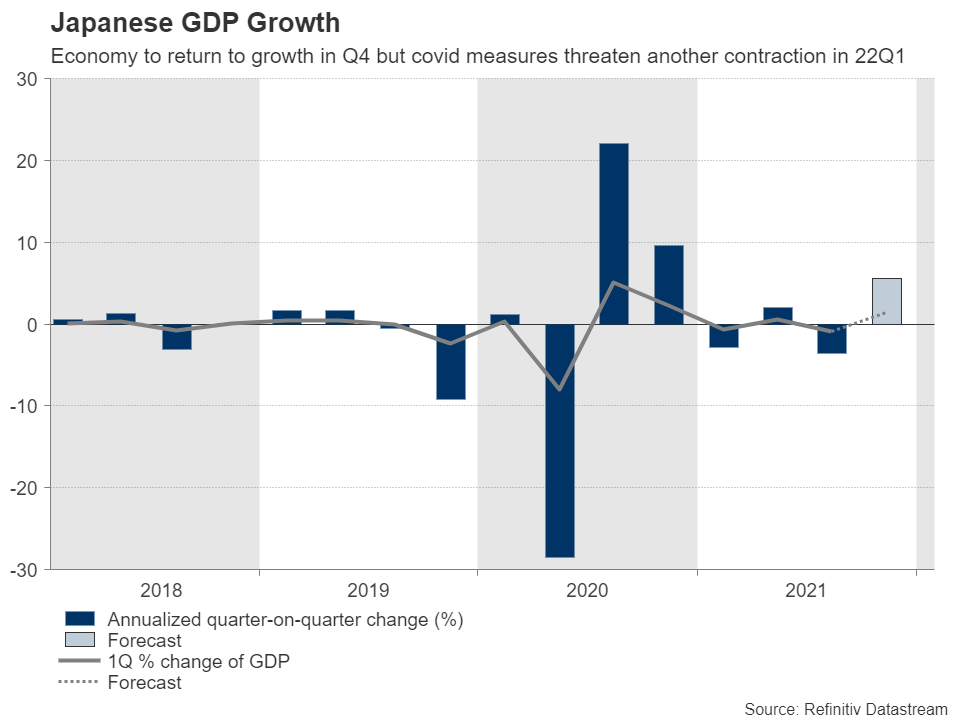
After a negative quarter, Japan’s economy probably returned to the expansion area in the last three months of 2021, GDP data is expected to show on Monday at 23:50 GMT. While the news could put smiles on policymakers’ faces, the relief may only be temporary as the latest record pickup in covid infections has brought a gloomy start to the year. Besides, with the Bank of Japan (BoJ) being determined to stay out of the tightening camp, the stats could barely provide any meaningful boost to the yen.
Japan to post positive growth in Q4, but will it last?
The industrialized export-reliant Japanese economy dived back into contraction at a much faster annualized rate of 3.6% y/y than analysts thought during the third quarter as a resurgence in covid infections weighed on consumption and supply bottlenecks pressured auto production and cut business spending.
The national output shrinkage contrasted the demand-led expansion in other advanced economies such as the US, though with the pandemic taking another halt during the last three months of the year, the upcoming Q4 GDP growth readings could be more promising. Particularly, forecasts point to a quarterly growth of 1.4% versus -0.9% previously and to a quick annualized rebound of 5.8%, with private consumption and capital expenditure likely contributing positively this time.
How will the yen react to GDP data?
If analysts are right, the economy will register its largest growth in a year. But would the news be good enough to boost the battered safe-haven yen?
Probably not. The pandemic roared harder than ever in January, elevating daily infections to fresh record levels and way higher than those in previous cycles. As a result, the government reintroduced quasi-emergency measures, which limited business working hours and reduced traffic in streets, to protect its health system. Yet after a month, it is still reluctant to scale back its restrictions as the battle is far from being over and the third round of vaccines has gained little popularity among residents. Hence, although other advanced economies are hoping for a pleasant start to 2022, Japan may lag a bit before catching up, likely leaving the yen in the doldrums for now.
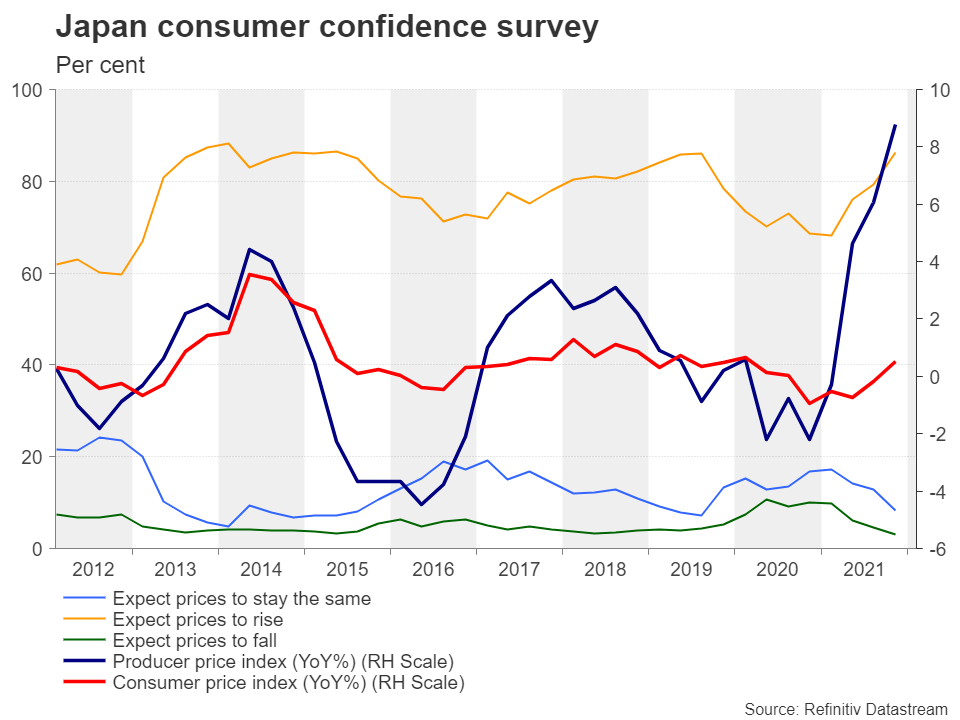
What is more striking is although inflation is getting toxic in several countries, adding pressure on global central banks to tighten monetary policy at a faster pace, price growth in Japan is still below the central bank’s target. Of course, heating global commodity prices have driven Japanese producer prices to the highest in four decades, but companies can still afford them without transferring the extra costs to consumers, preserving the CPI inflation index comfortably below 2.0%. Technically, that defends the BoJ’s super accommodative policy settings. But the job is getting difficult when policy divergence with the rest of the world is widening, challenging its yield curve control mandate.
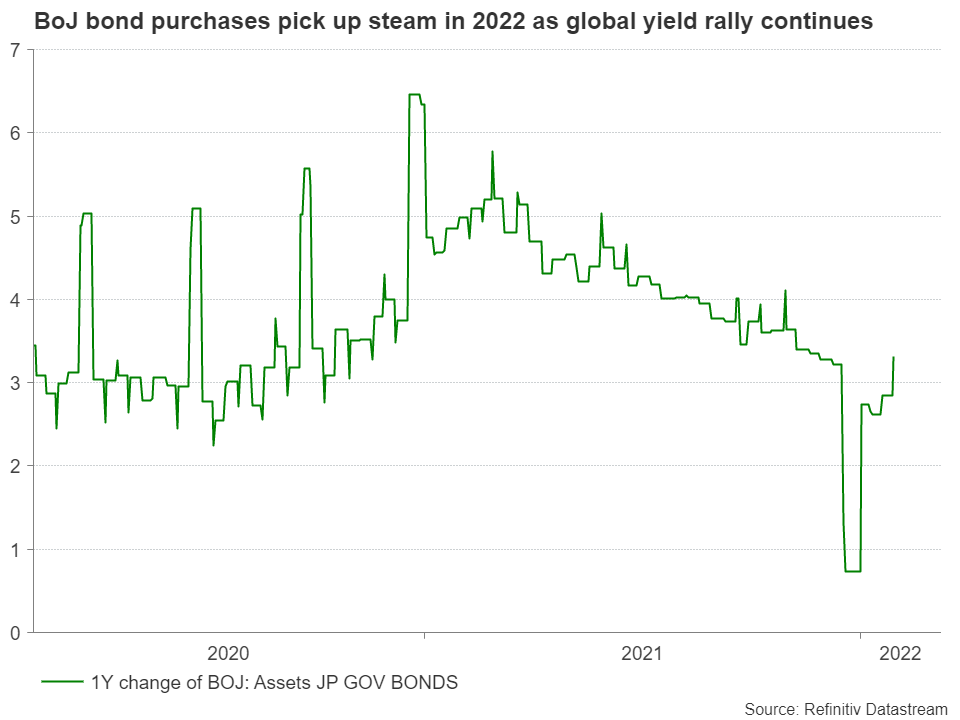
The rally in global bond yields boosted Japan’s 10-year yield to a notch below the 0.25% upper limit this week, forcing the central bank to engage in an unlimited bond buying action. The longer the yields are pressuring the 0.25% top band, the larger the amount of bonds the central bank needs to buy to achieve its yield curve control target. That said, the BoJ does not look to be sweating yet, with the BoJ chief Kuroda insisting yesterday that there is no chance of debating exiting the current ultra-easy policy, at least until his five-year term expires in April 2023. Therefore, markets will probably have to wait after that deadline to see any shifts in policy.
USD/JPY levels to watch
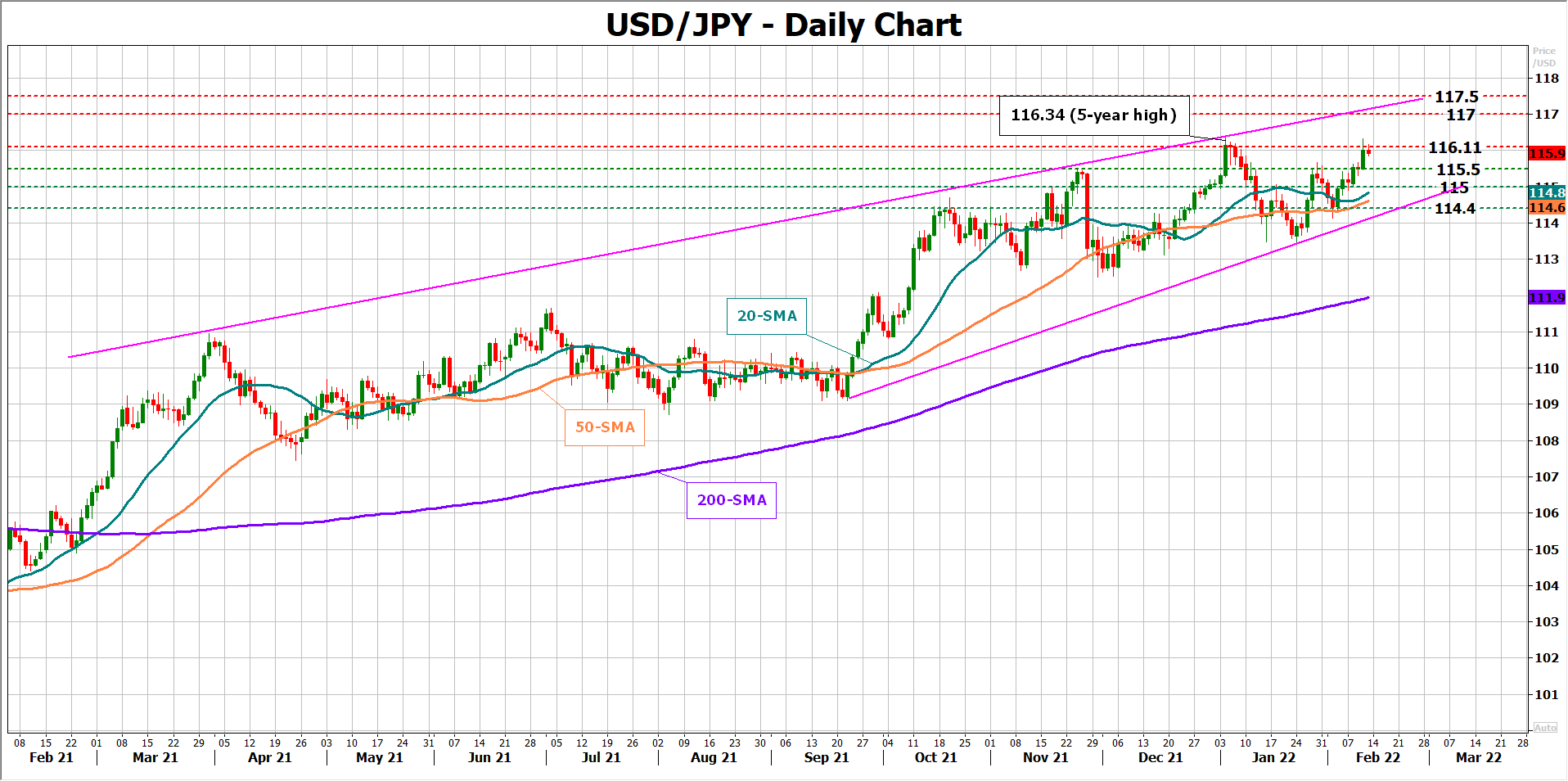
Hence, unless the bitter inflation pressures make the BoJ suddenly change its mind, the yen may remain subdued. It has significantly melted since the start of 2021, currently being around 12% down against the US dollar as traders remain steadily bearish on the currency for almost a year now according to CFTC speculative positions. Perhaps, a weaker currency makes Japanese exports more competitive overseas, though with production costs and import prices spiralling, businesses may have a tough time if their margins continue to narrow.
From a technical perspective, the sell-off in the yen could intensify if the US dollar closes above the 116.11 ceiling, though only a sharp negative surprise in the GDP data could trigger such a move, potentially pushing the price into the 117.00 – 117.50 region.
Alternatively, stronger-than-expected GDP growth figures may not excite traders. Nevertheless, if the bulls fail to claim the 116.00 level, the price may decelerate towards the 115.50 – 115.00 zone, while slightly lower, it may test the tentative ascending trendline drawn from the 109.10 low currently seen around 114.40.
Week Ahead – Dollar Defies Hot Inflation, Turns to Fed Minutes
Another scorching hot US inflation print has sent bond markets scrambling to price in aggressive Fed rate increases, but the dollar is trading like inflation has already peaked. Is this a turning point for the FX market? Next week’s Fed minutes and US retail sales could reveal whether the playbook has truly changed.
Dollar not impressed
Will the Fed pull the handbrake? That’s what the market is betting on after the latest acceleration in inflation. Six and a half rate increases are now priced in for the year, the probability of a ‘double’ hike in March has gone through the roof, and there is all kinds of speculation about an emergency Fed meeting being called this month already.
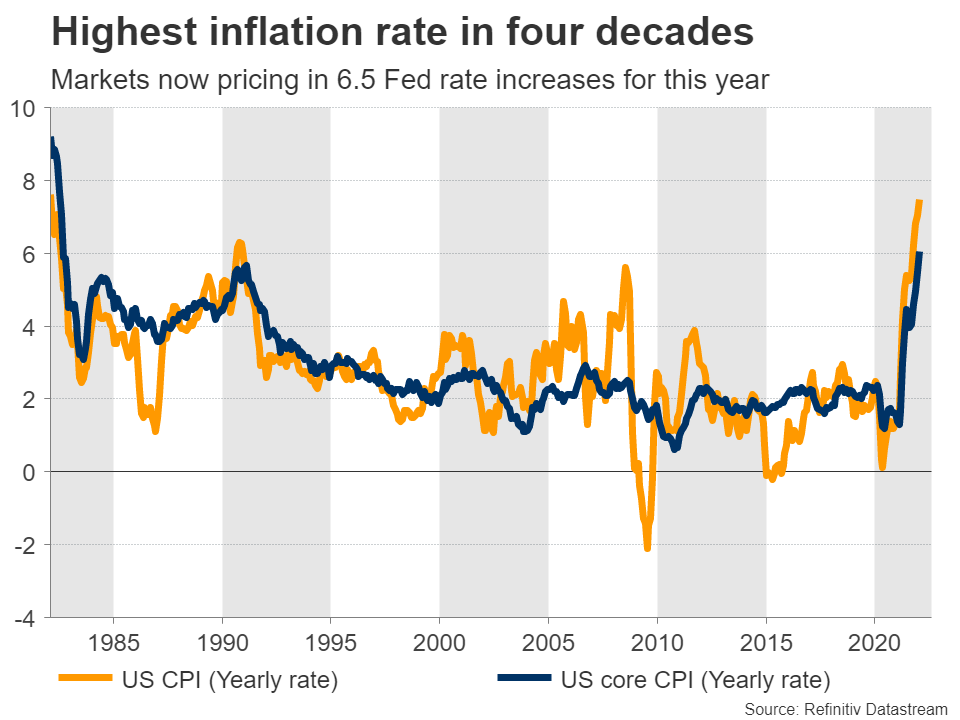
Bond markets are essentially saying the Fed has lost control and needs to take a sledgehammer to inflation. Yet despite the fireworks in yields, the FX market didn’t really play along. The dollar moved higher eventually, but it was a very delayed reaction and not particularly impressive considering that the market priced in one extra rate hike in a few hours.
There are several ways to interpret this lethargic move. For instance, many big players may have been positioned for a hot print or sensed that the resulting shock-and-awe rate increases to stomp out inflation could ultimately backfire and trigger a recession.
The reason is not so important. What matters is the price action. There has been a consistent pattern in recent weeks where the dollar cannot capitalize on ‘good’ news even as Fed bets mount. This suggests the uptrend that’s been in force for more than a year is losing steam.
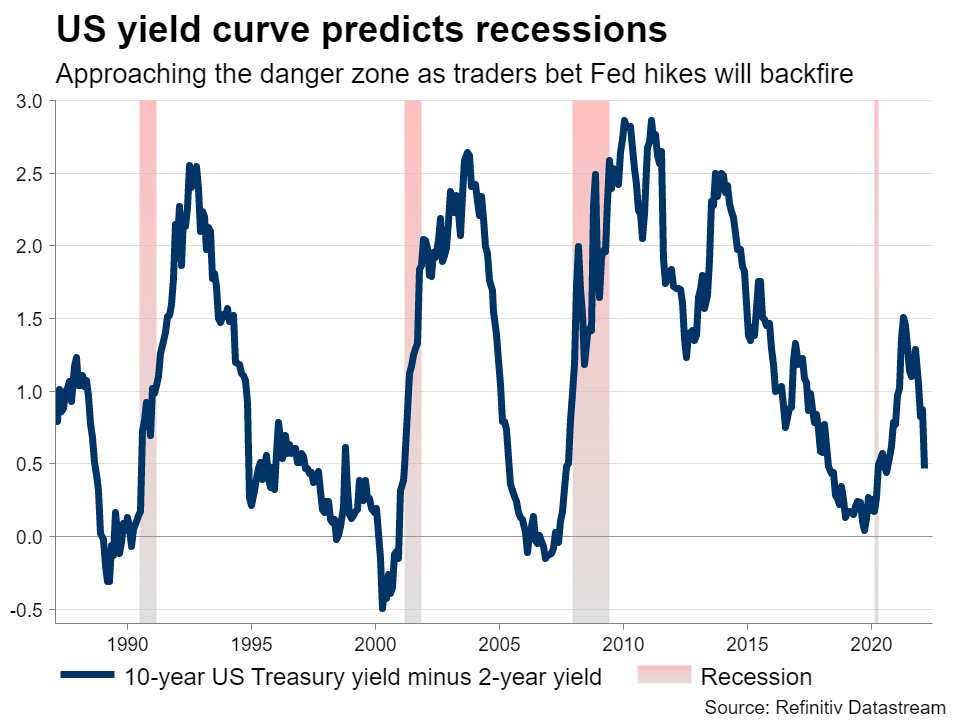
Let’s break it down. The Fed is almost ‘fully priced’ by now. In fact, markets may have gone too far already. There’s a serious argument that the yearly inflation rate could peak soon as government spending fades, supply chains finally normalize, consumers shift back to services with restrictions being lifted, and year-over-year comparisons become much tougher from March onwards.
When investors see concrete signs of ‘peak inflation, these hyper-aggressive Fed bets could be dialed back. Politics are not favorable either. The Democrats will probably lose Congress in November’s midterm elections, which means the days of extravagant government spending are over. This also implies that ‘peak growth’ may be behind us.
Last but not least, the Fed is not playing solo anymore. Foreign central banks including the ECB have started to turn hawkish, so the dollar’s interest rate advantage is unlikely to get any bigger.
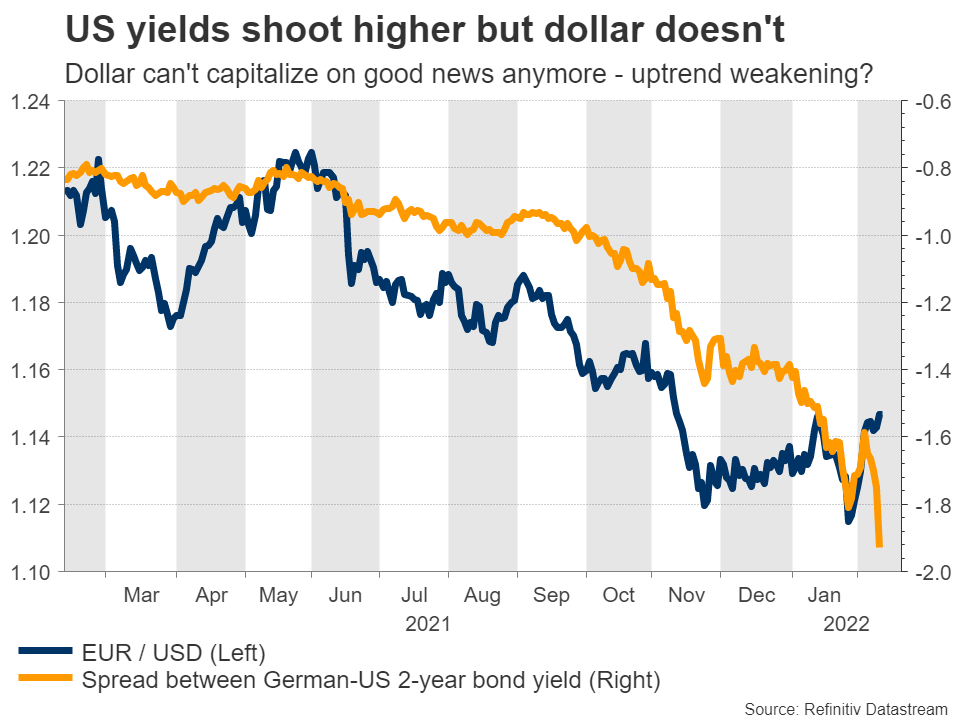
All told, the dollar may have ‘one last hurrah’ left as markets speculate about a double rate hike in March, but the overall rally seems to be on its last legs. It’s just difficult to see much upside left with the Fed already priced so aggressively.
The minutes of the latest Fed meeting and retail sales for January will both be released on Wednesday. The minutes are likely outdated already given recent developments, so the spotlight will fall on retail sales. If the report is solid but the dollar cannot capitalize again, it would be another sign the picture is turning.
Barrage of UK releases
There’s a volley of British data releases coming up, starting with the latest jobs report on Tuesday. Inflation stats for January will hit the markets on Wednesday, ahead of retail sales on Friday.
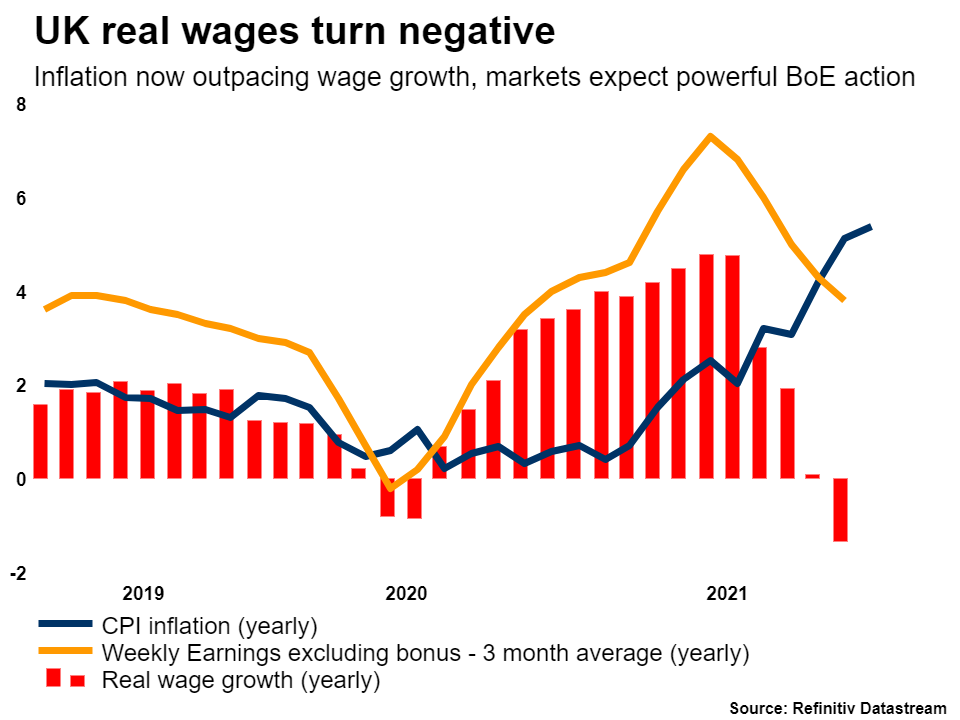
The Bank of England raised rates last week and started to shrink its balance sheet, yet the pound could not rally and instead lost significant ground against the euro as the ECB also flipped the hawkish switch. Money markets are now pricing in another six rate increases by the BoE for this year.
In the euro area, the second estimate of GDP for Q4 is out on Tuesday, although the euro generally doesn’t react much to that.
Canadian and Australian data
In Canada, the latest inflation report will be released on Wednesday ahead of retail sales on Friday. The nation’s economy is absolutely booming, although the retail sales numbers may be rather soft amid the covid restrictions in December.
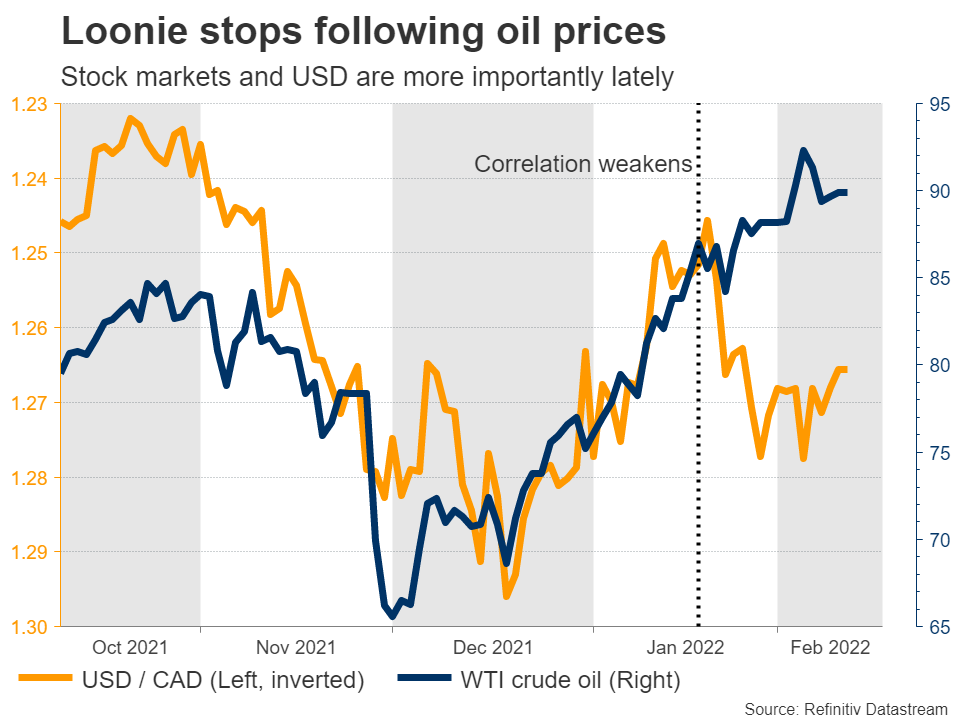
The Canadian dollar has been a real puzzle lately as it has decoupled from economic data and soaring oil prices, instead trading in lockstep with stock markets and risk appetite. That said, the outlook remains favorable as correlations could ultimately return and the broader inflationary environment bodes well for commodity-exporting economies like Canada.
In Australia, the minutes of the latest Reserve Bank meeting are out on Tuesday, before the employment data on Thursday. Both could be crucial for the aussie as markets are pricing more than six rate increases for this year, despite the RBA’s reluctance to signal any.
Japanese and Chinese inflation
The yen has come under heavy fire recently, losing ground across the board as yields and commodity prices shot higher. Soaring global yields are bad news for the yen because the Bank of Japan remains committed to its yield curve control strategy, which keeps a ceiling on the nation’s yields.
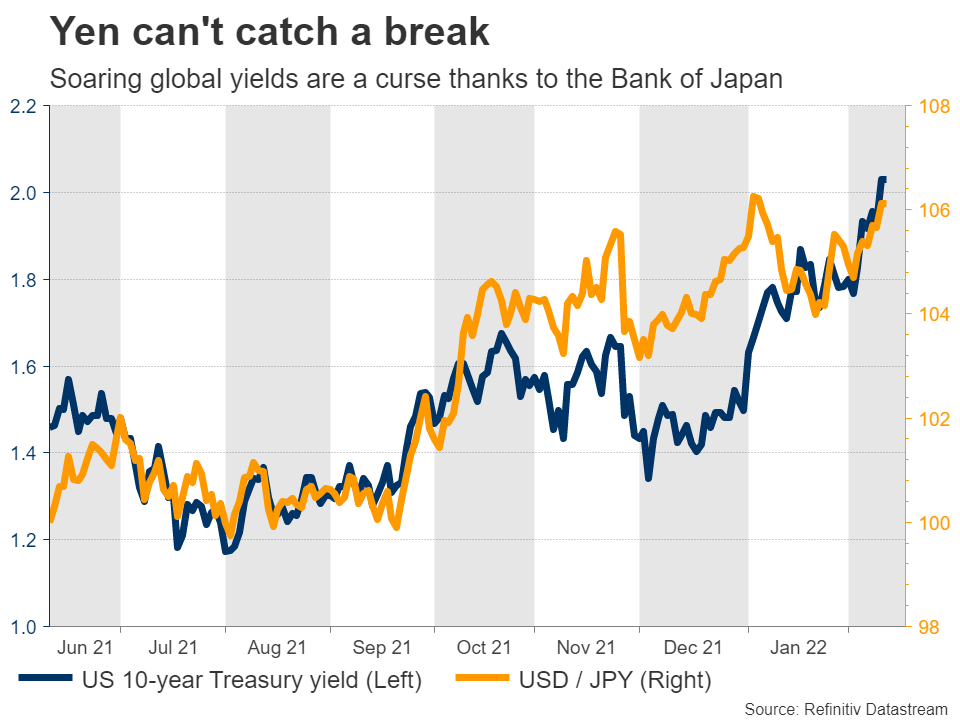
Hence, Japanese yields cannot keep up with foreign ones and rate differentials automatically widen against the yen. For the currency to stage a comeback, markets need to see signs the BoJ might raise this ceiling. This puts more emphasis on the upcoming GDP and inflation numbers on Tuesday and Friday, respectively.
Finally in China, inflation stats for January will be released on Wednesday.
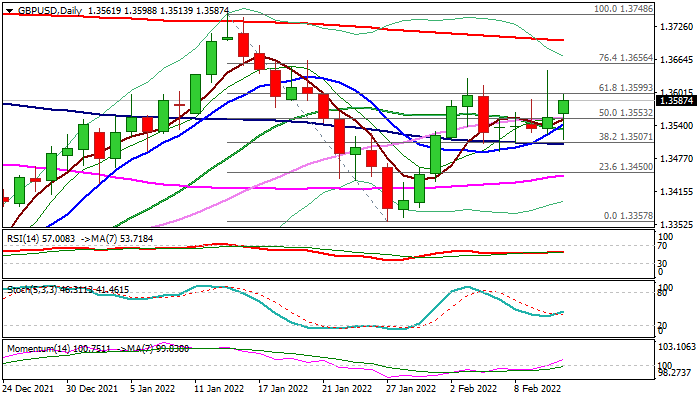
GBP/USD Outlook: Above Expectations UK GDP Lifts Sterling But Pivotal 1.3600 Barrier Caps the Action
Cable edged higher on Friday, following better than expected UK GDP data which partially offset negative impact from further rise in US inflation that fueled expectations for possible more radical action from Fed.
Fresh advance continued to face strong headwinds at pivotal 1.3600 barrier (Fibo 61.8% of 1.3748/1.3357) after several upticks (yesterday /last week) failed to sustain break above this level.
Technical studies on daily chart show rising bullish momentum and MA’s returning to bullish configuration that supports the action, but magnetic daily cloud twist next week (1.3444) may obstruct fresh bulls.
Neutral mode is expected while the price action stays between 100DMA (1.3503) and 1.3600 mark, with break of either side to generate fresh direction signal. Traders focus on next week’s UK jobs/earnings and inflation data.
Res: 1.3600; 1.3627; 1.3643; 1.3656.
Sup: 1.3553; 1.3532; 1.3503; 1.3450.
Weekly Focus – Fed to Step Hard on the Brakes?
Inflation and central banks continue to set the tone in global financial markets. US inflation for January rose by more than consensus reaching 7.5%, which is the highest level in 40 years. The core inflation measure also surprised on the upside, reaching 6% y/y. After the inflation print, Fed governor James Bullard argued that the Fed should increase the Fed funds target range by 100bp no later than July and that it may be necessary to hold an emergency meeting to get started before. However, some of the more centrists Fed members cautioned at moving too fast through an emergency hike or a 50bp rate hike as the first move. Markets are now pricing in 6.5 rate hikes by year-end and even a 5-6bp rate hike here in February, i.e. a non-negligible probability of an emergency rate hike. In addition, the markets are very close to fully price in a 50bp rate hike by March. We expect the Fed funds target range is raised by at least 50bp in March with the possibility of an emergency meeting move in the form of a rate hike or early end to QE. We are currently reviewing our Fed call of five rate hikes (125bp) this year.
The ECB seems more split on its tightening policy. President Christine Lagarde said that she favours a gradual approach. In an interview with Redaktionsnetzwerk Deutschland, she warned ECB could harm the economy's rebound from the pandemic if it were to rush to tighten monetary policy. Raising interest rates "would not solve any of the current problems," she stated "On the contrary: if we acted too hastily now, the recovery of our economies could be considerably weaker and jobs would be jeopardized." This was echoed by Banque De France governor, Francois Villeroy. In contrast, the more hawkish members of the governing council like Dutch central bank governor Klaas Knot said this week that he sees the first rate hike in 2022
In contrast, Riksbank seems even more relaxed about inflation pressures and the need to tighten policies and China central bank is easing policies. At its policy meeting this week, Riksbank (as expected) revised the inflation forecast higher, but stressed that there were not yet any second round effects into core inflation. As for the repo rate path there were only minor changes made in comparison to the November meeting, lifting it slightly signalling a first full hike in H2 2024. Chinese credit growth gained speed in January following easing of monetary policy in recent months.
Next week, central bank speakers both from the US and Europe will be in focus. Furthermore, In the US, we are looking forward to retail sales on Wednesday, especially in the light of the still skewed consumption pattern and high inflation. Besides that we receive FOMC minutes, where we will look for details about quantitative tightening and the 25bp or 50bp hike question.
This week the bond market sell-off continued. The US 2 year treasury yield increased by 30 bps while the 10 year US yield breached 2%. We now expect that 10Y US Treasury yields will rise to 2.45% (from 2.25%) in the course of the next 12 months. We also raised our 12M target for 10Y German Bunds to 0.60%, see our Yield Outlook: Upcoming ECB and Fed rate hikes pushing long yields higher, 10 February. Equity markets remained relatively resilient during the week.
Sunset Market Commentary
Markets
European stocks gapped lower today. They had some catching up to do with Wall Street, where Fed governor Bullard pounded equities with his aggressive policy comments in European after-market hours. Losses in the EuroStoxx50 at some point mounted to 1.5% but were trimmed to 0.7% currently. US stock futures momentum improved throughout the European session, resulting into minor gains at the cash open. The S&P 500 is still only 6% away from its all-time high in early January. The equity resilience is striking given the increasingly hawkish Fed and recent surge by core bond yields, although that last part reversed a bit today. US yields shed 1.9-3.8 bps in the 2y and 5y after skyrocketing 21 bps and 13 bps respectively after yesterday’s 7.5% inflation shocker. Bets for a 50 bps rate hike in March have eased slightly as well but that’s more of a kneejerk counterreaction rather than the scenario actually being priced out. Yields at the long end are 1.6-2.1 bps down in the 30y and 10y respectively. The latter holds the psychologically important 2% though. The German curve flattens with yields changing -0.2 bps (2y) to -2.5 bps (30y). European swap yields fall 2-5 bps. While core bonds gain today, the genie is really out of the bottle in Europe’s peripheral markets. Italian, Spanish and Portuguese spreads over Germany’s 10y yield advance another 4 bps, bringing the total since the ECB’s pivot within a 18-24 bps range. Greece is worse off, seeing spreads rise 8 bps today and bringing the sum to almost 50 bps.
FX markets are trading in the background. The Swedish krone outperforms G10 peers but received a heavy blow yesterday after the Riksbank shattered all hopes on interest rate support any time soon. The yen takes second place, benefiting from declining core bond yields and the (though improving) negative climate. The euro trades on the backfoot against a mixed dollar. EUR/USD is fighting to retain the 1.138 support. The early break lower at the height of risk-off in any case proved false for now. USD/JPY failed to push through 116 resistance and DXY is unable to strengthen beyond 96. UK Q4 GDP growth was strong though largely in line with expectations. EUR/GBP was meandering in the low 0.84 area and initially didn’t do much with the figures. But sterling had to push just once to move the pair sub 0.84 and it did. 0.838 acts as support (Nov 2021 low).
News Headlines
The Hungarian central statistical office published January inflation numbers today. Inflation unexpectedly surged by 1.4% M/M to 7.9% Y/Y, the highest level since August 2007. Core inflation rose to 7.4% Y/Y, the highest in 20 years. Both are significantly above the central bank’s 3% (+-1ppt) inflation target. Details showed food prices rising by 10.1% Y/Y, consumer durables up 7.9% Y/Y and service prices 5.2% Y/Y higher. Hungarian price pressure remains despite caps imposed on staple food items last month and on fuel & energy earlier on. Other popular pre-election spending measures probably more than countered the impact on inflation. The Hungarian swap curve inverts further today with yields adding up to 22 bps at the front end in anticipation of a more aggressive Hungarian central bank stance. The MNB meets next on Feb 22. Its base rate currently stands at 2.9% and is playing catch-up with the one week deposit rate (4.3%). The forint trades slightly stronger at EUR/HUF 353.50.
The central bank of Russia raised its policy rate as expected from 8.5% to 9.5%, the highest level since Q1 2017. The Russian real policy rate now turned slightly positive again. CBR-governor Nabiullina suggested that more rate hikes are coming and didn’t exclude a move by the same magnitude. The new range for the average key rate this year is 9%-11%, coming from 7.3%-8.3% previously. Nabiullina says that the only way to bring inflation down is by a (central bank triggered?!) recession. Upgraded inflation forecasts show end-2022 inflation at 5%-6% with inflation expected to return to the 4% inflation target by mid-2023. The worsening labor shortage gets top billing as a source of inflation pressure, right after supply constraints. The Russian ruble cedes ground today with USD/RUB rising from 75 to 75.50.
EUR/USD Outlook: Different Fed-ECB Policy Outlook May Weigh on Euro
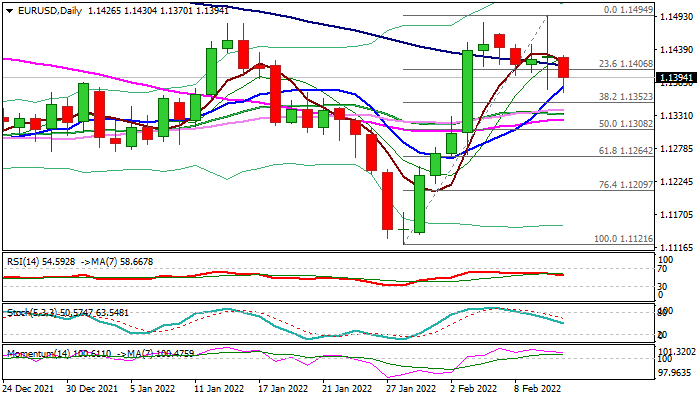
The Euro stands at the back foot on Friday following a bumpy ride after US inflation data on Thursday, but the action ended in a long-legged Doji candle, signaling strong indecision.
Although Friday’s action is in red, the downside remains limited by rising 10DMA (today’s attempts lower stalled near yesterday’s low).
Stronger than expected rise in US inflation fueled expectations for more aggressive action from Fed (the central bank announced it will start hiking from the next month) with analysts being divided over the size of the rate increase, as many now expect 0.5% hike, while some does not expect the Fed to diverge from expected first post-pandemic hike by 25 basis points.
While Fed remains hawkish, the European central bank is more cautious and not in hurry to start raising interest rates.
The ECB President Lagarde said today that rate hike would not bring down the record high EU inflation and would not affect high oil prices and supply problems that have boosted inflation, but would hurt the economy.
Lagarde said that fast reaction from the central bank won’t solve the problem, but would slow the recovery of the bloc’s economies, suggesting that the ECB should gradually withdraw a massive stimulus and adjust monetary policy instruments when conditions allowed.
Different outlooks from two central banks, in which the Fed is aggressive while ECB remains dovish, would weigh on the single currency in the short-term.
Technical studies on the daily chart are weakening, after the action on Thursday failed to clearly break above daily cloud top, as bullish momentum is fading and RSI turned south.
Fresh weakness probes again through 100DMA (1.1413) with eventual close below the indicator to generate initial bearish signal, which would look for confirmation on extension through 1.1352 (Fibo 38.2% of 1.1121/1.1494 rally).
On the other side, repeated failure to close below 100DMA would keep near-term price action in extended consolidation.
Res: 1.1439; 1.1494; 1.1558; 1.1600.
Sup: 1.1370; 1.1352; 1.1333; 1.1316.