Sample Category Title
New Support Level in Gold
Gold is attempting to return to the $1800 area on Tuesday. The bulls do not want the price fixing below this round level, as they want to avoid the markets starting a wider liquidation of long positions in the metal.
The latest FOMC comments have seen the price drop more than $70, from around $1850 to $1780. It looks like the latest level is a new stepping stone, which has withstood the bears’ attack since the second half of December.
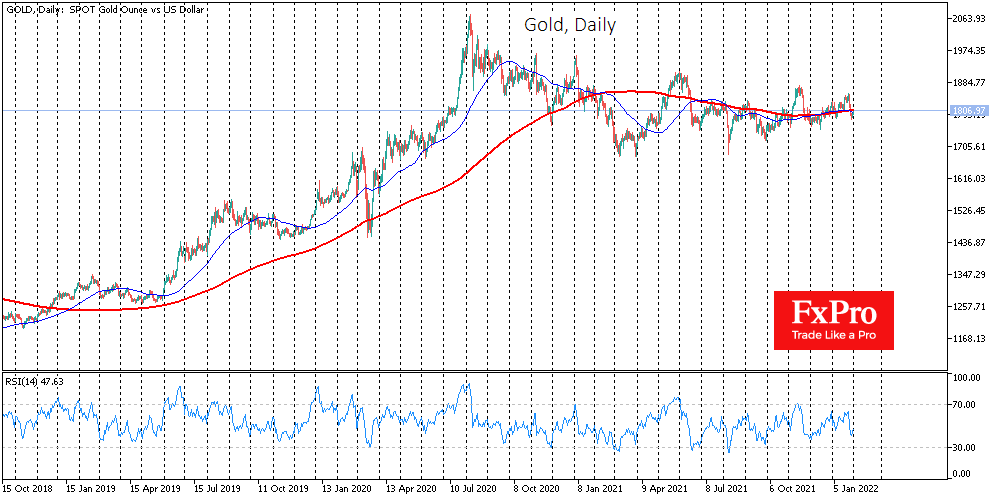
Prior to that, $1680 in March 2021, $1725 in August, $1760 in November and December were the impassable support levels. Buyers have activated on the declines towards $1780 since the last days of last year, and the return to that level late last week was also accompanied by increased buying.
The harsh tone of the US monetary authorities and the pressure in equities has almost wholly nullified the gains in gold from the levels of early December. However, a second consecutive day of buying after a downturn can now be seen. Gold bulls are neatly buying out the decline.
At the same time, it is too early to talk about signs of a rally, and it is better to wait for local technical signals. One of those signals might be a fixation above $1805, through which the 200-day moving average passes.
Even more reliable is to wait for the 50-day (now at $1801) to return above the 200-day, which will give a “golden cross” signal.
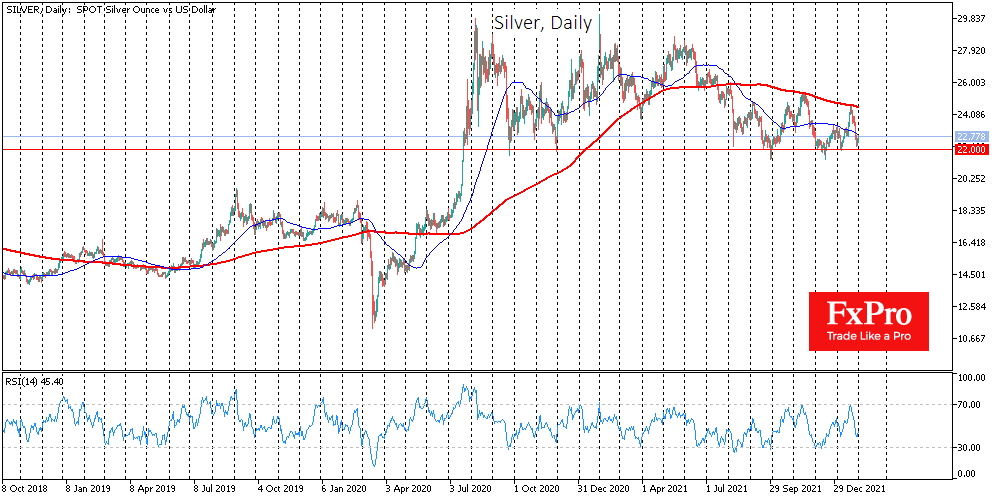
Among the related markets, silver is worth keeping an eye on. A bearish trend is still prevailing as the price has reversed three times since August after testing the 20-day average. However, global support near $22 has protected silver this time, effectively playing its role since September 2020.
EUR/USD Mid-Day Outlook
Daily Pivots: (S1) 1.1165; (P) 1.1207; (R1) 1.1274; More...
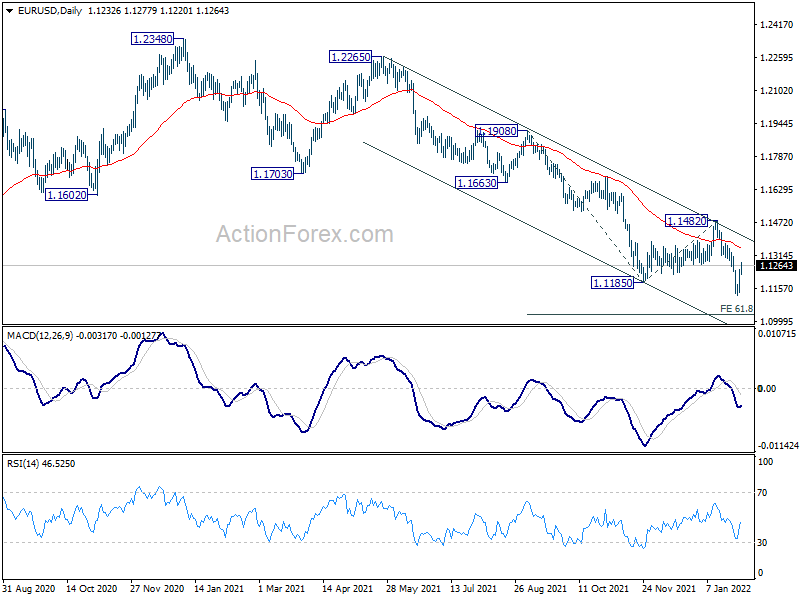
EUR/USD's recovery from 1.1120 extends higher today but stays below 1.1299 minor resistance. Intraday bias remains neutral first and further is still in favor. On the downside, break of 1.1120 will resume larger down trend to 61.8% projection of 1.1908 to 1.1185 from 1.1482 at 1.1035. However, break of 1.1299 minor resistance will bring stronger rebound back towards 1.1482 structural resistance.
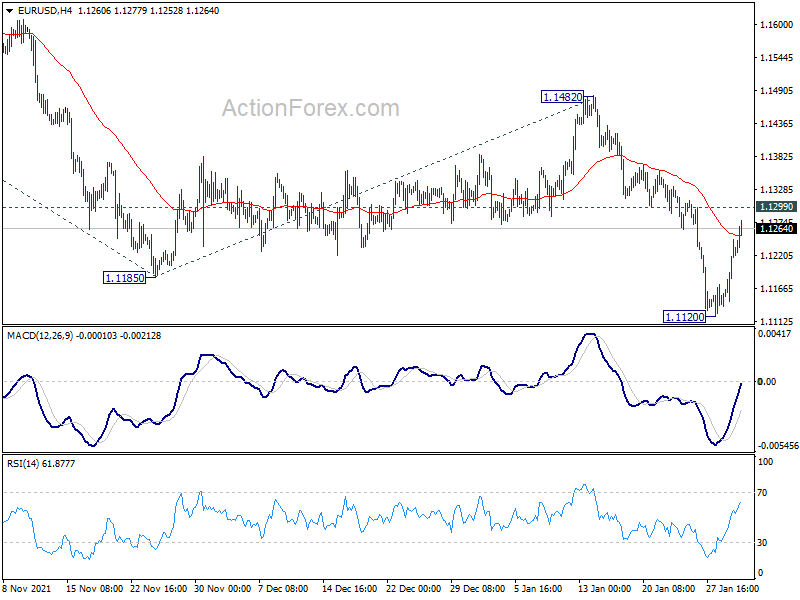
In the bigger picture, the strength of the the decline from 1.2348 (2021 high) suggests that it's not a corrective move. But still, it could be the fourth leg of a sideway pattern from 1.0339 (2017 low), or resuming long term down trend. In any case, outlook will now stay bearish as long as 1.1482 resistance holds. Next target would be 1.0635 low.
Dollar Drops Broadly on Positive Market Sentiment, Reversing?
Dollar drops broadly today in rather mixed markets. Firmer risk sentiment might be a factor. Yet, Swiss Franc is currently the strongest, followed by Kiwi and then Aussie. Yen is also just steadily mixed. On the other hand, Canadian Dollar is also weak, without much support from stronger than expected GDP data. Euro is also soft in general, except versus the greenback. Nevertheless, development in the stock markets and overall market sentiment would likely guidance the FX markets for now.
Technically, it's still early to tell if Dollar is reversing. But AUD/USD has made some progress by breaking 0.7089 minor resistance. USD/CHF also breaks 0.9243 minor support. Attention will be on 1.1299 minor resistance in EUR/USD, 1.3523 minor resistance in GBP/USD, and 114.46 minor support in USD/JPY. Break of these level will at least put the greenback under some pressure for the very near term.
In Europe, at the time of writing, FTSE is up 1.05%. DAX is up 1.12%. CAC is up 1.25%. Germany 10-year yield is down -0.0008 at 0.014. Earlier in Asia, Nikkei rose 0.28%. Japan 10-year JGB yield rose 0.0067 to 0.183. Hong Kong, China and Singapore were on holiday.
Canada GDP grew 0.6% mom in Nov, 0.2% above pre-pandemic level
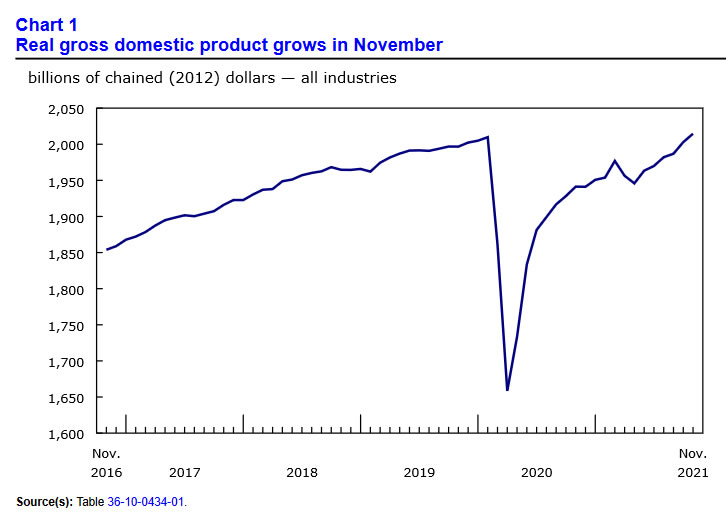
Canada GDP grew 0.6% mom in November, above expectation of 0.4% mom. Increases across almost all sectors contributed to the sixth consecutive monthly expansion. Real GDP was 0.2% above its pre-pandemic level in February 2020. Services-producing industries grew 0.6% mom while goods-producing industries rose 0.5% mom.
Statistic Canada also said advance information shows GDP was essentially flat in December. For Q4, GDP grew 1.6% qoq, 4.9% yoy.
UK PMI manufacturing finalized at 57.3 in Jan, a solid start to 2022
UK PMI Manufacturing was finalized at 57.3 in January, slightly down from December's 57.9. Markit said production rose at fastest rate in six months. new order growth slowed despite mild uptick in new export businesses. Input cost and output price inflation eased.
Rob Dobson, Director at IHS Markit, said: "UK manufacturing made a solid start to 2022, showing encouraging resilience on the face of the Omicron wave, with growth of output accelerating as companies reported fewer supply delays. Causes for concern remain, however, as new orders growth slowed, exports barely rose, staff absenteeism remained high and manufacturers' ongoing caution regarding supply chain disruptions led to the beefing up of safety stocks
"There was some positive news on the supply chains front. Although pressure on vendors remains severe, and still sufficient to stymie output growth and cause difficulty in obtaining required inputs, supplier lead times lengthened to the lowest degree since November 2020 to suggest that the current period of abnormal stress has hopefully passed its peak, despite the surge in cases linked to Omicron. This also lessened the upward pressure on prices, with input costs and output charges both rising at less elevated rates in January."
Eurozone PMI manufacturing finalized at 58.7 in Jan, weathering Omicron better than prior waves
Eurozone PMI Manufacturing was finalized at 58.7 in January, up from December's 58.0. Markit said there were faster expansion in output and new orders. Employment growth improved to five-month high. Also, supplier performance had the least marked deterioration for a year.
Looking at some member states, Germany PMI manufacturing improved to 59.8, five month high. But Italy dropped to 11-month low at 58.3. France also dropped to 3-month low at 55.5. Overall readings were still strong with Austria at 61.5, the Netherlands at 60.1, Ireland at 59.4, Greece at 57.9 and Spain at 56.2.
Chris Williamson, Chief Business Economist at IHS Markit said: "Eurozone manufacturers appear to be weathering the Omicron storm better than prior COVID-19 waves so far, with firms reporting the largest production and order book improvements for four months in January. Prospects have also brightened, with a further easing in the number of supply chain delays playing a key role in prompting producers to revise up their expectations for growth in the coming year to the highest since last June...
"Escalating tensions surrounding Ukraine, the energy price crisis and prospect of global central bank policy tightening meanwhile create additional headwinds to the outlook, which suggest that - although the global supply crunch may be easing - demand conditions may be less supportive to manufacturers in coming months."
Eurozone unemployment rate dropped to 7.1% in Dec, EU down to 6.4%
Eurozone unemployment rate dropped from 7.1% to 7.0% in December, better than expectation of 7.1%. EU Unemployment rate dropped from 6.5% to 6.4%.
Eurostat estimates that 13.612m men and women in the EU, of whom 11.481m in the euro area, were unemployed in December. Compared with November, the number of persons unemployed decreased by 210k in the EU and by 185k in the euro area.
From Swiss, retail sales dropped -0.4% yoy in December versus expectation of 5.5% yoy. SECO consumer climate dropped from 4 to -4 in Q1. PMI manufacturing rose from 62.7 to 63.8 in January, below expectation of 63.9.
RBA stops QE purchases, to be patient on interest rate
RBA keeps cash rate target unchanged at 0.10% today. It's reiterated that RBA "will not increase the cash rate until actual inflation is sustainably within the 2 to 3 per cent target range". And, it is "too early to conclude that it is sustainably within the target band". Thus, "the Board is prepared to be patient as it monitors how the various factors affecting inflation in Australia evolve.
RBA also decided to stop the asset purchase program after February 10. The issue of reinvestment of the proceeds of future bond maturities will be considered at the meeting in May.
As for the economy, RBA said Omicron "has not derailed" recovery. Central forecast if for GDP to grow around 4.25% over 2022 and 2% over 2.023. Unemployment rate is projected to fall below 4% later in the year, and to be around 3.75% at the end of 2023. Underlying inflation is is expected to increase further in coming quarters to around 3.25%, and decline to around 2.75% over 2023.
Australia retail sales dropped -4.4% mom in Dec, but turnover remains strong
Australia retail sales dropped -4.4% mom in December, much worse than expectation of -1.9% mom. That's also the largest monthly decline since April 2020.
"Despite this month's fall, retail turnover remains strong, up 4.8 per cent on December 2020, with strong consumer spending continuing post the Delta Outbreak," Ben James, Director of Quarterly Economy Wide Statistics, said.
Australia AiG manufacturing dropped to 48.4, modest contraction
Australia AiG Performance of Manufacturing Index dropped sharply by -6.4 pts to 48.4 in January. Production dropped -0.6 to 51.9. Employment dropped -4.6 to 45.4. New orders dropped -8.0 to 51.3. Supplier deliveries dropped -15.6 to 37.8. Exports dropped -9.5 to 45.1. Input prices rose 4.0 to 82.3. Selling prices dropped -3.3 to 64.8. Wages rose 1.1 to 63.5.
Innes Willox, Chief Executive of Ai Group said: "Australia's manufacturers reported a modest contraction in performance over December and January as businesses reported further disruptions to supply chains and as staff availability emerged as a major constraint on many businesses. Cost pressures were keenly felt with input prices continuing to rise and the selling prices index indicating only a partial recovery of these costs in the market."
EUR/USD Mid-Day Outlook
Daily Pivots: (S1) 1.1165; (P) 1.1207; (R1) 1.1274; More...
EUR/USD's recovery from 1.1120 extends higher today but stays below 1.1299 minor resistance. Intraday bias remains neutral first and further is still in favor. On the downside, break of 1.1120 will resume larger down trend to 61.8% projection of 1.1908 to 1.1185 from 1.1482 at 1.1035. However, break of 1.1299 minor resistance will bring stronger rebound back towards 1.1482 structural resistance.
In the bigger picture, the strength of the the decline from 1.2348 (2021 high) suggests that it's not a corrective move. But still, it could be the fourth leg of a sideway pattern from 1.0339 (2017 low), or resuming long term down trend. In any case, outlook will now stay bearish as long as 1.1482 resistance holds. Next target would be 1.0635 low.
Economic Indicators Update
| GMT | Ccy | Events | Actual | Forecast | Previous | Revised |
|---|---|---|---|---|---|---|
| 21:30 | AUD | AiG Performance of Mfg Index Jan | 48.4 | 54.8 | ||
| 21:45 | NZD | Trade Balance (NZD) Dec | -477M | -700M | -864M | -1060M |
| 23:30 | JPY | Unemployment Rate Dec | 2.70% | 2.80% | 2.80% | |
| 00:30 | AUD | Retail Sales M/M Dec | -4.40% | -1.90% | 7.30% | |
| 00:30 | JPY | Manufacturing PMI Jan F | 55.4 | 54.6 | 54.6 | |
| 03:30 | AUD | RBA Interest Rate Decision | 0.10% | 0.10% | 0.10% | |
| 07:00 | EUR | Germany Retail Sales M/M Dec | -5.50% | -1.20% | 0.60% | 0.80% |
| 07:30 | CHF | Real Retail Sales Y/Y Dec | -0.40% | 5.50% | 5.80% | 5.30% |
| 08:00 | CHF | SECO Consumer Climate Q1 | -4 | 4 | 4 | |
| 08:30 | CHF | Manufacturing PMI Jan | 63.8 | 63.9 | 62.7 | |
| 08:50 | EUR | France Manufacturing PMI Jan F | 55.5 | 55.5 | 55.5 | |
| 08:55 | EUR | Germany Unemployment Change Jan | -48K | -8K | -23K | |
| 08:55 | EUR | Germany Unemployment Rate Jan | 5.10% | 5.20% | 5.20% | |
| 08:55 | EUR | Germany Manufacturing PMI Jan F | 59.8 | 60.5 | 60.5 | |
| 09:00 | EUR | Eurozone Manufacturing PMI Jan F | 58.7 | 59 | 59 | |
| 09:30 | GBP | Manufacturing PMI Jan F | 57.3 | 56.9 | 56.9 | |
| 09:30 | GBP | Mortgage Approvals Dec | 71K | 66K | 67K | |
| 09:30 | GBP | M4 Money Supply M/M Dec | 0.10% | 0.80% | 0.70% | |
| 10:00 | EUR | Eurozone Unemployment Rate Dec | 7.00% | 7.10% | 7.20% | 7.10% |
| 13:30 | CAD | GDP M/M Nov | 0.60% | 0.40% | 0.80% | |
| 14:30 | CAD | Manufacturing PMI Jan | 56.5 | |||
| 14:45 | USD | Manufacturing PMI Jan F | 55 | 55 | ||
| 15:00 | USD | ISM Manufacturing PMI Jan | 57.5 | 58.7 | ||
| 15:00 | USD | ISM Manufacturing Prices Paid Jan | 79.5 | 68.2 | ||
| 15:00 | USD | ISM Manufacturing Employment Index Jan | 54.2 | |||
| 15:00 | USD | Construction Spending M/M Dec | 0.70% | 0.40% |
Canada GDP grew 0.6% mom in Nov, 0.2% above pre-pandemic level
Canada GDP grew 0.6% mom in November, above expectation of 0.4% mom. Increases across almost all sectors contributed to the sixth consecutive monthly expansion. Real GDP was 0.2% above its pre-pandemic level in February 2020. Services-producing industries grew 0.6% mom while goods-producing industries rose 0.5% mom.
Statistic Canada also said advance information shows GDP was essentially flat in December. For Q4, GDP grew 1.6% qoq, 4.9% yoy.
Canadian Dollar Steady ahead of GDP
The Canadian dollar has rebounded this week, after sustaining losses of over 1.5% last week.
One of this week’s highlights is Canada’s GDP, which will be released later today. After a strong gain of 0.8% m/m in October, the markets are braced for a slowdown in November, with a consensus of 0.3%. A reading below zero could weigh on the Canadian dollar, while a figure of 0.7% or higher would show that the economic recovery continues at a brisk pace and would likely boost the Canadian dollar. The Omicron wave has dampened economic activity, but we are seeing more of the economy reopen, with Ontario and Quebec easing Covid restrictions as of today.
Fed unclear on rate policy
The Federal Reserve is on the verge of raising rates, with a lift-off likely at the February meeting. But what is the game plan after that? Chair Jerome Powell left guidance unclear at last week’s meeting, apart from stating that the Fed planned a gradual reduction in support for the economy.
The forecast for the number of rate hikes we’ll see in 2022 ranges from 5-7, with speculation that the Fed could hike rates at every meeting this year if needed. At last week’s meeting, Powell noted that FOMC officials were still undecided on guidance and four FOMC members reiterated that point in public remarks on Monday.
If the Fed is undecided about policy, it’s no wonder that the markets remain unclear as to how many rate hikes to expect. The Fed had penciled in three rate hikes this year and some dovish FOMC members still favor that number. However, with inflation much higher and more persistent than the markets had expected, there is a strong chance of more rate hikes.
USD/CAD Technical
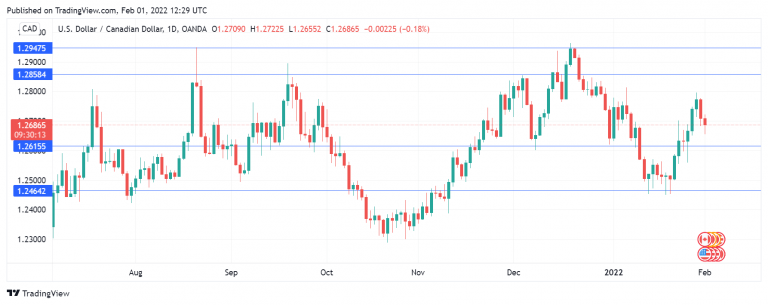
- USD/CAD faces resistance at 1.2857 and 1.2948
- There is support at 1.2615 and 1.2464
What Will Happen to Bitcoin in February?
Bitcoin rose 2.1% on the last day of January, ending the day at around $38,500. Ethereum added 4.3%, while other leading altcoins in the top 10 strengthened between 0.5% (XRP) and 9.2% (Terra). The total capitalisation of the crypto market, according to CoinGecko, rose 2.8% to $1.83 trillion overnight.
Bitcoin’s rise came amid a rebound in stock indices and a weakening dollar. The S&P 500 index of the U.S. broad market tested highs for a week and a half but lost 5.3 per cent in January. The past month was the worst for the S&P 500 since the crisis in March 2020.
The high-tech Nasdaq fell even further in January, by 9%. Bitcoin has been particularly strongly correlated with the index lately.
Bitcoin lost about 17% in January, declining for the third month in a row. Meanwhile, February is seen as a more successful month for the first cryptocurrency in historical data.
Over the past 11 years, BTC has strengthened on eight occasions and only declined on three. The average gain over the eight years was 31%. If bitcoin shows a similar rise in February, it will end the month just above the $50,000 round mark.
On a historical basis, bitcoin has rarely declined for more than three months in a row. There have only been three such instances: in 2011, 2014 and during the crypto-winter in 2018. All this increases the chances of a BTC rebound in February.
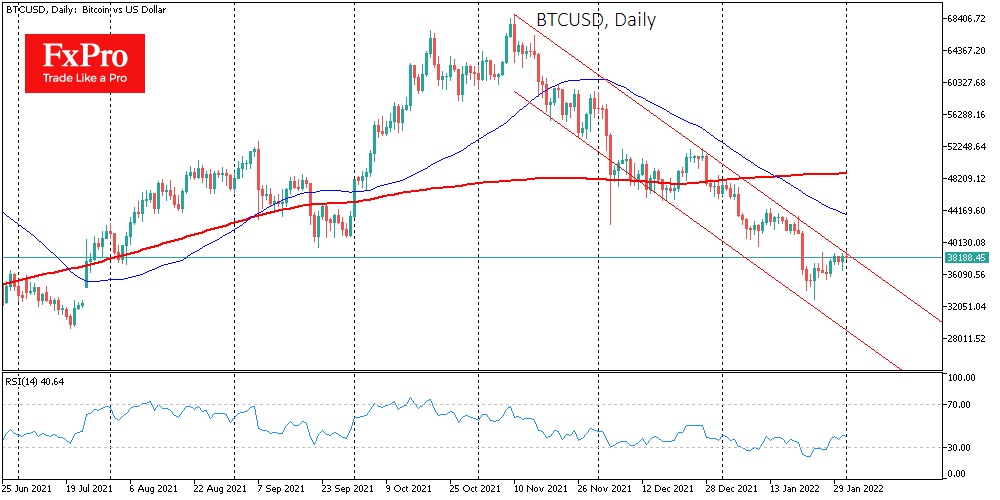
On the chart, bitcoin remains within a down channel, but thanks to the rebound, it has made it to the upper end of the corridor over the past week. A consolidation above 39,000 would be the first signal of a trend break, while the ability to develop a rise above 40,000 could instil even more confidence in buyers.
Aussie Rises as RBA Maintains Rates
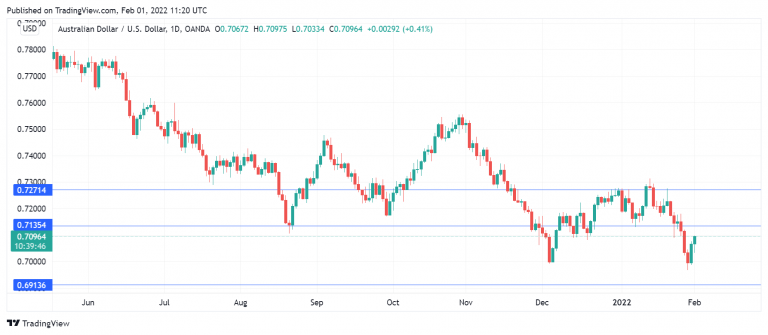
The Aussie has rebounded nicely this week, recovering half the losses from last week, when it tumbled 2.5%. AUD/USD has edged higher and is trading just below the 0.71 level in the European session.
RBA holds rates, winds up QE
There were no surprises from the RBA policy meeting earlier today. The central bank held the Cash Rate at a record low of 0.10% and announced that it would wind up its bond purchase program in February.
The RBA had expected to retire the bond purchase scheme in May but brought the date forward due to better than expected employment and inflation data for December. The unemployment rate has fallen to 4.2%, while Core CPI is at 2.6%, in the middle of the RBA’s target band of 2%-3%. These strong numbers could justify a rate hike, but the RBA has stuck to a dovish script, and Governor Lowe has tried to dampen rate hike expectations by saying that the bank will not before wage growth rises to 3%, which is not expected until 2023. In his statement, Lowe acknowledged that inflation had picked up, but said that it was too early to conclude that it was “sustainably” within the target band.”
The markets remain more hawkish about a rate hike and priced in a move in the second half of the year. Investors are betting that Lowe will have to hike before achieving his wage growth target due to surging inflation. Any hints from the RBA about a rate hike would be significant, as the bank last raised rates back in 2010.
The -4.2% reading came after five successive gains and was the sharpest drop since April 2020. This missed the consensus of a 3.9% gain. The Omicron variant has weighed heavily on consumer spending and this may be reflected in January and February retail sales reports as well.
AUD/USD Technical
- AUD/USD faces resistance at 0.7133. Above, we find resistance at 0.7271
- There is support at 0.6913 and 0.6831
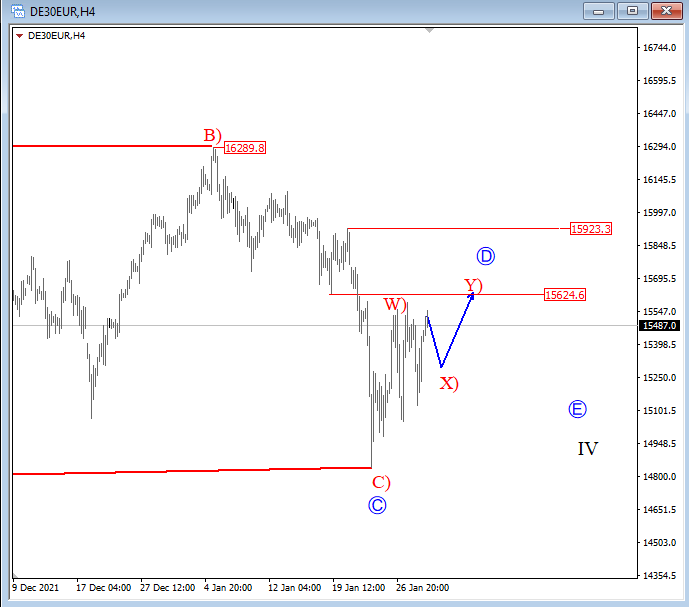
EUR/USD Finds Support: Elliott Wave Analysis
EURUSD made strong bounce in the 4-hour chart, which can be first signal for a completed wave 5), but to confirm the low, we need to see a rally back above 1.1300 level, otherwise wave 5) could be still in progress that can retest 1.11 - 1.10 area.
EUR/USD 4h Elliott Wave analysis
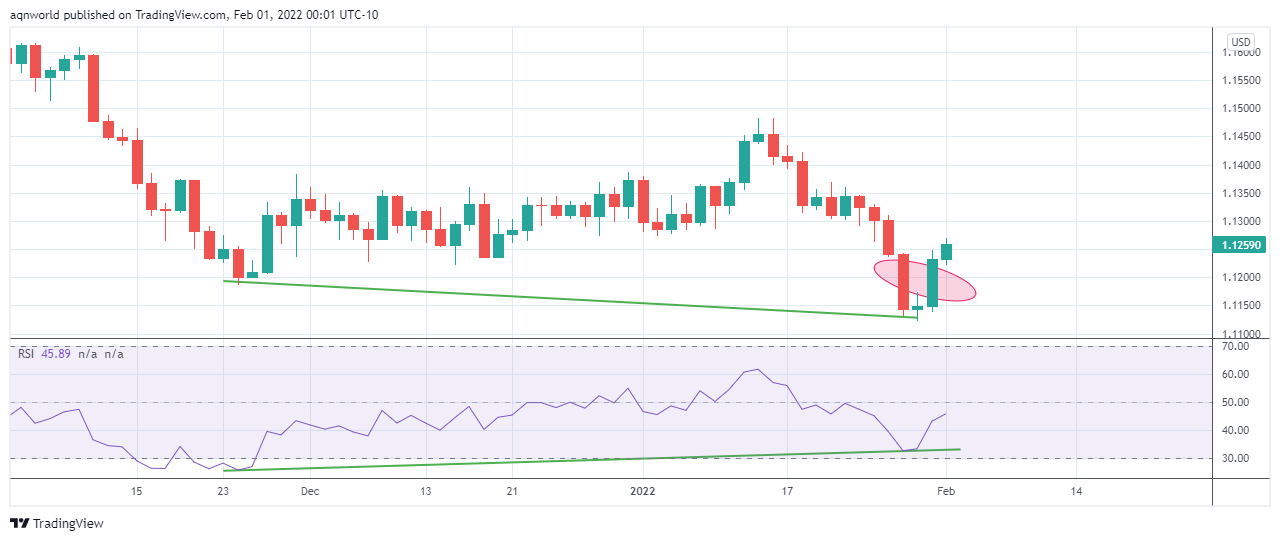
Technically EURUSD forms morning star candlestick pattern with RSI bullish divergence on daily chart means pair already finds support. Any daily closing below 1.1121 level invalidates this morning star pattern.
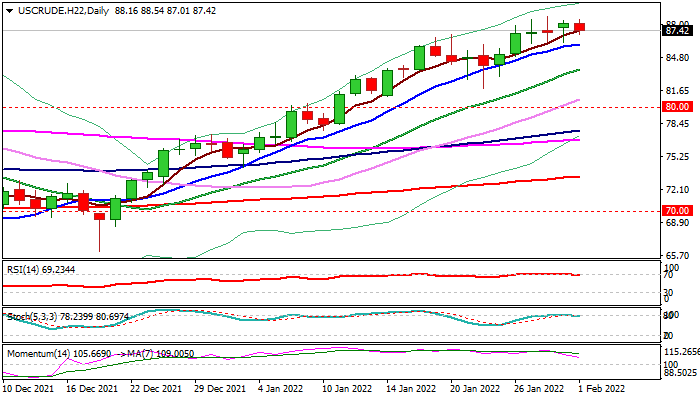
WTI Oil Outlook: Bulls Take a Breather ahead of OPEC+ Meeting, Crude Inventories
WTI oil is consolidating under new seven-year high ($88.81), posted after six consecutive weeks of gains, as overbought daily studies and expectations of a rise in US crude inventories prompted some profit-taking.
Overall picture remains firmly bullish, supported by solid demand growth and prospects of a limited production increase by OPEC+ group, geopolitical tensions and cold winter.
Rising 10DMA tracks the advance since Dec 22 offers solid support at $86.05, which should ideally keep the downside protected, however deeper pullback cannot be ruled out, as weekly stochastic is strongly overbought.
Extended dips would face 20DMA ($83.67) and should not exceed Jan 24 higher low at $81.89 to keep bulls intact for fresh push higher and probe above $90 level.
Caution on loss of $81.89 handle that may weaken near-term structure, while break below $80 support would sideline bulls and signal deeper correction.
US crude inventories (API late Tuesday and EIA on Wednesday) are eyed for stronger direction signals.
Res: 88.50; 88.81; 90.00; 90.81.
Sup: 86.05; 84.98; 83.68; 81.89.
EURJPY Rebounds ahead of 128 Handle, Neutral Tone Prevails
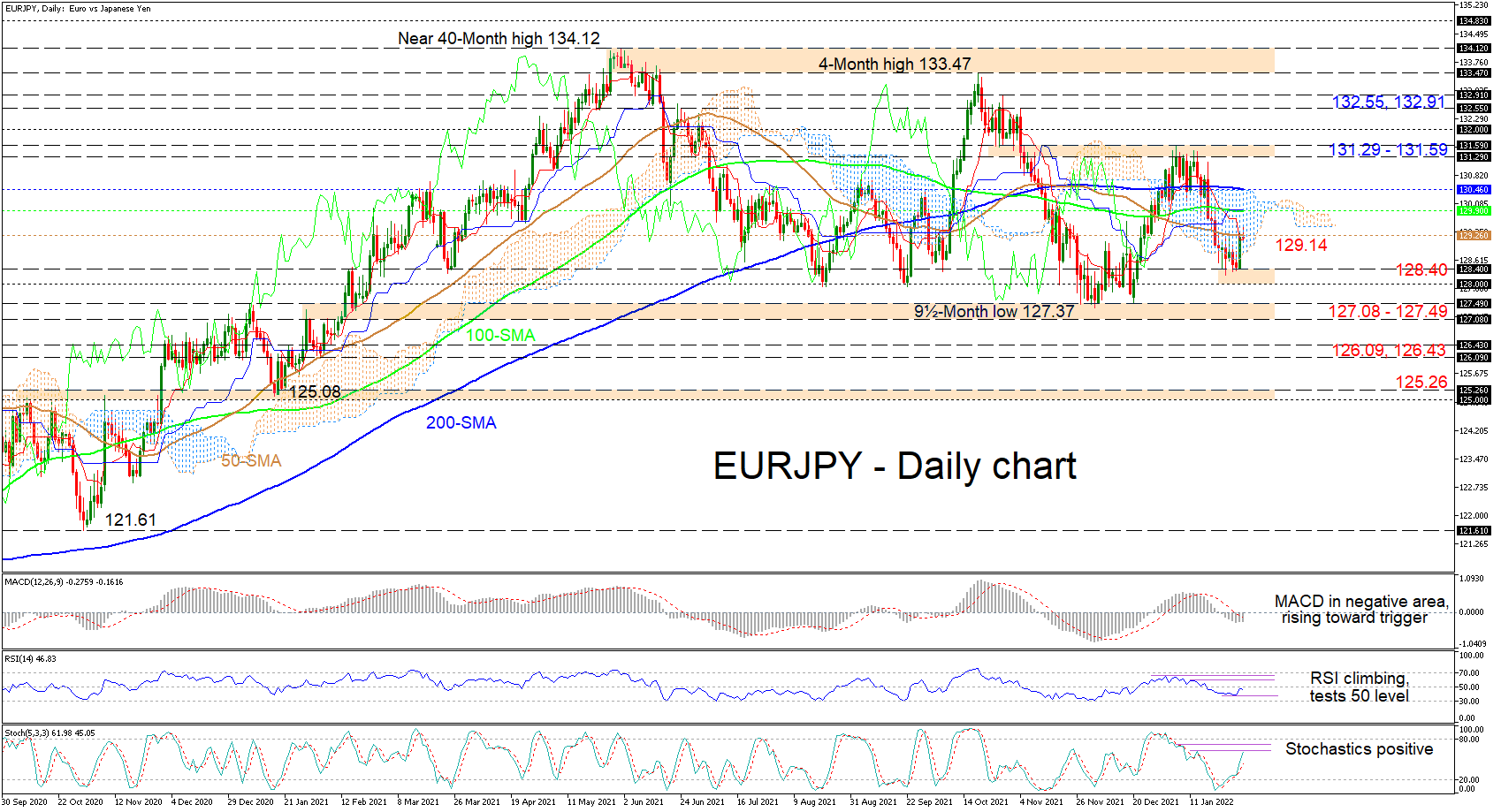
EURJPY buyers have managed to recoup the last week of losses through yesterday’s trading session and are now struggling to beat the 50-day simple moving average (SMA) at 129.26. The positive price action has underpinned the sideways bearing in the pair that has extended for around half a year, an outlook that the SMAs are endorsing too.
Currently, the Ichimoku lines are not indicating a convincing direction in the pair, while the short-term oscillators are reflecting conflicting energy in directional momentum. The MACD, some distance below zero, is rebounding higher towards the red trigger line, while the RSI is failing to overstep the 50 threshold. The positively charged stochastic oscillator continues to sponsor gains in the pair.
If buyers nudge past the 50-day SMA at 129.26, additional advances in the pair could face tough resistance between the 100- and 200-day SMAs at 129.90 and 130.46 respectively. A successful climb above the Ichimoku cloud’s upper band - overlapped by the 200-day SMA - may boost upside momentum to challenge the 131.29-131.59 resistance border. Should the bulls conquer this barrier too, they could then eye the 132.00 hurdle before their focus turns to the 132.55 and 132.91 subsequent highs.
Otherwise, if positive pressures continue to abate at the 50-day SMA, the initial 128.00-128.40 area could try to prevent a drop in the pair from accelerating. However, should negative pressures overwhelm this zone, the 127.08-127.49 support foundation may then contest the intensity of selling in the pair. Furthermore, if this one-year base fails to dismiss a decline from snowballing, the price could snag around the 126.43 and 126.09 lows before confronting the 125.00-125.26 support border that extends back to October 2020.
Summarizing, EURJPY is rangebound between the 127.08-127.49 floor and the 133.47-134.12 ceiling. That said, a dip beneath 128.00 could feed negative pressures, while a hike beyond the 131.59 high would be necessary to boost optimism in the pair.