

Sample Category Title
European Open – FTSE Buoyed By GBP Tumble
Markets flat as FTSE outperforms
Another steady start expected across Europe on Tuesday, as investors wait in anticipation of events later in the week that could shake things up.
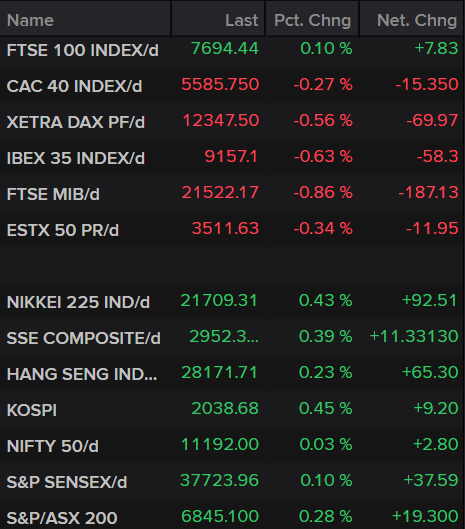
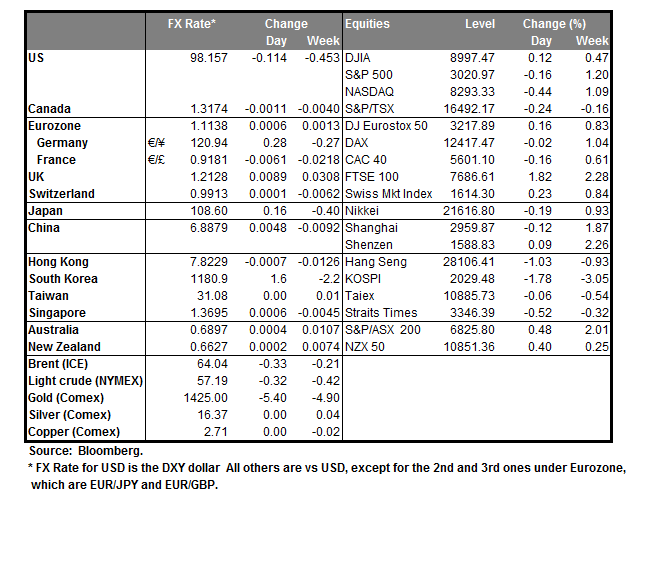
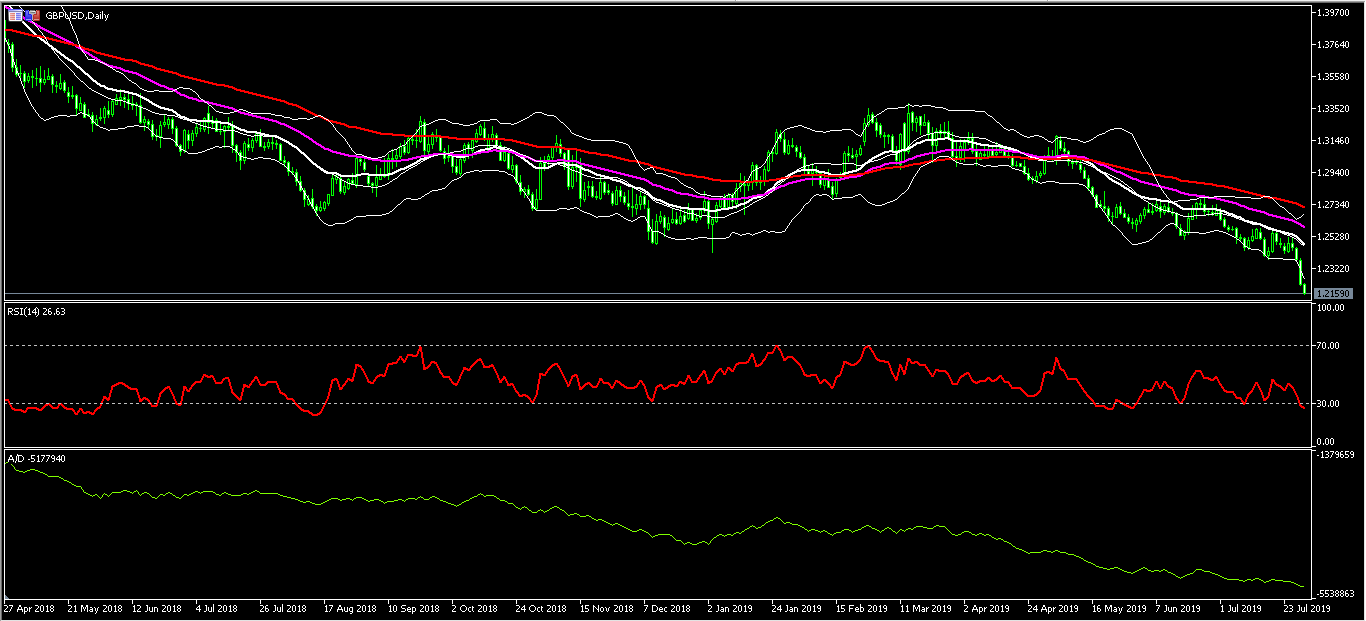
Of course, there is an anomaly here and that is the FTSE 100 which hugely outperformed the rest of the market on Monday, driven in part by a flurry of M&A reports but primarily by the plunging pound which continues to trade under pressure today. Already this morning, the pound is testing the March 2017 lows and sterling bulls are not putting up much of a fight so far.
GBPUSD Daily Chart
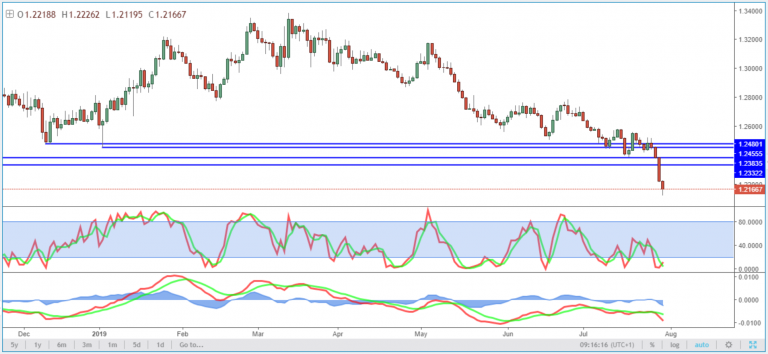
As ever, Brexit is to blame for the latest tumble in the pound as traders increasingly price in a higher likelihood of no-deal. Interestingly, the weakness in the pound is a reflection of the fact that Boris Johnson’s plan is working. He wants his no-deal threats to be taken seriously by the EU in the hope that it forces them to re-engage on the backstop, clearly he has traders convinced.
Ultimately, May failed to convince anyone that no-deal was ever an option, despite repeated warnings that it was better than a bad deal. Boris Johnson is determined not to make the same mistake and it now remains to be seen whether the EU will take his threats as seriously as the market is. Traders are currently not optimistic but it’s still early days. For now, the currency may remain under severe pressure.
BoJ stands ready to ease further
The Bank of Japan got things underway this week for central banks, although this was never going to be the highlight. The BoJ left the interest rate unchanged and signaled that it will adopt more easing without hesitation if momentum towards hitting its inflation target is lost. After all these years it would be fair to ask what momentum they’re referencing but ultimately, despite fighting talk, markets largely shrugged it off.
Trade talks and earnings also eyed
While this week is primarily about the Fed meeting on Wednesday, there’s plenty of other things that investors are focused on. Trade talks between the US and China restart in Shanghai, which will naturally attract a lot of attention, albeit with expectations now relatively low. Earnings season also continues, with Apple reporting after the close in the US.
Australian Inflation To Inch Higher But Unlikely To Stop RBA From Cutting Rates Further
Australia will publish quarterly inflation data on Wednesday at 01:30 GMT amid a stepping up by the Reserve Bank of Australia in its efforts to spur price growth. The RBA has cut rates twice since June on slowing economic growth and stubbornly low inflation and so the latest readings on the consumer price index (CPI) will be dissected for clues on the prospect of additional easing by the central bank. The Australian dollar is looking highly vulnerable ahead of this week’s releases, which will also include producer prices and retail sales figures.
CPI to edge slightly up in Q2
Annual inflation in Australia has been running below the RBA’s 2-3% target band since the third quarter of 2018, dropping to 1.3% in the first three months of the year. Underlying measures of inflation have also drifted uncomfortably below the target band and the subdued picture isn’t expected to have changed in the second quarter.
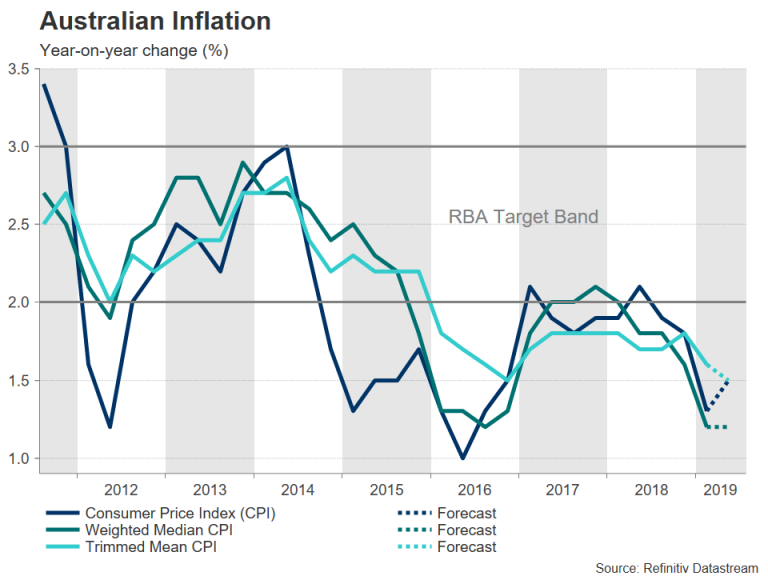
The quarterly rate of CPI is forecast to have increased by 0.5% in the three months to June, while on an annual basis, CPI is projected to have accelerated slightly to 1.5%. That’s still well below the lower band of the RBA’s target and so it’s unlikely to satisfy policymakers who would like to see evidence of a sustained rise in headline inflation, preferably through higher wage growth.
Underlying inflation to stay muted
The two measures of underlying inflation are not anticipated to be of much comfort either for the RBA. The weighted median CPI is forecast to have stayed unchanged at 1.2% y/y in Q2, while the trimmed mean is expected to have eased slightly to 1.5% y/y.
Weaker-than-forecast numbers are likely to pressure the Australian dollar, which is struggling to hold onto the $0.69 level on rising odds that the RBA will continue to slash rates in the coming months. If the aussie closes below the $0.69 handle, it could next slip towards the 78.6% Fibonacci retracement of the January upleg at $0.6861, before diving to the 2019 low of $0.6743.
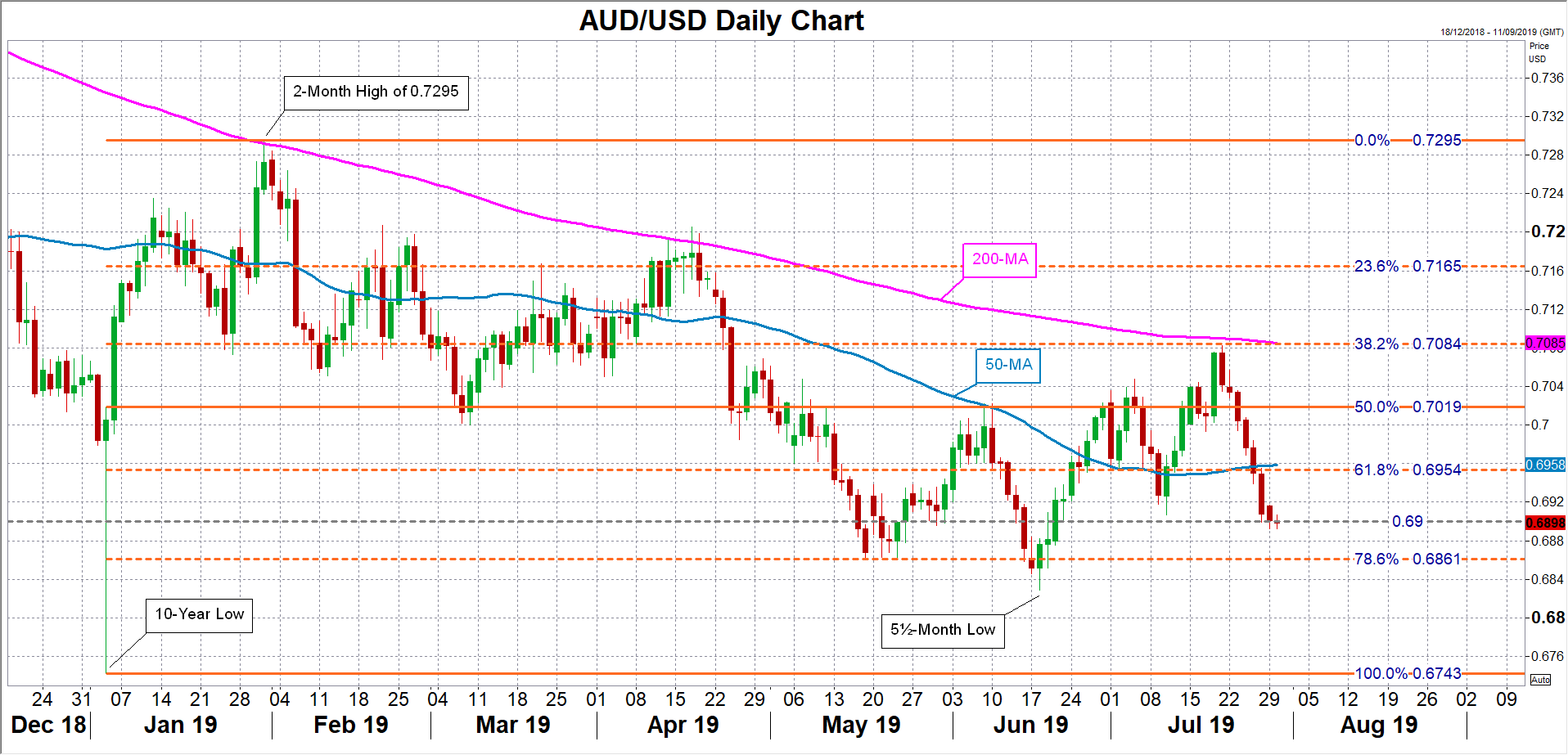
However, should the inflation data surprise significantly on the upside and take the pressure off the RBA to reduce rates further, the aussie could rebound to around $0.6954 – the 61.8% Fibonacci, before setting its sights on the 50% Fibonacci at $0.7019.
RBA expected to remain on easing path
But it will not be just the inflation numbers that aussie traders will be watching next week. Private sector credit figures are due at the same time as the CPI report, while on Thursday, Q2 producer prices are published alongside retail sales prints for both June and Q2.
All of these releases will come ahead of the August 6 policy meeting by the RBA when the central bank is expected to maintain a dovish tone. Although the RBA will probably hold off cutting rates again until the Autumn, an unimpressive set of figures would only reinforce the view that more cuts are on the way, especially after Governor Philip Lowe’s recent dovish remarks.
BOJ Remains On Hold And The Yen Shows Little Reaction
As was widely expected, BoJ maintained its interest rate at -0.10%, which caused little reaction on the JPY. The bank also left unchanged the guidance on interest rates, as it will keep current extremely low rates through spring 2020, maintaining an ultra-lose policy. It should also be noted that the bank lowered its forecast for the medium core CPI rate for 2019 at +1.0% yoy, if compared to prior forecast of +1.1% yoy. Yet inflation is expected to gradually accelerate toward +2.0% yoy. BoJ also mentioned that the it sees risks skewed to the downside for the economy and it won’t hesitate to take additional leasing if momentum to goal is lost. The markets may have been an even more dovish accompanying statement as at the time of the release, JPY momentarily strengthened against the USD. USD/JPY rose above the 108.60 (S1) support line yesterday, yet took a bearish turn during today’s Asian session, aiming for the upward trendline incepted since the 19th of July. For us to switch our bullish bias in favor of a sideways scenario, we would require the pair to clearly break the prementioned upward trendline. Should the bears dictate the pair’s direction, we could see it breaking the prementioned upward trendline, the 108.60 (S1) support line and aim for the 107.90 (S2) support barrier. Should the bulls take over, we could see the pair aiming if not breaking the 109.15 (R1) resistance line.
GBP falls to 2017 levels against the USD
Cable continued to drop yesterday, reaching the lowest level since March 2017, as the danger of a hard Brexit weighed on the pound. The new UK government seems to be hardening its stance towards the EU, about Brexit as preparations are made for a hard Brexit. It should be noted that the UK Government does no longer work under the assumption of an orderly withdrawal from the EU. According to media, Boris Johnson is not willing to restart talks unless the EU agrees to reopen the divorce deal which had been struck with Theresa May. Also, the Irish backstop continues to form a substantial obstacle in agreeing Brexit. We expect the pound to continue to be under pressure from the possibility of a hard Brexit, as well as BoE’s meeting on Thursday. Cable continued to drop for a fourth consecutive day, breaking the 1.2290 (R2) and the 1.2210 (R1) support lines, (now turned to support). We expect the pair to maintain its bearish momentum as the downward trendline incepted since the 25th of July, remains intact. However, one should note that the RSI indicator in the daily chart has broken below the reading of 30, which could be implying a rather overcrowded short position. Should the pair remain under the selling interest f the market, we could see the pair breaking the 1.2135 (S1) support line and aim if not also break the 1.2075 (S2) support level. Should the pair’s long positions e favored by the market, we could see it breaking the 1.2210 (R1) resistance line and aim for higher grounds.
Other economic highlights, today and early tomorrow
Today during the European session, we get Germany’s GfK consumer sentiment indicator for August, Eurozone’s industrial sentiment as well as the areas consumer confidence (final), both for July. Late in the European session, we get Germany’s preliminary CPI rate for July. From the US in the American session, we get the personal consumption rate, as well as the core PCE price index, both for June. Also in the American session from the US, we get the CB consumer confidence indicator for July, the pending home sales rate for June and late in the American session, we get the API weekly crude oil inventories figure. Tomorrow during the Asian session, we get China’s NBS manufacturing PMI for July and a bit later Australia’s CPI rate for Q2, which could provide volatility for the Aussie. Please bear in mind that the US- Sino trade negotiations are to restart today. The two sides until now seemed less willing to actually make concessions in order to strike a deal, or show some progres, yet on the other hand both economies seem to need such an agreement, in order for trade relations and terms to start normalizing.
GBP/USD Daily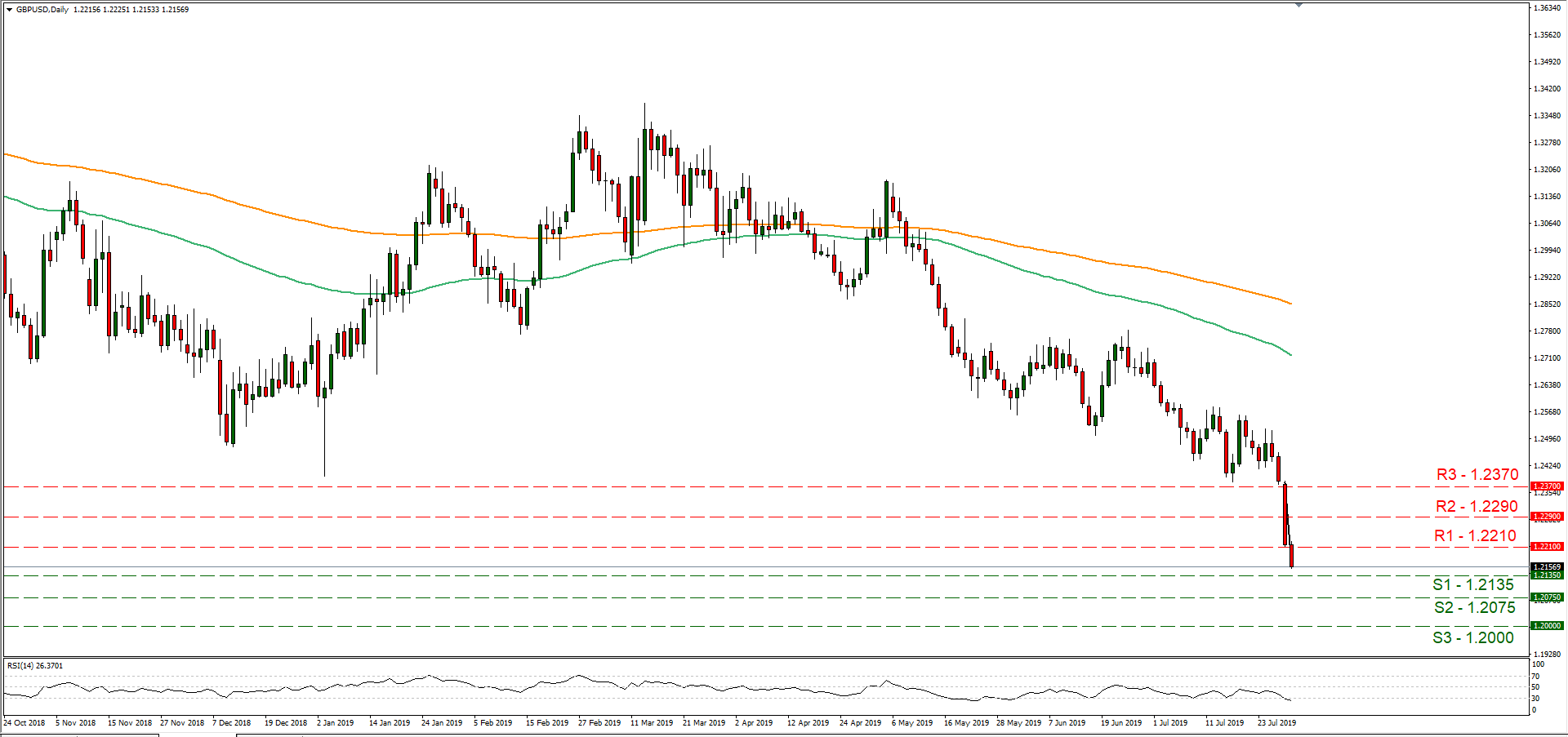
Support: 1.2135 (S1), 1.2075 (S2), 1.2000 (S3)
Resistance: 1.2210 (R1), 1.2290 (R2), 1.2370 (R3)
USD/JPY H4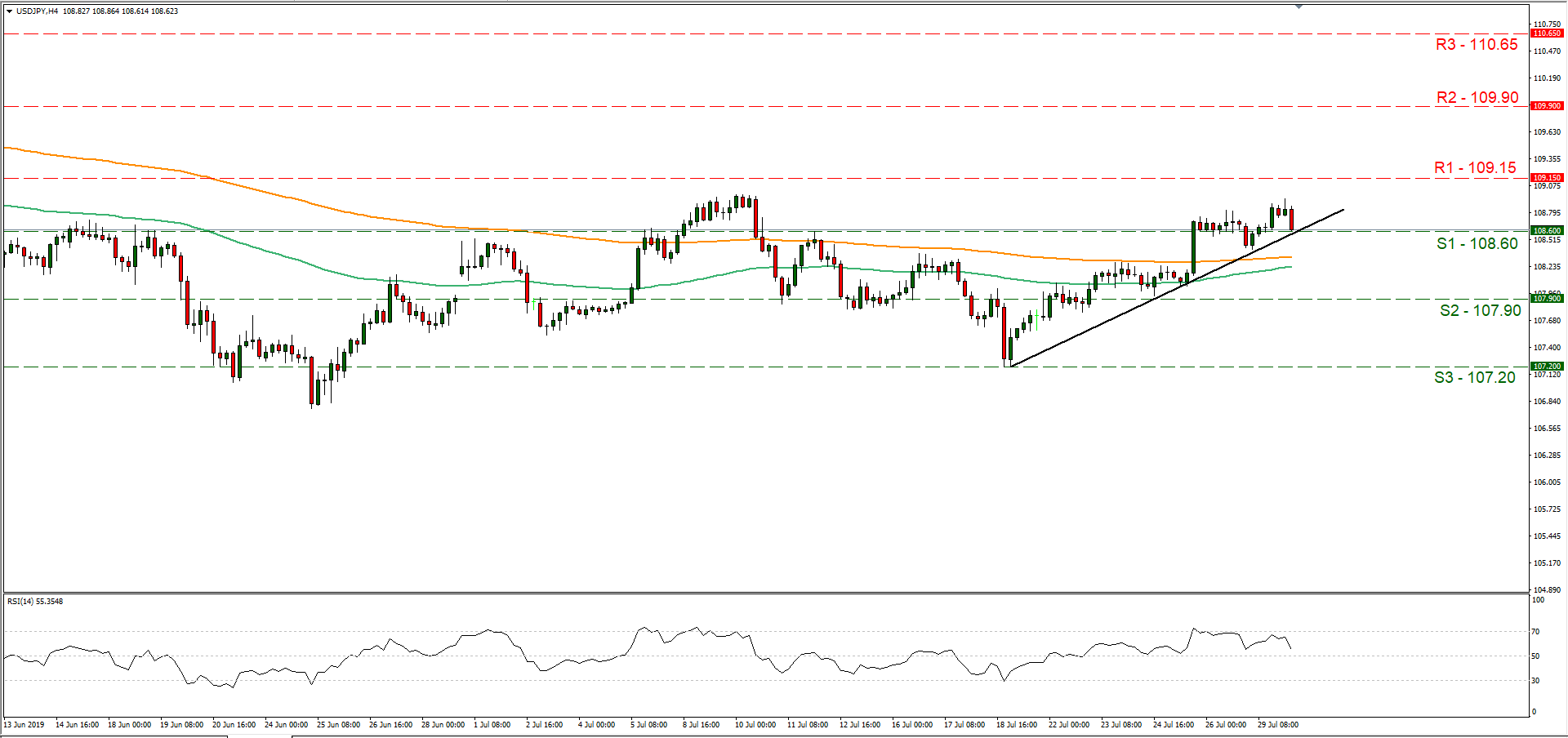
Support: 108.60 (S1), 107.90 (S2), 107.20 (S3)
Resistance: 109.15 (R1), 109.90 (R2), 110.65 (R3)
Japanese Yen Strengthens As BOJ Signals More Patience
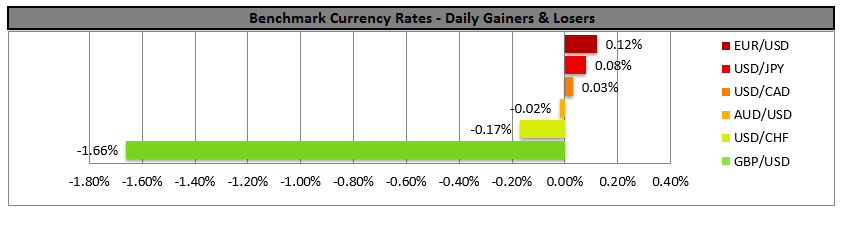
Sterling continued the downward trend in the Asian session on growing fears that the UK is heading towards a no-deal Brexit from the EU. The currency is trading at the lowest level it has since March 2017, when the UK first triggered Article 50. Boris Johnson has rejected meeting with European leaders like Emmanuel Macron and Angela Merkel over the EU backstop issue. EU leaders have warned that the backstop issue cannot be negotiated. They have said that the deal they negotiated with Theresa May was the best one available.
The Japanese yen strengthened after the Bank of Japan delivered its interest rates decision. As expected, the central bank left interest rates unchanged at -0.1%. It also left its forward guidance unchanged. The bank said that it will keep very low interest rates levels for an extended period of time at least through spring 2020. On the yield curve control, the bank voted to purchase Japanese government bonds (JGBs) so that the 10-year JGP yields will remain around 0%. The bank added that it “will make these purchases in a flexible manner so that their amount outstanding will increase at a pace of about 80 trillion yen”. Meanwhile, data released before the rate decision showed that the unemployment rate dropped to 2.3% while the industrial production contracted by -3.6%.
Later today, the market will receive the German import price index. This is a measure of the average price of goods imported by the country. Investors expect the data to show a contraction of -0.2%. The French consumer spending is expected to grow by 0.2%. In Sweden, the statistics office will release the preliminary GDP growth for the second quarter. From the European Union, investors will receive business and consumer survey data from the European Commission. Germany will also release its CPI data. In the US, investors will receive the personal income and spending data.
GBP/USD
The GBP/USD pair declined sharply to a low of 1.2158, which is the lowest level since 2017. On the daily chart below, the pair’s price is along the lower line of the Bollinger Bands. The price is also below all the short and medium-term moving averages while the RSI has dropped to the oversold level of 26. The accumulation/distribution indicator too has continued to drop. The pair will likely continue to drop as investors wait for a clear direction on Brexit.
EUR/USD
The EUR/USD pair rose slightly in the Asian session ahead of key economic data from the European Union. The pair is now trading at 1.1141, which is slightly higher than yesterday’s low of 1.1100. On the hourly chart, the pair is along the 25-day moving average and lower than the 50-day EMA. The pair is also along the major support, after completing the cup section of the inverted cup and handle pattern. The pair will likely rise to test the 1.1175, which is the 23.6% Fibonacci Retracement level.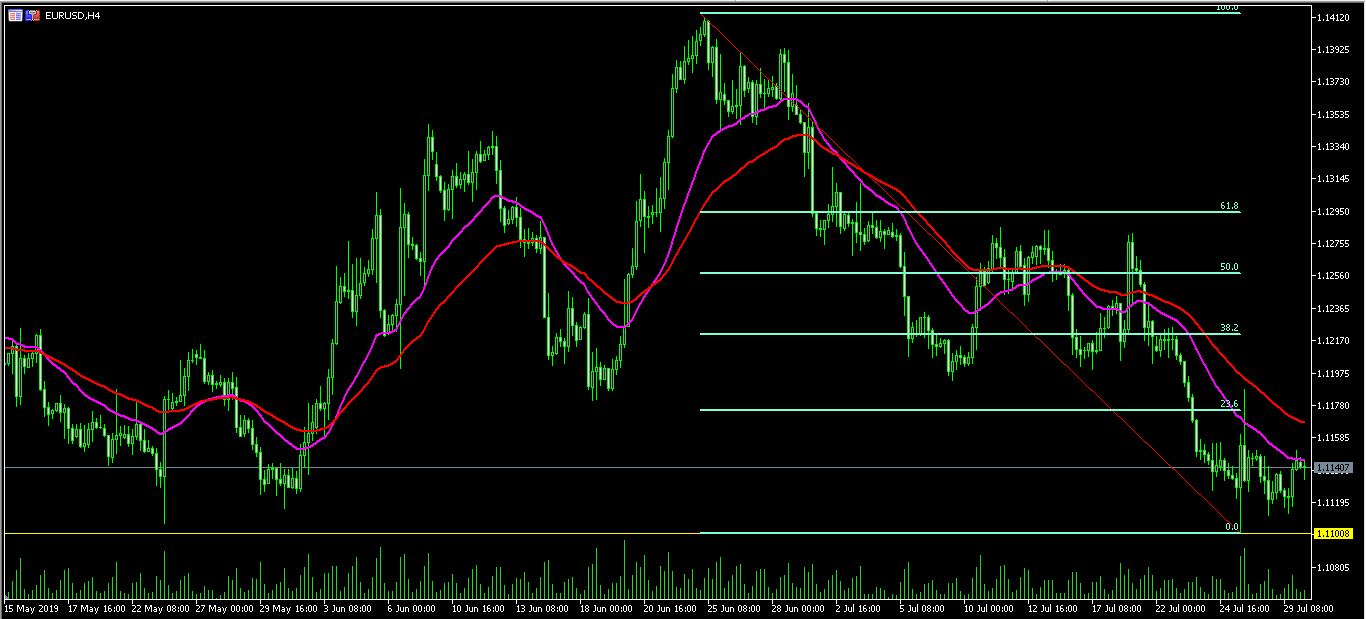
USD/JPY
The USD/JPY pair dropped to an intraday low of 108.63 after the BOJ delivered its interest rates decision. The price is now slightly below the 21-day and 42-day moving averages while the RSI has dropped sharply to the current low of 39. The price will likely continue moving lower, to test the important support level of 108.50.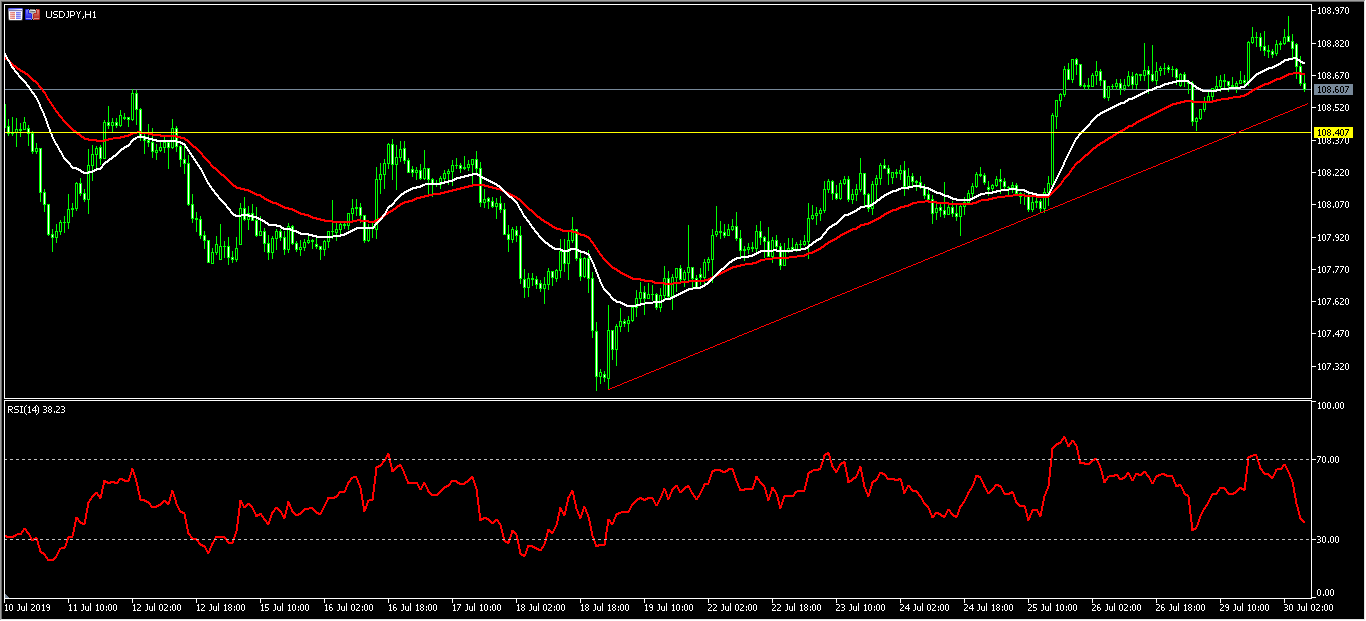
Sterling Struggles To Nurse Wounds Inflicted By No-Deal Brexit Fears
The past few days have offered investors a bitter appetizer on what to expect in the months ahead after Boris Johnson became the new UK Prime Minister.
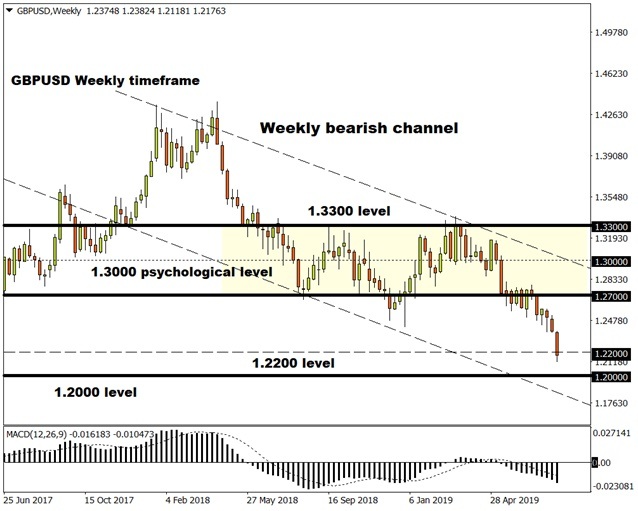
A severely depressed and unloved British Pound, disagreements with Brussels and chronic uncertainty over Brexit are positioned to be key themes shrouding the UK economy this quarter. Intensifying fears of a no-deal Brexit under Johnson's leadership are already being reflected in Sterling which is weakening against every single G10 currency today.
Michael Gove's comments over the weekend on how the government is “operating on the assumption” that the UK willleave the European Union has certainly not helped matters for the battered Pound. With uncertainty over Brexit set to mount ahead of the October 31 deadline, the Pound is fundamentally bearish.
The GBPUSD has already tumbled to a fresh 28 month low below 1.2150 this morning, and has scope to test 1.2000 if a solid daily close below 1.2100 is achieved.
Dollar stands tall ahead of Fed meeting
The Dollar jumped to a fresh two-month high against a basket of major currencies this morningahead of the Federal Reserve rate decision on Wednesday.
With markets pricing in a 79% probability of a 25-basis point cut, attention will be directed towards the dot-plot and Jerome Powell's press conference for fresh clues on when the Fed will cut rates again. Should the central bank sound less dovish than expected, expectations will most likely mount over the Federal Reserve holding off on further rate cuts beyond July.Although this will provide the Dollar with a welcome boost, the same cannot be said for global equity markets which have pushed higher on speculation over the Federal Reserve easing monetary policy.
The Dollar Index (DXY) has the potential to challenge 98.50 if an intraday breakout above 98.20 is secured.
Commodity spotlight – Gold
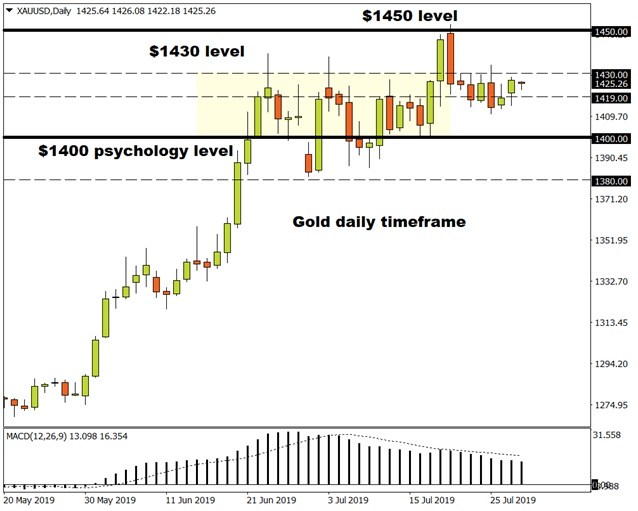
Where Gold concludes this week will be influenced by US-China trade talks in Shanghai, the Federal Reserve meeting on Wednesday and most importantly, the US jobs report on Friday.
Gold will find itself under pressure if the Federal Reserve is less dovish than expected and US jobs data on Friday dishes out an upside surprise. With anything on the table, the precious metal may remain rangebound until a catalyst is triggered. Focusing on the technical picture, prices are trading around $1425 as of writing. An intraday breakout above $1430 should encourage a move towards $1450.
WTI Futures Price Squeezed Between The Moving Averages
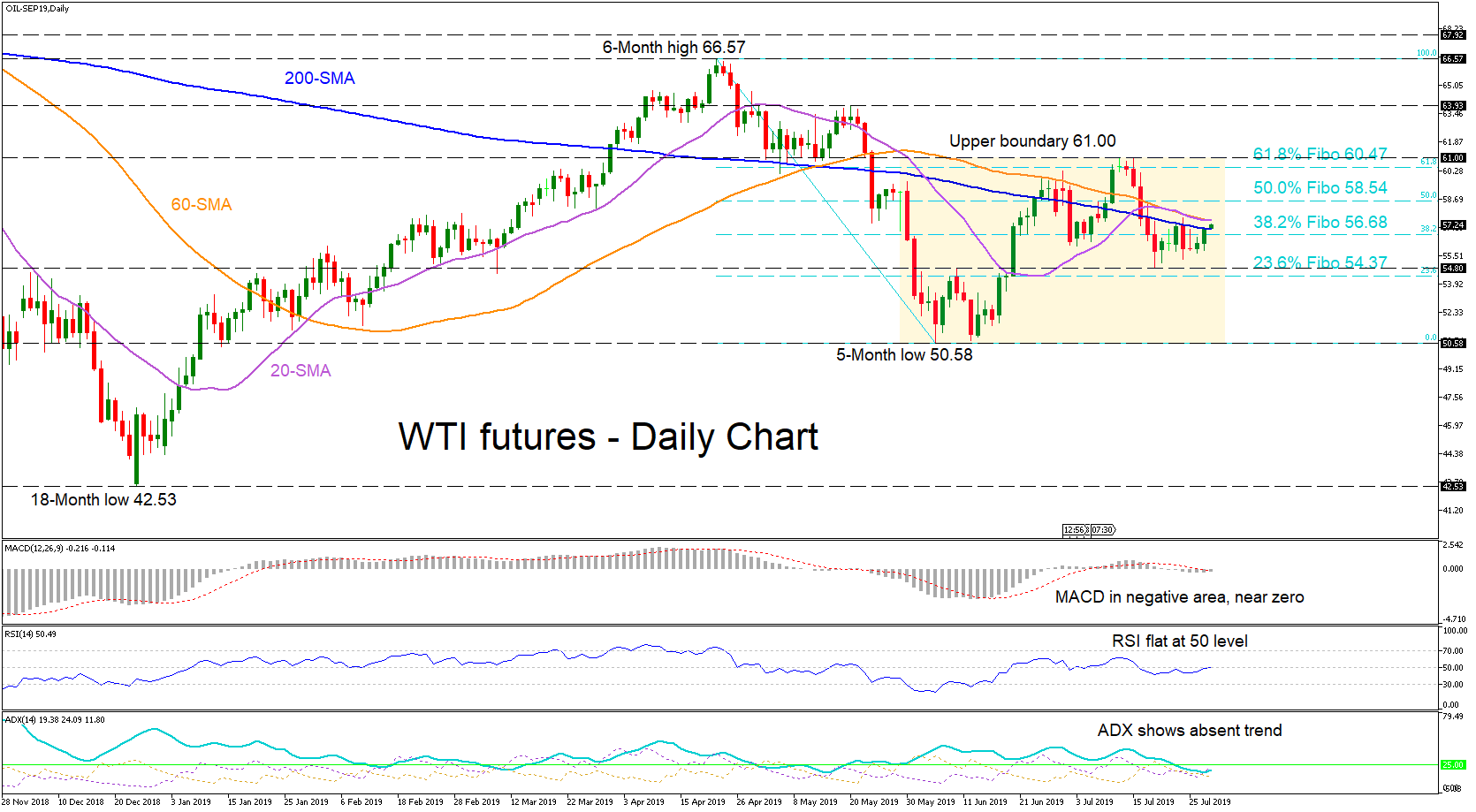
WTI oil futures have been flirting with the 200-day simple moving average (SMA) but were unable to close above it over the last week after finding support at the 54.80 level. The price seems to be caught between the 20-, 60- and 200-day SMAs in a sideways market that has lasted two-months, with formed candles which show no clear direction.
The ADX indicator suggests a trading range is in place, whilst the 20-, 60- and 200-day SMAs have converged showing further uncertainty to the price direction. The MACD and the RSI are flat at the zero line and the 50 level respectively, showing absent momentum in any single direction.
For moves to the upside, the coupled 20- and 60-day SMAs around 57.50 could initially come into play before the 58.54 level, which is the 50.0% Fibo of the down move from 66.57 to 50.58. Next in line is 60.47, the 61.8% Fibo, and slightly higher the resistance hurdle of 61.00. Further displacement may bring to light the six-month high of 66.57 once the 63.93 resistance is surpassed.
For the bearish picture, the SMAs would need to hold and push the price of oil below the 56.68 level, which is the 38.2% Fibo, so that the support of 54.80 can be retested. A continued move through 54.37, the 23.6% Fibo, could draw the attention to the five-month low of 50.58.
Summarizing, the short-term oil price is neutral for now, and a break of the range boundaries above (61.00) or below (50.58) would cement the next direction.
GBP/USD Outlook: Cable Extends Steep Fall In Early Tuesday’s
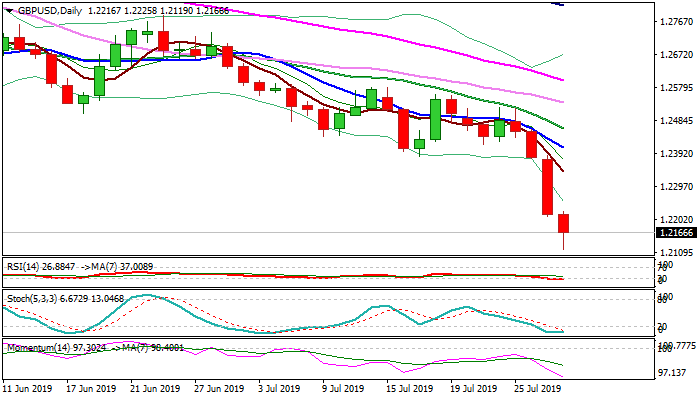
Cable extends steep fall in early Tuesday's trading to the lowest level since March 2017, in extension of Monday's 1.28% fall (the biggest one-day loss since 15 Nov 2018).
The pound collapsed after new PM Boris Johnson said that Britain would leave the EU without deal on 31 Oct if no changes in existing agreement.
Strong bearish sentiment intensified on fears of shock waves that would hit global economy on disorderly Brexit and push the Britain into recession. The Bank of England meets this week and is likely to add further pressure on pound on anticipated shift towards neutral bias, as the central bank is expected to stay on hold in coming months.
Also, rising market expectations of rate cut by the end of the year, on concerns of no-deal Brexit, signal further pressure on the currency.
Fresh weakness hit low at 1.2119, coming ticks ahead of 14 Mar 2017 low at 1.2108, violation of which would open 1.2085 (16 Jan 2017 low) and risk test of post-Brexit vote low at 1.1930 (7 Oct 2016 low).
Bearish daily/weekly studies support scenario, but oversold RSI/Stochastic warn of corrective action, with upticks expected to provide better selling opportunities. Initial resistance lay at 1.2200/25 (round-figure/session high), followed by 20-d lower Bollinger band (1.2254).
Res: 1.2200, 1.2225, 1.2254, 1.2300
Sup: 1.2119, 1.2110, 1.2085, 1.2000
Watch For A Trend Continuation While The Price Is Below 121.36
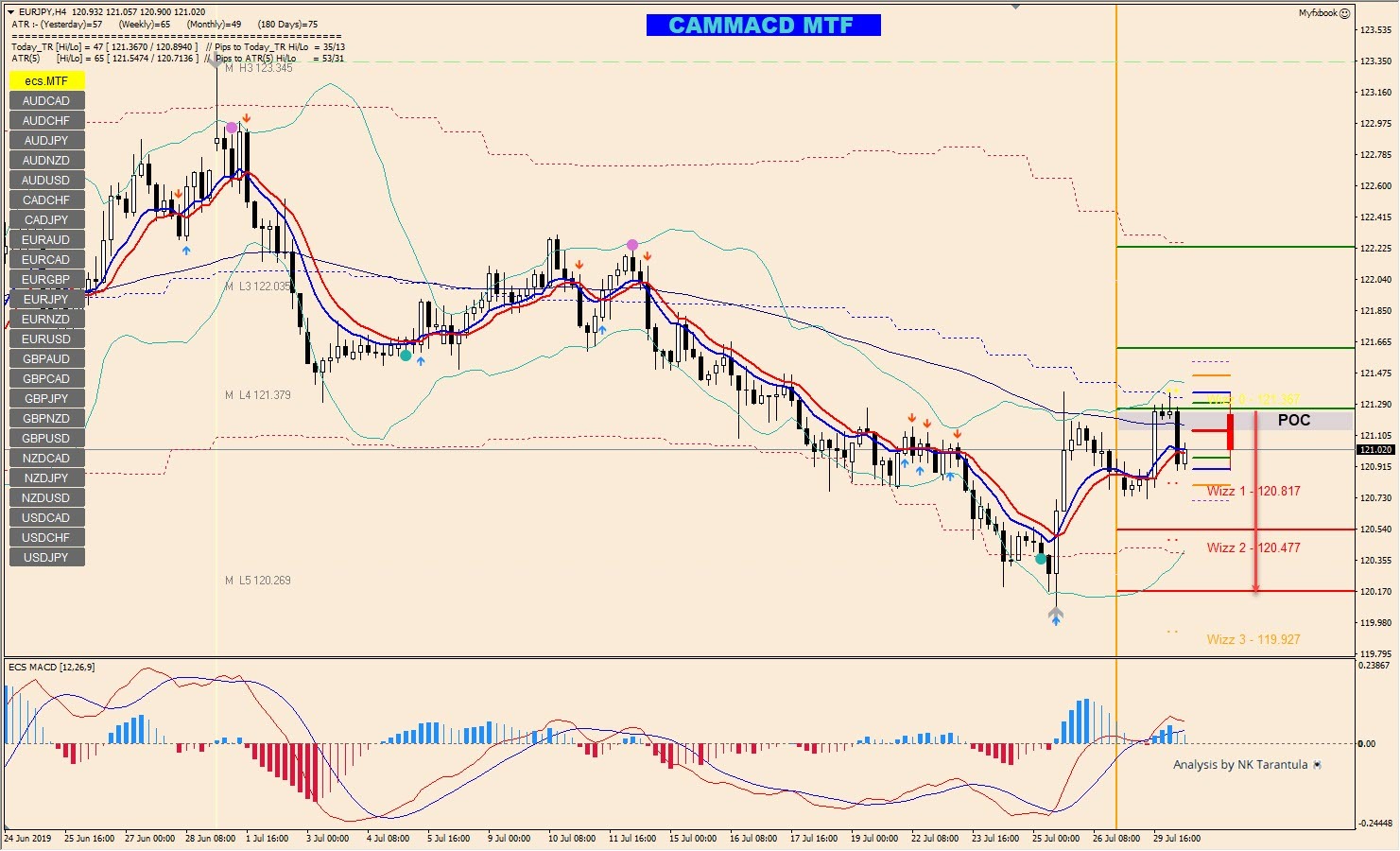
The EUR/JPY, popular 'Yuppy' has formed a zig-zag downtrend, and we can see a retracement straight towards the POC zone.
Rejections from 121.10-36 could show fresh sellers within the zone. However, we should see a confirmation in the next couple of hours. On a successful rejection, the pair should reach 120.81 followed by 121.47 and 120.15. On a powerful bearish impulse, we could also see 119.92. At this point, the upside is limited to 121.60, but as explained, ideally the pair needs to stay below 121.36 for bears to dominate.
P.S. Check out MYFXbook performance for the last 8 months on a verified LIVE account. Each trader and 'mentor' should disclose his/her trading results publicly from time to time. Transparency is the key for a mutual trust.
The Pound Collapsed To Hstorically Low Levels
GBPUSD
The British pound was sold out on growing fears of a potential ‘no deal’ Brexit. GBPUSD declined by 2% to 1.2130. Below these levels, the pair traded for only a few hours during the period from October 2016 to March 2017 because of the initial shock after the British referendum. The pound hasn't been consistently lower since 1985. The new UK government notes that it considers the exit without a deal as the main scenario, as the EU does not want to discuss a number of conditions. The current situation around the British currency is highly volatile. As in the previous episode three years ago, extremely oversold conditions sharply increase the sensitivity of the pound to Brexit news. Purchases in the foreign exchange market at the background of relatively good news may be reinforced by the desire of participants to buy the pound at historically low levels. On the other hand, the decline is currently intensified by a massive triggering of stop-orders, which can be seen by the rather torn dynamics of GBPUSD during the Asian session, where there were several episodes of GBPUSD decline by 20 points per minute.
EURGBP
The single currency stands apart from the weakening of the sterling this time, so the EURGBP came into play. From the moment of Johnson's first comments as prime minister EURGBP rose by 3.2%, of which 2% related to the growth since the beginning of the week. Historically, the pair feels very unstable at levels above 0.90. For the last 11 years above current levels near 0.9200, the pair appeared only in the periods of the highest market turbulence. The market pressure also shifted relatively quickly from the British currency to the euro, which provoked a pullback in the pair, as soon as the market shocks gave way to long-term purchases of the pound on the downturns and weakening of the euro against the currencies outside Europe.
Stocks
The pound’s drop contributed to the strengthening of British stocks. The FTSE100 added 2.2% since the beginning of the week to annual highs, the index growth from Friday surpasses 3.4%, which exceeds the scale of the pound's weakening. This is a clear indication that the stock markets are not yet too afraid of long-term negative consequences for the economy. In addition, the stock's growth is supported by positive sentiment in the hope that the policy will be eased soon. The Bank of Japan kept the policy unchanged but warned that it will undoubtedly soften it, if needs be. In addition, the markets are confident in the cut of the Fed's rate on Wednesday and are ready to receive signals of a possible further easing of the policy.
BoJ Kuroda: We went a step forward to additional policy easing
In the post policy meeting, BoJ Governor Haruhiko Kuroda indicated that the central bank has already taken a step forward to further monetary easing. And, the tools include cutting short-, long-term interest rates, increasing asset buying or accelerate the pace of base money expansion.
Kuroda said, “today, we went a step forward by saying we’ll take additional easing steps without hesitation if there is a risk the economy will lose momentum for hitting our price target". And, “previously, we said only that we will consider acting if the economy loses momentum for hitting our price goal.”
Nevertheless, Kuroda also noted “I don’t think Japan has lost momentum to hit the BOJ’s price goal, or that there is an imminent risk of this happening.". While, policymakers need to pay attention to downside risks, for now, "we expect the economy to continue expanding moderately, and that it is sustaining momentum for hitting our price goal."