


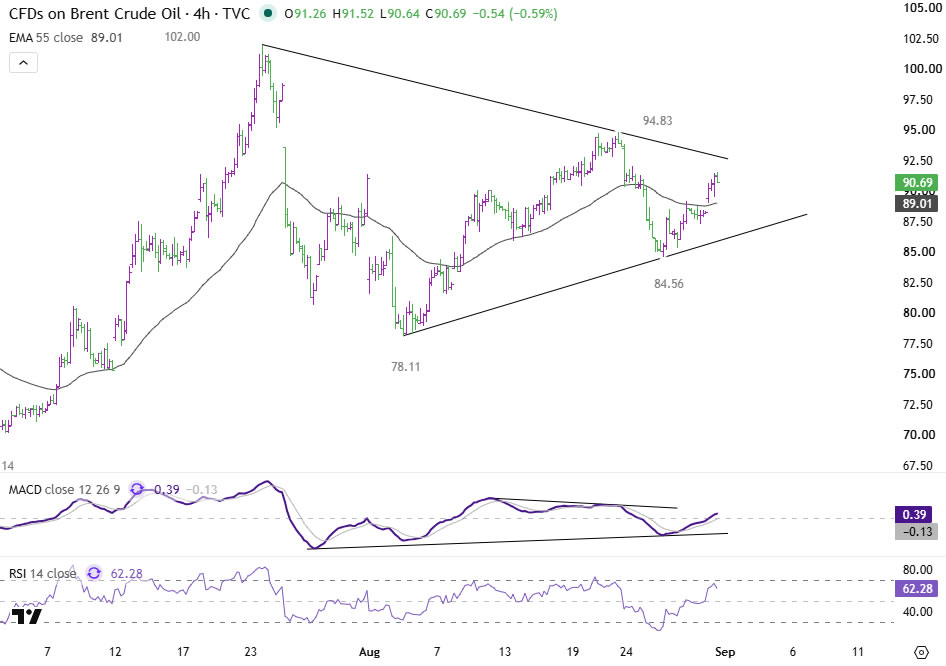
What’s happening: Brent surged back above $90 Monday after US forces struck two IRGC rocket launchers on Larak Island Sunday, the first acknowledged US strike on Iran since late July, and Iran retaliated with ballistic missiles against two US-linked bases in Jordan, with all eight reportedly intercepted. That reverses part of last week’s de-escalation trade, with sanctions pressure and direct military action now running concurrently rather than sequentially.
Why it matters: Oil is reacting forcefully, but the rest of the market isn’t confirming a full risk-off move. Dollar is weaker but looks like digestion of Friday’s Warsh-driven surge rather than a reversal, Yen’s rebound looks like intervention-threat short-covering rather than generic risk aversion, and Gold’s bounce off a roughly 1.5-week low remains consistent with a correction, not a reversal. Investors are repricing geopolitical risk, not panicking, which makes the durability of Brent’s move, not just its headline level, the real thing to watch.
Oil Reprices Return of Direct US-Iran Conflict
Brent surged back above $90 on Monday as direct military exchanges between US and Iran resumed, reversing part of last week’s de-escalation trade. Last week, markets grew more confident that sanctions and diplomatic pressure were replacing direct military confrontation. That assumption is now under pressure.
US forces struck two IRGC rocket launchers on Larak Island on Sunday, the first acknowledged US strike on Iran since late July. CENTCOM said the launchers were being prepared for mine-laying operations near the Strait of Hormuz, framing the action as a response to an imminent threat only days after US forces had finished clearing mines from shipping lanes.
Iran presented events differently, saying the US had “struck first” after a roughly month-long lull. The Revolutionary Guard retaliated on Monday with ballistic missiles targeting two US-linked bases in Jordan, with all eight reportedly intercepted and no casualties. Iran also claimed drone attacks against a UAE base, though those reports remain unconfirmed.
For markets, attribution matters less than the broader shift in risk regime. Sanctions pressure and direct military action are now operating concurrently rather than sequentially, weakening the recent narrative that financial pressure had become an alternative to renewed conflict. At the same time, both the Strait of Hormuz and Bab el-Mandeb remain active shipping-risk points, raising concern that two strategically important Gulf routes could face disruption simultaneously.
Monday’s Escalation Timeline
- Sunday: US strikes two IRGC rocket launchers on Larak Island, first acknowledged US strike on Iran since late July.
- CENTCOM’s framing: launchers were being prepared for mine-laying operations near the Strait of Hormuz.
- Monday: Iran’s Revolutionary Guard retaliates with ballistic missiles against two US-linked bases in Jordan, all eight reportedly intercepted, no casualties.
- Unconfirmed: Iran claims drone attacks against a UAE base.
Oil Shock Reinforces Post-Warsh Inflation Risk
The oil rebound also arrives at an awkward moment for the broader macro backdrop. Fed Chair Warsh’s Jackson Hole speech on Friday had already pushed markets toward earlier Fed tightening, with September hike expectations jumping sharply and front-end Treasury yields leading the move.
Renewed oil pressure reinforces that hawkish setup rather than offsetting it. The transmission mechanism is straightforward: persistent energy disruption raises inflation risk, firmer inflation expectations strengthen the case for keeping rates restrictive, and higher rate expectations then weigh on rate-sensitive risk assets and precious metals.
That makes the durability of Brent’s rebound more important than the headline level alone. A temporary spike above $90 can fade without materially changing policy expectations. A sustained move higher, particularly if shipping disruption worsens, would have much larger implications for the inflation outlook and Fed pricing.
Meanwhile, US President Donald Trump’s threat to target Kharg Island, Iran’s main oil export terminal, adds another layer of headline risk. That rhetoric should be separated from the base-case probability of an actual strike. Maritime-security analysts cited in the current discussion regard such action as relatively unlikely because of environmental, strategic and cultural-heritage consequences. Still, the threat alone increases sensitivity to further Middle East headlines.
Dollar Retreats, but Warsh Repricing Has Not Reversed
Dollar is broadly weaker on Monday, but the price action so far looks more like digestion of Friday’s surge than reversal of hawkish Fed repricing.
Three separate forces are probably at work. First, some profit-taking is natural after a sharp Warsh-driven move. Second, Monday is the final trading day of August, leaving month-end portfolio rebalancing and hedging flows capable of pushing against the underlying trend. Third, positioning is becoming more cautious ahead of Friday’s August nonfarm payrolls report, now the single most important near-term test of post-Warsh Fed expectations.
Those explanations should not be collapsed into one fundamental narrative. None by itself implies investors have abandoned the idea of earlier Fed tightening. Dollar weakness is broad, but losses remain modest, and the current heat-map structure shows weakness without widespread breaks beyond previous daily ranges. That is more consistent with retracement than outright trend reversal.
Payrolls therefore carry unusually high weight this week. Strong labor data would reinforce Warsh’s inflation-first framework and support elevated September hike odds. A material downside surprise would challenge that repricing and give the Dollar pullback a stronger fundamental basis.
Three Forces Behind Monday’s Dollar Weakness
- Profit-taking after Friday’s sharp Warsh-driven move.
- Month-end portfolio rebalancing and hedging flows, Monday is the final trading day of August.
- Cautious positioning ahead of Friday’s August nonfarm payrolls report.
Yen Rebounds as Traders Guard Against Intervention
Yen is outperforming more decisively. USD/JPY briefly broke above 160 overnight, its weakest Yen level in around a month, before reversing toward 159.65, leaving the pair down roughly -0.3%.
This move is better understood as intervention threat-driven short-covering than generic risk aversion. The breach of 160 put traders back on intervention watch, with 161 and the 162-163 area being discussed as levels where the risk of official action could rise further. Yen positioning remains crowded enough that even the absence of confirmed intervention can trigger rapid covering once psychologically important thresholds are crossed.
July provides a useful parallel. Japan’s Ministry of Finance confirmed on Aug. 1 that coordinated US-Japan intervention had taken place on July 31, during another NFP week. The setup then also involved a stretched short-Yen position, round-number pressure and major US labor data approaching.
The current environment rhymes with that episode, but it is not identical. There has been no sign of intervention today, and the underlying rate differential between US and Japan still favors carry demand against Yen. That means the rebound could prove fragile if authorities stay sidelined and Friday’s payrolls reinforce higher US yields.
Risk-Off Tone Is Mild, Not Disorderly
Broader market reaction remains restrained relative to the oil move. Asian equities traded lower across the board and US futures were slightly softer, while AUD and NZD sat toward the weaker end of the currency complex.
Gold recovered modestly after touching a roughly 1.5-week low during the Asian session. Iran escalation is providing some support, but the move remains consistent with the correction-not-reversal framework established earlier Monday. Post-Warsh rates repricing continues to exert pressure, preventing geopolitical demand from producing a stronger rebound.
That cross-asset combination is important. Oil is reacting forcefully to the return of direct US-Iran conflict, but equities, Dollar and Gold are not yet behaving as though markets expect uncontrolled escalation. Investors are repricing geopolitical risk, not panicking.
Markets Need to Decide Whether Escalation Is Persistent
The near-term question is whether Monday marks the start of another sustained escalation cycle or only a brief return of direct exchanges after several quieter weeks.
For oil, confirmation would come from further strikes, renewed disruption around Hormuz, escalation involving Kharg Island, or broader interference with shipping. For rates and Dollar, the key issue is whether higher energy prices feed inflation expectations enough to reinforce the Warsh-driven tightening path. For Yen, intervention risk is likely to remain elevated as long as USD/JPY trades around 160 and above.
For now, the message across markets is relatively clear: oil is starting to reprice a genuine geopolitical shock, but the rest of the market is still treating it as contained rather than systemic.
Related Coverage
Gold & Central Bank Deep Dives
- Read why Gold’s pullback looks like a correction rather than a confirmed reversal, with the 4,320-4,338 area forming key confluence support and $4,300 the broader line that matters: Gold Correction, Not Reversal? Why $4,300 Is the Line That Matters.
- See why Wednesday’s widely-priced RBNZ hike matters less than whether the updated OCR track can finally push NZD/USD through 0.6000: RBNZ Hike Is Priced In. Can the OCR Track Push NZD/USD Through 0.60?.
- Read why BoE’s Bailey warns frontier AI could become a systemic financial risk through cyber threats, concentrated tech dependencies and rising leverage, not just a valuation problem: AI Risk Is Bigger Than Valuations: BoE’s Bailey Flags Cyber, Leverage and Market Fragility.
Asia-Pacific Data Deep Dives
- See why Japan’s industrial production beating forecasts for a fourth straight month, alongside a retail sales rebound, adds evidence domestic activity is holding up ahead of the BoJ’s Sept. 18 meeting: Japan Industrial Production Beats Forecast as Retail Sales Rebound.
- Read why New Zealand’s softer headline business confidence still came with stronger realized activity and rebuilding price pressures: NZ ANZ Business Confidence Eases to 53.7, but Activity Strengthens and Price Pressures Rebuild.
- See why China’s manufacturing PMI nearing 50 wasn’t enough to lift the composite out of contraction, with services still stuck at 49.0: China NBS PMI Manufacturing Nears Recovery at 49.8, but Services Keep Economy Below 50.
Frequently Asked Questions
Q: Why is oil surging while the rest of the market isn’t in full risk-off mode?
A: Because oil has the most direct, mechanical link to the actual event, the return of confirmed direct military exchanges between the US and Iran, while other assets are responding to a mix of factors that only partly overlap with the geopolitical shock. Dollar’s move looks like digestion of Friday’s Warsh-driven surge, Yen’s rebound looks like intervention-threat positioning, and Gold’s bounce is consistent with an existing correction. None of those three are showing the kind of broad, disorderly moves that would signal markets expect uncontrolled escalation.
Q: Why is Yen rebounding if this isn’t a typical risk-aversion move?
A: Because USD/JPY’s brief break above 160 put traders back on intervention watch rather than triggering generic safe-haven buying. Yen positioning is crowded enough that even the absence of confirmed intervention can trigger rapid short-covering once a psychologically important level like 160 is crossed, echoing the pattern from Japan’s confirmed July 31 intervention. But no intervention has actually occurred this time, and the US-Japan rate differential still favors carry demand against Yen, so the rebound could prove fragile.
Q: What would confirm this is the start of a sustained escalation cycle rather than a brief flare-up?
A: For oil, further strikes, renewed disruption around the Strait of Hormuz, escalation involving Kharg Island, or broader interference with shipping. For rates and Dollar, whether higher energy prices feed into inflation expectations enough to reinforce the Warsh-driven tightening path. For Yen, intervention risk stays elevated as long as USD/JPY trades around 160 or above. Until those signals firm up, markets appear to be repricing geopolitical risk rather than pricing in a systemic shock.
Key Takeaways
- Brent surged back above $90 after the first acknowledged US strike on Iran since late July and Iranian ballistic missile retaliation against two US-linked bases in Jordan.
- Sanctions and direct military action are now running concurrently: Weakening the recent narrative that financial pressure had replaced renewed conflict, with both Hormuz and Bab el-Mandeb remaining active shipping-risk points.
- Oil’s rebound reinforces, rather than offsets, Warsh’s hawkish repricing: Persistent energy disruption raises inflation risk, which supports a higher-for-longer Fed path.
- Trump’s Kharg Island threat adds headline risk, but an actual strike is seen as unlikely: Maritime-security analysts cite environmental, strategic and cultural-heritage consequences.
- Dollar’s weakness looks like digestion, not reversal: Profit-taking, month-end flows and pre-payrolls caution, not an abandonment of hawkish Fed expectations.
- Yen’s rebound past 160 looks like intervention-threat short-covering: Echoing the confirmed July 31 intervention episode, though no intervention has occurred this time and the rate differential still favors carry demand against Yen.
- The broader message is contained risk repricing, not panic: Equities, Dollar and Gold aren’t showing the kind of disorderly moves that would signal markets expect uncontrolled escalation.
What to Watch Next
Friday’s August nonfarm payrolls report is the single most important near-term test of post-Warsh Fed pricing. Watch for further strikes or escalation around Hormuz and Kharg Island as the key confirmation point for oil, and watch whether USD/JPY sustains levels above 160 and draws an actual intervention response.





