Sample Category Title
MARKET WRAP: Stocks Dropped On Trump Tweets; Dollar Maintained Its Strength
*Fed may show more dovish hand after weak core CPI (inflation) number *Sterling made another multiyear low
Stocks
- The S&P 500 Index continued its sell off for the second day becuase of poor earning data and lost 0.37% of its value as of 15:25 London time.
- The Stoxx Europe 600 Index reacted to slowdown in the French economic numbers and dropped 1.47%.
- The UK FTSE 100 index retraced from its yesterday’s high because of Brexit fear and the index sank 0.33%
Currencies
- The Dollar Spot Index maintained its bull run and gained another 0.11%.
- The Euro moved back in positive territory but still well below the critical level of 1.12. It rose only 0.07%.
- The British pound made another multi-year low and fell 0.38% to 1.2173.
- The Japanese yen moved higher by 0.25% to 108.59.
Bonds
- The Yield on 10-year Treasuries dropped by two basis point to 2.05%.
- Britain’s 10-year yield fell to 0.63%.
Commodities
- West Texas Intermediate crude continued to build more gains today and made a high of 57.55. It rose 0.40% to $57.09 a barrel.
- Gold price surged on the back of weak US economic numbers. It rose 0.48%.
Sunset Market Commentary
Markets
Global core bonds showed no clear trend today despite a general risk off climate. Both the German Bund and US Treasuries initially edged higher, albeit very gradually. Core bonds printed a little spike after US president Trump complained China isn’t buying farm goods as promised, adding “they just don’t come through”. His comments suggest difficult trade talks ahead. The up-leg lacked momentum however. A second attempt following slightly below consensus US PCE data also failed. German inflation data (regional and HICP) were mixed with little impact on trading. US yields eventually closed unchanged, erasing losses inflicted by early US investors after a stellar Conference Board consumer confidence (135.7). German yield changes are close to unchanged, with only the very long end declining 1 bp (30-yr). Peripheral spreads widen further with Italy (+5 bps) again underperforming.
The euro in general and EUR/USD show remarkably resilient today. The EMU eco data, including a below census French GDP and poor EC confidence indicators and German inflation drifting further away from the 2.0% inflation target, all could be used to sell the euro. However, the opposite occurred. Yesterday afternoon EUR/USD already bounced off the 1.1100/10 support area. The pair temporarily lost a few ticks in Asia but turned again north from the start European dealings. An escalation of the EU-UK Brexit row won’t help to support confidence in the EMU and in theory should be a euro negative. However, it was also ignored. US president Trump accused China of unwillingness to buy American agricultural products. The Trump headlines only reinforced a risk-off reaction on equities, to a lesser extent in core bonds, but dollar lost some further ground, both against the euro and the yen. Is this just investor repositioning ahead of tomorrow’s Fed policy meeting? Or is the euro bought back as low-yielding funding currency in carry trades? At 1.1150, the pair has again some breathing space versus the 1.11 support area. USD/JPY is losing a few ticks trading near 108. 50.
The UK government openly heading for a clash with the EU is raising the odds of a no deal Brexit. This uncertainty reinforced the sterling sell-off that restarted yesterday morning. Sterling dropped below important technical levels against the dollar and the euro as markets adapted positions to this developing political situation. EUR/GBP surpassed the 0.91 resistance overnight and ‘easily’ extended gains beyond this level today as there is no sign that the EU or the UK are prepared to consider a compromise. EUR/GBP is currently trading in the 0.9150/60 area. The EUR/GBP 0.9307 2017 top is the last defence ahead of the post Brexit top (0.9415 area). The decline of cable was a bit less violent today as the dollar lost against the euro. Even so, near 1.2120 the pair touched the lowest level since March 2017 this morning. Interesting to hear the assessment of the BoE at Thursday’s policy meeting.
News Headlines
China’s Politburo said it would take up efforts to support the economy a notch as investors await more stimulus from the government to kickstart growth, which has slowed to a multi decade low. However, China will not resort to short-term measures such as easing curbs on real estate, it said. Such a move could spur a further build-up in household debt and risk property bubbles. Meanwhile, China’s central bank increased lending quotas of commercial banks and told them to step up lending appropriately, sources reported.
Turkish finance minister Albayrak said he expects Turkey to post positive growth close to its 2.3% target in 2019 but admitted that the budget deficit is likely to be higher than previously thought. On monetary policy, Albayrak added he anticipates “significant rate cuts this period”.
EUR/USD Mid-Day Outlook
Daily Pivots: (S1) 1.1122; (P) 1.1136 (R1) 1.1160; More.....
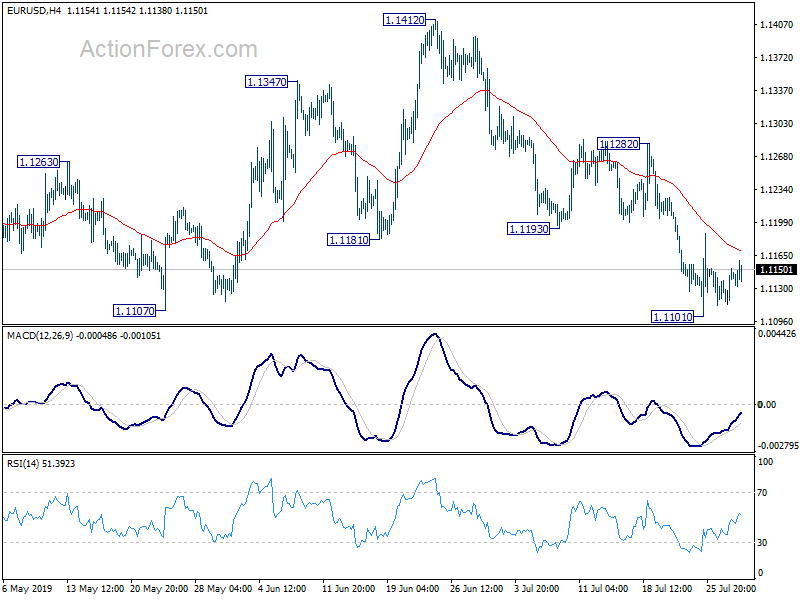
Intraday bias in EUR/USD remains neutral for the moment. More consolidation could be seen above 1.1101 temporary low. Another recovery cannot be rule out. But still, as long as 1.1282 resistance holds, further decline is expected. Sustained break of 1.1107 low will resume larger down trend from 1.2555. Though, firm break of 1.1282 will bring stronger rise to 1.1412 resistance.
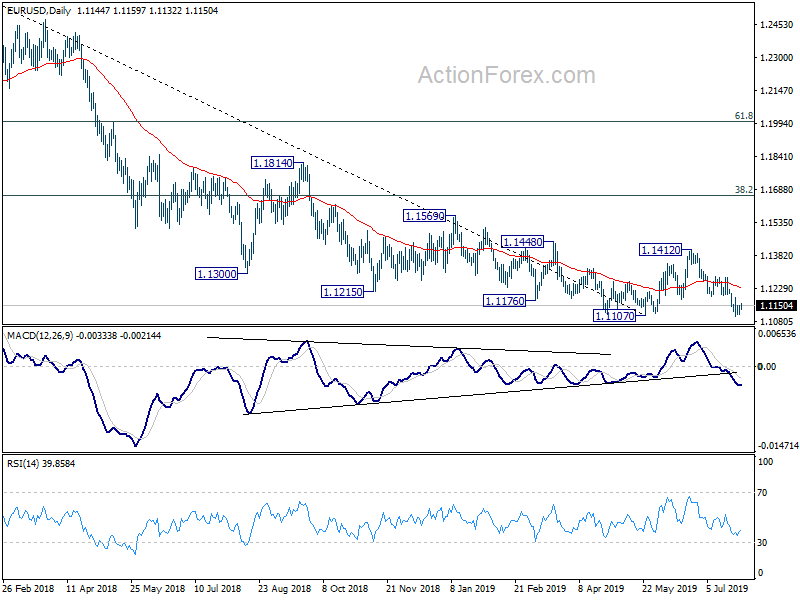
In the bigger picture, on the one hand, 1.1107 is seen as a medium term bottom on bullish convergence condition in weekly MACD. On the other hand, rejection by 55 week EMA retains medium term bearishness. Outlook stays neutral for now. On the downside, break of 1.1107 will resume the down trend from 1.2555 (2018 high) to 78.6% retracement of 1.0339 to 1.2555 at 1.0813. Meanwhile, break of 1.1412 will resume the rebound to 38.2% retracement of 1.2555 to 1.1107 at 1.1660.
GBP/USD Mid-Day Outlook
Daily Pivots: (S1) 1.2159; (P) 1.2272; (R1) 1.2331; More...
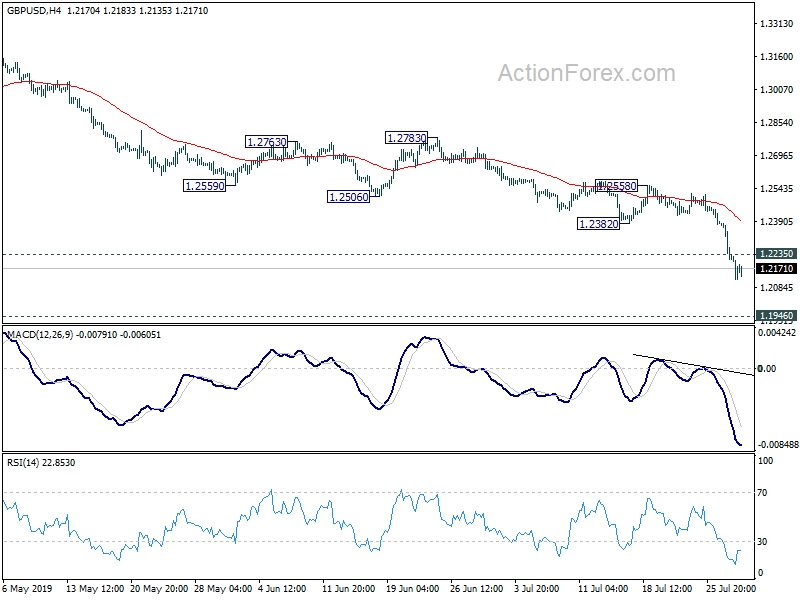
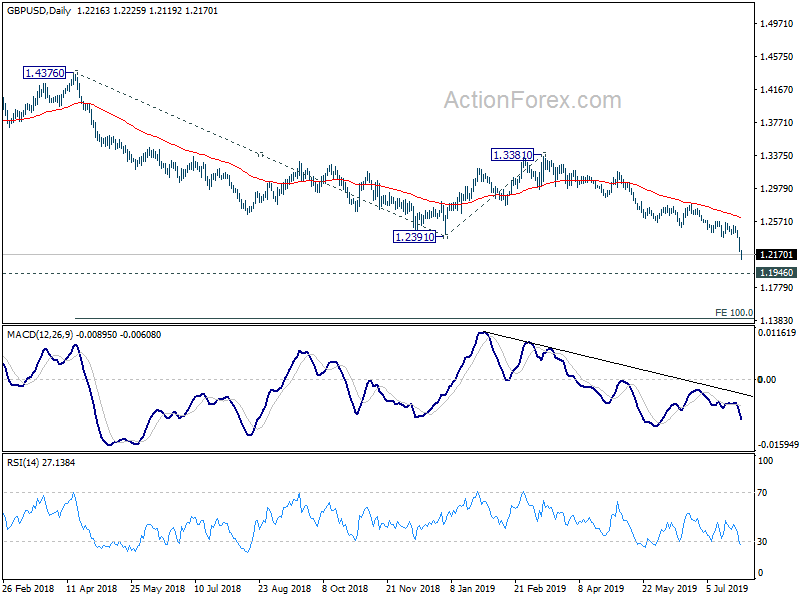
Intraday bias in GBP/USD remains on the downside at this point. Deeper decline would be seen to retest 1.1946 low. We'd be cautious on bottoming there. But break will target 100% projection of 1.4376 to 1.2391 from 1.3381 at 1.1396. On the upside, above 1.2235 minor resistance will turn intraday bias neutral and bring consolidation. But recovery should be limited by 1.2383 support turned resistance to bring fall resumption.
In the bigger picture, down trend from 1.4376 (2018 high) is still in progress and is resuming. Such decline should target a test on 1.1946 long term bottom (2016 low) next. For now, we don’t expect a firm break there yet. Hence, focus will be on bottoming signal as it approaches 1.1946. However, firm break of 1.1946 will resume down trend from 2.1161 (2007 high) to 61.8% projection of 1.7190 to 1.1946 from 1.4376 at 1.1135. In any case, medium term outlook will stay bearish as long as 1.3381 resistance holds, in case of strong rebound.
USD/CHF Mid-Day Outlook
Daily Pivots: (S1) 0.9905; (P) 0.9921; (R1) 0.9934; More.....
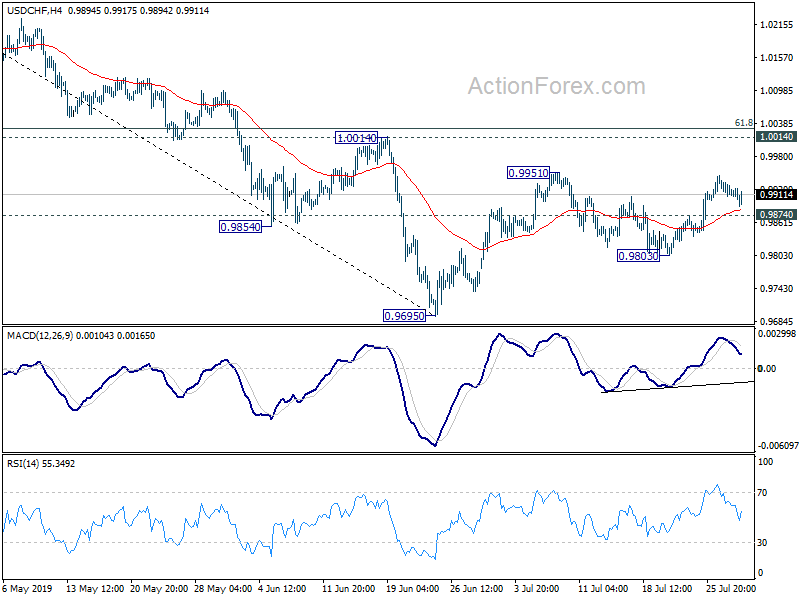
Intraday bias in USD/CHF remains neutral at this point. Further rise is expected with 0.9874 minor support intact. Break of 0.9951 resistance will resume the rebound from 0.9695 to 1.0014 resistance next. On the downside, break of 0.9874 minor support will turn bias back to the downside for 0.9803 support and below.
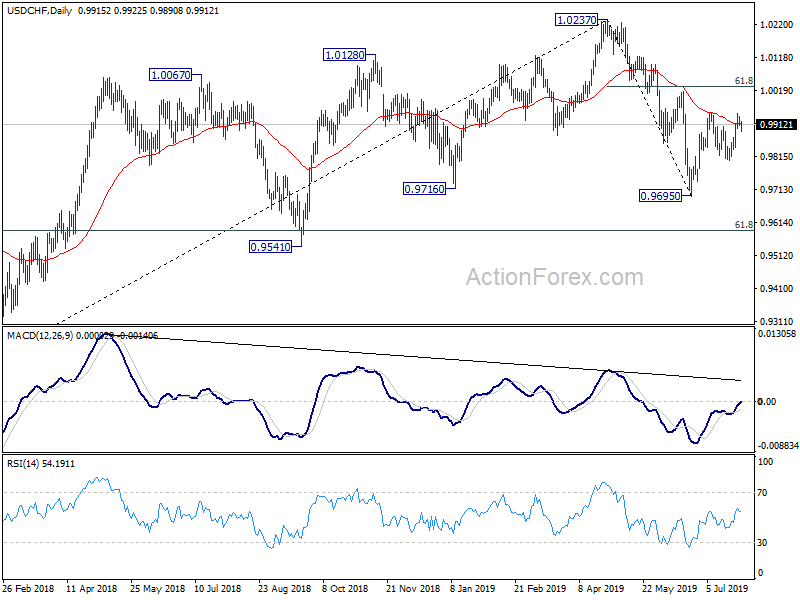
In the bigger picture, up trend from 0.9186 (2018 low) should have completed at 1.0237 already. Deeper decline would be seen to 61.8% retracement of 0.9186 to 1.0237 at 0.9587 and below. For now, USD/CHF is seen as in long term range pattern between 0.9186 and 1.0342. Hence, we'd pay attention to bottoming signal below 0.9587. However, sustained break of 1.0014 will revive medium term bullishness and turn focus back to 1.0237 high.
USD/JPY Mid-Day Outlook
Daily Pivots: (S1) 108.51; (P) 108.70; (R1) 108.99; More...
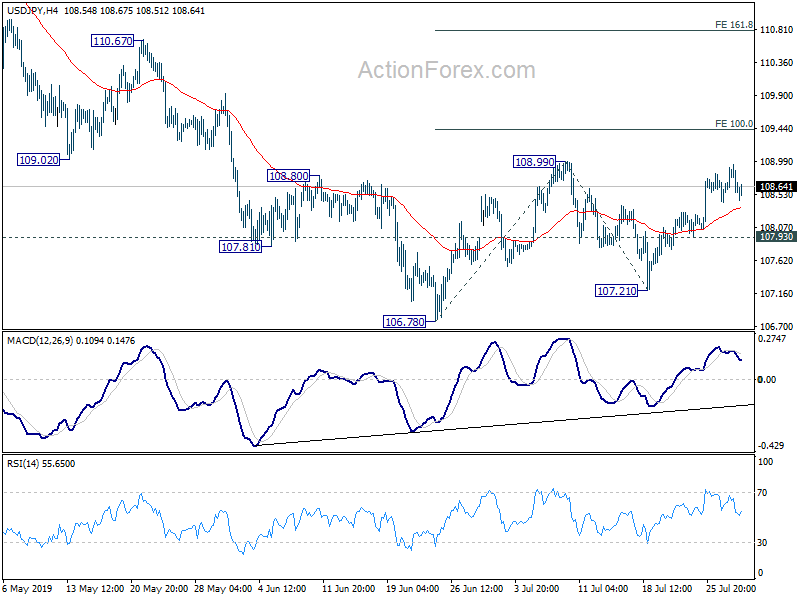
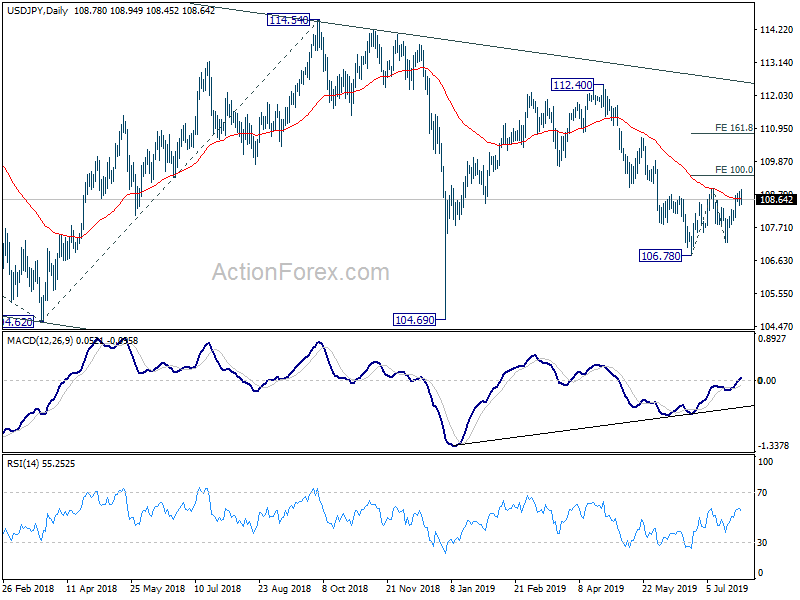
Intraday bias in USD/JPY remains neutral at this point. With 107.93 minor support intact, further rise is expected. On the upside, break of 108.99 will resume the rebound from 106.78 for 100% projection of 106.78 to 108.99 from 107.21 at 109.42 and then 161.8% projection at 110.78. On the downside, below 107.93 minor support will turn bias back to the downside instead.
In the bigger picture, decline from 118.65 (Dec 2016) not completed yet, with the pair staying inside long term falling channel. Break of 104.62 will target 100% projection of 118.65 to 104.62 from 114.54 at 100.51. For now, we’d expect strong support above 98.97 (2016 low) to contain downside to bring rebound. In any case, break of 112.40 is needed to the first serious sign of medium term bullishness. Otherwise, further decline will remain in favor in case of rebound.
Dollar Mixed after Core PCE Inflation Miss, Aussie Tumbles on Risk Aversion
Sterling remains the overwhelmingly weakest one on no-deal Brexit concerns. New Prime Minister Boris Johnson is pushing EU to re-open Brexit negotiation. But there is no sign from EU on a position shift yet. Australian and New Zealand Dollars are the next weakest as markets turn into risk averse mode. On the other hand, Swiss Franc is the strongest one, followed Euro. Dollar is mixed as today's US core PCE inflation reading is not enough to alter Fed's decision to cut interest rate tomorrow.
Technically, selloff in Australian Dollar intensifies in early US session on risk aversion. AUD/USD is on track to retest 0.6831 support. EUR/AUD is pressing 1.6231 resistance and break will confirm completion of corrective fall from 1.6448 at 1.5894. Further rise could then be seen back to retest 1.6448.
In other markets, US stocks open mildly lower with DOW down -0.30% at the time of writing. 10-year yield is flat at 2.066. In Europe, FTSE is down -0.41%. DAX is down -2.23%. CAC is down -1.62%. German 10-year yield is down -0.0053 % -0.394. Earlier in Asia, Nikkei rose 0.43%. Hong Kong HSI rose 0.14%. China Shanghai rose 0.39%. Singapore Strait Times rose 0.12%. Japan 10-year JGB yield dropped -0.0044 to -0.151.
US core PCE rose to 1.6%, not enough to change Fed's decision
In June, personal income rose 0.4%, above expectation of 0.3%. Personal spending rose 0.3%, matched expectations. Headline PCE was unchanged at 1.4% yoy, missed expectation of 1.5% yoy. Core PCE inflation accelerated to 1.6% yoy, up from 1.5% yoy, but missed expectation of 1.7% yoy.
The lack up materialistic acceleration in core inflation does nothing to alter FOMC policymakers' mind regarding tomorrow's rate decision. For now, Fed is still generally expected to cut interest rate by -0.25bps to 2.00-2.25%. The main question is whether Fed would explicitly say that it's a one-off, or it's a start of a policy easing cycle.
Also from the US, S&P Case-Shillar 20-cities house price rose 2.% yoy in May, matched expectations. Pending home sales rose 2.8% mom in June, above expectation of 0.3% mom. Consumer confidence improved to 135.7, up from 124.3, beat expectation of 125.0.
Eurozone confidence indicators deteriorated in July
Eurozone economic confidence dropped to 102.7 in July, down from 103.3 but matched expectation. Industrial confidence dropped to -7.4, missed expectation of -6.7. Services confidence dropped to 10.6, missed expectation of 10.7. Consumer confidence was finalized at -6.6. Business climate indicator dropped to -0.12, missed expectation of 102.7.
German CPI accelerated, consumer confidence dropped slightly
German CPI rose 0.5% mom in July, above expectation of 0.5% mom. Annually, CPI accelerated to 1.7% yoy, beat expectation of 1.5% yoy.
Gfk consumer confidence for August dropped -0.1 to 9.7, matched expectations. Economic expectations dropped from 2.4 to -3.7. Income expectations improved from 45.5 to 50.8. Propensity to buy dropped from 53.7 to 46.3. Gfk noted that “It is apparent that the global economic slowdown, trade conflict and Brexit discussions are having an ever increasing impact on consumer confidence. Thus, economic expectations continue to decline and the propensity to buy has dropped off slightly as well.”
Economic expectation fell below its long-standing average of 0 for the first time since March 2016. It's also the lowest reading since November 2015. Gfk said: “The trade war with the US, ongoing Brexit discussions and the global economic slowdown continue to drive fears of a recession. Employees in export-driven sectors in particular, such as the automotive industry and its suppliers, are most immediately affected by this. In addition, reports of downsizing add to employees' fears of losing their jobs.”
French GDP grew 0.2% qoq in Q2, missed expectation
French GDP grew 0.2% qoq in Q2, missed expectation of 0.3% qoq, slowed from Q1's 0.3% qoq. Looking at the details, household consumption expenditure slowed from 0.4% qoq to 0.2% qoq. But total gross fixed capital formation jumped from 0.5% qoq to 0.9% qoq. Final domestic demand excluding inventories accelerated slightly. Imports were stable, slowed from 1.1% qoq to 0.1% qoq. Export growth was unchanged at 0.2% qoq. Foreign trade balance didn't contribute to GDP growth, at 0.0%.
Swiss KOF rose to 97.1, slightly more favorable signals from manufacturing, and services
Swiss KOF Economic Barometer rose to 97.1 in July, up fro 93.8 and beat expectation of 93.3. KOF said: “Slightly more favourable signals than before are coming from manufacturing, other services, accommodation and food service activities as well as financial and insurance services. Construction is contributing slightly to the positive development. Consumer prospects are practically unchanged. On the other hand, the indicators for demand from abroad have a dampening effect.”
BoJ Kuroda: We went a step forward to additional policy easing
BoJ left monetary policy unchanged today as widely expected. Under the yield curve control framework, short-term policy interest rate is held at -0.10%. 10-year JGB yield will be held at around zero percent with JGB purchases. Monetary base will increase at an annual pace of around JPY 80T. The decisions are made with 7-2 vote with Y. Harada and G. Kataoka dissented again.
In the post policy meeting press conference, BoJ Governor Haruhiko Kuroda indicated that the central bank has already taken a step forward to further monetary easing. And, the tools include cutting short-, long-term interest rates, increasing asset buying or accelerate the pace of base money expansion.
Kuroda said, “today, we went a step forward by saying we'll take additional easing steps without hesitation if there is a risk the economy will lose momentum for hitting our price target”. And, “previously, we said only that we will consider acting if the economy loses momentum for hitting our price goal.”
Nevertheless, Kuroda also noted “I don't think Japan has lost momentum to hit the BOJ's price goal, or that there is an imminent risk of this happening.”. While, policymakers need to pay attention to downside risks, for now, “we expect the economy to continue expanding moderately, and that it is sustaining momentum for hitting our price goal.”
Japan industrial production dropped -3.6% in indecisive fluctuations
Japan industrial production dropped sharply by -3.6% mom in June, much worst than expectation of -1.8% mom. That's also the largest decline since January 2018. Shipments dropped -3.3% mom while inventories rose 0.3% mom.
A Ministry of Economy, Trade and Industry said in the press briefing that the decline was a reversal of the unexpectedly strong production in the preceding months." He added, "we don't believe there is a downward trend, though there isn't an upward trend either". Production just "fluctuates indecisively".
Also from Japan, unemployment rate improved to 2.3% in June, down from 2.4%. Number of people in work hit record 67.5m. Ministry of Internal Affairs and Communications said "the jobless rate has been firm and moving narrowly at that level".
AUD/USD Mid-Day Outlook
Daily Pivots: (S1) 0.6892; (P) 0.6904; (R1) 0.6914; More...
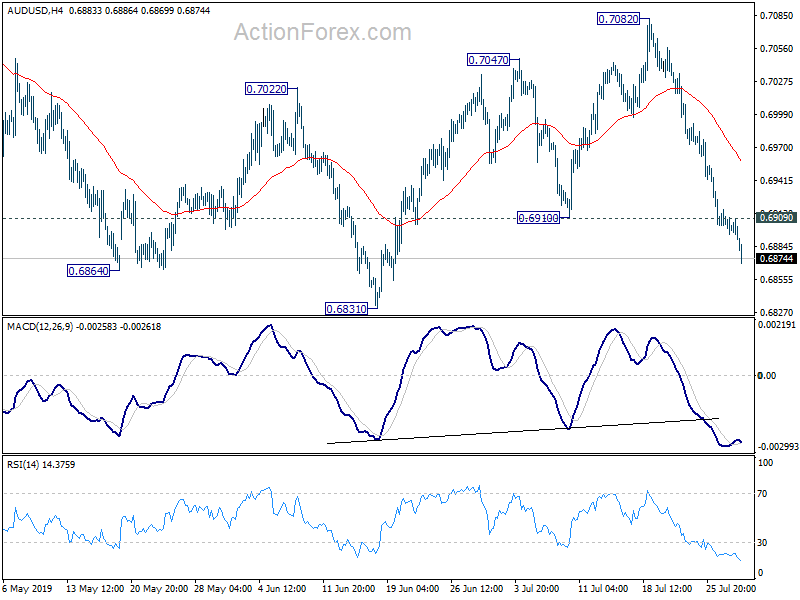
AUD/USD's fall extends to as low as 0.6869 so far and intraday bias remains on the downside for 0.6831 low. The three wave corrective structure from 0.6831 to 0.7082 suggests that larger decline from 0.7295 is in progress and is possibly resuming. Break of 0.6831 will confirm this bearish case and target 0.6722 low next. On the upside, break of 0.6909 minor resistance will turn intraday bias neutral again.
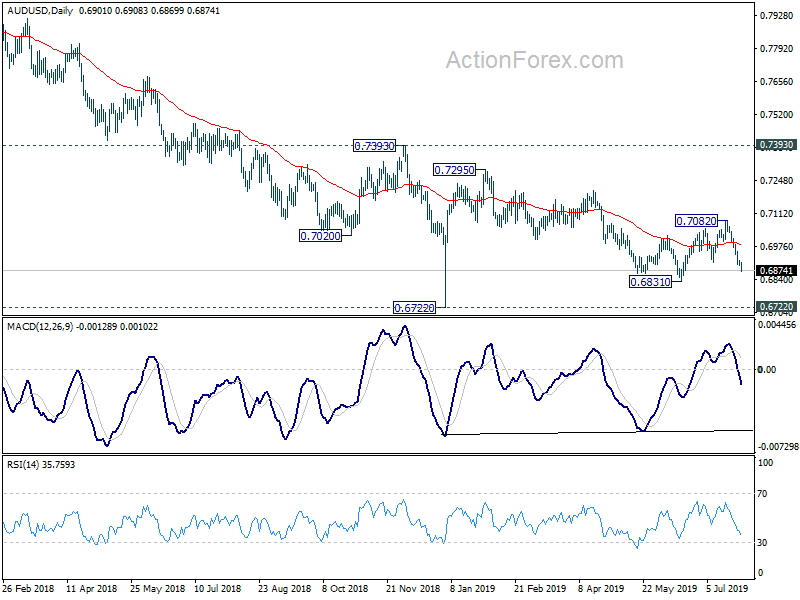
In the bigger picture, with 0.7393 key resistance intact, medium term outlook remains bearish. The decline from 0.8135 (2018 high) is seen as resuming long term down trend from 1.1079 (2011 high). Decisive break of 0.6826 (2016 low) will confirm this bearish view and resume the down trend to 0.6008 (2008 low). However, firm break of 0.7393 will argue that fall from 0.8135 has completed. And corrective pattern from 0.6826 has started the third leg, targeting 0.8135 again.
Economic Indicators Update
| GMT | Ccy | Events | Actual | Consensus | Previous | Revised |
|---|---|---|---|---|---|---|
| 22:45 | NZD | Building Permits M/M Jun | -3.90% | 13.20% | 13.50% | |
| 23:30 | JPY | Jobless Rate Jun | 2.30% | 2.40% | 2.40% | |
| 23:50 | JPY | Industrial Production M/M Jun P | -3.60% | -1.80% | 2.00% | |
| 01:30 | AUD | Building Approvals M/M Jun | -1.20% | 0.20% | 0.70% | 0.30% |
| 02:00 | JPY | BOJ Rate Decision | -0.10% | -0.10% | -0.10% | |
| 05:30 | EUR | French GDP Q/Q Q2 P | 0.20% | 0.30% | 0.30% | |
| 06:00 | EUR | German GfK Consumer Confidence Aug | 9.7 | 9.7 | 9.8 | |
| 07:00 | CHF | KOF Leading Indicator Jul | 97.1 | 93.3 | 93.6 | 93.8 |
| 09:00 | EUR | Eurozone Business Climate Indicator Jul | -0.12 | 0.1 | 0.17 | |
| 09:00 | EUR | Eurozone Economic Confidence Jul | 102.7 | 102.7 | 103.3 | |
| 09:00 | EUR | Eurozone Industrial Confidence Jul | -7.4 | -6.7 | -5.6 | |
| 09:00 | EUR | Eurozone Services Confidence Jul | 10.6 | 10.7 | 11 | |
| 09:00 | EUR | Eurozone Consumer Confidence Jul F | -6.6 | -6.6 | -6.6 | -7.2 |
| 12:00 | EUR | German CPI M/M Jull P | 0.50% | 0.30% | 0.30% | |
| 12:00 | EUR | German CPI Y/Y Jull P | 1.70% | 1.50% | 1.60% | |
| 12:30 | USD | Personal Income Jun | 0.40% | 0.30% | 0.50% | 0.40% |
| 12:30 | USD | Personal Spending Jun | 0.30% | 0.30% | 0.40% | 0.50% |
| 12:30 | USD | PCE Deflator M/M Jun | 0.10% | 0.10% | 0.20% | |
| 12:30 | USD | PCE Deflator Y/Y Jun | 1.40% | 1.50% | 1.50% | 1.40% |
| 12:30 | USD | PCE Core M/M Jun | 0.20% | 0.20% | 0.20% | |
| 12:30 | USD | PCE Core Y/Y Jun | 1.60% | 1.70% | 1.60% | 1.50% |
| 13:00 | USD | S&P/Case-Shiller Composite-20 Y/Y May | 2.40% | 2.40% | 2.54% | |
| 14:00 | USD | Pending Home Sales M/M Jun | 2.80% | 0.30% | 1.10% | |
| 14:00 | USD | Consumer Confidence Index Jul | 135.7 | 125 | 121.5 | 124.3 |
AUD/USD Mid-Day Outlook
Daily Pivots: (S1) 0.6892; (P) 0.6904; (R1) 0.6914; More...
AUD/USD's fall extends to as low as 0.6869 so far and intraday bias remains on the downside for 0.6831 low. The three wave corrective structure from 0.6831 to 0.7082 suggests that larger decline from 0.7295 is in progress and is possibly resuming. Break of 0.6831 will confirm this bearish case and target 0.6722 low next. On the upside, break of 0.6909 minor resistance will turn intraday bias neutral again.
In the bigger picture, with 0.7393 key resistance intact, medium term outlook remains bearish. The decline from 0.8135 (2018 high) is seen as resuming long term down trend from 1.1079 (2011 high). Decisive break of 0.6826 (2016 low) will confirm this bearish view and resume the down trend to 0.6008 (2008 low). However, firm break of 0.7393 will argue that fall from 0.8135 has completed. And corrective pattern from 0.6826 has started the third leg, targeting 0.8135 again.
US: Personal Spending Growth Rises for the Fourth Consecutive Months in June
- Personal income rose 0.4% in June, in line with the median survey estimate. Nominal personal spending rose 0.3%, also in line with expectations. May's spending was revised up to 0.5% (from 0.4%).
- Adjusting for price effects, real spending rose 0.2%, also in line with expectations. Goods spending was up 0.4% due to a strong 0.65% expansion in non-durables; durables spending fell 0.1%. Spending on services was a little more subdued, rising 0.05% in June. Revisions to May's data now puts real spending growth at 0.3% in that month, up a touch from the previously reported 0.2%.
- The personal consumption price deflator rose 0.1% on the month, and 1.4% on a year-on-year basis. Core PCE rose 0.2% (month-on-month), translating into a 1.6% year-on-year rate – a slight uptick from the downwardly revised 1.5% rate of inflation recorded in May.
- The personal saving rate nudged higher to 8.1% in June from 8.0% in May.
Key Implications
- There were few surprises in today's personal income and spending release for June. Friday's preliminary GDP report signaled strong consumer spending growth in the second quarter, and historical revisions to personal income saw a strong upward revision to the saving rate.
- A repeat of the 4.3% annualized growth in spending in the second quarter may prove tough to achieve this quarter. That said, June's income growth and a healthy labor market bode well for another quarter of decent consumer spending. Still, caution is warranted especially further out on the horizon. Elevated economic and trade policy uncertainty and global economic headwinds could yet dent consumer confidence and impact spending, particularly if higher tariffs feed through to higher consumer prices.
- Looking ahead to tomorrow's interest rate decision, there is very little in this report to change the mind of the Committee. Core inflation remains below its 2% target, but largely due to transitory factors, and the U.S. consumer has been stalwart despite a more uncertain economic backdrop. Nevertheless, we anticipate that the Committee will announce a 25 basis point cut at tomorrow's decision to ensure that financial conditions remain accommodative in this high risk environment.
GBPAUD Produces a Failed Break of the 6-Month Low, Buyers Take Back Losses
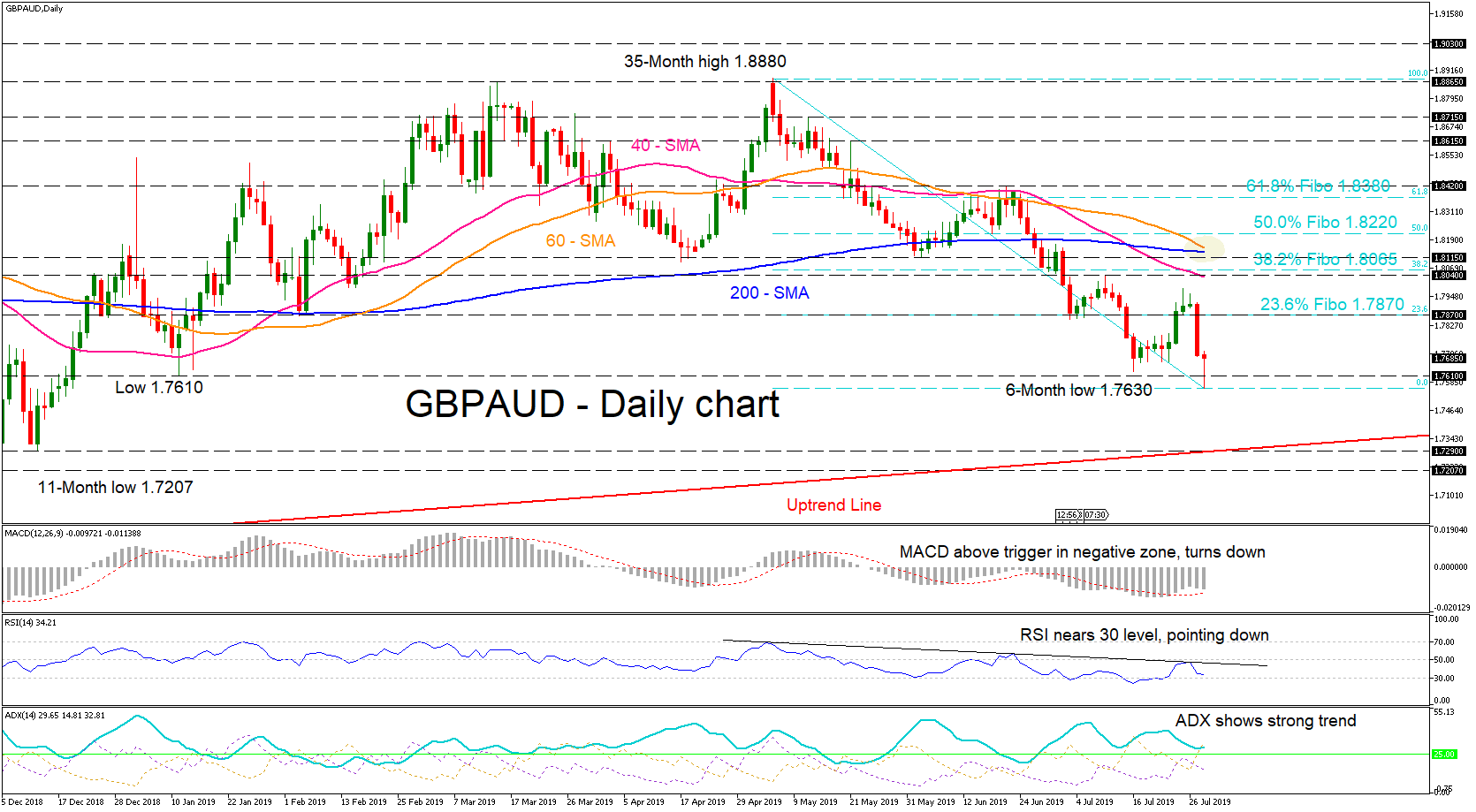
The GBPAUD pair in the last weeks bounced up from the 1.7610 support area above the 1.7870 resistance, which is also the 23.6% Fibo of the descent from the almost three year high of 1.8880 to the low of 1.7630. Price tried to sustain an aggressive move down passed the recent six-month low of 1.7630 and the near low of 1.7610 from January 11. Despite strong buying interest which returned the price above the recent low of 1.7630, it is worth mentioning that the 60-day simple moving average (SMA) is nearing a bearish cross of the 200-day SMA which may revive the down push.
The momentum indicators concur with the down bias as the MACD has returned south nearing the trigger line in the negative region, whilst the RSI points down and heads for the oversold area. The ADX also confirms the strong down trend.
Any further weakening could see price fall through the low of 1.7610 towards the 1.7300 – 1.7290 support barrier which is coupled with the uptrend line from March 2017. Surpassing it could bring a test of the eleven-month low of 1.7207.
Turning north, first resistance comes from 1.7870, the 23.6% Fibo, then higher a stronger barrier to tackle would be around 1.8040 – 1.8115 where the SMAs are currently hovering, with the 38.2% Fibo of 1.8065 falling in the middle.
Overall the short-term outlook remains negative, targeting the next lows, whereas a shift above the 1.8420 resistance would turn the bias neutral.