Sample Category Title
(FED) Chairman Jerome H. Powell – Semiannual Monetary Policy Report to the Congress
Chairwoman Waters, Ranking Member McHenry, and other members of the Committee, I am pleased to present the Federal Reserve's semiannual Monetary Policy Report to Congress.
Let me start by saying that my colleagues and I strongly support the goals of maximum employment and price stability that Congress has set for monetary policy. We are committed to providing clear explanations about our policies and activities. Congress has given us an important degree of independence so that we can effectively pursue our statutory goals based on objective analysis and data. We appreciate that our independence brings with it an obligation for transparency so that you and the public can hold us accountable.
Today I will review the current economic situation and outlook before turning to monetary policy. I will also provide an update of our ongoing public review of our framework for setting monetary policy.
Current Economic Situation and Outlook
The economy performed reasonably well over the first half of 2019, and the current expansion is now in its 11th year. However, inflation has been running below the Federal Open Market Committee's (FOMC) symmetric 2 percent objective, and crosscurrents, such as trade tensions and concerns about global growth, have been weighing on economic activity and the outlook.
The labor market remains healthy. Job gains averaged 172,000 per month from January through June. This number is lower than the average of 223,000 a month last year but above the pace needed to provide jobs for new workers entering the labor force. Consequently, the unemployment rate moved down from 3.9 percent in December to 3.7 percent in June, close to its lowest level in 50 years. Job openings remain plentiful, and employers are increasingly willing to hire workers with fewer skills and train them. As a result, the benefits of a strong job market have been more widely shared in recent years. Indeed, wage gains have been greater for lower-skilled workers. That said, individuals in some demographic groups and in certain parts of the country continue to face challenges. For example, unemployment rates for African Americans and Hispanics remain well above the rates for whites and Asians. Likewise, the share of the population with a job is higher in urban areas than in rural communities, and this gap widened over the past decade. A box in the July Monetary Policy Report provides a comparison of employment and wage gains over the current expansion for individuals with different levels of education.
Gross domestic product increased at an annual rate of 3.1 percent in the first quarter of 2019, similar to last year's pace. This strong reading was driven largely by net exports and inventories—components that are not generally reliable indicators of ongoing momentum. The more reliable drivers of growth in the economy are consumer spending and business investment. While growth in consumer spending was weak in the first quarter, incoming data show that it has bounced back and is now running at a solid pace. However, growth in business investment seems to have slowed notably, and overall growth in the second quarter appears to have moderated. The slowdown in business fixed investment may reflect concerns about trade tensions and slower growth in the global economy. In addition, housing investment and manufacturing output declined in the first quarter and appear to have decreased again in the second quarter.
After running close to our 2 percent objective over much of last year, overall consumer price inflation, measured by the 12-month change in the price index for personal consumption expenditures (PCE), declined earlier this year and stood at 1.5 percent in May. The 12-month change in core PCE inflation, which excludes food and energy prices and tends to be a better indicator of future inflation, has also come down this year and was 1.6 percent in May.
Our baseline outlook is for economic growth to remain solid, labor markets to stay strong, and inflation to move back up over time to the Committee's 2 percent objective. However, uncertainties about the outlook have increased in recent months. In particular, economic momentum appears to have slowed in some major foreign economies, and that weakness could affect the U.S. economy. Moreover, a number of government policy issues have yet to be resolved, including trade developments, the federal debt ceiling, and Brexit. And there is a risk that weak inflation will be even more persistent than we currently anticipate. We are carefully monitoring these developments, and we will continue to assess their implications for the U.S economic outlook and inflation.
The nation also continues to confront important longer-run challenges. Labor force participation by those in their prime working years is now lower in the United States than in most other nations with comparable economies. As I mentioned, there are troubling labor market disparities across demographic groups and different parts of the country. The relative stagnation of middle and lower incomes and low levels of upward mobility for lower-income families are also ongoing concerns. In addition, finding ways to boost productivity growth, which leads to rising wages and living standards over the longer term, should remain a high national priority. And I remain concerned about the longer-term effects of high and rising federal debt, which can restrain private investment and, in turn, reduce productivity and overall economic growth. The longer-run vitality of the U.S. economy would benefit from efforts to address these issues.
Monetary Policy
Against this backdrop, the FOMC maintained the target range for the federal funds rate at 2‑1/4 to 2-1/2 percent in the first half of this year. At our January, March, and May meetings, we stated that we would be patient as we determined what future adjustments to the federal funds rate might be appropriate to support our goals of maximum employment and price stability.
At the time of our May meeting, we were mindful of the ongoing crosscurrents from global growth and trade, but there was tentative evidence that these crosscurrents were moderating. The latest data from China and Europe were encouraging, and there were reports of progress in trade negotiations with China. Our continued patient stance seemed appropriate, and the Committee saw no strong case for adjusting our policy rate.
Since our May meeting, however, these crosscurrents have reemerged, creating greater uncertainty. Apparent progress on trade turned to greater uncertainty, and our contacts in business and agriculture report heightened concerns over trade developments. Growth indicators from around the world have disappointed on net, raising concerns that weakness in the global economy will continue to affect the U.S. economy. These concerns may have contributed to the drop in business confidence in some recent surveys and may have started to show through to incoming data.
In our June meeting statement, we indicated that, in light of increased uncertainties about the economic outlook and muted inflation pressures, we would closely monitor the implications of incoming information for the economic outlook and would act as appropriate to sustain the expansion. Many FOMC participants saw that the case for a somewhat more accommodative monetary policy had strengthened. Since then, based on incoming data and other developments, it appears that uncertainties around trade tensions and concerns about the strength of the global economy continue to weigh on the U.S. economic outlook. Inflation pressures remain muted.
The FOMC has made a number of important decisions this year about our framework for implementing monetary policy and our plans for completing the reduction of the Fed's securities holdings. At our January meeting, we decided to continue to implement monetary policy using our current policy regime with ample reserves, and emphasized that we are prepared to adjust any of the details for completing balance sheet normalization in light of economic and financial developments. At our March meeting, we communicated our intention to slow, starting in May, the decline in the Fed's aggregate securities holdings and to end the reduction in these holdings in September. The July Monetary Policy Report provides details on these decisions.
The July Monetary Policy Report also includes an update on monetary policy rules. The FOMC routinely looks at monetary policy rules that recommend a level for the federal funds rate based on inflation and unemployment rates. I continue to find these rules helpful, although using these rules requires careful judgment.
We are conducting a public review of our monetary policy strategy, tools, and communications—the first review of its kind for the FOMC. Our motivation is to consider ways to improve the Committee's current policy framework and to best position the Fed to achieve maximum employment and price stability. The review has started with outreach to and consultation with a broad range of people and groups through a series of Fed Listens events. The FOMC will consider questions related to the review at upcoming meetings. We will publicly report the outcome of our discussions.
Thank you. I am happy to respond to your questions.
NIESR: UK economy to contract -0.1% in Q2, but no recession
The National Institute of Economic Social Research (NIESR) said UK economy is on course to contract by -0.1% in Q2. However, initial outlook for Q3 is for growth of 0.2%. Thus, UK would likely avoid a technical recession, two consecutive quarters of contraction.
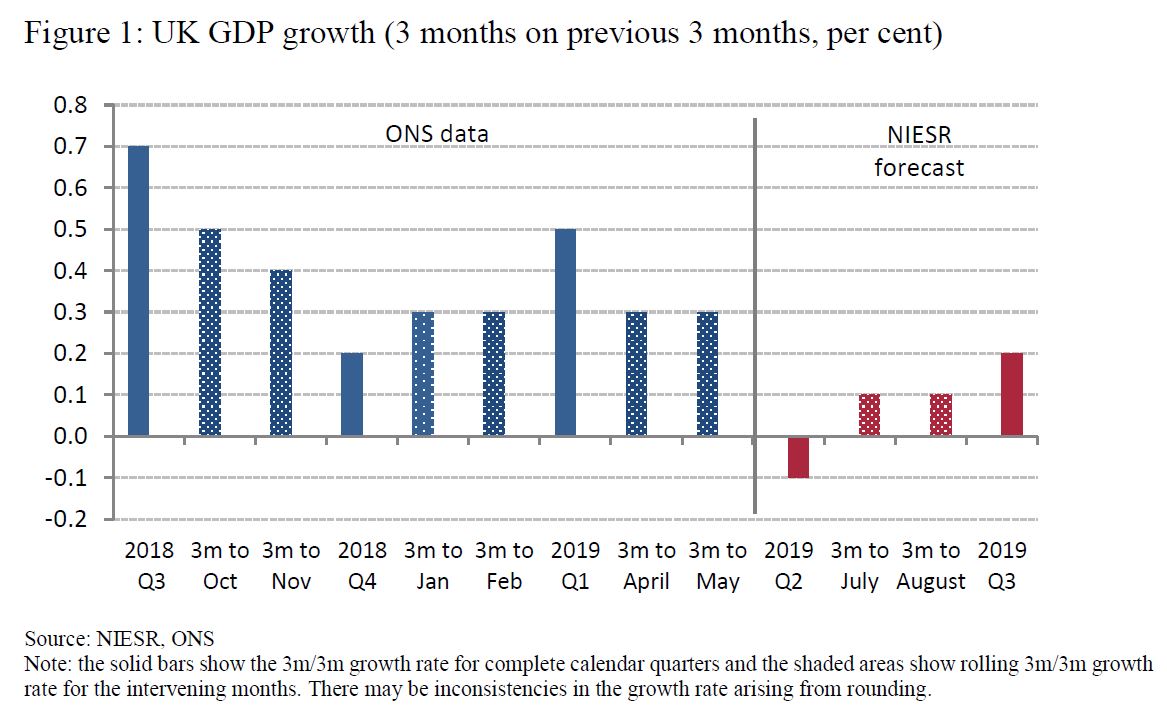
Janine Boshoff, Economist in the Macroeconomic Modelling and Forecasting team, said "Our latest estimate implies that the economy will narrowly avoid a technical recession in the middle quarters of this year. That said, the latest ONS data and recent surveys suggest that the economy has lost considerable momentum since the first quarter. This reflects the impact of Brexit-related uncertainty and slower growth in the global economy outside of the United States. The near-term outlook for the UK economy continues to depend on the outcome of the Brexit negotiations.".
CADJPY Breaks Downtrend Line, Flirts With 61.8% Fibonacci
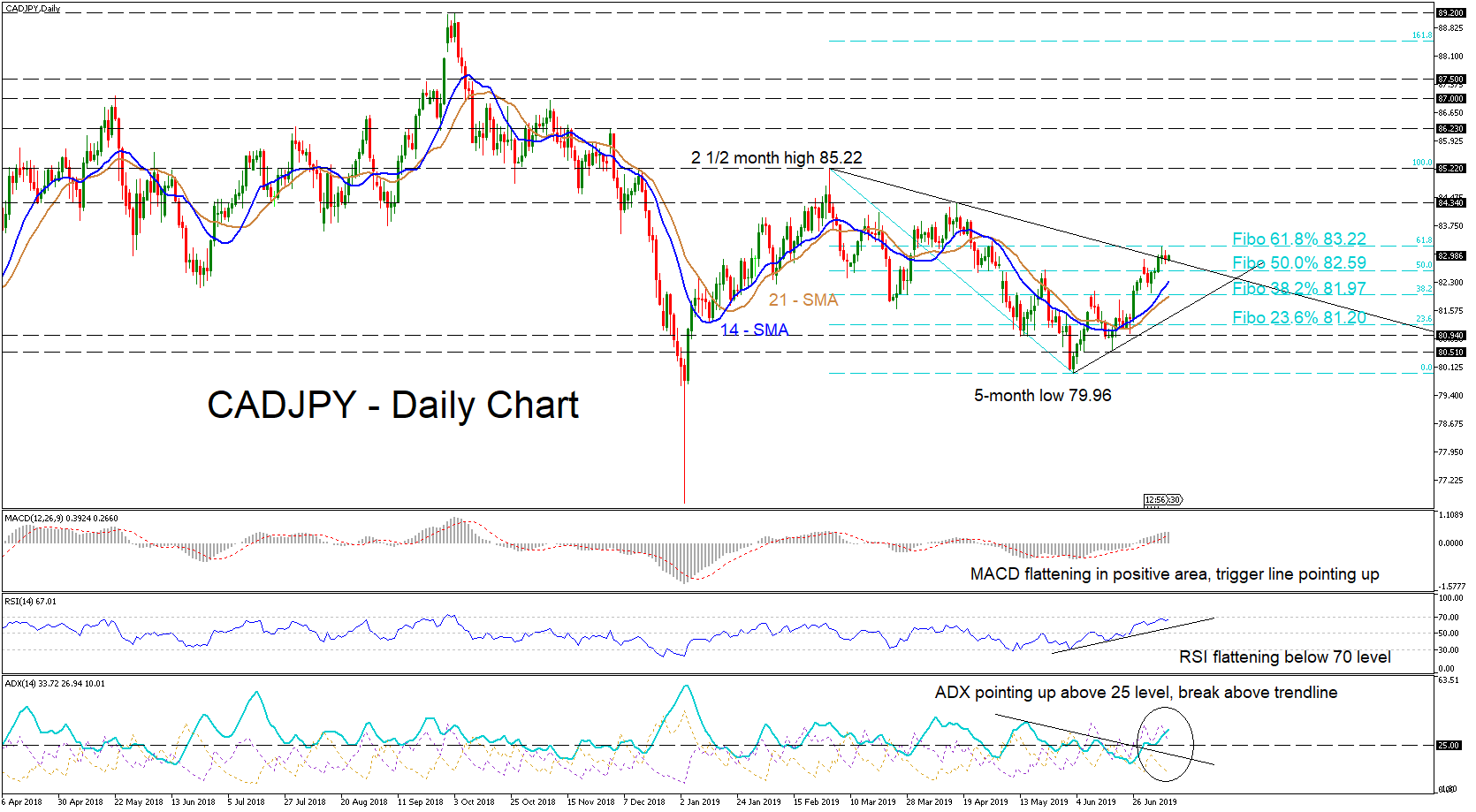
CADJPY has developed a short-term uptrend over the last month, which has now, broke the downtrend line to the upside. Currently, the upward move seems to be temporarily stalling as it encounters the 61.8% Fibonacci retracement level of the down move from 85.22 to the five-month low of 79.96 of 83.22.
Both the MACD and the RSI momentum indicators are flattening in positive areas and suggest a short-term pausing of the uptrend, as the pair tackles the 61.8% Fibo of 83.22. The 14-day simple moving average (SMA) and 21-SMA both point up, and confirm the bullish trend. ADX moved above the trend line and is currently above the 25 level, pointing up, confirming the increasing trend.
If momentum indicators continue their behavior and pick up speed above the 61.8% Fibo of 83.22, the next obstacle could be 84.34, but ultimately, a break above the high of 85.22 would confirm the bullish bias, targeting further resistance at 86.23 initially, and then around the 87.00 to 87.50 levels.
On the flip side, if the 61.8% Fibo level of 83.22 holds, the initial test would be the 50.0% Fibo level of 82.59 and then the 38.2% Fibo of 81.97 culminating around the 14- and 21-SMAs.
Overall, the very short-term outlook is positive as the bullish bias continue across indicators, and a break above the 61.8% Fibo level would see this unfold.
EURUSD 1.1220 Daily Pivot
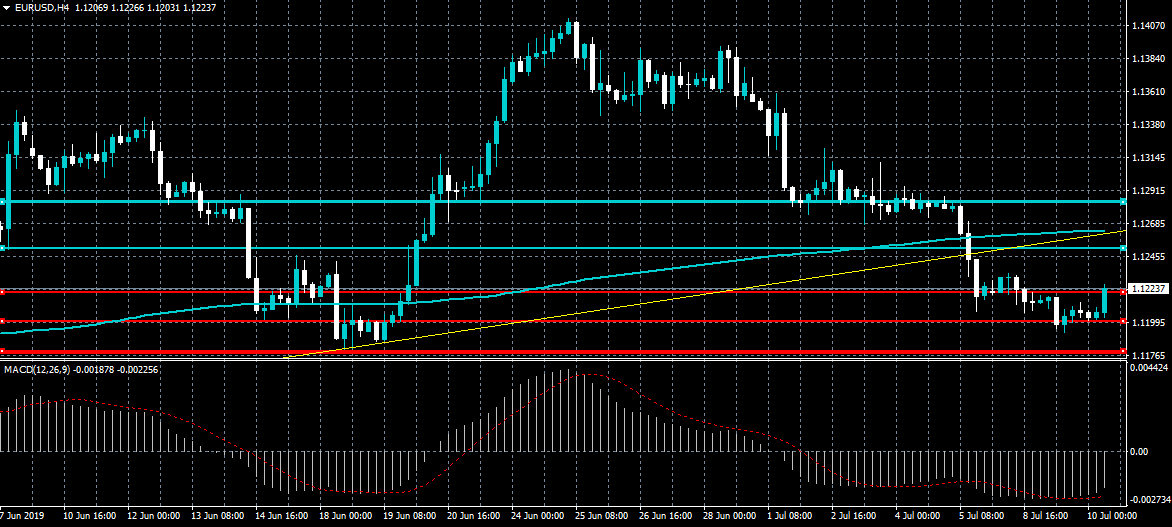
The euro currency is catching a bid against the US dollar as buyers start to move the pair away from the key 1.1205 support level. The 1.1220 level is the daily pivot point for the EURUSD pair and the key level to watch if any bullish rebounds occur. Jerome Powell’s speech later today should have a large impact on the EURUSD and should provide the next technical breakout.
The EURUSD pair is only bullish while trading above the 1.1220 level, key technical resistance is found at the 1.1248 and 1.1265 levels.
If the EURUSD pair trades below the 1.1220 level, key support is found at the 1.1205 and 1.1170 levels.
GBPUSD Attacking 1.2480
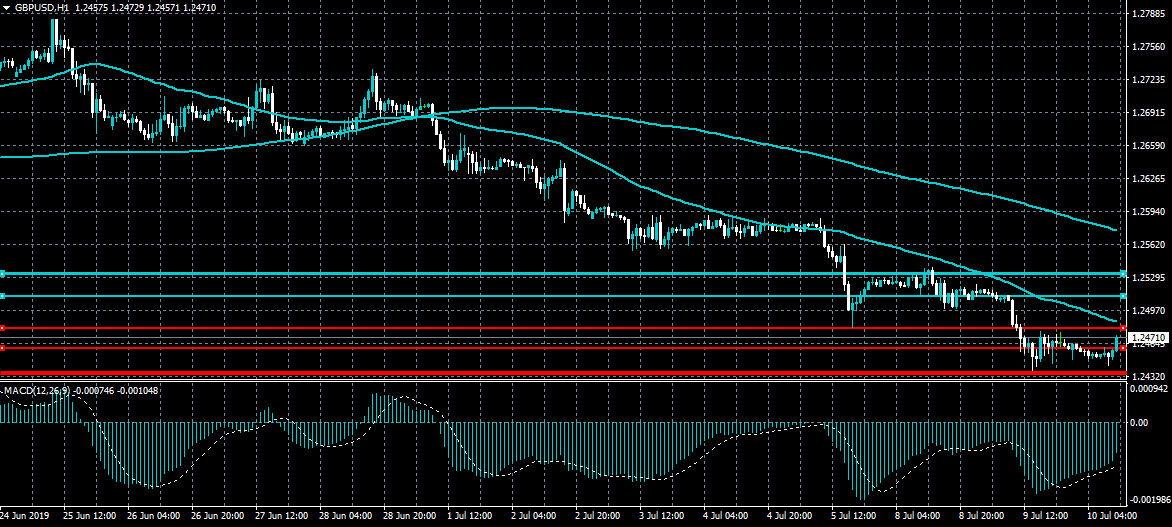
The British pound is starting to attack towards the 1.2480 level against the US dollar, following the release of supportive UK economic data. Bulls will need to lift the GBPUSD pair above the 1.2480 level to progress towards the main intraday resistance area, at 1.2505. GBPUSD sellers will need to hold price under the 1.2450 level to encourage the next round of technical selling.
The GBPUSD pair is only bearish while trading below the 1.2480 level, key support is found at the 1.2450 and 1.2424 levels.
The GBPUSD pair is only bullish while trading above the 1.2480 level, key resistance is found at the 1.2505 and 1.2530 levels.
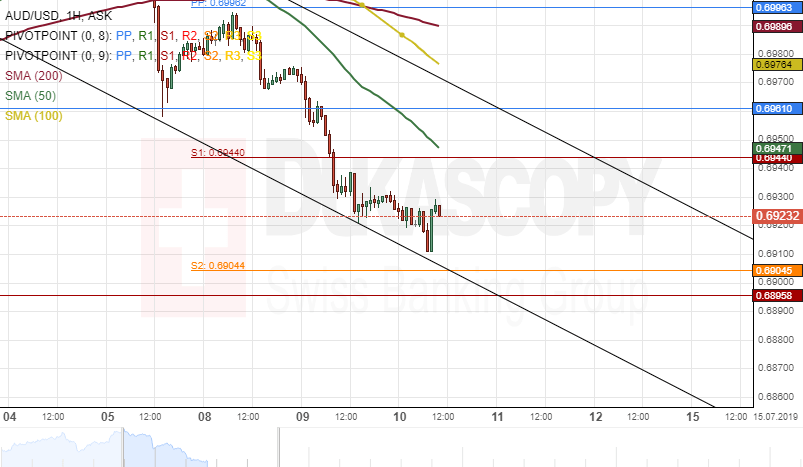
AUD/USD Analysis: Potential Upside Reversal
The Australian Dollar has continued to trade in a descending channel pattern against the US Dollar. The currency pair depreciated about 52 base points during yesterday's trading session.
The exchange rate was trading near the bottom border of a descending channel pattern at 0.6919 and could be set for a breakout.
If this breakout occurs, a decline towards the 0.6886 area might be expected during the following trading session.
However, if the channel pattern holds, a potential upside reversal will be possible today.
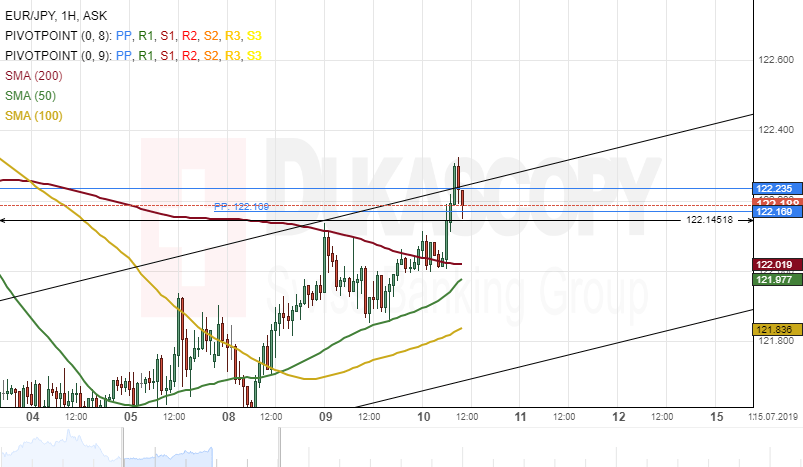
EUR/JPY Analysis: Sets For Breakout
The common European currency continued to maintain a junior ascending channel pattern against the Japanese Yen on Tuesday. The 50-hour simple moving average provided support for the currency pair at 121.92 during yesterday's trading session.
Given that the exchange rate is trading near the upper border of the channel pattern, a breakout could occur within this session.
If this breakout occurs, a surge towards a swing high at 122.40 could be expected within this session.
However, a resistance cluster formed by the combination of the weekly and the monthly PPs at 122.16 could provide resistance for the pair today.
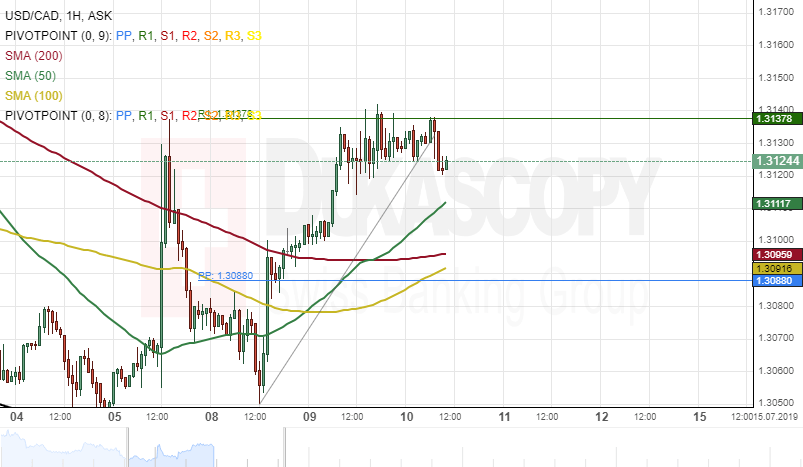
USD/CAD Analysis: Might Edge Lower Today
The US Dollar appreciated about 42 base points against the Canadian Dollar on Tuesday. The weekly R1 provided resistance for the currency pair during yesterday's trading session.
Most likely, a brief retracement towards a support cluster formed by the combination of the 50-, 100—200-hour SMAs near the 1.3100 area.
If the support cluster holds, the USD/CAD currency exchange rate will continue its upside movement during the following trading session.
However, technical indicators suggest that the Greenback might edge lower within this session.
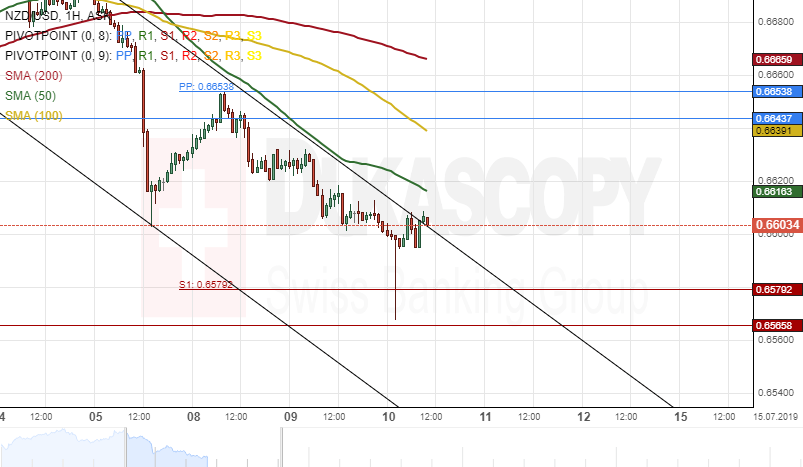
NZD/USD Analysis: Breaches Channel Pattern
The New Zealand Dollar versus the US Dollar breached the upper boundary of a descending channel pattern at 0.6603 during the morning hours of Wednesday's trading session.
Everything being equal, it is likely that the currency pair might continue to make gains within this session. The potential target for bullish traders will be near a resistance cluster at 0.6653.
However, a resistance level formed by the 50-hour simple moving average at 0.6619 could prevent the currency exchange rate from aiming for the resistance cluster as mentioned earlier.
WTI Oil: Price Re-Focuses $60 Barrier, Boosted By Strong Draw In US Crude Stocks
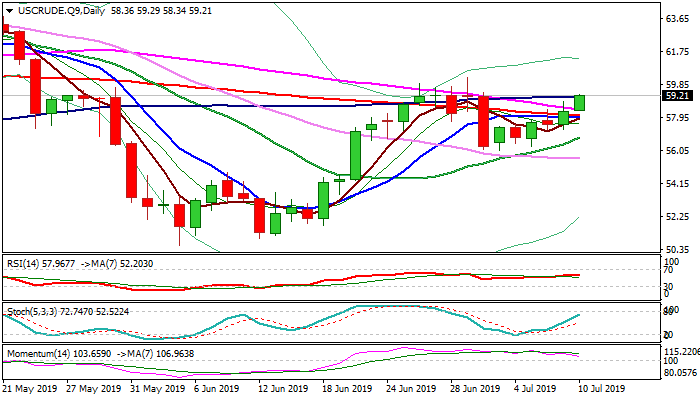
WTI oil extends advance on Wednesday and cracks 100DMA resistance ($59.16), maintaining bullish tone on OPEC+ extension of output cut agreement and stronger that expected draw in US crude stockpiles (API report on Tuesday showed drop of 8.1 mln bls, heavily beating forecast for 3.1 mln bls drop and also coming well above previous week's result of -5 mln bls).
Additional boost to oil price comes from shutdown of production in the Gulf of Mexico in expectations of tropical storm.
Traders focus on EIA crude stocks report, due later today (3 mln bls draw f/c vs previous week's draw of 1 mln bls) which could further boost oil price if release comes at / above forecast.
Fresh bulls signal the corrective pullback ($60.27/$56.04) might be over and shift focus towards cracked psychological $60 barrier, which capped last week's attack (oil price spiked to $60.27, the highest since 23 May).
Bullishly aligned daily techs support scenario, with bullish bias to remain intact while the price holds above broken 200SMA ($58.04).
Res: 59.42, 60.00, 60.27, 60.80
Sup: 58.40, 58.04, 57.90, 57.28