

Sample Category Title
GBP/USD Mid-Day Outlook
Daily Pivots: (S1) 1.2423; (P) 1.2477; (R1) 1.2513; More....
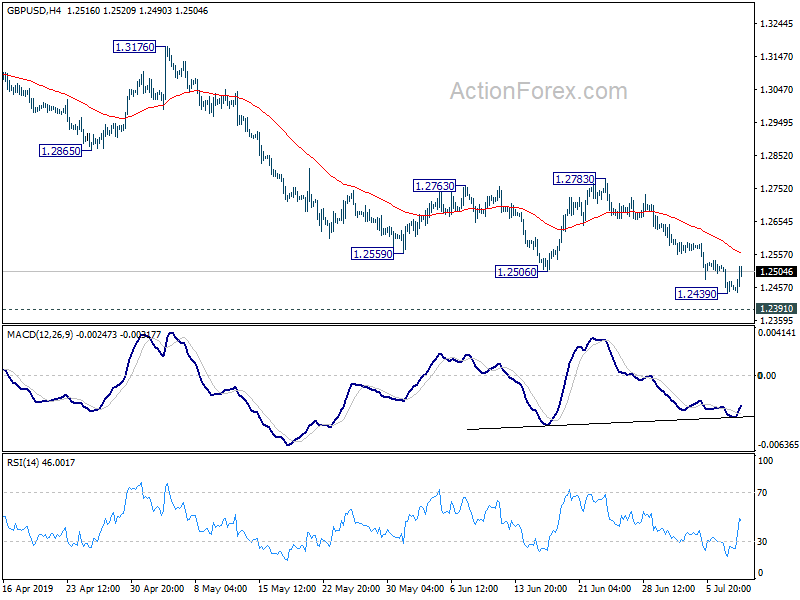
With today's recovery, a temporary low is in place at 1.2439. Intraday bias in GBP/USD is turned neutral for some more consolidations first. Upside of recovery should be limited well below 1.2783 resistance to bring fall resumption. On the downside, break of 1.2439 would resume the decline from 1.3381 to retest 1.2391 low. Firm break there will resume larger down trend.
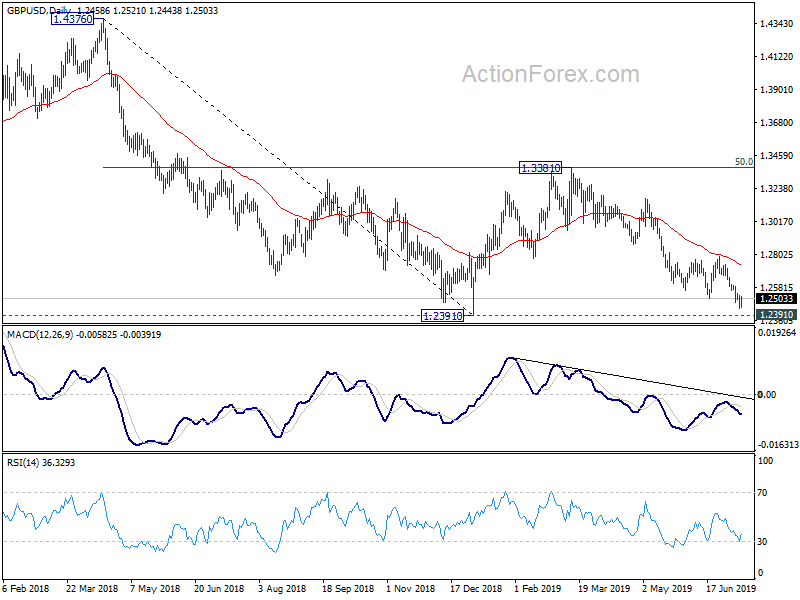
In the bigger picture, down trend from 1.4376 (2018 high) is still in progress. Break of 1.2391 would target a test on 1.1946 long term bottom (2016 low). For now, we don't expect a firm break there yet. Hence, focus will be on bottoming signal as it approaches 1.1946. In any case, medium term outlook will stay bearish as long as 1.3381 resistance holds, in case of strong rebound.
USD/CHF Mid-Day Outlook
Daily Pivots: (S1) 0.9922; (P) 0.9937; (R1) 0.9951; More...
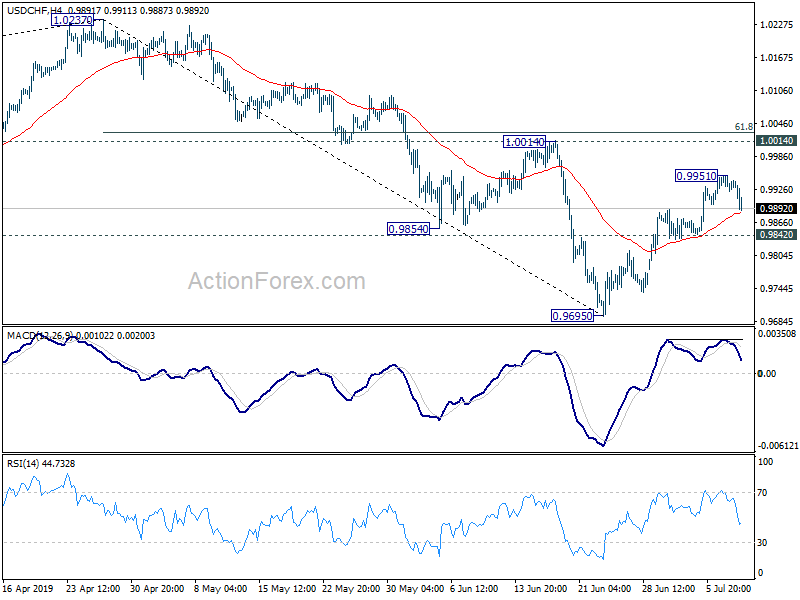
Intraday bias in USD/CHF remains neutral for the today. As long as 0.9842 minor support holds, further rise is still in favor. On the upside, above 0.9951 will target 1.0014 resistance. Upside could be limited by 61.8% retracement of 1.0237 to 0.9695 at 1.0030. On the downside, below 0.9842 minor support will turn bias back to the downside for retesting 0.9695 low instead.
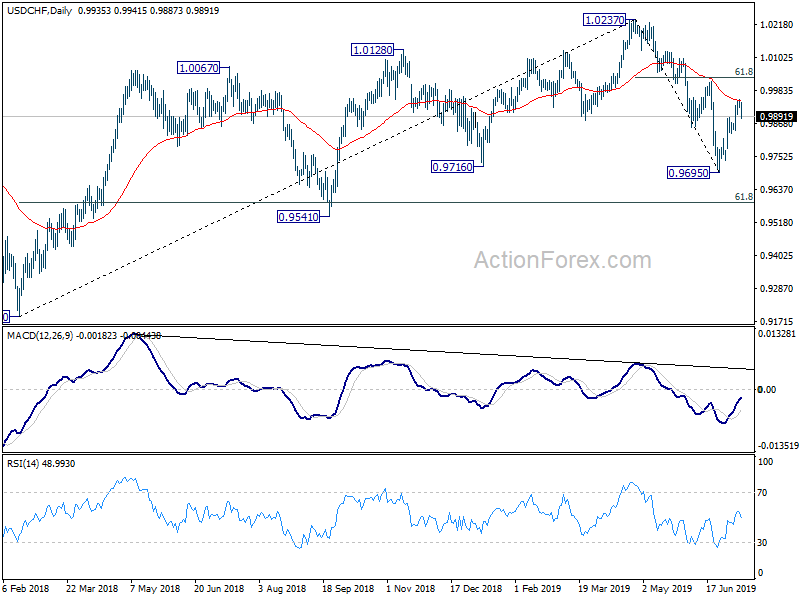
In the bigger picture, current development suggests that up trend from 0.9186 (2018 low) has completed at 1.0237 already. Deeper decline would be seen to 61.8% retracement of 0.9186 to 1.0237 at 0.9587 and below. For now, USD/CHF is seen as in long term range pattern between 0.9186 and 1.0342. Hence, we'd pay attention to bottoming signal below 0.9587. However, sustained break of 1.0014 will revive medium term bullishness and turn focus back to 1.0237 high.
USD/JPY Mid-Day Outlook
Daily Pivots: (S1) 108.66; (P) 108.81; (R1) 109.01; More...
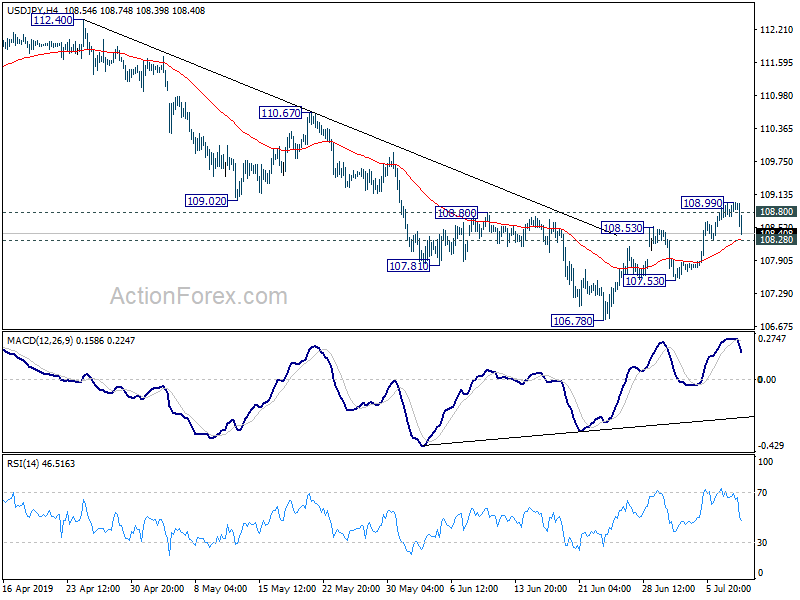
USD/JPY drops sharply in early US session but stays above 108.28 minor support. Intraday bias is turned neutral first. On the downside, break of 108.28 will indicate completion of rebound from 106.78. Intraday bias will be turned to the downside for 107.53 support and then retesting 106.78 low. On the upside, break of 108.99 and sustained trading above 108.80 will confirm short term bottoming at 106.78. Further rise should then been seen to 110.67 resistance next.
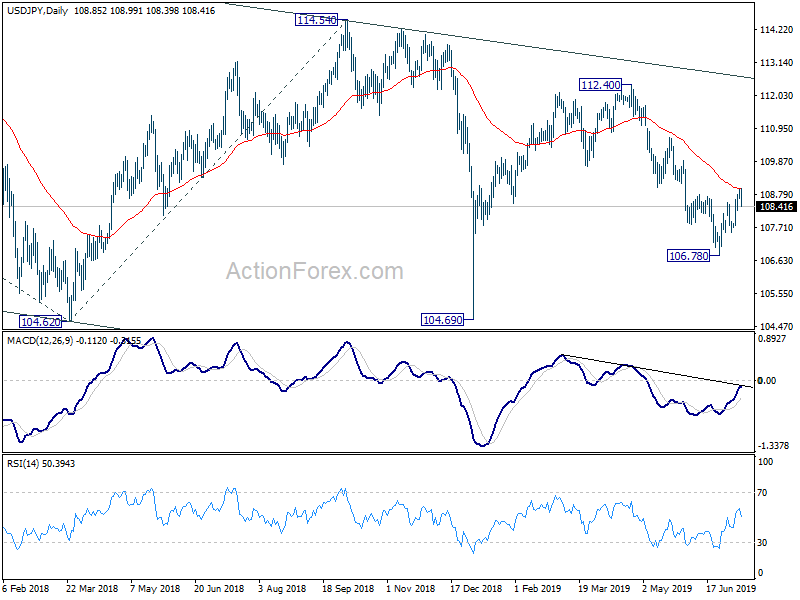
In the bigger picture, decline from 118.65 (Dec 2016) is still in progress, with the pair staying inside long term falling channel. Break of 104.62 will target 100% projection of 118.65 to 104.62 from 114.54 at 100.51. For now, we'd expect strong support above 98.97 (2016 low) to contain downside to bring rebound. In any case, break of 112.40 is needed to the first serious sign of medium term bullishness. Otherwise, further decline will remain in favor in case of rebound.
Dollar stays weak as Fed Powell doesn’t dismiss July cut, but loss limited
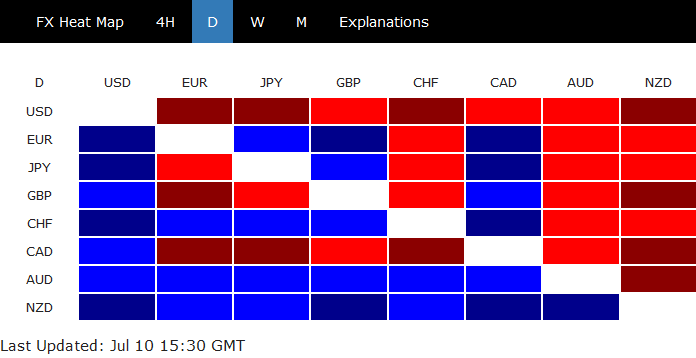
Dollar remains generally weak but selloff in so far rather limited except versus Yen. Fed Chair Jerome Powell didn't sound particular dovish at the Congressional testimony. Yet, he basically did nothing to alter market expectations of a 25bps rate cut by Fed in July. That's generally taken as a nod to the cut.
Among the Q&As, there's one thing that's rather important. Asked if June's stronger than expected job report had changed Fed's thinking, Powell bluntly said "a straight answer to your question is, no." But then, Powell still sounded non-committal to any move in interest rates. But he pointed to the upcoming data including CPI this week, retail sales next week, and Q2 GDP the week after. All these data will be taken in to considerations at the next FOMC meeting.
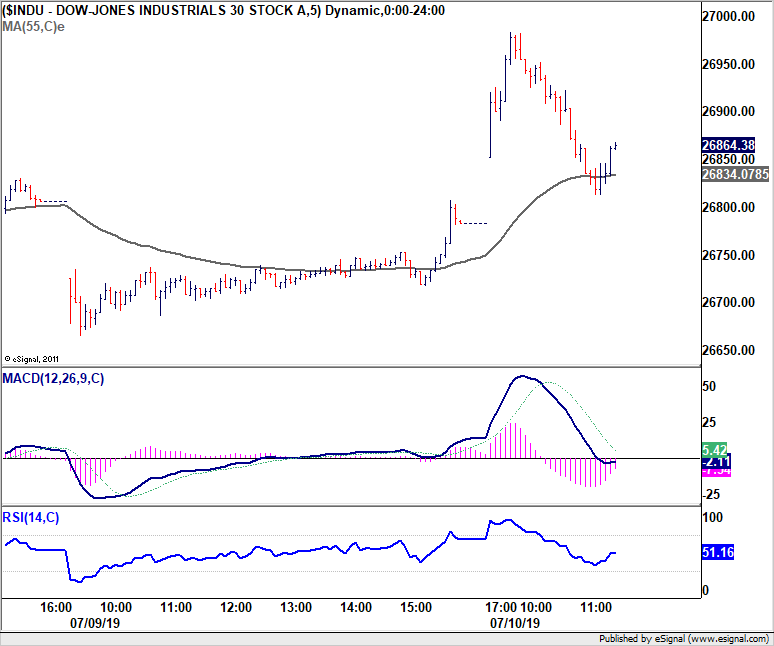
In the stock markets, DOW hit as high as 26983.45 earlier today but pared back much gains to 26860, up only 0.29%. S&P 500 also breached 3000 handle for the first time ever but it's now back below 2985.
Focus in USD/JPY is now back on 108.28 minor support. Break there will indicate failure to sustain above 108.80 resistance, and completion of rebound from 106.78. Deeper fall would then be seen back to 107.53 support and then 106.78 low.

Bank of Canada Still Signaling Caution
- The Bank of Canada held its policy interest rate unchanged at 1.75% this morning, meeting market expectations. The accompanying communique indicated that the Bank still sees the current setting of monetary policy as appropriate, but noted that the outlook is "clouded by persistent trade tensions". The loonie dropped about 0.4% immediately following the decision, although this shouldn't be considered new news on how the BoC views trade risk developments.
- Also released was the latest Monetary Policy Report (MPR). In the near-term, 2019 growth has been marked up to 1.3% (from 1.2%) on the back of expected second quarter strength. The outlook for 2020 offset this with a markdown of 0.2 percentage points, to 1.9%, largely due to a weaker export forecast. The 2021 outlook was left largely unchanged.
- The global backdrop has also weakened in the Bank's view. Global growth for this year and next has been marked down 0.2p.p. and 0.1p.p. respectively.
- When it comes to inflation, the Bank's latest view is that the recent strength will not persist. Inflation is forecast to dip below-target over the third quarter as gas price movements and other temporary factors work their way through the data. As usual, inflation is seen settling back to a sustainable 2% trend in roughly a year's time.
- As usual, the MPR also included a round-up of what the Bank considers major risks. First on the list is the potential lift from a stronger U.S. economy. The remainder of the list was comprised of downside risks: tighter global financial conditions, increased consumption and household debt here in Canada, weaker Chinese growth, and more pronounced housing weakness in Canada.
Key Implications
- The Bank of Canada walked the line with this communication, discussing domestic rebound dynamics that include a view of some one-off factors, while also emphasizing the growing risks to the outlook. Depending on what Governor Poloz communicates at the press conference, the first brush of the statement leaves the impression of a central bank that is 'going it alone' in maintaining a balanced view of its policy setting as other major central banks prepare markets for easing.
- Given the goal, it seems like mission accomplished. Markets sent the loonie back where it started the day, and implied odds of Bank of Canada easing by year-end sit at about one-in-three. This would seem to match a Bank with a still broadly supportive outlook (even after the 2020 downgrade) but facing significant external risks that may require a response should they worsen.
- Today's statement supports our view of a Bank of Canada that will stand pat as the domestic economy settles back to a roughly trend pace of growth. They would likely need to see more of the downside risks materialize in hard data to alter that position, with trade tensions topping the list of being a global catalyst.
Loonie Falls after BoC but Unable to Clear initial Support
The Canadian dollar fell after BoC kep interest rate unchanged at 1.75% as expected but soured the sentiment on negative projections for the economy in coming two years if the US increases tariffs by 25% on all imports.
Canada’s economy would shrink around 6% in such scenario and the loonie would loss around 25%.
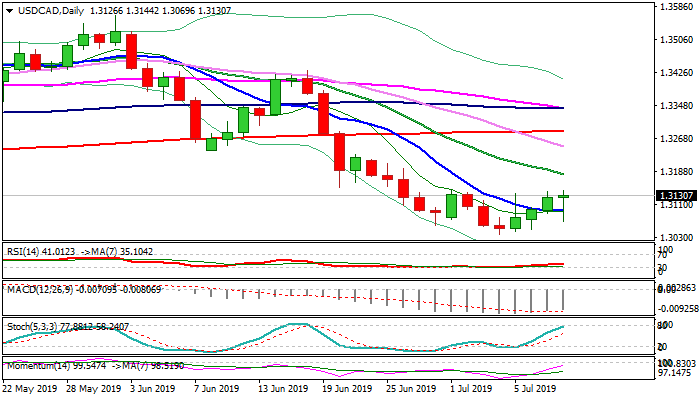
The Par rallied immediately after the release but bulls started to lose traction on renewed test pivotal 1.3140 resistance zone (highs of July) which repeatedly capped upside attempts.
Comments from Fed chief Powell, in prepared text for his two-day testimony to the Congress, highlight solid baseline for US economic growth, but low inflation is expected to persist that weakens the outlook.
Improving signals from daily studies continue to support, however, the pair is looking for a catalyst that would establish the price in fresh direction.
Release of FOMC minutes, due later today, would generate desired signals.
Bulls need break above 1.3140 zone and extension above 20DMA (1.3183) to signal continuation.
Near-term tone would weaken on loss of initial support at 1.3096 (10DMA).
Res: 1.3145; 1.3182; 1.3248; 1.3286
Sup: 1.3096; 1.3069; 1.3037; 1.3000
BoC Not Ready to Follow the Fed Lower (Yet)
- The overnight rate was held at 1.75%, as expected
- Trade policy and global growth concerns highlighted
- Current accommodation remains appropriate
Today’s policy statement was more dovish than expected. The BoC didn’t move explicitly to an easing bias (unlike the Fed and ECB) but sounded more concerned about “persistent trade tensions” that are clouding the outlook. Poloz and Co. still don’t appear to be in any rush to lower rates alongside the Fed (Powell’s comments this morning reinforced expectations for a July cut) but markets seem justified in thinking the BoC’s next move is more likely to be down than up.
Concerns about trade tensions and slowing global growth received top billing in the statement, unlike in May when signs of a firming domestic economy were highlighted. The BoC noted growing evidence that trade policy and related uncertainty are having “a material effect” on the global outlook, and lowered its global growth forecasts for this year and next. Escalation of trade conflicts remains the biggest downside risk to both the global and domestic outlooks.
On the domestic front, the BoC noted that Canada’s economy is returning to near-trend growth, as expected. They did emphasize, however, that stronger Q2 growth (their forecast now at 2.3% vs 1.3% previously) reflects a rebound from temporary factors that weighed on activity in prior quarters. GDP growth is expected to moderate to 1.5% in Q3. A more challenging global backdrop is dampening the outlook for investment and trade—both are expected to provide less support to growth than previously thought (2020 GDP forecast revised down to 1.9% from 2.1%). Inflation remains close to 2% (something the Fed and ECB can’t claim) and is expected to be sustained at the BoC’s target by the middle of next year as economic slack is absorbed.
Sunset Market Commentary
Markets
Core bond trading showed two faces today. The gentle downleg since Monday morning was initially extended. The Bund sell-off even accelerated somewhat following better than expected French (!) industrial production data. That’s probably more a reflection of thin trading conditions and one-sided positioning in core bonds than something else. Anyway, the slide lasted up until the release of Fed Chair Powell’s written testimony for US Congress. A deterioration in inflation wording was most striking. The Fed chair pointed out that risks to weak inflation may prove more persistent. That adds to the rate cut case since uncertainties continue to dim the eco outlook. Markets recently put the scenario of an aggressive rate cut in July to bed, but some revamped the idea after the testimony release. US Treasuries gained as a consequence with the front end of the curve outperforming. The US yield curve bull steepened with yield changes varying from -5 bps (2-yr) to -1 bps (10-yr). German yields retraced gains partly following Fed’s Powell but increased still about 5 bps at the longer end of the curve. Peripheral spread changes were mixed with Greece (+6 bps) underperforming and Italy (-4 bps) topping the class.
USD/JPY traded stable in a tight range in high 108 area as investors awaited the testimony of Fed chair Powell before the House. EUR/USD even regained modest growth as French and Italian production data printed stronger than expected and as European yields rebounded off recent lows. In his prepared statement, Powell indicated that risks since the previous FOMC continue to dim the economic outlook and that weak inflation might prove to be more persistent. This suggests the Fed is probably ready to implement a pre-emptive rate cut at the end of this month. Short term US yields declined about 5 bps weighing on the dollar. EUR/USD jumped to the mid 1.12 area. USD/JPY dropped to the 108.60 area. It was understandable for US yields and the dollar to decline on the ‘confirmation’ of a rate cut. Markets are now looking forward to the Q&A of Powell’s hearing, looking for clues on the amount and/or the pace of potential Fed easing. However, it is not sure that the Fed president will be really concrete. A rebound of EUR/USD to the 1.13 area would reverse the post-payrolls USD rebound and suggest a more neutral sentiment on the US currency. For now, we’re not there yet.
Sterling regained a few ticks today. The political battle on Brexit between the two candidates for PM and the attempts of Parliament to keep the ability to prevent a no deal Brexit simply continue. UK output data were mixed at best, but the 3M/3M May GDP update printed stronger than expected at 0.3%. NIESR still expects a small contraction of Q2 GDP (-0.1% Q/Q), but a recession will probably be avoided. Sterling rebounded slightly after the release. The absence of follow-through gains after yesterday’s EUR/GBP test of the 0.90 big figure maybe caused some profit taking in sterling shorts, too. EUR/GBP trades currently in the 0.8990 area. However, the MT picture for sterling hasn’t changed in any profound way.
News Headlines
The European Commission left 2019 euro area growth projections unchanged but cut 2020 growth projections in its Summer Forecasts. Trade tensions, political uncertainty and Brexit led to a trimmed growth of 1.4% (from 1.5%) with increased downside risks. Germany (0.5%) and Italy (0.1%) are forecasted to print the lowest growth rates this year.
Norwegian inflation accelerated less than expected in June with headline CPI printing at 0.1% MoM (1.9% YoY) vs. 0.2% expected and core measures coming in at 0.4% MoM (2.3% YoY) vs. 0.5% anticipated. Any loss of the Norwegian krone was temporary as markets concluded it won’t derail the Norges Bank rate hike intentions.
US oil inventories dropped -9.5m barrels, WTI back pressing 60
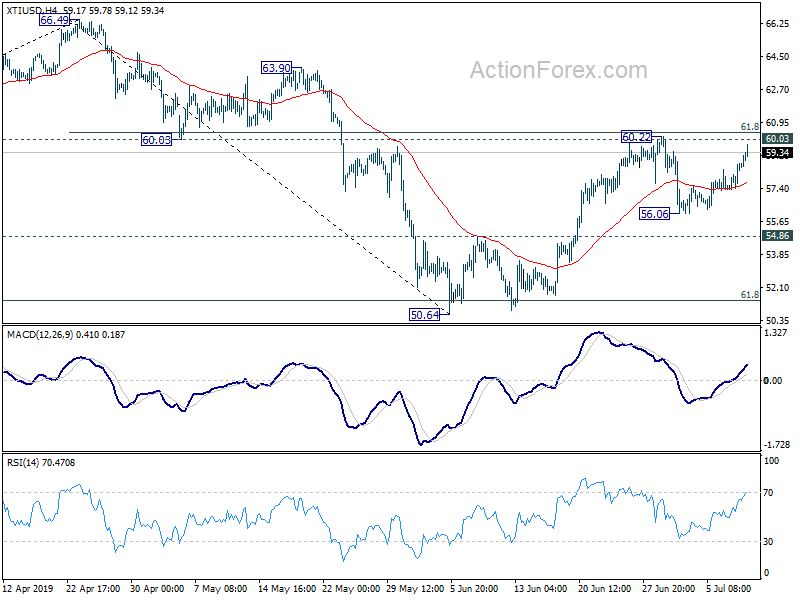
US commercial crude oil inventories dropped sharply by -9.5m barrels in the week ending July 5. That's much larger decline than expectation of -1.9m barrels. At 459.0m barrels, U.S. crude oil inventories are about 4% above the five year average for this time of year.
WTI oil extends this week's rebound and hits as high as 59.78 so far. It' possibly set to retest key resistance zone of 60.03 and 61.8% retracement of 66.49 to 50.64 at 60.34. At this point, we don't expect a firm break there yet. And consolidation pattern from 60.22 should extend with least another fall back to 56.06. In that case, downside should be contained above 54.86 support. Overall, range trading should continue.
Fed Chair Confirms Crosscurrents to Outlook, All But Guaranteeing a July Cut
Federal Reserve Chair Jerome Powell delivered his semiannual testimony to Congress. In it he confirmed that crosscurrents and increased uncertainty continue to weigh on the economic outlook and that inflation remains muted.
The discussion of the baseline outlook was couched in concerns for downside risks. Namely, that weakness in foreign economies could shift to the U.S., as well as concerns over numerous event risks including "trade developments, the federal debt ceiling, and Brexit."
Comments on the long-term challenges facing the economy also hewed on the dovish side. In particular, labor force participation for those in their prime working years was noted as low relative to other countries. This suggests that the Fed sees more room to run in the labor market.
Following his testimony, Chair Powell will answer questions from the U.S. House Committee on Financial Services.
Key Implications
The Fed Chair's speech all but guaranteed that the Federal Open Market Committee will cut rates at it its meeting in late July. This is not a surprise, but the clarity of his comments on this point was perhaps more than expected. Yields have edged lower across the curve on the publishing of his remarks.
Following the July rate cut, the outlook for additional cuts is more uncertain. On the one hand it seems unlikely that all of the possible event risks work out in a way that removes lingering uncertainty from the economic outlook. But, on the other hand, domestic spending data have held up well, and the American economy has, in the past, proven itself resilient to outside shocks. All told, we continue to anticipate at least one more cut in the latter half of this year, but expect that the economic data will hold up, limiting the case for further "insurance" cuts.