

Sample Category Title
Fed Minutes Focus on Downside Risks to Outlook
- The minutes from the Federal Open Market Committee's (FOMC) June meeting highlighted the downside risks to the economic outlook and members' feeling that they "had increased significantly over recent weeks."
- The factors cited as raising uncertainty include: weakening business confidence, business spending, manufacturing activity, trade, and global growth. Among these, trade tensions loom the largest as the underlying cause of the deterioration in confidence and rise in uncertainty.
- Participants also discussed the labor market and soft inflation. Notably, citing low wage inflation, "several participants…revised down their SEP estimate of the longer-run normal rate of unemployment."
- The decision to keep rates on hold at the June meeting (and not cut immediately) was influenced by the relatively recent deterioration in indicators. This requirement for more evidence appears to have been met, at least according to Chair Powell's testimony this morning that noted crosscurrents to the outlook continuing following the Fed's June meeting.
Key Implications
- While maintaining its economic outlook, the minutes show FOMC members moving toward a "risk management" framework, and increasingly in favor of cutting rates in order to "cushion the effects of possible adverse shocks to the economy."
- In addition to heightened uncertainty on the global front, the soft inflation environment and few signs that wage growth has broken out of its recent holding pattern provides support for a turn to more accommodative policy. This is particularly true as inflation expectations also appear to have moved lower.
- The evolution of economic data and key event risks will determine the future course of monetary policy. While there is good reason to expect the data to hold up, it is much harder to guess on the outcome of events, which as these minutes note, are clearly two-sided.
Dovish FOMC Minutes Heighten the Case for July Rate Cut
The FOMC minutes for the June meeting maintained a dovish tone, paving the way for a Fed funds rate cut later this month. The member generally acknowledged downside risks to growth have intensified while heightened uncertainty, in particular in trade tensions, would pose negative impacts on business investment. Fed’s monetary stance has moved to “risk management” with “several” of them believing a rate cut should be implemented to “cushion the effects of possible future adverse shocks”.
The members were very much concerned that uncertainty in trade tensions and global economic slowdown would weaken business investment. As noted in the minutes, “there were signs of weakness in US business spending”. Moreover, “uncertainties and risks regarding the global outlook appeared to be contributing to deterioration in risk sentiment in financial markets and a decline in business confidence that pointed to a weaker outlook for business investment in the United States”. They generally acknowledged downside risks to growth have intensified since the last meeting. “Many” of the voting members judged that “additional monetary policy accommodation would be warranted in the near term” if such developments “prove to be sustained” and “continue to weigh on the economic outlook”.
At the June meeting, FOMC left the policy rate unchanged at 2.25-2.50% but St Louis Fed President James Bullard, a dove, voted against the decision. Meanwhile, the dot plot projections show that more members are in favor of lowering interest rates. While the median dot plot remained unchanged for this year, 8 members indeed favored a rate cut. For 2020, the median dot plot shows that the policy rate might lower to 2.1%, compared with 2.6% projected in March. There has been a narrow majority (9 members) favoring rate cut. For 2021, the median dot plot projects that policy rate would increase to 2.4%, compared with 2.6% projected in March. The downward shift in the dot plot was mainly driven by subdued inflation, which could deteriorate further without easing.
Regarding the minor changes in economic projections despite rising uncertainty and downside risks, the members suggested that was based on market expectations of a rate cut which is expected to lend support to the economy. As noted in the minutes, the current financial conditions are “premised importantly on expectations that the Federal Reserve would ease policy in the near term to help offset the drag on economic growth stemming from uncertainties about the global outlook and other downside risks”. We believe this has presented a strong case for rate cut in July. With the market almost priced in a cut, another month of disappointment (the Fed left rate unchanged in June) could result in abrupt deterioration in the financial market conditions.
Market Morning Briefing: Euro Has Risen Above The Resistance At 1.1250
STOCKS
Equities have risen as the chances for a rate cut has increased after the US Federal Reserve Chairman hinted for the same in his testimony yesterday. However, the major indices like the Dow, Nikkei, Shanghai have key resistances ahead which needs to be broken to see further rally. While these resistances hold, the indices can continue to consolidate for some more time within their overall uptrend.
Dow (26860.20, +76.71, +0.29%) surged to an intraday high of 26983.45 and has come-off from there. As we have mentioning for some time the Dow can consolidate between 26500 and 27000 for some time before the overall uptrend resumes targeting 27200 and 27500. A strong break above 27000 will trigger the fresh rally.
DAX (12373.41, -63.14, -0.51%) has dipped further and is heading to test the 12300-12250 support zone as expected. We expect the DAX to reverse higher from this support zone and resume its uptrend targeting 12800-13000 over the medium term.
Nikkei (21622.42, +88.94, +0.41%) is holding above 21500 and is moving higher towards 21700-21750 as expected. A strong break above 21750 can trigger a fresh rise to 22000 and 22250. Inability to breach 21750 can keep the index range bound between 21500 and 21750 for some more time.
Shanghai (2934.50, +19.20, +0.66%) continues to hover above 2900 and is not gaining strength. A narrow consolidation between 2900-2950 looks possible before the index surges to 3000.
Sensex (38557.04, -173.78, -0.45%) and Nifty (11498.90, -57.00, -0.49%) failed to sustain their intraday gains yesterday and fell sharply from their respective highs of 38854.85 and 11593.7. This reflects the inherent weakness in them and keeps the bearish view intact. Sensex test 38100-38000 on the downside. Nifty can fall to 11400-11350 on a break below the immediate support level of 11460.
COMMODITIES
Sharp fall in the US dollar has given a boost to the commodity prices. Gold, Silver and Copper have surged. Crude Oil has surged after a sharp fall in inventories. The US Crude inventories fell by 9.5 million barrels much more than the market expectation for a draw-down of 3.1 million barrels. Threat of a tropical storm in the Gulf of Mexico which could affect the production is also weighing on the oil prices. Overall commodities have room to extend the upmove in the coming days.
Gold (1422) has surged beyond our expected level of 1410. The support at 1380 has held very well and gold can now revisit 1435 and 1440 levels. A strong break above 1440 is needed for a fresh rally. While 1440 holds, gold can consolidate between 1380 and 1440 for some time.
Silver (15.25) can rise to 15.40 and 15.50 in the near term. A break above 15.50 will pave way for the next target of 15.70. But a pull-back from 15.50 can keep silver in a sideways range between 14.90 and 15.50 for some time.
Contrary to our expectation for a fall Copper (2.68) has risen back sharply above 2.65. The expected fall to 2.60-2.58 has been negated. While above 2.65 copper can consolidate between 2.65 and 2.70 for some time with a higher possibility of testing 2.73-2.75 on the upside.
Brent (67) has surged much beyond our expected level of 66. The near-term outlook remains bullish to test 67.7 and 68 on the upside in the coming sessions.
Nymex WTI (60.59) looks much stronger than Brent. WTI can test 62 and 62.5 on the upside on a strong break above 61.
FOREX
Dollar has been beaten down after the US Federal Reserve Chairman Jerome Powell hinted for a rate cut in his testimony yesterday by saying that the central bank will act as appropriate to sustain the growth. The dollar can continue to trade weak and as such the Euro, Pound, Aussie and Yen can move further higher from current levels. The broader weakness in the dollar can drag the Dollar-Rupee below 68.50 today.
Dollar Index (96.97) failed to sustain above 97.5 and has declined sharply thereby negating the chances of a rise to 98. The index has support at 96.7 which can be tested in the coming sessions. A break below it will see the fall extending to 96.5 and 96.25.
Euro (1.1264) has risen above the resistance at 1.1250. The psychological support level of 1.12 has held very well. While above 1.1250, the Euro can test 1.13 and 1.1325 in the coming days.
Dollar-Yen (107.98) has tumbled from near 109 and can fall to 107 in the coming sessions. Resistance is at 108.50 which can cap the upside in the near term.
Euro-Yen (121.68) had dipped below 121 following the fall in the Dollar-Yen. The Euro-Yen cross can dip further to 121.3 and 121 in the coming sessions.
Aussie (0.6963) has bounced from 0.6910 indeed much beyond our expected level of 0.6950. It can test 0.6980 from where a pull-back to 0.6950 or even lower levels is possible again.
As expected, Pound (1.2512) has got a breather after falling consistently over the last several days. While it sustains above the 1.2500-1.2475 support zone, a relief rally to 1.2550 and even 1.2600 is possible in the coming days.
USDCNY (6.8725) has dipped below 6.88 and can fall to 6.86-6.85 in the coming days. The 6.83-6.90 range remains intact and the pair can move down to 6.83 - the lower end of the range while it remains below 6.88 in the coming days.
Dollar-Rupee (68.57) remained stable yesterday. The pair is facing strong resistance at 68.61. The chances are high for the Dollar-Rupee to break 68.50 and fall to 68.30-68.25 today on the back of the weakness in the dollar.
INTEREST RATES
The US Federal Reserve Chairman Jerome Powell's testimony which has increased the possibilities of a rate cut has dragged the yields sharply lower. Powell has raised concerns about the external risks continuing to weigh on the US economic Outlook and the inflation continuing to remain weak for a prolonged time than they had anticipated. The US inflation data is due today. A weak inflation number would further strengthen the case for the rate cut and drag the yields more lower.
The US Treasury yields tumbled in the near end while the far end remained stable. The 2Yr (1.81%) and the 5Yr (1.80%) were down sharply by 11 bps and 8 bps respectively. The 10Yr (2.04%) was down by 3bps while the 30Yr (2.55%) was stable. The yields can continue to move lower ahead of the next Fed meeting on July 31. The 5Yr can move down to 1.75%-1.73% while the 10Yr can dip below 2% in the coming days.
The German yields continue to move higher especially at the far end while the near end remains subdued. The 2Yr (-0.75%) was down by 2bps and the 5Yr (-0.61%) remains stable. The German yields can move further higher in the coming days. The 10Yr can test -0.25% while the 30Yr can move up to 0.35%.
The 10Yr GOI (6.5425%) has declined below the key support level of 6.55% as against our expectation for a rise to 6.65%-6.75%. A test of 6.50% and 6.45% on the downside looks likely now.
BOC Left Rate Unchanged at 1.75%. Cautious about Trade But Overall Tone Stays Neutral
BOC left the policy rate unchanged at 1.75% yesterday and maintained a neutral tone. Policymakers turned more cautious about the impact of trade tensions on economic activities and noted that global interest rates have been lower over the past months. Yet, they acknowledged that domestic growth remained upbeat. While raising the GDP growth forecast for this year, the members downgraded the forecast for 2020. Despite higher growth expectations, inflation outlook for this year was taken slightly lower. Yet, it remains within the central bank’s target. While BOC would be closely monitoring developments of trade tensions, current economic developments suggest that it can maintain the monetary policy unchanged for the rest of the year.
BOC sounded more cautious about global trade tensions. In the policy statement, it noted that “evidence has been accumulating that ongoing trade tensions are having a material effect on the global economic outlook”. It added that “trade conflicts between the United States and China, in particular, are curbing manufacturing activity and business investment and pushing down commodity prices”. The potential impacts have been incorporated in the economic projections in April and this month, although the central bank reinforced that “escalation of trade conflicts remains the biggest downside risk to the global and Canadian outlooks.
Domestically, Canada’s economy is “returning to growth around potential”. The strong performance in consumption is supported a “healthy labor market”. Stabilization in the housing market has also been supported by decline in mortgage rate. BOC also noted that as “slack in the economy is absorbed and these temporary effects wane, inflation is expected to return to +2% by mid-2020”.
Reflecting both global and domestic developments in economic forecasts, GDP growth for this year is revised higher to +1.3%, from April’s +1.2%. This is likely a response to the upside surprise in 2Q19. Growth for 2020 is lowered to +1.9% from 2.1%, while that for 2021 stays unchanged at +2%. On inflation, the members expect headline CPI to stay at 2% y/y in the three years through to 2021. While this signals a downgrade for this year from April’s +2.1%, inflation should stay within BOC’s target.
Daily Markets Broadcast
Stocks rise as Powell signals a rate cut
Powell’s testimony to Congress had a dovish bias, suggesting a rate cut is coming, possibly as early as this month. The SPX500 index hit a record high, briefly touching above 3,000. Bank of Canada kept rates unchanged while oil reached a three-week high.
US30USD Daily Chart
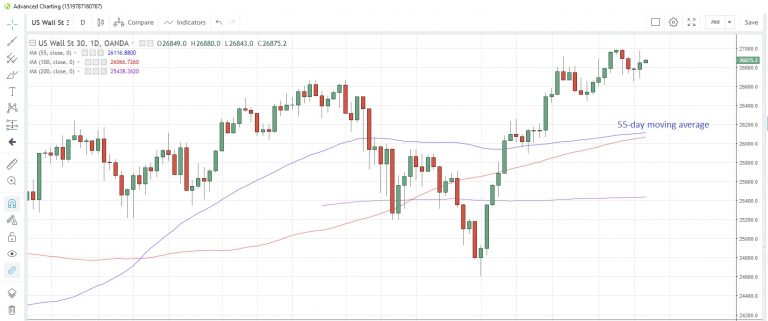
The US30 index snapped a three-day losing streak yesterday after Powell said trade war and global growth uncertainties outweighed the strong labour market, signaling a rate cut is on the way
The 100-day moving average at 26,067 is edging closer to the 55-day average at 26,117
FOMC minutes of the last meeting showed most members considered a rate cut warranted in the near term if recent global trade issues continue to weigh on the outlook. US CPI data for June are due today and seen rising 0.2% m/m, up from +0.1% in May. A lower-than-expected number would almost cement a rate cut later this month.
DE30EUR Daily Chart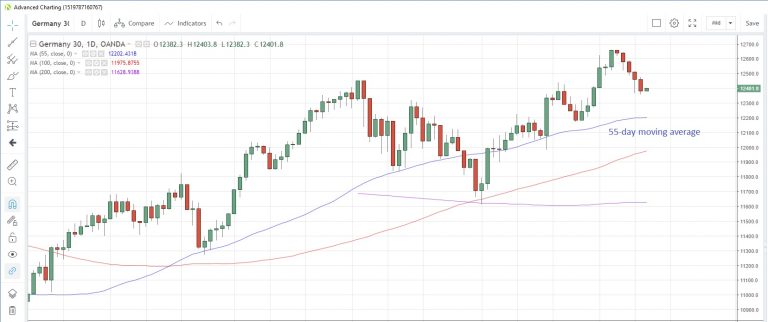
The Germany30 index fell for a fifth day yesterday, ignoring the euphoria on Wall Street. The index appears to be bringing that losing streak to a halt today
The index slid to a near-two week low yesterday, posting the biggest daily loss since June 21. The 55-day moving average is at 12,202
German consumer prices are expected to rise 0.3% m/m and 1.6% y/y in June, the latest survey of economists shows. ECB’s Coeure is scheduled to speak.
WTICOUSD Daily Chart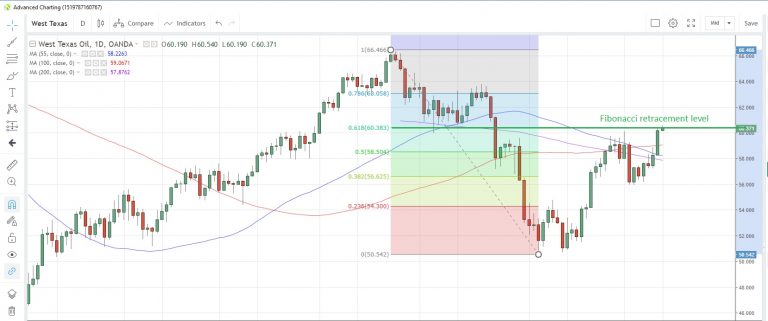
Crude oil prices jumped the most in three weeks yesterday, with WTI touching the highest since May 23 this morning
WTI is testing the 61.8% Fibonacci retracement of the April-June decline at $60.38
Weekly stockpiles data to July 5 from EIA confirmed a pickup in demand with a drawdown of 9.5 million barrels, the second-largest reduction since March. Oil supply could be affected by a potential hurricane building in the Gulf of Mexico.
USD/CHF Correcting Lower Before Fresh Increase
Key Highlights
- The US Dollar struggled to break the 0.9950 resistance against the Swiss Franc.
- There are many important supports for USD/CHF near 0.9860 and 0.9840.
- The US Wholesale Inventories increased 0.4% in May 2019, similar to the forecast.
- The US CPI in June 2019 might rise 0.2% (MoM), more than the last +0.1%.
USDCHF Technical Analysis
After a successful close above 0.9750, the US Dollar climbed higher steadily against the Swiss Franc. The USD/CHF pair traded above many hurdles, but it recently struggled to clear the 0.9950 resistance.
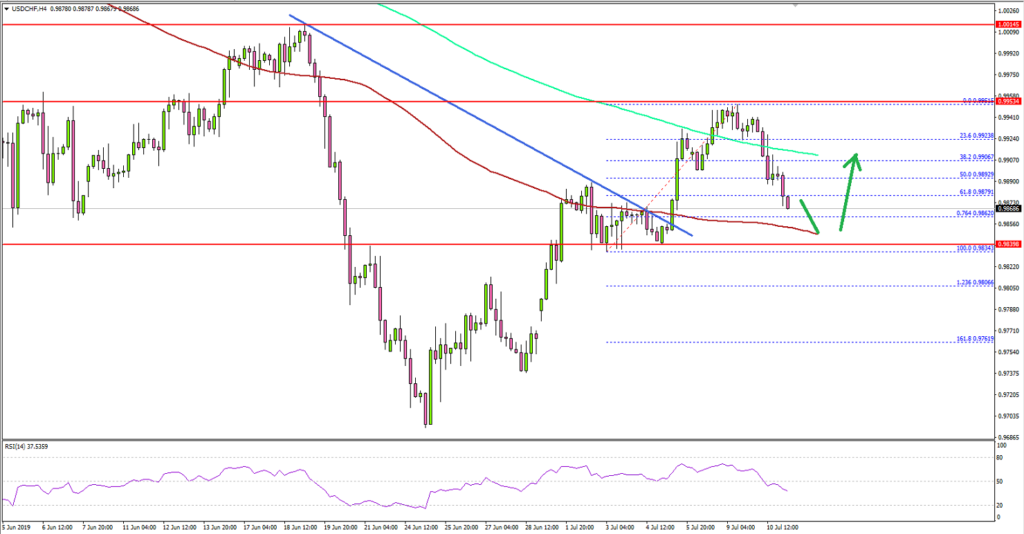
Looking at the 4-hours chart, the pair settled nicely above the 0.9840 pivot level plus the 100 simple moving average (red, 4-hours). During the recent rise, there was a break above a major bearish trend line with resistance at 0.9855.
The pair even broke the 0.9925 level and the 200 simple moving average (green, 4-hours). However, it struggled to gain momentum above 0.9950 and recently topped at 0.9951.
The pair corrected lower below 0.9925 and tested the 50% Fib retracement level of the upward move from the 0.9834 low to 0.9951 high. On the downside, there are a few important supports near the 0.9875, 0.9860 and 0.9840 levels.
Moreover, the 100 simple moving average (red, 4-hours) is also near the 0.9850 level to act as a strong support. Therefore, as long as USD/CHF is above the 0.9840 pivot level, it remains supported on dips and it is likely to bounce back.
Conversely, a successful close below 0.9840 and the 100 SMA might start a significant downward move below the 0.9820 and 0.9800 support levels.
Fundamentally, the US Wholesale Inventories report for May 2019 was released by the US Census Bureau. The market was looking for a 0.4% rise compared with the previous month.
The actual result was similar to the forecast, with a 0.4% rise in total inventories of merchant wholesalers, except manufacturers’ sales branches and offices (similar to the last).
The report added:
May 2019 sales of merchant wholesalers, except manufacturers’ sales branches and offices, after adjustment for seasonal variations and trading day differences but not for price changes, were $503.4 billion, up 0.1 percent (±0.4 percent) from the revised April level.
Overall, the US Dollar has likely started a downside correction, but it could bounce back if the US CPI report meets the market expectation today.
Economic Releases to Watch Today
- German Consumer Price Index for June 2019 (YoY) – Forecast +1.3%, versus +1.3% previous.
- German Consumer Price Index for June 2019 (MoM) – Forecast +0.3%, versus +0.3% previous.
- ECB Monetary Policy Meeting Minutes.
- US Initial Jobless Claims – Forecast 223K, versus 221K previous.
- US Consumer Price Index June 2019 (MoM) – Forecast +0.2%, versus +0.1% previous.
- US Consumer Price Index June 2019 (YoY) – Forecast +1.6%, versus +1.8% previous.
- US Consumer Price Index Ex Food & Energy June 2019 (YoY) – Forecast +2%, versus +2% previous.
USD/CAD Canadian Dollar Slightly Higher As Battle Of The Doves Limit Upside For Currency
The Canadian dollar gave back the gains ahead of the Fed Chair Powell's testimony before US congress. The Bank of Canada (BoC) held the benchmark rate unchanged as expected at 1.75 percent but was more dovish in its statement. The main source for the BoC's pessimism is trade disputes which impact commodity prices weakening demand.
The Canadian central bank was caught by surprise by the strong pace of the economy in the second quarter, but it concedes it could be temporary factors. The dovish remarks by Fed Chair Powell were met by a dovish BoC statement resulting in the loonie giving back the earlier gains where the currency traded under 1.31, reaching 1.3080 levels only to trade back up to 1.3131 despite the ongoing testimony by Powell.
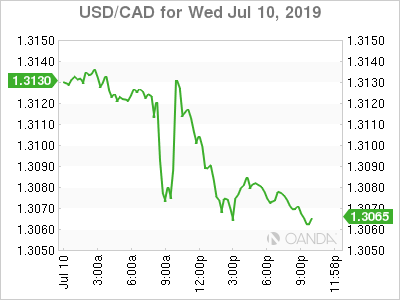
The press BoC press conference remarks before the Q and A made clear that the Canadian central bank is part of the dovish group of central banks that are looking to their tools for easing monetary policy. Deputy Governor Wilkins said that the US and Canadian economies are converging, not diverging, but even the bank's forecast could see more optimism on Canadian growth.
Trade is the biggest headwind, in particular the US-China dispute, Governor Poloz outlined that the effect of the trade war is tangible. Canada is no stranger to a head-on dispute with the US and even signing the USMCA will provide small comfort.
The Canadian dollar is trading at 1.3116 after the press conference. The Bank of Canada (BoC) made clear that is in no rush to intervene as it remains hawkish on the Canadian economy, but cautious about the effects that a prolonged trade war could bring.
OIL – Crude Rises on Soft Dollar, Huge Drawdown and Upcoming Storm
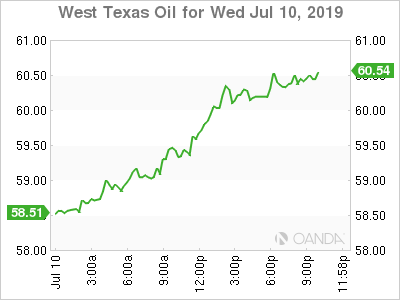
Energy prices surged on Wednesday after the release of US weekly crude inventories showed a larger than expected drawdown and a softer dollar as Fed Chair Powell testified before congress. The Energy Information Administration (EIA) published a 9.5 million barrel drop on weekly crude stocks which combined with Middle East tensions and the upcoming storm in the Gulf of Mexico supply will be limited boosting crude prices.
The US dollar is on the back foot after Fed Chair Powell kept up the dovish rhetoric that has the market pricing in an interest rate cut in July.
The US-Iran tension has not eased as both sides are digging in their heels and there are very little diplomacy options available. The Strait of Hormuz a big point of contention as Iran has said it could limit traffic or install a toll system to offset the negative effect of US sanctions. 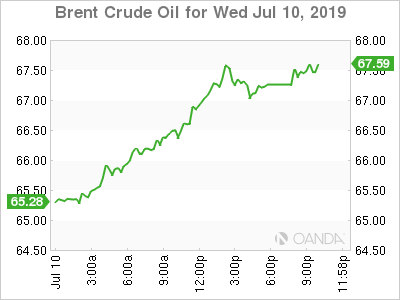
The OPEC+ production cut extension until March of 2020, Middle East tensions, weather related disruptions and a soft dollar drove more than 4 percent gains for WTI, Brent and gasoline.
GOLD – Gold Higher on Dollar Under Pressure from Dovish Fed
Gold jumped 1.46 percent on Wednesday after the Fed Chair continued to signal an upcoming rate cut. In his prepared remarks and later in the question and answer period Fed Chair Jerome Powell went full dove with his comments. The US-China trade war continues to be a threat for global growth and the US central bank is being forced to slash the benchmark interest rate to keep the economy from regressing.
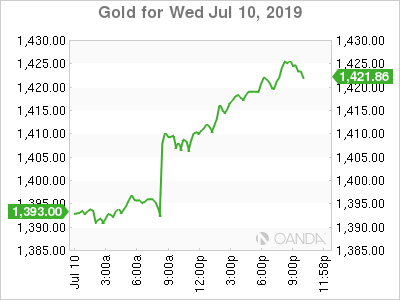
The metal broke through the $1,400 price level and is trading at $1,419 ahead of another day of Chair Powell being grilled on American monetary policy, this time by the Senate committee.
A soft dollar, trade war and Middle East tensions have put gold higher with the metal retaking the crown as top safe haven.
STOCKS – Equities Rise on Fed Sticking to Dovish Rhetoric, Signalling Impending Rate Cut
The S&P broke through the 3,000 point level for the first time ever as the Fed Chair did not go off his dovish script. The Fed has been telegraphing an interest downwards move since January and by removing some language in June and even a Fed member voting for a rate cut then it set off market anticipation that the end of July would bring the first cut under Powell's leadership.
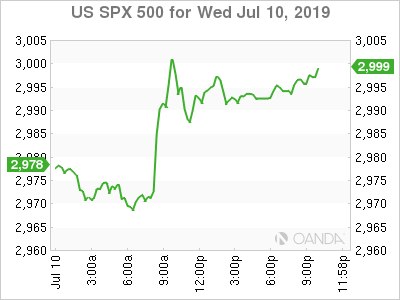
The Fed chief was more focused on the headwinds facing the US economy and did not let his optimism on growth get too much airtime, leaving the market with a dovish impression. The balancing act by Powell of being dovish, but not going full dove and injecting pessimism into the stock market was achieved.
A July rate cut is fully priced in, but a stronger than forecasted NFP report in June put a question mark on how many more cuts does the Fed need to make. The trade war with China is a major factor and if there is an agreement in the short term the central bank could leave it at one and done for the year.
BITCOIN – Fed Concerns on Facebook's Libra and Profit Taking Pressure Bitcoin
The most popular cryptocurrency fell more than $1,000 on Wednesday after Fed Chair Powell's comments on Libra. The policy maker said that Libra raises many serious concerns when asked about it during his testimony before the congress committee.
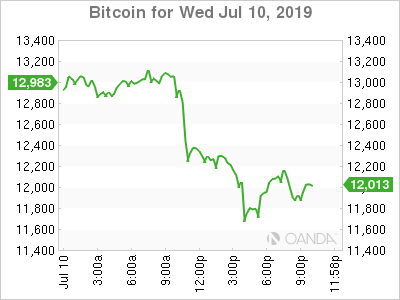
Bitcoin also fell from profit taking as investors saw the $13,000 price level as a good exit point. The combination between outflows and concern from the US central bank on Facebook's wallet pegged the cryptocurrency lower.
Eco Data 7/11/19
[php_everywhere instance="1"]
(FED) Minutes of the Federal Open Market Committee June 18-19, 2019
A joint meeting of the Federal Open Market Committee and the Board of Governors was held in the offices of the Board of Governors of the Federal Reserve System in Washington, D.C., on Tuesday, June 18, 2019, at 10:30 a.m. and continued on Wednesday, June 19, 2019, at 9:00 a.m.1
PRESENT:
Jerome H. Powell, Chair
John C. Williams, Vice Chair
Michelle W. Bowman
Lael Brainard
James Bullard
Richard H. Clarida
Charles L. Evans
Esther L. George
Randal K. Quarles
Eric Rosengren
Patrick Harker, Robert S. Kaplan, Neel Kashkari, Loretta J. Mester, and Michael Strine, Alternate Members of the Federal Open Market Committee
Thomas I. Barkin, Raphael W. Bostic, and Mary C. Daly, Presidents of the Federal Reserve Banks of Richmond, Atlanta, and San Francisco, respectively
James A. Clouse, Secretary
Matthew M. Luecke, Deputy Secretary
David W. Skidmore, Assistant Secretary
Michelle A. Smith, Assistant Secretary
Mark E. Van Der Weide, General Counsel
Michael Held, Deputy General Counsel
Steven B. Kamin, Economist
Thomas Laubach, Economist
Stacey Tevlin, Economist
Rochelle M. Edge, Eric M. Engen, Anna Paulson, Christopher J. Waller, William Wascher, and Beth Anne Wilson,2 Associate Economists
Lorie K. Logan, Manager pro tem,3 System Open Market Account
Ann E. Misback, Secretary, Office of the Secretary, Board of Governors
Matthew J. Eichner,4 Director, Division of Reserve Bank Operations and Payment Systems, Board of Governors; Andreas Lehnert, Director, Division of Financial Stability, Board of Governors
Jennifer J. Burns, Deputy Director, Division of Supervision and Regulation, Board of Governors; Michael T. Kiley, Deputy Director, Division of Financial Stability, Board of Governors; Trevor A. Reeve, Deputy Director, Division of Monetary Affairs, Board of Governors
Jon Faust, Senior Special Adviser to the Chair, Office of Board Members, Board of Governors
Joshua Gallin, Special Adviser to the Chair, Office of Board Members, Board of Governors
Brian M. Doyle, Wendy E. Dunn,2 Joseph W. Gruber, Ellen E. Meade, and John M. Roberts, Special Advisers to the Board, Office of Board Members, Board of Governors
Linda Robertson, Assistant to the Board, Office of Board Members, Board of Governors
Shaghil Ahmed, Senior Associate Director, Division of International Finance, Board of Governors
Jane E. Ihrig and Don H. Kim, Senior Advisers, Division of Monetary Affairs, Board of Governors; Jeremy B. Rudd, Senior Adviser, Division of Research and Statistics, Board of Governors
Marnie Gillis DeBoer and Min Wei, Associate Directors, Division of Monetary Affairs, Board of Governors
Christopher J. Gust,4 Deputy Associate Director, Division of Monetary Affairs, Board of Governors; Matteo Iacoviello and Paul R. Wood,2 Deputy Associate Directors, Division of International Finance, Board of Governors; Jeffrey D. Walker,4 Deputy Associate Director, Division of Reserve Bank Operations and Payment Systems, Board of Governors
Burcu Duygan-Bump, Andrew Figura, Glenn Follette, Patrick E. McCabe, and Paul A. Smith, Assistant Directors, Division of Research and Statistics, Board of Governors; Laura Lipscomb,4 Zeynep Senyuz,4 and Rebecca Zarutskie, Assistant Directors, Division of Monetary Affairs, Board of Governors; Steve Spurry,4 Assistant Director, Division of Supervision and Regulation, Board of Governors
Matthew Malloy,4 Section Chief, Division of Monetary Affairs, Board of Governors
Penelope A. Beattie,2 Assistant to the Secretary, Office of the Secretary, Board of Governors
Mark A. Carlson,4 Senior Economic Project Manager, Division of Monetary Affairs, Board of Governors
Sean Savage, Senior Project Manager, Division of Monetary Affairs, Board of Governors
David H. Small, Project Manager, Division of Monetary Affairs, Board of Governors
Heather A. Wiggins,4 Group Manager, Division of Monetary Affairs, Board of Governors
Maria Otoo, Principal Economist, Division of Research and Statistics, Board of Governors; Lubomir Petrasek, Marcelo Rezende, and Francisco Vazquez-Grande, Principal Economists, Division of Monetary Affairs, Board of Governors; Patrice Robitaille,2 Principal Economist, Division of International Finance, Board of Governors
Donielle A. Winford, Information Management Analyst, Division of Monetary Affairs, Board of Governors
Andre Anderson, First Vice President, Federal Reserve Bank of Atlanta
David Altig and Kartik B. Athreya, Executive Vice Presidents, Federal Reserve Banks of Atlanta and Richmond, respectively
Edward S. Knotek II, Paolo A. Pesenti, Mark L.J. Wright, and Nathaniel Wuerffel,4 Senior Vice Presidents, Federal Reserve Banks of Cleveland, New York, Minneapolis, and New York, respectively
Roc Armenter, Patrick Dwyer,4 George A. Kahn, Giovanni Olivei, Rania Perry,4 Benedict Wensley,4 and Patricia Zobel, Vice Presidents, Federal Reserve Banks of Philadelphia, New York, Kansas City, Boston, New York, New York, and New York, respectively
Gara Afonso4 and Scott Sherman,4 Assistant Vice Presidents, Federal Reserve Bank of New York
Nicolas Petrosky-Nadeau, Senior Research Advisor, Federal Reserve Bank of San Francisco
Jim Dolmas, Senior Research Economist, Federal Reserve Bank of Dallas
Standing Repurchase Facility
The staff briefed the Committee on the possible role of a standing fixed-rate repurchase agreement (repo) facility as part of the monetary policy implementation framework; a facility of this type would allow counterparties to obtain temporary liquidity at a fixed rate of interest through repurchase transactions with the Federal Reserve involving their holdings of select securities eligible for open market operations. The staff presentation noted how such a facility could provide a backstop against unusual spikes in the federal funds rate and other money market rates and might also provide incentives for banks to shift the composition of their portfolios of liquid assets away from reserves and toward high-quality securities. Key design features for such a facility, including the fixed rate offered to counterparties, the set of eligible counterparties, and the range of securities eligible to be placed at the facility, would influence the effectiveness of a facility in achieving either of these objectives. The staff noted a number of considerations that could arise in setting these design parameters, including potential repercussions in unsecured and secured funding markets, the eligibility of counterparties in weak financial condition, the potential that turning to such a facility could become stigmatized, and issues of a level playing field across different classes of counterparties.
Participants commented on a number of issues in connection with key design parameters for a repo facility. In terms of the setting of the facility's fixed rate, many participants acknowledged a tradeoff in determining the level of the rate relative to other money market rates. On the one hand, establishing the rate at a narrow spread above money market rates would likely provide better interest rate control and could also be helpful in avoiding stigma that can be associated with the use of standing lending facilities with fixed rates set well above the level of money market rates. On the other hand, setting the rate close to the level of money market rates could result in very sizable Federal Reserve operations on a daily basis that could be viewed as disintermediating the activity of private entities in money markets.
In considering the eligible set of counterparties for a repo facility, a number of participants noted that making the facility available only to primary dealers would likely imply that the effects of the facility would be most direct on repo markets, while the influence on the federal funds market would be only indirect. A couple of participants noted that, particularly if banks were eligible counterparties, it would be important for counterparties of all sizes to have access to funding through the facility on the same terms. A few participants noted that a facility could enhance financial stability by providing a means by which nonbank counterparties can readily obtain liquidity against their high-quality assets. A couple of other participants noted ways that a repo facility could have unintended effects on financial stability; for example, if reserves help support overall financial stability, a facility that significantly reduced the demand for reserves might not be beneficial.
Many participants commented on issues associated with the availability of such a facility to firms in different states of financial condition. Several thought there should not be a guarantee of access to such a facility regardless of a firm's financial condition, while a number of others were willing to consider how such a facility could be structured to work effectively in a stressed environment where high-quality liquid assets were used as collateral. A few participants noted that the availability of the facility to banks during periods of stress, particularly when they might be in weak financial condition, could be an important factor determining whether a facility would significantly reduce banks' demand for reserves in normal times.
In their discussion of key objectives for establishing a repo facility, some participants raised questions about whether such a facility is needed in an ample-reserves framework, noting that the current ample-reserves regime has provided good interest rate control. Other participants commented on the potential benefits of such a facility as a way to enhance interest rate control in the current implementation regime or as a means to operate in the current implementation framework but with a significantly smaller quantity of reserves than at present. A couple of participants noted that a facility could damp volatility in repo rates. Several participants noted that a facility could possibly aid with multiple policy objectives.
A number of participants noted that the policy objectives for a fixed-rate standing repo facility would have implications for the appropriate design for the facility. Several participants recognized the need to carefully evaluate possible parameter settings to guard against unintended consequences, including the potential for moral hazard or a more volatile Federal Reserve balance sheet. In addition, several participants highlighted the importance of evaluating whether other tools or initiatives could better achieve the desired goals. Overall, no decisions were reached at this meeting; participants stated that additional work would be necessary to clearly define the objectives of such a facility and to evaluate its potential net benefits.
Developments in Financial Markets and Open Market Operations
The manager pro tem discussed developments in global financial markets over the intermeeting period. Trade-related developments reportedly led many market participants to take a more pessimistic view of the U.S. economic outlook. Equity prices and interest rates fell noticeably after the announcement of higher tariffs on Chinese imports in early May and then again after news that tariffs might be imposed on Mexican imports. In response to these developments, markets appeared to become more sensitive to incoming news about the outlook for global growth and inflation, including data that pointed to a continued subdued inflation environment and to slower economic growth in the United States and abroad.
Treasury yields fell sharply and far-forward measures of inflation compensation dropped significantly in the United States and abroad. Against this backdrop, market participants reportedly viewed communications by Federal Reserve officials as signaling a greater likelihood of a cut in the target range for the federal funds rate later in the year. The expected path of the federal funds rate embedded in futures prices shifted down significantly over the period.
In the euro area, far-forward measures of inflation compensation fell noticeably, and market participants reportedly increasingly came to believe that further monetary policy accommodation would be needed. Late in the intermeeting period, remarks by European Central Bank (ECB) President Draghi were interpreted as suggesting increased odds of further asset purchases by the ECB. Euro-area peripheral spreads to German equivalents moved sharply lower, and far-forward inflation compensation recovered modestly.
The manager pro tem turned next to a review of money market developments and Open Market Desk operations. Money market rates generally stabilized at modestly lower levels over the intermeeting period, likely reflecting both the technical adjustment in the interest on excess reserves (IOER) rate following the May FOMC meeting and a sizable increase in reserve balances associated with a decline in balances held by the Treasury in its account at the Federal Reserve. Market participants reported seeing slightly more pass-through from repo rates to the federal funds rate on days with heightened firmness in repo rates. Market participants attributed recent increases in repo rates on month-end and mid-month Treasury auction settlement dates in part to elevated net dealer inventories of Treasury securities, which dealers finance in the repo market.
Regarding open market operations over the period, given the substantial decline in mortgage rates over recent months and an associated increase in refinancing activity, principal payments on the Federal Reserve's holdings of agency mortgage-backed securities (MBS) had recently moved somewhat above the $20 billion monthly redemption cap. As a result, the Desk began in May to reinvest agency MBS principal payments in excess of the cap. Based on current market rates and prepayment forecasts, the Desk expected to reinvest modest amounts of agency MBS over the coming months and possibly again in 2020, particularly during the summer months.
By unanimous vote, the Committee ratified the Desk's domestic transactions over the intermeeting period. There were no intervention operations in foreign currencies for the System's account during the intermeeting period.
Staff Review of the Economic Situation
The information available for the June 18–19 meeting indicated that labor market conditions remained strong. Real gross domestic product (GDP) appeared to be rising at a moderate rate in the second quarter, as household spending growth picked up from the weak first quarter while business fixed investment was soft. Consumer price inflation, as measured by the 12-month percentage change in the price index for personal consumption expenditures (PCE), was below 2 percent in April. Survey-based measures of longer-run inflation expectations were little changed.
Total nonfarm payroll employment expanded solidly, on average, in April and May; however, job gains slowed sharply in May after a strong increase in April. The unemployment rate declined to 3.6 percent in April and remained there in May, its lowest level in 50 years. The labor force participation rate moved down somewhat in April and held steady in May, remaining close to its average over the previous few years; the employment-to-population ratio stayed flat in April and May. The unemployment rates for African Americans, Asians, and Hispanics decreased, on net, over April and May and were below their levels at the end of the previous economic expansion, though persistent differentials in unemployment rates across groups remained. The average share of workers employed part time for economic reasons over April and May continued to be below the lows reached in late 2007. The rate of private-sector job openings moved up in March and held steady in April, while the rate of quits was unchanged at a high level; the four-week moving average of initial claims for unemployment insurance benefits through early June was near historically low levels. Average hourly earnings for all employees rose 3.1 percent over the 12 months ending in May, slightly lower than in April but somewhat faster than a year earlier. Total labor compensation per hour in the business sector increased 1.6 percent over the four quarters ending in the first quarter, slower than a year earlier.
Total consumer prices, as measured by the PCE price index, increased 1.5 percent over the 12 months ending in April. This increase was slower than a year earlier, as core PCE price inflation (which excludes changes in consumer food and energy prices) moved down to 1.6 percent, consumer food price inflation remained well below core inflation, and consumer energy price inflation slowed considerably to about the same rate as core inflation. The trimmed mean measure of PCE price inflation constructed by the Federal Reserve Bank of Dallas was 2.0 percent over that 12‑month period. The consumer price index (CPI) rose 1.8 percent over the 12 months ending in May, while core CPI inflation was 2.0 percent. The monthly change in core PCE prices in April and the staff's estimate of the change in May—based on the CPI data and the relevant prices from the producer price index—were higher in both of these months than the very low readings seen in January through March. Recent survey-based measures of longer-run inflation expectations were little changed on balance. While measures from the Desk's Survey of Primary Dealers and Survey of Market Participants were little changed, the preliminary June reading from the University of Michigan Surveys of Consumers dropped significantly to below its range in recent years.
Growth in real consumer expenditures appeared to pick up to a solid rate in the second quarter from its weak first-quarter pace. The components of the nominal retail sales data used by the Bureau of Economic Analysis to estimate PCE increased in May, and the retail sales data for the previous two months were revised up notably. Sales of light motor vehicles rose sharply in May after stepping down in April. Key factors that influence consumer spending—including a low unemployment rate, further gains in real disposable income, and still elevated measures of households' net worth—were supportive of solid real PCE growth in the near term. In addition, the Michigan survey measure of consumer sentiment edged down in the preliminary June reading but was still at an upbeat level.
Real residential investment in the second quarter looked to be continuing the decline seen earlier in the year, albeit at a slower rate. Starts of new single-family homes rose in April but fell back in May, while starts of multifamily units increased over both months. Building permit issuance for new single-family homes—which tends to be a good indicator of the underlying trend in construction of such homes—was at roughly the same level in May as its first-quarter average. Sales of new homes fell notably in April after a marked gain in March, and existing home sales edged down in April.
Real nonresidential private fixed investment appeared soft in the second quarter. Real private expenditures for business equipment and intellectual property looked to be roughly flat, as nominal shipments of nondefense capital goods excluding aircraft moved sideways in April. Forward-looking indicators of business equipment spending pointed to possible decreases in the near term. Orders for nondefense capital goods excluding aircraft declined notably in April and continued to be below the level of shipments, readings on business sentiment deteriorated further, and analysts' expectations of firms' longer-term profit growth moved down sharply. Nominal business expenditures for nonresidential structures outside of the drilling and mining sector decreased in April, and the number of crude oil and natural gas rigs in operation—an indicator of business spending for structures in the drilling and mining sector—continued to decline through mid‑June.
Industrial production moved down in April and picked up in May, leaving output about flat over those two months, but production was lower than at the beginning of the year. Manufacturing output declined, on net, over April and May, although mining output expanded. Automakers' assembly schedules suggested that the production of light motor vehicles would move up in the near term, but new orders indexes from national and regional manufacturing surveys pointed to continued soft total factory output in the coming months. Moreover, industry news indicated that aircraft production would continue to be slow in the near term.
Total real government purchases appeared to be rising solidly in the second quarter. Federal government purchases were being boosted by strong increases in defense spending through May and the return of nondefense purchases to more typical levels after the partial federal government shutdown in the first quarter. Real purchases by state and local governments seemed to be rising modestly; total payrolls of these governments edged down over April and May, but nominal state and local construction spending expanded notably in April.
Net exports added substantially to real GDP growth in the first quarter, as exports increased robustly and imports fell. After widening in March, the nominal trade deficit narrowed in April; even though exports declined, imports declined by more. The available data suggested that net exports would be a small drag on real GDP growth in the second quarter.
Growth in the foreign economies remained subdued in the first quarter, as soft growth in the Canadian economy and weakness in several emerging market economies (EMEs) offset somewhat stronger growth in other advanced foreign economies (AFEs) and in China's economy. Recent indicators suggested that the pace of economic activity picked up in Canada in the second quarter but slowed in some other AFEs. Economic growth also appeared to have slowed in China. Foreign inflation remained subdued but rose a bit from lows earlier in the year, in part reflecting higher retail energy prices in many economies.
Staff Review of the Financial Situation
Investors' concerns about downside risks to the economic outlook weighed on financial markets over the intermeeting period. Market participants cited negative news about international trade tensions and, to a lesser extent, soft U.S. and foreign economic data as factors that contributed to these developments. Nominal Treasury yields posted notable declines and the expected path of policy shifted down considerably over the period. Equity prices declined, on net, and corporate bond spreads widened. However, financing conditions for businesses and households generally remained supportive of economic growth.
FOMC communications following the May meeting had little net effect on yields, though they rose modestly following the Chair's press conference. Later in the period, the expected path of policy moved down, partly in response to incoming information pointing to a weaker economic outlook. The market-implied probability for a 25 basis point cut in the target range for the federal funds rate by the July FOMC meeting rose to about 85 percent. The market-implied path for the federal funds rate for 2019 and 2020 shifted down markedly. Based on overnight index swap rates, investors expected the federal funds rate to decline about 60 basis points by the end of this year—a downward revision of 40 basis points over the intermeeting period.
Longer-term Treasury yields fell considerably over the period, with the declines driven primarily by negative headlines about trade tensions between the United States and two major trading partners, China and Mexico. Softer-than-expected domestic economic news, such as the weaker-than-expected employment data, also contributed to the declines. The spread between 10-year and 3-month Treasury yields fell to the bottom decile of its distribution since 1971. Measures of inflation compensation derived from Treasury Inflation-Protected Securities also decreased notably over the period along with declines in oil prices.
Major U.S. equity price indexes declined, on net, over the intermeeting period. Equity prices fell notably over the first few weeks of the period, primarily in response to the escalation of trade tensions with China and Mexico. Firms with high China exposure and those in cyclical sectors—such as energy, information technology, industrials, communication services, and banks—posted particularly large losses. However, later in the period, stock prices regained a significant portion of their losses amid an easing of trade tensions with Mexico and expectations of a more accommodative stance of policy. One-month option-implied volatility on the S&P 500 index—the VIX—increased over the period, and corporate credit spreads widened.
Conditions in short-term funding markets remained stable over the intermeeting period. Overnight interest rates in short-term funding markets declined in response to the technical adjustment that reduced the IOER rate 5 basis points to 2.35 percent after the May FOMC meeting. The average of the effective federal funds rate over the period was about 6 basis points below the level just before the May FOMC meeting, well within the FOMC's target range. Rates on commercial paper and negotiable certificates of deposit also declined somewhat.
Escalation of trade tensions and soft economic data also weighed on foreign financial markets. Most major global equity price indexes declined, on net, and EME sovereign spreads widened modestly. In the AFEs, policy expectations and sovereign yields declined notably, in part reflecting more-accommodative monetary policy communications by major central banks.
The broad dollar index rose a bit over the intermeeting period. The Japanese yen and Swiss franc, which are viewed as safe-haven currencies, appreciated against the dollar. The British pound depreciated amid increased uncertainty around Brexit. Increased trade tensions contributed to some depreciation of the Chinese renminbi. The value of the Mexican peso against the dollar fluctuated in response to announcements related to potential tariffs on imports from Mexico but ended the period only slightly lower.
Financing conditions for nonfinancial businesses continued to be accommodative overall. Gross issuance of corporate bonds was strong in May following a spell of seasonal weakness in April. The credit quality of nonfinancial corporations remained solid, as the volume of nonfinancial corporate bond upgrades outpaced that of downgrades in May. Issuance in the institutional syndicated leveraged loan market was subdued in April but rebounded in May, reflecting strong issuance beyond that associated with refinancing of maturing leveraged loans. Meanwhile, commercial and industrial lending slowed somewhat in April and May after a period of stronger growth in the first quarter. Small business credit market conditions were little changed, and credit conditions in municipal bond markets stayed accommodative on net.
In the commercial real estate (CRE) sector, financing conditions continued to be generally accommodative. Commercial mortgage-backed securities (CMBS) spreads widened slightly over the intermeeting period but remained near the low end of their post-crisis range. Issuance of agency and non-agency CMBS was solid in May, and CRE lending by banks expanded in April and May at a slower rate than in the first quarter.
Financing conditions in the residential mortgage market also remained supportive over the intermeeting period. Home mortgage rates decreased about 40 basis points. Since last November, mortgage rates had declined more than 1 percentage point, contributing to an increase in home-purchase mortgage originations to the solid levels seen in 2017.
Financing conditions in consumer credit markets were little changed in recent months and remained generally supportive of household spending, although the supply of credit to consumers with subprime credit scores continued to be tight. Consumer credit expanded at a moderate pace in the first quarter, with bank credit data pointing to a pickup in April and May. Conditions in the consumer asset-backed securities market remained stable over the intermeeting period, with robust issuance and spreads that were little changed at low levels.
Staff Economic Outlook
The projection for U.S. economic activity prepared by the staff for the June FOMC meeting was revised down somewhat on balance. Real GDP growth was forecast to slow to a moderate rate in the second quarter and move down to a more modest pace in the second half of the year, primarily reflecting a more downbeat near-term outlook for business fixed investment. The projection for real GDP growth over the medium term was little changed, as the effects of a higher projected path for the broad real dollar and lower trajectory for foreign economic growth were largely counterbalanced by a lower projected path for interest rates. Real GDP was forecast to expand at a rate a little above the staff's estimate of potential output growth in 2019 and 2020 and then slow to a pace slightly below potential output growth in 2021. The unemployment rate was projected to be roughly flat through 2021 and remain below the staff's estimate of its longer-run natural rate. With labor market conditions judged to be tight, the staff continued to assume that projected employment gains would manifest in smaller-than-usual downward pressure on the unemployment rate and in larger-than-usual upward pressure on the labor force participation rate.
The staff's forecast for inflation was little changed on balance. The forecast for total PCE price inflation this year was revised down somewhat, reflecting a lower near-term projection for energy prices. The core inflation forecast for this year was unchanged at a level below 2 percent. Both total and core inflation were projected to move up slightly next year, as the low readings early this year were expected to be transitory, but nevertheless to continue to run below 2 percent.
The staff viewed the uncertainty around its projections for real GDP growth, the unemployment rate, and inflation as generally similar to the average of the past 20 years, although uncertainty was seen to have increased since the previous forecast. Moreover, the staff also judged that the risks to the forecast for real GDP growth had tilted to the downside, with a skew to the upside for the unemployment rate. The increased uncertainty and shift to downside risks around the projection reflected the staff's assessment that international trade tensions and foreign economic developments seemed more likely to move in directions that could have significant negative effects on the U.S. economy than to resolve more favorably than assumed. With the risks to the forecast for economic activity tilted to the downside, the risks to the inflation projection were also viewed as having a downward skew.
Participants' Views on Current Conditions and the Economic Outlook
Participants judged that uncertainties and downside risks surrounding the economic outlook had increased significantly over recent weeks. While they continued to view a sustained expansion of economic activity, strong labor market conditions, and inflation near the Committee's symmetric 2 percent objective as the most likely outcomes, many participants attached significant odds to scenarios with less favorable outcomes.5 Moreover, nearly all participants in their submissions to the Summary of Economic Projections (SEP), had revised down their assessment of the appropriate path of the federal funds rate over the projection period that would be consistent with their modal economic outlook. Many participants noted that, since the Committee's previous meeting, the economy appeared to have lost some momentum and pointed to a number of factors supporting that view including recent weak indicators for business confidence, business spending and manufacturing activity; trade developments; and signs of slowing global economic growth. Many participants noted that they viewed the risks to their growth and inflation projections, such as those emanating from greater uncertainty about trade, as shifting notably over recent weeks and that risks were now weighted to the downside.
Participants discussed at some length the softness in various indicators of business fixed investment in the second quarter. Incoming data on shipments and orders of new capital goods looked weak and recent readings from some manufacturing surveys had dropped sharply. Private sector analysts had marked down their forecasts for longer-term corporate profit growth. Manufacturing production had posted declines so far this year. In addition, contacts reported that softer export sales, weaker economic activity abroad, and elevated levels of uncertainty regarding the global outlook were weighing on business sentiment and leading firms to reassess plans for investment spending. Several participants noted comments from business contacts reporting that their base case now assumed that uncertainties about the global outlook would remain prominent over the medium term and would continue to act as a drag on investment. Several participants also noted reports from some business contacts in the manufacturing sector suggesting that they were putting capital expenditures or hiring plans on hold and were reevaluating their global supply chains in light of trade uncertainties. A couple of participants, however, pointed to signs that investment might pick up, including reports from some contacts that their orders and shipments remained strong and that some contacts planned to hire more workers. A few participants also noted ongoing challenges in the agricultural sector, including those associated with increased trade uncertainty, weak export markets, wet weather, and severe flooding. A few participants remarked on the decline in energy prices and the associated reduction in activity in the energy sector.
In their discussion of the household sector, participants noted that available data on consumer spending had been solid, supported by a strong labor market and rising incomes. Several participants also noted that measures of consumer sentiment remained upbeat, and a couple noted that their business contacts confirmed the view that consumer spending had rebounded from the weak patch earlier in the year. Several participants, however, noted that tariffs could eventually become a drag on consumer durables spending, especially if additional tariffs on consumer goods were imposed, and that they would be monitoring incoming data for signs of this effect. A couple of participants noted that the continued softness in the housing sector was a concern, even though the decline in mortgage rates since last fall was expected to provide stronger impetus for activity; a couple of participants were somewhat optimistic that residential investment would pick up.
In their discussion of the labor market, participants cited evidence that conditions remained strong, including the very low unemployment rate and the fact that job gains had been solid, on average, in recent months. That said, job gains in May were weaker than expected and, in light of other developments, participants judged that it would be important to closely monitor incoming data for any signs of softening in labor market conditions. Reports from business contacts pointed to continued strong labor demand, with many firms planning to hire more workers. Economy-wide wage growth was seen as being broadly consistent with modest average rates of labor productivity growth in recent years. However, a few participants noted that there were limited signs of upward pressure on wage inflation. A few participants cited the combination of muted inflation pressures, moderate wage growth, and expanding employment as a possible indication that some slack remained in the labor market. Partly reflecting that combination of developments, several participants had revised down their SEP estimates of the longer-run normal rate of unemployment.
Participants noted that readings on overall inflation and inflation for items other than food and energy had come in lower than expected over recent months. In light of recent softer inflation readings, perceptions of downside risks to growth, and global disinflationary pressures, many participants viewed the risks to the outlook for inflation as weighted to the downside. Several participants indicated that, while headline inflation had been close to 2 percent last year, it was noteworthy that inflation had softened this year despite continued strong labor market conditions. Participants generally noted that they revised down their SEP projections of inflation for the current year in light of recent data. They still anticipated that the overall rate of inflation would firm somewhat and move up to the Committee's longer-run symmetric objective of 2 percent over the next few years. Consistent with that view, several participants commented that alternative measures of inflation that removed the influence of unusually large changes in the prices of individual items in either direction were running around 2 percent. However, a number of participants anticipated that the return to 2 percent would take longer than previously projected even with an assumed path for the federal funds rate that was lower than in their previous projections.
In their discussion of indicators of inflation expectations, participants generally observed that market-based measures of inflation compensation had declined and were at low levels. Some participants also noted that recent readings on some survey measures of consumers' inflation expectations had declined or stood at historically low levels. Many participants further noted that longer-term inflation expectations could be somewhat below levels consistent with the Committee's 2 percent inflation objective, or that the continued weakness in inflation could prompt expectations to slip further. These developments might make it more difficult to achieve their inflation objective on a sustained basis. However, several participants remarked that inflation expectations appeared to be at levels consistent with the Committee's 2 percent inflation objective.
Participants generally agreed that downside risks tothe outlook for economic activityhad risen materially since their May meeting, particularly those associated with ongoing trade negotiations and slowing economic growth abroad. Other downside risks cited by several participants included the possibility that federal budget negotiations could result in a sharp reduction in government spending or that negotiations to raise the federal debt limit could be prolonged. A couple of participants observed that an economic deterioration in the United States, if it occurred, might be amplified by significant debt burdens for many firms. A few participants remarked that an upside risk to the outlook for economic activity and inflation included a scenario in which trade negotiations were resolved favorably and business sentiment rebounded sharply.
In their discussion of financial developments, participants observed that the increase in uncertainty surrounding the global outlook had affected risk sentiment in financial markets. While overall financial conditions remained supportive of growth, those conditions appeared to be premised importantly on expectations that the Federal Reserve would ease policy in the near term to help offset the drag on economic growth stemming from uncertainties about the global outlook and other downside risks. Participants also discussed the decline in yields on longer-term Treasury securities in recent months. Many participants noted that the spread between the 10-year and 3-month Treasury yields was now negative, and several noted that their assessment of the risk of a slowing in the economic expansion had increased based on either the shape of the yield curve or other financial and economic indicators. A few participants pointed to the growth in debt issuance by nonfinancial corporations and still generally high asset valuations as developments that warranted continued monitoring.
In their discussion of monetary policy decisions at this meeting, participants noted that, under their baseline outlook, the labor market was likely to remain strong with economic activity growing at a moderate pace. However, they judged that the risks and uncertainties surrounding their outlooks, particularly those related to the global economic outlook, had intensified in recent weeks. Moreover, inflation continued to run below the Committee's 2 percent objective; similarly, inflation for items other than food and energy had remained below 2 percent as well. In addition, some readings on inflation expectations had been low. The increase in risks and uncertainties surrounding the outlook was quite recent and nearly all participants agreed that it would be appropriate to maintain the current target range for the federal funds rate at 2-1/4 to 2-1/2 percent at this meeting. However, they noted that it would be important to monitor the implications of incoming information and global economic developments for the U.S. economic outlook. A couple of participants favored a cut in the target range at this meeting, judging that a prolonged period with inflation running below 2 percent warranted a more accommodative policy response to firmly center inflation and inflation expectations around the Committee's symmetric 2 percent objective.
With regard to the outlook for monetary policy beyond this meeting, nearly all participants had revised down their assessment of the appropriate path for the federal funds rate over the projection period in their SEP submissions, and some had marked down their estimates of the longer-run normal level of the funds rate as well. Many participants indicated that the case for somewhat more accommodative policy had strengthened. Participants widely noted that the global developments that led to the heightened uncertainties about the economic outlook were quite recent. Many judged additional monetary policy accommodation would be warranted in the near term should these recent developments prove to be sustained and continue to weigh on the economic outlook. Several others noted that additional monetary policy accommodation could well be appropriate if incoming information showed further deterioration in the outlook. Participants stated a variety of reasons that would call for a lower path of the federal funds rate. Several participants noted that a near-term cut in the target range for the federal funds rate could help cushion the effects of possible future adverse shocks to the economy and, hence, was appropriate policy from a risk-management perspective. Some participants also noted that the continued shortfall in inflation risked a softening of inflation expectations that could slow the sustained return of inflation to the Committee's 2 percent objective. Several participants pointed out that they had revised down their estimates of the longer-run normal rate of unemployment and, as a result, saw a smaller upward contribution to inflation pressures from tight resource utilization than they had earlier. A few participants were concerned that inflation expectations had already moved below levels consistent with the Committee's symmetric 2 percent objective and that it was important to provide additional accommodation in the near term to bolster inflation expectations. A few participants judged that allowing inflation to run above 2 percent for some time could help strengthen the credibility of the Committee's commitment to its symmetric 2 percent inflation objective.
Some participants suggested that although they now judged that the appropriate path of the federal funds rate would follow a flatter trajectory than they had previously assumed, there was not yet a strong case for a rate cut from current levels. They preferred to gather more information on the trajectory of the economy before concluding that a change in policy stance is warranted. A few participants expressed the view that with the economy still in a favorable position in terms of the dual mandate, an easing of policy in an attempt to increase inflation a few tenths of a percentage point risked overheating the labor markets and fueling financial imbalances. Several participants observed that the trimmed mean measure of PCE price inflation constructed by the Federal Reserve Bank of Dallas had stayed near 2 percent recently, underscoring the view that the recent low readings on inflation will prove transitory.
Committee Policy Action
In their discussion of monetary policy for the period ahead, members noted the significant increase in risks and uncertainties attending the economic outlook. There were signs of weakness in U.S. business spending, and foreign economic data were generally disappointing, raising concerns about the strength of global economic growth. While strong labor markets and rising incomes continued to support the outlook for consumer spending, uncertainties and risks regarding the global outlook appeared to be contributing to a deterioration in risk sentiment in financial markets and a decline in business confidence that pointed to a weaker outlook for business investment in the United States. Inflation pressures remained muted and some readings on inflation expectations were at low levels. Although nearly all members agreed to maintain the target range for the federal funds rate at 2-1/4 to 2-1/2 percent at this meeting, they generally agreed that risks and uncertainties surrounding the economic outlook had intensified and many judged that additional policy accommodation would be warranted if they continued to weigh on the economic outlook. One member preferred to lower the target range for the federal funds rate by 25 basis points at this meeting, stating that the Committee should ease policy at this meeting to re-center inflation and inflation expectations at the Committee's symmetric 2 percent objective.
Members agreed that in determining the timing and size of future adjustments to the target range for the federal funds rate, the Committee would assess realized and expected economic conditions relative to the Committee's maximum-employment and symmetric 2 percent inflation objectives. They reiterated that this assessment would take into account a wide range of information, including measures of labor market conditions, indicators of inflation pressures and inflation expectations, and readings on financial and international developments. More generally, members noted that decisions regarding near-term adjustments of the stance of monetary policy would appropriately remain dependent on the implications of incoming information for the economic outlook.
With regard to the postmeeting statement, members agreed to several adjustments in the description of the economic situation, including a revision in the description of market-based measures of inflation compensation to recognize the recent fall in inflation compensation. The Committee retained the characterization of the most likely outcomes as "sustained expansion of economic activity, strong labor market conditions, and inflation near the Committee's symmetric 2 percent objective" but added a clause to emphasize that uncertainties about this outlook had increased. In describing the monetary policy outlook, members agreed to remove the "patient" language and to emphasize instead that, in light of these uncertainties and muted inflation pressures, the Committee would closely monitor the implications of incoming information for the economic outlook and would act as appropriate to sustain the expansion, with a strong labor market and inflation near its symmetric 2 percent objective.
At the conclusion of the discussion, the Committee voted to authorize and direct the Federal Reserve Bank of New York, until instructed otherwise, to execute transactions in the System Open Market Account in accordance with the following domestic policy directive, to be released at 2:00 p.m.:
"Effective June 20, 2019, the Federal Open Market Committee directs the Desk to undertake open market operations as necessary to maintain the federal funds rate in a target range of 2-1/4 to 2-1/2 percent, including overnight reverse repurchase operations (and reverse repurchase operations with maturities of more than one day when necessary to accommodate weekend, holiday, or similar trading conventions) at an offering rate of 2.25 percent, in amounts limited only by the value of Treasury securities held outright in the System Open Market Account that are available for such operations and by a per-counterparty limit of $30 billion per day.
The Committee directs the Desk to continue rolling over at auction the amount of principal payments from the Federal Reserve's holdings of Treasury securities maturing during each calendar month that exceeds $15 billion, and to continue reinvesting in agency mortgage-backed securities the amount of principal payments from the Federal Reserve's holdings of agency debt and agency mortgage-backed securities received during each calendar month that exceeds $20 billion. Small deviations from these amounts for operational reasons are acceptable.
The Committee also directs the Desk to engage in dollar roll and coupon swap transactions as necessary to facilitate settlement of the Federal Reserve's agency mortgage-backed securities transactions."
The vote also encompassed approval of the statement below to be released at 2:00 p.m.:
"Information received since the Federal Open Market Committee met in May indicates that the labor market remains strong and that economic activity is rising at a moderate rate. Job gains have been solid, on average, in recent months, and the unemployment rate has remained low. Although growth of household spending appears to have picked up from earlier in the year, indicators of business fixed investment have been soft. On a 12-month basis, overall inflation and inflation for items other than food and energy are running below 2 percent. Market-based measures of inflation compensation have declined; survey-based measures of longer-term inflation expectations are little changed.
Consistent with its statutory mandate, the Committee seeks to foster maximum employment and price stability. In support of these goals, the Committee decided to maintain the target range for the federal funds rate at 2-1/4 to 2-1/2 percent. The Committee continues to view sustained expansion of economic activity, strong labor market conditions, and inflation near the Committee's symmetric 2 percent objective as the most likely outcomes, but uncertainties about this outlook have increased. In light of these uncertainties and muted inflation pressures, the Committee will closely monitor the implications of incoming information for the economic outlook and will act as appropriate to sustain the expansion, with a strong labor market and inflation near its symmetric 2 percent objective.
In determining the timing and size of future adjustments to the target range for the federal funds rate, the Committee will assess realized and expected economic conditions relative to its maximum employment objective and its symmetric 2 percent inflation objective. This assessment will take into account a wide range of information, including measures of labor market conditions, indicators of inflation pressures and inflation expectations, and readings on financial and international developments."
Voting for this action: Jerome H. Powell, John C. Williams, Michelle W. Bowman, Lael Brainard, Richard H. Clarida, Charles L. Evans, Esther L. George, Randal K. Quarles, and Eric Rosengren.
Voting against this action: James Bullard.
Mr. Bullard dissented because he believed that the current stance of monetary policy could be better positioned to foster progress toward the Committee's statutory objectives of maximum employment and stable prices. Particularly in light of persistent low readings on inflation and from indicators of inflation expectations along with the risks to the U.S. outlook associated with global economic developments, he noted that a policy rate reduction at the current meeting would help re-center inflation and inflation expectations at levels consistent with the Committee's symmetric 2 percent inflation objective and simultaneously provide some insurance against unexpected developments that could slow U.S. economic growth.
Consistent with the Committee's decision to leave the target range for the federal funds rate unchanged, the Board of Governors voted unanimously to leave the interest rates on required and excess reserve balances unchanged at 2.35 percent and voted unanimously to approve establishment of the primary credit rate at the existing level of 3.00 percent, effective June 20, 2019.
Update from Subcommittee on Communications
Governor Clarida provided a brief update on the work of the subcommittee on communications. The Fed Listens conferences conducted to date were viewed as successful in identifying many important issues for the strategic review of monetary policy strategy, tools, and communications. Additional Fed Listens events were planned over the remainder of the year. The Committee was likely to begin internal deliberations on aspects of the strategic review over coming FOMC meetings.
It was agreed that the next meeting of the Committee would be held on Tuesday–Wednesday, July 30–31, 2019. The meeting adjourned at 10:05 a.m. on June 19, 2019.
Notation Vote
By notation vote completed on May 21, 2019, the Committee unanimously approved the minutes of the Committee meeting held on April 30–May 1, 2019.
_______________________
James A. Clouse
Secretary
1. The Federal Open Market Committee is referenced as the "FOMC" and the "Committee" in these minutes. Return to text
2. Attended Tuesday session only. Return to text
3. In the absence of the manager, the Committee's Rules of Organization provide that the deputy manager acts as manager pro tem. Return to text
4. Attended through the discussion of developments in financial markets and open market operations. Return to text
5. In conjunction with this FOMC meeting, members of the Board of Governors and Federal Reserve Bank presidents submitted their projections of the most likely outcomes for real GDP growth, the unemployment rate, and inflation for each year from 2019 through 2021 and over the longer run, based on their individual assessments of the appropriate path for the federal funds rate. The longer-run projections represented each participant's assessment of the rate to which each variable would be expected to converge, over time, under appropriate monetary policy and in the absence of further shocks to the economy. These projections and policy assessments are described in the Summary of Economic Projections, which is an addendum to these minutes. Return to text
(BOC) Monetary Policy Report Press Conference Opening Statement
Good morning. Thanks for coming out on this beautiful summer day. Governor Poloz and I are pleased to be here to answer your questions about today's interest rate announcement and our Monetary Policy Report (MPR). Let me start by reviewing recent developments in the Canadian economy, before turning to key points from Governing Council's deliberations.
The Canadian economy has been recovering from the rough patch we saw at the end of 2018 and beginning of 2019. In fact, recent economic data have led us to upgrade our projection for the second quarter. That's largely due to a surge in oil production and a bounce-back from weather-related slowdowns earlier this year. We now expect that economic growth will ease over the summer and will average around potential output growth over the second and third quarters. At the same time, inflation remains around 2 percent.
The fact that Canada is picking up while the US economy is slowing sounds like a divergence. In fact, it's a process of convergence. This is because the two countries are at different points in the economic cycle. The United States is slowing to a more sustainable pace, while Canada is moving back up to its trend growth. Activity here at home is being supported by a policy rate that's lower than south of the border. By the second half of this year, growth should be similar in both economies as they converge on their respective potential level of activity.
Meanwhile, at the global level, escalating trade conflicts and geopolitical tensions have been taking even more of a toll on trade and business investment than we expected. Several major central banks have said they are ready to provide more accommodative monetary policy or have already taken policy actions. In this context, global interest rates have fallen considerably since April, and the Canadian dollar has strengthened.
We have said that we are paying particular attention to Canadian household spending and the oil sector. Consumption has rebounded and should continue to be supported by a solid labour market. So far this year we've seen strong job growth—unemployment is still near historic lows—and wage growth has picked up. Also, the housing market is evolving as expected at the national level. Adjustments to previous speculative activity and changes in housing financing conditions have been difficult in some markets. We're seeing signs that the housing market is improving in the Greater Toronto Area, while prices and activity are still adjusting to more sustainable levels in the Greater Vancouver Area, and Alberta's market continues to adjust to lower oil prices. At the same time, interest rates on five-year fixed-rate mortgages have fallen recently to around where they were five years ago, which is relevant for people buying a new house or renewing their mortgage. It also reinforces our view that residential investment is once again contributing to growth.
In the oil and gas sector, we expect that transportation constraints for crude oil will ease gradually. The Trans Mountain Pipeline expansion will provide a welcome boost to capacity, although the pipeline will come online beyond our projection horizon. There are also some positive developments in offshore oil in Newfoundland and Labrador. Despite this, we expect overall investment in this sector to contract further in 2019 before stabilizing over the next two years. All told, this would bring oil and gas investment down by 20 percent since 2017, on top of the 50 percent drop seen following the 2014 oil price shock. It's worth reminding ourselves that oil and gas production is still contributing some $65 billion annually to the Canadian economy. In addition, construction related to Trans Mountain and to the liquefied natural gas terminal in British Columbia will add to business investment.
While recent export data for Canada have been encouraging, the trade environment continues to be the biggest wild card in our outlook. Governing Council spent considerable time discussing developments on this front. Since our April MPR, the tariffs that the United States had imposed on aluminum and steel, as well as Canada's countermeasures, have been removed. And, there has been some progress toward ratification of the Canada-United States-Mexico Agreement. This is welcome news. On the other side of the ledger, the actions that China has taken against some Canadian agricultural products and the fact that the US–China trade war is still ongoing are clear negatives.
We have increased our estimate of the impact that trade actions and related uncertainty are having on the economy, both globally and within our borders. For Canada, while exports are still expected to grow over the next couple of years, we forecast them to be around 1½ percent lower than they would have been without the trade uncertainty. We have also marked down the level of investment by 3 percent in 2021 for the same reason. Investment outside the oil and gas sector is still expected to expand, nonetheless. Businesses across Canada tell us they plan to invest to increase competiveness or to meet demand for their products. Here's the bottom line: when we take into account the impact on the global economy and commodity prices, trade conflicts and uncertainty are projected to reduce the level of Canadian GDP by as much as 2 percent by the end of 2021.
We have said for a while that the risks to output and inflation from the trade war are two-sided. As the situation persists, two questions become critical. The first is whether the risks are balanced; the second is what this means for monetary policy.
Staff did some excellent work to inform our discussion, and you can see the results in Box 2 of the MPR. They analyzed two scenarios that can be thought of as extremes: an unfavourable scenario in which trade conflicts escalate significantly, and a favourable scenario in which they are resolved. They held fiscal and monetary policy unchanged so that the economic effects would be more visible.
The results are clear. The impact on growth, both globally and in Canada, is much larger in the unfavourable scenario than in the favourable one. That underscores how much we all have to lose if the trade war escalates.
As for inflation, it actually rises in the unfavourable scenario, even as the economy weakens. That's because a full blown trade war would affect supply. Trade patterns and global value chains would be severely disrupted. This would lower productivity and reduce economic potential. It would threaten our living standards.
At the same time, slower global growth in this scenario reduces commodity prices and leads to a sharp decline in the Canadian dollar. While a lower currency would help contain the decline in exports, it would also put strong and persistent upward pressure on prices, as would the direct effects of the tariffs. It's clear that monetary policy could not simultaneously buffer the impact on growth and keep inflation in check. Central banks in advanced economies have not faced this type of trade off since the 1970s.
Of course, during our deliberations Governing Council also discussed the Bank's ultimate mission—inflation control. Our core inflation measures have averaged close to 2 percent in recent quarters. Total inflation will likely dip in the upcoming months due to the dynamics of gasoline prices and some other temporary factors. It is expected to return sustainably to target by around mid-2020 as slack in the economy is absorbed and these temporary effects wane.
Let me wrap this up. The Canadian economy is returning to potential growth. However, the outlook is clouded by persistent trade tensions. Taken together, the degree of accommodation being provided by the current policy interest rate remains appropriate. As Governing Council continues to monitor incoming data, we will pay particular attention to developments in the energy sector and the impact of trade conflicts on the prospects for Canadian growth and inflation.
Finally, I would like to say a few words about Deputy Governor Lynn Patterson, who will retire from the Bank of Canada next week. Her contribution over the last six years to the Bank, and to Canada, has been exceptional, in matters as diverse as financial markets, payments, and monetary policy. She will be a hard act to follow.
With that, Governor Poloz and I will now take your questions.