

Sample Category Title
Aussie Trading On A Stronger Footing This Morning
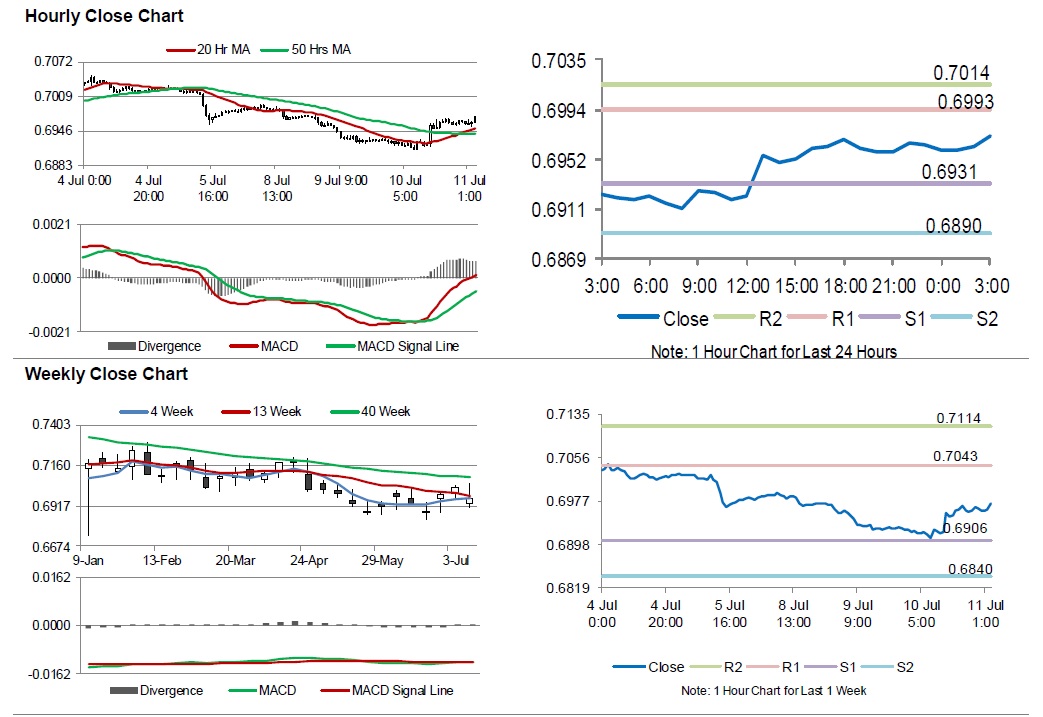
For the 24 hours to 23:00 GMT, the AUD rose 0.52% against the USD and closed at 0.6964.
LME Copper prices remained flat at $5805.0/MT. Aluminium prices rose 1.6% or $28.5/MT to $1811.5/MT.
In the Asian session, at GMT0300, the pair is trading at 0.6972, with the AUD trading 0.11% higher against the USD from yesterday’s close.
Overnight data showed that, in Australia, consumer inflation expectations eased to 3.2% in July, compared to 3.3% in the previous month. Additionally, seasonally adjusted home loan approvals dropped 0.1% on a monthly basis in May, less than market expectations. Home loan approvals had recorded a revised drop of 0.9% in the previous month.
The pair is expected to find support at 0.6931, and a fall through could take it to the next support level of 0.6890. The pair is expected to find its first resistance at 0.6993, and a rise through could take it to the next resistance level of 0.7014.
The currency pair is trading above its 20 Hr and 50 Hr moving averages.
Gold: Yellow Metal Extends Its Gains In The Asian Session
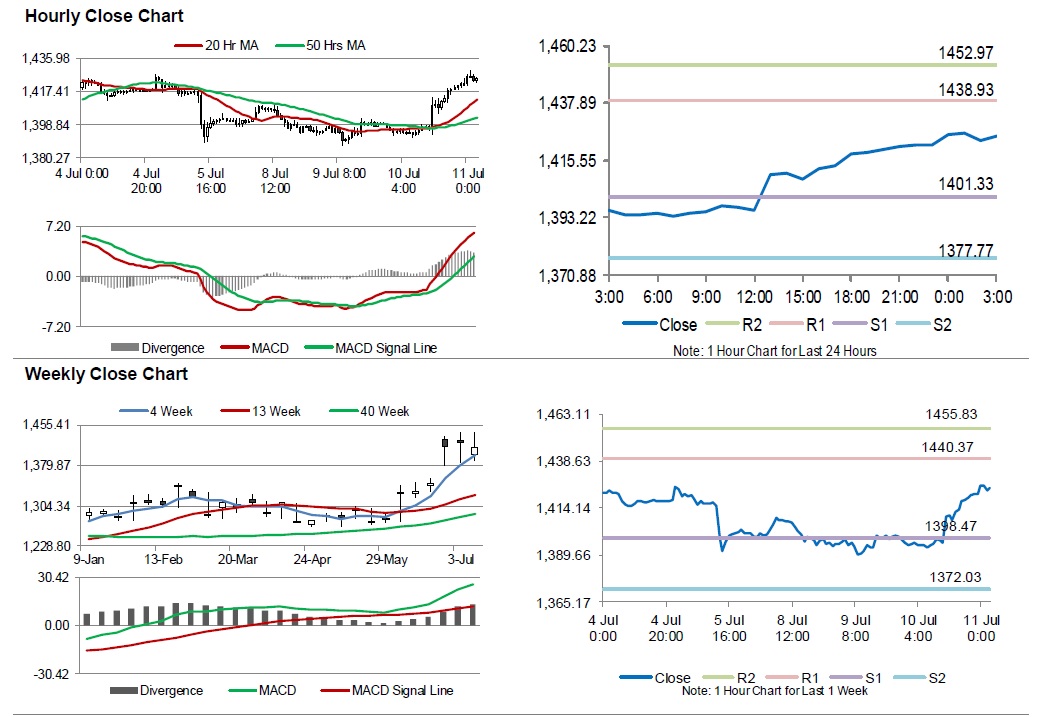
For the 24 hours to 23:00 GMT, Gold rose 1.75% against the USD and closed at USD1421.70 per ounce, amid broad weakness in the US dollar, following dovish comments by the US Fed Chairman.
In the Asian session, at GMT0300, the pair is trading at 1424.90, with gold trading 0.23% higher against the USD from yesterday’s close.
The pair is expected to find support at 1401.33, and a fall through could take it to the next support level of 1377.77. The pair is expected to find its first resistance at 1438.93, and a rise through could take it to the next resistance level of 1452.97.
The yellow metal is trading above its 20 Hr and 50 Hr moving averages.
Silver: White Metal Trading A Tad Higher In The Morning Session
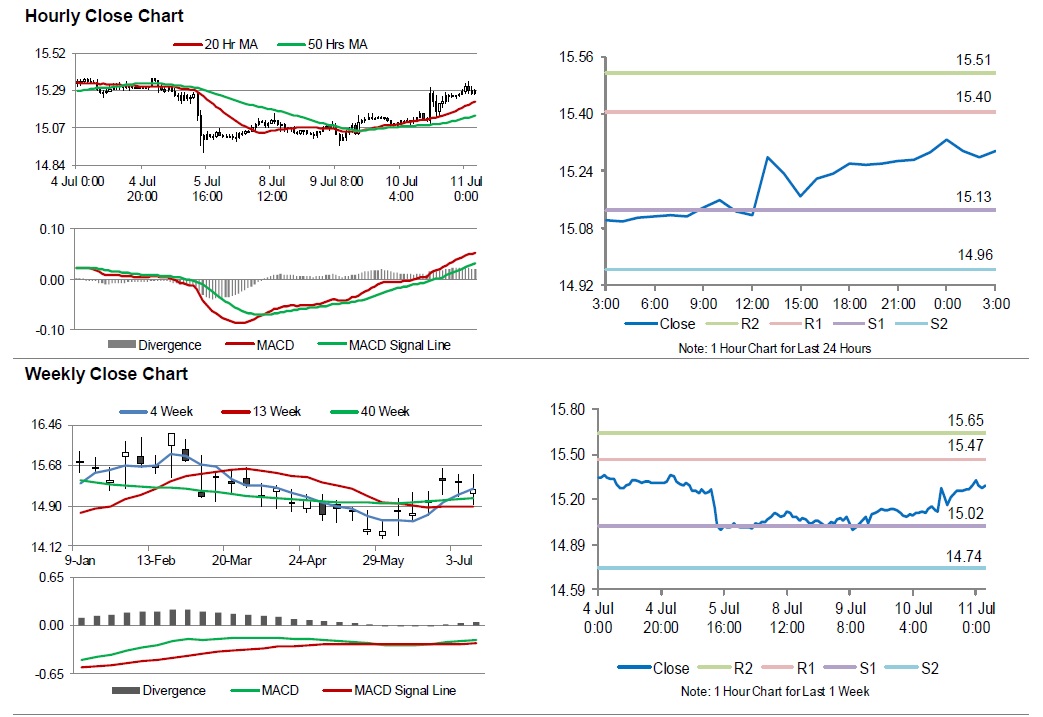
For the 24 hours to 23:00 GMT, Silver rose 1.09% against the USD and closed at USD15.29 per ounce, tracking gains in gold prices.
In the Asian session, at GMT0300, the pair is trading at 15.295, with silver trading marginally higher against the USD from yesterday’s close.
The pair is expected to find support at 15.13, and a fall through could take it to the next support level of 14.97. The pair is expected to find its first resistance at 15.40, and a rise through could take it to the next resistance level of 15.51.
The white metal is trading above its 20 Hr and 50 Hr moving averages.
Crude Oil: Oil Trading On A Positive Footing This Morning
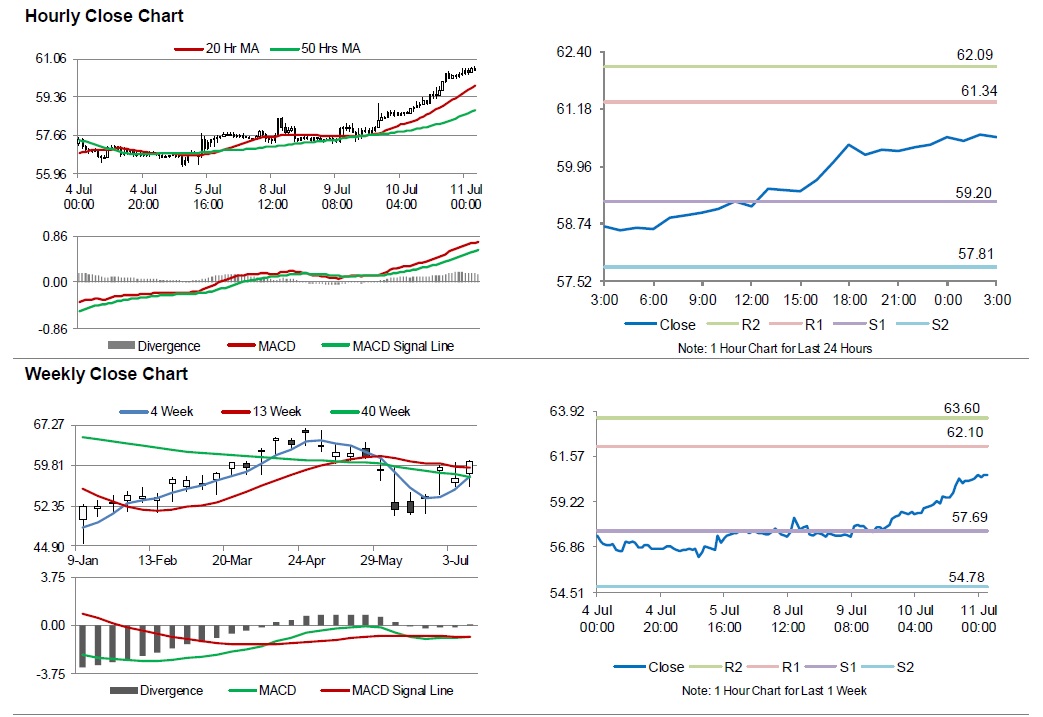
For the 24 hours to 23:00 GMT, Crude Oil rose 3.30% against the USD and closed at USD60.42 per barrel, after the US Energy Information Administration (EIA) report revealed that crude supplies fell by 9.5 million barrels for the week ended 5 July 2019.
In the Asian session, at GMT0300, the pair is trading at 60.59, with oil trading 0.28% higher against the USD from yesterday’s close.
The pair is expected to find support at 59.20, and a fall through could take it to the next support level of 57.81. The pair is expected to find its first resistance at 61.34, and a rise through could take it to the next resistance level of 62.09.
Crude oil is trading above its 20 Hr and 50 Hr moving averages.
Gold rebounds on weak dollar, ready for upside breakout
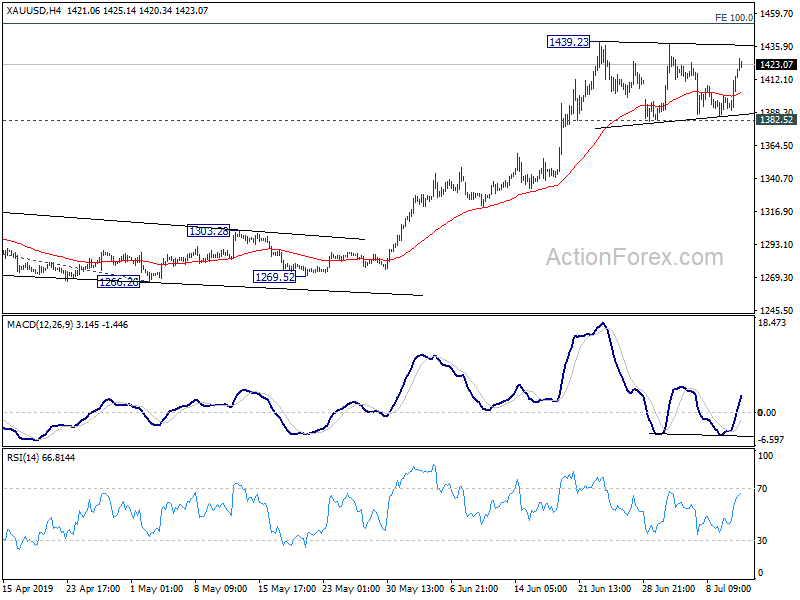
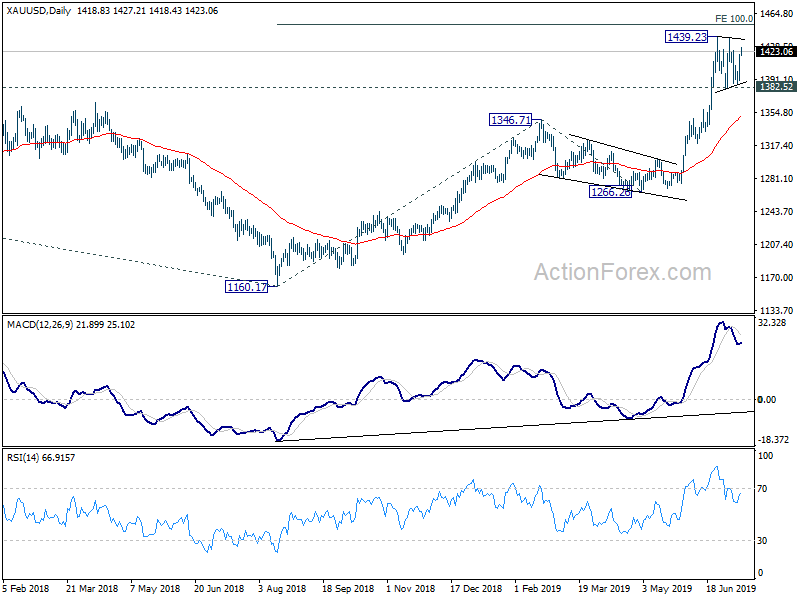
Gold rebounded strongly overnight, following Dollar's selloff. For now it's staying in range below 1439.23. But it's clear that price actions from there are just a consolidation pattern. Bullishness is also retained with 1382.52 support defended. Indeed, gold is probably ready for an upside breakout soon.
On the upside, break of 1439.23 will resume whole up trend from 1160.17. 100% projection of 1160.17 to 1346.71 from 1266.26 at 1452.80 should be taken out with relative ease.
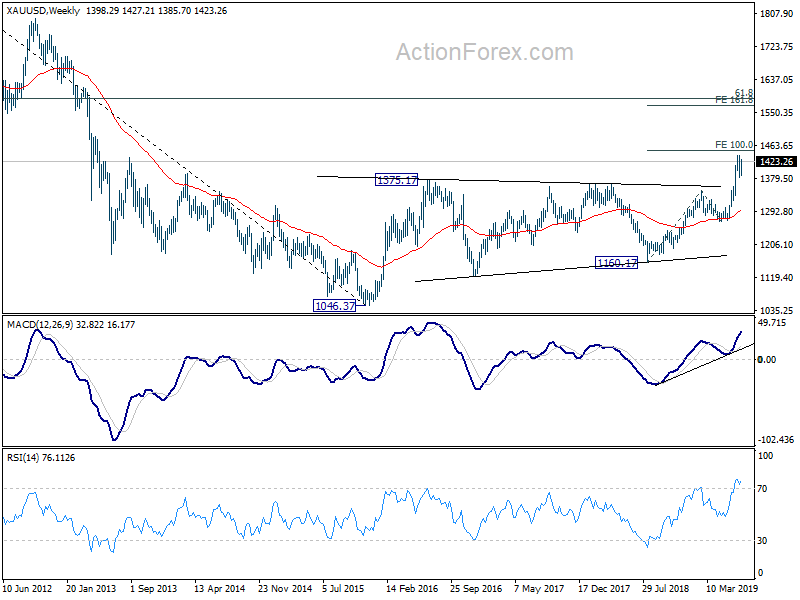
Considering upside acceleration as seen in weekly MACD, gold will likely target 161.8% projection at 1568.08.
Dollar selloff extends as markets see July Fed cut a done deal
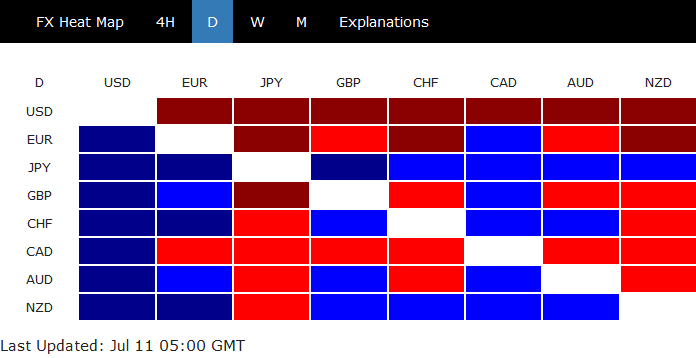
Dollar's selloff extends in Asian session today, riding on the view of Fed's rate cut in July is a done deal. Fed Chair Jerome Powell's testimony to Congress was not decidedly dovish. But he did nothing that toned down market's full pricing of July cut. Instead, he pointed to the continous uncertainties from trade tension and global slowdown. It seems now that continuation of uncertainties is already enough for an insurance rate, rather than manifested deterioration in outlook.
The tone was somewhat echoed by June FOMC minutes too. The minutes indicated that Fed's monetary stance has moved to "risk management" with "several" of them believing a rate cut should be implemented to "cushion the effects of possible future adverse shocks". Additionally, the minutes acknowledged that current financial conditions are "premised importantly on expectations that the Federal Reserve would ease policy in the near term to help offset the drag on economic growth stemming from uncertainties about the global outlook and other downside risks".
Suggested readings:
- Dovish FOMC Minutes Heighten the Case for July Rate Cut
- July a Done Deal for FOMC, with Risks Front of Mind
- Fed Minutes Focus on Downside Risks to Outlook
- Powell Hits a Dovish Note, Dollar Index Drops Back Toward 97.00
- Fed Chair Confirms Crosscurrents to Outlook, All But Guaranteeing a July Cut
- (FED) Minutes of the Federal Open Market Committee June 18-19, 2019
- Fed chair Powell's testimony, live stream
- (FED) Chairman Jerome H. Powell – Semiannual Monetary Policy Report to the Congress
German Altmaier open to drop subsides on Airbus, if US does so with Boeing
German Economy Minister Peter Altmaier is set to meet US Trade Representative Robert Lighthizer to discussion resolution to the Boeing-Airbus dispute. He would be open to eliminating all government subsidies to Airbus, on condition that US would do the same to Boeing.
He said, "I could perfectly go along with ... we will no longer provide any subsidies on both sides. Then it is just competition and nothing else." He added, "it is in the interest of both sides to avoid these tit-for-tit tariffs", referring to the tariffs between US and EU on the issue.
Altmaier also had a "productive and constructive" meeting with US Treasury Secretary Steven Mnuchin. He noted that "We are in the middle of intensive discussions. For me, the Americans remain partners and friends despite our disagreements."
Elliott Wave View: S&P 500 (SPX) Remains Buy In The Dips
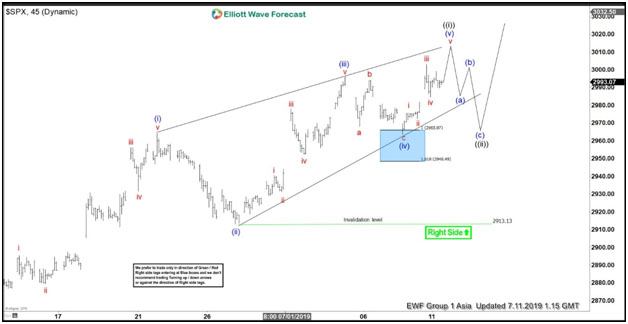
S&P 500 (SPX) shows a bullish sequence from December 26, 2018 low against June 3, 2019 low (2728.81) favoring further upside. Short term Elliott Wave view suggests the rally from June 13, 2019 low (2874.68) is unfolding as a leading diagonal Elliott Wave structure. Leading diagonal is a special type of 5 waves structure with a wedge like pattern and overlapping wave (i) and (iv). Up from June 13 low, wave (i) ended at 2964.15 and wave (ii) ended at 2912.99. Index then resumes higher in wave (iii) towards 2995.84 and wave (iv) pullback ended at 2963.44.
Expect SPX to do 1 more push higher to end wave (v) and this move should also end wave ((i)) in higher degree. Afterwards, Index should pullback within wave ((ii)) to correct the cycle from June 13 low before the rally resumes. Wave ((ii)) pullback should unfold in the sequence of 3, 7, or 11 swing. We don’t like selling the Index and expect Index to continue finding support in pullback. As far as pivot at June 13 low (2874.68) stays intact in first degree, and more importantly pivot at June 3 low (2728.81), Index should resume higher.
SPX 1 Hour Elliott Wave Chart
Dollar Softens On The ‘Powell Put’
July cut on the cards
Fed Chairman Powell’s first day of testimony on Capitol Hill had a dovish bias which appears to have paved the way for a July rate cut. Market pricing would seem to agree, with markets assigning a 100% probability of a cut on July 31; 75.5% for a 25bps reduction and 24.5% for a 50bps slash.
Powell stated that the recent uncertainty around the trade war with China and the global economic outlook outweighed any strength in the labour market, adding that June’s surprisingly strong employment report had not shifted Fed thinking.
Having said that inflation remained muted and is only seen rising gradually in the near future, tonight’s release of US CPI data for June could carry more weight than usual. A below-forecast number would almost certainly cement a July rate cut, and possibly fuel talk of deeper cuts before year end.
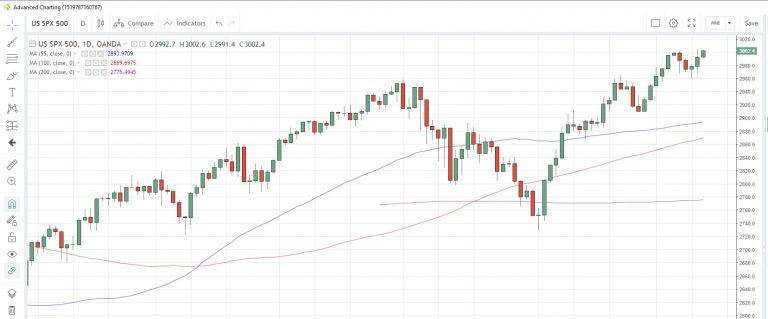
The dovish bias gave Wall Street a boost, pulling the SPX500 to record highs, breaching the 3,000 mark briefly for the first time before paring gains into the close. Asia has taken the index back higher again and it is currently sitting on the 3,000 handle.
SPX500 Daily Chart
Dollar extends slide
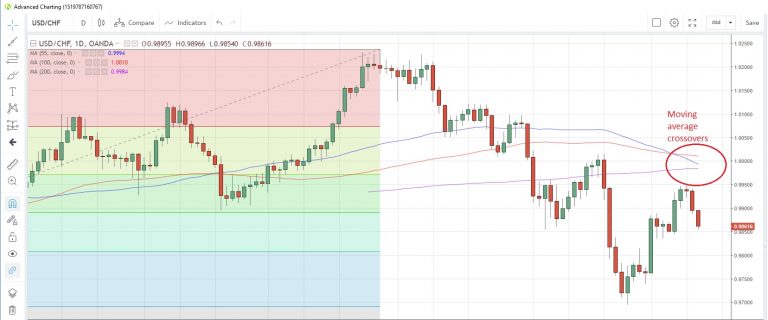
The US dollar weakened in response to Powell’s testimony and that softness continued into today’s Asian session. The US Dollar Index, a measure of the greenback’s value against six major currencies fell to the lowest in a week. USD/CHF has slumped almost 1% from its near-term peak on Tuesday and multiple moving average crossovers suggests that the downward bias will continue in the medium term.
USD/CHF Daily Chart
US consumer prices in the spotlight
As mentioned above, today’s release of US June inflation data will be the key event on the calendar. Forecasts suggest a slight uptick on a monthly basis, +0.2% m/m from +0.1% but a slightly softer 1.6% reading from 1.8% on an annual basis.
Fed speakers are out in force after Powell’s second day of testimony, with Williams, Bostic, Barkin and Kashkari all in the slate. No doubt they will be repeating the same theme of Powell’s testimony.
German CPI revisions will also be released. The first estimate was +0.3% m/m and +1.6% y/y. The Bank of England will release both its Financial Stability Report and minutes of the last meeting while the ECB also publishes the minutes of its meeting.
July a Done Deal for FOMC, with Risks Front of Mind
Threshold to cut is enduring uncertainty, not a further deterioration in conditions.
The minutes of the June FOMC meeting and Chair Powell’s Semiannual Monetary Policy Report to Congress provided support for the view that the July FOMC meeting will see a federal funds rate cut, and that further easing will follow in due course.
From the June meeting minutes, “Although nearly all members agreed to maintain the target range for the federal funds rate at 2-1/4 to 2-1/2 percent at this meeting, they generally agreed that risks and uncertainties surrounding the economic outlook had intensified and many judged that additional policy accommodation would be warranted if they continued to weigh on the economic outlook”.
From “if they continued to weigh”, it is clear that a further deterioration in conditions is not necessary to justify a cut. Instead, the threshold is simply that current uncertainties persist.
From Chair Powell’s appearance before Congress, this seems a near certainty ahead of the July meeting, with the global cross-currents seen as numerous and largely open-ended in nature.
In Chair Powell’s view, “uncertainties about the outlook have [actually] increased in recent months. In particular, economic momentum appears to have slowed in some major foreign economies… [and] a number of government policy issues have yet to be resolved, including trade developments, the federal debt ceiling, and Brexit”.
To be clear, policy easing is not warranted merely because these uncertainties exist, but rather as there is clear evidence they are affecting the US economy, particularly business investment.
From the June minutes, behind the revision of the appropriate path of the federal funds rate by “nearly all” Committee members (i.e. the pricing in of two cuts by end-2019) were “recent weak indicators for business confidence, business spending and manufacturing activity”. Private sector analysts were also noted to have “marked down their forecasts for longer-term corporate profit growth”. And “contacts reported that softer export sales, weaker economic activity abroad, and elevated levels of uncertainty regarding the global outlook were weighing on business sentiment and leading firms to reassess plans for investment spending”.
Emphasising that this is not just a matter for the July decision, “Several participants noted comments from business contacts reporting that their base case now assumed that uncertainties about the global outlook would remain prominent over the medium term and would continue to act as a drag on investment. Several participants also noted reports from some business contacts in the manufacturing sector suggesting that they were putting capital expenditures or hiring plans on hold and were reevaluating their global supply chains in light of trade uncertainties.”
It seems most appropriate then to not only anticipate a cut in July, but also a follow-up move later in the year – as we have anticipated for some time, and to which the FOMC’s June forecasts also correspond. This view is also supported by the aforementioned potential for fiscal uncertainty in the December quarter, specifically the “possibility that federal budget negotiations could result in a sharp reduction in government spending or that negotiations to raise the federal debt limit could be prolonged”.
In terms of the timing of a second cut, October seems most likely given the focus on risk management and sentiment in these communications. However, the call between October and December will remain finely balanced until we see a few more months of data, and progress in resolving trade and fiscal uncertainties can be gauged.
Regarding the likelihood of the Committee going further than the two cuts the FOMC and Westpac are forecasting, the state of the consumer will prove critical.
As above, up until now, the impact of global uncertainties has been restricted to the business sector, particularly their investment decisions. However, as made clear by the recent loss of momentum in hourly and weekly earnings growth (despite the unemployment rate being at multi-decade lows), there is a clear risk that employment and wage growth will also be hit.
If this occurs, then the cornerstone of the FOMC’s positive baseline view for GDP growth and inflation will be threatened, begetting a need to cut further.
To our mind, the probability of such an outcome is currently well below 50%, but not immaterial. Employment, wages and consumer sentiment will therefore remain key in coming months.