Sample Category Title
NZD/USD – Bulls Taking Care of The Trend; 0.673 High in View
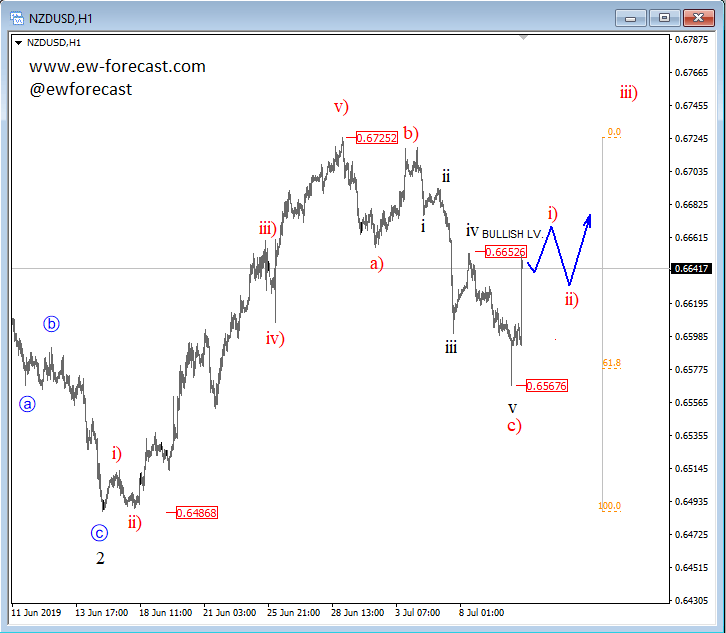
NZDUSD had found support for a three-wave correction as part of a bigger, bullish cycle. Support was found near the Fibonacci ratio of 61.8, at 0.657 region, from where a sharp rise occurred. This rally can be part of a minimum three-wave rally, that can target region beyond the 0.673 high. Also be aware of temporary pullbacks during current rise.
NZDUSD, 1h
Fed chair Powell’s testimony, live stream
https://www.youtube.com/watch?v=n9I_9-eqHoE
BoC keeps rate at 1.75%, growth returning to around potential
BoC left overnight rate target unchanged at 1.75% as widely expected. In the accompany statement, BoC said the economy is "returning to growth around potential". Q2 growth "appears to be stronger than expected" due to some "temporary factors". But ongoing trade conflicts and competitiveness challenges are dampening the outlook for trade and investment.
BoC upgraded 2019 growth forecast slightly from 1.2% to 1.3%. For 2020 and 2021, growth is projected to be at 2%, unchanged. On inflation, BoC noted "some recent upward pressure from higher food and automobile prices." Inflation is expected to "return sustainably to 2 percent by mid-2020." That is similar to April's forecasts.
Going forward, BoC noted that "outlook is clouded by persistent trade tensions". Current degree of monetary accommodation "remains appropriate". But the Governing Council will "continues to monitor incoming data, it will pay particular attention to developments in the energy sector and the impact of trade conflicts on the prospects for Canadian growth and inflation."
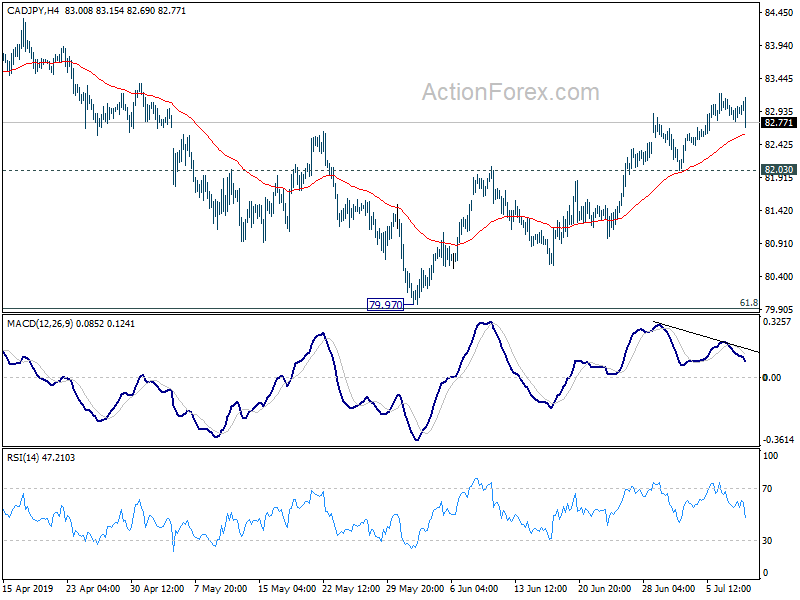
Canadian Dollar dips mildly after the release as BoC continued to sound rather "cautious regarding risks, in particular trade tensions. CAD/JPY dips but loss is very limited. As long as 82.03 minor support holds, rebound from 79.97 is resume sooner or later.
(BOC) Bank of Canada maintains overnight rate target at 1 ¾ per cent
The Bank of Canada today maintained its target for the overnight rate at 1 ¾ percent. The Bank Rate is correspondingly 2 percent and the deposit rate is 1 ½ percent.
Evidence has been accumulating that ongoing trade tensions are having a material effect on the global economic outlook. The Bank had already incorporated such negative effects in previous Monetary Policy Reports (MPR) and in this forecast has made further adjustments in light of weaker sentiment and activity in major economies. Trade conflicts between the United States and China, in particular, are curbing manufacturing activity and business investment and pushing down commodity prices.
Policy is responding to the slowdown: central banks in the US and Europe have signalled their readiness to provide more accommodative monetary policy and further policy stimulus has been implemented in China. In this context, global financial conditions have eased substantially. The Bank now expects global GDP to grow by 3 percent in 2019 and to strengthen to around 3 ¼ percent in 2020 and 2021, with the US slowing to a pace near its potential. Escalation of trade conflicts remains the biggest downside risk to the global and Canadian outlooks.
Following temporary weakness in late 2018 and early 2019, Canada's economy is returning to growth around potential, as expected. Growth in the second quarter appears to be stronger than predicted due to some temporary factors, including the reversal of weather-related slowdowns in the first quarter and a surge in oil production. Consumption is being supported by a healthy labour market. At the national level, the housing market is stabilizing, although there are still significant adjustments underway in some regions. A material decline in longer-term mortgage rates is supporting housing activity. Exports rebounded in the second quarter and will grow moderately as foreign demand continues to expand. However, ongoing trade conflicts and competitiveness challenges are dampening the outlook for trade and investment. The Bank projects real GDP growth to average 1.3 percent in 2019 and about 2 percent in 2020 and 2021.
Inflation remains around the 2 percent target, with some recent upward pressure from higher food and automobile prices. Core measures of inflation are also close to 2 percent. CPI inflation will likely dip this year because of the dynamics of gasoline prices and some other temporary factors. As slack in the economy is absorbed and these temporary effects wane, inflation is expected to return sustainably to 2 percent by mid-2020.
Recent data show the Canadian economy is returning to potential growth. However, the outlook is clouded by persistent trade tensions. Taken together, the degree of accommodation being provided by the current policy interest rate remains appropriate. As Governing Council continues to monitor incoming data, it will pay particular attention to developments in the energy sector and the impact of trade conflicts on the prospects for Canadian growth and inflation.
Information note
The next scheduled date for announcing the overnight rate target is September 4, 2019. The next full update of the Bank's outlook for the economy and inflation, including risks to the projection, will be published in the MPR on October 30, 2019.
Markets Embrace Powell’s Prepared Testimony; Stocks and Gold Surge, Dollar Tanks
Fed Chair Powell’s prepared testimony release highlighted uncertainties since the June FOMC continue to dim the outlook. The economic outlook has not improved in recent weeks and that pretty signals a rate cut at the July 30-31 FOMC meeting. He noted, that the economy performed reasonably well over the first half of the year and jobs are healthy. Markets are convinced that the Fed will deliver a 25-basis point rate cut this month, but if we see softer than expected inflation data tomorrow and if the advance second quarter GDP reading comes in well below 2.0% on July 26th, we will see the case grow for the first cut to be a 50 basis point one. Currently markets see one cut in July and its almost a coin flip for another one in September.
Treasury yields and US dollar tanked, while US stocks turned higher on the release of the Powell’s statement. The prepared testimony release have expectations running high for Powell to go full dove today.
China
China is preparing to take measure to stabilize trade and will continue to lower import tariff levels. Once markets get passed Powell’s two-day testimony, the focus will come right back to trade. Risk appetite could continue to rip higher if we see trade progress combined with ultra-easing signaled from the Fed, ECB and PBOC.
Oil
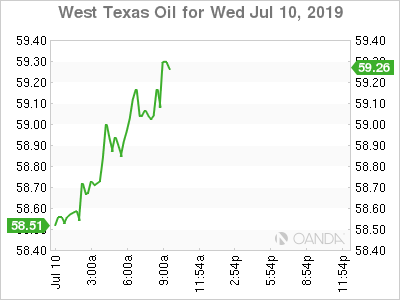
Crude prices are higher on yesterday’s third consecutive large drawdown from the API report and high tensions in the Persian Gulf. Oil may start to regain its bullish mojo on growing expected global oil markets will tighten in the second half of the year and on growing argument that Fed may have started a major reversal for the US dollar.
Gold
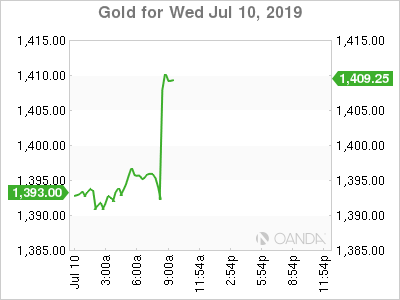
Gold prices are strongly supported on growing expectations the Fed and ECB will deliver larger than expected rate cuts. Financial markets are bracing for the next wave of easy money and that should support the case for owning bullion.
EUR/GBP – Is the Rally Stalling?
Parliament’s Brexit vote fails to lift sterling
Efforts by MPs to prevent a no-deal Brexit may have fallen short on Tuesday but they did manage to pass legislation by a single vote to make life far more difficult for the next PM to bypass Parliament altogether.
Teams on both sides will undoubtedly be straight back to work trying to find any loopholes or centuries old precedence that will put them on the front foot ahead of the end of October deadline, with yesterday being a swift reminder that we’re all about to become experts on Parliamentary procedure again.
Interestingly, sterling traders were not encouraged by the vote which instead sunk to its lowest level since mid-January against the euro. This morning’s GDP and manufacturing data for May provided a small lift for the pound but that was short-lived, with any gains being quickly reversed.
More bad times ahead for the pound?
While the pound has had a torrid time against the euro since early May, there are signs of exhaustion appearing. EURGBP has entered into a region that has previously been a key rotation point for the pair and once again it seems we’re seeing the rally run out of steam.
EURGBP Daily Chart
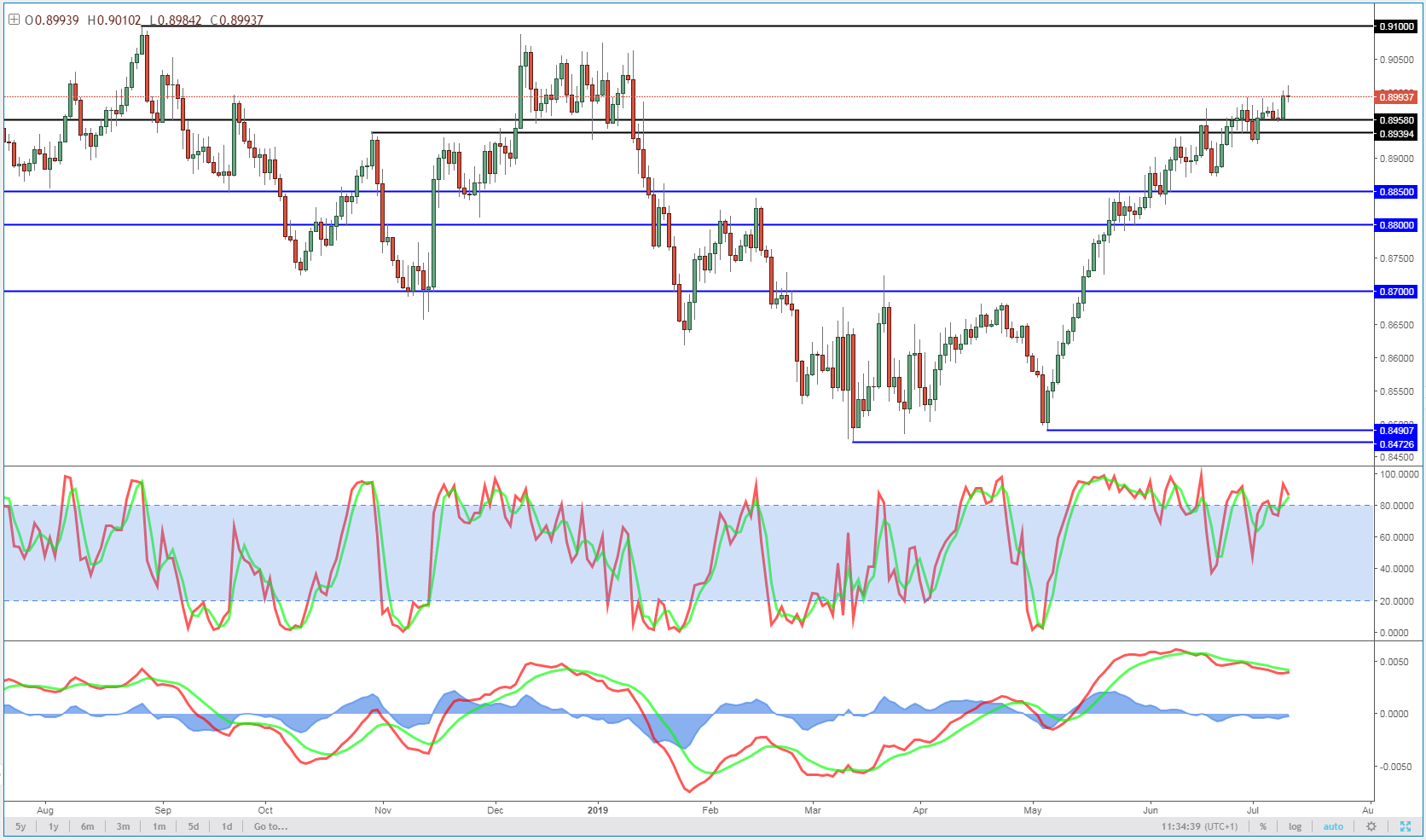
We’re seeing divergences on both the stochastic and the MACD, with neither confirming the highs being made in price. While this isn’t a reversal signal in itself, it may suggest the rally will continue to face challenges. Of course, the chart itself could have told you this, with price action dipping shortly after making a new high on the last couple of occasions.
EURGBP 4-Hour Chart
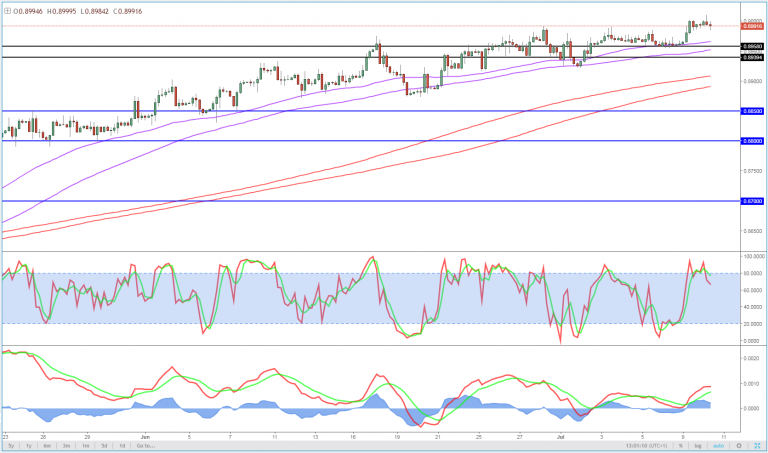 On the 4-hour chart above we can see that the recent gains have broadly tracked the 55-89 moving average band higher which currently intersects nicely around 0.8950. Should price break below here, it will be interesting to see whether this acts as a catalyst for further losses, with stops potentially being triggered.
Silver Climbs above 200-SMA in Near Term; Still Bearish in Long-Term
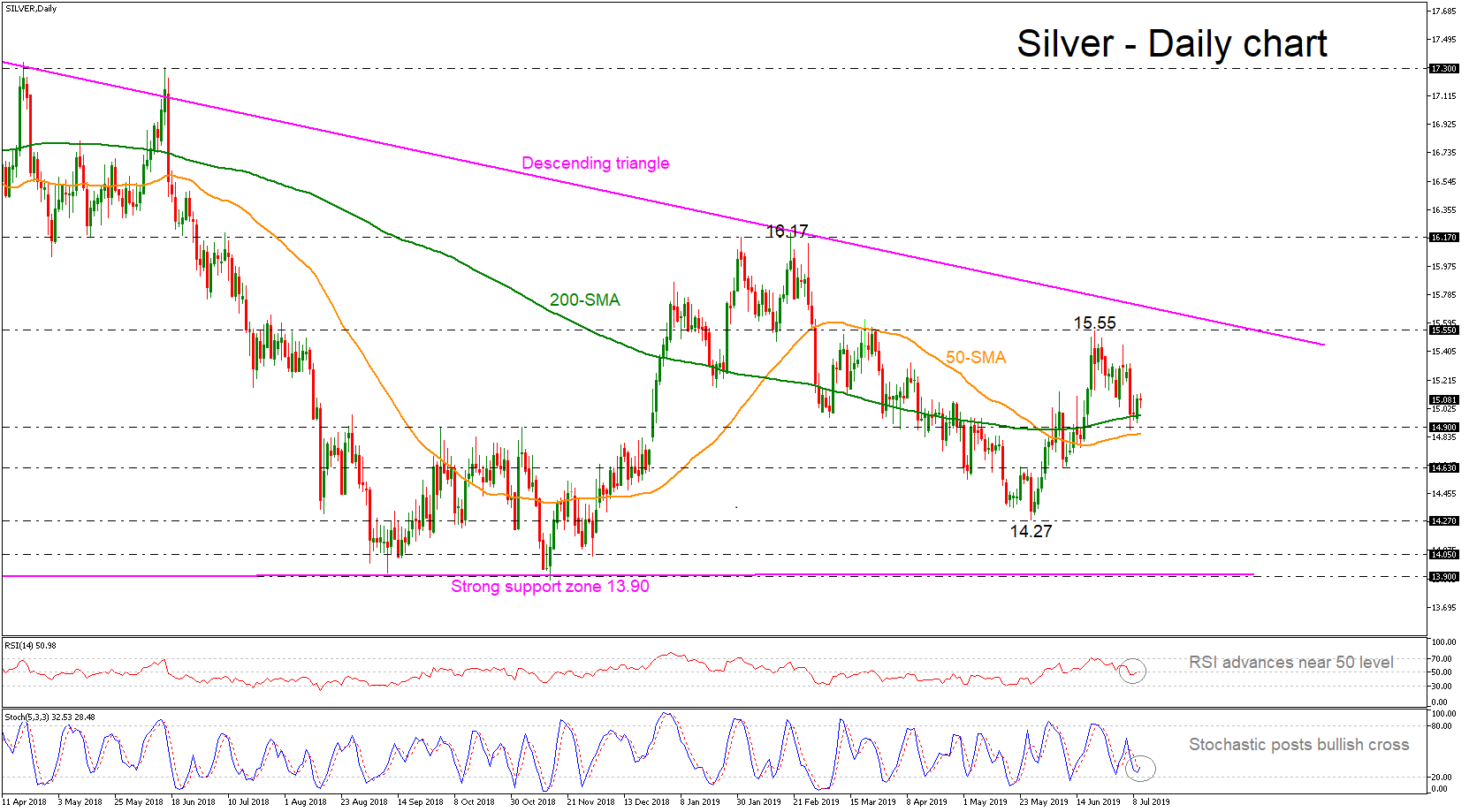
Silver prices came close to breaking the 14.90 level on Friday, finishing the day slightly above the 200-day simple moving average (SMA).
According to the RSI, the market could maintain positive momentum in the short-term as the indicator is positively sloped marginally above its neutral threshold of 50, though the stochastic is creating a bullish cross within the %K and %D lines.
On the upside, the price could attempt to hit the 15.55 resistance level, which if successfully broken the door could open for the downtrend line of the descending channel around 15.65. Should traders continue to buy the commodity above that level, shifting the long-term bearish outlook to bullish, resistance could then run towards the 16.17 area, identified by the peak on February 20.
A reversal to the downside, however, could find immediate support at the 14.90 level around the 50- and 200-SMAs. If the latter fails to halt bearish movements, the next target could be the 14.63 zone, identified by the recent lows.
Turning to the long-term trading, the outlook is bearish over the past more than two years as the price has been hovering within a descending triangle formation.
EUR/USD Mid-Day Outlook
Daily Pivots: (S1) 1.1194; (P) 1.1207; (R1) 1.1220; More...
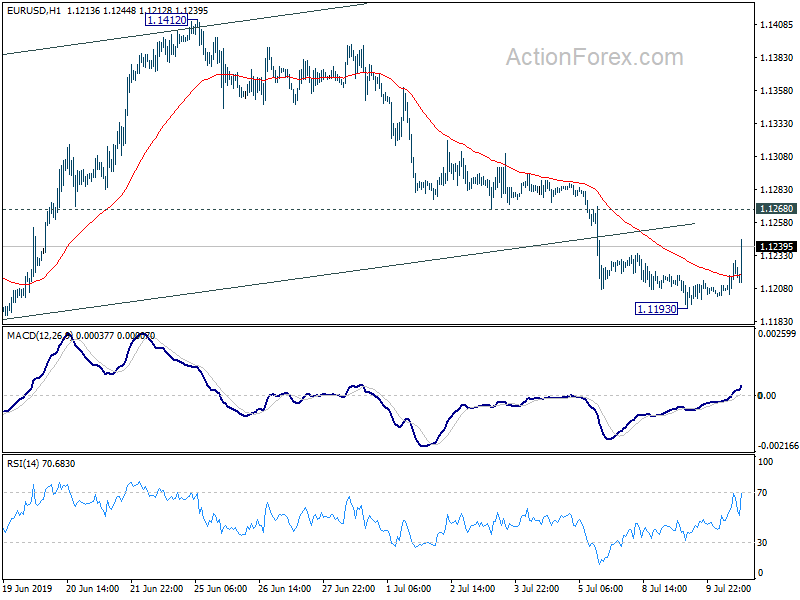
EUR/USD's recovery from 1.1193 temporary low extends further in US session. But upside is limited below 1.1268 minor resistance. Intraday bias stays neutral first. On the downside, firm break of 1.1181 support will confirm completion of rebound from 1.1107 at 1.1412. Further fall should then be see to retest 1.1107 low. On the upside, firm break of 1.1268 minor resistance will turn intraday bias back to the upside for 1.1412 instead.
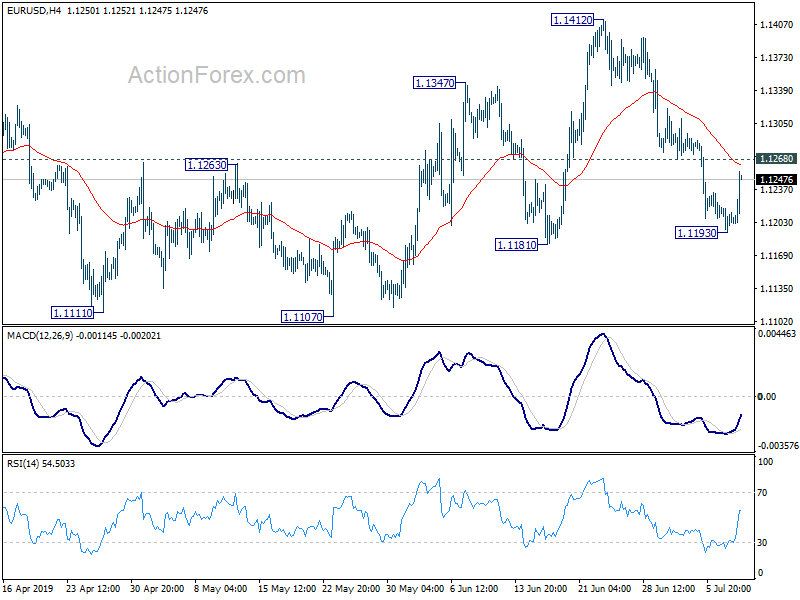
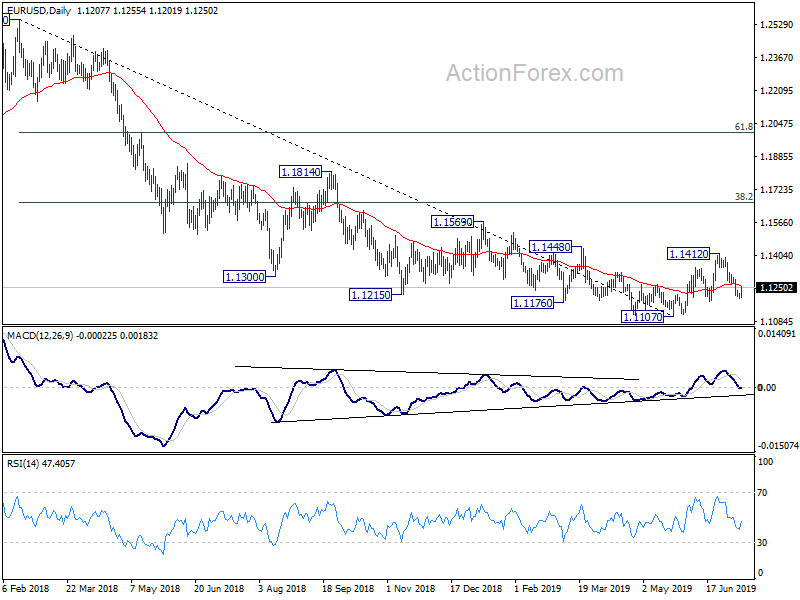
In the bigger picture, bullish convergence condition in daily and weekly MACD suggests that 1.1107 is a medium term bottom. However, rejection by 55 EMA retains medium term bearish. Outlook will be neutral for now. On the downside, break of 1.1107 will resume the down trend from 1.2555 (2018 high) to 78.6% retracement of 1.0339 to 1.2555 at 1.0813. Meanwhile, break of 1.1412 will resume the rebound to 38.2% retracement of 1.2555 to 1.1107 at 1.1660.
Dollar Drops as Powell Said Uncertainties Continue to Weigh on Outlook, Testimony Awaited
Dollar drops notably in response to Fed Chair Jerome Powell's prepared remains for the two day Congressional testimony which starts today. The greenback is currently the weakest one for today, followed by Yen and the Canadian. On the other hand, New Zealand Dollar is the strongest one, followed by Swiss Franc and then Sterling.
Quick updates:
- BoC left interest rate unchanged at 1.75% as widely expected. More here.
- Dollar stays weak after Powell didn't deliberately dismiss July cut. Yet, he wasn't dovish enough to push Dollar lower. Indeed, stocks has reversed much of earlier gains at the time of writing. More here.
Traders seems to be assuming that Powell's reference that uncertainties continue to weigh on outlook as a nod to July rate cut. Yet, Powell will still need to be more explicit in the Q&A session of the testimony. Currently, markets are still pricing in 100% chance of a Fed rate cut this month. We'd like to point out again that just back in June, nine out of seventeen FOMC participants expected interest rates to stay at 2.25-2.50% or higher within this year. It's rather hard to imagine these nine policymakers would change their mind for a cut, after Mexican tariffs were averted, US and China agreed to halt trade war escalation, and a solid June NFP report.
BoC is another major focus in US session. It's widely expected to keep policy rate unchanged at 1.75%. The case for easing faded after recent data continued to show broad-based pick-up in the economy. Also, WTI crude oil has already rebounded notably from last year's low of 42 and settled between 50/60. Headline inflation also picked up to 2.4% yoy, with core measures averaged at 2.1%. BoC would possibly shift towards a more neutral stance. But for now, due to external risks, there shouldn't be any case to turn hawkish yet.
Some suggested readings:
- BOC Preview – Not Following Fed's Footstep
- It Could Be A Lively Session For USD/CAD With Powell And BOC On Tap
- BoC Meeting: Staying Neutral in a Dovish World
- AUD/CAD Probes Key Support Ahead Of BOC
In Europe, currently, FTSE is down -0.08%. DAX is down -0.48%. CAC is up 0.03%. German 10-year yield is up 0.069 at -0.283. Earlier in Asia, Nikkei dropped -0.15%. Hong Kong HSI rose 0.31%. China Shanghai SSE dropped -0.44%. Singapore Strait Times rose 0.33%. Japan 10-year JGB yield rose 0.0127 to -0.126.
Fed Powell indicates uncertainties continue weigh on outlook since June meeting
Dollar drops notably in response to Fed chair Jerome Powell's prepared speech for the semi annual Congressional testimony. Most importantly, Powell said since June meeting, "based on incoming data and other developments, it appears that uncertainties around trade tensions and concerns about the strength of the global economy continue to weigh on the U.S. economic outlook. Inflation pressures remain muted."
Powell, also reiterated Fed's stance that "in light of increased uncertainties about the economic outlook and muted inflation pressures, we would closely monitor the implications of incoming information for the economic outlook and would act as appropriate to sustain the expansion."
However, just based on the prepared remarks, there is no confirmation on a July rate cut. Thus, selloff in Dollar is relatively limited so far. Powell will need to be really straightforward in the Q&A of the testimony.
EU kept 2019 growth forecasts unchanged, downgraded 2020 slightly
Comparing to Spring projections, European Commission kept 2019 Eurozone growth forecast unchanged at 1.2%. But for 2020, growth projection was lowered slightly from 1.5% to 1.4%. For EU28, 2019 and 2020 growth forecasts were kept unchanged at 1.4% and 1.6% respectively.
On prices, Eurozone 2019 inflation forecast was lowered from 1.4% to 1.3%. Similarly, 2020 inflation projection was lowered from 1.4% to 1.3% too. For EU28, 2019 and 2020 inflation forecasts were lowered to 1.5% and 1.6%, down from 1.6% and 1.7%.
Looking at some major countries, Germany forecast was kept unchanged at 0.5% in 2019, downgraded from 1.5% to 1.4% in 2020. France growth forecast was kept unchanged at 1.3% in 2019, downgraded from 1.5% to 1.4% in 2020. Italy growth forecasts were held unchanged at 0.1% in 2019 and 0.7% in 2020.
European Commission Vice President Valdis Dombrovskis said: "The resilience of our economies is being tested by persisting manufacturing weakness stemming from trade tensions and policy uncertainty. On the domestic side, a "no deal" Brexit remains a major source of risk."
Commissioner Pierre Moscovici urged: "Given the numerous risks to the outlook, we must intensify efforts to further strengthen the resilience of our economies and of the euro area as a whole."
UK GDP grew 0.3% mom in May, on partial recovery in car production
UK GDP grew 0.3% mom in May, matched expectations. Index of services rose 0.0% mom. Index of production rose 1.4% mom while manufacturing rose 1.4% mom. Construction rose 0.6% mom. Agriculture rose 0.0% mom.
Rolling three month growth from March to May slowed to 0.3%, down from 0.4% from February to April. It's also notably below 0.5% qoq in Q1. Services grew 0.3% in the three-month period, production grew 0.3%, while construction was flat.
Commenting on today's GDP figures, Head of GDP Rob Kent-Smith said: "GDP grew moderately in the latest three months, with IT, communications and retail showing strength. Despite this, there has been a longer-term slowdown in the often-dominant services sector since summer 2018. The economy returned to growth in the month of May, following the fall seen in April. This was mainly due to the partial recovery in car production."
Also released, manufacturing production came in at 1.4% mom, 0.0% yoy versus expectation of 2.2% mom, 1.1% yoy. Industrial production came in at 1.4% mom, 0.9% yoy, versus expectation of 1.5% mom, 0.9% yoy.
NIESR: UK economy to contract -0.1% in Q2, but no recession
The National Institute of Economic Social Research (NIER) said UK economy is on course to contract by -0.1% in Q2. However, initial outlook for Q3 is for growth of 0.2%. Thus, UK would likely avoid a technical recession, two consecutive quarters of contraction.
Janine Boshoff, Economist in the Macroeconomic Modelling and Forecasting team, said "Our latest estimate implies that the economy will narrowly avoid a technical recession in the middle quarters of this year. That said, the latest ONS data and recent surveys suggest that the economy has lost considerable momentum since the first quarter. This reflects the impact of Brexit-related uncertainty and slower growth in the global economy outside of the United States. The near-term outlook for the UK economy continues to depend on the outcome of the Brexit negotiations.".
Australia consumer confidence dropped sharply despite RBA rate cuts
Australia Westpac Consumer Confidence dropped sharply by -4.1% to 96.5 in July, hitting a two year low. The deterioration came as a surprise as confidence was not supported by recent positive developments, including RBA's rate cuts and easing US-China trade tensions.
Deepening concerns over Australian economic outlook were the main drivers in decreasing confidence. Expectations in economic conditions for the next 12 months dropped -12.3 to 87.1. That's the lowest level in four years. For the next 5 years, expectations index dropped -6.7 to 91.6.
After two rate cuts in June and July, Westpac expects RBA to stand pat at next meeting on August 6. Updated economic projections to be released then would give the best guide to how the RBA sees the case for further policy action. Westpac expects a further 25bps cut most likely coinciding with a downgrade to the Bank's growth and inflation forecasts in November. Though, it said "the timing of this next move remains highly uncertain".
Also released, Japan domestic CGPI dropped -0.1% yoy in June versus expectation of 0.4% yoy. China CPI was unchanged at 2.7% yoy in June. PPI slowed to 0.0% yoy.
EUR/USD Mid-Day Outlook
Daily Pivots: (S1) 1.1194; (P) 1.1207; (R1) 1.1220; More...
EUR/USD's recovery from 1.1193 temporary low extends further in US session. But upside is limited below 1.1268 minor resistance. Intraday bias stays neutral first. On the downside, firm break of 1.1181 support will confirm completion of rebound from 1.1107 at 1.1412. Further fall should then be see to retest 1.1107 low. On the upside, firm break of 1.1268 minor resistance will turn intraday bias back to the upside for 1.1412 instead.
In the bigger picture, bullish convergence condition in daily and weekly MACD suggests that 1.1107 is a medium term bottom. However, rejection by 55 EMA retains medium term bearish. Outlook will be neutral for now. On the downside, break of 1.1107 will resume the down trend from 1.2555 (2018 high) to 78.6% retracement of 1.0339 to 1.2555 at 1.0813. Meanwhile, break of 1.1412 will resume the rebound to 38.2% retracement of 1.2555 to 1.1107 at 1.1660.
Economic Indicators Update
| GMT | Ccy | Events | Actual | Forecast | Previous | Revised |
|---|---|---|---|---|---|---|
| 23:50 | JPY | Domestic CGPI Y/Y Jun | -0.10% | 0.40% | 0.70% | 0.60% |
| 0:30 | AUD | Westpac Consumer Confidence Jul | -4.10% | -0.60% | ||
| 1:30 | CNY | CPI Y/Y Jun | 2.70% | 2.70% | 2.70% | |
| 1:30 | CNY | PPI Y/Y Jun | 0.00% | 0.30% | 0.60% | |
| 8:30 | GBP | Monthly GDP M/M May | 0.30% | 0.30% | -0.40% | |
| 8:30 | GBP | Industrial Production M/M May | 1.40% | 1.50% | -2.70% | -2.90% |
| 8:30 | GBP | Industrial Production Y/Y May | 0.90% | 1.20% | -1.00% | -1.10% |
| 8:30 | GBP | Manufacturing Production M/M May | 1.40% | 2.20% | -3.90% | -4.20% |
| 8:30 | GBP | Manufacturing Production Y/Y May | 0.00% | 1.10% | -0.80% | -1.00% |
| 8:30 | GBP | Construction Output M/M May | 0.60% | 0.40% | -0.40% | -0.50% |
| 8:30 | GBP | Index of Services 3M/3M May | 0.30% | 0.10% | 0.20% | 0.30% |
| 8:30 | GBP | Visible Trade Balance (GBP) May | -11.5B | -12.5B | -12.1B | -12.8B |
| 14:00 | CAD | BoC Rate Decision | 1.75% | 1.75% | ||
| 14:00 | USD | Fed Chair Powell Testimony | ||||
| 14:00 | USD | Wholesale Inventories M/M May F | 0.40% | 0.40% | ||
| 14:30 | USD | Crude Oil Inventories | -1.1M | |||
| 18:00 | USD | FOMC Meeting Minutes Jun |
Dollar drops as Fed Powell indicates uncertainties continue weigh on outlook since June meeting
Dollar drops notably in response to Fed chair Jerome Powell's prepared speech for the semi annual Congressional testimony. Most importantly, Powell said since June meeting, "based on incoming data and other developments, it appears that uncertainties around trade tensions and concerns about the strength of the global economy continue to weigh on the U.S. economic outlook. Inflation pressures remain muted."
Powell, also reiterated Fed's stance that "in light of increased uncertainties about the economic outlook and muted inflation pressures, we would closely monitor the implications of incoming information for the economic outlook and would act as appropriate to sustain the expansion."
However, just based on the prepared remarks, there is no clear nod to a July rate cut. Thus, selloff in Dollar is relatively limited so far. Powell will need to be really straightforward in the Q&A of the testimony.