Sample Category Title
ECB Research: Lagarde To Take ‘One Of The Most Difficult’ Jobs
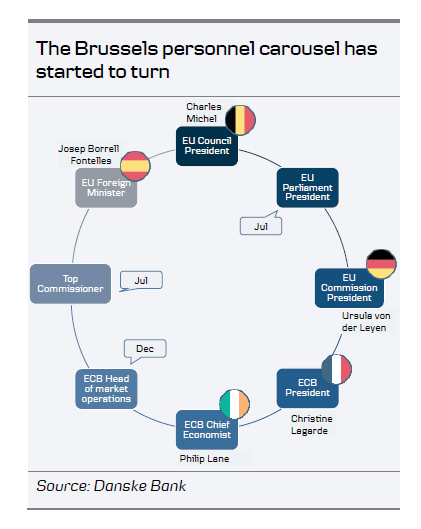
- Following intense negotiations, EU leaders have struck an agreement on the succession race for the EU Commission and ECB presidency. German defence minister Ursula von der Leyen will take over the reins at the Commission, while French IMF chief Christine Lagarde is succeeding Mario Draghi at the ECB. Other EU top posts have also been filled with Belgium's Premier Charles Michel scheduled to take over as President of the European Council and Spain's Foreign Affairs minister Josep Borrell Fontelles becoming the EU's new foreign policy chief.
- Lagarde has not given monetary policy speeches worth highlighting here, however she is open to unconventional monetary policy and does not rule out new economic thinking. Her reliance on IMF staff implies no imminent change in ECB monetary policy. We see no reason to change our call for a broad stimulus package expected in September.
- Draghi's term ends 31 October 2019.
Likely monetary policy continuation beyond Draghi but potential toolbox enlargement
It came as a surprise to most ECB watchers, including ourselves, that one of the dark horses for the ECB presidency, the current IMF Managing Director Christine Lagarde was nominated in the end. Although she is not formally appointed, it is a formality in our view, as ultimately the heads of state confirm her nomination (the ECB has to provide an opinion on her qualifications first as well as the European Parliament. Detailed outline of the process is similar to ECB VP, see ECB Research - The road to becoming VP).
Upon confirmation, Lagarde will be one of the two ECB top officials without any formal central bank experience (Lagarde is a lawyer by training, similar to Fed Chair Powell). VP de Guindos was a minister of Economy before joining ECB. That said, she does not join ECB without some monetary policy experience. In her role during the past 8 years at the IMF she has been involved in monetary policy deliberations but the new challenge will also be to guide markets knowing that her every single word will be weighted by market participants.
Lagarde has not provided independent views on her monetary policy stance in past years besides official IMF comments (which have been well prepared by staff). However, we have reason to believe that she supports the IMF line, as she has been conveying the usual openness to the unconventional monetary policy of the IMF at several occasions. She supported Draghi and the ECB's decision to launch QE in January 2015 and also called for other policy actions to play their role. She has also praised Draghi for his 'whatever it takes' commitment in 2012. That is a continuation of the ECB's narrative.
Interestingly, in a sign of openness to new economic thinking and potential ways to stimulate / keep easy monetary policy conditions, she said during the IMF spring meetings this year that MMT 'could possibly work for a short period of time' in situations such as if there is deflation, however, she also stressed clear caveats with MMT
As the monetary policy toolbox is looking rather challenged at this stage, and before fully endorsing MMT, she has the political knowhow and gravitas to build bridges across the political landscape, collaborate with policy makers in various institutions, to the right policy mix. In other words, her experience and collaboration with other institutions may speak to her advantage and be exactly what Europe needs at this stage. At the same time, we will likely hear continued questioning about central bank independence as not central bankers of background, but politicians of background will head the ECB (other major central banks, c.f. Powell versus Trump jitters). We will likely hear an intensification of that theme in the coming weeks and months.
Finally, in a show of continuation beyond Draghi, the ECB has called for structural reforms and other policy areas to step up their effort to bring inflation higher since the sovereign debt crisis erupted. However, politicians have not listened to Draghi, leaving upside to Lagarde in delivering this. Lagarde welcomes further deepening of the EMU.
No need to change our ECB call
With the nomination of Lagarde as new ECB president, we see no reason to change our ECB call for a package deal in September consisting of 20bp cut, QE restart of EUR45- 60bn, tiering and extended forward guidance, more in ECB Research - New ECB call - rate cut and restart of QE. We still expect ECB to open the door for easing in the July meeting as near-term macroeconomic momentum is challenged and inflation expectations continue to fade. Even Lagarde taking office in November after the announcement and implementation of a package deal, she will still have the 'one of the most difficult jobs' as she called Draghi's job in 2015.
ECB board change almost complete
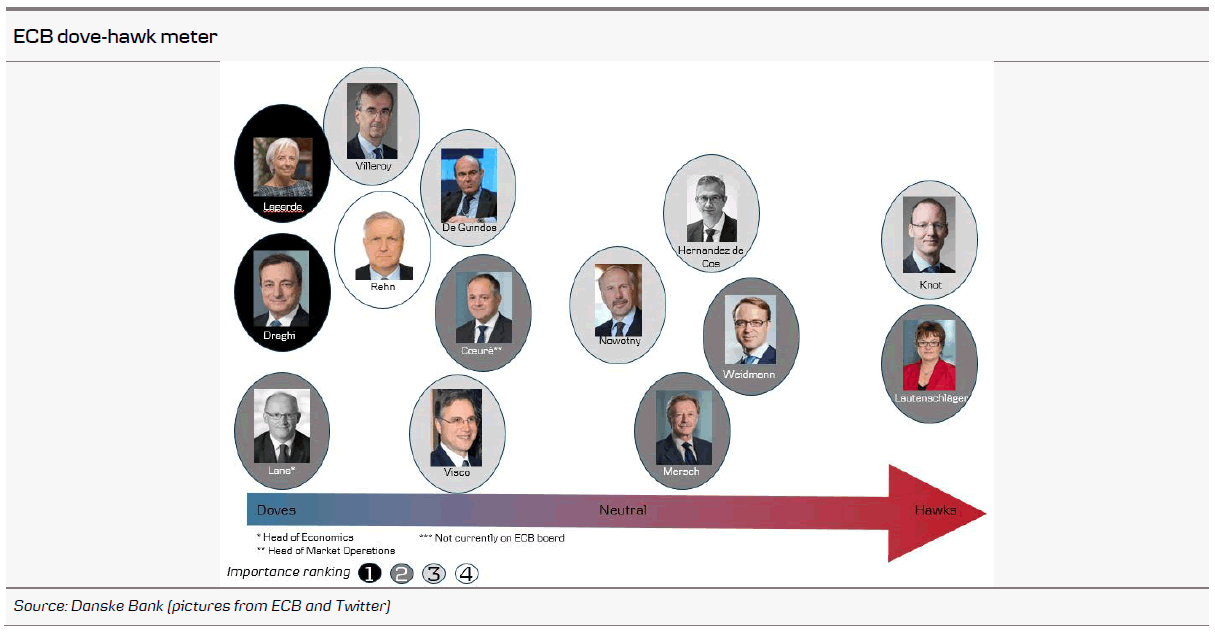
With the nomination of Lagarde and her subsequent appointment on 1 November 2019, there is still one seat to be filled to complete a large change in the ECB board that started just one month ago. Coeuré's term ends in December and is the last guardian of the Draghi/Praet/Coeuré team who shaved monetary policy for years. The process to find Coeuré's replacement has not started yet, but will likely start in the course of Q3. The appointment of Lagarde makes us conclude that we will still have a relative dovish leaning composition of the governing council (dove-hawk meter in appendix).
A Franco-German pas de deux
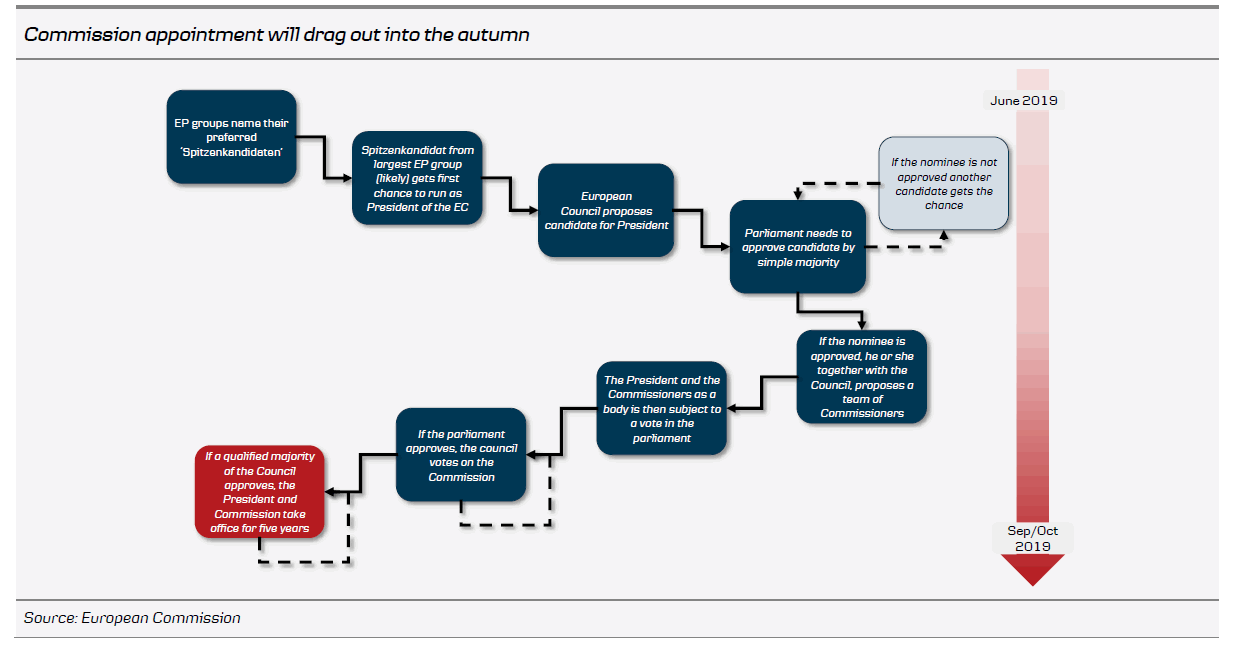
While the EU parliament will chose its President – likely amid the Social Democrats - already on 3 July, the Commission President appointment follows a more entangled process (see below), which could see the Parliament cast a vote of confidence on the appointment in mid-July. Opposition in some parliament groups to the Council deal and the 'death' of the Spitzenkandidaten system is starting to grow, hence the appointment of the Commission president could still prove a rocky road. While the fact that two out of four top posts went to women could appease the Parliament somewhat as it chimes in with its call for more gender diversity, the geographical concentration – with all posts going to Western European countries - might prove a further issue during the appointment process. Once Ursula von der Leyen - a seasoned centrist politician from Angela Merkel's CDU party - has been confirmed by both Council and Parliament, a team of Commissioners will need to undergo a similar procedure of appointment – a process that could well drag out in the autumn, before the new EU Commission is scheduled to take office on 1 November.
At the current stage, it is difficult to draw strong conclusions on the impact of the personnel changes on European policymaking, but we think the appointments are unlikely to rock the boat. As defence minister, Ursula von der Leyen pushed for closer European cooperation and she has previously expressed support for the idea of a federalist Europe (i.e. 'United States of Europe'). Hence, we think she could be a Commission President that strives to unite the different factions in the EU and – wherever possible – try to support Macron's agenda of building a closer and more integrated Europe
Eurozone’s Producer Price Index Rose Less-Than-Expected In May
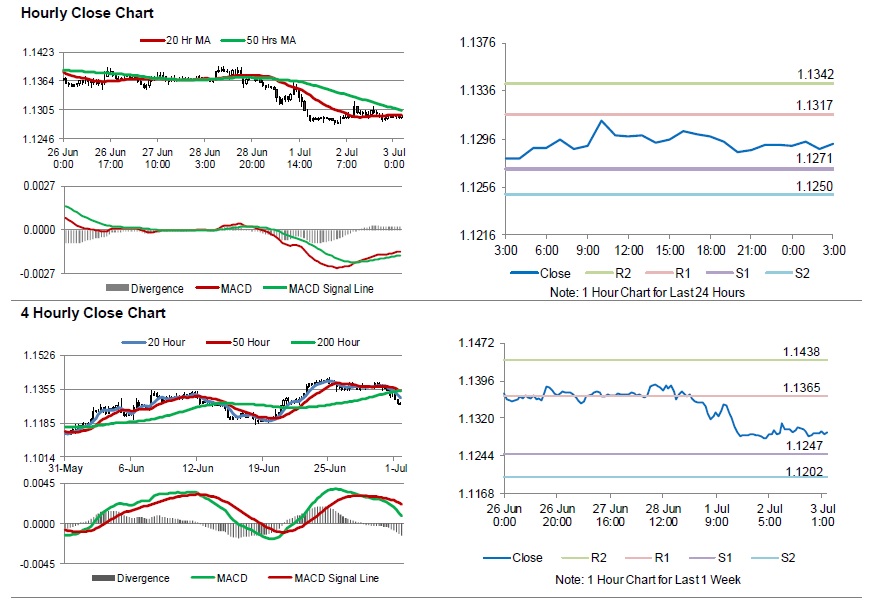
For the 24 hours to 23:00 GMT, the EUR slightly rose against the USD and closed at 1.1291.
On the macro front, the Eurozone's producer price index (PPI) advanced 1.6% on a yearly basis in May, undershooting market consensus for a rise of 1.7%. In the previous month, the (PPI) had recorded a rise of 2.6%.
Separately, in Germany, retail sales climbed 4.0% on a yearly basis in May, compared to a revised rise of 4.6% in the prior month. Market participants had expected the retail sales to climb 2.7%.
In the Asian session, at GMT0300, the pair is trading at 1.1292, with the EUR trading a tad higher against the USD from yesterday's close.
The pair is expected to find support at 1.1271, and a fall through could take it to the next support level of 1.125. The pair is expected to find its first resistance at 1.1317, and a rise through could take it to the next resistance level of 1.1342.
Looking ahead, traders would keep an eye the Markit services PMI for June, slated to release across the euro bloc. Later in the day, the US ADP employment change, the Markit services PMI and the ISM non-manufacturing/services composite, all for June, trade balance data, durable goods orders and factory orders, all for May along with initial jobless claims, the MBA mortgage application will be on investors' radar.
The currency pair is showing convergence with its 20 Hr moving average and trading below its 50 Hr moving average.
UK’s Construction PMI Surprisingly Fell To A Decade Low Level In June
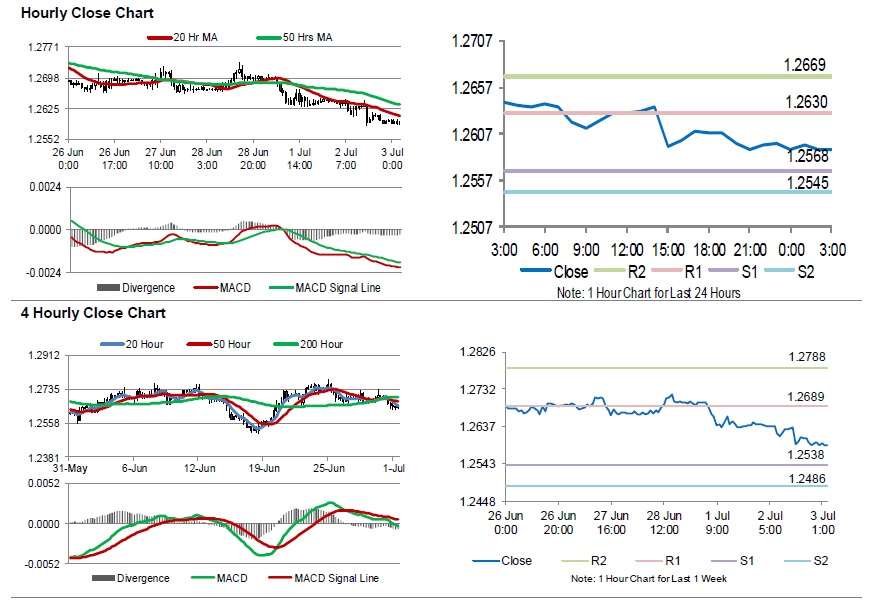
For the 24 hours to 23:00 GMT, the GBP declined 0.40% against the USD and closed at 1.2597, after the Bank of England's Governor, Mark Carney signalled that the economy could lose its momentum in case of a no-deal Brexit and ongoing global trade disputes resulting into possibilities of monetary policy easing in coming months.
In economic news, UK's construction PMI unexpectedly declined to a decade low level of 43.1 in June, amid mounting Brexit uncertainties and defying market consensus for a gain to a level of 49.2. The PMI had recorded a reading of 48.6 in the previous month. Meanwhile, the nation's seasonally adjusted Nationwide house price index rose 0.1% on a monthly basis in June, less than market expectations for a rise of 0.2%. In the prior month, index had registered a drop of 0.2%.
In the Asian session, at GMT0300, the pair is trading at 1.2591, with the GBP trading 0.05% lower against the USD from yesterday's close.
Overnight data indicated that BRC shop price index fell 0.1% on a yearly basis in June, following an increase of 0.8% in the preceding month.
The pair is expected to find support at 1.2568, and a fall through could take it to the next support level of 1.2545. The pair is expected to find its first resistance at 1.2630, and a rise through could take it to the next resistance level of 1.2669.
Trading trend in the Sterling today is expected to be determined by UK's Markit services PMI for June, slated to release in a few hours.
The currency pair is trading below its 20 Hr and 50 Hr moving averages.
Japanese Yen Extends Its Gains In The Asian Session
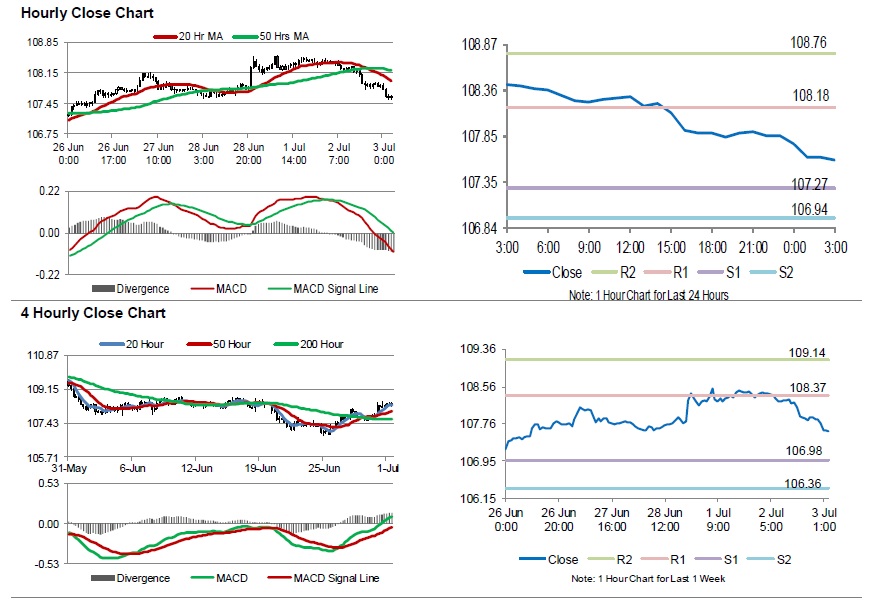
For the 24 hours to 23:00 GMT, the USD declined 0.43% against the JPY and closed at 107.86.
In the Asian session, at GMT0300, the pair is trading at 107.59, with the USD trading 0.25% lower against the JPY from yesterday’s close.
The pair is expected to find support at 107.27, and a fall through could take it to the next support level of 106.94. The pair is expected to find its first resistance at 108.18, and a rise through could take it to the next resistance level of 108.76.
In absence of key economic releases in Japan today, investor sentiment would be determined by global macroeconomic events.
The currency pair is trading below its 20 Hr and 50 Hr moving averages.
Swiss Franc Trading Higher In The Morning Session
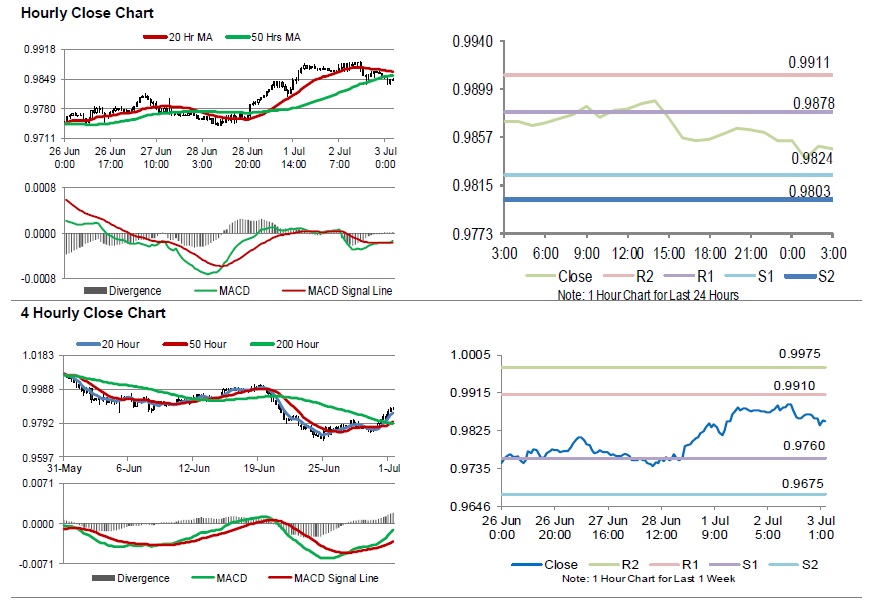
For the 24 hours to 23:00 GMT, the USD declined 0.17% against the CHF and closed at 0.9854.
In the Asian session, at GMT0300, the pair is trading at 0.9846, with the USD trading 0.08% lower against the CHF from yesterday’s close.
The pair is expected to find support at 0.9824, and a fall through could take it to the next support level of 0.9803. The pair is expected to find its first resistance at 0.9878, and a rise through could take it to the next resistance level of 0.9911.
The currency pair is trading below its 20 Hr and 50 Hr moving averages.
Canada’s Manufacturing Sector Activity Contracted For The Third Consecutive Month In June
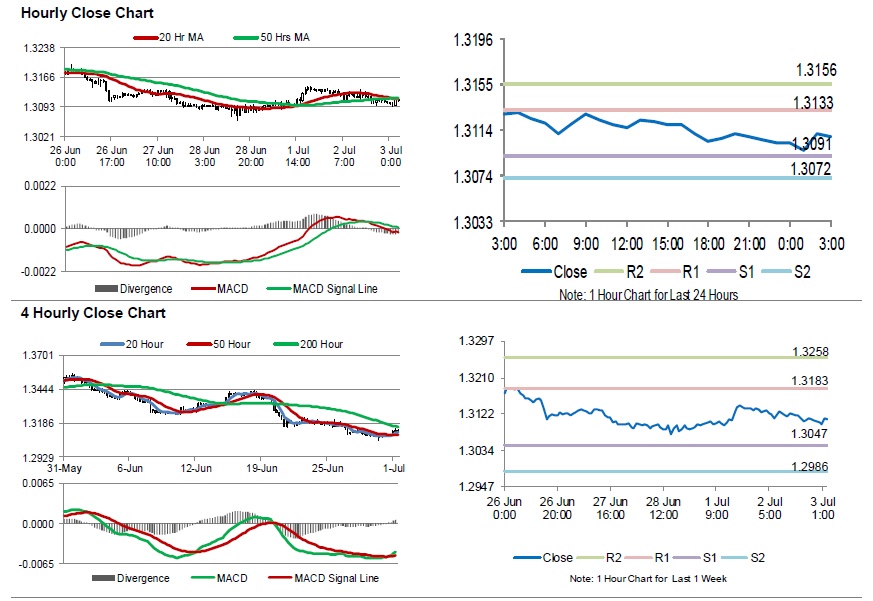
For the 24 hours to 23:00 GMT, the USD declined 0.21% against the CAD and closed at 1.3104.
Data indicated that Canada's Markit manufacturing PMI contracted for the third straight month to a level of 49.2 in June, following a reading of 49.1 in the previous month.
In the Asian session, at GMT0300, the pair is trading at 1.3109, with the USD trading marginally higher against the CAD from yesterday's close.
The pair is expected to find support at 1.3091, and a fall through could take it to the next support level of 1.3072. The pair is expected to find its first resistance at 1.3133, and a rise through could take it to the next resistance level of 1.3156.
Amid lack of economic releases in Canada today, traders would focus on global macroeconomic events for further direction.
The currency pair is showing convergence with its 20 Hr and 50 Hr moving averages.
Australia’s Trade Surplus Expanded At A Record High Level In May
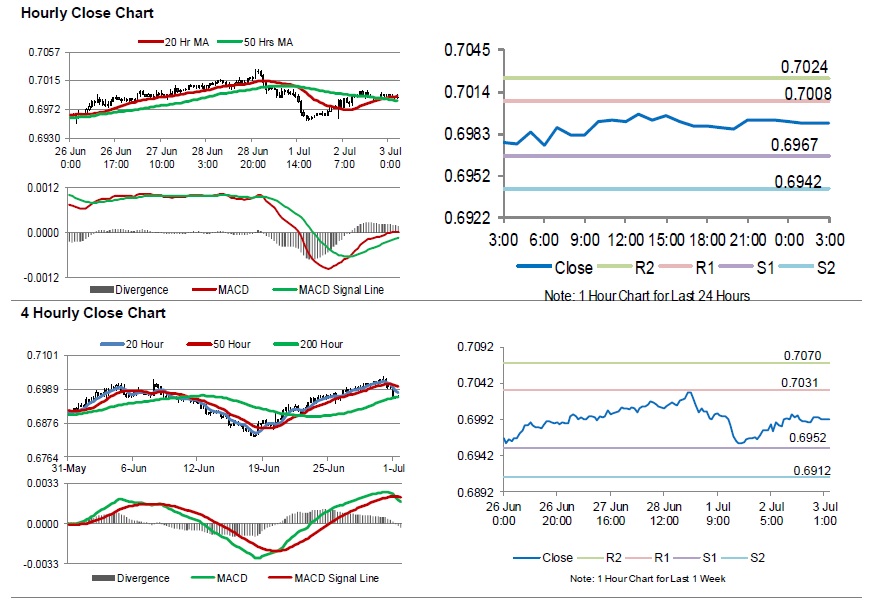
For the 24 hours to 23:00 GMT, the AUD rose 0.39% against the USD and closed at 0.6994, after the Reserve Bank Governor Philip Lowe, in a post-meeting statement, indicated that the monetary policy easing would support employment and the inflation to remain in line with its medium-term target.
LME Copper prices declined 1.5% or $89.0/MT to $5910.0/MT. Aluminium prices declined 0.3% or $22.5/MT to $1755.5/MT.
In the Asian session, at GMT0300, the pair is trading at 0.6991, with the AUD trading slightly lower against the USD from yesterday's close.
Overnight data showed that Australia's seasonally adjusted trade surplus widened to A$5745.0 million in May, marking a record high level amid surge in iron ore exports to China. In the preceding month the nation had recorded a revised surplus of A$4820.0 million, while market had anticipated to register a surplus of A$5250.0 million.
On the other hand, the nation's seasonally adjusted building approvals plunged 19.6% on a yearly basis in May, compared to a fall of 24.2% in the previous month. Market participants had envisaged the building approvals to record a decline of 21.5%. Moreover, the AIG performance of services index dropped to a level of 52.2 in June, following a level of 52.5 in the prior month. Also, the CBA final services PMI fell to a level of 52.5 in June, compared to a level of 53.1 in the prior month.
The pair is expected to find support at 0.6967, and a fall through could take it to the next support level of 0.6942. The pair is expected to find its first resistance at 0.7008, and a rise through could take it to the next resistance level of 0.7024.
The currency pair is showing convergence with its 20 Hr moving average and trading above its 50 Hr moving average.
Gold: Yellow Metal Trading Marginally Lower In The Asian Session
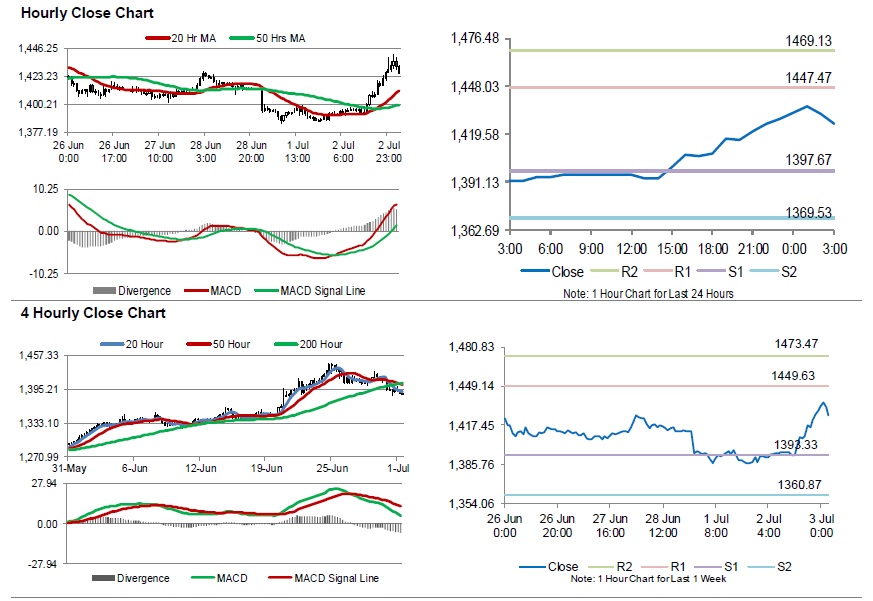
For the 24 hours to 23:00 GMT, Gold rose 2.49% against the USD and closed at USD1426.00 per ounce, as investors preferred to seek shelter in the safe haven asset amid concerns over the health of the global economy.
In the Asian session, at GMT0300, the pair is trading at 1425.80, with gold trading slightly lower against the USD from yesterday’s close.
The pair is expected to find support at 1397.67, and a fall through could take it to the next support level of 1369.53. The pair is expected to find its first resistance at 1447.47, and a rise through could take it to the next resistance level of 1469.13.
The yellow metal is trading above its 20 Hr and 50 Hr moving averages.
Silver: White Metal Trading On A Weaker Footing This Morning
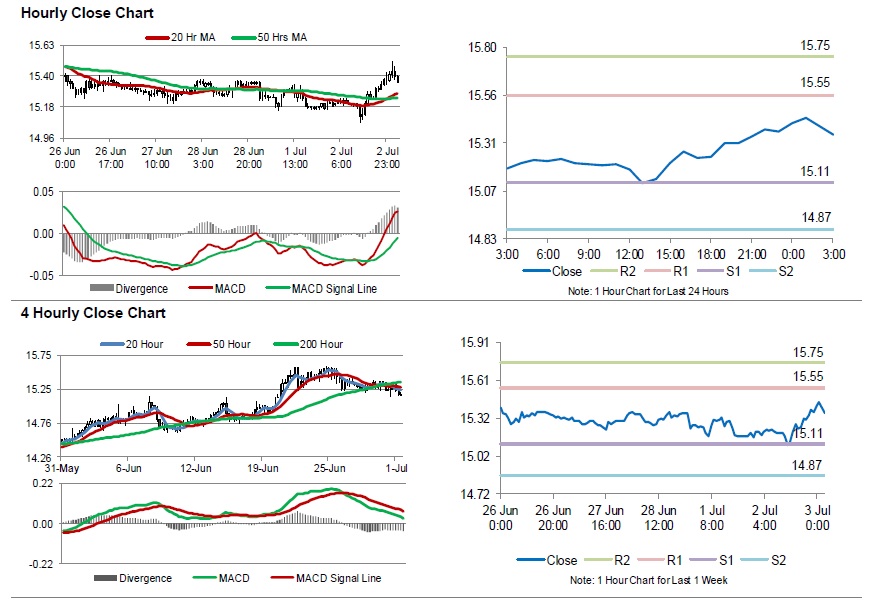
For the 24 hours to 23:00 GMT, Silver rose 1.09% against the USD and closed at USD15.37 per ounce, supported by gains in gold prices.
In the Asian session, at GMT0300, the pair is trading at 15.36, with silver trading 0.10% lower against the USD from yesterday’s close.
The pair is expected to find support at 15.11, and a fall through could take it to the next support level of 14.87. The pair is expected to find its first resistance at 15.55, and a rise through could take it to the next resistance level of 15.75.
The white metal is trading above its 20 Hr and 50 Hr moving averages.
Crude Oil: Oil Trading Higher, Ahead Of EIA’s Weekly Crude Oil Stockpiles Data
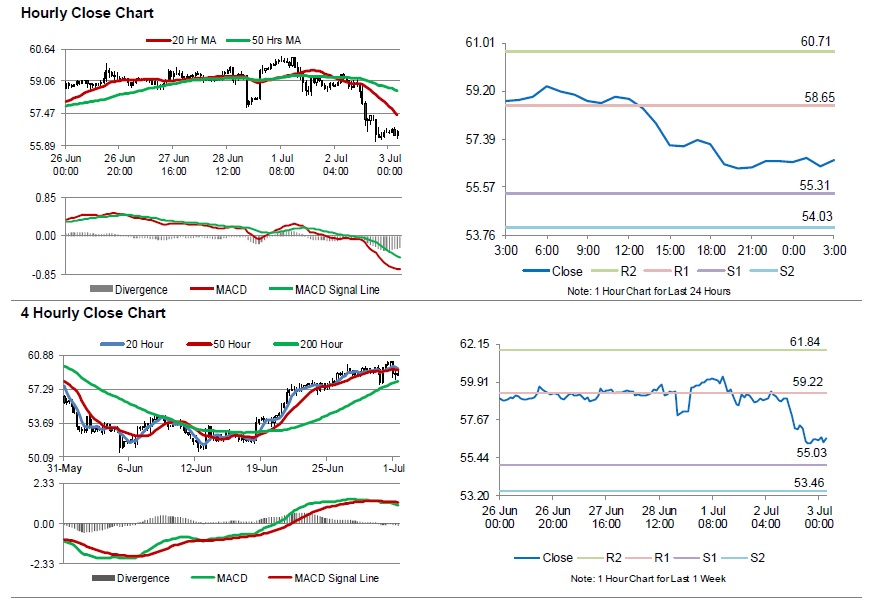
For the 24 hours to 23:00 GMT, Crude Oil declined 3.94% against the USD and closed at USD56.54 per barrel.
Separately, the American Petroleum Institute (API) reported that US crude oil inventories fell by 5.0 million barrels to 469.5 million barrels in the week ended 27 June 2019.
In the Asian session, at GMT0300, the pair is trading at 56.59, with oil trading 0.09% higher against the USD from yesterday's close.
The pair is expected to find support at 55.31, and a fall through could take it to the next support level of 54.03. The pair is expected to find its first resistance at 58.65, and a rise through could take it to the next resistance level of 60.71.
Crude oil is trading below its 20 Hr and 50 Hr moving averages.