Sample Category Title
USD/CHF Mid-Day Outlook
Daily Pivots: (S1) 0.9813; (P) 0.9848; (R1) 0.9914; More...
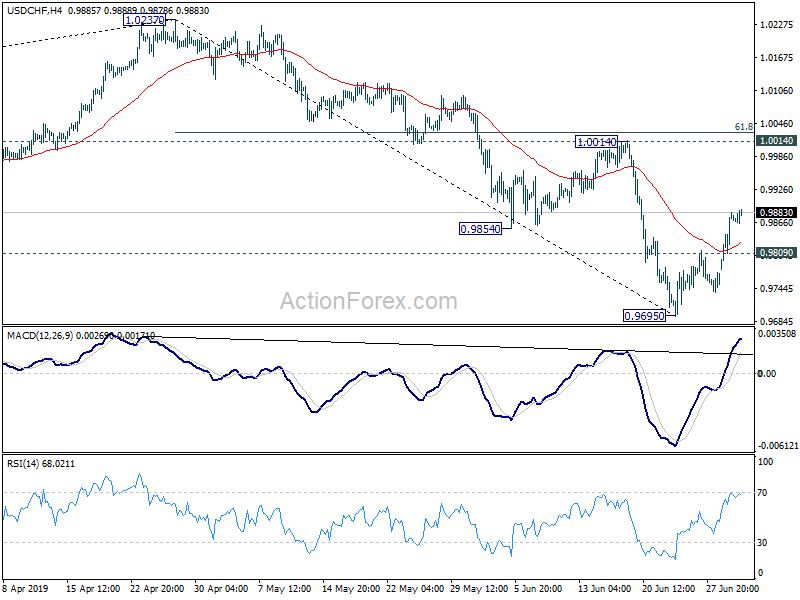
Intraday bias in USD/CHF remains mildly on the upside for the moment. Rebound from 0.9695 is in progress and would target 1.0014 resistance. But upside could be limited by 61.8% retracement of 1.0237 to 0.9695 at 1.0030. On the downside, below 0.9809 minor support will turn bias back to the downside for retesting 0.9695 low.
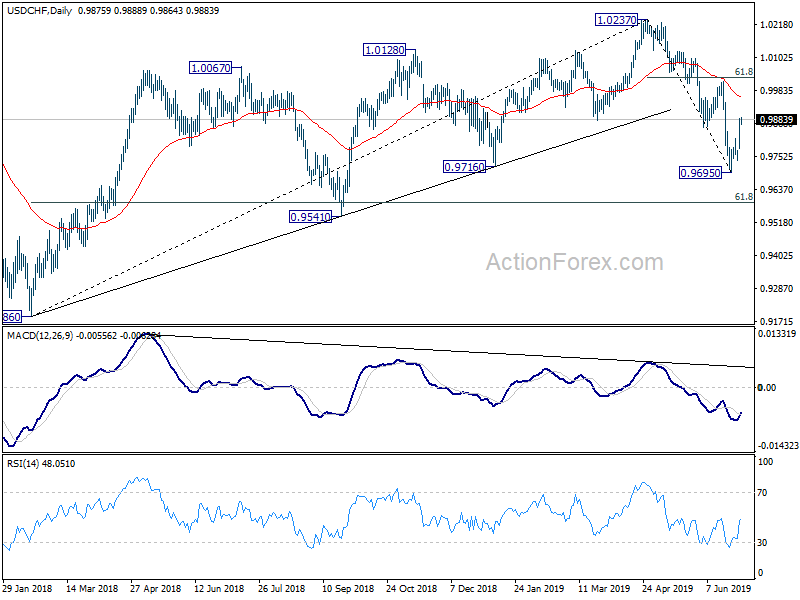
In the bigger picture, current development suggests that up trend from 0.9186 (2018 low) has completed at 1.0237 already. Deeper decline would be seen to 61.8% retracement of 0.9186 to 1.0237 at 0.9587 and below. For now, USD/CHF is seen as in long term range pattern between 0.9186 and 1.0342. Hence, we'd pay attention to bottoming signal below 0.9587. However, sustained break of 1.0014 will revive medium term bullishness and turn focus back to 1.0237 high.
USD/JPY Mid-Day Outlook
Daily Pivots: (S1) 108.18; (P) 108.35; (R1) 108.61; More...
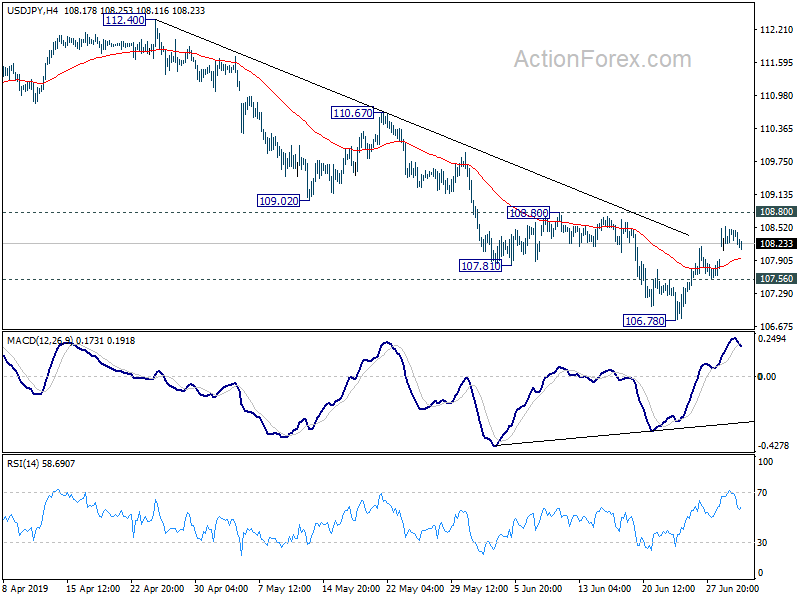
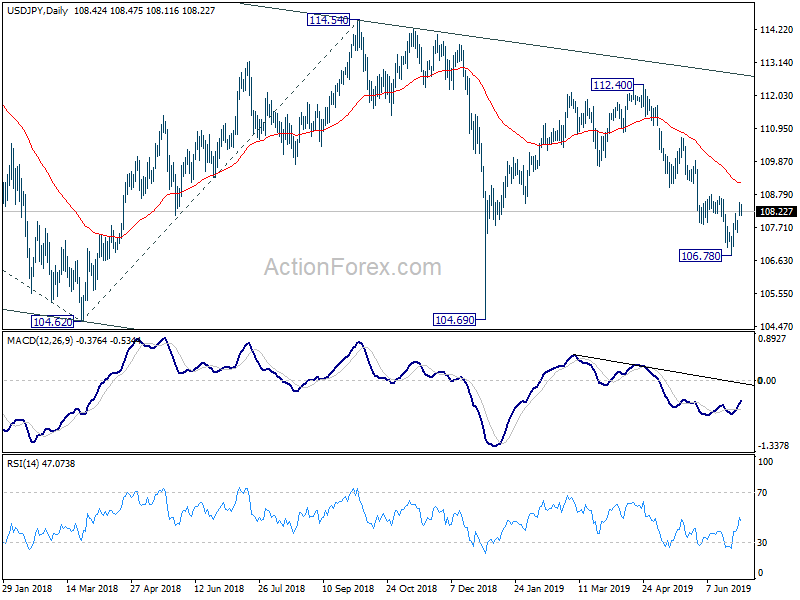
Intraday bias in USD/JPY remains neutral at this point. Considering bullish convergence condition in 4 hour MACD, sustained break of 108.80 will confirm short term bottoming at 106.78. In this case, stronger rise should be seen back to 110.67 resistance. On the other hand, rejection by 108.80, followed by break of 107.56 will retain near term bearishness. Intraday bias will be turned back to the downside for 106.78 support instead.
In the bigger picture, decline from 118.65 (Dec 2016) is still in progress, with the pair staying inside long term falling channel. Break of 104.62 will target 100% projection of 118.65 to 104.62 from 114.54 at 100.51. For now, we'd expect strong support above 98.97 (2016 low) to contain downside to bring rebound. In any case, break of 112.40 is needed to the first serious sign of medium term bullishness. Otherwise, further decline will remain in favor in case of rebound.
Sunset Market Commentary
Markets
The German Bund today oscillated near opening levels throughout the day with just one intraday market move worth mentioning. Reports suggested that ECB policy makers are in no rush to provide additional monetary support as soon as July. The downleg in the Bund disappeared as fast as it emerged however. German yields are virtually unchanged vs. opening levels with longer maturities hovering near the all-time lows. Peripheral spreads again narrow significantly as the ongoing search for yield is pushing investors towards riskier assets. Italy and Greece (both -10 bps) outperform. Italian BTP’s might have also found support in the government’s pledge to reduce the budget deficit to 2.04% and avoid EU penalties by doing so. US Treasuries retraced the majority of yesterday’s gains as investors’ eyes gradually turn to tomorrow’s (ADP, non-manufacturing ISM) and Friday’s (payrolls) key data. Will they nudge the Fed to a July rate cut? The US yield curve shifts south with yield changes varying from -1.2 bps (2-yr) to -1.6 bps (10-yr).
Global (FX) markets found a short-term equilibrium today as Saturday’s meeting between presidents Trump and Xi (and the G20 meeting) was more or less discounted and as there were few eco data in EMU and in the US. Yesterday, EUR/USD dropped below the 1.13 big figure both on USD strength (higher yields) and euro softness (poor data & political uncertainty, including on the nomination of the next ECB president). Overnight, EUR/USD touched a ST correction low in the 1.1275 area as the US extended a list of goods that might be hit with retaliatory tariffs. However, there were no follow-through losses. EUR/USD bottomed. The pair even rebounded (temporarily?) north of 1.13 on rumours that the ECB was in no hurry to ease policy already at the July meeting. Trading in the US this afternoon remains order-driven with no obvious guidance from bonds or equity markets. Investors await key US eco data tomorrow (ADP, ISM) and on Friday (US payrolls). US yields holding near recent lows indicate that markets expect to case for substantial Fed easing to remain in place, capping further USD gains. USD/JPY is trading in the 108.15 area. EUR/USD hovers near 1.13.
Sterling trading was also technical in nature, with EUR/GBP holding a rather tight range, roughly between 0.8920/70. The news flow, if any, probably didn’t help investors to turn more positive on the UK currency. The UK construction PMI unexpectedly tumbled from 48.6 to 43.1, the lowest level since 2009. UK PM candidate Jeremy Hunt said that a Brexit deal is impossible with current backstop procedure on the Irish boarder. This ‘commitment‘ only illustrates that any new talks with the EU later this year will be very difficult. Sterling declined temporarily after the construction PMI, but returned to the mid 0.89 area. Cable is changing hands in the 1.2630 area.
News Headlines
France, the UK and Germany won’t resort to the dispute mechanism incorporated in the 2015 nuclear deal with Iran after the latter said it exceeded the permitted stock limit of low-enriched uranium. A European diplomat said they first want to defuse the crisis.
Current head of the IMF Christine Lagarde is the latest candidate that is suggested to be the next president of the ECB as European leaders are trying to find a way to break the succession stalemate. Germany’s defense minister von der Leyen is currently the frontrunner to become the EC’s leader after CEE countries and the EPP rebuffed Dutch socialist Timmermans.
WTI Oil Outlook: Oil Price Eases But Remains Within Four-Day Congestion that Limits Downside Risk
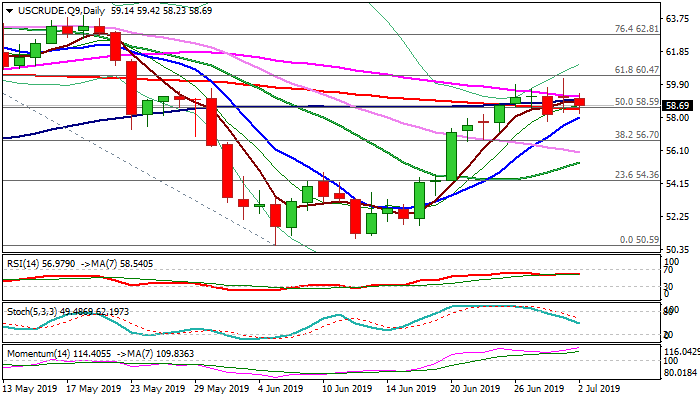
WTI oil eases on Tuesday after four consecutive failures to close above falling 55DMA and Monday's rejection at $60.27 (five-week high), followed by close below cracked psychological $60 barrier. Strong bullish momentum still exists, but bulls show signs of stall on four-day congestion and repeated upside rejections. Other studies are mixed and lack clearer direction signal, with fundamentals taking control. Fresh weakness is driven by persisting concerns about global demand that offsets positive signals from ceasefire in US/China trade conflict and agreement between main oil producers, including OPEC and non-OPEC members to extend supply cut until March 2020, in attempts to stabilize oil market and push price higher, as well as falling US crude stocks. Fresh easing is probing below broken 200DMA ($58.48) and approaching pivotal supports at $57.98/75 (rising 10DMA / congestion floor), break of which would generate initial reversal signal and risk deeper pullback from new high at $60.27. Loss of $56.75 handle would risk extension towards next pivot and double-Fibo support at $56.71 (Fibo 38.2% of $50.96/$60.27 upleg / broken Fibo 38.2% of $66.58/$50.59 fall). Extended consolidation with bullish bias in play can be expected while the price holds above 10DMA, but eventual close above $60 barrier and extension above $60.47 (Fibo 61.8% of $66.58/$50.59) is needed to signal bullish continuation.
Res: 59.42; 60.00; 60.27; 60.47
Sup: 58.23; 57.98; 57.75; 56.71
AUD/USD Mid-Day Outlook
Daily Pivots: (S1) 0.6937; (P) 0.6984; (R1) 0.7012; More...
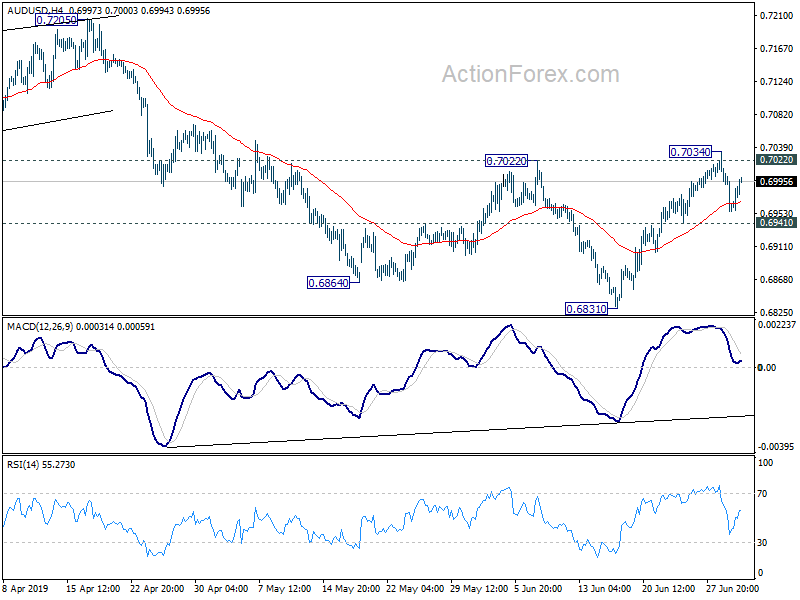
AUD/USD recovered ahead of 0.6941 support but stays below 0.7034 temporary top. Intraday bias remains neutral first and outlook is unchanged. We're still viewing the rebound from 0.6831 as a correction. And, upside should be limited by 0.7022 resistance. On the downside, break of 0.6941 minor support will turn bias back to the downside for retesting 0.6831 low. However, firm break of 0.7022 will indicate near term bullish reversal and turn outlook bullish for 0.7205 resistance next.
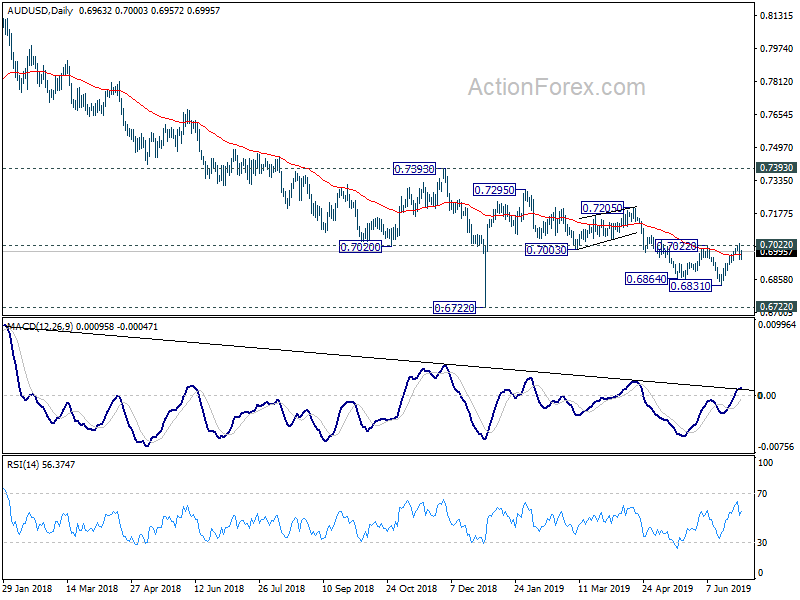
In the bigger picture, with 0.7393 key resistance intact, medium term outlook remains bearish. The decline from 0.8135 (2018 high) is seen as resuming long term down trend from 1.1079 (2011 high). Decisive break of 0.6826 (2016 low) will confirm this bearish view and resume the down trend to 0.6008 (2008 low). However, firm break of 0.7393 will argue that fall from 0.8135 has completed. And corrective pattern from 0.6826 has started the third leg, targeting 0.8135 again.
Aussie Talked Up by RBA Lowe after Rate Cut, Yen Rises as German Yield Hits Record Low
Australian Dollar is trading as the strongest one for today in spite of RBA's second consecutive rate cut. Additionally buying is seen after RBA Governor Philip Lowe talked about four positive developments that could help the economy in a speech. Though, the Aussie is held in range against Dollar for now and there is no indicate of larger rise resumption yet. For Now, Yen is following as the second strongest, partly thanks to falling major treasury yields again. In particular, German 10-year bund yield hits another record on as EU is preparing for tariff escalations by US.
On the other hand, New Zealand Dollar is the weakest, one, followed by New Zealand Dollar. Sterling is the third weakest after shockingly poor construction PMI. Dollar is mixed for today but remains the strongest one for the week. Resumption of trade talk with China remains a Dollar supportive factor, as well as yesterday's ISM Manufacturing. Though, the greenback will still need to face tests from ISM Services as well as Non-Farm Payrolls later in the week. These data will be crucial for Fed to decide if an insurance rate cut is needed this month.
In US, stocks open mildly lower today with DOW currently down -0.23%. S&P 500 is down -0.09%. NASDAQ is down -0.12%. 10-year yield is down -0.0139 at 2.013. In Europe, FTSE is up 0.43%. DAX is down -0.07%. CAC is up 0.02%. German 10-year yield is down -0.0048 at -0.359. Earlier in Asia, Nikkei rose 0.11%. Hong Kong HSI rose 1.17%. China Shanghai SSE dropped -0.03%. Singapore Strait Times dropped -0.04%. Japan 10-year JGB yield rose 0.0038 to -0.143.
UK PMI construction dropped to 43.1, worst contraction over a decade
UK PMI Construction dropped sharply to 43.1 in June, down from 48.6 and missed expectation of 49.2. It's also the worst contraction since April 209. Markit noted that business activity declined for second month running. There was sharpest drop in house building for three years. And, new orders shrank as political uncertainty hits client confidence.
Tim Moore, Associate Director at IHS Markit, said: "The latest survey reveals weakness across the board for the UK construction sector, with house building, commercial work and civil engineering activity all falling sharply in June. Delays to new projects in response to deepening political and economic uncertainty were the main reasons cited by construction companies for the fastest drop in total construction output since April 2009. While the scale of the downturn is in no way comparable that seen during the global financial crisis, the abrupt loss of momentum in 2019 has been the worst experienced across the sector for a decade.
German retail sales dropped -0.6% mom in May
German retail sales dropped -0.6% mom in May, well below expectation of 0.5% mom. Compared with 2018, for the first fives months of the year, retail sales rose 2.8% in real terms. The weak data dampened hope that domestic demand could offset the drag from global trade on the export-led economy. Euro is steady after the release. But German 10-year bund yield is extending recent record run, hitting as low as -0.364 so far today.
Eurozone PPI came in at -0.1% mom, 1.6% yoy in May, versus expectation of 0.1% mom, 1.8% yoy. In April, PPI was at -0.3% mom, 2.6% yoy. Comparing by main industry grouping, PPI dropped -0.6% mom in energy sector and by -0.1% mom in intermediate goods. PPI rose 0.1% mom in capital goods and durable consumer goods, and by 0.2% in non-durable consumer goods. Prices in total industry excluding energy was flat.
USTR proposes tariffs on additional USD 4B of EU products
Just days after agreeing to stop tariff escalation with China, US is now turning to EU. Yesterday, US Trade Representative proposed tariffs on additional EU imports, as countermeasures to harm caused by EU aircraft subsidies. A "supplemental list" of 89 subheadings with approximate trade value of USD 4B was proposed. The list includes olives, Italian cheese and Scotch whiskey, etc.
That's additional to the USD 21B in EU imports published on April 12. A hearing will be held on the proposed additional products on August 5. But US could immediately impose increased duties on the products included in the initial list, if the WTO arbitrator issues a decision before the public comment period ends.
SNB Zurbruegg: Will stick to boring expansionary policy
SNB Deputy Chairman Fritz Zurbruegg said the central bank will stick to the boring expansionary monetary policy today.
He said, "we are boring and are sticking to our expansionary monetary stance." He reiterated "we speak of negative interest rates and a readiness to intervene in the foreign exchange markets." And he emphasized "we have flexibility and room to manoeuvre on both core instruments. We are absolutely convinced we can use these tools and will continue to do so."
Also Zurbruegg he noticed that international developments are having strongest influences on the Franc exchange rate. However, "it is not a given that we have to react to each and every development."
RBA Lowe talks four developments that will help the economy
Australian Dollar is apparently lifted by some positive comments by RBA Governor Philip Lowe in a speech. He noted that the two recent rate cuts, including today's, will "make an important contribution to putting us on a better path and winding back spare capacity". More importantly, he pointed out four developments that will help the economy.
Firstly, borrowing costs for almost all borrowers are now the lowest they have ever been. It's partly because of the RBA cuts and partly due to tighter credit spreads. Secondly, terms of trade have risen again, largely due to higher iron ore prices. And RBA expects a "solid upswing" in the resources sector. Thirdly, exchange rate has depreciated over the past couple of years. Fourthly, RBA expects stronger growth in household disposable income over the next couple of years, due to low and middle income tax offset.
Together with the downside risks, globally and domestically, "what all this means for us here in Australia is yet to be determined." Lowe reiterated "we will be closely monitoring how things evolve over coming months". And, "the Board is prepared to adjust interest rates again if needed".
Earlier today, RBA lowered the cash rate for a second consecutive month, by -25bps to 1.00%. Here are some suggested readings.
- RBA Cut Rates To A New Record Low Of 1pct
- RBA Lowers Policy Rate to Fresh Record Low of 1%
- RBA Delivers July Rate Cut
- (RBA) Statement by Philip Lowe, Governor: Monetary Policy Decision
AUD/USD Mid-Day Outlook
Daily Pivots: (S1) 0.6937; (P) 0.6984; (R1) 0.7012; More...
AUD/USD recovered ahead of 0.6941 support but stays below 0.7034 temporary top. Intraday bias remains neutral first and outlook is unchanged. We're still viewing the rebound from 0.6831 as a correction. And, upside should be limited by 0.7022 resistance. On the downside, break of 0.6941 minor support will turn bias back to the downside for retesting 0.6831 low. However, firm break of 0.7022 will indicate near term bullish reversal and turn outlook bullish for 0.7205 resistance next.
In the bigger picture, with 0.7393 key resistance intact, medium term outlook remains bearish. The decline from 0.8135 (2018 high) is seen as resuming long term down trend from 1.1079 (2011 high). Decisive break of 0.6826 (2016 low) will confirm this bearish view and resume the down trend to 0.6008 (2008 low). However, firm break of 0.7393 will argue that fall from 0.8135 has completed. And corrective pattern from 0.6826 has started the third leg, targeting 0.8135 again.
Economic Indicators Update
| GMT | Ccy | Events | Actual | Forecast | Previous | Revised |
|---|---|---|---|---|---|---|
| 22:45 | NZD | Building Permits M/M May | 13.20% | -7.90% | ||
| 23:50 | JPY | Monetary Base Y/Y Jun | 4.00% | 3.40% | 3.60% | |
| 04:30 | AUD | RBA Rate Decision | 1.00% | 1.00% | 1.25% | |
| 06:00 | EUR | German Retail Sales M/M May | -0.60% | 0.50% | -2.00% | -1.00% |
| 08:30 | GBP | Construction PMI Jun | 43.1 | 49.2 | 48.6 | |
| 09:00 | EUR | Eurozone PPI M/M May | -0.10% | 0.10% | -0.30% | |
| 09:00 | EUR | Eurozone PPI Y/Y May | 1.60% | 1.80% | 2.60% | |
| 13:30 | CAD | Manufacturing PMI Jun | 49.2 | 49.1 |
Aussie lifted as RBA Lowe talks four developments that will help the economy
Australian Dollar is apparently lifted by some positive comments by RBA Governor Philip Lowe in a speech. He noted that the two recent rate cuts, including today's, will "make an important contribution to putting us on a better path and winding back spare capacity". More importantly, he pointed out four developments that will help the economy.
Firstly, borrowing costs for almost all borrowers are now the lowest they have ever been. It's partly because of the RBA cuts and partly due to tighter credit spreads. Secondly, terms of trade have risen again, largely due to higher iron ore prices. And RBA expects a "solid upswing" in the resources sector. Thirdly, exchange rate has depreciated over the past couple of years. Fourthly, RBA expects stronger growth in household disposable income over the next couple of years, due to low and middle income tax offset.
Together with the downside risks, globally and domestically, "what all this means for us here in Australia is yet to be determined." Lowe reiterated "we will be closely monitoring how things evolve over coming months". And, "the Board is prepared to adjust interest rates again if needed".
SNB Zurbruegg: Will stick to boring expansionary policy
SNB Deputy Chairman Fritz Zurbruegg said the central bank will stick to the boring expansionary monetary policy today.
He said, "we are boring and are sticking to our expansionary monetary stance." He reiterated "we speak of negative interest rates and a readiness to intervene in the foreign exchange markets." And he emphasized "we have flexibility and room to manoeuvre on both core instruments. We are absolutely convinced we can use these tools and will continue to do so."
Also Zurbruegg he noticed that international developments are having strongest influences on the Franc exchange rate. However, "it is not a given that we have to react to each and every development."
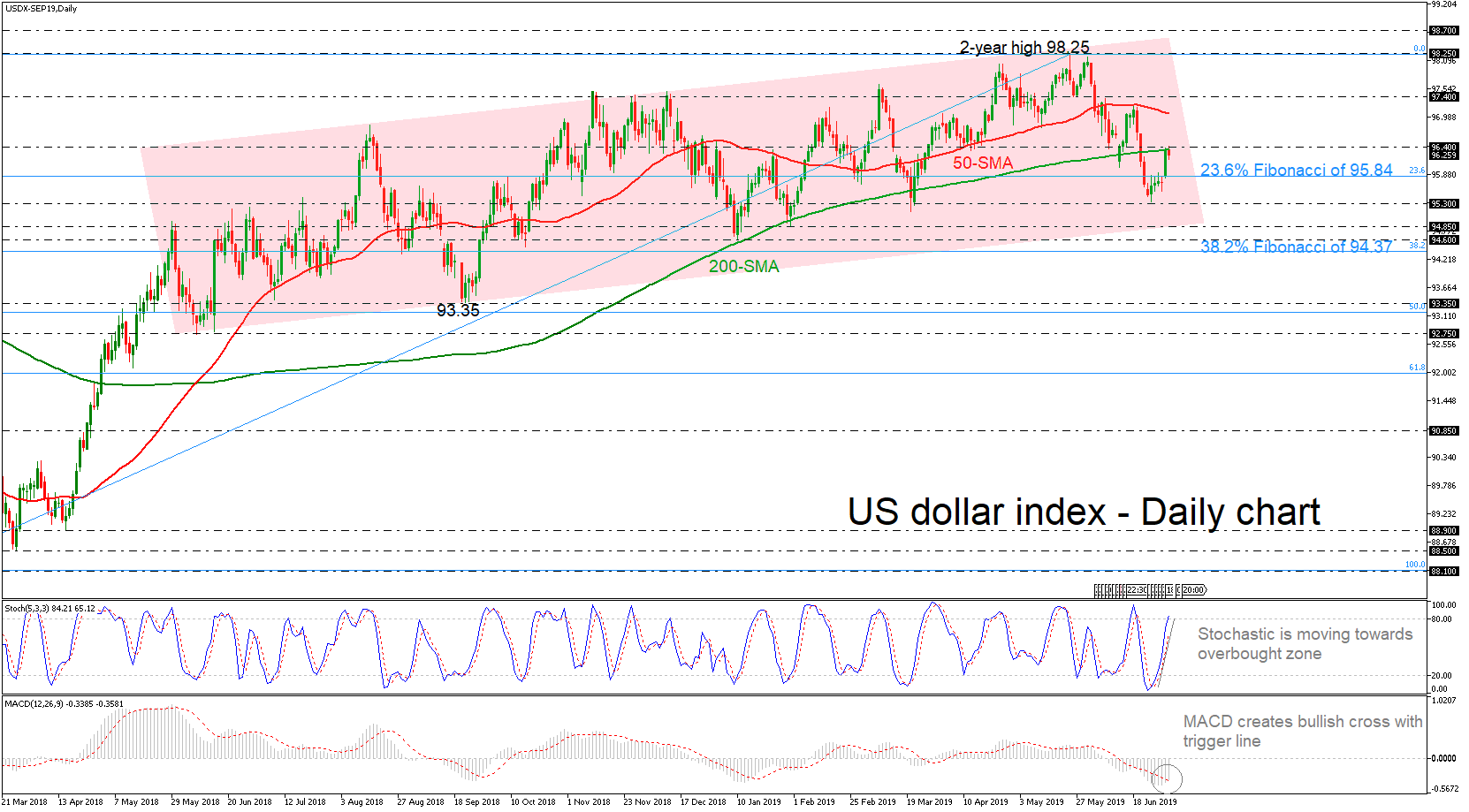
US Dollar Index Struggles Below 200-SMA; Long-Term Upward Channel Intact
The US dollar index has gained some remarkable ground after the climb above the 23.6% Fibonacci retracement level of the upward movement from 88.10 to 98.25 near 95.84. Currently, the index is failing to surpass the 200-day simple moving average (SMA), which coincides with the 96.40 resistance, flirting with a possible drop.
However, the stochastic oscillator is fluctuating in the overbought mark and the MACD is recording a bullish crossover with its trigger line in the negative zone.
Should the price stretch north and clear the 96.40 resistance, the 50-day SMA could come in focus near 97.00. If the buying interest extends, attention could then turn to the 97.40 resistance barrier, taken from the minor high on June 6. A significant step higher, could drive dollar index until the two-year high of 98.25.
On the flipside, in case of a failed attempt to clear the 200-SMA, prices would test the 23.6% Fibo (95.84) and then the 95.30 support level. If traders continue to sell the index, the price could decline until the 94.85 low, taken from the trough on January 31.
In the long-term, the market retains the bullish structure as it has been trading within an upward sloping channel since June 2016 but in the short-term, traders need to wait for a jump above the 50-SMA for positive orders again.
XAU/USD Analysis: Pressured By Moving Averages
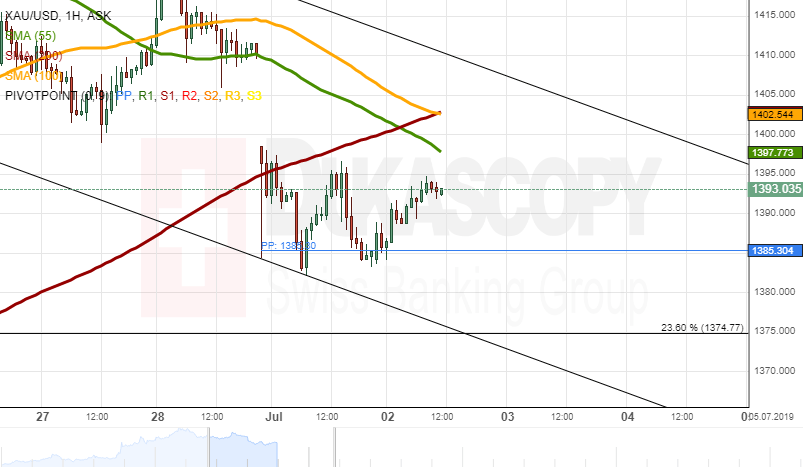
During the previous trading session, the XAU/USD exchange rate traded sideways around the 1,390.00, supported by the monthly PP at 1,385.30. During today's morning, the rate reversed north from the given support.
It is expected, that bulls could prevail in the market in the nearest future. However, note, that the rate has to surpass the 55-, 100– and 200-hour SMAs, currently located circa the 1,400.00 mark.
If the given moving averages hold, it is likely, that the gold could continue to trade sideways against the US Dollar.
It is unlikely, that the price for gold could tumble lower than 1,374.77 mark due to the support of the Fibonacci 23.60% retracement.