

Sample Category Title
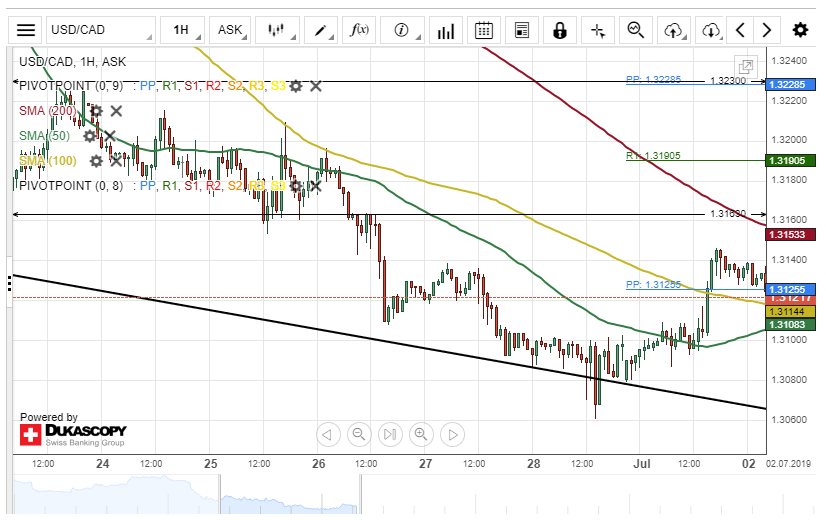
USD/CAD Support By 50– And 100-Hour SMAs
The US Dollar gained momentum against the Canadian Dollar on Monday. The USD/CAD currency pair appreciated about 60 base points at the end of yesterday's trading session.
A support cluster formed by the 50– and 100-hour SMAs at 1.3107 was providing support for the exchange rate on Tuesday morning.
If this cluster holds, a surge towards the weekly R1 at 1.3190 could be expected during the following trading session.
However, if the pair passes the SMAs, bears could drag the currency exchange rate further south today.
EURUSD Holding Support
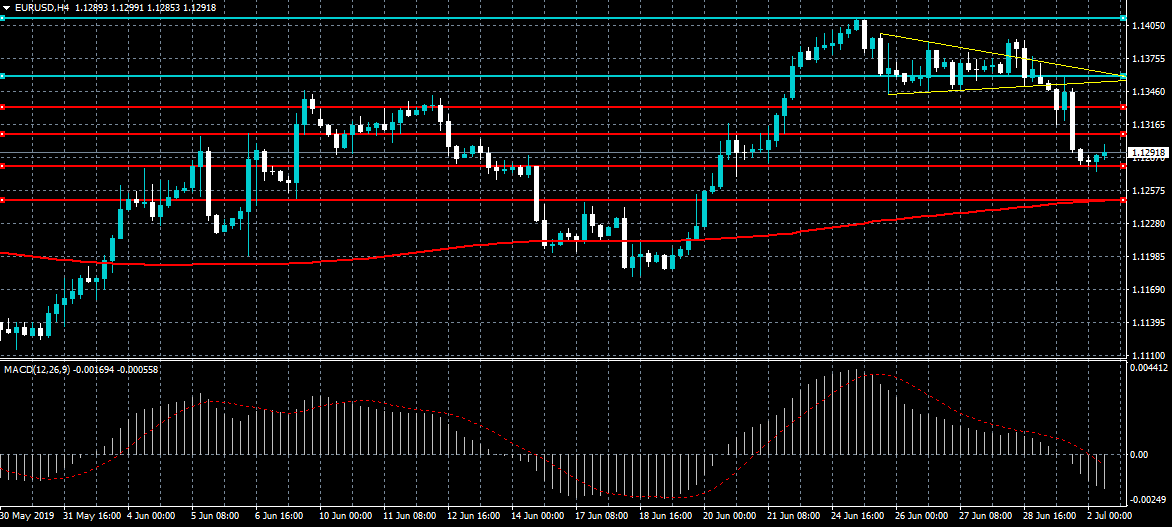
The euro currency has held above major support against the greenback during the European trading session as the US dollar has so far failed to build on Monday’s strong gains. EURUSD bulls need to stabilize the pair back above the 1.1321 level to help improve intraday sentiment. The upcoming announcement of the next ECB President may also have some impact on the EURUSD pair.
The EURUSD pair is only bullish while trading above the 1.1321 level, key technical resistance is found at the 1.1355 and 1.1400 levels.
If the EURUSD pair trades below the 1.1321 level, key support is found at the 1.1280 and 1.1255 levels.
GBPUSD 1.2610 Critical Support
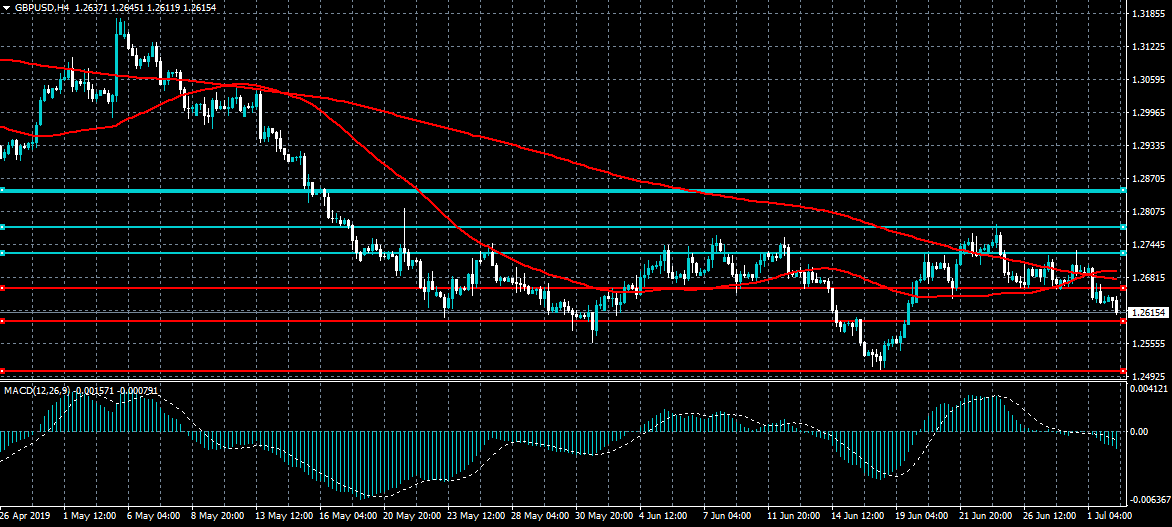
The British pound has continued to move lower against the US dollar during the European trading session, with the pair approaching the critical 1.2610 level. Bulls may look to enter around the 1.2610 level for a better risk-reward entry, while sellers will try to breach this level for an even deeper drop towards the 1.2520 level. The bullish inverted head and shoulders pattern on the four-hour time frame is also back in focus.
The GBPUSD pair is heavily bearish while trading below the 1.2660 level, key support is found at the 1.2610 and 1.2520 levels.
GBPUSD pair is only bullish while trading above the 1.2660 level, key resistance is found at the 1.2710 and 1.2730 levels.
The US Dollar Is In The Green. Growth Potential Is Still High
The US dollar rose significantly against a basket of major currencies after the meeting between the US President Donald Trump and Chinese President Xi Jinping at the G20 summit in Japan. The US dollar index (#DX) closed in the positive zone (+0.78%). Donald Trump said that US-China trade talks have already begun. The US President said that this deal should be more beneficial for the United States than for China since China had a big advantage for many years. Trump also noted that the biggest deal in history, not only in trade, could be concluded between the United States and China.
Optimistic economic data also supported the US currency. So, ISM manufacturing PMI was published yesterday, which counted to 51.7 in June and was higher than the forecasted value of 51.0.
Yesterday, weak economic data from the Eurozone and the UK were published. Thus, German manufacturing PMI fell to 45.0 in June and was worse than the expected value of 45.4. The number of unemployed in Germany decreased by 1K in June instead of 3K. The index of economic activity in the UK manufacturing sector fell to 48.0 in June, while experts forecasted 49.2.
Today, during the Asian trading session, the Reserve Bank of Australia has decided on a key interest rate. As expected, the regulator lowered the key interest rate by 25 basis points to 1.00%.
The "black gold" prices are declining after growth the day before. At the moment, futures for the WTI crude oil are testing the mark of $58.90 per barrel. At 23:30 (GMT+3:00) API weekly crude oil stock will be published.
Market Indicators
- Yesterday, the bullish sentiment was observed in the US stock market: #SPY (+0.91%), #DIA (+0.42%), #QQQ (+1.35%).
- The 10-year US government bonds yield is consolidating. At the moment, the indicator is at the level of 2.00-2.01%.
The News Feed on 2019.07.02:
- The index of economic activity in the UK construction sector at 11:30 (GMT+3:00).
- We also recommend paying attention to the speech by the Bank of England Governor Carney.
Solid Manufacturing Spotlight Back On Fed
A surprisingly solid ISM manufacturing index presented traders with a looming conundrum on Monday. The US dollar was the top performer on the first trading day of the month. Today, GBP is down across the board on weaker than expected construction figures. The focus now shifts to the Fed's John Williams speech on Tuesday. A new trade has been issued on Monday with 3 supporting charts and notes.
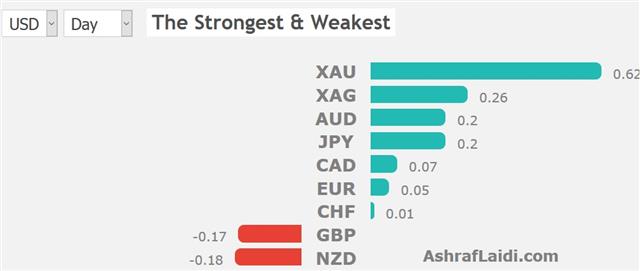
A series of poor regional numbers failed to predict the national manufacturing survey from the ISM on Monday. It was at 51.7 compared to 51.0 expected. The contraction in the prices paid component may provide luster for the doves. The commentary suggested the Mexican trade kerfuffle at the start of the month weighed and that's something that's since been reversed. The better China news will also add a lift this month.
The US dollar was higher ahead of the data but continued to strengthen after it. Nonetheless, equity markets gave back some gains after the data. The issue for risk trades is that if the good news mounts, it will change the plan of attack for the Fed. It already appears wholly unlikely the Fed will cut by 50 basis points at the end of the month, despite the market pricing in a 15% chance of it.
More importantly is the message from the Fed speakers in the weeks to come ahead of the Jul 31st decision and later in the year. In the day ahead we will hear from Williams and Mester, both of whom are scheduled to talk about the economy. Will they refer to an insurance cut, or will receding uncertainty keep the bid under the US dollar. A detailed analysis about the Fed was issued in Monday's Premium trade.
Looking at July more broadly, the seasonal trend over the past decade has been US dollar weakness, particularly against the yen and commodity currencies. It's also the best month for the S&P 500 and FTSE 100.
Euro Hits Lows On German Data Miss
Retail sales fail to rebound
German retail sales failed to match expectations of a 0.5% rebound on a month-by-month basis in May and instead declined for the third month in a row. Sales fell 0.6% m/m, below forecasts of a 0.5% rebound but were still better than April’s 2.0% drop. EUR/USD slid to the lowest level since June 20 but has since rebounded to 1.1291.
RBA cuts as expected
The Reserve Bank of Australia cut its benchmark rate by 25bps for the second consecutive meeting today, confirming expectations of the majority of analysts. The central bank stated that the moved was intended to reduce unemployment and promote economic growth, while inflation remains in a benign environment. Having held rates unchanged for more than two years, and often hinting that the next move could be a hike, the RBA has cut rates to record levels for the past two meetings.
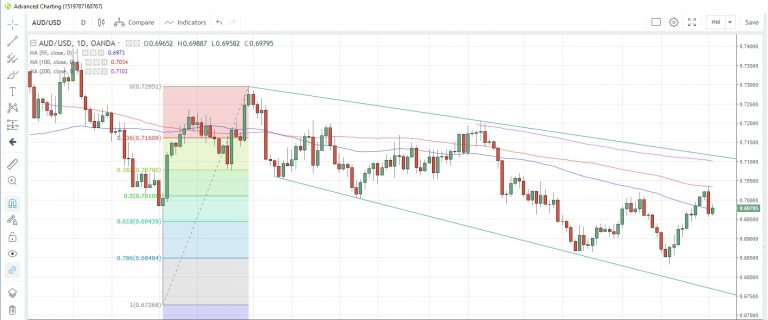
AUD/USD fell to an intraday low of 0.6958 in a knee-jerk reaction but failed to make it past yesterday’s 0.6956 low, and a technical rebound ensued. The RBA stated it “will continue to monitor developments in the labour market closely and adjust monetary policy if needed to support sustainable growth in the economy and the achievement of the inflation target over time”. The FX pair is now at 0.6983, marginally higher than pre-decision.
AUD/USD Daily Chart
Central Bank speakers on tap
Hot on the heels of the RBA’s rate cut, Governor Lowe is scheduled to speak at 0930GMT and is quickly followed by the Fed’s Williams at 1035GMT. On the data front, most releases are second tier, with the US Redbook index and Canada’s Markit manufacturing PMI the main events schgeduled. Bank of England’s Carney will round off today’s session.
EUR Optimism Subdued, RBA Cuts Rate
EUR optimism subdued amid trade, impasse on EU executive positions
Over a month has passed since European Parliament successors have been elected while newly elected 28 national leaders from Europe Commission, which already gathered three times this year to elect their President, could not come up with a final decision so far, an unusual case which confirms that EU Parliament is set for further deadlocks along the way. Four additional functions including ECB and EU Parliament presidents, head of European Council and top EU diplomats positions remain. Meanwhile, the US administration appears willing to pressure the EU by imposing tariffs on EU products, which would target a total of up to $25 billion from current list initiated in April amid continued disagreement on aerospace government funding. On a side note, Italian government appears willing to comply with EU Commission 2.04% GDP deficit target in order to avoid a multi-billion fine from the EU. An assessment by the Commission in order to decide whether disciplinary action should be implemented should take place this week.
Recent headlines should therefore turn negative for the single currency. We expect EUR/USD to head along 1.1275 short-term.
RBA cut preps AUD for rally
The Reserve Bank of Australia (RBA) reduced its official Cash rate (OCR) by 25bp taking the policy rate down to a low of 1.00%. Expectations for the move were balanced as Governor Lowe was worried about labor market developments, soft consumption, weak inflation outlook, and macro headwinds. The accompanying statement left the door open for additional easing “if needed”. The dovish statement suggest the status of labor markets (spillover into household consumption) will be critical in the direction of policy rates. Interestingly, pricing of a rate cut in the coming month fell rapidly after the statement. We suspect that a majority of downside global growth risk is already priced in indicating that its unlikely further easing is necessary. The RBA is likely to pause to allow for the transmission of policy to work through the broader economy. Despite the hype of potential QE we doubt that is really on the table baring an extreme idiosyncratic event. The minutes of today’s meeting will be released on 16th July providing further insight into the board's mindset. Relative AU-US real yields differential and AUDUSD are constantly correlated. We are now constructive on AUDUSD as Australian rates have seemingly hit bottom and positioning in AUD is overly short. AUDUSD is still facing solid resistance at 0.7036 (100d MA), the break should trigger extension of bullish rally to 0.7201.
AUD/USD: Uptrend Continuation Above 0.6960
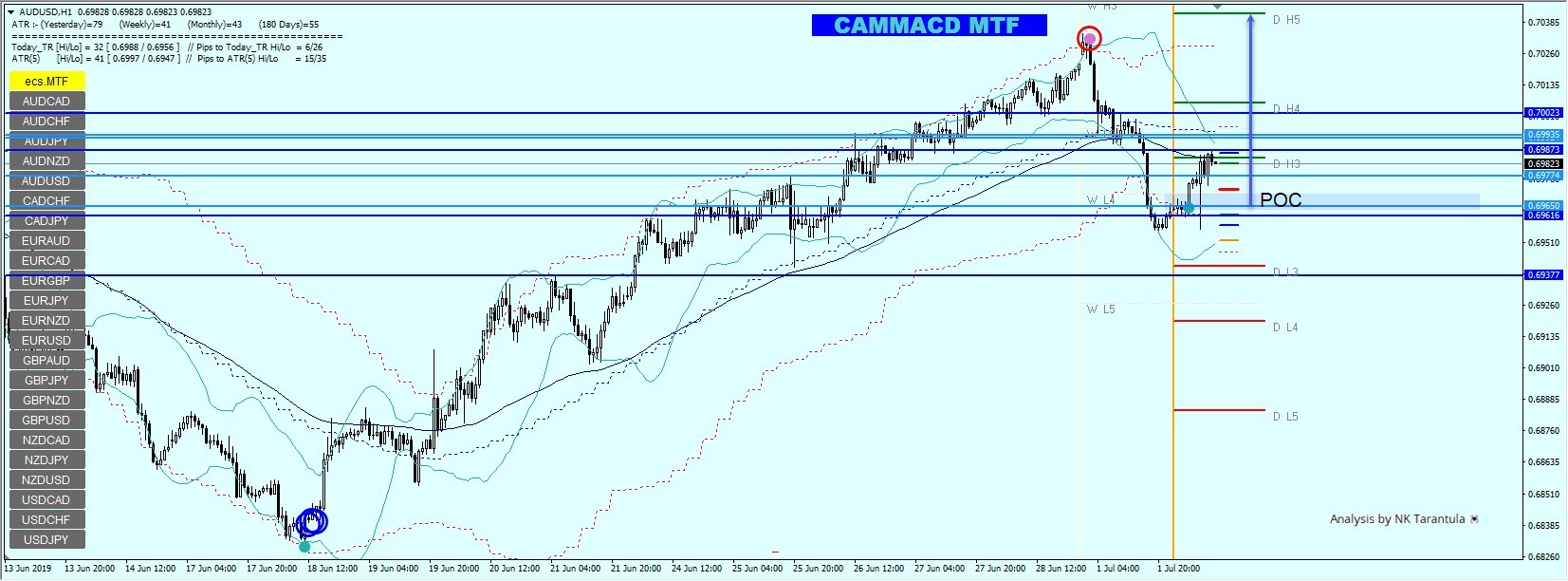
The AUD/USD retracement could be over and the pair is having another bullish momentum towards upper targets.
As the G20 meetings came to a conclusion, we saw OPEC extend their output caps for a further 9 months which has stabilised the Oil prices. Bond yields in the USA suggest a rate cut, or potentially 2 rate cuts in the next year or so, this has all led to a flight of money into risky assets again. The RBA in Australia today cut their central bank rates further by another 25bps which only adds to further flight to stock markets. Despite this, US Equities are a fraction below all time high's, so we could see profit taking in Equities, so beware of sudden risk-off. However, the AUD/USD is in a strong uptrend and the POC zone 0.6970-80 could make the price bounce. Targets are 0.7002 and 0.7040. As long as 0.6960 stays strong, the AUD/USD bulls have nothing to worry about.
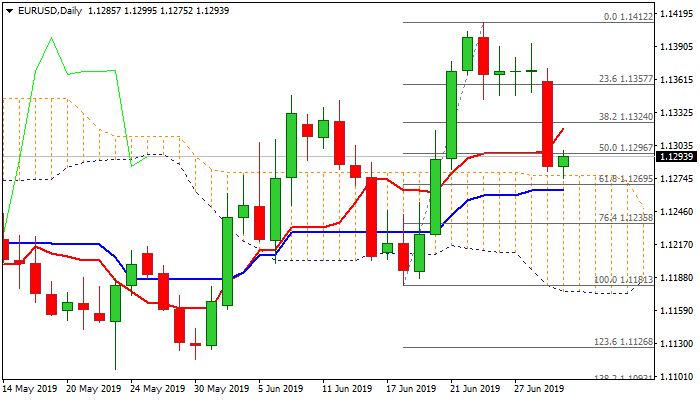
EUR/USD Outlook: Bears Are Taking A Breather Above Thick Daily Cloud
The Euro is consolidating above the top if thick daily cloud, which was cracked on today’s attempts to extend Monday’s strong fall (the pair was down 0.65% for the day).
Bears are taking a breather before fresh attempts lower as agreement between the US and China is creating negative environment for the EURUSD pair.
Firm break lower would expose strong supports at 1.1269 (Fibo 61.8% of 1.1181/1.1412) and 1.1260 (converged 100/30DMA’s), violation of which would risk further weakness.
Meanwhile, rising momentum and oversold stochastic suggest the pair may hold in extended consolidation, before bears resume.
Broken 20SMA (1.1299) caps consolidation for now, keeping immediate risk at the downside, however, extended upticks cannot be ruled out but should stay below broken 200DMA (1.1340) to keep bears in play.
Res: 1.1299, 1.1324, 1.1333, 1.1340
Sup: 1.1275, 1.1269, 1.1260, 1.1235
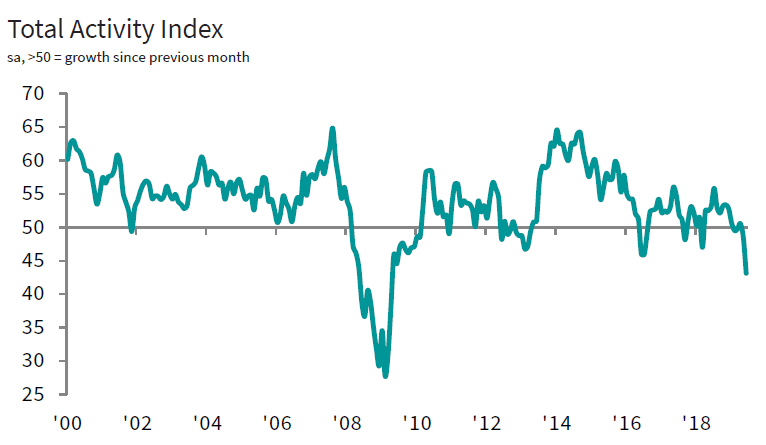
UK PMI construction dropped to 43.1, worst contraction over a decade
UK PMI Construction dropped sharply to 43.1 in June, down from 48.6 and missed expectation of 49.2. It's also the worst contraction since April 209. Markit noted that business activity declined for second month running. There was sharpest drop in house building for three years. And, new orders shrank as political uncertainty hits client confidence.
Tim Moore, Associate Director at IHS Markit, which compiles the survey:
"The latest survey reveals weakness across the board for the UK construction sector, with house building, commercial work and civil engineering activity all falling sharply in June. Delays to new projects in response to deepening political and economic uncertainty were the main reasons cited by construction companies for the fastest drop in total construction output since April 2009. While the scale of the downturn is in no way comparable that seen during the global financial crisis, the abrupt loss of momentum in 2019 has been the worst experienced across the sector for a decade.
"Greater risk aversion has now spread to the residential building sub-sector, as concerns about the near-term demand outlook contributed to a reduction in housing activity for the first time in 17 months.
"Construction companies reported a continued brake on commercial work from clients opting to postpone spending, with decisions on new projects often pending greater clarity about the path to Brexit. Latest data meanwhile indicated another sharp fall in civil engineering, which also reflected delayed projects and longer wait times for contract awards.
"Worrying signals from the survey's forward-looking indicators make it almost impossible to sugarcoat the Construction PMI data in June. In particular, new orders dropped to the largest extent for just over 10 years, while demand for construction products and materials fell at the sharpest pace since the start of 2010.
"A continued lack of new work to replace completed projects illustrates the degree of urgency required from policymakers to help restore confidence and support the long-term health of the construction supply chain."