Sample Category Title
EURUSD Bullish Breakout
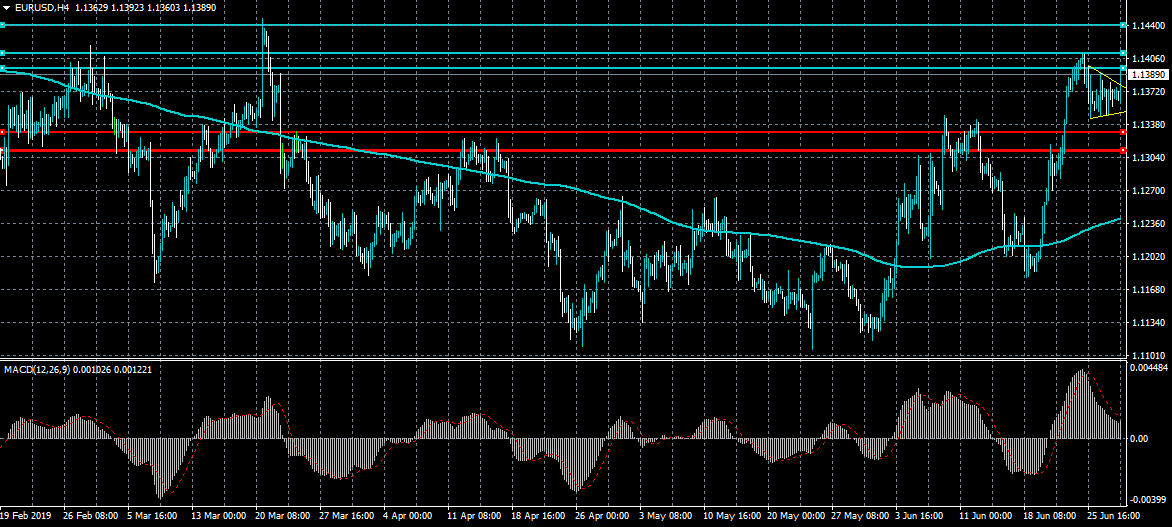
The euro has broken to the upside against the US dollar after moving above a well-defined wedge pattern the pair had been trapped in. EURUSD bulls need to break the 1.1400 level to further encourage technical buying towards at least the 1.1440 level. The release of data from the US economy later today and G20 news will be the main driver for the pair going into the weekend.
If the EURUSD pair trades above the 1.1400 level, key technical resistance is found at the 1.1440 and 1.1500 levels.
If the EURUSD pair trades below the 1.1380 level, key support is found at the 1.1360 and 1.1347 levels.
GBPCAD Posts 20-Month Low, Looks For A Rebound In Short-Term
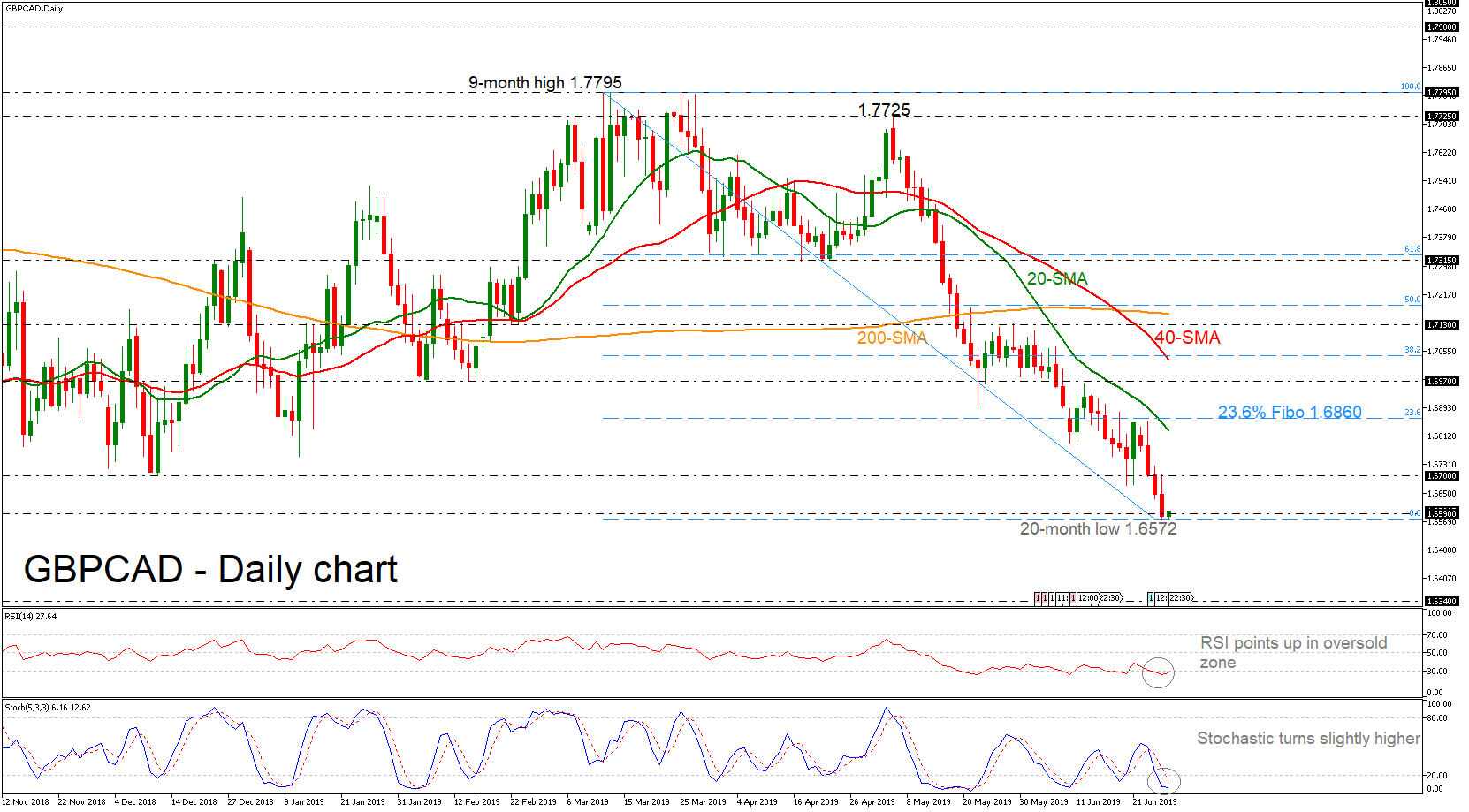
GBPCAD is currently trading not too far away from yesterday’s 20-month low of 1.6572, having pulled back marginally. The momentum indicators suggest that there is a potential for an upside correction. The RSI, which has been moving around its 30 level over the last month, is pointing up in the oversold area, while the stochastic oscillator is looking for a bullish cross below the 20 level.
If the price fails to hold today’s positive momentum, falling below the 1.6572 bottom, the 1.6340 support level, taken from the low on October 2017, could attract traders’ attention as there is no significant obstacle before that barrier.
On the other side, if the market continues recovery above 1.6590, resistance could next be detected around the December low of 1.6700. Should the price overcome this handle, the spotlight will shift to the 20-day simple moving average (SMA), currently at 1.6830, and the 23.6% Fibonacci mark of the downfall from 1.7795 to 1.6572, near 1.6860.
Overall, GBPCAD has been developing in a downtrend over the past two months and thus the view is still negative. There is a scope for an upside retracement in the short-term but only a daily close above the 200-SMA could shift the medium-term outlook to bullish.
Event Driven Weekend, EU And Switzerland Turn Their Backs
Event Driven Weekend
This weekend will be dominated by EU policy makers meeting in Brussels and representative of the G20 countries in Osaka. From a market standpoint, we are not widely interested in the into EU summit which will focus on complexity of personnel issues. Yet the potential successor of ECB president Draghi will have our attention. The probability of a Weidmann ECB presidency has increased significantly. The legacy of Mario Draghi will likely the total domination of the Governing Council. This control was encapsulated by the “Whatever it takes” speech and action which saved the EU monetary experiment in the summer for 2012. While Trichet had a strong hand, in most investors mind, Draghi is the ECB. It is logical to expect the factions in the Governing Council to crawl back some power as Draghi departs. Draghi’s ECB policy skew towards benefiting indebted peripheral nations (via loose monetary policy and delayed normalization), will likely be diluted. Weidmann will need to hear minor member who are worried about the threat of an extended period of negative interest rates into banking sector, pensions and savers, will now be heard. Barring a massive deterioration in economic outlook (ECB express real concern over the decline of market-based inflation expectations) unorthodox easing will be delayed. Should Weidmann get the nod, markets will expect less bond buying, supporting European yield curves and banking stocks. Yet with many moving pieces don’t expect a sharp correction. Especially considering it only speculation how the President of the Bundesbank will act when represented 19 members’ states of the European Union.
The ECB and Fed opening the door to rate cuts have seen bond yields in European and US drop meaningfully. Gold prices, however, have been the primary beneficiary to expectations of currency debasing. That said, policy uncertainty in ECB could reverse monetary policy safe-haven trades.
President Trump and Xi meet on Saturday on the sidelines of the G20 summit will likely have the broadest market impact. Unlike past meetings both domestic economies (prior weakness was isolated to China) have reported sharp deceleration. This rises expectations for a positive outcome (although a solid agreement is unlikely). Trump is now under significant pressure from constitutes to find a solution as negative consequences of the trade conflict mount. The US now risks structural shifts that could indeterminately damage agriculture and manufacturing sectors. Which in turn could spill over into the broader economy. The sharp downturn in consumer confidence indicates the trade war is having, at least, a psychological effect. While we don’t anticipate any breakthrough we suspect that Trump will take a moderate tone which will be risk positive Monday.
No faint hope game as EU and Switzerland turn their backs
It seems difficult to say, but it is a fact: Swiss Federal Councilor, Head of Foreign Affairs department, Ignazio Cassis, confirmed on Thursday that the EU has decided not to extend recognition of Swiss stock exchange, expiring on 30 June 2019. Yet unlike people consider, risks of a major decline in Swiss shares is rather limited. Swiss authorities “Plan B” should safeguard Swiss stock market from any abrupt decline in liquidity or downward pressure on prices. Indeed, the countermeasure implemented by Swiss authorities give EU investors the option to invest in Swiss shares directly by re-routing money flows through Swiss exchanges while a ban of Swiss registered multi-market securities in the EU is therefore implemented. EU sanctions have however no impact on multilateral trading facilities or systematic internalizer investment firms according to MiFid II.
Starting from July 2019, Swiss stock market should therefore remain safe and could even benefit from higher volumes short-term, at the benefit of Swiss brokers. However, the situation could worsen in the long-term, as the Swiss market could lose its shine due to persistent frictions with the EU, which would pose major obstacles to EU investors and asset managers in terms of investment horizon, adequacy and underlying risks. In addition, incentives to implement IPOs on the Swiss stock exchange would be reduced. The tough stance shown by the EU is therefore highly related to UK’s Brexit and the fact that it is not willing to send the wrong signal to its British counterparts. Following the headline, Swiss exchanges are facing a drop due to idiosyncratic risk, while the Swissie stays unaffected. June KOF economic barometer points to a drop of 0.2 points, pointing at 93.6 (prior: 93.8) as the goods producing sector and private consumption are declining while foreign demand shows positive signals.
EUR/CHF is trading at 1.11021 (-1.36% year-to-date), approaching 1.11150 short-term.
Anticipation Over Trump-Xi Meeting Keeps Markets On Tenterhooks
Asian stocks slipped as the G20 summit kicked off in Japan, bringing investors closer to the pivotal Trump-Xi meeting which should set the tone for US-China relations moving forward. The Dollar Index (DXY) remains steady, while the Japanese Yen and Gold are gaining at the time of writing, as markets continue playing it safe ahead of what could be a watershed event for global markets.
This weekend, markets will find out whether their hopes for a restoration in US-China trade talks will become reality, and whether the scope for further deterioration in bilateral relations would be significantly constrained. It remains to be seen whether the public displays of chest-thumping from both sides since May will eventually lead to handshakes and smiles on Saturday. Such a reconciliatory image out of the Trump-Xi meeting is expected to send relief signals coursing through the veins of the markets, potentially boosting global equities and emerging-market assets.
Still, the prudent investor would be well aware that the road ahead isn’t all plain sailing, given the tremendous gulf that still remains between both governments, with tit-for-tat tariffs still in place. As long as the prospects of more trade tariffs loom large over the horizon, risk aversion should continue having a major say on market sentiment.
Dollar remains doused with Fed dovishness
The Dollar Index (DXY) is struggling to lift itself off the psychological 96 support level, as the Greenback remains doused by the Fed’s dovish stance. The final-read on Q1 US GDP reported lower-than-expected consumer spending growth during the quarter, which suggests that US economic growth momentum is waning. Given the moderating economic indicators in Q2, a period when US-China tensions intensified, the data seems to justify the Federal Reserve’s openness to lowering US interest rates.
The prospects of looser US monetary policy are exerting downward pressure on the Greenback, and the subdued DXY performance is expected to continue as long as the Fed’s easing bias remains evident. The
headlines out of the Trump-Xi meeting may prove to be a major catalyst for the Dollar’s next move, with DXY potentially going on a tear if the door to a US-China trade deal is slammed shut this weekend.
Pound pressured by prospects of no-deal Brexit
GBPUSD is trading below the 1.27 level at the time of writing, after UK Prime Minister candidate, Boris Johnson, refused to rule out a no-deal Brexit. As long as a no-deal Brexit remains a possibility, that should keep the Pound below the psychological 1.30 mark against the US Dollar. Even though the UK leadership transition is set to be completed within the next month, Sterling is expected to remain exposed to political risks leading up to the October 31 Brexit deadline, as the UK continues to pursue its exit from the European Union.
GBP/USD Outlook: Extended Directionless Mode Looks For A Catalyst
Cable is holding within narrow range on Friday, showing mild reaction on UK data (Q1 GDP came in line with expectations / previous, while trade deficit widened significantly in Q1 but fell below expectations).
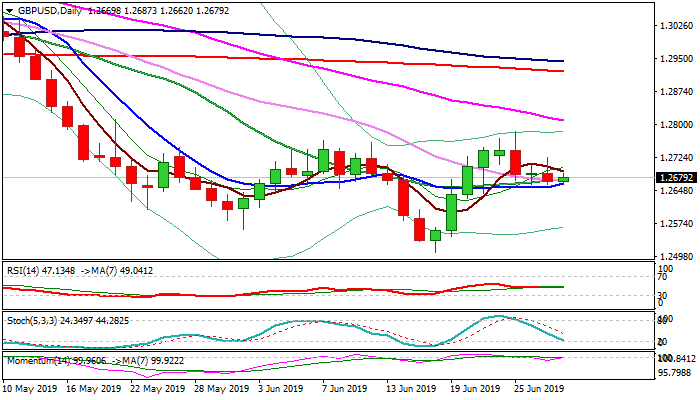
The action in past two days was directionless and holding between converging 10DMA (1.2663) and 5DMA (1.2692).
Fears of no-deal Brexit continue to weigh, but mixed studies on daily chart lack clearer direction signal.
Near-term action looks for a catalyst to break out of current congestion and generate initial direction signal.
Extension below 10DMA and converged flat daily Tenkan / Kijun-sen would increase downside risk. Conversely, lift above 5DMA would expose key barrier at 1.2763 (Fibo 38.2% of 1.3179/1.2505) for retest.
Res: 1.2691, 1.2724, 1.2763, 1.2783
Sup: 1.2663, 1.2644, 1.2611, 1.2571
Bitcoin Selling At A Discount
Bitcoin had another roller coaster week, it made a high of $14,000 approx and after touching that level, it dropped more than 1500 dollars in just a few minutes. It is trading at 11,608 at the time of writing this article. Nevertheless, the daily time frame and the weekly time frame are both strong, and it is highly likely that this bull run is going to continue as long as the price stays above the 50-day moving average on a daily time frame.
As for the intra-day price action, the price is challenging its downward trend line which is also near the 100-day moving average. What we do not want to see is the 50-day moving average, shown in pink, falling below the 100-day moving average. This would send a bearish signal. So, traders need to keep a close eye on the RSI, and as long as the RSI stays above the upward trend line, bulls still have chance to score more gains on a daily time frame.
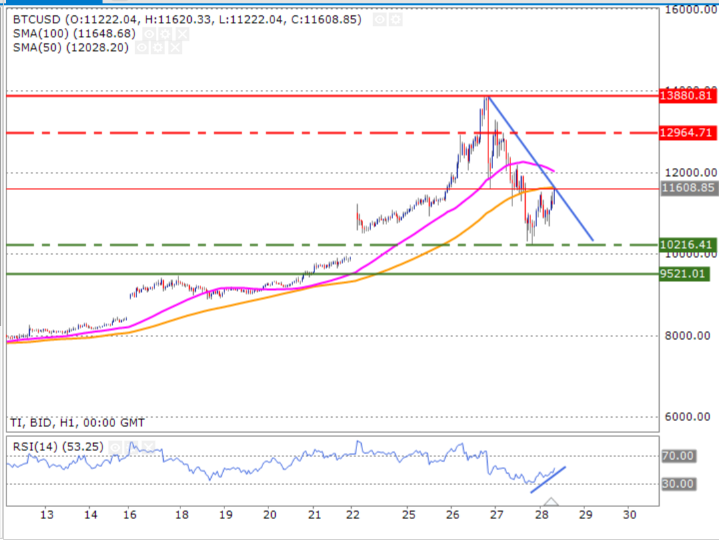
Minor support zone is shown in dotted green horizontal line.
Major support zone is shown in solid green horizontal line.
Minor resistance zone is shown in dotted red horizontal line.
Major resistance zone is shown in solid red horizontal line.
Eurozone CPI unchanged at 1.2%, but core CPI jumped to 1.1%
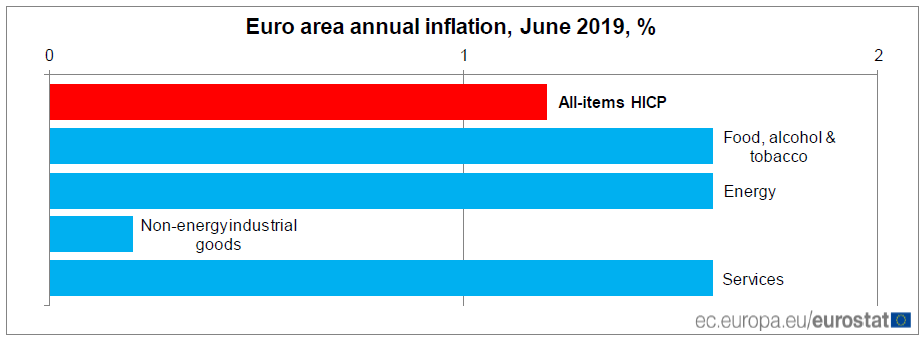
Eurozone CPI was unchanged at 1.2% yoy in June, matched expectations. However, CPI core accelerated to 1.1% yoy, up from 0.8% yoy and beat expectation of 0.9% yoy.
Looking at the main components of euro area inflation, 'food, alcohol & tobacco', 'energy' and 'services' are expected to have an annual rate of 1.6% in June. The annual rate of 'non-energy industrial goods' is expected to be 0.2%
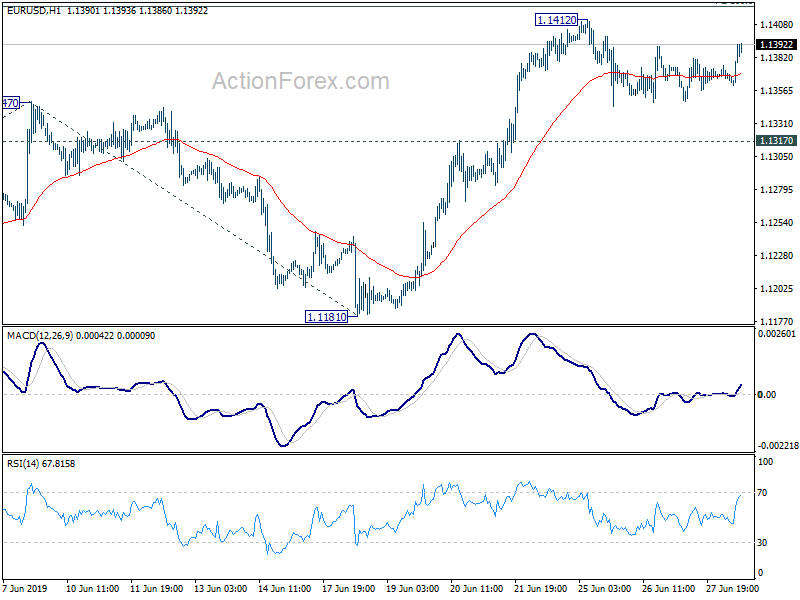
EUR/USD has little reaction to the release. For now, consolidation from 1.1412 is held well above 1.1317 minor support, keeping near term outlook bullish for another rally. Focus will stay on G20 summit in Japan, as well as US PCE inflation to be released later in the day.
AUD/USD Outlook: Bulls Pressure Key Resistance Zone But Risk Of Stall Exists
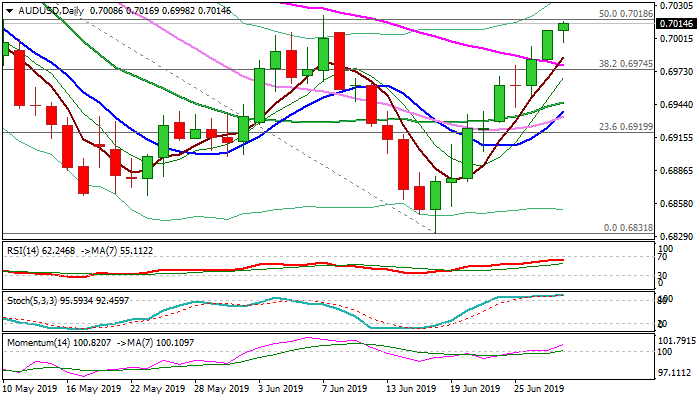
The Australian dollar extends advance above psychological 0.70 barrier on Friday, as bulls remain uninterrupted in expectations of a positive outcome of Trump / Xi meeting in G20 summit.
Bulls approach very strong resistance zone between 0.7022 and 0.7041, marked by 7 June high / daily cloud top / 100DMA and the base of thick falling weekly cloud.
The pair is on track for the second straight bullish week that provides additional positive signal, but needs clear break above these barriers to signal stronger recovery.
Caution on possible stall at this area (as strongly overbought stochastic adds to the strength of barriers) that would weaken near-term structure and risk fresh bearish acceleration.
Res: 0.7022, 0.7035, 0.7041, 0.7068
Sup: 0.7000, 0.6985, 0.6978, 0.6976
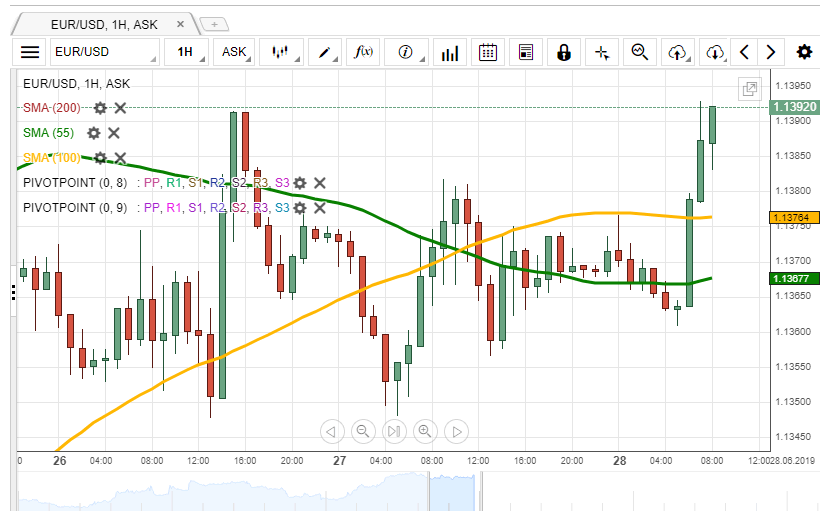
EUR/USD Supported By 55– And 100-Hour SMAs
During the previous trading session, the EUR/USD currency pair continue to trade sideways around the psychological level at 1.1370.
Note, that the pair is supported by the 55– and 100-hour SMAs, currently located at 1.1368 and 1.1376 respectively. Thus, some upside potential could prevail in the market, and the pair could target the monthly R3 at 1.1410.
However, note, that the market participants are focused on G20 summit today. Thus, the exchange rate could continue to trade sideways, supported by the given moving averages.
It is unlikely, that the rate could drop lower than the 1.1337 mark due to the support of the monthly R2.
GBP/USD Squeezed By Moving Averages
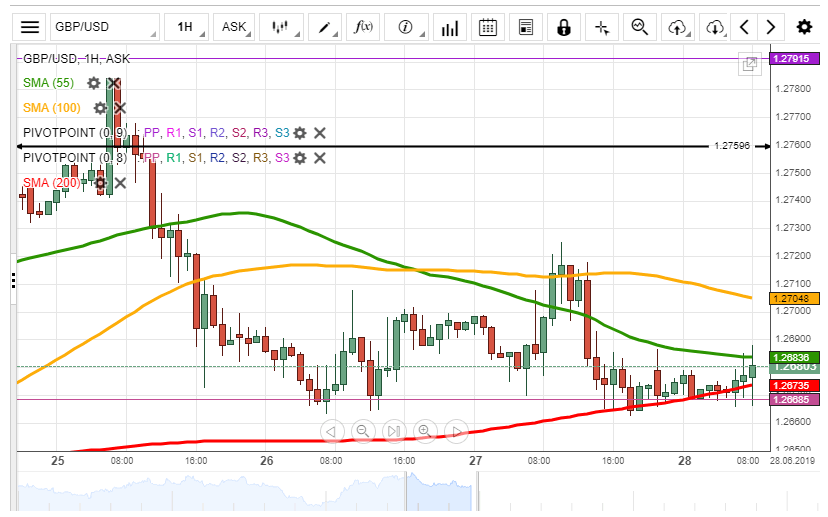
Yesterday, the GBP/USD exchange rate traded sideways, trying to surpass the support level formed by the weekly PP and the 200-hour SMA at 1.2669.
If the given support level holds, it is expected, that the rate could reverse north. However, note, that the currency pair would have to surpass the resistance formed by the 55– and 100-hour SMAs, currently located at 1.2684 and 1.2705 respectively.
If the given support level does not hold, it is likely, that bears could prevail in the market, and the pair could decline to the psychological level located at the 1.2640 mark.